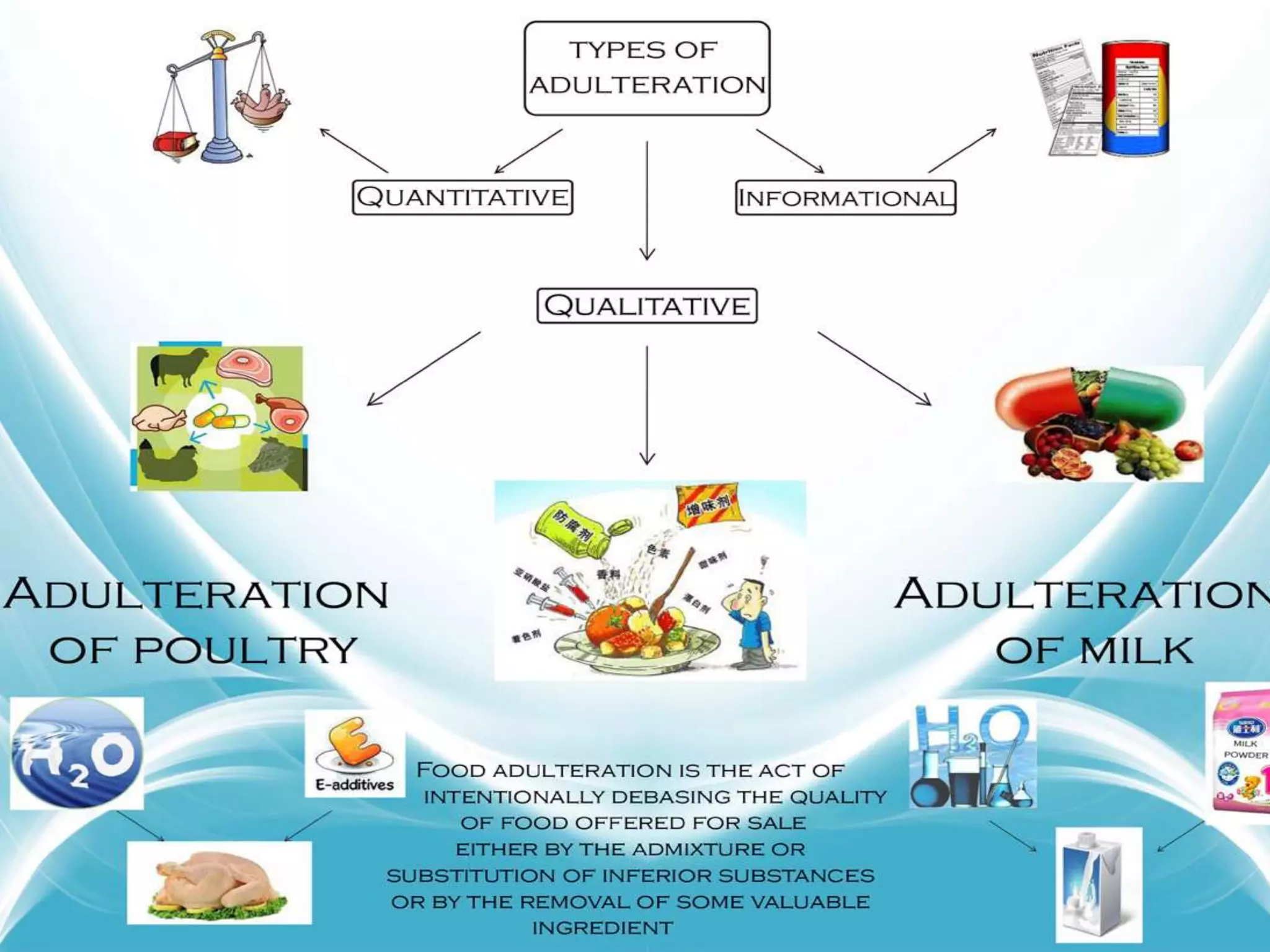
FOOD ADULTERATION
By:
Meesha Singh
What is Adulteration?
• An adulterant is a chemical substance which
should not be contained within other substances (e.g. food,
beverages, and fuels) for legal or other reasons.
• The addition of adulterants is called adulteration.
• The word is appropriate only when the additions are unwanted
by the recipient. Otherwise the expression would be food
additive. Adulterants when used in illicit drugs are called
cutting agents, while deliberate addition of toxic adulterants to
food or other products for human consumption is known as
poisoning.
The Prevention of Food Adulteration
Act, 1954 - Introduction
• The Prevention of Food Adulteration Bill was passed by both
the house of Parliament and received the assent of the
President on 29th September, 1954.
• It came into force on 1st June, 1955 as THE PREVENTION
OF FOOD ADULTERATION ACT, 1954 (37 of 1954).
• In this Act unless the context otherwise requires,—
i. "adulterant" means any material which is or could be
employed for the purposes of adulteration;
ii. "adulterated"—an article of food shall be deemed to be
adulterated.
Food is said to be adulterated if…
• the article sold by a vendor is not of the nature, substance or
quality demanded by the purchaser;
• the article contains any other substance which affects the
nature, substance or quality;
• any inferior or cheaper substance has been substituted;
• the article had been prepared, packed or kept under insanitary
conditions whereby it has become contaminated or injurious to
health;
• the article consists wholly or in part of any filthy, putrid, ,
rotten, decomposed or diseased animal or vegetable substance
or is insect-infested or is otherwise unfit for human
consumption;
• the article is obtained from a diseased animal;
• the article contains any poisonous or other ingredient which
renders it injurious to health;
• the container of the article is composed of any poisonous or
deleterious substance which renders its contents injurious to
health;
• any coloring matter other than that prescribed is present in the
article;
• the article contains any prohibited preservative or permitted
preservative in excess of the prescribed limits;
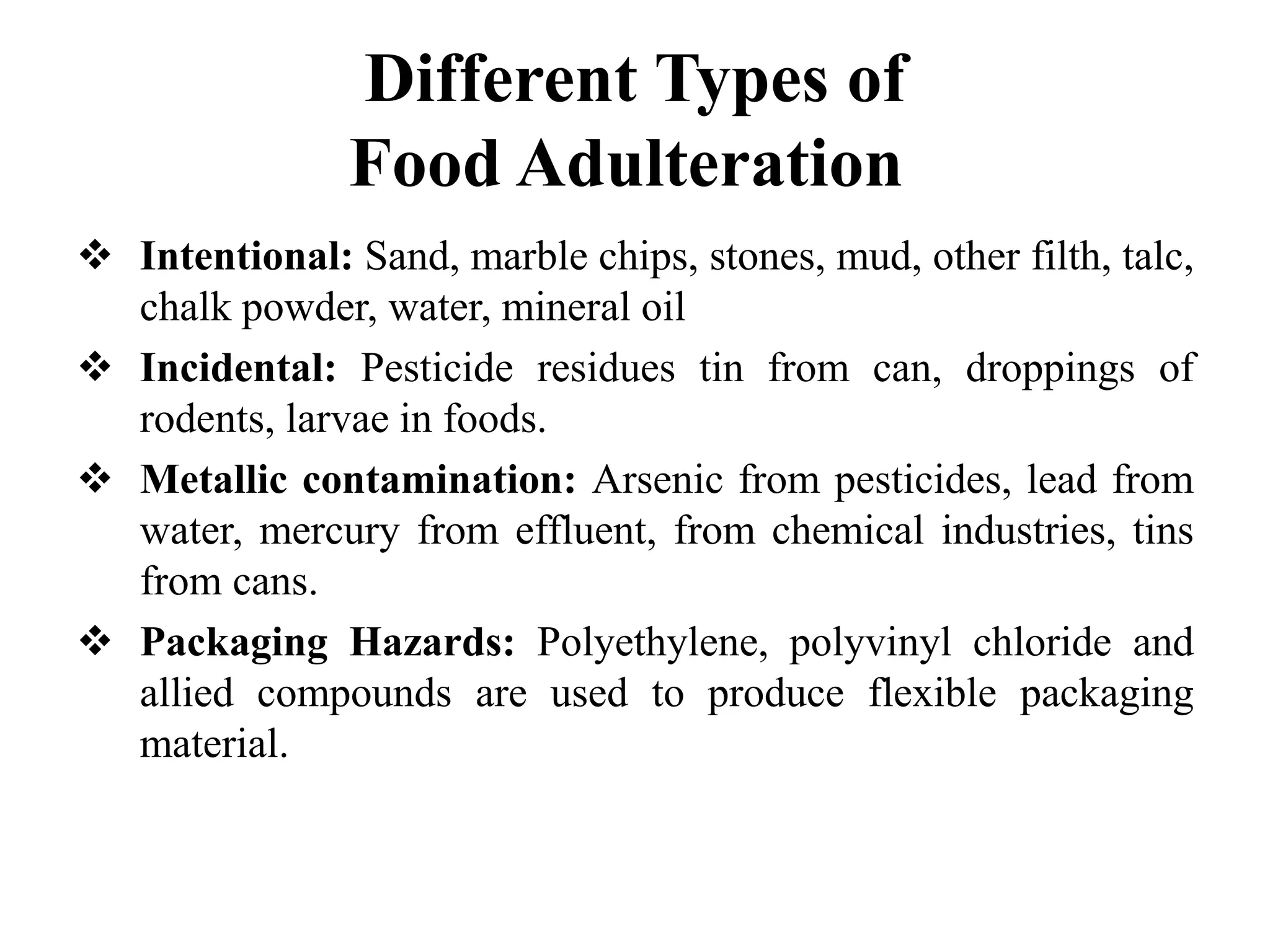
Different Types of
Food Adulteration
 Intentional: Sand, marble chips, stones, mud, other filth, talc,
chalk powder, water, mineral oil
 Incidental: Pesticide residues tin from can, droppings of
rodents, larvae in foods.
 Metallic contamination: Arsenic from pesticides, lead from
water, mercury from effluent, from chemical industries, tins
from cans.
 Packaging Hazards: Polyethylene, polyvinyl chloride and
allied compounds are used to produce flexible packaging
material.
Some Adulterated Foods in market
Turmeric, dals and pulses
• Adulterant: Metanil Yellow and Kesari Dal
• Health hazard: highly carcinogenic, stomach
disorders.
Green chillies, green peas&other vegetables
• Adulterant : Malachite Green, Argemone seeds
• Health hazard: carcinogenic if consumed over a long
period of time
Mustard seeds and mustard oil
• Adulterant : Argemone seeds, Papaya seeds
• Health hazard: epidemic dropsy and severe glaucoma
Paneer, khoya, condensed milk and milk
• Adulterant: Starch and water
• Health hazard: stomach disorders
Ice cream
• Adulterant: Pepperonil, Ethylacetate,
Butraldehyde, Nitrate, Washing powder etc
• Health hazard: Pepperonil is used as a pesticide
and ethyl acetate causes diseases affecting
lungs, kidneys and heart.
Coffee powder
• Adulterant : Tamarind seeds, chicory powder
• Health hazard: diarrhea, stomach disorders,
giddiness and severe joint pains
Some other adulterants…
 Cream is adulterated with gelatin, and
formaldehyde is employed as a
preservative for it.
 Butter is adulterated to an enormous
extent with oleomargarine, a product of
beef fat.
 Brick dust in chilli powder, colored chalk powder in turmeric.
 In confectionery, dangerous colors, such as chrome yellow,
prussian blue, copper and arsenic compounds are employed.
 Pickles and canned vegetables are sometimes colored green
with copper salts.
Samples Tested & found adulterated
every year
Some other products rejected by
FSSAI on 30th April, 2015
Rampant Food Adulteration in India
Not just Maggi, more than 400
other product are rejected by
FSSAI including ones from Tata
Starbucks, Kellog’s etc
Earlier Indian Veterinary Research
Institute discovered in a survey in
2013 that 28 per cent of the eggs
sampled in Bareilly, Izzatnagar
(Uttar Pradesh) and Dehradun
(Uttarakhand) were contaminated
with E.coli.
In 2012, a study in India conducted by the Food Safety Standards
Authority of India (FSSAI) across 33 states found that milk in India is
adulterated with detergent, fat and even urea, as well diluted with water.
Of the1791 random samples from 33 states, just 31.5% of the samples
tested (565) conformed to the FSSAI standards while the rest 1226
(68.4%) failed the test.
Milk Adulteration Test
The Maggi Issue!
• It all started with the sampling and testing of Maggi by the
office of Commissioner of Food Safety, Uttar Pradesh and
recognizing the serious food safety concerns. The FSSAI then
advised the Commissioners of Food Safety in various states to
draw samples of Maggi and get the same tested from
authorized laboratories.
Three major violations have been noted by the FSSAI:
 Presence of Lead detected in the product in excess of the
maximum permissible levels of 2.5 ppm
 Misleading labelling information on the package reading “No
added MSG”
 Release of a non-standardised food product in the market, viz.
“Maggi Oats Masala Noodles with Tastemaker” without risk
assessment and grant of product approval.
MSG: The notorious taste enhancer
• Though most of us know it as Ajinomoto, the secret ingredient is
actually called Monosodium Glutamate (MSG).
• What MSG does is that it interacts with the other flavors (mainly
salty and sour) and enhances the taste by triggering the umami
receptors of your taste buds.
• Some of the primary complaints after excessive MSG
consumption are headache, flushing, sweating, facial pressure,
numbness, chest pain, nausea and weakness. Some studies even
found that it can cause brain damage as well as eye problems for
children.
Criteria for selection of food
• Selection of wholesome and non-adulterated food is essential
for daily life to make sure that such foods do not cause any
health hazard.
• Although it is not possible to ensure wholesome food only on
visual examination when the toxic contaminants are present in
ppm/ppb level. However, visual examination of the food
before purchase makes sure to ensure absence of insects,
visual fungus, foreign matters, etc. Therefore,
due care taken by the consumer at the time of purchase of
food after thoroughly examining can be of great help.
• Secondly, label declaration on packed food is very important
for knowing the ingredients and nutritional value . It also helps
in checking the freshness of the food and the period of best
before use.
• The consumer should avoid taking food from an unhygienic
place and food being prepared under unhygienic conditions.
Such types of food may cause various diseases.
• Consumption of cut fruits being sold in unhygienic conditions
should be avoided. It is always better to buy certified food
from reputed shop.
THANK YOU 

Food adulteration

  • 1.
  • 2.
    What is Adulteration? •An adulterant is a chemical substance which should not be contained within other substances (e.g. food, beverages, and fuels) for legal or other reasons. • The addition of adulterants is called adulteration. • The word is appropriate only when the additions are unwanted by the recipient. Otherwise the expression would be food additive. Adulterants when used in illicit drugs are called cutting agents, while deliberate addition of toxic adulterants to food or other products for human consumption is known as poisoning.
  • 3.
    The Prevention ofFood Adulteration Act, 1954 - Introduction • The Prevention of Food Adulteration Bill was passed by both the house of Parliament and received the assent of the President on 29th September, 1954. • It came into force on 1st June, 1955 as THE PREVENTION OF FOOD ADULTERATION ACT, 1954 (37 of 1954). • In this Act unless the context otherwise requires,— i. "adulterant" means any material which is or could be employed for the purposes of adulteration; ii. "adulterated"—an article of food shall be deemed to be adulterated.
  • 4.
    Food is saidto be adulterated if… • the article sold by a vendor is not of the nature, substance or quality demanded by the purchaser; • the article contains any other substance which affects the nature, substance or quality; • any inferior or cheaper substance has been substituted; • the article had been prepared, packed or kept under insanitary conditions whereby it has become contaminated or injurious to health; • the article consists wholly or in part of any filthy, putrid, , rotten, decomposed or diseased animal or vegetable substance or is insect-infested or is otherwise unfit for human consumption; • the article is obtained from a diseased animal;
  • 5.
    • the articlecontains any poisonous or other ingredient which renders it injurious to health; • the container of the article is composed of any poisonous or deleterious substance which renders its contents injurious to health; • any coloring matter other than that prescribed is present in the article; • the article contains any prohibited preservative or permitted preservative in excess of the prescribed limits;
  • 7.
    Different Types of FoodAdulteration  Intentional: Sand, marble chips, stones, mud, other filth, talc, chalk powder, water, mineral oil  Incidental: Pesticide residues tin from can, droppings of rodents, larvae in foods.  Metallic contamination: Arsenic from pesticides, lead from water, mercury from effluent, from chemical industries, tins from cans.  Packaging Hazards: Polyethylene, polyvinyl chloride and allied compounds are used to produce flexible packaging material.
  • 8.
    Some Adulterated Foodsin market Turmeric, dals and pulses • Adulterant: Metanil Yellow and Kesari Dal • Health hazard: highly carcinogenic, stomach disorders. Green chillies, green peas&other vegetables • Adulterant : Malachite Green, Argemone seeds • Health hazard: carcinogenic if consumed over a long period of time Mustard seeds and mustard oil • Adulterant : Argemone seeds, Papaya seeds • Health hazard: epidemic dropsy and severe glaucoma
  • 9.
    Paneer, khoya, condensedmilk and milk • Adulterant: Starch and water • Health hazard: stomach disorders Ice cream • Adulterant: Pepperonil, Ethylacetate, Butraldehyde, Nitrate, Washing powder etc • Health hazard: Pepperonil is used as a pesticide and ethyl acetate causes diseases affecting lungs, kidneys and heart. Coffee powder • Adulterant : Tamarind seeds, chicory powder • Health hazard: diarrhea, stomach disorders, giddiness and severe joint pains
  • 10.
    Some other adulterants… Cream is adulterated with gelatin, and formaldehyde is employed as a preservative for it.  Butter is adulterated to an enormous extent with oleomargarine, a product of beef fat.  Brick dust in chilli powder, colored chalk powder in turmeric.  In confectionery, dangerous colors, such as chrome yellow, prussian blue, copper and arsenic compounds are employed.  Pickles and canned vegetables are sometimes colored green with copper salts.
  • 11.
    Samples Tested &found adulterated every year
  • 13.
    Some other productsrejected by FSSAI on 30th April, 2015
  • 15.
  • 17.
    Not just Maggi,more than 400 other product are rejected by FSSAI including ones from Tata Starbucks, Kellog’s etc Earlier Indian Veterinary Research Institute discovered in a survey in 2013 that 28 per cent of the eggs sampled in Bareilly, Izzatnagar (Uttar Pradesh) and Dehradun (Uttarakhand) were contaminated with E.coli. In 2012, a study in India conducted by the Food Safety Standards Authority of India (FSSAI) across 33 states found that milk in India is adulterated with detergent, fat and even urea, as well diluted with water. Of the1791 random samples from 33 states, just 31.5% of the samples tested (565) conformed to the FSSAI standards while the rest 1226 (68.4%) failed the test.
  • 18.
  • 20.
  • 21.
    • It allstarted with the sampling and testing of Maggi by the office of Commissioner of Food Safety, Uttar Pradesh and recognizing the serious food safety concerns. The FSSAI then advised the Commissioners of Food Safety in various states to draw samples of Maggi and get the same tested from authorized laboratories. Three major violations have been noted by the FSSAI:  Presence of Lead detected in the product in excess of the maximum permissible levels of 2.5 ppm  Misleading labelling information on the package reading “No added MSG”  Release of a non-standardised food product in the market, viz. “Maggi Oats Masala Noodles with Tastemaker” without risk assessment and grant of product approval.
  • 22.
    MSG: The notorioustaste enhancer • Though most of us know it as Ajinomoto, the secret ingredient is actually called Monosodium Glutamate (MSG). • What MSG does is that it interacts with the other flavors (mainly salty and sour) and enhances the taste by triggering the umami receptors of your taste buds. • Some of the primary complaints after excessive MSG consumption are headache, flushing, sweating, facial pressure, numbness, chest pain, nausea and weakness. Some studies even found that it can cause brain damage as well as eye problems for children.
  • 23.
    Criteria for selectionof food • Selection of wholesome and non-adulterated food is essential for daily life to make sure that such foods do not cause any health hazard. • Although it is not possible to ensure wholesome food only on visual examination when the toxic contaminants are present in ppm/ppb level. However, visual examination of the food before purchase makes sure to ensure absence of insects, visual fungus, foreign matters, etc. Therefore, due care taken by the consumer at the time of purchase of food after thoroughly examining can be of great help. • Secondly, label declaration on packed food is very important for knowing the ingredients and nutritional value . It also helps in checking the freshness of the food and the period of best before use.
  • 24.
    • The consumershould avoid taking food from an unhygienic place and food being prepared under unhygienic conditions. Such types of food may cause various diseases. • Consumption of cut fruits being sold in unhygienic conditions should be avoided. It is always better to buy certified food from reputed shop.
  • 25.