"ADULTERANT" means any material which is or could be employed
for making the food unsafe or sub-standard or misbranded or containing
extraneous matter
Example : Kesari Dhal, unapproved colours
“CONTAMINANT" means any substance, whether or not added to food, but which is present in
such food as a result of the production (including operations carried out in crop husbandry,
animal husbandry or veterinary medicine), manufacture, processing, preparation,
treatment, packing, packaging, transport or holding of such food or as a result
of environmental contamination and does not include insect fragments, rodent hairs and other
extraneous matter.
Example : Toxic metals, Pesticide Residues, Vet. Drug Residues, Mycotoxins
"FOOD ADDITIVE" means any substance not normally consumed as a food by itself or used as a
typical ingredient of the food, whether or not it has nutritive value, the intentional addition of
which to food for a technological (including organoleptic) purpose in the manufacture, processing,
preparation, treatment, packing, packaging, transport or holding of such food results, or may be
reasonably expected to result (directly or indirectly), in it or its by-products becoming a component of
or otherwise affecting the characteristics of such food but does not include "contaminants" or
substances added to food for maintaining or improving nutritional qualities
Example : Colours, Preservatives, Synthetic Sweeteners, Stabilizers & Emulsifiers
Unsafe Food
• If composed of poisonous or deleterious substance
• If consisting of any filthy, putrid, rotten, decomposed or diseased
animal substance or vegetable substance
• If processed unhygienically or presence of any harmful substance
• If substitution of any inferior or cheaper substance
• If addition of a substance directly or as an ingredient which is not
permitted
• If the abstraction of any of its constituents
• If coloured, flavoured or coated, powdered or polished, as to
damage or conceal the article or to make it appear better or of
greater value
FOOD SAFETY AND STANDARDS (PROHIBITION AND
RESTRICTIONS ON SALES) REGULATIONS, 2011
 Tobacco, Nicotine in food
 Kesari gram/dhal/flour
 Use of carbide gas in ripening of fruit
 Mineral Water without BIS Logo (Certification)
 Blended Vegetable oil without AGMARK Logo (Certification)
 Honey AGMARK Logo (Certification)
 Ghee which contains any added matter not exclusively derived
from milk fat;
 Milk which contains any added water
 Skimmed milk (fat abstracted) as milk
 Milk or a milk product specified in containing a substance not
found in milk, except as provided in the regulations.
 Condensed milk sweetened, condensed skimmed milk
sweetened, milk powder, skimmed milk powder, partly
skimmed milk powder and partly skimmed sweetened
condensed milk shall be sold only with ISI Certification Mark.
Colouring Matter:
 Natural Colours : β-Carotene, Chlorophyl, Annatto,
Saffron, etc
 Inorganic Pigments : Titanium dioxide
 Synthetic Colours:
Red – Ponceau 4R, Carmoisene, Erythrosine
Yellow – Tartrazine, Sunset yellow FCF
Blue – Indigo carmine, Brilliant blue FCF
Green – Fast green FCF
 Food Products : Ice-cream, Flavoured milk, Biscuits,
Squash, Jam, Jellies, Non-alcoholic beverages, Custard
powder
SUBSTANCES ADDED TO FOOD
FOOD SAFETY AND STANDARDS (CONTAMINANTS, TOXINS AND
RESIDUES) REGULATIONS, 2011
Metal contaminants :
Limits for Lead, Cadmium, Arsenic, Mercury, Tin, Copper and
Zinc, Nickel, Chromium.
Crop contaminants and naturally occuring toxic substances
Aflatoxins : Max. 30ppb(all foods)
Aflatoxin M1 : 0.5ppb (milk)
Patulin Max 50ppb (apple juice)
Ochratoxin 20ppb (wheat, barley, ray)
Restriction on the use of insecticides.
Limits for 149 pesticides in various Raw Agricultural
Commodities
Antibiotic and Other Pharmacologically Active Substances
Nitrofurans, Chloramphenicol, Sulfanoamides are banned
Tetracycline, oxy tetracycline Timethoprim and Oxolinic acid
permitted in sea foods
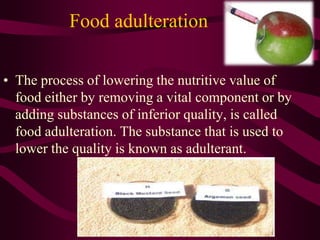
Food adulteration
• The process of lowering the nutritive value of
food either by removing a vital component or by
adding substances of inferior quality, is called
food adulteration. The substance that is used to
lower the quality is known as adulterant.
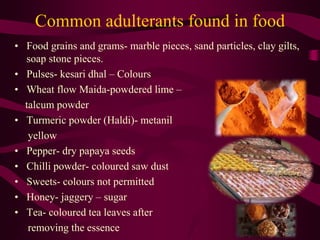
Common adulterants found in food
• Food grains and grams- marble pieces, sand particles, clay gilts,
soap stone pieces.
• Pulses- kesari dhal – Colours
• Wheat flow Maida-powdered lime –
talcum powder
• Turmeric powder (Haldi)- metanil
yellow
• Pepper- dry papaya seeds
• Chilli powder- coloured saw dust
• Sweets- colours not permitted
• Honey- jaggery – sugar
• Tea- coloured tea leaves after
removing the essence
Effects of adulteration
on humans
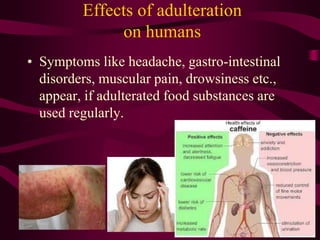
• Symptoms like headache, gastro-intestinal
disorders, muscular pain, drowsiness etc.,
appear, if adulterated food substances are
used regularly.
Detection of food adulteration
• Tea powder and Soji (rava) : Adulterants : Iron
filings: Spread the tea leaves or soji on a paper.
Draw a magnet over it. The iron filings if
present, are attracted by the magnet.
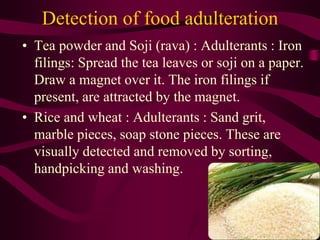
• Rice and wheat : Adulterants : Sand grit,
marble pieces, soap stone pieces. These are
visually detected and removed by sorting,
handpicking and washing.
• Common Salt, Soji : Adulterants- sand and grit
A tea spoon of salt is added to a glass tumbler
containing water. Salt dissolves. Sand and grit
settle at the bottom. About 5 gms of soji is
sprinkled on water. The sand particles sink and
soji floats.
• Coffee powder : Adulterant- Tamarind seed
powder: Two teaspoons of coffee powder is
added to water in a tumbler. Coffee powder
floats and the adulterants sink.
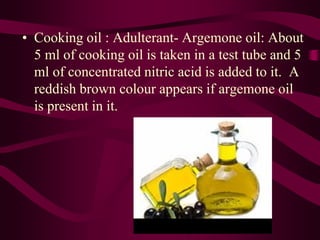
• Cooking oil : Adulterant- Argemone oil: About
5 ml of cooking oil is taken in a test tube and 5
ml of concentrated nitric acid is added to it. A
reddish brown colour appears if argemone oil
is present in it.
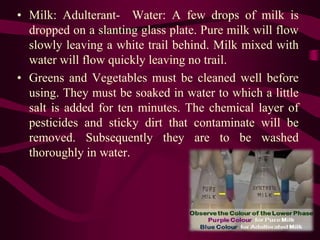
• Milk: Adulterant- Water: A few drops of milk is
dropped on a slanting glass plate. Pure milk will flow
slowly leaving a white trail behind. Milk mixed with
water will flow quickly leaving no trail.
• Greens and Vegetables must be cleaned well before
using. They must be soaked in water to which a little
salt is added for ten minutes. The chemical layer of
pesticides and sticky dirt that contaminate will be
removed. Subsequently they are to be washed
thoroughly in water.
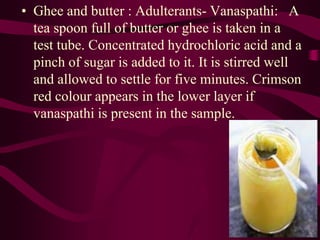
• Ghee and butter : Adulterants- Vanaspathi: A
tea spoon full of butter or ghee is taken in a
test tube. Concentrated hydrochloric acid and a
pinch of sugar is added to it. It is stirred well
and allowed to settle for five minutes. Crimson
red colour appears in the lower layer if
vanaspathi is present in the sample.
How dangerous are these
adulterants??
• The argemone oil used to adulterate ghee and butter
is highly toxic. It causes a disease known as dropsy.
• Watery fluid collecting in some parts of the body is
the main symptom. It affects the normal functioning
of the body. It may also paralyse the limbs.
• Metanil yellow used to brighten the colour of pulses,
turmeric powder and sweet meats, is a coal-tar dye. It
may cause cancer.
• Washing soda often added to powdered sugar
and other food items, may cause intestinal
disorders.
• Food items prepared under unhygienic
conditions and stale foods cause food
poisoning.

food adulteration ppt1.pptx

  • 1.
    "ADULTERANT" means anymaterial which is or could be employed for making the food unsafe or sub-standard or misbranded or containing extraneous matter Example : Kesari Dhal, unapproved colours “CONTAMINANT" means any substance, whether or not added to food, but which is present in such food as a result of the production (including operations carried out in crop husbandry, animal husbandry or veterinary medicine), manufacture, processing, preparation, treatment, packing, packaging, transport or holding of such food or as a result of environmental contamination and does not include insect fragments, rodent hairs and other extraneous matter. Example : Toxic metals, Pesticide Residues, Vet. Drug Residues, Mycotoxins "FOOD ADDITIVE" means any substance not normally consumed as a food by itself or used as a typical ingredient of the food, whether or not it has nutritive value, the intentional addition of which to food for a technological (including organoleptic) purpose in the manufacture, processing, preparation, treatment, packing, packaging, transport or holding of such food results, or may be reasonably expected to result (directly or indirectly), in it or its by-products becoming a component of or otherwise affecting the characteristics of such food but does not include "contaminants" or substances added to food for maintaining or improving nutritional qualities Example : Colours, Preservatives, Synthetic Sweeteners, Stabilizers & Emulsifiers
  • 2.
    Unsafe Food • Ifcomposed of poisonous or deleterious substance • If consisting of any filthy, putrid, rotten, decomposed or diseased animal substance or vegetable substance • If processed unhygienically or presence of any harmful substance • If substitution of any inferior or cheaper substance • If addition of a substance directly or as an ingredient which is not permitted • If the abstraction of any of its constituents • If coloured, flavoured or coated, powdered or polished, as to damage or conceal the article or to make it appear better or of greater value
  • 3.
    FOOD SAFETY ANDSTANDARDS (PROHIBITION AND RESTRICTIONS ON SALES) REGULATIONS, 2011  Tobacco, Nicotine in food  Kesari gram/dhal/flour  Use of carbide gas in ripening of fruit  Mineral Water without BIS Logo (Certification)  Blended Vegetable oil without AGMARK Logo (Certification)  Honey AGMARK Logo (Certification)  Ghee which contains any added matter not exclusively derived from milk fat;  Milk which contains any added water  Skimmed milk (fat abstracted) as milk  Milk or a milk product specified in containing a substance not found in milk, except as provided in the regulations.  Condensed milk sweetened, condensed skimmed milk sweetened, milk powder, skimmed milk powder, partly skimmed milk powder and partly skimmed sweetened condensed milk shall be sold only with ISI Certification Mark.
  • 4.
    Colouring Matter:  NaturalColours : β-Carotene, Chlorophyl, Annatto, Saffron, etc  Inorganic Pigments : Titanium dioxide  Synthetic Colours: Red – Ponceau 4R, Carmoisene, Erythrosine Yellow – Tartrazine, Sunset yellow FCF Blue – Indigo carmine, Brilliant blue FCF Green – Fast green FCF  Food Products : Ice-cream, Flavoured milk, Biscuits, Squash, Jam, Jellies, Non-alcoholic beverages, Custard powder SUBSTANCES ADDED TO FOOD
  • 5.
    FOOD SAFETY ANDSTANDARDS (CONTAMINANTS, TOXINS AND RESIDUES) REGULATIONS, 2011 Metal contaminants : Limits for Lead, Cadmium, Arsenic, Mercury, Tin, Copper and Zinc, Nickel, Chromium. Crop contaminants and naturally occuring toxic substances Aflatoxins : Max. 30ppb(all foods) Aflatoxin M1 : 0.5ppb (milk) Patulin Max 50ppb (apple juice) Ochratoxin 20ppb (wheat, barley, ray) Restriction on the use of insecticides. Limits for 149 pesticides in various Raw Agricultural Commodities Antibiotic and Other Pharmacologically Active Substances Nitrofurans, Chloramphenicol, Sulfanoamides are banned Tetracycline, oxy tetracycline Timethoprim and Oxolinic acid permitted in sea foods
  • 6.
    Food adulteration • Theprocess of lowering the nutritive value of food either by removing a vital component or by adding substances of inferior quality, is called food adulteration. The substance that is used to lower the quality is known as adulterant.
  • 7.
    Common adulterants foundin food • Food grains and grams- marble pieces, sand particles, clay gilts, soap stone pieces. • Pulses- kesari dhal – Colours • Wheat flow Maida-powdered lime – talcum powder • Turmeric powder (Haldi)- metanil yellow • Pepper- dry papaya seeds • Chilli powder- coloured saw dust • Sweets- colours not permitted • Honey- jaggery – sugar • Tea- coloured tea leaves after removing the essence
  • 8.
    Effects of adulteration onhumans • Symptoms like headache, gastro-intestinal disorders, muscular pain, drowsiness etc., appear, if adulterated food substances are used regularly.
  • 9.
    Detection of foodadulteration • Tea powder and Soji (rava) : Adulterants : Iron filings: Spread the tea leaves or soji on a paper. Draw a magnet over it. The iron filings if present, are attracted by the magnet. • Rice and wheat : Adulterants : Sand grit, marble pieces, soap stone pieces. These are visually detected and removed by sorting, handpicking and washing.
  • 10.
    • Common Salt,Soji : Adulterants- sand and grit A tea spoon of salt is added to a glass tumbler containing water. Salt dissolves. Sand and grit settle at the bottom. About 5 gms of soji is sprinkled on water. The sand particles sink and soji floats. • Coffee powder : Adulterant- Tamarind seed powder: Two teaspoons of coffee powder is added to water in a tumbler. Coffee powder floats and the adulterants sink.
  • 11.
    • Cooking oil: Adulterant- Argemone oil: About 5 ml of cooking oil is taken in a test tube and 5 ml of concentrated nitric acid is added to it. A reddish brown colour appears if argemone oil is present in it.
  • 12.
    • Milk: Adulterant-Water: A few drops of milk is dropped on a slanting glass plate. Pure milk will flow slowly leaving a white trail behind. Milk mixed with water will flow quickly leaving no trail. • Greens and Vegetables must be cleaned well before using. They must be soaked in water to which a little salt is added for ten minutes. The chemical layer of pesticides and sticky dirt that contaminate will be removed. Subsequently they are to be washed thoroughly in water.
  • 13.
    • Ghee andbutter : Adulterants- Vanaspathi: A tea spoon full of butter or ghee is taken in a test tube. Concentrated hydrochloric acid and a pinch of sugar is added to it. It is stirred well and allowed to settle for five minutes. Crimson red colour appears in the lower layer if vanaspathi is present in the sample.
  • 14.
    How dangerous arethese adulterants?? • The argemone oil used to adulterate ghee and butter is highly toxic. It causes a disease known as dropsy. • Watery fluid collecting in some parts of the body is the main symptom. It affects the normal functioning of the body. It may also paralyse the limbs. • Metanil yellow used to brighten the colour of pulses, turmeric powder and sweet meats, is a coal-tar dye. It may cause cancer.
  • 15.
    • Washing sodaoften added to powdered sugar and other food items, may cause intestinal disorders. • Food items prepared under unhygienic conditions and stale foods cause food poisoning.