Communication Strategies
Ms. May C. Francisco, MAE
One of the biggest sources of
misunderstandings and communication
breakdown is language. Studies show
that the following are the twelve
strategies that speakers commonly resort
to when communication problems arise:
Message Abandonment- You leave the
message unfinished because of language
difficulty.
Topic Avoidance- You try not to talk about
concepts difficult for you to express.
Circumlocution- You describe or
paraphrase the target object or action.
Approximation- You use an alternative
term (ship) to express the meaning of the
target word (sail) as closely as possible.
Use of all-purpose-words- You expand a
general word to the context where certain
words are lacking like the overuse of the
words: thing, stuff, make, do, what-do-you-
call-it, what-is-it.
Word Coinage- You create a new
English word based on what you know
of the way English works like
“vegetarianist” (which is not in the
dictionary) for the “vegetarian”
Use of nonverbal means- You mime, the
gesture, use facial expression, and imitate
sound to express the meaning you want.
Literal translation- You translate a word
or an idiom from your mother tongue to
English using the structure of your first
language.
Foreignizing- You use the word in your
native language but pronounce it like
English.
Code switching- You use the native word
or expression for the English term that
expresses the meaning you want.
Appeal for Help- You ask other
students or your teacher for help when
you do not know or forget some words,
structures or idioms.
Use of Fillers/ hesitation
devices- You use filling words
(uhhmmmm) to gain time to think.
Communicative Strategies
These are plans, ways or means of
sharing information which are
adopted to achieve a particular social,
political, psychological, or linguistic
purpose.
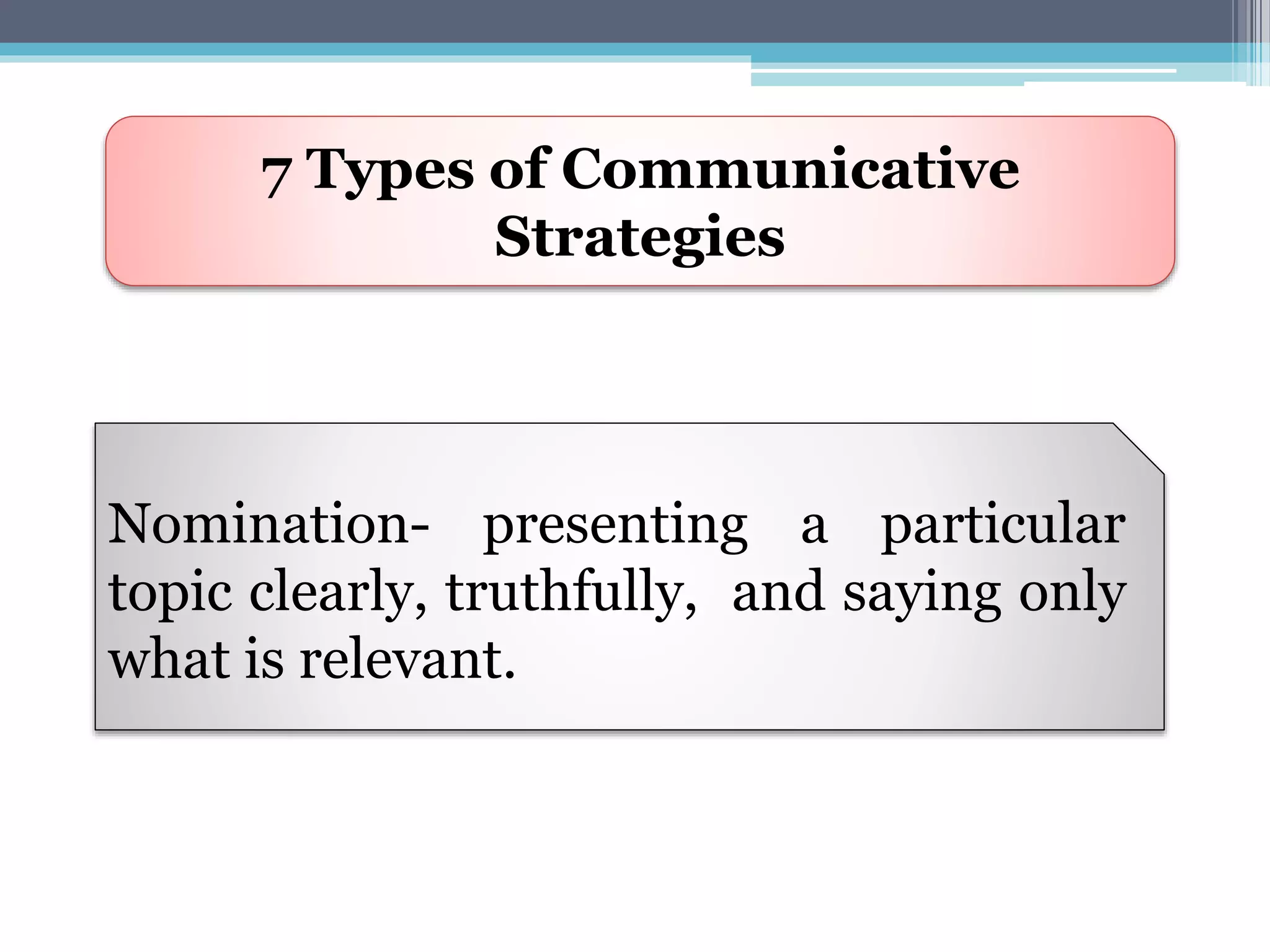
7 Types of Communicative
Strategies
Nomination- presenting a particular
topic clearly, truthfully, and saying only
what is relevant.
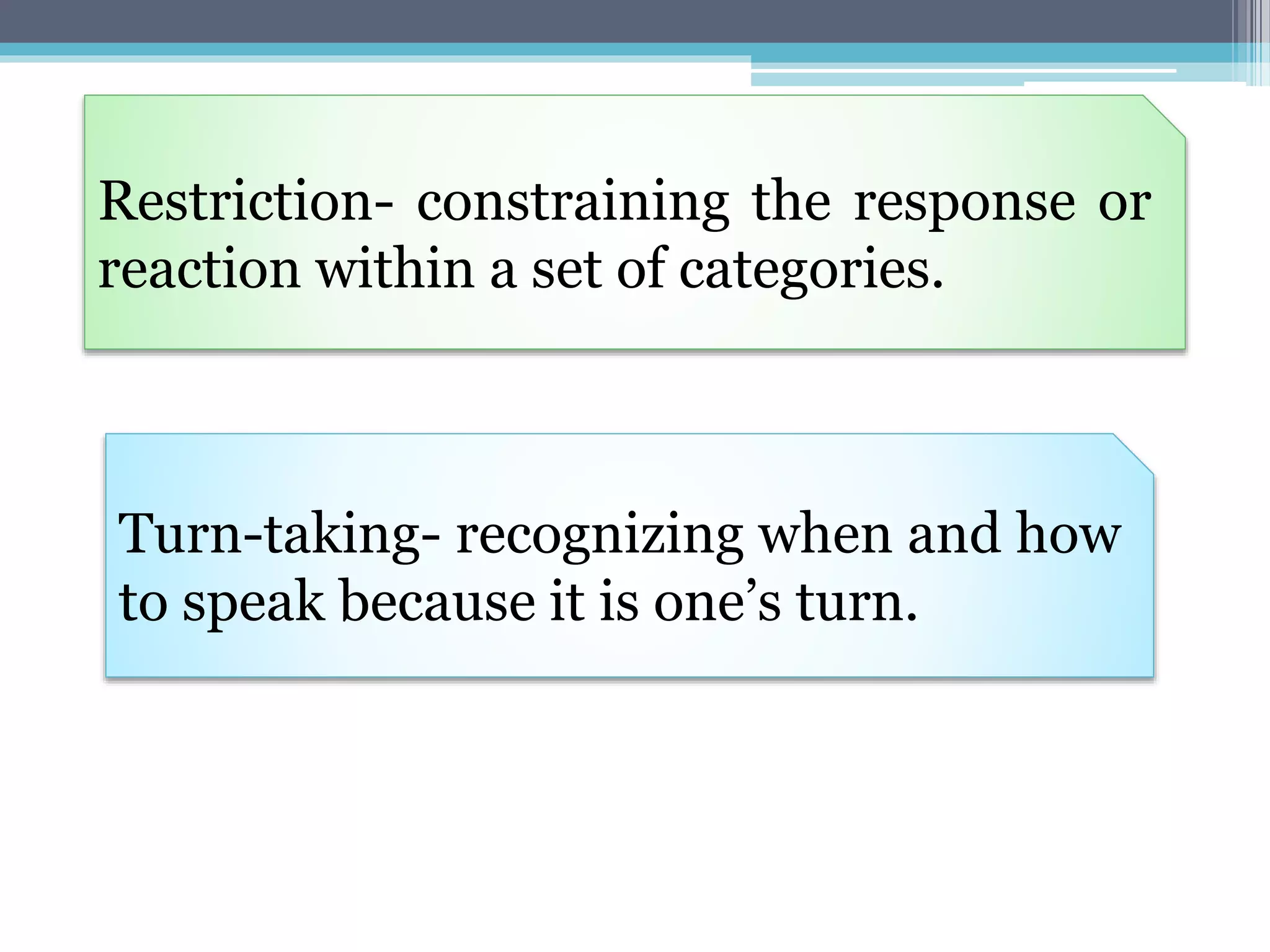
Restriction- constraining the response or
reaction within a set of categories.
Turn-taking- recognizing when and how
to speak because it is one’s turn.
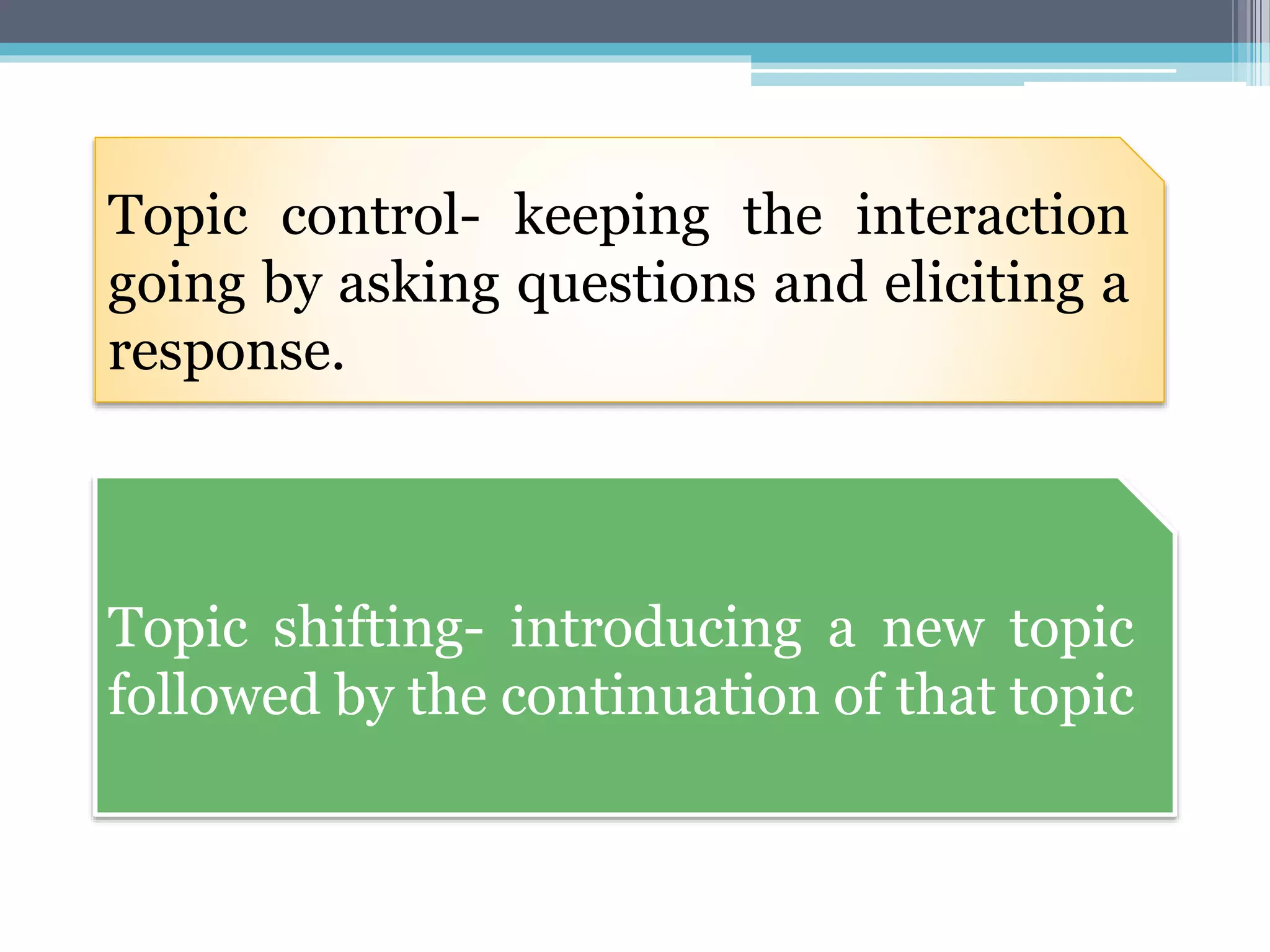
Topic control- keeping the interaction
going by asking questions and eliciting a
response.
Topic shifting- introducing a new topic
followed by the continuation of that topic
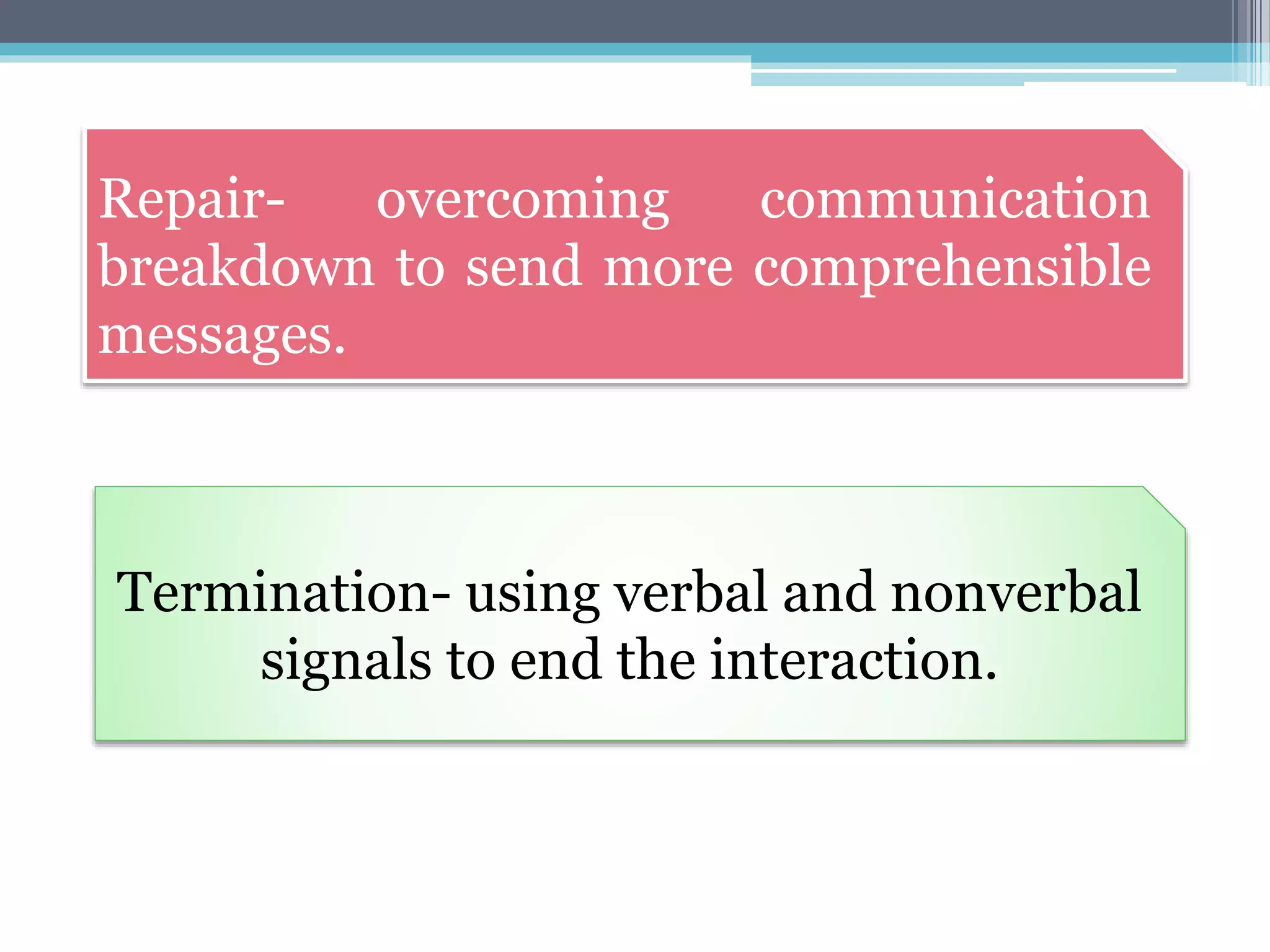
Repair- overcoming communication
breakdown to send more comprehensible
messages.
Termination- using verbal and nonverbal
signals to end the interaction.
When introducing a topic at the beginning of
a Communicative Situation, what is being
used is the Nomination Strategy. It is a
strategy that can also be applied any time
during the course of an interaction as a way
of continuing the communication. When this
strategy is used, the topic is introduced in a
clear and truthful manner, stating only what
is relevant to keep the interaction focused.
Examples:
Have you noticed the weird weather
lately? Is this because of global warming?
I was late for class again! The MRT
stopped midway. What is wrong with the
MRT?
Restriction Communicative Strategy is a
strategy that constrains or restricts the
Response of the other person involved
in the Communication Situation. The
Listener is forced to respond only
within a set of categories that is made
by the Speaker.
Examples:
They say that the Philippine economy is
getting better. Only the stupid thinks that,
right? (No one wants to be stupid.)
That arrest move was a disaster waiting to
happen. Do you agree? (Yes/No)
Turn-taking Communicative Strategy requires
that each Speaker speaks only when it is his/ her
turn during interaction. Knowing when to talk
depends on watching out for the verbal and
nonverbal cues that signal the next Speaker that
the previous Speaker has finished or the topic
under discussion has been exhausted and a new
topic may be introduced. At the same time, it also
means that others should be given the
opportunity to take turn. Turn-taking
Communicative Strategy uses either an informal
approach (just jump in and start talking) or a
formal approach (permission to speak is
requested).
Examples:
I agree with the point just made. But may I
add that OFWs would rather be home and
work here so they could be with their
families.
May I have the floor, sir? The topic under
discussion is the state of the Philippine
economy today. We want better lives for
all Filipinos, whether they are working
here or abroad.
After the Nomination Communicative
Strategy, the interaction is kept going by
using the Topic-Control
Communicative Strategy. This is
simply a question-answer formula that
moves the discussion forward. This also
allows the Listener or other participants
to take turns, contribute ideas, and
continue the discussion.
Examples:
How do you often ride the MRT, Tony?
How many times have you encountered a
stoppage in service?
Your car may break down, too, Luna,
right? So you have to find another means
of getting to school. We all do not want to
be late for class, yes?
Topic-Shifting Communicative
Strategy is the strategy that is useful
in introducing another topic. This
strategy works best when there is
follow-through so that new topic
continues to be discussed. This is also
used in Repair Communicative
Strategy.
Examples:
This is a battle with corporations that
continue to pollute the environment. But this
is also a battle with man himself, who
continues to act as if there is another Earth
we can move to once this Earth dies.
If we cannot use the Earth’s resources, our
economies will die. We need to choose: the
economy or the environment.
Repeating is a good way of correcting
one self and gives the Speaker time to do
just that. Recasting means changing the
form of a Message that could not be
understood. It allows the Speaker to say
the Message in another way so that the
Listener can understand what was
originally incomprehensible.
We have already learned that communication
almost always breaks down. When
miscommunication occurs, one can apply the
Repair Communicative Strategy that includes
requesting clarification, not acknowledging, topic
shifting, not responding, repeating, recasting and
adding. One requests clarification by asking
questions or using eyebrows , eyes, head or
shoulders to show that the Message could not be
understood. By not acknowledging the new
situation, the situation already in progress will
continue. Topic shifting can help direct the
discussion to another or divert the attention of the
Listener from the topic that has become
problematic.
Lastly, Termination Communicative
Strategy ends the interaction through
verbal and nonverbal Messages that both
Speaker and Listener send to each other.
Sometimes the Termination is quick and
short. Sometimes it is prolonged by
clarification, further questions, or the
continuation of the topic already
discussed, but the point of the language
and body movement is to end the
communication.

Communication strategies

  • 1.
  • 2.
    One of thebiggest sources of misunderstandings and communication breakdown is language. Studies show that the following are the twelve strategies that speakers commonly resort to when communication problems arise:
  • 3.
    Message Abandonment- Youleave the message unfinished because of language difficulty. Topic Avoidance- You try not to talk about concepts difficult for you to express.
  • 4.
    Circumlocution- You describeor paraphrase the target object or action. Approximation- You use an alternative term (ship) to express the meaning of the target word (sail) as closely as possible.
  • 5.
    Use of all-purpose-words-You expand a general word to the context where certain words are lacking like the overuse of the words: thing, stuff, make, do, what-do-you- call-it, what-is-it. Word Coinage- You create a new English word based on what you know of the way English works like “vegetarianist” (which is not in the dictionary) for the “vegetarian”
  • 6.
    Use of nonverbalmeans- You mime, the gesture, use facial expression, and imitate sound to express the meaning you want. Literal translation- You translate a word or an idiom from your mother tongue to English using the structure of your first language.
  • 7.
    Foreignizing- You usethe word in your native language but pronounce it like English. Code switching- You use the native word or expression for the English term that expresses the meaning you want.
  • 8.
    Appeal for Help-You ask other students or your teacher for help when you do not know or forget some words, structures or idioms. Use of Fillers/ hesitation devices- You use filling words (uhhmmmm) to gain time to think.
  • 9.
    Communicative Strategies These areplans, ways or means of sharing information which are adopted to achieve a particular social, political, psychological, or linguistic purpose.
  • 10.
    7 Types ofCommunicative Strategies Nomination- presenting a particular topic clearly, truthfully, and saying only what is relevant.
  • 11.
    Restriction- constraining theresponse or reaction within a set of categories. Turn-taking- recognizing when and how to speak because it is one’s turn.
  • 12.
    Topic control- keepingthe interaction going by asking questions and eliciting a response. Topic shifting- introducing a new topic followed by the continuation of that topic
  • 13.
    Repair- overcoming communication breakdownto send more comprehensible messages. Termination- using verbal and nonverbal signals to end the interaction.
  • 14.
    When introducing atopic at the beginning of a Communicative Situation, what is being used is the Nomination Strategy. It is a strategy that can also be applied any time during the course of an interaction as a way of continuing the communication. When this strategy is used, the topic is introduced in a clear and truthful manner, stating only what is relevant to keep the interaction focused.
  • 15.
    Examples: Have you noticedthe weird weather lately? Is this because of global warming? I was late for class again! The MRT stopped midway. What is wrong with the MRT?
  • 16.
    Restriction Communicative Strategyis a strategy that constrains or restricts the Response of the other person involved in the Communication Situation. The Listener is forced to respond only within a set of categories that is made by the Speaker.
  • 17.
    Examples: They say thatthe Philippine economy is getting better. Only the stupid thinks that, right? (No one wants to be stupid.) That arrest move was a disaster waiting to happen. Do you agree? (Yes/No)
  • 18.
    Turn-taking Communicative Strategyrequires that each Speaker speaks only when it is his/ her turn during interaction. Knowing when to talk depends on watching out for the verbal and nonverbal cues that signal the next Speaker that the previous Speaker has finished or the topic under discussion has been exhausted and a new topic may be introduced. At the same time, it also means that others should be given the opportunity to take turn. Turn-taking Communicative Strategy uses either an informal approach (just jump in and start talking) or a formal approach (permission to speak is requested).
  • 19.
    Examples: I agree withthe point just made. But may I add that OFWs would rather be home and work here so they could be with their families. May I have the floor, sir? The topic under discussion is the state of the Philippine economy today. We want better lives for all Filipinos, whether they are working here or abroad.
  • 20.
    After the NominationCommunicative Strategy, the interaction is kept going by using the Topic-Control Communicative Strategy. This is simply a question-answer formula that moves the discussion forward. This also allows the Listener or other participants to take turns, contribute ideas, and continue the discussion.
  • 21.
    Examples: How do youoften ride the MRT, Tony? How many times have you encountered a stoppage in service? Your car may break down, too, Luna, right? So you have to find another means of getting to school. We all do not want to be late for class, yes?
  • 22.
    Topic-Shifting Communicative Strategy isthe strategy that is useful in introducing another topic. This strategy works best when there is follow-through so that new topic continues to be discussed. This is also used in Repair Communicative Strategy.
  • 23.
    Examples: This is abattle with corporations that continue to pollute the environment. But this is also a battle with man himself, who continues to act as if there is another Earth we can move to once this Earth dies. If we cannot use the Earth’s resources, our economies will die. We need to choose: the economy or the environment.
  • 24.
    Repeating is agood way of correcting one self and gives the Speaker time to do just that. Recasting means changing the form of a Message that could not be understood. It allows the Speaker to say the Message in another way so that the Listener can understand what was originally incomprehensible.
  • 25.
    We have alreadylearned that communication almost always breaks down. When miscommunication occurs, one can apply the Repair Communicative Strategy that includes requesting clarification, not acknowledging, topic shifting, not responding, repeating, recasting and adding. One requests clarification by asking questions or using eyebrows , eyes, head or shoulders to show that the Message could not be understood. By not acknowledging the new situation, the situation already in progress will continue. Topic shifting can help direct the discussion to another or divert the attention of the Listener from the topic that has become problematic.
  • 26.
    Lastly, Termination Communicative Strategyends the interaction through verbal and nonverbal Messages that both Speaker and Listener send to each other. Sometimes the Termination is quick and short. Sometimes it is prolonged by clarification, further questions, or the continuation of the topic already discussed, but the point of the language and body movement is to end the communication.