

The Hidden enemy
Refeeding syndrom
Emad Zarief MD
Anesthesia & Surgical intensive care Dpt.
Agenda
Emad Zarief 2021 2
Definition of RFS
Pathophysiology
Incidence
Screening for
Prevention
Refeeding Syndrome (RFS) is a set of metabolic & electrolyte
alterations occurring due to reintroduction of calories through
oral, enteral, parenteral nutrition after a period of consistent
reduction of energy intake or starvation in individuals with pre-
existent malnutrition and/or in a catabolic state.
3
ASPEN Consensus recommendations for refeeding syndrome.;2020
Definition
Limitations: lack of capturing a patient’s clinical presentation.
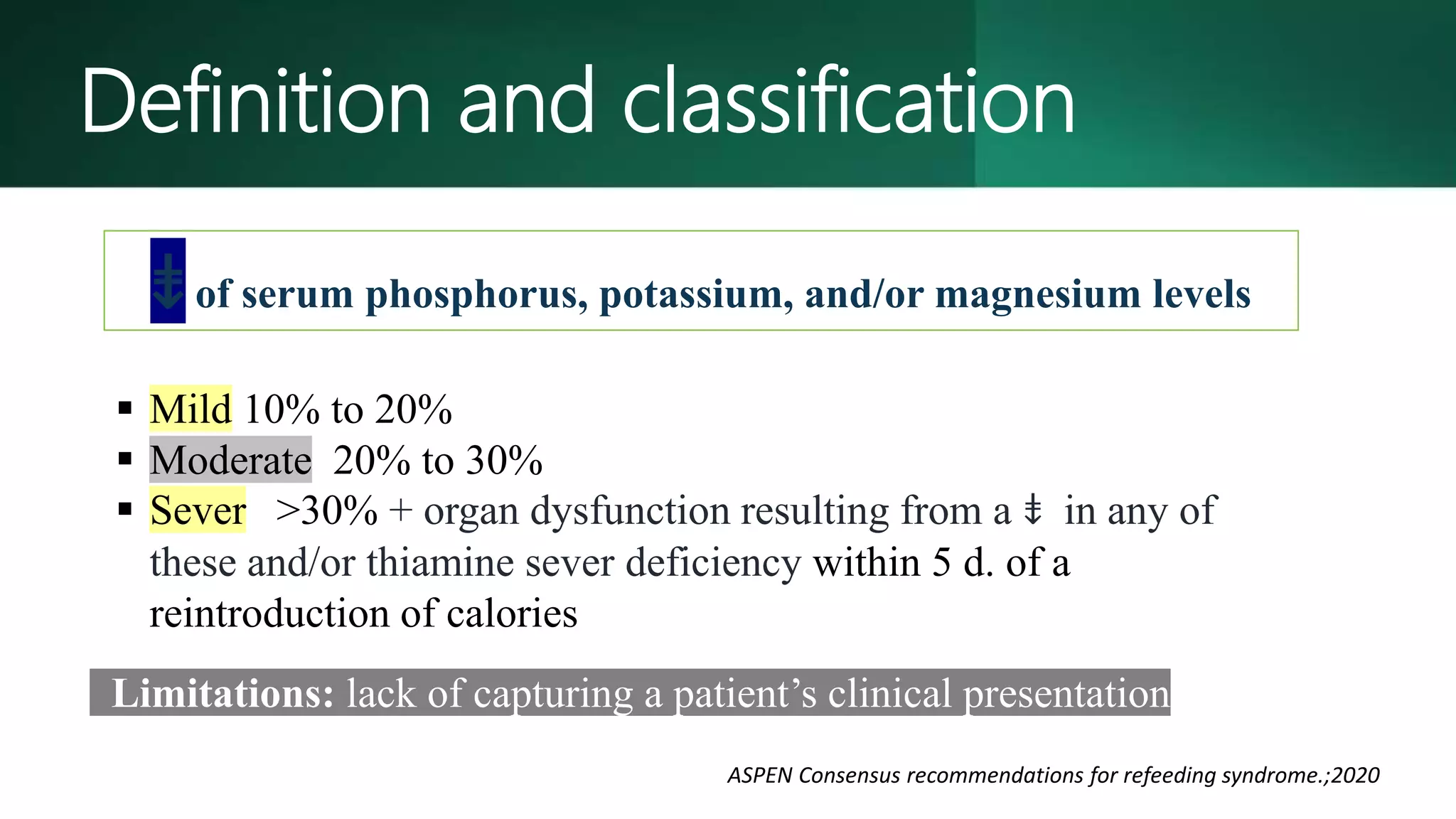
 Mild 10% to 20%
 Moderate 20% to 30%
 Sever >30% + organ dysfunction resulting from a ⇟ in any of
these and/or thiamine sever deficiency within 5 d. of a
reintroduction of calories
⇟of serum phosphorus, potassium, and/or magnesium levels
ASPEN Consensus recommendations for refeeding syndrome.;2020
Definition and classification
Emad Zarief 2021 5
ASPEN Consensus recommendations for refeeding syndrome.;2020 https://doi.org/10.1002/ncp.10474
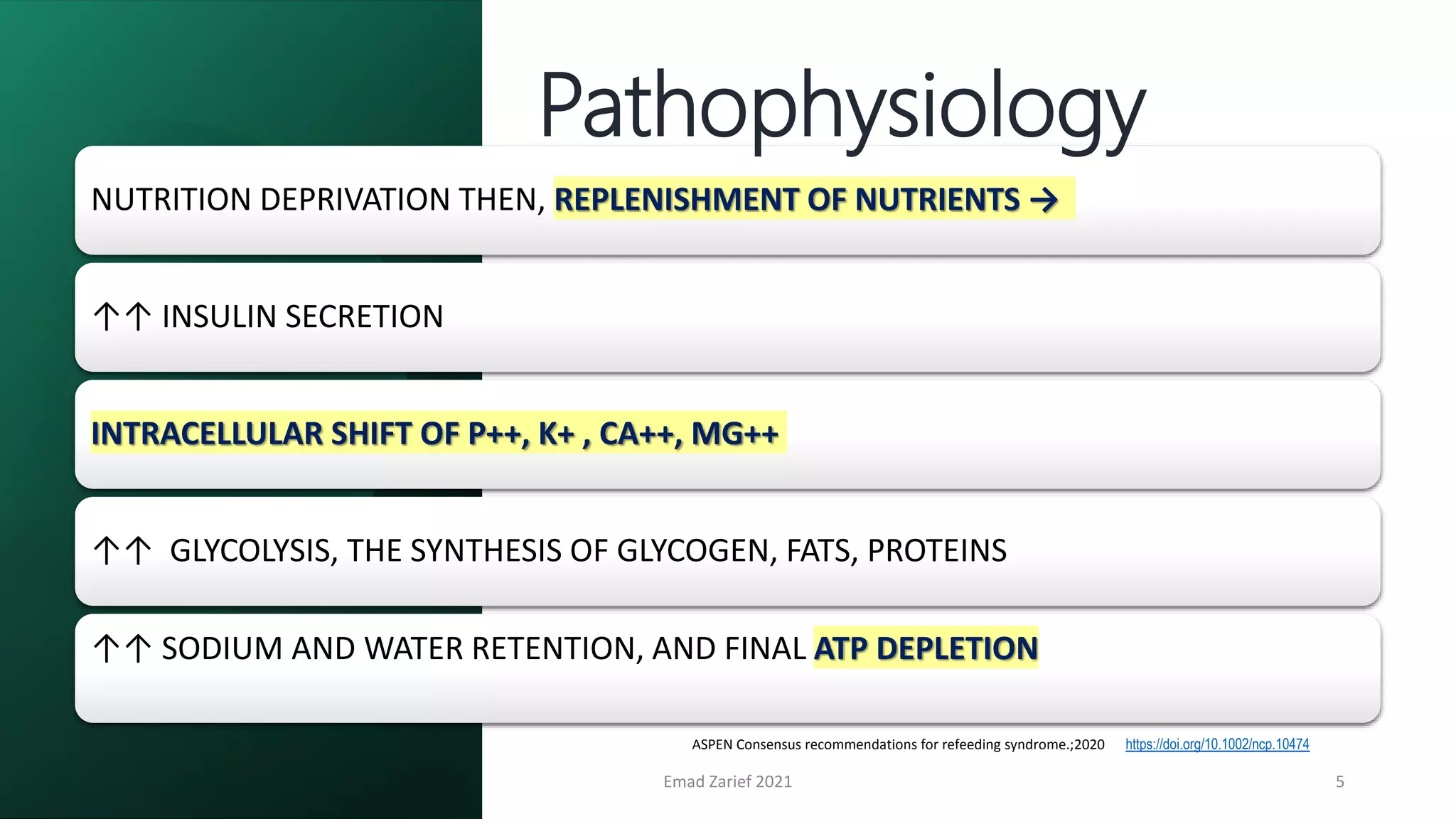
NUTRITION DEPRIVATION THEN, REPLENISHMENT OF NUTRIENTS →
↑↑ INSULIN SECRETION
INTRACELLULAR SHIFT OF P++, K+ , CA++, MG++
↑↑ GLYCOLYSIS, THE SYNTHESIS OF GLYCOGEN, FATS, PROTEINS
↑↑ SODIUM AND WATER RETENTION, AND FINAL ATP DEPLETION
Pathophysiology
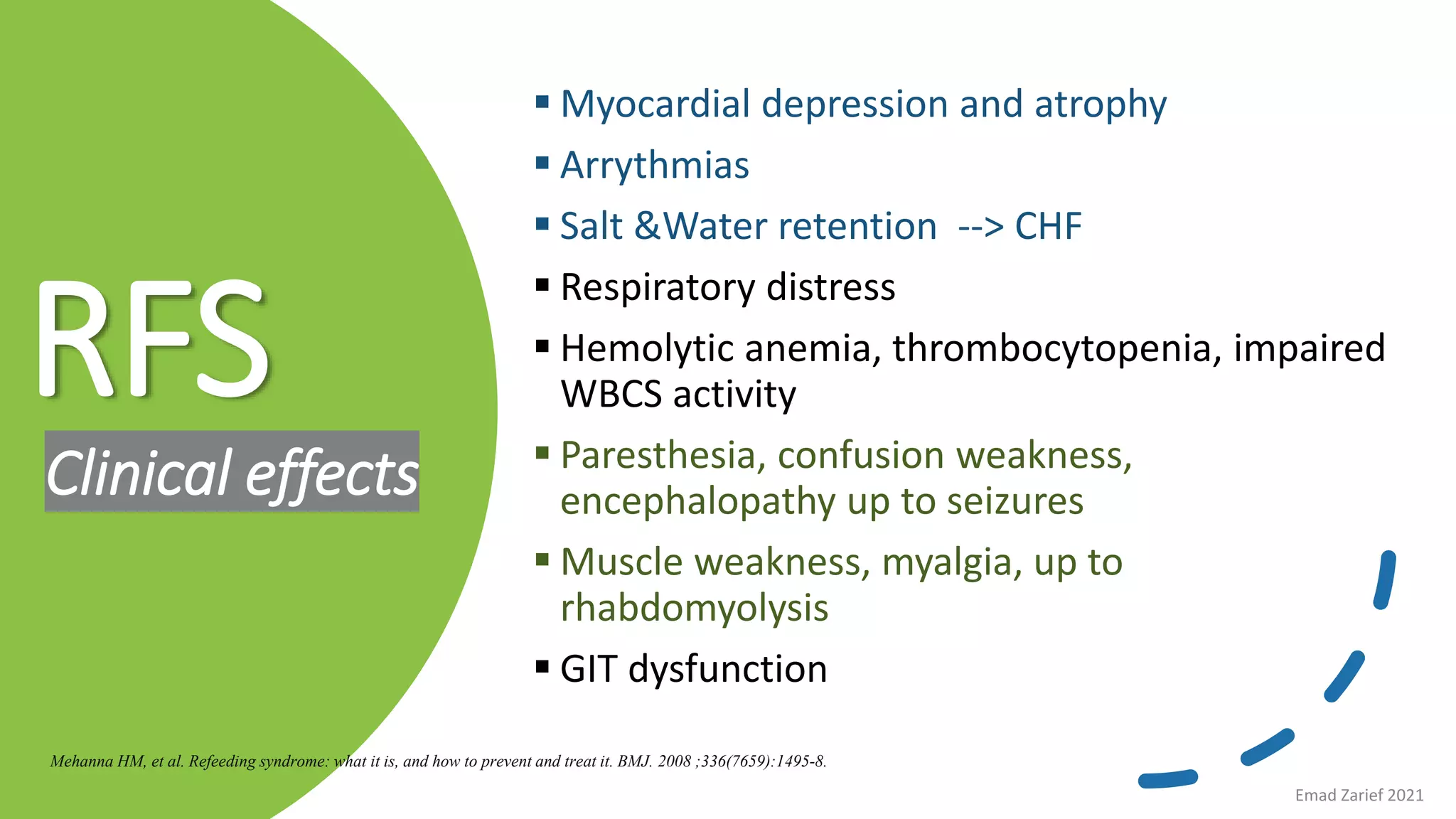
RFS
Clinical effects
 Myocardial depression and atrophy
 Arrythmias
 Salt &Water retention --> CHF
 Respiratory distress
 Hemolytic anemia, thrombocytopenia, impaired
WBCS activity
 Paresthesia, confusion weakness,
encephalopathy up to seizures
 Muscle weakness, myalgia, up to
rhabdomyolysis
 GIT dysfunction
Mehanna HM, et al. Refeeding syndrome: what it is, and how to prevent and treat it. BMJ. 2008 ;336(7659):1495-8.
Emad Zarief 2021
Emad Zarief 2021 7
Emad Zarief 2021 8
The incidence of RFS
Emad
Zarief
2021
9
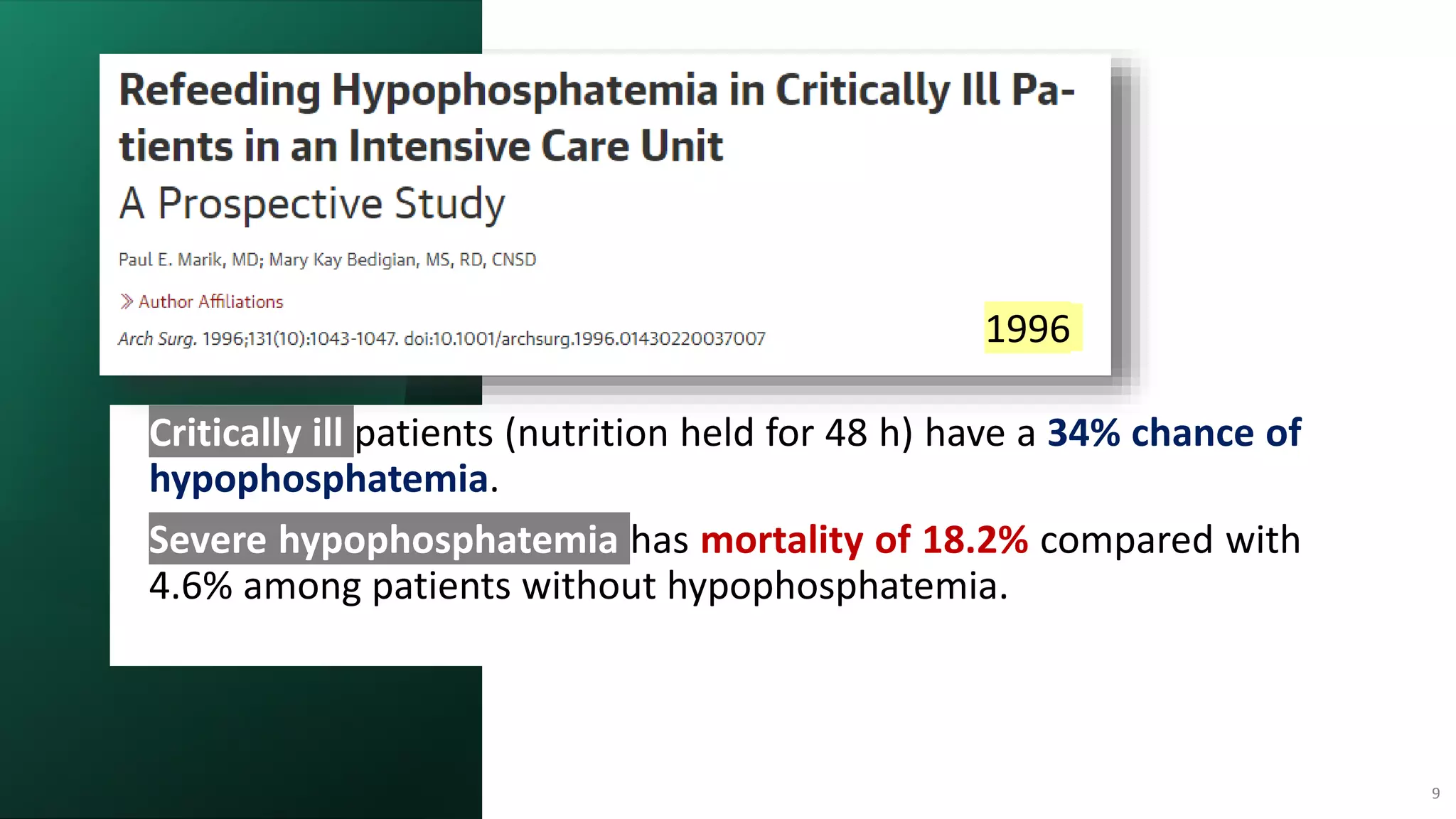
 Critically ill patients (nutrition held for 48 h) have a 34% chance of
hypophosphatemia.
 Severe hypophosphatemia has mortality of 18.2% compared with
4.6% among patients without hypophosphatemia.
1996
Incidence
of RFS
Emad
Zarief
2021
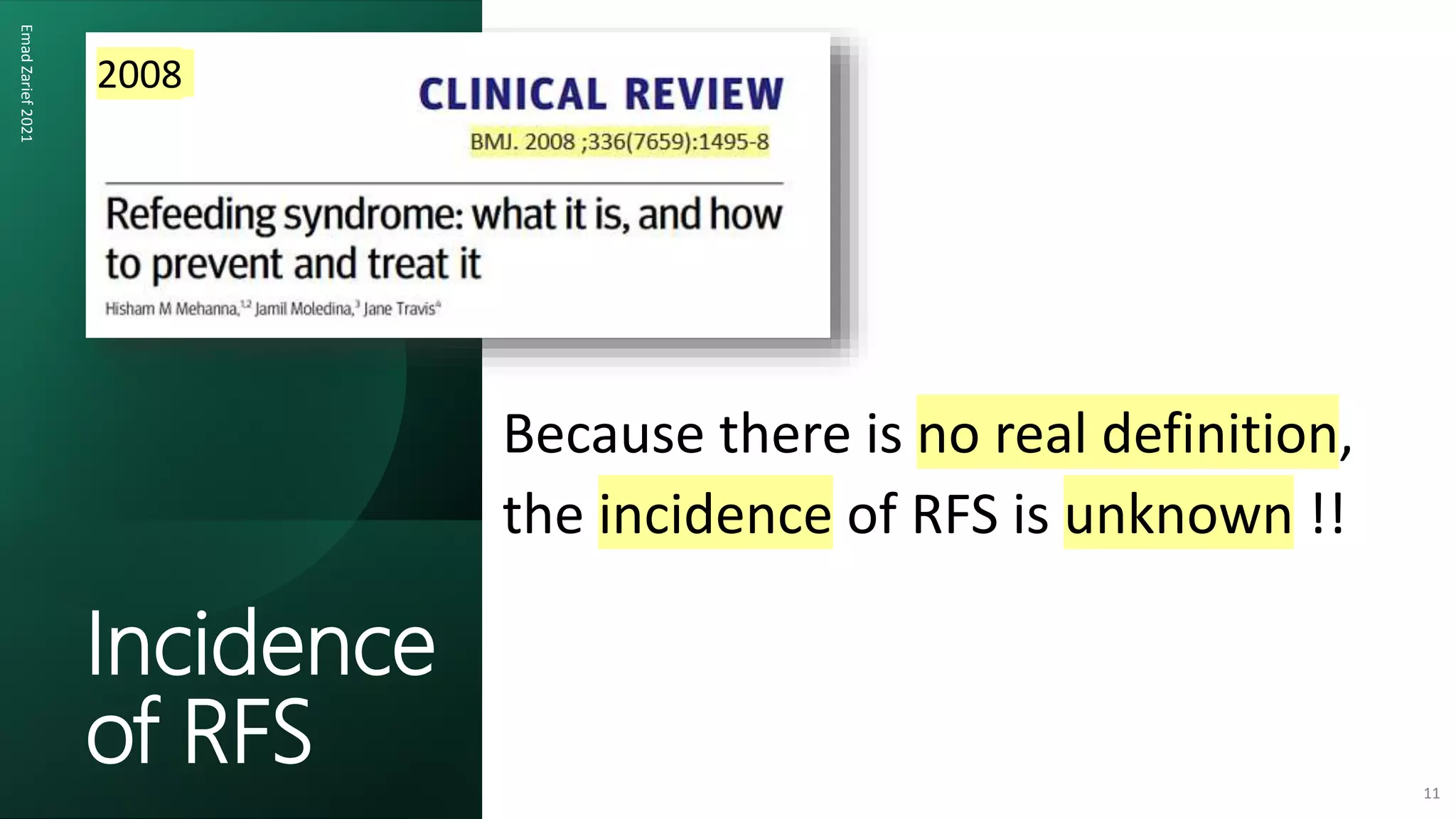
Because there is no real definition,
the incidence of RFS is unknown !!
11
2008
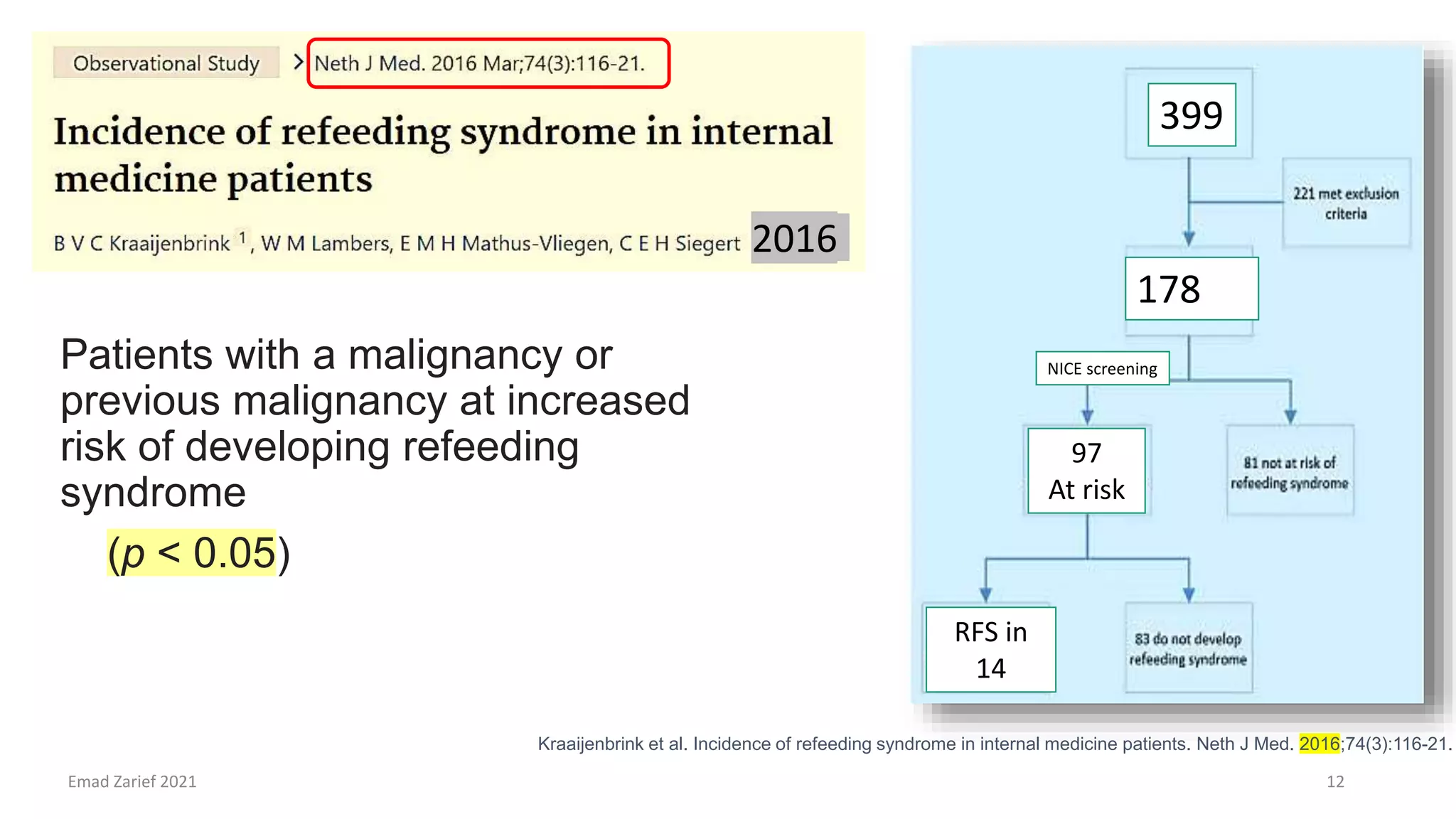
Kraaijenbrink et al. Incidence of refeeding syndrome in internal medicine patients. Neth J Med. 2016;74(3):116-21.
Patients with a malignancy or
previous malignancy at increased
risk of developing refeeding
syndrome
(p < 0.05)
Emad Zarief 2021 12
399
97
At risk
RFS in
14
NICE screening
178
2016
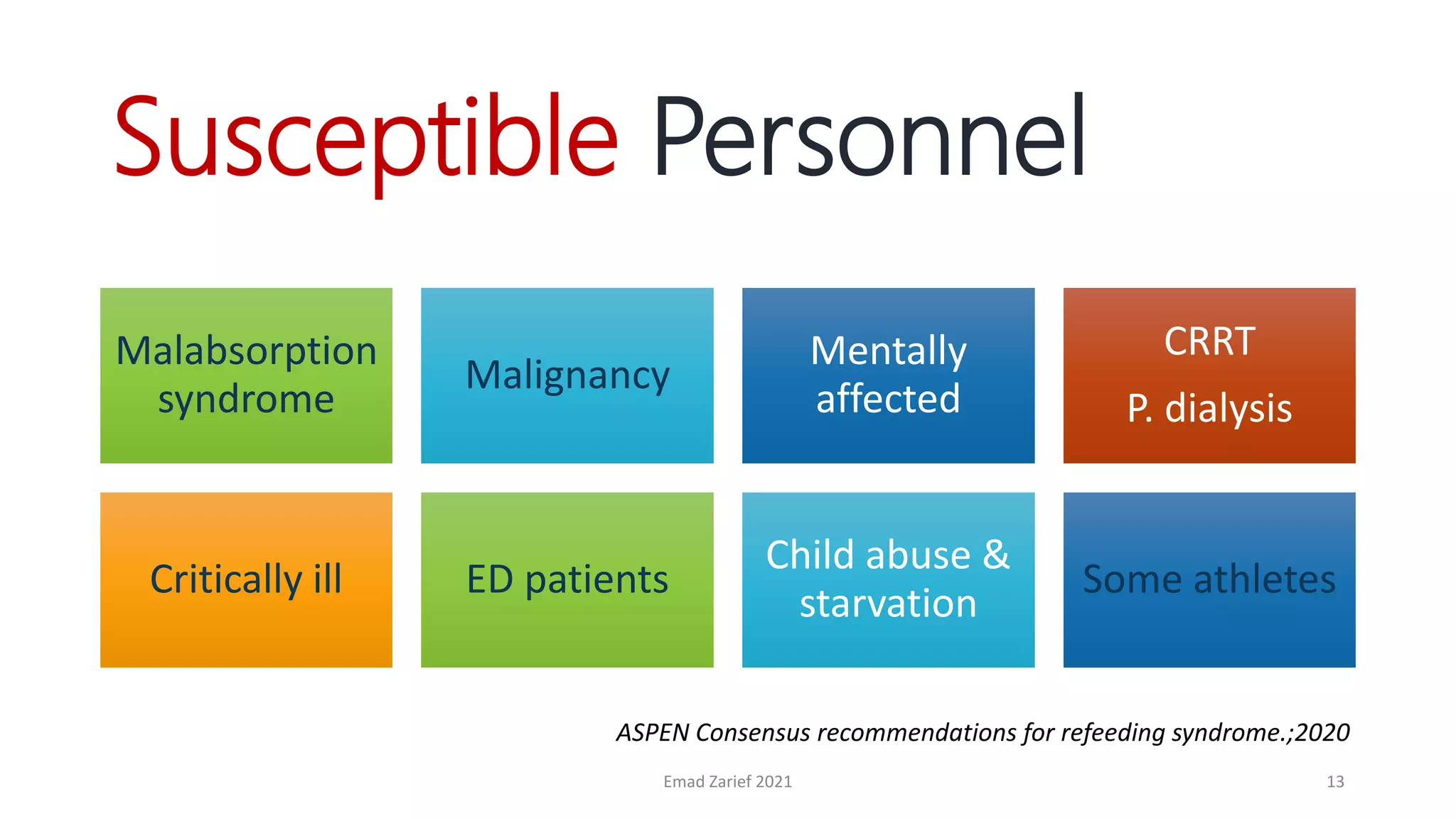
Susceptible Personnel
Malabsorption
syndrome
Malignancy
Mentally
affected
CRRT
P. dialysis
Critically ill ED patients
Child abuse &
starvation
Some athletes
ASPEN Consensus recommendations for refeeding syndrome.;2020
Emad Zarief 2021 13
Screening for RFS
Emad Zarief 2021 14
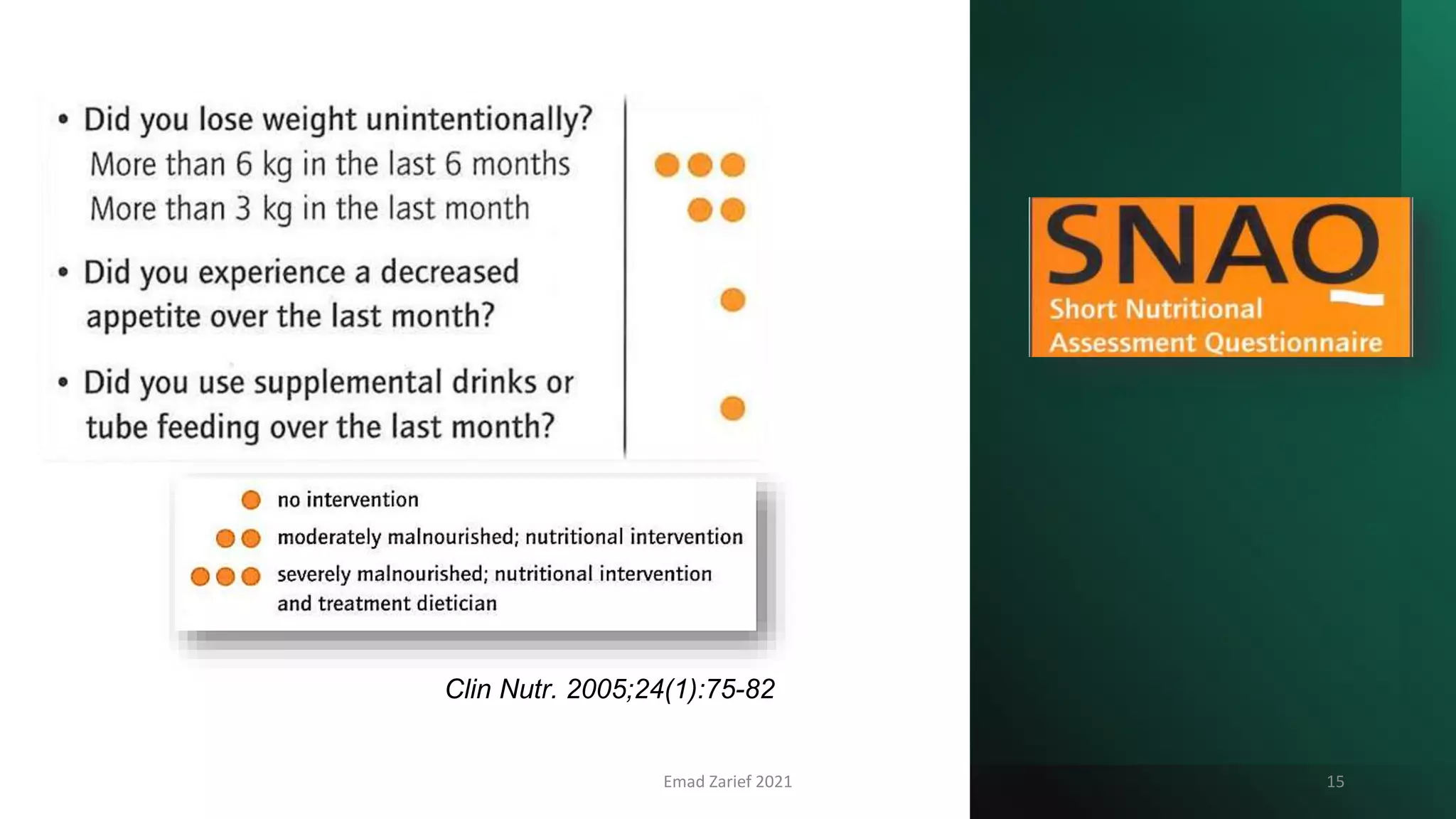
Screening Tool
Clin Nutr. 2005;24(1):75-82
Emad Zarief 2021 15
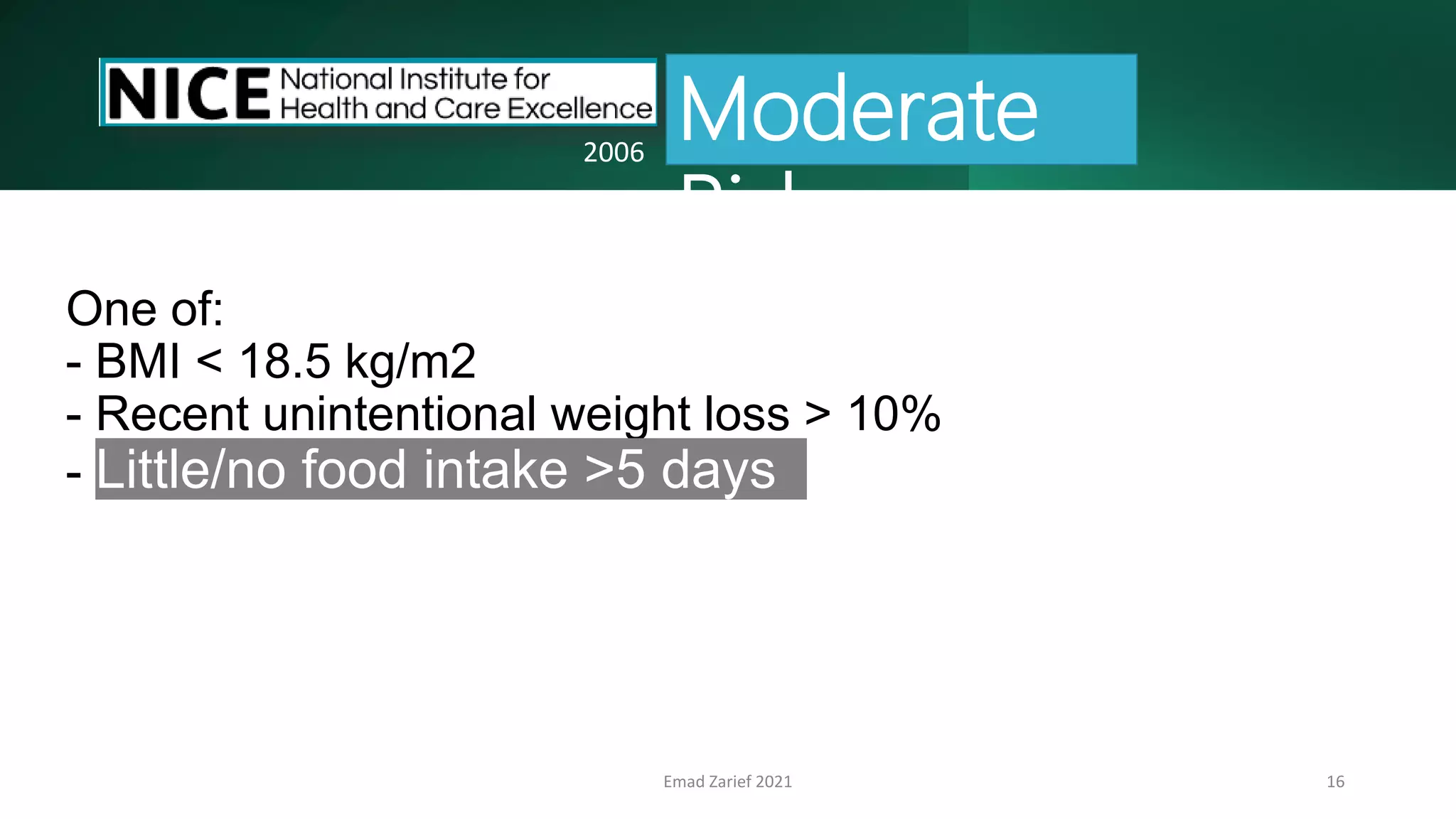
One of:
- BMI < 18.5 kg/m2
- Recent unintentional weight loss > 10%
- Little/no food intake >5 days
Emad Zarief 2021 16
Moderate
Risk
2006
Emad Zarief 2021 17
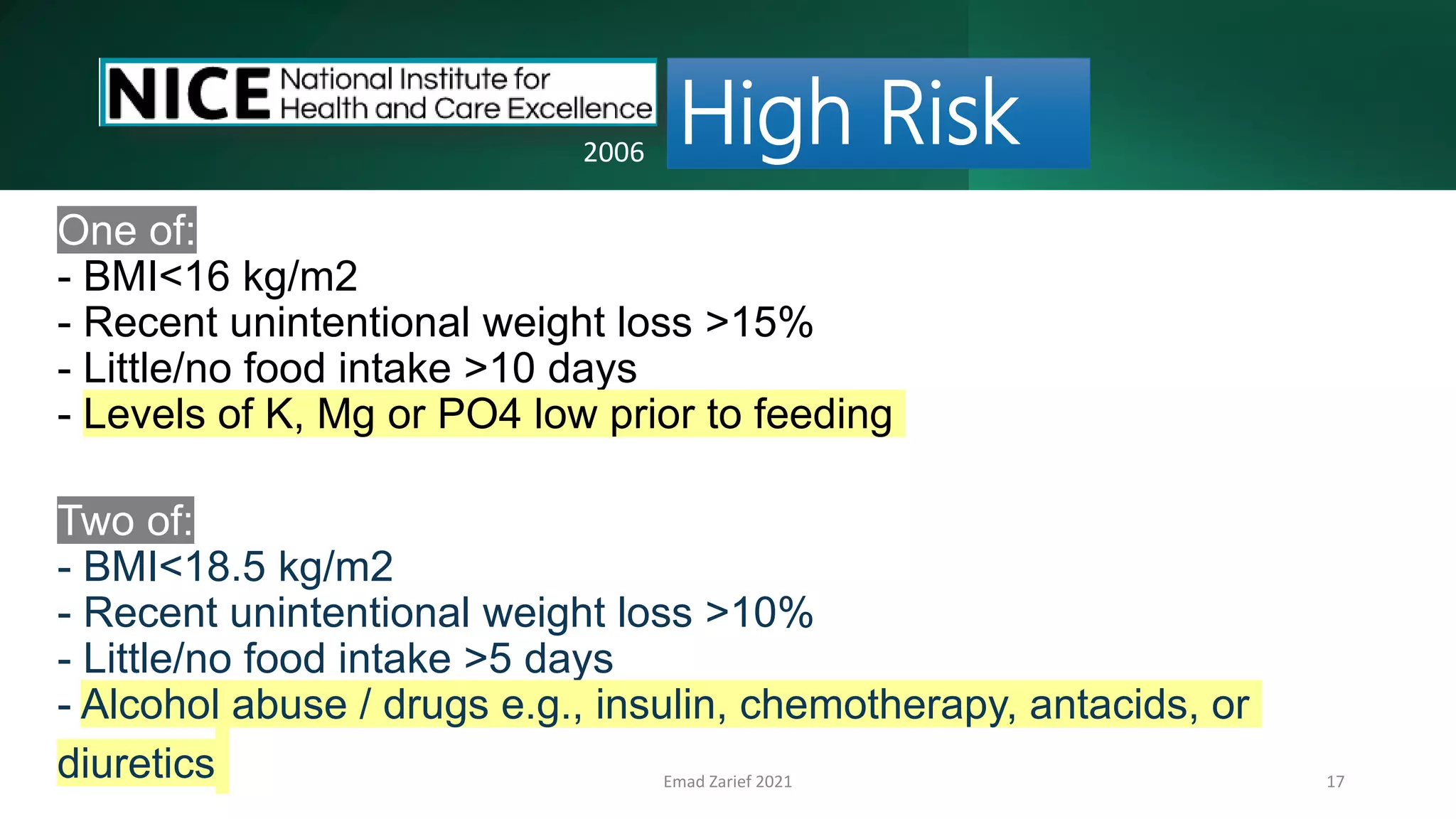
One of:
- BMI<16 kg/m2
- Recent unintentional weight loss >15%
- Little/no food intake >10 days
- Levels of K, Mg or PO4 low prior to feeding
Two of:
- BMI<18.5 kg/m2
- Recent unintentional weight loss >10%
- Little/no food intake >5 days
- Alcohol abuse / drugs e.g., insulin, chemotherapy, antacids, or
diuretics
High Risk
2006
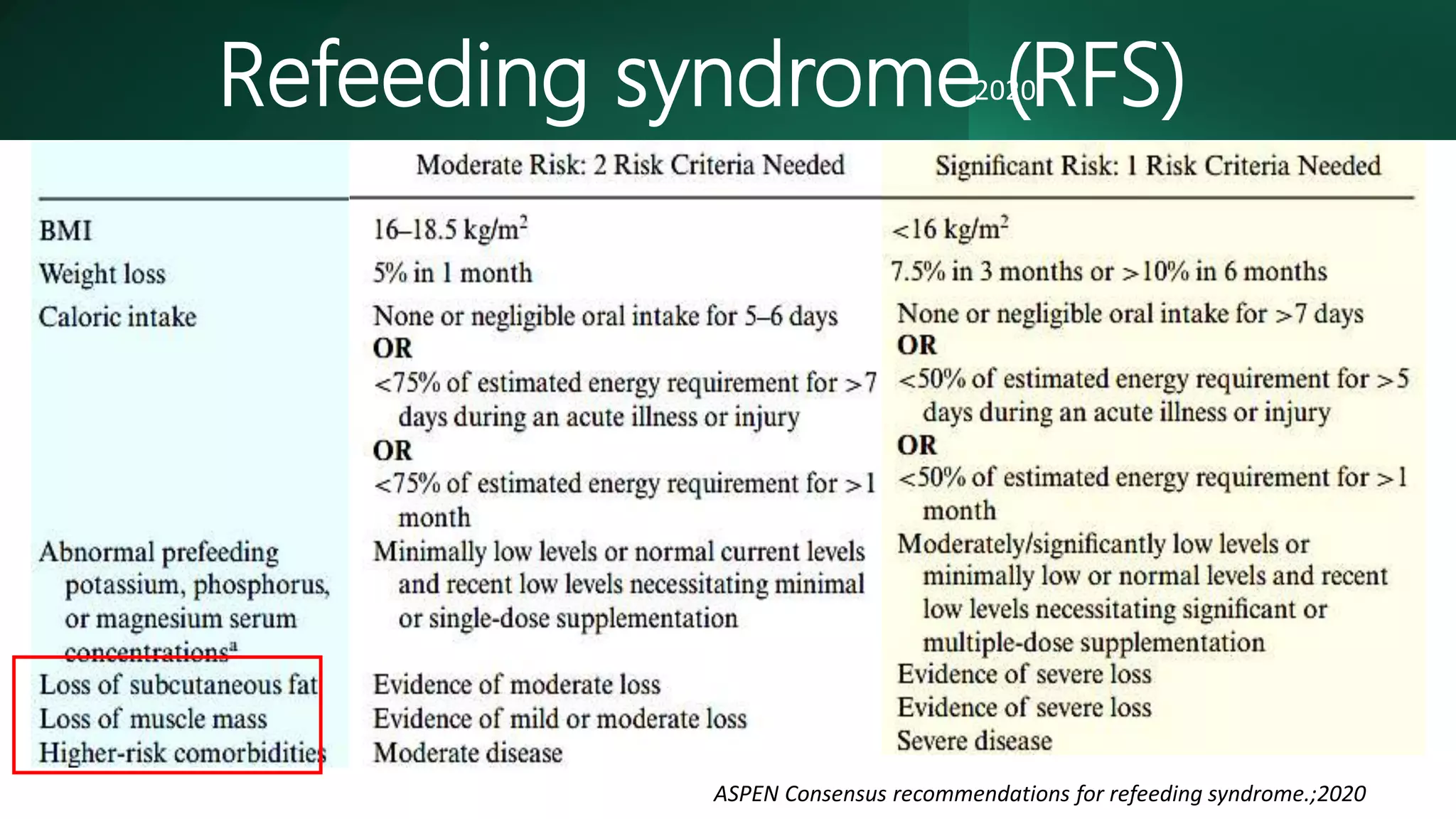
Refeeding syndrome (RFS)
2020
ASPEN Consensus recommendations for refeeding syndrome.;2020
Any
Predictive
Biomarker
s?
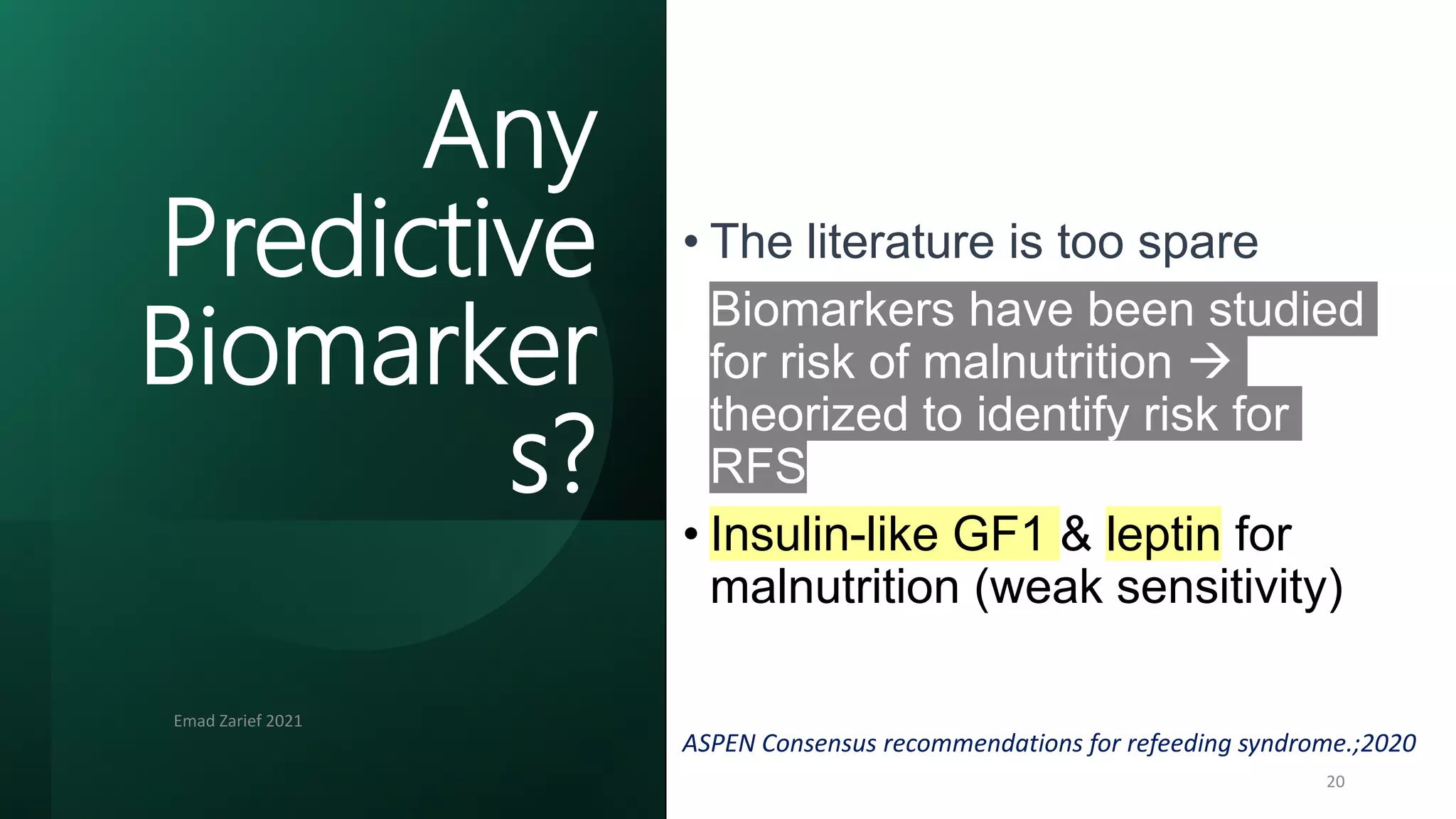
 Albumin long t-half
 Prealbumin of short t-half (2 to 3
days).
 These markers are unreliable as they
are acute phase reactants.
 Clinical examination remains crucial
in such patients.
.
Gastroenterol Rep (Oxf). 2016;4(4):272-280.
19
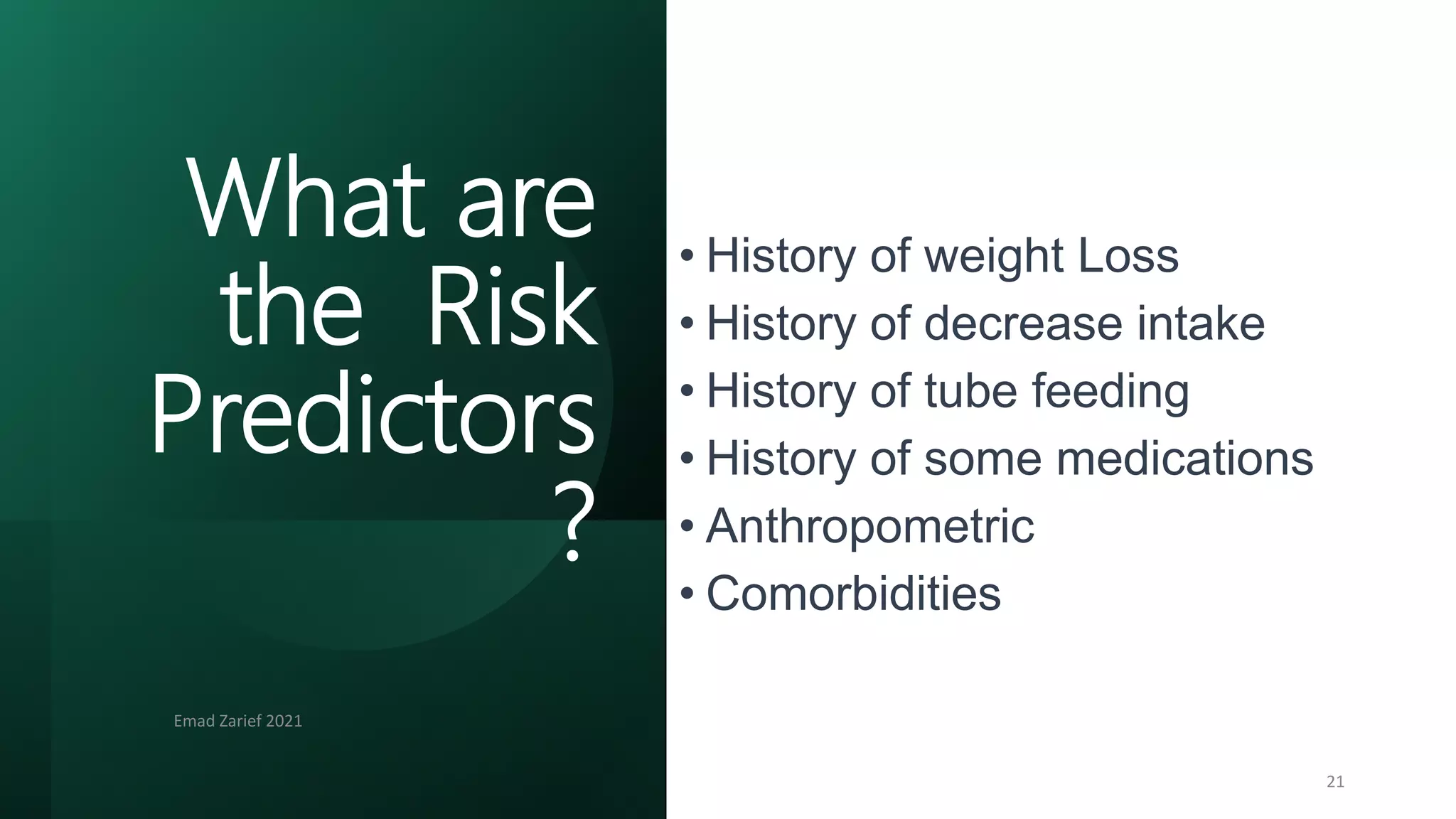
• The literature is too spare
• Biomarkers have been studied
for risk of malnutrition 
theorized to identify risk for
RFS.
• Insulin-like GF1 & leptin for
malnutrition (weak sensitivity)
ASPEN Consensus recommendations for refeeding syndrome.;2020
Emad Zarief 2021
20
Any
Predictive
Biomarker
s?
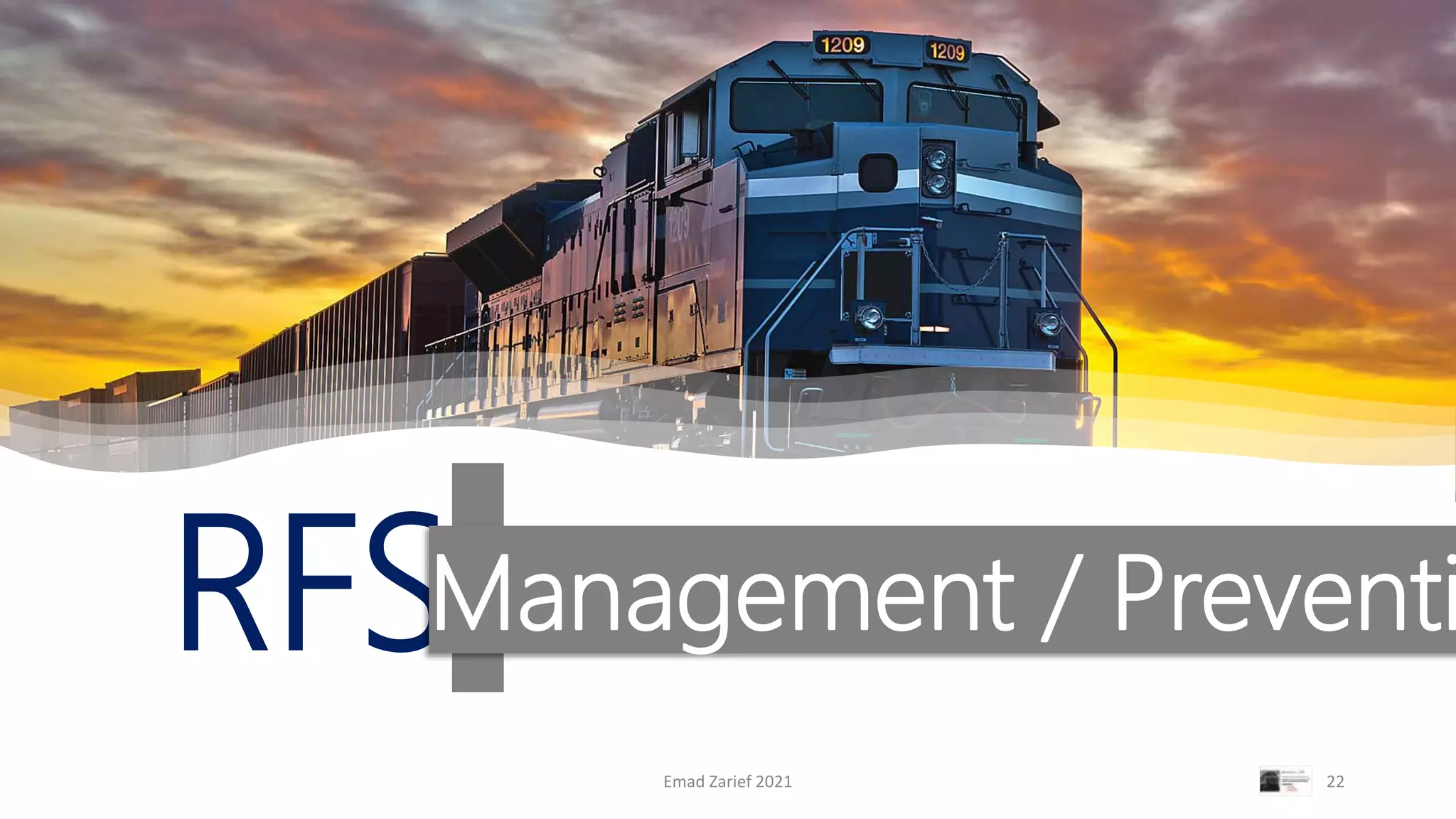
• History of weight Loss
• History of decrease intake
• History of tube feeding
• History of some medications
• Anthropometric
• Comorbidities
Emad Zarief 2021
21
What are
the Risk
Predictors
?
Emad Zarief 2021 22
RFSManagement / Preventi
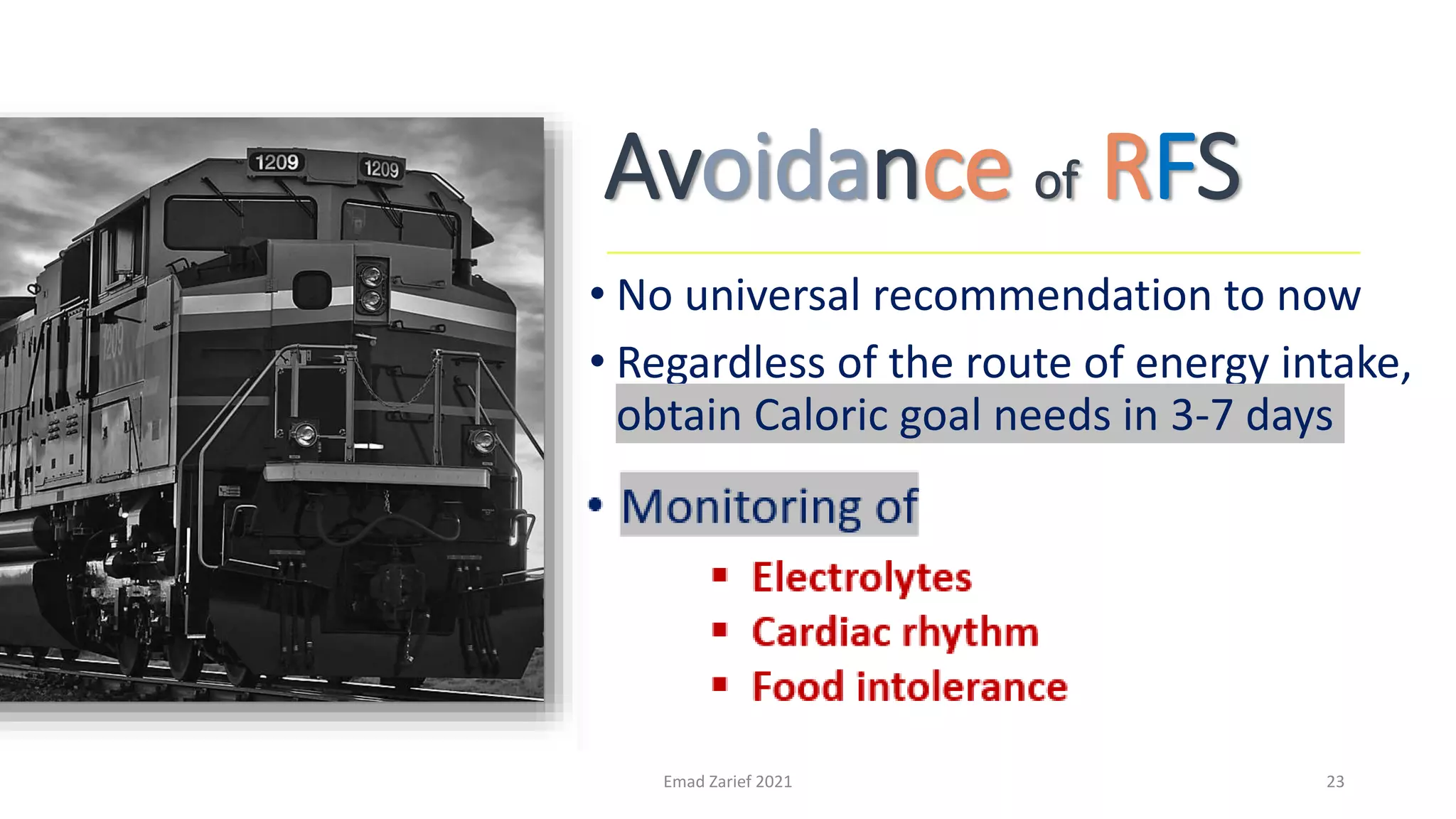
Avoidance of RFS
• No universal recommendation to now
• Regardless of the route of energy intake,
obtain Caloric goal needs in 3-7 days
Emad Zarief 2021 23
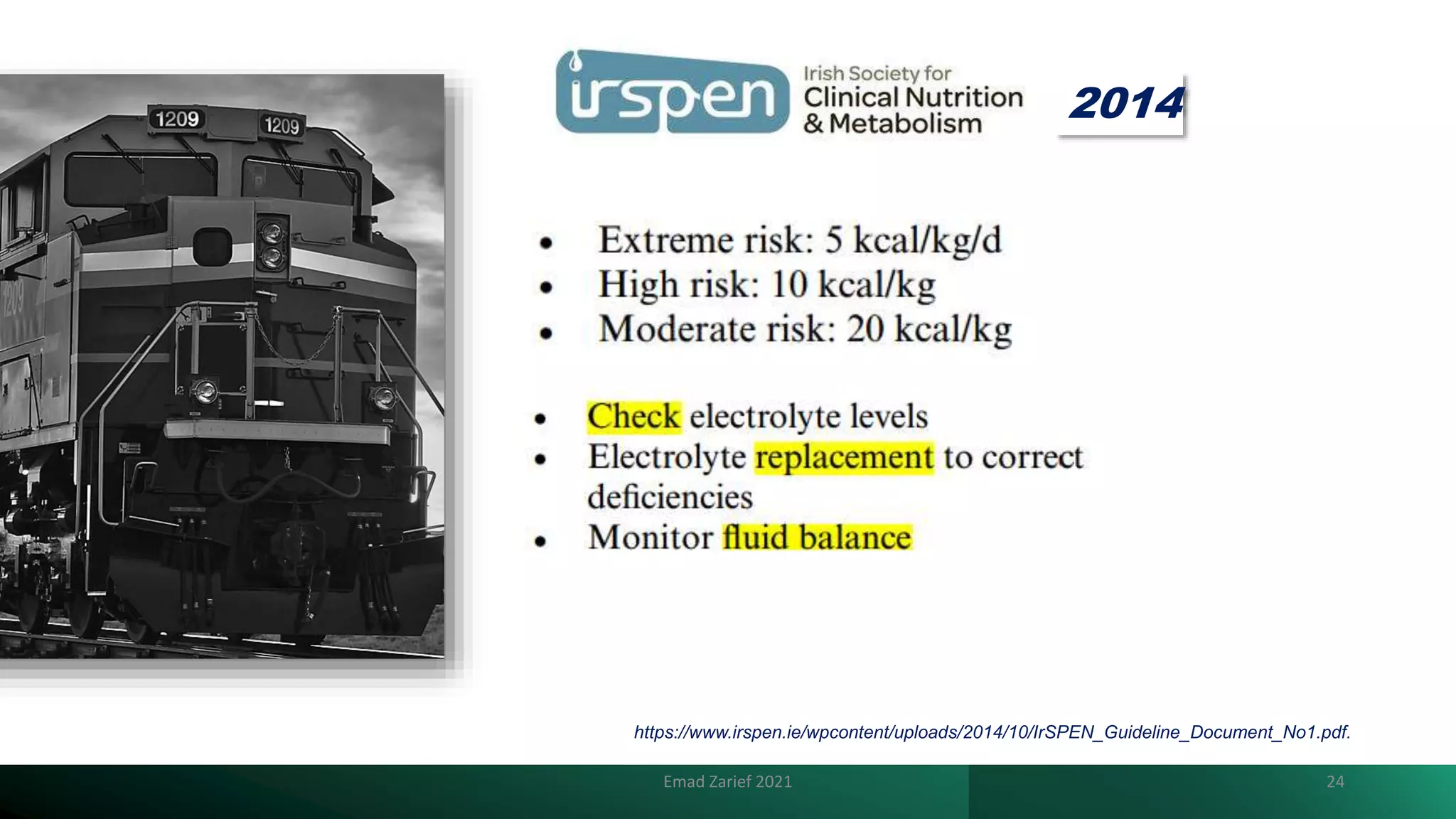
https://www.irspen.ie/wpcontent/uploads/2014/10/IrSPEN_Guideline_Document_No1.pdf.
Emad Zarief 2021 24
2014
Emad
Zarief
2021
.
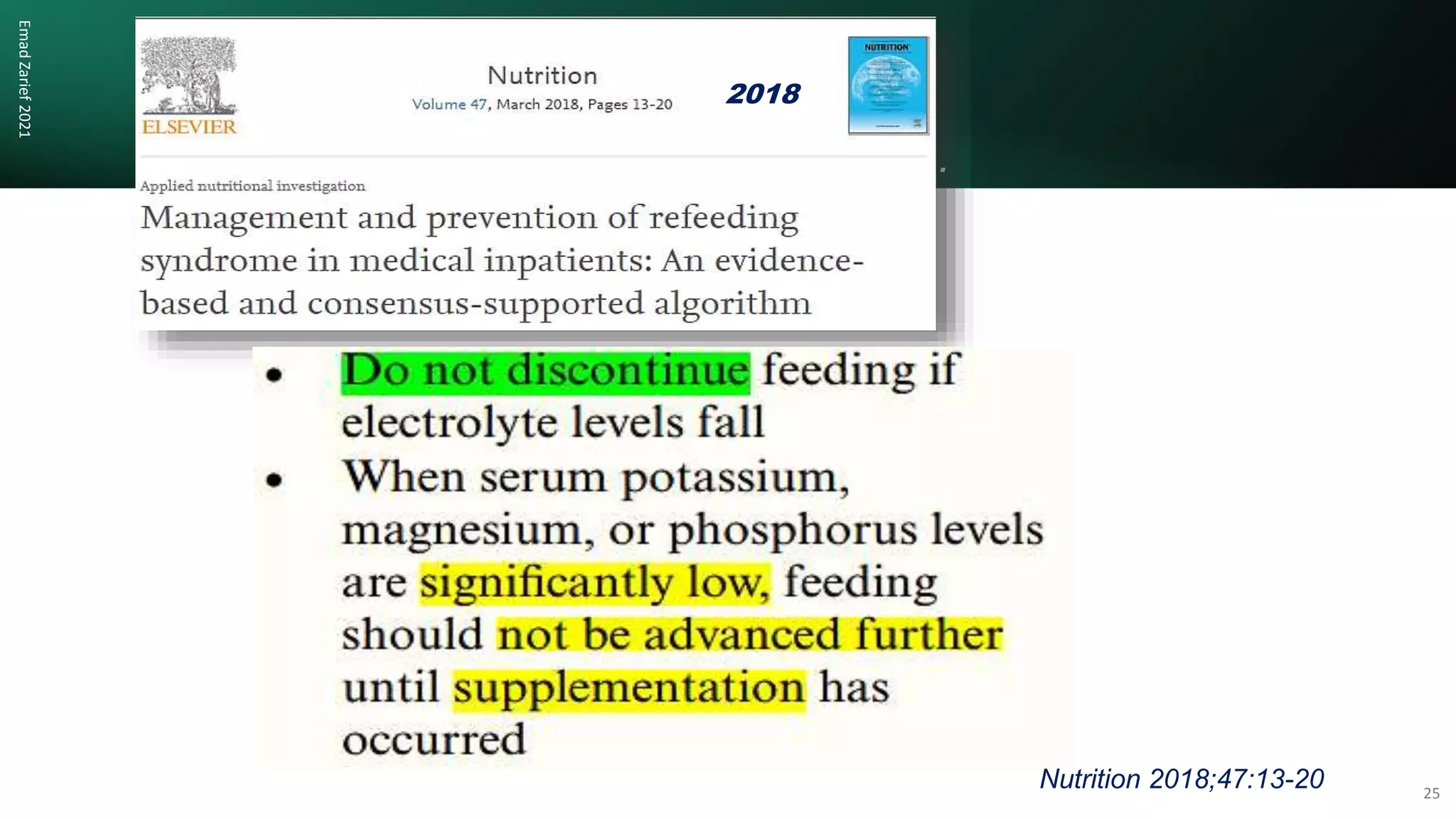
25
Nutrition 2018;47:13-20
2018
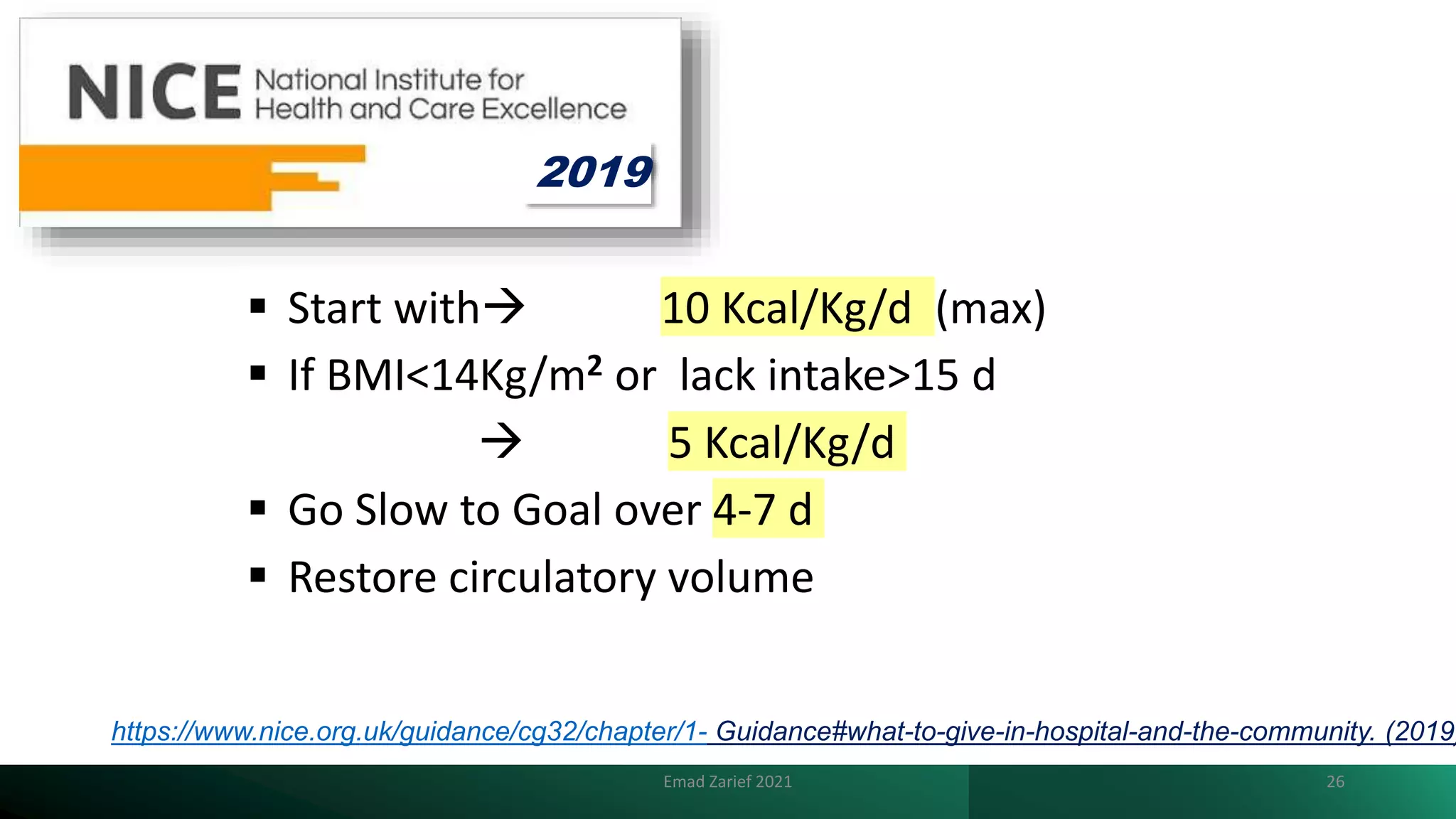
https://www.nice.org.uk/guidance/cg32/chapter/1- Guidance#what-to-give-in-hospital-and-the-community. (2019)
 Start with 10 Kcal/Kg/d (max)
 If BMI<14Kg/m2 or lack intake>15 d
 5 Kcal/Kg/d
 Go Slow to Goal over 4-7 d
 Restore circulatory volume
Emad Zarief 2021 26
2019
Initiate nutrition at a maximum of 40%–50% goal
Starting the glucose infusion rate 4–6 mg/kg/min
Advancing by 1–2 mg/kg/min daily
Emad Zarief 2021 27
ASPEN Consensus recommendations for refeeding syndrome.;2020
2020
ASPEN Consensus recommendations for refeeding syndrome.;2020
• Check electrolytes before initiation of nutrition
• Then / 12 hr. for 1st 3 days
• Replete low electrolytes
• No prophylactic supplements
• If electrolytes become difficult to correct or drop precipitously 
• ⇟
⇟ dextrose/calories by 50% and then,
• ↟
↟ dextrose/calories (33% of goal) / 1–2 days
28
2020
Supplement thiamin 100 mg before initiating dextrose-
containing IV fluids in patients at risk
Thiamine for 5–7 days or longer in high risk for deficiency
and/or signs of thiamin deficiency.
Iv or oral multivitamins once daily for 10 days or greater
based on clinical status
Emad Zarief 2021 29
ASPEN Consensus recommendations for refeeding syndrome.;2020
2020
Avoidance of RFS
• Predict the risk
• Obtain Caloric goal needs in 3-7 days
Emad Zarief 2021 30
Thank
you
Emad Zarief 2021 31
emadzarief@aun.edu.eg

Refeedin Syndrome

  • 1.
    The Hidden enemy Refeedingsyndrom Emad Zarief MD Anesthesia & Surgical intensive care Dpt.
  • 2.
    Agenda Emad Zarief 20212 Definition of RFS Pathophysiology Incidence Screening for Prevention
  • 3.
    Refeeding Syndrome (RFS)is a set of metabolic & electrolyte alterations occurring due to reintroduction of calories through oral, enteral, parenteral nutrition after a period of consistent reduction of energy intake or starvation in individuals with pre- existent malnutrition and/or in a catabolic state. 3 ASPEN Consensus recommendations for refeeding syndrome.;2020 Definition
  • 4.
    Limitations: lack ofcapturing a patient’s clinical presentation.  Mild 10% to 20%  Moderate 20% to 30%  Sever >30% + organ dysfunction resulting from a ⇟ in any of these and/or thiamine sever deficiency within 5 d. of a reintroduction of calories ⇟of serum phosphorus, potassium, and/or magnesium levels ASPEN Consensus recommendations for refeeding syndrome.;2020 Definition and classification
  • 5.
    Emad Zarief 20215 ASPEN Consensus recommendations for refeeding syndrome.;2020 https://doi.org/10.1002/ncp.10474 NUTRITION DEPRIVATION THEN, REPLENISHMENT OF NUTRIENTS → ↑↑ INSULIN SECRETION INTRACELLULAR SHIFT OF P++, K+ , CA++, MG++ ↑↑ GLYCOLYSIS, THE SYNTHESIS OF GLYCOGEN, FATS, PROTEINS ↑↑ SODIUM AND WATER RETENTION, AND FINAL ATP DEPLETION Pathophysiology
  • 6.
    RFS Clinical effects  Myocardialdepression and atrophy  Arrythmias  Salt &Water retention --> CHF  Respiratory distress  Hemolytic anemia, thrombocytopenia, impaired WBCS activity  Paresthesia, confusion weakness, encephalopathy up to seizures  Muscle weakness, myalgia, up to rhabdomyolysis  GIT dysfunction Mehanna HM, et al. Refeeding syndrome: what it is, and how to prevent and treat it. BMJ. 2008 ;336(7659):1495-8. Emad Zarief 2021
  • 7.
  • 8.
    Emad Zarief 20218 The incidence of RFS
  • 9.
    Emad Zarief 2021 9  Critically illpatients (nutrition held for 48 h) have a 34% chance of hypophosphatemia.  Severe hypophosphatemia has mortality of 18.2% compared with 4.6% among patients without hypophosphatemia. 1996
  • 10.
    Incidence of RFS Emad Zarief 2021 Because thereis no real definition, the incidence of RFS is unknown !! 11 2008
  • 11.
    Kraaijenbrink et al.Incidence of refeeding syndrome in internal medicine patients. Neth J Med. 2016;74(3):116-21. Patients with a malignancy or previous malignancy at increased risk of developing refeeding syndrome (p < 0.05) Emad Zarief 2021 12 399 97 At risk RFS in 14 NICE screening 178 2016
  • 12.
    Susceptible Personnel Malabsorption syndrome Malignancy Mentally affected CRRT P. dialysis Criticallyill ED patients Child abuse & starvation Some athletes ASPEN Consensus recommendations for refeeding syndrome.;2020 Emad Zarief 2021 13
  • 13.
    Screening for RFS EmadZarief 2021 14
  • 14.
    Screening Tool Clin Nutr.2005;24(1):75-82 Emad Zarief 2021 15
  • 15.
    One of: - BMI< 18.5 kg/m2 - Recent unintentional weight loss > 10% - Little/no food intake >5 days Emad Zarief 2021 16 Moderate Risk 2006
  • 16.
    Emad Zarief 202117 One of: - BMI<16 kg/m2 - Recent unintentional weight loss >15% - Little/no food intake >10 days - Levels of K, Mg or PO4 low prior to feeding Two of: - BMI<18.5 kg/m2 - Recent unintentional weight loss >10% - Little/no food intake >5 days - Alcohol abuse / drugs e.g., insulin, chemotherapy, antacids, or diuretics High Risk 2006
  • 17.
    Refeeding syndrome (RFS) 2020 ASPENConsensus recommendations for refeeding syndrome.;2020
  • 18.
    Any Predictive Biomarker s?  Albumin longt-half  Prealbumin of short t-half (2 to 3 days).  These markers are unreliable as they are acute phase reactants.  Clinical examination remains crucial in such patients. . Gastroenterol Rep (Oxf). 2016;4(4):272-280. 19
  • 19.
    • The literatureis too spare • Biomarkers have been studied for risk of malnutrition  theorized to identify risk for RFS. • Insulin-like GF1 & leptin for malnutrition (weak sensitivity) ASPEN Consensus recommendations for refeeding syndrome.;2020 Emad Zarief 2021 20 Any Predictive Biomarker s?
  • 20.
    • History ofweight Loss • History of decrease intake • History of tube feeding • History of some medications • Anthropometric • Comorbidities Emad Zarief 2021 21 What are the Risk Predictors ?
  • 21.
    Emad Zarief 202122 RFSManagement / Preventi
  • 22.
    Avoidance of RFS •No universal recommendation to now • Regardless of the route of energy intake, obtain Caloric goal needs in 3-7 days Emad Zarief 2021 23
  • 23.
  • 24.
  • 25.
    https://www.nice.org.uk/guidance/cg32/chapter/1- Guidance#what-to-give-in-hospital-and-the-community. (2019) Start with 10 Kcal/Kg/d (max)  If BMI<14Kg/m2 or lack intake>15 d  5 Kcal/Kg/d  Go Slow to Goal over 4-7 d  Restore circulatory volume Emad Zarief 2021 26 2019
  • 26.
    Initiate nutrition ata maximum of 40%–50% goal Starting the glucose infusion rate 4–6 mg/kg/min Advancing by 1–2 mg/kg/min daily Emad Zarief 2021 27 ASPEN Consensus recommendations for refeeding syndrome.;2020 2020
  • 27.
    ASPEN Consensus recommendationsfor refeeding syndrome.;2020 • Check electrolytes before initiation of nutrition • Then / 12 hr. for 1st 3 days • Replete low electrolytes • No prophylactic supplements • If electrolytes become difficult to correct or drop precipitously  • ⇟ ⇟ dextrose/calories by 50% and then, • ↟ ↟ dextrose/calories (33% of goal) / 1–2 days 28 2020
  • 28.
    Supplement thiamin 100mg before initiating dextrose- containing IV fluids in patients at risk Thiamine for 5–7 days or longer in high risk for deficiency and/or signs of thiamin deficiency. Iv or oral multivitamins once daily for 10 days or greater based on clinical status Emad Zarief 2021 29 ASPEN Consensus recommendations for refeeding syndrome.;2020 2020
  • 29.
    Avoidance of RFS •Predict the risk • Obtain Caloric goal needs in 3-7 days Emad Zarief 2021 30
  • 30.
    Thank you Emad Zarief 202131 emadzarief@aun.edu.eg

Editor's Notes

  • #14 CRRT Continuous R. R. therapy, ED emergency department
  • #17 National Institute for Health and Care Excellence. Nutrition support for adults: oral nutrition support, enteral tube feeding and parenteral nutrition (CG32). 2006
  • #18 National Institute for Health and Care Excellence. Nutrition support for adults: oral nutrition support, enteral tube feeding and parenteral nutrition (CG32). 2006
  • #19 https://doi.org/10.1002/ncp.10474
  • #20 Gastroenterology report journal
  • #26 Nutrition 2018;47:13-20