Akhfin Rahardhiyanto 
Elinda Fariz 
Naimy Zam Zam 
Sarrah Ulfah 
Silva Citra Dewi
We could make difference between 2 
types of study: 
1.Those who focuse on comparing the value, 
priority and orientation based on each 
typical of culture 
2.Those who focuse on on actual 
communication. 
American and British cultures are taken 
as typical examples of low-context cultures. 
Hutching and Weir(2007) said that they 
remark that Arabs consider their word of 
honor as binding and there is no need 
formal wirtten contexts.
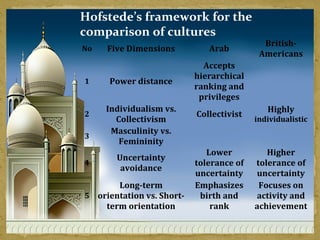
No. Five Dimensions Arab British-Americans 
1 Power distance 
Accepts 
hierarchical 
ranking and 
privileges 
2 Individualism vs. Collectivism Collectivist Highly 
individualistic 
3 Masculinity vs. Femininity 
4 Uncertainty avoidance Lower tolerance of 
uncertainty 
Higher tolerance 
of uncertainty 
5 Long-term orientation vs. Short-term 
orientation 
Emphasizes birth 
and rank 
Focuses on 
activity and 
achievement 
Hofstede’s framework for the 
comparison of cultures 
No Five Dimensions Arab 
British- 
Americans 
1 Power distance 
Accepts 
hierarchical 
ranking and 
privileges 
2 
Individualism vs. 
Collectivism 
Collectivist Highly 
individualistic 
3 
Masculinity vs. 
Femininity 
4 
Uncertainty 
avoidance 
Lower 
tolerance of 
uncertainty 
Higher 
tolerance of 
uncertainty 
5 
Long-term 
orientation vs. Short-term 
orientation 
Emphasizes 
birth and 
rank 
Focuses on 
activity and 
achievement
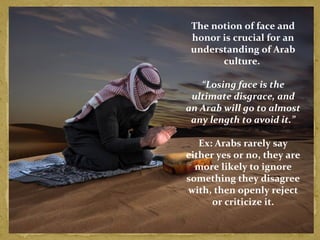
The notion of face and 
honor is crucial for an 
understanding of Arab 
culture. 
“Losing face is the 
ultimate disgrace, and 
an Arab will go to almost 
any length to avoid it.” 
Ex: Arabs rarely say 
either yes or no, they are 
more likely to ignore 
something they disagree 
with, then openly reject 
or criticize it.
Politeness issues differences in positive & 
negative politeness: 
In terms of offering British prefers positive politeness while 
Arab favors negative politeness 
Ex: in British when they offer food they’ll say “would you like 
another piece of cake?” while Moroccan would forcefully give 
more food and wouldn’t take no for an answer. 
In terms of written communication 
Ex: in job application letters, Arabic speakers use less negative 
politeness and more positive politeness (using compliments 
and appeal for pity). 
In terms of compliments Arabic-speaking communities use 
more formulas than Americans in compliments. 
Ex: similar formulas that exist in two languages used with 
different speaking actions (English thank god and Arabic 
hamdu lillah)
Another source of 
misunderstanding may be 
the subjects of conversation 
chosen by the participants 
in an Anglo-Arab 
interaction. 
The Arabic speakers 
differed significantly from 
the Americans in their 
judgments of what points 
could appropriately be 
talked about discussionsof 
age, money, recreation, 
weather, travel, and 
themselves.
Non-linguistic parameters such as gestures, eye contact, 
and personal space may also have impact on 
interlocutor’s perceptions of one another. 
Researcher found that the Arabs confronted each other 
more directly than the Americans, sat closer to each 
other, and looked each other more squarely in the eye. 
About personal space, may this space will be different 
between friends and between strangers. Norms for 
personal space clearly vary depending on whether the 
interlocutors are the same or the opposite sex
About eye contact, Wunderle (2007) 
advising intercultural negotiators, 
maintains that Arab use more eye contact 
than their American counterparts, but US 
Department Of Justice document (n.d.) 
for police training warns that in Arab 
culture it is disrespectful to maintain 
direct consistent eye contact. 
 Here too, it is probably necessary to 
distinguish situations involving different 
sexes from same sex interactions
Participants in an 
intercultural exchange 
cannot be assumed that 
they maintain the 
communication patterns 
they habitually use with 
their compatriots. 
Arabic speakers prefer to 
express disagreements 
indirectly when talking 
among themselves.
Discussion of intercultural 
interaction often seems to 
focus on the productive side 
of interaction, advising 
participants on how to talk 
to other. Americans need 
not only to know how to be 
polite when speaking to 
Arabs,and to be able to 
interpret the Arabs.
Family Values 
Meeting Etiquette 
Gift Giving Etiquette 
Dining Etiquette 
Table manners 
Business Meeting Etiquette 
Business Negotiating 
Dress Etiquette 
Business Card
In tthhee lliitteerraattuurree oonn AAnngglloo--AArraabb 
ccoommmmuunniiccaattiioonn tthhaatt tthhee kkeeyy ttoo 
ssuucccceessssffuull iinntteerrccuullttuurraall 
ccoommmmuunniiccaattiioonniiss kknnoowwlleeddggee ooff tthhee 
ootthheerrss’’ ccuullttuurree.. SSoo oofftteenn lleeaarrnniinngg ttoo 
iinntteerraacctt wwiitthh mmeemmbbeerrss ooff aannootthheerr 
ccuullttuurree sseeeemmss ttoo bbee eeqquuaalleedd wwiitthh 
lleeaarrnniinngg aabboouutt tthhiiss ccuullttuurree..
There are number of problems with this assumption, 
and we would agree with Shi-Xu and Wilson’s remark 
that “more linguistic and cultural knowledge is not a 
necessary, not even a sufficient, condition for the 
success of intercultural communication”.
First, there is the danger that provision of detailed 
information about the other may full interactants into a 
false sense of security. And this is definitely a situation 
where a little knowledge maybe a dangerous thing. A 
misused formula, a misleading gesture, or a 
misinterpreted remark may sometimes have far more 
serious consequences that a simple admission of 
ignorance.
Obstacle in AAnngglloo--AArraabb IInntteerraaccttiioonn 
Another danger is the Western people who already 
judge Arabs in stereotype. 
And so, we would agree that studies of Anglo-Arab 
intercultural communication need to address not 
merely the norms of such communication.
 There is a big differences between Arabian people and Moslem people 
especially in culture 
 Arab culture refers to the culture in 
the countries in which the official 
language is Arabic (although the 
Arabic language in some of them is the language 
of minority), and the west officials and 
scholars used to call them "Arab countries" 
of Western Asia and North Africa, from 
Morocco to the Arabian Sea. 
 Arab, is one of the region that 
have numbers of different 
local signal
ANGLO-ARAB

ANGLO-ARAB

  • 1.
    Akhfin Rahardhiyanto ElindaFariz Naimy Zam Zam Sarrah Ulfah Silva Citra Dewi
  • 3.
    We could makedifference between 2 types of study: 1.Those who focuse on comparing the value, priority and orientation based on each typical of culture 2.Those who focuse on on actual communication. American and British cultures are taken as typical examples of low-context cultures. Hutching and Weir(2007) said that they remark that Arabs consider their word of honor as binding and there is no need formal wirtten contexts.
  • 4.
    No. Five DimensionsArab British-Americans 1 Power distance Accepts hierarchical ranking and privileges 2 Individualism vs. Collectivism Collectivist Highly individualistic 3 Masculinity vs. Femininity 4 Uncertainty avoidance Lower tolerance of uncertainty Higher tolerance of uncertainty 5 Long-term orientation vs. Short-term orientation Emphasizes birth and rank Focuses on activity and achievement Hofstede’s framework for the comparison of cultures No Five Dimensions Arab British- Americans 1 Power distance Accepts hierarchical ranking and privileges 2 Individualism vs. Collectivism Collectivist Highly individualistic 3 Masculinity vs. Femininity 4 Uncertainty avoidance Lower tolerance of uncertainty Higher tolerance of uncertainty 5 Long-term orientation vs. Short-term orientation Emphasizes birth and rank Focuses on activity and achievement
  • 5.
    The notion offace and honor is crucial for an understanding of Arab culture. “Losing face is the ultimate disgrace, and an Arab will go to almost any length to avoid it.” Ex: Arabs rarely say either yes or no, they are more likely to ignore something they disagree with, then openly reject or criticize it.
  • 6.
    Politeness issues differencesin positive & negative politeness: In terms of offering British prefers positive politeness while Arab favors negative politeness Ex: in British when they offer food they’ll say “would you like another piece of cake?” while Moroccan would forcefully give more food and wouldn’t take no for an answer. In terms of written communication Ex: in job application letters, Arabic speakers use less negative politeness and more positive politeness (using compliments and appeal for pity). In terms of compliments Arabic-speaking communities use more formulas than Americans in compliments. Ex: similar formulas that exist in two languages used with different speaking actions (English thank god and Arabic hamdu lillah)
  • 8.
    Another source of misunderstanding may be the subjects of conversation chosen by the participants in an Anglo-Arab interaction. The Arabic speakers differed significantly from the Americans in their judgments of what points could appropriately be talked about discussionsof age, money, recreation, weather, travel, and themselves.
  • 9.
    Non-linguistic parameters suchas gestures, eye contact, and personal space may also have impact on interlocutor’s perceptions of one another. Researcher found that the Arabs confronted each other more directly than the Americans, sat closer to each other, and looked each other more squarely in the eye. About personal space, may this space will be different between friends and between strangers. Norms for personal space clearly vary depending on whether the interlocutors are the same or the opposite sex
  • 10.
    About eye contact,Wunderle (2007) advising intercultural negotiators, maintains that Arab use more eye contact than their American counterparts, but US Department Of Justice document (n.d.) for police training warns that in Arab culture it is disrespectful to maintain direct consistent eye contact.  Here too, it is probably necessary to distinguish situations involving different sexes from same sex interactions
  • 11.
    Participants in an intercultural exchange cannot be assumed that they maintain the communication patterns they habitually use with their compatriots. Arabic speakers prefer to express disagreements indirectly when talking among themselves.
  • 12.
    Discussion of intercultural interaction often seems to focus on the productive side of interaction, advising participants on how to talk to other. Americans need not only to know how to be polite when speaking to Arabs,and to be able to interpret the Arabs.
  • 13.
    Family Values MeetingEtiquette Gift Giving Etiquette Dining Etiquette Table manners Business Meeting Etiquette Business Negotiating Dress Etiquette Business Card
  • 15.
    In tthhee lliitteerraattuurreeoonn AAnngglloo--AArraabb ccoommmmuunniiccaattiioonn tthhaatt tthhee kkeeyy ttoo ssuucccceessssffuull iinntteerrccuullttuurraall ccoommmmuunniiccaattiioonniiss kknnoowwlleeddggee ooff tthhee ootthheerrss’’ ccuullttuurree.. SSoo oofftteenn lleeaarrnniinngg ttoo iinntteerraacctt wwiitthh mmeemmbbeerrss ooff aannootthheerr ccuullttuurree sseeeemmss ttoo bbee eeqquuaalleedd wwiitthh lleeaarrnniinngg aabboouutt tthhiiss ccuullttuurree..
  • 16.
    There are numberof problems with this assumption, and we would agree with Shi-Xu and Wilson’s remark that “more linguistic and cultural knowledge is not a necessary, not even a sufficient, condition for the success of intercultural communication”.
  • 17.
    First, there isthe danger that provision of detailed information about the other may full interactants into a false sense of security. And this is definitely a situation where a little knowledge maybe a dangerous thing. A misused formula, a misleading gesture, or a misinterpreted remark may sometimes have far more serious consequences that a simple admission of ignorance.
  • 18.
    Obstacle in AAnngglloo--AArraabbIInntteerraaccttiioonn Another danger is the Western people who already judge Arabs in stereotype. And so, we would agree that studies of Anglo-Arab intercultural communication need to address not merely the norms of such communication.
  • 19.
     There isa big differences between Arabian people and Moslem people especially in culture  Arab culture refers to the culture in the countries in which the official language is Arabic (although the Arabic language in some of them is the language of minority), and the west officials and scholars used to call them "Arab countries" of Western Asia and North Africa, from Morocco to the Arabian Sea.  Arab, is one of the region that have numbers of different local signal