Trends in Medical education Dr. Neelesh Bhandari M.B.B.S (AFMC), M.D ( Path) P.G.P. in Human Rights
TV will be shut in 10 years, says BILL GATES "An interesting revolution is underway". said Microsoft founder Bill Gates. In the future there will be  elimination of text book or books altogether  because  we will have a very light screen, a tablet-like computer connected to the Internet that  you will carry with you at all times.
Medical education   has a history of tinkering with the curriculum endlessly without   realizing larger educational objectives. Medical Schools have yet to   create  a true learner- centered environment   that makes active,   self-directed learning  under the close tutelage of interested   faculty members .
A set of basic  competencies  and expectations from a competent medical graduate, for “ the Physician of the  21 st  century ” E ffective Communication. Basic clinical skills. Using science to guide Diagnosis, Management, Therapeutics & prevention. Lifelong Learning. Self-Awareness, Self –Care & Personal Growth. The social & Community Contexts of Health Care. Moral reasoning& Ethical judgment. Problem Solving. Professionalism & Role Recognition.
* Traditional lecture based approach, which is often teacher oriented * D eprives the students of active learning with less clinical content * Poor development of student skills Inadequacies of the present  Teaching Program
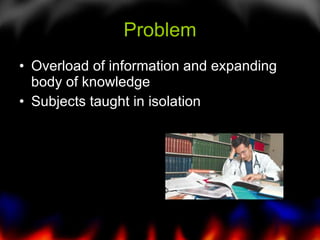
Problem Overload of information and expanding  body of knowledge Subjects taught in isolation
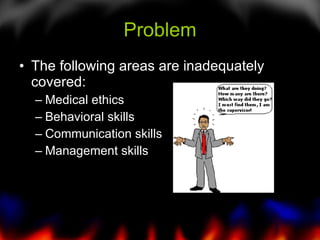
Problem The following areas are inadequately covered: Medical ethics Behavioral skills Communication skills Management skills
Problem No provision for training medical students  for PG entrance tests.  No training in using information technology  for gathering current scientific evidence.
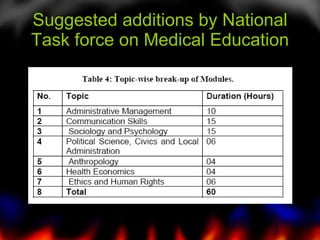
Suggested additions by National Task force on Medical Education
Good teaching is by design and not by chance
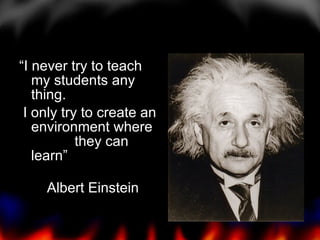
“I never try to teach my students any thing. I only try to create an environment where  they can learn” Albert Einstein
The Goal of Medical Education The ultimate aim of the MBBS program is not only  to enable medical graduates acquire competencies related to knowledge, skill and attitude required of a medical graduate  on completion of undergraduate medical education but also  to provide sufficient opportunity to them to become familiar with the know how of medical informatics that would ultimately help them work efficiently.
Medical informatics Health informatics  or  medical informatics  is the intersection of  information science ,  medicine  and  health care .  It deals with the resources, devices and methods required to optimize the acquisition, storage, retrieval and use of information in health and biomedicine .  Health informatics tools include not only computers but also clinical guidelines, formal medical terminologies, and information and communication systems. Subdomains of  (bio)medical  or  health care informatics  include:  clinical informatics ,  nursing informatics ,  imaging informatics ,  consumer health informatics ,  public health informatics ,  dental informatics ,  clinical research informatics ,  bioinformatics ,  veterinary informatics , and pharmacy informatics.
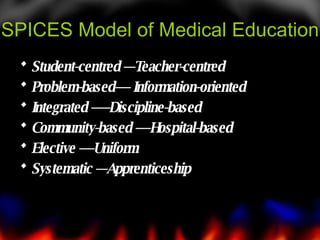
SPICES Model of Medical Education Student-centred ---Teacher-centred Problem-based---- Information-oriented Integrated -----Discipline-based Community-based ----Hospital-based Elective ----Uniform Systematic ---Apprenticeship
e-learning Also called CBT ( Computer based teaching ) A general term that relates to all training that is delivered with the assistance of a computer Delivery: CD,  Internet,  shared files on a network
e-learning Learning process facilitated by technology An additional arm to the teacher’s armamentarium e-Learning provides an environment that transforms teacher centric to learner centric learning .
Problems of Traditional teaching and benefits of e-learning  E-learning has the potential to enhance both the students and instructors educational experience. Traditional didactic lectures often fall  short in meeting the different learning styles of pupils. e-learning allows- students to access the lectures and other material when they are most attentive.  In addition, students have the ability to review the material to the degree they feel necessary .


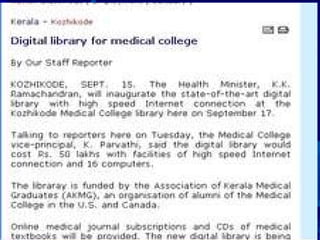
NTR university digital library To start with, the library is subscribing to 152 journals in 37 disciplines and 102 e-textbooks and yearbooks at a cost of Rs. 1.92 crores.  He said that it was mainly a reference library for the fields of medical and allied sciences.  Responding to the changing modes in the curriculum, the university had decided to focus on web-based resources and services. Staff and students of medical colleges affiliated to the university and staff of Government hospitals and other teaching hospitals in the State were eligible for regular membership in the library.
MEdRC EduTech Medical Education Research Centre  for Education Technologies    MEdRC was set up in 1993 by Dr. Neeraj Raj, evolved  into an ambitious project that aims at significantly enhancing the existing infrastructure and quality of medical and health education through digital channels using SmarTeach, a World-Class Teaching/ Learning software developed by MEdRC.
MEdRC Edutech A solution to medical education from the private sector. First of its kind in India Herculean task – About 7500 lectures from Anatomy to Medicine
AIMS of MEdRC To develop an exhaustive library of digitally archived e-Lectures by “Master Teachers” encompassing the undergraduate and continuing medical curriculum. To support and promote the expansion of lifelong learning at all levels of practicing healthcare professionals, particularly in the form of continuing professional development
AIMS of  MEdRC  To develop interactive and hyper-linked  e-Learning modules that include animations and simulations of laboratory experiments and clinical case databases. 
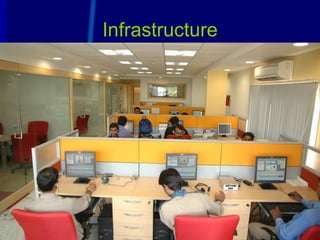
Infrastructure
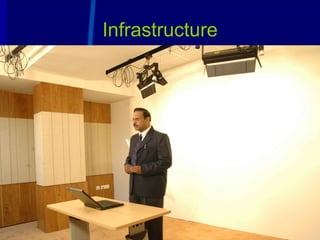
Infrastructure
UGMed The product shall be hosted on the SmarTeach Learning Management System (LMS) at a medical college. 
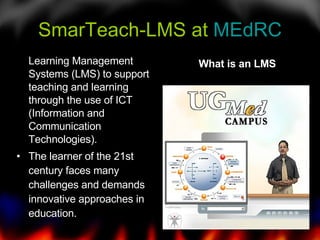
SmarTeach-LMS at  MEdRC Learning Management Systems (LMS) to support teaching and learning through the use of ICT (Information and Communication Technologies).  The learner of the 21st century faces many challenges and demands innovative approaches in education.  What is an LMS
Delivery of student assessments and course critiques and the collection of responses    Tracking of learner progress    Virtual classrooms    Collaboration between learners    Record of learners’ acquisition of knowledge, skills, and competencies .   Importance of LMS
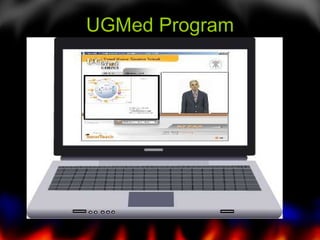
UGMed Program  Targeted towards Undergraduate Medical students. The entire MBBS curriculum as per the MCI prescribed syllabus has been broken in to component subjects, chapters and topics. Each topic constitutes a module of learning consisting of several granular learning objects such as digital lectures, slides, animations of concepts, textual notes, glossaries, questions relevant to the topic, book and journal references, etc  .
Content divided into three categories  M ust learn 2.Useful to learn 3.Interesting / Nice to learn
UGMed Each module is developed and delivered by a Teacher of Excellence who provides all inputs to the content. Gets peer reviewed by a subject expert  Subsequently gets enriched with addition of multimedia elements such as graphics, illustrations and animations.
UGMed Program
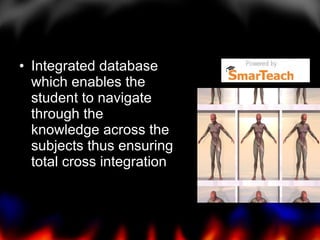
Integrated database which enables the student to navigate through the knowledge across the subjects thus ensuring total cross integration
Learner centered - benefits Anytime learning  Any where learning Any number of times learning Customized to level of assimilation Individual or group learning Interactivity based learning – active learning Enables group discussion across geographical barriers. Adaptability and flexibility of the system
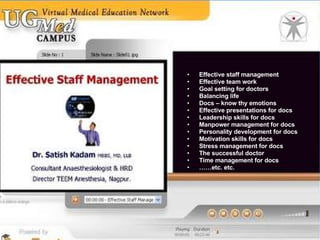
Solution Lectures on HR issues for doctors exclusively covers these issues  Effective staff management Effective team work Goal setting for doctors Balancing life Docs – know thy emotions Effective presentations for docs Leadership skills for docs Manpower management for docs Personality development for docs Motivation skills for docs Stress management for docs The successful doctor Time management for docs …… etc. etc.
A Note on Animation  2D Allow the students to visualize complex concepts and structural designs - enhance understanding and sharpening their doctoring skills.
A note on animations  3D  Animations transport students into a three-dimensional journey through the dynamic microscopic world of a cell visually pleasing and  scientifically meaningful . Take undergrads beyond textbooks and vividly illustrates the mechanisms.
Problem No provision for training medical students for PG entrance tests.
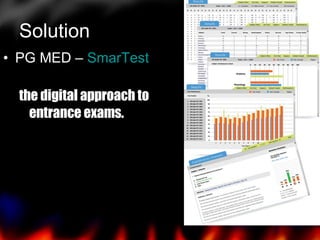
PG MED –  SmarTest  the digital approach to entrance exams. Solution
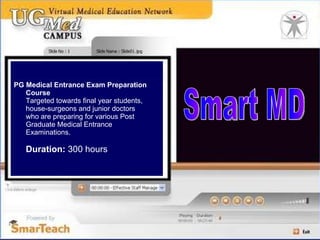
Smart MD PG Medical Entrance Exam Preparation Course Targeted towards final year students, house-surgeons and junior doctors who are preparing for various Post Graduate Medical Entrance Examinations.  Duration:  300 hours  
Also included: Case discussions and case oriented approach Videos in clinical medicine Clinical methods Emergencies and their management Evidence based medicine Ethics,  HR issues Computers for doctors Learning modules Questions bank – Large essay, short notes and MCQs
What is EBM.. The conscientious, explicit and judicious use of current best evidence in making clinical decisions about the care of individual patients Can be categorized into Evidence based Guidelines ( for institutions) Evidence based individual decision making
Advantages to Students Learn any topic through video lessons prepared by India’s best teachers including many authors of the books you normally read!  You can learn at the e-Library or access through owned Laptop for 5 years Self paced learning – Pause, View/Review, Skip/Rewind, Bookmark Add your own notes, Share notes, e-Mail and Chat Weaker students can take as tutorial several times Self assessments for students - Know your own strengths and weaknesses - Know where to devote more attention
Advantages to Medical Colleges Establish an Electronic Library with Servers, LAN, 25-50 PC’s, Software    Wi-Fi enabled Campus - Hotspots created in academic building, library, hostels, etc.    Deploy the SmarTeach Medical Learning Management System - All students get registered - Enhanced communication between     departments - Allows all academic activities to be tracked - Electronic records allow real time       management analysis
Advantages to College Management Get college technologically on par with campuses around the world    One of the ways to counter shortage of teachers    Existing teachers empowered with excellent and standardized teaching material & tools    Tracking of academic student data from 1st year to final year across all subjects
Advantages to Faculty Empowered to teach using modern audiovisual aids such as a Laptop and LCD projection system in the class Get training in use of I.T. for Teaching from Intel, Microsoft and MEdRC Able to create question papers for assessment using our bank of over 1,00,000 questions and MCQ’s
Standardized teaching material available to you  with readymade and customizable lesson plans, library of slides, illustrations, 2D and 3D animations  and case databases for teaching Access data on individual student / group progress   Advantages to Faculty..(contd.)
Demos Baby Delivery Brainstem Human Heart Spino Thalamic Tracts Blood glucose levels Induction of PEPCK Glucose  Alanine  Cycle Gluconeogenesis Coris Cycle Activation of Glycogen  Phosphorylase Glycogen Breakdown Cellular Respiration Citric Acid Cycle Inhibitors of Citric Acid Cycle Mechanism of PDH Mercuric Poisoning
Demos Oxidative  Phosphorylation PDH Complex Pyruvate  Dehydrogenase  Complex Regulation of Metabolite flow from Pyruvate through the TCA cycle Role of TCA Cycle in  Anebolism Urea Cycle Central Dogma DNA Replication Lac  Operon Prions Peripheal Nerves Changes in the Nerve Fiber: Stages of Regeneration Reflex Types Formation of Myelin Sheath
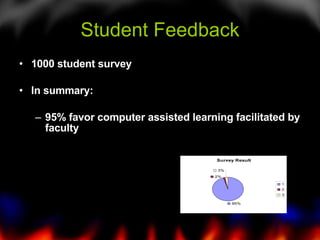
Student Feedback 1000 student survey In summary:  95% favor computer assisted learning facilitated by faculty Is computer assisted learning facilitated by faculty required?
Our Vision of a Virtual Medical Education Network
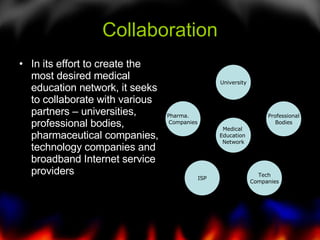
Collaboration In its effort to create the most desired medical education network, it seeks to collaborate with various partners – universities, professional bodies, pharmaceutical companies, technology companies and broadband Internet service providers  Pharma.  Companies ISP Tech Companies Professional Bodies University Medical  Education  Network
And Thanks for your time .

Medical education in India

  • 1.
    Trends in Medicaleducation Dr. Neelesh Bhandari M.B.B.S (AFMC), M.D ( Path) P.G.P. in Human Rights
  • 2.
    TV will beshut in 10 years, says BILL GATES "An interesting revolution is underway". said Microsoft founder Bill Gates. In the future there will be elimination of text book or books altogether because we will have a very light screen, a tablet-like computer connected to the Internet that you will carry with you at all times.
  • 3.
    Medical education has a history of tinkering with the curriculum endlessly without realizing larger educational objectives. Medical Schools have yet to create a true learner- centered environment that makes active, self-directed learning under the close tutelage of interested faculty members .
  • 4.
    A set ofbasic competencies and expectations from a competent medical graduate, for “ the Physician of the 21 st century ” E ffective Communication. Basic clinical skills. Using science to guide Diagnosis, Management, Therapeutics & prevention. Lifelong Learning. Self-Awareness, Self –Care & Personal Growth. The social & Community Contexts of Health Care. Moral reasoning& Ethical judgment. Problem Solving. Professionalism & Role Recognition.
  • 5.
    * Traditional lecturebased approach, which is often teacher oriented * D eprives the students of active learning with less clinical content * Poor development of student skills Inadequacies of the present Teaching Program
  • 6.
    Problem Overload ofinformation and expanding body of knowledge Subjects taught in isolation
  • 7.
    Problem The followingareas are inadequately covered: Medical ethics Behavioral skills Communication skills Management skills
  • 8.
    Problem No provisionfor training medical students for PG entrance tests. No training in using information technology for gathering current scientific evidence.
  • 9.
    Suggested additions byNational Task force on Medical Education
  • 10.
    Good teaching isby design and not by chance
  • 11.
    “I never tryto teach my students any thing. I only try to create an environment where they can learn” Albert Einstein
  • 12.
    The Goal ofMedical Education The ultimate aim of the MBBS program is not only to enable medical graduates acquire competencies related to knowledge, skill and attitude required of a medical graduate on completion of undergraduate medical education but also to provide sufficient opportunity to them to become familiar with the know how of medical informatics that would ultimately help them work efficiently.
  • 13.
    Medical informatics Healthinformatics or medical informatics is the intersection of information science , medicine and health care . It deals with the resources, devices and methods required to optimize the acquisition, storage, retrieval and use of information in health and biomedicine . Health informatics tools include not only computers but also clinical guidelines, formal medical terminologies, and information and communication systems. Subdomains of (bio)medical or health care informatics include: clinical informatics , nursing informatics , imaging informatics , consumer health informatics , public health informatics , dental informatics , clinical research informatics , bioinformatics , veterinary informatics , and pharmacy informatics.
  • 14.
    SPICES Model ofMedical Education Student-centred ---Teacher-centred Problem-based---- Information-oriented Integrated -----Discipline-based Community-based ----Hospital-based Elective ----Uniform Systematic ---Apprenticeship
  • 15.
    e-learning Also calledCBT ( Computer based teaching ) A general term that relates to all training that is delivered with the assistance of a computer Delivery: CD, Internet, shared files on a network
  • 16.
    e-learning Learning processfacilitated by technology An additional arm to the teacher’s armamentarium e-Learning provides an environment that transforms teacher centric to learner centric learning .
  • 17.
    Problems of Traditionalteaching and benefits of e-learning E-learning has the potential to enhance both the students and instructors educational experience. Traditional didactic lectures often fall short in meeting the different learning styles of pupils. e-learning allows- students to access the lectures and other material when they are most attentive. In addition, students have the ability to review the material to the degree they feel necessary .
  • 18.
  • 19.
  • 20.
  • 21.
    NTR university digitallibrary To start with, the library is subscribing to 152 journals in 37 disciplines and 102 e-textbooks and yearbooks at a cost of Rs. 1.92 crores. He said that it was mainly a reference library for the fields of medical and allied sciences. Responding to the changing modes in the curriculum, the university had decided to focus on web-based resources and services. Staff and students of medical colleges affiliated to the university and staff of Government hospitals and other teaching hospitals in the State were eligible for regular membership in the library.
  • 22.
    MEdRC EduTech MedicalEducation Research Centre  for Education Technologies  MEdRC was set up in 1993 by Dr. Neeraj Raj, evolved into an ambitious project that aims at significantly enhancing the existing infrastructure and quality of medical and health education through digital channels using SmarTeach, a World-Class Teaching/ Learning software developed by MEdRC.
  • 23.
    MEdRC Edutech Asolution to medical education from the private sector. First of its kind in India Herculean task – About 7500 lectures from Anatomy to Medicine
  • 24.
    AIMS of MEdRCTo develop an exhaustive library of digitally archived e-Lectures by “Master Teachers” encompassing the undergraduate and continuing medical curriculum. To support and promote the expansion of lifelong learning at all levels of practicing healthcare professionals, particularly in the form of continuing professional development
  • 25.
    AIMS of MEdRC To develop interactive and hyper-linked e-Learning modules that include animations and simulations of laboratory experiments and clinical case databases. 
  • 26.
  • 27.
  • 28.
    UGMed The productshall be hosted on the SmarTeach Learning Management System (LMS) at a medical college. 
  • 29.
    SmarTeach-LMS at MEdRC Learning Management Systems (LMS) to support teaching and learning through the use of ICT (Information and Communication Technologies). The learner of the 21st century faces many challenges and demands innovative approaches in education. What is an LMS
  • 30.
    Delivery of studentassessments and course critiques and the collection of responses   Tracking of learner progress   Virtual classrooms   Collaboration between learners   Record of learners’ acquisition of knowledge, skills, and competencies . Importance of LMS
  • 31.
    UGMed Program  Targetedtowards Undergraduate Medical students. The entire MBBS curriculum as per the MCI prescribed syllabus has been broken in to component subjects, chapters and topics. Each topic constitutes a module of learning consisting of several granular learning objects such as digital lectures, slides, animations of concepts, textual notes, glossaries, questions relevant to the topic, book and journal references, etc  .
  • 32.
    Content divided intothree categories M ust learn 2.Useful to learn 3.Interesting / Nice to learn
  • 33.
    UGMed Each moduleis developed and delivered by a Teacher of Excellence who provides all inputs to the content. Gets peer reviewed by a subject expert Subsequently gets enriched with addition of multimedia elements such as graphics, illustrations and animations.
  • 34.
  • 35.
    Integrated database whichenables the student to navigate through the knowledge across the subjects thus ensuring total cross integration
  • 36.
    Learner centered -benefits Anytime learning Any where learning Any number of times learning Customized to level of assimilation Individual or group learning Interactivity based learning – active learning Enables group discussion across geographical barriers. Adaptability and flexibility of the system
  • 37.
    Solution Lectures onHR issues for doctors exclusively covers these issues Effective staff management Effective team work Goal setting for doctors Balancing life Docs – know thy emotions Effective presentations for docs Leadership skills for docs Manpower management for docs Personality development for docs Motivation skills for docs Stress management for docs The successful doctor Time management for docs …… etc. etc.
  • 38.
    A Note onAnimation 2D Allow the students to visualize complex concepts and structural designs - enhance understanding and sharpening their doctoring skills.
  • 39.
    A note onanimations 3D Animations transport students into a three-dimensional journey through the dynamic microscopic world of a cell visually pleasing and scientifically meaningful . Take undergrads beyond textbooks and vividly illustrates the mechanisms.
  • 40.
    Problem No provisionfor training medical students for PG entrance tests.
  • 41.
    PG MED – SmarTest the digital approach to entrance exams. Solution
  • 42.
    Smart MD PGMedical Entrance Exam Preparation Course Targeted towards final year students, house-surgeons and junior doctors who are preparing for various Post Graduate Medical Entrance Examinations.  Duration: 300 hours  
  • 43.
    Also included: Casediscussions and case oriented approach Videos in clinical medicine Clinical methods Emergencies and their management Evidence based medicine Ethics, HR issues Computers for doctors Learning modules Questions bank – Large essay, short notes and MCQs
  • 44.
    What is EBM..The conscientious, explicit and judicious use of current best evidence in making clinical decisions about the care of individual patients Can be categorized into Evidence based Guidelines ( for institutions) Evidence based individual decision making
  • 45.
    Advantages to StudentsLearn any topic through video lessons prepared by India’s best teachers including many authors of the books you normally read! You can learn at the e-Library or access through owned Laptop for 5 years Self paced learning – Pause, View/Review, Skip/Rewind, Bookmark Add your own notes, Share notes, e-Mail and Chat Weaker students can take as tutorial several times Self assessments for students - Know your own strengths and weaknesses - Know where to devote more attention
  • 46.
    Advantages to MedicalColleges Establish an Electronic Library with Servers, LAN, 25-50 PC’s, Software   Wi-Fi enabled Campus - Hotspots created in academic building, library, hostels, etc.   Deploy the SmarTeach Medical Learning Management System - All students get registered - Enhanced communication between     departments - Allows all academic activities to be tracked - Electronic records allow real time       management analysis
  • 47.
    Advantages to CollegeManagement Get college technologically on par with campuses around the world   One of the ways to counter shortage of teachers   Existing teachers empowered with excellent and standardized teaching material & tools   Tracking of academic student data from 1st year to final year across all subjects
  • 48.
    Advantages to FacultyEmpowered to teach using modern audiovisual aids such as a Laptop and LCD projection system in the class Get training in use of I.T. for Teaching from Intel, Microsoft and MEdRC Able to create question papers for assessment using our bank of over 1,00,000 questions and MCQ’s
  • 49.
    Standardized teaching materialavailable to you with readymade and customizable lesson plans, library of slides, illustrations, 2D and 3D animations and case databases for teaching Access data on individual student / group progress Advantages to Faculty..(contd.)
  • 50.
    Demos Baby DeliveryBrainstem Human Heart Spino Thalamic Tracts Blood glucose levels Induction of PEPCK Glucose Alanine Cycle Gluconeogenesis Coris Cycle Activation of Glycogen Phosphorylase Glycogen Breakdown Cellular Respiration Citric Acid Cycle Inhibitors of Citric Acid Cycle Mechanism of PDH Mercuric Poisoning
  • 51.
    Demos Oxidative Phosphorylation PDH Complex Pyruvate Dehydrogenase Complex Regulation of Metabolite flow from Pyruvate through the TCA cycle Role of TCA Cycle in Anebolism Urea Cycle Central Dogma DNA Replication Lac Operon Prions Peripheal Nerves Changes in the Nerve Fiber: Stages of Regeneration Reflex Types Formation of Myelin Sheath
  • 52.
    Student Feedback 1000student survey In summary: 95% favor computer assisted learning facilitated by faculty Is computer assisted learning facilitated by faculty required?
  • 53.
    Our Vision ofa Virtual Medical Education Network
  • 54.
    Collaboration In itseffort to create the most desired medical education network, it seeks to collaborate with various partners – universities, professional bodies, pharmaceutical companies, technology companies and broadband Internet service providers Pharma. Companies ISP Tech Companies Professional Bodies University Medical Education Network
  • 55.
    And Thanks foryour time .