1
Curriculum Implementation Support
Program of the Competency Based
Undergraduate Medical Education
Curriculum
2019
Medical Council of India
Pocket-14, Sector-8, Dwarka,
New Delhi 110 077
1
Curriculum Implementation Support
Program of the Competency Based
Undergraduate Medical Education
Curriculum
2019
Medical Council of India
Pocket-14, Sector-8, Dwarka,
New Delhi 110 077
1
Curriculum Implementation Support
Program of the Competency Based
Undergraduate Medical Education
Curriculum
2019
Medical Council of India
Pocket-14, Sector-8, Dwarka,
New Delhi 110 077
2
Backside Cover Page
3
Introduction
The Medical Council of India has revised the undergraduate medical education
curriculum so that the Indian Medical Graduate is able to recognize "health for all" as a
national goal and should be able to fulfill his/her societal obligations. The revised
curriculum has attempted to enunciate the competencies the student must be
imparted and should have learnt, with clearly defined teaching-learning strategies and
effective methods of assessment. Communicating effectively and sympathetically with
patients and their relatives has been visualized as a core area of the revised
curriculum. These and other goals identified in the curriculum are to be implemented

in all medical colleges under the ambit of Medical Council of India from August 2019
and to smoothen this process Guidelines have been prepared for its effective
implementation. In response to the need for a seamless introduction of the curriculum
into the Undergraduate system, all medical colleges need to upgrade the teaching-
learning skills of their faculty. Earlier experience with implementation of curricular
changes suggests that a carefully managed, sustainable approach is necessary to
ensure that every college has access to the new skills and knowledge enunciated in the
new curriculum. Faculty training and development thus assumes a key role in the
effective implementation and sustenance of the envisaged curricular reforms.
Though Medical Council of India has provided broad framework, it is not possible
to bring complete uniformity in a vast country like India. Hence, local authorities such
as Universities, Colleges and faculty need to make appropriate refinements at local
level to suit their local needs keeping the broad framework intact. The program needs
to be implemented by all stakeholders and shall be facilitated by Universities, Nodal
and Regional centers along with Curriculum Committees in all colleges.
State Health Universities and other Universities shall develop appropriate
assessment plan along the directions and principles mentioned in the curriculum
documents, as assessment is mainly a University prerogative. They can use a variety of
established methods of assessment that would test competency and make choices as
per feasibility and available expertise. Academic Councils along with Board of Studies
should revamp the assessment plans to achieve goals and objectives of the revised UG
Curriculum.
MCI has already issued directions that Dean/ Principal of medical College should
constitute a “ Curriculum committee” with following representation:
a) One Professor/ Associate Professor from Medicine & allied disciplines
b) One Professor/ Associate Professor from Surgery & allied disciplines
c) One Professor/ Associate Professor from Para-clinical disciplines
d) One Professor/ Associate Professor from Pre-clinical disciplines
e) MEU coordinator of the college
4
f) Student/Intern representative
g) Dean: Chairman of Committee
The Curriculum Committee members (a to e) require to undergo the Faculty
Development Programme of the Council, imparted through its network of Nodal and
Regional Centres.
Curriculum Committees along with Medical Education Units/ Departments would
help colleges to implement the new UG curriculum including the AETCOM (Attitude,
Ethics & Communication) program. Each college should develop the framework for the
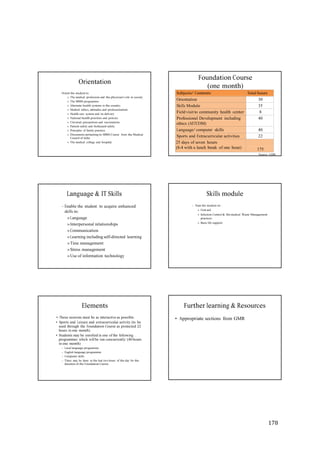
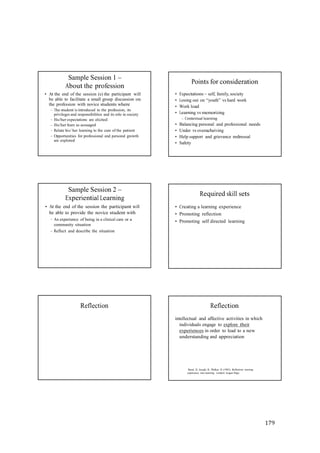
Foundation Course. The Foundation course which will be of 1-month duration after
admission, aims to orient the students to national health scenarios, medical ethics,
health economics, learning skills & communication, Basic Life Support, computer
learning, sociology & demographics, biohazard safety, environmental issues and
community orientation. Foundation course may also include 1) Orientation program 2)
language and computer skills 3) communication skills and 4) time management skills
and 5) Professional development program highlighting ethical and humanities issues.
Each College should select elements of Foundation course as per local needs and
develop faculty expertise from initial years. However, experts and other teachers may
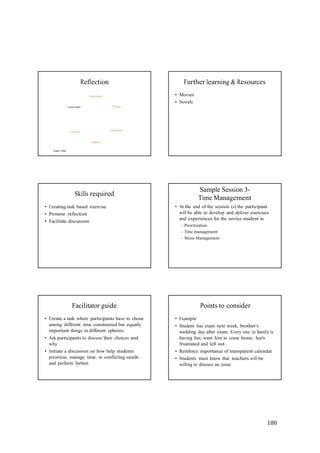
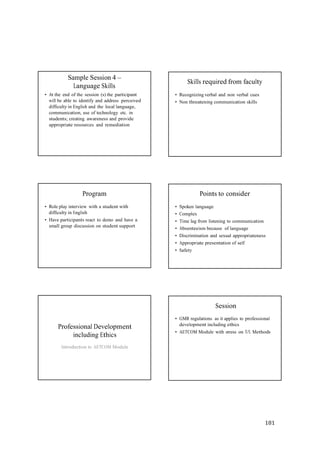
be invited as per need. It is emphasized that interactive case scenarios, movies, videos,
and small group discussions may be used for each concept along with the principles of
reflective learning.
The Curriculum Committee will be responsible for developing the curricular
modules and their implementation at their institution.
The Curriculum implementation Support Program (CISP) developed by the Expert
Group constituted by the Medical Council of India, provides the much needed
intellectual support to colleges for smooth transition from existing to the new
curriculum. The key players in CISP are the faculty of the Medical Education
Department of Regional centers and Nodal centers to which all colleges are attached.
Four of the many new key areas recommended in the Vision 2015, were identified for
implementation across the entire duration of the course at Phase I. The areas
identified were such that they would be helpful to initiate the process of curricular
reforms from first year of the undergraduate course. These areas are Foundation
course, Early Clinical Exposure, Integrated teaching & Learning & Skill development &
training.
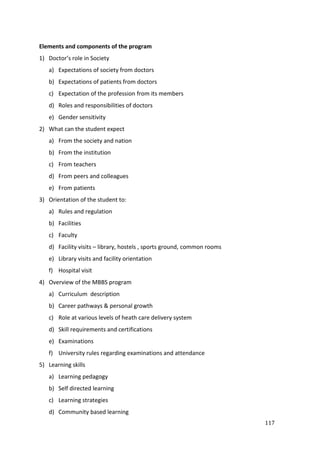
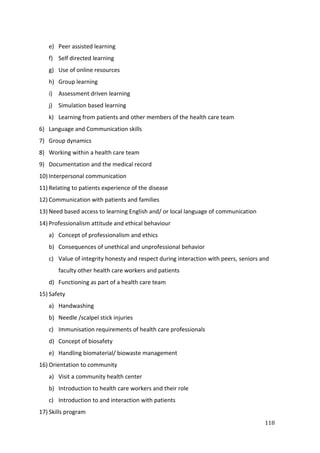
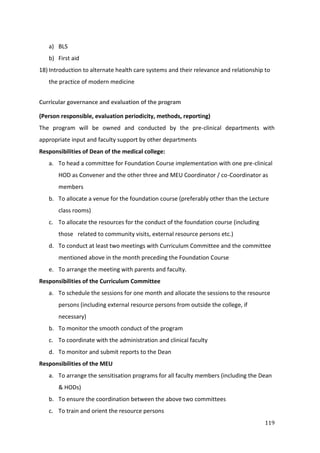
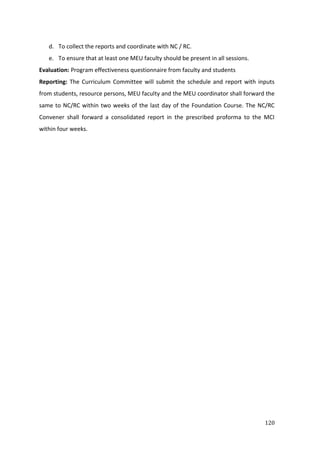
a) Foundation Course: This is a one month to orient medical learners to MBBS program
and provide them with requisite knowledge, communication (including electronic),
technical and language skills.
b) Early clinical exposure: The clinical training would start in the first year, focusing on
5
communication, basic clinical skills and professionalism. There would be sufficient
clinical exposure at the primary care level and this would be integrated with the
learning of basic and laboratory sciences. Introduction of case scenarios for classroom
discussion/case-based learning would be emphasized. It will be done as a coordinated
effort by the pre-clinical, para-clinical and clinical faculty.
c) Integrated teaching and learning : The innovative new curriculum has been structured
to facilitate horizontal and vertical integration between and among disciplines, bridge
the gaps between theory & practice, between hospital based medicine and community
medicine. Basic and laboratory sciences (integrated with their clinical relevance) would
be maximum in the first year and will progressively decrease in the second and third
year of the training when clinical exposure and learning would be dominant.
d) Skill development and learning (throughout curriculum): A mandatory & desirable
comprehensive list of skills has been planned and would be recommended for the
Indian Medical Graduate. Certification of skills would be necessary before licensure.
e) Electives: The aim of adding electives is to allow flexible learning options in the
curriculum and may offer a variety of options including clinical electives, laboratory
postings or community exposure in areas that students are not normally exposed as a
part of regular curriculum. This will also provide opportunity for students to do a
project, enhance self-directed learning, critical thinking and research abilities.
Examples:- Bio-Informatics, Tissue Culture, Tissue Engineering/Processing, Computer
and Computer applications, Immunology, Genetics, Human Nutrition, Sports Medicine,
Laboratory Sciences, Research Methodology, Ethics, Accident and Emergencies (A&E),
Community Projects, HIV Medicine,
Pharmacokinetics/Pharmacodynamics/Pharmacoeconomics, Assisted Reproductive
Technology, Ethics & Medical Education.
All Nodal centers and Regional centers will conduct CISP workshops for all faculty
assigned to their Centres, in the above mentioned areas.
1. All Nodal and Regional Centres (NC/RC) will conduct workshop/s for all MEU Unit
coordinators and Curriculum Committee members of the colleges under their charge
for Faculty Development program (FDP), before March 2019. This workshop should be
of similar nature and convey the theme along with these concepts to all ME Unit
coordinators. MEU coordinators should conduct local workshop for first Phase
teachers and few senior teachers from other phases to initiate implementation of new
curriculum.
6
2. All NCs/RCs would also conduct a workshop for their respective medical school
teachers prior to the workshop for ME Unit coordinators workshop. This will be an in-
house workshop.
3. All Teaching-Learning materials may be refined and uploaded on website for wider
access.
4. Basic skill labs to be made mandatory requirement in all medical colleges. This must
be made a part of the Minimum Standard Requirements for a college.
7
Contributors*
1. Dr. Avinash Supe
Former Director (ME & MH) and Dean, Professor,
Departments of G I Surgery and Medical Education
Seth GSMC and KEM Hospital, Mumbai – 400012
2. Dr. Krishna G. Seshadri
Member, Board of Management
Visiting Professor
Departments of Endocrinology, Diabetes and Medical Education
Sri Balaji Vidyapeeth, Puducherry - 607 403
3. Dr. R. Sajith Kumar
Professor and Head, Departments of Infectious Disease and Medical Education
Convener, MCI Nodal Centre for Faculty Development
Government Medical College, Kottayam, Kerala – 686008
4. Dr. P.V. Chalam
Former Professor of Surgery
Gandhi medical College, Secunderabad
Currently, Principal & Professor, Department of Surgery
Bhaskar Medical College, RR Dist., Telangana – 500075
5. Dr. Praveen Singh
Professor and Head, Departments of Anatomy and Medical Education
Convener, MCI Nodal Centre for Faculty Development
Pramukhswami Medical College, Karamsad, Gujarat - 388325
6. Dr. Tejinder Singh
Professor, Departments of Pediatrics and Medical Education
Convener, MCI Nodal Centre for Faculty Development
Christian Medical College, Ludhiana, Punjab – 141008
7. Dr. P.V. Vijayaraghavan
Convener, MCI Nodal Centre,
Vice Chancellor & Professor of Orthopedics,
Sri Ramachandra Medical College & Research Institute,
Porur, Chennai-600116.
8. Dr. Subir K. Maulik
Professor, Department of Pharmacology
All India Institute of Medical Sciences, New Delhi-110029
* The contributors are members of Expert Group for Curriculum Implementation &
Support Program of the Council.
8
9
PREAMBLE
The undergraduate medical curriculum of the medical council of India is created to
ensure that the medical doctor who emerges from the MBBS training program is
capable of assisting the nation to achieve its goal of health for all. In addition, it aspires
to ensure that the “graduate” meets or exceeds global bench-mark in knowledge,
attitude, skills and communication. This intent is at the core of the Graduate Medical
Regulations, 2019.
The Graduate Medical Regulations, 2019 represents the first major revision to the
medical curriculum since 1997 and hence incorporates changes in science and thought
over two decades. A significant advance is the development of global competencies
and subject-wise outcomes that define the roles of the “Indian Medical Graduate”.
Learning and assessment strategies have been outlined that will allow the learner to
achieve these competencies/outcomes. Effective appropriate and empathetic
communication, skill acquisition, student-doctor method of learning, aligned and
integrated learning and assessment are features that have been given additional
emphasis in the revised curriculum.

The revised curriculum is to be implemented by all medical colleges under the
ambit of Medical Council of India from August 2019. The roll out will be progressive
over the duration of the MBBS course.
Since the curriculum requires significant change in planning, delivery and
assessment, the Council has created a governance and support structure that would
help institutions, teachers and students navigate the change successfully. Capacity
building in the form of basic and advanced support for faculty is an ongoing activity of
the Medical Council of India. The structural framework of support includes the Medical
Education Unit or the Medical Education Department of the institutions and the Nodal
and Regional Centers of the Medical Council of India. To these, the MCI has added the
governance oversight of the curriculum in the form of the Curriculum Committee at
the institutional level.
As part of the roadmap to the curricular roll out - a nationwide Curriculum
Implementation Support Program is being cascaded in a ‘train the trainer’ format. The
program will be supported by learning resource material, workshops, videos online
support etc. A carefully designed quality and oversight program will ensure monitoring
of the curricular implementation and required course corrections.
The change requires extensive stakeholder commitment and involvement. These
include commitment for the curricular change at the leadership level in institutions,
investment in infrastructure, oversight and training programs and technology that will
facilitate smooth delivery and evaluation of the curriculum. Faculty would be required
10
to unlearn, re-learn, adapt and innovate. The role of the University in adopting and
embracing the change and aligning assessment along the lines suggested in the
Graduate Medical Education Regulations (GMR) document are critical to achieving the
objectives of the curricular change. At a student level, the curriculum requires greater
commitment, shared responsibility, self directed and ongoing learning.
This document represents a compilation of the resource material that will be used
in the Curricular Implementation Support Program (CISP) and has attempted to
provide a stepwise and comprehensive approach to implement the curriculum. It
details the philosophy and the steps required in a simple and richly illustrated manner.
Teaching slide decks, faculty guides and online resource material supplement this
document. The document is to be used in conjunction with the Competency
document, AETCOM module and the GMR document.
The timelines and measurables for the new curriculum are outlined in the chapter
on curricular governance. The Expert Group for curricular implementation would like
to place on record the tremendous contribution by subject experts, the Reconciliation
Board, the Academic Cell of the MCI, the faculty, administration, Medical Education
Units and leaders of each medical college, the Nodal and Regional Centers, and the
Universities who have all helped to create the right environment for change. The
Board of Governors of MCI are the pivot who have led from the front and facilitated
this important national need in a very short time duration and deserve the praise and
gratitude of the medical fraternity.
11
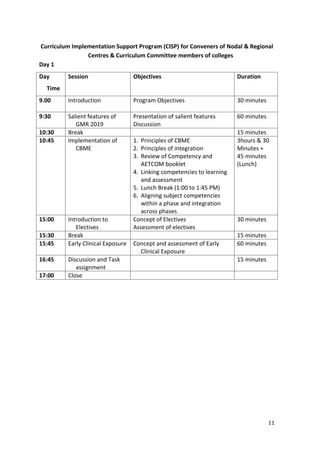
Curriculum Implementation Support Program (CISP) for Conveners of Nodal & Regional
Centres & Curriculum Committee members of colleges
Day 1
Day
Time
Session Objectives Duration
9.00 Introduction Program Objectives 30 minutes
9:30 Salient features of
GMR 2019
Presentation of salient features
Discussion
60 minutes
10:30 Break 15 minutes
10:45 Implementation of
CBME
1. Principles of CBME
2. Principles of integration
3. Review of Competency and
AETCOM booklet
4. Linking competencies to learning
and assessment
5. Lunch Break (1:00 to 1:45 PM)
6. Aligning subject competencies
within a phase and integration
across phases
3hours & 30
Minutes +
45 minutes
(Lunch)
15:00 Introduction to
Electives
Concept of Electives
Assessment of electives
30 minutes
15:30 Break 15 minutes
15:45 Early Clinical Exposure Concept and assessment of Early
Clinical Exposure
60 minutes
16:45 Discussion and Task
assignment
15 minutes
17:00 Close
12
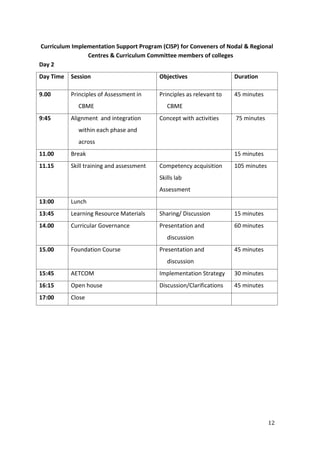
Curriculum Implementation Support Program (CISP) for Conveners of Nodal & Regional
Centres & Curriculum Committee members of colleges
Day 2
Day Time Session Objectives Duration
9.00 Principles of Assessment in
CBME
Principles as relevant to
CBME
45 minutes
9:45 Alignment and integration
within each phase and
across
Concept with activities 75 minutes
11.00 Break 15 minutes
11.15 Skill training and assessment Competency acquisition
Skills lab
Assessment
105 minutes
13:00 Lunch
13:45 Learning Resource Materials Sharing/ Discussion 15 minutes
14.00 Curricular Governance Presentation and
discussion
60 minutes
15.00 Foundation Course Presentation and
discussion
45 minutes
15:45 AETCOM Implementation Strategy 30 minutes
16:15 Open house Discussion/Clarifications 45 minutes
17:00 Close
13
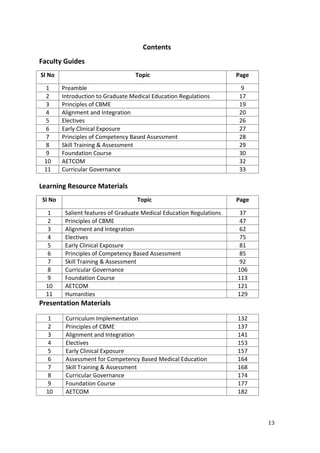
Contents
Faculty Guides
Sl No Topic Page
1 Preamble 9
2 Introduction to Graduate Medical Education Regulations 17
3 Principles of CBME 19
4 Alignment and Integration 20
5 Electives 26
6 Early Clinical Exposure 27
7 Principles of Competency Based Assessment 28
8 Skill Training & Assessment 29
9 Foundation Course 30
10 AETCOM 32
11 Curricular Governance 33
Learning Resource Materials
Sl No Topic Page
1 Salient features of Graduate Medical Education Regulations 37
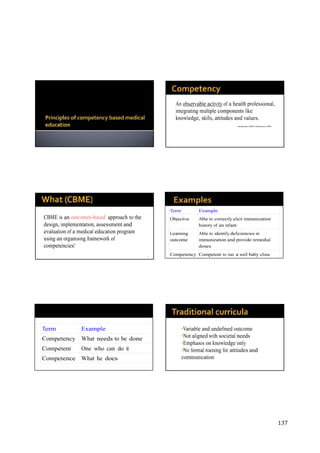
2 Principles of CBME 47
3 Alignment and Integration 62
4 Electives 75
5 Early Clinical Exposure 81
6 Principles of Competency Based Assessment 85
7 Skill Training & Assessment 92
8 Curricular Governance 106
9 Foundation Course 113
10 AETCOM 121
11 Humanities 129
Presentation Materials
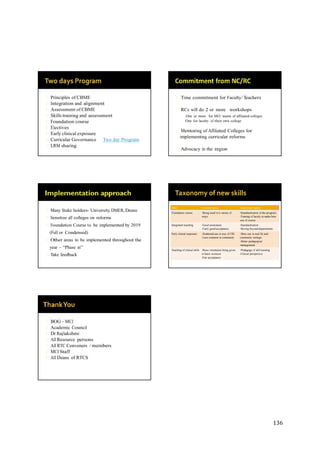
1 Curriculum Implementation 132
2 Principles of CBME 137
3 Alignment and Integration 141
4 Electives 153
5 Early Clinical Exposure 157
6 Assessment for Competency Based Medical Education 164
7 Skill Training & Assessment 168
8 Curricular Governance 174
9 Foundation Course 177
10 AETCOM 182
14
15
FACULTY GUIDES
(Session wise)
16
17
Introduction to Graduate Medical Education Regulations,
2019
18
Introduction to Graduate Medical Education Regulations,
2019
60 min
Time Topic Details Material
09:30 – 10:00 Introduction Context
Salient Features
Slide deck
09:45- 10:00 Relevance
10:00-10:15 Discussion
10:15-10:30 Wrap Up
Session Salient Features of the GMR, 2019
Competency The learner must enumerate the unique features of the GMR
document
Specific learning
objective
At the end of the session the participants must be able to:
a. Enumerate the unique features of GMR, 2019
Method Interactive Lecture
Required reading GMR document
Additional reading None
Assessment None
Faculty guide 1. An initial discussion on what are the salient changes in
medical education since the last GMR, may be done to
set the ball rolling
2. The slides do not have much content and are intended
to set the stage for the CISP program and provide an
overview
3. Encourage questions with the caveat that there is will
detailed discussion on each of these features during the
course of the discussions
19
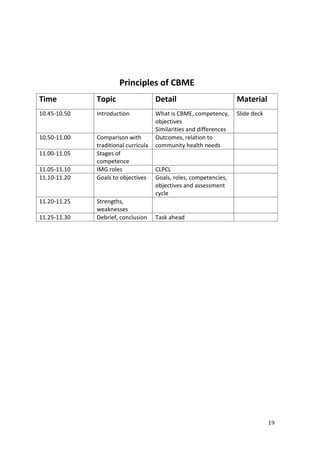
Principles of CBME
Time Topic Detail Material
10.45-10.50 Introduction What is CBME, competency,
objectives
Similarities and differences
Slide deck
10.50-11.00 Comparison with
traditional curricula
Outcomes, relation to
community health needs
11.00-11.05 Stages of
competence
11.05-11.10 IMG roles CLPCL
11.10-11.20 Goals to objectives Goals, roles, competencies,
objectives and assessment
cycle
11.20-11.25 Strengths,
weaknesses
11.25-11.30 Debrief, conclusion Task ahead
20
Alignment and Integration
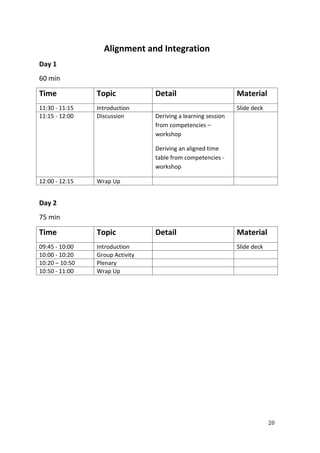
Day 1
60 min
Time Topic Detail Material
11:30 - 11:15 Introduction Slide deck
11:15 - 12:00 Discussion Deriving a learning session
from competencies –
workshop
Deriving an aligned time
table from competencies -
workshop
12:00 - 12:15 Wrap Up
Day 2
75 min
Time Topic Detail Material
09:45 - 10:00 Introduction Slide deck
10:00 - 10:20 Group Activity
10:20 – 10:50 Plenary
10:50 - 11:00 Wrap Up
21
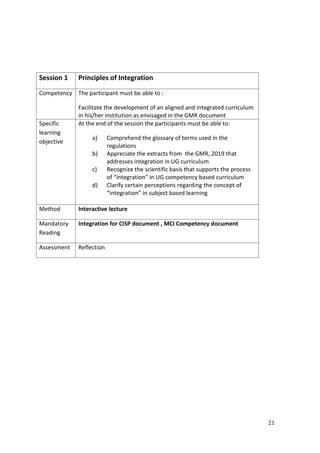
Session 1 Principles of Integration
Competency The participant must be able to :
Facilitate the development of an aligned and integrated curriculum
in his/her institution as envisaged in the GMR document
Specific
learning
objective
At the end of the session the participants must be able to:
a) Comprehend the glossary of terms used in the
regulations
b) Appreciate the extracts from the GMR, 2019 that
addresses integration in UG curriculum
c) Recognize the scientific basis that supports the process
of “integration” in UG competency based curriculum
d) Clarify certain perceptions regarding the concept of
“integration” in subject based learning
Method Interactive lecture
Mandatory
Reading
Integration for CISP document , MCI Competency document
Assessment Reflection
22
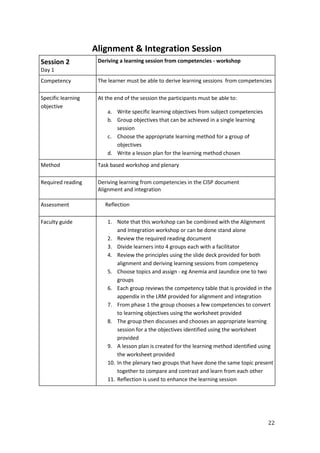
Alignment & Integration Session
Session 2
Day 1
Deriving a learning session from competencies - workshop
Competency The learner must be able to derive learning sessions from competencies
Specific learning
objective
At the end of the session the participants must be able to:
a. Write specific learning objectives from subject competencies
b. Group objectives that can be achieved in a single learning
session
c. Choose the appropriate learning method for a group of
objectives
d. Write a lesson plan for the learning method chosen
Method Task based workshop and plenary
Required reading Deriving learning from competencies in the CISP document
Alignment and integration
Assessment Reflection
Faculty guide 1. Note that this workshop can be combined with the Alignment
and Integration workshop or can be done stand alone
2. Review the required reading document
3. Divide learners into 4 groups each with a facilitator
4. Review the principles using the slide deck provided for both
alignment and deriving learning sessions from competency
5. Choose topics and assign - eg Anemia and Jaundice one to two
groups
6. Each group reviews the competency table that is provided in the
appendix in the LRM provided for alignment and integration
7. From phase 1 the group chooses a few competencies to convert
to learning objectives using the worksheet provided
8. The group then discusses and chooses an appropriate learning
session for a the objectives identified using the worksheet
provided
9. A lesson plan is created for the learning method identified using
the worksheet provided
10. In the plenary two groups that have done the same topic present
together to compare and contrast and learn from each other
11. Reflection is used to enhance the learning session
23
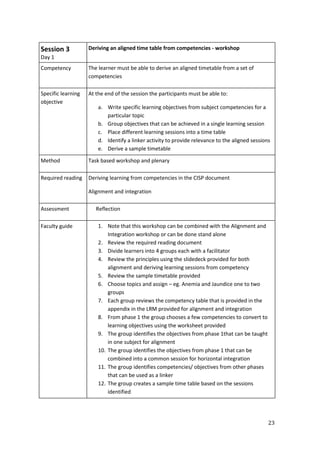
Session 3
Day 1
Deriving an aligned time table from competencies - workshop
Competency The learner must be able to derive an aligned timetable from a set of
competencies
Specific learning
objective
At the end of the session the participants must be able to:
a. Write specific learning objectives from subject competencies for a
particular topic
b. Group objectives that can be achieved in a single learning session
c. Place different learning sessions into a time table
d. Identify a linker activity to provide relevance to the aligned sessions
e. Derive a sample timetable
Method Task based workshop and plenary
Required reading Deriving learning from competencies in the CISP document
Alignment and integration
Assessment Reflection
Faculty guide 1. Note that this workshop can be combined with the Alignment and
Integration workshop or can be done stand alone
2. Review the required reading document
3. Divide learners into 4 groups each with a facilitator
4. Review the principles using the slidedeck provided for both
alignment and deriving learning sessions from competency
5. Review the sample timetable provided
6. Choose topics and assign – eg. Anemia and Jaundice one to two
groups
7. Each group reviews the competency table that is provided in the
appendix in the LRM provided for alignment and integration
8. From phase 1 the group chooses a few competencies to convert to
learning objectives using the worksheet provided
9. The group identifies the objectives from phase 1that can be taught
in one subject for alignment
10. The group identifies the objectives from phase 1 that can be
combined into a common session for horizontal integration
11. The group identifies competencies/ objectives from other phases
that can be used as a linker
12. The group creates a sample time table based on the sessions
identified
24
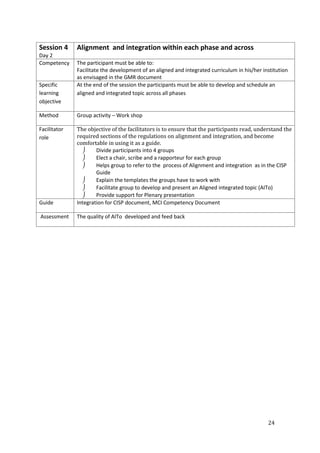
Session 4
Day 2
Alignment and integration within each phase and across
Competency The participant must be able to:
Facilitate the development of an aligned and integrated curriculum in his/her institution
as envisaged in the GMR document
Specific
learning
objective
At the end of the session the participants must be able to develop and schedule an
aligned and integrated topic across all phases
Method Group activity – Work shop
Facilitator
role
The objective of the facilitators is to ensure that the participants read, understand the
required sections of the regulations on alignment and integration, and become
comfortable in using it as a guide.
 Divide participants into 4 groups
 Elect a chair, scribe and a rapporteur for each group
 Helps group to refer to the process of Alignment and integration as in the CISP
Guide
 Explain the templates the groups have to work with
 Facilitate group to develop and present an Aligned integrated topic (AITo)
 Provide support for Plenary presentation
Guide Integration for CISP document, MCI Competency Document
Assessment The quality of AITo developed and feed back
25
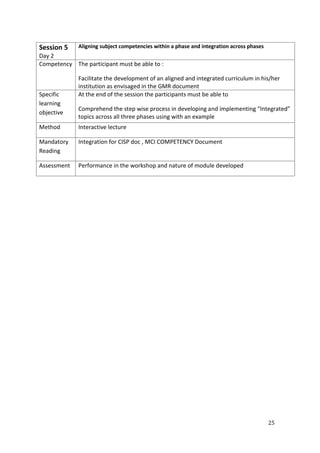
Session 5
Day 2
Aligning subject competencies within a phase and integration across phases
Competency The participant must be able to :
Facilitate the development of an aligned and integrated curriculum in his/her
institution as envisaged in the GMR document
Specific
learning
objective
At the end of the session the participants must be able to
Comprehend the step wise process in developing and implementing “Integrated”
topics across all three phases using with an example
Method Interactive lecture
Mandatory
Reading
Integration for CISP doc , MCI COMPETENCY Document
Assessment Performance in the workshop and nature of module developed
26
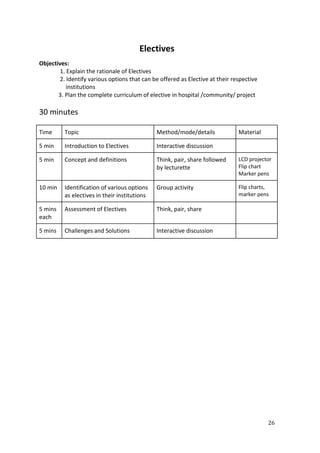
Electives
Objectives:
1. Explain the rationale of Electives
2. Identify various options that can be offered as Elective at their respective
institutions
3. Plan the complete curriculum of elective in hospital /community/ project
30 minutes
Time Topic Method/mode/details Material
5 min Introduction to Electives Interactive discussion
5 min Concept and definitions Think, pair, share followed
by lecturette
LCD projector
Flip chart
Marker pens
10 min Identification of various options
as electives in their institutions
Group activity Flip charts,
marker pens
5 mins
each
Assessment of Electives Think, pair, share
5 mins Challenges and Solutions Interactive discussion
27
Early Clinical Exposure (ECE)
Objectives:
1. Explain the rationale of ECE
2. Enumerate the pedagogical advantages of ECE
3. Plan their teaching-learning methods around clinical scenarios
4. Optimally use ECE to orient students to basic clinical methods and soft clinical
skills (communication, professionalism, ethics etc.)
60 minutes
Time Topic Method/mode/details Material
3.45-
3.50
Introduction to ECE Interactive discussion
3.50-
3.55
Concept and
definitions
Think, pair, share followed
by lecturette
LCD projector
Flipchart
Marker pens
3.55-
4.05
Sharing of best
practices
Appreciative inquiry
followed by large group
presentations
Interview guide
Flipcharts, marker pens
4.05-
4.15
Advantages and impact
of ECE
Interactive lecture
4.15-
4.25
Opportunities for using
ECE
Concept of observation
guides
Interactive lecture
Sample observation
guide
4.25-
4.35
Group work:
1. ECE in class room
2. ECE in hospital
settings
(wards/labs/radiolo
gy)
3. ECE in community
settings
4. Develop a sample
observation guide
Task
Prepare a sample teaching
material
What will be the objectives?
Write out a plan of how and
what T/L methods will you
use?
What resources are needed?
What issues should be
emphasized in affective
domain? How to get and
give feedback?
List of possible clinical
conditions for use in
each setting
Templates/guides and
samples
4.35-
4.45
Presentations and
discussion
28
Principles of Competency Based Assessment
40 min.
Time Topic Details Material
9.00-9.05 Introduction Role of assessment PPT deck
9.05-9.10 Requirements for
CBA
Differences in general and
competency-based assessment,
common misconceptions
9.10-9.20 Aligning
assessment with
competencies
Examples from curriculum
document
9.20-9.30 Group work Select assessment methods and
tools
9.30-9.35 Internal
assessment
Focus of IA, mechanics
9.35-9.40 University
examinations
Focus of University examinations,
mechanics
9.40-9.45 Debrief
29
Skill Training and Assessment
105 mins
Time Topic Comments
11:15-
11:30
Introduction, definition of skill
with examples
Interactive lecture
11.30-
11.40
Why teach skills Interactive lecture
11.40-
11.55
How skills are currently
taught
Think, pair, share
11.55-
12.05
Models of skills training Technical and non-technical
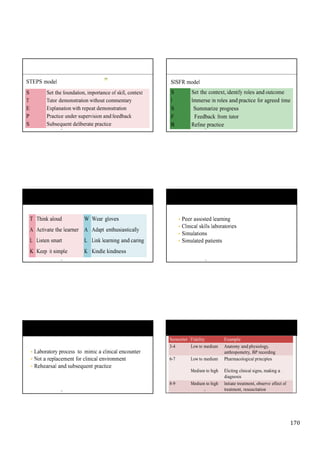
skills; STEPS model, SISFR
model, SODOTO
12.05-
12.15
Simulation for skills training
12.15-
12.30
Develop an outline of a skills-
training module
Think, pair, share
12.30-
12.40
Assessment of skills Concept, issues
12.40-
12.50
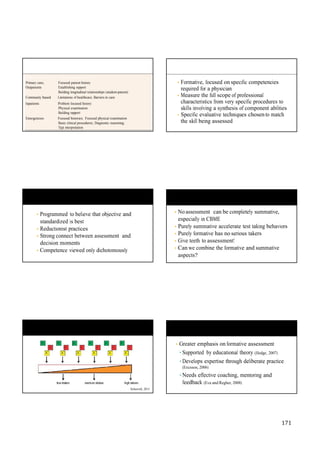
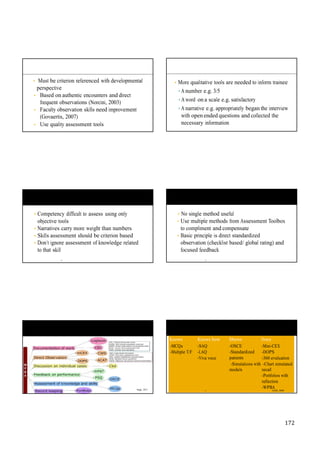
Assessment tool box Interactive lecture
12.50-
13.00
Reflection, taking forwards
30
Foundation Course
Session Foundation Course
Competency The participant must be able to :
a. Facilitate the development of a schedule for the one month foundation
course in his/her institution as envisaged in the GMR document
b. Facilitate the Curriculum Committee in the implementation of the one
month foundation course in his/her institution as envisaged in the GMR
document
Specific
learning
objective
At the end of the session the participants must be able to
a) Describe and discuss the need for foundation course in the first year of
the MBBS course in India
b) Appreciate the extracts from the GMR, 2019 that addresses foundation
course
c) Plan the conduct of the foundation course with regard to the contents in
accordance with the timings as per GMR, 2019
d) Develop a plan for monitoring the foundation Course
Method Interactive lecture followed by Group Discussion and Plenary
Mandatory
Reading
Graduate Medical Regulations, 2019
Assessment Reflection
31
Total Time : 45 mins
Time Agenda/Activity Materials
15
mins
Introduction to Foundation course
Scope and need
PPT
10 min Discussion in small groups on
a. Challenges and suggestions
b. Session planning with regard to contents, faculty
c. Time table.
1. Orientation to medical profession & college [w.r.t GMR
9.1.2(a)]
2. Professional Development & Ethics [w.r.t AETCOM module]
3. Language & Computer skills [w.r.t GMR 9.1.2(b)]
4. Basic Skills Training [w.r.t GMR 9.1.2(c)]
20 min Plenary on the above (3 min presentation and 2 minutes discussion
from each group)
32
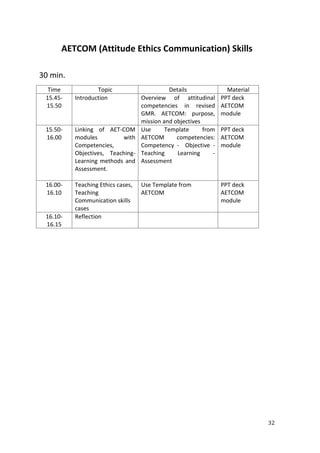
AETCOM (Attitude Ethics Communication) Skills
30 min.
Time Topic Details Material
15.45-
15.50
Introduction Overview of attitudinal
competencies in revised
GMR. AETCOM: purpose,
mission and objectives
PPT deck
AETCOM
module
15.50-
16.00
Linking of AET-COM
modules with
Competencies,
Objectives, Teaching-
Learning methods and
Assessment.
Use Template from
AETCOM competencies:
Competency - Objective -
Teaching Learning -
Assessment
PPT deck
AETCOM
module
16.00-
16.10
Teaching Ethics cases,
Teaching
Communication skills
cases
Use Template from
AETCOM
PPT deck
AETCOM
module
16.10-
16.15
Reflection
33
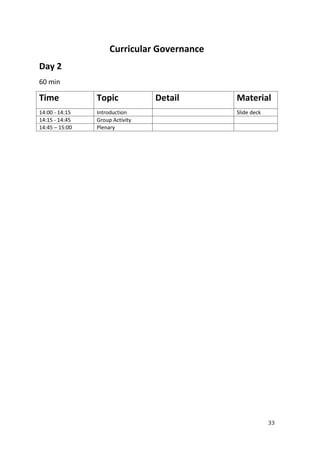
Curricular Governance
Day 2
60 min
Time Topic Detail Material
14:00 - 14:15 Introduction Slide deck
14:15 - 14:45 Group Activity
14:45 – 15:00 Plenary
34
35
LEARNING RESOURCE MATERIALS
36
37
Salient features of
Graduate Medical Education Regulations, 2019
Overview
The new Graduate Medical Education Regulations, 2019 attempts to stand on the
shoulder of the contributions and the efforts of resource persons, teachers and students
past and present attempts to take the learner to provide healthcare to the evolving needs
of the nation and the world.
More than twenty years have passed since the existing Regulations on Graduate
Medical Education, 1997 was notified necessitating a relook at all aspects of the various
components in the current regulations and adapt them to the changing demography,
socio-economic context, perceptions, values and expectations of stakeholder, emerging
health care issues particularly in the context of newly emerging diseases, impact of
advances in science and technology, shorter distances on diseases and their
management, The strong and forward looking fundamentals enshrined in the Graduate
Medical Education Regulations, 1997 has made this job easier. A comparison between the
1997 Regulations and proposed Regulations on Graduate Medical Education, 2019 (GMR)
will reveal that the 2019 Regulations have evolved from several key principles enshrined
in the 1997 Regulations.
The thrust in the new Regulations is continuation and evolution of thought in
medical education making it more learner-centric, patient-centric, gender-sensitive,
outcome oriented and environment appropriate. The result is a competency based
curriculum which conforms to global trends. Emphasis is made on alignment and
integration of subjects both horizontally and vertically while respecting the strengths and
necessity of subject-based instruction and assessment.
A significant attempt has been made in the competency based undergraduate
curriculum to provide the orientation and the skills necessary for life-long care of the
patient. In particular, the curriculum provides for early clinical exposure, electives and
longitudinal care. Skill acquisition is an indispensable component of the learning process
in medicine. The curriculum reinforces this aspect by necessitating certification of certain
essential skills. The experts and the writing group have factored in patient availability,
access, consent, number of students in a class etc in suggesting skill acquisition and
assessment methods; the use of skills labs, simulated and guided environments are
encouraged.
The importance of ethical values, responsiveness to the needs of the patient and
acquisition of communication skills is underscored by providing dedicated curriculum
time in the form of a longitudinal program called Attitude, Ethics and Communication
(AETCOM) competencies. Greater emphasis has been placed on collaborative and
interdisciplinary teamwork, professionalism, altruism and respect in professional
relationships with due sensitivity to differences in thought, social and economic position
and gender.
38
In addition to the above an attempt has been made to allow students from diverse
educational streams and backgrounds to transition appropriately through a foundation
program. Dedicated time has been allotted for self directed learning and co curricular
activity.
Formative and internal assessment has been streamlined to achieve the objectives
of the curriculum. Minor tweaks to the summative assessment have been made to reflect
evolving thought and regulatory requirements. Curricular governance and support have
been strengthened.
The curriculum document in conjunction with the new Graduate Medical
Education Regulations, when notified, must be seen as a “living document” that should
evolve as stakeholder requirements and aspirations change.
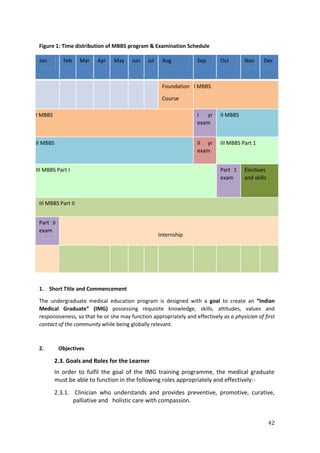
Key components of GMR, 2019 are summarised below. The time distribution according to
phases is summarised in figure 1 later.
1. Concept of the Indian Medical Graduate as an achievable goal
2. Roles that define the Indian Medical Graduate
3. Definition of Global competencies for each role envisaged
4. Defined subject-based outcomes that can be mapped to the global
competencies
5. Alignment of instruction with reasonable integration
6. Greater emphasis on learner centric instruction
7. Greater emphasis on learning in primary and secondary care environments
8. Student Doctor Method of Clinical Training
9. Emphasis on skill acquisition and certification
10. Early Clinical Exposure
11. Longitudinal program on attitude ethics and communication
12. Foundation course
13. Shared responsibility and self directed learning
14. Electives
15. Time for sport and extracurricular activities
16. Assessment changes
Concept of the Indian Medical Graduate as an achievable goal
The undergraduate medical education program is designed with a goal to create an
“Indian Medical Graduate” (IMG) possessing requisite knowledge, skills, attitudes, values
39
and responsiveness, so that he or she may function appropriately and effectively as a
physician of first contact of the community while being globally relevant.
Defined Roles of the Indian Medical Graduate
The GMR envisages the following roles that a graduate must perform in-order to achieve
the goal of the UG medical education program
Clinician: who understands and provides preventive, promotive, curative, palliative and
holistic care with compassion.
Leader and member of the healthcare team and system: with capabilities to collect
analyze, synthesize and communicate health data appropriately.
Communicator: with patients, families, colleagues and community.
Lifelong learner: committed to continuous improvement of skills and knowledge.
Professional: who is committed to excellence, is ethical, responsive and accountable to
patients, community and profession.
Global Competencies mapped to each role:
Statement of achievement of defined measurable outcomes have been spelt out for each
role - these are called global competencies and are summarised in GMR, 2019 document.
Defined subject based outcomes that can be mapped to the global competencies
The GMR, 2019 proposes continuance with subject based instruction. To reconcile subject
based instruction with transition to competency based education - subject based
outcomes (so called sub-competencies) have been derived by subject experts and
compiled. Guidance on the domain, level of mastery required, suggested learning and
assessment methods, requirement of certification, recommended integration etc have
been provided in a three volume stand alone document. This document can be accessed
at https://old.mciindia.org/InformationDesk/ForColleges/UGCurriculum.aspx
Alignment of instruction with reasonable integration
To the extent possible the GMR, 2019 stresses the importance of temporal coordination
of related topics in each phase - this is called alignment. Integration within the phase
(horizontal integration) and with other phases have been provided for - this is explained
in greater length in this document.
Learner centered instruction
The GMR, 2019 lays great emphasis on learner centric methods of instruction. Time has
been apportioned for small group learning, interactive and case based learning,
collaborative and team based learning. Didactic learning time has been reduced to less
than a third of the allotted time in each subject.
40
Learning in primary and secondary care environments
The GMR, 2019 has provisions for learning in both primary and secondary care settings
such as Taluk hospitals and Urban Health Care Centres. Learning will have a strong
prevention and primary care focus with particular emphasis on national and regional
health care priorities and programs.
Student - Doctor Method of Clinical Training
The student - doctor method of clinical training provides for the student to function as a
member of the clinical care team, work with patients and follow them longitudinally. The
program allows for students to care for patients in a supervised manner taking part in
admission day activities, following patients during the course of hospitalisation, writing
and maintaining case records and participating, observing and assisting in procedures in a
graded fashion. The student doctor method of training will commence in the second
clinical posting
Skill Acquisition and Certification
The ability of students to be able to acquire and practice important skills in a safe and
supervised environment is given importance. Institutions are mandated to create skills
labs in which skill acquisition is possible. A list of certifiable skills that the learner has to
acquire prior to graduation has been developed. Protected skill acquisition time for basic
skills has also been appropriated in the timetable.
Early Clinical Exposure (ECE)
Providing a clinical context and ensuring patient centricity of instructions are the key
principles underlying early clinical exposure. The ECE provides for three key elements -
basic science correlation, clinical skills including authentic patient contact and an
introduction to humanities in medicine. ECE is expanded further in this document.
Attitude Ethics and Communication
AETCOM (Attitude Ethics and Communication) is a longitudinal modular program that
provides for instruction in professionalism, bioethics and communication skills. Dedicated
time has been carved out for AETCOM instruction in all the phases. The program has
already been rolled out by the MCI.
Foundation Course
The Foundation Course is aimed at providing an introduction to the MBBS program that
will allow students from diverse backgrounds languages and varying degrees of technical
and communication skills to adapt and enhance required skills. There is a provision for
continued longitudinal instruction in language and computer skills following the one
month program.
41
Self Directed Learning
The GMR, 2019 encourages shared responsibility in learning with emphasis on knowledge
and skill acquisition, assignment and task completion, living experiences, reflection and
self directed learning. Dedicated time for self directed learning is provided in each subject
in every phase.
Electives
Electives provide opportunities for students to acquire diverse learning experiences. Two,
four week blocks of elective time, has been created to allow students to a) rotate in a pre-
or a para - clinical / work under the supervision of a researcher, and b) rotate in a pre-
specified specialty / work in a rural or urban community clinic under supervision.
Sports and Extracurricular activity
Protected time for sports and extracurricular activity has been carved into the curriculum
to allow students to preserve work life balance and prevent burn out.
Assessment changes
Some key changes in areas of assessment have been proposed in the GMR, 2019. A pass
score in the theory AND practical/ clinical parts of the Internal Assessment will be a
prerequisite to attempt the summative examination. Formative assessment is
streamlined. Continuous assessment through log books, documentation reports etc are
given additional importance. Internal Assessment will not contribute to the summative
examination. Separate pass in theory and practical / clinical is required. Viva marks will be
added to practical/ clinical examination. A provision for skill assessment and assessment
of AETCOM competencies has also been made.
42
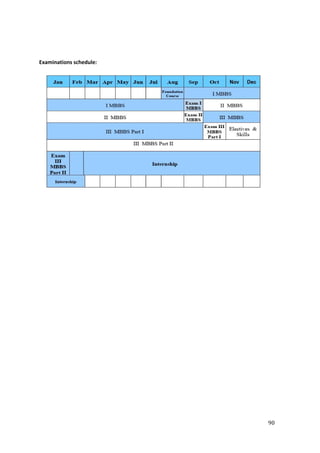
Figure 1: Time distribution of MBBS program & Examination Schedule
Jan Feb Mar Apr May Jun Jul Aug Sep Oct Nov Dec
Foundation
Course
I MBBS
I MBBS I yr
exam
II MBBS
II MBBS II yr
exam
III MBBS Part 1
III MBBS Part I Part 1
exam
Electives
and skills
III MBBS Part II
Part II
exam
Internship
1. Short Title and Commencement
The undergraduate medical education program is designed with a goal to create an “Indian
Medical Graduate” (IMG) possessing requisite knowledge, skills, attitudes, values and
responsiveness, so that he or she may function appropriately and effectively as a physician of first
contact of the community while being globally relevant.
2. Objectives
2.3. Goals and Roles for the Learner
In order to fulfil the goal of the IMG training programme, the medical graduate
must be able to function in the following roles appropriately and effectively:-
2.3.1. Clinician who understands and provides preventive, promotive, curative,
palliative and holistic care with compassion.
43
2.3.2. Leader and member of the health care team and system with capabilities to
collect analyze, synthesize and communicate health data appropriately.
2.3.3. Communicator with patients, families, colleagues and community.
2.3.4. Lifelong learner committed to continuous improvement of skills and
knowledge.
2.3.5. Professional, who is committed to excellence, is ethical, responsive and
accountable to patients, community and profession.
3. Competency Based Training Programme of the Indian Medical Graduate
Competency based learning would include designing and implementing medical
education curriculum that focuses on the desired and observable ability in real life
situations. In order to effectively fulfil the roles as listed in clause 2, the Indian
Medical Graduate would have obtained the following set of competencies at the
time of graduation:
3.1. Clinician, who understands and provides preventive, promotive, curative,
palliative and holistic care with compassion
3.1.1 Demonstrate knowledge of normal human structure, function and
development from a molecular, cellular, biologic, clinical, behavioural and
social perspective.
3.1.2. Demonstrate knowledge of abnormal human structure, function and
development from a molecular, cellular, biological, clinical, behavioural and
social perspective.
3.1.3 Demonstrate knowledge of medico-legal, societal, ethical and humanitarian
principles that influence health care.
3.1.4 Demonstrate knowledge of national and regional health care policies
including the National Health Mission that incorporates National Rural
Health Mission (NRHM) and National Urban Health Mission (NUHM),
frameworks, economics and systems that influence health promotion, health
care delivery, disease prevention, effectiveness, responsiveness, quality and
patient safety.
3.1.5. Demonstrate ability to elicit and record from the patient, and other relevant
sources including relatives and caregivers, a history that is complete and
relevant to disease identification, disease prevention and health promotion.
3.1.6. Demonstrate ability to elicit and record from the patient, and other relevant
sources including relatives and caregivers, a history that is contextual to
gender, age, vulnerability, social and economic status, patient preferences,
beliefs and values.
3.1.7 Demonstrate ability to perform a physical examination that is complete and
relevant to disease identification, disease prevention and health promotion.
44
3.1.8 Demonstrate ability to perform a physical examination that is contextual to
gender, social and economic status, patient preferences and values.
3.1.9 Demonstrate effective clinical problem solving, judgment and ability to
interpret and integrate available data in order to address patient problems,
generate differential diagnoses and develop individualized management
plans that include preventive, promotive and therapeutic goals.
3.1.10 Maintain accurate, clear and appropriate record of the patient in
conformation with legal and administrative frame works.
3.1.11 Demonstrate ability to choose the appropriate diagnostic tests and interpret
these tests based on scientific validity, cost effectiveness and clinical
context.
3.1.12 Demonstrate ability to prescribe and safely administer appropriate therapies
including nutritional interventions, pharmacotherapy and interventions
based on the principles of rational drug therapy, scientific validity, evidence
and cost that conform to established national and regional health
programmes and policies for the following:
i) Disease prevention,
ii) Health promotion and cure,
iii) Pain and distress alleviation, and
iv) Rehabilitation
3.1.13 Demonstrate ability to provide a continuum of care at the primary and/or
secondary level that addresses chronicity, mental and physical disability.
3.1.14 Demonstrate ability to appropriately identify and refer patients who may
require specialized or advanced tertiary care.
3.1.15 Demonstrate familiarity with basic, clinical and translational research as it
applies to the care of the patient.
3.2. Leader and member of the health care team and system
3.2.1 Work effectively and appropriately with colleagues in an inter-professional
health care team respecting diversity of roles, responsibilities and
competencies of other professionals.
3.2.2 Recognize and function effectively, responsibly and appropriately as a health
care team leader in primary and secondary health care settings.
3.2.3 Educate and motivate other members of the team and work in a
collaborative and collegial fashion that will help maximize the health care
delivery potential of the team.
3.2.4 Access and utilize components of the health care system and health delivery
in a manner that is appropriate, cost effective, fair and in compliance with
45
the national health care priorities and policies, as well as be able to collect,
analyze and utilize health data.
3.2.5 Participate appropriately and effectively in measures that will advance
quality of health care and patient safety within the health care system.
3.2.6 Recognize and advocate health promotion, disease prevention and health
care quality improvement through prevention and early recognition: in a) life
style diseases and b) cancers, in collaboration with other members of the
health care team.
3.3. Communicator with patients, families, colleagues and community
3.3.1 Demonstrate ability to communicate adequately, sensitively, effectively and
respectfully with patients in a language that the patient understands and in a
manner that will improve patient satisfaction and health care outcomes.
3.3.2 Demonstrate ability to establish professional relationships with patients and
families that are positive, understanding, humane, ethical, empathetic, and
trustworthy.
3.3.3 Demonstrate ability to communicate with patients in a manner respectful of
patient’s preferences, values, prior experience, beliefs, confidentiality and
privacy.
3.3.4 Demonstrate ability to communicate with patients, colleagues and families
in a manner that encourages participation and shared decision-making.
3.4. Lifelong learner committed to continuous improvement of skills and
knowledge
3.4.1. Demonstrate ability to perform an objective self-assessment of knowledge
and skills, continue learning, refine existing skills and acquire new skills.
3.4.2. Demonstrate ability to apply newly gained knowledge or skills to the care of
the patient.
3.4.3. Demonstrate ability to introspect and utilize experiences, to enhance
personal and professional growth and learning.
3.4.4. Demonstrate ability to search (including through electronic means), and
critically evaluate the medical literature and apply the information in the
care of the patient.
3.4.5. Be able to identify and select an appropriate career pathway that is
professionally rewarding and personally fulfilling.
3.5. Professional who is committed to excellence, is ethical, responsive and
accountable to patients, community and the profession
3.5.1. Practice selflessness, integrity, responsibility, accountability and respect.
3.5.2. Respect and maintain professional boundaries between patients, colleagues
and society.
46
3.5.3. Demonstrate ability to recognize and manage ethical and professional
conflicts.
3.5.4. Abide by prescribed ethical and legal codes of conduct and practice.
3.5.5. Demonstrate a commitment to the growth of the medical profession as a
whole.
47
Principles of CBME
Aligning Competencies to Learning
Objectives of the session
At the end of this session, the learner will be able to facilitate institute faculty to derive
learning sessions as envisaged in the GMR and competency documents of the MCI
Glossary of terms used
A competency is an observable ability of a learner that includes multiple components
including knowledge skills values and attitude.
An objective is a statement of what a learner should be able to do at the end of a specific
learning session (or experience).
Core: A competency that is necessary in order to complete the requirements of the
subject (traditional must know).
None Core: A competency that is optional in order to complete the requirements of the
subject (traditional nice (good) to know/ desirable to know).
Lecture: Any instructional large group method including traditional lecture and interactive
lecture.
Small Group Discussion: Any instructional method involving small groups of students in
an appropriate learning context.
Skill Assessment: A session that assesses the skill of the student including those in the
practical laboratory, skills lab, skills station that uses mannequins/ paper case/simulated
patients/real patients as the context demands.
DOAP (Demonstrate Observe Assist Perform Session) A practical session that allows the
student to observe a demonstration, assist the performer, perform (demonstrate) in a
simulated environment, perform under supervision or perform independently.
Relevant Extract from GMR, 2019
4. Broad Outline on training format
4.1.3 Teaching-learning methods shall be student centric and shall predominantly
include small group learning, interactive teaching methods and case based
learning.
4.1.4 Clinical training shall emphasize early clinical exposure, skill acquisition,
certification in essential skills; community/primary/secondary care based learning
experiences and emergencies.
48
4.1.5 Training shall primarily focus on preventive and community based approaches to
health and disease, with specific emphasis on national health priorities such as
family welfare, communicable and non-communicable diseases including cancer,
epidemics and disaster management.
4.1.6 Acquisition and certification of skills shall be through experiences in patient care,
diagnostic and skill laboratories.
4.1.7 The development of ethical values and overall professional growth as integral part
of curriculum shall be emphasized through a structured longitudinal and
dedicated programme on professional development and ethics.
7.5 Didactic lectures shall not exceed one third of the schedule; two third of the
schedule shall include interactive sessions, practicals, clinical or/and group
discussions. The learning process should include living experiences, problem
oriented approach, case studies and community health care activities.
Description in the context of the curriculum
The curriculum in GMR, 2019 is outcome (competency) driven. The transition from a
syllabi-driven curriculum (structure process) to a competency based framework
necessitates several important changes in approach to the learning and assessment.
These are summarised in table 1.
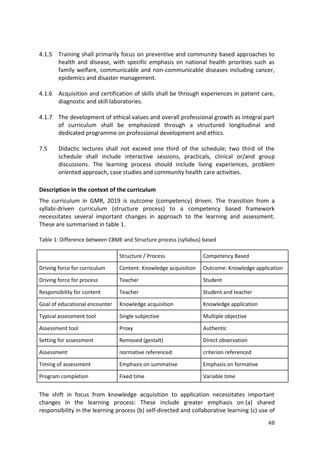
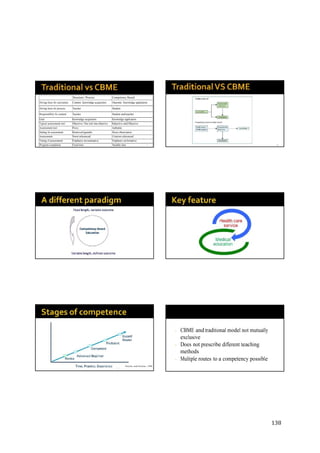
Table 1: Difference between CBME and Structure process (syllabus) based
Structure / Process Competency Based
Driving force for curriculum Content: Knowledge acquisition Outcome: Knowledge application
Driving force for process Teacher Student
Responsibility for content Teacher Student and teacher
Goal of educational encounter Knowledge acquisition Knowledge application
Typical assessment tool Single subjective Multiple objective
Assessment tool Proxy Authentic
Setting for assessment Removed (gestalt) Direct observation
Assessment normative referenced criterion referenced
Timing of assessment Emphasis on summative Emphasis on formative
Program completion Fixed time Variable time
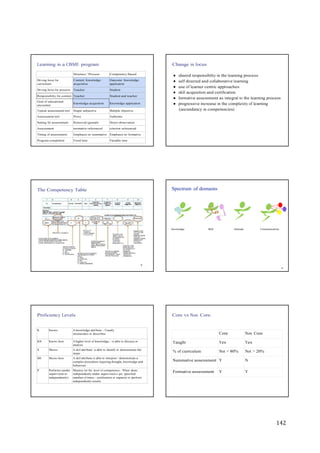
The shift in focus from knowledge acquisition to application necessitates important
changes in the learning process: These include greater emphasis on (a) shared
responsibility in the learning process (b) self-directed and collaborative learning (c) use of
49
learner centric approaches (d) skill acquisition and certification e) formative assessment
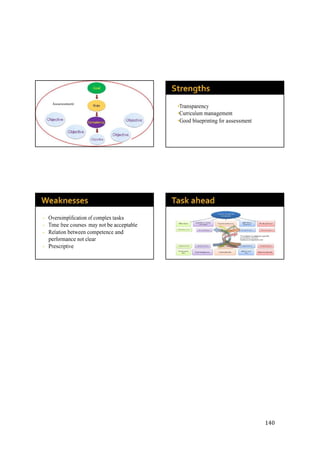
as integral to the learning process (f) progressive increase in the complexity of learning
(the so called ascendancy in competencies).
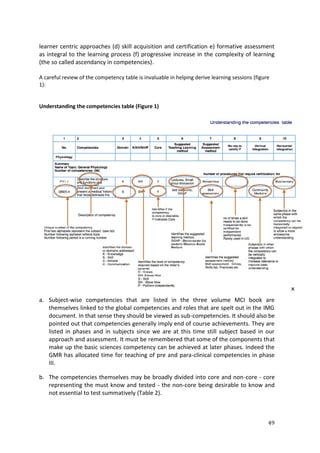
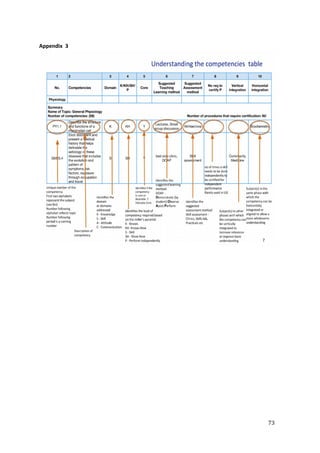
A careful review of the competency table is invaluable in helping derive learning sessions (figure
1):
Understanding the competencies table (Figure 1)
a. Subject-wise competencies that are listed in the three volume MCI book are
themselves linked to the global competencies and roles that are spelt out in the IMG
document. In that sense they should be viewed as sub-competencies. It should also be
pointed out that competencies generally imply end of course achievements. They are
listed in phases and in subjects since we are at this time still subject based in our
approach and assessment. It must be remembered that some of the components that
make up the basic sciences competency can be achieved at later phases. Indeed the
GMR has allocated time for teaching of pre and para-clinical competencies in phase
III.
b. The competencies themselves may be broadly divided into core and non-core - core
representing the must know and tested - the non-core being desirable to know and
not essential to test summatively (Table 2).
50
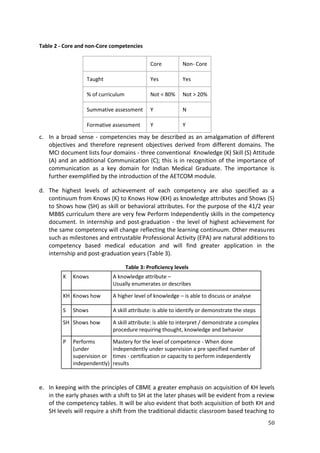
Table 2 - Core and non-Core competencies
Core Non- Core
Taught Yes Yes
% of curriculum Not < 80% Not > 20%
Summative assessment Y N
Formative assessment Y Y
c. In a broad sense - competencies may be described as an amalgamation of different
objectives and therefore represent objectives derived from different domains. The
MCI document lists four domains - three conventional Knowledge (K) Skill (S) Attitude
(A) and an additional Communication (C); this is in recognition of the importance of
communication as a key domain for Indian Medical Graduate. The importance is
further exemplified by the introduction of the AETCOM module.
d. The highest levels of achievement of each competency are also specified as a
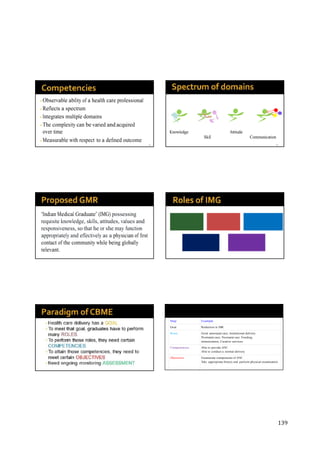
continuum from Knows (K) to Knows How (KH) as knowledge attributes and Shows (S)
to Shows how (SH) as skill or behavioral attributes. For the purpose of the 41/2 year
MBBS curriculum there are very few Perform Independently skills in the competency
document. In internship and post-graduation - the level of highest achievement for
the same competency will change reflecting the learning continuum. Other measures
such as milestones and entrustable Professional Activity (EPA) are natural additions to
competency based medical education and will find greater application in the
internship and post-graduation years (Table 3).
Table 3: Proficiency levels
K Knows A knowledge attribute –
Usually enumerates or describes
KH Knows how A higher level of knowledge – is able to discuss or analyse
S Shows A skill attribute: is able to identify or demonstrate the steps
SH Shows how A skill attribute: is able to interpret / demonstrate a complex
procedure requiring thought, knowledge and behavior
P Performs
(under
supervision or
independently)
Mastery for the level of competence - When done
independently under supervision a pre specified number of
times - certification or capacity to perform independently
results
e. In keeping with the principles of CBME a greater emphasis on acquisition of KH levels
in the early phases with a shift to SH at the later phases will be evident from a review
of the competency tables. It will be also evident that both acquisition of both KH and
SH levels will require a shift from the traditional didactic classroom based teaching to
51
learning environments where there is a greater emphasis on learning by exploring,
questioning, applying, discussing analysing, collaborating and doing. The recognition
of this need is enshrined by a greatly enhanced allocation of time to these methods of
learning in GMR, 2019.
52
Deriving teaching learning methods from competencies
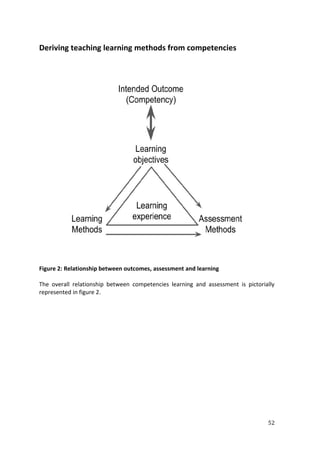
Figure 2: Relationship between outcomes, assessment and learning
The overall relationship between competencies learning and assessment is pictorially
represented in figure 2.
53
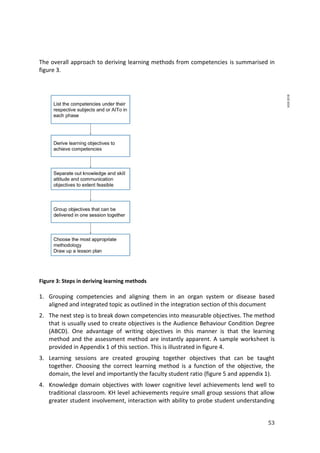
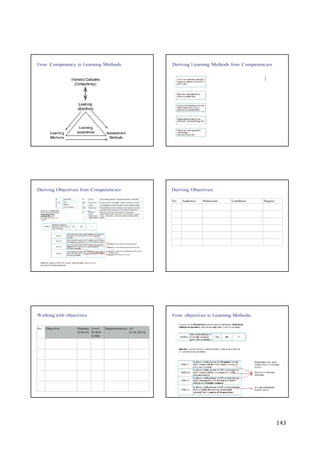
The overall approach to deriving learning methods from competencies is summarised in
figure 3.
Figure 3: Steps in deriving learning methods
1. Grouping competencies and aligning them in an organ system or disease based
aligned and integrated topic as outlined in the integration section of this document
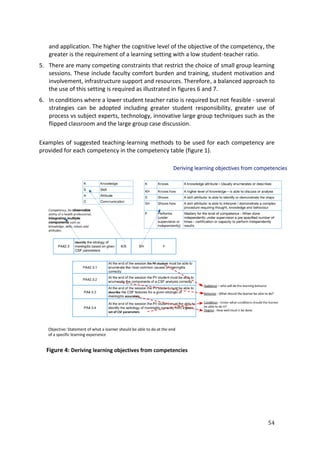
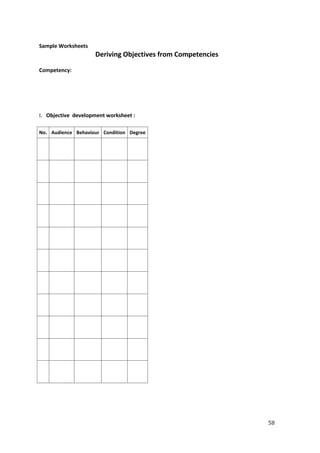
2. The next step is to break down competencies into measurable objectives. The method
that is usually used to create objectives is the Audience Behaviour Condition Degree
(ABCD). One advantage of writing objectives in this manner is that the learning
method and the assessment method are instantly apparent. A sample worksheet is
provided in Appendix 1 of this section. This is illustrated in figure 4.
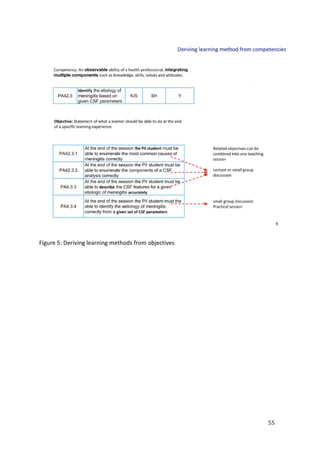
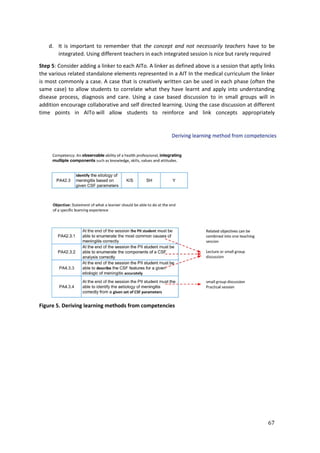
3. Learning sessions are created grouping together objectives that can be taught
together. Choosing the correct learning method is a function of the objective, the
domain, the level and importantly the faculty student ratio (figure 5 and appendix 1).
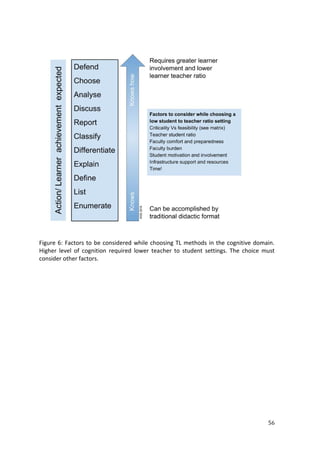
4. Knowledge domain objectives with lower cognitive level achievements lend well to
traditional classroom. KH level achievements require small group sessions that allow
greater student involvement, interaction with ability to probe student understanding
54
and application. The higher the cognitive level of the objective of the competency, the
greater is the requirement of a learning setting with a low student-teacher ratio.
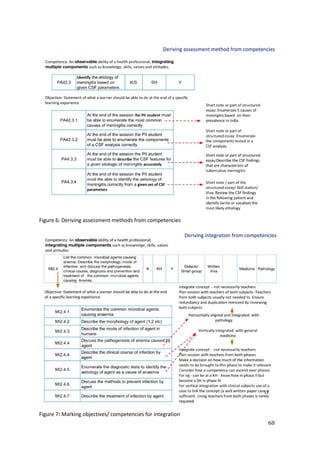
5. There are many competing constraints that restrict the choice of small group learning
sessions. These include faculty comfort burden and training, student motivation and
involvement, infrastructure support and resources. Therefore, a balanced approach to
the use of this setting is required as illustrated in figures 6 and 7.
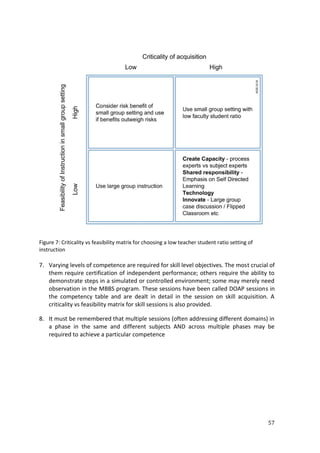
6. In conditions where a lower student teacher ratio is required but not feasible - several
strategies can be adopted including greater student responsibility, greater use of
process vs subject experts, technology, innovative large group techniques such as the
flipped classroom and the large group case discussion.
Examples of suggested teaching-learning methods to be used for each competency are
provided for each competency in the competency table (figure 1).
Figure 4: Deriving learning objectives from competencies
55
Figure 5: Deriving learning methods from objectives
56
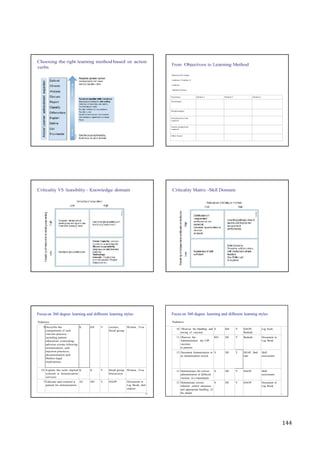
Figure 6: Factors to be considered while choosing TL methods in the cognitive domain.
Higher level of cognition required lower teacher to student settings. The choice must
consider other factors.
57
Figure 7: Criticality vs feasibility matrix for choosing a low teacher student ratio setting of
instruction
7. Varying levels of competence are required for skill level objectives. The most crucial of
them require certification of independent performance; others require the ability to
demonstrate steps in a simulated or controlled environment; some may merely need
observation in the MBBS program. These sessions have been called DOAP sessions in
the competency table and are dealt in detail in the session on skill acquisition. A
criticality vs feasibility matrix for skill sessions is also provided.
8. It must be remembered that multiple sessions (often addressing different domains) in
a phase in the same and different subjects AND across multiple phases may be
required to achieve a particular competence
58
Sample Worksheets
Deriving Objectives from Competencies
Competency:
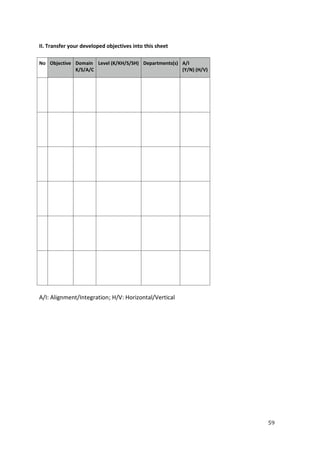
I. Objective development worksheet :
No. Audience Behaviour Condition Degree
59
II. Transfer your developed objectives into this sheet
No Objective Domain
K/S/A/C
Level (K/KH/S/SH) Departments(s) A/I
(Y/N) (H/V)
A/I: Alignment/Integration; H/V: Horizontal/Vertical
60
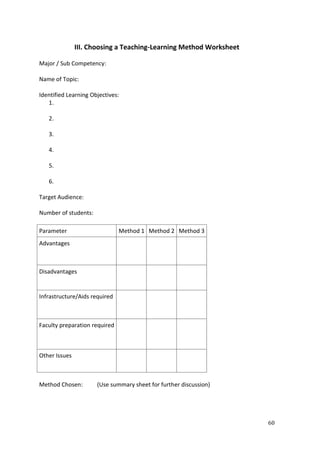
III. Choosing a Teaching-Learning Method Worksheet
Major / Sub Competency:
Name of Topic:
Identified Learning Objectives:
1.
2.
3.
4.
5.
6.
Target Audience:
Number of students:
Parameter Method 1 Method 2 Method 3
Advantages
Disadvantages
Infrastructure/Aids required
Faculty preparation required
Other Issues
Method Chosen: (Use summary sheet for further discussion)
61
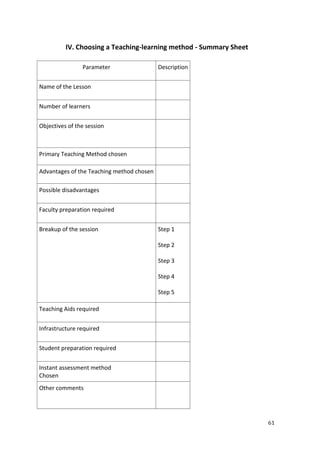
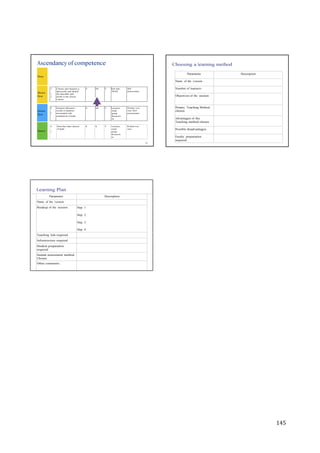
IV. Choosing a Teaching-learning method - Summary Sheet
Parameter Description
Name of the Lesson
Number of learners
Objectives of the session
Primary Teaching Method chosen
Advantages of the Teaching method chosen
Possible disadvantages
Faculty preparation required
Breakup of the session Step 1
Step 2
Step 3
Step 4
Step 5
Teaching Aids required
Infrastructure required
Student preparation required
Instant assessment method
Chosen
Other comments
62
Alignment and Integration
Objectives
The participant must be able to:
a. Facilitate the development of an aligned and integrated curriculum in his/her
institution as envisaged in the GMR, 2019 document
Glossary of terms used
For the purposes of this document -
Alignment implies the teaching of subject material that occurs under a particular organ
system/ disease concept from the same phase in the same time frame i.e., temporally.
Integration implies that concepts in a topic / organ system that are similar, overlapping or
redundant are merged into a single teaching session in which subject based demarcations
are removed. For the purpose of this document, topics from other phases that are
brought into a particular phase for the purpose of reinforcement or introduction will also
be considered as integrated topics. In GMR, 2019 time for integrated teaching is clearly
demarcated.
Linker is a session that allows the learner to link the concepts presented in an aligned
topic
Curricular Element or Program Addressed
Alignment and Integration
Relevant Extract from GMR
10.1 Preamble:
The salient feature of the revision of the medical curriculum is the emphasis on learning
which is competency-based, integrated and student-centered acquisition of skills and
ethical & humanistic values.
Each of the competencies described below must be read in conjunction with the goals of
the medical education as listed in items 2 and 3.
It is recommended that didactic teaching be restricted to less than one third of the total
time allotted for that discipline. Greater emphasis is to be laid on hands-on training,
symposia, seminars, small group discussions, problem-oriented and problem-based
discussions and self-directed learning. Students must be encouraged to take active part in
and shared responsibility for their learning.
Subject specific competencies with appropriate alignment and integration are available
with Medical Council of India.
63
10.2 Integration must be horizontal (i.e. across disciplines in a given phase of the course)
and vertical (across different phases of the course). As far as possible, it is desirable that
teaching/learning occurs in each phase through study of organ systems or disease blocks
in order to align the learning process. Clinical cases must be used to integrate and link
learning across disciplines.
Description of the curricular program
Concept of integration used in the GMR
Integration is a learning experience that allows the learner to perceive relationships from
blocks of knowledge and develop a unified view of its basis and its application (KGS 2018).
The GMR, 2019 applies these principles to the extent that will retain the strengths of silo
based education and assessment while providing experiences that will allow learners to
integrate concepts.
Keeping this in mind the regulations recommend temporal coordination as described by
Harden (called alignment in this document) as the major method to be followed allowing
similar topics in different subjects to be learnt separately but during the same time frame
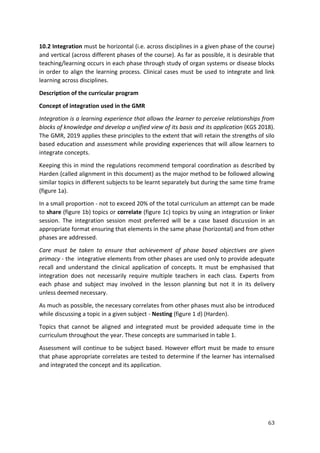
(figure 1a).
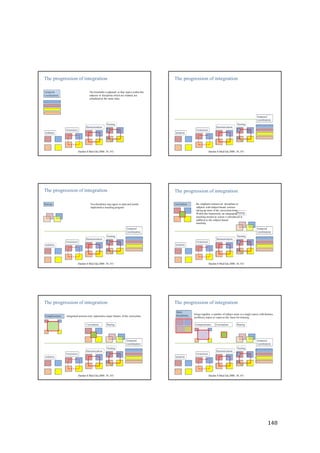
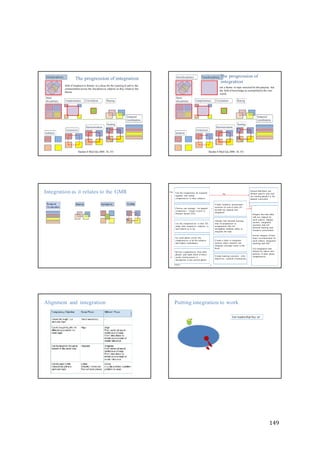
In a small proportion - not to exceed 20% of the total curriculum an attempt can be made
to share (figure 1b) topics or correlate (figure 1c) topics by using an integration or linker
session. The integration session most preferred will be a case based discussion in an
appropriate format ensuring that elements in the same phase (horizontal) and from other
phases are addressed.
Care must be taken to ensure that achievement of phase based objectives are given
primacy - the integrative elements from other phases are used only to provide adequate
recall and understand the clinical application of concepts. It must be emphasised that
integration does not necessarily require multiple teachers in each class. Experts from
each phase and subject may involved in the lesson planning but not it in its delivery
unless deemed necessary.
As much as possible, the necessary correlates from other phases must also be introduced
while discussing a topic in a given subject - Nesting (figure 1 d) (Harden).
Topics that cannot be aligned and integrated must be provided adequate time in the
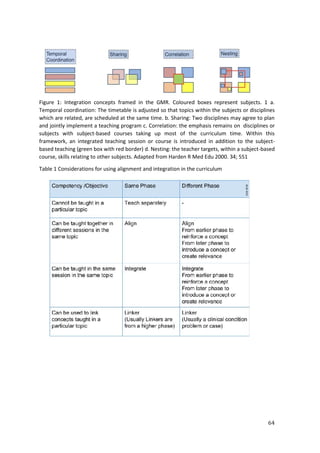
curriculum throughout the year. These concepts are summarised in table 1.
Assessment will continue to be subject based. However effort must be made to ensure
that phase appropriate correlates are tested to determine if the learner has internalised
and integrated the concept and its application.
64
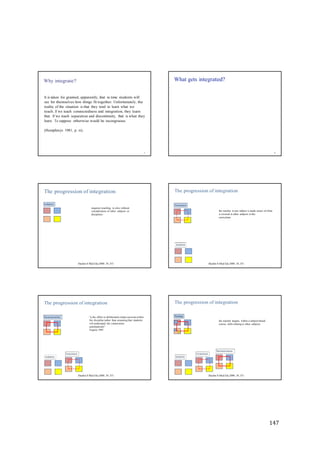
Figure 1: Integration concepts framed in the GMR. Coloured boxes represent subjects. 1 a.
Temporal coordination: The timetable is adjusted so that topics within the subjects or disciplines
which are related, are scheduled at the same time. b. Sharing: Two disciplines may agree to plan
and jointly implement a teaching program c. Correlation: the emphasis remains on disciplines or
subjects with subject-based courses taking up most of the curriculum time. Within this
framework, an integrated teaching session or course is introduced in addition to the subject-
based teaching (green box with red border) d. Nesting: the teacher targets, within a subject-based
course, skills relating to other subjects. Adapted from Harden R Med Edu 2000. 34; 551
Table 1 Considerations for using alignment and integration in the curriculum
65
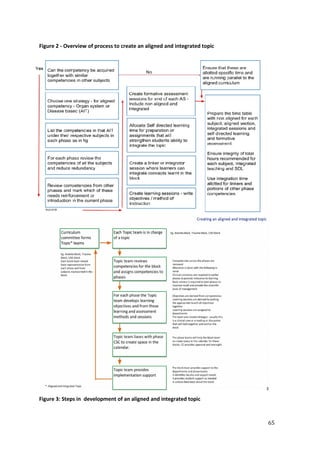
Figure 2 - Overview of process to create an aligned and integrated topic
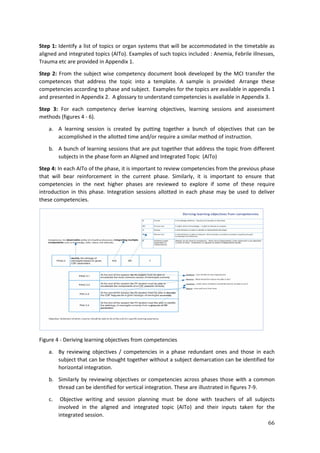
Figure 3: Steps in development of an aligned and integrated topic
66
Step 1: Identify a list of topics or organ systems that will be accommodated in the timetable as
aligned and integrated topics (AITo). Examples of such topics included : Anemia, Febrile illnesses,
Trauma etc are provided in Appendix 1.
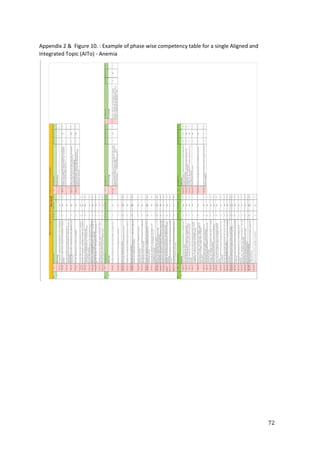
Step 2: From the subject wise competency document book developed by the MCI transfer the
competences that address the topic into a template. A sample is provided Arrange these
competencies according to phase and subject. Examples for the topics are available in appendix 1
and presented in Appendix 2. A glossary to understand competencies is available in Appendix 3.
Step 3: For each competency derive learning objectives, learning sessions and assessment
methods (figures 4 - 6).
a. A learning session is created by putting together a bunch of objectives that can be
accomplished in the allotted time and/or require a similar method of instruction.
b. A bunch of learning sessions that are put together that address the topic from different
subjects in the phase form an Aligned and Integrated Topic (AITo)
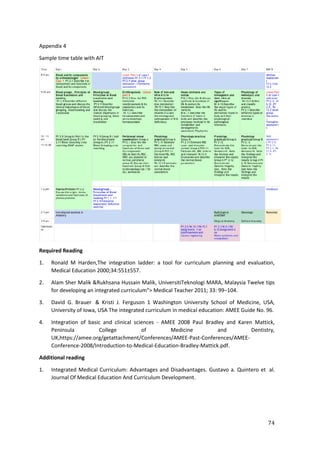
Step 4: In each AITo of the phase, it is important to review competencies from the previous phase
that will bear reinforcement in the current phase. Similarly, it is important to ensure that
competencies in the next higher phases are reviewed to explore if some of these require
introduction in this phase. Integration sessions allotted in each phase may be used to deliver
these competencies.
Figure 4 - Deriving learning objectives from competencies
a. By reviewing objectives / competencies in a phase redundant ones and those in each
subject that can be thought together without a subject demarcation can be identified for
horizontal integration.
b. Similarly by reviewing objectives or competencies across phases those with a common
thread can be identified for vertical integration. These are illustrated in figures 7-9.
c. Objective writing and session planning must be done with teachers of all subjects
involved in the aligned and integrated topic (AITo) and their inputs taken for the
integrated session.
67
d. It is important to remember that the concept and not necessarily teachers have to be
integrated. Using different teachers in each integrated session is nice but rarely required
Step 5: Consider adding a linker to each AITo. A linker as defined above is a session that aptly links
the various related standalone elements represented in a AIT In the medical curriculum the linker
is most commonly a case. A case that is creatively written can be used in each phase (often the
same case) to allow students to correlate what they have learnt and apply into understanding
disease process, diagnosis and care. Using a case based discussion to in small groups will in
addition encourage collaborative and self directed learning. Using the case discussion at different
time points in AITo will allow students to reinforce and link concepts appropriately
Figure 5. Deriving learning methods from competencies
68
Figure 6: Deriving assessment methods from competencies
Figure 7: Marking objectives/ competencies for integration
69
The creation of an aligned and integrated topic (AITo) are pictorially illustrated in figures 8 and 9.
Step 6: Ensure that adequate time for the block is created in the time table. It is important to
consider the inclusion of an end of block assessment that will count towards formative/ internal
assessment.
Important: While creating the timetable ensure that topics in each subject that cannot be aligned
are also taught simultaneously in each subject and that the timetable accommodates these topics
appropriately.
An example timetable incorporating an aligned and integrated topic is available in Appendix 4.
The functions of the AIT team in collaboration on CSC and CC in creating the AIT/Block is
illustrated in figure 10.
70
Figures. 8 and 9. Pictorial illustration of creating horizontal alignment and horizontal vertical
integration
71
Appendix 1
Example topics developed by the RCB for the aligned and integrated topics (indicative)
 Anemia
 Jaundice
 Diabetes
 Thyroid Diseases
 Nutrition
 Febrile Illness
 Tuberculosis
 Malaria
 Diarrhoea
 Ischemic Heart Disease
 Polycystic Ovarian Syndrome
72
Appendix 2 & Figure 10. : Example of phase wise competency table for a single Aligned and
Integrated Topic (AITo) - Anemia
73
Appendix 3
74
Appendix 4
Sample time table with AIT
Required Reading
1. Ronald M Harden,The integration ladder: a tool for curriculum planning and evaluation,
Medical Education 2000;34:551±557.
2. Alam Sher Malik &Rukhsana Hussain Malik, UniversitiTeknologi MARA, Malaysia Twelve tips
for developing an integrated curriculum"> Medical Teacher 2011; 33: 99–104.
3. David G. Brauer & Kristi J. Ferguson 1 Washington University School of Medicine, USA,
University of Iowa, USA The integrated curriculum in medical education: AMEE Guide No. 96.
4. Integration of basic and clinical sciences ‐ AMEE 2008 Paul Bradley and Karen Mattick,
Peninsula College of Medicine and Dentistry,
UK,https://amee.org/getattachment/Conferences/AMEE-Past-Conferences/AMEE-
Conference-2008/Introduction-to-Medical-Education-Bradley-Mattick.pdf.
Additional reading
1. Integrated Medical Curriculum: Advantages and Disadvantages. Gustavo a. Quintero et al.
Journal Of Medical Education And Curriculum Development.
74
Appendix 4
Sample time table with AIT
Required Reading
1. Ronald M Harden,The integration ladder: a tool for curriculum planning and evaluation,
Medical Education 2000;34:551±557.
2. Alam Sher Malik &Rukhsana Hussain Malik, UniversitiTeknologi MARA, Malaysia Twelve tips
for developing an integrated curriculum"> Medical Teacher 2011; 33: 99–104.
3. David G. Brauer & Kristi J. Ferguson 1 Washington University School of Medicine, USA,
University of Iowa, USA The integrated curriculum in medical education: AMEE Guide No. 96.
4. Integration of basic and clinical sciences ‐ AMEE 2008 Paul Bradley and Karen Mattick,
Peninsula College of Medicine and Dentistry,
UK,https://amee.org/getattachment/Conferences/AMEE-Past-Conferences/AMEE-
Conference-2008/Introduction-to-Medical-Education-Bradley-Mattick.pdf.
Additional reading
1. Integrated Medical Curriculum: Advantages and Disadvantages. Gustavo a. Quintero et al.
Journal Of Medical Education And Curriculum Development.
74
Appendix 4
Sample time table with AIT
Required Reading
1. Ronald M Harden,The integration ladder: a tool for curriculum planning and evaluation,
Medical Education 2000;34:551±557.
2. Alam Sher Malik &Rukhsana Hussain Malik, UniversitiTeknologi MARA, Malaysia Twelve tips
for developing an integrated curriculum"> Medical Teacher 2011; 33: 99–104.
3. David G. Brauer & Kristi J. Ferguson 1 Washington University School of Medicine, USA,
University of Iowa, USA The integrated curriculum in medical education: AMEE Guide No. 96.
4. Integration of basic and clinical sciences ‐ AMEE 2008 Paul Bradley and Karen Mattick,
Peninsula College of Medicine and Dentistry,
UK,https://amee.org/getattachment/Conferences/AMEE-Past-Conferences/AMEE-
Conference-2008/Introduction-to-Medical-Education-Bradley-Mattick.pdf.
Additional reading
1. Integrated Medical Curriculum: Advantages and Disadvantages. Gustavo a. Quintero et al.
Journal Of Medical Education And Curriculum Development.
75
Electives
Introduction
Elective can be defined as a brief course made available to the learner during
his/her undergraduate study period, where she/he can choose from the available options
depending upon their interest and career preferences. This provides an opportunity in the
form of an elective course, where an undergraduate medical student can explore his/her
deeper interest areas, by working in a medical specialty in hospital/ community setting or
undertake a project under an identified expert, which can be an important component in
the undergraduate medical education. A student can be helped in identifying his/her
future career path by direct experiences in diverse areas. An elective is not being offered
by medical schools in India till now.
Introduction of electives in undergraduate medical curriculum is an important
step for providing flexible choices in student’s areas of interest, direct individual
experience and this will help in developing self-directed learning skills.
The range of electives that can be offered to the students will depend upon the
local logistics and resources available for the medical institutions (within or nearby).
These can be in a wide range that can include electives from educational, community and
research-project related, directly or indirectly with health care, super-specialty clinical
electives and specific laboratory electives.
Relevant Extract from GMR:
Method:
9.3.2 Two months are allotted for elective rotations after completion of the exam at end
of the third MBBS Part I examination and before commencement of third MBBS
Part II.
9.3.3 It is compulsory for learners to do an elective. The protected time for electives
should not be used to make up for missed clinical postings, shortage of
attendance or any other purpose.
9.3.4 Structure
(a) The learner shall rotate through two elective blocks of 04 weeks each,
(b) Block 1 shall be done in a pre-selected preclinical or para-clinical or other basic
sciences laboratory OR under a faculty researcher in an ongoing research
project. During the electives regular clinical postings shall continue.
(c) Block 2 shall be done in a clinical department (including specialties, super-
specialties, ICUs, blood bank and casualty) from a list of electives developed and
76
available in the institution OR as a supervised learning experience at a rural or
urban community clinic.
(d) Institutions will determine the number and nature of electives beforehand ,
names of the supervisors, and the number of learners in each elective based on
the local logistics, available resources and faculty.
9.3.5 Each institution will develop its own mechanism for allocation of electives.
9.3.6 It is preferable that electives are made available to the learners in the beginning
of the academic year.
9.3.7 The learner must submit a learning log book based on both blocks of the elective.
9.3.8 75% attendance in the electives and submission of log book maintained during
elective is mandatory for eligibility to appear in the final MBBS examination.
9.3.9 Institutions may use part of this time for strengthening basic skill certification.
Description of the curricular program
Objectives:
To provide learner with opportunities
 for a wide spectrum of learning experiences
 to carry hospital/ community based research projects which stimulate
enquiry, self-directed, experiential learning and lateral thinking
Intent:
The purpose of introducing electives in the undergraduate curriculum is to:
 allow flexibility and choice during study period
 provide opportunity to explore their areas of interest that can supplement
their future studies
 develop self directed learning skills
 have direct experience of working in their interest areas
 develop ability of deeper learning and critical thinking through reflection
 have a student centric component in curriculum
Elements and components of the program:
1) Faculty Development:
The existing MCI curriculum for UG does not have electives and thus faculty as well
as institutions need to be trained to implement this new element.
2) Incorporation in the curriculum:
77
List of electives offered by the institution must be displayed for students. Each
elective should have well defined objectives, expected outcomes, expectations from
the students, their assessment mechanism and faculty guide or mentors. A faculty
mentor should guide the student, monitor their learning activities and assess the
students’ performance with regular feedback.
Curricular delivery:
Method:
 Two months are designated for elective rotations after completion of the
examination at end of the third MBBS Part I and before commencement of
third MBBS Part II
 It is compulsory for learners to do an elective.
 The protected time for electives should not be used to make up for missed
clinical postings, shortage of attendance or any other purposes.
Curricular governance and evaluation of the program (Person responsible, evaluation
periodicity, methods, reporting)
Each medical institution will be primarily responsible for the elective
postings. Dean’s office in each medical college will identify a person/office/department/
MEU in the college who will be assigned the task of identifying, organizing and taking all
administrative responsibilities for the elective postings.
The responsible person/office/department/ MEU will identify possible electives
within and outside institution that can be offered to the students. These need to be
specified and communicated to the students at the beginning of the academic year. The
departments and/ or faculty who will guide/ supervise/mentor the students during their
elective posting also need to be identified and trained in various requirements of
electives.
If resources are available, students may be permitted to do electives in other
medical colleges or institutions within/ outside the country with permission of local
authorities and Universities.
Examples of some of the electives that may be offered are:
Example of General Electives:
• Bio-Informatics, Tissue Engineering/ Processing,
78
• Computer & Computer Applications, Immunology,
• Genetics, Human Nutrition, etc. Sports Medicine,
• Laboratory Sciences, Research Methodology,
• Ethics, Accident and Emergencies (A&E),
• Community Projects, HIV Medicine, Tissue Culture,
• Pharmaco-kinetics/-dynamics /-economics,
• Assisted Reproductive Technology, Ethics & Medical Education
Example of List of clinical electives / disciplines(where it can be done):
 Cardiothoracic Surgery, Cardiology, Paediatric Surgery, Gastroenterology
 Infectious Disease, Geriatrics, Psychiatry, Radiodiagnosis
 Neurosurgery, Neurology, Accident & Emergency Medicine
 Rheumatology, Pulmonary Medicine
 Neonatology, Anaesthesia, Oncology
 Dermatology, Endocrinology, Nephrology
 Palliative care, Clinical pharmacology, Physical Medicine and Rehabilitation
 Clinical genetics, Biomedical waste management, Toxicology
Example of Community electives/Places where it can be done:
 District, taluka hospital or PHC
 Community hospital
 Community project
 National programmes
List of Laboratory Electives:
 Biochemistry, Pathology, Microbiology, Virology
 Pharmacology, Forensic Medicine, Molecular biology etc.
Assessment:
 Assessment will be in line with the general assessment pattern document
of CBME.
 Electives are compulsory part of medical curriculum and 75% of
attendance will be mandatory
79
 Student should maintain and submit a log book/ portfolio with all
academic and non academic activities. For example; Cases seen, examined,
investigated, test performed, case operated etc.
 Along with their stories and reflection about each event.
 Students will be assessed in between and at the end of each elective
posting.
 Feedback, comments and /or grades about the student’s performance by
the faculty mentor can be documented with the help of a checklist where
both professional and academic attributes can be included.
 Various points that are included in the checklist can be related to clinical
skills like history taking/examination, motivation and interest,
communication, team work, discipline, documentation etc
 The performance of the students in the electives will also contribute
towards internal marks.
 Student’s feedback about the elective also needs to be documented in a
structured format. This will help in gathering student’s perceptions about
various aspects of elective posting and help in program evaluation.
List of resources :
Must read
 Lumb A, Murdoch-Eaton D. Electives in undergraduate medical education: AMEE
Guide No. 88. Medical Teacher. 2014 Jul 1;36(7):557-72.
 Ankit Agarwal, Stephanie Wong, Suzanne Sarfaty, Anand Devaiah& Ariel E. Hirsch
(2015) Elective courses for medical students during the preclinical curriculum: a
systematic review and evaluation, Medical Education Online, 20:1,
DOI:10.3402/meo.v20.26615
 Thompson MJ, Huntington MK, Hunt DD, Pinsky LE, Brodie JJ. Educational effects
of international health electives on US and Canadian medical students and
residents: a literature review. Academic medicine: journal of the Association of
American Medical Colleges. 2003 Mar;78(3):342.
Additional reading
80
 Hastings, Adrian & Dowell, Jon &KalmusEliasz, Michael. (2013). Medical student
electives and learning outcomes for global health: A commentary on behalf of the
UK Medical Schools Elective Council. Medical teacher. 36.
10.3109/0142159X.2013.849330.
 Harth SC, Leonard NA, Fitzgerald SM, Thong YH. The educational value of clinical
electives. Medical education. 1990 Jul;24(4):344-53.
 Dana Stys, Wilma Hopman& Jennifer Carpenter (2013) What is the value of global
health electives during medical school?, Medical Teacher, 35:3, 209-218,
DOI:10.3109/0142159X.2012.731107
81
Early Clinical Exposure
Introduction:
Students who enter the MBBS course, have little knowledge and experience of
medicine as a practical field. Neither will they have insight into the inter-relatedness of its
scientific, social, professional and interpersonal dimensions. They look forward to dealing
with patients and learning how to take care of them. However, the experience their
preclinical experience seems very far removed from the purpose for which they entered
the medical field. Students find it difficult to correlate structure, function and metabolic
processes without seeing patients and understanding the purpose of what they are
learning.
Today it has become clear that the clinical context, which the pre-clinical phase
would ultimately serve, should be introduced earlier. Curricula therefore became
‘integrated’ such that early clinical exposure was introduced alongside the basic and
clinical sciences. Students learn both the basic and clinical sciences as such, alongside rich
integrating learning activities, be these early clinical contact, clinical skills, communication
skills, problem-based or task-based learning sessions and so on. So curricula are settling
down with the strength of the scaffolding that the basic and clinical sciences per se bring
to the student’s trajectory of learning, accompanied by contextual development of
clinical and communication skills, practice with clinical problems, attachments to primary
care and particular patients or families and so on. Early clinical exposure, and the
accompanying knowledge and skills development, does not replace the basic and clinical
sciences, but rather enriches and contextualizes that learning and offers a wider variety
of teaching and learning methods.
Relevant Extract from GMR:
9.1.1 Objectives: The objectives of early clinical exposure of the first-year medical
learners are to enable the learner to:
(a) Recognize the relevance of basic sciences in diagnosis, patient care and treatment
(b) Provide a context that will enhance basic science learning
(c) Relate to experience of patients as a motivation to learn
82
(d) Recognize attitude, ethics and professionalism as integral to the doctor-patient
relationship
(e) Understand the socio-cultural context of disease through the study of humanities
9.1.2 Elements
(a) Basic science correlation: i.e. apply and correlate principles of basic sciences as
they relate to the care of the patient (this will be part of integrated modules).
(b) Clinical skills: to include basic skills in interviewing patients, doctor-patient
communication, ethics and professionalism, critical thinking and analysis and self-
learning (this training will be imparted in the time allotted for early clinical
exposure).
(c) Humanities: To introduce learners to a broader understanding of the socio-
economic framework and cultural context within which health is delivered
through the study of humanities and social sciences.
Description of the curricular program:
Definition
Although there is no consensus on the definition of ECE in the literature, it can be defined
as an ‘‘authentic human contact in a social or clinical context that enhances learning of
health, illness and/ or disease, and the role of the health professional’’, occurring in the
early or preclinical years of undergraduate education (taken from the hand-out
reference)
Objectives:
1. Recognize the relevance of basic sciences in diagnosis, patient care and treatment·
2. Provide a context that will enhance basic science learning & relate to experience
of patients as a motivation to learn
3. Provide an opportunity for observing basic skills in interviewing patients & doctor-
patient communication.
4. Recognize attitude, ethics and professionalism as integral to the doctor-patient
relationship
5. Understand the socio-cultural context of disease through the study of humanities
Intent:
83
Purpose for early clinical exposure to students in the 1st year is to:
 Learn basic clinical skills
 Enhance their motivation and prepare them towards the purpose for which they
entered the profession
 Enable students to correlate what they are learning in basic sciences by learning
basics clinical skills and observing relevant disease abnormalities
 Encourage students to learn the professional behavior of a doctor by observing
and being mentored by a clinical teacher
 Provide the context for application of their learning in practice
Elements and components of the program:
Faculty Development:
While early clinical exposure is widely used, it is not a prominent feature of the existing
MCI curriculum. Therefore in the new curriculum which emphasizes horizontal and
vertical integration, faculty need to be reoriented to the principles and practice of early
clinical exposure with commonly agreed guidelines.
Preclinical faculty need to coordinate and involve in the activities related to hospital visit
with clinical faculty
Incorporation in the curriculum:
Some of the key issues in designing a clinically relevant basic science course are;
 Identifying clinically relevant core content and principles of understanding.
Avoiding content that is likely to change in a short period of time.
 Developing critical thinking and reasoning skills by offering students opportunities
to repeatedly apply their learning in the clinical context of patient care.
 Encouraging students to critically think about problems of health care, evaluate
and incorporate new information which is a skill that they will use for the rest of
their professional lives.
 Providing opportunities for students to be sensitised to the broader context of
health and health care in India and encouraging them to reflect on their role in
addressing issues of health care.
Planning of activities & its distribution:
ECE has to be done in practically each of the sessions of basic sciences, preferably
for first 10-15 minutes as we do not want to happen it in silo, but want it as an integral
part of the basic science curriculum.
Total allotted hours in first year (as per GMR, 2019) is 90 hours which has to be
equally divided in the three preclinical subjects. So time available for each subject is 30
hours, which can be further divided as follows:
84
1. Basic sciences Correlation - 18 hours - 3 hour session per month for 6 months
can take place with charts, graphics, videos, reports, field visits etc... in class
rooms / hospital labs
2. Clinical Skills - 12 hours - one 3 hour session per month for four months per
department- students in small groups to go with preclinical faculty equipped with
observation guides to specified cases being demonstrated by clinicians and
observed by first year students
3. Humanities - will be merged with AETCOM - no additional time.
Each 3 hour session of clinical skills will have:
 Introduction & instruction: 30 minutes
 Hospital visit: 1 hour 30 minutes
 Summary & conclusion: 30 minutes -
 Reflection: 30 minutes
Assessment: will be in line with the general assessment pattern document of CBME.
A) Internal Assessment:
Internal assessment shall be based on day-to-day assessment, internal examination &
Preliminary examination. It shall relate to different ways in which learners participate
during teaching-learning like preparation of clinical case for discussion, clinical case
study/problem solving exercise, clinical assignments, clinical case presentation, active
participation in group discussion for clinical case discussion, a written test related to CBL
etc.
1. Regular periodic examinations shall be conducted throughout the course.
2. Day to day records, reflective writing and log book (which can be appropriately
modified) will be given importance in internal assessment. Internal assessment should
be based on competencies and skills. A model log book can be provided to medical
colleges
B) University Examinations
Modified Essay Questions (Problem based long answer questions), Clinical vignette based
Short Answers Questions (SAQ) and objective type questions (e.g. Multiple Choice
Questions - MCQ).
Viva/oral examination should assess approach to clinical context in the concepts of basic
sciences.
85
Principles of Competency Based Assessment
Introduction
Competency based medical education focuses on outcomes, competencies and
learner centeredness in education. This shift has challenged medical educators to look for
different ways to teach and assess. CBME does not entail a different type of teaching;
what it entails differently is the ongoing assessment to help the teachers find the stage of
the learner, need for further interventions and better learning. The International CBME
Collaborators have defined competency as an observable activity of health professions
integrating multiple components like knowledge, skills, attitudes and communication and
used habitually for doing a patient care related task.
Competency is not an all or none phenomenon. Rather it is incremental. The role
of teachers is to help the learner acquire and improve upon the competencies. CBME
moves away from time bound education and looks at competency as the end point.
Consequently, we are no longer interested in demonstration of discrete behaviors by the
learners; rather we are interested in application of these in each patient context. Thus, it
is more about integration of the required knowledge, skills and attitudes rather than
anyone of them in isolation.
There are several misconcepts surrounding competency-based assessment (CBA).
Some of those are listed below:
Myth Reality
Assessment should be performance based Competency denotes ability of a learner to
perform – not weather he actually performs
Assessment of discreet domains can be taken
as surrogate of competency
CBA should assess integration of domains in a
clinical context
CBA should concentrate of technical skills Non-technical skills are as important to be
taught and assessed.
CBA can be a onetime process CBA must be an ongoing process
CBA can be norm referenced CBA must be criterion referenced.
86
The key approach for CBA is direct observation. It is not concerned with detecting
incompetence but helps the learners to acquire competence.
While learning objectives can be straightforward and measurable, competencies
are often complex and made up of more than one domain. Many a times, they may
require a lot of expert subjective judgment and may show inter-assessor variation. The
test of CBA however is more from the point of utility of assessment, mainly its
educational impact. The variation can also be countered by increasing the sample size of
assessment tasks and assessors.
There is a high context specificity of tasks in clinical area, meaning thereby that
attaining one competency in say physical examination does not automatically mean
competence in another area say counseling. Therefore, each competency has to be
assessed. Internal assessment provides the best opportunity to assess and provide
feedback about competencies. A blueprint may be needed to decide which competencies
should be assessed during internal assessment and which should go to summative or
University examinations. Since the purpose of ongoing assessment is improving the
competencies, not all assessments should contribute to pass/fail decisions.
Objectives of the document:
 To enable the faculty to plan effective assessment for CBME
 To enable faculty to understand the changes in assessment proposed in GMER
Glossary of terms used
Assessment: A systematic process of documenting and using empirical data on the
knowledge, skill, attitudes, and beliefs to refine programs and improve student learning
CBME: Outcome based education which uses competency framework to design, deliver,
assess and evaluate the curriculum.
Curricular Element or Program Addressed:
Using assessment as a tool to help the learners acquire and improve competencies.
Relevant Extract from GMR
Included in the reading material
87
The key to success of CBME is the alignment between competencies, TL methods and
assessment. Here are some examples of deriving appropriate assessment methods from
competencies:
Record keeping is an integral part of CBA. They help the students, teachers and administrators to
understand the learning trajectory as well as enable them to take corrective action.
Internal Assessment:
Internal assessment shall be based on day-to-day assessment. It shall relate to
different ways in which learners participate in learning process including assignments,
preparation for seminar, clinical case presentation, preparation of clinical case for
discussion, clinical case study/problem solving exercise, participation in project for health
88
care in the community, proficiency in carrying out a practical or a skill in small research
project, a written test etc.
1. Regular periodic examinations shall be conducted throughout the course. There shall
be no less than three internal assessment examinations in each Preclinical / Para-
clinical subject and no less than two examinations in each clinical subject in a
professional year. An end of posting clinical assessment shall be conducted for each
clinical posting in each professional year.
2. In subjects that are taught at more than one phase, proportionate weightage must be
given for internal assessment for each Phase. For example, General Medicine must be
assessed in second Professional, third Professional Part I and third Professional Part II,
independently.
3. Day to day records and log book should be given importance in internal assessment.
Internal assessment should be based on competencies and skills. Learners must
secure at least 50% marks of the total marks (combined in theory and practicals /
clinicals) assigned for internal assessment in a particular subject in order to be
declared successful at the final University examination of that subject. The learner
should be made aware of the results of Internal Assessment. Each college can build its
own mechanism and the calendar of the college should show the details regarding
conduct of Internal assessment. Internal assessment marks will reflect as separate
head of passing at the summative examination.
4. A candidate who has not secured requisite aggregate in the internal assessment may
be provisionally permitted to appear for university examination. However, he/she has
to successfully complete the remediation measures prescribed by the institution/
university as the case may be, prior to the declaration of his/her results in that
particular phase. Failure to meet prescribed 50% marks in Internal assessment after
availing remedial measures will lead to annulment of the results of the candidate in
that particular subject(s) in the university examination.
University Examinations
11.2.1 University examinations are to be designed with a view to ascertain whether the
candidate has acquired the necessary knowledge, minimal level of skills, ethical
89
and professional values with clear concepts of the fundamentals which are
necessary for him/her to function effectively and appropriately as a physician of
first contact. Assessment shall be carried out on an objective basis to the extent
possible.
11.2.2 Nature of questions will include different types such as structured essays (Long
Answer Questions - LAQ), Short Answers Questions (SAQ) and objective type
questions (e.g. Multiple Choice Questions - MCQ). Marks for each part should be
indicated separately. MCQs shall be accorded a weightage of not more than 20%
of the total theory marks. In subjects that have two papers, the learner must
secure at least 40% marks in each of the papers with minimum 50% of marks in
aggregate (both papers together) to pass.
11.2.3 Practical/clinical examinations will be conducted in the laboratories or hospital
wards. The objective will be to assess proficiency and skills to conduct
experiments, interpret data and form logical conclusion. Clinical cases kept in the
examination must be common conditions that the learner may encounter as a
physician of first contact in the community. Selection of rare syndromes and
disorders as examination cases is to be discouraged. Emphasis should be on
candidate’s capability to elicit history, demonstrate physical signs, write a case
record, analyze the case and develop a management plan.
11.2.4 Viva/oral examination should assess approach to patient management,
emergencies, attitudinal, ethical and professional values. Candidate’s skill in
interpretation of common investigative data, X rays, identification of specimens,
ECG, etc. is to be also assessed.
11.2.5 There shall be one main examination in an academic year and a supplementary to
be held not later than 90 days after the declaration of the results of the main
examination.
90
Examinations schedule:
91
Marks distribution is given below:
List of resources:
a. http://www.jgme.org/doi/10.4300/JGME-D-17-00365.1 Accessed 13.12.2018
b. https://med.ucf.edu/comfacultycouncil/files/2018/08/Core-principles-of-assessment-in-
competency-based-medical-education.pdf Accessed 13.12.18
c. http://medind.nic.in/ibv/t15/i5/ibvt15i5p413.pdf Accessed 13.12.18
Additional reading
a. https://www.indianpediatrics.net/june2013/553.pdf Accessed 13.12.2018
b. https://amee.org/getattachment/AMEE-Initiatives/MedEdWorld/38074-
Outcome_Competency-Med-Ed-WEB.PDF Accessed 13.12.2018
c. https://www.innohealthed.com/video/assessment-needs-for-individualized-competency-
%C2%ADbased-medical-education-dr-donald-melnick/Accessed 13.12.2018
92
Skills Training and Assessment
Introduction
The new Curriculum focuses on Competencies and Outcome and gives lot of
emphasis to skill development in all phases. The competencies where ‘Shows How’ (SH)
or ‘P’ (Perform) (under supervision or independently) is listed, are related to the skills to
be developed by IMG. In case of P, the number required to be performed is also specified.
The skill labs pertaining to psychomotor, affective and communications domains thus
serves a very important purpose in the new curriculum.
Curricular Element or Program Addressed:
 Development of various skills at different levels and utilization of Skills lab in UG
training.
 Implement program for skills training and assessment.
Relevant Extract from GMR
The undergraduate medical education Programme is designed with a goal to
create an “Indian Medical Graduate” (IMG) possessing requisite knowledge, skills,
attitudes, values and responsiveness, so that he or she may function appropriately and
effectively as a physician of first contact of the community while being globally relevant.
3.1. Clinician, who understands and provides preventive, promotive, curative,
palliative and holistic care with compassion
3.1.7 Demonstrate ability to perform a physical examination that is complete and
relevant to disease identification, disease prevention and health promotion.
3.1.8 Demonstrate ability to perform a physical examination that is contextual to
gender, social and economic status, patient preferences and values.
3.1.9 Demonstrate effective clinical problem solving, judgment and ability to
interpret and integrate available data in order to address patient problems,
generate differential diagnoses and develop individualized management plans
that include preventive, promotive and therapeutic goals.
3.3. Communicator with patients, families, colleagues and community
93
3.3.1 Demonstrate ability to communicate adequately, sensitively, effectively and
respectfully with patients in a language that the patient understands and in a
manner that will improve patient satisfaction and health care outcomes.
3.3.2 Demonstrate ability to establish professional relationships with patients and
families that are positive, understanding, humane, ethical, empathetic, and
trustworthy.
3.4. Lifelong learner committed to continuous improvement of skills and
knowledge
Description of the curricular program:
Definition
Skill was the term used traditionally to denote procedural skill. However, there has been a
paradigm shift and the term is now used (in the present context) to represent any action
by the health professional during a clinical encounter, which can result in a change in the
health outcome. Thus, in addition to procedural skills, the term now also includes clinical
reasoning skills, decision making, team work, task management and Communication
skills.
Skill, Competency and Competence
Skill is ability to perform a specialized task with defined expertise.
Competency is the acquisition of skills by repeated practice, under a planned, observable
environment, which can also be assessed by standard tools. Competence is doing a task
effortlessly with accuracy.
Types of skills:
Following are the types of skills expected to be developed during the medical course:
a. Technical skills, which include
. Psychomotor skills
Manual abilities needed towards diagnosing and treating patients.
e.g. - Ability to obtain a blood sample by Venipuncture
. Communication skills
Ability to communicate with others in a given situation
e.g. - Ability to motivate relatives for blood donation
b. Non-technical skills, which include
94
.Team skills
Ability to work together in a team
e.g. Ability to work towards implementing a project/ operating on a patient
with the team.
. Intellectual skills
To think in a desirable way- underlining component of knowledge
e.g. - Ability to interpret liver function test results of a patient with jaundice
Objectives:
At the end of the session participants will be able to:
 Understand the concept of skills and competence
 Enumerate general principles, different methods and steps of skills
teaching and learning (skill cycle)
 Apply the principles and steps of teaching and learning of skills in the
undergraduate medical curriculum at different levels of UG training
 Develop an outline of a skills module in the given framework for a scenario
in Cognitive skills, Procedural skills, Communication skills.
 Develop a draft plan for implementation of skills enhancement program in
the undergraduate curriculum at their own institution
 Review principles of skills assessment, incorporate these principles into
assessment design
 Reflect on and discuss about the processes used in this workshop for skill
training and assessment.
Theories of skill learning and application:
Intellectual skills
(from Teaching and assessing clinical reasoning skills. Jyoti Nathmodi, Anshu, Piyush
gupta and Tejinder Singh: Indian Pediatrics, vol 52 sept 2015.)
Clinical reasoning is best taught during the course of a clinical encounter either
conducted by the physician-teacher (for demonstration), or preferably during observation
of a clinical encounter being carried out by the student. Clinical case presentations, case
based discussions/ chart stimulated recall, clinical problem solving exercises and
95
structured case presentation models like SNAPPS and One Minute Preceptor are good
settings for teaching clinical reasoning skills.
SNAPPS model can help learners build illness scripts essentially by way of
comparing differential diagnoses and clarifications of uncertainties. This method
encourages expression of intuitive as well as analytical thinking and promotes self-
reflection by the student.
The One Minute Preceptor (OMP) model is another useful model of structured
clinical case discussion. In this model, the student presents a case, he/she is then asked to
commit to a diagnosis, and is probed for reasoning for the same. The preceptor, now
aware of patient as well as student’s diagnosis, teaches general rules (e.g. key features,
principles of management, effective communication). The final two steps are to reinforce
what was done well by the student and to correct the mistakes made. Usually it takes
about 10 minutes (arbitrary division of time could be: 6 minutes for case presentation, 3
minutes for questioning and 1 minute for teaching the general rule and feedback).
Despite being a teacher initiated model, it drives the student to propose and justify the
diagnosis, employing appropriate clinical reasoning skills by the learner.
Reflection and metacognition: Students must be encouraged and provided an
opportunity to reflect on their diagnostic approach, and think about what they could be
missing.
Deliberate practice (Ericsson) includes finding opportunities for repeated practice,
requesting honest feedback on performance at frequent intervals, maximizing learning
from each case, reflecting on feedback and errors to improve performance and using
mental practice to support clinical experiences. This can be done during regular clinical
activities such as, asking students to report back during the morning rounds or after an
emergency floor/ call duty.
According to Ericsson these skills are not innate or unchangeable but the result of
lifelong and especially deliberate, as in systematic and goal-oriented, practice of an
activity. DP involves (a) repetitive practice of the intended skill, combined with (b) the
thorough assessment of the skill so that the learner (c) can receive specific, informative
feedback, which results in an increasingly (d) better performance of skill. So, according to
Ericsson et al., the improved performance of an activity largely depends on how much
time one spends actively practicing it – time alone does not suffice to achieve expert
96
status. Even for skills of little complexity, repetitive practice seems very important and is
even indispensable for medium or highly-complex skills.
Performance:
Peyton’s Four-Step Approach has proven to be most helpful. The Four-Step
Approach consists of the following four clearly defined steps:
1. The trainer demonstrates the skill in real time without giving instructions or
explanatory words (“Demonstration”).
2. The trainer repeats the procedure, this time describing all necessary sub- steps
(“Deconstruction”).
3. The trainer performs the skill for a third time, this time following the sub- steps
only as described to him by the trainee (“Comprehension”). This step has been
identified as the most important step of the Four-Step Approach in the past as
deeper processing mechanisms reflecting what was observed in the first two steps
are necessary for the trainees’ to be able to give instructions.
4. The trainee performs the skill on his/her own (“Performance”).
STEPS model
S Set the foundation, importance of skill, context
T Tutor demonstration without commentary
E Explanation with repeat demonstration
P Practice under supervision and feedback
S Subsequent deliberate practice
SISFR model
S Set the context, identify roles and outcome
I Immerse in roles and practice for agreed time
S Summarize progress
F Feedback from tutor
R Refine practice
Organizational set up
It requires:
1. Communication skill lab: where students will be taught regarding the
development of the communication skills like developing the knowledge about
97
the language of the region, communication with the patients in their own
language, patients relatives.
Doctor – Patient, Doctor – doctors, doctor – other health professionals.
2. Clinical skill lab: where students will learn the clinical skills before performing
the procedures on the patients.
Clinical skills laboratories may consist of a space for seminars, clinical settings,
emergency room, outpatient setting, intensive care setting, consulting rooms, procedural
skill rooms, operating rooms, different types of simulators. This facility need to simulate
the real setting as close as possible.
Simulators can be classified into four types:
1. A part-time trainer: training model which represents part of the body
or structure that can be used alone or can be attached to simulated
patients for simultaneous technical and communication skills
development.
2. A computer-based system which can be in the form of: (a) multimedia
program using audio and video systems; (b) interactive systems which
provide the users with clinical variables that can be manipulated to provide
feedback on the decisions and actions; (c) virtual reality that creates
environments or objects such as computer-generated imaging that
replicate kinesthetic and tactile perception.
3. Simulated patients and environments: Simulated patients can be
professional actors trained to present history and -sometimes mimic
physical signs or can be trained patients. Both can be used as
standardized patients. Creation of simulated environment is common
in CSLs.
4. Integrated simulators: These simulators combine manikins with
advanced computer controls that can be adjusted to provide various
physiological parameter outputs.
The GMR, 2019 clearly states that the aim of teaching the undergraduate student
in all pre-clinical, para-clinical and clinical specialties is to impart such knowledge and
98
skills that may enable him to manage common medical problems in day to day practice.
This is reflected in the various sections in GMR related to each subject. Acquisition of such
skills is to be ensured in each subject.
Certifiable Procedural Skills: (ref. GMR 2019)
Comprehensive list of skills recommended as desirable for Bachelor of Medicine and
Bachelor of Surgery (MBBS) – Indian Medical Graduate
Specialty Procedure
General
Medicine
· Venipuncture (I)
· Intramuscular injection(I)
· Intradermal injection (D)
· Subcutaneous injection(I)
· IV injection (I)
· Setting up IV and calculating drip rate (I)
· Blood transfusion (O)
· Urinary catheterization (D)
· Basic life support (D)
· Oxygen therapy (I)
· Aerosol therapy / nebulization (I)
· Ryle’s tube insertion (D)
· Lumbar puncture (O)
· Pleural and ascitic aspiration (O)
· Cardiac resuscitation (D)
· Peripheral blood smear (I)
· Bedside urine analysis (D)
99
General Surgery · Basic suturing (I)
· Basic wound care (I)
· Basic bandaging (I)
· Incision and drainage of superficial abscess (I)
· Early management of trauma (I) and trauma life support
(D)
Orthopedics · Application of basic splints and slings (I)
· Basic fracture and dislocation management (O)
· Compression bandage (I)
Gynecology · Per Speculum (PS) and Per Vaginal (PV) examination (I)
· Visual Inspection of Cervix with Acetic Acid (VIA) (O)
· Pap Smear (I)
· Intra- Uterine Contraceptive Device (IUCD) insertion &
removal (I)
Obstetrics · Obstetrics examination (I)
· Episiotomy (I)
· Normal labor and delivery (including partogram) (I)
Pediatrics · Neonatal resuscitation (D)
· Pediatric IV line (I)
· Intraosseous line (O)
Forensic
Medicine
· Documentation and certification of trauma (I)
· Diagnosis and certification of death (D)
· Legal formalities related to emergency cases (D)
· Certification of medical-legal cases e.g. Age estimation,
sexual assault etc. (D)
· Establishing communication in medico-legal cases with
police, public health authorities, other concerned
100
departments, etc (D)
Otorhinolaryngo
logy
· Anterior nasal packing (D)
· Otoscopy (I)
Ophthalmology · Visual acuity testing (I)
· Digital tonometry (D)
· Indirect ophthalmoscopy (O)
· Epilation (O)
· Eye irrigation (I)
· Instillation of eye medication (I)
· Ocular bandaging (I)
Dermatology · Slit skin smear for leprosy (O)
· Skin biopsy (O)
· Gram’s stained smear (I)
· Gram’s stain smear (D)
· KOH examination (D)
· Dark ground illumination (O)
· Tissue smear (O)
· Cautery - Chemical and electrical (O)
· Lasers (O)
· Chemical (O).
I-Independently performed on patients,
O-Observed in patients or on simulations,
D- Demonstration on patients or simulations and performance under supervision
in patients
Certification of Skills: Any faculty member of concerned department can certify skills.
For common procedures, the certifying faculty may be decided locally.
Logistics of skills training and assessment:
Responsibilities of Dean of the medical college:
1. To arrange for the necessary logistics for establishment/ maintenance of Skill Labs
with focus on psychomotor, affective and communication skills
2. To arrange technical manpower for the above in addition to the faculty.
101
Responsibilities of the Curriculum Committee:
1. To schedule the usage of skill labs by students of each phases and interns
2. To monitor the smooth conduct of the program
3. To coordinate with the administration and clinical faculty
4. To monitor and submit reports to the Dean
Responsibilities of the MEU:
1. To arrange the sensitization programs for all faculty members (including the Dean
& HODs)
2. To train and orient the resource persons
3. To collect the reports and coordinate with NC / RC.
4. To ensure that at least one MEU faculty be monitoring the use of skill labs.
Evaluation: Program effectiveness questionnaire from faculty and students
Reporting: The Curriculum Committee will submit the schedule and report with inputs
from students, resource persons, MEU faculty and the MEU coordinator shall forward the
same to NC/RC on a quarterly basis. The NC/RC Convener shall forward a consolidated
report in the prescribed proforma to the MCI on annual basis.
Assessment planning blueprint process and method
Intellectual skills
Multiple Choice Questions (MCQ)
MCQ-based examination has the potential of assessing wide content areas across
different contexts in a short time. Simple recall type MCQs contribute little to assessment
of medical decision making. Clinical problem-solving ability can be assessed by inserting
clinical scenarios.
Extended matching questions (EMQs) learners have to pick the answers to context-
specific clinical scenarios around a single theme from a list of options.
Assessment of the ‘Shows how’ in Miller’s Pyramid
● The Long Case
Integrated, in-depth assessment of clinical competence in a realistic setting
Poor inter-case reliability is more of an issue than inter-rater reliability
● OSCE
Objective structured clinical examination
Make stations as authentic as possible
102
● Mini Clinical Examination (Mini CEX)
Short observation during clinical patient contact (10-20 minutes)
Oral evaluation
Generic evaluation forms completed
Repeated at least 4 times by different examiners
Assessment of the ‘Does’ of Miller’s Pyramid
This assessment is done during the performance of the student in the actual
set up where the procedure is performed independently. It is done mainly by
two methods: DOPS, MSF
DOPS (Direct Observation of Procedural Skills)
Trainee observed by faculty while performing procedure independently in the
hospital set up
Receives feedback on essential procedural skills
Likely to be more reliable and valid than log book system
MSF (Multi-Source Feedback)
It uses questionnaire data from 8-10 colleagues, medical and non-medical,
assessing aspects of performance. The feedback is obtained from teachers, paramedical
staff, fellow students, patients, non clinical staff and the relatives of the patients. The
feedback is obtained regarding the sincerely, communication skills and the procedural
skills.
It is important to bear in mind that not all skills may be assessable at the final
examination. Rather, many are better assessed during training. The grid below will help to
decide which skills are to be assessed locally and which should be included in the final
assessment.
103
Curricular governance and evaluation of the program:
All teaching Faculty under the leadership of the Dean / Principal; CC and MEU - to be
reported in a format to NCs/ RCs to be carried forward to a National Monitoring Team
Evaluation: periodicity, methods, reporting - preferably every two months by the CC,
every six months by NC/ RC and six months initially and later annually at the national
level.
List of resources:
Must read
1. Daniela Vogel, Sigrid Harendza. Basic practical skills teaching and learning in
undergraduate medical education – a review on methodological evidence. GMS
Journal for Medical Education 2016,vol 33(4). Available at
https://www.ncbi.nlm.nih.gov/pmc/articles/PMC5003143/pdf/JME-33-64.pdf
accessed on 26.12.2018
2. Jyoti Nath Modi, Anshu, Piyush Gupta and Tejinder singh Teaching and assessing
clinical reasoning skills. Indian Pediatrics, vol 52 sept 2015. Available at
https://indianpediatrics.net/sep2015/787.pdf accessed on 26.12.2018
103
Curricular governance and evaluation of the program:
All teaching Faculty under the leadership of the Dean / Principal; CC and MEU - to be
reported in a format to NCs/ RCs to be carried forward to a National Monitoring Team
Evaluation: periodicity, methods, reporting - preferably every two months by the CC,
every six months by NC/ RC and six months initially and later annually at the national
level.
List of resources:
Must read
1. Daniela Vogel, Sigrid Harendza. Basic practical skills teaching and learning in
undergraduate medical education – a review on methodological evidence. GMS
Journal for Medical Education 2016,vol 33(4). Available at
https://www.ncbi.nlm.nih.gov/pmc/articles/PMC5003143/pdf/JME-33-64.pdf
accessed on 26.12.2018
2. Jyoti Nath Modi, Anshu, Piyush Gupta and Tejinder singh Teaching and assessing
clinical reasoning skills. Indian Pediatrics, vol 52 sept 2015. Available at
https://indianpediatrics.net/sep2015/787.pdf accessed on 26.12.2018
103
Curricular governance and evaluation of the program:
All teaching Faculty under the leadership of the Dean / Principal; CC and MEU - to be
reported in a format to NCs/ RCs to be carried forward to a National Monitoring Team
Evaluation: periodicity, methods, reporting - preferably every two months by the CC,
every six months by NC/ RC and six months initially and later annually at the national
level.
List of resources:
Must read
1. Daniela Vogel, Sigrid Harendza. Basic practical skills teaching and learning in
undergraduate medical education – a review on methodological evidence. GMS
Journal for Medical Education 2016,vol 33(4). Available at
https://www.ncbi.nlm.nih.gov/pmc/articles/PMC5003143/pdf/JME-33-64.pdf
accessed on 26.12.2018
2. Jyoti Nath Modi, Anshu, Piyush Gupta and Tejinder singh Teaching and assessing
clinical reasoning skills. Indian Pediatrics, vol 52 sept 2015. Available at
https://indianpediatrics.net/sep2015/787.pdf accessed on 26.12.2018
104
3. T. J. Bugaj C. Nikendei, Practical Clinical Training in Skills Labs: Theory and Practice.
GMS Journal for Medical Education 2016, Vol. 33(4) Available at
https://www.ncbi.nlm.nih.gov/pmc/articles/PMC5003146/pdf/JME-33-63.pdf
accesse4d 26.12.2018
Additional reading
1. Upreet Dhaliwal, Piyush Gupta and Tejinder singh, Entrustable professional activities:
teaching and assessing clinical competence, Indian Pediatrics vol 52__july 15, 2015
Available at https://indianpediatrics.net/july2015/591.pdf accessed on 26.12.2018
2. Reznick RK, MacRaeHc (2006). Teaching surgical skills- changes in the wind. N Eng J
Med. 355, 2664-69.
3. Abdulmohsen H. Al-Elq, Medicine and clinical skills laboratories, J Family Community
Med. 2007 May-Aug; 14(2): 59–63. Available at
https://www.ncbi.nlm.nih.gov/pmc/articles/PMC3410147/ Accessed on 26.12.2018
Suggested reading
• Miller GE (1990) The assessment of clinical skills/competence/performance. Academic
Medicine, 65(9) (Suppe), S63-S67. Available at
http://winbev.pbworks.com/f/Assessment.pdf Accessed 26.12.2018
• SyndneySmee ABC of Skill Learning BMJ, 2003: 326 :703-6. Available at
https://www.bmj.com/content/326/7391/703 Accessed 26.12.2018
• Ericson Deliberate Practice and acquisition and maintenance of expert performance in
Medicine and Related domain. Academic Medicine; 2004: 7: October Suppl. S70.
Available here Accessed 26.12.2018
• Accreditation Council for Graduate Medical Education (ACGME) and American Board of
Medical Specialties (ABMS). Version 1.1. Toolbox of Assessment Methods (2000)
Available at https://www.partners.org/Assets/ Documents/Graduate-Medical-
Education/ToolTable.pdf. Accessed 26.12.2018
• Epstein RM (2007). Assessment in medical education. NEJM 356, 387-96.
• Furney SL, Orsini AL, Orsetti KE, et al. Teaching the one minute preceptor. A
randomized controlled trial. J Gen Intern Med 2001; 16: 620- 624. Available at
https://www.ncbi.nlm.nih.gov/pmc/articles/PMC1495264/pdf/jgi_00924.pdf
Accessed 26.12.2018
105
• http:// www.wfme.org, WHO/WFME accreditation of medical education, Basic
Medical Education- WFME Global Standards for Quality Improvement. Available here
Accessed 26.12.2018
• http://www.rcsed.ac.uk/eselect/Select_modules.htm , Surgical organization and
surgical education (Samuel J Leinster).
• Rita Sood, Tejinder Singh Assessment in medical education. NMJI 2012 Available at
http://archive.nmji.in/archives/Volume-25/Issue-6/Medical-Education-I.pdf accessed
26.12.2018
• Nackman GB, Bermann M, Hammond. Effective use of human simulators in surgical
education; J Surg Res. 2003 Dec; 115(2):214-8 Available at
https://www.journalofsurgicalresearch.com/article/S0022-4804(03)00359-7/pdf
• Rider and Keefer. Communication skills competencies: definitions and a teaching
toolbox Medical Education 2006; 40: 624–629
106
Curricular Governance
Introduction
The development and roll out of the competency driven integrated curriculum
marks an important milestone in the evolution of medical education in India. The 2019
Graduate Medical Regulations builds on the previous regulations published in 1997
incorporating newer concepts and addressing the changes in health, illness, societal
economic and technology changes that have occurred over a decade and a half.
The ability of the new curriculum to help the students achieve their potential will
largely depend on converting the intent enshrined in the document into tangible
curricular delivery mechanism. We believe that creating processes which will ensure that
the curriculum is delivered appropriately to the stakeholder is crucial. We outline a
curricular governance process that will enable this.
Glossary of Terms used in this document
Curriculum: a designed learning experience (learning and assessment) which facilitates
the learner to achieve the prescribed outcome of a course
Curricular Governance: a process established to design, deliver, evaluate and improve
curriculum
Curriculum committee: an institutional body that comprises of faculty and constituted
based on the norms prescribed by the MCI that oversees the medical education program
as a whole and has responsibility for the overall design, integration, coordination, delivery
and improvement of the curriculum
Curricular Governance
Addressing the following questions will help us understand the organisation and
processes required in curricular governance
1. Who is accountable for the delivery of the curriculum?
2. Who is responsible for the oversight of the curriculum?
3. Who will support enable and facilitate the faculty to deliver the curriculum?
107
4. Who will evaluate and provide necessary inputs that will enable course
corrections and continuous improvements?
The proposed governance organogram is summarised in figure 1.
Figure 1. Organogram for curricular governance
Who is accountable for the delivery of the curriculum?
The Dean, Heads of Departments (HOD), faculty and the clinical administrative
set up of the institution are responsible for the ultimate delivery of the curriculum. The
role of the heads of department in this is regard is especially crucial.
The role of the HOD in the process is summarised:
 Responsible for curricular implementation in the department
 Identifies training needs for faculty in the department
 Liaises with other HOD s and ensures smooth delivery of the curriculum
 Ensures that departmental responsibility is aligned and integrated topics
(AITo) are completed
 Escalates issues to the appropriate teams
108
 Provides faculty and student support
Who is responsible for the oversight of the curriculum?
The curriculum committee (CC) as constituted in compliance to the terms of
reference provided by the MCI (circular date) is responsible. The curriculum committee
ensures that the institutional curricular plan and its delivery are aligned to and in
accordance to the principles and requirements enshrined in the GMR document.
The role of the curriculum committee in this process is summarised:
a. Overall in-charge of the curricular delivery
b. Meets at least 6 times a year
c. Provides oversight and support of the curricular program
d. Creates the timetable with the help of the CSC and AIT and approves them
e. Provides necessary authority and support for the work of the curriculum
f. Responsible for preparation reports etc as required by the medical council
A mechanism of phase-wise sub-committees and topic specific alignment and integration
teams that will help the curriculum committee in its task has been envisaged.
The phase wise Curriculum Subcommittee (CSC): should consist of heads of
departments/ key faculty from each specialty teaching in that phase and with
representation from members of other phases and reporting to the CC. Its functions are
summarised below:
a. Responsible for the implementation of the curriculum in each phase
b. Meets as often as needed
c. Reviews competencies for each phase and converts them into learning objectives
d. Works in aligning the curriculum as much as possible and enlisting help from other
phases in creating necessary vertical integration and links
e. Reduces redundancy across the phase by integrating overlapping teaching
elements
f. Develops learning and assessment methods for each phase
g. Prepares the timetable for the phase and presents it to the CC for approval
h. Collects feedback and provides student support
109
The Alignment and Integration team (AIT): is a group of faculty that will ensure that a
Aligned and Integrated Topic (AITo) is delivered. Each team will have at least one member
from each department across phases and is responsible for delivery of the topics. The AIT
reports to the curriculum committee. The functions of the AIT include the following:
a. Responsible for the creating learning and assessment sessions of the Aligned and
Integrated Topics (AITo) identified across phases
b. Each AIT will have a team with adequate representation from the subjects
involved in that topic
c. A team leader from each AIT represents the Aligned and Integrated Topic (AITo)
to the CSC and/or CC
d. Reviews competencies and develops learning objectives for the topic
e. Assigns learning objectives to each phase and teaching session
f. Develops learning and assessment methods for the (AITo)
g. Helps faculty with delivering session appropriately and in a collaborative manner
across phases
h. Collects feedback for the AITo
i. Provides student support
Who will support, enable and facilitate the faculty to deliver the curriculum?
The Medical Education Unit or Department (MEU) as established in compliance
with the terms of reference established by the MCI is responsible for enabling and
facilitating the faculty in the delivery of the curriculum. The roles of the MEU in the
context of the curricular process include the following :
a. Provides faculty education and support
b. Helps develop teaching and assessment methods and trains faculty for each
c. May be involved in program evaluation and quality improvement of the
curriculum
d. Liaises with the Regional / Nodal centres of the MCI
Who will monitor and provide necessary inputs that will enable course corrections and
continuous improvements?
110
The existing internal quality assurance (IQA) program or mechanism in the
medical college is responsible for the reviewing, evaluating and advising authorities of
the institution on the performance of the curriculum and improvements required
thereof. In institutions where an internal quality assurance process is not established, a
Quality Assurance and Insurance QAI program may be set up initially under the aegis of
the MEU with a plan to create an autonomous QI program when the institution is ready.
Reporting
In order to ensure appropriate and adequate compliance to the regulations and
the curriculum a proactive reporting system is envisaged. This includes reporting of
compliance to milestones created training and program evaluations in a half yearly basis.
The network of RC and NCs of the MCI will facilitate gathering and processing the data
collected. In addition compliance to the curricular requirements will be reviewed during
inspections of the institution by the Medical Council of India.
Support
Ongoing support for the curriculum will be provided by the MCI through its
national experts nodal and regional centres. A library of resources, videos, case studies,
best practices etc will be available for institutions through the website. A collaborative
support network of institutions and teachers will also be created that will allow
institutions to work and grow together and help fulfill the aspirations of the new
regulations.
111
ROLL OUT PLAN OF COMPETENCY BASED UG CURRICULUM
Milestone Dates of Workshop Location of
workshop
First CISP at MCI for Conveners & Co-
Conveners of Regional & Nodal
Centres at Kerala, Tamil Nadu,
Puducherry, Karnataka, Andhra
Pradesh, Madhya Pradesh & UP
January 16-17, 2019 Medical Council
of India
Second CISP at MCI for Conveners &
Co-Conveners of Regional & Nodal
Centres at Maharashtra, Odisha,
Punjab, Assam, Uttarakhand & Gujarat
January 23-24, 2019 Medical Council
of India
CISP training program for in-house
faculty of department of Medical
Education at Nodal & Regional Centres
To be completed by February 7, 2019 Nodal &
Regional
Centre ME
Departments
CISP training program for Curriculum
Committee members of colleges
allotted to each Nodal & Regional
Centre
From second week of February, 2019
to end of April, 2019
CISP workshops to train medical
college faculty supervised by Observer
from respective Nodal & Regional
Centres
May 2019 (or even earlier as per
schedule fixed by medical colleges in
consultation with corresponding
Nodal or Regional centres) – a
continuing process until all college
faculty are trained.
Medical colleges
Submission of first compliance report March, 2019 for in-house workshops Nodal &
Regional centre
faculty in charge
of CISP
Submission of second compliance
report
March 2019 – May 2019
Submission of third compliance report May 2019 onwards By Observer to
the workshop
through Nodal &
Regional centre
faculty- in -
charge of CISP
Completion of skill labs and other
requisite infrastructure
March 2019 to December 2019 Dean of
institution
112
Figure 2 : Governance structure for curriculum with functions and responsibilities
Further Reading
Hendricson, W. D., A. F. Payer, L. P. Rogers, and J. F. Markus. 1993. “The Medical School
Curriculum Committee Revisited.” Academic Medicine: Journal of the Association of American
Medical Colleges 68 (3): 183–89.
113
Foundation course
Introduction:
Medical education today is characterized by vast knowledge base, from cutting-
edge biomedical science to the professional artistry, and the high level of technical
proficiency that students must acquire for practice. Clinical education, recognized as very
strenuous training, involves far more than imparting students with scientific knowledge
and technical skills.
The clinical work and the other tasks of physicians are social practices and
therefore physicians need to be prepared to work in relation with their patients, other
professionals and nonprofessionals in varied settings like clinics, hospitals and
communities. Care of patients is an interpersonal pursuit, involving interactions between
clinicians and patients, which even in a simple situation involves many people, let alone in
more complex settings where a number of specialists from different fields are engaged.
The selection of students to medical colleges in India is based on merit of the
candidate at competitive entrance examinations. The selection criteria do not take care of
non-cognitive abilities of the students. The entry level students are in the age group of
17-19 years. At this stage of the transition from high school to a professional course,
these students may also face possible maladjustment to hostel life and food, and
instruction in foreign language. Many students who might have pursued rote learning in
high school find it difficult to cope with the different learning environment in a medical
college.
Therefore, it is necessary to develop and implement students’ orientation
program at the entry level of MBBS program to acclimatize them to campus environment,
familiarize with teaching programs, help adapt to the academic challenges as they move
from high school into undergraduate programs. Such structured foundation course would
help students coming from a very different learning environment to cope with the vast
body of knowledge and skills required in the dynamic and rapidly changing health care
system. Besides the development of essential knowledge and skills, the emphasis on
training the undergraduate students in techniques of learning will motivate them to
develop the habits of self-directed learning.
114
The overall objective of foundation course would be to sensitize the learners with
essential knowledge and skills which will lay a sound foundation for their pursuit of
learning across the subjects in MBBS course and later on a career in medicine. Foundation
course at entry level and the longitudinal program envisaged GMR 2017 in AETCOM
module will help students acquire necessary non-cognitive competencies.
Relevant Extract from GMR
New teaching / learning elements
9.1. Foundation Course
Goal: The goal of the Foundation Course is to prepare a learner to study Medicine
effectively. It will be of one month duration after admission (see Table)
9.1.1 Objectives: The objectives are to:
(a) Orient the learner to:
(i) The medical profession and the physician’s role in society
(ii) The MBBS programme
(iii) Alternate health systems in the country and history of medicine
(iv) Medical ethics, attitudes and professionalism
(v) Health care system and its delivery
(vi) National health priorities and policies
(vii) Universal precautions and vaccinations
(viii) Patient safety and biohazard safety
(ix) Principles of primary care (general and community based care)
(x) The academic ambience
(b) Enable the learner to acquire enhanced skills in:
(i) Language
(ii) Interpersonal relationships
(iii) Communication
(iv) Learning including self-directed learning
(v) Time management
(vi) Stress management
(vii) Use of information technology
(c) Train the learner to provide:
(i) First-aid
(ii) Basic life support
115
9.1.2 In addition to the above, learners may be enrolled in one of the following
programmes which will be run concurrently:
(a) Local language programme
(b) English language programme
(c) Computer skills
(d) These may be done in the last two hours of the day for the duration of
the Foundation Course.
9.1.3 These sessions must be as interactive as possible.
9.1.4 Sports (to be used through the Foundation Course as protected 04 hours /
week).
9.1.5 Leisure and extracurricular activity (to be used through the Foundation
Course as protected 02 hours per week).
9.1.6 Institutions shall develop learning modules and identify the appropriate
resource persons for their delivery.
9.1.7 The time committed for the Foundation Course may not be used for any
other curricular activity.
9.1.8 The Foundation Course will have compulsory 75% attendance. This will be
certified by the Dean of the college.
9.1.9 The Foundation Course will be organized by the Coordinator appointed by
the Dean of the college and will be under supervision of the heads of the
preclinical departments.
9.1.10 Every college must arrange for a meeting with parents and their wards.
116
Table : Foundation Course (one month)
Subjects/ Contents Teaching hours Total hours
Orientation 1
30 30
Skills Module 2
35 35
Field visit to community health center 8 8
Professional Development including ethics 40
Sports and Extracurricular activities 22 22
Enhancement of language/ computer skills3
40 40
175
1. Orientation course will be completed as single block in first week and will contain
elements outlined in 9.1.
2. Skills modules will contain elements outlined in 9.1
3. Based on perceived need of students, may choose language enhancement (English or
local spoken or both) and computer skills. This should be provided longitudinally
through the duration of the Foundation Course.
4. Teaching of Foundation Course will be in preclinical departments.
Intent
To provide a bridge course for students from different boards, language of instructions,
backgrounds and cultures and adequately prepare them for learning and a career in
medicine
117
Elements and components of the program
1) Doctor’s role in Society
a) Expectations of society from doctors
b) Expectations of patients from doctors
c) Expectation of the profession from its members
d) Roles and responsibilities of doctors
e) Gender sensitivity
2) What can the student expect
a) From the society and nation
b) From the institution
c) From teachers
d) From peers and colleagues
e) From patients
3) Orientation of the student to:
a) Rules and regulation
b) Facilities
c) Faculty
d) Facility visits – library, hostels , sports ground, common rooms
e) Library visits and facility orientation
f) Hospital visit
4) Overview of the MBBS program
a) Curriculum description
b) Career pathways & personal growth
c) Role at various levels of heath care delivery system
d) Skill requirements and certifications
e) Examinations
f) University rules regarding examinations and attendance
5) Learning skills
a) Learning pedagogy
b) Self directed learning
c) Learning strategies
d) Community based learning
118
e) Peer assisted learning
f) Self directed learning
g) Use of online resources
h) Group learning
i) Assessment driven learning
j) Simulation based learning
k) Learning from patients and other members of the health care team
6) Language and Communication skills
7) Group dynamics
8) Working within a health care team
9) Documentation and the medical record
10) Interpersonal communication
11) Relating to patients experience of the disease
12) Communication with patients and families
13) Need based access to learning English and/ or local language of communication
14) Professionalism attitude and ethical behaviour
a) Concept of professionalism and ethics
b) Consequences of unethical and unprofessional behavior
c) Value of integrity honesty and respect during interaction with peers, seniors and
faculty other health care workers and patients
d) Functioning as part of a health care team
15) Safety
a) Handwashing
b) Needle /scalpel stick injuries
c) Immunisation requirements of health care professionals
d) Concept of biosafety
e) Handling biomaterial/ biowaste management
16) Orientation to community
a) Visit a community health center
b) Introduction to health care workers and their role
c) Introduction to and interaction with patients
17) Skills program
119
a) BLS
b) First aid
18) Introduction to alternate health care systems and their relevance and relationship to
the practice of modern medicine
Curricular governance and evaluation of the program
(Person responsible, evaluation periodicity, methods, reporting)
The program will be owned and conducted by the pre-clinical departments with
appropriate input and faculty support by other departments
Responsibilities of Dean of the medical college:
a. To head a committee for Foundation Course implementation with one pre-clinical
HOD as Convener and the other three and MEU Coordinator / co-Coordinator as
members
b. To allocate a venue for the foundation course (preferably other than the Lecture
class rooms)
c. To allocate the resources for the conduct of the foundation course (including
those related to community visits, external resource persons etc.)
d. To conduct at least two meetings with Curriculum Committee and the committee
mentioned above in the month preceding the Foundation Course
e. To arrange the meeting with parents and faculty.
Responsibilities of the Curriculum Committee
a. To schedule the sessions for one month and allocate the sessions to the resource
persons (including external resource persons from outside the college, if
necessary)
b. To monitor the smooth conduct of the program
c. To coordinate with the administration and clinical faculty
d. To monitor and submit reports to the Dean
Responsibilities of the MEU
a. To arrange the sensitisation programs for all faculty members (including the Dean
& HODs)
b. To ensure the coordination between the above two committees
c. To train and orient the resource persons
120
d. To collect the reports and coordinate with NC / RC.
e. To ensure that at least one MEU faculty should be present in all sessions.
Evaluation: Program effectiveness questionnaire from faculty and students
Reporting: The Curriculum Committee will submit the schedule and report with inputs
from students, resource persons, MEU faculty and the MEU coordinator shall forward the
same to NC/RC within two weeks of the last day of the Foundation Course. The NC/RC
Convener shall forward a consolidated report in the prescribed proforma to the MCI
within four weeks.
121
Attitude, Ethics & Communication (AETCOM)
Introduction
In order to be able to function appropriately ethically and effectively in her/his
roles as clinician, leader and member of the health care team and system, communicator,
lifelong learner and as a professional, there need to be a structured training program.
Medical Council of India has proposed new teaching learning approaches including a
structured longitudinal program on attitude, communication and ethics.
Role modelling and mentoring associated with classical approach to professional
apprenticeship has long been a powerful tool. This approach alone is no longer sufficient
for the development of a medical professional. The domains of attitude and
communications with emphasis on ethics therefore need to be taught directly and
explicitly throughout the undergraduate curriculum. The two major aspects of teaching
professionalism include explicit teaching of cognitive base and stage appropriate
opportunities for experiential learning and reflection throughout the curriculum.
AETCOM module has been prepared as a guide to facilitate institutions and faculty
in implementing a longitudinal program that will help students acquire necessary
competence in the attitudinal, ethical and communication domains. It offers framework
of competencies that students must achieve. It also offers approaches to teaching
learning methods. However, it is a suggested format and institutions can develop their
own approaches to impart these competencies.
Objectives of the document:
To facilitate institutions and faculty in implementing a longitudinal program that will help
students acquire necessary competence in the attitude, ethics and communication
domains. This shall enable the graduate to function effectively in the four roles of leader
and member of the health care team, communicator, life-long learner and professional
as envisaged in the revised Graduate Medical Education Regulations.
Curricular Element or Program Addressed:
Professional development including Attitude, Ethics & Communication (AETCOM)
Relevant Extract from GMR:
122
2. Indian Medical Graduate Training Programme
The undergraduate medical education programme is designed with a goal to create an
“Indian Medical Graduate” (IMG) possessing requisite knowledge, skills, attitudes, values
and responsiveness, so that she or he may function appropriately and effectively as a
physician of first contact of the community while being globally relevant.
2.3. Goals and Roles for the Learner
In order to fulfil the goal of the IMG training programme, the medical graduate must be
able to function in the following roles appropriately and effectively:-
2.3.1. Clinician who understands and provides preventive, promotive, curative,
palliative and holistic care with compassion.
2.3.2. Leader and member of the health care team and system with capabilities to
collect analyze, synthesize and communicate health data appropriately.
2.3.3. Communicator with patients, families, colleagues and community.
2.3.4. Lifelong learner committed to continuous improvement of skills and
knowledge.
2.3.5. Professional, who is committed to excellence, is ethical, responsive and
accountable to patients, community and profession.
7.4.1 Pre-Clinical Phase - Professional development including Attitude, Ethics &
Communication (AETCOM) module
7.4.2 Para-clinical phase - Professional development including Attitude, Ethics &
Communication (AETCOM) module
7.4.3 Clinical Phase - Professional development including Attitude, Ethics &
Communication (AETCOM) module
9.4 Professional Development including Attitude, Ethics and Communication Module
(AETCOM).
Objectives of the programme: At the end of the programme, the learner must
demonstrate ability to:
123
(a) understand and apply principles of bioethics and law as they apply to medical
practice and research,
(b) understand and apply the principles of clinical reasoning as they apply to the
care of the patients,
(c) understand and apply the principles of system based care as they relate to the
care of the patient,
(d) understand and apply empathy and other human values to the care of the
patient,
(e) communicate effectively with patients, families, colleagues and other health
care professionals,
(f) understand the strengths and limitations of alternative systems of medicine,
(g) respond to events and issues in a professional, considerate and humane
fashion,
(h) translate learning from the humanities in order to further his / her
professional and personal growth
Teaching Learning Methods recommended
Guidelines for Case Discussion
A hybrid problem-oriented approach is one of the most effective ways for students to
explore the various facets of “real life issues” that will confront them in their careers. In
addition to problem solving skills, case discussions promote collaborative learning, team
work, reflection and self-directed learning. The cases presented in the AETCOM booklet
represent competencies that lend themselves best to this form of learning.
1. Two or more learning sessions are recommended for each session with ample time for
self-directed learning and other learning activities between each session.
2. A case is introduced into a small group and the facilitator facilitates a small group
discussion where,
a. initial reactions of the group to the case is obtained,
b. the underlying ethical, legal and societal principles of the case are elicited,
124
c. learning objectives for the case are developed,
d. Learning tasks are assigned for members of the learning groups,
e. Learning resources are identified.
The suggested location for such a session is a small group discussion area which
requires a small table with seating for 8 - 10 students. Suggested duration for such a
session is 1 hour.
A board with chalk or marker is also required.
3. Learning occurs in between sessions by the learners through following:
• Self-directed learning by study of identified learning resources,
• Self-directed learning through study of online learning resources,
• Identification of legal, ethical and social precedents for the given settings,
• Obtaining opinion from seniors in the profession on their impressions on the
setting
4. Reinforcement of the fundamental concepts underlying the case can be done through a
large group learning session (lecture or equivalent) in between the small group
sessions.
5. In the second session, the small group discussion is focussed on closure of the case (or
the part of the case) for which learning objectives were identified for in the first
session. The facilitators may guide the discussion based on the ethical, legal, societal
and communication aspects of the case. The group discusses the case, based on the
learning done in between the session and provides suggestions and alternatives on the
approach for doctors to follow. It must be reiterated that there may not be one correct
way to resolve a case. The approach will be to allow students to reflect, make a choice
and defend their choice, based on their values and learning.
125
Student narrative
The student narrative is a learning method that focuses on the following skills:
a. Elicit, observe and record data,
b. Reflect on the data at a higher level of thinking and derive opinions and
conclusions,
c. Communicate the observations and conclusions in a written and verbal form
and expand on and defend the conclusions with colleagues and teachers,
d. Form new experiences and conclusions based on this discussion.
Communication Skill:
Doctor patient encounters
1. Building the doctor patient relationship - Body Language, Introduction.
126
2. Opening the discussion – Gaining Confidence.
3. Gathering information – Re alignment
4. Understanding the patient’s perspective – Physical / Emotional / Social - Pts
perspective
5. Sharing information – Medical Advice.
6. Reaching agreement on problems and plans – Discuss treatment options.
7. Providing closure – Future course / Follow up
Breaking a bad news: Bad News: Definition: “Any information which adversely and
seriously affects an individual’s view of his or her future”
SPIKES- Six- Step Protocol for Delivering Bad News
Step 1: S- Setting Up The Interview
Step 2: P- Assessing The Patient’s Perception
Step 3: I- Obtaining The Patient’s Invitation
Step 4: K- Giving Knowledge And Information To The Patient
Step 5: E- Addressing The Patient’s Emotions With Empathic Responses
Step 6: S- Strategy and Summary
Medicine and humanities
Curriculum
Different approaches would be used to help students to understand the broader socio-
economic framework and cultural context within which health care is delivered. Students
would also learn about the humanities through art, literature and cinema.
Objective
To provide knowledge, understanding and critical perspective in areas outside
conventional biomedicine that are required for a doctor. The training should offer the
ability to reflect on problems and understand the milieu of practice in India.
Suggested themes may include:
• The history and culture of diseases
• The history of modern medicine in the western world and in India.
• The political economy of medicine in India
• Representing the doctor. A study of selected fiction, artworks and films.
• Questions of gender, caste, minority, sexuality
127
• Patient issues
• Death and Dying in India
• The art of practice
• Sociology
• Family structure
• Socio-economic aspects, poverty
• Health seeking behaviour
• Health beliefs
Methodology
a) Sociology training through practical exercises, experiential learning and
discussion, local art forms etc..
b) Experience of urban and village life
c) A group of students adopts a set of families. Each student has responsibility for
one family.
d) Students conduct a set of surveys regarding family structure, socio-economic
status, common health problems, and health seeking behaviour and
health beliefs
e) Students are involved in health education and health clinics
This may be suitably modified according to the facilities of each medical college.
Assessment of skills related to Attitude, Ethics and Communication
Assessment is a vital component of competency based education. In addition to
making the pass/fail decisions, a very important role of assessment is to provide feedback
to the learner and help him/her to improve learning. The assessment in AETCOM nodule
has been designed with this purpose. The teachers should use this opportunity to observe
the performance and provide feedback based on their observations. In case a student has
demonstrated a performance, which is considered below expectation, corrective action
including counseling should be initiated. Many of the tools in this module may appear
subjective but coupled with the experience of the assessor, they will serve a very useful
purpose
128
List of resources :
Must read :
1. Attitude, Ethics and Communication (AETCOM) Competencies for the Indian
Medical Graduate - Medical Council of India
2. Jonathan Martin, Margaret Lloyd and Surinder Singh. Professional attitudes: can
they be taught and assessed in medical education. Clinical Medicine Vol 2 No 3
May/June 2002 217
3. Walter f. Baile, Robert buckman, Renato lenzi, Gary glober, Estela a. Beale,
Andrzej p. Kudelkab. Spikes—a six-step protocol for delivering bad news:
Application to the patient with cancer the oncologist 2000;5:302-311
Additional reading
1. Herbert M.Swick, Teaching Professionalism in undergraduate Medical Education,
JAMA, September 1, 199-vol282. No 9.
2. Antje Lumma-Sellenthin Learning professional skills and attitudes medical
students attitudes towards communication skills and group learning. Linkoping
University, Department of Medical and Health Sciences, 2013.
129
Humanities
Music and Healing
Background
Music is an integral part of human life from birth to death, through happiness and joy. For many
of us it is part of our wellness quotient. Does music heal? Does it help patients cope with illness?
Does it improve outcomes? Should medicine embrace music as part of its armamentarium? This
module allows the learner to explore the interface between music health and healing
Competency addressed
The learner must explore and appreciate the relationship between music and healing and
demonstrate an understanding as to how music is used as an adjunct to the healing process
Learning Session
Year of Study: 1st
year
Hours: 8 hours
Exploratory session : 2 hours
Self Directed Learning: 4 hours
Research / Task / Report
Discussion and closure: 2 hours
Description:
1. An exploratory session is created where either in small groups or an interactive large
group students are allowed to explore their personal relationship with music. Discuss
particularly about music during time of illness and depression. Faculty /Clinicians share
patient related experiences. If there is access to live experts if not, a curated selection of
healing music may be played. Regional music traditions linked to healing can be explored.
If available, a documentary such as Alive Inside can be screened. The task as enumerated
in item 2 is given to individuals or groups
2. Students individually or in groups are asked to research evidentiary and other links to
music and healing. They may be requested to talk to local musicians, experts, clinicians
and patients and compile a narrative. Audio samples of local music traditions used to heal
can be part of the report.
3. Discussion ad closure: A closure session where students share their reflection based on
their tasks and learnings and their implications.
130
Assessment
Submitted Narrative and reflections
Resources
1. https://www.the-scientist.com/features/exploring-the-mechanisms-of-music-therapy-
31936
2. http://www.allsciencejournal.com/download/3/1-1-18.1.pdf
131
PRESENTATIONS
132
Name
Center
Previous experience in CISP
Expert Group / Academic Cell
Medical Council of India
Academic cell appreciates your hard work and
commitment
Thank you for your time
The Medical Council of India proposed
curricular reforms in MBBS curriculum for
Undergraduate Education.
These reforms focus on enhancing
integration, clinical competency, flexibility
and improvement in quality of training
Global Trends
Indian context
Locally relevant and feasible changes
Foundation Course
EarlyClinical Exposure
Integration –Vertical and Horizontal
SkillTraining / Competency based Training
Electives
Student doctor method of ClinicalTraining
Secondary Hospital Exposure
Newer teaching techniques – skill labs etc
Community Oriented Education
133
Foundation Course
EarlyClinical Exposure
Integration –Vertical and Horizontal
SkillTraining / Competency based Training
Electives
Student doctor method of ClinicalTraining
Secondary Hospital Exposure
Newer teaching techniques – skill labs etc
Community Oriented Education
Published – AETCOM, Competency driven
UG Curriculum
To Be Published – GMR 2019
Time line – 2019 onwards
Curricular Governance and Program
Evaluation
Action Plan
Assessment tools for CBME
Internship
Learning Resource materials 2019
The purpose of the CISP is to prepare
and support faculty and medical colleges in
planning, implementing and evaluating the
curriculum 2019 through a multi tiered
approach.
Multiple level – Change,
Multiple Stakeholders
Variability in ability of NC/ RC/ MEU/ trainers
Develop materials in context to reforms
Motivation of MEU/ Faculty for change
Faculty Development
Making change happen at departmental level
134
Factors For
MCI Initiative
Step wise
implementation
Selected areas
RTC/ MEU/ CC
Factors Against
New Concepts
Variability in capacity
Short time
491 colleges
Poorly developed
educational units
MCI- BOG
MCI- Academic cell
Nodal/Regional Centers – 20
Medical Colleges – 491
Medical Education Unit/ Department
Curriculum Committee
Faculty Trained in Basic and Advance course
Dean/ Principal of medical College to constitute as
“ Curriculum committee” with following
representations:
One Professor/ Associate Professor from Clinical (Medical) discipline
One Professor/ Associate Professor from Clinical (Surgical) discipline
One Professor/ Associate Professor from Para- Clinical discipline
One Professor/ Associate Professor from Preclinical discipline
MEU coordinators
Student and Interns representative
The curricular committee will assist Dean for
developing the curricular modules and implement
the same at their institution.
Curricular Committee will see oversee
implementation of CISP in their institution.
National team of experts to develop action
plan and resource materials
Develop special groups for specific tasks
Rolling out Curriculum 2019 onwards
Advocacy meetings with Key stake holders (
VC/ DME /Dean
135
Foundation Course
Early Clinical Exposure
Integration
Skills Orientation / Training
Electives
MCI- NationalTeam
Nodal /Regional Training Centers –
20 * 2
Jan 2019
Nodal / Regional Training Centers
– 20
Medical Education Unit Teams/ CC
Coordinators – 491*5
• Each NC/ RC – Conduct workshops for MEU Teams/ CC Coordinators
• 5 MEU/CC coordinators from Each College
• 2 days workshop
February - March – April 2019
This workshop provides Conceptual
Frameworks for each of topic Use
these to develop your workshops
Share with ME Unit Coordinators
Support them to Implement in their
respective colleges
Medical Education Unit Teams/CC
Coordinators 491*5
Faculty Members from Each college
• Each MEU /CC – Conduct workshops for Faculty
• 5 members from Each Department – Include Clinicians
• 2 days workshop
Before June 2019
Reorient/ Refresh CISP for NC/RC coordinators
Action Plan and Curriculum Implementation
Share session details and LRM
Sharing of practices
136
Skill Current status Additional inputs
Foundation course -Being used in a variety of -Standardization of the program
ways -Training of faculty to make best
use of course
Integrated teaching -Good awareness -Standardization
-Fairly good acceptance -Moving beyond departments
Early clinical exposure -Scattered use in way of CBL -More use in real life and
-Less common in community community settings
-Better pedagogical
management
Teaching of clinical skills -Basic orientation being given -Pedagogy of skill learning
in basic sciences -Clinical perspective
-Fair acceptance
Principles of CBME
Integration and alignment
Assessment of CBME
Skills training and assessment
Foundation course
Electives
Early clinical exposure
Curricular Governance Two day Program
LRM sharing
Time commitment for Faculty/ Teachers
RCs will do 2 or more workshops
One or more for MEU teams of affiliated colleges
One for faculty of their own college
Mentoring of Affiliated Colleges for
implementing curricular reforms
Advocacy in the region
Many Stake holders- University, DMER, Deans
Sensitize all colleges on reforms
Foundation Course to be implemented by 2019
(Full or Condensed)
Other areas to be implemented throughout the
year – “Phase in”
Take feedback
BOG – MCI
Academic Council
Dr Rajlakshmi
All Resource persons
All RTC Conveners / members
MCI Staff
All Deans of RTCS
137
Term Example
Objective Able to correctly elicit immunization
history of an infant
Learning
outcome
Able to identify deficiencies in
immunization and provide remedial
doses
Competency Competent to run a well baby clinic
Term Example
Competency What needs to be done
Competent One who can do it
Competence What he does
An observable activity of a health professional,
integrating multiple components like
knowledge, skills, attitudes and values.
International CBME Collaborators (2009)
CBME is an outcomes-based approach to the
design, implementation, assessment and
evaluation of a medical education program
using an organising framework of
competencies!
3
•Variable and undefined outcome
•Not aligned with societal needs
•Emphasis on knowledge only
•No formal training for attitudes and
communication
138
Structure/ Process Competency Based
Driving force for curriculum Content: Knowledge acquisition Outcome: Knowledge application
Driving force for process Teacher Student
Responsibility for content Teacher Student and teacher
Goal Knowledge acquisition Knowledge application
Typical assessment tool Objective; One tool one objective Subjective and Objective
Assessment tool Proxy Authentic
Setting for assessment Removed (gestalt) Direct observation
Assessment Norm referenced Criterion referenced
Timing of assessment Emphasis on summative Emphasis on formative
Program completion Fixed time Variable time 7 8
- CBME and traditional model not mutually
exclusive
- Does not prescribe different teaching
methods
- Multiple routes to a competency possible
Dreyfus and Dreyfus, 1980
139
• Observable ability of a health care professional
• Reflects a spectrum
• Integrates multiple domains
• The complexity can be varied and acquired
over time
• Measurable with respect to a defined outcome
Knowledge
Skill
Attitude
Communication
13 14
“Indian Medical Graduate” (IMG) possessing
requisite knowledge, skills, attitudes, values and
responsiveness, so that he or she may function
appropriately and effectively as a physician of first
contact of the community while being globally
relevant.
Step Example
Goal Reduction in IMR
Roles Good antenatal care, Institutional delivery
Postnatal care, Neonatal care Feeding,
immunization, Curative services
Competencies Able to provide ANC
Able to conduct a normal delivery
Objectives Enumerate components of ANC
Take appropriate history and perform physical examination
140
Assessment
•Transparency
•Curriculum management
•Good blueprinting for assessment
- Oversimplification of complex tasks
- Time free courses may not be acceptable
- Relation between competence and
performance not clear
- Prescriptive
141
Objectives
Aligning Competencies to Learning
● At the end of the presentation the learner will be
able to derive appropriate learning sessions from
a given competency
Terms used
A competency is an observable ability of a learner that includes multiple
components including knowledge skills values and attitude.
An objective is a statement of what a learner should be able to do at the end of
a specific learning session (or experience)
Core: A competency that is necessary in order to complete the requirements of
the subject (traditional must know)
None Core: A competency that is optional in order to complete the requirements
of the subject (traditional nice (good) to know/ desirable to know)
Terms Used
Lecture: Any instructional large group method including traditional lecture and
interactive lecture
Small Group Discussion: Any instructional method involving small groups of
students in an appropriate learning context
Skill Assessment: A session that assesses the skill of the student including
those in the practical laboratory, skills lab, skills station that uses mannequins/
paper case/simulated patients/real patients as the context demands
DOAP (Demonstrate Observe Assist Perform Session) A practical session that
allows the student to observe a demonstration, assist the performer, perform
(demonstrate) in a simulated environment, perform under supervision or perform
independently
Salient features of GMR as relevant
● Learner centric methods
● Didactic less than 1/3
● Skill acquisition
● Emphasis on communication skills
Competencies
• Observable ability of a health care professional
• Reflects a spectrum
• Integrates multiple domains such as knowledge
skill and attitude and values
• The complexity can be varied and acquired over
time
• Measurable with respect to a defined outcome
6
142
Structure / Process Competency Based
Driving force for
curriculum
Content: Knowledge
acquisition
Outcome: Knowledge
application
Driving force for process Teacher Student
Responsibility for content Teacher Student and teacher
Goal of educational
encounter
Knowledge acquisition Knowledge application
Typical assessment tool Single subjective Multiple objective
Assessment tool Proxy Authentic
Setting for assessment Removed (gestalt) Direct observation
Assessment normative referenced criterion referenced
Timing of assessment Emphasis on summative Emphasis on formative
Program completion Fixed time Variable time
Core Non Core
Taught Yes Yes
% of curriculum Not < 80% Not > 20%
Summative assessment Y N
Formative assessment Y Y
Learning in a CBME program Change in focus
● shared responsibility in the learning process
● self directed and collaborative learning
● use of learner centric approaches
● skill acquisition and certification
● formative assessment as integral to the learning process
● progressive increase in the complexity of learning
(ascendancy in competencies)
The Competency Table Spectrum of domains
Knowledge Skill Attitude Communication
10
Proficiency Levels Core vs Non Core
K Knows A knowledge attribute – Usually
enumerates or describes
KH Knows how A higher level of knowledge – is able to discuss or
analyse
S Shows A skill attribute: is able to identify or demonstrate the
steps
SH Shows how A skill attribute:is able to interpret / demonstrate a
complex procedure requiring thought, knowledge and
behaviour
P Performs (under
supervision or
independently)
Mastery for the level of competence - When done
independently under supervision a pre specified
number of times - certification or capacity to perform
independently results
143
From Competency to Learning Methods Deriving Learning Methods from Competencies
Deriving Objectives from Competencies Deriving Objectives
No. Audience Behaviour Condition Degree
Working with objectives From objectives to Learning Methods
No Objective Domain
K/S/A/C
Level
(K/KH/
S/SH)
Departments(s) A/I
(Y/N) (H/V))
144
24
9 Describe the
components of safe
vaccine practice –
including patient
education/ counseling,
adverse events following
immunization, safe
injection practices,
documentation and
Medico-legal
implications
K KH Y Lecture,
Small group
Written , Viva
16 Explain the term implied
consent in Immunization
services
K K Y Small group
Discussion
Written , Viva
7 Educate and counsel a
patient for immunization
AC SH Y DAOP Document in
Log Book, skill
station
Focus on 360 degree learning and different learning styles
Pediatrics
10 Observes the Handling and
storing of vaccines
S KH Y DAOP,
Bedside
Log book
11 Observes the
Administration the UIP
vaccines
in patients
KH SH Y Bedside Document in
Log Book
12 Document Immunization in
an immunization record
S SH Y DOAP, Bed
side
Skill
assessment
13 Demonstrates the correct
administration of different
vaccines in a mannequin
S SH Y DAOP Skill
assessment
15 Demonstrate correct
infection control measures
and appropriate handling of
the sharps
S SH Y DAOP Document in
Log Book
Choosing the right learning method based on action
verbs
From Objectives to Learning Method
Objective(S) Target
Audience: Number of
students:
Method Chosen:
Parameter Method 1 Method 2 Method 3
Advantages
Disadvantages
Infrastructure/Aids
required
Faculty preparation
required
Other Issues
Criticality VS feasibility - Knowledge domain Criticality Matrix -Skill Domain
Focus on 360 degree learning and different learning styles
Pediatrics
23
145
Knows
Knows
How
Shows
How
Does
4
.
1
Describe main classes
of lipids
K K Y Lectures,
small
group
discussio
ns
Written/viva
voce
Parameter Description
Name of the Lesson
Number of learners
Objectives of the session
Primary Teaching Method
chosen
Advantages of the
Teaching method chosen
Possible disadvantages
Faculty preparation
required
Ascendancy of competence Choosing a learning method
Does
Shows
How
2 Choose and interpret a
. lipid profile and identify
1 the desirable lipid
2 profile in the clinical
context
S SH Y bed side,
DOAP
Skill
assessment
Knows
How
4 Interpret laboratory
. results of analytes
5 associated with
metabolism of lipids
S KH Y Lectures/
small
group
discussio
ns
Written/ viva
voce Skill
assessment
Knows
25
Learning Plan
Parameter Description
Name of the Lesson
Breakup of the session Step 1
Step 2
Step 3
Step 4
Teaching Aids required
Infrastructure required
Student preparation
required
Instant assessment method
Chosen
Other comments
146
Systematic organization of curriculum content
and parts into a meaningful pattern
broadly explore knowledge in various
subjects related to certain aspects of their
environment
ects related to certain aspects of their
onment
...education that is organized in such a way that it cuts
across subject-matter lines, bringing together various
aspects of the curriculum into meaningful association
to focus upon broad areas of study. It views learning
and teaching in a holistic way and reflects the real
world, which is interactive.
ects related to certain aspects of their
onment
ocus upon broad areas of study. It views learning
teaching in a holistic way and reflects the real d,
which is interactive.
the planned learning experiences not only provide the
learners with a unified view of commonly held knowledge
(by learning the models, systems, and structures of the
culture) but also motivate and develop learners' power to
perceive new relationships and thus to create new models,
systems, and structures.
What do you mean by integration?
Creating Aligned and
Integrated Learning
2
Definition Definition
Systematic organization of curriculum content
and parts into a meaningful pattern
Systematic organization of curriculum content
and parts into a meaningful pattern
broadly explore knowledge in various
subjects related to certain aspects of their
environment
Humphreys 1981
Definition Definition
Systematic organization of curriculum content
and parts into a meaningful pattern
broadly explore knowledge in various
subj
envir
...education that is organized in such a way that it cuts
across subject-matter lines, bringing together various
aspects of the curriculum into meaningful association
to focus upon broad areas of study. It views learning
and teaching in a holistic way and reflects the real
world, which is interactive.
Shoemaker 1989
Systematic organization of curriculum content
and parts into a meaningful pattern
broadly explore knowledge in various
subj
envir
...education that is organized in such a way that it cuts
across subject-matter lines, bringing together various
aspects of the curriculum into meaningful association
to f the planned learning experiences not only provide the
and learners with a unified view of commonly held knowledge
worl(by learning the models, systems, and structures of the
culture) but also motivate and develop learners' power to
perceive new relationships and thus to create new models,
systems, and structures.
Dressel 1958
147
Why integrate? What gets integrated?
It is taken for granted, apparently, that in time students will
see for themselves how things fit together. Unfortunately, the
reality of the situation is that they tend to learn what we
teach. If we teach connectedness and integration, they learn
that. If we teach separation and discontinuity, that is what they
learn. To suppose otherwise would be incongruous.
(Humphreys 1981, p. xi).
7 8
The progression of integration The progression of integration
Isolation
organize teaching in silos without
consideration of other subjects or
disciplines
Awareness
the teacher in one subject is made aware of what
is covered in other subjects in the
curriculum
Isolation
Harden R Med Edu 2000. 34; 551 Harden R Med Edu 2000. 34; 551
The progression of integration The progression of integration
Harmonization “is the effort to deliberately relate curricula within
the discipline rather than assuming that students
will understand the connections
automatically”
Fogarty 1991
Nesting
the teacher targets, within a subject-based
course, skills relating to other subjects
Awareness
Isolation Isolation
Awareness
Harmonization
Harden R Med Edu 2000. 34; 551 Harden R Med Edu 2000. 34; 551
148
The progression of integration The progression of integration
Temporal
Coordination
The timetable is adjusted so that topics within the
subjects or disciplines which are related, are
scheduled at the same time.
Isolation
Awareness
Harmonization
Nesting
Isolation
Awareness
Harmonization
Nesting
Temporal
Coordination
Harden R Med Edu 2000. 34; 551 Harden R Med Edu 2000. 34; 551
The progression of integration The progression of integration
Sharing Two disciplines may agree to plan and jointly
implement a teaching program
Correlation the emphasis remains on disciplines or
subjects with subject-based courses
taking up most of the curriculum time.
Within this framework, an integratedSharing
teaching session or course is introduced in
addition to the subject-based
teaching
Isolation
Awareness
Harmonization
Nesting
Temporal
Coordination
Isolation
Awareness
Harmonization
Nesting
Temporal
Coordination
Harden R Med Edu 2000. 34; 551 Harden R Med Edu 2000. 34; 551
The progression of integration The progression of integration
Complemetary integrated sessions now represent a major feature of the curriculum.
Multi
disciplinary brings together a number of subject areas in a single course with themes,
problems, topics or issues as the focus for learning
Correlation Sharing Complemetary Correlation Sharing
Isolation
Awareness
Harmonization
Nesting
Temporal
Coordination
Isolation
Awareness
Harmonization
Nesting
Temporal
Coordination
Harden R Med Edu 2000. 34; 551 Harden R Med Edu 2000. 34; 551
149
Interdisciplinary
The progression of integration
shift of emphasis to themes as a focus for the learning of and to the
commonaltiesacross the disciplinesor subjects as they relate to the
theme
Interdisciplinary Transdisciplinary The progression of
integration
not a theme or topic selected for this purpose, but
the field of knowledge as exemplifiedin the real
world.
Multi
disciplinary Complemetary Correlation Sharing
Multi
disciplinary Complemetary Correlation Sharing
Isolation
Awareness
Harmonization
Nesting
Temporal
Coordination
Isolation
Awareness
Harmonization
Nesting
Temporal
Coordination
Harden R Med Edu 2000. 34; 551 Harden R Med Edu 2000. 34; 551
Integration as it relates to the GMR Yes Can the competency be acquired
No
together with similar
competencies in other subjects
Ensure that these are
allotted specific time and
are running parallel to the
aligned curriculum
Choose one strategy - for aligned
competency - Organ system or
Disease based (AIT)
List the competencies in that AIT
under their respective subjects in
each phase as in fig
For each phase review the
competencies of all the subjects
and reduce redundancy
Review competencies from other
phases and mark which of these
needs reinforcement or
introduction in the current phase
Create formative assessment
sessions for end of each AS -
Include non aligned and
integrated
Allocate Self directed learning
time for preparation or
assignments that will
strengthen students ability to
integrate the topic
Create a linker or integrator
session where learners can
integrate concepts learnt in the
block
Create learning sessions - write
objectives / method of instruction
Prepare the time table
with non aligned for
each subject, aligned
section, integrated
sessions and self
directed learning and
formative assessment
Ensure integrity of total
hours recommended for
each subject, Integrated
teaching and SDL
Use integration time
allotted for linkers and
portions of other phase
competencies
Alignment and integration Putting integration to work
Get leadership buy in!
150
Putting integration to work Putting integration to work
Get the stakeholders together
The stake holders should own
the process
Putting integration to work Putting integration to work
Competency – narrow discipline based cannot be integrated
Competency – can be taught in more than one discipline in
a single phase – mark for horizontal integration
Putting integration to work Putting integration to work
Competency – can be thought in more than one discipline in
a single phase – mark for horizontal integration
Competency – can be taught in more than one discipline in
across phases– mark for horizontal integration
151
Putting integration to work Putting integration to work
Competency – can be taught in more than one discipline in
across phases– mark for verticall integration Alignthe colors
Putting integration to work Putting integration to work
Alignthe colors Find the links and link with relevance
Putting integration to work Putting integration to work
Link with relevance Link with relevance
152
Putting integration to work
Create Linkers
Aligning in a phase
Sample Aligned Timetable
153
• Explain the rationale of Electives
• Enumerate pedagogical advantages of Electives
• Plan their incorporation in the curriculum
• Curricular governance of Electives
• Types and example of Electives
• Assessment of Electives
Opportunity for a wide spectrum of flexible learning
experiences to carry hospital / community based research
projects which stimulate enquiry, self-directed, experiential
learning and lateral thinking
Brief course made available to learner during
undergraduate study period, where students can choose
from available options depending upon their interest and
career preferences
• Allow flexibility and choice during study period
• Opportunity to explore areas of interest to supplement their future studies
• Develop self directed learning skills
• Have direct experience of working in their interest areas
• Develop ability of deeper learning and critical thinking through reflection
• Have a student centric component in curriculum
• Identify future career path by direct experiences in diverse areas
154
• Two months designated for elective rotations
• after completion of the examination at end of the third MBBS Part I and before
commencement of third MBBS Part II
• Compulsory for learners to do an elective
• Time for electives not to be used to make up for
• missed clinical postings
• shortage of attendance or
• any other purposes
• The learner shall rotate through two elective blocks of 04 weeks each
• During electives regular clinical postings shall continue
• Block 1
• In a pre-selected preclinical or para-clinical or other basic sciences laboratory OR
under a faculty researcher in an ongoing research project
• Block 2
• In a clinical department (including specialties, super-specialties, ICUs, blood bank
and casualty) from a list of electives developed and available in the institution OR
as a supervised learning experience at a rural or urban community clinic
• Each college responsible for elective postings
• Dean’s office, all administrative responsibilities for elective postings
• identify possible electives within and outside institution that can be offered
• to be specified and communicated to students at beginning of academic year
• Department/ faculty who will guide/ supervise/mentor students during electives
need to be identified and trained
• If required students may be permitted to do electives in other medical colleges
or institutions within/ outside the country
• Bio Informatics, Tissue Engineering/ Processing,
• Computer & Computer Applications, Immunology,
• Genetics, Human Nutrition, Sports Medicine,
• Laboratory Sciences, Research Methodology,
• Ethics, Accident and Emergencies (A&E),
• Community Projects, HIV Medicine, Tissue Culture,
• Pharmaco Kinetics/dynamics / economics,
• Assisted Reproductive Technology, Ethics & ME
• Cardiothoracic Surgery, Cardiology, Paediatric surgery,
• Gastroenterology, Infectious Disease, Geriatrics,
• Psychiatry, Radiodiagnosis, Neurosurgery, Neurology,
• Accident & Emergency Medicine, Rheumatology,
• Pulmonary Medicine, Neonatology, Anaesthesia, Oncology,
• Dermatology, Endocrinology, Nephrology, Palliative care,
• Clinical pharmacology, Physical medicine and rehabilitation
• Clinical genetics, Biomedical waste management, Toxicology
• Example of Community electives/Places where it can be done:
• District, taluka hospital or PHC
• Community hospital
• Community project
• National programmes
• List of Laboratory Electives:
• Biochemistry, Pathology, Microbiology, Virology
• Pharmacology, Forensic Medicine, Molecular biology etc
155
• Electives compulsory, 75% attendance mandatory
• Student log book/ portfolio with academic/ non academic activities. For eg;
• Cases seen, examined, investigated, test performed, case operated etc
• Along with stories, reflection about each event
• Various points included in checklist related to clinical skills like
• History taking/examination, motivation, communication, team work, discipline
• Students to be assessed in between and at end of elective posting
• Feedback, comments and /or grades by faculty mentor
• Performance of students in electives to contribute towards internal marks
• Student’s feedback also needs to be documented in a structured format
• To Head a committee for implementation of Electives with MEU
Coordinator, Curriculum committee members & respective
heads of electives department as members
• To hold regular meetings for the effective implementation of
electives
• Dean’s office in each medical college will identify a
person/office/department in the college who will be assigned
the task of identifying, organizing and taking all administrative
responsibilities for the elective postings
• The responsible person/office/department will identify possible electives within and outside
institution that can be offered to the students
• List of Electives need to be specified and communicated to the students at the beginning of
the academic year
• The departments and/ or faculty who will guide/ supervise/mentor the students during their
elective posting also need to be identified and trained in various requirements of electives
• To conduct meetings at regular interval for monitoring, smooth handing & implementation
• To help in sensitizing faculties & students for
Electives & its scheduling
• To monitor the smooth conduct of the program
• To coordinate with the Dean, faculty & students for
various activities enlisted before
• To monitor and submit reports to the Dean
• To arrange the sensitisation programs for all related faculty members
• To ensure the coordination between faculty & students
• To train and orient the resource persons
• To collect the reports and coordinate with NC / RC
• To ensure that at least one MEU faculty should be present in the monitoring of
sessions on electives
• Evaluation: Program effectiveness
questionnaire from faculty and students
• Reporting: The Curriculum Committee
will submit the schedule and report with
inputs from students, resource persons,
MEU faculty and the MEU coordinator
shall forward the same to NC/RC at 3
monthly interval.
156
1. Lumb A, Murdoch-Eaton D. Electives in undergraduate medical education: AMEE Guide No. 88. Medical Teacher.
2014 Jul 1;36(7):557-72.
2. Ankit Agarwal, Stephanie Wong, Suzanne Sarfaty, Anand Devaiah & Ariel E. Hirsch (2015) Elective courses for
medical students during the preclinical curriculum: a systematic review and evaluation, Medical Education Online,
20:1, DOI: 10.3402/meo.v20.26615
3. Thompson MJ, Huntington MK, Hunt DD, Pinsky LE, Brodie JJ. Educational effects of international health electives
on US and Canadian medical students and residents: a literature review. Academic medicine: journal of the
Association of American Medical Colleges. 2003 Mar;78(3):342.
4. Hastings, Adrian & Dowell, Jon & Kalmus Eliasz, Michael. (2013). Medical student electives and learning outcomes
for global health: A commentary on behalf of the UKMedical Schools Elective Council. Medical teacher. 36.
10.3109/0142159X.2013.849330.
5. Harth SC, Leonard NA, Fitzgerald SM, Thong YH. The educational value of clinical electives. Medical education.
1990 Jul;24(4):344-53.
6. Dana Stys, Wilma Hopman & Jennifer Carpenter (2013) What is the value of global health electives during medical
school?, Medical Teacher, 35:3, 209-218, DOI: 10.3109/0142159X.2012.731107
157
Acetyl CoA
Citrate
Oxaloa itrate
Malate
Fumara
Kreb’s
cycle
etoglutarate
yl CoA
Whydo I
have to
learn this?
It is so
boring
Succinate
I thought I was
learning to be a
doctor!
• Explain the rationale of ECE
• Enumerate the pedagogical advantages of ECE
• Plan their teaching-learning methods around
clinical scenarios
• Optimally use ECE to orient students to basic
clinical methods and ‘soft’ clinical skills
(communication, professionalism, ethics etc.)
• What is early clinical exposure?
Exposure:
“Authentic human contact in a social or clinical context that
enhances learning of health, illness and/or disease, and the
role of a health professional”
Early:
“What would have traditionally been regarded as the
pre-clinical phase, usually the first two years”
Dornan et al. Med Teacher 2006; 28: 3-18
Pre-clinical
disciplines
Clinical
disciplines
158
Early Clinical Exposure (ECE) is a teaching learning
methodology, which fosters exposure of the medical
students to the patients as early as the first year of
medical college.
Elizabeth K. Medical Education. 2003, 37: 88-89.
The goals of ECE are to provide context and
relevance to basic science teaching some gain in
medical knowledge few basic clinical skills and
wide range of attitudes.
• Divide into 4 groups
• Form dyads within groups
• Share your experiences with ECE:
• Who, when, where
• What was the setting
• What was good about the practice
• How it could have been even better
• Identify salient points in your group
Case discussions
Patient brought to classroom
CONTEXT
Classroom RELEVANCE
setting
Training in basic clinical skills
Demonstration of clinical problems
RSK
Hospital
setting
Hospital visit
Community
setting
Primary care exposure
Community visits
159
• Paper cases
• Photographs
• X-rays
• Laboratory reports
• ECG
• Cases provide a focus for learning
• A case is a framework for a discussion
• A well constructed case functions as a
“surrogate teacher”
• A case is not a textbook or a syllabus
• Use of a case match the goals, objectives, of
the curriculum
University of New Mexico, 2002
• Planning the case
• Constructing the case
• Formatting the case
• Preparing the use of case
• What is the setting?
• State overall goal , learning objectives and
expected competency
• Plan Learning experiences
• How will you implement it? What are the challenges/
How will you overcome them?
• Plan evaluation of the ECE curriculum/module
• Observe the personentering the room now.
• Write your observations on a piece of paper.
• Pass on the paper to the person next to you. Keep
on doing so till the bell rings.
• Each one reads out what was written on the slip.
• What are your ‘observations’?
160
You are sitting in on an outpatient clinic and have been
told that the next patient to be seen is Mr. Jagan, a 24-
year-old man who has signs and symptoms of
thyrotoxicosis. Your clinical teacher has asked you to
observe.
Take a few minutes to jot down the kinds of things you
might look for.
• There are different ways of looking at same
situation.
• Students may observe everything superficially
or look at totally unintended things.
• Observation is not neutral.
• “ Clearly the instruction “observe” is absurd.
Observation is always selective. It needs a chosen
object, a definite task, an interest, a point of view, a
problem .” (Popper, 1972)
• Who
• What
• How
• For what
• Use advance organizers as pegs, which the
students can use to hang new knowledge on
(Ausubel, 1960)
• Structure the learners’ observations, using their
existing knowledge and demonstrate the
connection between basic and clinical science
• Observation guides
• What is the student being asked to observe?
• What prior knowledge does he have?
• What might he learn from these observations?
161
• Watch Mr Jagan as I examine him and see if
you can identify any typical features of
thyrotoxicosis. Think about the correlation
between his presenting symptoms and signs.
During this consultation with Mr Jagan I am
going to demonstrate how to palpate the thyroid.
Correlate the method of palpation with the
anatomy of thyroid that you have learnt.
You have heard the history from Mr. Jagan. Try to
correlate his symptoms with physiologic changes
in his body.
Which other conditions might present with similar
symptoms?
• Meet intended learning outcomes
• Develop an understanding of how symptoms
can be explained by the underlying physiologic
changes.
• Move students from ‘knows’ to ‘knows how’.
• Allow students to correlate anatomy and
physiology with the signs and symptoms.
• Have the feel of utility of basic sciences in
patient care
• Look at the person having the disease rather
than the disease itself.
• Can be used in a variety of ways:
• Two students observing same aspect & comparing
notes
• Students observing different aspects and sharing
ideas
• Focusing on communication, data gathering etc.
• Communication and differences in different patients.
162
• Write a clinical case which can be used as a tool
for Early Clinical Exposure
• Reflect how it will be different from a case for III
MBBS students
RSK
• Develop a session for incorporating ECE in
hospital settings to incorporate utility of knowledge
of basic sciences
(Hint: Include wards, OPDs, investigative facilities. Suggest
ways to include situations with ethical dilemmas)
• Develop a session for incorporating ECE in
community setting.
• List cases/ situations useful in the community
• Identify a common clinical condition to be shown
to students
• List objectives of clinical demonstration
• Develop an observation guide
• Try to include all domains of learning
• Think of different ways of using them
163
• Core approach to clinical teaching
• Generally a passive process causing anxiety or
‘shut down’ of the learner
• Students need to be told what they should observe
• Can make the teaching contextual and interesting
• Can be used in a variety of ways
164
Myth Reality
Assessment should be performance
based
Competency denotes ability of a learner
to perform – not performance
Assessment of discrete domains can be
taken as surrogate of competency
CBA should assess integration of
domains in a clinical context
CBA should concentrate of technical
skills
Non-technical skills are as important to
be taught and assessed.
CBA can be a one-time process CBA must be an ongoing process
CBA can be norm referenced CBA must be criterion referenced.
Assessment for competency based
medical education
What is CBME?
Competency Based Medical Education
(CBME) is an outcome based education
which uses competencyframework to
design, deliver, assess and evaluate the
curriculum.
How does assessment differ Common misconceptions
Conventional curricula Competency based
curricula
Fragmented, mostly
summative, norm-references
Integrated, mostly formative,
criterion-referenced
Key features
- Helps the learners to acquire and
develop competencies
- Direct observation plays a major role
(specially for skill based)
- All competencies have to be assessed
Aligning assessment with competencies
165
Aligning assessment with competencies.. Blueprinting
Group work
Link assessment methods to the competencies and
objectives that you have worked.
Opportunities for assessment
A.Informal
B.Formal
- Internal assessment
- University examinations
Blueprinting needed
Informal opportunities
- Provide the much needed feedback to the learner, helping
her to improve
- Dissociate assessment and decision making, allowing
students to ‘open up’
- Help to take away the stress of assessment
Formal opportunities
- Internal assessment: How she learnt
- University examinations: How much she learnt
Fall out:
- Both test different aspects
- One is not a replacement for other
166
Internal assessment: Extract from GMER
Regular periodic examinations shall be conducted throughout
the course. There shall be no less than three internal
assessment examinations in each Preclinical / Paraclinical
subject and no less than two examinations in each clinical
subject in a professional year. An end of posting clinical
assessment shall be conducted for each clinical posting in
each professional year.
In subjects that are taught at more than one phase,
proportionate weightage must be given for internal
assessment for each Phase. For example, General Medicine
must be assessed in second Professional, third Professional
Part I and third Professional Part II, independently.
Internal assessment: Eligibility
Day to day records and log book should be given importance
in internal assessment. Internal assessment should be based
on competencies and skills.
- Made mandatory before a student is allowed to appear for
the final university examination
- Need at least 35% separately in theory and practicals
- However, need 50% in theory and practical combined
before being declared pass
- Those who appear in University exams with <50%, will
need to make up before the result is declared
- Passing in internal assessment will be separately shown in
the final result
University examinations
University examinations are to be designed with a view to
ascertain whether the candidate has acquired the necessary
knowledge, minimal level of skills, ethical and professional
values with clear concepts of the fundamentals which are
necessary for him/her to function effectively and appropriately
as a physician of first contact.
Theory examinations
- Use multiple tools like long answer, short answer
and multiple choice questions
- MCQs not more than 20%
167
Practical/Clinical examinations
- To assess proficiency in skills, data interpretation and
logical conclusions
- Clinical cases should match what a practitioner is likely
to see in actual practice
- Avoid rare cases/syndromes
- Focus on data gathering, physical examination, writing
records and management plans.
Viva-voce
- Assess approach to patient management, emergencies,
attitudinal, ethical and professional values
- Skill in interpretation of common investigative data,
X-rays, identification of specimens, ECG, etc. is to be
also assessed.
- Viva marks to be added to practicals
Examination schedule Marks allotment
168
?
What do you understand by ‘skills’?
Activity: Think- Pair- Share
TS
• Conventionally taken as psychomotor domain
• “Any action by a health care practitioner, involved
in direct patient care which has a measurable
impact on clinical outcome”. (Scottish clinical skills strategy, 2007)
• Can be classifies as ‘technical’ and ‘non-technical’.
TS
Technical Non-technical
History taking Situational awareness
Physical examination Task management
Communication (patients) Communication (team)
Procedural skills Decision making
Information management Prioritization skills
TS
Dreyfus and Dreyfus, 1980
6
169
• Rehearsing skills in preparation for practice
reduces adverse events. (Leonard et al, 2004)
• Behaviors during simulated training predict actual
practice (Weller et al, 2003)
• Changing educational trends e.g. CBME
• Changing healthcare scenarios e.g. teams
TS
• Number of students, time constraints
• Different levels of learners
• Mismatched learner priorities
• Patient safety concerns
• Awkwardness in pointing errors
• Inability to provide developmental feedback
TS
• How do you teach clinical skills?
• What changes can be made in the way clinical
skills are taught?
TS TS AAMC, 2008
• Different approaches needed for two types of skills
• Non-technical skills often first sign of impeding
trouble
• Non-technical skills enhance the learning of
technical skills (Salas, 2005)
TS
• One of the oldest apprenticeship model
• Poorly structured and supervised
• Wrong practices transmitted over generations
• Assessment difficult
• Patients may be exposed to iatrogenic harm
TS
170
Semester Fidelity Example
3-4 Low to medium Anatomy and physiology,
anthropometry, BP recording
6-7 Low to medium Pharmacological principles
Medium to high Eliciting clinical signs, making a
diagnosis
8-9 Medium to high Initiate treatment, observe effect of
TS treatment, resuscitation
STEPS model
TS1
SISFR model
S Set the foundation, importance of skill, context
T Tutor demonstration without commentary
E Explanation with repeat demonstration
P Practice under supervision and feedback
S Subsequent deliberate practice
TS
S Set the context, identify roles and outcome
I Immerse in roles and practice for agreed time
S Summarize progress
F Feedback from tutor
R Refine practice
TS
T Think aloud W Wear gloves
A Activate the learner A Adapt enthusiastically
L Listen smart L Link learning and caring
K Keep it simple K Kindle kindness
TS
• Peer assisted learning
• Clinical skills laboratories
• Simulations
• Simulated patients
TS
• Laboratory process to mimic a clinical encounter
• Not a replacement for clinical environment
• Rehearsal and subsequent practice
TS
171
Patient care setting Learning opportunities
Primary care,
Outpatients
Focused patient history
Establishing rapport
Building longitudinal relationships (student-patient)
• Formative, focused on specific competencies
required for a physician
Community based Limitations of healthcare; Barriers to care
Inpatients Problem focused history
Physical examination
Building rapport
Emergencies Focused histories; Focused physical examination
Basic clinical procedures; Diagnostic reasoning;
Test interpretation
TS
• Measure the full scope of professional
characteristics from very specific procedures to
skills involving a synthesis of component abilities
• Specific evaluative techniques chosen to match
the skill being assessed
• Programmed to believe that objective and
standardized is best
• Reductionist practices
• Strong connect between assessment and
decision moments
• Competence viewed only dichotomously
• No assessment can be completely summative,
especially in CBME
• Purely summative accelerate test taking behaviors
• Purely formative has no serious takers
• Give teeth to assessment!
• Can we combine the formative and summative
aspects?
Schuwirth, 2015
• Greater emphasis on formative assessment
• Supported by educational theory (Hodge, 2007)
• Develops expertise through deliberate practice
(Ericsson, 2006)
• Needs effective coaching, mentoring and
feedback (Eva and Regher, 2008)
172
© TS
• Must be criterion referenced with developmental
perspective
• Based on authentic encounters and direct
frequent observations (Norcini, 2003)
• Faculty observation skills need improvement
(Govaertis, 2007)
• Use quality assessment tools
• More qualitative tools are needed to inform trainee
• A number e.g. 3/5
• A word on a scale e.g. satisfactory
• A narrative e.g. appropriately began the interview
with open ended questions and collected the
necessary information
• Competency difficult to assess using only
objective tools
• Narratives carry more weight than numbers
• Skills assessment should be criterion based
• Don’t ignore assessment of knowledge related
to that skill
TS
• No single method useful
• Use multiple methods from Assessment Toolbox
to compliment and compensate
• Basic principle is direct standardized
observation (checklist based/ global rating) and
focused feedback
TS
Knows Knows how Shows Does
-MCQs
-Multiple T/F
-SAQ
-LAQ
-Viva voce
-OSCE
-Standardized
patients
-Mini-CEX
-DOPS
-360 evaluation
-Simulations with -Chart simulated
Singh, 2015
TS
models
TS
recall
-Portfolios with
reflection
-WPBA
AAMC, 2008
173
• Key concept is to activate prior knowledge
and link it to the current problem.
• One Minute Preceptor (OMP)
• SNAPPS
• Mini-CEX
TS
• Application oriented MCQs
• Extended matching questions (EMQs)
• Key feature test (KFT)
• Script concordance test (SCT)
• Oral examinations
• Mini-CEX
• Portfolios
TS
• Reflect on the challenges in teaching and
assessing clinical skills.
• Think of an implementation plan.
• Think of developing the capability of teachers
in this area.
TS
174
Glossary
Curricular Governance
Curriculum: a designed learning experience (learning
and assessment) which facilitates the learner to achieve
the prescribed outcome of a course
Curricular Governance: a process established to
design, deliver, evaluate and improve curriculum
Curriculum committee: an institutional body that
comprises of faculty and constituted based on the norms
prescribed by the MCI that oversees the medical
education programas a whole and has responsibility for
the overall design, integration, coordination, delivery and
improvement of the curriculum
Curricular Governance
Dean Proposed structure for curricular governance
1. Who is accountable for the delivery of the
curriculum?
2. Who is responsible for the oversight of the
curriculum?
3. Who will support enable and facilitate the faculty
Curriculum
committee
Overall incharge of the curricular delivery
Meets at least 6 times a year Provides
oversight and support of the curricular
program Creates the timetable with the
help of the phase teams
and approvesthem
Provides necessary authorityand support
for the work of the curriculum
MEU/ MED
Provides faculty education and
support Helps develop teaching
and assessment methods and
trains faculty for each May be
involved in program evaluation
and quality improvementof the
curriculum Liaises with nodal
centres of the MCI
HODs
Responsible for curricular
implementation in the
department Identifiestraining
needs for faculty in the
department Liaises with other
HODS and ensures smooth deliver
of curriculum Ensures that
departmental responsibility in
aligned and integrated blocks are
completed Escalates issues to the
appropriate teams
to deliver the curriculum?
4. Who will evaluate and provide necessary inputs
Topic Teams Phase wise
Curricular sub
committee
Provides faculty and student
support
that will enable course corrections and continuous
improvements?
Responsible for the implementation of
the Aligned and Integrated Topics
identified across phases
Each AIT will have a team with adequate
representation from the subjects involved
in that topic
A team leader from each AIT represents
the AIT to the curriculumcommittee
Reviews competencies and develops
learning objectives
Assigns learning objectivesto each phase
and teaching session Develops
learning and assessment methods
for the block Collects feed back
Provides student support
Responsible for the implementation of the
curriculumin each phase Meets as often as
needed Reviews competenciesfor each
phase and converts them into learning
objectives Works in aligning the curriculum
as much as possible and enlisting help from
other phases in creating necessary vertical
integration and links Reduces redundancy
across the phase by integrating overlapping
teaching elements Develops learning and
assessment methods for each phase
Collects feed back and provides student
support 4
Curriculum Committee
● Constituted in compliance to the terms of
reference provided by the MCI (circular
date) is responsible.
● The curriculum committee ensures that the
institutional curricular plan and its delivery
are aligned to and in accordance to the
principles and requirements enshrined in the
GMR document.
Curriculum Committee
a) Overall incharge of the curricular delivery
b) Meets at least 6 times a year
c) Provides oversight and support of the curricular
program
d) Creates the timetable with the help of the CSC
and AIT and approves them
e) Provides necessary authority and support for
the work of the curriculum
f) Responsible for preparation reports etc as
required by the medical council
175
Curricular Sub Committee
consist of heads of departments/
key faculty from each specialty
teaching in that phase and with
representation from members of
other phases and reporting to the
CC.
Curricular Sub Committee
a. Responsible for the implementation of the curriculum in each
phase
b. Meets as often as needed
c. Reviews competencies for each phase and converts them into
learning objectives
d. Works in aligning the curriculum as much as possible and
enlisting help from other phases in creating necessary vertical
integration and links
e. Reduces redundancy across the phase by integrating
overlapping teaching elements
f. Develops learning and assessment methods for each phase
g. Prepares the timetable for the phase and presents it to the CC
for approval
h. Collects feedback and provides student support
Alignment and Integration Team
Group of faculty that will ensure that a
Aligned and Integrated Topic (AITo) is
delivered.
Each team will have at least one
member from each department across
phases and is responsible for delivery
of the topics.
The AIT reports to the curriculum
committee.
Alignment and Integration Team
a. Responsible for the creating learning and assessment
sessions of the Aligned and Integrated Topics (AITo)
identified across phases
b. Each AIT will have a team with adequate representation from
the subjects involved in that topic
c. A team leader from each AIT represents the Aligned and
Integrated Topic (AITo) to the CSC and/or CC
d. Reviews competencies and develops learning objectives for
the topic
e. Assigns learning objectives to each phase and teaching
session
f. Develops learning and assessment methods for the (AITo)
g. Helps faculty with delivering session appropriately and in a
collaborative manner across phases
h. Collects feedback for the AITo
i. Provides student support
Who will support enable and facilitate the faculty to
deliver the curriculum?
The Medical Education Unit
● Provides faculty education and support
● Helps develop teaching and assessment
methods and trains faculty for each
● May be involved in program evaluation
and quality improvement of the
curriculum
● Liaises with the Regional / Nodal Centres
of the MCI
Curricular oversight
Institutional Quality Assurance program
176
Milestone Dates Person responsible
Submission of first
compliance report
March, 2019
for in-house
workshops
Nodal & Regional
Centre faculty in
charge of CISP
Submission of second
compliance report
March 2019 –
May 2019
Submission of third
compliance report
May 2019
onwards
By Observer to the
workshop through
Nodal & Regional
Centre faculty- in -
charge of CISP
Completion of skill labs and other
requisite infrastructure
March 2019 to
December
2019
Dean of institution
Mile stones
Milestone Dates of Workshop Location
First CISP at MCI for Conveners & Co-
Conveners of Regional & Nodal Centres
Second CISP at MCI for Conveners & Co-
Conveners of Regional & Nodal Centres
CISP training program for in-house faculty
January 16-17, 2019
January 23-24, 2019
To be completed by
Medical Council
of India
of department of Medical Education at
Nodal & Regional Centres
February 7, 2019
Nodal &
Regional
CISP training program for Curriculum
Committee members of colleges allotted
to each Nodal & Regional Centre
CISP workshops to train medical college
faculty supervised by Observer from
respective Nodal & Regional Centres
From second week of
February, 2019 to end of
April, 2019
May 2019 - a continuing
process until all
college faculty
are trained.
Centre ME
Departments
Medical
colleges
Dean
Curriculum
committee
MEU/ MED HODs Quality Assurance
and Improvement
As specified by MCI As specified by MCI
Topic Teams Phase wise
Curricular sub
committee
This is a working group. Mixed composition
with one member from each subject in that
phase as well as one representativefrom
other phases
HODs or designateof each subject in that
phase with at least one representative
from other phases at a senior level
1
5
177
Faculty Guide
Session on “Orientation on Foundation course”
Total Time : 45 min.s
Time Agenda/Activity Materials
15
min
Introduction to Foundation course
Scope and need
PPT
10
min
Discussion in small groups on
1. Orientation to medical profession & college w.r.t GMR 9.1.2(a)
2. Professional Development & Ethics ( w.r.t AETCOM module)
3. Language & Computer skills w.r.t GMR 9.1.2(b)
4. Basic Skills Training w.r.t GMR 9.1.2(c)
20
min
Plenary on the above (3 min presentation and 2 minutes
discussion from each group)
Objectives
Foundation Course Orientation
• At the end of this presentation the trainers
will be able to sensitize and guide faculty to
design an effective program for learners on
the foundation course
Foundation Course
Session outline
• GMR as it applies to the foundation course
• Proposed components and time lines
Objective
The overall objective of foundation course would be
to sensitize the learners with essential knowledge
and skills which will lay a sound foundation for their
pursuit of learning across the subjects in MBBS
course and later on a career in medicine.
GMR 9.1.2 to 9.1.3
178
Subjects/ Contents Total hours
Orientation 30
Skills Module 35
Field visit to community health center 8
Professional Development including
ethics (AETCOM)
40
Language/ computer skills 40
Sports and Extracurricular activities 22
25 days of seven hours
(8-4 with a lunch break of one hour) 175
Orientation
Orient the student to
» The medical profession and the physician’s role in society
» The MBBS programme
» Alternate health systems in the country
» Medical ethics, attitudes and professionalism
» Health care system and its delivery
» National health priorities and policies
» Universal precautions and vaccinations
» Patient safety and biohazard safety
» Principles of family practice
» Documents pertaining to MBBS Course from the Medical
Council of India
» The medical college and hospital
Foundation Course
(one month)
Source: GMR
Language & IT Skills
– Enable the student to acquire enhanced
skills in:
» Language
»Interpersonal relationships
» Communication
» Learning including self-directed learning
» Time management
»Stress management
»Use of information technology
Skills module
– Train the student on :
» First-aid
» Infection Control & Bio medical Waste Management
practices
» Basic life support
Elements
• These sessions must be as interactive as possible.
• Sports and Leisure and extracurricular activity (to be
used through the Foundation Course as protected 22
hours in one month).
• Students may be enrolled in one of the following
programmes which willbe run concurrently: (40 hours
in one month)
– Local language programme
– English language programme
– Computer skills
– These may be done in the last two hours of the day for the
duration of the Foundation Course
Further learning & Resources
• Appropriate sections from GMR
179
Sample Session 1 –
About the profession
• At the end of the session (s) the participant will
be able to facilitate a small group discussion on
the profession with novice students where
– The student is introduced to the profession, its
privileges and responsibilities and its role in society
– His/her expectations are elicited
– His/her fears as assuaged
– Relate his/ her learning to the care of the patient
– Opportunities for professional and personal growth
are explored
Points for consideration
• Expectations – self, family, society
• Losing out on “youth” vs hard work
• Work load
• Learning vs memorizing
– Contextual learning
• Balancing personal and professional needs
• Under vs overacheiving
• Help support and grievance redressal
• Safety
Sample Session 2 –
Experiential Learning
• At the end of the session the participant will
be able to provide the novice student with
– An experience of being in a clinical care or a
community situation
– Reflect and describe the situation
Required skill sets
• Creating a learning experience
• Promoting reflection
• Promoting self directed learning
Reflection Reflection
intellectual and affective activities in which
individuals engage to explore their
experiences in order to lead to a new
understanding and appreciation
Boud, D., Keogh, R., Walker, D. (1985). Reflection: turning
experience into learning. London: Kogan Page.
180
Reflection Further learning & Resources
Action plan if
it arose again
what would you
do?
Description
What
happened?
Feelings
What were you
thinking and
feeling
• Movies
• Novels
Gibbs 1988
Conclusion
What else could
you have done?
Analysis
What sense can
you make of the
situation
Evaluation
What was good and
bad about the
experience
Skills required
• Creating task based exercise
• Promote reflection
• Facilitate discussion
Sample Session 3-
Time Management
• At the end of the session (s) the participant
will be able to develop and deliver exercises
and experiences for the novice student in
– Prioritization
– Time management
– Stress Management
Facilitator guide
• Create a task where participants have to chose
among different time constrained but equally
important things in different spheres
• Ask participants to discuss their choices and
why
• Initiate a discussion on how help students
prioritize, manage time, to conflicting needs
and perform better.
Points to consider
• Example
• Student has exam next week, brother’s
wedding day after exam. Every one in family is
having fun; want him to come home; feels
frustrated and left out..
• Reinforce importance of transparent calendar
• Students must know that teachers will be
willing to discuss an issue
181
Sample Session 4 –
Language Skills
• At the end of the session (s) the participant
will be able to identify and address perceived
difficulty in English and the local language,
communication, use of technology etc. in
students; creating awareness and provide
appropriate resources and remediation
Skills required from faculty
• Recognizing verbal and non verbal cues
• Non threatening communication skills
Program
• Role play interview with a student with
difficulty in English
• Have participants react to demo and have a
small group discussion on student support
Points to consider
• Spoken language
• Complex
• Time lag from listening to communication
• Absenteeism because of language
• Discrimination and sexual appropriateness
• Appropriate presentation of self
• Safety
Session
Professional Development
including Ethics
Introduction to AETCOM Module
• GMR regulations as it applies to professional
development including ethics
• AETCOM Module with stress on T/L Methods
182
• Competencies
• Objectives
• Modules
AETCOM Learning Experiences
•This will be a longitudinal
programme spread across the
continuum of the MBBS programme
including internship.
•Learning experiences may include –
small group discussions, patient care
scenarios, workshop, seminars, role
plays, lectures etc
• The Foundation Course will have compulsory
75% attendance. This will be certified by the
Dean of the college.
• Assessment : To be decided
Responsibilities of Dean of the
medical college
• To head a committee for Foundation Course implementation
with one preclinical HOD as Convener and the other three and
MEU Coordinator / co-Coordinator as members
• To allocate a venue for the foundation course (preferably
other than the Lecture class rooms)
• To allocate the resources for the conduct of the foundation
course (including those related to community visits, external
resource persons etc..)
• To conduct at least two meetings with Curriculum Committee
and the committee mentioned above in the month preceding
the foundation course
• To arrange the meeting with parents and faculty.
Responsibilities of the Curriculum
Committee
• To schedule the sessions for one month and
allocate the sessions to the resource persons
(including external resource persons from
outside the college, if necessary)
• To monitor the smooth conduct of the
program
• To coordinate with the administration and
clinical faculty
• To monitor and submit reports to the Dean
Responsibilities of the MEU
• To arrange the sensitisation programs for all
faculty members (including the Dean & HODs)
• To ensure the coordination between the
above two committees
• To train and orient the resource persons
• To collect the reports and coordinate with NC
/ RC.
• To ensure that at least one MEU faculty should
be present in all sessions.
183
Monitoring
• Evaluation: Program effectiveness
questionnaire from faculty and students
• Reporting: The Curriculum Committee will
submit the schedule and report with inputs
from students, resource persons, MEU faculty
and the MEU coordinator shall forward the
same to NC/RC within two weeks of the last day
of the Foundation Course.
• The NC/RC Convenor shall forward a
consolidated report in the prescribed proforma
to the MCI within four weeks.
184
Attitude Ethics and Communication
AETCOM
Graduate Medical Regulations
“Indian Medical Graduate” (IMG) possessing requisite
knowledge, skills, attitudes, values and responsiveness, so that
he or she may function appropriately and effectively as a
physician of first contact of the community
while being globally relevant.
Revised Regulations on Graduate Medical Education,
“Indian Medical Graduate” ROLES
Clinician - preventive, promotive, curative, palliative and holistic
care with compassion.
Leader and member of the health care team -
collect analyze, synthesize and communicate health data
Communicator - patients, families, colleagues and community.
Lifelong learner - continuous improvement.
Professional - ethical, responsive and accountable.
How it is being learnt now?
My Teacher
Through
Hidden curriculum
The hidden curriculum
The hidden curriculum consists of those
things the students learn through the
experience of attending college
rather than the stated
educational objectives of such institutions.
185
NED DELIV
EXPEERIENCED
PLAN ERED
EXPEERIENCED
explicit part
implicit part
Teach by example Attitude - Teaching ?
Modules
Role play
Feed Back
Project work
Field trips
Medical camps
Voluntary services
NCC NSS
Attitude, communication
Movie clips
If we could see
Classical approach
Vs
Direct and explicit teaching
What and How to teach?
Deriving from participants
186
Attitude and Communication (AT-COM) Module
Section I: Extract of goals, roles and universal competencies as
envisaged by I MG document.
Section II: Suggested teaching modules for each professional
year , resources cases and method to teach
Section III: List of additional non-core competencies that form a
desirable set of learning
Section IV: Competency log - in a simulated setting .
- progressing in complexity over time.
Attitude and Communication (AT-COM) Module Learning modules for Professional year I
Number of Modules: 5 Number of hours: 34
Section V: Formative elements that are observable by guides
and marked over time.
Appendix 1: Set of competencies as approved by the Academic
Committee of the Medical Council of India
Appendix 2: Modified communication skill rating tool adapted
from the Kalamazoo consensus
1. What does it mean to be a doctor?
BACKGROUND
It is important for new entrants to get a holistic view of their profession, its ups and downs, its
responsibilities and its privileges.
It is important to start this discussion early in their careers when their minds are still fresh with the
thrill of joining medical school.
Such a discussion will help them remember the big picture through the program and remind them
why they have chosen to be doctors.
LEARNING EXPERIENCE
When: Professional year 1
Hours: 8 (6 hours + 2 hours self directed learning) This session can be delivered by
4 inter-dependent learning experiences
Learning modules for Professional year I
1. An exploratory session with the students enquiring from them
Why they chose to become doctors and what do they think are the
privileges and the responsibilities of the profession.
What do they expect from society and what do they think society
expects from them?
What will they have to do and give up in order to meet
their own and society’s expectations.
This is preferably done in a small group discussion.
2. A facilitated panel discussion involving doctors who are at various stages of their
careers (senior, midlevel, young) where doctorsshare their experiences and also
answer questions from students.
Learning modules for Professional year I
3. Self directed learning where students write a report from
reflection based on sessions 1 & 2 and on other readings, TV series movies etc that
they have chosen from the lay press about doctor experiences.
4. Introductory visit to the hospital / community medical centres
5. A closure session with students to share their reflections based
on 1, 2, 3 and 4 that includes what they plan to do in the next 5
years in order to fulfill their professional and personal roles as doctors.
6. A white coat ceremony in the Foundation Course.
RESOURCES
Whitcomb ME. Academic Medicine 2007 82: 917
187
Communication skill
Doctor – Patient / Attendants
Applications in Medical Education
List the communication skills required to be taught to a
UG
Derive from participants
Doctor – Patient encounter
1. Building the doctor patient relationship
2. Opening the discussion
3. Gathering information
4. Understanding the patient’s perspective
5. Sharing information
6. Reaching agreement on problems and plans
Breaking a bad news
Goals of the Bad News Interview
To provide intelligible information and educate the pt / attendents
regarding the disease process.
To support the patient by employing skills to reduce the emotional
impact
To develop a strategy in the form of a treatment plan with the input
and cooperation of the patient.
To support the relatives / attendents in accepting the event.
188
SPIKES- Six- Step
Protocol for
Delivering Bad News
Step 1: S- Setting Up The Interview
Step 2: P- Assessing The Patient’s Perception
Step 3: I- Obtaining The Patient’s Invitation
Step 4: K- Giving Knowledge And Information To The Patient
Step 5: E- Addressing The Patient’s Emotions With Empathic
Resp
onse
s
Step 6: S- Strategy and Summary
189
Presentations
CISP.pdf

MCI-CISP.pdf

  • 1.
    1 Curriculum Implementation Support Programof the Competency Based Undergraduate Medical Education Curriculum 2019 Medical Council of India Pocket-14, Sector-8, Dwarka, New Delhi 110 077 1 Curriculum Implementation Support Program of the Competency Based Undergraduate Medical Education Curriculum 2019 Medical Council of India Pocket-14, Sector-8, Dwarka, New Delhi 110 077 1 Curriculum Implementation Support Program of the Competency Based Undergraduate Medical Education Curriculum 2019 Medical Council of India Pocket-14, Sector-8, Dwarka, New Delhi 110 077
  • 2.
  • 3.
    3 Introduction The Medical Councilof India has revised the undergraduate medical education curriculum so that the Indian Medical Graduate is able to recognize "health for all" as a national goal and should be able to fulfill his/her societal obligations. The revised curriculum has attempted to enunciate the competencies the student must be imparted and should have learnt, with clearly defined teaching-learning strategies and effective methods of assessment. Communicating effectively and sympathetically with patients and their relatives has been visualized as a core area of the revised curriculum. These and other goals identified in the curriculum are to be implemented in all medical colleges under the ambit of Medical Council of India from August 2019 and to smoothen this process Guidelines have been prepared for its effective implementation. In response to the need for a seamless introduction of the curriculum into the Undergraduate system, all medical colleges need to upgrade the teaching- learning skills of their faculty. Earlier experience with implementation of curricular changes suggests that a carefully managed, sustainable approach is necessary to ensure that every college has access to the new skills and knowledge enunciated in the new curriculum. Faculty training and development thus assumes a key role in the effective implementation and sustenance of the envisaged curricular reforms. Though Medical Council of India has provided broad framework, it is not possible to bring complete uniformity in a vast country like India. Hence, local authorities such as Universities, Colleges and faculty need to make appropriate refinements at local level to suit their local needs keeping the broad framework intact. The program needs to be implemented by all stakeholders and shall be facilitated by Universities, Nodal and Regional centers along with Curriculum Committees in all colleges. State Health Universities and other Universities shall develop appropriate assessment plan along the directions and principles mentioned in the curriculum documents, as assessment is mainly a University prerogative. They can use a variety of established methods of assessment that would test competency and make choices as per feasibility and available expertise. Academic Councils along with Board of Studies should revamp the assessment plans to achieve goals and objectives of the revised UG Curriculum. MCI has already issued directions that Dean/ Principal of medical College should constitute a “ Curriculum committee” with following representation: a) One Professor/ Associate Professor from Medicine & allied disciplines b) One Professor/ Associate Professor from Surgery & allied disciplines c) One Professor/ Associate Professor from Para-clinical disciplines d) One Professor/ Associate Professor from Pre-clinical disciplines e) MEU coordinator of the college
  • 4.
    4 f) Student/Intern representative g)Dean: Chairman of Committee The Curriculum Committee members (a to e) require to undergo the Faculty Development Programme of the Council, imparted through its network of Nodal and Regional Centres. Curriculum Committees along with Medical Education Units/ Departments would help colleges to implement the new UG curriculum including the AETCOM (Attitude, Ethics & Communication) program. Each college should develop the framework for the Foundation Course. The Foundation course which will be of 1-month duration after admission, aims to orient the students to national health scenarios, medical ethics, health economics, learning skills & communication, Basic Life Support, computer learning, sociology & demographics, biohazard safety, environmental issues and community orientation. Foundation course may also include 1) Orientation program 2) language and computer skills 3) communication skills and 4) time management skills and 5) Professional development program highlighting ethical and humanities issues. Each College should select elements of Foundation course as per local needs and develop faculty expertise from initial years. However, experts and other teachers may be invited as per need. It is emphasized that interactive case scenarios, movies, videos, and small group discussions may be used for each concept along with the principles of reflective learning. The Curriculum Committee will be responsible for developing the curricular modules and their implementation at their institution. The Curriculum implementation Support Program (CISP) developed by the Expert Group constituted by the Medical Council of India, provides the much needed intellectual support to colleges for smooth transition from existing to the new curriculum. The key players in CISP are the faculty of the Medical Education Department of Regional centers and Nodal centers to which all colleges are attached. Four of the many new key areas recommended in the Vision 2015, were identified for implementation across the entire duration of the course at Phase I. The areas identified were such that they would be helpful to initiate the process of curricular reforms from first year of the undergraduate course. These areas are Foundation course, Early Clinical Exposure, Integrated teaching & Learning & Skill development & training. a) Foundation Course: This is a one month to orient medical learners to MBBS program and provide them with requisite knowledge, communication (including electronic), technical and language skills. b) Early clinical exposure: The clinical training would start in the first year, focusing on
  • 5.
    5 communication, basic clinicalskills and professionalism. There would be sufficient clinical exposure at the primary care level and this would be integrated with the learning of basic and laboratory sciences. Introduction of case scenarios for classroom discussion/case-based learning would be emphasized. It will be done as a coordinated effort by the pre-clinical, para-clinical and clinical faculty. c) Integrated teaching and learning : The innovative new curriculum has been structured to facilitate horizontal and vertical integration between and among disciplines, bridge the gaps between theory & practice, between hospital based medicine and community medicine. Basic and laboratory sciences (integrated with their clinical relevance) would be maximum in the first year and will progressively decrease in the second and third year of the training when clinical exposure and learning would be dominant. d) Skill development and learning (throughout curriculum): A mandatory & desirable comprehensive list of skills has been planned and would be recommended for the Indian Medical Graduate. Certification of skills would be necessary before licensure. e) Electives: The aim of adding electives is to allow flexible learning options in the curriculum and may offer a variety of options including clinical electives, laboratory postings or community exposure in areas that students are not normally exposed as a part of regular curriculum. This will also provide opportunity for students to do a project, enhance self-directed learning, critical thinking and research abilities. Examples:- Bio-Informatics, Tissue Culture, Tissue Engineering/Processing, Computer and Computer applications, Immunology, Genetics, Human Nutrition, Sports Medicine, Laboratory Sciences, Research Methodology, Ethics, Accident and Emergencies (A&E), Community Projects, HIV Medicine, Pharmacokinetics/Pharmacodynamics/Pharmacoeconomics, Assisted Reproductive Technology, Ethics & Medical Education. All Nodal centers and Regional centers will conduct CISP workshops for all faculty assigned to their Centres, in the above mentioned areas. 1. All Nodal and Regional Centres (NC/RC) will conduct workshop/s for all MEU Unit coordinators and Curriculum Committee members of the colleges under their charge for Faculty Development program (FDP), before March 2019. This workshop should be of similar nature and convey the theme along with these concepts to all ME Unit coordinators. MEU coordinators should conduct local workshop for first Phase teachers and few senior teachers from other phases to initiate implementation of new curriculum.
  • 6.
    6 2. All NCs/RCswould also conduct a workshop for their respective medical school teachers prior to the workshop for ME Unit coordinators workshop. This will be an in- house workshop. 3. All Teaching-Learning materials may be refined and uploaded on website for wider access. 4. Basic skill labs to be made mandatory requirement in all medical colleges. This must be made a part of the Minimum Standard Requirements for a college.
  • 7.
    7 Contributors* 1. Dr. AvinashSupe Former Director (ME & MH) and Dean, Professor, Departments of G I Surgery and Medical Education Seth GSMC and KEM Hospital, Mumbai – 400012 2. Dr. Krishna G. Seshadri Member, Board of Management Visiting Professor Departments of Endocrinology, Diabetes and Medical Education Sri Balaji Vidyapeeth, Puducherry - 607 403 3. Dr. R. Sajith Kumar Professor and Head, Departments of Infectious Disease and Medical Education Convener, MCI Nodal Centre for Faculty Development Government Medical College, Kottayam, Kerala – 686008 4. Dr. P.V. Chalam Former Professor of Surgery Gandhi medical College, Secunderabad Currently, Principal & Professor, Department of Surgery Bhaskar Medical College, RR Dist., Telangana – 500075 5. Dr. Praveen Singh Professor and Head, Departments of Anatomy and Medical Education Convener, MCI Nodal Centre for Faculty Development Pramukhswami Medical College, Karamsad, Gujarat - 388325 6. Dr. Tejinder Singh Professor, Departments of Pediatrics and Medical Education Convener, MCI Nodal Centre for Faculty Development Christian Medical College, Ludhiana, Punjab – 141008 7. Dr. P.V. Vijayaraghavan Convener, MCI Nodal Centre, Vice Chancellor & Professor of Orthopedics, Sri Ramachandra Medical College & Research Institute, Porur, Chennai-600116. 8. Dr. Subir K. Maulik Professor, Department of Pharmacology All India Institute of Medical Sciences, New Delhi-110029 * The contributors are members of Expert Group for Curriculum Implementation & Support Program of the Council.
  • 8.
  • 9.
    9 PREAMBLE The undergraduate medicalcurriculum of the medical council of India is created to ensure that the medical doctor who emerges from the MBBS training program is capable of assisting the nation to achieve its goal of health for all. In addition, it aspires to ensure that the “graduate” meets or exceeds global bench-mark in knowledge, attitude, skills and communication. This intent is at the core of the Graduate Medical Regulations, 2019. The Graduate Medical Regulations, 2019 represents the first major revision to the medical curriculum since 1997 and hence incorporates changes in science and thought over two decades. A significant advance is the development of global competencies and subject-wise outcomes that define the roles of the “Indian Medical Graduate”. Learning and assessment strategies have been outlined that will allow the learner to achieve these competencies/outcomes. Effective appropriate and empathetic communication, skill acquisition, student-doctor method of learning, aligned and integrated learning and assessment are features that have been given additional emphasis in the revised curriculum. The revised curriculum is to be implemented by all medical colleges under the ambit of Medical Council of India from August 2019. The roll out will be progressive over the duration of the MBBS course. Since the curriculum requires significant change in planning, delivery and assessment, the Council has created a governance and support structure that would help institutions, teachers and students navigate the change successfully. Capacity building in the form of basic and advanced support for faculty is an ongoing activity of the Medical Council of India. The structural framework of support includes the Medical Education Unit or the Medical Education Department of the institutions and the Nodal and Regional Centers of the Medical Council of India. To these, the MCI has added the governance oversight of the curriculum in the form of the Curriculum Committee at the institutional level. As part of the roadmap to the curricular roll out - a nationwide Curriculum Implementation Support Program is being cascaded in a ‘train the trainer’ format. The program will be supported by learning resource material, workshops, videos online support etc. A carefully designed quality and oversight program will ensure monitoring of the curricular implementation and required course corrections. The change requires extensive stakeholder commitment and involvement. These include commitment for the curricular change at the leadership level in institutions, investment in infrastructure, oversight and training programs and technology that will facilitate smooth delivery and evaluation of the curriculum. Faculty would be required
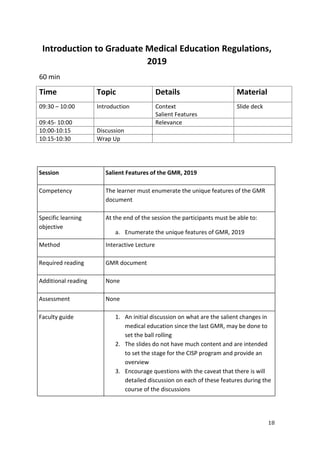
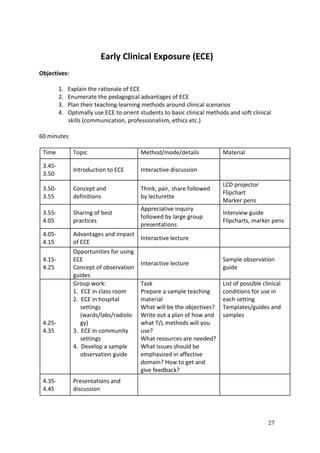
  • 10.
    10 to unlearn, re-learn,adapt and innovate. The role of the University in adopting and embracing the change and aligning assessment along the lines suggested in the Graduate Medical Education Regulations (GMR) document are critical to achieving the objectives of the curricular change. At a student level, the curriculum requires greater commitment, shared responsibility, self directed and ongoing learning. This document represents a compilation of the resource material that will be used in the Curricular Implementation Support Program (CISP) and has attempted to provide a stepwise and comprehensive approach to implement the curriculum. It details the philosophy and the steps required in a simple and richly illustrated manner. Teaching slide decks, faculty guides and online resource material supplement this document. The document is to be used in conjunction with the Competency document, AETCOM module and the GMR document. The timelines and measurables for the new curriculum are outlined in the chapter on curricular governance. The Expert Group for curricular implementation would like to place on record the tremendous contribution by subject experts, the Reconciliation Board, the Academic Cell of the MCI, the faculty, administration, Medical Education Units and leaders of each medical college, the Nodal and Regional Centers, and the Universities who have all helped to create the right environment for change. The Board of Governors of MCI are the pivot who have led from the front and facilitated this important national need in a very short time duration and deserve the praise and gratitude of the medical fraternity.
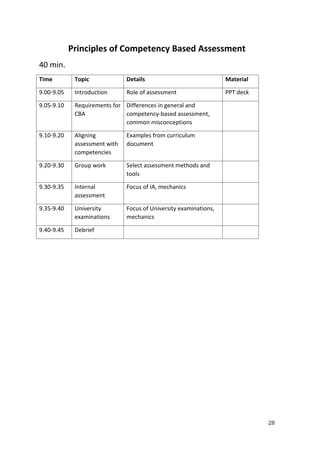
  • 11.
    11 Curriculum Implementation SupportProgram (CISP) for Conveners of Nodal & Regional Centres & Curriculum Committee members of colleges Day 1 Day Time Session Objectives Duration 9.00 Introduction Program Objectives 30 minutes 9:30 Salient features of GMR 2019 Presentation of salient features Discussion 60 minutes 10:30 Break 15 minutes 10:45 Implementation of CBME 1. Principles of CBME 2. Principles of integration 3. Review of Competency and AETCOM booklet 4. Linking competencies to learning and assessment 5. Lunch Break (1:00 to 1:45 PM) 6. Aligning subject competencies within a phase and integration across phases 3hours & 30 Minutes + 45 minutes (Lunch) 15:00 Introduction to Electives Concept of Electives Assessment of electives 30 minutes 15:30 Break 15 minutes 15:45 Early Clinical Exposure Concept and assessment of Early Clinical Exposure 60 minutes 16:45 Discussion and Task assignment 15 minutes 17:00 Close
  • 12.
    12 Curriculum Implementation SupportProgram (CISP) for Conveners of Nodal & Regional Centres & Curriculum Committee members of colleges Day 2 Day Time Session Objectives Duration 9.00 Principles of Assessment in CBME Principles as relevant to CBME 45 minutes 9:45 Alignment and integration within each phase and across Concept with activities 75 minutes 11.00 Break 15 minutes 11.15 Skill training and assessment Competency acquisition Skills lab Assessment 105 minutes 13:00 Lunch 13:45 Learning Resource Materials Sharing/ Discussion 15 minutes 14.00 Curricular Governance Presentation and discussion 60 minutes 15.00 Foundation Course Presentation and discussion 45 minutes 15:45 AETCOM Implementation Strategy 30 minutes 16:15 Open house Discussion/Clarifications 45 minutes 17:00 Close
  • 13.
    13 Contents Faculty Guides Sl NoTopic Page 1 Preamble 9 2 Introduction to Graduate Medical Education Regulations 17 3 Principles of CBME 19 4 Alignment and Integration 20 5 Electives 26 6 Early Clinical Exposure 27 7 Principles of Competency Based Assessment 28 8 Skill Training & Assessment 29 9 Foundation Course 30 10 AETCOM 32 11 Curricular Governance 33 Learning Resource Materials Sl No Topic Page 1 Salient features of Graduate Medical Education Regulations 37 2 Principles of CBME 47 3 Alignment and Integration 62 4 Electives 75 5 Early Clinical Exposure 81 6 Principles of Competency Based Assessment 85 7 Skill Training & Assessment 92 8 Curricular Governance 106 9 Foundation Course 113 10 AETCOM 121 11 Humanities 129 Presentation Materials 1 Curriculum Implementation 132 2 Principles of CBME 137 3 Alignment and Integration 141 4 Electives 153 5 Early Clinical Exposure 157 6 Assessment for Competency Based Medical Education 164 7 Skill Training & Assessment 168 8 Curricular Governance 174 9 Foundation Course 177 10 AETCOM 182
  • 14.
  • 15.
  • 16.
  • 17.
    17 Introduction to GraduateMedical Education Regulations, 2019
  • 18.
    18 Introduction to GraduateMedical Education Regulations, 2019 60 min Time Topic Details Material 09:30 – 10:00 Introduction Context Salient Features Slide deck 09:45- 10:00 Relevance 10:00-10:15 Discussion 10:15-10:30 Wrap Up Session Salient Features of the GMR, 2019 Competency The learner must enumerate the unique features of the GMR document Specific learning objective At the end of the session the participants must be able to: a. Enumerate the unique features of GMR, 2019 Method Interactive Lecture Required reading GMR document Additional reading None Assessment None Faculty guide 1. An initial discussion on what are the salient changes in medical education since the last GMR, may be done to set the ball rolling 2. The slides do not have much content and are intended to set the stage for the CISP program and provide an overview 3. Encourage questions with the caveat that there is will detailed discussion on each of these features during the course of the discussions
  • 19.
    19 Principles of CBME TimeTopic Detail Material 10.45-10.50 Introduction What is CBME, competency, objectives Similarities and differences Slide deck 10.50-11.00 Comparison with traditional curricula Outcomes, relation to community health needs 11.00-11.05 Stages of competence 11.05-11.10 IMG roles CLPCL 11.10-11.20 Goals to objectives Goals, roles, competencies, objectives and assessment cycle 11.20-11.25 Strengths, weaknesses 11.25-11.30 Debrief, conclusion Task ahead
  • 20.
    20 Alignment and Integration Day1 60 min Time Topic Detail Material 11:30 - 11:15 Introduction Slide deck 11:15 - 12:00 Discussion Deriving a learning session from competencies – workshop Deriving an aligned time table from competencies - workshop 12:00 - 12:15 Wrap Up Day 2 75 min Time Topic Detail Material 09:45 - 10:00 Introduction Slide deck 10:00 - 10:20 Group Activity 10:20 – 10:50 Plenary 10:50 - 11:00 Wrap Up
  • 21.
    21 Session 1 Principlesof Integration Competency The participant must be able to : Facilitate the development of an aligned and integrated curriculum in his/her institution as envisaged in the GMR document Specific learning objective At the end of the session the participants must be able to: a) Comprehend the glossary of terms used in the regulations b) Appreciate the extracts from the GMR, 2019 that addresses integration in UG curriculum c) Recognize the scientific basis that supports the process of “integration” in UG competency based curriculum d) Clarify certain perceptions regarding the concept of “integration” in subject based learning Method Interactive lecture Mandatory Reading Integration for CISP document , MCI Competency document Assessment Reflection
  • 22.
    22 Alignment & IntegrationSession Session 2 Day 1 Deriving a learning session from competencies - workshop Competency The learner must be able to derive learning sessions from competencies Specific learning objective At the end of the session the participants must be able to: a. Write specific learning objectives from subject competencies b. Group objectives that can be achieved in a single learning session c. Choose the appropriate learning method for a group of objectives d. Write a lesson plan for the learning method chosen Method Task based workshop and plenary Required reading Deriving learning from competencies in the CISP document Alignment and integration Assessment Reflection Faculty guide 1. Note that this workshop can be combined with the Alignment and Integration workshop or can be done stand alone 2. Review the required reading document 3. Divide learners into 4 groups each with a facilitator 4. Review the principles using the slide deck provided for both alignment and deriving learning sessions from competency 5. Choose topics and assign - eg Anemia and Jaundice one to two groups 6. Each group reviews the competency table that is provided in the appendix in the LRM provided for alignment and integration 7. From phase 1 the group chooses a few competencies to convert to learning objectives using the worksheet provided 8. The group then discusses and chooses an appropriate learning session for a the objectives identified using the worksheet provided 9. A lesson plan is created for the learning method identified using the worksheet provided 10. In the plenary two groups that have done the same topic present together to compare and contrast and learn from each other 11. Reflection is used to enhance the learning session
  • 23.
    23 Session 3 Day 1 Derivingan aligned time table from competencies - workshop Competency The learner must be able to derive an aligned timetable from a set of competencies Specific learning objective At the end of the session the participants must be able to: a. Write specific learning objectives from subject competencies for a particular topic b. Group objectives that can be achieved in a single learning session c. Place different learning sessions into a time table d. Identify a linker activity to provide relevance to the aligned sessions e. Derive a sample timetable Method Task based workshop and plenary Required reading Deriving learning from competencies in the CISP document Alignment and integration Assessment Reflection Faculty guide 1. Note that this workshop can be combined with the Alignment and Integration workshop or can be done stand alone 2. Review the required reading document 3. Divide learners into 4 groups each with a facilitator 4. Review the principles using the slidedeck provided for both alignment and deriving learning sessions from competency 5. Review the sample timetable provided 6. Choose topics and assign – eg. Anemia and Jaundice one to two groups 7. Each group reviews the competency table that is provided in the appendix in the LRM provided for alignment and integration 8. From phase 1 the group chooses a few competencies to convert to learning objectives using the worksheet provided 9. The group identifies the objectives from phase 1that can be taught in one subject for alignment 10. The group identifies the objectives from phase 1 that can be combined into a common session for horizontal integration 11. The group identifies competencies/ objectives from other phases that can be used as a linker 12. The group creates a sample time table based on the sessions identified
  • 24.
    24 Session 4 Day 2 Alignmentand integration within each phase and across Competency The participant must be able to: Facilitate the development of an aligned and integrated curriculum in his/her institution as envisaged in the GMR document Specific learning objective At the end of the session the participants must be able to develop and schedule an aligned and integrated topic across all phases Method Group activity – Work shop Facilitator role The objective of the facilitators is to ensure that the participants read, understand the required sections of the regulations on alignment and integration, and become comfortable in using it as a guide.  Divide participants into 4 groups  Elect a chair, scribe and a rapporteur for each group  Helps group to refer to the process of Alignment and integration as in the CISP Guide  Explain the templates the groups have to work with  Facilitate group to develop and present an Aligned integrated topic (AITo)  Provide support for Plenary presentation Guide Integration for CISP document, MCI Competency Document Assessment The quality of AITo developed and feed back
  • 25.
    25 Session 5 Day 2 Aligningsubject competencies within a phase and integration across phases Competency The participant must be able to : Facilitate the development of an aligned and integrated curriculum in his/her institution as envisaged in the GMR document Specific learning objective At the end of the session the participants must be able to Comprehend the step wise process in developing and implementing “Integrated” topics across all three phases using with an example Method Interactive lecture Mandatory Reading Integration for CISP doc , MCI COMPETENCY Document Assessment Performance in the workshop and nature of module developed
  • 26.
    26 Electives Objectives: 1. Explain therationale of Electives 2. Identify various options that can be offered as Elective at their respective institutions 3. Plan the complete curriculum of elective in hospital /community/ project 30 minutes Time Topic Method/mode/details Material 5 min Introduction to Electives Interactive discussion 5 min Concept and definitions Think, pair, share followed by lecturette LCD projector Flip chart Marker pens 10 min Identification of various options as electives in their institutions Group activity Flip charts, marker pens 5 mins each Assessment of Electives Think, pair, share 5 mins Challenges and Solutions Interactive discussion
  • 27.
    27 Early Clinical Exposure(ECE) Objectives: 1. Explain the rationale of ECE 2. Enumerate the pedagogical advantages of ECE 3. Plan their teaching-learning methods around clinical scenarios 4. Optimally use ECE to orient students to basic clinical methods and soft clinical skills (communication, professionalism, ethics etc.) 60 minutes Time Topic Method/mode/details Material 3.45- 3.50 Introduction to ECE Interactive discussion 3.50- 3.55 Concept and definitions Think, pair, share followed by lecturette LCD projector Flipchart Marker pens 3.55- 4.05 Sharing of best practices Appreciative inquiry followed by large group presentations Interview guide Flipcharts, marker pens 4.05- 4.15 Advantages and impact of ECE Interactive lecture 4.15- 4.25 Opportunities for using ECE Concept of observation guides Interactive lecture Sample observation guide 4.25- 4.35 Group work: 1. ECE in class room 2. ECE in hospital settings (wards/labs/radiolo gy) 3. ECE in community settings 4. Develop a sample observation guide Task Prepare a sample teaching material What will be the objectives? Write out a plan of how and what T/L methods will you use? What resources are needed? What issues should be emphasized in affective domain? How to get and give feedback? List of possible clinical conditions for use in each setting Templates/guides and samples 4.35- 4.45 Presentations and discussion
  • 28.
    28 Principles of CompetencyBased Assessment 40 min. Time Topic Details Material 9.00-9.05 Introduction Role of assessment PPT deck 9.05-9.10 Requirements for CBA Differences in general and competency-based assessment, common misconceptions 9.10-9.20 Aligning assessment with competencies Examples from curriculum document 9.20-9.30 Group work Select assessment methods and tools 9.30-9.35 Internal assessment Focus of IA, mechanics 9.35-9.40 University examinations Focus of University examinations, mechanics 9.40-9.45 Debrief
  • 29.
    29 Skill Training andAssessment 105 mins Time Topic Comments 11:15- 11:30 Introduction, definition of skill with examples Interactive lecture 11.30- 11.40 Why teach skills Interactive lecture 11.40- 11.55 How skills are currently taught Think, pair, share 11.55- 12.05 Models of skills training Technical and non-technical skills; STEPS model, SISFR model, SODOTO 12.05- 12.15 Simulation for skills training 12.15- 12.30 Develop an outline of a skills- training module Think, pair, share 12.30- 12.40 Assessment of skills Concept, issues 12.40- 12.50 Assessment tool box Interactive lecture 12.50- 13.00 Reflection, taking forwards
  • 30.
    30 Foundation Course Session FoundationCourse Competency The participant must be able to : a. Facilitate the development of a schedule for the one month foundation course in his/her institution as envisaged in the GMR document b. Facilitate the Curriculum Committee in the implementation of the one month foundation course in his/her institution as envisaged in the GMR document Specific learning objective At the end of the session the participants must be able to a) Describe and discuss the need for foundation course in the first year of the MBBS course in India b) Appreciate the extracts from the GMR, 2019 that addresses foundation course c) Plan the conduct of the foundation course with regard to the contents in accordance with the timings as per GMR, 2019 d) Develop a plan for monitoring the foundation Course Method Interactive lecture followed by Group Discussion and Plenary Mandatory Reading Graduate Medical Regulations, 2019 Assessment Reflection
  • 31.
    31 Total Time :45 mins Time Agenda/Activity Materials 15 mins Introduction to Foundation course Scope and need PPT 10 min Discussion in small groups on a. Challenges and suggestions b. Session planning with regard to contents, faculty c. Time table. 1. Orientation to medical profession & college [w.r.t GMR 9.1.2(a)] 2. Professional Development & Ethics [w.r.t AETCOM module] 3. Language & Computer skills [w.r.t GMR 9.1.2(b)] 4. Basic Skills Training [w.r.t GMR 9.1.2(c)] 20 min Plenary on the above (3 min presentation and 2 minutes discussion from each group)
  • 32.
    32 AETCOM (Attitude EthicsCommunication) Skills 30 min. Time Topic Details Material 15.45- 15.50 Introduction Overview of attitudinal competencies in revised GMR. AETCOM: purpose, mission and objectives PPT deck AETCOM module 15.50- 16.00 Linking of AET-COM modules with Competencies, Objectives, Teaching- Learning methods and Assessment. Use Template from AETCOM competencies: Competency - Objective - Teaching Learning - Assessment PPT deck AETCOM module 16.00- 16.10 Teaching Ethics cases, Teaching Communication skills cases Use Template from AETCOM PPT deck AETCOM module 16.10- 16.15 Reflection
  • 33.
    33 Curricular Governance Day 2 60min Time Topic Detail Material 14:00 - 14:15 Introduction Slide deck 14:15 - 14:45 Group Activity 14:45 – 15:00 Plenary
  • 34.
  • 35.
  • 36.
  • 37.
    37 Salient features of GraduateMedical Education Regulations, 2019 Overview The new Graduate Medical Education Regulations, 2019 attempts to stand on the shoulder of the contributions and the efforts of resource persons, teachers and students past and present attempts to take the learner to provide healthcare to the evolving needs of the nation and the world. More than twenty years have passed since the existing Regulations on Graduate Medical Education, 1997 was notified necessitating a relook at all aspects of the various components in the current regulations and adapt them to the changing demography, socio-economic context, perceptions, values and expectations of stakeholder, emerging health care issues particularly in the context of newly emerging diseases, impact of advances in science and technology, shorter distances on diseases and their management, The strong and forward looking fundamentals enshrined in the Graduate Medical Education Regulations, 1997 has made this job easier. A comparison between the 1997 Regulations and proposed Regulations on Graduate Medical Education, 2019 (GMR) will reveal that the 2019 Regulations have evolved from several key principles enshrined in the 1997 Regulations. The thrust in the new Regulations is continuation and evolution of thought in medical education making it more learner-centric, patient-centric, gender-sensitive, outcome oriented and environment appropriate. The result is a competency based curriculum which conforms to global trends. Emphasis is made on alignment and integration of subjects both horizontally and vertically while respecting the strengths and necessity of subject-based instruction and assessment. A significant attempt has been made in the competency based undergraduate curriculum to provide the orientation and the skills necessary for life-long care of the patient. In particular, the curriculum provides for early clinical exposure, electives and longitudinal care. Skill acquisition is an indispensable component of the learning process in medicine. The curriculum reinforces this aspect by necessitating certification of certain essential skills. The experts and the writing group have factored in patient availability, access, consent, number of students in a class etc in suggesting skill acquisition and assessment methods; the use of skills labs, simulated and guided environments are encouraged. The importance of ethical values, responsiveness to the needs of the patient and acquisition of communication skills is underscored by providing dedicated curriculum time in the form of a longitudinal program called Attitude, Ethics and Communication (AETCOM) competencies. Greater emphasis has been placed on collaborative and interdisciplinary teamwork, professionalism, altruism and respect in professional relationships with due sensitivity to differences in thought, social and economic position and gender.
  • 38.
    38 In addition tothe above an attempt has been made to allow students from diverse educational streams and backgrounds to transition appropriately through a foundation program. Dedicated time has been allotted for self directed learning and co curricular activity. Formative and internal assessment has been streamlined to achieve the objectives of the curriculum. Minor tweaks to the summative assessment have been made to reflect evolving thought and regulatory requirements. Curricular governance and support have been strengthened. The curriculum document in conjunction with the new Graduate Medical Education Regulations, when notified, must be seen as a “living document” that should evolve as stakeholder requirements and aspirations change. Key components of GMR, 2019 are summarised below. The time distribution according to phases is summarised in figure 1 later. 1. Concept of the Indian Medical Graduate as an achievable goal 2. Roles that define the Indian Medical Graduate 3. Definition of Global competencies for each role envisaged 4. Defined subject-based outcomes that can be mapped to the global competencies 5. Alignment of instruction with reasonable integration 6. Greater emphasis on learner centric instruction 7. Greater emphasis on learning in primary and secondary care environments 8. Student Doctor Method of Clinical Training 9. Emphasis on skill acquisition and certification 10. Early Clinical Exposure 11. Longitudinal program on attitude ethics and communication 12. Foundation course 13. Shared responsibility and self directed learning 14. Electives 15. Time for sport and extracurricular activities 16. Assessment changes Concept of the Indian Medical Graduate as an achievable goal The undergraduate medical education program is designed with a goal to create an “Indian Medical Graduate” (IMG) possessing requisite knowledge, skills, attitudes, values
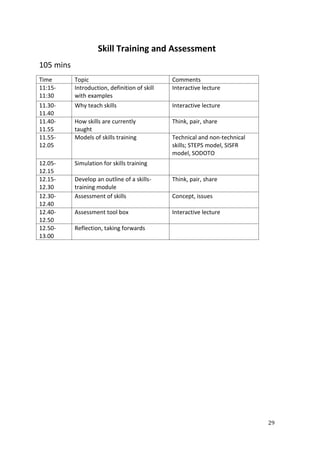
  • 39.
    39 and responsiveness, sothat he or she may function appropriately and effectively as a physician of first contact of the community while being globally relevant. Defined Roles of the Indian Medical Graduate The GMR envisages the following roles that a graduate must perform in-order to achieve the goal of the UG medical education program Clinician: who understands and provides preventive, promotive, curative, palliative and holistic care with compassion. Leader and member of the healthcare team and system: with capabilities to collect analyze, synthesize and communicate health data appropriately. Communicator: with patients, families, colleagues and community. Lifelong learner: committed to continuous improvement of skills and knowledge. Professional: who is committed to excellence, is ethical, responsive and accountable to patients, community and profession. Global Competencies mapped to each role: Statement of achievement of defined measurable outcomes have been spelt out for each role - these are called global competencies and are summarised in GMR, 2019 document. Defined subject based outcomes that can be mapped to the global competencies The GMR, 2019 proposes continuance with subject based instruction. To reconcile subject based instruction with transition to competency based education - subject based outcomes (so called sub-competencies) have been derived by subject experts and compiled. Guidance on the domain, level of mastery required, suggested learning and assessment methods, requirement of certification, recommended integration etc have been provided in a three volume stand alone document. This document can be accessed at https://old.mciindia.org/InformationDesk/ForColleges/UGCurriculum.aspx Alignment of instruction with reasonable integration To the extent possible the GMR, 2019 stresses the importance of temporal coordination of related topics in each phase - this is called alignment. Integration within the phase (horizontal integration) and with other phases have been provided for - this is explained in greater length in this document. Learner centered instruction The GMR, 2019 lays great emphasis on learner centric methods of instruction. Time has been apportioned for small group learning, interactive and case based learning, collaborative and team based learning. Didactic learning time has been reduced to less than a third of the allotted time in each subject.
  • 40.
    40 Learning in primaryand secondary care environments The GMR, 2019 has provisions for learning in both primary and secondary care settings such as Taluk hospitals and Urban Health Care Centres. Learning will have a strong prevention and primary care focus with particular emphasis on national and regional health care priorities and programs. Student - Doctor Method of Clinical Training The student - doctor method of clinical training provides for the student to function as a member of the clinical care team, work with patients and follow them longitudinally. The program allows for students to care for patients in a supervised manner taking part in admission day activities, following patients during the course of hospitalisation, writing and maintaining case records and participating, observing and assisting in procedures in a graded fashion. The student doctor method of training will commence in the second clinical posting Skill Acquisition and Certification The ability of students to be able to acquire and practice important skills in a safe and supervised environment is given importance. Institutions are mandated to create skills labs in which skill acquisition is possible. A list of certifiable skills that the learner has to acquire prior to graduation has been developed. Protected skill acquisition time for basic skills has also been appropriated in the timetable. Early Clinical Exposure (ECE) Providing a clinical context and ensuring patient centricity of instructions are the key principles underlying early clinical exposure. The ECE provides for three key elements - basic science correlation, clinical skills including authentic patient contact and an introduction to humanities in medicine. ECE is expanded further in this document. Attitude Ethics and Communication AETCOM (Attitude Ethics and Communication) is a longitudinal modular program that provides for instruction in professionalism, bioethics and communication skills. Dedicated time has been carved out for AETCOM instruction in all the phases. The program has already been rolled out by the MCI. Foundation Course The Foundation Course is aimed at providing an introduction to the MBBS program that will allow students from diverse backgrounds languages and varying degrees of technical and communication skills to adapt and enhance required skills. There is a provision for continued longitudinal instruction in language and computer skills following the one month program.
  • 41.
    41 Self Directed Learning TheGMR, 2019 encourages shared responsibility in learning with emphasis on knowledge and skill acquisition, assignment and task completion, living experiences, reflection and self directed learning. Dedicated time for self directed learning is provided in each subject in every phase. Electives Electives provide opportunities for students to acquire diverse learning experiences. Two, four week blocks of elective time, has been created to allow students to a) rotate in a pre- or a para - clinical / work under the supervision of a researcher, and b) rotate in a pre- specified specialty / work in a rural or urban community clinic under supervision. Sports and Extracurricular activity Protected time for sports and extracurricular activity has been carved into the curriculum to allow students to preserve work life balance and prevent burn out. Assessment changes Some key changes in areas of assessment have been proposed in the GMR, 2019. A pass score in the theory AND practical/ clinical parts of the Internal Assessment will be a prerequisite to attempt the summative examination. Formative assessment is streamlined. Continuous assessment through log books, documentation reports etc are given additional importance. Internal Assessment will not contribute to the summative examination. Separate pass in theory and practical / clinical is required. Viva marks will be added to practical/ clinical examination. A provision for skill assessment and assessment of AETCOM competencies has also been made.
  • 42.
    42 Figure 1: Timedistribution of MBBS program & Examination Schedule Jan Feb Mar Apr May Jun Jul Aug Sep Oct Nov Dec Foundation Course I MBBS I MBBS I yr exam II MBBS II MBBS II yr exam III MBBS Part 1 III MBBS Part I Part 1 exam Electives and skills III MBBS Part II Part II exam Internship 1. Short Title and Commencement The undergraduate medical education program is designed with a goal to create an “Indian Medical Graduate” (IMG) possessing requisite knowledge, skills, attitudes, values and responsiveness, so that he or she may function appropriately and effectively as a physician of first contact of the community while being globally relevant. 2. Objectives 2.3. Goals and Roles for the Learner In order to fulfil the goal of the IMG training programme, the medical graduate must be able to function in the following roles appropriately and effectively:- 2.3.1. Clinician who understands and provides preventive, promotive, curative, palliative and holistic care with compassion.
  • 43.
    43 2.3.2. Leader andmember of the health care team and system with capabilities to collect analyze, synthesize and communicate health data appropriately. 2.3.3. Communicator with patients, families, colleagues and community. 2.3.4. Lifelong learner committed to continuous improvement of skills and knowledge. 2.3.5. Professional, who is committed to excellence, is ethical, responsive and accountable to patients, community and profession. 3. Competency Based Training Programme of the Indian Medical Graduate Competency based learning would include designing and implementing medical education curriculum that focuses on the desired and observable ability in real life situations. In order to effectively fulfil the roles as listed in clause 2, the Indian Medical Graduate would have obtained the following set of competencies at the time of graduation: 3.1. Clinician, who understands and provides preventive, promotive, curative, palliative and holistic care with compassion 3.1.1 Demonstrate knowledge of normal human structure, function and development from a molecular, cellular, biologic, clinical, behavioural and social perspective. 3.1.2. Demonstrate knowledge of abnormal human structure, function and development from a molecular, cellular, biological, clinical, behavioural and social perspective. 3.1.3 Demonstrate knowledge of medico-legal, societal, ethical and humanitarian principles that influence health care. 3.1.4 Demonstrate knowledge of national and regional health care policies including the National Health Mission that incorporates National Rural Health Mission (NRHM) and National Urban Health Mission (NUHM), frameworks, economics and systems that influence health promotion, health care delivery, disease prevention, effectiveness, responsiveness, quality and patient safety. 3.1.5. Demonstrate ability to elicit and record from the patient, and other relevant sources including relatives and caregivers, a history that is complete and relevant to disease identification, disease prevention and health promotion. 3.1.6. Demonstrate ability to elicit and record from the patient, and other relevant sources including relatives and caregivers, a history that is contextual to gender, age, vulnerability, social and economic status, patient preferences, beliefs and values. 3.1.7 Demonstrate ability to perform a physical examination that is complete and relevant to disease identification, disease prevention and health promotion.
  • 44.
    44 3.1.8 Demonstrate abilityto perform a physical examination that is contextual to gender, social and economic status, patient preferences and values. 3.1.9 Demonstrate effective clinical problem solving, judgment and ability to interpret and integrate available data in order to address patient problems, generate differential diagnoses and develop individualized management plans that include preventive, promotive and therapeutic goals. 3.1.10 Maintain accurate, clear and appropriate record of the patient in conformation with legal and administrative frame works. 3.1.11 Demonstrate ability to choose the appropriate diagnostic tests and interpret these tests based on scientific validity, cost effectiveness and clinical context. 3.1.12 Demonstrate ability to prescribe and safely administer appropriate therapies including nutritional interventions, pharmacotherapy and interventions based on the principles of rational drug therapy, scientific validity, evidence and cost that conform to established national and regional health programmes and policies for the following: i) Disease prevention, ii) Health promotion and cure, iii) Pain and distress alleviation, and iv) Rehabilitation 3.1.13 Demonstrate ability to provide a continuum of care at the primary and/or secondary level that addresses chronicity, mental and physical disability. 3.1.14 Demonstrate ability to appropriately identify and refer patients who may require specialized or advanced tertiary care. 3.1.15 Demonstrate familiarity with basic, clinical and translational research as it applies to the care of the patient. 3.2. Leader and member of the health care team and system 3.2.1 Work effectively and appropriately with colleagues in an inter-professional health care team respecting diversity of roles, responsibilities and competencies of other professionals. 3.2.2 Recognize and function effectively, responsibly and appropriately as a health care team leader in primary and secondary health care settings. 3.2.3 Educate and motivate other members of the team and work in a collaborative and collegial fashion that will help maximize the health care delivery potential of the team. 3.2.4 Access and utilize components of the health care system and health delivery in a manner that is appropriate, cost effective, fair and in compliance with
  • 45.
    45 the national healthcare priorities and policies, as well as be able to collect, analyze and utilize health data. 3.2.5 Participate appropriately and effectively in measures that will advance quality of health care and patient safety within the health care system. 3.2.6 Recognize and advocate health promotion, disease prevention and health care quality improvement through prevention and early recognition: in a) life style diseases and b) cancers, in collaboration with other members of the health care team. 3.3. Communicator with patients, families, colleagues and community 3.3.1 Demonstrate ability to communicate adequately, sensitively, effectively and respectfully with patients in a language that the patient understands and in a manner that will improve patient satisfaction and health care outcomes. 3.3.2 Demonstrate ability to establish professional relationships with patients and families that are positive, understanding, humane, ethical, empathetic, and trustworthy. 3.3.3 Demonstrate ability to communicate with patients in a manner respectful of patient’s preferences, values, prior experience, beliefs, confidentiality and privacy. 3.3.4 Demonstrate ability to communicate with patients, colleagues and families in a manner that encourages participation and shared decision-making. 3.4. Lifelong learner committed to continuous improvement of skills and knowledge 3.4.1. Demonstrate ability to perform an objective self-assessment of knowledge and skills, continue learning, refine existing skills and acquire new skills. 3.4.2. Demonstrate ability to apply newly gained knowledge or skills to the care of the patient. 3.4.3. Demonstrate ability to introspect and utilize experiences, to enhance personal and professional growth and learning. 3.4.4. Demonstrate ability to search (including through electronic means), and critically evaluate the medical literature and apply the information in the care of the patient. 3.4.5. Be able to identify and select an appropriate career pathway that is professionally rewarding and personally fulfilling. 3.5. Professional who is committed to excellence, is ethical, responsive and accountable to patients, community and the profession 3.5.1. Practice selflessness, integrity, responsibility, accountability and respect. 3.5.2. Respect and maintain professional boundaries between patients, colleagues and society.
  • 46.
    46 3.5.3. Demonstrate abilityto recognize and manage ethical and professional conflicts. 3.5.4. Abide by prescribed ethical and legal codes of conduct and practice. 3.5.5. Demonstrate a commitment to the growth of the medical profession as a whole.
  • 47.
    47 Principles of CBME AligningCompetencies to Learning Objectives of the session At the end of this session, the learner will be able to facilitate institute faculty to derive learning sessions as envisaged in the GMR and competency documents of the MCI Glossary of terms used A competency is an observable ability of a learner that includes multiple components including knowledge skills values and attitude. An objective is a statement of what a learner should be able to do at the end of a specific learning session (or experience). Core: A competency that is necessary in order to complete the requirements of the subject (traditional must know). None Core: A competency that is optional in order to complete the requirements of the subject (traditional nice (good) to know/ desirable to know). Lecture: Any instructional large group method including traditional lecture and interactive lecture. Small Group Discussion: Any instructional method involving small groups of students in an appropriate learning context. Skill Assessment: A session that assesses the skill of the student including those in the practical laboratory, skills lab, skills station that uses mannequins/ paper case/simulated patients/real patients as the context demands. DOAP (Demonstrate Observe Assist Perform Session) A practical session that allows the student to observe a demonstration, assist the performer, perform (demonstrate) in a simulated environment, perform under supervision or perform independently. Relevant Extract from GMR, 2019 4. Broad Outline on training format 4.1.3 Teaching-learning methods shall be student centric and shall predominantly include small group learning, interactive teaching methods and case based learning. 4.1.4 Clinical training shall emphasize early clinical exposure, skill acquisition, certification in essential skills; community/primary/secondary care based learning experiences and emergencies.
  • 48.
    48 4.1.5 Training shallprimarily focus on preventive and community based approaches to health and disease, with specific emphasis on national health priorities such as family welfare, communicable and non-communicable diseases including cancer, epidemics and disaster management. 4.1.6 Acquisition and certification of skills shall be through experiences in patient care, diagnostic and skill laboratories. 4.1.7 The development of ethical values and overall professional growth as integral part of curriculum shall be emphasized through a structured longitudinal and dedicated programme on professional development and ethics. 7.5 Didactic lectures shall not exceed one third of the schedule; two third of the schedule shall include interactive sessions, practicals, clinical or/and group discussions. The learning process should include living experiences, problem oriented approach, case studies and community health care activities. Description in the context of the curriculum The curriculum in GMR, 2019 is outcome (competency) driven. The transition from a syllabi-driven curriculum (structure process) to a competency based framework necessitates several important changes in approach to the learning and assessment. These are summarised in table 1. Table 1: Difference between CBME and Structure process (syllabus) based Structure / Process Competency Based Driving force for curriculum Content: Knowledge acquisition Outcome: Knowledge application Driving force for process Teacher Student Responsibility for content Teacher Student and teacher Goal of educational encounter Knowledge acquisition Knowledge application Typical assessment tool Single subjective Multiple objective Assessment tool Proxy Authentic Setting for assessment Removed (gestalt) Direct observation Assessment normative referenced criterion referenced Timing of assessment Emphasis on summative Emphasis on formative Program completion Fixed time Variable time The shift in focus from knowledge acquisition to application necessitates important changes in the learning process: These include greater emphasis on (a) shared responsibility in the learning process (b) self-directed and collaborative learning (c) use of
  • 49.
    49 learner centric approaches(d) skill acquisition and certification e) formative assessment as integral to the learning process (f) progressive increase in the complexity of learning (the so called ascendancy in competencies). A careful review of the competency table is invaluable in helping derive learning sessions (figure 1): Understanding the competencies table (Figure 1) a. Subject-wise competencies that are listed in the three volume MCI book are themselves linked to the global competencies and roles that are spelt out in the IMG document. In that sense they should be viewed as sub-competencies. It should also be pointed out that competencies generally imply end of course achievements. They are listed in phases and in subjects since we are at this time still subject based in our approach and assessment. It must be remembered that some of the components that make up the basic sciences competency can be achieved at later phases. Indeed the GMR has allocated time for teaching of pre and para-clinical competencies in phase III. b. The competencies themselves may be broadly divided into core and non-core - core representing the must know and tested - the non-core being desirable to know and not essential to test summatively (Table 2).
  • 50.
    50 Table 2 -Core and non-Core competencies Core Non- Core Taught Yes Yes % of curriculum Not < 80% Not > 20% Summative assessment Y N Formative assessment Y Y c. In a broad sense - competencies may be described as an amalgamation of different objectives and therefore represent objectives derived from different domains. The MCI document lists four domains - three conventional Knowledge (K) Skill (S) Attitude (A) and an additional Communication (C); this is in recognition of the importance of communication as a key domain for Indian Medical Graduate. The importance is further exemplified by the introduction of the AETCOM module. d. The highest levels of achievement of each competency are also specified as a continuum from Knows (K) to Knows How (KH) as knowledge attributes and Shows (S) to Shows how (SH) as skill or behavioral attributes. For the purpose of the 41/2 year MBBS curriculum there are very few Perform Independently skills in the competency document. In internship and post-graduation - the level of highest achievement for the same competency will change reflecting the learning continuum. Other measures such as milestones and entrustable Professional Activity (EPA) are natural additions to competency based medical education and will find greater application in the internship and post-graduation years (Table 3). Table 3: Proficiency levels K Knows A knowledge attribute – Usually enumerates or describes KH Knows how A higher level of knowledge – is able to discuss or analyse S Shows A skill attribute: is able to identify or demonstrate the steps SH Shows how A skill attribute: is able to interpret / demonstrate a complex procedure requiring thought, knowledge and behavior P Performs (under supervision or independently) Mastery for the level of competence - When done independently under supervision a pre specified number of times - certification or capacity to perform independently results e. In keeping with the principles of CBME a greater emphasis on acquisition of KH levels in the early phases with a shift to SH at the later phases will be evident from a review of the competency tables. It will be also evident that both acquisition of both KH and SH levels will require a shift from the traditional didactic classroom based teaching to
  • 51.
    51 learning environments wherethere is a greater emphasis on learning by exploring, questioning, applying, discussing analysing, collaborating and doing. The recognition of this need is enshrined by a greatly enhanced allocation of time to these methods of learning in GMR, 2019.
  • 52.
    52 Deriving teaching learningmethods from competencies Figure 2: Relationship between outcomes, assessment and learning The overall relationship between competencies learning and assessment is pictorially represented in figure 2.
  • 53.
    53 The overall approachto deriving learning methods from competencies is summarised in figure 3. Figure 3: Steps in deriving learning methods 1. Grouping competencies and aligning them in an organ system or disease based aligned and integrated topic as outlined in the integration section of this document 2. The next step is to break down competencies into measurable objectives. The method that is usually used to create objectives is the Audience Behaviour Condition Degree (ABCD). One advantage of writing objectives in this manner is that the learning method and the assessment method are instantly apparent. A sample worksheet is provided in Appendix 1 of this section. This is illustrated in figure 4. 3. Learning sessions are created grouping together objectives that can be taught together. Choosing the correct learning method is a function of the objective, the domain, the level and importantly the faculty student ratio (figure 5 and appendix 1). 4. Knowledge domain objectives with lower cognitive level achievements lend well to traditional classroom. KH level achievements require small group sessions that allow greater student involvement, interaction with ability to probe student understanding
  • 54.
    54 and application. Thehigher the cognitive level of the objective of the competency, the greater is the requirement of a learning setting with a low student-teacher ratio. 5. There are many competing constraints that restrict the choice of small group learning sessions. These include faculty comfort burden and training, student motivation and involvement, infrastructure support and resources. Therefore, a balanced approach to the use of this setting is required as illustrated in figures 6 and 7. 6. In conditions where a lower student teacher ratio is required but not feasible - several strategies can be adopted including greater student responsibility, greater use of process vs subject experts, technology, innovative large group techniques such as the flipped classroom and the large group case discussion. Examples of suggested teaching-learning methods to be used for each competency are provided for each competency in the competency table (figure 1). Figure 4: Deriving learning objectives from competencies
  • 55.
    55 Figure 5: Derivinglearning methods from objectives
  • 56.
    56 Figure 6: Factorsto be considered while choosing TL methods in the cognitive domain. Higher level of cognition required lower teacher to student settings. The choice must consider other factors.
  • 57.
    57 Figure 7: Criticalityvs feasibility matrix for choosing a low teacher student ratio setting of instruction 7. Varying levels of competence are required for skill level objectives. The most crucial of them require certification of independent performance; others require the ability to demonstrate steps in a simulated or controlled environment; some may merely need observation in the MBBS program. These sessions have been called DOAP sessions in the competency table and are dealt in detail in the session on skill acquisition. A criticality vs feasibility matrix for skill sessions is also provided. 8. It must be remembered that multiple sessions (often addressing different domains) in a phase in the same and different subjects AND across multiple phases may be required to achieve a particular competence
  • 58.
    58 Sample Worksheets Deriving Objectivesfrom Competencies Competency: I. Objective development worksheet : No. Audience Behaviour Condition Degree
  • 59.
    59 II. Transfer yourdeveloped objectives into this sheet No Objective Domain K/S/A/C Level (K/KH/S/SH) Departments(s) A/I (Y/N) (H/V) A/I: Alignment/Integration; H/V: Horizontal/Vertical
  • 60.
    60 III. Choosing aTeaching-Learning Method Worksheet Major / Sub Competency: Name of Topic: Identified Learning Objectives: 1. 2. 3. 4. 5. 6. Target Audience: Number of students: Parameter Method 1 Method 2 Method 3 Advantages Disadvantages Infrastructure/Aids required Faculty preparation required Other Issues Method Chosen: (Use summary sheet for further discussion)
  • 61.
    61 IV. Choosing aTeaching-learning method - Summary Sheet Parameter Description Name of the Lesson Number of learners Objectives of the session Primary Teaching Method chosen Advantages of the Teaching method chosen Possible disadvantages Faculty preparation required Breakup of the session Step 1 Step 2 Step 3 Step 4 Step 5 Teaching Aids required Infrastructure required Student preparation required Instant assessment method Chosen Other comments
  • 62.
    62 Alignment and Integration Objectives Theparticipant must be able to: a. Facilitate the development of an aligned and integrated curriculum in his/her institution as envisaged in the GMR, 2019 document Glossary of terms used For the purposes of this document - Alignment implies the teaching of subject material that occurs under a particular organ system/ disease concept from the same phase in the same time frame i.e., temporally. Integration implies that concepts in a topic / organ system that are similar, overlapping or redundant are merged into a single teaching session in which subject based demarcations are removed. For the purpose of this document, topics from other phases that are brought into a particular phase for the purpose of reinforcement or introduction will also be considered as integrated topics. In GMR, 2019 time for integrated teaching is clearly demarcated. Linker is a session that allows the learner to link the concepts presented in an aligned topic Curricular Element or Program Addressed Alignment and Integration Relevant Extract from GMR 10.1 Preamble: The salient feature of the revision of the medical curriculum is the emphasis on learning which is competency-based, integrated and student-centered acquisition of skills and ethical & humanistic values. Each of the competencies described below must be read in conjunction with the goals of the medical education as listed in items 2 and 3. It is recommended that didactic teaching be restricted to less than one third of the total time allotted for that discipline. Greater emphasis is to be laid on hands-on training, symposia, seminars, small group discussions, problem-oriented and problem-based discussions and self-directed learning. Students must be encouraged to take active part in and shared responsibility for their learning. Subject specific competencies with appropriate alignment and integration are available with Medical Council of India.
  • 63.
    63 10.2 Integration mustbe horizontal (i.e. across disciplines in a given phase of the course) and vertical (across different phases of the course). As far as possible, it is desirable that teaching/learning occurs in each phase through study of organ systems or disease blocks in order to align the learning process. Clinical cases must be used to integrate and link learning across disciplines. Description of the curricular program Concept of integration used in the GMR Integration is a learning experience that allows the learner to perceive relationships from blocks of knowledge and develop a unified view of its basis and its application (KGS 2018). The GMR, 2019 applies these principles to the extent that will retain the strengths of silo based education and assessment while providing experiences that will allow learners to integrate concepts. Keeping this in mind the regulations recommend temporal coordination as described by Harden (called alignment in this document) as the major method to be followed allowing similar topics in different subjects to be learnt separately but during the same time frame (figure 1a). In a small proportion - not to exceed 20% of the total curriculum an attempt can be made to share (figure 1b) topics or correlate (figure 1c) topics by using an integration or linker session. The integration session most preferred will be a case based discussion in an appropriate format ensuring that elements in the same phase (horizontal) and from other phases are addressed. Care must be taken to ensure that achievement of phase based objectives are given primacy - the integrative elements from other phases are used only to provide adequate recall and understand the clinical application of concepts. It must be emphasised that integration does not necessarily require multiple teachers in each class. Experts from each phase and subject may involved in the lesson planning but not it in its delivery unless deemed necessary. As much as possible, the necessary correlates from other phases must also be introduced while discussing a topic in a given subject - Nesting (figure 1 d) (Harden). Topics that cannot be aligned and integrated must be provided adequate time in the curriculum throughout the year. These concepts are summarised in table 1. Assessment will continue to be subject based. However effort must be made to ensure that phase appropriate correlates are tested to determine if the learner has internalised and integrated the concept and its application.
  • 64.
    64 Figure 1: Integrationconcepts framed in the GMR. Coloured boxes represent subjects. 1 a. Temporal coordination: The timetable is adjusted so that topics within the subjects or disciplines which are related, are scheduled at the same time. b. Sharing: Two disciplines may agree to plan and jointly implement a teaching program c. Correlation: the emphasis remains on disciplines or subjects with subject-based courses taking up most of the curriculum time. Within this framework, an integrated teaching session or course is introduced in addition to the subject- based teaching (green box with red border) d. Nesting: the teacher targets, within a subject-based course, skills relating to other subjects. Adapted from Harden R Med Edu 2000. 34; 551 Table 1 Considerations for using alignment and integration in the curriculum
  • 65.
    65 Figure 2 -Overview of process to create an aligned and integrated topic Figure 3: Steps in development of an aligned and integrated topic
  • 66.
    66 Step 1: Identifya list of topics or organ systems that will be accommodated in the timetable as aligned and integrated topics (AITo). Examples of such topics included : Anemia, Febrile illnesses, Trauma etc are provided in Appendix 1. Step 2: From the subject wise competency document book developed by the MCI transfer the competences that address the topic into a template. A sample is provided Arrange these competencies according to phase and subject. Examples for the topics are available in appendix 1 and presented in Appendix 2. A glossary to understand competencies is available in Appendix 3. Step 3: For each competency derive learning objectives, learning sessions and assessment methods (figures 4 - 6). a. A learning session is created by putting together a bunch of objectives that can be accomplished in the allotted time and/or require a similar method of instruction. b. A bunch of learning sessions that are put together that address the topic from different subjects in the phase form an Aligned and Integrated Topic (AITo) Step 4: In each AITo of the phase, it is important to review competencies from the previous phase that will bear reinforcement in the current phase. Similarly, it is important to ensure that competencies in the next higher phases are reviewed to explore if some of these require introduction in this phase. Integration sessions allotted in each phase may be used to deliver these competencies. Figure 4 - Deriving learning objectives from competencies a. By reviewing objectives / competencies in a phase redundant ones and those in each subject that can be thought together without a subject demarcation can be identified for horizontal integration. b. Similarly by reviewing objectives or competencies across phases those with a common thread can be identified for vertical integration. These are illustrated in figures 7-9. c. Objective writing and session planning must be done with teachers of all subjects involved in the aligned and integrated topic (AITo) and their inputs taken for the integrated session.
  • 67.
    67 d. It isimportant to remember that the concept and not necessarily teachers have to be integrated. Using different teachers in each integrated session is nice but rarely required Step 5: Consider adding a linker to each AITo. A linker as defined above is a session that aptly links the various related standalone elements represented in a AIT In the medical curriculum the linker is most commonly a case. A case that is creatively written can be used in each phase (often the same case) to allow students to correlate what they have learnt and apply into understanding disease process, diagnosis and care. Using a case based discussion to in small groups will in addition encourage collaborative and self directed learning. Using the case discussion at different time points in AITo will allow students to reinforce and link concepts appropriately Figure 5. Deriving learning methods from competencies
  • 68.
    68 Figure 6: Derivingassessment methods from competencies Figure 7: Marking objectives/ competencies for integration
  • 69.
    69 The creation ofan aligned and integrated topic (AITo) are pictorially illustrated in figures 8 and 9. Step 6: Ensure that adequate time for the block is created in the time table. It is important to consider the inclusion of an end of block assessment that will count towards formative/ internal assessment. Important: While creating the timetable ensure that topics in each subject that cannot be aligned are also taught simultaneously in each subject and that the timetable accommodates these topics appropriately. An example timetable incorporating an aligned and integrated topic is available in Appendix 4. The functions of the AIT team in collaboration on CSC and CC in creating the AIT/Block is illustrated in figure 10.
  • 70.
    70 Figures. 8 and9. Pictorial illustration of creating horizontal alignment and horizontal vertical integration
  • 71.
    71 Appendix 1 Example topicsdeveloped by the RCB for the aligned and integrated topics (indicative)  Anemia  Jaundice  Diabetes  Thyroid Diseases  Nutrition  Febrile Illness  Tuberculosis  Malaria  Diarrhoea  Ischemic Heart Disease  Polycystic Ovarian Syndrome
  • 72.
    72 Appendix 2 &Figure 10. : Example of phase wise competency table for a single Aligned and Integrated Topic (AITo) - Anemia
  • 73.
  • 74.
    74 Appendix 4 Sample timetable with AIT Required Reading 1. Ronald M Harden,The integration ladder: a tool for curriculum planning and evaluation, Medical Education 2000;34:551±557. 2. Alam Sher Malik &Rukhsana Hussain Malik, UniversitiTeknologi MARA, Malaysia Twelve tips for developing an integrated curriculum"> Medical Teacher 2011; 33: 99–104. 3. David G. Brauer & Kristi J. Ferguson 1 Washington University School of Medicine, USA, University of Iowa, USA The integrated curriculum in medical education: AMEE Guide No. 96. 4. Integration of basic and clinical sciences ‐ AMEE 2008 Paul Bradley and Karen Mattick, Peninsula College of Medicine and Dentistry, UK,https://amee.org/getattachment/Conferences/AMEE-Past-Conferences/AMEE- Conference-2008/Introduction-to-Medical-Education-Bradley-Mattick.pdf. Additional reading 1. Integrated Medical Curriculum: Advantages and Disadvantages. Gustavo a. Quintero et al. Journal Of Medical Education And Curriculum Development. 74 Appendix 4 Sample time table with AIT Required Reading 1. Ronald M Harden,The integration ladder: a tool for curriculum planning and evaluation, Medical Education 2000;34:551±557. 2. Alam Sher Malik &Rukhsana Hussain Malik, UniversitiTeknologi MARA, Malaysia Twelve tips for developing an integrated curriculum"> Medical Teacher 2011; 33: 99–104. 3. David G. Brauer & Kristi J. Ferguson 1 Washington University School of Medicine, USA, University of Iowa, USA The integrated curriculum in medical education: AMEE Guide No. 96. 4. Integration of basic and clinical sciences ‐ AMEE 2008 Paul Bradley and Karen Mattick, Peninsula College of Medicine and Dentistry, UK,https://amee.org/getattachment/Conferences/AMEE-Past-Conferences/AMEE- Conference-2008/Introduction-to-Medical-Education-Bradley-Mattick.pdf. Additional reading 1. Integrated Medical Curriculum: Advantages and Disadvantages. Gustavo a. Quintero et al. Journal Of Medical Education And Curriculum Development. 74 Appendix 4 Sample time table with AIT Required Reading 1. Ronald M Harden,The integration ladder: a tool for curriculum planning and evaluation, Medical Education 2000;34:551±557. 2. Alam Sher Malik &Rukhsana Hussain Malik, UniversitiTeknologi MARA, Malaysia Twelve tips for developing an integrated curriculum"> Medical Teacher 2011; 33: 99–104. 3. David G. Brauer & Kristi J. Ferguson 1 Washington University School of Medicine, USA, University of Iowa, USA The integrated curriculum in medical education: AMEE Guide No. 96. 4. Integration of basic and clinical sciences ‐ AMEE 2008 Paul Bradley and Karen Mattick, Peninsula College of Medicine and Dentistry, UK,https://amee.org/getattachment/Conferences/AMEE-Past-Conferences/AMEE- Conference-2008/Introduction-to-Medical-Education-Bradley-Mattick.pdf. Additional reading 1. Integrated Medical Curriculum: Advantages and Disadvantages. Gustavo a. Quintero et al. Journal Of Medical Education And Curriculum Development.
  • 75.
    75 Electives Introduction Elective can bedefined as a brief course made available to the learner during his/her undergraduate study period, where she/he can choose from the available options depending upon their interest and career preferences. This provides an opportunity in the form of an elective course, where an undergraduate medical student can explore his/her deeper interest areas, by working in a medical specialty in hospital/ community setting or undertake a project under an identified expert, which can be an important component in the undergraduate medical education. A student can be helped in identifying his/her future career path by direct experiences in diverse areas. An elective is not being offered by medical schools in India till now. Introduction of electives in undergraduate medical curriculum is an important step for providing flexible choices in student’s areas of interest, direct individual experience and this will help in developing self-directed learning skills. The range of electives that can be offered to the students will depend upon the local logistics and resources available for the medical institutions (within or nearby). These can be in a wide range that can include electives from educational, community and research-project related, directly or indirectly with health care, super-specialty clinical electives and specific laboratory electives. Relevant Extract from GMR: Method: 9.3.2 Two months are allotted for elective rotations after completion of the exam at end of the third MBBS Part I examination and before commencement of third MBBS Part II. 9.3.3 It is compulsory for learners to do an elective. The protected time for electives should not be used to make up for missed clinical postings, shortage of attendance or any other purpose. 9.3.4 Structure (a) The learner shall rotate through two elective blocks of 04 weeks each, (b) Block 1 shall be done in a pre-selected preclinical or para-clinical or other basic sciences laboratory OR under a faculty researcher in an ongoing research project. During the electives regular clinical postings shall continue. (c) Block 2 shall be done in a clinical department (including specialties, super- specialties, ICUs, blood bank and casualty) from a list of electives developed and
  • 76.
    76 available in theinstitution OR as a supervised learning experience at a rural or urban community clinic. (d) Institutions will determine the number and nature of electives beforehand , names of the supervisors, and the number of learners in each elective based on the local logistics, available resources and faculty. 9.3.5 Each institution will develop its own mechanism for allocation of electives. 9.3.6 It is preferable that electives are made available to the learners in the beginning of the academic year. 9.3.7 The learner must submit a learning log book based on both blocks of the elective. 9.3.8 75% attendance in the electives and submission of log book maintained during elective is mandatory for eligibility to appear in the final MBBS examination. 9.3.9 Institutions may use part of this time for strengthening basic skill certification. Description of the curricular program Objectives: To provide learner with opportunities  for a wide spectrum of learning experiences  to carry hospital/ community based research projects which stimulate enquiry, self-directed, experiential learning and lateral thinking Intent: The purpose of introducing electives in the undergraduate curriculum is to:  allow flexibility and choice during study period  provide opportunity to explore their areas of interest that can supplement their future studies  develop self directed learning skills  have direct experience of working in their interest areas  develop ability of deeper learning and critical thinking through reflection  have a student centric component in curriculum Elements and components of the program: 1) Faculty Development: The existing MCI curriculum for UG does not have electives and thus faculty as well as institutions need to be trained to implement this new element. 2) Incorporation in the curriculum:
  • 77.
    77 List of electivesoffered by the institution must be displayed for students. Each elective should have well defined objectives, expected outcomes, expectations from the students, their assessment mechanism and faculty guide or mentors. A faculty mentor should guide the student, monitor their learning activities and assess the students’ performance with regular feedback. Curricular delivery: Method:  Two months are designated for elective rotations after completion of the examination at end of the third MBBS Part I and before commencement of third MBBS Part II  It is compulsory for learners to do an elective.  The protected time for electives should not be used to make up for missed clinical postings, shortage of attendance or any other purposes. Curricular governance and evaluation of the program (Person responsible, evaluation periodicity, methods, reporting) Each medical institution will be primarily responsible for the elective postings. Dean’s office in each medical college will identify a person/office/department/ MEU in the college who will be assigned the task of identifying, organizing and taking all administrative responsibilities for the elective postings. The responsible person/office/department/ MEU will identify possible electives within and outside institution that can be offered to the students. These need to be specified and communicated to the students at the beginning of the academic year. The departments and/ or faculty who will guide/ supervise/mentor the students during their elective posting also need to be identified and trained in various requirements of electives. If resources are available, students may be permitted to do electives in other medical colleges or institutions within/ outside the country with permission of local authorities and Universities. Examples of some of the electives that may be offered are: Example of General Electives: • Bio-Informatics, Tissue Engineering/ Processing,
  • 78.
    78 • Computer &Computer Applications, Immunology, • Genetics, Human Nutrition, etc. Sports Medicine, • Laboratory Sciences, Research Methodology, • Ethics, Accident and Emergencies (A&E), • Community Projects, HIV Medicine, Tissue Culture, • Pharmaco-kinetics/-dynamics /-economics, • Assisted Reproductive Technology, Ethics & Medical Education Example of List of clinical electives / disciplines(where it can be done):  Cardiothoracic Surgery, Cardiology, Paediatric Surgery, Gastroenterology  Infectious Disease, Geriatrics, Psychiatry, Radiodiagnosis  Neurosurgery, Neurology, Accident & Emergency Medicine  Rheumatology, Pulmonary Medicine  Neonatology, Anaesthesia, Oncology  Dermatology, Endocrinology, Nephrology  Palliative care, Clinical pharmacology, Physical Medicine and Rehabilitation  Clinical genetics, Biomedical waste management, Toxicology Example of Community electives/Places where it can be done:  District, taluka hospital or PHC  Community hospital  Community project  National programmes List of Laboratory Electives:  Biochemistry, Pathology, Microbiology, Virology  Pharmacology, Forensic Medicine, Molecular biology etc. Assessment:  Assessment will be in line with the general assessment pattern document of CBME.  Electives are compulsory part of medical curriculum and 75% of attendance will be mandatory
  • 79.
    79  Student shouldmaintain and submit a log book/ portfolio with all academic and non academic activities. For example; Cases seen, examined, investigated, test performed, case operated etc.  Along with their stories and reflection about each event.  Students will be assessed in between and at the end of each elective posting.  Feedback, comments and /or grades about the student’s performance by the faculty mentor can be documented with the help of a checklist where both professional and academic attributes can be included.  Various points that are included in the checklist can be related to clinical skills like history taking/examination, motivation and interest, communication, team work, discipline, documentation etc  The performance of the students in the electives will also contribute towards internal marks.  Student’s feedback about the elective also needs to be documented in a structured format. This will help in gathering student’s perceptions about various aspects of elective posting and help in program evaluation. List of resources : Must read  Lumb A, Murdoch-Eaton D. Electives in undergraduate medical education: AMEE Guide No. 88. Medical Teacher. 2014 Jul 1;36(7):557-72.  Ankit Agarwal, Stephanie Wong, Suzanne Sarfaty, Anand Devaiah& Ariel E. Hirsch (2015) Elective courses for medical students during the preclinical curriculum: a systematic review and evaluation, Medical Education Online, 20:1, DOI:10.3402/meo.v20.26615  Thompson MJ, Huntington MK, Hunt DD, Pinsky LE, Brodie JJ. Educational effects of international health electives on US and Canadian medical students and residents: a literature review. Academic medicine: journal of the Association of American Medical Colleges. 2003 Mar;78(3):342. Additional reading
  • 80.
    80  Hastings, Adrian& Dowell, Jon &KalmusEliasz, Michael. (2013). Medical student electives and learning outcomes for global health: A commentary on behalf of the UK Medical Schools Elective Council. Medical teacher. 36. 10.3109/0142159X.2013.849330.  Harth SC, Leonard NA, Fitzgerald SM, Thong YH. The educational value of clinical electives. Medical education. 1990 Jul;24(4):344-53.  Dana Stys, Wilma Hopman& Jennifer Carpenter (2013) What is the value of global health electives during medical school?, Medical Teacher, 35:3, 209-218, DOI:10.3109/0142159X.2012.731107
  • 81.
    81 Early Clinical Exposure Introduction: Studentswho enter the MBBS course, have little knowledge and experience of medicine as a practical field. Neither will they have insight into the inter-relatedness of its scientific, social, professional and interpersonal dimensions. They look forward to dealing with patients and learning how to take care of them. However, the experience their preclinical experience seems very far removed from the purpose for which they entered the medical field. Students find it difficult to correlate structure, function and metabolic processes without seeing patients and understanding the purpose of what they are learning. Today it has become clear that the clinical context, which the pre-clinical phase would ultimately serve, should be introduced earlier. Curricula therefore became ‘integrated’ such that early clinical exposure was introduced alongside the basic and clinical sciences. Students learn both the basic and clinical sciences as such, alongside rich integrating learning activities, be these early clinical contact, clinical skills, communication skills, problem-based or task-based learning sessions and so on. So curricula are settling down with the strength of the scaffolding that the basic and clinical sciences per se bring to the student’s trajectory of learning, accompanied by contextual development of clinical and communication skills, practice with clinical problems, attachments to primary care and particular patients or families and so on. Early clinical exposure, and the accompanying knowledge and skills development, does not replace the basic and clinical sciences, but rather enriches and contextualizes that learning and offers a wider variety of teaching and learning methods. Relevant Extract from GMR: 9.1.1 Objectives: The objectives of early clinical exposure of the first-year medical learners are to enable the learner to: (a) Recognize the relevance of basic sciences in diagnosis, patient care and treatment (b) Provide a context that will enhance basic science learning (c) Relate to experience of patients as a motivation to learn
  • 82.
    82 (d) Recognize attitude,ethics and professionalism as integral to the doctor-patient relationship (e) Understand the socio-cultural context of disease through the study of humanities 9.1.2 Elements (a) Basic science correlation: i.e. apply and correlate principles of basic sciences as they relate to the care of the patient (this will be part of integrated modules). (b) Clinical skills: to include basic skills in interviewing patients, doctor-patient communication, ethics and professionalism, critical thinking and analysis and self- learning (this training will be imparted in the time allotted for early clinical exposure). (c) Humanities: To introduce learners to a broader understanding of the socio- economic framework and cultural context within which health is delivered through the study of humanities and social sciences. Description of the curricular program: Definition Although there is no consensus on the definition of ECE in the literature, it can be defined as an ‘‘authentic human contact in a social or clinical context that enhances learning of health, illness and/ or disease, and the role of the health professional’’, occurring in the early or preclinical years of undergraduate education (taken from the hand-out reference) Objectives: 1. Recognize the relevance of basic sciences in diagnosis, patient care and treatment· 2. Provide a context that will enhance basic science learning & relate to experience of patients as a motivation to learn 3. Provide an opportunity for observing basic skills in interviewing patients & doctor- patient communication. 4. Recognize attitude, ethics and professionalism as integral to the doctor-patient relationship 5. Understand the socio-cultural context of disease through the study of humanities Intent:
  • 83.
    83 Purpose for earlyclinical exposure to students in the 1st year is to:  Learn basic clinical skills  Enhance their motivation and prepare them towards the purpose for which they entered the profession  Enable students to correlate what they are learning in basic sciences by learning basics clinical skills and observing relevant disease abnormalities  Encourage students to learn the professional behavior of a doctor by observing and being mentored by a clinical teacher  Provide the context for application of their learning in practice Elements and components of the program: Faculty Development: While early clinical exposure is widely used, it is not a prominent feature of the existing MCI curriculum. Therefore in the new curriculum which emphasizes horizontal and vertical integration, faculty need to be reoriented to the principles and practice of early clinical exposure with commonly agreed guidelines. Preclinical faculty need to coordinate and involve in the activities related to hospital visit with clinical faculty Incorporation in the curriculum: Some of the key issues in designing a clinically relevant basic science course are;  Identifying clinically relevant core content and principles of understanding. Avoiding content that is likely to change in a short period of time.  Developing critical thinking and reasoning skills by offering students opportunities to repeatedly apply their learning in the clinical context of patient care.  Encouraging students to critically think about problems of health care, evaluate and incorporate new information which is a skill that they will use for the rest of their professional lives.  Providing opportunities for students to be sensitised to the broader context of health and health care in India and encouraging them to reflect on their role in addressing issues of health care. Planning of activities & its distribution: ECE has to be done in practically each of the sessions of basic sciences, preferably for first 10-15 minutes as we do not want to happen it in silo, but want it as an integral part of the basic science curriculum. Total allotted hours in first year (as per GMR, 2019) is 90 hours which has to be equally divided in the three preclinical subjects. So time available for each subject is 30 hours, which can be further divided as follows:
  • 84.
    84 1. Basic sciencesCorrelation - 18 hours - 3 hour session per month for 6 months can take place with charts, graphics, videos, reports, field visits etc... in class rooms / hospital labs 2. Clinical Skills - 12 hours - one 3 hour session per month for four months per department- students in small groups to go with preclinical faculty equipped with observation guides to specified cases being demonstrated by clinicians and observed by first year students 3. Humanities - will be merged with AETCOM - no additional time. Each 3 hour session of clinical skills will have:  Introduction & instruction: 30 minutes  Hospital visit: 1 hour 30 minutes  Summary & conclusion: 30 minutes -  Reflection: 30 minutes Assessment: will be in line with the general assessment pattern document of CBME. A) Internal Assessment: Internal assessment shall be based on day-to-day assessment, internal examination & Preliminary examination. It shall relate to different ways in which learners participate during teaching-learning like preparation of clinical case for discussion, clinical case study/problem solving exercise, clinical assignments, clinical case presentation, active participation in group discussion for clinical case discussion, a written test related to CBL etc. 1. Regular periodic examinations shall be conducted throughout the course. 2. Day to day records, reflective writing and log book (which can be appropriately modified) will be given importance in internal assessment. Internal assessment should be based on competencies and skills. A model log book can be provided to medical colleges B) University Examinations Modified Essay Questions (Problem based long answer questions), Clinical vignette based Short Answers Questions (SAQ) and objective type questions (e.g. Multiple Choice Questions - MCQ). Viva/oral examination should assess approach to clinical context in the concepts of basic sciences.
  • 85.
    85 Principles of CompetencyBased Assessment Introduction Competency based medical education focuses on outcomes, competencies and learner centeredness in education. This shift has challenged medical educators to look for different ways to teach and assess. CBME does not entail a different type of teaching; what it entails differently is the ongoing assessment to help the teachers find the stage of the learner, need for further interventions and better learning. The International CBME Collaborators have defined competency as an observable activity of health professions integrating multiple components like knowledge, skills, attitudes and communication and used habitually for doing a patient care related task. Competency is not an all or none phenomenon. Rather it is incremental. The role of teachers is to help the learner acquire and improve upon the competencies. CBME moves away from time bound education and looks at competency as the end point. Consequently, we are no longer interested in demonstration of discrete behaviors by the learners; rather we are interested in application of these in each patient context. Thus, it is more about integration of the required knowledge, skills and attitudes rather than anyone of them in isolation. There are several misconcepts surrounding competency-based assessment (CBA). Some of those are listed below: Myth Reality Assessment should be performance based Competency denotes ability of a learner to perform – not weather he actually performs Assessment of discreet domains can be taken as surrogate of competency CBA should assess integration of domains in a clinical context CBA should concentrate of technical skills Non-technical skills are as important to be taught and assessed. CBA can be a onetime process CBA must be an ongoing process CBA can be norm referenced CBA must be criterion referenced.
  • 86.
    86 The key approachfor CBA is direct observation. It is not concerned with detecting incompetence but helps the learners to acquire competence. While learning objectives can be straightforward and measurable, competencies are often complex and made up of more than one domain. Many a times, they may require a lot of expert subjective judgment and may show inter-assessor variation. The test of CBA however is more from the point of utility of assessment, mainly its educational impact. The variation can also be countered by increasing the sample size of assessment tasks and assessors. There is a high context specificity of tasks in clinical area, meaning thereby that attaining one competency in say physical examination does not automatically mean competence in another area say counseling. Therefore, each competency has to be assessed. Internal assessment provides the best opportunity to assess and provide feedback about competencies. A blueprint may be needed to decide which competencies should be assessed during internal assessment and which should go to summative or University examinations. Since the purpose of ongoing assessment is improving the competencies, not all assessments should contribute to pass/fail decisions. Objectives of the document:  To enable the faculty to plan effective assessment for CBME  To enable faculty to understand the changes in assessment proposed in GMER Glossary of terms used Assessment: A systematic process of documenting and using empirical data on the knowledge, skill, attitudes, and beliefs to refine programs and improve student learning CBME: Outcome based education which uses competency framework to design, deliver, assess and evaluate the curriculum. Curricular Element or Program Addressed: Using assessment as a tool to help the learners acquire and improve competencies. Relevant Extract from GMR Included in the reading material
  • 87.
    87 The key tosuccess of CBME is the alignment between competencies, TL methods and assessment. Here are some examples of deriving appropriate assessment methods from competencies: Record keeping is an integral part of CBA. They help the students, teachers and administrators to understand the learning trajectory as well as enable them to take corrective action. Internal Assessment: Internal assessment shall be based on day-to-day assessment. It shall relate to different ways in which learners participate in learning process including assignments, preparation for seminar, clinical case presentation, preparation of clinical case for discussion, clinical case study/problem solving exercise, participation in project for health
  • 88.
    88 care in thecommunity, proficiency in carrying out a practical or a skill in small research project, a written test etc. 1. Regular periodic examinations shall be conducted throughout the course. There shall be no less than three internal assessment examinations in each Preclinical / Para- clinical subject and no less than two examinations in each clinical subject in a professional year. An end of posting clinical assessment shall be conducted for each clinical posting in each professional year. 2. In subjects that are taught at more than one phase, proportionate weightage must be given for internal assessment for each Phase. For example, General Medicine must be assessed in second Professional, third Professional Part I and third Professional Part II, independently. 3. Day to day records and log book should be given importance in internal assessment. Internal assessment should be based on competencies and skills. Learners must secure at least 50% marks of the total marks (combined in theory and practicals / clinicals) assigned for internal assessment in a particular subject in order to be declared successful at the final University examination of that subject. The learner should be made aware of the results of Internal Assessment. Each college can build its own mechanism and the calendar of the college should show the details regarding conduct of Internal assessment. Internal assessment marks will reflect as separate head of passing at the summative examination. 4. A candidate who has not secured requisite aggregate in the internal assessment may be provisionally permitted to appear for university examination. However, he/she has to successfully complete the remediation measures prescribed by the institution/ university as the case may be, prior to the declaration of his/her results in that particular phase. Failure to meet prescribed 50% marks in Internal assessment after availing remedial measures will lead to annulment of the results of the candidate in that particular subject(s) in the university examination. University Examinations 11.2.1 University examinations are to be designed with a view to ascertain whether the candidate has acquired the necessary knowledge, minimal level of skills, ethical
  • 89.
    89 and professional valueswith clear concepts of the fundamentals which are necessary for him/her to function effectively and appropriately as a physician of first contact. Assessment shall be carried out on an objective basis to the extent possible. 11.2.2 Nature of questions will include different types such as structured essays (Long Answer Questions - LAQ), Short Answers Questions (SAQ) and objective type questions (e.g. Multiple Choice Questions - MCQ). Marks for each part should be indicated separately. MCQs shall be accorded a weightage of not more than 20% of the total theory marks. In subjects that have two papers, the learner must secure at least 40% marks in each of the papers with minimum 50% of marks in aggregate (both papers together) to pass. 11.2.3 Practical/clinical examinations will be conducted in the laboratories or hospital wards. The objective will be to assess proficiency and skills to conduct experiments, interpret data and form logical conclusion. Clinical cases kept in the examination must be common conditions that the learner may encounter as a physician of first contact in the community. Selection of rare syndromes and disorders as examination cases is to be discouraged. Emphasis should be on candidate’s capability to elicit history, demonstrate physical signs, write a case record, analyze the case and develop a management plan. 11.2.4 Viva/oral examination should assess approach to patient management, emergencies, attitudinal, ethical and professional values. Candidate’s skill in interpretation of common investigative data, X rays, identification of specimens, ECG, etc. is to be also assessed. 11.2.5 There shall be one main examination in an academic year and a supplementary to be held not later than 90 days after the declaration of the results of the main examination.
  • 90.
  • 91.
    91 Marks distribution isgiven below: List of resources: a. http://www.jgme.org/doi/10.4300/JGME-D-17-00365.1 Accessed 13.12.2018 b. https://med.ucf.edu/comfacultycouncil/files/2018/08/Core-principles-of-assessment-in- competency-based-medical-education.pdf Accessed 13.12.18 c. http://medind.nic.in/ibv/t15/i5/ibvt15i5p413.pdf Accessed 13.12.18 Additional reading a. https://www.indianpediatrics.net/june2013/553.pdf Accessed 13.12.2018 b. https://amee.org/getattachment/AMEE-Initiatives/MedEdWorld/38074- Outcome_Competency-Med-Ed-WEB.PDF Accessed 13.12.2018 c. https://www.innohealthed.com/video/assessment-needs-for-individualized-competency- %C2%ADbased-medical-education-dr-donald-melnick/Accessed 13.12.2018
  • 92.
    92 Skills Training andAssessment Introduction The new Curriculum focuses on Competencies and Outcome and gives lot of emphasis to skill development in all phases. The competencies where ‘Shows How’ (SH) or ‘P’ (Perform) (under supervision or independently) is listed, are related to the skills to be developed by IMG. In case of P, the number required to be performed is also specified. The skill labs pertaining to psychomotor, affective and communications domains thus serves a very important purpose in the new curriculum. Curricular Element or Program Addressed:  Development of various skills at different levels and utilization of Skills lab in UG training.  Implement program for skills training and assessment. Relevant Extract from GMR The undergraduate medical education Programme is designed with a goal to create an “Indian Medical Graduate” (IMG) possessing requisite knowledge, skills, attitudes, values and responsiveness, so that he or she may function appropriately and effectively as a physician of first contact of the community while being globally relevant. 3.1. Clinician, who understands and provides preventive, promotive, curative, palliative and holistic care with compassion 3.1.7 Demonstrate ability to perform a physical examination that is complete and relevant to disease identification, disease prevention and health promotion. 3.1.8 Demonstrate ability to perform a physical examination that is contextual to gender, social and economic status, patient preferences and values. 3.1.9 Demonstrate effective clinical problem solving, judgment and ability to interpret and integrate available data in order to address patient problems, generate differential diagnoses and develop individualized management plans that include preventive, promotive and therapeutic goals. 3.3. Communicator with patients, families, colleagues and community
  • 93.
    93 3.3.1 Demonstrate abilityto communicate adequately, sensitively, effectively and respectfully with patients in a language that the patient understands and in a manner that will improve patient satisfaction and health care outcomes. 3.3.2 Demonstrate ability to establish professional relationships with patients and families that are positive, understanding, humane, ethical, empathetic, and trustworthy. 3.4. Lifelong learner committed to continuous improvement of skills and knowledge Description of the curricular program: Definition Skill was the term used traditionally to denote procedural skill. However, there has been a paradigm shift and the term is now used (in the present context) to represent any action by the health professional during a clinical encounter, which can result in a change in the health outcome. Thus, in addition to procedural skills, the term now also includes clinical reasoning skills, decision making, team work, task management and Communication skills. Skill, Competency and Competence Skill is ability to perform a specialized task with defined expertise. Competency is the acquisition of skills by repeated practice, under a planned, observable environment, which can also be assessed by standard tools. Competence is doing a task effortlessly with accuracy. Types of skills: Following are the types of skills expected to be developed during the medical course: a. Technical skills, which include . Psychomotor skills Manual abilities needed towards diagnosing and treating patients. e.g. - Ability to obtain a blood sample by Venipuncture . Communication skills Ability to communicate with others in a given situation e.g. - Ability to motivate relatives for blood donation b. Non-technical skills, which include
  • 94.
    94 .Team skills Ability towork together in a team e.g. Ability to work towards implementing a project/ operating on a patient with the team. . Intellectual skills To think in a desirable way- underlining component of knowledge e.g. - Ability to interpret liver function test results of a patient with jaundice Objectives: At the end of the session participants will be able to:  Understand the concept of skills and competence  Enumerate general principles, different methods and steps of skills teaching and learning (skill cycle)  Apply the principles and steps of teaching and learning of skills in the undergraduate medical curriculum at different levels of UG training  Develop an outline of a skills module in the given framework for a scenario in Cognitive skills, Procedural skills, Communication skills.  Develop a draft plan for implementation of skills enhancement program in the undergraduate curriculum at their own institution  Review principles of skills assessment, incorporate these principles into assessment design  Reflect on and discuss about the processes used in this workshop for skill training and assessment. Theories of skill learning and application: Intellectual skills (from Teaching and assessing clinical reasoning skills. Jyoti Nathmodi, Anshu, Piyush gupta and Tejinder Singh: Indian Pediatrics, vol 52 sept 2015.) Clinical reasoning is best taught during the course of a clinical encounter either conducted by the physician-teacher (for demonstration), or preferably during observation of a clinical encounter being carried out by the student. Clinical case presentations, case based discussions/ chart stimulated recall, clinical problem solving exercises and
  • 95.
    95 structured case presentationmodels like SNAPPS and One Minute Preceptor are good settings for teaching clinical reasoning skills. SNAPPS model can help learners build illness scripts essentially by way of comparing differential diagnoses and clarifications of uncertainties. This method encourages expression of intuitive as well as analytical thinking and promotes self- reflection by the student. The One Minute Preceptor (OMP) model is another useful model of structured clinical case discussion. In this model, the student presents a case, he/she is then asked to commit to a diagnosis, and is probed for reasoning for the same. The preceptor, now aware of patient as well as student’s diagnosis, teaches general rules (e.g. key features, principles of management, effective communication). The final two steps are to reinforce what was done well by the student and to correct the mistakes made. Usually it takes about 10 minutes (arbitrary division of time could be: 6 minutes for case presentation, 3 minutes for questioning and 1 minute for teaching the general rule and feedback). Despite being a teacher initiated model, it drives the student to propose and justify the diagnosis, employing appropriate clinical reasoning skills by the learner. Reflection and metacognition: Students must be encouraged and provided an opportunity to reflect on their diagnostic approach, and think about what they could be missing. Deliberate practice (Ericsson) includes finding opportunities for repeated practice, requesting honest feedback on performance at frequent intervals, maximizing learning from each case, reflecting on feedback and errors to improve performance and using mental practice to support clinical experiences. This can be done during regular clinical activities such as, asking students to report back during the morning rounds or after an emergency floor/ call duty. According to Ericsson these skills are not innate or unchangeable but the result of lifelong and especially deliberate, as in systematic and goal-oriented, practice of an activity. DP involves (a) repetitive practice of the intended skill, combined with (b) the thorough assessment of the skill so that the learner (c) can receive specific, informative feedback, which results in an increasingly (d) better performance of skill. So, according to Ericsson et al., the improved performance of an activity largely depends on how much time one spends actively practicing it – time alone does not suffice to achieve expert
  • 96.
    96 status. Even forskills of little complexity, repetitive practice seems very important and is even indispensable for medium or highly-complex skills. Performance: Peyton’s Four-Step Approach has proven to be most helpful. The Four-Step Approach consists of the following four clearly defined steps: 1. The trainer demonstrates the skill in real time without giving instructions or explanatory words (“Demonstration”). 2. The trainer repeats the procedure, this time describing all necessary sub- steps (“Deconstruction”). 3. The trainer performs the skill for a third time, this time following the sub- steps only as described to him by the trainee (“Comprehension”). This step has been identified as the most important step of the Four-Step Approach in the past as deeper processing mechanisms reflecting what was observed in the first two steps are necessary for the trainees’ to be able to give instructions. 4. The trainee performs the skill on his/her own (“Performance”). STEPS model S Set the foundation, importance of skill, context T Tutor demonstration without commentary E Explanation with repeat demonstration P Practice under supervision and feedback S Subsequent deliberate practice SISFR model S Set the context, identify roles and outcome I Immerse in roles and practice for agreed time S Summarize progress F Feedback from tutor R Refine practice Organizational set up It requires: 1. Communication skill lab: where students will be taught regarding the development of the communication skills like developing the knowledge about
  • 97.
    97 the language ofthe region, communication with the patients in their own language, patients relatives. Doctor – Patient, Doctor – doctors, doctor – other health professionals. 2. Clinical skill lab: where students will learn the clinical skills before performing the procedures on the patients. Clinical skills laboratories may consist of a space for seminars, clinical settings, emergency room, outpatient setting, intensive care setting, consulting rooms, procedural skill rooms, operating rooms, different types of simulators. This facility need to simulate the real setting as close as possible. Simulators can be classified into four types: 1. A part-time trainer: training model which represents part of the body or structure that can be used alone or can be attached to simulated patients for simultaneous technical and communication skills development. 2. A computer-based system which can be in the form of: (a) multimedia program using audio and video systems; (b) interactive systems which provide the users with clinical variables that can be manipulated to provide feedback on the decisions and actions; (c) virtual reality that creates environments or objects such as computer-generated imaging that replicate kinesthetic and tactile perception. 3. Simulated patients and environments: Simulated patients can be professional actors trained to present history and -sometimes mimic physical signs or can be trained patients. Both can be used as standardized patients. Creation of simulated environment is common in CSLs. 4. Integrated simulators: These simulators combine manikins with advanced computer controls that can be adjusted to provide various physiological parameter outputs. The GMR, 2019 clearly states that the aim of teaching the undergraduate student in all pre-clinical, para-clinical and clinical specialties is to impart such knowledge and
  • 98.
    98 skills that mayenable him to manage common medical problems in day to day practice. This is reflected in the various sections in GMR related to each subject. Acquisition of such skills is to be ensured in each subject. Certifiable Procedural Skills: (ref. GMR 2019) Comprehensive list of skills recommended as desirable for Bachelor of Medicine and Bachelor of Surgery (MBBS) – Indian Medical Graduate Specialty Procedure General Medicine · Venipuncture (I) · Intramuscular injection(I) · Intradermal injection (D) · Subcutaneous injection(I) · IV injection (I) · Setting up IV and calculating drip rate (I) · Blood transfusion (O) · Urinary catheterization (D) · Basic life support (D) · Oxygen therapy (I) · Aerosol therapy / nebulization (I) · Ryle’s tube insertion (D) · Lumbar puncture (O) · Pleural and ascitic aspiration (O) · Cardiac resuscitation (D) · Peripheral blood smear (I) · Bedside urine analysis (D)
  • 99.
    99 General Surgery ·Basic suturing (I) · Basic wound care (I) · Basic bandaging (I) · Incision and drainage of superficial abscess (I) · Early management of trauma (I) and trauma life support (D) Orthopedics · Application of basic splints and slings (I) · Basic fracture and dislocation management (O) · Compression bandage (I) Gynecology · Per Speculum (PS) and Per Vaginal (PV) examination (I) · Visual Inspection of Cervix with Acetic Acid (VIA) (O) · Pap Smear (I) · Intra- Uterine Contraceptive Device (IUCD) insertion & removal (I) Obstetrics · Obstetrics examination (I) · Episiotomy (I) · Normal labor and delivery (including partogram) (I) Pediatrics · Neonatal resuscitation (D) · Pediatric IV line (I) · Intraosseous line (O) Forensic Medicine · Documentation and certification of trauma (I) · Diagnosis and certification of death (D) · Legal formalities related to emergency cases (D) · Certification of medical-legal cases e.g. Age estimation, sexual assault etc. (D) · Establishing communication in medico-legal cases with police, public health authorities, other concerned
  • 100.
    100 departments, etc (D) Otorhinolaryngo logy ·Anterior nasal packing (D) · Otoscopy (I) Ophthalmology · Visual acuity testing (I) · Digital tonometry (D) · Indirect ophthalmoscopy (O) · Epilation (O) · Eye irrigation (I) · Instillation of eye medication (I) · Ocular bandaging (I) Dermatology · Slit skin smear for leprosy (O) · Skin biopsy (O) · Gram’s stained smear (I) · Gram’s stain smear (D) · KOH examination (D) · Dark ground illumination (O) · Tissue smear (O) · Cautery - Chemical and electrical (O) · Lasers (O) · Chemical (O). I-Independently performed on patients, O-Observed in patients or on simulations, D- Demonstration on patients or simulations and performance under supervision in patients Certification of Skills: Any faculty member of concerned department can certify skills. For common procedures, the certifying faculty may be decided locally. Logistics of skills training and assessment: Responsibilities of Dean of the medical college: 1. To arrange for the necessary logistics for establishment/ maintenance of Skill Labs with focus on psychomotor, affective and communication skills 2. To arrange technical manpower for the above in addition to the faculty.
  • 101.
    101 Responsibilities of theCurriculum Committee: 1. To schedule the usage of skill labs by students of each phases and interns 2. To monitor the smooth conduct of the program 3. To coordinate with the administration and clinical faculty 4. To monitor and submit reports to the Dean Responsibilities of the MEU: 1. To arrange the sensitization programs for all faculty members (including the Dean & HODs) 2. To train and orient the resource persons 3. To collect the reports and coordinate with NC / RC. 4. To ensure that at least one MEU faculty be monitoring the use of skill labs. Evaluation: Program effectiveness questionnaire from faculty and students Reporting: The Curriculum Committee will submit the schedule and report with inputs from students, resource persons, MEU faculty and the MEU coordinator shall forward the same to NC/RC on a quarterly basis. The NC/RC Convener shall forward a consolidated report in the prescribed proforma to the MCI on annual basis. Assessment planning blueprint process and method Intellectual skills Multiple Choice Questions (MCQ) MCQ-based examination has the potential of assessing wide content areas across different contexts in a short time. Simple recall type MCQs contribute little to assessment of medical decision making. Clinical problem-solving ability can be assessed by inserting clinical scenarios. Extended matching questions (EMQs) learners have to pick the answers to context- specific clinical scenarios around a single theme from a list of options. Assessment of the ‘Shows how’ in Miller’s Pyramid ● The Long Case Integrated, in-depth assessment of clinical competence in a realistic setting Poor inter-case reliability is more of an issue than inter-rater reliability ● OSCE Objective structured clinical examination Make stations as authentic as possible
  • 102.
    102 ● Mini ClinicalExamination (Mini CEX) Short observation during clinical patient contact (10-20 minutes) Oral evaluation Generic evaluation forms completed Repeated at least 4 times by different examiners Assessment of the ‘Does’ of Miller’s Pyramid This assessment is done during the performance of the student in the actual set up where the procedure is performed independently. It is done mainly by two methods: DOPS, MSF DOPS (Direct Observation of Procedural Skills) Trainee observed by faculty while performing procedure independently in the hospital set up Receives feedback on essential procedural skills Likely to be more reliable and valid than log book system MSF (Multi-Source Feedback) It uses questionnaire data from 8-10 colleagues, medical and non-medical, assessing aspects of performance. The feedback is obtained from teachers, paramedical staff, fellow students, patients, non clinical staff and the relatives of the patients. The feedback is obtained regarding the sincerely, communication skills and the procedural skills. It is important to bear in mind that not all skills may be assessable at the final examination. Rather, many are better assessed during training. The grid below will help to decide which skills are to be assessed locally and which should be included in the final assessment.
  • 103.
    103 Curricular governance andevaluation of the program: All teaching Faculty under the leadership of the Dean / Principal; CC and MEU - to be reported in a format to NCs/ RCs to be carried forward to a National Monitoring Team Evaluation: periodicity, methods, reporting - preferably every two months by the CC, every six months by NC/ RC and six months initially and later annually at the national level. List of resources: Must read 1. Daniela Vogel, Sigrid Harendza. Basic practical skills teaching and learning in undergraduate medical education – a review on methodological evidence. GMS Journal for Medical Education 2016,vol 33(4). Available at https://www.ncbi.nlm.nih.gov/pmc/articles/PMC5003143/pdf/JME-33-64.pdf accessed on 26.12.2018 2. Jyoti Nath Modi, Anshu, Piyush Gupta and Tejinder singh Teaching and assessing clinical reasoning skills. Indian Pediatrics, vol 52 sept 2015. Available at https://indianpediatrics.net/sep2015/787.pdf accessed on 26.12.2018 103 Curricular governance and evaluation of the program: All teaching Faculty under the leadership of the Dean / Principal; CC and MEU - to be reported in a format to NCs/ RCs to be carried forward to a National Monitoring Team Evaluation: periodicity, methods, reporting - preferably every two months by the CC, every six months by NC/ RC and six months initially and later annually at the national level. List of resources: Must read 1. Daniela Vogel, Sigrid Harendza. Basic practical skills teaching and learning in undergraduate medical education – a review on methodological evidence. GMS Journal for Medical Education 2016,vol 33(4). Available at https://www.ncbi.nlm.nih.gov/pmc/articles/PMC5003143/pdf/JME-33-64.pdf accessed on 26.12.2018 2. Jyoti Nath Modi, Anshu, Piyush Gupta and Tejinder singh Teaching and assessing clinical reasoning skills. Indian Pediatrics, vol 52 sept 2015. Available at https://indianpediatrics.net/sep2015/787.pdf accessed on 26.12.2018 103 Curricular governance and evaluation of the program: All teaching Faculty under the leadership of the Dean / Principal; CC and MEU - to be reported in a format to NCs/ RCs to be carried forward to a National Monitoring Team Evaluation: periodicity, methods, reporting - preferably every two months by the CC, every six months by NC/ RC and six months initially and later annually at the national level. List of resources: Must read 1. Daniela Vogel, Sigrid Harendza. Basic practical skills teaching and learning in undergraduate medical education – a review on methodological evidence. GMS Journal for Medical Education 2016,vol 33(4). Available at https://www.ncbi.nlm.nih.gov/pmc/articles/PMC5003143/pdf/JME-33-64.pdf accessed on 26.12.2018 2. Jyoti Nath Modi, Anshu, Piyush Gupta and Tejinder singh Teaching and assessing clinical reasoning skills. Indian Pediatrics, vol 52 sept 2015. Available at https://indianpediatrics.net/sep2015/787.pdf accessed on 26.12.2018
  • 104.
    104 3. T. J.Bugaj C. Nikendei, Practical Clinical Training in Skills Labs: Theory and Practice. GMS Journal for Medical Education 2016, Vol. 33(4) Available at https://www.ncbi.nlm.nih.gov/pmc/articles/PMC5003146/pdf/JME-33-63.pdf accesse4d 26.12.2018 Additional reading 1. Upreet Dhaliwal, Piyush Gupta and Tejinder singh, Entrustable professional activities: teaching and assessing clinical competence, Indian Pediatrics vol 52__july 15, 2015 Available at https://indianpediatrics.net/july2015/591.pdf accessed on 26.12.2018 2. Reznick RK, MacRaeHc (2006). Teaching surgical skills- changes in the wind. N Eng J Med. 355, 2664-69. 3. Abdulmohsen H. Al-Elq, Medicine and clinical skills laboratories, J Family Community Med. 2007 May-Aug; 14(2): 59–63. Available at https://www.ncbi.nlm.nih.gov/pmc/articles/PMC3410147/ Accessed on 26.12.2018 Suggested reading • Miller GE (1990) The assessment of clinical skills/competence/performance. Academic Medicine, 65(9) (Suppe), S63-S67. Available at http://winbev.pbworks.com/f/Assessment.pdf Accessed 26.12.2018 • SyndneySmee ABC of Skill Learning BMJ, 2003: 326 :703-6. Available at https://www.bmj.com/content/326/7391/703 Accessed 26.12.2018 • Ericson Deliberate Practice and acquisition and maintenance of expert performance in Medicine and Related domain. Academic Medicine; 2004: 7: October Suppl. S70. Available here Accessed 26.12.2018 • Accreditation Council for Graduate Medical Education (ACGME) and American Board of Medical Specialties (ABMS). Version 1.1. Toolbox of Assessment Methods (2000) Available at https://www.partners.org/Assets/ Documents/Graduate-Medical- Education/ToolTable.pdf. Accessed 26.12.2018 • Epstein RM (2007). Assessment in medical education. NEJM 356, 387-96. • Furney SL, Orsini AL, Orsetti KE, et al. Teaching the one minute preceptor. A randomized controlled trial. J Gen Intern Med 2001; 16: 620- 624. Available at https://www.ncbi.nlm.nih.gov/pmc/articles/PMC1495264/pdf/jgi_00924.pdf Accessed 26.12.2018
  • 105.
    105 • http:// www.wfme.org,WHO/WFME accreditation of medical education, Basic Medical Education- WFME Global Standards for Quality Improvement. Available here Accessed 26.12.2018 • http://www.rcsed.ac.uk/eselect/Select_modules.htm , Surgical organization and surgical education (Samuel J Leinster). • Rita Sood, Tejinder Singh Assessment in medical education. NMJI 2012 Available at http://archive.nmji.in/archives/Volume-25/Issue-6/Medical-Education-I.pdf accessed 26.12.2018 • Nackman GB, Bermann M, Hammond. Effective use of human simulators in surgical education; J Surg Res. 2003 Dec; 115(2):214-8 Available at https://www.journalofsurgicalresearch.com/article/S0022-4804(03)00359-7/pdf • Rider and Keefer. Communication skills competencies: definitions and a teaching toolbox Medical Education 2006; 40: 624–629
  • 106.
    106 Curricular Governance Introduction The developmentand roll out of the competency driven integrated curriculum marks an important milestone in the evolution of medical education in India. The 2019 Graduate Medical Regulations builds on the previous regulations published in 1997 incorporating newer concepts and addressing the changes in health, illness, societal economic and technology changes that have occurred over a decade and a half. The ability of the new curriculum to help the students achieve their potential will largely depend on converting the intent enshrined in the document into tangible curricular delivery mechanism. We believe that creating processes which will ensure that the curriculum is delivered appropriately to the stakeholder is crucial. We outline a curricular governance process that will enable this. Glossary of Terms used in this document Curriculum: a designed learning experience (learning and assessment) which facilitates the learner to achieve the prescribed outcome of a course Curricular Governance: a process established to design, deliver, evaluate and improve curriculum Curriculum committee: an institutional body that comprises of faculty and constituted based on the norms prescribed by the MCI that oversees the medical education program as a whole and has responsibility for the overall design, integration, coordination, delivery and improvement of the curriculum Curricular Governance Addressing the following questions will help us understand the organisation and processes required in curricular governance 1. Who is accountable for the delivery of the curriculum? 2. Who is responsible for the oversight of the curriculum? 3. Who will support enable and facilitate the faculty to deliver the curriculum?
  • 107.
    107 4. Who willevaluate and provide necessary inputs that will enable course corrections and continuous improvements? The proposed governance organogram is summarised in figure 1. Figure 1. Organogram for curricular governance Who is accountable for the delivery of the curriculum? The Dean, Heads of Departments (HOD), faculty and the clinical administrative set up of the institution are responsible for the ultimate delivery of the curriculum. The role of the heads of department in this is regard is especially crucial. The role of the HOD in the process is summarised:  Responsible for curricular implementation in the department  Identifies training needs for faculty in the department  Liaises with other HOD s and ensures smooth delivery of the curriculum  Ensures that departmental responsibility is aligned and integrated topics (AITo) are completed  Escalates issues to the appropriate teams
  • 108.
    108  Provides facultyand student support Who is responsible for the oversight of the curriculum? The curriculum committee (CC) as constituted in compliance to the terms of reference provided by the MCI (circular date) is responsible. The curriculum committee ensures that the institutional curricular plan and its delivery are aligned to and in accordance to the principles and requirements enshrined in the GMR document. The role of the curriculum committee in this process is summarised: a. Overall in-charge of the curricular delivery b. Meets at least 6 times a year c. Provides oversight and support of the curricular program d. Creates the timetable with the help of the CSC and AIT and approves them e. Provides necessary authority and support for the work of the curriculum f. Responsible for preparation reports etc as required by the medical council A mechanism of phase-wise sub-committees and topic specific alignment and integration teams that will help the curriculum committee in its task has been envisaged. The phase wise Curriculum Subcommittee (CSC): should consist of heads of departments/ key faculty from each specialty teaching in that phase and with representation from members of other phases and reporting to the CC. Its functions are summarised below: a. Responsible for the implementation of the curriculum in each phase b. Meets as often as needed c. Reviews competencies for each phase and converts them into learning objectives d. Works in aligning the curriculum as much as possible and enlisting help from other phases in creating necessary vertical integration and links e. Reduces redundancy across the phase by integrating overlapping teaching elements f. Develops learning and assessment methods for each phase g. Prepares the timetable for the phase and presents it to the CC for approval h. Collects feedback and provides student support
  • 109.
    109 The Alignment andIntegration team (AIT): is a group of faculty that will ensure that a Aligned and Integrated Topic (AITo) is delivered. Each team will have at least one member from each department across phases and is responsible for delivery of the topics. The AIT reports to the curriculum committee. The functions of the AIT include the following: a. Responsible for the creating learning and assessment sessions of the Aligned and Integrated Topics (AITo) identified across phases b. Each AIT will have a team with adequate representation from the subjects involved in that topic c. A team leader from each AIT represents the Aligned and Integrated Topic (AITo) to the CSC and/or CC d. Reviews competencies and develops learning objectives for the topic e. Assigns learning objectives to each phase and teaching session f. Develops learning and assessment methods for the (AITo) g. Helps faculty with delivering session appropriately and in a collaborative manner across phases h. Collects feedback for the AITo i. Provides student support Who will support, enable and facilitate the faculty to deliver the curriculum? The Medical Education Unit or Department (MEU) as established in compliance with the terms of reference established by the MCI is responsible for enabling and facilitating the faculty in the delivery of the curriculum. The roles of the MEU in the context of the curricular process include the following : a. Provides faculty education and support b. Helps develop teaching and assessment methods and trains faculty for each c. May be involved in program evaluation and quality improvement of the curriculum d. Liaises with the Regional / Nodal centres of the MCI Who will monitor and provide necessary inputs that will enable course corrections and continuous improvements?
  • 110.
    110 The existing internalquality assurance (IQA) program or mechanism in the medical college is responsible for the reviewing, evaluating and advising authorities of the institution on the performance of the curriculum and improvements required thereof. In institutions where an internal quality assurance process is not established, a Quality Assurance and Insurance QAI program may be set up initially under the aegis of the MEU with a plan to create an autonomous QI program when the institution is ready. Reporting In order to ensure appropriate and adequate compliance to the regulations and the curriculum a proactive reporting system is envisaged. This includes reporting of compliance to milestones created training and program evaluations in a half yearly basis. The network of RC and NCs of the MCI will facilitate gathering and processing the data collected. In addition compliance to the curricular requirements will be reviewed during inspections of the institution by the Medical Council of India. Support Ongoing support for the curriculum will be provided by the MCI through its national experts nodal and regional centres. A library of resources, videos, case studies, best practices etc will be available for institutions through the website. A collaborative support network of institutions and teachers will also be created that will allow institutions to work and grow together and help fulfill the aspirations of the new regulations.
  • 111.
    111 ROLL OUT PLANOF COMPETENCY BASED UG CURRICULUM Milestone Dates of Workshop Location of workshop First CISP at MCI for Conveners & Co- Conveners of Regional & Nodal Centres at Kerala, Tamil Nadu, Puducherry, Karnataka, Andhra Pradesh, Madhya Pradesh & UP January 16-17, 2019 Medical Council of India Second CISP at MCI for Conveners & Co-Conveners of Regional & Nodal Centres at Maharashtra, Odisha, Punjab, Assam, Uttarakhand & Gujarat January 23-24, 2019 Medical Council of India CISP training program for in-house faculty of department of Medical Education at Nodal & Regional Centres To be completed by February 7, 2019 Nodal & Regional Centre ME Departments CISP training program for Curriculum Committee members of colleges allotted to each Nodal & Regional Centre From second week of February, 2019 to end of April, 2019 CISP workshops to train medical college faculty supervised by Observer from respective Nodal & Regional Centres May 2019 (or even earlier as per schedule fixed by medical colleges in consultation with corresponding Nodal or Regional centres) – a continuing process until all college faculty are trained. Medical colleges Submission of first compliance report March, 2019 for in-house workshops Nodal & Regional centre faculty in charge of CISP Submission of second compliance report March 2019 – May 2019 Submission of third compliance report May 2019 onwards By Observer to the workshop through Nodal & Regional centre faculty- in - charge of CISP Completion of skill labs and other requisite infrastructure March 2019 to December 2019 Dean of institution
  • 112.
    112 Figure 2 :Governance structure for curriculum with functions and responsibilities Further Reading Hendricson, W. D., A. F. Payer, L. P. Rogers, and J. F. Markus. 1993. “The Medical School Curriculum Committee Revisited.” Academic Medicine: Journal of the Association of American Medical Colleges 68 (3): 183–89.
  • 113.
    113 Foundation course Introduction: Medical educationtoday is characterized by vast knowledge base, from cutting- edge biomedical science to the professional artistry, and the high level of technical proficiency that students must acquire for practice. Clinical education, recognized as very strenuous training, involves far more than imparting students with scientific knowledge and technical skills. The clinical work and the other tasks of physicians are social practices and therefore physicians need to be prepared to work in relation with their patients, other professionals and nonprofessionals in varied settings like clinics, hospitals and communities. Care of patients is an interpersonal pursuit, involving interactions between clinicians and patients, which even in a simple situation involves many people, let alone in more complex settings where a number of specialists from different fields are engaged. The selection of students to medical colleges in India is based on merit of the candidate at competitive entrance examinations. The selection criteria do not take care of non-cognitive abilities of the students. The entry level students are in the age group of 17-19 years. At this stage of the transition from high school to a professional course, these students may also face possible maladjustment to hostel life and food, and instruction in foreign language. Many students who might have pursued rote learning in high school find it difficult to cope with the different learning environment in a medical college. Therefore, it is necessary to develop and implement students’ orientation program at the entry level of MBBS program to acclimatize them to campus environment, familiarize with teaching programs, help adapt to the academic challenges as they move from high school into undergraduate programs. Such structured foundation course would help students coming from a very different learning environment to cope with the vast body of knowledge and skills required in the dynamic and rapidly changing health care system. Besides the development of essential knowledge and skills, the emphasis on training the undergraduate students in techniques of learning will motivate them to develop the habits of self-directed learning.
  • 114.
    114 The overall objectiveof foundation course would be to sensitize the learners with essential knowledge and skills which will lay a sound foundation for their pursuit of learning across the subjects in MBBS course and later on a career in medicine. Foundation course at entry level and the longitudinal program envisaged GMR 2017 in AETCOM module will help students acquire necessary non-cognitive competencies. Relevant Extract from GMR New teaching / learning elements 9.1. Foundation Course Goal: The goal of the Foundation Course is to prepare a learner to study Medicine effectively. It will be of one month duration after admission (see Table) 9.1.1 Objectives: The objectives are to: (a) Orient the learner to: (i) The medical profession and the physician’s role in society (ii) The MBBS programme (iii) Alternate health systems in the country and history of medicine (iv) Medical ethics, attitudes and professionalism (v) Health care system and its delivery (vi) National health priorities and policies (vii) Universal precautions and vaccinations (viii) Patient safety and biohazard safety (ix) Principles of primary care (general and community based care) (x) The academic ambience (b) Enable the learner to acquire enhanced skills in: (i) Language (ii) Interpersonal relationships (iii) Communication (iv) Learning including self-directed learning (v) Time management (vi) Stress management (vii) Use of information technology (c) Train the learner to provide: (i) First-aid (ii) Basic life support
  • 115.
    115 9.1.2 In additionto the above, learners may be enrolled in one of the following programmes which will be run concurrently: (a) Local language programme (b) English language programme (c) Computer skills (d) These may be done in the last two hours of the day for the duration of the Foundation Course. 9.1.3 These sessions must be as interactive as possible. 9.1.4 Sports (to be used through the Foundation Course as protected 04 hours / week). 9.1.5 Leisure and extracurricular activity (to be used through the Foundation Course as protected 02 hours per week). 9.1.6 Institutions shall develop learning modules and identify the appropriate resource persons for their delivery. 9.1.7 The time committed for the Foundation Course may not be used for any other curricular activity. 9.1.8 The Foundation Course will have compulsory 75% attendance. This will be certified by the Dean of the college. 9.1.9 The Foundation Course will be organized by the Coordinator appointed by the Dean of the college and will be under supervision of the heads of the preclinical departments. 9.1.10 Every college must arrange for a meeting with parents and their wards.
  • 116.
    116 Table : FoundationCourse (one month) Subjects/ Contents Teaching hours Total hours Orientation 1 30 30 Skills Module 2 35 35 Field visit to community health center 8 8 Professional Development including ethics 40 Sports and Extracurricular activities 22 22 Enhancement of language/ computer skills3 40 40 175 1. Orientation course will be completed as single block in first week and will contain elements outlined in 9.1. 2. Skills modules will contain elements outlined in 9.1 3. Based on perceived need of students, may choose language enhancement (English or local spoken or both) and computer skills. This should be provided longitudinally through the duration of the Foundation Course. 4. Teaching of Foundation Course will be in preclinical departments. Intent To provide a bridge course for students from different boards, language of instructions, backgrounds and cultures and adequately prepare them for learning and a career in medicine
  • 117.
    117 Elements and componentsof the program 1) Doctor’s role in Society a) Expectations of society from doctors b) Expectations of patients from doctors c) Expectation of the profession from its members d) Roles and responsibilities of doctors e) Gender sensitivity 2) What can the student expect a) From the society and nation b) From the institution c) From teachers d) From peers and colleagues e) From patients 3) Orientation of the student to: a) Rules and regulation b) Facilities c) Faculty d) Facility visits – library, hostels , sports ground, common rooms e) Library visits and facility orientation f) Hospital visit 4) Overview of the MBBS program a) Curriculum description b) Career pathways & personal growth c) Role at various levels of heath care delivery system d) Skill requirements and certifications e) Examinations f) University rules regarding examinations and attendance 5) Learning skills a) Learning pedagogy b) Self directed learning c) Learning strategies d) Community based learning
  • 118.
    118 e) Peer assistedlearning f) Self directed learning g) Use of online resources h) Group learning i) Assessment driven learning j) Simulation based learning k) Learning from patients and other members of the health care team 6) Language and Communication skills 7) Group dynamics 8) Working within a health care team 9) Documentation and the medical record 10) Interpersonal communication 11) Relating to patients experience of the disease 12) Communication with patients and families 13) Need based access to learning English and/ or local language of communication 14) Professionalism attitude and ethical behaviour a) Concept of professionalism and ethics b) Consequences of unethical and unprofessional behavior c) Value of integrity honesty and respect during interaction with peers, seniors and faculty other health care workers and patients d) Functioning as part of a health care team 15) Safety a) Handwashing b) Needle /scalpel stick injuries c) Immunisation requirements of health care professionals d) Concept of biosafety e) Handling biomaterial/ biowaste management 16) Orientation to community a) Visit a community health center b) Introduction to health care workers and their role c) Introduction to and interaction with patients 17) Skills program
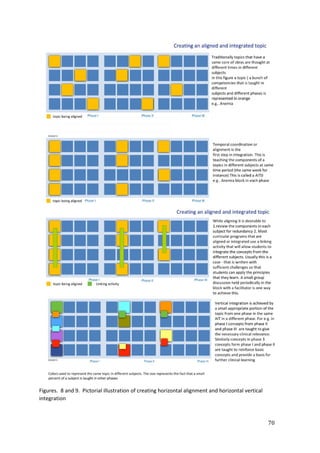
  • 119.
    119 a) BLS b) Firstaid 18) Introduction to alternate health care systems and their relevance and relationship to the practice of modern medicine Curricular governance and evaluation of the program (Person responsible, evaluation periodicity, methods, reporting) The program will be owned and conducted by the pre-clinical departments with appropriate input and faculty support by other departments Responsibilities of Dean of the medical college: a. To head a committee for Foundation Course implementation with one pre-clinical HOD as Convener and the other three and MEU Coordinator / co-Coordinator as members b. To allocate a venue for the foundation course (preferably other than the Lecture class rooms) c. To allocate the resources for the conduct of the foundation course (including those related to community visits, external resource persons etc.) d. To conduct at least two meetings with Curriculum Committee and the committee mentioned above in the month preceding the Foundation Course e. To arrange the meeting with parents and faculty. Responsibilities of the Curriculum Committee a. To schedule the sessions for one month and allocate the sessions to the resource persons (including external resource persons from outside the college, if necessary) b. To monitor the smooth conduct of the program c. To coordinate with the administration and clinical faculty d. To monitor and submit reports to the Dean Responsibilities of the MEU a. To arrange the sensitisation programs for all faculty members (including the Dean & HODs) b. To ensure the coordination between the above two committees c. To train and orient the resource persons
  • 120.
    120 d. To collectthe reports and coordinate with NC / RC. e. To ensure that at least one MEU faculty should be present in all sessions. Evaluation: Program effectiveness questionnaire from faculty and students Reporting: The Curriculum Committee will submit the schedule and report with inputs from students, resource persons, MEU faculty and the MEU coordinator shall forward the same to NC/RC within two weeks of the last day of the Foundation Course. The NC/RC Convener shall forward a consolidated report in the prescribed proforma to the MCI within four weeks.
  • 121.
    121 Attitude, Ethics &Communication (AETCOM) Introduction In order to be able to function appropriately ethically and effectively in her/his roles as clinician, leader and member of the health care team and system, communicator, lifelong learner and as a professional, there need to be a structured training program. Medical Council of India has proposed new teaching learning approaches including a structured longitudinal program on attitude, communication and ethics. Role modelling and mentoring associated with classical approach to professional apprenticeship has long been a powerful tool. This approach alone is no longer sufficient for the development of a medical professional. The domains of attitude and communications with emphasis on ethics therefore need to be taught directly and explicitly throughout the undergraduate curriculum. The two major aspects of teaching professionalism include explicit teaching of cognitive base and stage appropriate opportunities for experiential learning and reflection throughout the curriculum. AETCOM module has been prepared as a guide to facilitate institutions and faculty in implementing a longitudinal program that will help students acquire necessary competence in the attitudinal, ethical and communication domains. It offers framework of competencies that students must achieve. It also offers approaches to teaching learning methods. However, it is a suggested format and institutions can develop their own approaches to impart these competencies. Objectives of the document: To facilitate institutions and faculty in implementing a longitudinal program that will help students acquire necessary competence in the attitude, ethics and communication domains. This shall enable the graduate to function effectively in the four roles of leader and member of the health care team, communicator, life-long learner and professional as envisaged in the revised Graduate Medical Education Regulations. Curricular Element or Program Addressed: Professional development including Attitude, Ethics & Communication (AETCOM) Relevant Extract from GMR:
  • 122.
    122 2. Indian MedicalGraduate Training Programme The undergraduate medical education programme is designed with a goal to create an “Indian Medical Graduate” (IMG) possessing requisite knowledge, skills, attitudes, values and responsiveness, so that she or he may function appropriately and effectively as a physician of first contact of the community while being globally relevant. 2.3. Goals and Roles for the Learner In order to fulfil the goal of the IMG training programme, the medical graduate must be able to function in the following roles appropriately and effectively:- 2.3.1. Clinician who understands and provides preventive, promotive, curative, palliative and holistic care with compassion. 2.3.2. Leader and member of the health care team and system with capabilities to collect analyze, synthesize and communicate health data appropriately. 2.3.3. Communicator with patients, families, colleagues and community. 2.3.4. Lifelong learner committed to continuous improvement of skills and knowledge. 2.3.5. Professional, who is committed to excellence, is ethical, responsive and accountable to patients, community and profession. 7.4.1 Pre-Clinical Phase - Professional development including Attitude, Ethics & Communication (AETCOM) module 7.4.2 Para-clinical phase - Professional development including Attitude, Ethics & Communication (AETCOM) module 7.4.3 Clinical Phase - Professional development including Attitude, Ethics & Communication (AETCOM) module 9.4 Professional Development including Attitude, Ethics and Communication Module (AETCOM). Objectives of the programme: At the end of the programme, the learner must demonstrate ability to:
  • 123.
    123 (a) understand andapply principles of bioethics and law as they apply to medical practice and research, (b) understand and apply the principles of clinical reasoning as they apply to the care of the patients, (c) understand and apply the principles of system based care as they relate to the care of the patient, (d) understand and apply empathy and other human values to the care of the patient, (e) communicate effectively with patients, families, colleagues and other health care professionals, (f) understand the strengths and limitations of alternative systems of medicine, (g) respond to events and issues in a professional, considerate and humane fashion, (h) translate learning from the humanities in order to further his / her professional and personal growth Teaching Learning Methods recommended Guidelines for Case Discussion A hybrid problem-oriented approach is one of the most effective ways for students to explore the various facets of “real life issues” that will confront them in their careers. In addition to problem solving skills, case discussions promote collaborative learning, team work, reflection and self-directed learning. The cases presented in the AETCOM booklet represent competencies that lend themselves best to this form of learning. 1. Two or more learning sessions are recommended for each session with ample time for self-directed learning and other learning activities between each session. 2. A case is introduced into a small group and the facilitator facilitates a small group discussion where, a. initial reactions of the group to the case is obtained, b. the underlying ethical, legal and societal principles of the case are elicited,
  • 124.
    124 c. learning objectivesfor the case are developed, d. Learning tasks are assigned for members of the learning groups, e. Learning resources are identified. The suggested location for such a session is a small group discussion area which requires a small table with seating for 8 - 10 students. Suggested duration for such a session is 1 hour. A board with chalk or marker is also required. 3. Learning occurs in between sessions by the learners through following: • Self-directed learning by study of identified learning resources, • Self-directed learning through study of online learning resources, • Identification of legal, ethical and social precedents for the given settings, • Obtaining opinion from seniors in the profession on their impressions on the setting 4. Reinforcement of the fundamental concepts underlying the case can be done through a large group learning session (lecture or equivalent) in between the small group sessions. 5. In the second session, the small group discussion is focussed on closure of the case (or the part of the case) for which learning objectives were identified for in the first session. The facilitators may guide the discussion based on the ethical, legal, societal and communication aspects of the case. The group discusses the case, based on the learning done in between the session and provides suggestions and alternatives on the approach for doctors to follow. It must be reiterated that there may not be one correct way to resolve a case. The approach will be to allow students to reflect, make a choice and defend their choice, based on their values and learning.
  • 125.
    125 Student narrative The studentnarrative is a learning method that focuses on the following skills: a. Elicit, observe and record data, b. Reflect on the data at a higher level of thinking and derive opinions and conclusions, c. Communicate the observations and conclusions in a written and verbal form and expand on and defend the conclusions with colleagues and teachers, d. Form new experiences and conclusions based on this discussion. Communication Skill: Doctor patient encounters 1. Building the doctor patient relationship - Body Language, Introduction.
  • 126.
    126 2. Opening thediscussion – Gaining Confidence. 3. Gathering information – Re alignment 4. Understanding the patient’s perspective – Physical / Emotional / Social - Pts perspective 5. Sharing information – Medical Advice. 6. Reaching agreement on problems and plans – Discuss treatment options. 7. Providing closure – Future course / Follow up Breaking a bad news: Bad News: Definition: “Any information which adversely and seriously affects an individual’s view of his or her future” SPIKES- Six- Step Protocol for Delivering Bad News Step 1: S- Setting Up The Interview Step 2: P- Assessing The Patient’s Perception Step 3: I- Obtaining The Patient’s Invitation Step 4: K- Giving Knowledge And Information To The Patient Step 5: E- Addressing The Patient’s Emotions With Empathic Responses Step 6: S- Strategy and Summary Medicine and humanities Curriculum Different approaches would be used to help students to understand the broader socio- economic framework and cultural context within which health care is delivered. Students would also learn about the humanities through art, literature and cinema. Objective To provide knowledge, understanding and critical perspective in areas outside conventional biomedicine that are required for a doctor. The training should offer the ability to reflect on problems and understand the milieu of practice in India. Suggested themes may include: • The history and culture of diseases • The history of modern medicine in the western world and in India. • The political economy of medicine in India • Representing the doctor. A study of selected fiction, artworks and films. • Questions of gender, caste, minority, sexuality
  • 127.
    127 • Patient issues •Death and Dying in India • The art of practice • Sociology • Family structure • Socio-economic aspects, poverty • Health seeking behaviour • Health beliefs Methodology a) Sociology training through practical exercises, experiential learning and discussion, local art forms etc.. b) Experience of urban and village life c) A group of students adopts a set of families. Each student has responsibility for one family. d) Students conduct a set of surveys regarding family structure, socio-economic status, common health problems, and health seeking behaviour and health beliefs e) Students are involved in health education and health clinics This may be suitably modified according to the facilities of each medical college. Assessment of skills related to Attitude, Ethics and Communication Assessment is a vital component of competency based education. In addition to making the pass/fail decisions, a very important role of assessment is to provide feedback to the learner and help him/her to improve learning. The assessment in AETCOM nodule has been designed with this purpose. The teachers should use this opportunity to observe the performance and provide feedback based on their observations. In case a student has demonstrated a performance, which is considered below expectation, corrective action including counseling should be initiated. Many of the tools in this module may appear subjective but coupled with the experience of the assessor, they will serve a very useful purpose
  • 128.
    128 List of resources: Must read : 1. Attitude, Ethics and Communication (AETCOM) Competencies for the Indian Medical Graduate - Medical Council of India 2. Jonathan Martin, Margaret Lloyd and Surinder Singh. Professional attitudes: can they be taught and assessed in medical education. Clinical Medicine Vol 2 No 3 May/June 2002 217 3. Walter f. Baile, Robert buckman, Renato lenzi, Gary glober, Estela a. Beale, Andrzej p. Kudelkab. Spikes—a six-step protocol for delivering bad news: Application to the patient with cancer the oncologist 2000;5:302-311 Additional reading 1. Herbert M.Swick, Teaching Professionalism in undergraduate Medical Education, JAMA, September 1, 199-vol282. No 9. 2. Antje Lumma-Sellenthin Learning professional skills and attitudes medical students attitudes towards communication skills and group learning. Linkoping University, Department of Medical and Health Sciences, 2013.
  • 129.
    129 Humanities Music and Healing Background Musicis an integral part of human life from birth to death, through happiness and joy. For many of us it is part of our wellness quotient. Does music heal? Does it help patients cope with illness? Does it improve outcomes? Should medicine embrace music as part of its armamentarium? This module allows the learner to explore the interface between music health and healing Competency addressed The learner must explore and appreciate the relationship between music and healing and demonstrate an understanding as to how music is used as an adjunct to the healing process Learning Session Year of Study: 1st year Hours: 8 hours Exploratory session : 2 hours Self Directed Learning: 4 hours Research / Task / Report Discussion and closure: 2 hours Description: 1. An exploratory session is created where either in small groups or an interactive large group students are allowed to explore their personal relationship with music. Discuss particularly about music during time of illness and depression. Faculty /Clinicians share patient related experiences. If there is access to live experts if not, a curated selection of healing music may be played. Regional music traditions linked to healing can be explored. If available, a documentary such as Alive Inside can be screened. The task as enumerated in item 2 is given to individuals or groups 2. Students individually or in groups are asked to research evidentiary and other links to music and healing. They may be requested to talk to local musicians, experts, clinicians and patients and compile a narrative. Audio samples of local music traditions used to heal can be part of the report. 3. Discussion ad closure: A closure session where students share their reflection based on their tasks and learnings and their implications.
  • 130.
    130 Assessment Submitted Narrative andreflections Resources 1. https://www.the-scientist.com/features/exploring-the-mechanisms-of-music-therapy- 31936 2. http://www.allsciencejournal.com/download/3/1-1-18.1.pdf
  • 131.
  • 132.
    132 Name Center Previous experience inCISP Expert Group / Academic Cell Medical Council of India Academic cell appreciates your hard work and commitment Thank you for your time The Medical Council of India proposed curricular reforms in MBBS curriculum for Undergraduate Education. These reforms focus on enhancing integration, clinical competency, flexibility and improvement in quality of training Global Trends Indian context Locally relevant and feasible changes Foundation Course EarlyClinical Exposure Integration –Vertical and Horizontal SkillTraining / Competency based Training Electives Student doctor method of ClinicalTraining Secondary Hospital Exposure Newer teaching techniques – skill labs etc Community Oriented Education
  • 133.
    133 Foundation Course EarlyClinical Exposure Integration–Vertical and Horizontal SkillTraining / Competency based Training Electives Student doctor method of ClinicalTraining Secondary Hospital Exposure Newer teaching techniques – skill labs etc Community Oriented Education Published – AETCOM, Competency driven UG Curriculum To Be Published – GMR 2019 Time line – 2019 onwards Curricular Governance and Program Evaluation Action Plan Assessment tools for CBME Internship Learning Resource materials 2019 The purpose of the CISP is to prepare and support faculty and medical colleges in planning, implementing and evaluating the curriculum 2019 through a multi tiered approach. Multiple level – Change, Multiple Stakeholders Variability in ability of NC/ RC/ MEU/ trainers Develop materials in context to reforms Motivation of MEU/ Faculty for change Faculty Development Making change happen at departmental level
  • 134.
    134 Factors For MCI Initiative Stepwise implementation Selected areas RTC/ MEU/ CC Factors Against New Concepts Variability in capacity Short time 491 colleges Poorly developed educational units MCI- BOG MCI- Academic cell Nodal/Regional Centers – 20 Medical Colleges – 491 Medical Education Unit/ Department Curriculum Committee Faculty Trained in Basic and Advance course Dean/ Principal of medical College to constitute as “ Curriculum committee” with following representations: One Professor/ Associate Professor from Clinical (Medical) discipline One Professor/ Associate Professor from Clinical (Surgical) discipline One Professor/ Associate Professor from Para- Clinical discipline One Professor/ Associate Professor from Preclinical discipline MEU coordinators Student and Interns representative The curricular committee will assist Dean for developing the curricular modules and implement the same at their institution. Curricular Committee will see oversee implementation of CISP in their institution. National team of experts to develop action plan and resource materials Develop special groups for specific tasks Rolling out Curriculum 2019 onwards Advocacy meetings with Key stake holders ( VC/ DME /Dean
  • 135.
    135 Foundation Course Early ClinicalExposure Integration Skills Orientation / Training Electives MCI- NationalTeam Nodal /Regional Training Centers – 20 * 2 Jan 2019 Nodal / Regional Training Centers – 20 Medical Education Unit Teams/ CC Coordinators – 491*5 • Each NC/ RC – Conduct workshops for MEU Teams/ CC Coordinators • 5 MEU/CC coordinators from Each College • 2 days workshop February - March – April 2019 This workshop provides Conceptual Frameworks for each of topic Use these to develop your workshops Share with ME Unit Coordinators Support them to Implement in their respective colleges Medical Education Unit Teams/CC Coordinators 491*5 Faculty Members from Each college • Each MEU /CC – Conduct workshops for Faculty • 5 members from Each Department – Include Clinicians • 2 days workshop Before June 2019 Reorient/ Refresh CISP for NC/RC coordinators Action Plan and Curriculum Implementation Share session details and LRM Sharing of practices
  • 136.
    136 Skill Current statusAdditional inputs Foundation course -Being used in a variety of -Standardization of the program ways -Training of faculty to make best use of course Integrated teaching -Good awareness -Standardization -Fairly good acceptance -Moving beyond departments Early clinical exposure -Scattered use in way of CBL -More use in real life and -Less common in community community settings -Better pedagogical management Teaching of clinical skills -Basic orientation being given -Pedagogy of skill learning in basic sciences -Clinical perspective -Fair acceptance Principles of CBME Integration and alignment Assessment of CBME Skills training and assessment Foundation course Electives Early clinical exposure Curricular Governance Two day Program LRM sharing Time commitment for Faculty/ Teachers RCs will do 2 or more workshops One or more for MEU teams of affiliated colleges One for faculty of their own college Mentoring of Affiliated Colleges for implementing curricular reforms Advocacy in the region Many Stake holders- University, DMER, Deans Sensitize all colleges on reforms Foundation Course to be implemented by 2019 (Full or Condensed) Other areas to be implemented throughout the year – “Phase in” Take feedback BOG – MCI Academic Council Dr Rajlakshmi All Resource persons All RTC Conveners / members MCI Staff All Deans of RTCS
  • 137.
    137 Term Example Objective Ableto correctly elicit immunization history of an infant Learning outcome Able to identify deficiencies in immunization and provide remedial doses Competency Competent to run a well baby clinic Term Example Competency What needs to be done Competent One who can do it Competence What he does An observable activity of a health professional, integrating multiple components like knowledge, skills, attitudes and values. International CBME Collaborators (2009) CBME is an outcomes-based approach to the design, implementation, assessment and evaluation of a medical education program using an organising framework of competencies! 3 •Variable and undefined outcome •Not aligned with societal needs •Emphasis on knowledge only •No formal training for attitudes and communication
  • 138.
    138 Structure/ Process CompetencyBased Driving force for curriculum Content: Knowledge acquisition Outcome: Knowledge application Driving force for process Teacher Student Responsibility for content Teacher Student and teacher Goal Knowledge acquisition Knowledge application Typical assessment tool Objective; One tool one objective Subjective and Objective Assessment tool Proxy Authentic Setting for assessment Removed (gestalt) Direct observation Assessment Norm referenced Criterion referenced Timing of assessment Emphasis on summative Emphasis on formative Program completion Fixed time Variable time 7 8 - CBME and traditional model not mutually exclusive - Does not prescribe different teaching methods - Multiple routes to a competency possible Dreyfus and Dreyfus, 1980
  • 139.
    139 • Observable abilityof a health care professional • Reflects a spectrum • Integrates multiple domains • The complexity can be varied and acquired over time • Measurable with respect to a defined outcome Knowledge Skill Attitude Communication 13 14 “Indian Medical Graduate” (IMG) possessing requisite knowledge, skills, attitudes, values and responsiveness, so that he or she may function appropriately and effectively as a physician of first contact of the community while being globally relevant. Step Example Goal Reduction in IMR Roles Good antenatal care, Institutional delivery Postnatal care, Neonatal care Feeding, immunization, Curative services Competencies Able to provide ANC Able to conduct a normal delivery Objectives Enumerate components of ANC Take appropriate history and perform physical examination
  • 140.
    140 Assessment •Transparency •Curriculum management •Good blueprintingfor assessment - Oversimplification of complex tasks - Time free courses may not be acceptable - Relation between competence and performance not clear - Prescriptive
  • 141.
    141 Objectives Aligning Competencies toLearning ● At the end of the presentation the learner will be able to derive appropriate learning sessions from a given competency Terms used A competency is an observable ability of a learner that includes multiple components including knowledge skills values and attitude. An objective is a statement of what a learner should be able to do at the end of a specific learning session (or experience) Core: A competency that is necessary in order to complete the requirements of the subject (traditional must know) None Core: A competency that is optional in order to complete the requirements of the subject (traditional nice (good) to know/ desirable to know) Terms Used Lecture: Any instructional large group method including traditional lecture and interactive lecture Small Group Discussion: Any instructional method involving small groups of students in an appropriate learning context Skill Assessment: A session that assesses the skill of the student including those in the practical laboratory, skills lab, skills station that uses mannequins/ paper case/simulated patients/real patients as the context demands DOAP (Demonstrate Observe Assist Perform Session) A practical session that allows the student to observe a demonstration, assist the performer, perform (demonstrate) in a simulated environment, perform under supervision or perform independently Salient features of GMR as relevant ● Learner centric methods ● Didactic less than 1/3 ● Skill acquisition ● Emphasis on communication skills Competencies • Observable ability of a health care professional • Reflects a spectrum • Integrates multiple domains such as knowledge skill and attitude and values • The complexity can be varied and acquired over time • Measurable with respect to a defined outcome 6
  • 142.
    142 Structure / ProcessCompetency Based Driving force for curriculum Content: Knowledge acquisition Outcome: Knowledge application Driving force for process Teacher Student Responsibility for content Teacher Student and teacher Goal of educational encounter Knowledge acquisition Knowledge application Typical assessment tool Single subjective Multiple objective Assessment tool Proxy Authentic Setting for assessment Removed (gestalt) Direct observation Assessment normative referenced criterion referenced Timing of assessment Emphasis on summative Emphasis on formative Program completion Fixed time Variable time Core Non Core Taught Yes Yes % of curriculum Not < 80% Not > 20% Summative assessment Y N Formative assessment Y Y Learning in a CBME program Change in focus ● shared responsibility in the learning process ● self directed and collaborative learning ● use of learner centric approaches ● skill acquisition and certification ● formative assessment as integral to the learning process ● progressive increase in the complexity of learning (ascendancy in competencies) The Competency Table Spectrum of domains Knowledge Skill Attitude Communication 10 Proficiency Levels Core vs Non Core K Knows A knowledge attribute – Usually enumerates or describes KH Knows how A higher level of knowledge – is able to discuss or analyse S Shows A skill attribute: is able to identify or demonstrate the steps SH Shows how A skill attribute:is able to interpret / demonstrate a complex procedure requiring thought, knowledge and behaviour P Performs (under supervision or independently) Mastery for the level of competence - When done independently under supervision a pre specified number of times - certification or capacity to perform independently results
  • 143.
    143 From Competency toLearning Methods Deriving Learning Methods from Competencies Deriving Objectives from Competencies Deriving Objectives No. Audience Behaviour Condition Degree Working with objectives From objectives to Learning Methods No Objective Domain K/S/A/C Level (K/KH/ S/SH) Departments(s) A/I (Y/N) (H/V))
  • 144.
    144 24 9 Describe the componentsof safe vaccine practice – including patient education/ counseling, adverse events following immunization, safe injection practices, documentation and Medico-legal implications K KH Y Lecture, Small group Written , Viva 16 Explain the term implied consent in Immunization services K K Y Small group Discussion Written , Viva 7 Educate and counsel a patient for immunization AC SH Y DAOP Document in Log Book, skill station Focus on 360 degree learning and different learning styles Pediatrics 10 Observes the Handling and storing of vaccines S KH Y DAOP, Bedside Log book 11 Observes the Administration the UIP vaccines in patients KH SH Y Bedside Document in Log Book 12 Document Immunization in an immunization record S SH Y DOAP, Bed side Skill assessment 13 Demonstrates the correct administration of different vaccines in a mannequin S SH Y DAOP Skill assessment 15 Demonstrate correct infection control measures and appropriate handling of the sharps S SH Y DAOP Document in Log Book Choosing the right learning method based on action verbs From Objectives to Learning Method Objective(S) Target Audience: Number of students: Method Chosen: Parameter Method 1 Method 2 Method 3 Advantages Disadvantages Infrastructure/Aids required Faculty preparation required Other Issues Criticality VS feasibility - Knowledge domain Criticality Matrix -Skill Domain Focus on 360 degree learning and different learning styles Pediatrics 23
  • 145.
    145 Knows Knows How Shows How Does 4 . 1 Describe main classes oflipids K K Y Lectures, small group discussio ns Written/viva voce Parameter Description Name of the Lesson Number of learners Objectives of the session Primary Teaching Method chosen Advantages of the Teaching method chosen Possible disadvantages Faculty preparation required Ascendancy of competence Choosing a learning method Does Shows How 2 Choose and interpret a . lipid profile and identify 1 the desirable lipid 2 profile in the clinical context S SH Y bed side, DOAP Skill assessment Knows How 4 Interpret laboratory . results of analytes 5 associated with metabolism of lipids S KH Y Lectures/ small group discussio ns Written/ viva voce Skill assessment Knows 25 Learning Plan Parameter Description Name of the Lesson Breakup of the session Step 1 Step 2 Step 3 Step 4 Teaching Aids required Infrastructure required Student preparation required Instant assessment method Chosen Other comments
  • 146.
    146 Systematic organization ofcurriculum content and parts into a meaningful pattern broadly explore knowledge in various subjects related to certain aspects of their environment ects related to certain aspects of their onment ...education that is organized in such a way that it cuts across subject-matter lines, bringing together various aspects of the curriculum into meaningful association to focus upon broad areas of study. It views learning and teaching in a holistic way and reflects the real world, which is interactive. ects related to certain aspects of their onment ocus upon broad areas of study. It views learning teaching in a holistic way and reflects the real d, which is interactive. the planned learning experiences not only provide the learners with a unified view of commonly held knowledge (by learning the models, systems, and structures of the culture) but also motivate and develop learners' power to perceive new relationships and thus to create new models, systems, and structures. What do you mean by integration? Creating Aligned and Integrated Learning 2 Definition Definition Systematic organization of curriculum content and parts into a meaningful pattern Systematic organization of curriculum content and parts into a meaningful pattern broadly explore knowledge in various subjects related to certain aspects of their environment Humphreys 1981 Definition Definition Systematic organization of curriculum content and parts into a meaningful pattern broadly explore knowledge in various subj envir ...education that is organized in such a way that it cuts across subject-matter lines, bringing together various aspects of the curriculum into meaningful association to focus upon broad areas of study. It views learning and teaching in a holistic way and reflects the real world, which is interactive. Shoemaker 1989 Systematic organization of curriculum content and parts into a meaningful pattern broadly explore knowledge in various subj envir ...education that is organized in such a way that it cuts across subject-matter lines, bringing together various aspects of the curriculum into meaningful association to f the planned learning experiences not only provide the and learners with a unified view of commonly held knowledge worl(by learning the models, systems, and structures of the culture) but also motivate and develop learners' power to perceive new relationships and thus to create new models, systems, and structures. Dressel 1958
  • 147.
    147 Why integrate? Whatgets integrated? It is taken for granted, apparently, that in time students will see for themselves how things fit together. Unfortunately, the reality of the situation is that they tend to learn what we teach. If we teach connectedness and integration, they learn that. If we teach separation and discontinuity, that is what they learn. To suppose otherwise would be incongruous. (Humphreys 1981, p. xi). 7 8 The progression of integration The progression of integration Isolation organize teaching in silos without consideration of other subjects or disciplines Awareness the teacher in one subject is made aware of what is covered in other subjects in the curriculum Isolation Harden R Med Edu 2000. 34; 551 Harden R Med Edu 2000. 34; 551 The progression of integration The progression of integration Harmonization “is the effort to deliberately relate curricula within the discipline rather than assuming that students will understand the connections automatically” Fogarty 1991 Nesting the teacher targets, within a subject-based course, skills relating to other subjects Awareness Isolation Isolation Awareness Harmonization Harden R Med Edu 2000. 34; 551 Harden R Med Edu 2000. 34; 551
  • 148.
    148 The progression ofintegration The progression of integration Temporal Coordination The timetable is adjusted so that topics within the subjects or disciplines which are related, are scheduled at the same time. Isolation Awareness Harmonization Nesting Isolation Awareness Harmonization Nesting Temporal Coordination Harden R Med Edu 2000. 34; 551 Harden R Med Edu 2000. 34; 551 The progression of integration The progression of integration Sharing Two disciplines may agree to plan and jointly implement a teaching program Correlation the emphasis remains on disciplines or subjects with subject-based courses taking up most of the curriculum time. Within this framework, an integratedSharing teaching session or course is introduced in addition to the subject-based teaching Isolation Awareness Harmonization Nesting Temporal Coordination Isolation Awareness Harmonization Nesting Temporal Coordination Harden R Med Edu 2000. 34; 551 Harden R Med Edu 2000. 34; 551 The progression of integration The progression of integration Complemetary integrated sessions now represent a major feature of the curriculum. Multi disciplinary brings together a number of subject areas in a single course with themes, problems, topics or issues as the focus for learning Correlation Sharing Complemetary Correlation Sharing Isolation Awareness Harmonization Nesting Temporal Coordination Isolation Awareness Harmonization Nesting Temporal Coordination Harden R Med Edu 2000. 34; 551 Harden R Med Edu 2000. 34; 551
  • 149.
    149 Interdisciplinary The progression ofintegration shift of emphasis to themes as a focus for the learning of and to the commonaltiesacross the disciplinesor subjects as they relate to the theme Interdisciplinary Transdisciplinary The progression of integration not a theme or topic selected for this purpose, but the field of knowledge as exemplifiedin the real world. Multi disciplinary Complemetary Correlation Sharing Multi disciplinary Complemetary Correlation Sharing Isolation Awareness Harmonization Nesting Temporal Coordination Isolation Awareness Harmonization Nesting Temporal Coordination Harden R Med Edu 2000. 34; 551 Harden R Med Edu 2000. 34; 551 Integration as it relates to the GMR Yes Can the competency be acquired No together with similar competencies in other subjects Ensure that these are allotted specific time and are running parallel to the aligned curriculum Choose one strategy - for aligned competency - Organ system or Disease based (AIT) List the competencies in that AIT under their respective subjects in each phase as in fig For each phase review the competencies of all the subjects and reduce redundancy Review competencies from other phases and mark which of these needs reinforcement or introduction in the current phase Create formative assessment sessions for end of each AS - Include non aligned and integrated Allocate Self directed learning time for preparation or assignments that will strengthen students ability to integrate the topic Create a linker or integrator session where learners can integrate concepts learnt in the block Create learning sessions - write objectives / method of instruction Prepare the time table with non aligned for each subject, aligned section, integrated sessions and self directed learning and formative assessment Ensure integrity of total hours recommended for each subject, Integrated teaching and SDL Use integration time allotted for linkers and portions of other phase competencies Alignment and integration Putting integration to work Get leadership buy in!
  • 150.
    150 Putting integration towork Putting integration to work Get the stakeholders together The stake holders should own the process Putting integration to work Putting integration to work Competency – narrow discipline based cannot be integrated Competency – can be taught in more than one discipline in a single phase – mark for horizontal integration Putting integration to work Putting integration to work Competency – can be thought in more than one discipline in a single phase – mark for horizontal integration Competency – can be taught in more than one discipline in across phases– mark for horizontal integration
  • 151.
    151 Putting integration towork Putting integration to work Competency – can be taught in more than one discipline in across phases– mark for verticall integration Alignthe colors Putting integration to work Putting integration to work Alignthe colors Find the links and link with relevance Putting integration to work Putting integration to work Link with relevance Link with relevance
  • 152.
    152 Putting integration towork Create Linkers Aligning in a phase Sample Aligned Timetable
  • 153.
    153 • Explain therationale of Electives • Enumerate pedagogical advantages of Electives • Plan their incorporation in the curriculum • Curricular governance of Electives • Types and example of Electives • Assessment of Electives Opportunity for a wide spectrum of flexible learning experiences to carry hospital / community based research projects which stimulate enquiry, self-directed, experiential learning and lateral thinking Brief course made available to learner during undergraduate study period, where students can choose from available options depending upon their interest and career preferences • Allow flexibility and choice during study period • Opportunity to explore areas of interest to supplement their future studies • Develop self directed learning skills • Have direct experience of working in their interest areas • Develop ability of deeper learning and critical thinking through reflection • Have a student centric component in curriculum • Identify future career path by direct experiences in diverse areas
  • 154.
    154 • Two monthsdesignated for elective rotations • after completion of the examination at end of the third MBBS Part I and before commencement of third MBBS Part II • Compulsory for learners to do an elective • Time for electives not to be used to make up for • missed clinical postings • shortage of attendance or • any other purposes • The learner shall rotate through two elective blocks of 04 weeks each • During electives regular clinical postings shall continue • Block 1 • In a pre-selected preclinical or para-clinical or other basic sciences laboratory OR under a faculty researcher in an ongoing research project • Block 2 • In a clinical department (including specialties, super-specialties, ICUs, blood bank and casualty) from a list of electives developed and available in the institution OR as a supervised learning experience at a rural or urban community clinic • Each college responsible for elective postings • Dean’s office, all administrative responsibilities for elective postings • identify possible electives within and outside institution that can be offered • to be specified and communicated to students at beginning of academic year • Department/ faculty who will guide/ supervise/mentor students during electives need to be identified and trained • If required students may be permitted to do electives in other medical colleges or institutions within/ outside the country • Bio Informatics, Tissue Engineering/ Processing, • Computer & Computer Applications, Immunology, • Genetics, Human Nutrition, Sports Medicine, • Laboratory Sciences, Research Methodology, • Ethics, Accident and Emergencies (A&E), • Community Projects, HIV Medicine, Tissue Culture, • Pharmaco Kinetics/dynamics / economics, • Assisted Reproductive Technology, Ethics & ME • Cardiothoracic Surgery, Cardiology, Paediatric surgery, • Gastroenterology, Infectious Disease, Geriatrics, • Psychiatry, Radiodiagnosis, Neurosurgery, Neurology, • Accident & Emergency Medicine, Rheumatology, • Pulmonary Medicine, Neonatology, Anaesthesia, Oncology, • Dermatology, Endocrinology, Nephrology, Palliative care, • Clinical pharmacology, Physical medicine and rehabilitation • Clinical genetics, Biomedical waste management, Toxicology • Example of Community electives/Places where it can be done: • District, taluka hospital or PHC • Community hospital • Community project • National programmes • List of Laboratory Electives: • Biochemistry, Pathology, Microbiology, Virology • Pharmacology, Forensic Medicine, Molecular biology etc
  • 155.
    155 • Electives compulsory,75% attendance mandatory • Student log book/ portfolio with academic/ non academic activities. For eg; • Cases seen, examined, investigated, test performed, case operated etc • Along with stories, reflection about each event • Various points included in checklist related to clinical skills like • History taking/examination, motivation, communication, team work, discipline • Students to be assessed in between and at end of elective posting • Feedback, comments and /or grades by faculty mentor • Performance of students in electives to contribute towards internal marks • Student’s feedback also needs to be documented in a structured format • To Head a committee for implementation of Electives with MEU Coordinator, Curriculum committee members & respective heads of electives department as members • To hold regular meetings for the effective implementation of electives • Dean’s office in each medical college will identify a person/office/department in the college who will be assigned the task of identifying, organizing and taking all administrative responsibilities for the elective postings • The responsible person/office/department will identify possible electives within and outside institution that can be offered to the students • List of Electives need to be specified and communicated to the students at the beginning of the academic year • The departments and/ or faculty who will guide/ supervise/mentor the students during their elective posting also need to be identified and trained in various requirements of electives • To conduct meetings at regular interval for monitoring, smooth handing & implementation • To help in sensitizing faculties & students for Electives & its scheduling • To monitor the smooth conduct of the program • To coordinate with the Dean, faculty & students for various activities enlisted before • To monitor and submit reports to the Dean • To arrange the sensitisation programs for all related faculty members • To ensure the coordination between faculty & students • To train and orient the resource persons • To collect the reports and coordinate with NC / RC • To ensure that at least one MEU faculty should be present in the monitoring of sessions on electives • Evaluation: Program effectiveness questionnaire from faculty and students • Reporting: The Curriculum Committee will submit the schedule and report with inputs from students, resource persons, MEU faculty and the MEU coordinator shall forward the same to NC/RC at 3 monthly interval.
  • 156.
    156 1. Lumb A,Murdoch-Eaton D. Electives in undergraduate medical education: AMEE Guide No. 88. Medical Teacher. 2014 Jul 1;36(7):557-72. 2. Ankit Agarwal, Stephanie Wong, Suzanne Sarfaty, Anand Devaiah & Ariel E. Hirsch (2015) Elective courses for medical students during the preclinical curriculum: a systematic review and evaluation, Medical Education Online, 20:1, DOI: 10.3402/meo.v20.26615 3. Thompson MJ, Huntington MK, Hunt DD, Pinsky LE, Brodie JJ. Educational effects of international health electives on US and Canadian medical students and residents: a literature review. Academic medicine: journal of the Association of American Medical Colleges. 2003 Mar;78(3):342. 4. Hastings, Adrian & Dowell, Jon & Kalmus Eliasz, Michael. (2013). Medical student electives and learning outcomes for global health: A commentary on behalf of the UKMedical Schools Elective Council. Medical teacher. 36. 10.3109/0142159X.2013.849330. 5. Harth SC, Leonard NA, Fitzgerald SM, Thong YH. The educational value of clinical electives. Medical education. 1990 Jul;24(4):344-53. 6. Dana Stys, Wilma Hopman & Jennifer Carpenter (2013) What is the value of global health electives during medical school?, Medical Teacher, 35:3, 209-218, DOI: 10.3109/0142159X.2012.731107
  • 157.
    157 Acetyl CoA Citrate Oxaloa itrate Malate Fumara Kreb’s cycle etoglutarate ylCoA Whydo I have to learn this? It is so boring Succinate I thought I was learning to be a doctor! • Explain the rationale of ECE • Enumerate the pedagogical advantages of ECE • Plan their teaching-learning methods around clinical scenarios • Optimally use ECE to orient students to basic clinical methods and ‘soft’ clinical skills (communication, professionalism, ethics etc.) • What is early clinical exposure? Exposure: “Authentic human contact in a social or clinical context that enhances learning of health, illness and/or disease, and the role of a health professional” Early: “What would have traditionally been regarded as the pre-clinical phase, usually the first two years” Dornan et al. Med Teacher 2006; 28: 3-18 Pre-clinical disciplines Clinical disciplines
  • 158.
    158 Early Clinical Exposure(ECE) is a teaching learning methodology, which fosters exposure of the medical students to the patients as early as the first year of medical college. Elizabeth K. Medical Education. 2003, 37: 88-89. The goals of ECE are to provide context and relevance to basic science teaching some gain in medical knowledge few basic clinical skills and wide range of attitudes. • Divide into 4 groups • Form dyads within groups • Share your experiences with ECE: • Who, when, where • What was the setting • What was good about the practice • How it could have been even better • Identify salient points in your group Case discussions Patient brought to classroom CONTEXT Classroom RELEVANCE setting Training in basic clinical skills Demonstration of clinical problems RSK Hospital setting Hospital visit Community setting Primary care exposure Community visits
  • 159.
    159 • Paper cases •Photographs • X-rays • Laboratory reports • ECG • Cases provide a focus for learning • A case is a framework for a discussion • A well constructed case functions as a “surrogate teacher” • A case is not a textbook or a syllabus • Use of a case match the goals, objectives, of the curriculum University of New Mexico, 2002 • Planning the case • Constructing the case • Formatting the case • Preparing the use of case • What is the setting? • State overall goal , learning objectives and expected competency • Plan Learning experiences • How will you implement it? What are the challenges/ How will you overcome them? • Plan evaluation of the ECE curriculum/module • Observe the personentering the room now. • Write your observations on a piece of paper. • Pass on the paper to the person next to you. Keep on doing so till the bell rings. • Each one reads out what was written on the slip. • What are your ‘observations’?
  • 160.
    160 You are sittingin on an outpatient clinic and have been told that the next patient to be seen is Mr. Jagan, a 24- year-old man who has signs and symptoms of thyrotoxicosis. Your clinical teacher has asked you to observe. Take a few minutes to jot down the kinds of things you might look for. • There are different ways of looking at same situation. • Students may observe everything superficially or look at totally unintended things. • Observation is not neutral. • “ Clearly the instruction “observe” is absurd. Observation is always selective. It needs a chosen object, a definite task, an interest, a point of view, a problem .” (Popper, 1972) • Who • What • How • For what • Use advance organizers as pegs, which the students can use to hang new knowledge on (Ausubel, 1960) • Structure the learners’ observations, using their existing knowledge and demonstrate the connection between basic and clinical science • Observation guides • What is the student being asked to observe? • What prior knowledge does he have? • What might he learn from these observations?
  • 161.
    161 • Watch MrJagan as I examine him and see if you can identify any typical features of thyrotoxicosis. Think about the correlation between his presenting symptoms and signs. During this consultation with Mr Jagan I am going to demonstrate how to palpate the thyroid. Correlate the method of palpation with the anatomy of thyroid that you have learnt. You have heard the history from Mr. Jagan. Try to correlate his symptoms with physiologic changes in his body. Which other conditions might present with similar symptoms? • Meet intended learning outcomes • Develop an understanding of how symptoms can be explained by the underlying physiologic changes. • Move students from ‘knows’ to ‘knows how’. • Allow students to correlate anatomy and physiology with the signs and symptoms. • Have the feel of utility of basic sciences in patient care • Look at the person having the disease rather than the disease itself. • Can be used in a variety of ways: • Two students observing same aspect & comparing notes • Students observing different aspects and sharing ideas • Focusing on communication, data gathering etc. • Communication and differences in different patients.
  • 162.
    162 • Write aclinical case which can be used as a tool for Early Clinical Exposure • Reflect how it will be different from a case for III MBBS students RSK • Develop a session for incorporating ECE in hospital settings to incorporate utility of knowledge of basic sciences (Hint: Include wards, OPDs, investigative facilities. Suggest ways to include situations with ethical dilemmas) • Develop a session for incorporating ECE in community setting. • List cases/ situations useful in the community • Identify a common clinical condition to be shown to students • List objectives of clinical demonstration • Develop an observation guide • Try to include all domains of learning • Think of different ways of using them
  • 163.
    163 • Core approachto clinical teaching • Generally a passive process causing anxiety or ‘shut down’ of the learner • Students need to be told what they should observe • Can make the teaching contextual and interesting • Can be used in a variety of ways
  • 164.
    164 Myth Reality Assessment shouldbe performance based Competency denotes ability of a learner to perform – not performance Assessment of discrete domains can be taken as surrogate of competency CBA should assess integration of domains in a clinical context CBA should concentrate of technical skills Non-technical skills are as important to be taught and assessed. CBA can be a one-time process CBA must be an ongoing process CBA can be norm referenced CBA must be criterion referenced. Assessment for competency based medical education What is CBME? Competency Based Medical Education (CBME) is an outcome based education which uses competencyframework to design, deliver, assess and evaluate the curriculum. How does assessment differ Common misconceptions Conventional curricula Competency based curricula Fragmented, mostly summative, norm-references Integrated, mostly formative, criterion-referenced Key features - Helps the learners to acquire and develop competencies - Direct observation plays a major role (specially for skill based) - All competencies have to be assessed Aligning assessment with competencies
  • 165.
    165 Aligning assessment withcompetencies.. Blueprinting Group work Link assessment methods to the competencies and objectives that you have worked. Opportunities for assessment A.Informal B.Formal - Internal assessment - University examinations Blueprinting needed Informal opportunities - Provide the much needed feedback to the learner, helping her to improve - Dissociate assessment and decision making, allowing students to ‘open up’ - Help to take away the stress of assessment Formal opportunities - Internal assessment: How she learnt - University examinations: How much she learnt Fall out: - Both test different aspects - One is not a replacement for other
  • 166.
    166 Internal assessment: Extractfrom GMER Regular periodic examinations shall be conducted throughout the course. There shall be no less than three internal assessment examinations in each Preclinical / Paraclinical subject and no less than two examinations in each clinical subject in a professional year. An end of posting clinical assessment shall be conducted for each clinical posting in each professional year. In subjects that are taught at more than one phase, proportionate weightage must be given for internal assessment for each Phase. For example, General Medicine must be assessed in second Professional, third Professional Part I and third Professional Part II, independently. Internal assessment: Eligibility Day to day records and log book should be given importance in internal assessment. Internal assessment should be based on competencies and skills. - Made mandatory before a student is allowed to appear for the final university examination - Need at least 35% separately in theory and practicals - However, need 50% in theory and practical combined before being declared pass - Those who appear in University exams with <50%, will need to make up before the result is declared - Passing in internal assessment will be separately shown in the final result University examinations University examinations are to be designed with a view to ascertain whether the candidate has acquired the necessary knowledge, minimal level of skills, ethical and professional values with clear concepts of the fundamentals which are necessary for him/her to function effectively and appropriately as a physician of first contact. Theory examinations - Use multiple tools like long answer, short answer and multiple choice questions - MCQs not more than 20%
  • 167.
    167 Practical/Clinical examinations - Toassess proficiency in skills, data interpretation and logical conclusions - Clinical cases should match what a practitioner is likely to see in actual practice - Avoid rare cases/syndromes - Focus on data gathering, physical examination, writing records and management plans. Viva-voce - Assess approach to patient management, emergencies, attitudinal, ethical and professional values - Skill in interpretation of common investigative data, X-rays, identification of specimens, ECG, etc. is to be also assessed. - Viva marks to be added to practicals Examination schedule Marks allotment
  • 168.
    168 ? What do youunderstand by ‘skills’? Activity: Think- Pair- Share TS • Conventionally taken as psychomotor domain • “Any action by a health care practitioner, involved in direct patient care which has a measurable impact on clinical outcome”. (Scottish clinical skills strategy, 2007) • Can be classifies as ‘technical’ and ‘non-technical’. TS Technical Non-technical History taking Situational awareness Physical examination Task management Communication (patients) Communication (team) Procedural skills Decision making Information management Prioritization skills TS Dreyfus and Dreyfus, 1980 6
  • 169.
    169 • Rehearsing skillsin preparation for practice reduces adverse events. (Leonard et al, 2004) • Behaviors during simulated training predict actual practice (Weller et al, 2003) • Changing educational trends e.g. CBME • Changing healthcare scenarios e.g. teams TS • Number of students, time constraints • Different levels of learners • Mismatched learner priorities • Patient safety concerns • Awkwardness in pointing errors • Inability to provide developmental feedback TS • How do you teach clinical skills? • What changes can be made in the way clinical skills are taught? TS TS AAMC, 2008 • Different approaches needed for two types of skills • Non-technical skills often first sign of impeding trouble • Non-technical skills enhance the learning of technical skills (Salas, 2005) TS • One of the oldest apprenticeship model • Poorly structured and supervised • Wrong practices transmitted over generations • Assessment difficult • Patients may be exposed to iatrogenic harm TS
  • 170.
    170 Semester Fidelity Example 3-4Low to medium Anatomy and physiology, anthropometry, BP recording 6-7 Low to medium Pharmacological principles Medium to high Eliciting clinical signs, making a diagnosis 8-9 Medium to high Initiate treatment, observe effect of TS treatment, resuscitation STEPS model TS1 SISFR model S Set the foundation, importance of skill, context T Tutor demonstration without commentary E Explanation with repeat demonstration P Practice under supervision and feedback S Subsequent deliberate practice TS S Set the context, identify roles and outcome I Immerse in roles and practice for agreed time S Summarize progress F Feedback from tutor R Refine practice TS T Think aloud W Wear gloves A Activate the learner A Adapt enthusiastically L Listen smart L Link learning and caring K Keep it simple K Kindle kindness TS • Peer assisted learning • Clinical skills laboratories • Simulations • Simulated patients TS • Laboratory process to mimic a clinical encounter • Not a replacement for clinical environment • Rehearsal and subsequent practice TS
  • 171.
    171 Patient care settingLearning opportunities Primary care, Outpatients Focused patient history Establishing rapport Building longitudinal relationships (student-patient) • Formative, focused on specific competencies required for a physician Community based Limitations of healthcare; Barriers to care Inpatients Problem focused history Physical examination Building rapport Emergencies Focused histories; Focused physical examination Basic clinical procedures; Diagnostic reasoning; Test interpretation TS • Measure the full scope of professional characteristics from very specific procedures to skills involving a synthesis of component abilities • Specific evaluative techniques chosen to match the skill being assessed • Programmed to believe that objective and standardized is best • Reductionist practices • Strong connect between assessment and decision moments • Competence viewed only dichotomously • No assessment can be completely summative, especially in CBME • Purely summative accelerate test taking behaviors • Purely formative has no serious takers • Give teeth to assessment! • Can we combine the formative and summative aspects? Schuwirth, 2015 • Greater emphasis on formative assessment • Supported by educational theory (Hodge, 2007) • Develops expertise through deliberate practice (Ericsson, 2006) • Needs effective coaching, mentoring and feedback (Eva and Regher, 2008)
  • 172.
    172 © TS • Mustbe criterion referenced with developmental perspective • Based on authentic encounters and direct frequent observations (Norcini, 2003) • Faculty observation skills need improvement (Govaertis, 2007) • Use quality assessment tools • More qualitative tools are needed to inform trainee • A number e.g. 3/5 • A word on a scale e.g. satisfactory • A narrative e.g. appropriately began the interview with open ended questions and collected the necessary information • Competency difficult to assess using only objective tools • Narratives carry more weight than numbers • Skills assessment should be criterion based • Don’t ignore assessment of knowledge related to that skill TS • No single method useful • Use multiple methods from Assessment Toolbox to compliment and compensate • Basic principle is direct standardized observation (checklist based/ global rating) and focused feedback TS Knows Knows how Shows Does -MCQs -Multiple T/F -SAQ -LAQ -Viva voce -OSCE -Standardized patients -Mini-CEX -DOPS -360 evaluation -Simulations with -Chart simulated Singh, 2015 TS models TS recall -Portfolios with reflection -WPBA AAMC, 2008
  • 173.
    173 • Key conceptis to activate prior knowledge and link it to the current problem. • One Minute Preceptor (OMP) • SNAPPS • Mini-CEX TS • Application oriented MCQs • Extended matching questions (EMQs) • Key feature test (KFT) • Script concordance test (SCT) • Oral examinations • Mini-CEX • Portfolios TS • Reflect on the challenges in teaching and assessing clinical skills. • Think of an implementation plan. • Think of developing the capability of teachers in this area. TS
  • 174.
    174 Glossary Curricular Governance Curriculum: adesigned learning experience (learning and assessment) which facilitates the learner to achieve the prescribed outcome of a course Curricular Governance: a process established to design, deliver, evaluate and improve curriculum Curriculum committee: an institutional body that comprises of faculty and constituted based on the norms prescribed by the MCI that oversees the medical education programas a whole and has responsibility for the overall design, integration, coordination, delivery and improvement of the curriculum Curricular Governance Dean Proposed structure for curricular governance 1. Who is accountable for the delivery of the curriculum? 2. Who is responsible for the oversight of the curriculum? 3. Who will support enable and facilitate the faculty Curriculum committee Overall incharge of the curricular delivery Meets at least 6 times a year Provides oversight and support of the curricular program Creates the timetable with the help of the phase teams and approvesthem Provides necessary authorityand support for the work of the curriculum MEU/ MED Provides faculty education and support Helps develop teaching and assessment methods and trains faculty for each May be involved in program evaluation and quality improvementof the curriculum Liaises with nodal centres of the MCI HODs Responsible for curricular implementation in the department Identifiestraining needs for faculty in the department Liaises with other HODS and ensures smooth deliver of curriculum Ensures that departmental responsibility in aligned and integrated blocks are completed Escalates issues to the appropriate teams to deliver the curriculum? 4. Who will evaluate and provide necessary inputs Topic Teams Phase wise Curricular sub committee Provides faculty and student support that will enable course corrections and continuous improvements? Responsible for the implementation of the Aligned and Integrated Topics identified across phases Each AIT will have a team with adequate representation from the subjects involved in that topic A team leader from each AIT represents the AIT to the curriculumcommittee Reviews competencies and develops learning objectives Assigns learning objectivesto each phase and teaching session Develops learning and assessment methods for the block Collects feed back Provides student support Responsible for the implementation of the curriculumin each phase Meets as often as needed Reviews competenciesfor each phase and converts them into learning objectives Works in aligning the curriculum as much as possible and enlisting help from other phases in creating necessary vertical integration and links Reduces redundancy across the phase by integrating overlapping teaching elements Develops learning and assessment methods for each phase Collects feed back and provides student support 4 Curriculum Committee ● Constituted in compliance to the terms of reference provided by the MCI (circular date) is responsible. ● The curriculum committee ensures that the institutional curricular plan and its delivery are aligned to and in accordance to the principles and requirements enshrined in the GMR document. Curriculum Committee a) Overall incharge of the curricular delivery b) Meets at least 6 times a year c) Provides oversight and support of the curricular program d) Creates the timetable with the help of the CSC and AIT and approves them e) Provides necessary authority and support for the work of the curriculum f) Responsible for preparation reports etc as required by the medical council
  • 175.
    175 Curricular Sub Committee consistof heads of departments/ key faculty from each specialty teaching in that phase and with representation from members of other phases and reporting to the CC. Curricular Sub Committee a. Responsible for the implementation of the curriculum in each phase b. Meets as often as needed c. Reviews competencies for each phase and converts them into learning objectives d. Works in aligning the curriculum as much as possible and enlisting help from other phases in creating necessary vertical integration and links e. Reduces redundancy across the phase by integrating overlapping teaching elements f. Develops learning and assessment methods for each phase g. Prepares the timetable for the phase and presents it to the CC for approval h. Collects feedback and provides student support Alignment and Integration Team Group of faculty that will ensure that a Aligned and Integrated Topic (AITo) is delivered. Each team will have at least one member from each department across phases and is responsible for delivery of the topics. The AIT reports to the curriculum committee. Alignment and Integration Team a. Responsible for the creating learning and assessment sessions of the Aligned and Integrated Topics (AITo) identified across phases b. Each AIT will have a team with adequate representation from the subjects involved in that topic c. A team leader from each AIT represents the Aligned and Integrated Topic (AITo) to the CSC and/or CC d. Reviews competencies and develops learning objectives for the topic e. Assigns learning objectives to each phase and teaching session f. Develops learning and assessment methods for the (AITo) g. Helps faculty with delivering session appropriately and in a collaborative manner across phases h. Collects feedback for the AITo i. Provides student support Who will support enable and facilitate the faculty to deliver the curriculum? The Medical Education Unit ● Provides faculty education and support ● Helps develop teaching and assessment methods and trains faculty for each ● May be involved in program evaluation and quality improvement of the curriculum ● Liaises with the Regional / Nodal Centres of the MCI Curricular oversight Institutional Quality Assurance program
  • 176.
    176 Milestone Dates Personresponsible Submission of first compliance report March, 2019 for in-house workshops Nodal & Regional Centre faculty in charge of CISP Submission of second compliance report March 2019 – May 2019 Submission of third compliance report May 2019 onwards By Observer to the workshop through Nodal & Regional Centre faculty- in - charge of CISP Completion of skill labs and other requisite infrastructure March 2019 to December 2019 Dean of institution Mile stones Milestone Dates of Workshop Location First CISP at MCI for Conveners & Co- Conveners of Regional & Nodal Centres Second CISP at MCI for Conveners & Co- Conveners of Regional & Nodal Centres CISP training program for in-house faculty January 16-17, 2019 January 23-24, 2019 To be completed by Medical Council of India of department of Medical Education at Nodal & Regional Centres February 7, 2019 Nodal & Regional CISP training program for Curriculum Committee members of colleges allotted to each Nodal & Regional Centre CISP workshops to train medical college faculty supervised by Observer from respective Nodal & Regional Centres From second week of February, 2019 to end of April, 2019 May 2019 - a continuing process until all college faculty are trained. Centre ME Departments Medical colleges Dean Curriculum committee MEU/ MED HODs Quality Assurance and Improvement As specified by MCI As specified by MCI Topic Teams Phase wise Curricular sub committee This is a working group. Mixed composition with one member from each subject in that phase as well as one representativefrom other phases HODs or designateof each subject in that phase with at least one representative from other phases at a senior level 1 5
  • 177.
    177 Faculty Guide Session on“Orientation on Foundation course” Total Time : 45 min.s Time Agenda/Activity Materials 15 min Introduction to Foundation course Scope and need PPT 10 min Discussion in small groups on 1. Orientation to medical profession & college w.r.t GMR 9.1.2(a) 2. Professional Development & Ethics ( w.r.t AETCOM module) 3. Language & Computer skills w.r.t GMR 9.1.2(b) 4. Basic Skills Training w.r.t GMR 9.1.2(c) 20 min Plenary on the above (3 min presentation and 2 minutes discussion from each group) Objectives Foundation Course Orientation • At the end of this presentation the trainers will be able to sensitize and guide faculty to design an effective program for learners on the foundation course Foundation Course Session outline • GMR as it applies to the foundation course • Proposed components and time lines Objective The overall objective of foundation course would be to sensitize the learners with essential knowledge and skills which will lay a sound foundation for their pursuit of learning across the subjects in MBBS course and later on a career in medicine. GMR 9.1.2 to 9.1.3
  • 178.
    178 Subjects/ Contents Totalhours Orientation 30 Skills Module 35 Field visit to community health center 8 Professional Development including ethics (AETCOM) 40 Language/ computer skills 40 Sports and Extracurricular activities 22 25 days of seven hours (8-4 with a lunch break of one hour) 175 Orientation Orient the student to » The medical profession and the physician’s role in society » The MBBS programme » Alternate health systems in the country » Medical ethics, attitudes and professionalism » Health care system and its delivery » National health priorities and policies » Universal precautions and vaccinations » Patient safety and biohazard safety » Principles of family practice » Documents pertaining to MBBS Course from the Medical Council of India » The medical college and hospital Foundation Course (one month) Source: GMR Language & IT Skills – Enable the student to acquire enhanced skills in: » Language »Interpersonal relationships » Communication » Learning including self-directed learning » Time management »Stress management »Use of information technology Skills module – Train the student on : » First-aid » Infection Control & Bio medical Waste Management practices » Basic life support Elements • These sessions must be as interactive as possible. • Sports and Leisure and extracurricular activity (to be used through the Foundation Course as protected 22 hours in one month). • Students may be enrolled in one of the following programmes which willbe run concurrently: (40 hours in one month) – Local language programme – English language programme – Computer skills – These may be done in the last two hours of the day for the duration of the Foundation Course Further learning & Resources • Appropriate sections from GMR
  • 179.
    179 Sample Session 1– About the profession • At the end of the session (s) the participant will be able to facilitate a small group discussion on the profession with novice students where – The student is introduced to the profession, its privileges and responsibilities and its role in society – His/her expectations are elicited – His/her fears as assuaged – Relate his/ her learning to the care of the patient – Opportunities for professional and personal growth are explored Points for consideration • Expectations – self, family, society • Losing out on “youth” vs hard work • Work load • Learning vs memorizing – Contextual learning • Balancing personal and professional needs • Under vs overacheiving • Help support and grievance redressal • Safety Sample Session 2 – Experiential Learning • At the end of the session the participant will be able to provide the novice student with – An experience of being in a clinical care or a community situation – Reflect and describe the situation Required skill sets • Creating a learning experience • Promoting reflection • Promoting self directed learning Reflection Reflection intellectual and affective activities in which individuals engage to explore their experiences in order to lead to a new understanding and appreciation Boud, D., Keogh, R., Walker, D. (1985). Reflection: turning experience into learning. London: Kogan Page.
  • 180.
    180 Reflection Further learning& Resources Action plan if it arose again what would you do? Description What happened? Feelings What were you thinking and feeling • Movies • Novels Gibbs 1988 Conclusion What else could you have done? Analysis What sense can you make of the situation Evaluation What was good and bad about the experience Skills required • Creating task based exercise • Promote reflection • Facilitate discussion Sample Session 3- Time Management • At the end of the session (s) the participant will be able to develop and deliver exercises and experiences for the novice student in – Prioritization – Time management – Stress Management Facilitator guide • Create a task where participants have to chose among different time constrained but equally important things in different spheres • Ask participants to discuss their choices and why • Initiate a discussion on how help students prioritize, manage time, to conflicting needs and perform better. Points to consider • Example • Student has exam next week, brother’s wedding day after exam. Every one in family is having fun; want him to come home; feels frustrated and left out.. • Reinforce importance of transparent calendar • Students must know that teachers will be willing to discuss an issue
  • 181.
    181 Sample Session 4– Language Skills • At the end of the session (s) the participant will be able to identify and address perceived difficulty in English and the local language, communication, use of technology etc. in students; creating awareness and provide appropriate resources and remediation Skills required from faculty • Recognizing verbal and non verbal cues • Non threatening communication skills Program • Role play interview with a student with difficulty in English • Have participants react to demo and have a small group discussion on student support Points to consider • Spoken language • Complex • Time lag from listening to communication • Absenteeism because of language • Discrimination and sexual appropriateness • Appropriate presentation of self • Safety Session Professional Development including Ethics Introduction to AETCOM Module • GMR regulations as it applies to professional development including ethics • AETCOM Module with stress on T/L Methods
  • 182.
    182 • Competencies • Objectives •Modules AETCOM Learning Experiences •This will be a longitudinal programme spread across the continuum of the MBBS programme including internship. •Learning experiences may include – small group discussions, patient care scenarios, workshop, seminars, role plays, lectures etc • The Foundation Course will have compulsory 75% attendance. This will be certified by the Dean of the college. • Assessment : To be decided Responsibilities of Dean of the medical college • To head a committee for Foundation Course implementation with one preclinical HOD as Convener and the other three and MEU Coordinator / co-Coordinator as members • To allocate a venue for the foundation course (preferably other than the Lecture class rooms) • To allocate the resources for the conduct of the foundation course (including those related to community visits, external resource persons etc..) • To conduct at least two meetings with Curriculum Committee and the committee mentioned above in the month preceding the foundation course • To arrange the meeting with parents and faculty. Responsibilities of the Curriculum Committee • To schedule the sessions for one month and allocate the sessions to the resource persons (including external resource persons from outside the college, if necessary) • To monitor the smooth conduct of the program • To coordinate with the administration and clinical faculty • To monitor and submit reports to the Dean Responsibilities of the MEU • To arrange the sensitisation programs for all faculty members (including the Dean & HODs) • To ensure the coordination between the above two committees • To train and orient the resource persons • To collect the reports and coordinate with NC / RC. • To ensure that at least one MEU faculty should be present in all sessions.
  • 183.
    183 Monitoring • Evaluation: Programeffectiveness questionnaire from faculty and students • Reporting: The Curriculum Committee will submit the schedule and report with inputs from students, resource persons, MEU faculty and the MEU coordinator shall forward the same to NC/RC within two weeks of the last day of the Foundation Course. • The NC/RC Convenor shall forward a consolidated report in the prescribed proforma to the MCI within four weeks.
  • 184.
    184 Attitude Ethics andCommunication AETCOM Graduate Medical Regulations “Indian Medical Graduate” (IMG) possessing requisite knowledge, skills, attitudes, values and responsiveness, so that he or she may function appropriately and effectively as a physician of first contact of the community while being globally relevant. Revised Regulations on Graduate Medical Education, “Indian Medical Graduate” ROLES Clinician - preventive, promotive, curative, palliative and holistic care with compassion. Leader and member of the health care team - collect analyze, synthesize and communicate health data Communicator - patients, families, colleagues and community. Lifelong learner - continuous improvement. Professional - ethical, responsive and accountable. How it is being learnt now? My Teacher Through Hidden curriculum The hidden curriculum The hidden curriculum consists of those things the students learn through the experience of attending college rather than the stated educational objectives of such institutions.
  • 185.
    185 NED DELIV EXPEERIENCED PLAN ERED EXPEERIENCED explicitpart implicit part Teach by example Attitude - Teaching ? Modules Role play Feed Back Project work Field trips Medical camps Voluntary services NCC NSS Attitude, communication Movie clips If we could see Classical approach Vs Direct and explicit teaching What and How to teach? Deriving from participants
  • 186.
    186 Attitude and Communication(AT-COM) Module Section I: Extract of goals, roles and universal competencies as envisaged by I MG document. Section II: Suggested teaching modules for each professional year , resources cases and method to teach Section III: List of additional non-core competencies that form a desirable set of learning Section IV: Competency log - in a simulated setting . - progressing in complexity over time. Attitude and Communication (AT-COM) Module Learning modules for Professional year I Number of Modules: 5 Number of hours: 34 Section V: Formative elements that are observable by guides and marked over time. Appendix 1: Set of competencies as approved by the Academic Committee of the Medical Council of India Appendix 2: Modified communication skill rating tool adapted from the Kalamazoo consensus 1. What does it mean to be a doctor? BACKGROUND It is important for new entrants to get a holistic view of their profession, its ups and downs, its responsibilities and its privileges. It is important to start this discussion early in their careers when their minds are still fresh with the thrill of joining medical school. Such a discussion will help them remember the big picture through the program and remind them why they have chosen to be doctors. LEARNING EXPERIENCE When: Professional year 1 Hours: 8 (6 hours + 2 hours self directed learning) This session can be delivered by 4 inter-dependent learning experiences Learning modules for Professional year I 1. An exploratory session with the students enquiring from them Why they chose to become doctors and what do they think are the privileges and the responsibilities of the profession. What do they expect from society and what do they think society expects from them? What will they have to do and give up in order to meet their own and society’s expectations. This is preferably done in a small group discussion. 2. A facilitated panel discussion involving doctors who are at various stages of their careers (senior, midlevel, young) where doctorsshare their experiences and also answer questions from students. Learning modules for Professional year I 3. Self directed learning where students write a report from reflection based on sessions 1 & 2 and on other readings, TV series movies etc that they have chosen from the lay press about doctor experiences. 4. Introductory visit to the hospital / community medical centres 5. A closure session with students to share their reflections based on 1, 2, 3 and 4 that includes what they plan to do in the next 5 years in order to fulfill their professional and personal roles as doctors. 6. A white coat ceremony in the Foundation Course. RESOURCES Whitcomb ME. Academic Medicine 2007 82: 917
  • 187.
    187 Communication skill Doctor –Patient / Attendants Applications in Medical Education List the communication skills required to be taught to a UG Derive from participants Doctor – Patient encounter 1. Building the doctor patient relationship 2. Opening the discussion 3. Gathering information 4. Understanding the patient’s perspective 5. Sharing information 6. Reaching agreement on problems and plans Breaking a bad news Goals of the Bad News Interview To provide intelligible information and educate the pt / attendents regarding the disease process. To support the patient by employing skills to reduce the emotional impact To develop a strategy in the form of a treatment plan with the input and cooperation of the patient. To support the relatives / attendents in accepting the event.
  • 188.
    188 SPIKES- Six- Step Protocolfor Delivering Bad News Step 1: S- Setting Up The Interview Step 2: P- Assessing The Patient’s Perception Step 3: I- Obtaining The Patient’s Invitation Step 4: K- Giving Knowledge And Information To The Patient Step 5: E- Addressing The Patient’s Emotions With Empathic Resp onse s Step 6: S- Strategy and Summary
  • 189.