Social Geography
- Pooja Chavda
What is Social Geography?
• Social Geography is primarily concerned with the ways in which
social relations, identities and inequalities are created.
• How these social creations vary over space and the role of space in
their construction is the principle distinction between sociology and
social geography.
Social Interaction and relations
• According to PANOPIO,1997, Social interaction refers to the mutual
inter stimulation and response between two or more persons and
groups through symbols, language, gestures and expression of ideas.
• Social interaction is the foundation of society. Without interaction
there would be no group life.
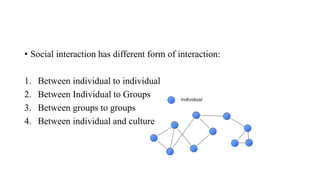
• Social interaction has different form of interaction:
1. Between individual to individual
2. Between Individual to Groups
3. Between groups to groups
4. Between individual and culture
Formation of Social Groups
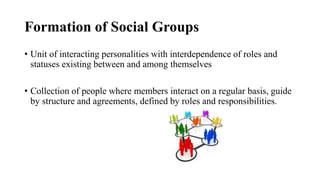
• Unit of interacting personalities with interdependence of roles and
statuses existing between and among themselves
• Collection of people where members interact on a regular basis, guide
by structure and agreements, defined by roles and responsibilities.
Characteristics of Social groups
• Group members interact on a fairly regular basis through
communication.
• Members should develop a structure where each member assumes a
specific status and adopts a particular role.
• Certain orderly procedures and values are agreed upon.
• The members of the group feel a sense of identity.
Types of Social Groups
• Below are the types of Social Groups:
1. Primary Group (Families, Play groups)
2. Secondary Group (industrial workers, Faculty Staff)
3. According Self-identification
4. According to purpose
5. According to geographic location
Community and Society
• The Primary difference between a community and Society is that a
community is limited to a specific geographic location, but a society
can be made up of people who live in different places.
• Another difference is that a society is made up of direct and indirect
social connections between people, but a community is made up of
individuals who are more closely connected.
• For example, people who live in town represent a community, whereas
everyone who lives in the state the town is located in makes up a
society.
• Several communities can be located within a society but each society
is separate from another.
• Societies often include more diversity, with people from different
backgrounds, social classes and races.
• People in communities most often share similar characteristics.
Concept of Social Space
• A social space is physical or virtual space such as a social center,
online social media, or other gathering place where people gather and
interact.
• Some social spaces such as town squares or parks are public places
and others such as pubs, websites or shopping malls are private places.
• Henri emphasized that in human society all “Space is social: It
involves assigning more or less appropriated places to social relations.
Socio-cultural Region
• Socio cultural regions helps us to understand the soul of the place.
• The well we know the socio cultural regions, it is easier to understand
the people, agriculture, traditions seasons, and buying selling periods
• We can also plot them.
• For Example Cooking Medium
• Some Socio Cultural regions are mustard oil users and some may be
ground nut oil users.
• We can also map hard and soft water.
• A social planner have many maps. These maps helps us to know about
the particular region.
Social geography

Social geography

  • 1.
  • 2.
    What is SocialGeography? • Social Geography is primarily concerned with the ways in which social relations, identities and inequalities are created. • How these social creations vary over space and the role of space in their construction is the principle distinction between sociology and social geography.
  • 3.
    Social Interaction andrelations • According to PANOPIO,1997, Social interaction refers to the mutual inter stimulation and response between two or more persons and groups through symbols, language, gestures and expression of ideas. • Social interaction is the foundation of society. Without interaction there would be no group life.
  • 4.
    • Social interactionhas different form of interaction: 1. Between individual to individual 2. Between Individual to Groups 3. Between groups to groups 4. Between individual and culture
  • 5.
    Formation of SocialGroups • Unit of interacting personalities with interdependence of roles and statuses existing between and among themselves • Collection of people where members interact on a regular basis, guide by structure and agreements, defined by roles and responsibilities.
  • 6.
    Characteristics of Socialgroups • Group members interact on a fairly regular basis through communication. • Members should develop a structure where each member assumes a specific status and adopts a particular role. • Certain orderly procedures and values are agreed upon. • The members of the group feel a sense of identity.
  • 7.
    Types of SocialGroups • Below are the types of Social Groups: 1. Primary Group (Families, Play groups) 2. Secondary Group (industrial workers, Faculty Staff) 3. According Self-identification 4. According to purpose 5. According to geographic location
  • 8.
    Community and Society •The Primary difference between a community and Society is that a community is limited to a specific geographic location, but a society can be made up of people who live in different places. • Another difference is that a society is made up of direct and indirect social connections between people, but a community is made up of individuals who are more closely connected. • For example, people who live in town represent a community, whereas everyone who lives in the state the town is located in makes up a society.
  • 9.
    • Several communitiescan be located within a society but each society is separate from another. • Societies often include more diversity, with people from different backgrounds, social classes and races. • People in communities most often share similar characteristics.
  • 10.
    Concept of SocialSpace • A social space is physical or virtual space such as a social center, online social media, or other gathering place where people gather and interact. • Some social spaces such as town squares or parks are public places and others such as pubs, websites or shopping malls are private places. • Henri emphasized that in human society all “Space is social: It involves assigning more or less appropriated places to social relations.
  • 11.
    Socio-cultural Region • Sociocultural regions helps us to understand the soul of the place. • The well we know the socio cultural regions, it is easier to understand the people, agriculture, traditions seasons, and buying selling periods • We can also plot them. • For Example Cooking Medium • Some Socio Cultural regions are mustard oil users and some may be ground nut oil users. • We can also map hard and soft water. • A social planner have many maps. These maps helps us to know about the particular region.