WRITING
IDENTIFICATION TESTS
LEARNING OUTCOMES
At the end of this presentation, the class will be able to:
 Define what an identification test is
 Understand the advantages and disadvantages of
identification tests
 Learn the guidelines for preparing an identification
test
DEFINITION
Identification Test
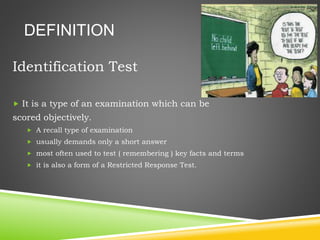
 It is a type of an examination which can be
scored objectively.
 A recall type of examination
 usually demands only a short answer
 most often used to test ( remembering ) key facts and terms
 it is also a form of a Restricted Response Test.
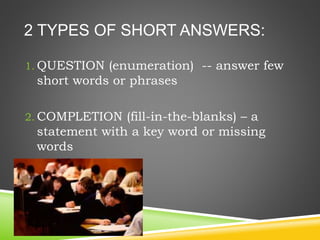
1. QUESTION (enumeration) -- answer few
short words or phrases
2. COMPLETION (fill-in-the-blanks) – a
statement with a key word or missing
words
2 TYPES OF SHORT ANSWERS:
ADVANTAGES OF IDENTIFICATION
TEST
Easy to construct
Low probability of guessing the answer
because it has to be supplied by the
examinees rather than select from the
given answers.
They are good to test the lowest level of
cognitive taxonomy.
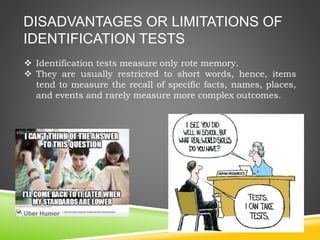
DISADVANTAGES OR LIMITATIONS OF
IDENTIFICATION TESTS
 Identification tests measure only rote memory.
 They are usually restricted to short words, hence, items
tend to measure the recall of specific facts, names, places,
and events and rarely measure more complex outcomes.
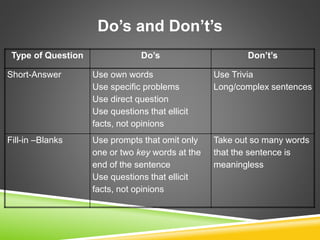
Do’s and Don’t’s
Type of Question Do’s Don’t’s
Short-Answer Use own words
Use specific problems
Use direct question
Use questions that ellicit
facts, not opinions
Use Trivia
Long/complex sentences
Fill-in –Blanks Use prompts that omit only
one or two key words at the
end of the sentence
Use questions that ellicit
facts, not opinions
Take out so many words
that the sentence is
meaningless
GUIDELINES IN PREPARING AN
IDENTIFICATION TEST
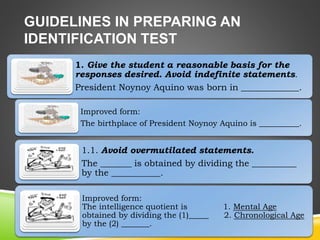
1. Give the student a reasonable basis for the
responses desired. Avoid indefinite statements.
President Noynoy Aquino was born in _____________.
Improved form:
The birthplace of President Noynoy Aquino is __________.
1.1. Avoid overmutilated statements.
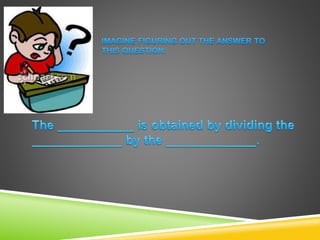
The _______ is obtained by dividing the __________
by the ___________.
Improved form:
The intelligence quotient is 1. Mental Age
obtained by dividing the (1)_____ 2. Chronological Age
by the (2) _______.
GUIDELINES IN PREPARING AN
IDENTIFICATION TEST
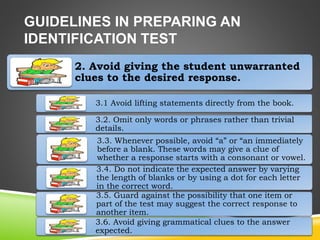
2. Avoid giving the student unwarranted
clues to the desired response.
3.1 Avoid lifting statements directly from the book.
3.2. Omit only words or phrases rather than trivial
details.
3.3. Whenever possible, avoid “a” or “an immediately
before a blank. These words may give a clue of
whether a response starts with a consonant or vowel.
3.4. Do not indicate the expected answer by varying
the length of blanks or by using a dot for each letter
in the correct word.
3.5. Guard against the possibility that one item or
part of the test may suggest the correct response to
another item.
3.6. Avoid giving grammatical clues to the answer
expected.
GUIDELINES IN PREPARING AN
IDENTIFICATION TEST
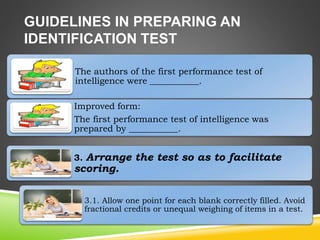
The authors of the first performance test of
intelligence were ___________.
Improved form:
The first performance test of intelligence was
prepared by ___________.
3. Arrange the test so as to facilitate
scoring.
3.1. Allow one point for each blank correctly filled. Avoid
fractional credits or unequal weighing of items in a test.
GUIDELINES IN PREPARING AN
IDENTIFICATION TEST
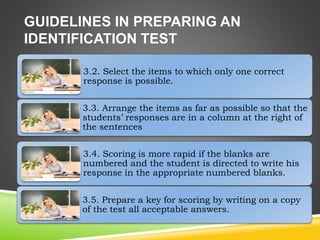
3.2. Select the items to which only one correct
response is possible.
3.3. Arrange the items as far as possible so that the
students’ responses are in a column at the right of
the sentences
3.4. Scoring is more rapid if the blanks are
numbered and the student is directed to write his
response in the appropriate numbered blanks.
3.5. Prepare a key for scoring by writing on a copy
of the test all acceptable answers.
GUIDELINES IN PREPARING AN
IDENTIFICATION TEST
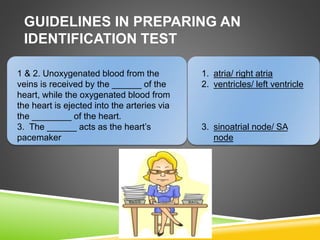
1. atria/ right atria
2. ventricles/ left ventricle
3. sinoatrial node/ SA
node
1 & 2. Unoxygenated blood from the
veins is received by the ______ of the
heart, while the oxygenated blood from
the heart is ejected into the arteries via
the ________ of the heart.
3. The ______ acts as the heart’s
pacemaker
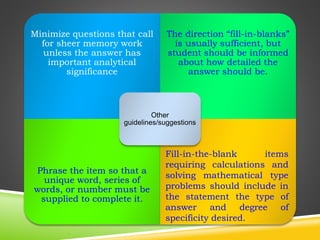
Minimize questions that call
for sheer memory work
unless the answer has
important analytical
significance
The direction “fill-in-blanks”
is usually sufficient, but
student should be informed
about how detailed the
answer should be.
Phrase the item so that a
unique word, series of
words, or number must be
supplied to complete it.
Other
guidelines/suggestions
Fill-in-the-blank items
requiring calculations and
solving mathematical type
problems should include in
the statement the type of
answer and degree of
specificity desired.
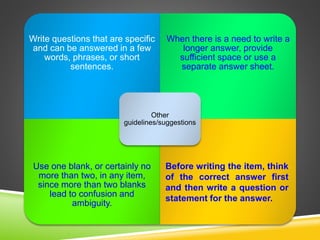
Write questions that are specific
and can be answered in a few
words, phrases, or short
sentences.
When there is a need to write a
longer answer, provide
sufficient space or use a
separate answer sheet.
Use one blank, or certainly no
more than two, in any item,
since more than two blanks
lead to confusion and
ambiguity.
Other
guidelines/suggestions
Before writing the item, think
of the correct answer first
and then write a question or
statement for the answer.
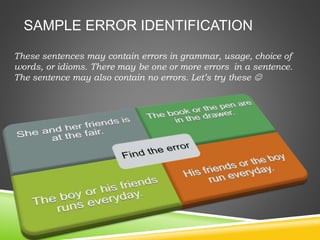
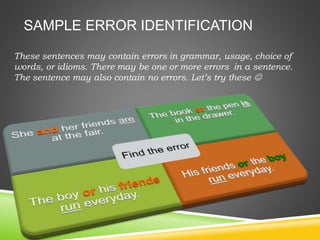
SAMPLE ERROR IDENTIFICATION
These sentences may contain errors in grammar, usage, choice of
words, or idioms. There may be one or more errors in a sentence.
The sentence may also contain no errors. Let’s try these 
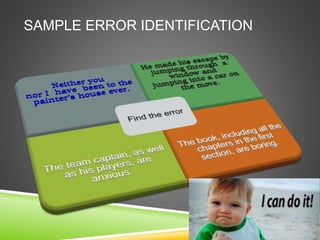
SAMPLE ERROR IDENTIFICATION
These sentences may contain errors in grammar, usage, choice of
words, or idioms. There may be one or more errors in a sentence.
The sentence may also contain no errors. Let’s try these 
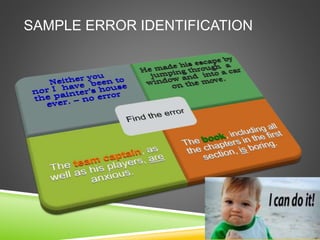
SAMPLE ERROR IDENTIFICATION
KNOWLEDGE IS AS VAST AS THE OCEAN.
NAVIGATE YOUR WORLD. KEEP LEARNING.
THANK YOU FOR LISTENING 
SOURCES:
 Dr. Warren Ramos’ Presentation “Writing an
Identification Test”
 Measurement and Evaluation Book by Laurentina P.
Calmorin; 3rd Edition

Writing Identification Tests

  • 1.
  • 2.
    LEARNING OUTCOMES At theend of this presentation, the class will be able to:  Define what an identification test is  Understand the advantages and disadvantages of identification tests  Learn the guidelines for preparing an identification test
  • 4.
    DEFINITION Identification Test  Itis a type of an examination which can be scored objectively.  A recall type of examination  usually demands only a short answer  most often used to test ( remembering ) key facts and terms  it is also a form of a Restricted Response Test.
  • 5.
    1. QUESTION (enumeration)-- answer few short words or phrases 2. COMPLETION (fill-in-the-blanks) – a statement with a key word or missing words 2 TYPES OF SHORT ANSWERS:
  • 6.
    ADVANTAGES OF IDENTIFICATION TEST Easyto construct Low probability of guessing the answer because it has to be supplied by the examinees rather than select from the given answers. They are good to test the lowest level of cognitive taxonomy.
  • 7.
    DISADVANTAGES OR LIMITATIONSOF IDENTIFICATION TESTS  Identification tests measure only rote memory.  They are usually restricted to short words, hence, items tend to measure the recall of specific facts, names, places, and events and rarely measure more complex outcomes.
  • 8.
    Do’s and Don’t’s Typeof Question Do’s Don’t’s Short-Answer Use own words Use specific problems Use direct question Use questions that ellicit facts, not opinions Use Trivia Long/complex sentences Fill-in –Blanks Use prompts that omit only one or two key words at the end of the sentence Use questions that ellicit facts, not opinions Take out so many words that the sentence is meaningless
  • 9.
    GUIDELINES IN PREPARINGAN IDENTIFICATION TEST 1. Give the student a reasonable basis for the responses desired. Avoid indefinite statements. President Noynoy Aquino was born in _____________. Improved form: The birthplace of President Noynoy Aquino is __________. 1.1. Avoid overmutilated statements. The _______ is obtained by dividing the __________ by the ___________. Improved form: The intelligence quotient is 1. Mental Age obtained by dividing the (1)_____ 2. Chronological Age by the (2) _______.
  • 10.
    GUIDELINES IN PREPARINGAN IDENTIFICATION TEST 2. Avoid giving the student unwarranted clues to the desired response. 3.1 Avoid lifting statements directly from the book. 3.2. Omit only words or phrases rather than trivial details. 3.3. Whenever possible, avoid “a” or “an immediately before a blank. These words may give a clue of whether a response starts with a consonant or vowel. 3.4. Do not indicate the expected answer by varying the length of blanks or by using a dot for each letter in the correct word. 3.5. Guard against the possibility that one item or part of the test may suggest the correct response to another item. 3.6. Avoid giving grammatical clues to the answer expected.
  • 11.
    GUIDELINES IN PREPARINGAN IDENTIFICATION TEST The authors of the first performance test of intelligence were ___________. Improved form: The first performance test of intelligence was prepared by ___________. 3. Arrange the test so as to facilitate scoring. 3.1. Allow one point for each blank correctly filled. Avoid fractional credits or unequal weighing of items in a test.
  • 12.
    GUIDELINES IN PREPARINGAN IDENTIFICATION TEST 3.2. Select the items to which only one correct response is possible. 3.3. Arrange the items as far as possible so that the students’ responses are in a column at the right of the sentences 3.4. Scoring is more rapid if the blanks are numbered and the student is directed to write his response in the appropriate numbered blanks. 3.5. Prepare a key for scoring by writing on a copy of the test all acceptable answers.
  • 13.
    GUIDELINES IN PREPARINGAN IDENTIFICATION TEST 1. atria/ right atria 2. ventricles/ left ventricle 3. sinoatrial node/ SA node 1 & 2. Unoxygenated blood from the veins is received by the ______ of the heart, while the oxygenated blood from the heart is ejected into the arteries via the ________ of the heart. 3. The ______ acts as the heart’s pacemaker
  • 14.
    Minimize questions thatcall for sheer memory work unless the answer has important analytical significance The direction “fill-in-blanks” is usually sufficient, but student should be informed about how detailed the answer should be. Phrase the item so that a unique word, series of words, or number must be supplied to complete it. Other guidelines/suggestions Fill-in-the-blank items requiring calculations and solving mathematical type problems should include in the statement the type of answer and degree of specificity desired.
  • 15.
    Write questions thatare specific and can be answered in a few words, phrases, or short sentences. When there is a need to write a longer answer, provide sufficient space or use a separate answer sheet. Use one blank, or certainly no more than two, in any item, since more than two blanks lead to confusion and ambiguity. Other guidelines/suggestions Before writing the item, think of the correct answer first and then write a question or statement for the answer.
  • 16.
    SAMPLE ERROR IDENTIFICATION Thesesentences may contain errors in grammar, usage, choice of words, or idioms. There may be one or more errors in a sentence. The sentence may also contain no errors. Let’s try these 
  • 17.
    SAMPLE ERROR IDENTIFICATION Thesesentences may contain errors in grammar, usage, choice of words, or idioms. There may be one or more errors in a sentence. The sentence may also contain no errors. Let’s try these 
  • 18.
  • 19.
  • 20.
    KNOWLEDGE IS ASVAST AS THE OCEAN. NAVIGATE YOUR WORLD. KEEP LEARNING. THANK YOU FOR LISTENING 
  • 21.
    SOURCES:  Dr. WarrenRamos’ Presentation “Writing an Identification Test”  Measurement and Evaluation Book by Laurentina P. Calmorin; 3rd Edition

Editor's Notes

  • #4 Mention Learning Outcomes
  • #5 Restricted response test – short answer; highly specific, and, generally, contains only one correct answer
  • #6 This test consists of a series of items which requires the testee to fill a word or phrase on the blanks. This is also called filling the blank type of test
  • #7 http://www.hec.gov.pk/InsideHEC/Divisions/LearningInnovation/Documents/Learning%20Portal/NCES/NCES%20Presentations/TEST%20AND%20TYPES%20OF%20TEST.pdf
  • #8 THEY ARE UNSUITABLE FOR MEASURING COMPLEX LEARNING OUTCOMES
  • #9 Who is the current bf of kris aquino _________________ is the best president of the Philippines
  • #17 When the subject of a sentence is composed of 2 or more nouns or pronouns connected by and, use plural verb. When 2 or more singular nouns or pronouns are connected by or or nor, use a singular verb. When a compound subject contains both a singular and a plural noun or pronoun joined by or or nor, the verb should agree with the part of the subject that is nearer the verb.
  • #18 When the subject of a sentence is composed of 2 or more nouns or pronouns connected by and, use plural verb. When 2 or more singular nouns or pronouns are connected by or or nor, use a singular verb. When a compound subject contains both a singular and a plural noun or pronoun joined by or or nor, the verb should agree with the part of the subject that is nearer the verb.
  • #19 3. Do not be misled by a phrase that comes between the subject and the verb. The verb agrees with the subject, not with a noun or pronoun in the phrase. 4. Same rule
  • #20 3. Do not be misled by a phrase that comes between the subject and the verb. The verb agrees with the subject, not with a noun or pronoun in the phrase. 4. Same rule