Ivo Depoorter
Whois I
   Functions
     Sysadmin, DBA, CIO, ADP instructor, SSO,
      Security consultant
   Career (20 y)
     NATO – Local government – Youth care
   Training
     Lots of Microsoft, Linux, networking,
      programming…
     Security: Site Security Officer, CISSP, BCM,
      Ethical Hacking, network scanning,…
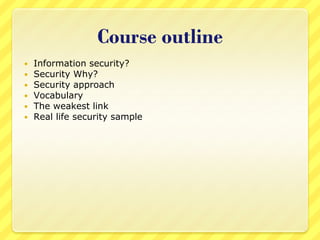
Course outline
   Information security?
   Security Why?
   Security approach
   Vocabulary
   The weakest link
   Real life security sample
Information security?
According to Wikipedia, ISO2700x, CISSP,
SANS,….

   Confidentiality: Classified information must, be protected
    from unauthorized disclosure.

   Integrity: Information must be protected against
    unauthorized changes and modification.

   Availability: the information processed, and the services
    provided must be protected from deliberate or accidental
    loss, destruction, or interruption of services.
Information security?
Security attributes according to the Belgian
privacycommission

   Confidentiality
   Integrity
   Availability

    +

   Accountability
   Non-repudiation
   Authenticity
   Reliability
CIA Exercise
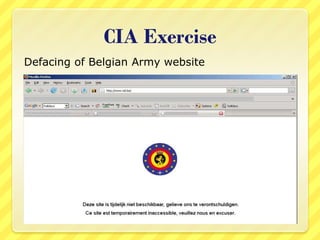
Defacing of Belgian Army website
CIA Exercise
   Confidentiality

      ??
      Webserver only hosting public information?
      Webserver separated from LAN?


   Integrity
     Unauthorized changes!


   Availability
     Information is no longer available
Security Why?
   Compliance with law

   Protect (valuable) assets

   Prevent production breakdowns

   Protect reputation, (non-)commercial image

   Meet customer & shareholder requirements

   Keep personnel happy
Security approach
   Both technical and non-technical countermeasures.
   Top-management approval and support!
   Communicate!
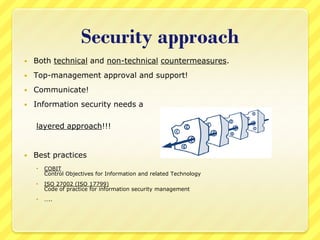
   Information security needs a

    layered approach!!!


   Best practices
       COBIT
        Control Objectives for Information and related Technology
       ISO 27002 (ISO 17799)
        Code of practice for information security management
       …..
ISO 27002
   Section   0    Introduction
   Section   1    Scope
   Section   2    Terms and Definitions
   Section   3    Structure of the Standard
   Section   4    Risk Assessment and Treatment
   Section   5    Security Policy
   Section   6    Organizing Information Security
   Section   7    Asset Management
   Section   8    Human Resources Security
   Section   9    Physical and Environmental Security
   Section   10   Communications and Operations Management
   Section   11   Access Control
   Section   12   Information Systems Acquisition, Development and
                   Maintenance
   Section 13     Information Security Incident Management
   Section 14     Business Continuity Management
   Section 15     Compliance
ISO 27002 - Example
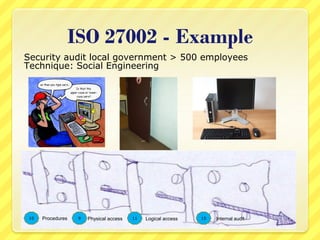
Security audit local government > 500 employees
Technique: Social Engineering


 10   Procedures   9   Physical access   11   Logical access   15   Internal audit
Security vocabulary - Threat
   A potential cause of an unwanted incident, which may
    result in harm to individuals, assets, a system or
    organization, the environment, or the community.
    (BCI)

   Samples:

     Fire

     Death of a key person (SPOK or Single Point of Knowledge)

     Crash of a critical network component e.g. core switch (SPOF: single
      point of failure)

     …
Security vocabulary - Damage
   Harm or injury to property or a person, resulting in loss of
    value or the impairment of usefulness

   Damage in information security:
       Operational
       Financial
       Legal
       Reputational

   Damage defaced Belgian Army website?
       Operational:    probably (temporary frontpage, patch management,….)
       Financial:      probably (training personnel, hiring consultancy,….)
       Legal:          probably (lawsuit against external responsible?)
       Reputational:   certainly!
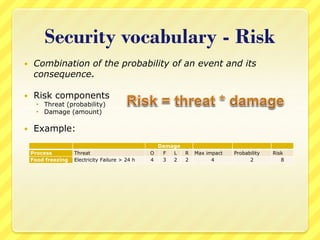
Security vocabulary - Risk
    Combination of the probability of an event and its
     consequence.

    Risk components
      Threat (probability)
      Damage (amount)

    Example:
                                                   Damage
    Process         Threat                       O  F  L    R   Max impact   Probability   Risk
    Food freezing   Electricity Failure > 24 h   4  3  2    2         4            2          8
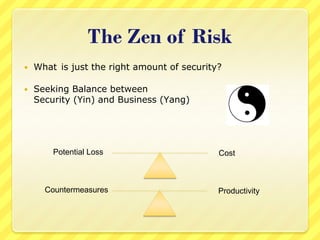
The Zen of Risk
   What is just the right amount of security?

   Seeking Balance between
    Security (Yin) and Business (Yang)


        Potential Loss                       Cost


      Countermeasures                        Productivity
Security vocabulary - AAA
    Authentication: technologies used to determine the
     authenticity of users, network nodes, and documents

    Authorization: who is allowed to do what?

    Accountability: is it possible to find out who has made
     any operations?


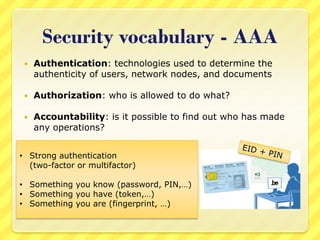
• Strong authentication
  (two-factor or multifactor)

• Something you know (password, PIN,…)
• Something you have (token,…)
• Something you are (fingerprint, …)
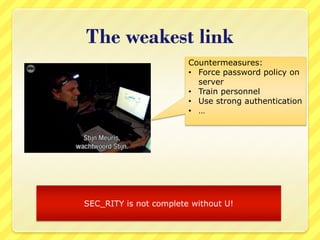
The weakest link
                        Countermeasures:
                        • Force password policy on
                          server
                        • Train personnel
                        • Use strong authentication
                        • …


SEC_RITY is not complete without U!
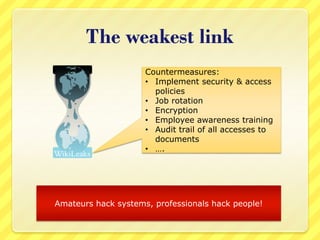
The weakest link
                     Countermeasures:
                     • Implement security & access
                       policies
                     • Job rotation
                     • Encryption
                     • Employee awareness training
                     • Audit trail of all accesses to
                       documents
                     • ….


Amateurs hack systems, professionals hack people!
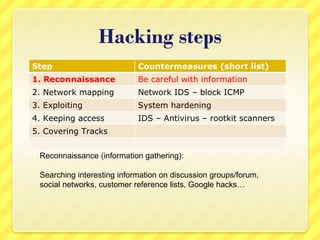
Hacking steps
Step                        Countermeasures (short list)
1. Reconnaissance           Be careful with information
2. Network mapping          Network IDS – block ICMP
3. Exploiting               System hardening
4. Keeping access           IDS – Antivirus – rootkit scanners
5. Covering Tracks


 Reconnaissance (information gathering):

 Searching interesting information on discussion groups/forum,
 social networks, customer reference lists, Google hacks…
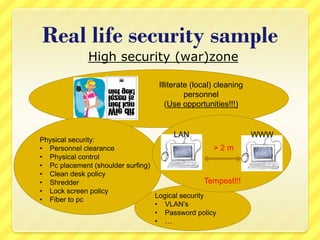
Real life security sample
              High security (war)zone

                                    Illiterate (local) cleaning
                                             personnel
                                       (Use opportunities!!!)


                                        LAN                       WWW
Physical security:
• Personnel clearance                                >2m
• Physical control
• Pc placement (shoulder surfing)
• Clean desk policy
• Shredder                                         Tempest!!!
• Lock screen policy
                                  Logical security
• Fiber to pc
                                  • VLAN’s
                                  • Password policy
                                  • …
We learned….
   Security is CIA(+)
   Why: law, reputation, production continuity,…
   Approach: layered, technical & non-technical, support
    from CEO, lots of communication
   Vocabulary: threat, damage, risk, (strong)authentication,
    authorization, accountability
   Risk = threat * damage
   Security balance: loss vs. cost
    & countermeasures vs. productivity
   The weakest link is personnel!
   A hacker starts with information gathering
Information security for dummies

Information security for dummies

  • 1.
  • 2.
    Whois I  Functions  Sysadmin, DBA, CIO, ADP instructor, SSO, Security consultant  Career (20 y)  NATO – Local government – Youth care  Training  Lots of Microsoft, Linux, networking, programming…  Security: Site Security Officer, CISSP, BCM, Ethical Hacking, network scanning,…
  • 3.
    Course outline  Information security?  Security Why?  Security approach  Vocabulary  The weakest link  Real life security sample
  • 4.
    Information security? According toWikipedia, ISO2700x, CISSP, SANS,….  Confidentiality: Classified information must, be protected from unauthorized disclosure.  Integrity: Information must be protected against unauthorized changes and modification.  Availability: the information processed, and the services provided must be protected from deliberate or accidental loss, destruction, or interruption of services.
  • 5.
    Information security? Security attributesaccording to the Belgian privacycommission  Confidentiality  Integrity  Availability +  Accountability  Non-repudiation  Authenticity  Reliability
  • 6.
    CIA Exercise Defacing ofBelgian Army website
  • 7.
    CIA Exercise  Confidentiality  ??  Webserver only hosting public information?  Webserver separated from LAN?  Integrity  Unauthorized changes!  Availability  Information is no longer available
  • 8.
    Security Why?  Compliance with law  Protect (valuable) assets  Prevent production breakdowns  Protect reputation, (non-)commercial image  Meet customer & shareholder requirements  Keep personnel happy
  • 9.
    Security approach  Both technical and non-technical countermeasures.  Top-management approval and support!  Communicate!  Information security needs a layered approach!!!  Best practices  COBIT Control Objectives for Information and related Technology  ISO 27002 (ISO 17799) Code of practice for information security management  …..
  • 10.
    ISO 27002  Section 0 Introduction  Section 1 Scope  Section 2 Terms and Definitions  Section 3 Structure of the Standard  Section 4 Risk Assessment and Treatment  Section 5 Security Policy  Section 6 Organizing Information Security  Section 7 Asset Management  Section 8 Human Resources Security  Section 9 Physical and Environmental Security  Section 10 Communications and Operations Management  Section 11 Access Control  Section 12 Information Systems Acquisition, Development and Maintenance  Section 13 Information Security Incident Management  Section 14 Business Continuity Management  Section 15 Compliance
  • 11.
    ISO 27002 -Example Security audit local government > 500 employees Technique: Social Engineering 10 Procedures 9 Physical access 11 Logical access 15 Internal audit
  • 12.
    Security vocabulary -Threat  A potential cause of an unwanted incident, which may result in harm to individuals, assets, a system or organization, the environment, or the community. (BCI)  Samples:  Fire  Death of a key person (SPOK or Single Point of Knowledge)  Crash of a critical network component e.g. core switch (SPOF: single point of failure)  …
  • 13.
    Security vocabulary -Damage  Harm or injury to property or a person, resulting in loss of value or the impairment of usefulness  Damage in information security:  Operational  Financial  Legal  Reputational  Damage defaced Belgian Army website?  Operational: probably (temporary frontpage, patch management,….)  Financial: probably (training personnel, hiring consultancy,….)  Legal: probably (lawsuit against external responsible?)  Reputational: certainly!
  • 14.
    Security vocabulary -Risk  Combination of the probability of an event and its consequence.  Risk components  Threat (probability)  Damage (amount)  Example: Damage Process Threat O F L R Max impact Probability Risk Food freezing Electricity Failure > 24 h 4 3 2 2 4 2 8
  • 15.
    The Zen ofRisk  What is just the right amount of security?  Seeking Balance between Security (Yin) and Business (Yang) Potential Loss Cost Countermeasures Productivity
  • 16.
    Security vocabulary -AAA  Authentication: technologies used to determine the authenticity of users, network nodes, and documents  Authorization: who is allowed to do what?  Accountability: is it possible to find out who has made any operations? • Strong authentication (two-factor or multifactor) • Something you know (password, PIN,…) • Something you have (token,…) • Something you are (fingerprint, …)
  • 17.
    The weakest link Countermeasures: • Force password policy on server • Train personnel • Use strong authentication • … SEC_RITY is not complete without U!
  • 18.
    The weakest link Countermeasures: • Implement security & access policies • Job rotation • Encryption • Employee awareness training • Audit trail of all accesses to documents • …. Amateurs hack systems, professionals hack people!
  • 19.
    Hacking steps Step Countermeasures (short list) 1. Reconnaissance Be careful with information 2. Network mapping Network IDS – block ICMP 3. Exploiting System hardening 4. Keeping access IDS – Antivirus – rootkit scanners 5. Covering Tracks Reconnaissance (information gathering): Searching interesting information on discussion groups/forum, social networks, customer reference lists, Google hacks…
  • 20.
    Real life securitysample High security (war)zone Illiterate (local) cleaning personnel (Use opportunities!!!) LAN WWW Physical security: • Personnel clearance >2m • Physical control • Pc placement (shoulder surfing) • Clean desk policy • Shredder Tempest!!! • Lock screen policy Logical security • Fiber to pc • VLAN’s • Password policy • …
  • 21.
    We learned….  Security is CIA(+)  Why: law, reputation, production continuity,…  Approach: layered, technical & non-technical, support from CEO, lots of communication  Vocabulary: threat, damage, risk, (strong)authentication, authorization, accountability  Risk = threat * damage  Security balance: loss vs. cost & countermeasures vs. productivity  The weakest link is personnel!  A hacker starts with information gathering