Basic Food Safety
11/25/2015
www.facebook.com/delhindra
11/25/2015www.facebook.com/delhindra
Critical Control Point
A Hazard Analysis Critical Control Point system
▪ Identifies hazards within the flow of food
▪ Implements controls based on the hazards identified
HACCP
11/25/2015www.facebook.com/delhindra
Actions taken at the critical control point to prevent,
eliminate or reduce the hazard
Look for critical control points in these areas:
▪ Raw Material
▪ Receiving and Handling
▪ Processing
▪ Distribution
Critical Control Point - CCP
Basic Flow Diagram
Receiving Storing Preparation Thawing Cooking Cooling Holding Reheating Serving
CCP
11/25/2015www.facebook.com/delhindra
Airlines Flow Diagram
Receiving Cold Storage Thawing
Cooking
Process
Rapid
Cooling
Dishing
CCP
11/25/2015www.facebook.com/delhindra
Process Flow Airlines Diagram Examples
11/25/2015
CCP 1 -Receiving
CCP 2 – Cold Storage
CCP 2 – Cold StorageCCP 2 – Cold Storage
CCP 2 – Cold Storage
CCP 5 – Rapid Cooling
CCP 4 – Cooking Process
CCP 5 – DishingCCP 6 – Dishing
CCP 3 – Thawing
Food Preparation
www.facebook.com/delhindra
11/25/2015www.facebook.com/delhindra
Receiving
▪ The company purchases food only from reputable suppliers who
have an HACCAP control system in place.
▪ However, to minimize the chance of taking soiled or
contaminated food on board, all food must be inspected before
it is received. If any food is showing signs of spoilage, or if it is of
inferior quality, it must be rejected.
Receiving
11/25/2015www.facebook.com/delhindra
CP 1: Control at Food Receiving
Purpose
▪ To verify safe food temperature control during transport from the supplier
Scope
▪ Deliveries of refrigerated and frozen time/temperature control for safety
Critical Limit
▪ Refrigerated (or chilled) foods shall be delivered at a maximum of 8 °C / 46
°F.
▪ Frozen foods shall be hard frozen and without signs of previous thawing at
time of delivery such as frost build-up, discoloration, packaging integrity or
freezer burn.
11/25/2015www.facebook.com/delhindra
Monitoring
▪ Food temperature for refrigerated (chilled) foods is to be monitored and
recorded for each delivery.
▪ The condition defined as “hard frozen” must be recorded.
▪ Note: Each delivery of refrigerated (chilled) and frozen food must be
controlled, but not necessarily each food of a given delivery or
consignment.
Corrective Action
▪ Reject deliveries where critical limits are not met.
Audit
▪ Randomly select recently delivered foods in refrigerators and freezers
▪ Verify control measures and documentation on possible deliveries taking
place at the time of the audit.
11/25/2015www.facebook.com/delhindra
Storing
▪ Proper storage is another line of defense against the growth of
bacteria.
▪ Potentially hazardous foods must be stored at certain temperatures,
out of the temperature danger zone (41-140°F = 5 - 60°C).
▪ Separate different types of raw animal foods from each other during
storage, preparation, holding and display.
▪ Separate raw animal foods from READY-TO-EAT FOODS during
storage, preparation, holding and display
Storing
11/25/2015www.facebook.com/delhindra
▪ Chiller - Cook food, meat, dairy product, etc. - 5ºC or lower
▪ Freezer - Frozen Commodities - 0ºC or Minus
▪ Dry Storage - Canned/Dry Foods - 10ºC to 21ºC
Storage Temperature
11/25/2015www.facebook.com/delhindra
▪ Top Shelf : READY-TO-EAT Foods and Fully Cooked Foods
▪ Next Shelf : Raw Seafood &Fish
▪ Next Shelf : Raw Steak (sirloin, ribeye, T-bone)
▪ Next Shelf : Raw Pork (ham, bacon, pork chops)
▪ Next Shelf : Raw Ground Meat (hamburger)
▪ Bottom Shelf : Raw Poultry (chicken, turkey, duck)
Store According to Cooking Temperatures
11/25/2015www.facebook.com/delhindra
Minimum required core temperatures:
▪ Poultry 74 °C
▪ Meats1 65 °C
▪ Meats, comminuted 74 °C
▪ Fish, Shell fish, Crustaceans 65 °C
▪ Fish, shell fish, comminuted 70 °C
▪ Un-pasteurized Eggs 74 °C
▪ Un-pasteurized Dairy 72 °C
Whole-muscle beef, lamb, fish seared on all external surfaces to effect a cooked
color change
11/25/2015www.facebook.com/delhindra
Temperature Cooking Point
▪ Use thermometers in all refrigerators and freezers. Ensure that all
refrigerators have internal thermometers, and that they are in proper
working order.
▪ Keep temperature logs for at least six months of history.
▪ Rotate inventories FIRST IN-FIRST OUT (FIFO).
▪ Cooked, potentially hazardous food must be cooled within the following
time parameters:
1. In the blast chiller within 2 hours, from 60°C (140°F) to 21°C (70°F)
2. within 4 hours, from 21°C (70°F) to 5°C (41°F) or less.
Always
11/25/2015www.facebook.com/delhindra
▪ Potentially hazardous food must be cooled within 4 hours to 5°C (41°F)
or less, if prepared from ingredients at ambient temperature.
▪ Check for expiration dates, especially on dairy products.
▪ Cover all food mise-en-place (e.g. vegetables, fruits, cold cuts).
▪ Check and clean the rubber gaskets on all refrigerator doors. Report
damaged refrigerator gaskets to your supervisor.
▪ Check for ice and condensed water on the cooling elements.
▪ Use and label plastic food storage containers (e.g. flour, sugar, salt).
▪ Sanitize all ready-to-eat raw fruits with 10 ppm chlorine solution or
Micro Chlorine before preparation and consumption
11/25/2015www.facebook.com/delhindra
▪ Allow other items to be stored inside milk dispenser cooling units.
▪ Allow any paper, carton or wooden boxes in food preparation areas.
▪ Stack food containers on top of each other.
▪ Store food under overflow trays of cooling systems or air conditioning
systems.
▪ Keep personal items in food storage areas and preparation areas.
ate other foods.
▪ Return raw or prepared foods back to their original containers once they
have been removed. Items have to be stored in a clean, covered
container, except during preparation or service, and must also be dated
and labeled as to the content.
▪ Fill a storage container to the top of the container. The cover must fit
tightly.
▪ Store eggs and frozen egg products on top of any other food items. If the
container breaks, it can contaminate to another.
Never
11/25/2015www.facebook.com/delhindra
CP 2: Control of Cold Storage Temperature
Purpose
▪ To prevent growth of pathogenic micro-organisms to harmful levels during
storage
Scope
▪ Refrigerators for food storage
Critical Limit Product
▪ Critical limit: 5 °C / 41 °F
Monitoring
▪ Refrigerator gauges monitored and recorded at a frequency to ensure
compliance and effectiveness
11/25/2015www.facebook.com/delhindra
Corrective Action
▪ If refrigeration temperature rises above 8 °C / 46 °F, check temperature
of a representative sample of food items.
▪ If food temperature rises above 5 °C / 41 °F, determine the appropriate
corrective action to be taken and document it accordingly. NOTE:
Allowances may be made for food which has been recently returned
following handling at higher temperatures.
Audit
Check temperatures of randomly selected refrigerators:
▪ Check gauge temperatures during tour of unit. If significant deviations
are noticed, verify over next 1-2 hours that corrective action is initiated
and effective.
▪ Where continuous electronic surveillance systems exist: Verify that a
procedure/schedule for monitoring screens or print-outs is in place
and/or that an alarm system is active and monitored.
▪ Verify completion of documentation for randomly selected refrigerators
11/25/2015www.facebook.com/delhindra
Preparation
▪ Once food has been purchased and stored, it is essential that it be
prepared and served safely. This is the stage at which the greatest
risk of contamination and temperature abuse can occur.
▪ The most common factor found in outbreaks of food-borne illness is
the failure to adequately control food temperature.
▪ Since disease-causing bacteria are capable of rapidly multiplying at
temperatures from 41°F to 140°F (5 to 60°C), this is known as the
Temperature Danger Zone.
▪ The total accumulated time potentially hazardous foods are
exposed to the temperature danger zone must not exceed four
hours. The food should pass through the danger zone as few times
as possible.
Preparation
11/25/2015www.facebook.com/delhindra
▪ Dirty and improperly cleaned utensils and equipment may
contaminate the food.
▪ Cross-contamination is the transfer of bacteria from something
dirty to something clean or from food with many bacteria to food
with fewer bacteria.
▪ Cooked and ready-to-eat foods such as cold cuts, salads, peeled
fruits, etc., must not be handled with bare hands. Since no cooking
process that would kill the bacteria follows, plastic gloves must be
worn whenever these foods are touched.
▪ Food that has not been prepared, or is not going to be served
immediately must be kept refrigerated.
▪ Food must be cooked to proper temperatures to kill any bacteria
that might be present.
Important Points
11/25/2015www.facebook.com/delhindra
Always
▪ Keep food off of the floor.
▪ Keep food covered.
▪ Keep food covered in storage or during transportation.
▪ Use sanitized utensils.
▪ Avoid cross-contamination.
▪ Avoid handling foods with your bare hands.
▪ Keep food refrigerated.
▪ Cook food to proper temperatures.
Never
• Place or store food on the floor, even if it is for a short period of
time.
11/25/2015www.facebook.com/delhindra
Purpose
▪ To ensure raw fruit and vegetables are thoroughly washed and or
sanitized where permitted in order to remove dirt, insects and reduce
bacteria levels, thereby ensuring safe product.
Scope
▪ All fresh fruit and vegetables should be washed in clean potable water.
Where permitted a suitable sanitizer should be used in accordance with
the manufacturer’s instructions.
▪
Wash and Sanitized Raw Vegetable
11/25/2015www.facebook.com/delhindra
Procedure
Cleaning and disinfection (where allowed) of raw fruit and vegetables:
▪ Raw fruit and vegetables shall undergo the following steps of
cleaning: Preparation (removal of damaged parts, major foreign
bodies, separation of leaves etc.)
▪ Washing/ disinfection in a solution with concentration and contact
times in accordance with manufacturer’s instructions
▪ Rinse in potable water
▪ Inspect to verify cleanliness
Audit
▪ Verify compliance to the procedure. Check records of monitoring of
the concentration of sanitizing solution.
Thawing
• Refrigeration
• Running Water
• During Cooking
• Microwave
11/25/2015www.facebook.com/delhindra
▪ Under refrigeration at 5ºC or less/must not exceed 8ºC
▪ During submersion in running potable water at 21ºC or below,
maximum 4 hours, if food item are not complete thawed in 4
hours, food should be return to chiller (medina)
▪ As part of the cooking process; ensure minimum
internal temperature
▪ In the microwave, if cooked immediately
Thawing Foods Properly
11/25/2015www.facebook.com/delhindra
Butcher Chiller and Thawing Room
▪ Identity of chiller (number, location, etc.)
▪ Provide internal thermometer every chiller
▪ Put in clean plastic container and covered wit plastic cover or
plastic wrap
▪ Label, date, and refrigerate cut items.
▪ Temperature of chiller between 2-5 Celsius
▪ Chiller and rack have to be clean and sanitized.
▪ No water or wet on floor of chiller
▪ No dirt or food in drainage of chiller
▪ Plastic curtain has to be clean
▪ No wet or water at the ceiling of chiller
▪ Thawing frozen meat should be in the chiller under 5 Celsius
▪ Thawing meat should be place in colander/perforated pan
11/25/2015www.facebook.com/delhindra
Purpose
▪ To control growth of pathogenic microorganisms during thawing of raw
food for cook/chill and ready-to-eat foods.
▪ To ensure that ready-to-eat food is not contaminated by micro organisms
during thawing.
Scope
▪ Thawing of raw food for cook/chill and ready-to-eat food above freezing
point in accordance with an approved documented procedure.
Procedure
▪ Segregation between raw and ready-to-eat food must be maintained
during thawing.
▪ The temperature of food surface must not exceed 8 °C / 47 °F. Thawed
food must be labelled with appropriate day or date marking. (Label
indicating the day it was removed from the freezer.)
▪ The food must be temperature controlled after thawing.
▪ Thawed food must not be refrozen without heat treatment.
CCP 3 -Thawing
11/25/2015www.facebook.com/delhindra
Approved Methods
▪ Under refrigeration below 8 °C / 47 °F no record required
▪ Outside of refrigeration – The surface temperature of the food
must not exceed 8 °C/46 °F and must be recorded. Once thawed
using this method, the product must be immediately processed or
sent to storage at or below 5°C / 41°F. •
▪ In water Under running cool potable water food temperature and
time exposure shall be recorded. The temperature of food surface
must not exceed 8 °C / 47 °F. Risk of cross- contamination must be
avoided by use of a clean, sanitized container or sink.
▪ Cook from Frozen Continuous process where product is cooked
from a frozen state.
Audit
▪ Review the thawing process and the labeling. Check temperatures
and verify control documentation.
11/25/2015www.facebook.com/delhindra
Cooking Process
11/25/2015www.facebook.com/delhindra
Cooking Process
▪ Eating undercooked foods can cause foodborne illness such
as E. coli or Salmonella.
▪ Use an appropriate thermometer to check final cooking
temperatures.
▪ Meat that “looks” or “feels” done is not necessarily safely
cooked.
11/25/2015www.facebook.com/delhindra
Temperature Danger Zone
Reheat Foods to 73,5°C
Keep Hot Foods at or above 61°C
Keep Cold Foods at or below 5°C
WHEN IN DOUBT, THROW IT OUT
Danger Zone
5°C < Bacteria Multiply > 61°C
Minimum required core temperatures:
▪ Poultry 74 °C
▪ Meats1 65 °C
▪ Meats, comminuted 74 °C
▪ Fish, Shell fish, Crustaceans 65 °C
▪ Fish, shell fish, comminuted 70 °C
▪ Un-pasteurized Eggs 74 °C
▪ Un-pasteurized Dairy 72 °C
Whole-muscle beef, lamb, fish seared on all external surfaces to effect a cooked
color change
11/25/2015www.facebook.com/delhindra
Temperature Cooking Point
Thermometer
11/25/2015www.facebook.com/delhindra
Types of Thermometer
of
Thermometer
TERMOMETER
Dope/ STEM
TERMOMETER
GUN/ Infrared
Internal Temperature Surface Temperature
Kinds of Kitchen Thermometer
11/25/2015www.facebook.com/delhindra
Thermometer Procedure
11/25/2015www.facebook.com/delhindra
▪ Provide and use an accurate, metal stem thermometer for
checking food temperatures.
▪ Refrigeration units must have accurate and easy-to-read
thermometers.
▪ Place the thermometer in the warmest area of the
refrigerator.
▪ All thermometers should be checked for accuracy and
CALIBRATED.
▪ CALIBRATE all new thermometers.
▪ CALIBRATE a thermometer after it had been accidentally
dropped.
▪ Clean and sanitize thermometers between uses.
Calibrating Thermometers
11/25/2015www.facebook.com/delhindra
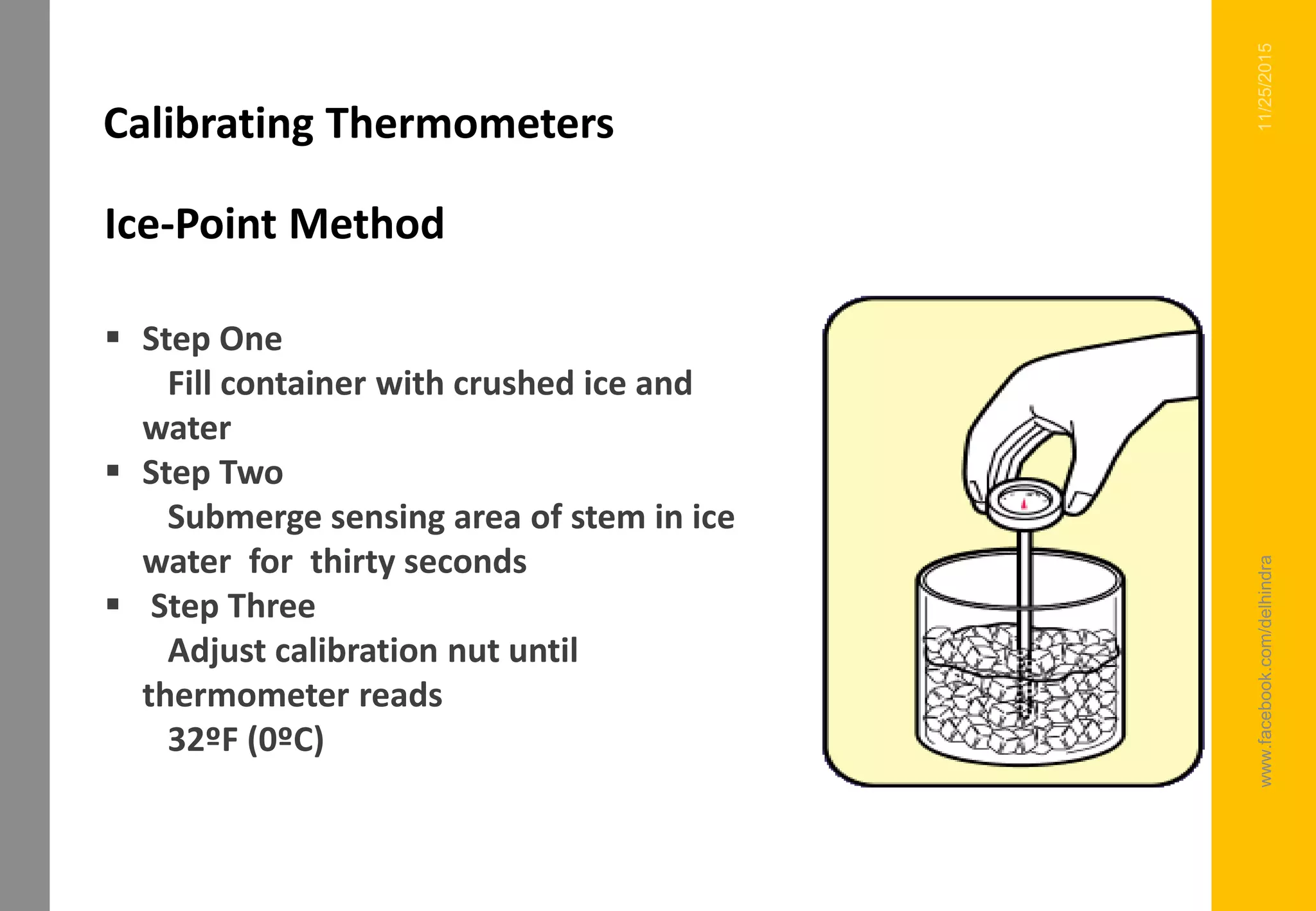
Ice-Point Method
▪ Step One
Fill container with crushed ice and
water
▪ Step Two
Submerge sensing area of stem in ice
water for thirty seconds
▪ Step Three
Adjust calibration nut until
thermometer reads
32ºF (0ºC)
11/25/2015www.facebook.com/delhindra
Purpose
▪ To ensure destruction/reduction to safe levels of pathogenic bacteria,
viruses and parasites.
Scope
▪ High-risk raw foods of animal origin.
Procedure
▪ Minimum required core temperatures according Temperature Cooking Point
Monitoring
▪ Check food core temperature upon completion of cooking or surface color
change where food has been seared.
Corrective Action
▪ If critical limit is not met, re-cook until limit is met.
CCP 4 –Cooking Process
11/25/2015www.facebook.com/delhindra
Physical Audit
Select at random some foods being cooked and verify compliance by end
temperature monitoring.
▪ Verify compliance with batch control principle for high risk raw foods in
general, particularly for batches of raw poultry, eggs and minced meats.
▪ Monitor by use of probe thermometer compliance with critical limit on
possible batches of poultry, eggs and minced meats being cooked at time
of inspection.
▪ Verify complete cooking of poultry and minced meat products by cutting
through a piece and confirm fully cooked meat color.
▪ Randomly monitor by use of probe thermometer cooking of other raw
high-risk foods such as pork, fish, shellfish.
▪ Identify representative samples of food in refrigerator and verify control
documentation for these batches
Paper Audit
▪ Select at random some foods and verify control documentation.
11/25/2015www.facebook.com/delhindra
Rapid Cooling
Rapid Cooling
11/25/2015www.facebook.com/delhindra
▪ Cool food from 60ºC to 21ºC within two hours, and to 5ºC or
lower in an additional four hours.
▪ All foods in refrigerators that have been cooled down must be
logged in a blast chiller log or cooling log.
▪ Foods cooled down that are in refrigerators or walk-ins shall
have labels that match the cooling logs.
▪ Do not re-label foods with new dates
Cooling Methods
11/25/2015www.facebook.com/delhindra
▪ Shallow Pans
▪ Blast Chiller
▪ Smaller/Thinner Portions
▪ Ice & Water Bath
11/25/2015www.facebook.com/delhindra
▪ Purpose
▪ To prevent growth of vegetative pathogenic bacteria during post-cook
chilling processes
▪
▪ Scope
▪ In-house cooked time/temperature control for safety food (TCS foods)
Critical Limit
▪ Food core temperature to pass temperature interval of 60 °C / 140 °F to
10 °C / 50 °F within 4 hours.
▪ Or 57 °C / 135 °F to 21 °C/ 70 °F (core) within 2 hours and from 21 °C/
70 °F to 5 °C / 41 °F in an additional 4 hours. (FDA Food Code)
▪ Or Follow national regulations as appropriate
Monitoring
▪ Check and record time and core food temperature at the thickest part of
the product at start and finish of process
CCP 5 – Rapid Cooling
11/25/2015www.facebook.com/delhindra
Corrective Action
▪ Dispose of product
Physical Audit
Select at random some foods (preferably dense*) being chilled and verify
compliance by time/temperature monitoring.
▪ Verify by visual observation general quality and reliability of chilling
procedure.
▪ If available verify compliance by control of dense* cooked foods presently
being chilled.
▪ Identify representative samples of dense food batches in refrigerator and
verify control documentation for these batches *dense products such as
cooked rice, pasta, stews, sauces
Paper Audit
▪ Select at random some foods in refrigerator having been cook/chilled within
the past 24 hours and verify control documentation
11/25/2015www.facebook.com/delhindra
Monitoring
▪ Check and record time and core food temperature at the thickest part
of the product at start and finish of process
Corrective Action
▪ Dispose of product.
Audit
▪ Randomly select some foods (preferably dense: e.g. mashed
potatoes, meat loaf, lasagna, etc.) being chilled and verify
compliance.
▪ Randomly select TCS foods in refrigerator that have been cooked /
chilled within the past 24 hours and verify control documentation.
11/25/2015www.facebook.com/delhindra
Reheating
11/25/2015www.facebook.com/delhindra
Holding
.
Metal containers transfer heat and cold faster than plastic
containers; hot foods will cool more quickly in metal
container
▪ Hot POTENTIALLY HAZARDOUS FOOD must be kept at or above
60°C.
▪ Never use hot-holding equipment to reheat foods
▪ Hot-holding equipment must keep foods at 140ºF (60ºC) or
higher
▪ Stir at regular intervals
▪ Keep foods covered
▪ Measure internal temperatures at least every two hours
▪ Discard food after four hours if not held at or above 140ºF (60ºC)
▪ Never mix fresh food with food being held
▪ Prepare in small
batches
Hot Holding
11/25/2015www.facebook.com/delhindra
Hot Holding Equipment
11/25/2015www.facebook.com/delhindra
Cold Holding
▪ Cold POTENTIALLY HAZARDOUS FOOD must be kept at or below
5°C.
▪ Cold-holding equipment must keep food at 41ºF (5ºC) or lower
▪ Do not store directly on ice
▪ Measure internal temperature at least every two hours
▪ Keep foods covered
▪ Storing smaller portions and covering foods after cooling are
helpful tips for keeping food below 41°F.
▪ Frozen food must be maintained frozen
11/25/2015www.facebook.com/delhindra
Cold Holding Equipment
11/25/2015www.facebook.com/delhindra
Buffets and Salad Bars
Special concerns for buffets and salad bars
▪ Contamination by the customer is quite likely.
▪ Maintaining temperatures below 41oF, or above 140oF, is highly unlikely.
▪ No re-use of dinnerware with exception of glassware.
▪ Food container location
▪ Under sneeze guard or covered container
▪ Appropriate utensils for each container
▪ Utensils under sneeze guard
▪ Displayed foods discarded.
▪ Empty container must be removed.
▪ Food on the serving line more than 4 hours must be discarded.
11/25/2015www.facebook.com/delhindra
CCP 6 - Dishing
11/25/2015www.facebook.com/delhindra
Purpose:
▪ To prevent growth of pathogenic microorganisms to harmful levels during
handling. Scope Potentially Hazardous Foods.
Critical Limit:
Temperature as critical limit.
1. Ambient temperature above 15 °C / 59 °F, food temperature must not
exceed 15 °C / 59 °F.
Or
Time as critical limit
1. Ambient temperature above 15 °C / 59 °F, exposure time must not exceed
45 minutes
2. Ambient temperature 8 °C / 47 °F to 15 °C/ 59 °F, exposure time must not
exceed 90 minutes.
Or
Exemption Where ambient temperature is below 8 °C / 47 °F no time or
temperature recording on food is required
CCP 6 - Dishing
Or
11/25/2015www.facebook.com/delhindra
Monitoring:
Temperature as critical limit.
1. Check and record food temperature at end of process. (Note: It is
not necessary to check time.)
Or
Time as critical limit
1. Check and record time at start and end of process. (Note: It is not
necessary to check food temperature.)
Or
Exemption Where ambient temperature is below 8 °C / 47 °F no time
or temperature recording on food is required
11/25/2015www.facebook.com/delhindra
Corrective action
▪ If critical limit is exceeded, discard food.
Physical Audit
▪ Randomly select foods/meals batches and verify compliance by
temperature or time monitoring.
Paper Audit
▪ Randomly select foods in refrigerators and verify control documentation.
11/25/2015www.facebook.com/delhindra
▪ READY-TO-EAT FOODS, POTENTIALLY HAZARDOUS FOOD
must be date marked if held for more than 24 hours.
▪ The food must be consumed or discarded within 7 days/ In Flight Cat
3 days.
Date Marking-Labelling
11/25/2015www.facebook.com/delhindra
Hazards Food (HF) are date marked at each of the following times:
▪ Once HF are placed in Food Store Area (expiry date or the receiving
date)
▪ Once HF frozen are removed from freezer (date of removal/Thawing
date)
▪ Once pre-packaged HF are opened (Open date)
▪ Once HF are processed (Production date )
▪ Once HF are portioned (Portioned date)
▪ Once HF are ready dispatch to the Airline (flight date)
11/25/2015www.facebook.com/delhindra
What and when we mark the food?
11/25/2015Delhindra/chefqtraining.blogspot.com
▪ Maximum 72 hours for hot food from cooking to scheduled
time of departure.
▪ Maximum 48 hours for cold food from start of
preparation/end of thawing to scheduled time of departure
The Airline Label Regulation
Label
1 Product : ………………
2 Open Date : ………………
3 Production Date : ………………
4 Thawing Date : ………………
5 Expiry Date : ………………
6 Chef : ………………
11/25/2015Delhindra/chefqtraining.blogspot.com
Product All staff
Open Date All Staff who’s oven the package or can.
Production
Date
All production, who’s make the product
Thawing
Date
Butcher staff
Expiry Date All Staff
Chef The name who’s write the label
How to write label
11/25/2015Delhindra/chefqtraining.blogspot.com
11/25/2015www.facebook.com/delhindra
Food Transportation
▪ Transportation From Provision to Preparation
▪ Avoid cross-contamination
▪ Separation between raw and cooked/ready-to-eat
▪ Separation between types of raw meats/seafood
▪ Maintain product temperature
▪ Organize order and pick-up times
▪ Organize product transportation
▪ Avoid transportation to food preparation areas in original
shipping boxes/cartons
11/25/2015www.facebook.com/delhindra
ALWAYS
▪ Cover all food items during transport.
▪ Sanitize all ready-to-eat raw fruits with 25 ppm of Micro
Chlorine solution before preparation and consumption.
▪ Transfer food from one refrigerator to another as quickly as
possible.
▪ Assure all equipment used to transport food is clean and
sanitized.
NEVER
▪ Place food on the floor.
▪ Allow food to sit at room temperature for long periods of time.
▪ Use cracked or chipped containers.
▪ Transfer hot, ready-to-eat items, without a heated
transportation trolley (with a thermometer).
11/25/2015www.facebook.com/delhindra

Critical Control Point (CCP): https://www.facebook.com/delhindra/

  • 1.
  • 2.
  • 3.
    A Hazard AnalysisCritical Control Point system ▪ Identifies hazards within the flow of food ▪ Implements controls based on the hazards identified HACCP 11/25/2015www.facebook.com/delhindra
  • 4.
    11/25/2015www.facebook.com/delhindra Actions taken atthe critical control point to prevent, eliminate or reduce the hazard Look for critical control points in these areas: ▪ Raw Material ▪ Receiving and Handling ▪ Processing ▪ Distribution Critical Control Point - CCP
  • 5.
    Basic Flow Diagram ReceivingStoring Preparation Thawing Cooking Cooling Holding Reheating Serving CCP 11/25/2015www.facebook.com/delhindra
  • 6.
    Airlines Flow Diagram ReceivingCold Storage Thawing Cooking Process Rapid Cooling Dishing CCP 11/25/2015www.facebook.com/delhindra
  • 7.
    Process Flow AirlinesDiagram Examples 11/25/2015 CCP 1 -Receiving CCP 2 – Cold Storage CCP 2 – Cold StorageCCP 2 – Cold Storage CCP 2 – Cold Storage CCP 5 – Rapid Cooling CCP 4 – Cooking Process CCP 5 – DishingCCP 6 – Dishing CCP 3 – Thawing Food Preparation www.facebook.com/delhindra
  • 8.
  • 9.
    ▪ The companypurchases food only from reputable suppliers who have an HACCAP control system in place. ▪ However, to minimize the chance of taking soiled or contaminated food on board, all food must be inspected before it is received. If any food is showing signs of spoilage, or if it is of inferior quality, it must be rejected. Receiving 11/25/2015www.facebook.com/delhindra
  • 10.
    11/25/2015www.facebook.com/delhindra CP 1: Controlat Food Receiving Purpose ▪ To verify safe food temperature control during transport from the supplier Scope ▪ Deliveries of refrigerated and frozen time/temperature control for safety Critical Limit ▪ Refrigerated (or chilled) foods shall be delivered at a maximum of 8 °C / 46 °F. ▪ Frozen foods shall be hard frozen and without signs of previous thawing at time of delivery such as frost build-up, discoloration, packaging integrity or freezer burn.
  • 11.
    11/25/2015www.facebook.com/delhindra Monitoring ▪ Food temperaturefor refrigerated (chilled) foods is to be monitored and recorded for each delivery. ▪ The condition defined as “hard frozen” must be recorded. ▪ Note: Each delivery of refrigerated (chilled) and frozen food must be controlled, but not necessarily each food of a given delivery or consignment. Corrective Action ▪ Reject deliveries where critical limits are not met. Audit ▪ Randomly select recently delivered foods in refrigerators and freezers ▪ Verify control measures and documentation on possible deliveries taking place at the time of the audit.
  • 12.
  • 13.
  • 14.
    ▪ Proper storageis another line of defense against the growth of bacteria. ▪ Potentially hazardous foods must be stored at certain temperatures, out of the temperature danger zone (41-140°F = 5 - 60°C). ▪ Separate different types of raw animal foods from each other during storage, preparation, holding and display. ▪ Separate raw animal foods from READY-TO-EAT FOODS during storage, preparation, holding and display Storing 11/25/2015www.facebook.com/delhindra
  • 15.
    ▪ Chiller -Cook food, meat, dairy product, etc. - 5ºC or lower ▪ Freezer - Frozen Commodities - 0ºC or Minus ▪ Dry Storage - Canned/Dry Foods - 10ºC to 21ºC Storage Temperature 11/25/2015www.facebook.com/delhindra
  • 16.
    ▪ Top Shelf: READY-TO-EAT Foods and Fully Cooked Foods ▪ Next Shelf : Raw Seafood &Fish ▪ Next Shelf : Raw Steak (sirloin, ribeye, T-bone) ▪ Next Shelf : Raw Pork (ham, bacon, pork chops) ▪ Next Shelf : Raw Ground Meat (hamburger) ▪ Bottom Shelf : Raw Poultry (chicken, turkey, duck) Store According to Cooking Temperatures 11/25/2015www.facebook.com/delhindra
  • 17.
    Minimum required coretemperatures: ▪ Poultry 74 °C ▪ Meats1 65 °C ▪ Meats, comminuted 74 °C ▪ Fish, Shell fish, Crustaceans 65 °C ▪ Fish, shell fish, comminuted 70 °C ▪ Un-pasteurized Eggs 74 °C ▪ Un-pasteurized Dairy 72 °C Whole-muscle beef, lamb, fish seared on all external surfaces to effect a cooked color change 11/25/2015www.facebook.com/delhindra Temperature Cooking Point
  • 18.
    ▪ Use thermometersin all refrigerators and freezers. Ensure that all refrigerators have internal thermometers, and that they are in proper working order. ▪ Keep temperature logs for at least six months of history. ▪ Rotate inventories FIRST IN-FIRST OUT (FIFO). ▪ Cooked, potentially hazardous food must be cooled within the following time parameters: 1. In the blast chiller within 2 hours, from 60°C (140°F) to 21°C (70°F) 2. within 4 hours, from 21°C (70°F) to 5°C (41°F) or less. Always 11/25/2015www.facebook.com/delhindra
  • 19.
    ▪ Potentially hazardousfood must be cooled within 4 hours to 5°C (41°F) or less, if prepared from ingredients at ambient temperature. ▪ Check for expiration dates, especially on dairy products. ▪ Cover all food mise-en-place (e.g. vegetables, fruits, cold cuts). ▪ Check and clean the rubber gaskets on all refrigerator doors. Report damaged refrigerator gaskets to your supervisor. ▪ Check for ice and condensed water on the cooling elements. ▪ Use and label plastic food storage containers (e.g. flour, sugar, salt). ▪ Sanitize all ready-to-eat raw fruits with 10 ppm chlorine solution or Micro Chlorine before preparation and consumption 11/25/2015www.facebook.com/delhindra
  • 20.
    ▪ Allow otheritems to be stored inside milk dispenser cooling units. ▪ Allow any paper, carton or wooden boxes in food preparation areas. ▪ Stack food containers on top of each other. ▪ Store food under overflow trays of cooling systems or air conditioning systems. ▪ Keep personal items in food storage areas and preparation areas. ate other foods. ▪ Return raw or prepared foods back to their original containers once they have been removed. Items have to be stored in a clean, covered container, except during preparation or service, and must also be dated and labeled as to the content. ▪ Fill a storage container to the top of the container. The cover must fit tightly. ▪ Store eggs and frozen egg products on top of any other food items. If the container breaks, it can contaminate to another. Never 11/25/2015www.facebook.com/delhindra
  • 21.
    11/25/2015www.facebook.com/delhindra CP 2: Controlof Cold Storage Temperature Purpose ▪ To prevent growth of pathogenic micro-organisms to harmful levels during storage Scope ▪ Refrigerators for food storage Critical Limit Product ▪ Critical limit: 5 °C / 41 °F Monitoring ▪ Refrigerator gauges monitored and recorded at a frequency to ensure compliance and effectiveness
  • 22.
    11/25/2015www.facebook.com/delhindra Corrective Action ▪ Ifrefrigeration temperature rises above 8 °C / 46 °F, check temperature of a representative sample of food items. ▪ If food temperature rises above 5 °C / 41 °F, determine the appropriate corrective action to be taken and document it accordingly. NOTE: Allowances may be made for food which has been recently returned following handling at higher temperatures. Audit Check temperatures of randomly selected refrigerators: ▪ Check gauge temperatures during tour of unit. If significant deviations are noticed, verify over next 1-2 hours that corrective action is initiated and effective. ▪ Where continuous electronic surveillance systems exist: Verify that a procedure/schedule for monitoring screens or print-outs is in place and/or that an alarm system is active and monitored. ▪ Verify completion of documentation for randomly selected refrigerators
  • 23.
  • 24.
  • 25.
    ▪ Once foodhas been purchased and stored, it is essential that it be prepared and served safely. This is the stage at which the greatest risk of contamination and temperature abuse can occur. ▪ The most common factor found in outbreaks of food-borne illness is the failure to adequately control food temperature. ▪ Since disease-causing bacteria are capable of rapidly multiplying at temperatures from 41°F to 140°F (5 to 60°C), this is known as the Temperature Danger Zone. ▪ The total accumulated time potentially hazardous foods are exposed to the temperature danger zone must not exceed four hours. The food should pass through the danger zone as few times as possible. Preparation 11/25/2015www.facebook.com/delhindra
  • 26.
    ▪ Dirty andimproperly cleaned utensils and equipment may contaminate the food. ▪ Cross-contamination is the transfer of bacteria from something dirty to something clean or from food with many bacteria to food with fewer bacteria. ▪ Cooked and ready-to-eat foods such as cold cuts, salads, peeled fruits, etc., must not be handled with bare hands. Since no cooking process that would kill the bacteria follows, plastic gloves must be worn whenever these foods are touched. ▪ Food that has not been prepared, or is not going to be served immediately must be kept refrigerated. ▪ Food must be cooked to proper temperatures to kill any bacteria that might be present. Important Points 11/25/2015www.facebook.com/delhindra
  • 27.
    Always ▪ Keep foodoff of the floor. ▪ Keep food covered. ▪ Keep food covered in storage or during transportation. ▪ Use sanitized utensils. ▪ Avoid cross-contamination. ▪ Avoid handling foods with your bare hands. ▪ Keep food refrigerated. ▪ Cook food to proper temperatures. Never • Place or store food on the floor, even if it is for a short period of time. 11/25/2015www.facebook.com/delhindra
  • 28.
    11/25/2015www.facebook.com/delhindra Purpose ▪ To ensureraw fruit and vegetables are thoroughly washed and or sanitized where permitted in order to remove dirt, insects and reduce bacteria levels, thereby ensuring safe product. Scope ▪ All fresh fruit and vegetables should be washed in clean potable water. Where permitted a suitable sanitizer should be used in accordance with the manufacturer’s instructions. ▪ Wash and Sanitized Raw Vegetable
  • 29.
    11/25/2015www.facebook.com/delhindra Procedure Cleaning and disinfection(where allowed) of raw fruit and vegetables: ▪ Raw fruit and vegetables shall undergo the following steps of cleaning: Preparation (removal of damaged parts, major foreign bodies, separation of leaves etc.) ▪ Washing/ disinfection in a solution with concentration and contact times in accordance with manufacturer’s instructions ▪ Rinse in potable water ▪ Inspect to verify cleanliness Audit ▪ Verify compliance to the procedure. Check records of monitoring of the concentration of sanitizing solution.
  • 30.
    Thawing • Refrigeration • RunningWater • During Cooking • Microwave 11/25/2015www.facebook.com/delhindra
  • 31.
    ▪ Under refrigerationat 5ºC or less/must not exceed 8ºC ▪ During submersion in running potable water at 21ºC or below, maximum 4 hours, if food item are not complete thawed in 4 hours, food should be return to chiller (medina) ▪ As part of the cooking process; ensure minimum internal temperature ▪ In the microwave, if cooked immediately Thawing Foods Properly 11/25/2015www.facebook.com/delhindra
  • 32.
    11/25/2015www.facebook.com/delhindra Butcher Chiller andThawing Room ▪ Identity of chiller (number, location, etc.) ▪ Provide internal thermometer every chiller ▪ Put in clean plastic container and covered wit plastic cover or plastic wrap ▪ Label, date, and refrigerate cut items. ▪ Temperature of chiller between 2-5 Celsius ▪ Chiller and rack have to be clean and sanitized. ▪ No water or wet on floor of chiller ▪ No dirt or food in drainage of chiller ▪ Plastic curtain has to be clean ▪ No wet or water at the ceiling of chiller ▪ Thawing frozen meat should be in the chiller under 5 Celsius ▪ Thawing meat should be place in colander/perforated pan
  • 33.
  • 34.
  • 35.
  • 36.
  • 37.
    11/25/2015www.facebook.com/delhindra Purpose ▪ To controlgrowth of pathogenic microorganisms during thawing of raw food for cook/chill and ready-to-eat foods. ▪ To ensure that ready-to-eat food is not contaminated by micro organisms during thawing. Scope ▪ Thawing of raw food for cook/chill and ready-to-eat food above freezing point in accordance with an approved documented procedure. Procedure ▪ Segregation between raw and ready-to-eat food must be maintained during thawing. ▪ The temperature of food surface must not exceed 8 °C / 47 °F. Thawed food must be labelled with appropriate day or date marking. (Label indicating the day it was removed from the freezer.) ▪ The food must be temperature controlled after thawing. ▪ Thawed food must not be refrozen without heat treatment. CCP 3 -Thawing
  • 38.
    11/25/2015www.facebook.com/delhindra Approved Methods ▪ Underrefrigeration below 8 °C / 47 °F no record required ▪ Outside of refrigeration – The surface temperature of the food must not exceed 8 °C/46 °F and must be recorded. Once thawed using this method, the product must be immediately processed or sent to storage at or below 5°C / 41°F. • ▪ In water Under running cool potable water food temperature and time exposure shall be recorded. The temperature of food surface must not exceed 8 °C / 47 °F. Risk of cross- contamination must be avoided by use of a clean, sanitized container or sink. ▪ Cook from Frozen Continuous process where product is cooked from a frozen state. Audit ▪ Review the thawing process and the labeling. Check temperatures and verify control documentation.
  • 39.
  • 40.
  • 41.
    11/25/2015www.facebook.com/delhindra Cooking Process ▪ Eatingundercooked foods can cause foodborne illness such as E. coli or Salmonella. ▪ Use an appropriate thermometer to check final cooking temperatures. ▪ Meat that “looks” or “feels” done is not necessarily safely cooked.
  • 42.
    11/25/2015www.facebook.com/delhindra Temperature Danger Zone ReheatFoods to 73,5°C Keep Hot Foods at or above 61°C Keep Cold Foods at or below 5°C WHEN IN DOUBT, THROW IT OUT Danger Zone 5°C < Bacteria Multiply > 61°C
  • 43.
    Minimum required coretemperatures: ▪ Poultry 74 °C ▪ Meats1 65 °C ▪ Meats, comminuted 74 °C ▪ Fish, Shell fish, Crustaceans 65 °C ▪ Fish, shell fish, comminuted 70 °C ▪ Un-pasteurized Eggs 74 °C ▪ Un-pasteurized Dairy 72 °C Whole-muscle beef, lamb, fish seared on all external surfaces to effect a cooked color change 11/25/2015www.facebook.com/delhindra Temperature Cooking Point
  • 44.
  • 45.
  • 46.
    Thermometer TERMOMETER Dope/ STEM TERMOMETER GUN/ Infrared InternalTemperature Surface Temperature Kinds of Kitchen Thermometer 11/25/2015www.facebook.com/delhindra
  • 47.
    Thermometer Procedure 11/25/2015www.facebook.com/delhindra ▪ Provideand use an accurate, metal stem thermometer for checking food temperatures. ▪ Refrigeration units must have accurate and easy-to-read thermometers. ▪ Place the thermometer in the warmest area of the refrigerator. ▪ All thermometers should be checked for accuracy and CALIBRATED. ▪ CALIBRATE all new thermometers. ▪ CALIBRATE a thermometer after it had been accidentally dropped. ▪ Clean and sanitize thermometers between uses.
  • 48.
    Calibrating Thermometers 11/25/2015www.facebook.com/delhindra Ice-Point Method ▪Step One Fill container with crushed ice and water ▪ Step Two Submerge sensing area of stem in ice water for thirty seconds ▪ Step Three Adjust calibration nut until thermometer reads 32ºF (0ºC)
  • 49.
    11/25/2015www.facebook.com/delhindra Purpose ▪ To ensuredestruction/reduction to safe levels of pathogenic bacteria, viruses and parasites. Scope ▪ High-risk raw foods of animal origin. Procedure ▪ Minimum required core temperatures according Temperature Cooking Point Monitoring ▪ Check food core temperature upon completion of cooking or surface color change where food has been seared. Corrective Action ▪ If critical limit is not met, re-cook until limit is met. CCP 4 –Cooking Process
  • 50.
    11/25/2015www.facebook.com/delhindra Physical Audit Select atrandom some foods being cooked and verify compliance by end temperature monitoring. ▪ Verify compliance with batch control principle for high risk raw foods in general, particularly for batches of raw poultry, eggs and minced meats. ▪ Monitor by use of probe thermometer compliance with critical limit on possible batches of poultry, eggs and minced meats being cooked at time of inspection. ▪ Verify complete cooking of poultry and minced meat products by cutting through a piece and confirm fully cooked meat color. ▪ Randomly monitor by use of probe thermometer cooking of other raw high-risk foods such as pork, fish, shellfish. ▪ Identify representative samples of food in refrigerator and verify control documentation for these batches Paper Audit ▪ Select at random some foods and verify control documentation.
  • 51.
  • 52.
  • 53.
    Rapid Cooling 11/25/2015www.facebook.com/delhindra ▪ Coolfood from 60ºC to 21ºC within two hours, and to 5ºC or lower in an additional four hours. ▪ All foods in refrigerators that have been cooled down must be logged in a blast chiller log or cooling log. ▪ Foods cooled down that are in refrigerators or walk-ins shall have labels that match the cooling logs. ▪ Do not re-label foods with new dates
  • 54.
    Cooling Methods 11/25/2015www.facebook.com/delhindra ▪ ShallowPans ▪ Blast Chiller ▪ Smaller/Thinner Portions ▪ Ice & Water Bath
  • 55.
    11/25/2015www.facebook.com/delhindra ▪ Purpose ▪ Toprevent growth of vegetative pathogenic bacteria during post-cook chilling processes ▪ ▪ Scope ▪ In-house cooked time/temperature control for safety food (TCS foods) Critical Limit ▪ Food core temperature to pass temperature interval of 60 °C / 140 °F to 10 °C / 50 °F within 4 hours. ▪ Or 57 °C / 135 °F to 21 °C/ 70 °F (core) within 2 hours and from 21 °C/ 70 °F to 5 °C / 41 °F in an additional 4 hours. (FDA Food Code) ▪ Or Follow national regulations as appropriate Monitoring ▪ Check and record time and core food temperature at the thickest part of the product at start and finish of process CCP 5 – Rapid Cooling
  • 56.
    11/25/2015www.facebook.com/delhindra Corrective Action ▪ Disposeof product Physical Audit Select at random some foods (preferably dense*) being chilled and verify compliance by time/temperature monitoring. ▪ Verify by visual observation general quality and reliability of chilling procedure. ▪ If available verify compliance by control of dense* cooked foods presently being chilled. ▪ Identify representative samples of dense food batches in refrigerator and verify control documentation for these batches *dense products such as cooked rice, pasta, stews, sauces Paper Audit ▪ Select at random some foods in refrigerator having been cook/chilled within the past 24 hours and verify control documentation
  • 57.
    11/25/2015www.facebook.com/delhindra Monitoring ▪ Check andrecord time and core food temperature at the thickest part of the product at start and finish of process Corrective Action ▪ Dispose of product. Audit ▪ Randomly select some foods (preferably dense: e.g. mashed potatoes, meat loaf, lasagna, etc.) being chilled and verify compliance. ▪ Randomly select TCS foods in refrigerator that have been cooked / chilled within the past 24 hours and verify control documentation.
  • 58.
  • 59.
  • 60.
  • 61.
    11/25/2015www.facebook.com/delhindra Holding . Metal containers transferheat and cold faster than plastic containers; hot foods will cool more quickly in metal container
  • 62.
    ▪ Hot POTENTIALLYHAZARDOUS FOOD must be kept at or above 60°C. ▪ Never use hot-holding equipment to reheat foods ▪ Hot-holding equipment must keep foods at 140ºF (60ºC) or higher ▪ Stir at regular intervals ▪ Keep foods covered ▪ Measure internal temperatures at least every two hours ▪ Discard food after four hours if not held at or above 140ºF (60ºC) ▪ Never mix fresh food with food being held ▪ Prepare in small batches Hot Holding 11/25/2015www.facebook.com/delhindra
  • 63.
  • 64.
    Cold Holding ▪ ColdPOTENTIALLY HAZARDOUS FOOD must be kept at or below 5°C. ▪ Cold-holding equipment must keep food at 41ºF (5ºC) or lower ▪ Do not store directly on ice ▪ Measure internal temperature at least every two hours ▪ Keep foods covered ▪ Storing smaller portions and covering foods after cooling are helpful tips for keeping food below 41°F. ▪ Frozen food must be maintained frozen 11/25/2015www.facebook.com/delhindra
  • 65.
  • 66.
    Buffets and SaladBars Special concerns for buffets and salad bars ▪ Contamination by the customer is quite likely. ▪ Maintaining temperatures below 41oF, or above 140oF, is highly unlikely. ▪ No re-use of dinnerware with exception of glassware. ▪ Food container location ▪ Under sneeze guard or covered container ▪ Appropriate utensils for each container ▪ Utensils under sneeze guard ▪ Displayed foods discarded. ▪ Empty container must be removed. ▪ Food on the serving line more than 4 hours must be discarded. 11/25/2015www.facebook.com/delhindra
  • 67.
  • 68.
  • 69.
    11/25/2015www.facebook.com/delhindra Purpose: ▪ To preventgrowth of pathogenic microorganisms to harmful levels during handling. Scope Potentially Hazardous Foods. Critical Limit: Temperature as critical limit. 1. Ambient temperature above 15 °C / 59 °F, food temperature must not exceed 15 °C / 59 °F. Or Time as critical limit 1. Ambient temperature above 15 °C / 59 °F, exposure time must not exceed 45 minutes 2. Ambient temperature 8 °C / 47 °F to 15 °C/ 59 °F, exposure time must not exceed 90 minutes. Or Exemption Where ambient temperature is below 8 °C / 47 °F no time or temperature recording on food is required CCP 6 - Dishing Or
  • 70.
    11/25/2015www.facebook.com/delhindra Monitoring: Temperature as criticallimit. 1. Check and record food temperature at end of process. (Note: It is not necessary to check time.) Or Time as critical limit 1. Check and record time at start and end of process. (Note: It is not necessary to check food temperature.) Or Exemption Where ambient temperature is below 8 °C / 47 °F no time or temperature recording on food is required
  • 71.
    11/25/2015www.facebook.com/delhindra Corrective action ▪ Ifcritical limit is exceeded, discard food. Physical Audit ▪ Randomly select foods/meals batches and verify compliance by temperature or time monitoring. Paper Audit ▪ Randomly select foods in refrigerators and verify control documentation.
  • 72.
  • 73.
    ▪ READY-TO-EAT FOODS,POTENTIALLY HAZARDOUS FOOD must be date marked if held for more than 24 hours. ▪ The food must be consumed or discarded within 7 days/ In Flight Cat 3 days. Date Marking-Labelling 11/25/2015www.facebook.com/delhindra
  • 74.
    Hazards Food (HF)are date marked at each of the following times: ▪ Once HF are placed in Food Store Area (expiry date or the receiving date) ▪ Once HF frozen are removed from freezer (date of removal/Thawing date) ▪ Once pre-packaged HF are opened (Open date) ▪ Once HF are processed (Production date ) ▪ Once HF are portioned (Portioned date) ▪ Once HF are ready dispatch to the Airline (flight date) 11/25/2015www.facebook.com/delhindra What and when we mark the food?
  • 75.
    11/25/2015Delhindra/chefqtraining.blogspot.com ▪ Maximum 72hours for hot food from cooking to scheduled time of departure. ▪ Maximum 48 hours for cold food from start of preparation/end of thawing to scheduled time of departure The Airline Label Regulation
  • 76.
    Label 1 Product :……………… 2 Open Date : ……………… 3 Production Date : ……………… 4 Thawing Date : ……………… 5 Expiry Date : ……………… 6 Chef : ……………… 11/25/2015Delhindra/chefqtraining.blogspot.com
  • 77.
    Product All staff OpenDate All Staff who’s oven the package or can. Production Date All production, who’s make the product Thawing Date Butcher staff Expiry Date All Staff Chef The name who’s write the label How to write label 11/25/2015Delhindra/chefqtraining.blogspot.com
  • 78.
  • 79.
    Food Transportation ▪ TransportationFrom Provision to Preparation ▪ Avoid cross-contamination ▪ Separation between raw and cooked/ready-to-eat ▪ Separation between types of raw meats/seafood ▪ Maintain product temperature ▪ Organize order and pick-up times ▪ Organize product transportation ▪ Avoid transportation to food preparation areas in original shipping boxes/cartons 11/25/2015www.facebook.com/delhindra
  • 80.
    ALWAYS ▪ Cover allfood items during transport. ▪ Sanitize all ready-to-eat raw fruits with 25 ppm of Micro Chlorine solution before preparation and consumption. ▪ Transfer food from one refrigerator to another as quickly as possible. ▪ Assure all equipment used to transport food is clean and sanitized. NEVER ▪ Place food on the floor. ▪ Allow food to sit at room temperature for long periods of time. ▪ Use cracked or chipped containers. ▪ Transfer hot, ready-to-eat items, without a heated transportation trolley (with a thermometer). 11/25/2015www.facebook.com/delhindra
  • 81.
  • 82.