PHYSIOTHERAPY ASSESSMENT OF SPINAL
CORD INJURIES
DR. DEEPAK ANAP
ASSOCIATE PROFESSOR
OBJECTIVES
 At the end of lecture student should be able to assess a spinal cord injury patient under
following headings
 Pain
 Range of motion
 Muscle Performance
 Reflexes
 Aerobic capacity / Endurance
 Arousal, Attention and cognition
 Gait, Locomotion and balance
 Motor Function,
 Self care and Home Management
 Ventilation and Integument
2
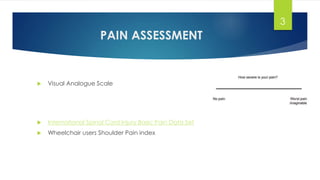
PAIN ASSESSMENT
 Visual Analogue Scale
 International Spinal Cord Injury Basic Pain Data Set
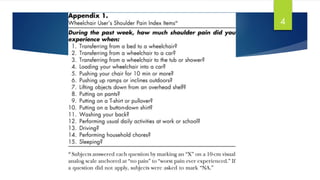
 Wheelchair users Shoulder Pain index
3
4
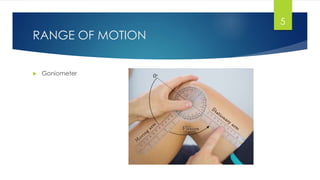
RANGE OF MOTION
 Goniometer
5
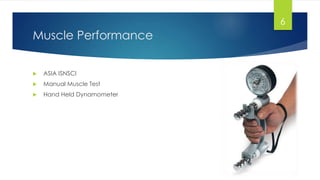
Muscle Performance
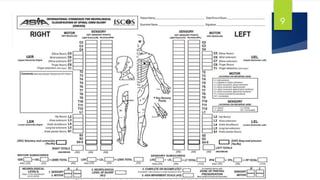
 ASIA ISNSCI
 Manual Muscle Test
 Hand Held Dynamometer
6
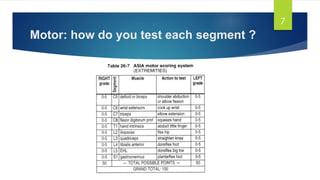
Motor: how do you test each segment ?
7
8
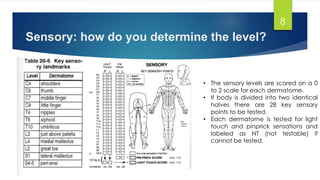
Sensory: how do you determine the level?
• The sensory levels are scored on a 0
to 2 scale for each dermatome.
• If body is divided into two identical
halves there are 28 key sensory
points to be tested.
• Each dermatome is tested for light
touch and pinprick sensations and
labeled as NT (not testable) if
cannot be tested.
9
10
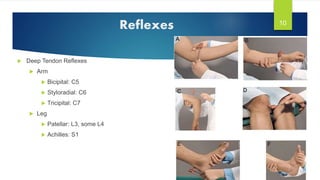
Reflexes
 Deep Tendon Reflexes
 Arm
 Bicipital: C5
 Styloradial: C6
 Tricipital: C7
 Leg
 Patellar: L3, some L4
 Achilles: S1
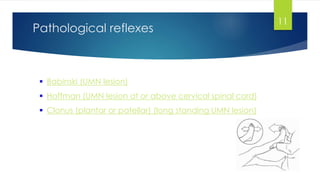
Pathological reflexes
11
 Babinski (UMN lesion)
 Hoffman (UMN lesion at or above cervical spinal cord)
 Clonus (plantar or patellar) (long standing UMN lesion)
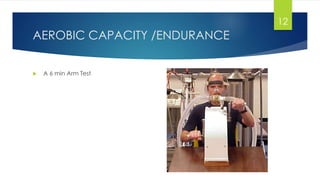
AEROBIC CAPACITY /ENDURANCE
 A 6 min Arm Test
12
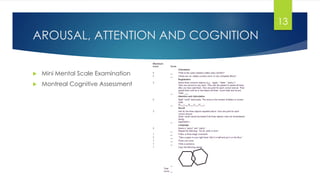
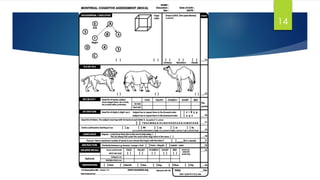
AROUSAL, ATTENTION AND COGNITION
 Mini Mental Scale Examination
 Montreal Cognitive Assessment
13
14
ENVIROMNETAL OR WORK BARRIERS
GAIT, LOCOMOTION AND BALANCE
 Wheelchair Skill test
 Modified functional Reach test
 Berg Balance scale
 Walking index for spinal cord injury
 Spinal Cord injury Functional ambulation Inventory
 10 meter walk test
 6 min walk test
 Neuromuscular Recovery scale
15
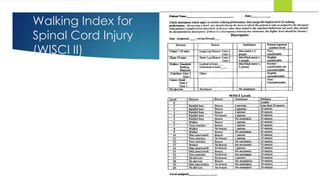
Walking Index for
Spinal Cord Injury
(WISCI II)
16
Motor Function
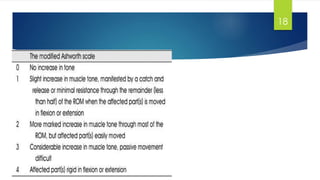
 Modified Ashworth scale
 Spinal Cord injury spasticity Evaluation tool
17
18
SELF CARE AND HOME MANAGEMENT
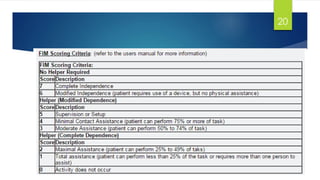
 Functional Independence Measure
 spinal cord injury independence measure
 Quadriplegia Index of function
 Capabilities of upper extremity instrument
19
20
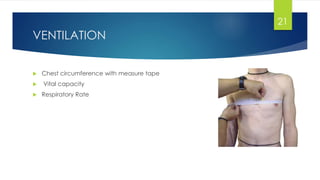
VENTILATION
 Chest circumference with measure tape
 Vital capacity
 Respiratory Rate
21
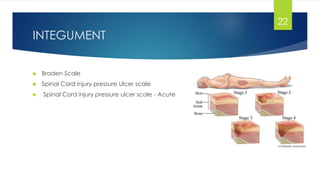
INTEGUMENT
 Braden Scale
 Spinal Cord injury pressure Ulcer scale
 Spinal Cord injury pressure ulcer scale - Acute
22
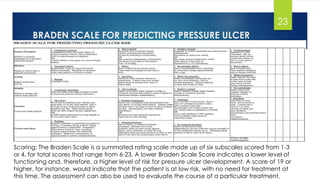
BRADEN SCALE FOR PREDICTING PRESSURE ULCER
23
Scoring: The Braden Scale is a summated rating scale made up of six subscales scored from 1-3
or 4, for total scores that range from 6-23. A lower Braden Scale Score indicates a lower level of
functioning and, therefore, a higher level of risk for pressure ulcer development. A score of 19 or
higher, for instance, would indicate that the patient is at low risk, with no need for treatment at
this time. The assessment can also be used to evaluate the course of a particular treatment.
WORK COMMUNITY AND LEISURE
INTEGRATION OR REINTEGRATION
 Craig Handicap Assessment and Reporting technique
 Assessment of life habits
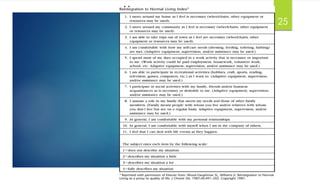
 Reintegration to Normal living index
24
25
26
Thank you

Spinal cord injury assessment

  • 1.
    PHYSIOTHERAPY ASSESSMENT OFSPINAL CORD INJURIES DR. DEEPAK ANAP ASSOCIATE PROFESSOR
  • 2.
    OBJECTIVES  At theend of lecture student should be able to assess a spinal cord injury patient under following headings  Pain  Range of motion  Muscle Performance  Reflexes  Aerobic capacity / Endurance  Arousal, Attention and cognition  Gait, Locomotion and balance  Motor Function,  Self care and Home Management  Ventilation and Integument 2
  • 3.
    PAIN ASSESSMENT  VisualAnalogue Scale  International Spinal Cord Injury Basic Pain Data Set  Wheelchair users Shoulder Pain index 3
  • 4.
  • 5.
    RANGE OF MOTION Goniometer 5
  • 6.
    Muscle Performance  ASIAISNSCI  Manual Muscle Test  Hand Held Dynamometer 6
  • 7.
    Motor: how doyou test each segment ? 7
  • 8.
    8 Sensory: how doyou determine the level? • The sensory levels are scored on a 0 to 2 scale for each dermatome. • If body is divided into two identical halves there are 28 key sensory points to be tested. • Each dermatome is tested for light touch and pinprick sensations and labeled as NT (not testable) if cannot be tested.
  • 9.
  • 10.
    10 Reflexes  Deep TendonReflexes  Arm  Bicipital: C5  Styloradial: C6  Tricipital: C7  Leg  Patellar: L3, some L4  Achilles: S1
  • 11.
    Pathological reflexes 11  Babinski(UMN lesion)  Hoffman (UMN lesion at or above cervical spinal cord)  Clonus (plantar or patellar) (long standing UMN lesion)
  • 12.
  • 13.
    AROUSAL, ATTENTION ANDCOGNITION  Mini Mental Scale Examination  Montreal Cognitive Assessment 13
  • 14.
  • 15.
    ENVIROMNETAL OR WORKBARRIERS GAIT, LOCOMOTION AND BALANCE  Wheelchair Skill test  Modified functional Reach test  Berg Balance scale  Walking index for spinal cord injury  Spinal Cord injury Functional ambulation Inventory  10 meter walk test  6 min walk test  Neuromuscular Recovery scale 15
  • 16.
    Walking Index for SpinalCord Injury (WISCI II) 16
  • 17.
    Motor Function  ModifiedAshworth scale  Spinal Cord injury spasticity Evaluation tool 17
  • 18.
  • 19.
    SELF CARE ANDHOME MANAGEMENT  Functional Independence Measure  spinal cord injury independence measure  Quadriplegia Index of function  Capabilities of upper extremity instrument 19
  • 20.
  • 21.
    VENTILATION  Chest circumferencewith measure tape  Vital capacity  Respiratory Rate 21
  • 22.
    INTEGUMENT  Braden Scale Spinal Cord injury pressure Ulcer scale  Spinal Cord injury pressure ulcer scale - Acute 22
  • 23.
    BRADEN SCALE FORPREDICTING PRESSURE ULCER 23 Scoring: The Braden Scale is a summated rating scale made up of six subscales scored from 1-3 or 4, for total scores that range from 6-23. A lower Braden Scale Score indicates a lower level of functioning and, therefore, a higher level of risk for pressure ulcer development. A score of 19 or higher, for instance, would indicate that the patient is at low risk, with no need for treatment at this time. The assessment can also be used to evaluate the course of a particular treatment.
  • 24.
    WORK COMMUNITY ANDLEISURE INTEGRATION OR REINTEGRATION  Craig Handicap Assessment and Reporting technique  Assessment of life habits  Reintegration to Normal living index 24
  • 25.
  • 26.

Editor's Notes

  • #24 Scoring: The Braden Scale is a summated rating scale made up of six subscales scored from 1-3 or 4, for total scores that range from 6-23. A lower Braden Scale Score indicates a lower level of functioning and, therefore, a higher level of risk for pressure ulcer development. A score of 19 or higher, for instance, would indicate that the patient is at low risk, with no need for treatment at this time. The assessment can also be used to evaluate the course of a particular treatment.