Exploration of Jovian 
Atmosphere Using Nuclear 
Ramjet Flyer 
by 
George Maise 
Plus Ultra Technologies, Inc.
Characteristics of Nuclear Ramjet 
Flyer: 
• Jovian atmosphere is an unlimited source of 
propellant. 
• MITEE compact nuclear reactor is (nearly) 
unlimited source of heat. 
• There are virtually no moving parts to wear 
out.
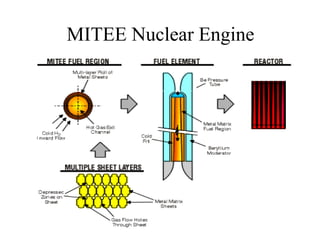
MITEE Nuclear Engine 
• MITEE (MIniature ReacTor EnginE) 
Ref.: Acta Astronautica, Vol. 44, No.2-4, 
1999 
• Derivative of Ultra-Light Particle Bed 
Reactor (PBR) Developed for SDIO (1985 - 
1993) 
• MITEE is lighter and more compact than 
PBR.
MITEE Nuclear Engine (Contd.) 
• Have Proposed MITEE-Based Rocket 
Engine for Solar System Exploration 
Missions: 
– Jupiter Orbiter: 2 Years 
– Europa Lander/Sample Return: 5 Years 
– Pluto Lander/Sample Return: 24 Years 
– Gavitational Lens at 550 AU: 30 Years
MITEE Nuclear Engine (Contd.) 
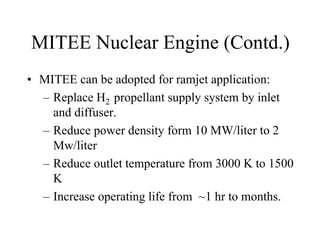
• MITEE can be adopted for ramjet application: 
– Replace H2 propellant supply system by inlet 
and diffuser. 
– Reduce power density form 10 MW/liter to 2 
Mw/liter 
– Reduce outlet temperature from 3000 K to 1500 
K 
– Increase operating life from ~1 hr to months.
MITEE Nuclear Engine
Radiation Safety 
• Before reactor startup nuclear fuel is not 
hazardous. 
• Reactor will start operation after Jovian 
entry. 
• During launch phase (from Earth) safety 
systems prevent criticality for all 
conceivable accidents.
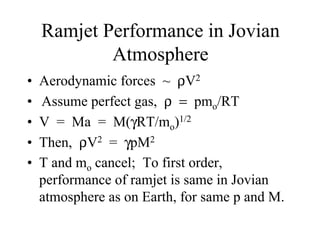
Ramjet Performance in Jovian 
Atmosphere 
• Aerodynamic forces ~ ρV2 
• Assume perfect gas, ρ = pmo/RT 
• V = Ma = M(γRT/mo)1/2 
• Then, ρV2 = γpM2 
• T and mo cancel; To first order, 
performance of ramjet is same in Jovian 
atmosphere as on Earth, for same p and M.
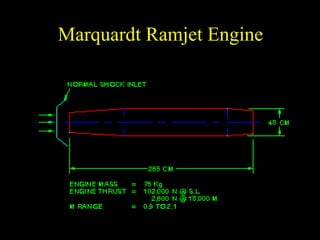
Marquardt Ramjet Engine
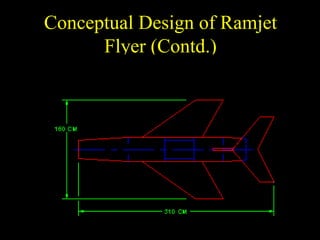
Conceptual Design of Ramjet Flyer
Conceptual Design of Ramjet 
Flyer (Contd.)
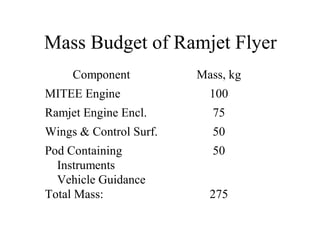
Mass Budget of Ramjet Flyer 
Component Mass, kg 
MITEE Engine 100 
Ramjet Engine Encl. 75 
Wings & Control Surf. 50 
Pod Containing 
50 
Instruments 
Vehicle Guidance 
Total Mass: 275
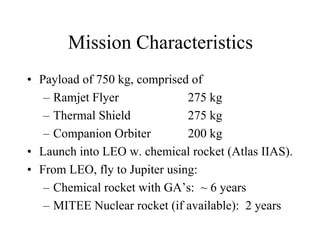
Mission Characteristics 
• Payload of 750 kg, comprised of 
– Ramjet Flyer 275 kg 
– Thermal Shield 275 kg 
– Companion Orbiter 200 kg 
• Launch into LEO w. chemical rocket (Atlas IIAS). 
• From LEO, fly to Jupiter using: 
– Chemical rocket with GA’s: ~ 6 years 
– MITEE Nuclear rocket (if available): 2 years
Mission Characteristics (Contd.) 
• Deployment of Companion Satellite. 
Jovian entry profile similar to Galileo. 
• When entry package has slowed to Mach 
~1.5, flyer separates from thermal shield. 
Nuclear engine starts. 
• Flyer commences atmospheric mapping 
operation.
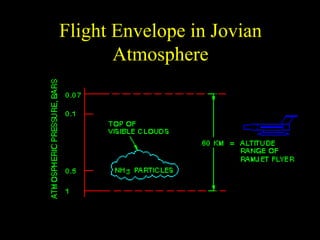
Flight Envelope in Jovian 
Atmosphere
Atmospheric Properties Measured 
• Pressure 
• Temperature 
• Chemical Composition 
• Wind Velocity 
• Cloud Particles and Size Distribution 
• Lightning Frequency and Energy 
• Energy Flux From Sunlight 
• Energy Flux from Deep Interior
Development Work Plan 
• Task 1 : Preliminary Design of Engine 
– Thermal-Hydraulic Design 
– Neutronic Analysis 
• Task 2: Preliminary Design of Flyer 
– Aerodynamic Configuration 
– Packaging for Jovian Entry 
– Detachment and Transition into Flight Mode
Development Work Plan (Contd.) 
• Task 3: Design Instrument Package 
• Task 4: PD of Data Storage and 
Transmission 
• Task 5: Mission Analysis 
• Task 6: Establish Flight Envelopes in on 
Jupiter, Saturn, Neptune and Uranus 
• Task 7: Nuclear Ramjet for Collection of 
He-3 on Uranus
Preliminary Conclusions 
• Ramjet flyer provides unique tool for 
mapping in detail Jovian atmosphere. 
• Detailed data should help explain poorly 
understood features of Jovian atmosphere, 
e.g., the Great Red Spot. 
• Concept applicable to other planetary 
atmospheres.

Nuclear ramjetflyer

  • 1.
    Exploration of Jovian Atmosphere Using Nuclear Ramjet Flyer by George Maise Plus Ultra Technologies, Inc.
  • 2.
    Characteristics of NuclearRamjet Flyer: • Jovian atmosphere is an unlimited source of propellant. • MITEE compact nuclear reactor is (nearly) unlimited source of heat. • There are virtually no moving parts to wear out.
  • 3.
    MITEE Nuclear Engine • MITEE (MIniature ReacTor EnginE) Ref.: Acta Astronautica, Vol. 44, No.2-4, 1999 • Derivative of Ultra-Light Particle Bed Reactor (PBR) Developed for SDIO (1985 - 1993) • MITEE is lighter and more compact than PBR.
  • 4.
    MITEE Nuclear Engine(Contd.) • Have Proposed MITEE-Based Rocket Engine for Solar System Exploration Missions: – Jupiter Orbiter: 2 Years – Europa Lander/Sample Return: 5 Years – Pluto Lander/Sample Return: 24 Years – Gavitational Lens at 550 AU: 30 Years
  • 5.
    MITEE Nuclear Engine(Contd.) • MITEE can be adopted for ramjet application: – Replace H2 propellant supply system by inlet and diffuser. – Reduce power density form 10 MW/liter to 2 Mw/liter – Reduce outlet temperature from 3000 K to 1500 K – Increase operating life from ~1 hr to months.
  • 6.
  • 7.
    Radiation Safety •Before reactor startup nuclear fuel is not hazardous. • Reactor will start operation after Jovian entry. • During launch phase (from Earth) safety systems prevent criticality for all conceivable accidents.
  • 8.
    Ramjet Performance inJovian Atmosphere • Aerodynamic forces ~ ρV2 • Assume perfect gas, ρ = pmo/RT • V = Ma = M(γRT/mo)1/2 • Then, ρV2 = γpM2 • T and mo cancel; To first order, performance of ramjet is same in Jovian atmosphere as on Earth, for same p and M.
  • 9.
  • 10.
  • 11.
    Conceptual Design ofRamjet Flyer (Contd.)
  • 12.
    Mass Budget ofRamjet Flyer Component Mass, kg MITEE Engine 100 Ramjet Engine Encl. 75 Wings & Control Surf. 50 Pod Containing 50 Instruments Vehicle Guidance Total Mass: 275
  • 13.
    Mission Characteristics •Payload of 750 kg, comprised of – Ramjet Flyer 275 kg – Thermal Shield 275 kg – Companion Orbiter 200 kg • Launch into LEO w. chemical rocket (Atlas IIAS). • From LEO, fly to Jupiter using: – Chemical rocket with GA’s: ~ 6 years – MITEE Nuclear rocket (if available): 2 years
  • 14.
    Mission Characteristics (Contd.) • Deployment of Companion Satellite. Jovian entry profile similar to Galileo. • When entry package has slowed to Mach ~1.5, flyer separates from thermal shield. Nuclear engine starts. • Flyer commences atmospheric mapping operation.
  • 15.
    Flight Envelope inJovian Atmosphere
  • 16.
    Atmospheric Properties Measured • Pressure • Temperature • Chemical Composition • Wind Velocity • Cloud Particles and Size Distribution • Lightning Frequency and Energy • Energy Flux From Sunlight • Energy Flux from Deep Interior
  • 17.
    Development Work Plan • Task 1 : Preliminary Design of Engine – Thermal-Hydraulic Design – Neutronic Analysis • Task 2: Preliminary Design of Flyer – Aerodynamic Configuration – Packaging for Jovian Entry – Detachment and Transition into Flight Mode
  • 18.
    Development Work Plan(Contd.) • Task 3: Design Instrument Package • Task 4: PD of Data Storage and Transmission • Task 5: Mission Analysis • Task 6: Establish Flight Envelopes in on Jupiter, Saturn, Neptune and Uranus • Task 7: Nuclear Ramjet for Collection of He-3 on Uranus
  • 19.
    Preliminary Conclusions •Ramjet flyer provides unique tool for mapping in detail Jovian atmosphere. • Detailed data should help explain poorly understood features of Jovian atmosphere, e.g., the Great Red Spot. • Concept applicable to other planetary atmospheres.