Radio
Broadcasting and
Scriptwriting
Presented by:
Cleo U. Barawid, RGC
Division Seminar on Campus Journalism
August 30-September 1, 2016
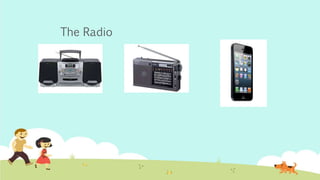
The Radio
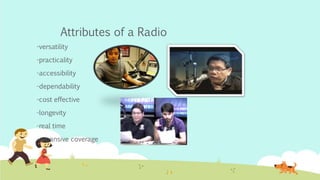
Attributes of a Radio
-versatility
-practicality
-accessibility
-dependability
-cost effective
-longevity
-real time
-expansive coverage
TOOLS FOR BROADCASTING
 -Effective Speaker
 Sound and Efficient Equipment/Functional
Facilities
 Clean directional policies
THE EFFECTIVE SPEAKER –
knowledgeable, smart, well-modulated and
good voice quality
The Charismatic and Persuasive Broadcaster
 Charming, appealing, pleasant, convincing
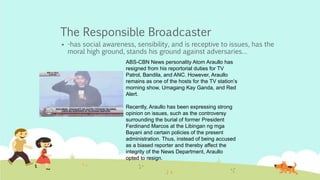
The Responsible Broadcaster
 -has social awareness, sensibility, and is receptive to issues, has the
moral high ground, stands his ground against adversaries…
ABS-CBN News personality Atom Araullo has
resigned from his reportorial duties for TV
Patrol, Bandila, and ANC. However, Araullo
remains as one of the hosts for the TV station’s
morning show, Umagang Kay Ganda, and Red
Alert.
Recently, Araullo has been expressing strong
opinion on issues, such as the controversy
surrounding the burial of former President
Ferdinand Marcos at the Libingan ng mga
Bayani and certain policies of the present
administration. Thus, instead of being accused
as a biased reporter and thereby affect the
integrity of the News Department, Araullo
opted to resign.
The Accountable Broadcaster
Acknowledges mistakes, knows
his/her limitations, answerable
for deeds and actions,
willingness to take
responsibility
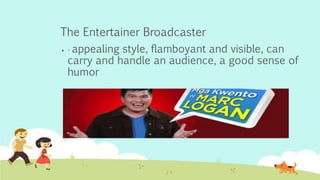
The Entertainer Broadcaster
 - appealing style, flamboyant and visible, can
carry and handle an audience, a good sense of
humor
Three Main Tasks of Broadcasting
News Gathering
Scriptwriting
Delivery
The Radio Script
The radio script refers to the
written material, which indicates
verbal and non-verbal action that
has to go into the radio program. It
tells us what to do and say and
when and how.
Importance of Radio Script
-ensure accuracy of information
ensure continuity of the
program
-maximize airtime
Things to Remember in Script Writing
 Double or triple space-typewrite all lines and
paragraphs.
 Type copy in big letter/font so the news reader can
easily read it.
 All spoken lines should be written in big and small
letters.
 All instructions and non-spoken lines should be typed
in capital letters.
Cont. Things to Remember in Script Writing
 Have a duplicate of each copy.
 Make each sentence a paragraph.
 Write a page number in your script.
 End each page with a paragraph before using another
paper.
 Make your script clean.
 Make the script short and simple.
Cont. Things to Remember in Script Writing
 -Do not use words which are hard to
pronounce.
 Don’t text write.
 Break down long sentences for readability.
 Attribute the source of your news either at the
beginning or at the end of the news.
 Use easy, conversation words.
Cont. Things to Remember in Script Writing
 Avoid “this, that, the former, the latter”
 Use adjectives with care.
 Do not string together a collection of ideas with “and”, sentences should be
kept short.
 Use the active voice.
 Sample Wrong: Ang naganap na sunud-sunod na nakawan sa mga paaralan
ay ipinasisiyasat ni Mayor Pilot Bihasa.
 Correct: Ipinasisiyasat ni Mayor Pilot Bihasa ang sunud-
sunod na nakawan sa mga paaralan.
Cont. Things to Remember in Script Writing
 Round-off figures/numbers
Egs. Change 2.6213 million to more than 2 and a half million
35.7002 percent to nearly 36 percent
Umabot sa may 10.356 milyong piso
to
Umabot sa mahigit sampung milyong piso
-Write out symbols and fractions
-Avoid abbreviations.
-Provide phonetic spelling
Cont. Things To Remember in Script Writing
Speech has rhythm and this should
be kept in mind when writing a
script.
Key repetitive statements would
help the listener get the
message.
Basic Steps/Process in Radio Script Writing
 Get a good briefing/know your listener
 Do research about the topic
 Prepare content outline
 Write the first draft.
 Read it aloud. Time the material.
 Visualize the script
 Review the script
 Revise for style, correct timing, and accuracy
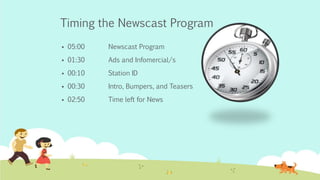
Timing the Newscast Program
 05:00 Newscast Program
 01:30 Ads and Infomercial/s
 00:10 Station ID
 00:30 Intro, Bumpers, and Teasers
 02:50 Time left for News
BUMPER, TEASER, and BILLBOARD
 BUMPER is used between the news and
commercial breaks.
 It tells the listener that there is a break but there
are still more news coming up.
 Example: “We’ll be back for more news after
these words from our sponsors.”
BUMPER, TEASER, and BILLBOARD
 It is used to stimulate curiosity so that listeners
will stay tuned in to the news.
 Example: “Waling waling to replace Sampaguita
as our national flower?”
 “Bea Alonzo at Gerald Anderson,
nagkakamabutihan na nga ba?”
BUMPER, TEASER, and BILLBOARD
 BILLBOARD is usually heard after the
news.
 It tells the listeners who sponsored the
news or infomercial.
 Example: “This infomercial is brought to
you by the Department of Health and this
station.
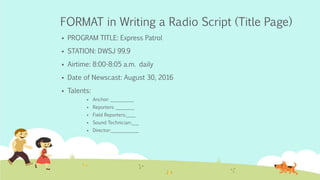
FORMAT in Writing a Radio Script (Title Page)
 PROGRAM TITLE: Express Patrol
 STATION: DWSJ 99.9
 Airtime: 8:00-8:05 a.m. daily
 Date of Newscast: August 30, 2016
 Talents:
 Anchor: __________
 Reporters: ________
 Field Reporters:____
 Sound Technician:___
 Director:____________
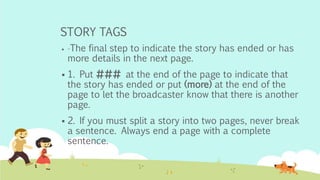
STORY TAGS
 -The final step to indicate the story has ended or has
more details in the next page.
 1. Put ### at the end of the page to indicate that
the story has ended or put (more) at the end of the
page to let the broadcaster know that there is another
page.
 2. If you must split a story into two pages, never break
a sentence. Always end a page with a complete
sentence.
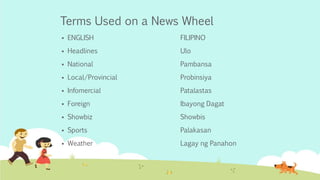
Terms Used on a News Wheel
 ENGLISH FILIPINO
 Headlines Ulo
 National Pambansa
 Local/Provincial Probinsiya
 Infomercial Patalastas
 Foreign Ibayong Dagat
 Showbiz Showbis
 Sports Palakasan
 Weather Lagay ng Panahon
THIS PART IS OVER!
STAY TUNED FOR MORE
PRESENTATIONS IN RADIO
BROADCASTING!
Thanks for listening.

Radio broadcasting and scriptwriting

  • 1.
    Radio Broadcasting and Scriptwriting Presented by: CleoU. Barawid, RGC Division Seminar on Campus Journalism August 30-September 1, 2016
  • 2.
  • 3.
    Attributes of aRadio -versatility -practicality -accessibility -dependability -cost effective -longevity -real time -expansive coverage
  • 4.
    TOOLS FOR BROADCASTING -Effective Speaker  Sound and Efficient Equipment/Functional Facilities  Clean directional policies
  • 5.
    THE EFFECTIVE SPEAKER– knowledgeable, smart, well-modulated and good voice quality
  • 6.
    The Charismatic andPersuasive Broadcaster  Charming, appealing, pleasant, convincing
  • 7.
    The Responsible Broadcaster -has social awareness, sensibility, and is receptive to issues, has the moral high ground, stands his ground against adversaries… ABS-CBN News personality Atom Araullo has resigned from his reportorial duties for TV Patrol, Bandila, and ANC. However, Araullo remains as one of the hosts for the TV station’s morning show, Umagang Kay Ganda, and Red Alert. Recently, Araullo has been expressing strong opinion on issues, such as the controversy surrounding the burial of former President Ferdinand Marcos at the Libingan ng mga Bayani and certain policies of the present administration. Thus, instead of being accused as a biased reporter and thereby affect the integrity of the News Department, Araullo opted to resign.
  • 8.
    The Accountable Broadcaster Acknowledgesmistakes, knows his/her limitations, answerable for deeds and actions, willingness to take responsibility
  • 9.
    The Entertainer Broadcaster - appealing style, flamboyant and visible, can carry and handle an audience, a good sense of humor
  • 10.
    Three Main Tasksof Broadcasting News Gathering Scriptwriting Delivery
  • 11.
    The Radio Script Theradio script refers to the written material, which indicates verbal and non-verbal action that has to go into the radio program. It tells us what to do and say and when and how.
  • 12.
    Importance of RadioScript -ensure accuracy of information ensure continuity of the program -maximize airtime
  • 13.
    Things to Rememberin Script Writing  Double or triple space-typewrite all lines and paragraphs.  Type copy in big letter/font so the news reader can easily read it.  All spoken lines should be written in big and small letters.  All instructions and non-spoken lines should be typed in capital letters.
  • 14.
    Cont. Things toRemember in Script Writing  Have a duplicate of each copy.  Make each sentence a paragraph.  Write a page number in your script.  End each page with a paragraph before using another paper.  Make your script clean.  Make the script short and simple.
  • 15.
    Cont. Things toRemember in Script Writing  -Do not use words which are hard to pronounce.  Don’t text write.  Break down long sentences for readability.  Attribute the source of your news either at the beginning or at the end of the news.  Use easy, conversation words.
  • 16.
    Cont. Things toRemember in Script Writing  Avoid “this, that, the former, the latter”  Use adjectives with care.  Do not string together a collection of ideas with “and”, sentences should be kept short.  Use the active voice.  Sample Wrong: Ang naganap na sunud-sunod na nakawan sa mga paaralan ay ipinasisiyasat ni Mayor Pilot Bihasa.  Correct: Ipinasisiyasat ni Mayor Pilot Bihasa ang sunud- sunod na nakawan sa mga paaralan.
  • 17.
    Cont. Things toRemember in Script Writing  Round-off figures/numbers Egs. Change 2.6213 million to more than 2 and a half million 35.7002 percent to nearly 36 percent Umabot sa may 10.356 milyong piso to Umabot sa mahigit sampung milyong piso -Write out symbols and fractions -Avoid abbreviations. -Provide phonetic spelling
  • 18.
    Cont. Things ToRemember in Script Writing Speech has rhythm and this should be kept in mind when writing a script. Key repetitive statements would help the listener get the message.
  • 19.
    Basic Steps/Process inRadio Script Writing  Get a good briefing/know your listener  Do research about the topic  Prepare content outline  Write the first draft.  Read it aloud. Time the material.  Visualize the script  Review the script  Revise for style, correct timing, and accuracy
  • 20.
    Timing the NewscastProgram  05:00 Newscast Program  01:30 Ads and Infomercial/s  00:10 Station ID  00:30 Intro, Bumpers, and Teasers  02:50 Time left for News
  • 21.
    BUMPER, TEASER, andBILLBOARD  BUMPER is used between the news and commercial breaks.  It tells the listener that there is a break but there are still more news coming up.  Example: “We’ll be back for more news after these words from our sponsors.”
  • 22.
    BUMPER, TEASER, andBILLBOARD  It is used to stimulate curiosity so that listeners will stay tuned in to the news.  Example: “Waling waling to replace Sampaguita as our national flower?”  “Bea Alonzo at Gerald Anderson, nagkakamabutihan na nga ba?”
  • 23.
    BUMPER, TEASER, andBILLBOARD  BILLBOARD is usually heard after the news.  It tells the listeners who sponsored the news or infomercial.  Example: “This infomercial is brought to you by the Department of Health and this station.
  • 24.
    FORMAT in Writinga Radio Script (Title Page)  PROGRAM TITLE: Express Patrol  STATION: DWSJ 99.9  Airtime: 8:00-8:05 a.m. daily  Date of Newscast: August 30, 2016  Talents:  Anchor: __________  Reporters: ________  Field Reporters:____  Sound Technician:___  Director:____________
  • 25.
    STORY TAGS  -Thefinal step to indicate the story has ended or has more details in the next page.  1. Put ### at the end of the page to indicate that the story has ended or put (more) at the end of the page to let the broadcaster know that there is another page.  2. If you must split a story into two pages, never break a sentence. Always end a page with a complete sentence.
  • 26.
    Terms Used ona News Wheel  ENGLISH FILIPINO  Headlines Ulo  National Pambansa  Local/Provincial Probinsiya  Infomercial Patalastas  Foreign Ibayong Dagat  Showbiz Showbis  Sports Palakasan  Weather Lagay ng Panahon
  • 27.
    THIS PART ISOVER! STAY TUNED FOR MORE PRESENTATIONS IN RADIO BROADCASTING! Thanks for listening.