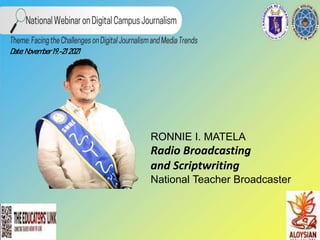
RONNIE I. MATELA
Radio Broadcasting
and Scriptwriting
National Teacher Broadcaster
Date:November19,-212021
National Webinar on Campus
Journalism
Facing the Challenges on Digital Journalism and Media
Trends
TONGUE TWISTER
Peter Piper picked a peck of peppers
A peck of pickled peppers peter Piper
picked
If Peter Piper picked a peck of pickled
peppers
where’s the peck of pickled peppers
Peter Piper picked?
National Webinar on Campus
Journalism
Facing the Challenges on Digital Journalism and Media
Trends
TONGUE TWISTER
Palakang kabkab,
kumakalabukab,
kakakalabukab pa
lamang,
kumakalabukab na
naman.
National Webinar on Campus
Journalism
Facing the Challenges on Digital Journalism and Media
Trends
TEXT TITLE
Subtexts……
National Webinar on Campus
Journalism
Facing the Challenges on Digital Journalism and Media
Trends
INTRODUCTION TO
BROADCAST
JOURNALISM
WHAT BROADCAST JOURNALISM IS?
• Broadcast journalism is news that is
carried on radio, television, and the
Internet.
• Broadcast journalism is a powerful
medium, it can shape public opinion,
touch hearts, influence, and inspire.
Some History
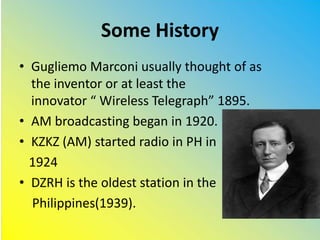
• Gugliemo Marconi usually thought of as
the inventor or at least the
innovator “ Wireless Telegraph” 1895.
• AM broadcasting began in 1920.
• KZKZ (AM) started radio in PH in
1924
• DZRH is the oldest station in the
Philippines(1939).
RADIOBROADCASTING
• Updates people about the latest
news .
• Form people`s opinion about
certain issues.
• Inform busy persons.
National Webinar on Campus
Journalism
Facing the Challenges on Digital Journalism and Media
Trends
TOOLS FOR BROADCASTING
* Effective Speaker
* Sound and Efficient
Equipment/Functional Facilities *
Clean directional policies
National Webinar on Campus
Journalism
Facing the Challenges on Digital Journalism and Media
Trends
– knowledgeable,
smart, well-
modulated and good
voice quality
THE EFFECTIVE SPEAKER
The Responsible Broadcaster
-has social awareness,
sensibility, and is receptive to
issues, has the moral high
ground, stands his ground
against adversaries
• The Entertainer Broadcaster
-appealing style, flamboyant and
visible, can carry and handle an
audience, a good sense of
humor
Three Main Tasks of
Broadcasting
• News Gathering
• Scriptwriting
• Delivery
MEMBERS IN RADIO
BROADCASTING
• Script Writer
• Technical
• Anchor
• News Presenter
• Writers(News,Bumper, Infomercial, Teaser,
Billboard)
National Webinar on Campus
Journalism
Facing the Challenges on Digital Journalism and Media
Trends
Materials for Broadcasting
• Microphone
• Speaker
• Mixer
• Recorder
• Timer
• Downloaded Application for Music(Virtual DJ)
• Laptop, printer, bondpaper, stapler
National Webinar on Campus
Journalism
Facing the Challenges on Digital Journalism and Media
Trends
RADIO SCRIPT
WRITING
National Webinar on Campus
Journalism
Facing the Challenges on Digital Journalism and Media
Trends
IMPORTANCE OF RADIO SCRIPT
• Ensure technical accuracy of
information.
• To ensure continuity of program.
• To maximize airtime
National Webinar on Campus
Journalism
Facing the Challenges on Digital Journalism and Media
Trends
National Webinar on Campus
Journalism
Facing the Challenges on Digital Journalism and Media
Trends
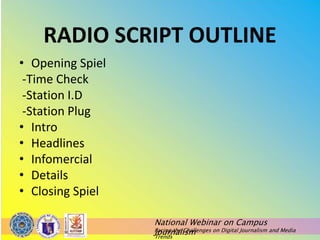
RADIO SCRIPT OUTLINE
• Opening Spiel
-Time Check
-Station I.D
-Station Plug
• Intro
• Headlines
• Infomercial
• Details
• Closing Spiel
National Webinar on Campus
Journalism
Facing the Challenges on Digital Journalism and Media
Trends
RADIO SCRIPT OUTLINE
• Bumper - “Magbabalik ang P-R-C-P makalipas
ang ilang paalala”
• Teaser - “Alam niyo ba na ang Halamang
Malunggay ay nakakatulong sa ibat-ibang
sakit?”
• Billboard – “ hatid sa inyo ng Alaska,wala
paring tatalo sa Alaska…”
National Webinar on Campus
Journalism
Facing the Challenges on Digital Journalism and Media
Trends
Timing the Newscast
Program
• 05:00 Newscast Program
• 01:30 Ads and Infomercial/s
• 00:10 Station ID
• 00:30 Intro, Bumpers, and Teasers
• 02:50 Time left for News
National Webinar on Campus
Journalism
Facing the Challenges on Digital Journalism and Media
Trends
NEWS SEQUENCE
• National News/ Balitang Nasyonal
• Local News/ Balitang Panlokal
• International News/ Balitang Ibayong Dagat
• Sports News/ Balitang Pampalakasan
• Showbiz News/ Balitang Pang-artista
• Weather News/ Balitang/Lagay Panahon
National Webinar on Campus
Journalism
Facing the Challenges on Digital Journalism and Media
Trends
Setting up scripts
• All spoken line should be typed in big and small letters.
• All non-spoken lines should be typed in capital letters.
• Number each line .
• Do not use words which are hard to pronounce.
• Write the story easy to read and understand. ( D-O-H,
Department of Health)
• Make your script organized and easy to follow.
• Indicate production elements in your script-when
video or sound come in.
National Webinar on Campus
Journalism
Facing the Challenges on Digital Journalism and Media
Trends
Setting up scripts
• Double space all lines.
• Have a duplicate each copy.
• A4 bond paper size
• Write a page number on each script.
• Make your script clean
• 25-30 words per news.
National Webinar on Campus
Journalism
Facing the Challenges on Digital Journalism and Media
Trends
STORY TAGS
-used to indicate the story has ended or has
more details in the next page.
1. Put ### at the end of the page to indicate
that the story has ended or put (more) at the
end of the page to let the broadcaster know
that there is another page.
2. If you must split a story into two pages,
never break a sentence. Always end a page
with a complete sentence
National Webinar on Campus
Journalism
Facing the Challenges on Digital Journalism and Media
Trends
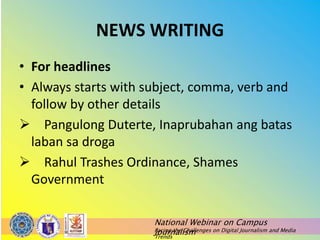
NEWS WRITING
• For headlines
• Always starts with subject, comma, verb and
follow by other details
 Pangulong Duterte, Inaprubahan ang batas
laban sa droga
 Rahul Trashes Ordinance, Shames
Government
National Webinar on Campus
Journalism
Facing the Challenges on Digital Journalism and Media
Trends
NEWS WRITING
• For news
• Always starts with verb for Filipino and subject
for English
 Pinasisiyasat ni Tarlac City Mayor Aro
Mendoza ang naganap na sunod sunod na
nakawan.
Malacanang Chinese Ambassador Zhai Jianhua
to explain the presence of Chinese warships in
the Philippines
National Webinar on Campus
Journalism
Facing the Challenges on Digital Journalism and Media
Trends
• Avoid “this, that, the former, the latter”
• Use adjectives with care.
• Do not string together a collection of ideas
with “and”, sentences should be kept short.
• Use the active voice.
Wrong: Ang naganap na sunud-sunod na
nakawan sa mga paaralan ay ipinasisiyasat ni
Mayor Pilot Bihasa.
Correct: Ipinasisiyasat ni Mayor Pilot Bihasa
ang sunud- sunod na nakawan sa mga
paaralan.
National Webinar on Campus
Journalism
Facing the Challenges on Digital Journalism and Media
Trends
NEWS WRITING
• Always answer the WH’s Questions
• Round –off figures
• Write out symbols and fractions
• Avoid abbreviations
• Display an element of Nowness/News
• 25-30 words
• Keep it simple. Listeners only have one chance to hear
and understand the news.
• Keep it conversational (pretend you are telling the
story to your best friend).
National Webinar on Campus
Journalism
Facing the Challenges on Digital Journalism and Media
Trends
NEWS WRITING
• For sports news
1. Use sports language
2. Write numbers or scores in digits.
3. Review wordings use in sports
National Webinar on Campus
Journalism
Facing the Challenges on Digital Journalism and Media
Trends
INFOMERCIAL
• Conversation/Dialog
• Theatrical
• 20-30 secs.
National Webinar on Campus
Journalism
Facing the Challenges on Digital Journalism and Media
Trends
BASIC STEPS IN RSW
• Prepare content outline
• Write the first draft.
• Read it aloud.
• Time the material.
• Visualize the script
• Review the script
• Revise for style, correct timing, and accuracy
National Webinar on Campus
Journalism
Facing the Challenges on Digital Journalism and Media
Trends
REMEMBER
• No Dead Air
• Repetition of words
• 1 hour for scriptwriting and
5 minutes for delivery
National Webinar on Campus
Journalism
Facing the Challenges on Digital Journalism and Media
Trends
DELIVERY
National Webinar on Campus
Journalism
Facing the Challenges on Digital Journalism and Media
Trends
National Webinar on Campus
Journalism
Facing the Challenges on Digital Journalism and Media
Trends
How can I improve my radio voice?
1. Exercise your vocal cords. Develop a
powerful voice by practicing strength training for
your voice.
2. Enunciate your words. Look in the mirror
and practice saying each word slowly and
properly.
3. Listen to your recorded voice. Get to know
the qualities of your voice.
National Webinar on Campus
Journalism
Facing the Challenges on Digital Journalism and Media
Trends
THE RULES OF RADIO HOST
Rule 1: Do not use Voice Pitch, just talk normally
Rule 2: Smile as you talk
Rule 3: Don’t belong-winded
Rule 4: Concentrate on content
Rule 5: Think of the consequences of what you say
Rule 6: Be careful with your pronunciation of foreign words
Rule 7: Give the correct weight to words
Rule n.8: Never mention rival radio stations
Rule 9: Don’t run on about yourself
Rule 10: Pronounce words clearly
National Webinar on Campus
Journalism
Facing the Challenges on Digital Journalism and Media
Trends
National Webinar on Campus
Journalism
Facing the Challenges on Digital Journalism and Media
Trends
National Webinar on Campus
Journalism
Facing the Challenges on Digital Journalism and Media
Trends
National Webinar on Campus
Journalism
Facing the Challenges on Digital Journalism and Media
Trends
National Webinar on Campus
Journalism
Facing the Challenges on Digital Journalism and Media
Trends
National Webinar on Campus
Journalism
Facing the Challenges on Digital Journalism and Media
Trends
National Webinar on Campus
Journalism
Facing the Challenges on Digital Journalism and Media
Trends
RONNIE I. MATELA
Radio Broadcasting
and Scriptwriting
National Teacher Broadcaster
Date:November19,-212021

RADIO-BROADCASTING-ppt.pptx

  • 1.
    RONNIE I. MATELA RadioBroadcasting and Scriptwriting National Teacher Broadcaster Date:November19,-212021
  • 2.
    National Webinar onCampus Journalism Facing the Challenges on Digital Journalism and Media Trends TONGUE TWISTER Peter Piper picked a peck of peppers A peck of pickled peppers peter Piper picked If Peter Piper picked a peck of pickled peppers where’s the peck of pickled peppers Peter Piper picked?
  • 3.
    National Webinar onCampus Journalism Facing the Challenges on Digital Journalism and Media Trends TONGUE TWISTER Palakang kabkab, kumakalabukab, kakakalabukab pa lamang, kumakalabukab na naman.
  • 4.
    National Webinar onCampus Journalism Facing the Challenges on Digital Journalism and Media Trends TEXT TITLE Subtexts……
  • 5.
    National Webinar onCampus Journalism Facing the Challenges on Digital Journalism and Media Trends INTRODUCTION TO BROADCAST JOURNALISM
  • 6.
    WHAT BROADCAST JOURNALISMIS? • Broadcast journalism is news that is carried on radio, television, and the Internet. • Broadcast journalism is a powerful medium, it can shape public opinion, touch hearts, influence, and inspire.
  • 7.
    Some History • GugliemoMarconi usually thought of as the inventor or at least the innovator “ Wireless Telegraph” 1895. • AM broadcasting began in 1920. • KZKZ (AM) started radio in PH in 1924 • DZRH is the oldest station in the Philippines(1939).
  • 8.
    RADIOBROADCASTING • Updates peopleabout the latest news . • Form people`s opinion about certain issues. • Inform busy persons.
  • 9.
    National Webinar onCampus Journalism Facing the Challenges on Digital Journalism and Media Trends TOOLS FOR BROADCASTING * Effective Speaker * Sound and Efficient Equipment/Functional Facilities * Clean directional policies
  • 10.
    National Webinar onCampus Journalism Facing the Challenges on Digital Journalism and Media Trends – knowledgeable, smart, well- modulated and good voice quality THE EFFECTIVE SPEAKER
  • 11.
    The Responsible Broadcaster -hassocial awareness, sensibility, and is receptive to issues, has the moral high ground, stands his ground against adversaries
  • 12.
    • The EntertainerBroadcaster -appealing style, flamboyant and visible, can carry and handle an audience, a good sense of humor
  • 13.
    Three Main Tasksof Broadcasting • News Gathering • Scriptwriting • Delivery
  • 14.
    MEMBERS IN RADIO BROADCASTING •Script Writer • Technical • Anchor • News Presenter • Writers(News,Bumper, Infomercial, Teaser, Billboard)
  • 15.
    National Webinar onCampus Journalism Facing the Challenges on Digital Journalism and Media Trends Materials for Broadcasting • Microphone • Speaker • Mixer • Recorder • Timer • Downloaded Application for Music(Virtual DJ) • Laptop, printer, bondpaper, stapler
  • 16.
    National Webinar onCampus Journalism Facing the Challenges on Digital Journalism and Media Trends RADIO SCRIPT WRITING
  • 17.
    National Webinar onCampus Journalism Facing the Challenges on Digital Journalism and Media Trends IMPORTANCE OF RADIO SCRIPT • Ensure technical accuracy of information. • To ensure continuity of program. • To maximize airtime
  • 18.
    National Webinar onCampus Journalism Facing the Challenges on Digital Journalism and Media Trends
  • 19.
    National Webinar onCampus Journalism Facing the Challenges on Digital Journalism and Media Trends RADIO SCRIPT OUTLINE • Opening Spiel -Time Check -Station I.D -Station Plug • Intro • Headlines • Infomercial • Details • Closing Spiel
  • 20.
    National Webinar onCampus Journalism Facing the Challenges on Digital Journalism and Media Trends RADIO SCRIPT OUTLINE • Bumper - “Magbabalik ang P-R-C-P makalipas ang ilang paalala” • Teaser - “Alam niyo ba na ang Halamang Malunggay ay nakakatulong sa ibat-ibang sakit?” • Billboard – “ hatid sa inyo ng Alaska,wala paring tatalo sa Alaska…”
  • 21.
    National Webinar onCampus Journalism Facing the Challenges on Digital Journalism and Media Trends Timing the Newscast Program • 05:00 Newscast Program • 01:30 Ads and Infomercial/s • 00:10 Station ID • 00:30 Intro, Bumpers, and Teasers • 02:50 Time left for News
  • 22.
    National Webinar onCampus Journalism Facing the Challenges on Digital Journalism and Media Trends NEWS SEQUENCE • National News/ Balitang Nasyonal • Local News/ Balitang Panlokal • International News/ Balitang Ibayong Dagat • Sports News/ Balitang Pampalakasan • Showbiz News/ Balitang Pang-artista • Weather News/ Balitang/Lagay Panahon
  • 23.
    National Webinar onCampus Journalism Facing the Challenges on Digital Journalism and Media Trends Setting up scripts • All spoken line should be typed in big and small letters. • All non-spoken lines should be typed in capital letters. • Number each line . • Do not use words which are hard to pronounce. • Write the story easy to read and understand. ( D-O-H, Department of Health) • Make your script organized and easy to follow. • Indicate production elements in your script-when video or sound come in.
  • 24.
    National Webinar onCampus Journalism Facing the Challenges on Digital Journalism and Media Trends Setting up scripts • Double space all lines. • Have a duplicate each copy. • A4 bond paper size • Write a page number on each script. • Make your script clean • 25-30 words per news.
  • 25.
    National Webinar onCampus Journalism Facing the Challenges on Digital Journalism and Media Trends STORY TAGS -used to indicate the story has ended or has more details in the next page. 1. Put ### at the end of the page to indicate that the story has ended or put (more) at the end of the page to let the broadcaster know that there is another page. 2. If you must split a story into two pages, never break a sentence. Always end a page with a complete sentence
  • 26.
    National Webinar onCampus Journalism Facing the Challenges on Digital Journalism and Media Trends NEWS WRITING • For headlines • Always starts with subject, comma, verb and follow by other details  Pangulong Duterte, Inaprubahan ang batas laban sa droga  Rahul Trashes Ordinance, Shames Government
  • 27.
    National Webinar onCampus Journalism Facing the Challenges on Digital Journalism and Media Trends NEWS WRITING • For news • Always starts with verb for Filipino and subject for English  Pinasisiyasat ni Tarlac City Mayor Aro Mendoza ang naganap na sunod sunod na nakawan. Malacanang Chinese Ambassador Zhai Jianhua to explain the presence of Chinese warships in the Philippines
  • 28.
    National Webinar onCampus Journalism Facing the Challenges on Digital Journalism and Media Trends • Avoid “this, that, the former, the latter” • Use adjectives with care. • Do not string together a collection of ideas with “and”, sentences should be kept short. • Use the active voice. Wrong: Ang naganap na sunud-sunod na nakawan sa mga paaralan ay ipinasisiyasat ni Mayor Pilot Bihasa. Correct: Ipinasisiyasat ni Mayor Pilot Bihasa ang sunud- sunod na nakawan sa mga paaralan.
  • 29.
    National Webinar onCampus Journalism Facing the Challenges on Digital Journalism and Media Trends NEWS WRITING • Always answer the WH’s Questions • Round –off figures • Write out symbols and fractions • Avoid abbreviations • Display an element of Nowness/News • 25-30 words • Keep it simple. Listeners only have one chance to hear and understand the news. • Keep it conversational (pretend you are telling the story to your best friend).
  • 30.
    National Webinar onCampus Journalism Facing the Challenges on Digital Journalism and Media Trends NEWS WRITING • For sports news 1. Use sports language 2. Write numbers or scores in digits. 3. Review wordings use in sports
  • 31.
    National Webinar onCampus Journalism Facing the Challenges on Digital Journalism and Media Trends INFOMERCIAL • Conversation/Dialog • Theatrical • 20-30 secs.
  • 32.
    National Webinar onCampus Journalism Facing the Challenges on Digital Journalism and Media Trends BASIC STEPS IN RSW • Prepare content outline • Write the first draft. • Read it aloud. • Time the material. • Visualize the script • Review the script • Revise for style, correct timing, and accuracy
  • 33.
    National Webinar onCampus Journalism Facing the Challenges on Digital Journalism and Media Trends REMEMBER • No Dead Air • Repetition of words • 1 hour for scriptwriting and 5 minutes for delivery
  • 34.
    National Webinar onCampus Journalism Facing the Challenges on Digital Journalism and Media Trends DELIVERY
  • 35.
    National Webinar onCampus Journalism Facing the Challenges on Digital Journalism and Media Trends
  • 36.
    National Webinar onCampus Journalism Facing the Challenges on Digital Journalism and Media Trends How can I improve my radio voice? 1. Exercise your vocal cords. Develop a powerful voice by practicing strength training for your voice. 2. Enunciate your words. Look in the mirror and practice saying each word slowly and properly. 3. Listen to your recorded voice. Get to know the qualities of your voice.
  • 37.
    National Webinar onCampus Journalism Facing the Challenges on Digital Journalism and Media Trends THE RULES OF RADIO HOST Rule 1: Do not use Voice Pitch, just talk normally Rule 2: Smile as you talk Rule 3: Don’t belong-winded Rule 4: Concentrate on content Rule 5: Think of the consequences of what you say Rule 6: Be careful with your pronunciation of foreign words Rule 7: Give the correct weight to words Rule n.8: Never mention rival radio stations Rule 9: Don’t run on about yourself Rule 10: Pronounce words clearly
  • 38.
    National Webinar onCampus Journalism Facing the Challenges on Digital Journalism and Media Trends
  • 39.
    National Webinar onCampus Journalism Facing the Challenges on Digital Journalism and Media Trends
  • 40.
    National Webinar onCampus Journalism Facing the Challenges on Digital Journalism and Media Trends
  • 41.
    National Webinar onCampus Journalism Facing the Challenges on Digital Journalism and Media Trends
  • 42.
    National Webinar onCampus Journalism Facing the Challenges on Digital Journalism and Media Trends
  • 43.
    National Webinar onCampus Journalism Facing the Challenges on Digital Journalism and Media Trends
  • 44.
    National Webinar onCampus Journalism Facing the Challenges on Digital Journalism and Media Trends
  • 45.
    RONNIE I. MATELA RadioBroadcasting and Scriptwriting National Teacher Broadcaster Date:November19,-212021