THE CONTEMPORARY IN TRADITIONAL ART:
G A W A D S A M A N L I L I K H A N G BAYAN
( G A M A B A )
LESSON 4
WHAT IS GAMABA AWARD?
 The National Living Treasures Award, alternatively known as the Gawad sa
Manlilikha ng Bayan (GAMABA; lit. 'Award for the Creators of the
Country'), is conferred to a person or group of artists recognized by the
Government of the Philippines for their contributions to the country's
intangible cultural heritage. A recipient of the award, a National Living
Treasure or Manlilikha ng Bayan is "a Filipino citizen or group of Filipino
citizens engaged in any traditional art uniquely Filipino, whose distinctive
skills have reached such a high level of technical and artistic excellence
and have been passed on to and widely practiced by the present
generations in their community with the same degree of technical and
artistic competence."
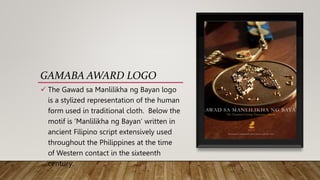
GAMABA AWARD LOGO
 The Gawad sa Manlilikha ng Bayan logo
is a stylized representation of the human
form used in traditional cloth. Below the
motif is ‘Manlilikha ng Bayan’ written in
ancient Filipino script extensively used
throughout the Philippines at the time
of Western contact in the sixteenth
century.
WHY WAS GAMABA ESTABLISHED?
GAMABA system in the Philippines
The NLT system was established in order to:
 Acknowledge the importance of traditional folk artists;
 Revitalize the artistic traditions of communities;
 Provide mechanisms for identifying and assisting qualified traditional folk
artists to transfer their skills to the community.
WH AT IS G A M A B A ARTIST?
• Our National Living Treasures.
• The awardees produce art forms that are often
woven into everyday life.
• Exceptional practitioners of the traditional arts.
• They are living traditions a n d are produced
u p to the present, in modified ways.
HOW DOES ONE BECOME A MANLILIKHA NG
BAYAN?
• To become a “Manlilikha ng Bayan”, a candidate must possess the
following qualifications;
a. Should be a Filipino citizen or group of citizens belonging to an
indigenous/traditional cultural community anywhere in the Philippines,
engage in Filipino traditional art in the following categories; folk,
architecture, maritime transport, weaving, carving, performing arts,
literature, graphic and plastic arts, ornament, textile or fiber art, pottery and
other artistic expressions of traditional culture;
b. Should have been engaged in the tradition and craft for a significant period
of time with at least 50 years of existence and documentation;
c. Should have produced and performed of artistic, distinctive, and superior
quality;
d. Should possess the mastery of the tools and materials that are needed for
the art and must have a reputation for being an art master and craft maker
in the community where he/she belongs;
e. Should have passed on and/ or will pass on the traditional crafts and skills
to other members of the community by virtue of teaching;
f. In case when a Manlilikha ng Bayan candidate is incapable of teaching
further his/ her craft and skill due to age or infirmity;
i. He/she should have created a significant body of work and has
contributed to the development of the tradition and craft
ii. He/she should have played a role in the preservation and revitalization
of the artistic tradition in the community.
iii. He/ she has been recognized as a master of his / her craft and
admired for his character and integrity in his / her community.
THE GAMABA AWARDEES
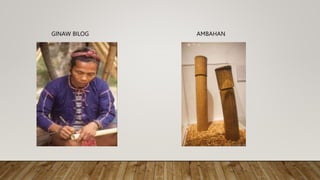
1. GINAW BILOG ( A FILIPINO POET) - Ginaw Bilog was a Filipino poet
who was recognized as a National Living Treasure by the Philippine
government. Born on January 3, 1953, Bilog was a Hanunuo Mangyan
who was a native of Mansalay, Oriental Mindoro. He was known for his
efforts in preserving the Mangyan poetry tradition of ambahan. Then-
President Fidel V. Ramos, conferred the National Living Treasure Award
to Ginaw Bilog on December 17, 1993, in recognition of his people's
preservation efforts of the ambahan poetry, which is recorded on
bamboo. He died on June 3, 2003, at age 50 due to a lingering illness.
GINAW BILOG AMBAHAN
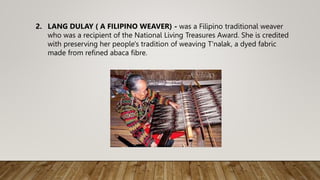
2. LANG DULAY ( A FILIPINO WEAVER) - was a Filipino traditional weaver
who was a recipient of the National Living Treasures Award. She is credited
with preserving her people's tradition of weaving T'nalak, a dyed fabric
made from refined abaca fibre.
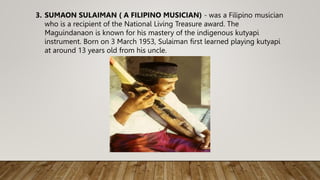
3. SUMAON SULAIMAN ( A FILIPINO MUSICIAN) - was a Filipino musician
who is a recipient of the National Living Treasure award. The
Maguindanaon is known for his mastery of the indigenous kutyapi
instrument. Born on 3 March 1953, Sulaiman first learned playing kutyapi
at around 13 years old from his uncle.
By the time he was 35 years old, he was already recognized in Maganoy for his
skills in playing the instrument as well as being a teacher to aspiring kutyapi
practitioners. He is credited for influencing other local experts in his area such
as Esmael Ahmad, Bitul Sulaiman, Nguda Latip, Ali Ahmad and Tukal Nanalon.
Sulaiman also plays the kulintang, agong (suspended bossed gong with wide
rim), gandingan, palendag, and the tambul. He was also a barber, as well as an
imam at the Libutan mosque.He died on 21 May 2011.
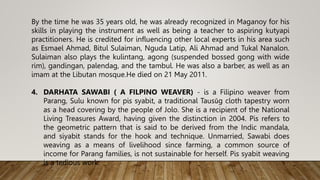
4. DARHATA SAWABI ( A FILPINO WEAVER) - is a Filipino weaver from
Parang, Sulu known for pis syabit, a traditional Tausūg cloth tapestry worn
as a head covering by the people of Jolo. She is a recipient of the National
Living Treasures Award, having given the distinction in 2004. Pis refers to
the geometric pattern that is said to be derived from the Indic mandala,
and siyabit stands for the hook and technique. Unmarried, Sawabi does
weaving as a means of livelihood since farming, a common source of
income for Parang families, is not sustainable for herself. Pis syabit weaving
is a tedious work.
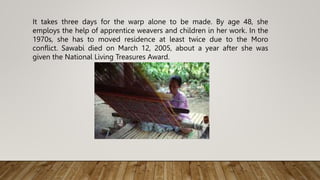
It takes three days for the warp alone to be made. By age 48, she
employs the help of apprentice weavers and children in her work. In the
1970s, she has to moved residence at least twice due to the Moro
conflict. Sawabi died on March 12, 2005, about a year after she was
given the National Living Treasures Award.
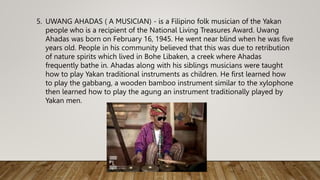
5. UWANG AHADAS ( A MUSICIAN) - is a Filipino folk musician of the Yakan
people who is a recipient of the National Living Treasures Award. Uwang
Ahadas was born on February 16, 1945. He went near blind when he was five
years old. People in his community believed that this was due to retribution
of nature spirits which lived in Bohe Libaken, a creek where Ahadas
frequently bathe in. Ahadas along with his siblings musicians were taught
how to play Yakan traditional instruments as children. He first learned how
to play the gabbang, a wooden bamboo instrument similar to the xylophone
then learned how to play the agung an instrument traditionally played by
Yakan men.
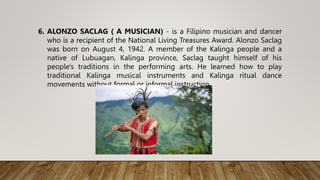
6. ALONZO SACLAG ( A MUSICIAN) - is a Filipino musician and dancer
who is a recipient of the National Living Treasures Award. Alonzo Saclag
was born on August 4, 1942. A member of the Kalinga people and a
native of Lubuagan, Kalinga province, Saclag taught himself of his
people's traditions in the performing arts. He learned how to play
traditional Kalinga musical instruments and Kalinga ritual dance
movements without formal or informal instruction.
SOURCE
• https://ncca.gov.ph/about-culture-and-arts/culture-profile/gamaba/
• https://www.slideshare.net/CandiceMay/gawad-sa-manlilikha-ng-bayan

The-Contemporary-in-traditional-Art.pptx

  • 1.
    THE CONTEMPORARY INTRADITIONAL ART: G A W A D S A M A N L I L I K H A N G BAYAN ( G A M A B A ) LESSON 4
  • 2.
    WHAT IS GAMABAAWARD?  The National Living Treasures Award, alternatively known as the Gawad sa Manlilikha ng Bayan (GAMABA; lit. 'Award for the Creators of the Country'), is conferred to a person or group of artists recognized by the Government of the Philippines for their contributions to the country's intangible cultural heritage. A recipient of the award, a National Living Treasure or Manlilikha ng Bayan is "a Filipino citizen or group of Filipino citizens engaged in any traditional art uniquely Filipino, whose distinctive skills have reached such a high level of technical and artistic excellence and have been passed on to and widely practiced by the present generations in their community with the same degree of technical and artistic competence."
  • 3.
    GAMABA AWARD LOGO The Gawad sa Manlilikha ng Bayan logo is a stylized representation of the human form used in traditional cloth. Below the motif is ‘Manlilikha ng Bayan’ written in ancient Filipino script extensively used throughout the Philippines at the time of Western contact in the sixteenth century.
  • 4.
    WHY WAS GAMABAESTABLISHED? GAMABA system in the Philippines The NLT system was established in order to:  Acknowledge the importance of traditional folk artists;  Revitalize the artistic traditions of communities;  Provide mechanisms for identifying and assisting qualified traditional folk artists to transfer their skills to the community.
  • 5.
    WH AT ISG A M A B A ARTIST? • Our National Living Treasures. • The awardees produce art forms that are often woven into everyday life. • Exceptional practitioners of the traditional arts. • They are living traditions a n d are produced u p to the present, in modified ways.
  • 6.
    HOW DOES ONEBECOME A MANLILIKHA NG BAYAN? • To become a “Manlilikha ng Bayan”, a candidate must possess the following qualifications; a. Should be a Filipino citizen or group of citizens belonging to an indigenous/traditional cultural community anywhere in the Philippines, engage in Filipino traditional art in the following categories; folk, architecture, maritime transport, weaving, carving, performing arts, literature, graphic and plastic arts, ornament, textile or fiber art, pottery and other artistic expressions of traditional culture; b. Should have been engaged in the tradition and craft for a significant period of time with at least 50 years of existence and documentation; c. Should have produced and performed of artistic, distinctive, and superior quality;
  • 7.
    d. Should possessthe mastery of the tools and materials that are needed for the art and must have a reputation for being an art master and craft maker in the community where he/she belongs; e. Should have passed on and/ or will pass on the traditional crafts and skills to other members of the community by virtue of teaching; f. In case when a Manlilikha ng Bayan candidate is incapable of teaching further his/ her craft and skill due to age or infirmity; i. He/she should have created a significant body of work and has contributed to the development of the tradition and craft ii. He/she should have played a role in the preservation and revitalization of the artistic tradition in the community. iii. He/ she has been recognized as a master of his / her craft and admired for his character and integrity in his / her community.
  • 8.
    THE GAMABA AWARDEES 1.GINAW BILOG ( A FILIPINO POET) - Ginaw Bilog was a Filipino poet who was recognized as a National Living Treasure by the Philippine government. Born on January 3, 1953, Bilog was a Hanunuo Mangyan who was a native of Mansalay, Oriental Mindoro. He was known for his efforts in preserving the Mangyan poetry tradition of ambahan. Then- President Fidel V. Ramos, conferred the National Living Treasure Award to Ginaw Bilog on December 17, 1993, in recognition of his people's preservation efforts of the ambahan poetry, which is recorded on bamboo. He died on June 3, 2003, at age 50 due to a lingering illness.
  • 9.
  • 10.
    2. LANG DULAY( A FILIPINO WEAVER) - was a Filipino traditional weaver who was a recipient of the National Living Treasures Award. She is credited with preserving her people's tradition of weaving T'nalak, a dyed fabric made from refined abaca fibre.
  • 11.
    3. SUMAON SULAIMAN( A FILIPINO MUSICIAN) - was a Filipino musician who is a recipient of the National Living Treasure award. The Maguindanaon is known for his mastery of the indigenous kutyapi instrument. Born on 3 March 1953, Sulaiman first learned playing kutyapi at around 13 years old from his uncle.
  • 12.
    By the timehe was 35 years old, he was already recognized in Maganoy for his skills in playing the instrument as well as being a teacher to aspiring kutyapi practitioners. He is credited for influencing other local experts in his area such as Esmael Ahmad, Bitul Sulaiman, Nguda Latip, Ali Ahmad and Tukal Nanalon. Sulaiman also plays the kulintang, agong (suspended bossed gong with wide rim), gandingan, palendag, and the tambul. He was also a barber, as well as an imam at the Libutan mosque.He died on 21 May 2011. 4. DARHATA SAWABI ( A FILPINO WEAVER) - is a Filipino weaver from Parang, Sulu known for pis syabit, a traditional Tausūg cloth tapestry worn as a head covering by the people of Jolo. She is a recipient of the National Living Treasures Award, having given the distinction in 2004. Pis refers to the geometric pattern that is said to be derived from the Indic mandala, and siyabit stands for the hook and technique. Unmarried, Sawabi does weaving as a means of livelihood since farming, a common source of income for Parang families, is not sustainable for herself. Pis syabit weaving is a tedious work.
  • 13.
    It takes threedays for the warp alone to be made. By age 48, she employs the help of apprentice weavers and children in her work. In the 1970s, she has to moved residence at least twice due to the Moro conflict. Sawabi died on March 12, 2005, about a year after she was given the National Living Treasures Award.
  • 14.
    5. UWANG AHADAS( A MUSICIAN) - is a Filipino folk musician of the Yakan people who is a recipient of the National Living Treasures Award. Uwang Ahadas was born on February 16, 1945. He went near blind when he was five years old. People in his community believed that this was due to retribution of nature spirits which lived in Bohe Libaken, a creek where Ahadas frequently bathe in. Ahadas along with his siblings musicians were taught how to play Yakan traditional instruments as children. He first learned how to play the gabbang, a wooden bamboo instrument similar to the xylophone then learned how to play the agung an instrument traditionally played by Yakan men.
  • 15.
    6. ALONZO SACLAG( A MUSICIAN) - is a Filipino musician and dancer who is a recipient of the National Living Treasures Award. Alonzo Saclag was born on August 4, 1942. A member of the Kalinga people and a native of Lubuagan, Kalinga province, Saclag taught himself of his people's traditions in the performing arts. He learned how to play traditional Kalinga musical instruments and Kalinga ritual dance movements without formal or informal instruction.
  • 16.