SESSION ID:SESSION ID:
#RSAC
John Miller
Your Sector Doesn’t Matter: 
Achieving Effective Threat Prioritization
GRC‐R03
Manager, Threat Intelligence
Financial Crime Analysis Group
FireEye
John Hultquist
Manager, Threat Intelligence
Cyber Espionage Analysis Group
FireEye
#RSAC
The Problem
#RSAC
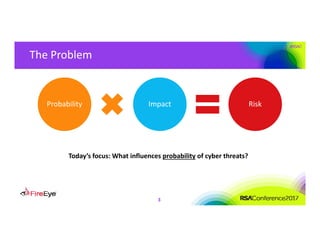
The Problem
3
Probability Impact Risk
Today’s focus: What influences probability of cyber threats?
#RSAC
The Problem
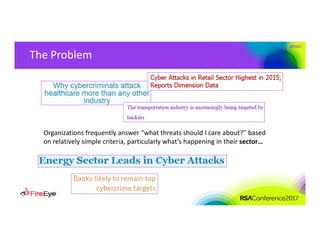
Organizations frequently answer “what threats should I care about?” based 
on relatively simple criteria, particularly what’s happening in their sector…
#RSAC
The Problem
5
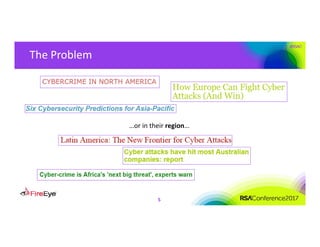
…or in their region…
#RSAC
The Problem
… BUT
Threat actors don’t consistently select their victims that way.
THE RESULT: Organizations miss opportunities to prevent loss
rather than remediate damage.
UP NEXT: What factors actually influence which threats affect who?
#RSAC
How are targets selected?
Cyber Crime
#RSAC
Cyber Crime: Target Selection
Cyber Crime: Abuses of computer systems to steal victims’ money, goods, or services.
#RSAC
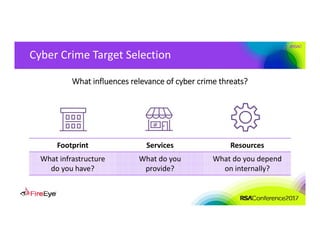
Cyber Crime Target Selection
What influences relevance of cyber crime threats?
Footprint Services Resources
What infrastructure 
do you have?
What do you 
provide?
What do you depend 
on internally?
#RSAC
Cyber Crime Target Selection: Footprint
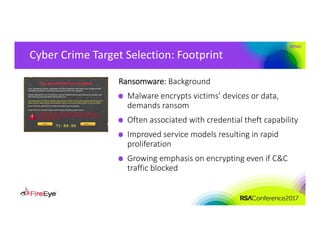
Ransomware: Background
Malware encrypts victims’ devices or data, 
demands ransom
Often associated with credential theft capability
Improved service models resulting in rapid 
proliferation
Growing emphasis on encrypting even if C&C 
traffic blocked
#RSAC
Cyber Crime Target Selection: Footprint
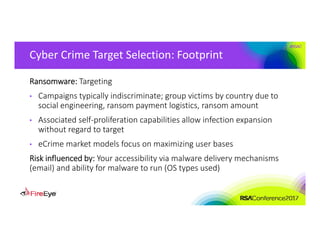
Ransomware: Targeting
• Campaigns typically indiscriminate; group victims by country due to 
social engineering, ransom payment logistics, ransom amount
• Associated self‐proliferation capabilities allow infection expansion 
without regard to target
• eCrime market models focus on maximizing user bases
Risk influenced by: Your accessibility via malware delivery mechanisms 
(email) and ability for malware to run (OS types used)
#RSAC
Cyber Crime Target Selection: Footprint
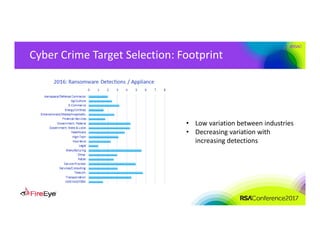
• Low variation between industries
• Decreasing variation with 
increasing detections
#RSAC
Cyber Crime Target Selection: Services
Trade‐Based Laundering: Background
• Many eCrime operations purchase and resell goods 
and services continuously to launder stolen funds
• Mule networks (may be for‐hire) move physical goods
• Gift cards offer rapid laundering mechanism
• Hospitality, travel, entertainment tickets booked just before event
• Resold to unsuspecting consumers, other criminals
• Resold in underground, grey‐market sites, multi‐vendor sites
#RSAC
Cyber Crime Target Selection: Services
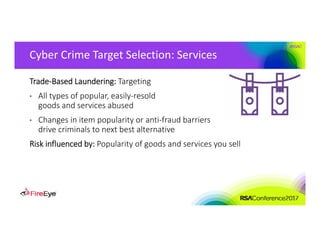
Trade‐Based Laundering: Targeting
• All types of popular, easily‐resold 
goods and services abused
• Changes in item popularity or anti‐fraud barriers 
drive criminals to next best alternative
Risk influenced by: Popularity of goods and services you sell
#RSAC
Cyber Crime Target Selection: Resources
Corporate Account Takeover: Background
• Advanced credential theft malware compromises 
organizations’ accounts with variety of services for fraud
• Leverage advanced authentication bypass techniques
• Tactic offers higher value per compromise than 
stereotypical consumer account takeover
• Potential examples: Dridex, TrickBot, GozNym…
#RSAC
Cyber Crime Target Selection: Resources
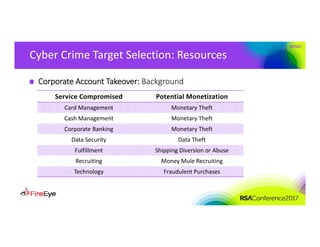
Corporate Account Takeover: Background
Service Compromised Potential Monetization
Card Management Monetary Theft
Cash Management Monetary Theft
Corporate Banking Monetary Theft
Data Security Data Theft
Fulfillment Shipping Diversion or Abuse
Recruiting Money Mule Recruiting
Technology Fraudulent Purchases
#RSAC
Cyber Crime Target Selection: Resources
Corporate Account Takeover: Targeting
• Distribution leverages combination of mass spam 
with tailoring (can be automated) to recipient
• Compromise services offering opportunity to capitalize 
on perpetrators’ monetization and laundering capabilities
Risk influenced by: Your use of typically‐outsourced platforms 
for finance, HR, shipping, etc.
#RSAC
How are targets selected?
Cyber Espionage
#RSAC
Cyber Espionage Target Selection
Cyber Espionage: Abuses of computer systems to conduct surveillance 
or monitor, in order to create corporate or political advantage.
#RSAC
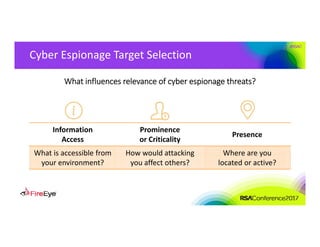
Cyber Espionage Target Selection
What influences relevance of cyber espionage threats?
Information 
Access
Prominence 
or Criticality
Presence
What is accessible from 
your environment?
How would attacking 
you affect others?
Where are you 
located or active?
#RSAC
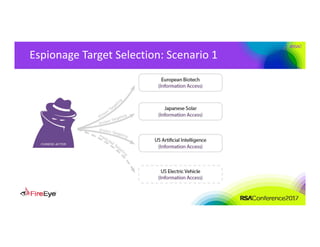
Espionage Target Selection: Scenario 1
#RSAC
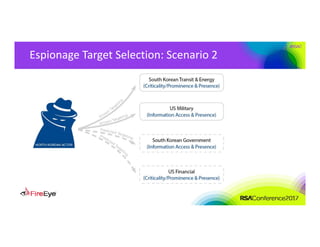
Espionage Target Selection: Scenario 2
#RSAC
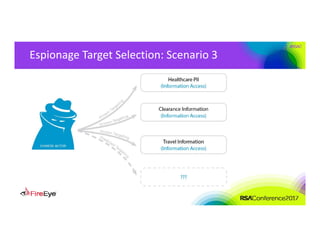
Espionage Target Selection: Scenario 3
#RSAC
How are targets selected?
Hacktivism
#RSAC
Hacktivism: Target Selection
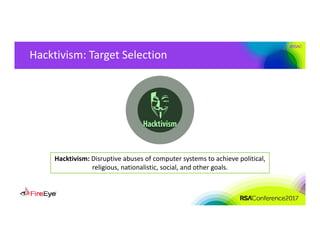
Hacktivism: Disruptive abuses of computer systems to achieve political, 
religious, nationalistic, social, and other goals.
#RSAC
Hacktivism: Target Selection
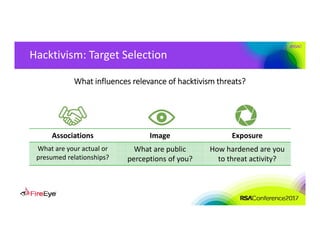
What influences relevance of hacktivism threats?
Associations Image Exposure
What are your actual or 
presumed relationships?
What are public
perceptions of you?
How hardened are you 
to threat activity?
#RSAC
Hacktivism Target Selection: Associations 
Dyn DDoS: Background
• Mid‐October: Dyn Managed DNS suffers repeat 
attacks disrupting service to many customers
• Attacks use Mirai botnet, variant of Gafgyt Linux bot
• Followed reports of attacks up to 1.5 Tbps using 
same capability
• Multiple links to hacktivist activity
#RSAC
Hacktivism Target Selection: Associations 
Dyn DDoS: Targeting
• Dyn DDoS was directly attacked, but other high‐profile 
organizations suffered downtime and associated 
potential losses
• Critical service providers an attractive target 
in many cases
Risk influenced by: What external providers victims 
depended on
#RSAC
Hacktivism Target Selection: Image
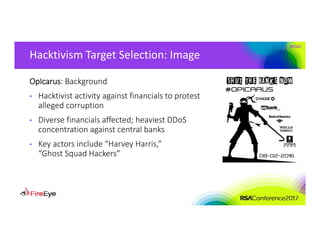
OpIcarus: Background
• Hacktivist activity against financials to protest 
alleged corruption
• Diverse financials affected; heaviest DDoS 
concentration against central banks
• Key actors include “Harvey Harris,” 
“Ghost Squad Hackers”
#RSAC
Hacktivism Target Selection: Image
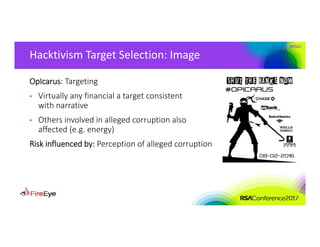
OpIcarus: Targeting
• Virtually any financial a target consistent 
with narrative
• Others involved in alleged corruption also 
affected (e.g. energy)
Risk influenced by: Perception of alleged corruption
#RSAC
Hacktivism Target Selection: Exposure
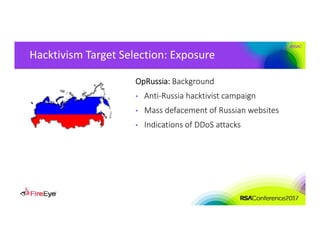
OpRussia: Background
• Anti‐Russia hacktivist campaign
• Mass defacement of Russian websites
• Indications of DDoS attacks
#RSAC
Hacktivism Target Selection: Exposure
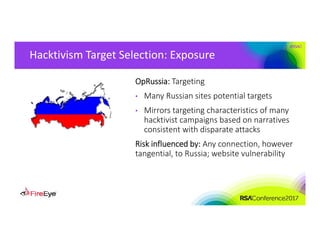
OpRussia: Targeting
• Many Russian sites potential targets
• Mirrors targeting characteristics of many 
hacktivist campaigns based on narratives 
consistent with disparate attacks
Risk influenced by: Any connection, however 
tangential, to Russia; website vulnerability
#RSAC
What should I do?
#RSAC
Application
 Evaluate threat probability for your organization based on the factors 
shaping adversaries’ targets from adversaries’ perspective
 What significant threats exist?
 Who are they affecting and why?
 Particularly, who are  threats affecting outside where organizations typically look –
“my sector,” “my region”?
 How much does the “why” apply to me also?
 Assume internal risk‐related conversations and decision‐making may 
require initial level set
#RSAC
Application
This presentation was…
How to evaluate threats 
for relevance
This presentation was not / 
continuing action required…
Identify existing and potential 
threats to evaluate
Gain understanding needed 
to evaluate them
#RSAC
Application
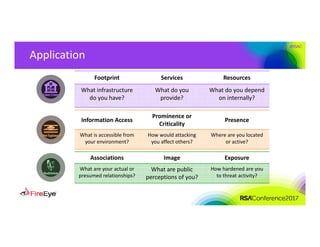
Associations Image Exposure
What are your actual or 
presumed relationships?
What are public
perceptions of you?
How hardened are you 
to threat activity?
Information Access
Prominence or
Criticality
Presence
What is accessible from 
your environment?
How would attacking 
you affect others?
Where are you located 
or active?
Footprint Services Resources
What infrastructure 
do you have?
What do you 
provide?
What do you depend 
on internally?
#RSAC
Discussion

Your Sector Doesn’t Matter: Achieving Effective Threat Prioritization