Jugal Parikh, Senior Data Scientist
Holly Stewart, Principal Research Manager
Randy Treit, Senior Researcher
W i n d o w s D e f e n d e r
E n d p o i n t P r o t e c t i o n
Blocks low
reputation web
downloads
Blocks malicious
websites
W i n d o w s D e f e n d e r E n d p o i n t
D e t e c t i o n a n d R e s p o n s e
D e t e c t i o n a n d R e m e d i a t i o n
After execution -
Windows Defender
ATP monitors for
post-breach signals
After execution -
Windows Defender
Hexadite can
reverse damage
Blocks malicious
programs and
content (scripts,
docs, etc.)
W i n d o w s D e f e n d e r
S m a r t S c r e e n
Monitors behaviors
and terminates bad
processes
Introduction ML Primer Adversarial Examples Ensemble Model Development and Testing Results
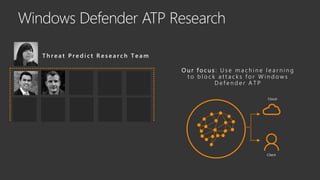
T h r e a t P r e d i c t R e s e a r c h T e a m
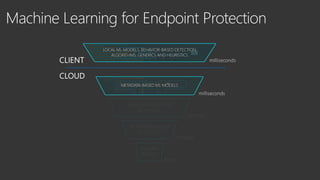
Cloud
Client
O u r f o c u s : U s e m a c h i n e l e a r n i n g
t o b l o c k a t t a c k s f o r W i n d o w s
D e f e n d e r A T P
Introduction ML Primer Adversarial Examples Ensemble Model Development and Testing Results
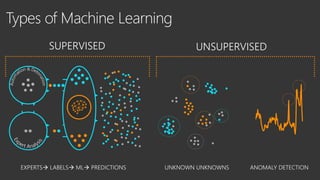
UNKNOWN UNKNOWNSEXPERTS→ LABELS→ ML→ PREDICTIONS ANOMALY DETECTION
SUPERVISED UNSUPERVISED
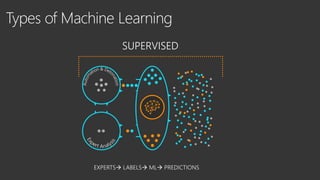
EXPERTS→ LABELS→ ML→ PREDICTIONS
SUPERVISED
Pro:
Disconnected
protection
Con: Silent
adversarial brute
force attacks
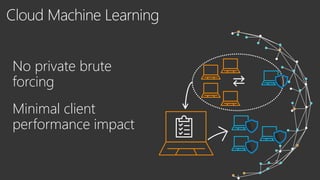
No private brute
forcing
Minimal client
performance impact
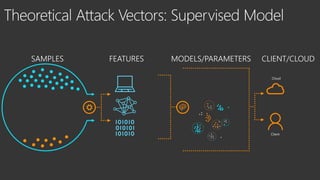
Introduction ML Primer Adversarial Examples Ensemble Model Development and Testing Results
Machine
attributes
Dynamic and
contextual
attributes
Static file
attributes
Example: Averaged perceptron
model with > .90 probability =
0.0001% false positive rate
Cloud
Client
Immunity from antimalware automation attacks
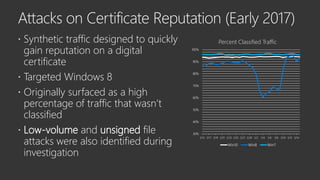
 Synthetic traffic designed to quickly
gain reputation on a digital
certificate
 Targeted Windows 8
 Originally surfaced as a high
percentage of traffic that wasn’t
classified
 Low-volume and unsigned file
attacks were also identified during
investigation
30%
40%
50%
60%
70%
80%
90%
100%
2/15 2/17 2/19 2/21 2/23 2/25 2/27 2/29 3/2 3/4 3/6 3/8 3/10 3/12 3/14
Percent Classified Traffic
Win10 Win8 Win7
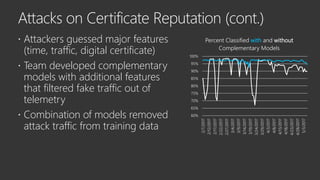
 Attackers guessed major features
(time, traffic, digital certificate)
 Team developed complementary
models with additional features
that filtered fake traffic out of
telemetry
 Combination of models removed
attack traffic from training data
60%
65%
70%
75%
80%
85%
90%
95%
100%
2/7/2017
2/12/2017
2/17/2017
2/22/2017
2/27/2017
3/4/2017
3/9/2017
3/14/2017
3/19/2017
3/24/2017
3/29/2017
4/3/2017
4/8/2017
4/13/2017
4/18/2017
4/23/2017
4/28/2017
5/3/2017
Percent Classified with and without
Complementary Models
 Research on adversarial attacks against deep learning classifiers
 Showed that an ensemble of classifiers helped defend against the
attacks tested in the paper
 See more at:
Attack and Defense of Dynamic Analysis-Based, Adversarial Neural Malware Classification Models
Jack W. Stokes, De Wang, Mady Marinescu, Marc Marino, Brian Bussone
https://arxiv.org/abs/1712.05919
Introduction ML Primer Adversarial Examples Ensemble Model Development and Testing ResultsEnsemble Model Development and Testing
Ensemble Model Development and Testing
Ensemble ML Primer Diversity Requirements Developing the Model Testing the Model
1
1
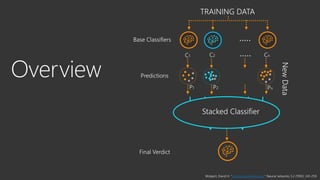
Wolpert, David H. "Stacked generalization." Neural networks 5.2 (1992): 241-259.
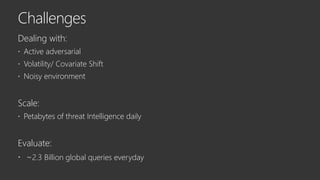
Dealing with:
 Active adversarial
 Volatility/ Covariate Shift
 Noisy environment
Scale:
 Petabytes of threat Intelligence daily
Evaluate:
 ~2.3 Billion global queries everyday
Ensemble ML Primer Diversity Requirements Developing the Model Testing the Model
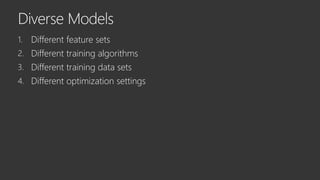
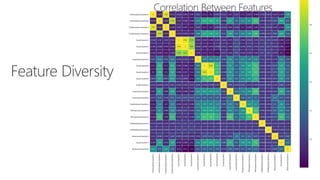
1. Different feature sets
2. Different training algorithms
3. Different training data sets
4. Different optimization settings
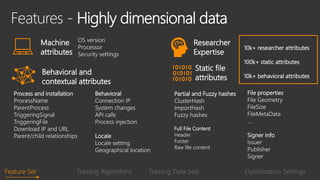
Process and installation
ProcessName
ParentProcess
TriggeringSignal
TriggeringFile
Download IP and URL
Parent/child relationships
Machine
attributes
Partial and Fuzzy hashes
ClusterHash
ImportHash
Fuzzy hashes
Full File Content
Header
Footer
Raw file content
File properties
File Geometry
FileSize
FileMetaData
….
Signer info
Issuer
Publisher
Signer
Behavioral
Connection IP
System changes
API calls
Process injection
Locale
Locale setting
Geographical location
Behavioral and
contextual attributes
Static file
attributes
OS version
Processor
Security settings
Features - Highly dimensional data
Researcher
Expertise
10k+ researcher attributes
100k+ static attributes
10k+ behavioral attributes
Feature Set Training Algorithms Training Data Sets Optimization Settings
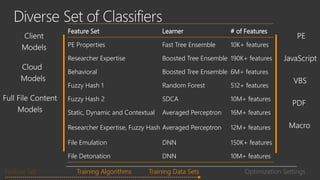
Feature Set Learner # of Features
PE Properties Fast Tree Ensemble 10K+ features
Researcher Expertise Boosted Tree Ensemble 190K+ features
Behavioral Boosted Tree Ensemble 6M+ features
Fuzzy Hash 1 Random Forest 512+ features
Fuzzy Hash 2 SDCA 10M+ features
Static, Dynamic and Contextual Averaged Perceptron 16M+ features
Researcher Expertise, Fuzzy Hash Averaged Perceptron 12M+ features
File Emulation DNN 150K+ features
File Detonation DNN 10M+ features
Feature Set Training Algorithms Training Data Sets Optimization Settings
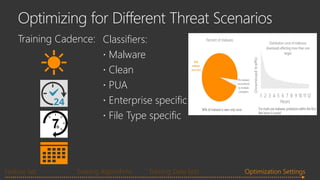
Training Cadence: Classifiers:
 Malware
 Clean
 PUA
 Enterprise specific
 File Type specific
Feature Set Training Algorithms Training Data Sets Optimization Settings
Ensemble ML Primer Diversity Requirements Developing the Model Testing the Model
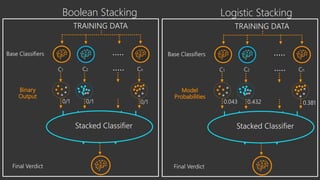
1. Boolean Stacking
2. Linear/ Logistic Stacking
Boolean Stacking
1
Binary
Output
1
Model
Probabilities
Logistic Stacking
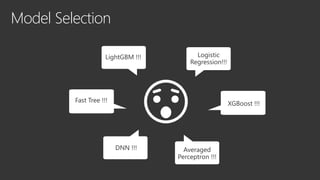
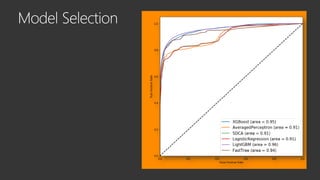
Model Selection
LightGBM !!!
Averaged
Perceptron !!!
Logistic
Regression!!!
Fast Tree !!! XGBoost !!!
DNN !!!
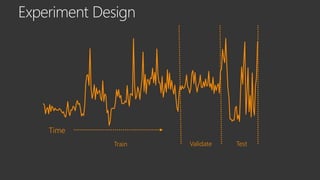
Train
Time
Validate Test
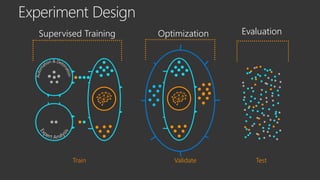
Supervised Training Optimization Evaluation
Train Validate Test
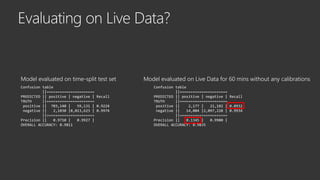
Model evaluated on time-split test set
Confusion table
||======================
PREDICTED || positive | negative | Recall
TRUTH ||======================
positive || 2,177 | 21,182 | 0.0932
negative || 14,004 |2,097,228 | 0.9934
||======================
Precision || 0.1345 | 0.9900 |
OVERALL ACCURACY: 0.9835
Model evaluated on Live Data for 60 mins without any calibrations
Confusion table
||======================
PREDICTED || positive | negative | Recall
TRUTH ||======================
positive || 703,140 | 59,131 | 0.9224
negative || 2,1030 |8,013,623 | 0.9974
||======================
Precision || 0.9710 | 0.9927 |
OVERALL ACCURACY: 0.9811
Ensemble ML Primer Diversity Requirements Developing the Model Testing the Model
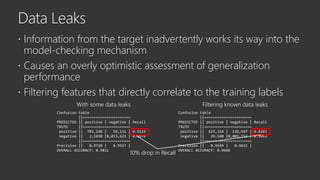
 Information from the target inadvertently works its way into the
model-checking mechanism
 Causes an overly optimistic assessment of generalization
performance
 Filtering features that directly correlate to the training labels
Confusion table
||======================
PREDICTED || positive | negative | Recall
TRUTH ||======================
positive || 703,140 | 59,131 | 0.9224
negative || 2,1030 |8,013,623 | 0.9974
||======================
Precision || 0.9710 | 0.9927 |
OVERALL ACCURACY: 0.9811
Confusion table
||======================
PREDICTED || positive | negative | Recall
TRUTH ||======================
positive || 625,324 | 136,947 | 0.8203
negative || 29,540 |8,005,113 | 0.9963
||======================
Precision || 0.9549 | 0.9832 |
OVERALL ACCURACY: 0.9668
With some data leaks Filtering known data leaks
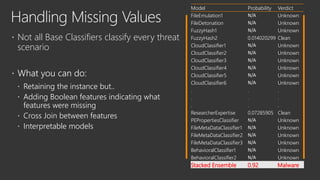
 Not all Base Classifiers classify every threat
scenario
 What you can do:
 Retaining the instance but..
 Adding Boolean features indicating what
features were missing
 Cross Join between features
 Interpretable models
Model Probability Verdict
FileEmulation1 N/A Unknown
FileDetonation N/A Unknown
FuzzyHash1 N/A Unknown
FuzzyHash2 0.014020299 Clean
CloudClassifier1 N/A Unknown
CloudClassifier2 N/A Unknown
CloudClassifier3 N/A Unknown
CloudClassifier4 N/A Unknown
CloudClassifier5 N/A Unknown
CloudClassifier6 N/A Unknown
. . .
. . .
. . .
ResearcherExpertise 0.07285905 Clean
PEPropertiesClassifier N/A Unknown
FileMetaDataClassifier1 N/A Unknown
FileMetaDataClassifier2 N/A Unknown
FileMetaDataClassifier3 N/A Unknown
BehavioralClassifier1 N/A Unknown
BehavioralClassifier2 N/A Unknown
Stacked Ensemble 0.92 Malware
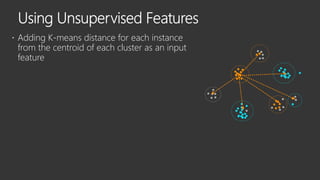
 Adding K-means distance for each instance
from the centroid of each cluster as an input
feature
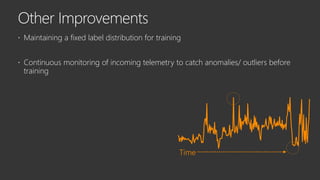
 Maintaining a fixed label distribution for training
 Continuous monitoring of incoming telemetry to catch anomalies/ outliers before
training
Time
evaluate on
Cloud
Client
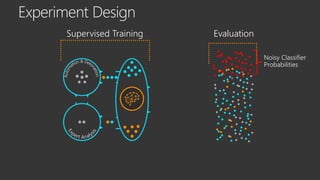
Supervised Training Evaluation
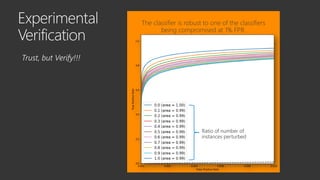
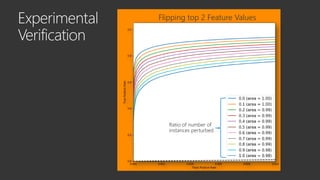
Ratio of number of
instances perturbed
The classifier is robust to one of the classifiers
being compromised at 1% FPR.
train
Machine
attributes
Dynamic and
contextual
attributes
Static file
attributes
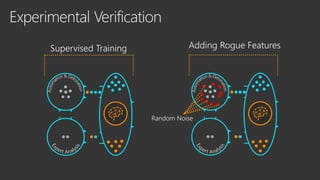
Example: Averaged perceptron
model with > .90 probability =
0.0001% false positive rate
Cloud
Client
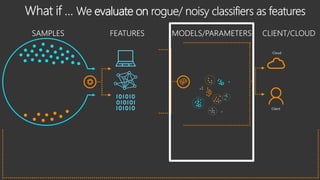
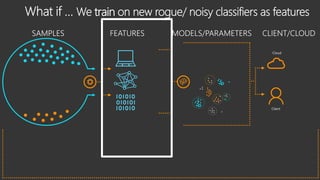
Supervised Training Adding Rogue Features
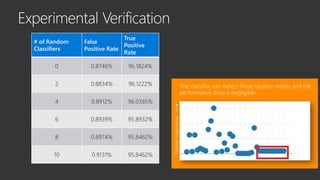
# of Random
Classifiers
False
Positive Rate
True
Positive
Rate
0 0.8746% 96.1824%
2 0.8834% 96.1222%
4 0.8912% 96.0385%
6 0.8939% 95.8932%
8 0.8974% 95.8462%
10 0.9131% 95.8462%
The classifier can detect these random noises and the
performance drop is negligible.
Machine
attributes
Dynamic and
contextual
attributes
Static file
attributes
Example: Averaged perceptron
model with > .90 probability =
0.0001% false positive rate
Cloud
Client
Ratio of number of
instances perturbed
Flipping top 2 Feature Values
Cloud
Client
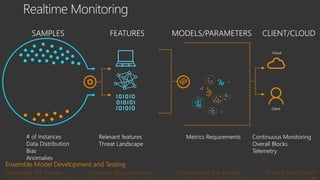
# of Instances
Data Distribution
Bias
Anomalies
Metrics Requirements Continuous Monitoring
Overall Blocks
Telemetry
Relevant features
Threat Landscape
Ensemble Model Development and Testing
Ensemble ML Primer Diversity Requirements Developing the Model Testing the Model
Introduction ML Primer Adversarial Examples Ensemble Model Development and Testing ResultsEnsemble Model Development and Testing
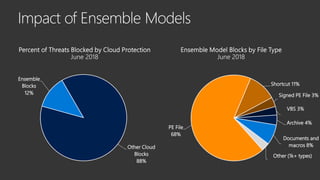
Other Cloud
Blocks
88%
Ensemble
Blocks
12%
Archive 4%
Documents and
macros 8%
Other (1k+ types)
PE File
68%
Shortcut 11%
Signed PE File 3%
VBS 3%
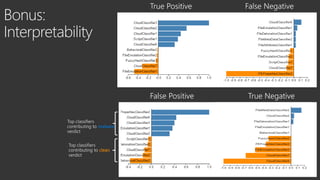
malware
clean
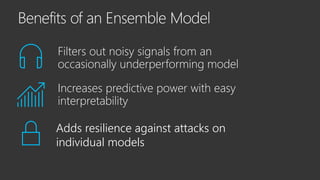
Filters out noisy signals from an
occasionally underperforming model
Increases predictive power with easy
interpretability
Adds resilience against attacks on
individual models
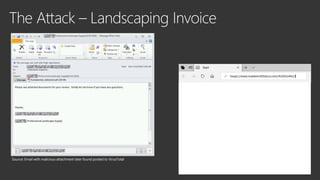
 Small-scale attack in Central and Western Canada
 Most targets reached within 5 ½ hours
 73% of targets were commercial businesses
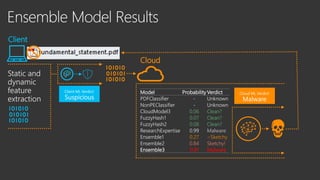
Model Probability Verdict
PDFClassifier - Unknown
NonPEClassifier - Unknown
CloudModel3 0.06 Clean?
FuzzyHash1 0.07 Clean?
FuzzyHash2 0.08 Clean?
ResearchExpertise 0.99 Malware
Ensemble1 0.27 ~Sketchy
Ensemble2 0.84 Sketchy!
Ensemble3 0.91 Malware
Client
Cloud
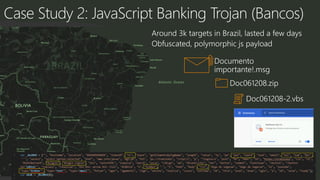
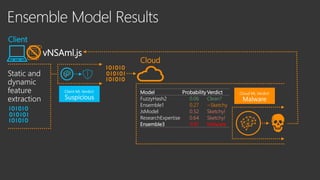
Model Probability Verdict
FuzzyHash2 0.06 Clean?
Ensemble1 0.27 ~Sketchy
JsModel 0.52 Sketchy!
ResearchExpertise 0.64 Sketchy!
Ensemble3 0.91 Malware
Client
Cloud
vNSAml.js
 Daewoo Chong (Windows Defender ATP Research)
 Christian Seifert (Windows Defender ATP Research)
 Allan Sepillo (Windows Defender ATP Research)
 Bhavna Soman (Windows Defender ATP Research)
 Jay Stokes (Microsoft Research)
 Maria Vlachopoulou (Windows Defender ATP Research)
 Samuel Wakasugui (Windows Defender ATP Research)
Today’s presentation
All data and charts, unless otherwise noted, is from Microsoft.
Preso: https://www.blackhat.com/us-18/briefings/schedule/index.html#protecting-the-protector-hardening-machine-learning-defenses-
against-adversarial-attacks-11669
Blog: https://aka.ms/hardening-ML
Upcoming conference presentations
Virus Bulletin 2018 (Montreal): Starving malware authors through dynamic classification
Karishma Sanghvi (Microsoft), Joe Blackbird (Microsoft)
Blog Posts and Other References
Antivirus evolved
Windows Defender Antivirus cloud protection service: Advanced real-time defense against never-before-seen malware
Detonating a bad rabbit: Windows Defender Antivirus and layered machine learning defenses
How artificial intelligence stopped an Emotet outbreak
Behavior monitoring combined with machine learning spoils a massive Dofoil coin mining campaign
Machine Learning vs. Social Engineering
Whitepaper: The Evolution of Malware Prevention
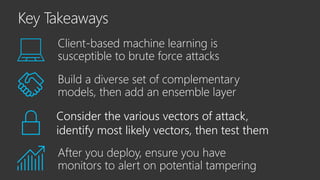
Client-based machine learning is
susceptible to brute force attacks
After you deploy, ensure you have
monitors to alert on potential tampering
Consider the various vectors of attack,
identify most likely vectors, then test them
Build a diverse set of complementary
models, then add an ensemble layer
adversarialml@microsoft.com

Protecting the Protector, Hardening Machine Learning Defenses Against Adversarial Attacks

  • 1.
    Jugal Parikh, SeniorData Scientist Holly Stewart, Principal Research Manager Randy Treit, Senior Researcher
  • 4.
    W i nd o w s D e f e n d e r E n d p o i n t P r o t e c t i o n E n d p o i n t P r o t e c t i o n Blocks low reputation web downloads Blocks malicious websites W i n d o w s D e f e n d e r E n d p o i n t D e t e c t i o n a n d R e s p o n s e D e t e c t i o n a n d R e m e d i a t i o n After execution - Windows Defender ATP monitors for post-breach signals After execution - Windows Defender Hexadite can reverse damage Blocks malicious programs and content (scripts, docs, etc.) W i n d o w s D e f e n d e r S m a r t S c r e e n Monitors behaviors and terminates bad processes Introduction ML Primer Adversarial Examples Ensemble Model Development and Testing Results
  • 5.
    T h re a t P r e d i c t R e s e a r c h T e a m Cloud Client O u r f o c u s : U s e m a c h i n e l e a r n i n g t o b l o c k a t t a c k s f o r W i n d o w s D e f e n d e r A T P
  • 6.
    Introduction ML PrimerAdversarial Examples Ensemble Model Development and Testing Results
  • 7.
    UNKNOWN UNKNOWNSEXPERTS→ LABELS→ML→ PREDICTIONS ANOMALY DETECTION SUPERVISED UNSUPERVISED
  • 8.
    EXPERTS→ LABELS→ ML→PREDICTIONS SUPERVISED
  • 10.
  • 11.
    No private brute forcing Minimalclient performance impact
  • 12.
    Introduction ML PrimerAdversarial Examples Ensemble Model Development and Testing Results
  • 13.
    Machine attributes Dynamic and contextual attributes Static file attributes Example:Averaged perceptron model with > .90 probability = 0.0001% false positive rate Cloud Client
  • 14.
    Immunity from antimalwareautomation attacks
  • 15.
     Synthetic trafficdesigned to quickly gain reputation on a digital certificate  Targeted Windows 8  Originally surfaced as a high percentage of traffic that wasn’t classified  Low-volume and unsigned file attacks were also identified during investigation 30% 40% 50% 60% 70% 80% 90% 100% 2/15 2/17 2/19 2/21 2/23 2/25 2/27 2/29 3/2 3/4 3/6 3/8 3/10 3/12 3/14 Percent Classified Traffic Win10 Win8 Win7
  • 16.
     Attackers guessedmajor features (time, traffic, digital certificate)  Team developed complementary models with additional features that filtered fake traffic out of telemetry  Combination of models removed attack traffic from training data 60% 65% 70% 75% 80% 85% 90% 95% 100% 2/7/2017 2/12/2017 2/17/2017 2/22/2017 2/27/2017 3/4/2017 3/9/2017 3/14/2017 3/19/2017 3/24/2017 3/29/2017 4/3/2017 4/8/2017 4/13/2017 4/18/2017 4/23/2017 4/28/2017 5/3/2017 Percent Classified with and without Complementary Models
  • 17.
     Research onadversarial attacks against deep learning classifiers  Showed that an ensemble of classifiers helped defend against the attacks tested in the paper  See more at: Attack and Defense of Dynamic Analysis-Based, Adversarial Neural Malware Classification Models Jack W. Stokes, De Wang, Mady Marinescu, Marc Marino, Brian Bussone https://arxiv.org/abs/1712.05919 Introduction ML Primer Adversarial Examples Ensemble Model Development and Testing ResultsEnsemble Model Development and Testing
  • 18.
    Ensemble Model Developmentand Testing Ensemble ML Primer Diversity Requirements Developing the Model Testing the Model
  • 19.
    1 1 Wolpert, David H."Stacked generalization." Neural networks 5.2 (1992): 241-259.
  • 20.
    Dealing with:  Activeadversarial  Volatility/ Covariate Shift  Noisy environment Scale:  Petabytes of threat Intelligence daily Evaluate:  ~2.3 Billion global queries everyday
  • 21.
    Ensemble ML PrimerDiversity Requirements Developing the Model Testing the Model
  • 22.
    1. Different featuresets 2. Different training algorithms 3. Different training data sets 4. Different optimization settings
  • 23.
    Process and installation ProcessName ParentProcess TriggeringSignal TriggeringFile DownloadIP and URL Parent/child relationships Machine attributes Partial and Fuzzy hashes ClusterHash ImportHash Fuzzy hashes Full File Content Header Footer Raw file content File properties File Geometry FileSize FileMetaData …. Signer info Issuer Publisher Signer Behavioral Connection IP System changes API calls Process injection Locale Locale setting Geographical location Behavioral and contextual attributes Static file attributes OS version Processor Security settings Features - Highly dimensional data Researcher Expertise 10k+ researcher attributes 100k+ static attributes 10k+ behavioral attributes Feature Set Training Algorithms Training Data Sets Optimization Settings
  • 24.
    Feature Set Learner# of Features PE Properties Fast Tree Ensemble 10K+ features Researcher Expertise Boosted Tree Ensemble 190K+ features Behavioral Boosted Tree Ensemble 6M+ features Fuzzy Hash 1 Random Forest 512+ features Fuzzy Hash 2 SDCA 10M+ features Static, Dynamic and Contextual Averaged Perceptron 16M+ features Researcher Expertise, Fuzzy Hash Averaged Perceptron 12M+ features File Emulation DNN 150K+ features File Detonation DNN 10M+ features Feature Set Training Algorithms Training Data Sets Optimization Settings
  • 25.
    Training Cadence: Classifiers: Malware  Clean  PUA  Enterprise specific  File Type specific Feature Set Training Algorithms Training Data Sets Optimization Settings
  • 27.
    Ensemble ML PrimerDiversity Requirements Developing the Model Testing the Model
  • 28.
    1. Boolean Stacking 2.Linear/ Logistic Stacking
  • 29.
  • 30.
    Model Selection LightGBM !!! Averaged Perceptron!!! Logistic Regression!!! Fast Tree !!! XGBoost !!! DNN !!!
  • 31.
  • 32.
    Supervised Training OptimizationEvaluation Train Validate Test
  • 36.
    Model evaluated ontime-split test set Confusion table ||====================== PREDICTED || positive | negative | Recall TRUTH ||====================== positive || 2,177 | 21,182 | 0.0932 negative || 14,004 |2,097,228 | 0.9934 ||====================== Precision || 0.1345 | 0.9900 | OVERALL ACCURACY: 0.9835 Model evaluated on Live Data for 60 mins without any calibrations Confusion table ||====================== PREDICTED || positive | negative | Recall TRUTH ||====================== positive || 703,140 | 59,131 | 0.9224 negative || 2,1030 |8,013,623 | 0.9974 ||====================== Precision || 0.9710 | 0.9927 | OVERALL ACCURACY: 0.9811
  • 37.
    Ensemble ML PrimerDiversity Requirements Developing the Model Testing the Model
  • 38.
     Information fromthe target inadvertently works its way into the model-checking mechanism  Causes an overly optimistic assessment of generalization performance  Filtering features that directly correlate to the training labels Confusion table ||====================== PREDICTED || positive | negative | Recall TRUTH ||====================== positive || 703,140 | 59,131 | 0.9224 negative || 2,1030 |8,013,623 | 0.9974 ||====================== Precision || 0.9710 | 0.9927 | OVERALL ACCURACY: 0.9811 Confusion table ||====================== PREDICTED || positive | negative | Recall TRUTH ||====================== positive || 625,324 | 136,947 | 0.8203 negative || 29,540 |8,005,113 | 0.9963 ||====================== Precision || 0.9549 | 0.9832 | OVERALL ACCURACY: 0.9668 With some data leaks Filtering known data leaks
  • 39.
     Not allBase Classifiers classify every threat scenario  What you can do:  Retaining the instance but..  Adding Boolean features indicating what features were missing  Cross Join between features  Interpretable models Model Probability Verdict FileEmulation1 N/A Unknown FileDetonation N/A Unknown FuzzyHash1 N/A Unknown FuzzyHash2 0.014020299 Clean CloudClassifier1 N/A Unknown CloudClassifier2 N/A Unknown CloudClassifier3 N/A Unknown CloudClassifier4 N/A Unknown CloudClassifier5 N/A Unknown CloudClassifier6 N/A Unknown . . . . . . . . . ResearcherExpertise 0.07285905 Clean PEPropertiesClassifier N/A Unknown FileMetaDataClassifier1 N/A Unknown FileMetaDataClassifier2 N/A Unknown FileMetaDataClassifier3 N/A Unknown BehavioralClassifier1 N/A Unknown BehavioralClassifier2 N/A Unknown Stacked Ensemble 0.92 Malware
  • 40.
     Adding K-meansdistance for each instance from the centroid of each cluster as an input feature
  • 41.
     Maintaining afixed label distribution for training  Continuous monitoring of incoming telemetry to catch anomalies/ outliers before training Time
  • 43.
  • 44.
  • 45.
    Ratio of numberof instances perturbed The classifier is robust to one of the classifiers being compromised at 1% FPR.
  • 46.
    train Machine attributes Dynamic and contextual attributes Static file attributes Example:Averaged perceptron model with > .90 probability = 0.0001% false positive rate Cloud Client
  • 47.
  • 48.
    # of Random Classifiers False PositiveRate True Positive Rate 0 0.8746% 96.1824% 2 0.8834% 96.1222% 4 0.8912% 96.0385% 6 0.8939% 95.8932% 8 0.8974% 95.8462% 10 0.9131% 95.8462% The classifier can detect these random noises and the performance drop is negligible.
  • 49.
    Machine attributes Dynamic and contextual attributes Static file attributes Example:Averaged perceptron model with > .90 probability = 0.0001% false positive rate Cloud Client
  • 51.
    Ratio of numberof instances perturbed Flipping top 2 Feature Values
  • 53.
    Cloud Client # of Instances DataDistribution Bias Anomalies Metrics Requirements Continuous Monitoring Overall Blocks Telemetry Relevant features Threat Landscape Ensemble Model Development and Testing Ensemble ML Primer Diversity Requirements Developing the Model Testing the Model
  • 54.
    Introduction ML PrimerAdversarial Examples Ensemble Model Development and Testing ResultsEnsemble Model Development and Testing
  • 55.
    Other Cloud Blocks 88% Ensemble Blocks 12% Archive 4% Documentsand macros 8% Other (1k+ types) PE File 68% Shortcut 11% Signed PE File 3% VBS 3%
  • 56.
  • 57.
    Filters out noisysignals from an occasionally underperforming model Increases predictive power with easy interpretability Adds resilience against attacks on individual models
  • 59.
     Small-scale attackin Central and Western Canada  Most targets reached within 5 ½ hours  73% of targets were commercial businesses
  • 61.
    Model Probability Verdict PDFClassifier- Unknown NonPEClassifier - Unknown CloudModel3 0.06 Clean? FuzzyHash1 0.07 Clean? FuzzyHash2 0.08 Clean? ResearchExpertise 0.99 Malware Ensemble1 0.27 ~Sketchy Ensemble2 0.84 Sketchy! Ensemble3 0.91 Malware Client Cloud
  • 63.
    Model Probability Verdict FuzzyHash20.06 Clean? Ensemble1 0.27 ~Sketchy JsModel 0.52 Sketchy! ResearchExpertise 0.64 Sketchy! Ensemble3 0.91 Malware Client Cloud vNSAml.js
  • 65.
     Daewoo Chong(Windows Defender ATP Research)  Christian Seifert (Windows Defender ATP Research)  Allan Sepillo (Windows Defender ATP Research)  Bhavna Soman (Windows Defender ATP Research)  Jay Stokes (Microsoft Research)  Maria Vlachopoulou (Windows Defender ATP Research)  Samuel Wakasugui (Windows Defender ATP Research)
  • 66.
    Today’s presentation All dataand charts, unless otherwise noted, is from Microsoft. Preso: https://www.blackhat.com/us-18/briefings/schedule/index.html#protecting-the-protector-hardening-machine-learning-defenses- against-adversarial-attacks-11669 Blog: https://aka.ms/hardening-ML Upcoming conference presentations Virus Bulletin 2018 (Montreal): Starving malware authors through dynamic classification Karishma Sanghvi (Microsoft), Joe Blackbird (Microsoft) Blog Posts and Other References Antivirus evolved Windows Defender Antivirus cloud protection service: Advanced real-time defense against never-before-seen malware Detonating a bad rabbit: Windows Defender Antivirus and layered machine learning defenses How artificial intelligence stopped an Emotet outbreak Behavior monitoring combined with machine learning spoils a massive Dofoil coin mining campaign Machine Learning vs. Social Engineering Whitepaper: The Evolution of Malware Prevention
  • 67.
    Client-based machine learningis susceptible to brute force attacks After you deploy, ensure you have monitors to alert on potential tampering Consider the various vectors of attack, identify most likely vectors, then test them Build a diverse set of complementary models, then add an ensemble layer
  • 68.