
Music Theory
& Keyboard
Skills
Polyrhythms
musicstudentinfo.com
Christopher Baker
Polyrhythm
Definition
Polyrhythm is the simultaneous use of two or
more rhythms that are not readily perceived as
deriving from one another.
Polyrhythms require at least two rhythms to be
played concurrently
The rhythmic layers may be the basis of an entire
piece of music, or a momentary section.
Rhythmic
Layering
• Simply put, a polyrhythm consists of layers of
simpler rhythms. More than one type of rhythm
is played at the same time, with each rhythm
containing a different beat subdivision.
• The rhythmic tension and release found in
polyrhythms makes them danceable, aurally
interesting, and more expressive than your
typical four-on-the-floor rhythm.
3:2 Polyrhythm or Hemiola
• 3:2 polyrhythm: Known as hemiola, this triple-over-
duple polyrhythm involves a three-note rhythm held over
a two-note rhythmic pattern.
• Typically, this involves triplets over quarter notes or eighth
notes.
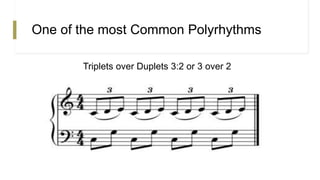
One of the most Common Polyrhythms
Triplets over Duplets 3:2 or 3 over 2
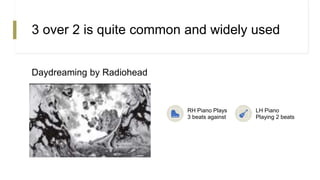
3 over 2 is quite common and widely used
Daydreaming by Radiohead
RH Piano Plays
3 beats against
LH Piano
Playing 2 beats
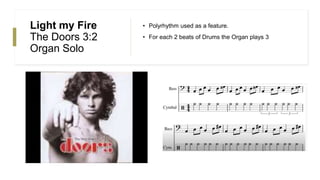
Light my Fire
The Doors 3:2
Organ Solo
• Polyrhythm used as a feature.
• For each 2 beats of Drums the Organ plays 3
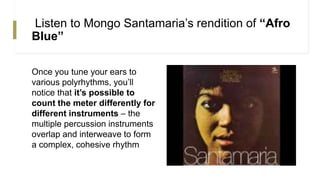
Listen to Mongo Santamaria’s rendition of “Afro
Blue”
Once you tune your ears to
various polyrhythms, you’ll
notice that it’s possible to
count the meter differently for
different instruments – the
multiple percussion instruments
overlap and interweave to form
a complex, cohesive rhythm
African Origins
• Most polyrhythms originated in the musical traditions of Africa.
• The organic, complex rhythms served an important social purpose: they are a musical
symbol of the relationships between people that combine to build the cohesive cultural
expression of a community.
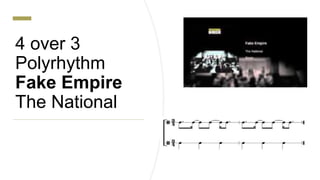
4 over 3
Polyrhythm
Fake Empire
The National
Play & Count Aloud 1 e + d, 2 e & d, 3 e & d
Practicing basic polyrhythms will help improve your
musicianship.
1. First, tap your foot to the quarter-
note beat
2. tap and count 1 e & d, 2 3 & d,
3. tap and count Ba ta ta, Ba ta ta
4. playing both simultaneously will
give a 4 over 3 Polyrhythm
5. Stop saying the “ta”s and just say
the “BA”s, still tapping your foot to the
quarter note, you’re playing the
four-against-three polyrhythm!
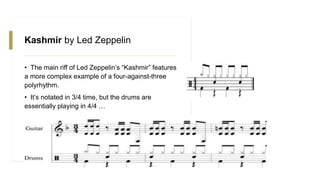
Kashmir by Led Zeppelin
• The main riff of Led Zeppelin’s “Kashmir” features
a more complex example of a four-against-three
polyrhythm.
• It’s notated in 3/4 time, but the drums are
essentially playing in 4/4 …
Kashmir by Led Zeppelin
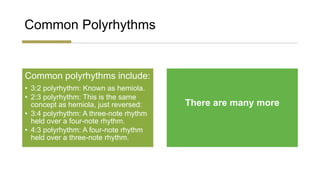
Common Polyrhythms
Common polyrhythms include:
• 3:2 polyrhythm: Known as hemiola.
• 2:3 polyrhythm: This is the same
concept as hemiola, just reversed:
• 3:4 polyrhythm: A three-note rhythm
held over a four-note rhythm.
• 4:3 polyrhythm: A four-note rhythm
held over a three-note rhythm.
There are many more
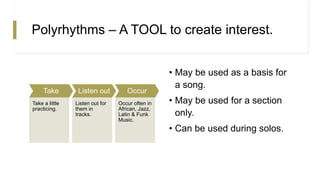
Polyrhythms – A TOOL to create interest.
Take
Take a little
practicing.
Listen out
Listen out for
them in
tracks.
Occur
Occur often in
African, Jazz,
Latin & Funk
Music.
• May be used as a basis for
a song.
• May be used for a section
only.
• Can be used during solos.
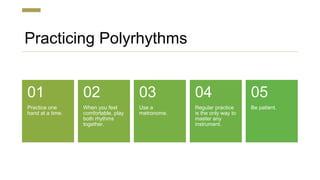
Practicing Polyrhythms
Practice one
hand at a time.
01
When you feel
comfortable, play
both rhythms
together.
02
Use a
metronome.
03
Regular practice
is the only way to
master any
instrument.
04
Be patient.
05

Polyrhythms.pptx

  • 1.
  • 2.
    Polyrhythm Definition Polyrhythm is thesimultaneous use of two or more rhythms that are not readily perceived as deriving from one another. Polyrhythms require at least two rhythms to be played concurrently The rhythmic layers may be the basis of an entire piece of music, or a momentary section.
  • 3.
    Rhythmic Layering • Simply put,a polyrhythm consists of layers of simpler rhythms. More than one type of rhythm is played at the same time, with each rhythm containing a different beat subdivision. • The rhythmic tension and release found in polyrhythms makes them danceable, aurally interesting, and more expressive than your typical four-on-the-floor rhythm.
  • 4.
    3:2 Polyrhythm orHemiola • 3:2 polyrhythm: Known as hemiola, this triple-over- duple polyrhythm involves a three-note rhythm held over a two-note rhythmic pattern. • Typically, this involves triplets over quarter notes or eighth notes.
  • 5.
    One of themost Common Polyrhythms Triplets over Duplets 3:2 or 3 over 2
  • 6.
    3 over 2is quite common and widely used Daydreaming by Radiohead RH Piano Plays 3 beats against LH Piano Playing 2 beats
  • 7.
    Light my Fire TheDoors 3:2 Organ Solo • Polyrhythm used as a feature. • For each 2 beats of Drums the Organ plays 3
  • 8.
    Listen to MongoSantamaria’s rendition of “Afro Blue” Once you tune your ears to various polyrhythms, you’ll notice that it’s possible to count the meter differently for different instruments – the multiple percussion instruments overlap and interweave to form a complex, cohesive rhythm
  • 9.
    African Origins • Mostpolyrhythms originated in the musical traditions of Africa. • The organic, complex rhythms served an important social purpose: they are a musical symbol of the relationships between people that combine to build the cohesive cultural expression of a community.
  • 10.
    4 over 3 Polyrhythm FakeEmpire The National
  • 11.
    Play & CountAloud 1 e + d, 2 e & d, 3 e & d Practicing basic polyrhythms will help improve your musicianship. 1. First, tap your foot to the quarter- note beat 2. tap and count 1 e & d, 2 3 & d, 3. tap and count Ba ta ta, Ba ta ta 4. playing both simultaneously will give a 4 over 3 Polyrhythm 5. Stop saying the “ta”s and just say the “BA”s, still tapping your foot to the quarter note, you’re playing the four-against-three polyrhythm!
  • 12.
    Kashmir by LedZeppelin • The main riff of Led Zeppelin’s “Kashmir” features a more complex example of a four-against-three polyrhythm. • It’s notated in 3/4 time, but the drums are essentially playing in 4/4 …
  • 13.
  • 14.
    Common Polyrhythms Common polyrhythmsinclude: • 3:2 polyrhythm: Known as hemiola. • 2:3 polyrhythm: This is the same concept as hemiola, just reversed: • 3:4 polyrhythm: A three-note rhythm held over a four-note rhythm. • 4:3 polyrhythm: A four-note rhythm held over a three-note rhythm. There are many more
  • 15.
    Polyrhythms – ATOOL to create interest. Take Take a little practicing. Listen out Listen out for them in tracks. Occur Occur often in African, Jazz, Latin & Funk Music. • May be used as a basis for a song. • May be used for a section only. • Can be used during solos.
  • 16.
    Practicing Polyrhythms Practice one handat a time. 01 When you feel comfortable, play both rhythms together. 02 Use a metronome. 03 Regular practice is the only way to master any instrument. 04 Be patient. 05