Chemtronics Solution
Enhance
Indoor Air Quality
&
Reduce
Sick Building Syndrome
Indoor Air Quality - IAQ
3
Indoor Air Quality Concern
Indoor Air Quality (IAQ) is an important determinant of individual’s
performance, health and well being.
This is because people spend most of their time in indoor then
out door
Results of numerous studies have demonstrated that Building
Related Symptoms (BRS) can adversely affect efficiency,
productivity and occupant well being.
4
Studies on IAQ
 Indoor Environment contains variety of visible & invisible
contaminants
 Airborne diseases are 2 to10 times higher in indoor then outdoor
 Fresh Air is restricted in closed environment of doubled glass
buildings
 Lack of fresh air intake
 increased use of artificial synthetic building materials
5
Indoor Air Contaminations
 VOC
 ODOR
 SMOKE
 DUST
 CO2
 FUNGUS, MOLD AND MICROBES
 AIR BORNE BACTERIA
6
VOC CONSTITUENTS
There are more than 100 known VOCs
 Most VOC are Hydro Carbon
 Contain Carbon, Hydrogen & Oxygen
 Susceptible to Oxidization
 Oxidization Reduces these to
O2, H2O, & CO2
7
SOURCE OF VOC
 Body Excretions
 Furniture
 Paints, Varnish & Polish
 Sticking chemicals
 Carpets
 Stationary, Printers & Copiers
 Cooking
 Aerosols & Cleaning Chemicals
 Pest control chemical
8
ODOR
ODOR IS MAJOR IRRITANT
 TRANSIENT ODOR (Instantaneous)
 RESIDUAL ODOR (Retained Odor)
Residual odor - Difficult to Remove by Conventional Methods
9
SOURCE OF ODOR
 Food odor
 Body odor
 Cigarette Smoke
 Odor from footwear
 Carpet
 Furniture Glue
 Synthetic Material
 Paint, varnish, polish
 Cleaning Chemicals
 Burnt rubber, plastic, wood, wire
 Dead rodent, bird, insects
 STP
 Odor & Toxicity from outdoor FA
 Mold, Fungi & Microbes
 Pest control chemicals
10
SOURCE OF FUNGS, MOLD & MICROBES
 Visitors
 AHU Ducts
 Humidity
 Damp Carpets, walls, ceilings, upholsteries
 Moist areas
 Dirty Footwear
 Occupants
 Insects, pest, rodents
11
CO2
CO2 IS NOT
VOC Toxic Carcinogenic Odorous
High level of CO2 can Cause
Headaches | Restlessness | Reduced Concentration | Tiredness
Fatigue| Lethargy | Reduced Tolerance | Irritability | Difficulty
in Breathing | Sweating | Increased Heart Rate | Elevated
Blood Pressure
12
SOURCE OF CO2
In an indoor environment human being exhale CO2
Carbon Dioxide cannot be
filtered, adsorbed, reduced or oxidized.
Carbon Dioxide has to be neutralized with
oxygen
13
These are collectively known as
“ SICK BUILDING SYNDROMES ”
14
• Headache, Reduced Concentration
• Reduced Tolerance, Irritability, Restlessness
• Eye Irritation, Eye watering
• Asthma, Nose & Throat Irritation, Cold & Cough
• Increased Heart Rate, Elevated Blood Pressure
• Verity of Allergies, General Fatigue, Sweating, Lethargy
Sick Building Syndromes are
15
 Reduce VOC
Reduce / Remove Odor
Reduce / Eliminate Fungus, Mold
Reduce / Eliminate Airborne Bacteria & Viruses
Lower / Maintain Carbon Dioxide levels
TO ADDRESS “SBS”
16
To reduce Sick Building Syndrome (SBS)
&
Enhance Indoor Air Quality (IAQ)
Outdoor Fresh air is taken by AHU System
CONVENTIONAL SOLUTION
17
 Oxidation VOC & Odor
 Lower /Maintain CO₂ up to
desired level
ROLE OF OUTDOOR FRESH AIR
Oxidation
75%
CO₂
25%
Role of Fresh Air
Oxygen in fresh air is Oxidizing agent; 75% of
Oxygen in fresh air is consumed for Oxidation
25% of Oxygen in fresh air is consumed to
neutralize CO₂
18
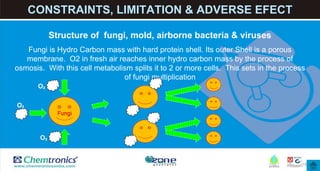
Structure of fungi, mold, airborne bacteria & viruses
Fungi is Hydro Carbon mass with hard protein shell. Its outer Shell is a porous
membrane. O2 in fresh air reaches inner hydro carbon mass by the process of
osmosis. With this cell metabolism splits it to 2 or more cells. This sets in the process
of fungi multiplication
CONSTRAINTS, LIMITATION & ADVERSE EFECT
Fungi
O₂
O₂
O₂
19
Fresh Air Is Not Cheap
Increase in fresh air significantly increases the Air conditioning load.
CONSTRAINTS, LIMITATION & ADVERSE EFECT
20
Controlled Injection Of
“ Medical grade Ozone ”
in AHU System
Chemtronics SOLUTION
21
VOC & Odor :
Ozone is more powerful oxidizing agent then Oxygen;
Thus VOCs , Odor & pollutants are efficiently oxidized
&
60 – 70 % of oxygen in fresh air is conserved.
Advantages of Ozone Injection
Fungi & Mold :
Ozone (Even in low concentration), interferes with the
process of cell metabolism. This Retards the Process of
Fungi & mold multiplication. Over the period of time, Fungi &
microbes Colony Depletes
Reaching Near Total Elimination
22
Advantages of Ozone Injection
23
Airborne Bacteria & Viruses :
Ozone kills (Oxidizes) bacteria & Viruses almost instantly. Also fungi
in ducts & coil Provide Food & Nutrients for Air Borne Bacteria to
Grow & Propagate; Ducts, Coil, AHU are Breeding Grounds for
Bacteria, When Mold & Fungi Are Eliminated, Food & Nutrients to Air
Borne Bacteria & viruses is Deprived
Results in Dramatic Reduction in Air Borne
Bacteria
Advantages of Ozone Injection
24
Dust (SPM) :
For Any Object (dust / suspended particulate matter) to Adhere, Force
of Adhesion is Necessary. In AC Duct, Air Travels at Velocity of 1200
to 1500 FPM (365 to 450 M/Min). There Should be Compelling
Reason for Dust to Depart this high Velocity Stream and Adhere to
Duct Surface. This is Due To Bio Adhesive Force Provided by Fungi
Results in Reduction in Suspended Particulate matters
Advantages of Ozone Injection
25
Carbon Dioxide :
When 60 – 70 % of oxygen in fresh air is conserved using
ozone injection in AHU. More oxygen is now available to
neutralize carbon dioxide.
This lowers CO₂ levels very significantly.
Advantages of Ozone Injection
26
These multiple effects of Ozone brings
“ Freshness in the closed environment ”
Completely Eliminates
“ SICK BUILDING SYNDROME ”
& Greatly Enhances
“ Indoor Air Quality ”
27
Specified Max. IAQ of CO2
28
Thank You,
For Your Precious Time
End Of Slide Show
For more information visit :
www.chemtronicsindia.com
www.ozonegeneratorindia.com

Indoor Air Quality - IAQ & SBS

  • 1.
    Chemtronics Solution Enhance Indoor AirQuality & Reduce Sick Building Syndrome
  • 2.
  • 3.
    3 Indoor Air QualityConcern Indoor Air Quality (IAQ) is an important determinant of individual’s performance, health and well being. This is because people spend most of their time in indoor then out door Results of numerous studies have demonstrated that Building Related Symptoms (BRS) can adversely affect efficiency, productivity and occupant well being.
  • 4.
    4 Studies on IAQ Indoor Environment contains variety of visible & invisible contaminants  Airborne diseases are 2 to10 times higher in indoor then outdoor  Fresh Air is restricted in closed environment of doubled glass buildings  Lack of fresh air intake  increased use of artificial synthetic building materials
  • 5.
    5 Indoor Air Contaminations VOC  ODOR  SMOKE  DUST  CO2  FUNGUS, MOLD AND MICROBES  AIR BORNE BACTERIA
  • 6.
    6 VOC CONSTITUENTS There aremore than 100 known VOCs  Most VOC are Hydro Carbon  Contain Carbon, Hydrogen & Oxygen  Susceptible to Oxidization  Oxidization Reduces these to O2, H2O, & CO2
  • 7.
    7 SOURCE OF VOC Body Excretions  Furniture  Paints, Varnish & Polish  Sticking chemicals  Carpets  Stationary, Printers & Copiers  Cooking  Aerosols & Cleaning Chemicals  Pest control chemical
  • 8.
    8 ODOR ODOR IS MAJORIRRITANT  TRANSIENT ODOR (Instantaneous)  RESIDUAL ODOR (Retained Odor) Residual odor - Difficult to Remove by Conventional Methods
  • 9.
    9 SOURCE OF ODOR Food odor  Body odor  Cigarette Smoke  Odor from footwear  Carpet  Furniture Glue  Synthetic Material  Paint, varnish, polish  Cleaning Chemicals  Burnt rubber, plastic, wood, wire  Dead rodent, bird, insects  STP  Odor & Toxicity from outdoor FA  Mold, Fungi & Microbes  Pest control chemicals
  • 10.
    10 SOURCE OF FUNGS,MOLD & MICROBES  Visitors  AHU Ducts  Humidity  Damp Carpets, walls, ceilings, upholsteries  Moist areas  Dirty Footwear  Occupants  Insects, pest, rodents
  • 11.
    11 CO2 CO2 IS NOT VOCToxic Carcinogenic Odorous High level of CO2 can Cause Headaches | Restlessness | Reduced Concentration | Tiredness Fatigue| Lethargy | Reduced Tolerance | Irritability | Difficulty in Breathing | Sweating | Increased Heart Rate | Elevated Blood Pressure
  • 12.
    12 SOURCE OF CO2 Inan indoor environment human being exhale CO2 Carbon Dioxide cannot be filtered, adsorbed, reduced or oxidized. Carbon Dioxide has to be neutralized with oxygen
  • 13.
    13 These are collectivelyknown as “ SICK BUILDING SYNDROMES ”
  • 14.
    14 • Headache, ReducedConcentration • Reduced Tolerance, Irritability, Restlessness • Eye Irritation, Eye watering • Asthma, Nose & Throat Irritation, Cold & Cough • Increased Heart Rate, Elevated Blood Pressure • Verity of Allergies, General Fatigue, Sweating, Lethargy Sick Building Syndromes are
  • 15.
    15  Reduce VOC Reduce/ Remove Odor Reduce / Eliminate Fungus, Mold Reduce / Eliminate Airborne Bacteria & Viruses Lower / Maintain Carbon Dioxide levels TO ADDRESS “SBS”
  • 16.
    16 To reduce SickBuilding Syndrome (SBS) & Enhance Indoor Air Quality (IAQ) Outdoor Fresh air is taken by AHU System CONVENTIONAL SOLUTION
  • 17.
    17  Oxidation VOC& Odor  Lower /Maintain CO₂ up to desired level ROLE OF OUTDOOR FRESH AIR Oxidation 75% CO₂ 25% Role of Fresh Air Oxygen in fresh air is Oxidizing agent; 75% of Oxygen in fresh air is consumed for Oxidation 25% of Oxygen in fresh air is consumed to neutralize CO₂
  • 18.
    18 Structure of fungi,mold, airborne bacteria & viruses Fungi is Hydro Carbon mass with hard protein shell. Its outer Shell is a porous membrane. O2 in fresh air reaches inner hydro carbon mass by the process of osmosis. With this cell metabolism splits it to 2 or more cells. This sets in the process of fungi multiplication CONSTRAINTS, LIMITATION & ADVERSE EFECT Fungi O₂ O₂ O₂
  • 19.
    19 Fresh Air IsNot Cheap Increase in fresh air significantly increases the Air conditioning load. CONSTRAINTS, LIMITATION & ADVERSE EFECT
  • 20.
    20 Controlled Injection Of “Medical grade Ozone ” in AHU System Chemtronics SOLUTION
  • 21.
    21 VOC & Odor: Ozone is more powerful oxidizing agent then Oxygen; Thus VOCs , Odor & pollutants are efficiently oxidized & 60 – 70 % of oxygen in fresh air is conserved. Advantages of Ozone Injection
  • 22.
    Fungi & Mold: Ozone (Even in low concentration), interferes with the process of cell metabolism. This Retards the Process of Fungi & mold multiplication. Over the period of time, Fungi & microbes Colony Depletes Reaching Near Total Elimination 22 Advantages of Ozone Injection
  • 23.
    23 Airborne Bacteria &Viruses : Ozone kills (Oxidizes) bacteria & Viruses almost instantly. Also fungi in ducts & coil Provide Food & Nutrients for Air Borne Bacteria to Grow & Propagate; Ducts, Coil, AHU are Breeding Grounds for Bacteria, When Mold & Fungi Are Eliminated, Food & Nutrients to Air Borne Bacteria & viruses is Deprived Results in Dramatic Reduction in Air Borne Bacteria Advantages of Ozone Injection
  • 24.
    24 Dust (SPM) : ForAny Object (dust / suspended particulate matter) to Adhere, Force of Adhesion is Necessary. In AC Duct, Air Travels at Velocity of 1200 to 1500 FPM (365 to 450 M/Min). There Should be Compelling Reason for Dust to Depart this high Velocity Stream and Adhere to Duct Surface. This is Due To Bio Adhesive Force Provided by Fungi Results in Reduction in Suspended Particulate matters Advantages of Ozone Injection
  • 25.
    25 Carbon Dioxide : When60 – 70 % of oxygen in fresh air is conserved using ozone injection in AHU. More oxygen is now available to neutralize carbon dioxide. This lowers CO₂ levels very significantly. Advantages of Ozone Injection
  • 26.
    26 These multiple effectsof Ozone brings “ Freshness in the closed environment ” Completely Eliminates “ SICK BUILDING SYNDROME ” & Greatly Enhances “ Indoor Air Quality ”
  • 27.
  • 28.
    28 Thank You, For YourPrecious Time End Of Slide Show For more information visit : www.chemtronicsindia.com www.ozonegeneratorindia.com