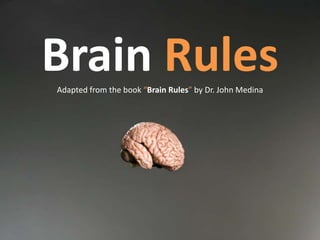



















BrainRulesAdapted from the book “Brain Rules” by Dr. John Medina
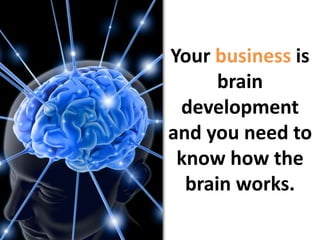
Your business is brain developmentand you need to know how the brain works.
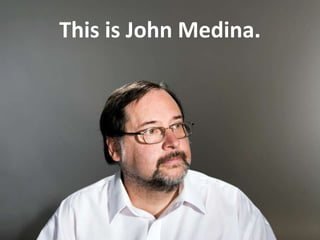
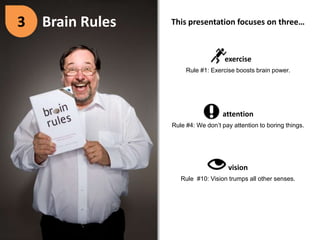
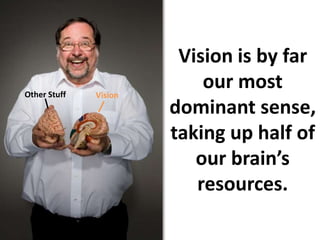
This is John Medina.
He knows how these work.
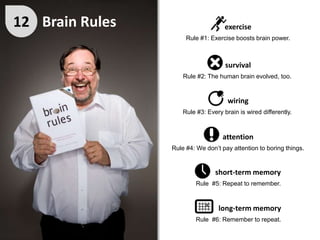
12Brain RulesexerciseRule #1: Exercise boosts brain power.survivalRule #2: The human brain evolved, too. wiringRule #3: Every brain is wired differently. attentionRule #4: We don’t pay attention to boring things.short-term memoryRule  #5: Repeat to remember.long-term memoryRule  #6: Remember to repeat.
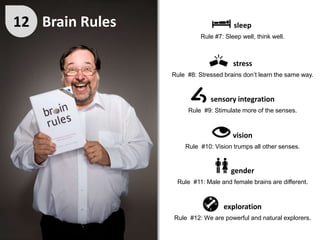
sleepRule #7: Sleep well, think well.12Brain RulesstressRule  #8: Stressed brains don’t learn the same way.sensory integrationRule  #9: Stimulate more of the senses.visionRule  #10: Vision trumps all other senses.genderRule  #11: Male and female brains are different.explorationRule  #12: We are powerful and natural explorers.
3Brain RulesThis presentation focuses on three…exerciseRule #1: Exercise boosts brain power.visionRule  #10: Vision trumps all other senses.attentionRule #4: We don’t pay attention to boring things.
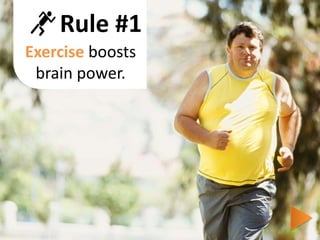
Rule #1Exercise boosts brain power.
A brilliant survival strategy…move!
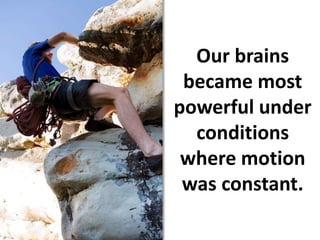
Our brains became most powerful under conditions where motion was constant.
…not whilloungingaround.
Will you age like Frank or like Jim?
Jim is withering away in a nursing home.Frank is sharp and productive as an architect.
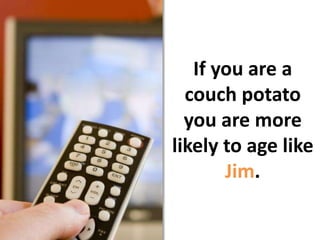
If you are a couch potato you are more likely to age like Jim.
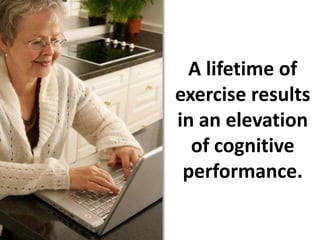
A lifetime of exercise results in an elevation of cognitive performance.
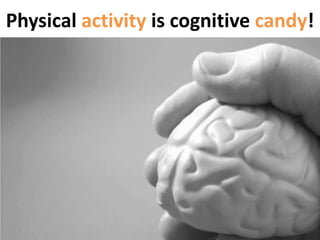
Physical activity is cognitive candy!
Kids pay better attention when they’ve had exercise.
Physically fit children feel better, have higher self esteem and less anxiety……all of which can improve academic performance
…all of which can improve academic performance
We were not designed to sit in a classroom or a cubicle for 8 hour stretches.
Exercise is the closest thing we have to a magic bullet for improving human health
We need to move!
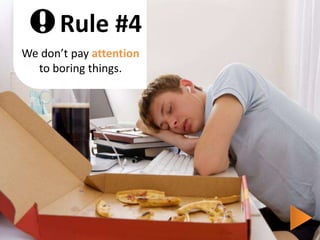
Rule #4We don’t pay attentionto boring things.
What do we pay attention to?
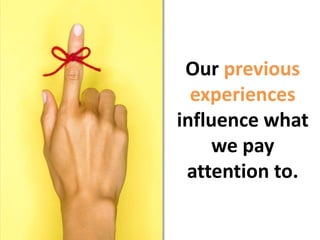
Our previous experiences influence what we pay attention to.
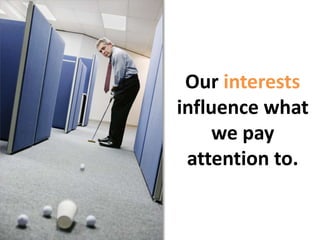
Our interests influence what we pay attention to.
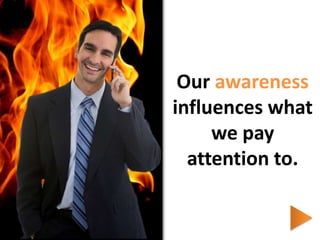
Our awareness influences what we pay attention to.
Emotions capture our attention.
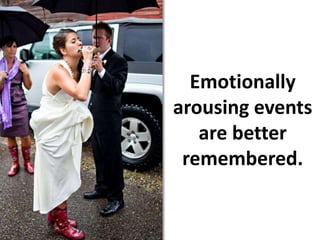
Emotionally arousing events are better remembered.
Emotions focus attention on the “gist” of an experience not on the details.
Understanding the “gist” of an event leads to understanding the meaning behind it.
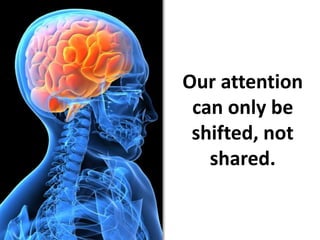
Our brains cannot multi-task.
Our attention can only be shifted, not shared.
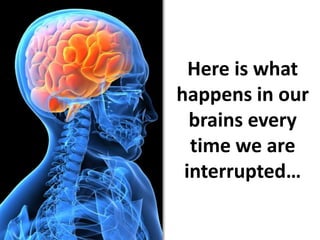
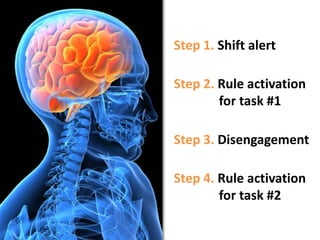
Here is what happens in our brains every time we are interrupted…
Step 1. Shift alertStep 2. Rule activation 	                  for task #1Step 3. DisengagementStep 4. Rule activation               for task #2
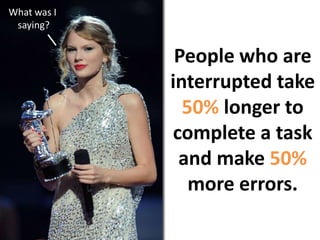
What was I saying?People who are interrupted take 50% longerto complete a task and make 50% more errors.
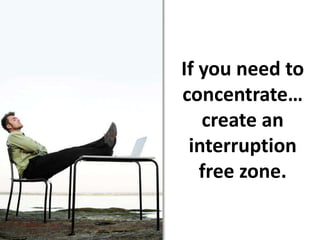
If you need to concentrate…create an interruption free zone.
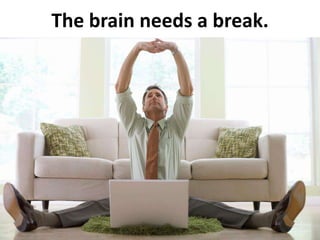
The brain needs a break.
Your student’s get full after consuming too much information.
They check out after 10 minutes.
After 9 minutes and 59 seconds, “bait the hook” to bring them back into your instruction
The hook should trigger an emotion. The hook should have relevancy.The hook should transition between lessons
Rule #10Vision trumps all other senses.
We see with our brains.
Vision is by far our most dominant sense, taking up half of our brain’s resources.Other StuffVision
What we see is what our brains tell us we see, and it’s kind of guessing.
The brain bases it guesses on our prior experience with events in our past.
We have better recall for pictures.Your bullet points gavea good summary of the main points……too bad I’m probablygoing to forget them
Hear a piece of information and three days later you will remember 10% of it.
Add a picture and you will remember 65%.
Our brain tries to make sense of certain features in letters and that takes time.
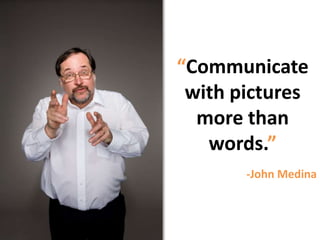
“Communicate with pictures more than words.”-John Medina
Rule #10Vision trumps all other senses.
Go to brainrules.net for additional resources.

Brain Rules