Older People and Consumer
Directed Care in Australia – More
Choice or Voice?
Australian Association of Gerontology 48th National Conference
Alice Springs
November 2015
Carrie Hayter
Managing Director
Carrie Hayter Consulting
Nothing about me without me www.carriehayter.com
Purpose
• Critically analyse the concept of choice
– Competing assumptions and tensions
– Limitations of policy mechanisms
• Idea of voice
– Risks and benefits of policy mechanisms that
promote the voice
Nothing about me without me www.carriehayter.com
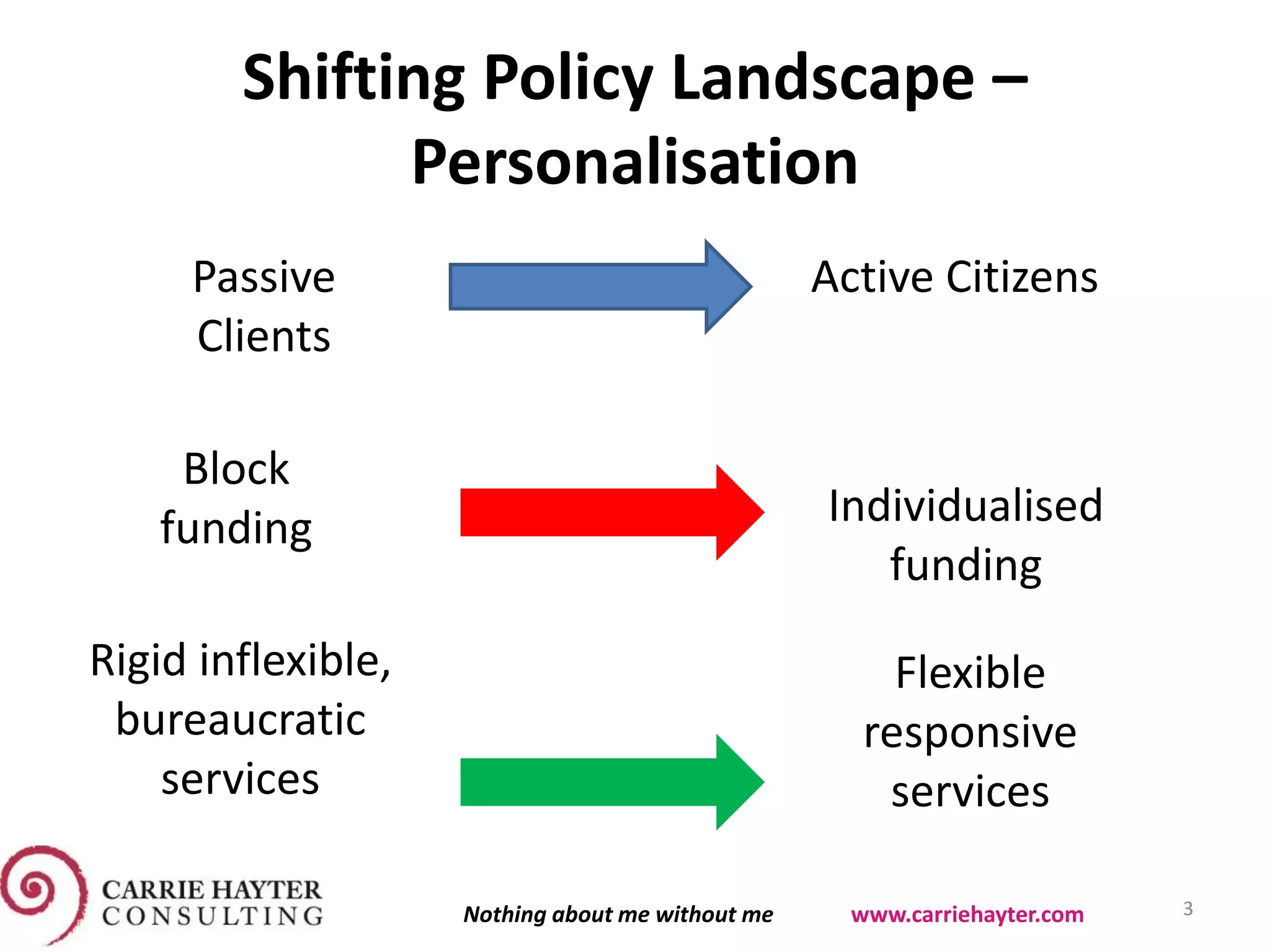
Shifting Policy Landscape –
Personalisation
Passive
Clients
Active Citizens
Block
funding Individualised
funding
Rigid inflexible,
bureaucratic
services
Flexible
responsive
services
5/11/2015 3Nothing about me without me www.carriehayter.com
Personalisation Narratives
• Personalisation works, transforming people’s
lives for the better.
• Personalisation saves money.
• Person- centred approaches reflect the way
that people live their lives.
• Personalisation is applicable to everyone.
• People are the experts in their own lives
(Needham, 2011: pg 7).
4Nothing about me without me www.carriehayter.com
5
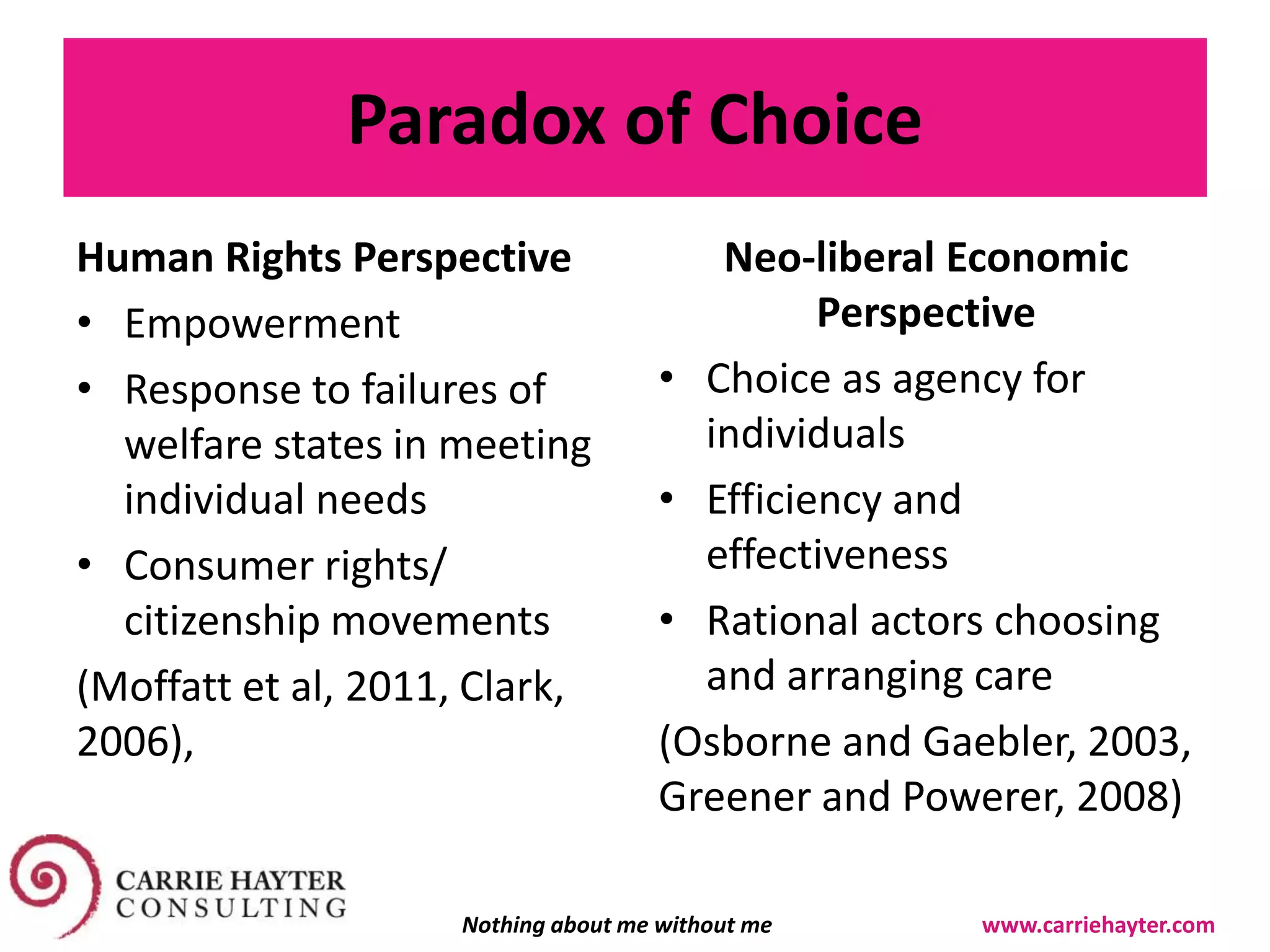
Paradox of Choice
Human Rights Perspective
• Empowerment
• Response to failures of
welfare states in meeting
individual needs
• Consumer rights/
citizenship movements
(Moffatt et al, 2011, Clark,
2006),
Neo-liberal Economic
Perspective
• Choice as agency for
individuals
• Efficiency and
effectiveness
• Rational actors choosing
and arranging care
(Osborne and Gaebler, 2003,
Greener and Powerer, 2008)
Nothing about me without me www.carriehayter.com
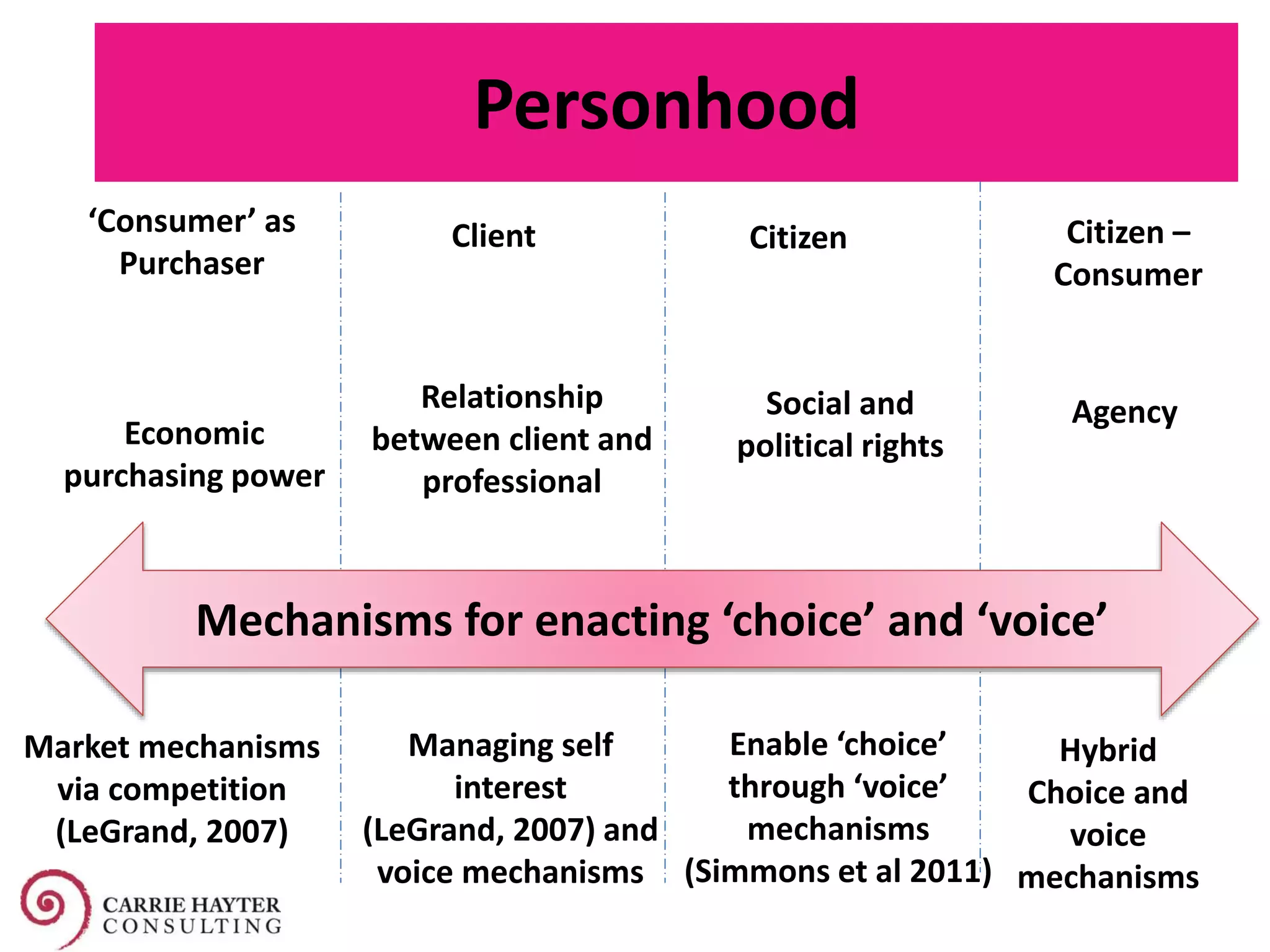
Personhood
‘Consumer’ as
Purchaser
Citizen
Social and
political rightsEconomic
purchasing power
Relationship
between client and
professional
Client Citizen –
Consumer
Agency
Mechanisms for enacting ‘choice’ and ‘voice’
Market mechanisms
via competition
(LeGrand, 2007)
Managing self
interest
(LeGrand, 2007) and
voice mechanisms
Enable ‘choice’
through ‘voice’
mechanisms
(Simmons et al 2011)
Hybrid
Choice and
voice
mechanisms
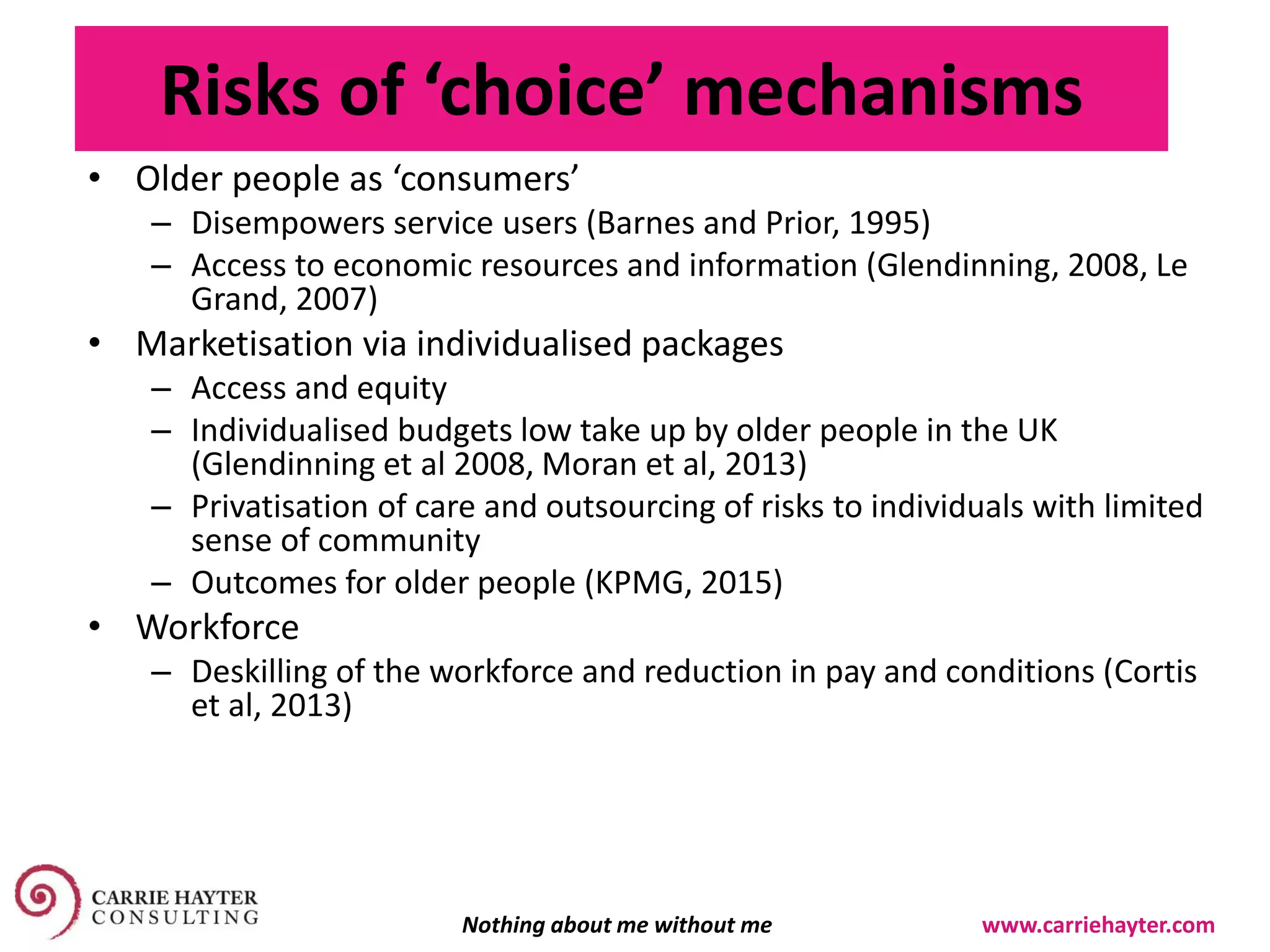
Risks of ‘choice’ mechanisms
• Older people as ‘consumers’
– Disempowers service users (Barnes and Prior, 1995)
– Access to economic resources and information (Glendinning, 2008, Le
Grand, 2007)
• Marketisation via individualised packages
– Access and equity
– Individualised budgets low take up by older people in the UK
(Glendinning et al 2008, Moran et al, 2013)
– Privatisation of care and outsourcing of risks to individuals with limited
sense of community
– Outcomes for older people (KPMG, 2015)
• Workforce
– Deskilling of the workforce and reduction in pay and conditions (Cortis
et al, 2013)
Nothing about me without me www.carriehayter.com
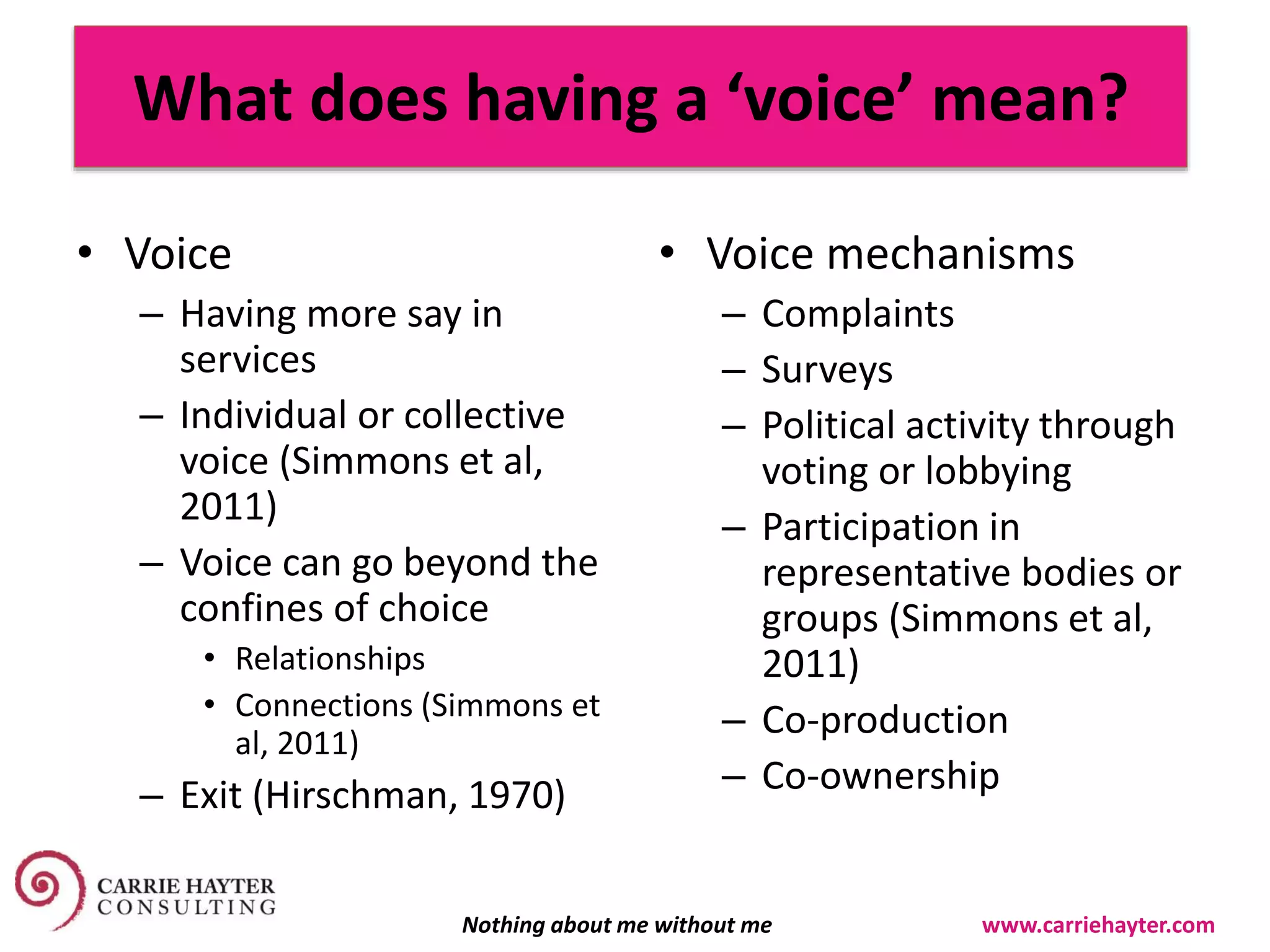
What does having a ‘voice’ mean?
• Voice
– Having more say in
services
– Individual or collective
voice (Simmons et al,
2011)
– Voice can go beyond the
confines of choice
• Relationships
• Connections (Simmons et
al, 2011)
– Exit (Hirschman, 1970)
• Voice mechanisms
– Complaints
– Surveys
– Political activity through
voting or lobbying
– Participation in
representative bodies or
groups (Simmons et al,
2011)
– Co-production
– Co-ownership
Nothing about me without me www.carriehayter.com
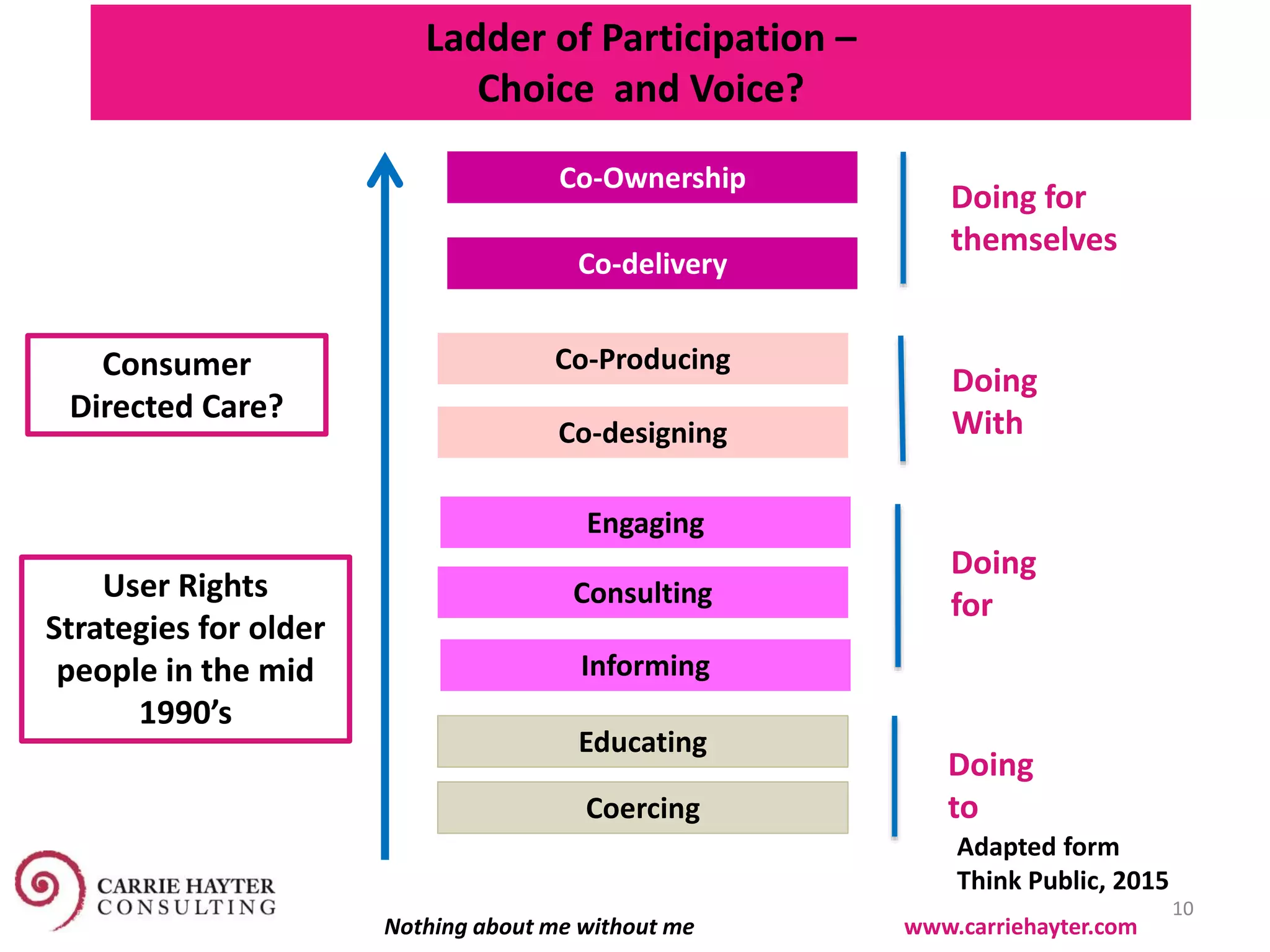
5 November 2015 10
Coercing
Educating
Informing
Consulting
Engaging
Co-designing
Co-Producing
Co-delivery
Co-Ownership
Ladder of Participation –
Choice and Voice?
Doing
for
Doing
to
Doing
With
Doing for
themselves
Adapted form
Think Public, 2015
User Rights
Strategies for older
people in the mid
1990’s
Consumer
Directed Care?
Nothing about me without me www.carriehayter.com
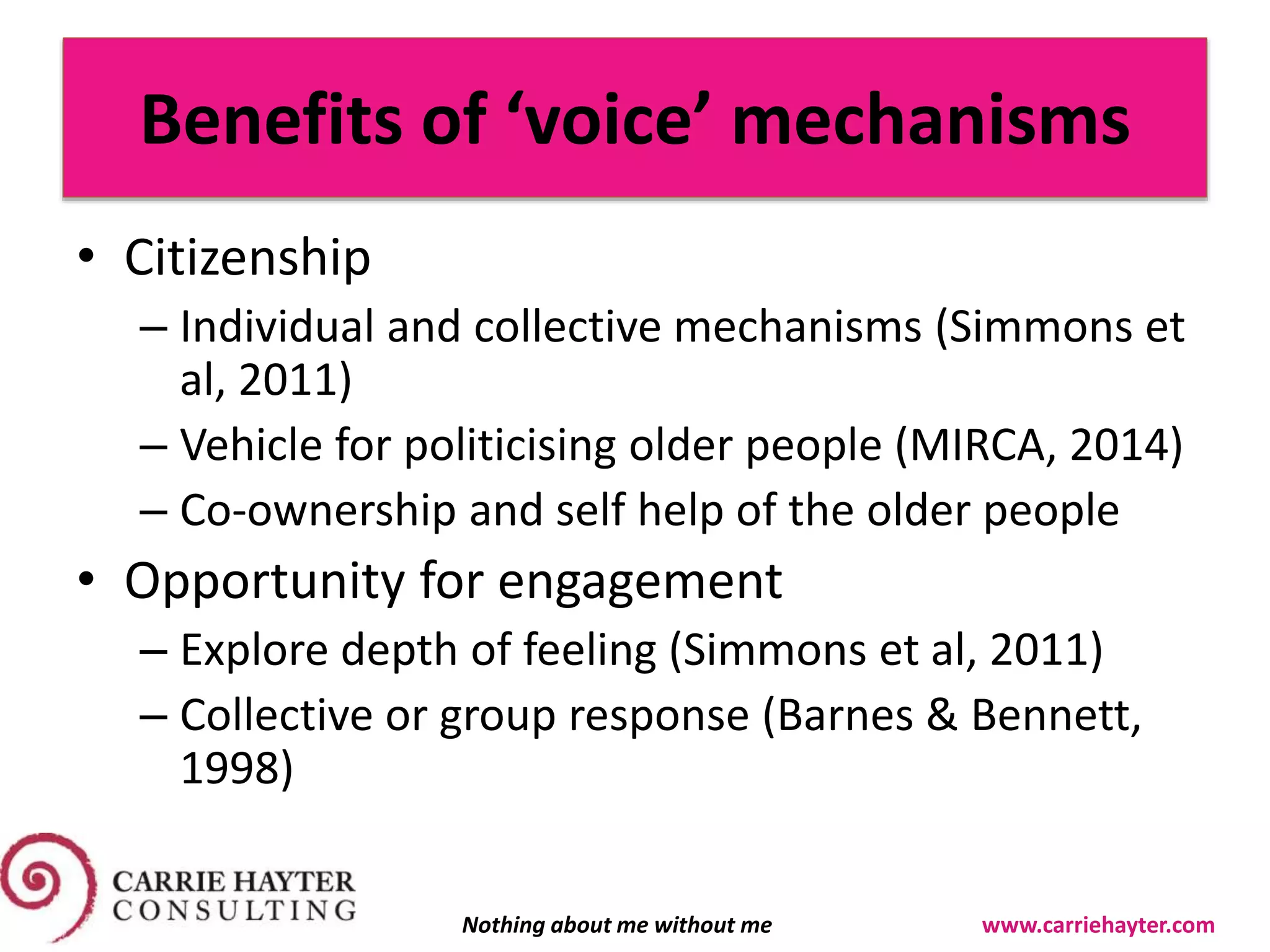
Benefits of ‘voice’ mechanisms
• Citizenship
– Individual and collective mechanisms (Simmons et
al, 2011)
– Vehicle for politicising older people (MIRCA, 2014)
– Co-ownership and self help of the older people
• Opportunity for engagement
– Explore depth of feeling (Simmons et al, 2011)
– Collective or group response (Barnes & Bennett,
1998)
Nothing about me without me www.carriehayter.com
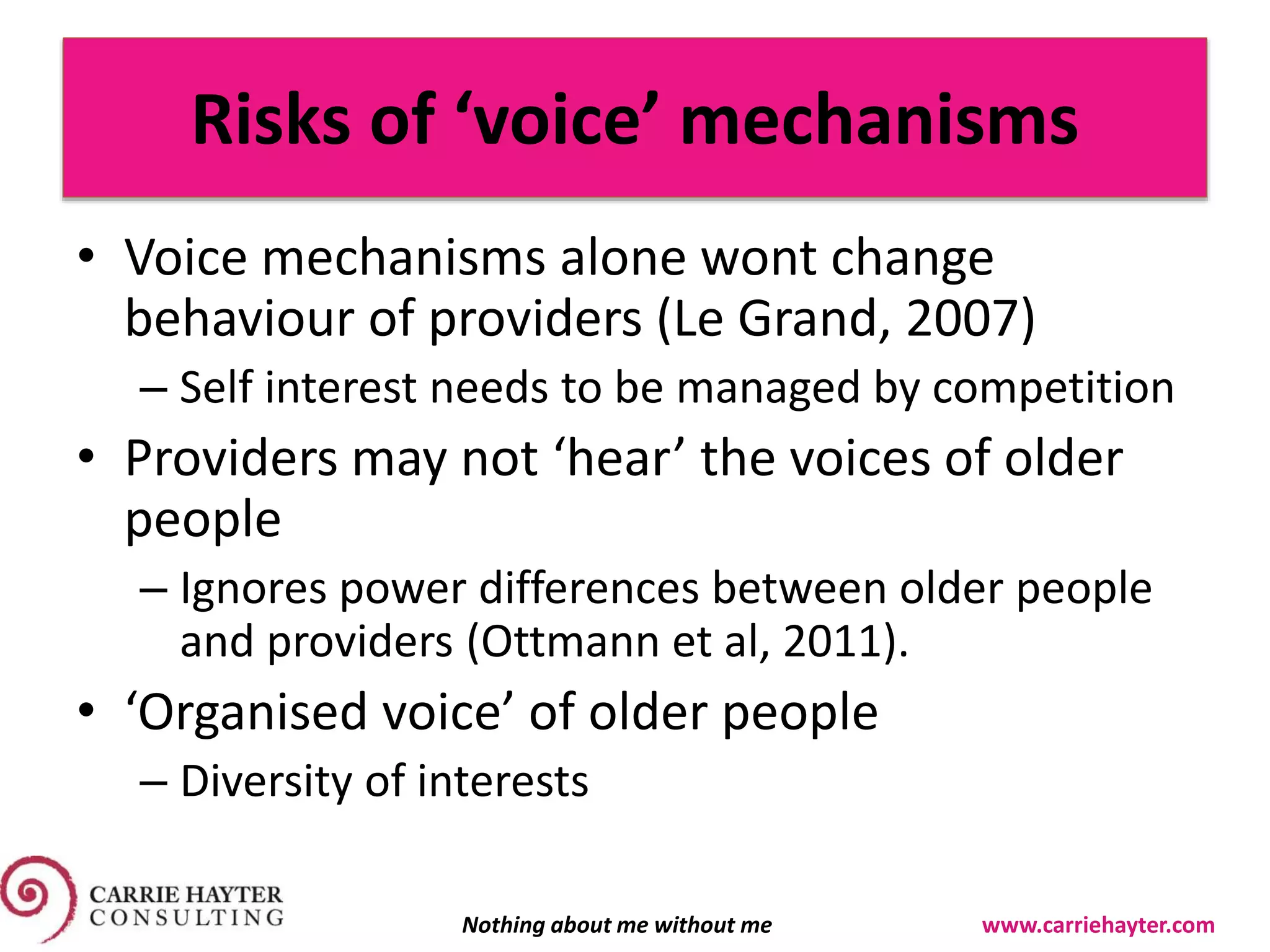
Risks of ‘voice’ mechanisms
• Voice mechanisms alone wont change
behaviour of providers (Le Grand, 2007)
– Self interest needs to be managed by competition
• Providers may not ‘hear’ the voices of older
people
– Ignores power differences between older people
and providers (Ottmann et al, 2011).
• ‘Organised voice’ of older people
– Diversity of interests
Nothing about me without me www.carriehayter.com
Conclusion
• Paradox of Choice
– Who, what, when and how (Le Grand, 2007)
– Constrained choice (Schwartz, 2004)
• Choice about voice
– Reflect the diversity of service users (Simmons et al,
2011)
– Creative engagement
• Guided choice and voice
– Individual and Systemic Advocacy
– Access to effective information (Needham, 2011)
Nothing about me without me www.carriehayter.com
References
Barnes, M. (2009). Authoritative Consumers or Experts by Experience? User Groups in Health and Social Care In R. Simmons,
Powell, M., & Greener, I., (Ed.), The Consumer in Public Services, Choice, Values and Difference, . Bristol: The Policy Press
Barnes, M., & Bennett, G. (1998). Frail bodies, courageous voices: older people influencing community care. Health & Social Care
in the Community, 6(2), 102-111. doi: 10.1046/j.1365-2524.1998.00105.x
Barnes, M., & Bennett, G. (1998). Frail bodies, courageous voices: older people influencing community care. Health & Social Care
in the Community, 6(2), 102-111. doi: 10.1046/j.1365-2524.1998.00105.x
Beresford, P. (2009). Differentiated Consumers? A Differentiated View from a Service User Perspective In R. Simmons, Powell, M.,
& Greener, I., (Ed.), The Consumer in Public Services, Choice, Values and Difference
Glendinning, C., Challis, D., Fernández, J., Jacobs, S., Jones, K., Knapp, K., Wilberforce, M. (2008). Evaluation of the Individual
Budgets Pilot Program York: Social Policy Research Unit
Glendinning, C. (2009). The Consumer in Social Care In R. Simmons, Powell, M., & Greener, I., (Ed.), The Consumer in Public
Services, Choice, Values and Difference Bristol The Policy Press
Greener, I. (2008). Choice and Voice – A Review. Social Policy and Society, 7(02), 255-265. doi: doi:10.1017/S1474746407004204
Hirschman, A. (Ed.). (1970). Exit, Voice and Loyalty Responses to the Decline in Firms, Organisations and States Cambridge
Massachusetts: Harvard University Press
KPMG. (2015). Formative Evaluation of the Home Care Packages Australia: Department of Social Services
Le Grand, J. (2007). Choice and Competition In J. Le Grand (Ed.), Delivering Public Services through Choice and Competition - The
Other Invisible Hand (pp. 38-62)
Nothing about me without me www.carriehayter.com
References
Needham, C. (2011). Personalising Public Services Understanding the Personalisation Narrative Bristol, UK Policy Press
Moran, N., Glendinning, C., Wilberforce, M., Stevens, M., Nettens, N., Jones, K., Manthorpe, J., Knapp, M., Fernandez, J., Challis,
D., & Jacobs, S. (2013) Older people’s experience of cash-for-care schemes: evidence from the English Individual Budget pilot
projects, Ageing and Society 33, pp 826-851
Ottmann, G., Laragy, C., Allen, J., & Feldman, P. (2011). Coproduction in Practice: Participatory Action Research to Develop a
Model of Community Aged Care. Systemic Practice and Action Research, 24(5), 413-427. doi: 10.1007/s11213-010-9181-5
http://dx.doi.org/10.1007/s11213-011-9192-x
Schwartz, B. (2004). The paradox of choice - When more is less? New York Harper Collins Publishers
Simmons, R. (2009). Understanding the Differentiated Consumer in Public Services In R. Simmons, M. Powell & I. Greener (Eds.),
The Consumer in Public Services, Choice, Values and Difference Bristol The Policy Press.
Simmons, R., Birchall, J., & Prout, A. (2011). User Involvement in Public Services: ‘Choice about Voice’. Public Policy and
Administration, 27(1), 3-29. doi: 10.1177/0952076710384903
Wilberforce, M., Glendinning, C, Challis, D, Fernandex, J-L, Jacobs, S., Jones, K., Knapp, M, Manthorpe, J., Moran, N., Netten, A., &
Stevens, M., (2011) ‘Implementing Consumer Choice in Long-Term Care: The Impact of Individual Budgets on Social Care Providers
in England’, Social Policy & Administration, 45 (5), 593-612
Nothing about me without me www.carriehayter.com
Contact Details
Carrie Hayter
Email: carrie@carriehayter.com
www.carriehayter.com
@carriehayter

Choice, Voice and Decision Making

  • 1.
    Older People andConsumer Directed Care in Australia – More Choice or Voice? Australian Association of Gerontology 48th National Conference Alice Springs November 2015 Carrie Hayter Managing Director Carrie Hayter Consulting Nothing about me without me www.carriehayter.com
  • 2.
    Purpose • Critically analysethe concept of choice – Competing assumptions and tensions – Limitations of policy mechanisms • Idea of voice – Risks and benefits of policy mechanisms that promote the voice Nothing about me without me www.carriehayter.com
  • 3.
    Shifting Policy Landscape– Personalisation Passive Clients Active Citizens Block funding Individualised funding Rigid inflexible, bureaucratic services Flexible responsive services 5/11/2015 3Nothing about me without me www.carriehayter.com
  • 4.
    Personalisation Narratives • Personalisationworks, transforming people’s lives for the better. • Personalisation saves money. • Person- centred approaches reflect the way that people live their lives. • Personalisation is applicable to everyone. • People are the experts in their own lives (Needham, 2011: pg 7). 4Nothing about me without me www.carriehayter.com
  • 5.
  • 6.
    Paradox of Choice HumanRights Perspective • Empowerment • Response to failures of welfare states in meeting individual needs • Consumer rights/ citizenship movements (Moffatt et al, 2011, Clark, 2006), Neo-liberal Economic Perspective • Choice as agency for individuals • Efficiency and effectiveness • Rational actors choosing and arranging care (Osborne and Gaebler, 2003, Greener and Powerer, 2008) Nothing about me without me www.carriehayter.com
  • 7.
    Personhood ‘Consumer’ as Purchaser Citizen Social and politicalrightsEconomic purchasing power Relationship between client and professional Client Citizen – Consumer Agency Mechanisms for enacting ‘choice’ and ‘voice’ Market mechanisms via competition (LeGrand, 2007) Managing self interest (LeGrand, 2007) and voice mechanisms Enable ‘choice’ through ‘voice’ mechanisms (Simmons et al 2011) Hybrid Choice and voice mechanisms
  • 8.
    Risks of ‘choice’mechanisms • Older people as ‘consumers’ – Disempowers service users (Barnes and Prior, 1995) – Access to economic resources and information (Glendinning, 2008, Le Grand, 2007) • Marketisation via individualised packages – Access and equity – Individualised budgets low take up by older people in the UK (Glendinning et al 2008, Moran et al, 2013) – Privatisation of care and outsourcing of risks to individuals with limited sense of community – Outcomes for older people (KPMG, 2015) • Workforce – Deskilling of the workforce and reduction in pay and conditions (Cortis et al, 2013) Nothing about me without me www.carriehayter.com
  • 9.
    What does havinga ‘voice’ mean? • Voice – Having more say in services – Individual or collective voice (Simmons et al, 2011) – Voice can go beyond the confines of choice • Relationships • Connections (Simmons et al, 2011) – Exit (Hirschman, 1970) • Voice mechanisms – Complaints – Surveys – Political activity through voting or lobbying – Participation in representative bodies or groups (Simmons et al, 2011) – Co-production – Co-ownership Nothing about me without me www.carriehayter.com
  • 10.
    5 November 201510 Coercing Educating Informing Consulting Engaging Co-designing Co-Producing Co-delivery Co-Ownership Ladder of Participation – Choice and Voice? Doing for Doing to Doing With Doing for themselves Adapted form Think Public, 2015 User Rights Strategies for older people in the mid 1990’s Consumer Directed Care? Nothing about me without me www.carriehayter.com
  • 11.
    Benefits of ‘voice’mechanisms • Citizenship – Individual and collective mechanisms (Simmons et al, 2011) – Vehicle for politicising older people (MIRCA, 2014) – Co-ownership and self help of the older people • Opportunity for engagement – Explore depth of feeling (Simmons et al, 2011) – Collective or group response (Barnes & Bennett, 1998) Nothing about me without me www.carriehayter.com
  • 12.
    Risks of ‘voice’mechanisms • Voice mechanisms alone wont change behaviour of providers (Le Grand, 2007) – Self interest needs to be managed by competition • Providers may not ‘hear’ the voices of older people – Ignores power differences between older people and providers (Ottmann et al, 2011). • ‘Organised voice’ of older people – Diversity of interests Nothing about me without me www.carriehayter.com
  • 13.
    Conclusion • Paradox ofChoice – Who, what, when and how (Le Grand, 2007) – Constrained choice (Schwartz, 2004) • Choice about voice – Reflect the diversity of service users (Simmons et al, 2011) – Creative engagement • Guided choice and voice – Individual and Systemic Advocacy – Access to effective information (Needham, 2011) Nothing about me without me www.carriehayter.com
  • 14.
    References Barnes, M. (2009).Authoritative Consumers or Experts by Experience? User Groups in Health and Social Care In R. Simmons, Powell, M., & Greener, I., (Ed.), The Consumer in Public Services, Choice, Values and Difference, . Bristol: The Policy Press Barnes, M., & Bennett, G. (1998). Frail bodies, courageous voices: older people influencing community care. Health & Social Care in the Community, 6(2), 102-111. doi: 10.1046/j.1365-2524.1998.00105.x Barnes, M., & Bennett, G. (1998). Frail bodies, courageous voices: older people influencing community care. Health & Social Care in the Community, 6(2), 102-111. doi: 10.1046/j.1365-2524.1998.00105.x Beresford, P. (2009). Differentiated Consumers? A Differentiated View from a Service User Perspective In R. Simmons, Powell, M., & Greener, I., (Ed.), The Consumer in Public Services, Choice, Values and Difference Glendinning, C., Challis, D., Fernández, J., Jacobs, S., Jones, K., Knapp, K., Wilberforce, M. (2008). Evaluation of the Individual Budgets Pilot Program York: Social Policy Research Unit Glendinning, C. (2009). The Consumer in Social Care In R. Simmons, Powell, M., & Greener, I., (Ed.), The Consumer in Public Services, Choice, Values and Difference Bristol The Policy Press Greener, I. (2008). Choice and Voice – A Review. Social Policy and Society, 7(02), 255-265. doi: doi:10.1017/S1474746407004204 Hirschman, A. (Ed.). (1970). Exit, Voice and Loyalty Responses to the Decline in Firms, Organisations and States Cambridge Massachusetts: Harvard University Press KPMG. (2015). Formative Evaluation of the Home Care Packages Australia: Department of Social Services Le Grand, J. (2007). Choice and Competition In J. Le Grand (Ed.), Delivering Public Services through Choice and Competition - The Other Invisible Hand (pp. 38-62) Nothing about me without me www.carriehayter.com
  • 15.
    References Needham, C. (2011).Personalising Public Services Understanding the Personalisation Narrative Bristol, UK Policy Press Moran, N., Glendinning, C., Wilberforce, M., Stevens, M., Nettens, N., Jones, K., Manthorpe, J., Knapp, M., Fernandez, J., Challis, D., & Jacobs, S. (2013) Older people’s experience of cash-for-care schemes: evidence from the English Individual Budget pilot projects, Ageing and Society 33, pp 826-851 Ottmann, G., Laragy, C., Allen, J., & Feldman, P. (2011). Coproduction in Practice: Participatory Action Research to Develop a Model of Community Aged Care. Systemic Practice and Action Research, 24(5), 413-427. doi: 10.1007/s11213-010-9181-5 http://dx.doi.org/10.1007/s11213-011-9192-x Schwartz, B. (2004). The paradox of choice - When more is less? New York Harper Collins Publishers Simmons, R. (2009). Understanding the Differentiated Consumer in Public Services In R. Simmons, M. Powell & I. Greener (Eds.), The Consumer in Public Services, Choice, Values and Difference Bristol The Policy Press. Simmons, R., Birchall, J., & Prout, A. (2011). User Involvement in Public Services: ‘Choice about Voice’. Public Policy and Administration, 27(1), 3-29. doi: 10.1177/0952076710384903 Wilberforce, M., Glendinning, C, Challis, D, Fernandex, J-L, Jacobs, S., Jones, K., Knapp, M, Manthorpe, J., Moran, N., Netten, A., & Stevens, M., (2011) ‘Implementing Consumer Choice in Long-Term Care: The Impact of Individual Budgets on Social Care Providers in England’, Social Policy & Administration, 45 (5), 593-612 Nothing about me without me www.carriehayter.com
  • 16.
    Contact Details Carrie Hayter Email:carrie@carriehayter.com www.carriehayter.com @carriehayter

Editor's Notes

  • #2 I would like to acknowledge the traditional owners of the land that we meet on today and pay my respects to Elders Past and Present and acknowledge my Aboriginal colleagues who are hear today. .
  • #3 In todays paper I want to explore why choice has emerged as a key policy issue in community aged care in Australia. The title of my paper “Older People and Consumer Directed Care in Australia – More Choice or Voice?” critically explores the issue of choice and why it has emerged as a key policy issue in community aged care in Australia. As part of this paper I will explore the different policy mechanisms used to implement choice and voice and debate the competing tensions upon which these are based. As part of this debate I will explore some of the issues and criticisms of the mechanisms that promote choice and use this as a means for introducing the concept and idea of voice. In doing this I hope to promote critical debate about the vexed issue of choice and why mechanisms that promote voice may be more important than choice. This paper is based on work that I completed as part of a literature completed for my PhD project between 2012 and 2013. It also includes some reflections on the consulting work I have undertaken over the last five years in working with over 150 social care agencies implementing Consumer Directed Care.
  • #4 There are significant changes happening in the policy landscape in age care and disability policy in Australia as part of the agenda of personalisation. The assumptions that underpin these shifts include the changing role of people who use public services shifting from being ‘passive’ clients to ‘active consumers’. It is assumed that people who use disability services or aged care services will become active ‘consumers’. Rather than being passive clients relying on professionals for support and advice people are assumed to be active engaged ‘consumers’ who will make informed choices about their care. Flowing from this assumption is the need for changes in the how agencies are funded from block funded to individually funded. It is assumed that individualised funding will provide more mechanisms for service users to get their needs met. We are seeing this funding system emerging as part of the launch sites of the NDIS as well as the emergence of the concept of ‘consumer directed care’ in packaged care in aged care in Australia. As part of this changing landscape there are significant challenges for small, medium to large organisations in being able to thrive and survive in this changing landscape? As well as considering the structures that are in place to enable the participation and engagement of service users in your service.
  • #5 People have described some of the challenges of what personalisation means for their organisations some of which are on the spectrum of the lucky country to fear and somewhere in between. Needham (2011) who has researched the narratives that have influenced policy debates in the personalisation of social care in the UK contends that are five key narratives that have emerged as part of the policy landscape in the UK. These include the following: Personalisation works , transforming people’s lives for the better Personalisation saves money Person – centred approaches reflect the way that people live their lives Personalisation is applicable to everyone People are the experts in their own lives One of the interesting things is that we are seeing these narratives emerging in debates in Australia particularly with the actual implementation of the NDIS which had a much more grass roots campaign. For older people it appears that it has been more driven by professionals and some advocacy groups rather than older people themselves. These narratives can influence how organisations think about personalisation and what it means in your organisation. Some people and organisations will see the possibilities of personalisation but others are fearful.
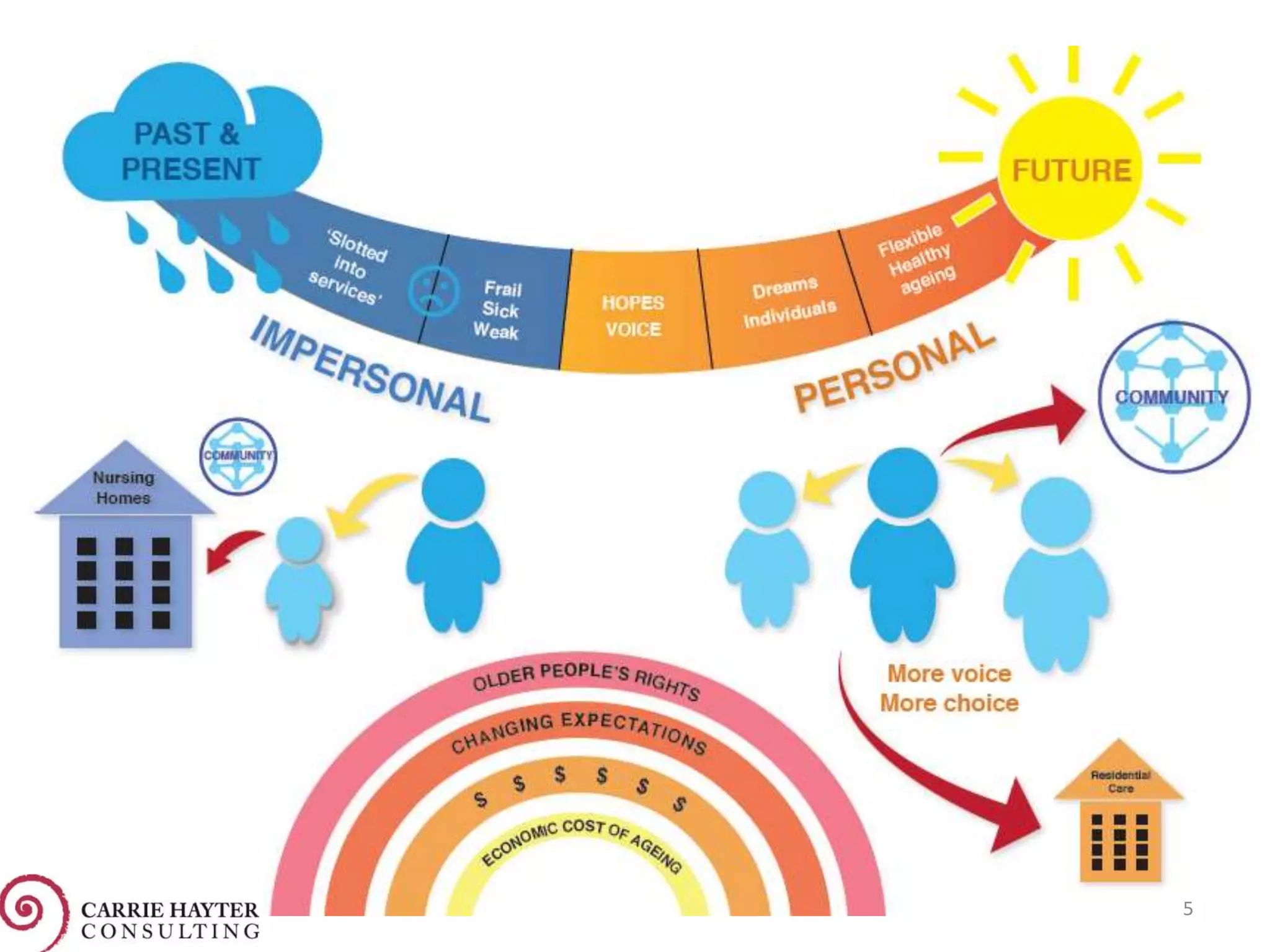
  • #6 The aged care system in Australia was largely created in the interests of providers, professionals and government. Older people were slotted in services and placed in institutions, were largely seen as a burden on society and should be seen and not heard. Since the late 1980s and 1990s through the emergence of active ageing as well as a growing awareness of the economic costs of ageing, and the changing expectations of consumers has seen some significant shifts. These include the move to community based care as well as seeing older people as being more active participants in their lives. If you look at history we have come a long way, however, we are in the process of dismantling a whole service infrastructure and moving from a block funded to individualised funding system with different stages occurring for older people, people with disabilities and their carers. This picture shows some of the drivers of personalisation for older people in Australia. It contends that for older people they were largely invisible and the system was created in the interests of professionals, providers and with older people institutionalised. However, with the economic costs of ageing combined with the changing expectations and the emergence of the concept of active ageing we are seeing changing models.
  • #7 The issue of choice is a vexed and loaded concept. It is very difficult to argue against choice because it has different philosophical underpinnings. The concept of choice appeals to people across the political spectrum because of the different assumptions that underpin the issue of choice. On the one hand we can see that it comes from a human right perspective with a link to notions of user empowerment driven by consumer rights and citizenship movements. Some of these arguments have largely been driven in response to the perceived failure of the welfare state and large bureaucratic organisations in meeting individual needs. On the other hand it is driven out of neo-liberal view about the role of the state and the desire and driven for freedom of ‘consumers’ to have choice and maximum agency about how their supports are structured. It is based on an assumption that individual people have agency and are able to make decisions when they enter a market of care. Understanding the ideological and philosophical differences in how we conceptualise choice is important in terms of how these influence policy directions and changes.
  • #8 The policy mechanisms for enacting the issue of ‘choice’ are framed by how we view people who use services. For those who argue that people who use public services are ‘consumers’ the policy mechanisms tend to favour the creation of markets through the introduction of competition to drive efficiency and effectiveness and services to be more responsive to the needs of consumers. Similarly they introduce mechanisms that promote choice for service users reflecting an assumption that people are both able and willing to navigate a market of care. For those that describe people who use public services as clients. The policy mechanisms are about managing the perceived self interest of the bureaucracy and challenging the paternalism of the welfare state. This can be achieved through competition and the creation of markets but also through voice mechanisms For those who conceptualise service users as citizens the focus moves away from purchasing power to notions of social and political rights and for people to have choice about the voice mechanisms that are introduced. For example, this could include mechanisms that empower people to organise their own supports or to be politically active in this process. There is also the hybrid citizen –consumer whose relationship with public services can change over time. People can be both active and passive subjects and there needs to be a diversity of policy mechanisms not just those that shift the user of public services to be a ‘consumer’. In this space it is very much about how older people see themselves as actors in the social care system . In this space it is about the policy mechanisms that can reflect the diversity of the perspectives of service users.
  • #9 There are a number of risks of ‘choice’ mechanisms. Some argue that the move from citizen to consumer can work to disempower service users. The ability to act as an informed consumer is conditional on information as well as having access to economic resources to make systems work in your interests. For many older people and their allies they often don’t have access to information to actually know how the aged care system works. The issue of shifting to a more individualised approach can lead to issues of access and equity. There can be significant differences between people in terms of who gets what and how these are delivered. Research from the evaluation of individualised budgets identified there was low take up by older people. This begs the question as to why we are implementing this model in Australia There is the potential within a more marketised and individualised world of the further privatisation of care and outsourcing of the risk for the management of packages to individuals. This can therefore undermine the collective social interests of the functions of the welfare state and shifts the risk to individuals rather than collective solutions.
  • #10 Given the risks of mechanisms promoting choice then perhaps it is about focusing on voice. What does voice mean? Simmons argues that voice is about ‘giving users a more effective say in the direction of services, by means of representative bodies, complaints mechanisms and surveys of individual preferences. According to Hirschman it can also be about exit whereby people choose to exit a service because they are dissatisfied. This, however, is tricky in aged care because there is often nowhere else for people to exit. Voice can also have a political focus through expressing wishes and preferences through voting or participation in political parties or representative bodies. In this sense voice links and connections to citizenship and empowerment. Simmons argues that voice can go beyond the confines of choice because it allows people to express their preferences or feelings about a particular issue. This can also be undertaken as part of the membership of a group which can increase the impact on political processes and outcomes. Rather than one consumer expressing their individual preferences in the market, people can express their preferences through relationships with other people, providers and groups. As part of the move to citizenship for older people we are also seeing the emergence of co-production and co-ownership models for older people – this reflects a citizenship type model for older people.
  • #11 If we think about voice as participation then we can conceptualise the mechanisms that promote the voices of older people on a ladder of participation. But perhaps they can also promote the choice of older people. Historically, the aged care system in Australia was based on ‘doing to’ older people. Older people and their allies were coerced into accepting whatever the system offered them includin g the limited option of primarily residential care rather than community care. In the mid 1990s the government introduced the principles of user rights for older people which meant that providers were forced to engage and consult and inform older people about who they work with older people. In 2013 we saw the introduction of Consumer Directed Care in Community Aged Care which is supposedly shifting the way that providers are thinking and engaging with older people. The degree to which this is happening is contested because of the skills and abilities and knowledge of older people. We are also seeing the emergence of co –ownership and co-delivery with older people setting up their own organisations ( for example the Waverton Hub) to promote self –help between older people.
  • #12 The concept of voice is based on the idea of citizenship and that older people have social, economic and political rights. It can therefore be a mechanism for older people to express both their individual preferences and their views in terms of collective groups or interests. In this sense, it views older people as part of the social, economic and political life rather than being reduced to a person who purchases services in the market that tends to downplay the collective interests and responsibilities of older people. Some people argue that this move towards consumer directed care presents an opportunity for older people and the agencies that support them to work together to co-produce outcomes. However, others such as Barnes remind us of the importance of understanding how service users, particularly older people, may not see themselves as equal partners with agencies that support them and the need for structures to really encourage the participation of older people.
  • #13 There are some risks of relying on solely on voice mechanisms for providers and service users. Le Grand (2007) argues that because of the entrenched self interest of providers, voice mechanisms alone will not change the behaviour of providers. In order to change the behaviour there needs to be external incentives including competition between providers for funding to ensure they respond to the interests and wishes of service users. In terms of aged care in Australia, it has only been recently that consumer directed care has emerged largely in response to government policy changes rather than the demands from service users. The recent evaluation of the KPMG report also highlighted that not much has changed for older people with the roll out of Consumer Directed Care packages. Perhaps this suggests that voice alone wont change behaviour of providers and more effective mechanisms for older people to have ownership need to be implemented. While providers and government may create structures to engage with older people, this may not necessarily translate into actual changes in practice or policy. If mechanisms to encourage the voice of older people are to be considered then there needs to be consideration of the power imbalance between people who use services and those who provide them. Australia has a long history of active engagement of organisations in the political and lobbying process over the history of aged care policy in Australia. Some of these organisations have been instrumental in advocating for significant policy changes, however, there may be questions about whose these groups represent. There may not be one voice but many voices and ensuring these voices are heard is important. Older people are diverse and having a range of organisations that represent the diversity of older people is an important consideration.
  • #14 Perhaps it is about ‘choice’ about ‘voice’ and the use of diversity of policy mechanisms Le Grand (2007) has developed a schema for some of the parameters of choice in terms of service provision including the who, what, when and how of choice to provide some control or option for service users We also need to really examine the mechanisms for older people to participate both as service users but also as citizens and recognising for some older people the nature of being a ‘service user’ may be a point of vulnerability. As part of this conversation carers and informal allies need to be included in this discussion. Do we need to look to navigated or supported choice and voice?