LESSON PLANS
Date: 06/03/2013
Student-Teacher: Silvia Buján
Level: First Grade (1-1)
Topic: Feelings
Objectives Activities/Procedures Useful
Language
Assessment
Criteria
Material/Resources Time
Ss will be able
to:
-Identify
feelings
-Express
feelings
-Respond with
short phrases to
inform about
feelings.
Warm up:
-The T greets the Ss
and mentions what is
going to be done
during the class.
-T asks Ss to clean
their desks and get out
their notebook.
Presentation:
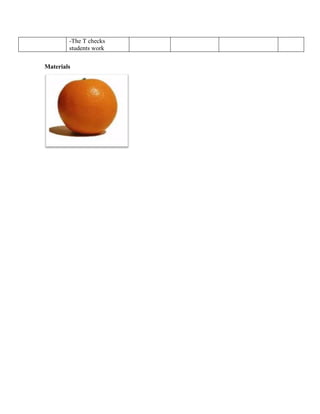
-T shows one orange
and asks “What is
this?”
-T draws an orange
with a happy face and
asks Ss “How does the
orange feel?”
Practice:
-Ss draw on the board
different faces for the
orange. Sad, angry,
scare, confused.
Consolidation:
-Ss copy the oranges o
n their notebooks and
color them
Closing Activity:
-Ss repeat together
after the T the
different feelings
-Happy, sad,
angry, scare,
confused
-How do you
feel?
-I feel…
-Ss show
comprehension
of expressions
being use by
naming,
pointing or
describing
-Ss apply
language or
expressions
being studied
-Ss imitate
words, phrases
and sentences
through
repetition
-Ss participation
-Ss complete the
assignment on
their notebooks.
-Board
-Chalk
-One orange
-Notebook
-Crayons
-5 min
-10 min
-10 min
-10 min
-5 min
-The T checks
students work
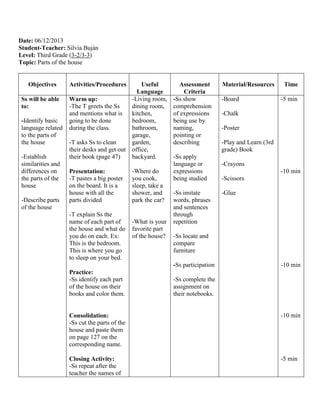
Materials
Date: 06/03/2013
Student-Teacher: Silvia Buján
Level: Second Grade (2-3)/Third Grade (3-2/3-3)
Topic: Family
Objectives Activities/Procedures Useful
Language
Assessment
Criteria
Material/Resources Time
Ss will be able
to:
-Identify family
members
-Express
feelings
-Respond with
short phrases to
inform about
family
-Describe
family
relationships.
Warm up:
-The T greets the Ss
and mentions what is
going to be done
during the class.
-T asks Ss to clean
their desks and get out
their notebook.
Presentation:
-T shows one heart of
paper and asks “What
is this?”
-T draws a heart and a
family member inside
of it. T asks “Who is
this? This is a mother.
I love my mother”
Practice:
-Ss draw the family
member that they
chose inside of one
heart. Ss said “This is
my brother, sister,
etc.”
Consolidation:
-Ss copy the hearts on
their notebooks and
color them
Closing Activity:
-Ss respond to the
question “How does
your mother feel?” Is
she happy? Is she sad?
-He/she feels
-Nuclear and
extended
family
members:
Mother,
father,
brother,
sister,
grandfather,
grandmother,
pet, uncle,
aunt, cousin.
-Who is this?
-This is my
father
-How many
brothers and
sister do you
have?
-I have 1
brother and 1
sister
-Do you have
a pet?
-I have a dog
-How does
your father
look like?
-My father is
-Ss show
comprehension
of expressions
being use by
naming,
pointing or
describing
-Ss apply
language or
expressions
being studied
-Ss imitate
words, phrases
and sentences
through
repetition
-Ss participation
-Ss complete the
assignment on
their notebooks.
-Board
-Chalk
-Heart shape
-Notebook
-Crayons
-5 min
-10 min
-10 min
-10 min
-5 min
Is she angry?
-The T checks
students work
tall
Materials
Date: 06/05/13
Student-Teacher: Silvia Buján
Level: First Grade (1-2/1-3)/Second Grade (2-3)/Third Grade (3-2/3-3)
Topic: Family activities
Objectives Activities/Procedures Useful
Language
Assessment
Criteria
Material/Resources Time
Ss will be able
to:
-Recognize
family members
-Respond with
short phrases to
inform about
family
-Describe
family activities.
Warm up:
-The T greets the Ss
and mentions what is
going to be done
during the class.
-T asks Ss to clean
their desks and get out
their notebook.
Presentation:
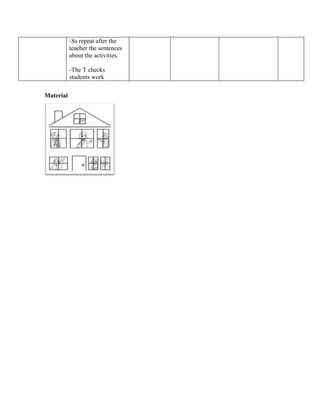
-T pastes a big poster
on the board. It is a
house where all the
family members are
performing different
activities.
-T asks Ss “what is
the mother doing?”
and so on with all
family members
Practice:
-Ss draw and color the
family members doing
the activities and write
the corresponding
sentence. Ex: The
mother is reading the
newspaper
Consolidation:
-Ss come to the board
and draw their own
favorite family
activity
Closing Activity:
-He/she feels
-Nuclear
family
members:
Mother,
father,
brother,
sister,
grandfather,
grandmother,
pet.
-Who is this?
-This is my
father
-How many
brothers and
sister do you
have?
-I have 1
brother and 1
sister
-Do you have
a pet?
-I have a dog
-How does
your father
look like?
-My father is
tall
-Ss show
comprehension
of expressions
being use by
naming,
pointing or
describing
-Ss apply
language or
expressions
being studied
-Ss imitate
words, phrases
and sentences
through
repetition
-Ss participation
-Ss complete the
assignment on
their notebooks.
-Board
-Chalk
-Poster
-Notebook
-Pencil
-Crayons
-5 min
-10 min
-10 min
-10 min
-5 min
-Ss repeat after the
teacher the sentences
about the activities.
-The T checks
students work
Material
Date: 06/10/2013
Student-Teacher: Silvia Buján
Level: First Grade (1-1)/Second Grade (2-3)/Third Grade (3-2/3-3)
Topic: Food
Objectives Activities/Procedures Useful
Language
Assessment
Criteria
Material/Resources Time
Ss will be able
to:
-Identify food
items
-Exchange
information
about different
kinds of food
Warm up:
-The T greets the Ss
and mentions what is
going to be done
during the class.
-T asks Ss to clean
their desks and get out
their book (page 50)
Presentation:
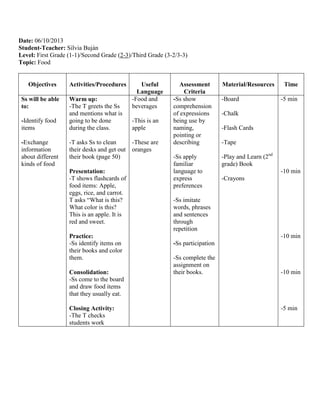
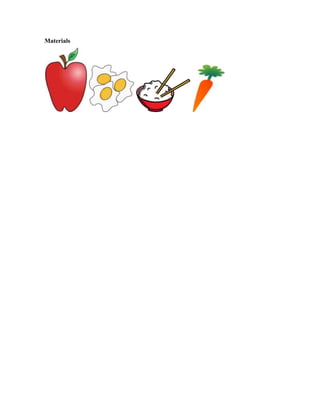
-T shows flashcards of
food items: Apple,
eggs, rice, and carrot.
T asks “What is this?
What color is this?
This is an apple. It is
red and sweet.
Practice:
-Ss identify items on
their books and color
them.
Consolidation:
-Ss come to the board
and draw food items
that they usually eat.
Closing Activity:
-The T checks
students work
-Food and
beverages
-This is an
apple
-These are
oranges
-Ss show
comprehension
of expressions
being use by
naming,
pointing or
describing
-Ss apply
familiar
language to
express
preferences
-Ss imitate
words, phrases
and sentences
through
repetition
-Ss participation
-Ss complete the
assignment on
their books.
-Board
-Chalk
-Flash Cards
-Tape
-Play and Learn (2nd
grade) Book
-Crayons
-5 min
-10 min
-10 min
-10 min
-5 min
Materials
Date: 06/12/2013
Student-Teacher: Silvia Buján
Level: Third Grade (3-2/3-3)
Topic: Parts of the house
Objectives Activities/Procedures Useful
Language
Assessment
Criteria
Material/Resources Time
Ss will be able
to:
-Identify basic
language related
to the parts of
the house
-Establish
similarities and
differences on
the parts of the
house
-Describe parts
of the house
Warm up:
-The T greets the Ss
and mentions what is
going to be done
during the class.
-T asks Ss to clean
their desks and get out
their book (page 47)
Presentation:
-T pastes a big poster
on the board. It is a
house with all the
parts divided
-T explain Ss the
name of each part of
the house and what do
you do on each. Ex:
This is the bedroom.
This is where you go
to sleep on your bed.
Practice:
-Ss identify each part
of the house on their
books and color them.
Consolidation:
-Ss cut the parts of the
house and paste them
on page 127 on the
corresponding name.
Closing Activity:
-Ss repeat after the
teacher the names of
-Living room,
dining room,
kitchen,
bedroom,
bathroom,
garage,
garden,
office,
backyard.
-Where do
you cook,
sleep, take a
shower, and
park the car?
-What is your
favorite part
of the house?
-Ss show
comprehension
of expressions
being use by
naming,
pointing or
describing
-Ss apply
language or
expressions
being studied
-Ss imitate
words, phrases
and sentences
through
repetition
-Ss locate and
compare
furniture
-Ss participation
-Ss complete the
assignment on
their notebooks.
-Board
-Chalk
-Poster
-Play and Learn (3rd
grade) Book
-Crayons
-Scissors
-Glue
-5 min
-10 min
-10 min
-10 min
-5 min
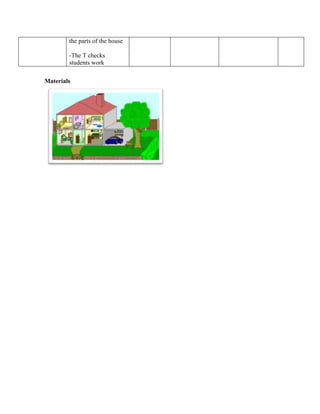
the parts of the house
-The T checks
students work
Materials
Date: 06/17/13
Student-Teacher: Silvia Buján
Level: First Grade (1-1)/Second Grade (2-3)
Topic: Likes and dislikes on food
Objectives Activities/Procedures Useful
Language
Assessment
Criteria
Material/Resources Time
Ss will be able
to:
-Identify food
items
-Exchange
information
about different
kinds of food
-Express likes
and dislikes
Warm up:
-The T greets the Ss
and mentions what is
going to be done
during the class.
-T asks Ss to clean
their desks and get out
their book (page 50)
Presentation:
-T shows flashcards of
food items: Beans,
fish, lettuce, cheese.
T asks “What is this?
What color is this?
This is a lettuce. It is
green and very
healthy.
Practice:
-Ss identify items on
their books and color
them.
Consolidation:
-T draws to columns
one says “I like” and
the other “I don´t
like”. T gives an
example.
-Ss come to the board
and draw food items
that they like or
dislike in the
corresponding column
Closing Activity:
-Food and
beverages
-This is a
carrot
-These are
lemons
-I like pizza
-I don´t like
soup
-Ss show
comprehension
of expressions
being use by
naming,
pointing or
describing
-Ss apply
familiar
language to
express
preferences
-Ss imitate
words, phrases
and sentences
through
repetition
-Ss participation
-Ss complete the
assignment on
their books.
-Board
-Chalk
-Flash Cards
-Tape
-Play and Learn (2nd
grade) Book
-Crayons
-Notebook
-Pencil
-5 min
-10 min
-10 min
-10 min
-5 min
-The T checks
students work
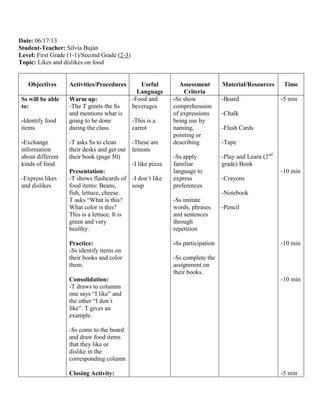
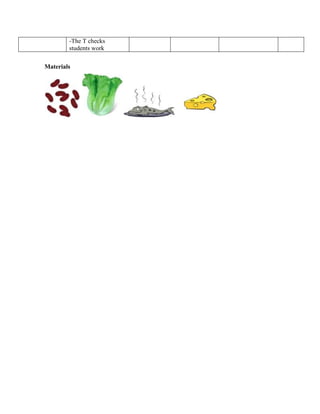
Materials
Date: 06/17/2013
Student-Teacher: Silvia Buján
Level: Third Grade (3-2/3-3)
Topic: House items
Objectives Activities/Procedures Useful
Language
Assessment
Criteria
Material/Resources Time
Ss will be able
to:
-Identify basic
language related
to the parts of
the house
-Identify
furniture inside
of the house
-Describe house
items
Warm up:
-The T greets the Ss
and mentions what is
going to be done
during the class.
-T asks Ss to clean
their desks and get out
their book (page 44)
Presentation:
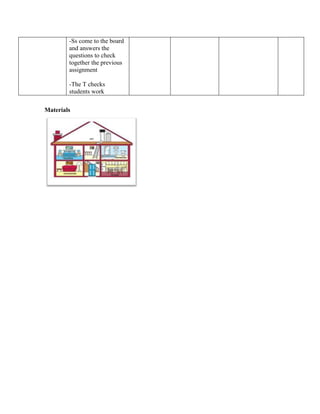
-T pastes a big poster
on the board. It is a
house with all the
parts divided
-T asks Ss to help her
identify each item of
the house. She asks
“What is this? This is
a bed”
-Ss repeat after the
teacher the name of
the furniture
Practice:
-Ss identify each part
of the house on their
books and color them.
Consolidation:
-Ss have to respond
the questions on their
books. Ex: Where is
the T.V? “The TV is
in the living room.
Closing Activity:
-Living room,
dining room,
kitchen,
bedroom,
bathroom,
garage,
garden,
office,
backyard.
-Where is the
table, TV,
bed, sofa,
toilet, sink,
stove,
refrigerator,
car, lamp,
etc?
-Ss show
comprehension
of expressions
being use by
naming,
pointing or
describing
-Ss apply
language or
expressions
being studied
-Ss imitate
words, phrases
and sentences
through
repetition
-Ss locate and
compare
furniture
-Ss participation
-Ss complete the
assignment on
their books.
-Board
-Chalk
-Poster
-Play and Learn (3rd
grade) Book
-Crayons
-Pencil
-5 min
-10 min
-10 min
-10 min
-5 min
-Ss come to the board
and answers the
questions to check
together the previous
assignment
-The T checks
students work
Materials
Date: 06/19/2013
Student-Teacher: Silvia Buján
Level: Third Grade (3-2/3-3)
Topic: Parts of the house and furniture review.
Objectives Activities/Procedures Useful
Language
Assessment
Criteria
Material/Resources Time
Ss will be able
to:
-Identify basic
language related
to the parts of
the house
-Identify
furniture inside
of the house
-Describe house
items
-Express actions
perform inside
the house
Warm up:
-The T greets the Ss
and mentions what is
going to be done
during the class.
-T asks Ss to clean
their desks
Presentation:
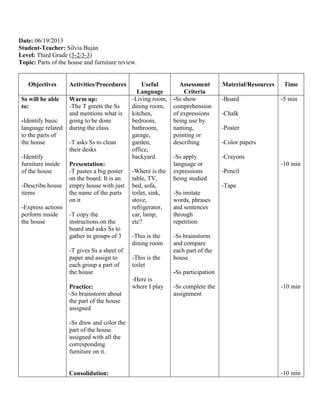
-T pastes a big poster
on the board. It is an
empty house with just
the name of the parts
on it
-T copy the
instructions on the
board and asks Ss to
gather in groups of 3
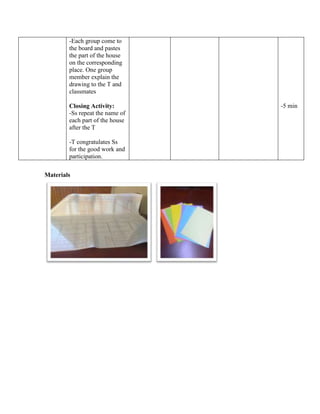
-T gives Ss a sheet of
paper and assign to
each group a part of
the house
Practice:
-Ss brainstorm about
the part of the house
assigned
-Ss draw and color the
part of the house
assigned with all the
corresponding
furniture on it.
Consolidation:
-Living room,
dining room,
kitchen,
bedroom,
bathroom,
garage,
garden,
office,
backyard.
-Where is the
table, TV,
bed, sofa,
toilet, sink,
stove,
refrigerator,
car, lamp,
etc?
-This is the
dining room
-This is the
toilet
-Here is
where I play
-Ss show
comprehension
of expressions
being use by
naming,
pointing or
describing
-Ss apply
language or
expressions
being studied
-Ss imitate
words, phrases
and sentences
through
repetition
-Ss brainstorm
and compare
each part of the
house
-Ss participation
-Ss complete the
assignment
-Board
-Chalk
-Poster
-Color papers
-Crayons
-Pencil
-Tape
-5 min
-10 min
-10 min
-10 min
-Each group come to
the board and pastes
the part of the house
on the corresponding
place. One group
member explain the
drawing to the T and
classmates
Closing Activity:
-Ss repeat the name of
each part of the house
after the T
-T congratulates Ss
for the good work and
participation.
-5 min
Materials
Date: 06/24/2013 and 06/26/2013
Student-Teacher: Silvia Buján
Level: First Grade (1-1/1-2/1-3)/Second Grade (2-3)/Third Grade (3-2/3-3)
Topic: Healthy Food vs. Junk Food
Objectives Activities/Procedures Useful
Language
Assessment
Criteria
Material/Resources Time
Ss will be able
to:
-Recall
instructions that
have been
reviewed on
previous lessons
-Identify
different kinds
of food
-Infer the
difference
between healthy
food and junk
food
-Describe
different kinds
of food
-Classify
healthy and junk
food
Warm up:
-The T greets the Ss
and mentions what is
going to be done
during the class.
-The T starts giving
and showing
instructions that Ss
have to follow while
they perform the
movements and repeat
the command: Stand
up, sit down, stand up,
hands up, hands
down, spin, and jump.
Presentation:
-The T introduces
content by showing
flash cards while Ss
answer the question
“What is this?”
-The T draws two
columns, one for
healthy food and other
for junk food and
classifies the
flashcards showed
before. T explains the
difference between
healthy and junk food.
Practice:
-Ss work on page 50
on their books by
identifying the same
items that are being
-Food and
beverages
vocabulary
-I like
-I don’t like
-This is a/an
-These are
-That apple is
red
-The banana
is sweet
-Delicious
-Healthy
-Junk
-Ss show
comprehension
of expressions
being use by
naming,
pointing or
describing
-Ss apply
language or
expressions
being studied
-Ss participation
-Ss willingness
to communicate
-Board
-Chalk
-Flash Cards (Big
and small versions)
-Tape
-Play and Learn (2nd
grade) Book
-Crayons
-Plastic Jars
-5 min
-10 min
-10 min
showed on the
flashcards.
-Ss repeat together
after the teacher and
then color on their
books the same items
from the board.
Consolidation:
-The T gives one food
item to each student.
-T shows two jars, one
is an apple for healthy
food and the other is a
chocolate for junk
food.
-Students come to the
front and make a line,
then each one have to
classify the food on
the jars.
Closing Activity:
-The T checks
students work
-T points out what has
been accomplished
and congratulates the
Ss for their good
work.
-10 min
-5 min
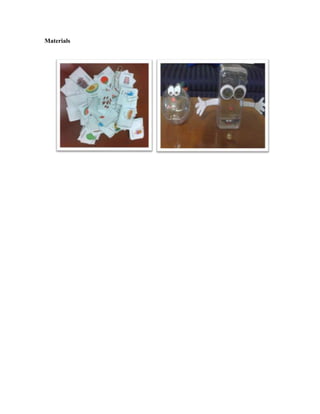
Materials
Date: 07/15/2013
Student-Teacher: Silvia Buján
Level: First Grade (1-1)/Second Grade (2-3)/Third Grade (3-2/3-3)
Topic: Food with Five Senses
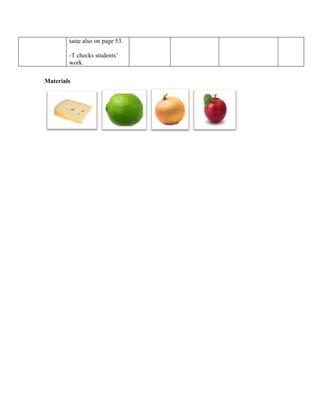
Objectives Activities/Procedures Useful
Language
Assessment
Criteria
Material/Resources Time
Ss will be able
to:
-Recognize food
items
-Describe
different types
of food
-Match
meanings with
visual material
Warm up:
- Ss greet the T and
she mentions what is
going to be done
during the class.
-Ss have to listen to T
instructions and
follow her while they
perform the
movements and repeat
the command.
Presentation:
-Ss watch different
items like lemons,
apples, cheese,
orange, fries, beans,
coffee, and onion and
describe its flavor,
size, color and shape.
Practice:
-Ss will have to
identify and color the
items showed by the
teacher on their books.
Consolidation:
-Ss will have to solve
a match on page 53.
They must circle the
main sense they need
to experience each
item.
Closing Activity:
-Ss have to match
each item with its
Flavors:
Salty, sweet,
sour, acid.
Food items
like: lemons,
apples,
cheese,
orange, fries,
beans, coffee,
onion
What is this?
This is a
lemon
What color is
this?
It is green.
-Ss show
comprehension
of expressions
being use by
naming,
pointing or
describing
-Ss apply
language or
expressions
being studied
-Ss imitate
words, phrases
and sentences
through
repetition
-Ss show
comprehension
of tastes by
completing the
assignment.
-Board
-Chalk
-Food items
-Book
-Pencils
-5 min
-10 min
-10 min
-10 min
-5 min
taste also on page 53.
-T checks students’
work.
Materials
Date: 07/19/2013
Student-Teacher: Silvia Buján
Level: First Grade (1-3)/Second Grade (2-1/2-2)/Third Grade (3-1).
Topic: Types of Meals
Objectives Activities/Procedures Useful
Language
Assessment
Criteria
Material/Resources Time
Ss will be able
to:
Recognize food
items
-Describe
different types
of food
-Match
meanings with
visual material
Warm up:
- Ss greet the T and
she mentions what is
going to be done
during the class.
-Ss have to listen to T
instructions and
follow her while they
perform the
movements and repeat
the command.
Presentation:
-Ss will listen to
Carlos the puppet.
Carlos will ask
students about what
they brought for
breakfast and lunch.
Practice:
-Ss will identify and
color each item
presented by the
teacher on their books
on page 54.
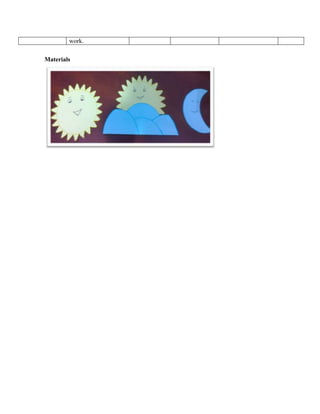
Consolidation:
-Ss will have to come
to the board and draw
next to the
corresponding image
what they usually eat
for each meal of the
day.
Closing Activity:
-T checks students’
Food items
like: eggs,
milk, coffee,
cereal,
yogurt,
orange juice,
sandwich,
chicken, fish,
meat, rice,
beans, soup,
tea,
vegetables
What do you
eat for
breakfast,
lunch, and
dinner?
I eat cereal at
7am
-Ss show
comprehension
of expressions
being use by
naming,
pointing or
describing
-Ss apply
language or
expressions
being studied
-Ss imitate
words, phrases
and sentences
through
repetition
-Ss demonstrate
understanding
by completing
the task.
-Board
-Chalk
-Flashcards
-Book
-Crayons
-Tape
-5 min
-10 min
-10 min
-10 min
-5 min
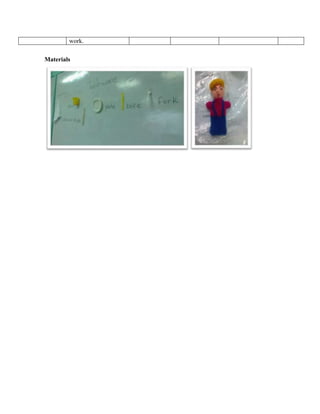
work.
Materials
Date: 07/22/2013
Student-Teacher: Silvia Buján
Level: First Grade (1-2/1-3)/Second Grade (2-3)/Third Grade (3-2/3-3).
Topic: Animals Descriptions
Objectives Activities/Procedures Useful
Language
Assessment
Criteria
Material/Resources Time
Ss will be able
to:
-Identify basic
language related
to pet animals
and domestic
animals.
-Recognize
animals’ sounds
and actions.
-Describe pets’
characteristics.
-Match
meanings with
visual material
-Express likes
and dislikes
Warm up:
- Ss greet the T and
she mentions what is
going to be done
during the class.
-Ss have to listen to T
instructions and
follow her while they
perform the
movements and repeat
the command.
Presentation:
-Ss will watch some
animal’s flashcards,
and will answer
questions about how
they look like
Practice:
-Ss will have to
identify and color the
presented animals on
their books.
Consolidation:
-Ss will have to
describe their pets or
favorite animals
Closing Activity:
-T checks students’
work.
Dog, chicken,
rabbit, turtle,
fish, cat, bird,
frog, horse,
cow, pig,
hamster,
duck,
monkey.
-This is a
dog. It is my
pet.
-I have a fish.
-I like cats.
-I don´t like
pigs.
-Move like a
rabbit
-My dog is
black
-Ss show
comprehension
of expressions
being use by
naming,
pointing or
describing
-Ss apply
language or
expressions
being studied
-Ss imitate
words, phrases
and sentences
through
repetition
-Ss demonstrate
understanding
by performing
actions and
sounds
requested
-Board
-Chalk
-Book
-Crayons
-5 min
-10 min
-10 min
-10 min
-5 min
Materials
Date: 07/29/2013
Student-Teacher: Silvia Buján
Level: Third Grade (3-2/3-3)
Topic: Clothing
Objectives Activities/Procedures Useful
Language
Assessment
Criteria
Material/Resources Time
Ss will be able
to:
-Identify basic
language related
to clothing
articles
-Describe
clothing items
-Match
meanings with
visual material
Warm up:
- Ss greet the T and
she mentions what is
going to be done
during the class.
-Ss have to listen to T
instructions and
follow her while they
perform the
movements and repeat
the command.
Presentation:
-Ss will watch some
flashcards presented
by the teacher
Practice:
-Ss will have to draw
and color on their
notebooks the
different items
presented by the
teacher.
Consolidation:
- Students will have to
match clothing items
with its corresponding
description on page
55.
Closing Activity:
-T checks students’
work.
Clothing
Items: Jacket,
top, t-shirt,
shorts,
blouse,
sweater,
pants,
jumpsuit,
shoes, scarf,
hat.
-Ss show
comprehension
of expressions
being use by
naming,
pointing or
describing
-Ss apply
language or
expressions
being studied
-Ss imitate
words, phrases
and sentences
through
repetition
-Ss demonstrate
understanding
by completing
the assignment
-Board
-Chalk
-Tape
-Book
-Crayons
-Notebook
-5 min
-10 min
-10 min
-10 min
-5 min
Materials
Date: 07/31/2013
Student-Teacher: Silvia Buján
Level: Third Grade (3-2/3-3)
Topic: Tableware and Manners
Objectives Activities/Procedures Useful
Language
Assessment
Criteria
Material/Resources Time
Ss will be able
to:
-Identify basic
language related
to tableware.
-Recognize the
correct ways to
behave on the
table.
Warm up:
- Ss greet the T and
she mentions what is
going to be done
during the class.
-Ss have to listen to T
instructions and
follow her while they
perform the
movements and repeat
the command.
Presentation:
-Ss will watch the
plastic items that the
teachers pasted on the
board, and answers
the question: “What is
this?”
Practice:
-Ss will have to
identify and color the
presented items on
their notebooks.
Consolidation:
-Ss will reflect about
the correct way to
behave on the table
Closing Activity:
-Ss will listen to
Carlos the puppet
while he explains how
we have to behave on
the table.
-T checks students’
Tableware:
plate, spoon,
fork, glass,
napkin, jar,
tablecloth,
table, chair,
Chinese
sticks, pot,
pitcher, mug,
knife
-What is this?
This is a glass
I drink water
in the glass
-Where is the
spoon?
-Seat
correctly.
-Do not use
the cell
phone.
-Ss show
comprehension
of expressions
being use by
naming,
pointing or
describing
-Ss apply
language or
expressions
being studied
-Ss imitate
words, phrases
and sentences
through
repetition
-Ss brainstorm
about the right
way to behave
on the table
-Ss demonstrate
understanding
by completing
the task.
-Board
-Pilots
-Plastic items
-Tape
-Notebook
-Book page 54
-Pencil
-Crayons
-5 min
-10 min
-10 min
-5 min
-10 min
work.
Materials
Date: 07/31/2013 and 08/05/2013
Student-Teacher: Silvia Buján
Level: First Grade (1-2/1-1)/Second Grade (2-3)
Topic: Pet Animals/Domestic Animals
Objectives Activities/Procedures Useful
Language
Assessment
Criteria
Material/Resources Time
Ss will be able
to:
-Identify basic
language related
to pet animals
and domestic
animals.
-Imitate
animal’s sounds
and actions
-Recognize
animals’ sounds
-Match
meanings with
visual material
-Express likes
and dislikes by
drawing their
favorite animals.
Warm up:
-Ss will imitate
animals’ sounds and
movements by
following the
teacher’s instructions
Presentation:
-Ss will listen to some
sounds and will have
to guess which
animals make those
sounds. Then, T will
paste a flashcard of
the animal on the
board.
Practice:
-Ss will have to
identify and color the
presented animals on
their books. Pages 53
and 55.
Consolidation:
-Each student will
have a palette with an
animal assigned by
the T. Then, when the
T asked them where
those animals are they
will have to raise their
pallets and act like
that animal.
Closing Activity:
-Ss will have to draw
and color their pets or
favorite animal on a
Dog, chicken,
rabbit, turtle,
fish, cat, bird,
frog, horse,
cow, pig,
hamster,
duck,
monkey.
-This is a
dog. It is my
pet.
-I have a fish.
-I like cats.
-I don´t like
pigs.
-Move like a
rabbit
-Ss show
comprehension
of expressions
being use by
naming,
pointing or
describing
-Ss apply
language or
expressions
being studied
-Ss imitate
words, phrases
and sentences
through
repetition
-Ss brainstorm
and compare
each part of the
house
-Ss
demonstrates
understanding
by performing
actions and
sounds
requested
-Ss complete the
assignments
-Board
-Chalk
-Recorder
-CD
-Flashcards
-Palettes
-Color papers
-Crayons
-Pencil
-Tape
-Cookies
-10 min
-10 min
-5 min
-10 min
-5 min
piece of paper and
pasted on the board
once they are done.
-T congratulates Ss
for the good work and
participation and will
give them some
cookies with animal’s
shapes.
Materials
Date: 08/05/2013 and 08/07/2013
Student-Teacher: Silvia Buján
Level: First Grade (1-2/1-3)/Second Grade (2-3)/Third Grade (3-2/3-3)
Topic: Animal’s Bingo
Objectives Activities/Procedures Useful
Language
Assessment
Criteria
Material/Resources Time
Ss will be able
to:
-Identify basic
language related
to pet animals
and domestic
animals.
-Imitate
animal’s sounds
and actions
-Recognize
animals’
descriptions
-Match
meanings with
visual material
Warm up:
- Ss greet the T and
she mentions what is
going to be done
during the class.
-Ss have to listen to T
instructions and
follow her while they
perform the
movements and repeat
the command.
Presentation:
-Ss will watch an
example of how to
play the game.
Practice:
-Ss will have to sit in
pairs and will wait for
the teacher to call the
first animal. They will
have to put a bean on
each animal that the
teacher mentions. The
first group who
complete the task
wins.
Consolidation:
-Ss will play the game
one more time.
Closing Activity:
-T congratulates Ss
for the good work and
participation and will
give them some
Dog, chicken,
rabbit, turtle,
fish, cat, bird,
frog, horse,
cow, pig,
hamster,
duck,
monkey.
-This is a
dog.
-I have the
fish.
-I need the
bird
-Ss show
comprehension
of expressions
being use by
naming,
pointing or
describing
-Ss apply
language or
expressions
being studied
-Ss imitate
words, phrases
and sentences
through
repetition
-Ss demonstrate
understanding
by completing
the task.
-Ss are able to
work in pairs.
-Board
-Chalk
-Flashcards
-Bingo Cards
-Beans
-Tape
-Cookies
-5 min
-10 min
-10 min
-10 min
-5 min
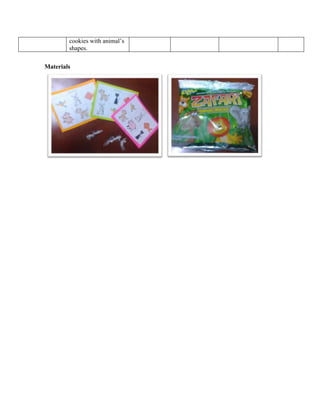
cookies with animal’s
shapes.
Materials
Date: 08/09/2013
Student-Teacher: Silvia Buján
Level: First Grade (1-3)/Second Grade (2-1/2-2)/Third Grade (3-1)
Topic: Traditional Games
Objectives Activities/Procedures Useful
Language
Assessment
Criteria
Material/Resources Time
Ss will be able
to:
-Identify basic
language related
to games
-Recognize the
difference
between
traditional and
modern games
-Match
meanings with
visual material
-Express likes
and dislikes by
drawing their
favorite toys.
Warm up:
- Ss greet the T and
she mentions what is
going to be done
during the class.
-Ss have to listen to T
instructions and
follow her while they
perform the
movements and repeat
the command.
Presentation:
-Ss will watch some
flashcards, and real
toys presented by the
teacher.
Practice:
-Ss will have to
identify, draw, and
color the presented
items on their
notebooks.
Consolidation:
-T will check
student’s work.
Closing Activity:
-T congratulates Ss
for the good work and
participation and will
allow them to go to
play with the toys
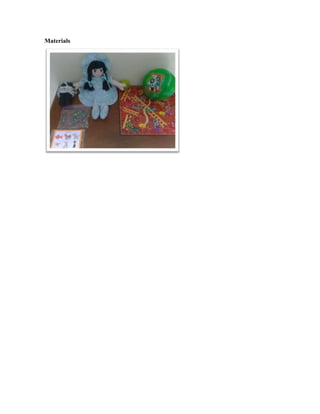
outside.
Toys: Doll,
skateboard,
marble, yo-
yo, board
games, jump
rope, hide
and seek,
cars, play
station, ball,
Barbie.
-Ss show
comprehension
of expressions
being use by
naming,
pointing or
describing
-Ss apply
language or
expressions
being studied
-Ss imitate
words, phrases
and sentences
through
repetition
-Ss brainstorm
and compare
traditional
games with
modern games
-Ss
demonstrates
understanding
by competing
the task
-Board
-Chalk
-Flashcards
-Toys
-Notebook
-Crayons
-Pencil
-5 min
-10 min
-10 min
-5 min
-10 min
Materials

Lesson Plans for Elementary School

  • 1.
    LESSON PLANS Date: 06/03/2013 Student-Teacher:Silvia Buján Level: First Grade (1-1) Topic: Feelings Objectives Activities/Procedures Useful Language Assessment Criteria Material/Resources Time Ss will be able to: -Identify feelings -Express feelings -Respond with short phrases to inform about feelings. Warm up: -The T greets the Ss and mentions what is going to be done during the class. -T asks Ss to clean their desks and get out their notebook. Presentation: -T shows one orange and asks “What is this?” -T draws an orange with a happy face and asks Ss “How does the orange feel?” Practice: -Ss draw on the board different faces for the orange. Sad, angry, scare, confused. Consolidation: -Ss copy the oranges o n their notebooks and color them Closing Activity: -Ss repeat together after the T the different feelings -Happy, sad, angry, scare, confused -How do you feel? -I feel… -Ss show comprehension of expressions being use by naming, pointing or describing -Ss apply language or expressions being studied -Ss imitate words, phrases and sentences through repetition -Ss participation -Ss complete the assignment on their notebooks. -Board -Chalk -One orange -Notebook -Crayons -5 min -10 min -10 min -10 min -5 min
  • 2.
    -The T checks studentswork Materials
  • 3.
    Date: 06/03/2013 Student-Teacher: SilviaBuján Level: Second Grade (2-3)/Third Grade (3-2/3-3) Topic: Family Objectives Activities/Procedures Useful Language Assessment Criteria Material/Resources Time Ss will be able to: -Identify family members -Express feelings -Respond with short phrases to inform about family -Describe family relationships. Warm up: -The T greets the Ss and mentions what is going to be done during the class. -T asks Ss to clean their desks and get out their notebook. Presentation: -T shows one heart of paper and asks “What is this?” -T draws a heart and a family member inside of it. T asks “Who is this? This is a mother. I love my mother” Practice: -Ss draw the family member that they chose inside of one heart. Ss said “This is my brother, sister, etc.” Consolidation: -Ss copy the hearts on their notebooks and color them Closing Activity: -Ss respond to the question “How does your mother feel?” Is she happy? Is she sad? -He/she feels -Nuclear and extended family members: Mother, father, brother, sister, grandfather, grandmother, pet, uncle, aunt, cousin. -Who is this? -This is my father -How many brothers and sister do you have? -I have 1 brother and 1 sister -Do you have a pet? -I have a dog -How does your father look like? -My father is -Ss show comprehension of expressions being use by naming, pointing or describing -Ss apply language or expressions being studied -Ss imitate words, phrases and sentences through repetition -Ss participation -Ss complete the assignment on their notebooks. -Board -Chalk -Heart shape -Notebook -Crayons -5 min -10 min -10 min -10 min -5 min
  • 4.
    Is she angry? -TheT checks students work tall Materials
  • 5.
    Date: 06/05/13 Student-Teacher: SilviaBuján Level: First Grade (1-2/1-3)/Second Grade (2-3)/Third Grade (3-2/3-3) Topic: Family activities Objectives Activities/Procedures Useful Language Assessment Criteria Material/Resources Time Ss will be able to: -Recognize family members -Respond with short phrases to inform about family -Describe family activities. Warm up: -The T greets the Ss and mentions what is going to be done during the class. -T asks Ss to clean their desks and get out their notebook. Presentation: -T pastes a big poster on the board. It is a house where all the family members are performing different activities. -T asks Ss “what is the mother doing?” and so on with all family members Practice: -Ss draw and color the family members doing the activities and write the corresponding sentence. Ex: The mother is reading the newspaper Consolidation: -Ss come to the board and draw their own favorite family activity Closing Activity: -He/she feels -Nuclear family members: Mother, father, brother, sister, grandfather, grandmother, pet. -Who is this? -This is my father -How many brothers and sister do you have? -I have 1 brother and 1 sister -Do you have a pet? -I have a dog -How does your father look like? -My father is tall -Ss show comprehension of expressions being use by naming, pointing or describing -Ss apply language or expressions being studied -Ss imitate words, phrases and sentences through repetition -Ss participation -Ss complete the assignment on their notebooks. -Board -Chalk -Poster -Notebook -Pencil -Crayons -5 min -10 min -10 min -10 min -5 min
  • 6.
    -Ss repeat afterthe teacher the sentences about the activities. -The T checks students work Material
  • 7.
    Date: 06/10/2013 Student-Teacher: SilviaBuján Level: First Grade (1-1)/Second Grade (2-3)/Third Grade (3-2/3-3) Topic: Food Objectives Activities/Procedures Useful Language Assessment Criteria Material/Resources Time Ss will be able to: -Identify food items -Exchange information about different kinds of food Warm up: -The T greets the Ss and mentions what is going to be done during the class. -T asks Ss to clean their desks and get out their book (page 50) Presentation: -T shows flashcards of food items: Apple, eggs, rice, and carrot. T asks “What is this? What color is this? This is an apple. It is red and sweet. Practice: -Ss identify items on their books and color them. Consolidation: -Ss come to the board and draw food items that they usually eat. Closing Activity: -The T checks students work -Food and beverages -This is an apple -These are oranges -Ss show comprehension of expressions being use by naming, pointing or describing -Ss apply familiar language to express preferences -Ss imitate words, phrases and sentences through repetition -Ss participation -Ss complete the assignment on their books. -Board -Chalk -Flash Cards -Tape -Play and Learn (2nd grade) Book -Crayons -5 min -10 min -10 min -10 min -5 min
  • 8.
  • 9.
    Date: 06/12/2013 Student-Teacher: SilviaBuján Level: Third Grade (3-2/3-3) Topic: Parts of the house Objectives Activities/Procedures Useful Language Assessment Criteria Material/Resources Time Ss will be able to: -Identify basic language related to the parts of the house -Establish similarities and differences on the parts of the house -Describe parts of the house Warm up: -The T greets the Ss and mentions what is going to be done during the class. -T asks Ss to clean their desks and get out their book (page 47) Presentation: -T pastes a big poster on the board. It is a house with all the parts divided -T explain Ss the name of each part of the house and what do you do on each. Ex: This is the bedroom. This is where you go to sleep on your bed. Practice: -Ss identify each part of the house on their books and color them. Consolidation: -Ss cut the parts of the house and paste them on page 127 on the corresponding name. Closing Activity: -Ss repeat after the teacher the names of -Living room, dining room, kitchen, bedroom, bathroom, garage, garden, office, backyard. -Where do you cook, sleep, take a shower, and park the car? -What is your favorite part of the house? -Ss show comprehension of expressions being use by naming, pointing or describing -Ss apply language or expressions being studied -Ss imitate words, phrases and sentences through repetition -Ss locate and compare furniture -Ss participation -Ss complete the assignment on their notebooks. -Board -Chalk -Poster -Play and Learn (3rd grade) Book -Crayons -Scissors -Glue -5 min -10 min -10 min -10 min -5 min
  • 10.
    the parts ofthe house -The T checks students work Materials
  • 11.
    Date: 06/17/13 Student-Teacher: SilviaBuján Level: First Grade (1-1)/Second Grade (2-3) Topic: Likes and dislikes on food Objectives Activities/Procedures Useful Language Assessment Criteria Material/Resources Time Ss will be able to: -Identify food items -Exchange information about different kinds of food -Express likes and dislikes Warm up: -The T greets the Ss and mentions what is going to be done during the class. -T asks Ss to clean their desks and get out their book (page 50) Presentation: -T shows flashcards of food items: Beans, fish, lettuce, cheese. T asks “What is this? What color is this? This is a lettuce. It is green and very healthy. Practice: -Ss identify items on their books and color them. Consolidation: -T draws to columns one says “I like” and the other “I don´t like”. T gives an example. -Ss come to the board and draw food items that they like or dislike in the corresponding column Closing Activity: -Food and beverages -This is a carrot -These are lemons -I like pizza -I don´t like soup -Ss show comprehension of expressions being use by naming, pointing or describing -Ss apply familiar language to express preferences -Ss imitate words, phrases and sentences through repetition -Ss participation -Ss complete the assignment on their books. -Board -Chalk -Flash Cards -Tape -Play and Learn (2nd grade) Book -Crayons -Notebook -Pencil -5 min -10 min -10 min -10 min -5 min
  • 12.
    -The T checks studentswork Materials
  • 13.
    Date: 06/17/2013 Student-Teacher: SilviaBuján Level: Third Grade (3-2/3-3) Topic: House items Objectives Activities/Procedures Useful Language Assessment Criteria Material/Resources Time Ss will be able to: -Identify basic language related to the parts of the house -Identify furniture inside of the house -Describe house items Warm up: -The T greets the Ss and mentions what is going to be done during the class. -T asks Ss to clean their desks and get out their book (page 44) Presentation: -T pastes a big poster on the board. It is a house with all the parts divided -T asks Ss to help her identify each item of the house. She asks “What is this? This is a bed” -Ss repeat after the teacher the name of the furniture Practice: -Ss identify each part of the house on their books and color them. Consolidation: -Ss have to respond the questions on their books. Ex: Where is the T.V? “The TV is in the living room. Closing Activity: -Living room, dining room, kitchen, bedroom, bathroom, garage, garden, office, backyard. -Where is the table, TV, bed, sofa, toilet, sink, stove, refrigerator, car, lamp, etc? -Ss show comprehension of expressions being use by naming, pointing or describing -Ss apply language or expressions being studied -Ss imitate words, phrases and sentences through repetition -Ss locate and compare furniture -Ss participation -Ss complete the assignment on their books. -Board -Chalk -Poster -Play and Learn (3rd grade) Book -Crayons -Pencil -5 min -10 min -10 min -10 min -5 min
  • 14.
    -Ss come tothe board and answers the questions to check together the previous assignment -The T checks students work Materials
  • 15.
    Date: 06/19/2013 Student-Teacher: SilviaBuján Level: Third Grade (3-2/3-3) Topic: Parts of the house and furniture review. Objectives Activities/Procedures Useful Language Assessment Criteria Material/Resources Time Ss will be able to: -Identify basic language related to the parts of the house -Identify furniture inside of the house -Describe house items -Express actions perform inside the house Warm up: -The T greets the Ss and mentions what is going to be done during the class. -T asks Ss to clean their desks Presentation: -T pastes a big poster on the board. It is an empty house with just the name of the parts on it -T copy the instructions on the board and asks Ss to gather in groups of 3 -T gives Ss a sheet of paper and assign to each group a part of the house Practice: -Ss brainstorm about the part of the house assigned -Ss draw and color the part of the house assigned with all the corresponding furniture on it. Consolidation: -Living room, dining room, kitchen, bedroom, bathroom, garage, garden, office, backyard. -Where is the table, TV, bed, sofa, toilet, sink, stove, refrigerator, car, lamp, etc? -This is the dining room -This is the toilet -Here is where I play -Ss show comprehension of expressions being use by naming, pointing or describing -Ss apply language or expressions being studied -Ss imitate words, phrases and sentences through repetition -Ss brainstorm and compare each part of the house -Ss participation -Ss complete the assignment -Board -Chalk -Poster -Color papers -Crayons -Pencil -Tape -5 min -10 min -10 min -10 min
  • 16.
    -Each group cometo the board and pastes the part of the house on the corresponding place. One group member explain the drawing to the T and classmates Closing Activity: -Ss repeat the name of each part of the house after the T -T congratulates Ss for the good work and participation. -5 min Materials
  • 17.
    Date: 06/24/2013 and06/26/2013 Student-Teacher: Silvia Buján Level: First Grade (1-1/1-2/1-3)/Second Grade (2-3)/Third Grade (3-2/3-3) Topic: Healthy Food vs. Junk Food Objectives Activities/Procedures Useful Language Assessment Criteria Material/Resources Time Ss will be able to: -Recall instructions that have been reviewed on previous lessons -Identify different kinds of food -Infer the difference between healthy food and junk food -Describe different kinds of food -Classify healthy and junk food Warm up: -The T greets the Ss and mentions what is going to be done during the class. -The T starts giving and showing instructions that Ss have to follow while they perform the movements and repeat the command: Stand up, sit down, stand up, hands up, hands down, spin, and jump. Presentation: -The T introduces content by showing flash cards while Ss answer the question “What is this?” -The T draws two columns, one for healthy food and other for junk food and classifies the flashcards showed before. T explains the difference between healthy and junk food. Practice: -Ss work on page 50 on their books by identifying the same items that are being -Food and beverages vocabulary -I like -I don’t like -This is a/an -These are -That apple is red -The banana is sweet -Delicious -Healthy -Junk -Ss show comprehension of expressions being use by naming, pointing or describing -Ss apply language or expressions being studied -Ss participation -Ss willingness to communicate -Board -Chalk -Flash Cards (Big and small versions) -Tape -Play and Learn (2nd grade) Book -Crayons -Plastic Jars -5 min -10 min -10 min
  • 18.
    showed on the flashcards. -Ssrepeat together after the teacher and then color on their books the same items from the board. Consolidation: -The T gives one food item to each student. -T shows two jars, one is an apple for healthy food and the other is a chocolate for junk food. -Students come to the front and make a line, then each one have to classify the food on the jars. Closing Activity: -The T checks students work -T points out what has been accomplished and congratulates the Ss for their good work. -10 min -5 min
  • 19.
  • 20.
    Date: 07/15/2013 Student-Teacher: SilviaBuján Level: First Grade (1-1)/Second Grade (2-3)/Third Grade (3-2/3-3) Topic: Food with Five Senses Objectives Activities/Procedures Useful Language Assessment Criteria Material/Resources Time Ss will be able to: -Recognize food items -Describe different types of food -Match meanings with visual material Warm up: - Ss greet the T and she mentions what is going to be done during the class. -Ss have to listen to T instructions and follow her while they perform the movements and repeat the command. Presentation: -Ss watch different items like lemons, apples, cheese, orange, fries, beans, coffee, and onion and describe its flavor, size, color and shape. Practice: -Ss will have to identify and color the items showed by the teacher on their books. Consolidation: -Ss will have to solve a match on page 53. They must circle the main sense they need to experience each item. Closing Activity: -Ss have to match each item with its Flavors: Salty, sweet, sour, acid. Food items like: lemons, apples, cheese, orange, fries, beans, coffee, onion What is this? This is a lemon What color is this? It is green. -Ss show comprehension of expressions being use by naming, pointing or describing -Ss apply language or expressions being studied -Ss imitate words, phrases and sentences through repetition -Ss show comprehension of tastes by completing the assignment. -Board -Chalk -Food items -Book -Pencils -5 min -10 min -10 min -10 min -5 min
  • 21.
    taste also onpage 53. -T checks students’ work. Materials
  • 22.
    Date: 07/19/2013 Student-Teacher: SilviaBuján Level: First Grade (1-3)/Second Grade (2-1/2-2)/Third Grade (3-1). Topic: Types of Meals Objectives Activities/Procedures Useful Language Assessment Criteria Material/Resources Time Ss will be able to: Recognize food items -Describe different types of food -Match meanings with visual material Warm up: - Ss greet the T and she mentions what is going to be done during the class. -Ss have to listen to T instructions and follow her while they perform the movements and repeat the command. Presentation: -Ss will listen to Carlos the puppet. Carlos will ask students about what they brought for breakfast and lunch. Practice: -Ss will identify and color each item presented by the teacher on their books on page 54. Consolidation: -Ss will have to come to the board and draw next to the corresponding image what they usually eat for each meal of the day. Closing Activity: -T checks students’ Food items like: eggs, milk, coffee, cereal, yogurt, orange juice, sandwich, chicken, fish, meat, rice, beans, soup, tea, vegetables What do you eat for breakfast, lunch, and dinner? I eat cereal at 7am -Ss show comprehension of expressions being use by naming, pointing or describing -Ss apply language or expressions being studied -Ss imitate words, phrases and sentences through repetition -Ss demonstrate understanding by completing the task. -Board -Chalk -Flashcards -Book -Crayons -Tape -5 min -10 min -10 min -10 min -5 min
  • 23.
  • 24.
    Date: 07/22/2013 Student-Teacher: SilviaBuján Level: First Grade (1-2/1-3)/Second Grade (2-3)/Third Grade (3-2/3-3). Topic: Animals Descriptions Objectives Activities/Procedures Useful Language Assessment Criteria Material/Resources Time Ss will be able to: -Identify basic language related to pet animals and domestic animals. -Recognize animals’ sounds and actions. -Describe pets’ characteristics. -Match meanings with visual material -Express likes and dislikes Warm up: - Ss greet the T and she mentions what is going to be done during the class. -Ss have to listen to T instructions and follow her while they perform the movements and repeat the command. Presentation: -Ss will watch some animal’s flashcards, and will answer questions about how they look like Practice: -Ss will have to identify and color the presented animals on their books. Consolidation: -Ss will have to describe their pets or favorite animals Closing Activity: -T checks students’ work. Dog, chicken, rabbit, turtle, fish, cat, bird, frog, horse, cow, pig, hamster, duck, monkey. -This is a dog. It is my pet. -I have a fish. -I like cats. -I don´t like pigs. -Move like a rabbit -My dog is black -Ss show comprehension of expressions being use by naming, pointing or describing -Ss apply language or expressions being studied -Ss imitate words, phrases and sentences through repetition -Ss demonstrate understanding by performing actions and sounds requested -Board -Chalk -Book -Crayons -5 min -10 min -10 min -10 min -5 min
  • 25.
  • 26.
    Date: 07/29/2013 Student-Teacher: SilviaBuján Level: Third Grade (3-2/3-3) Topic: Clothing Objectives Activities/Procedures Useful Language Assessment Criteria Material/Resources Time Ss will be able to: -Identify basic language related to clothing articles -Describe clothing items -Match meanings with visual material Warm up: - Ss greet the T and she mentions what is going to be done during the class. -Ss have to listen to T instructions and follow her while they perform the movements and repeat the command. Presentation: -Ss will watch some flashcards presented by the teacher Practice: -Ss will have to draw and color on their notebooks the different items presented by the teacher. Consolidation: - Students will have to match clothing items with its corresponding description on page 55. Closing Activity: -T checks students’ work. Clothing Items: Jacket, top, t-shirt, shorts, blouse, sweater, pants, jumpsuit, shoes, scarf, hat. -Ss show comprehension of expressions being use by naming, pointing or describing -Ss apply language or expressions being studied -Ss imitate words, phrases and sentences through repetition -Ss demonstrate understanding by completing the assignment -Board -Chalk -Tape -Book -Crayons -Notebook -5 min -10 min -10 min -10 min -5 min
  • 27.
  • 28.
    Date: 07/31/2013 Student-Teacher: SilviaBuján Level: Third Grade (3-2/3-3) Topic: Tableware and Manners Objectives Activities/Procedures Useful Language Assessment Criteria Material/Resources Time Ss will be able to: -Identify basic language related to tableware. -Recognize the correct ways to behave on the table. Warm up: - Ss greet the T and she mentions what is going to be done during the class. -Ss have to listen to T instructions and follow her while they perform the movements and repeat the command. Presentation: -Ss will watch the plastic items that the teachers pasted on the board, and answers the question: “What is this?” Practice: -Ss will have to identify and color the presented items on their notebooks. Consolidation: -Ss will reflect about the correct way to behave on the table Closing Activity: -Ss will listen to Carlos the puppet while he explains how we have to behave on the table. -T checks students’ Tableware: plate, spoon, fork, glass, napkin, jar, tablecloth, table, chair, Chinese sticks, pot, pitcher, mug, knife -What is this? This is a glass I drink water in the glass -Where is the spoon? -Seat correctly. -Do not use the cell phone. -Ss show comprehension of expressions being use by naming, pointing or describing -Ss apply language or expressions being studied -Ss imitate words, phrases and sentences through repetition -Ss brainstorm about the right way to behave on the table -Ss demonstrate understanding by completing the task. -Board -Pilots -Plastic items -Tape -Notebook -Book page 54 -Pencil -Crayons -5 min -10 min -10 min -5 min -10 min
  • 29.
  • 30.
    Date: 07/31/2013 and08/05/2013 Student-Teacher: Silvia Buján Level: First Grade (1-2/1-1)/Second Grade (2-3) Topic: Pet Animals/Domestic Animals Objectives Activities/Procedures Useful Language Assessment Criteria Material/Resources Time Ss will be able to: -Identify basic language related to pet animals and domestic animals. -Imitate animal’s sounds and actions -Recognize animals’ sounds -Match meanings with visual material -Express likes and dislikes by drawing their favorite animals. Warm up: -Ss will imitate animals’ sounds and movements by following the teacher’s instructions Presentation: -Ss will listen to some sounds and will have to guess which animals make those sounds. Then, T will paste a flashcard of the animal on the board. Practice: -Ss will have to identify and color the presented animals on their books. Pages 53 and 55. Consolidation: -Each student will have a palette with an animal assigned by the T. Then, when the T asked them where those animals are they will have to raise their pallets and act like that animal. Closing Activity: -Ss will have to draw and color their pets or favorite animal on a Dog, chicken, rabbit, turtle, fish, cat, bird, frog, horse, cow, pig, hamster, duck, monkey. -This is a dog. It is my pet. -I have a fish. -I like cats. -I don´t like pigs. -Move like a rabbit -Ss show comprehension of expressions being use by naming, pointing or describing -Ss apply language or expressions being studied -Ss imitate words, phrases and sentences through repetition -Ss brainstorm and compare each part of the house -Ss demonstrates understanding by performing actions and sounds requested -Ss complete the assignments -Board -Chalk -Recorder -CD -Flashcards -Palettes -Color papers -Crayons -Pencil -Tape -Cookies -10 min -10 min -5 min -10 min -5 min
  • 31.
    piece of paperand pasted on the board once they are done. -T congratulates Ss for the good work and participation and will give them some cookies with animal’s shapes. Materials
  • 32.
    Date: 08/05/2013 and08/07/2013 Student-Teacher: Silvia Buján Level: First Grade (1-2/1-3)/Second Grade (2-3)/Third Grade (3-2/3-3) Topic: Animal’s Bingo Objectives Activities/Procedures Useful Language Assessment Criteria Material/Resources Time Ss will be able to: -Identify basic language related to pet animals and domestic animals. -Imitate animal’s sounds and actions -Recognize animals’ descriptions -Match meanings with visual material Warm up: - Ss greet the T and she mentions what is going to be done during the class. -Ss have to listen to T instructions and follow her while they perform the movements and repeat the command. Presentation: -Ss will watch an example of how to play the game. Practice: -Ss will have to sit in pairs and will wait for the teacher to call the first animal. They will have to put a bean on each animal that the teacher mentions. The first group who complete the task wins. Consolidation: -Ss will play the game one more time. Closing Activity: -T congratulates Ss for the good work and participation and will give them some Dog, chicken, rabbit, turtle, fish, cat, bird, frog, horse, cow, pig, hamster, duck, monkey. -This is a dog. -I have the fish. -I need the bird -Ss show comprehension of expressions being use by naming, pointing or describing -Ss apply language or expressions being studied -Ss imitate words, phrases and sentences through repetition -Ss demonstrate understanding by completing the task. -Ss are able to work in pairs. -Board -Chalk -Flashcards -Bingo Cards -Beans -Tape -Cookies -5 min -10 min -10 min -10 min -5 min
  • 33.
  • 34.
    Date: 08/09/2013 Student-Teacher: SilviaBuján Level: First Grade (1-3)/Second Grade (2-1/2-2)/Third Grade (3-1) Topic: Traditional Games Objectives Activities/Procedures Useful Language Assessment Criteria Material/Resources Time Ss will be able to: -Identify basic language related to games -Recognize the difference between traditional and modern games -Match meanings with visual material -Express likes and dislikes by drawing their favorite toys. Warm up: - Ss greet the T and she mentions what is going to be done during the class. -Ss have to listen to T instructions and follow her while they perform the movements and repeat the command. Presentation: -Ss will watch some flashcards, and real toys presented by the teacher. Practice: -Ss will have to identify, draw, and color the presented items on their notebooks. Consolidation: -T will check student’s work. Closing Activity: -T congratulates Ss for the good work and participation and will allow them to go to play with the toys outside. Toys: Doll, skateboard, marble, yo- yo, board games, jump rope, hide and seek, cars, play station, ball, Barbie. -Ss show comprehension of expressions being use by naming, pointing or describing -Ss apply language or expressions being studied -Ss imitate words, phrases and sentences through repetition -Ss brainstorm and compare traditional games with modern games -Ss demonstrates understanding by competing the task -Board -Chalk -Flashcards -Toys -Notebook -Crayons -Pencil -5 min -10 min -10 min -5 min -10 min
  • 35.