Heavy vehicle
driver
handbook
Heavy vehicle driver handbook 1
This handbook is only a general interpretation of the law, made easy to
understand by using plain English. Laws change often so make sure you
have the most recent handbook.
other Roads and Maritime services (RMS)
publications
•	 Road Users’ Handbook
•	 Load Restraint Guide
•	 A guide to heavy vehicle competency based assessment
•	 Getting your heavy vehicle driver licence
Heavy vehicle driver handbook
Heavy vehicle driver handbook2
Introduction
The Heavy vehicle driver handbook will help you understand the special
rules and regulations that apply to you and your heavy vehicle. It is a useful
guide outlining rules and regulations, skills and correct attitude required by
professional drivers. This publication must be read in conjunction with the
Road Users’ Handbook and Load Restraint Guide before undertaking a
heavy vehicle driver knowledge test.
Heavy vehicle driver handbook 3
1.	 HOW TO USE THIS HANDBOOK. . . . . . . . . . . . . . . . . . . . . . .  7
2.	LICENCES. . . . . . . . . . . . . . . . . . . . . . . . . . . . . . . . . . . . . . . . . . .  9
	 Ways to get a heavy vehicle driver licence . . . . . . . . . . . . . . . . . . . . . . . . . . . . . . . . . 9
	 Bribing people is against the law. . . . . . . . . . . . . . . . . . . . . . . . . . . . . . . . . . . . . . . . . 9
	 Medical assessment. . . . . . . . . . . . . . . . . . . . . . . . . . . . . . . . . . . . . . . . . . . . . . . . . . 10
	 Licence classes . . . . . . . . . . . . . . . . . . . . . . . . . . . . . . . . . . . . . . . . . . . . . . . . . . . . 11
	 Upgrading from a P2 licence. . . . . . . . . . . . . . . . . . . . . . . . . . . . . . . . . . . . . . . . . . . 17
	 Learning to drive. . . . . . . . . . . . . . . . . . . . . . . . . . . . . . . . . . . . . . . . . . . . . . . . . . . 18
	 Heavy Vehicle Competency Based Assessment (HVCBA). . . . . . . . . . . . . . . . . . . 18
	 Knowledge tests. . . . . . . . . . . . . . . . . . . . . . . . . . . . . . . . . . . . . . . . . . . . . . . . . . . . . 19
	 Driving tests. . . . . . . . . . . . . . . . . . . . . . . . . . . . . . . . . . . . . . . . . . . . . . . . . . . . . . . . 19
	 National Heavy Vehicle Driver Licence. . . . . . . . . . . . . . . . . . . . . . . . . . . . . . . . . . 21
	 Summary . . . . . . . . . . . . . . . . . . . . . . . . . . . . . . . . . . . . . . . . . . . . . . . . . . . . . . . . . . 22
3.	 driver management. . . . . . . . . . . . . . . . . . . . . . . . . . . . .  23
	 Health of professional drivers . . . . . . . . . . . . . . . . . . . . . . . . . . . . . . . . . . . . . . . . . 23
	 Driver fatigue . . . . . . . . . . . . . . . . . . . . . . . . . . . . . . . . . . . . . . . . . . . . . . . . . . . . . 24
	 Fatigue is caused by a number of factors. . . . . . . . . . . . . . . . . . . . . . . . . . . . . . . . . 24
	 Signs of driver fatigue. . . . . . . . . . . . . . . . . . . . . . . . . . . . . . . . . . . . . . . . . . . . . . . . 25
	 Tips on managing driver fatigue. . . . . . . . . . . . . . . . . . . . . . . . . . . . . . . . . . . . . . . . 25
	 Roadside rest areas. . . . . . . . . . . . . . . . . . . . . . . . . . . . . . . . . . . . . . . . . . . . . . . . . . . 26
	 The National Driving Hours Regulation. . . . . . . . . . . . . . . . . . . . . . . . . . . . . . . . . 26
	 Driver fatigue is an Occupational Health and Safety issue. . . . . . . . . . . . . . . . . . . 28
	 Chain of responsibility. . . . . . . . . . . . . . . . . . . . . . . . . . . . . . . . . . . . . . . . . . . . . . . 29
	 Work and rest options. . . . . . . . . . . . . . . . . . . . . . . . . . . . . . . . . . . . . . . . . . . . . . . . 29
	 National work diary. . . . . . . . . . . . . . . . . . . . . . . . . . . . . . . . . . . . . . . . . . . . . . . . . .  36
	 Record keeping . . . . . . . . . . . . . . . . . . . . . . . . . . . . . . . . . . . . . . . . . . . . . . . . . . . . .  36
	 Looking after your work diary. . . . . . . . . . . . . . . . . . . . . . . . . . . . . . . . . . . . . . . . . .  37
	 Driver base. . . . . . . . . . . . . . . . . . . . . . . . . . . . . . . . . . . . . . . . . . . . . . . . . . . . . . . . .  37
	 Alcohol, drugs and professional drivers. . . . . . . . . . . . . . . . . . . . . . . . . . . . . . . 38
	 Effects of alcohol on driving. . . . . . . . . . . . . . . . . . . . . . . . . . . . . . . . . . . . . . . . . .  38
	 Getting back to zero takes time . . . . . . . . . . . . . . . . . . . . . . . . . . . . . . . . . . . . . . . .  38
	 What does not sober you up. . . . . . . . . . . . . . . . . . . . . . . . . . . . . . . . . . . . . . . . . . .  38
	 Drugs and professional drivers. . . . . . . . . . . . . . . . . . . . . . . . . . . . . . . . . . . . . . . . .  39
	 Drug testing. . . . . . . . . . . . . . . . . . . . . . . . . . . . . . . . . . . . . . . . . . . . . . . . . . . . . . . .  41
	Seatbelts. . . . . . . . . . . . . . . . . . . . . . . . . . . . . . . . . . . . . . . . . . . . . . . . . . . . . . . . . . . 42
	 Entering and exiting a vehicle. . . . . . . . . . . . . . . . . . . . . . . . . . . . . . . . . . . . . . . . . . 43
	 Summary . . . . . . . . . . . . . . . . . . . . . . . . . . . . . . . . . . . . . . . . . . . . . . . . . . . . . . . . . . 44
Contents
Heavy vehicle driver handbook4
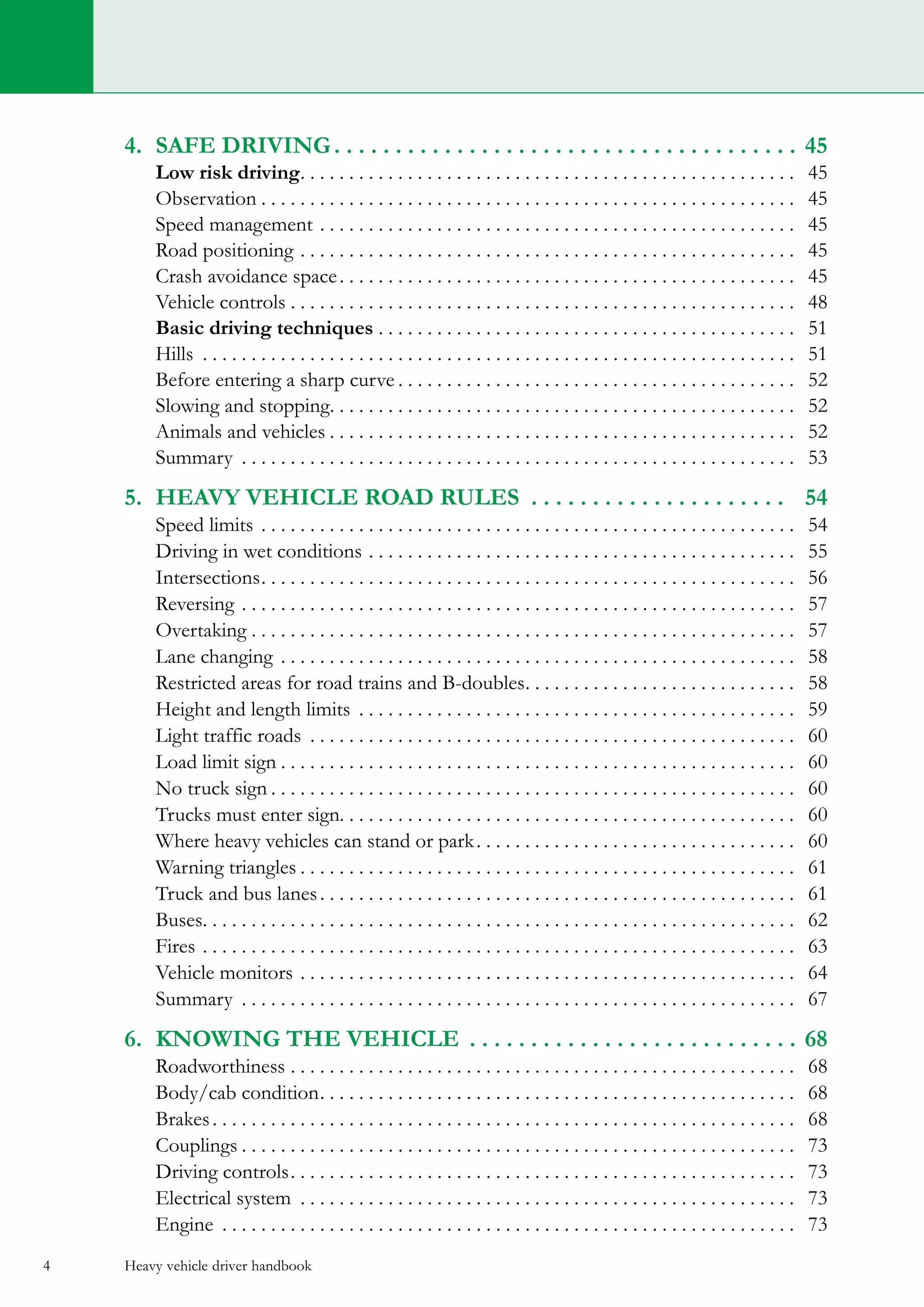
4.	 safe driving. . . . . . . . . . . . . . . . . . . . . . . . . . . . . . . . . . . . . .  45
	 Low risk driving. . . . . . . . . . . . . . . . . . . . . . . . . . . . . . . . . . . . . . . . . . . . . . . . . . . . 45
	Observation. . . . . . . . . . . . . . . . . . . . . . . . . . . . . . . . . . . . . . . . . . . . . . . . . . . . . . . . 45
	 Speed management. . . . . . . . . . . . . . . . . . . . . . . . . . . . . . . . . . . . . . . . . . . . . . . . . . 45
	 Road positioning. . . . . . . . . . . . . . . . . . . . . . . . . . . . . . . . . . . . . . . . . . . . . . . . . . . . 45
	 Crash avoidance space. . . . . . . . . . . . . . . . . . . . . . . . . . . . . . . . . . . . . . . . . . . . . . . . 45
	 Vehicle controls. . . . . . . . . . . . . . . . . . . . . . . . . . . . . . . . . . . . . . . . . . . . . . . . . . . . . 48
	 Basic driving techniques. . . . . . . . . . . . . . . . . . . . . . . . . . . . . . . . . . . . . . . . . . . . 51
	 Hills . . . . . . . . . . . . . . . . . . . . . . . . . . . . . . . . . . . . . . . . . . . . . . . . . . . . . . . . . . . . . . 51
	 Before entering a sharp curve. . . . . . . . . . . . . . . . . . . . . . . . . . . . . . . . . . . . . . . . . . 52
	 Slowing and stopping. . . . . . . . . . . . . . . . . . . . . . . . . . . . . . . . . . . . . . . . . . . . . . . . . 52
	 Animals and vehicles. . . . . . . . . . . . . . . . . . . . . . . . . . . . . . . . . . . . . . . . . . . . . . . . . 52
	 Summary . . . . . . . . . . . . . . . . . . . . . . . . . . . . . . . . . . . . . . . . . . . . . . . . . . . . . . . . . . 53
5.	 heavy vehicle road rules . . . . . . . . . . . . . . . . . . . . . . 54
	 Speed limits. . . . . . . . . . . . . . . . . . . . . . . . . . . . . . . . . . . . . . . . . . . . . . . . . . . . . . . . 54
	 Driving in wet conditions. . . . . . . . . . . . . . . . . . . . . . . . . . . . . . . . . . . . . . . . . . . . . 55
	Intersections. . . . . . . . . . . . . . . . . . . . . . . . . . . . . . . . . . . . . . . . . . . . . . . . . . . . . . . . 56
	 Reversing. . . . . . . . . . . . . . . . . . . . . . . . . . . . . . . . . . . . . . . . . . . . . . . . . . . . . . . . . . 57
	 Overtaking. . . . . . . . . . . . . . . . . . . . . . . . . . . . . . . . . . . . . . . . . . . . . . . . . . . . . . . . . 57
	 Lane changing. . . . . . . . . . . . . . . . . . . . . . . . . . . . . . . . . . . . . . . . . . . . . . . . . . . . . . 58
	 Restricted areas for road trains and B-doubles. . . . . . . . . . . . . . . . . . . . . . . . . . . . . 58
	 Height and length limits . . . . . . . . . . . . . . . . . . . . . . . . . . . . . . . . . . . . . . . . . . . . . . 59
	 Light traffic roads . . . . . . . . . . . . . . . . . . . . . . . . . . . . . . . . . . . . . . . . . . . . . . . . . . . 60
	 Load limit sign. . . . . . . . . . . . . . . . . . . . . . . . . . . . . . . . . . . . . . . . . . . . . . . . . . . . . . 60
	 No truck sign. . . . . . . . . . . . . . . . . . . . . . . . . . . . . . . . . . . . . . . . . . . . . . . . . . . . . . . 60
	 Trucks must enter sign. . . . . . . . . . . . . . . . . . . . . . . . . . . . . . . . . . . . . . . . . . . . . . . 60
	 Where heavy vehicles can stand or park. . . . . . . . . . . . . . . . . . . . . . . . . . . . . . . . . . 60
	 Warning triangles. . . . . . . . . . . . . . . . . . . . . . . . . . . . . . . . . . . . . . . . . . . . . . . . . . . . 61
	 Truck and bus lanes. . . . . . . . . . . . . . . . . . . . . . . . . . . . . . . . . . . . . . . . . . . . . . . . . . 61
	 Buses. . . . . . . . . . . . . . . . . . . . . . . . . . . . . . . . . . . . . . . . . . . . . . . . . . . . . . . . . . . . . . 62
	 Fires. . . . . . . . . . . . . . . . . . . . . . . . . . . . . . . . . . . . . . . . . . . . . . . . . . . . . . . . . . . . . . 63
	 Vehicle monitors. . . . . . . . . . . . . . . . . . . . . . . . . . . . . . . . . . . . . . . . . . . . . . . . . . . . 64
	 Summary . . . . . . . . . . . . . . . . . . . . . . . . . . . . . . . . . . . . . . . . . . . . . . . . . . . . . . . . . . 67
6.	 KNowing the vehicle . . . . . . . . . . . . . . . . . . . . . . . . . . .  68
	 Roadworthiness. . . . . . . . . . . . . . . . . . . . . . . . . . . . . . . . . . . . . . . . . . . . . . . . . . . . . 68
	 Body/cab condition. . . . . . . . . . . . . . . . . . . . . . . . . . . . . . . . . . . . . . . . . . . . . . . . . . 68
	 Brakes. . . . . . . . . . . . . . . . . . . . . . . . . . . . . . . . . . . . . . . . . . . . . . . . . . . . . . . . . . . . . 68
	 Couplings. . . . . . . . . . . . . . . . . . . . . . . . . . . . . . . . . . . . . . . . . . . . . . . . . . . . . . . . . . 73
	 Driving controls. . . . . . . . . . . . . . . . . . . . . . . . . . . . . . . . . . . . . . . . . . . . . . . . . . . . . 73
	 Electrical system . . . . . . . . . . . . . . . . . . . . . . . . . . . . . . . . . . . . . . . . . . . . . . . . . . . . 73
	 Engine . . . . . . . . . . . . . . . . . . . . . . . . . . . . . . . . . . . . . . . . . . . . . . . . . . . . . . . . . . . . 73
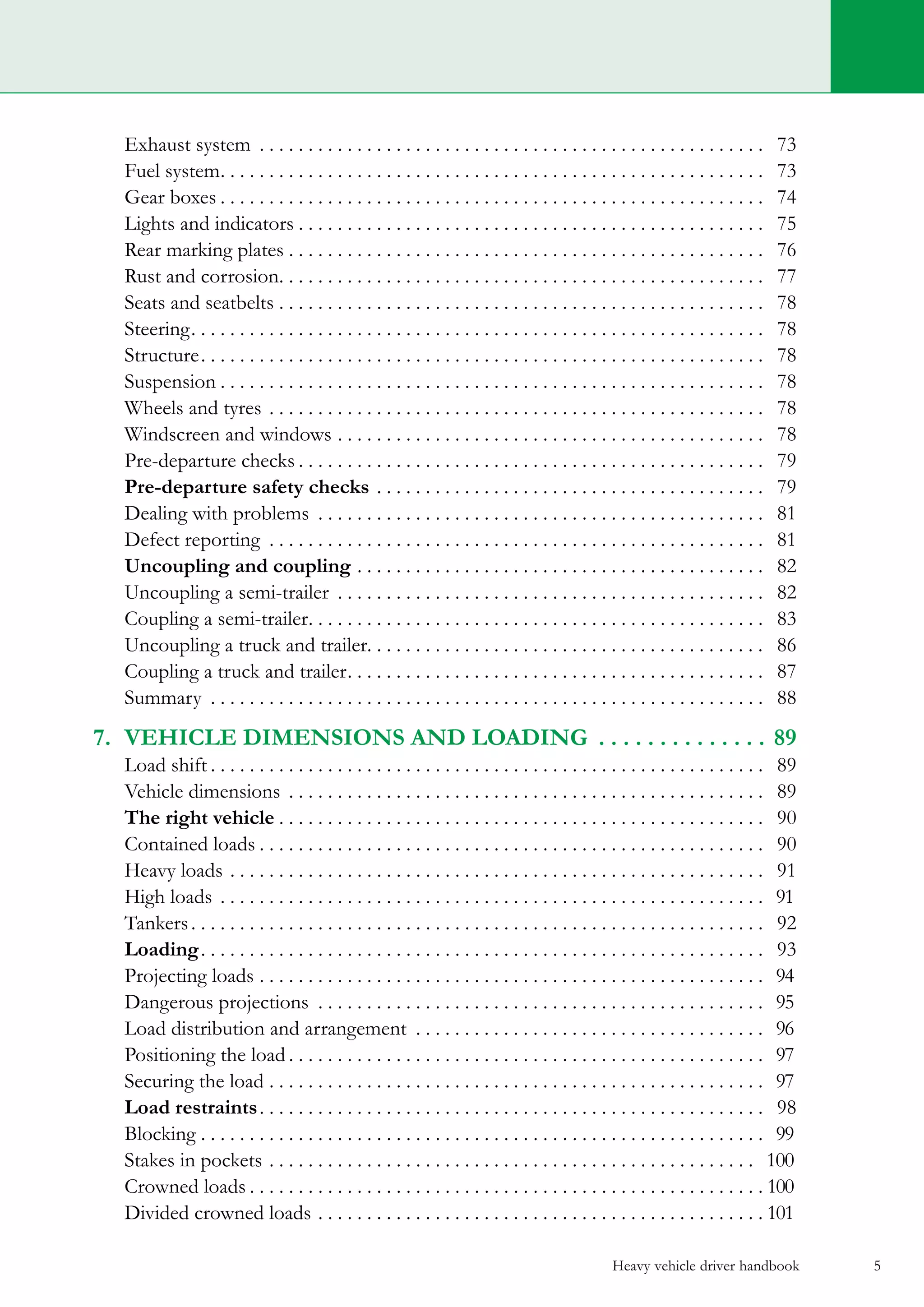
Heavy vehicle driver handbook 5
	 Exhaust system . . . . . . . . . . . . . . . . . . . . . . . . . . . . . . . . . . . . . . . . . . . . . . . . . . . . . 73
	 Fuel system. . . . . . . . . . . . . . . . . . . . . . . . . . . . . . . . . . . . . . . . . . . . . . . . . . . . . . . . . 73
	 Gear boxes. . . . . . . . . . . . . . . . . . . . . . . . . . . . . . . . . . . . . . . . . . . . . . . . . . . . . . . . . 74
	 Lights and indicators. . . . . . . . . . . . . . . . . . . . . . . . . . . . . . . . . . . . . . . . . . . . . . . . . 75
	 Rear marking plates. . . . . . . . . . . . . . . . . . . . . . . . . . . . . . . . . . . . . . . . . . . . . . . . . . 76
	 Rust and corrosion. . . . . . . . . . . . . . . . . . . . . . . . . . . . . . . . . . . . . . . . . . . . . . . . . . . 77
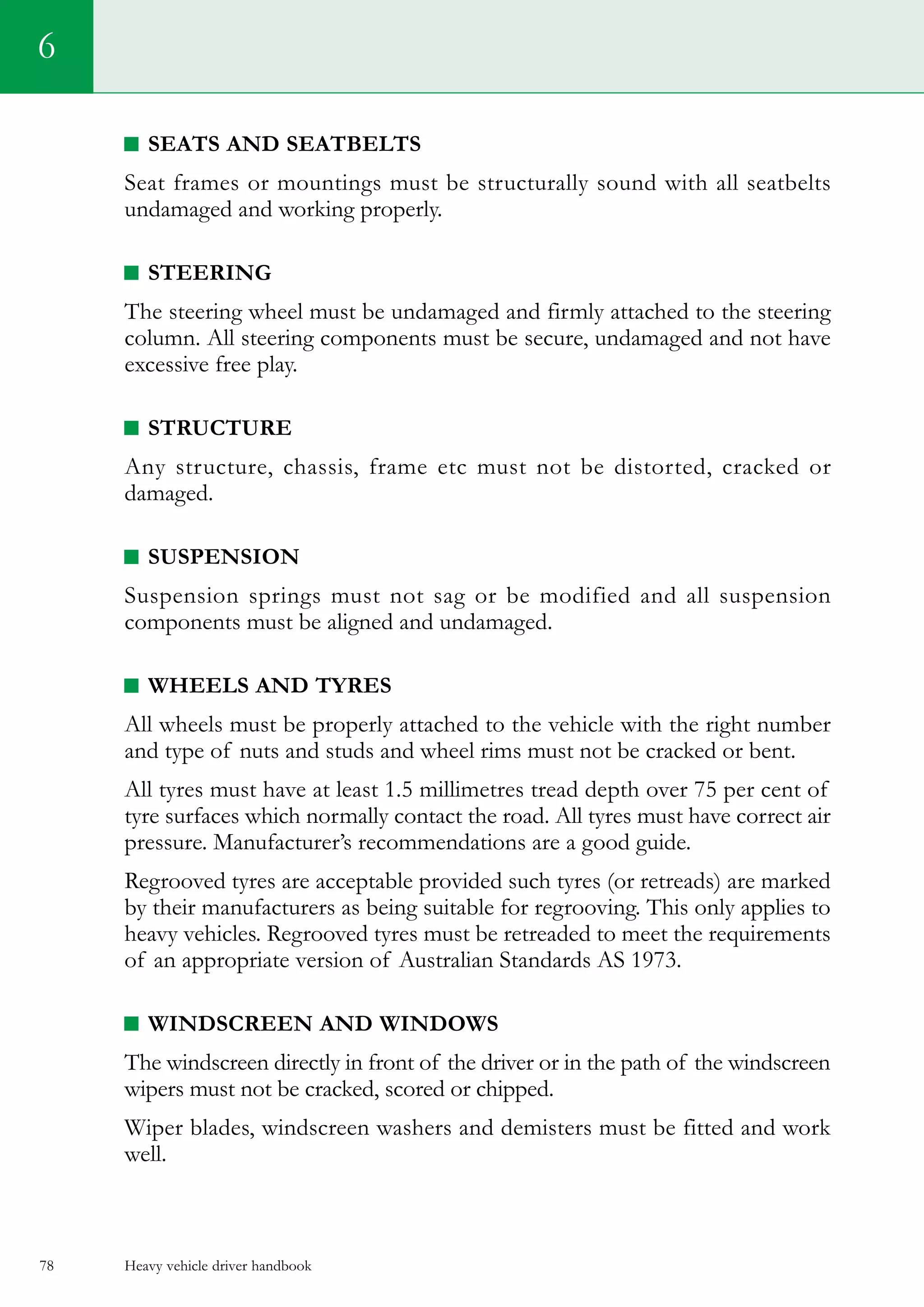
	 Seats and seatbelts. . . . . . . . . . . . . . . . . . . . . . . . . . . . . . . . . . . . . . . . . . . . . . . . . . . 78
	 Steering. . . . . . . . . . . . . . . . . . . . . . . . . . . . . . . . . . . . . . . . . . . . . . . . . . . . . . . . . . . . 78
	 Structure. . . . . . . . . . . . . . . . . . . . . . . . . . . . . . . . . . . . . . . . . . . . . . . . . . . . . . . . . . . 78
	 Suspension. . . . . . . . . . . . . . . . . . . . . . . . . . . . . . . . . . . . . . . . . . . . . . . . . . . . . . . . . 78
	 Wheels and tyres. . . . . . . . . . . . . . . . . . . . . . . . . . . . . . . . . . . . . . . . . . . . . . . . . . . . 78
	 Windscreen and windows. . . . . . . . . . . . . . . . . . . . . . . . . . . . . . . . . . . . . . . . . . . . . 78
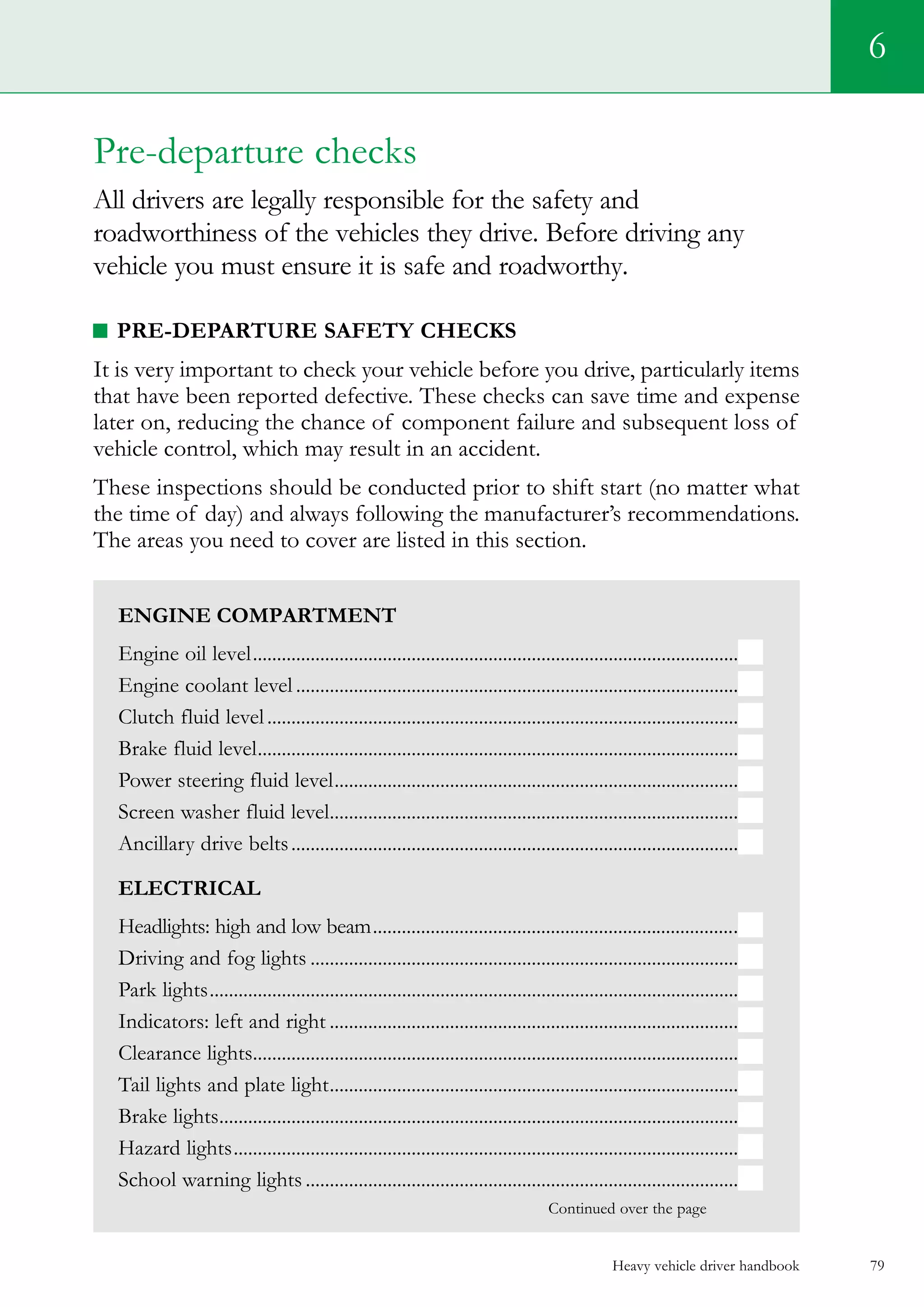
	 Pre-departure checks. . . . . . . . . . . . . . . . . . . . . . . . . . . . . . . . . . . . . . . . . . . . . . . . . 79
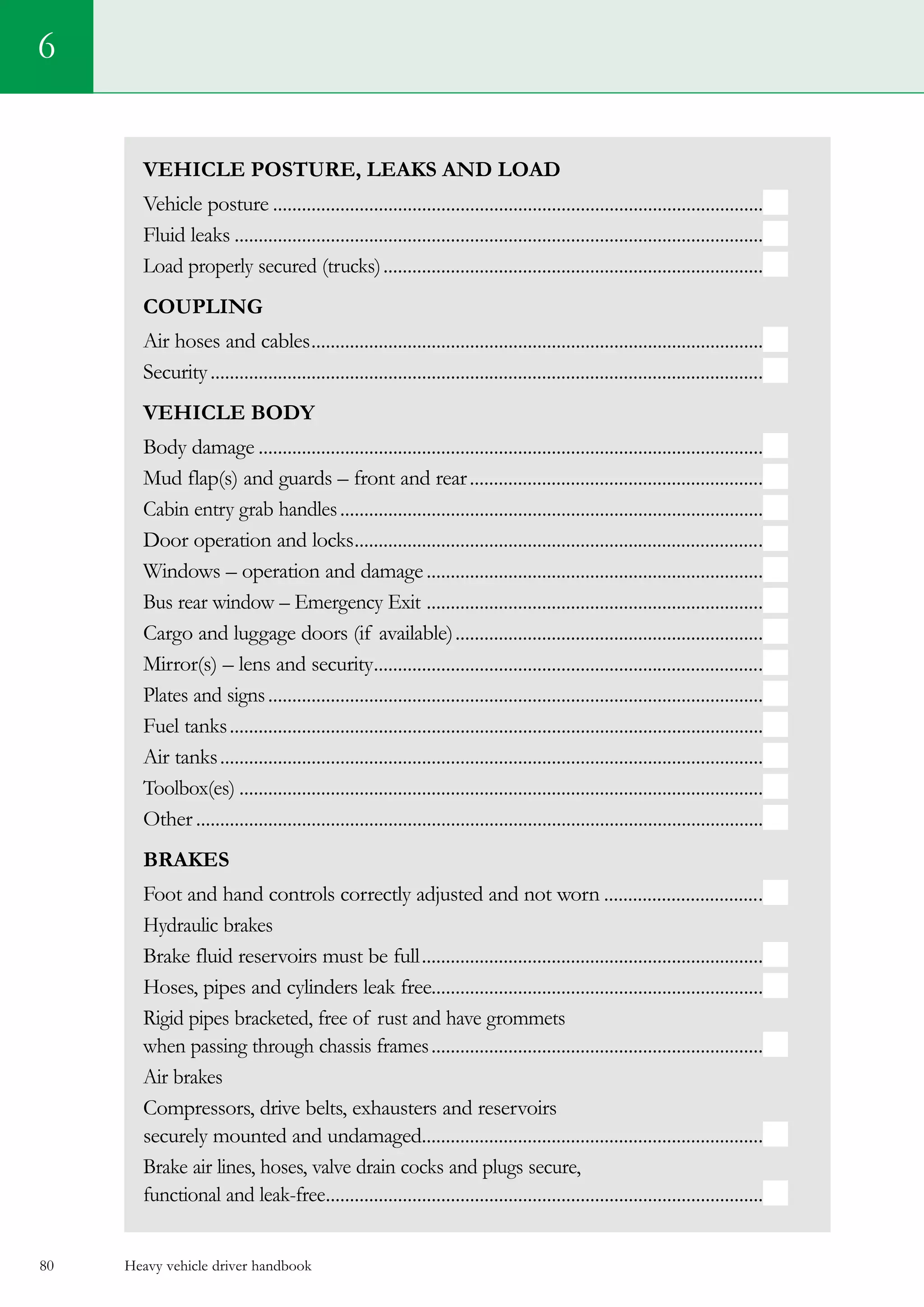
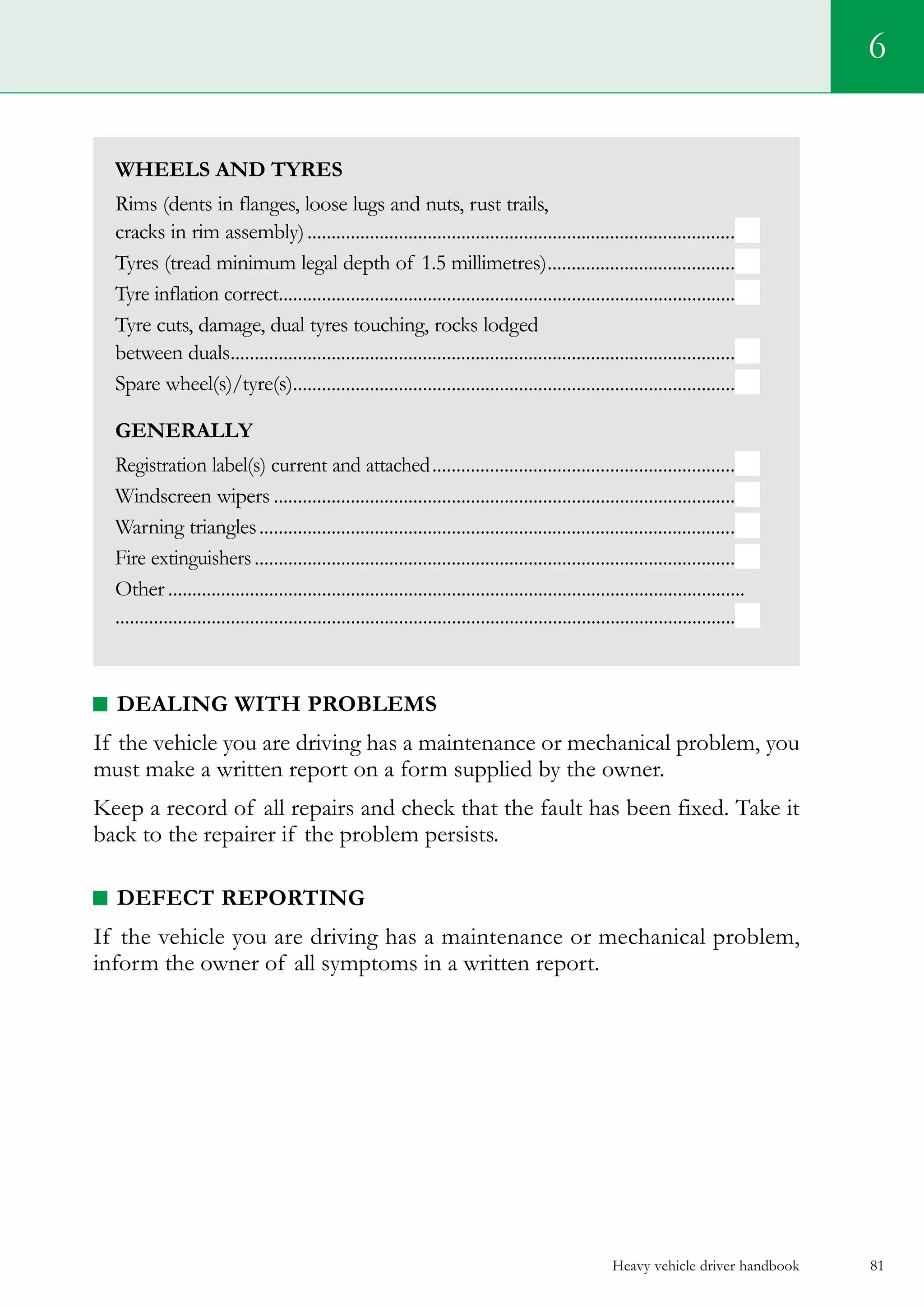
	 Pre-departure safety checks. . . . . . . . . . . . . . . . . . . . . . . . . . . . . . . . . . . . . . . . . 79
	 Dealing with problems . . . . . . . . . . . . . . . . . . . . . . . . . . . . . . . . . . . . . . . . . . . . . . . 81
	 Defect reporting . . . . . . . . . . . . . . . . . . . . . . . . . . . . . . . . . . . . . . . . . . . . . . . . . . . . 81
	 Uncoupling and coupling. . . . . . . . . . . . . . . . . . . . . . . . . . . . . . . . . . . . . . . . . . . 82
	 Uncoupling a semi-trailer . . . . . . . . . . . . . . . . . . . . . . . . . . . . . . . . . . . . . . . . . . . . . 82
	 Coupling a semi-trailer. . . . . . . . . . . . . . . . . . . . . . . . . . . . . . . . . . . . . . . . . . . . . . . . 83
	 Uncoupling a truck and trailer. . . . . . . . . . . . . . . . . . . . . . . . . . . . . . . . . . . . . . . . . 86
	 Coupling a truck and trailer. . . . . . . . . . . . . . . . . . . . . . . . . . . . . . . . . . . . . . . . . . . . 87
	Summary . . . . . . . . . . . . . . . . . . . . . . . . . . . . . . . . . . . . . . . . . . . . . . . . . . . . . . . . . . 88
7.	 Vehicle dimensions and loading . . . . . . . . . . . . . .  89
	 Load shift. . . . . . . . . . . . . . . . . . . . . . . . . . . . . . . . . . . . . . . . . . . . . . . . . . . . . . . . . . 89
	 Vehicle dimensions . . . . . . . . . . . . . . . . . . . . . . . . . . . . . . . . . . . . . . . . . . . . . . . . . . 89
	 The right vehicle. . . . . . . . . . . . . . . . . . . . . . . . . . . . . . . . . . . . . . . . . . . . . . . . . . . 90
	 Contained loads. . . . . . . . . . . . . . . . . . . . . . . . . . . . . . . . . . . . . . . . . . . . . . . . . . . . . 90
	 Heavy loads. . . . . . . . . . . . . . . . . . . . . . . . . . . . . . . . . . . . . . . . . . . . . . . . . . . . . . . . 91
	 High loads. . . . . . . . . . . . . . . . . . . . . . . . . . . . . . . . . . . . . . . . . . . . . . . . . . . . . . . . . 91	
	Tankers. . . . . . . . . . . . . . . . . . . . . . . . . . . . . . . . . . . . . . . . . . . . . . . . . . . . . . . . . . . . 92	
	 Loading. . . . . . . . . . . . . . . . . . . . . . . . . . . . . . . . . . . . . . . . . . . . . . . . . . . . . . . . . . . 93
	 Projecting loads. . . . . . . . . . . . . . . . . . . . . . . . . . . . . . . . . . . . . . . . . . . . . . . . . . . . . 94	
	 Dangerous projections . . . . . . . . . . . . . . . . . . . . . . . . . . . . . . . . . . . . . . . . . . . . . . . 95	
	 Load distribution and arrangement . . . . . . . . . . . . . . . . . . . . . . . . . . . . . . . . . . . . . 96	
	 Positioning the load. . . . . . . . . . . . . . . . . . . . . . . . . . . . . . . . . . . . . . . . . . . . . . . . . . 97	
	 Securing the load. . . . . . . . . . . . . . . . . . . . . . . . . . . . . . . . . . . . . . . . . . . . . . . . . . . . 97	
	 Load restraints. . . . . . . . . . . . . . . . . . . . . . . . . . . . . . . . . . . . . . . . . . . . . . . . . . . . . 98
	Blocking. . . . . . . . . . . . . . . . . . . . . . . . . . . . . . . . . . . . . . . . . . . . . . . . . . . . . . . . . . . 99	
	 Stakes in pockets. . . . . . . . . . . . . . . . . . . . . . . . . . . . . . . . . . . . . . . . . . . . . . . . . . . 100 	
	 Crowned loads. . . . . . . . . . . . . . . . . . . . . . . . . . . . . . . . . . . . . . . . . . . . . . . . . . . . .  100	
	 Divided crowned loads. . . . . . . . . . . . . . . . . . . . . . . . . . . . . . . . . . . . . . . . . . . . . .  101
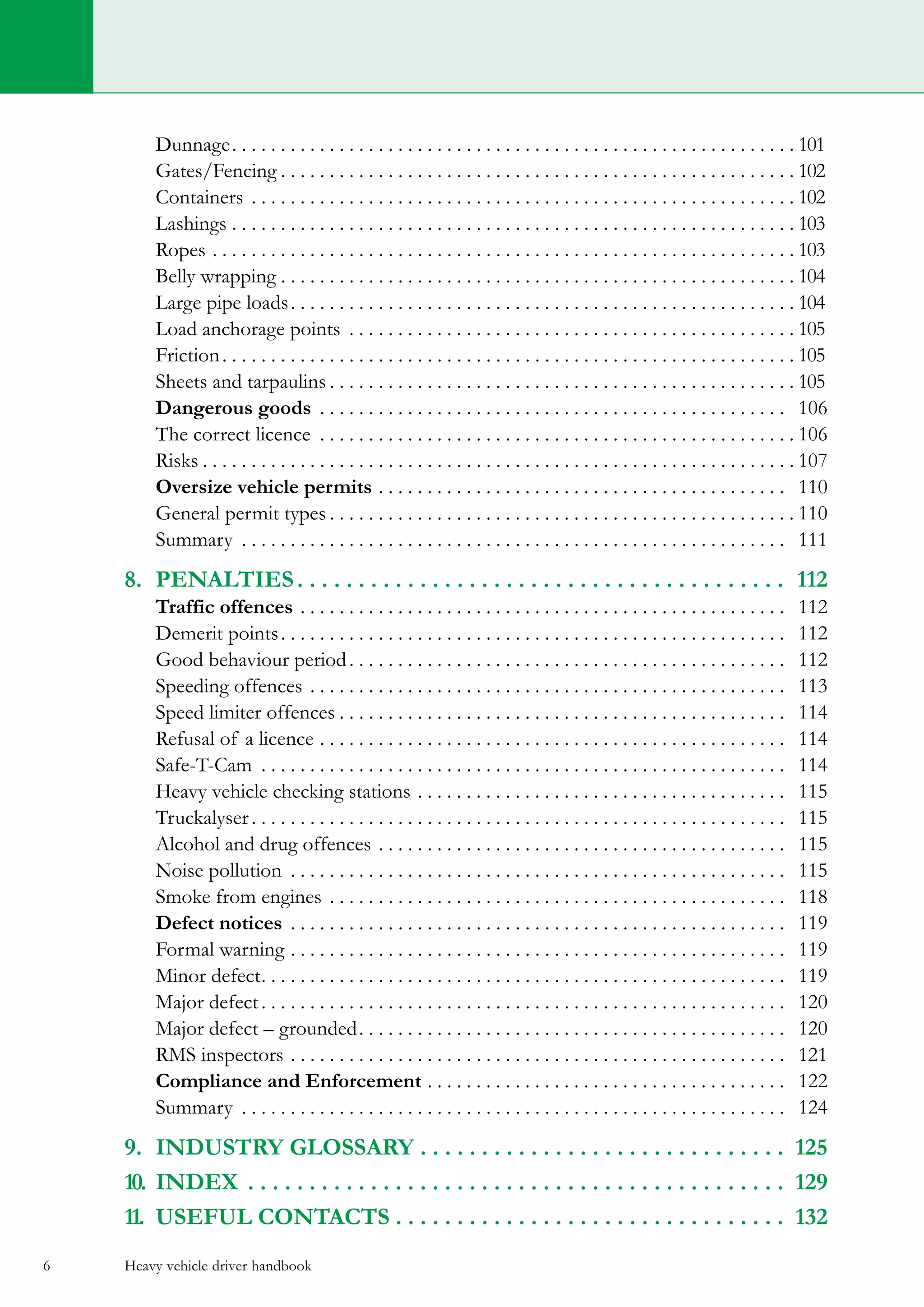
Heavy vehicle driver handbook6
	Dunnage. . . . . . . . . . . . . . . . . . . . . . . . . . . . . . . . . . . . . . . . . . . . . . . . . . . . . . . . . .  101	
	 Gates/Fencing. . . . . . . . . . . . . . . . . . . . . . . . . . . . . . . . . . . . . . . . . . . . . . . . . . . . .  102	
	 Containers. . . . . . . . . . . . . . . . . . . . . . . . . . . . . . . . . . . . . . . . . . . . . . . . . . . . . . . .  102	
	Lashings. . . . . . . . . . . . . . . . . . . . . . . . . . . . . . . . . . . . . . . . . . . . . . . . . . . . . . . . . .  103	
	 Ropes. . . . . . . . . . . . . . . . . . . . . . . . . . . . . . . . . . . . . . . . . . . . . . . . . . . . . . . . . . . .  103	
	 Belly wrapping. . . . . . . . . . . . . . . . . . . . . . . . . . . . . . . . . . . . . . . . . . . . . . . . . . . . .  104	
	 Large pipe loads. . . . . . . . . . . . . . . . . . . . . . . . . . . . . . . . . . . . . . . . . . . . . . . . . . . .  104	
	 Load anchorage points . . . . . . . . . . . . . . . . . . . . . . . . . . . . . . . . . . . . . . . . . . . . . .  105	
	Friction. . . . . . . . . . . . . . . . . . . . . . . . . . . . . . . . . . . . . . . . . . . . . . . . . . . . . . . . . . .  105	
	 Sheets and tarpaulins. . . . . . . . . . . . . . . . . . . . . . . . . . . . . . . . . . . . . . . . . . . . . . . .  105	
	 Dangerous goods . . . . . . . . . . . . . . . . . . . . . . . . . . . . . . . . . . . . . . . . . . . . . . . . . 106
	 The correct licence . . . . . . . . . . . . . . . . . . . . . . . . . . . . . . . . . . . . . . . . . . . . . . . . .  106	
	 Risks. . . . . . . . . . . . . . . . . . . . . . . . . . . . . . . . . . . . . . . . . . . . . . . . . . . . . . . . . . . . .  107	
	 Oversize vehicle permits. . . . . . . . . . . . . . . . . . . . . . . . . . . . . . . . . . . . . . . . . . . 110
	 General permit types. . . . . . . . . . . . . . . . . . . . . . . . . . . . . . . . . . . . . . . . . . . . . . . .  110	
	Summary . . . . . . . . . . . . . . . . . . . . . . . . . . . . . . . . . . . . . . . . . . . . . . . . . . . . . . . . . 111
8.	 penalties. . . . . . . . . . . . . . . . . . . . . . . . . . . . . . . . . . . . . . . . . 112
	 Traffic offences. . . . . . . . . . . . . . . . . . . . . . . . . . . . . . . . . . . . . . . . . . . . . . . . . . . 112
	 Demerit points. . . . . . . . . . . . . . . . . . . . . . . . . . . . . . . . . . . . . . . . . . . . . . . . . . . . . 112
	 Good behaviour period. . . . . . . . . . . . . . . . . . . . . . . . . . . . . . . . . . . . . . . . . . . . . . 112
	 Speeding offences. . . . . . . . . . . . . . . . . . . . . . . . . . . . . . . . . . . . . . . . . . . . . . . . . . 113
	 Speed limiter offences. . . . . . . . . . . . . . . . . . . . . . . . . . . . . . . . . . . . . . . . . . . . . . . 114
	 Refusal of a licence. . . . . . . . . . . . . . . . . . . . . . . . . . . . . . . . . . . . . . . . . . . . . . . . . 114
	 Safe-T-Cam . . . . . . . . . . . . . . . . . . . . . . . . . . . . . . . . . . . . . . . . . . . . . . . . . . . . . . . 114
  	 Heavy vehicle checking stations. . . . . . . . . . . . . . . . . . . . . . . . . . . . . . . . . . . . . . . 115
	Truckalyser. . . . . . . . . . . . . . . . . . . . . . . . . . . . . . . . . . . . . . . . . . . . . . . . . . . . . . . . 115
	 Alcohol and drug offences. . . . . . . . . . . . . . . . . . . . . . . . . . . . . . . . . . . . . . . . . . . 115
	 Noise pollution . . . . . . . . . . . . . . . . . . . . . . . . . . . . . . . . . . . . . . . . . . . . . . . . . . . . 115
	 Smoke from engines. . . . . . . . . . . . . . . . . . . . . . . . . . . . . . . . . . . . . . . . . . . . . . . . 118
	 Defect notices . . . . . . . . . . . . . . . . . . . . . . . . . . . . . . . . . . . . . . . . . . . . . . . . . . . . 119
	 Formal warning. . . . . . . . . . . . . . . . . . . . . . . . . . . . . . . . . . . . . . . . . . . . . . . . . . . . 119
	 Minor defect. . . . . . . . . . . . . . . . . . . . . . . . . . . . . . . . . . . . . . . . . . . . . . . . . . . . . . . 119
	 Major defect. . . . . . . . . . . . . . . . . . . . . . . . . . . . . . . . . . . . . . . . . . . . . . . . . . . . . . . 120
	 Major defect – grounded. . . . . . . . . . . . . . . . . . . . . . . . . . . . . . . . . . . . . . . . . . . . . 120
	 RMS inspectors. . . . . . . . . . . . . . . . . . . . . . . . . . . . . . . . . . . . . . . . . . . . . . . . . . . . 121
	 Compliance and Enforcement. . . . . . . . . . . . . . . . . . . . . . . . . . . . . . . . . . . . . . 122
	 Summary . . . . . . . . . . . . . . . . . . . . . . . . . . . . . . . . . . . . . . . . . . . . . . . . . . . . . . . . . 124
9.	 industry glossary. . . . . . . . . . . . . . . . . . . . . . . . . . . . . .  125
10.	index. . . . . . . . . . . . . . . . . . . . . . . . . . . . . . . . . . . . . . . . . . . .  129
11.	 useful contacts. . . . . . . . . . . . . . . . . . . . . . . . . . . . . . . .  132
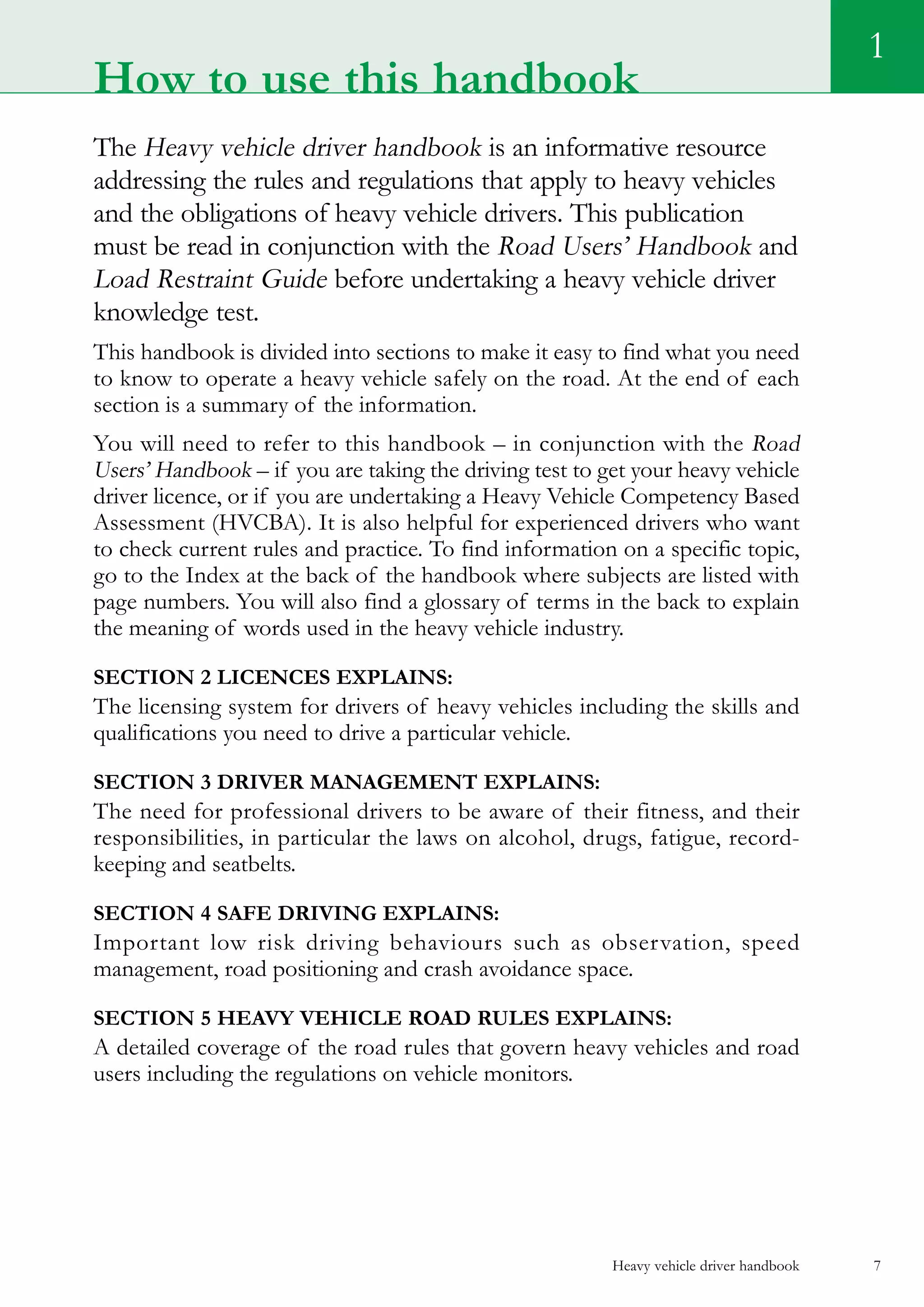
Heavy vehicle driver handbook 7
1
The Heavy vehicle driver handbook is an informative resource
addressing the rules and regulations that apply to heavy vehicles
and the obligations of heavy vehicle drivers. This publication
must be read in conjunction with the Road Users’ Handbook and
Load Restraint Guide before undertaking a heavy vehicle driver
knowledge test.
This handbook is divided into sections to make it easy to find what you need
to know to operate a heavy vehicle safely on the road. At the end of each
section is a summary of the information.
You will need to refer to this handbook – in conjunction with the Road
Users’ Handbook – if you are taking the driving test to get your heavy vehicle
driver licence, or if you are undertaking a Heavy Vehicle Competency Based
Assessment (HVCBA). It is also helpful for experienced drivers who want
to check current rules and practice. To find information on a specific topic,
go to the Index at the back of the handbook where subjects are listed with
page numbers. You will also find a glossary of terms in the back to explain
the meaning of words used in the heavy vehicle industry.
Section 2 Licences explains:
The licensing system for drivers of heavy vehicles including the skills and
qualifications you need to drive a particular vehicle.
Section 3 Driver management explains:
The need for professional drivers to be aware of their fitness, and their
responsibilities, in particular the laws on alcohol, drugs, fatigue, record-
keeping and seatbelts.
Section 4 Safe driving explains:
Important low risk driving behaviours such as observation, speed
management, road positioning and crash avoidance space.
Section 5 Heavy vehicle road rules explains:
A detailed coverage of the road rules that govern heavy vehicles and road
users including the regulations on vehicle monitors.
How to use this handbook
Heavy vehicle driver handbook8
Section 6 Knowing the vehicle explains:
The requirements for keeping your vehicle roadworthy covering most
vehicle components and functions such as checking, testing, maintenance
and inspections. This section includes user friendly checklists.
Checklist icon
Checklists are provided to guide you through procedures
and general checks. This icon will help you locate them.
Section 7 Vehicle dimensions and loading explains:
The dimensions of vehicles and allowable loads; ways to secure and
distribute loads, types of loads such as dangerous goods and vehicle types
including B-doubles and road trains.
Section 8 Penalties explains:
Penalties for traffic offences and offences directly related to driving heavy
vehicles.
For information about towing limits for light vehicles
(ie cars, station wagons and trucks under 4.5 tonnes GVM) get
a copy of the brochure Towing trailers from our website or the
Road Users’ Handbook from our registry.
1
Heavy vehicle driver handbook 9
As a professional driver who holds a heavy vehicle licence, you
have additional obligations and responsibilities to the people you
share the road with.
A heavy vehicle driver licence carries special responsibilities. Like your
private car driver licence, it is a ‘contract’ or agreement between you as a
driver and the rest of society. However as a professional driver, you must
meet certain conditions and rules that apply only to drivers of heavy vehicles.
This handbook contains information that will guide you towards the skills
and knowledge you need to hold a heavy vehicle driver licence.
For more information on your car driver licence, refer to the Road Users’
Handbook.
Ways to get a heavy vehicle driver licence
1. Undertake a Heavy Vehicle Competency Based Assessment (HVCBA)
with a Roads and Maritime Services (RMS) accredited Registered
Training Organisation (RTO).
2. Undertake a RMS heavy vehicle driving test at the registry.
Both the RMS heavy vehicle driving test and HVCBA are conducted in
loaded vehicles.
The HVCBA system is run by RMS accredited RTOs with heavy vehicle
licensed driving instructors. RMS heavy vehicle driving test is conducted by
RMS testing officers.
For more information on both these licence schemes, see the following
pages in this section.
Bribing people is against the law
It is illegal to offer, request or accept gifts, rewards, money or other favours
in order to get a licence without passing the required tests. Penalties are
severe and include fines and imprisonment. All cases of corruption will be
reported and investigated, and strong action will be taken against all those
involved.
If you know or believe that someone has got or is about to get a NSW
licence by offering or responding to a request for a bribe – or if you suspect
or know of any other corruption involving an RMS employee – call RMS on
1800 043 642 (free call) or the Independent Commission Against Corruption
(ICAC) on (02) 8281 5999.
2
Licences
Heavy vehicle driver handbook10
Medical assessment
When you apply for or renew your heavy vehicle licence, you must complete
a form with questions about your fitness to drive a heavy vehicle safely. On
the basis of this information RMS may ask for a medical report.
NSW adopts the national medical standards for private and commercial
drivers contained in the Assessing Fitness to Drive, Commercial and Private
Vehicle Drivers booklet, published by AUSTROADS and approved by the
Australian Transport Council. These standards apply to those licence holders
of class MR and higher who are required to provide a medical report to
RMS.
Proof of Identity and NSW residential
address
You need to provide proof of your identity and NSW
residential address when you apply for a heavy vehicle driver
licence.
For more information about proof of identity documents, get
the brochure, How to prove who you are to RMS from our registry
or visit our website. Special requirements also apply if you
have changed your name.
2
Heavy vehicle driver handbook 11
Licence classes
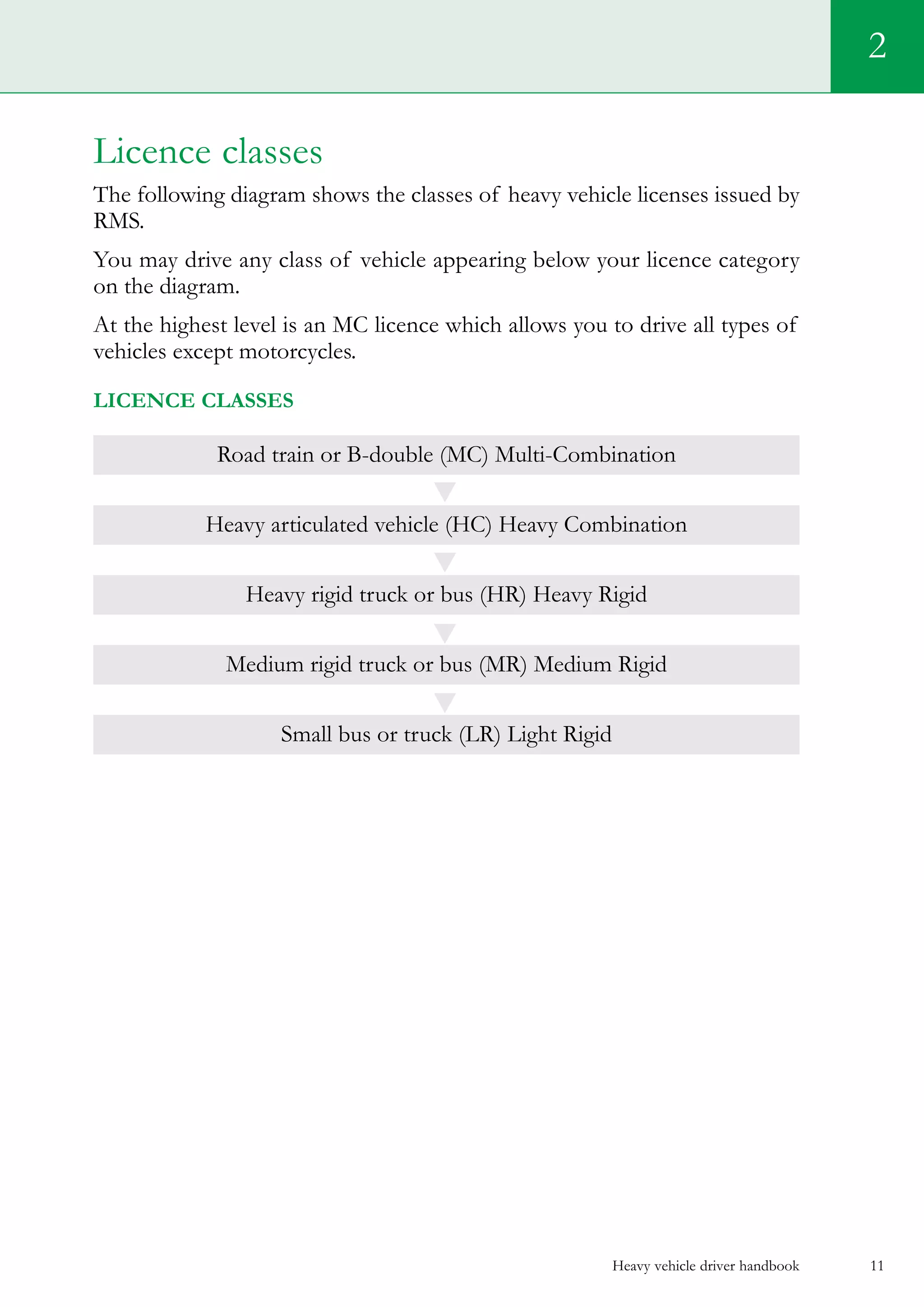
The following diagram shows the classes of heavy vehicle licenses issued by
RMS.
You may drive any class of vehicle appearing below your licence category
on the diagram.
At the highest level is an MC licence which allows you to drive all types of
vehicles except motorcycles.
Licence classes
Road train or B-double (MC) Multi-Combination
Heavy articulated vehicle (HC) Heavy Combination
Heavy rigid truck or bus (HR) Heavy Rigid
Medium rigid truck or bus (MR) Medium Rigid
Small bus or truck (LR) Light Rigid
2
Heavy vehicle driver handbook12
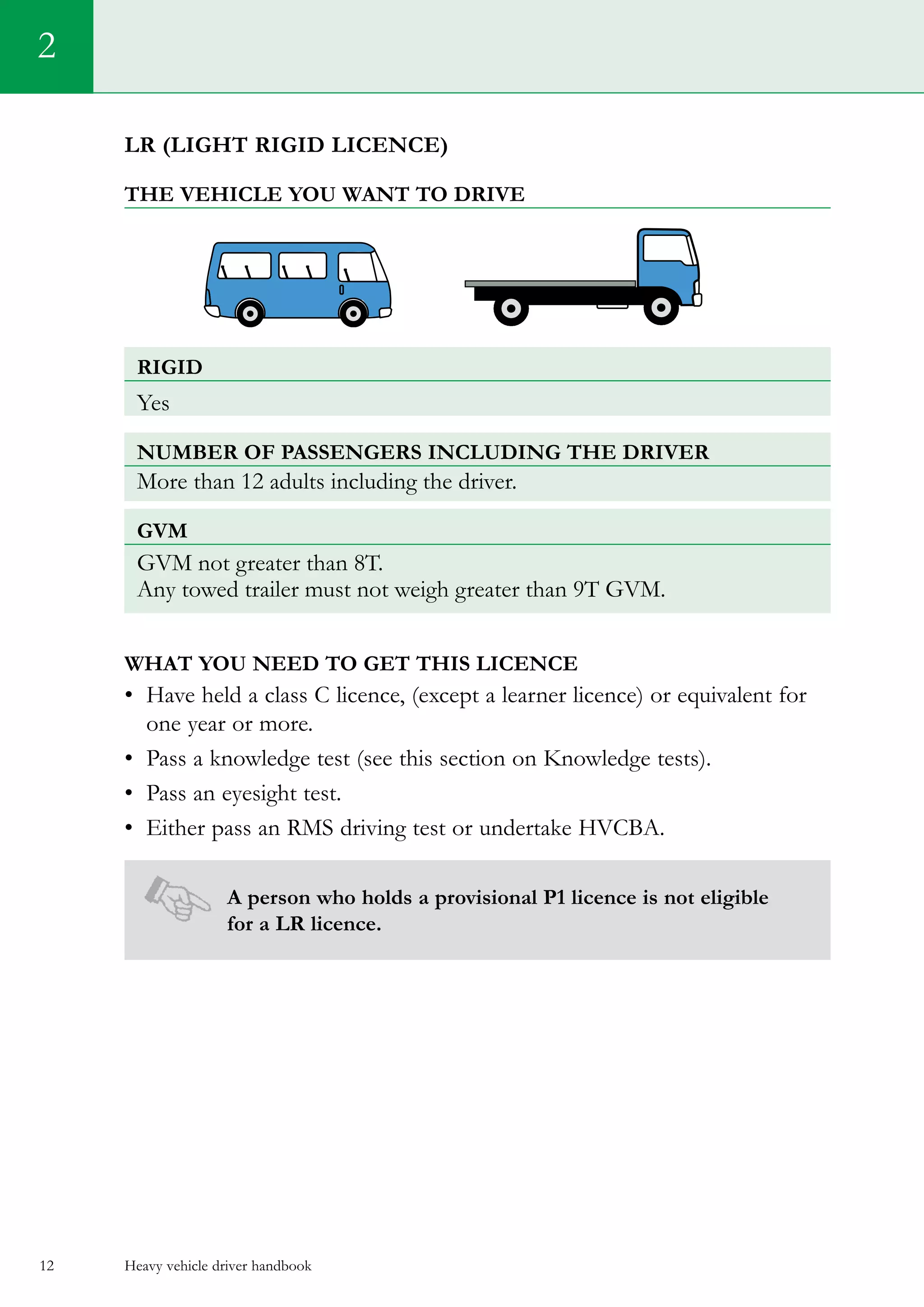
LR (light rigid licence)
The vehicle you want to drive
rigiD
Yes
Number of passengers including the driver
More than 12 adults including the driver.
GVM
GVM not greater than 8T.
Any towed trailer must not weigh greater than 9T GVM.
What you need to get this licence
•	 Have held a class C licence, (except a learner licence) or equivalent for
one year or more.
•	 Pass a knowledge test (see this section on Knowledge tests).   
•	 Pass an eyesight test.
•	 Either pass an RMS driving test or undertake HVCBA.
A person who holds a provisional P1 licence is not eligible
for a LR licence.
2
Heavy vehicle driver handbook 13
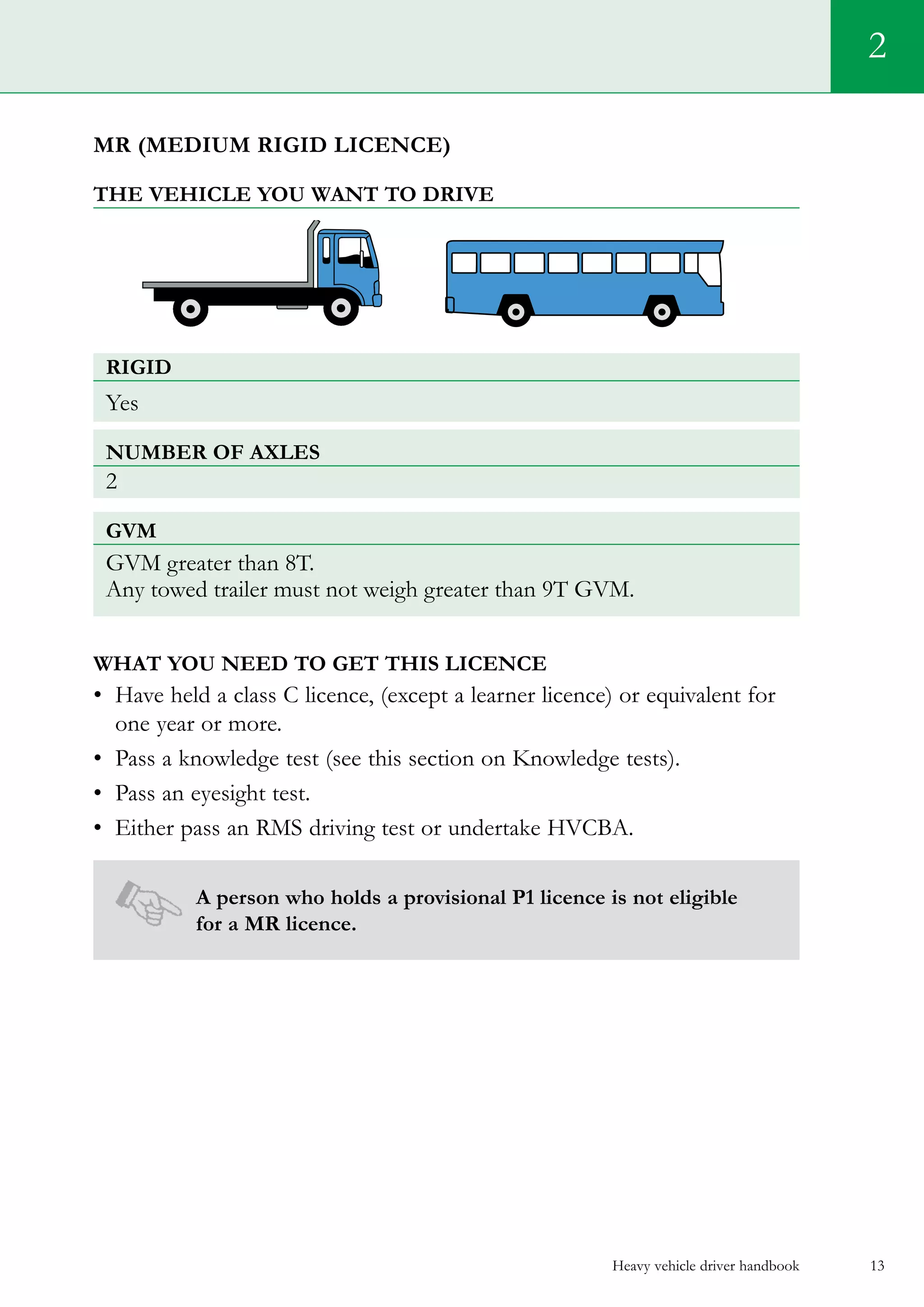
MR (medium rigid licence)
The vehicle you want to drive
rigiD
Yes
Number of axles
2
GVM
GVM greater than 8T.
Any towed trailer must not weigh greater than 9T GVM.
What you need to get this licence
•	 Have held a class C licence, (except a learner licence) or equivalent for
one year or more.
•	 Pass a knowledge test (see this section on Knowledge tests).   
•	 Pass an eyesight test.
•	 Either pass an RMS driving test or undertake HVCBA.
A person who holds a provisional P1 licence is not eligible
for a MR licence.
2
Heavy vehicle driver handbook14
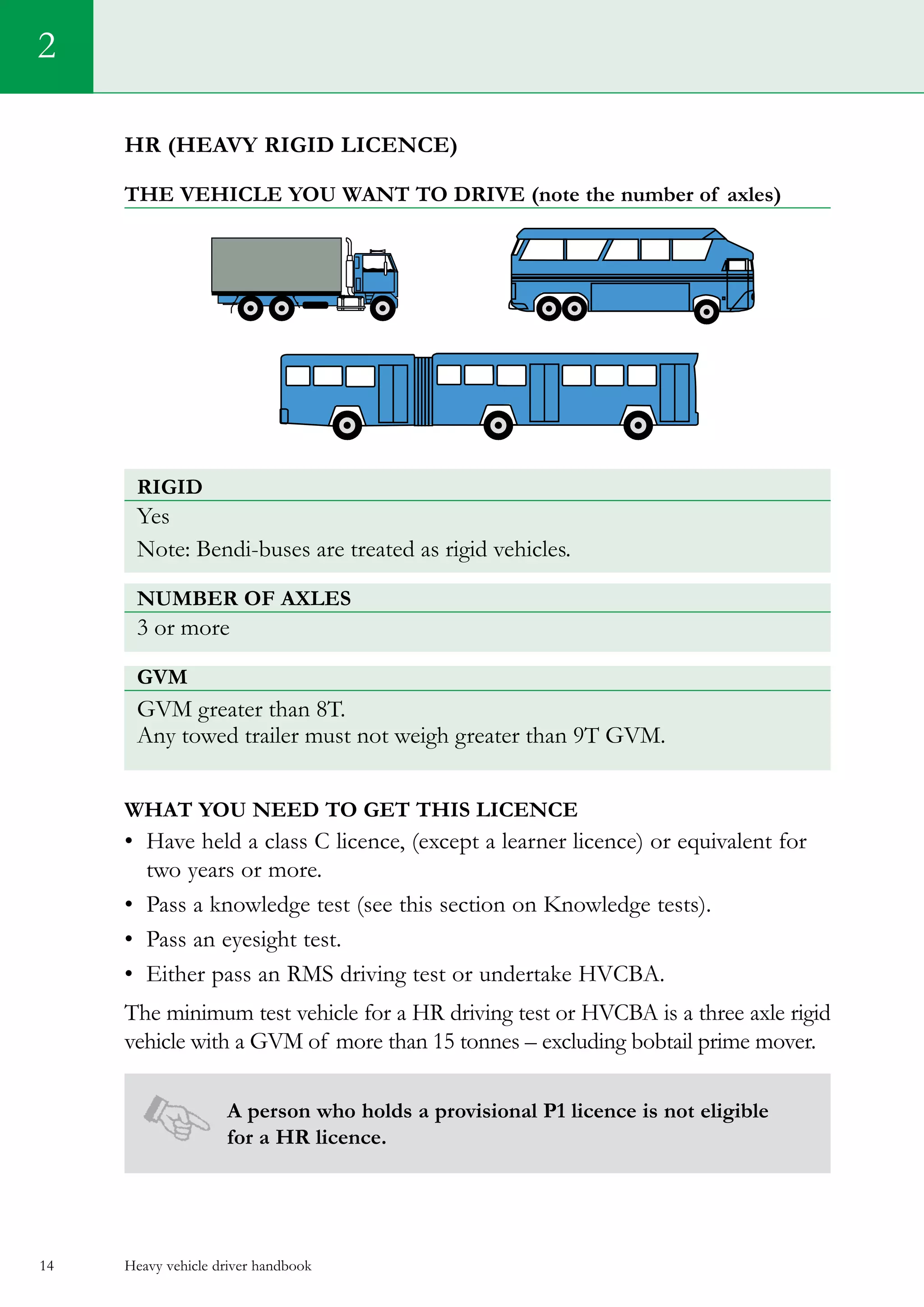
HR (heavy rigid licence)
The vehicle you want to drive (note the number of axles)
rigiD
Yes
Note: Bendi-buses are treated as rigid vehicles.
Number of axles
3 or more
GVM
GVM greater than 8T.
Any towed trailer must not weigh greater than 9T GVM.
What you need to get this licence
•	 Have held a class C licence, (except a learner licence) or equivalent for
two years or more.
•	 Pass a knowledge test (see this section on Knowledge tests).   
•	 Pass an eyesight test.
•	 Either pass an RMS driving test or undertake HVCBA.
The minimum test vehicle for a HR driving test or HVCBA is a three axle rigid
vehicle with a GVM of more than 15 tonnes – excluding bobtail prime mover.
A person who holds a provisional P1 licence is not eligible
for a HR licence.
2
Heavy vehicle driver handbook 15
2
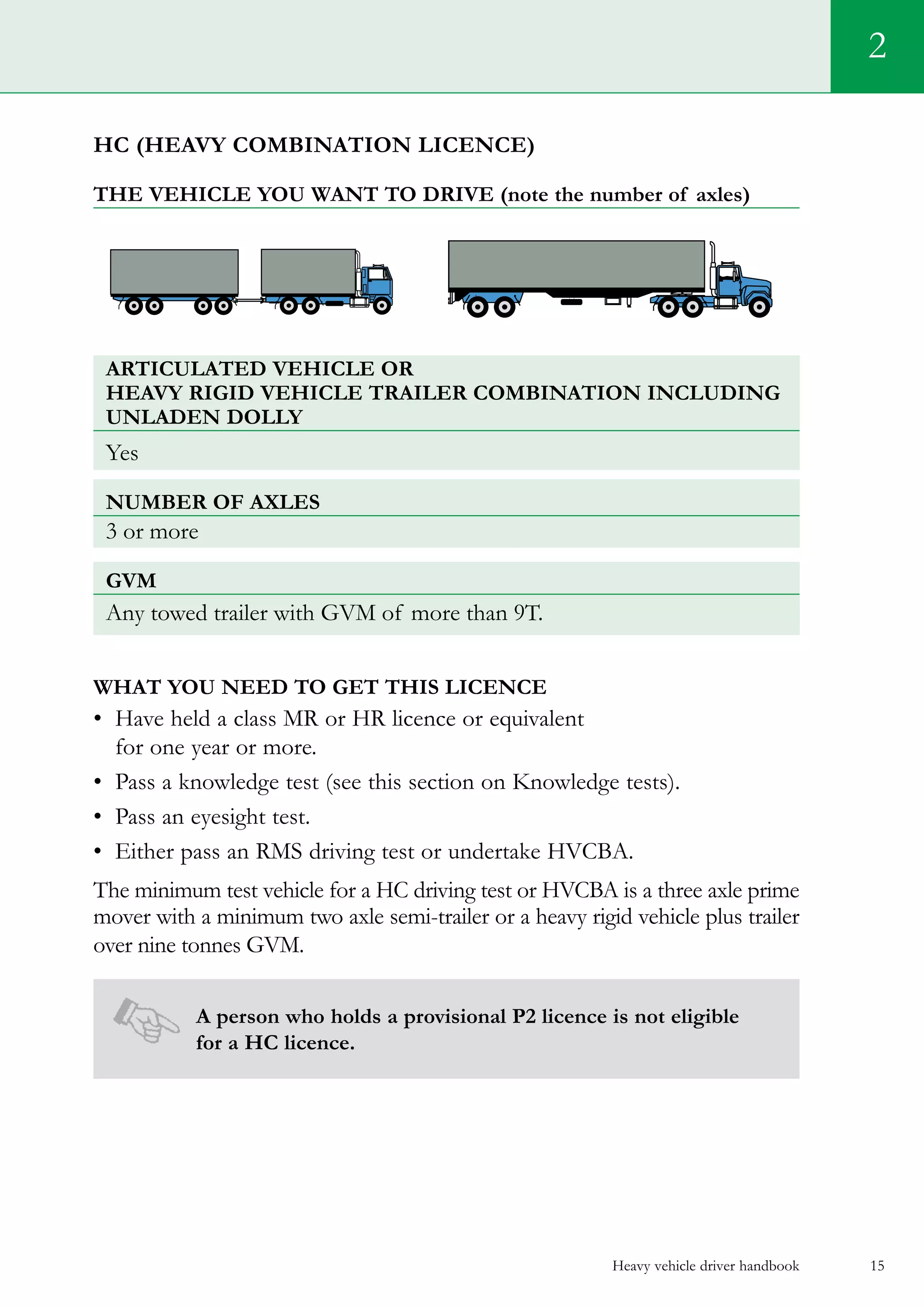
Hc (heavy combination licence)
The vehicle you want to drive (note the number of axles)
Articulated vehicle or
heavy rigid vehicle trailer combination including
unladen dolly
Yes
Number of axles
3 or more
GVM
Any towed trailer with GVM of more than 9T.
What you need to get this licence
•	 Have held a class MR or HR licence or equivalent
for one year or more.
•	 Pass a knowledge test (see this section on Knowledge tests).   
•	 Pass an eyesight test.
•	 Either pass an RMS driving test or undertake HVCBA.
The minimum test vehicle for a HC driving test or HVCBA is a three axle prime
mover with a minimum two axle semi-trailer or a heavy rigid vehicle plus trailer
over nine tonnes GVM.
A person who holds a provisional P2 licence is not eligible
for a HC licence.
Heavy vehicle driver handbook16
2
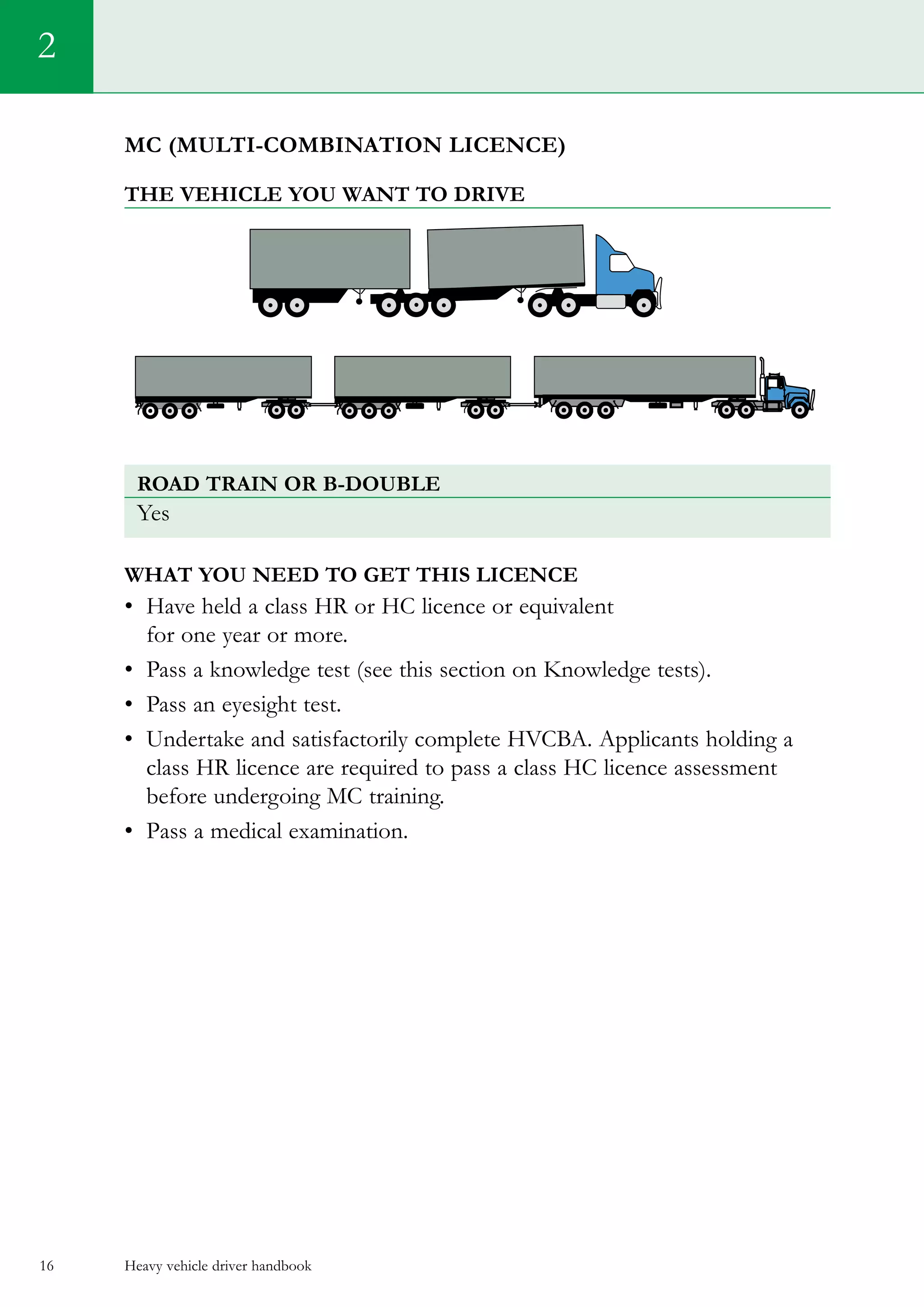
Mc (Multi-combination licence)
The vehicle you want to drive
road train or B-double
Yes
What you need to get this licence
•	 Have held a class HR or HC licence or equivalent
for one year or more.
•	 Pass a knowledge test (see this section on Knowledge tests).   
•	 Pass an eyesight test.
•	 Undertake and satisfactorily complete HVCBA. Applicants holding a
class HR licence are required to pass a class HC licence assessment
before undergoing MC training.
•	 Pass a medical examination.
Heavy vehicle driver handbook 17
2
Medical examinations
For licence class MC, a medical is required:
•	 To first obtain an MC licence.   
•	 At age 21 then every 10 years.
•	 At age 40 then every five years.
•	 At age 60 then every two years.
•	 At age 70 then annually.
A person who holds a provisional P2 licence is not eligible
for a MC licence.
upgrading from a p2 licence
Provisional P2 licence holders (who also hold a  Class LR, MR or HR heavy
vehicle licence) will remain on a provisional licence until they have held the
P2 licence for a minimum of two years and passed a Driver Qualification
Test. There is no variation to this rule and an unrestricted licence will not be
issued until the applicant complies with the requirements of the Graduated
Licensing Scheme.
Heavy vehicle driver handbook18
Learning to drive
You can learn to drive heavy vehicles on your current licence if you are
eligible to apply for the particular vehicle type. Check this section under  
What you need to get this licence.
You must be accompanied and supervised by a person who has held the
class of licence for the heavy vehicle you want to drive, or a higher class of
driver licence, for one year or more. You may also need a National Driver
Work Diary, see section 3 Driver management.
If you want to upgrade your driver licence you need to:
•	 Pass a knowledge test.   
•	 Pass an eyesight test.
•	 Either pass an RMS driving test or undertake HVCBA
training and assessment.
Heavy Vehicle Competency Based Assessment (HVCBA)
Under HVCBA you have to demonstrate that you can perform certain
skills or criteria to an RMS-accredited RTO driving assessor. Your assessor
records your performance in a log book and once you have successfully
completed all the required criteria you can apply to upgrade your licence.
HVCBA assessment while you learn
You can learn to drive either with a licensed driving instructor or with an
appropriate NSW licence holder. You can only be assessed by an accredited
RTO assessor. All assessors are licensed driving instructors so they can
assess and train you.
For more information on HVCBA call 13 22 13 or ask for the brochure
Getting your heavy vehicle driver licence from any registry.
You must hold a current NSW driver licence to be eligible
for HVCBA.
HVCBA with an RMS-accredited RTO assessor is the primary
method for obtaining a heavy vehicle licence in Sydney, Central
Coast and Newcastle regions.
2
Heavy vehicle driver handbook 19
Knowledge tests
The knowledge test assesses what you know about the general road rules as
well as rules which relate only to heavy vehicles. For more information on
knowledge tests, see the Road Users’ Handbook or our website.
You must pass a heavy vehicle road rules knowledge test before you can:
•	 Apply for a Heavy Vehicle Competency Based Assessment
Learner’s Log Book and undertake HVCBA.
•	 Book a heavy vehicle driving test.
If you are learning, you can start to drive straight away on your current
licence, however, you must pass the heavy vehicle road rules knowledge test
before booking for a driving test or obtaining a HVCBA Learner’s Log Book.
The knowledge test pass is valid for 36 months.
Driving tests
When you are ready to take a driving test, contact our Call Centre on 13 22
13 and make a booking at a heavy vehicle testing location. Or book through
the website www.myrta.com. If you book through the Call Centre, you can
pay the test fee by credit card – cash is not accepted.
A driving test can also be booked and paid for at any registry.
The test vehicle must be currently registered (NOT under the Federal
Interstate Registration Scheme (FIRS)) and be roadworthy. All heavy vehicles
(except buses and coaches used for driving tests) must have a complying
(approved and in working condition) lap-sash retractable seatbelt fitted to
the front left passenger seat for use by the testing officer.
Driving tests can be undertaken in most vehicles authorised for the licence
class you are applying for. However, for a class HR or HC licence there are
minimum standards for vehicles used for the driving test (see Which licence
do you need, in this section). Vehicles that do not meet these standards will
not be accepted for driving tests. All heavy vehicles, except buses, presented
for the heavy vehicle driving test must be loaded to at least 75 per cent of
the maximum mass allowable for the vehicle to be driven on public roads.
This is at least 75 per cent of the ‘legal mass limit’.
2
Heavy vehicle driver handbook20
Also, if you pass a driving test in a vehicle fitted with an automatic or
synchromesh gear box you will be restricted to driving these types of
vehicles. To have the condition removed you have to pass a driving
test in a vehicle fitted with a non-synchromesh gear box. Information
on which vehicles can be used for testing is available on our website at
www.rms.nsw.gov.au
Manoeuvres
The driving test assesses your ability to drive safely and competently. During
the test you will be required to perform certain manoeuvres. The following
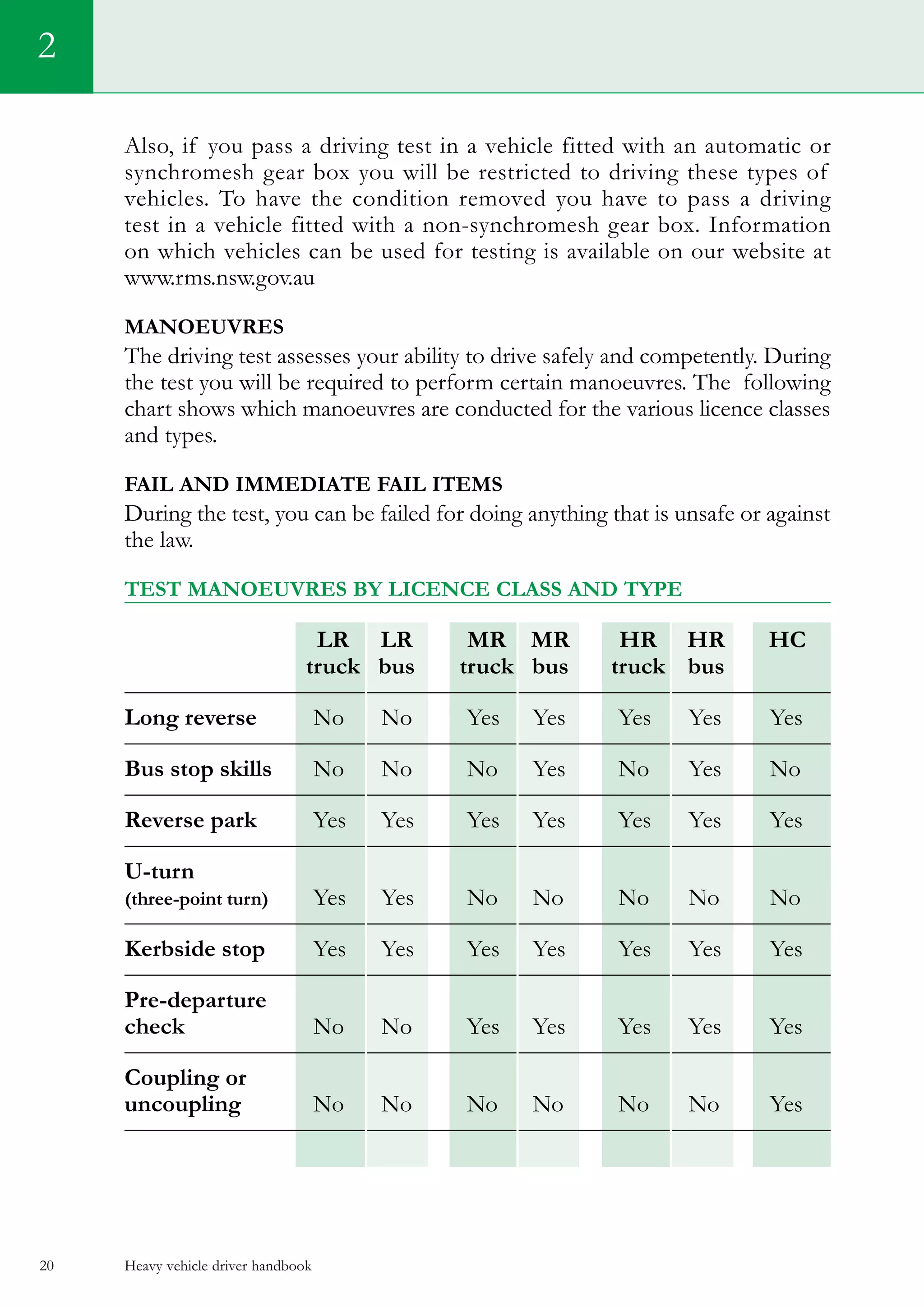
chart shows which manoeuvres are conducted for the various licence classes
and types.
Fail and immediate fail items
During the test, you can be failed for doing anything that is unsafe or against
the law.
Test Manoeuvres by licence class and type
	 LR 	LR 	 MR 	 MR 	 HR 	 HR 	 HC
	 truck	bus	 truck	bus 	 truck	 bus
Long reverse	 No	 No	 Yes	 Yes	 Yes	 Yes	 Yes
Bus stop skills	 No	No	 No	Yes	 No	 Yes	 No
Reverse park	 Yes	Yes	Yes	Yes	Yes	Yes	Yes
U-turn
(three-point turn)	 Yes	Yes	 No	No	 No	 No	 No
Kerbside stop	Yes	Yes	Yes	Yes	Yes	Yes	Yes
Pre-departure
check	 No	 No	 Yes	Yes	 Yes	 Yes	 Yes
Coupling or
uncoupling	 No	No	No	No	No	No	Yes
2
Heavy vehicle driver handbook 21
National Heavy Vehicle Driver Licence
The National Heavy Vehicle Driver Licence was introduced in the
interests of road safety. It provides a driver with a single licence for all
states. Points accumulated for traffic offences in any state count against
your home state record.
You will be given a national licence when you are licensed to drive one
of the following vehicles:
•	 A truck over eight tonnes GVM with three or more axles.
•	 A bus over eight tonnes GVM with three or more axles.    
Licence class MC
Applicants for licence class MC, covering B-doubles,
road trains and/or road train combinations, should be familiar with
RMS publication, Permit Notices for the operation
of B-doubles, road trains and 4.6m high vehicles.
This publication is available free from our website
www.rms.nsw.gov.au
2
Heavy vehicle driver handbook22
What you should know about LICENCES
After reading this section, you should know:
•	 Which vehicle type you are eligible to apply for
on your current licence.
•	 What you must do to upgrade your driver licence.
•	 What manoeuvres you must perform in order to pass
a heavy vehicle driving test.
•	 Alternate ways of obtaining a HV licence.
Notes
..........................................................................................................................
...........................................................................................................................
..........................................................................................................................
...........................................................................................................................
..........................................................................................................................
...........................................................................................................................
..........................................................................................................................
...........................................................................................................................
..........................................................................................................................
...........................................................................................................................
..........................................................................................................................
...........................................................................................................................
..........................................................................................................................
...........................................................................................................................
2
Summary
Heavy vehicle driver handbook 23
Driving a heavy vehicle can be demanding. It is important to
abide by the driver fatigue laws and regulations and generally take
care of your health, in the interest of public safety and your own
wellbeing.
A heavy vehicle driver spends a lot of time on the road. The work is
demanding and you are responsible for heavy loads, dangerous goods and
passengers. It is very important that you are in good health for your own
safety and that of the public.
Health of professional drivers
The most important ways to stay healthy and keep on top of your job are:
•	 Get enough sleep.
•	 Eat a well-balanced diet.
•	 Exercise regularly.
•	 Try to relieve stress.
Enough sleep
The need for sleep varies among individuals with some people needing more
sleep than others. Make sure that you get most of your sleep at night time
– it is better than daytime sleep. Regular night sleep of about seven to eight
hours is one of the best ways to manage driver fatigue.
See the following pages in this section on managing driver fatigue and for
information on the legal minimum work and rest time.
Diet and exercise
To stay fit and healthy for your job your weight needs to be within an
acceptable range. Eating the right foods and taking regular exercise is the
only answer. Ask your GP for advice or check these websites for information:
www.ntc.gov.au and www.austroads.com.au
Try to relieve stress
Stress affects your driving. If you are having problems at home or at work,
you are up to five times more likely to be involved in a crash. Your GP can
advise you on where to go for help.
3
Driver management
Heavy vehicle driver handbook24
Driver fatigue
Driver fatigue is one of the biggest causes of crashes for heavy vehicle
drivers. In NSW, at least eight per cent of heavy truck fatal crashes involve
a fatigued heavy vehicle driver. Many of these crashes occur late at night or
early in the morning.
As a professional driver, you need to understand what causes fatigue and
how to pick up on the early warning signs so that you can do something
about it before it affects your driving.
Fatigue is caused by a number of factors, including:
Sleep factors
•	 Getting less sleep than you need.
•	 Getting less sleep than you need over a number of days.
•	 Trying to sleep during the day.
Time of day factors
•	 Working when you should normally be asleep.
•	 Working in the early hours of the morning.
•	 Working in the early afternoon after a heavy lunch.
•	 Sleeping during the day when you would normally be awake.
Work factors
•	 Long driving hours.
•	 Night time driving.
•	 Irregular hours and early starting times.
•	 Tight scheduling.
•	 Insufficient time to recover from previous work.
•	 Doing non-driving physical work such as loading and unloading.
•	 Poor driving conditions such as hot or wet weather.
•	 Monotonous driving.
Physical factors
•	 Poor health and fitness.
•	 Emotional issues.
•	 Medical sleep problems.
3
Heavy vehicle driver handbook 25
Signs of driver fatigue
Driver fatigue severely impairs your concentration and judgment; it slows
your reaction time. Watch for these early warning signs of driver fatigue:
•	 Yawning.
•	 Poor concentration.
•	 Tired or sore eyes.
•	 Restlessness.
•	 Drowsiness.
•	 Slow reactions.
•	 Boredom.
•	 Feeling irritable.
•	 Making fewer and larger steering corrections.
•	 Missing road signs and taking wrong turns.
•	 Having difficulty staying in the lane.
•	 Microsleeps where you ‘nod off’ for a short time.
Tips on managing driver fatigue
•	 Resting and sleeping are the two most important ways to combat
fatigue. Have a good night’s sleep before you start your trip, and even
have an afternoon nap before starting back on a night shift. You can
also take rests early on in the trip before you start feeling fatigued.
•	 Plan your trip ahead of time to allow for rest breaks.
•	 Plan your rest breaks to happen before you start feeling fatigued,
or plan where to stop if you do start to feel fatigued. If you can,
plan rest breaks for when your body clock will tell you to be asleep (ie
afternoon, night/early morning) because that is when you are
most likely to become fatigued.
•	 Try and have a regular sleep and waking schedule on every day
of the week.
•	 Be aware of the causes and effects of fatigue and recognise the early warn-
ing signs. Make sure you stop and rest as soon as possible when you realise
you are becoming fatigued. Do not try and push on, especially in those
‘body clock’ danger times of night/early morning and afternoon.
3
Heavy vehicle driver handbook26
•	 Have at least two nights of unrestricted sleep to repay
‘sleep debt’ to become completely refreshed.
•	 Look after your health and fitness with regular exercise
and a healthy diet.
•	 Never drink alcohol before or during your trip.
•	 Never drive longer than the legal work and rest hours,
or agree to a roster that is longer than the legal work and rest hours.
Roadside rest areas
Rest areas are available 24 hours a day all year round and are clearly signposted.
Service centres, petrol stations, parks and country towns are other places you can
stop and take a break from driving. The NSW truck rest area road map is a useful
guide to all major trucking routes across the state as well as locations of truck
stops. The map is available from www.rms.nsw.gov.au
The National Driving Hours Regulation
The Road Transport (General) Regulation contains provisions relating to
the management of heavy vehicle driver fatigue. The Regulation applies to
drivers of regulated heavy vehicles and to parties in the supply chain whose
activities influence the conduct of heavy vehicle drivers in such a way as to
affect the driver’s fatigue. The Regulation sets the maximum hours of work
and minimum rest periods for drivers of ‘regulated heavy vehicles’.  
A ‘regulated heavy vehicle’ is a:
•	 Heavy truck with a Gross Vehicle Mass (GVM)
of over 12 tonnes or a truck and trailer combination, if the combined
GVM is over 12 tonnes.   
•	 Bus that seats more than 12 adults (including the driver).
3
Heavy vehicle driver handbook 27
work
Work limits are like speed limits. They state the maximum time allowed in ideal
conditions. That is, when drivers are well rested and alert. If you are likely to be
fatigued for any reason you must not drive a regulated heavy vehicle.
Work time is not just driving time.
Work refers to the time that the driver spends driving a regulated heavy
vehicle whether or not it is on a road and any other time spent on tasks
related to the operation of the vehicle. Driving includes being in the driver’s
seat while the engine is running and instructing or supervising the driver of
the vehicle. Work time also includes:
•	 Loading and unloading the vehicle.  
•	 Inspecting, servicing or repairing the vehicle.
•	 Inspecting or attending to the load on the vehicle.   
•	 Attending to passengers of a bus.  
•	 Cleaning or refuelling the vehicle.
•	 Performing marketing tasks in relation to the operation of the vehicle.
Marketing tasks include arranging for the transport of passengers or
goods as well as canvassing for orders for the transport of passengers
or goods.
•	 Recording information.
Work time is a maximum period so is always rounded upwards eg a period
less than 15 minutes is counted as 15 minutes work, a period more than 15
minutes up to 30 minutes is counted as 30 minutes work etc.
Rest
All other time is counted as rest. The rest requirement is a minimum period.  
If you feel fatigued, you will need more rest. When you feel tired, stop, take
a break or have a sleep.  Rest is always rounded downwards eg a period less
than 15 minutes does not count towards rest while a period of 15 minutes
but less than 30 minutes is counted as 15 minutes rest etc.
3
Heavy vehicle driver handbook28
Driver Fatigue is an
Occupational Health and Safety Issue
Employers and employees may be held responsible for driver fatigue crashes.
The Work Health and Safety (WHS) Act places obligations upon employers
to ensure the health, safety and welfare of their employees in the
workplace. Employers, in consultation with employees, must identify
risks to health and safety, assess the risks, then eliminate the risks or
where this is not reasonably practicable, control the risks. Responsibilities
under WHS legislation are broad and include employers, employees and
self employed persons. The Act provides severe penalties where it is
established the employer has failed to meet that duty. It is important that
employers and employees adopt principles and practices to manage driver
fatigue within those limits to ensure that they fulfil their duty of care.
In addition Part 4 (Long Distance Truck Driver Fatigue) of the
Occupational Health and Safety Regulation places obligations on an
employer whose employee drives a heavy truck that transports freight long
distance, to reduce driver fatigue. Employers must assess the risk of harm
from fatigue to the driver’s health and safety and take steps to eliminate or
control risk. A Driver Fatigue Management Plan must be developed and
implemented in accordance with the WHS legislation. A similar obligation
is placed on certain carriers, consignors and consignees.
3
Heavy vehicle driver handbook 29
Chain of Responsibility
Under the Regulation a ‘general duty’ (similar to WHS laws) requires all parties
in the supply chain to take all reasonable steps to prevent fatigue of heavy
vehicle drivers.
For example, this means that:
•	 Drivers must stop the vehicle if feeling tired or fatigued.
•	 Operators and schedulers must plan when drivers can take a rest.
•	 Loading managers must take steps to ensure queuing is managed properly.
•	 Contracts must not be prepared that require drivers to break the law.   
Parties in the supply chain include the:
•	 Employer of the driver of the vehicle.
•	 Prime contractor of the driver.
•	 Operator of the vehicle.
•	 Scheduler of goods or passengers for transport by the vehicle, and the
scheduler of its driver.
•	 Consignor of goods for transport by the vehicle.
•	 Consignee of goods for transport by the vehicle.
•	 Loading manager of goods for transport by the vehicle.
•	 Loader of goods on to the vehicle.
•	 Unloader of goods from the vehicle.
Your vehicle is your workplace
Any vehicle used by employees in the course of their
employment is defined as their workplace, including
heavy trucks or buses.
Work and Rest Options
Under the Regulation, industry will have a choice of operating under three
fatigue management schemes. Each option allows increasing levels of flexibility
which are offset by managing risks through accreditation schemes.
3
Heavy vehicle driver handbook30
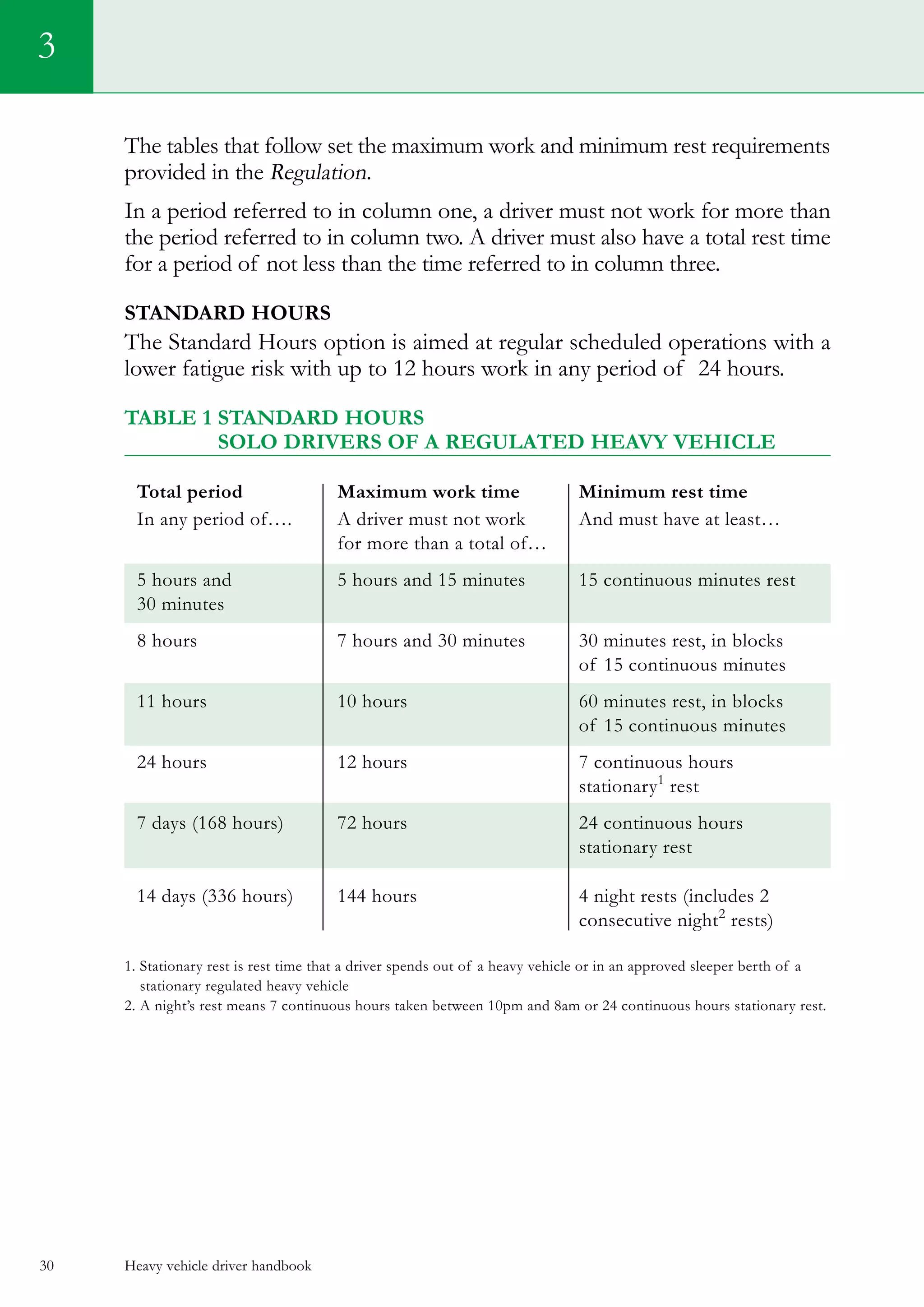
The tables that follow set the maximum work and minimum rest requirements
provided in the Regulation.
In a period referred to in column one, a driver must not work for more than
the period referred to in column two. A driver must also have a total rest time
for a period of not less than the time referred to in column three.
Standard Hours
The Standard Hours option is aimed at regular scheduled operations with a
lower fatigue risk with up to 12 hours work in any period of 24 hours.
Table 1 	STandard hours
	Solo Drivers of a Regulated Heavy Vehicle
Total period	 Maximum work time	 Minimum rest time
In any period of….	 A driver must not work 	 And must have at least…
	 for more than a total of…		
5 hours and 	 5 hours and 15 minutes	 15 continuous minutes rest
30 minutes
8 hours	 7 hours and 30 minutes	 30 minutes rest, in blocks
		 of 15 continuous minutes
11 hours	 10 hours 	 60 minutes rest, in blocks
		 of 15 continuous minutes
24 hours	 12 hours	 7 continuous hours
		 stationary1
rest
7 days (168 hours)	 72 hours	 24 continuous hours
		 stationary rest
14 days (336 hours)	 144 hours	 4 night rests (includes 2
		 consecutive night2
rests)
1. Stationary rest is rest time that a driver spends out of a heavy vehicle or in an approved sleeper berth of a
stationary regulated heavy vehicle
2. A night’s rest means 7 continuous hours taken between 10pm and 8am or 24 continuous hours stationary rest.
3
Heavy vehicle driver handbook 31
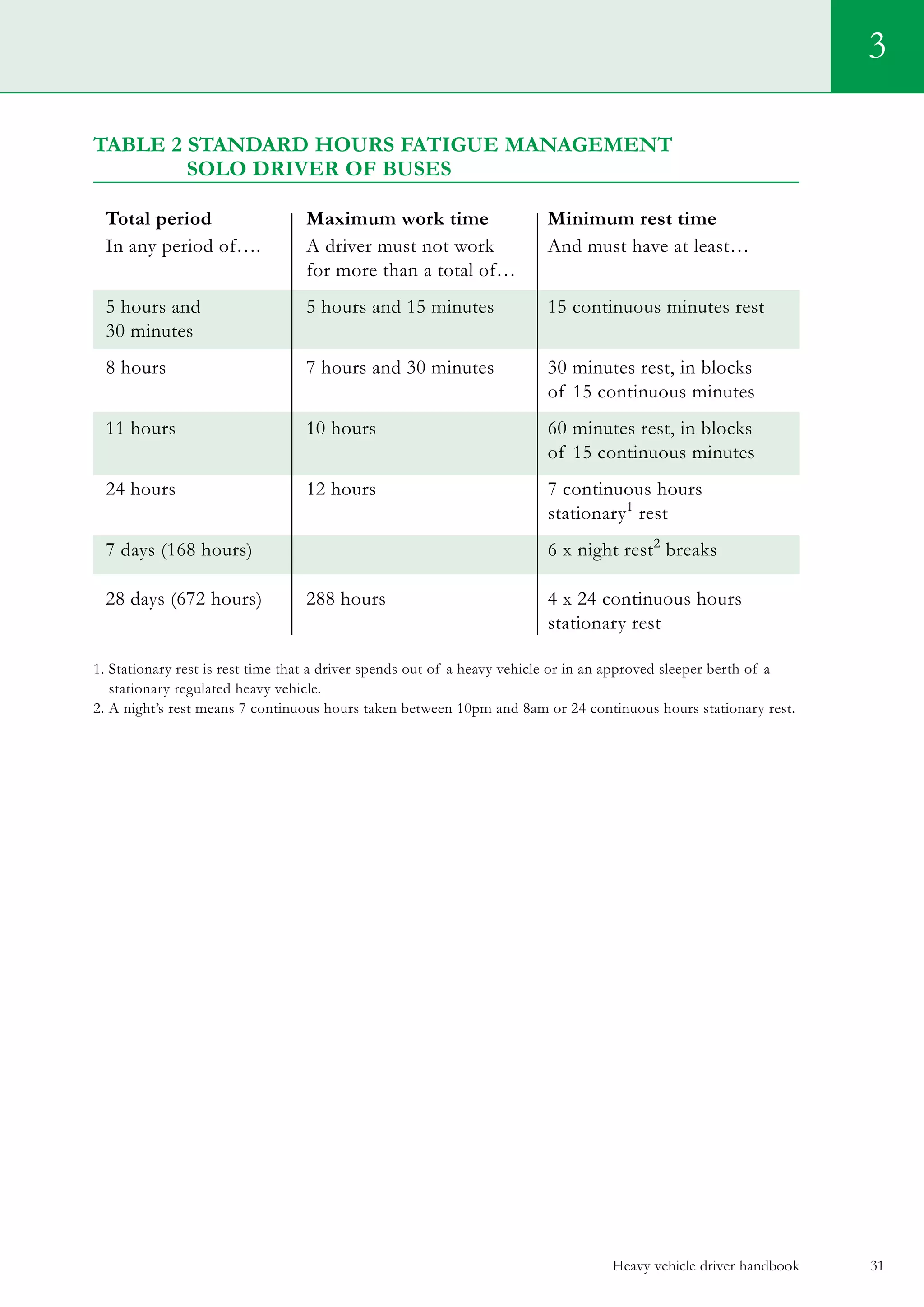
Table 2 Standard hours FATIGUE MANAGEMENT
	Solo driver of buses
Total period	 Maximum work time	 Minimum rest time
In any period of….	 A driver must not work 	 And must have at least…
	 for more than a total of…		
5 hours and 	 5 hours and 15 minutes	 15 continuous minutes rest
30 minutes
8 hours	 7 hours and 30 minutes	 30 minutes rest, in blocks
		 of 15 continuous minutes
11 hours	 10 hours 	 60 minutes rest, in blocks
		 of 15 continuous minutes
24 hours	 12 hours	 7 continuous hours
		 stationary1
rest
7 days (168 hours)	 	 6 x night rest2
breaks
28 days (672 hours)	 288 hours	 4 x 24 continuous hours
		 stationary rest
1. Stationary rest is rest time that a driver spends out of a heavy vehicle or in an approved sleeper berth of a
stationary regulated heavy vehicle.
2. A night’s rest means 7 continuous hours taken between 10pm and 8am or 24 continuous hours stationary rest.
3
Heavy vehicle driver handbook32
3
Table 3 Standard hours FATIGUE MANAGEMENT
	Two-Up Drivers of a Regulated Heavy Vehicle
Total period	 Maximum work time	 Minimum rest time
In any period of….	 A driver must not work 	 And must have at least…
	 for more than a total of…		
5 hours and 	 5 hours and 15 minutes	 15 continuous minutes rest
30 minutes
8 hours	 7 hours and 30 minutes	 30 minutes rest, in blocks
		 of 15 continuous minutes
11 hours	 10 hours 	 60 minutes rest, in blocks
		 of 15 continuous minutes
24 hours	 12 hours	 5 continuous hours
		 stationary1
rest or
		 5 continuous hours rest
		 time in an approved
		 sleeper berth while the
		 vehicle is moving
52 hours		 10 continuous hours
		 stationary rest
7 days (168 hours)	 60 hours	 24 hours continuous
		 stationary rest time and
		 24 hours stationary rest
		 time in blocks of at least
		 7 continuous hours
		 stationary
14 days (336 hours)	 120 hours	 4 night rests (includes
		 2 consecutive night2
rests)  
1. Stationary rest is rest time that a driver spends out of a heavy vehicle or in an approved sleeper berth of a
stationary regulated heavy vehicle.
2. A night’s rest means 7 continuous hours taken between 10pm and 8am or 24 continuous hours stationary rest.
Heavy vehicle driver handbook 33
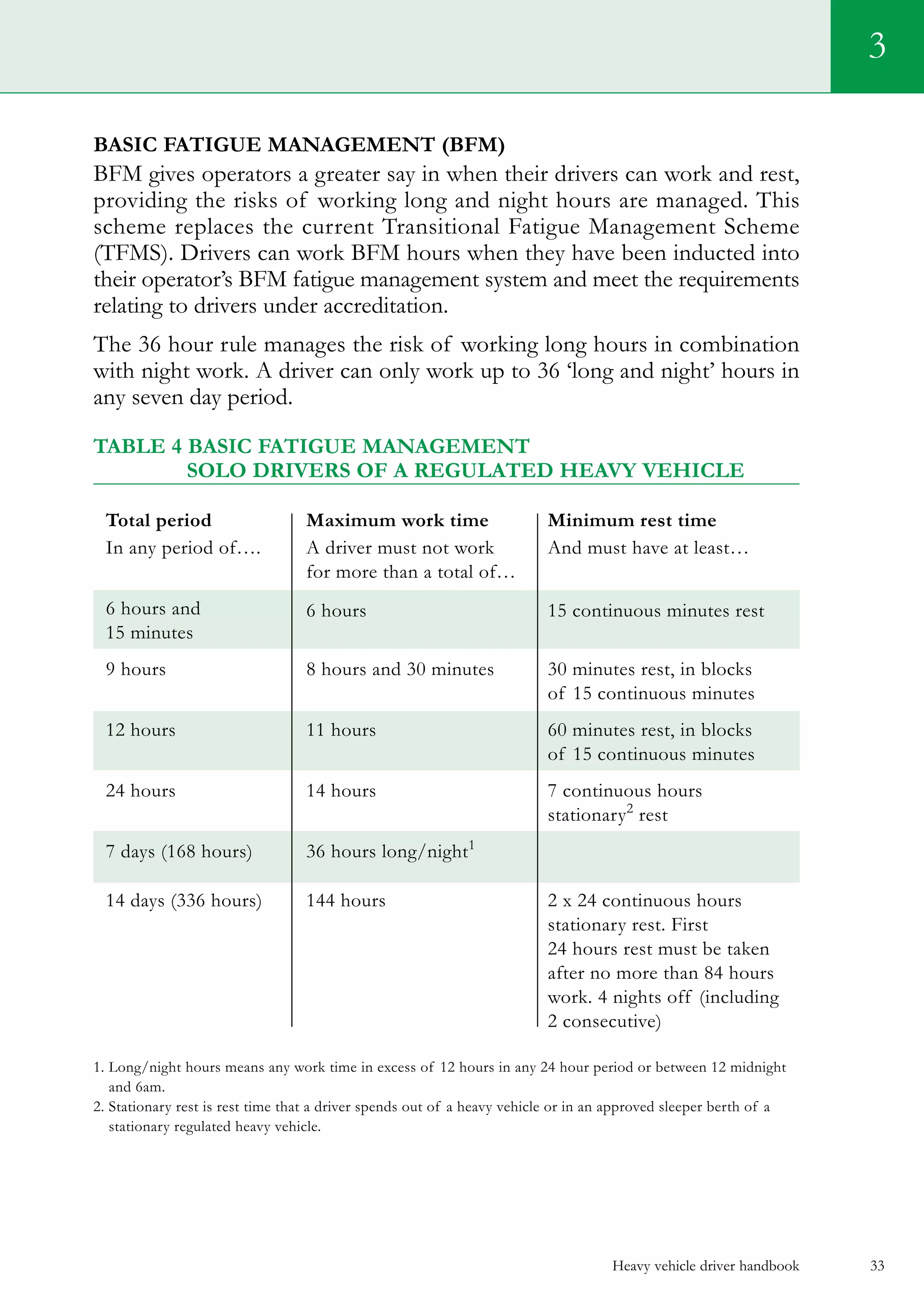
Basic Fatigue Management (BFM)
BFM gives operators a greater say in when their drivers can work and rest,
providing the risks of working long and night hours are managed. This
scheme replaces the current Transitional Fatigue Management Scheme
(TFMS). Drivers can work BFM hours when they have been inducted into
their operator’s BFM fatigue management system and meet the requirements
relating to drivers under accreditation.
The 36 hour rule manages the risk of working long hours in combination
with night work. A driver can only work up to 36 ‘long and night’ hours in
any seven day period.
Table 4 Basic Fatigue Management
	Solo Drivers of a Regulated Heavy Vehicle
Total period	 Maximum work time	 Minimum rest time
In any period of….	 A driver must not work 	 And must have at least…
	 for more than a total of…		
6 hours and
15 minutes	
6 hours
	
15 continuous minutes rest
9 hours	 8 hours and 30 minutes	 30 minutes rest, in blocks
		 of 15 continuous minutes
12 hours	 11 hours 	 60 minutes rest, in blocks
		 of 15 continuous minutes
24 hours	 14 hours	 7 continuous hours
		 stationary2
rest
7 days (168 hours)	 36 hours long/night1
14 days (336 hours)	 144 hours	 2 x 24 continuous hours
		 stationary rest. First
		 24 hours rest must be taken
		 after no more than 84 hours
	 	 work. 4 nights off (including
	 	 2 consecutive)
1. Long/night hours means any work time in excess of 12 hours in any 24 hour period or between 12 midnight
and 6am.
2. Stationary rest is rest time that a driver spends out of a heavy vehicle or in an approved sleeper berth of a
stationary regulated heavy vehicle.
3
Heavy vehicle driver handbook34
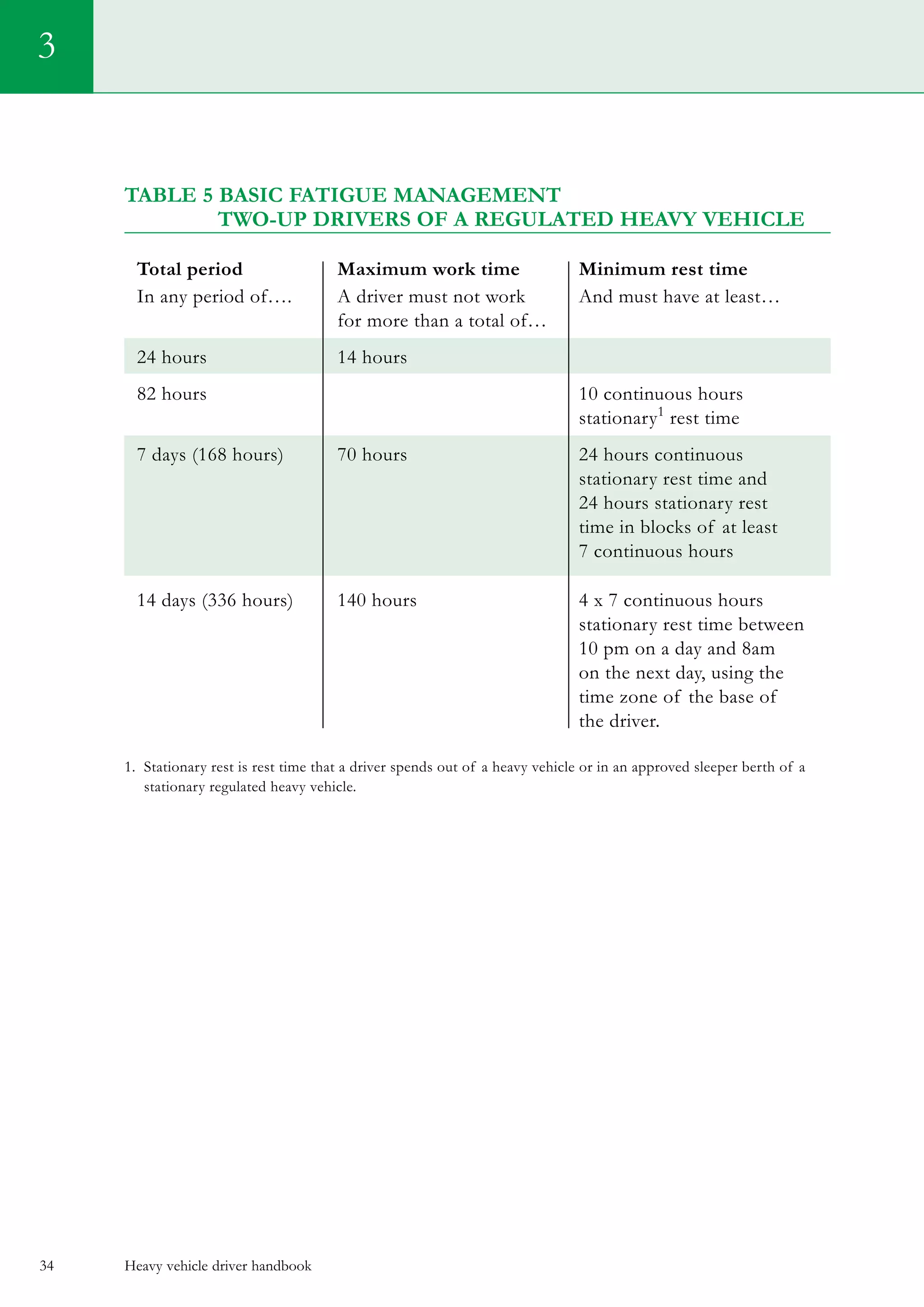
Table 5 Basic Fatigue Management
	Two-Up Drivers of a Regulated Heavy Vehicle
Total period	 Maximum work time	 Minimum rest time
In any period of….	 A driver must not work 	 And must have at least…
	 for more than a total of…		
24 hours	 14 hours
82 hours		 10 continuous hours
		 stationary1
rest time
7 days (168 hours)	 70 hours	 24 hours continuous
		 stationary rest time and
		 24 hours stationary rest
		 time in blocks of at least
		 7 continuous hours
14 days (336 hours)	 140 hours	 4 x 7 continuous hours
		 stationary rest time between
		 10 pm on a day and 8am
		 on the next day, using the
	 	 time zone of the base of
		 the driver.
1. Stationary rest is rest time that a driver spends out of a heavy vehicle or in an approved sleeper berth of a
stationary regulated heavy vehicle.
3
Heavy vehicle driver handbook 35
Advanced Fatigue Management (AFM)
AFM hours are more flexible and less prescriptive than either Standard
Hours or BFM hours. Drivers may work AFM hours when they have been
inducted into their operator’s AFM fatigue management system and meet
the requirements relating to drivers under accreditation. Operators will need
specify the normal operating limits.
Table 6	advanced Fatigue Management
	 outer limits
Total period	 Maximum work time	 Minimum rest time
In any period of….	 A driver must not work 	 And must have at least…
	 for more than a total of…		
24 hours	 15 hours1
	 6 continuous hours
		 stationary2
rest or 8 hours
		 stationary rest in 2 parts
14 days (336 hours)	 154 hours work time	 2 x 7 continuous hours
		 stationary rest time between
		 10pm on a day and 8am on 	
		 the next day, or 24 continuous 	
		 hours stationary rest time 	
		 taken after no more than 84 	
		 hours of work time
28 days (672 hours)	 288 hours work time	 4 x 24 continuous hours
		 stationary rest
1. The outer limit for NSW and Victoria is 15 hours in any 24 hour period (16 hours in other states).
2. Stationary rest is rest time that a driver spends out of a heavy vehicle or in an approved sleeper berth of a
stationary regulated heavy vehicle.
3
Heavy vehicle driver handbook36
National Work Diary
Records must be kept of work and rest hours. The log book has been replaced
by a work diary. Drivers must record information such as whether they are
working under Standard Hours, BFM hours or AFM hours, and when they
change from work and rest option in their work diary.
The new work diary is available from registries.
completing your work diary
You must record all work and rest time in your work diary unless operating
under an exemption. These records must be completed for the whole trip. The
work diary must show:
•	 Your name.
•	 Driver licence number.
•	 State/Territory licence issued.
•	 Accreditation number (if applicable).
•	 Name of work and rest option.
•	 Date and day of week.
•	 Time zone (driver base).
During the journey, you must record:
•	 Work and rest hours.
•	 Number plate (record at start and end of day and at each work and rest
change and vehicle change).    
•	 Odometer reading (record at start and end of day and at each work and
rest change and vehicle change).    
•	 Name of location at each work and rest change (rest area, truck stop,
suburb or town).
•	 Total number of hours of each activity at the end of the day.
•	 When the page is completed, sign the daily sheet to certify that the
entries are correct.
3
Heavy vehicle driver handbook 37
If you are a two-up driver or become a two-up driver, you must record the:
•	 Other driver’s name.
•	 Other driver’s licence number.
•	 Security or identifying number of the other driver’s work diary and
name of jurisdiction that issued the work diary.
You must use the work diary pages in strict order from start to finish. You
must be able to produce your last 28 days driving records. You must give
your record keeper the duplicate copies of your work diary within 21 days.
If you have more than one employer in a single day, you must also give the
other record keeper a copy of your work diary page. Record keepers must
keep copies of work and rest records for a period of three years.
Looking After Your Work Diary
The work diary is issued to you personally and it is an offence to:
•	 Let anyone else use or borrow it.
•	 Have more than one work diary containing pages which have not been
used or cancelled.
•	 Remove the application page or any original pages.
•	 Alter, deface or destroy any page.
•	 Make any false entries.
Carry and complete your work diary at all times. You must be
able to produce your driving record for the last 28 days.
Driver base
The driver base is the place from where the driver normally does the work.
3
Heavy vehicle driver handbook38
3
Alcohol, drugs and professional drivers
It is illegal to drive while under the influence of alcohol or drugs, including
some over-the-counter and prescription medicines.
Effects of alcohol on driving
Alcohol is a depressant and reduces your ability to drive safely because it:
•	 Slows brain functions so that you can’t respond to situations, make deci-
sions or react quickly.
•	 Reduces your ability to judge speed and distance.
•	 Gives you false confidence that leads to taking risks.
•	 Makes it hard to do more than one thing at a time.
•	 Affects your sense of balance and coordination.
•	 Makes you sleepy.
Getting back to zero takes time
After a night of heavy drinking, it can take more than 18 hours for your blood
alcohol concentration (BAC) level to get back to zero. Many people are booked
for drink driving the day after.
What does not sober you up
•	 A cup of black coffee.
•	 A cold shower.
•	 Fresh air.
•	 Mints or chewing gum.
•	 Milk.
•	 A short nap.
•	 Vomiting.
These things have no effect on your blood alcohol level. Once you have had
a drink, you just have to wait it out.
Your BAC must be under .02 when you drive a:
• Heavy vehicle with a GVM of more than 13.9 tonnes.
• Public passenger vehicle such as a bus or a coach.
• Vehicle which carries a dangerous load.
Even one drink can put you over the legal limit.
You need to take into account any drinks you have had.
It takes the body an hour or more to get rid of the alcohol
from one standard drink.
Drugs and professional drivers
A drug is any chemical substance that alters the normal way that your
body or mind works. Drugs not only affect your physical skills such as
reaction times, coordination and vehicle control but also affect your mood,
perception, information processing and risk taking behaviour. That is why
drugs can make your driving worse and greatly increase your chance of
having a crash.
How a drug will affect you depends on:
•	 The drug itself – type, amount, purity and method of use.
•	 Your weight, body size and health.
•	 Other drugs you have taken, and the setting such as surroundings and
work situation.
Whatever drug is used, it is important that you know how it affects you, the
harm it can do and what it does to your body.
Generally heavy vehicle drivers who do take drugs take two types – stimulants
to try and stay awake and depressants to try and go to sleep.
stimulants
Stimulants (uppers) speed up messages between the brain and the body.
They include medicines with mild stimulants like pseudoephedrine and
illegal drugs like speed.
Heavy vehicle driver handbook 39
3
Heavy vehicle driver handbook40
3
The effect of stimulants on driving
Stimulants do not increase your driving ability or coordination, however,
they can:
•	 Give you a false sense of confidence.
•	 Increase your risk taking behaviour.
•	 Distort your visual perceptions making it difficult to judge distances.
•	 Make you feel exhausted because you cannot sleep which will affect
your reflexes and your concentration.
•	 Increase your risk of having a crash.
As the effects of stimulants begin to wear off, you may experience a level of
fatigue that is worse than when you first took the drug.
The long-term health effects of taking stimulants include:
• Anxiety.
• Chronic sleep problems.
• Compulsive repetition of actions.
• Depression.
• Extreme mood swings.
• High blood pressure.
• Heart failure.
• Impotence.
• Irritability.
• Panic attacks or seizures.
• Paranoia.
• Suspiciousness.
• Weight problems.
A good sleep is the only way to prevent or cure fatigue.
Taking drugs to keep awake can make fatigue worse
when the effect of the drug wears off.
Heavy vehicle driver handbook 41
4
Depressants
Depressants slow your reflexes, impair your balance and coordination,
affect your vision and perception of time and space, your memory and your
ability to think logically. The ‘hangover’ effects such as drowsiness and poor
coordination can last for several hours after the initial effects, which can
mean you are not able to drive safely.
Depressants greatly increase the risk of having a crash when you are driving
because you can have:
•	 Slower reaction time.
•	 Distorted perception of speed and distance.
•	 Impaired vision.
•	 Reduced ability to concentrate.
•	 Impaired coordination and decreased ability to coordinate
the appropriate reaction when driving.
Prescription drugs
Some prescription medications can affect your driving. Read the instructions
on the packaging or consult your doctor or pharmacist to find out if the
drugs you are taking would impair your driving ability. More information on
prescription drugs is available in the RMS brochure, Driving and medicines.
Drug testing
Roadside drug testing
Police now have the powers to carry out roadside drug testing on any driver,
rider and supervising licence holder in NSW. Specific Police drug testing
operations will target heavy vehicle drivers.
Driving under the influence of drugs
If the manner of your driving indicates that you are impaired by drugs or you
are involved in a fatal crash, Police have the power to take you to hospital to
obtain a blood and urine sample. The sample will be analysed for any drug,
including some prescription drugs known to impair driving.
Heavy vehicle driver handbook42
Seatbelts
It is important for truck and bus drivers to wear a seatbelt. Any driver or
passenger must wear a seatbelt properly adjusted and securely fastened
wherever there is one available. If there is an empty seat with a seatbelt, a
passenger must move to that seat. The driver will not be penalised if there is
no seatbelt and the vehicle has been manufactured before the requirement for
seatbelts commenced.
Compulsory seatbelt laws have been in place for heavy vehicle drivers since 1
February 2000.
Vehicles that have been modified by the installation of non-original seats (eg
driver’s suspension seat) must have suitable seatbelts in order for those vehicles
to comply with mandatory equipment requirements and provide the driver
with a suitable level of comfort.
It is an offence to remove a fitted seatbelt from a vehicle.
If you remove it you may be breached for not wearing it
as well as for removing it.
The driver is responsible
Drivers are responsible for all passengers, particularly children, being properly
restrained in a seatbelt or approved child restraint where seat belts are fitted.
There are fines and demerit points for a driver who is not wearing a seatbelt
and who fails to ensure that passengers use seatbelts.
Passengers aged 16 years and over who do not use an available seatbelt will
also be individually fined.
3
Heavy vehicle driver handbook 43
Entering and exiting a vehicle
For safety there is a procedure for entering and exiting a heavy vehicle.
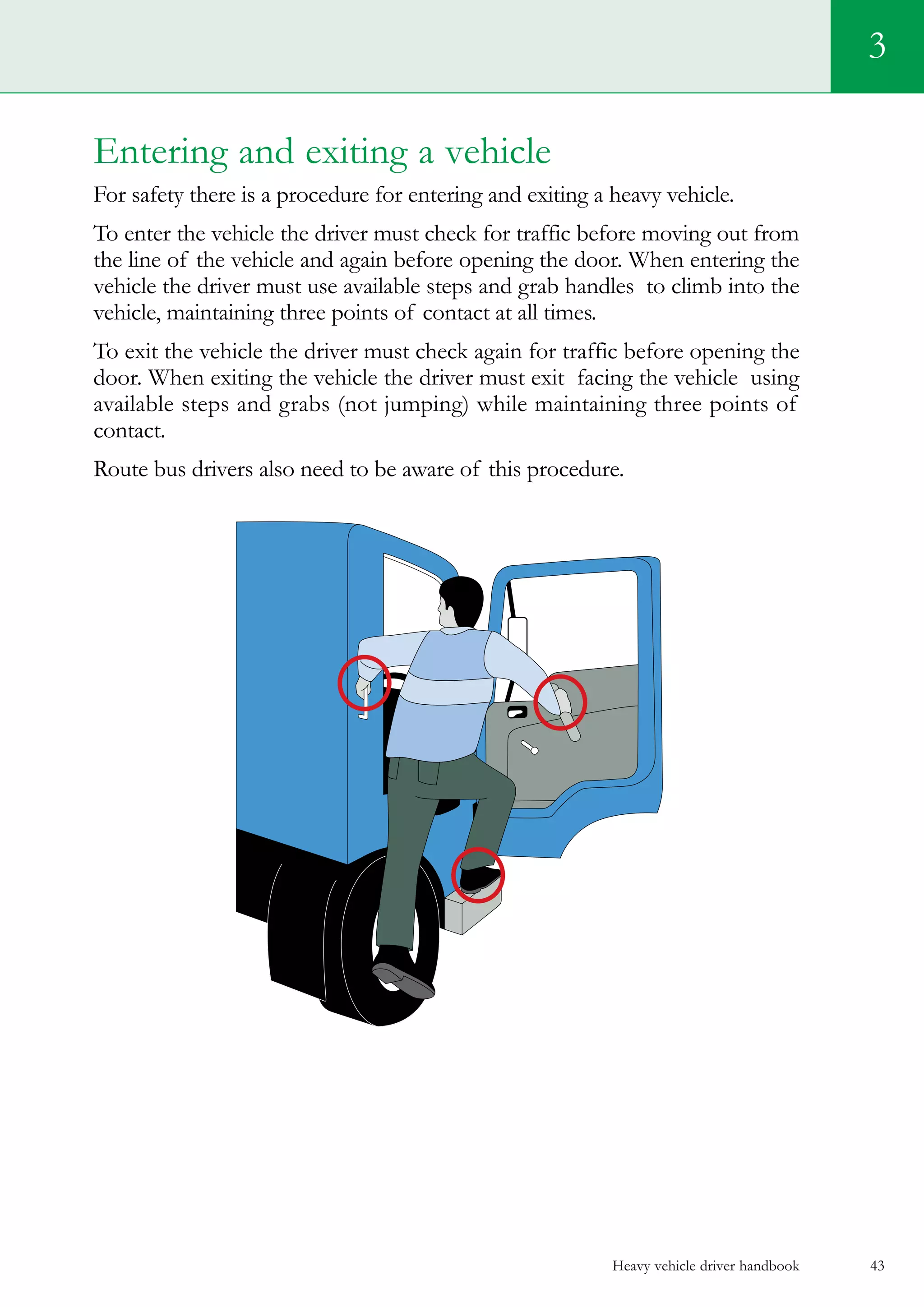
To enter the vehicle the driver must check for traffic before moving out from
the line of the vehicle and again before opening the door. When entering the
vehicle the driver must use available steps and grab handles to climb into the
vehicle, maintaining three points of contact at all times.
To exit the vehicle the driver must check again for traffic before opening the
door. When exiting the vehicle the driver must exit facing the vehicle using
available steps and grabs (not jumping) while maintaining three points of
contact.
Route bus drivers also need to be aware of this procedure.
3
Heavy vehicle driver handbook44
3
What you should know about driver management
After reading this section, you should know:
•	 How often to take a break when driving.
•	 The warning signs of fatigue.
•	 The blood alcohol level for drivers of trucks and buses.
•	 Standard allowable driving hours for the type of vehicle
you intend to drive.
•	 Drugs and their effects.
•	 Law relating to seatbelts.
Notes
..........................................................................................................................
...........................................................................................................................
..........................................................................................................................
...........................................................................................................................
..........................................................................................................................
...........................................................................................................................
..........................................................................................................................
...........................................................................................................................
..........................................................................................................................
...........................................................................................................................
..........................................................................................................................
...........................................................................................................................
..........................................................................................................................
...........................................................................................................................
Summary
Heavy vehicle driver handbook 45
4
Low risk driving
As a professional driver you should at all times display ‘low risk’
driving. Only drive when you are alert, respect other road users
and know how to control your vehicle.
Driving is never risk free, but you should aim to drive ‘low risk’. A low risk
driver has good observation, speed management and road positioning skills.
This is explained in detail in the Road Users’ Handbook.
Observation
The key to good observation is scanning.
Speed management
Drive at a speed that is within the speed limit and that will allow you to react
and completely stop within the distance you can see is clear. When you see
potential hazards, slow down and prepare to stop. If you cannot see at least
five seconds ahead you must slow down. Slow down on wet, icy or gravel
roads where it will take longer for your vehicle to stop.
Road positioning
Position your vehicle to maximise the distance from hazards (this is also
referred to as buffering). For example, moving left at the crest of a hill to
create space from oncoming vehicles, or moving away from a parked car to
avoid doors opening and pedestrian movement.
Crash avoidance space
A low risk driver maintains a crash avoidance space completely around the
vehicle. The crash avoidance space is managed by adjusting the vehicle’s
speed and road position.
To determine the crash avoidance space to the front of the vehicle you need
to take into account two key factors – reaction time and response time.
Reaction time is the time the driver needs to:
•	 See the information.
•	 Perceive what it means.
•	 Decide on a response.
•	 Instigate that response.
Safe driving
Heavy vehicle driver handbook46
4
A heavy vehicle driver who is fit, concentrating, and alert, and not affected
by alcohol, drugs, fatigue or a distraction, will still require about 11/2 seconds
to react.
Response time is the time required to take action. Generally a minimum of
two to three seconds is needed to respond. In many situations braking may
be the only possible response. Swerving is rarely appropriate and can result
in a more severe crash, for example a head-on collision.
A total of at least four seconds crash avoidance space is needed to react and
respond to a situation in front of you. You may need even longer in poor
conditions such as rain or darkness.
The four-second gap can be used when following another vehicle or if there
is potential for something to move into your crash avoidance space.
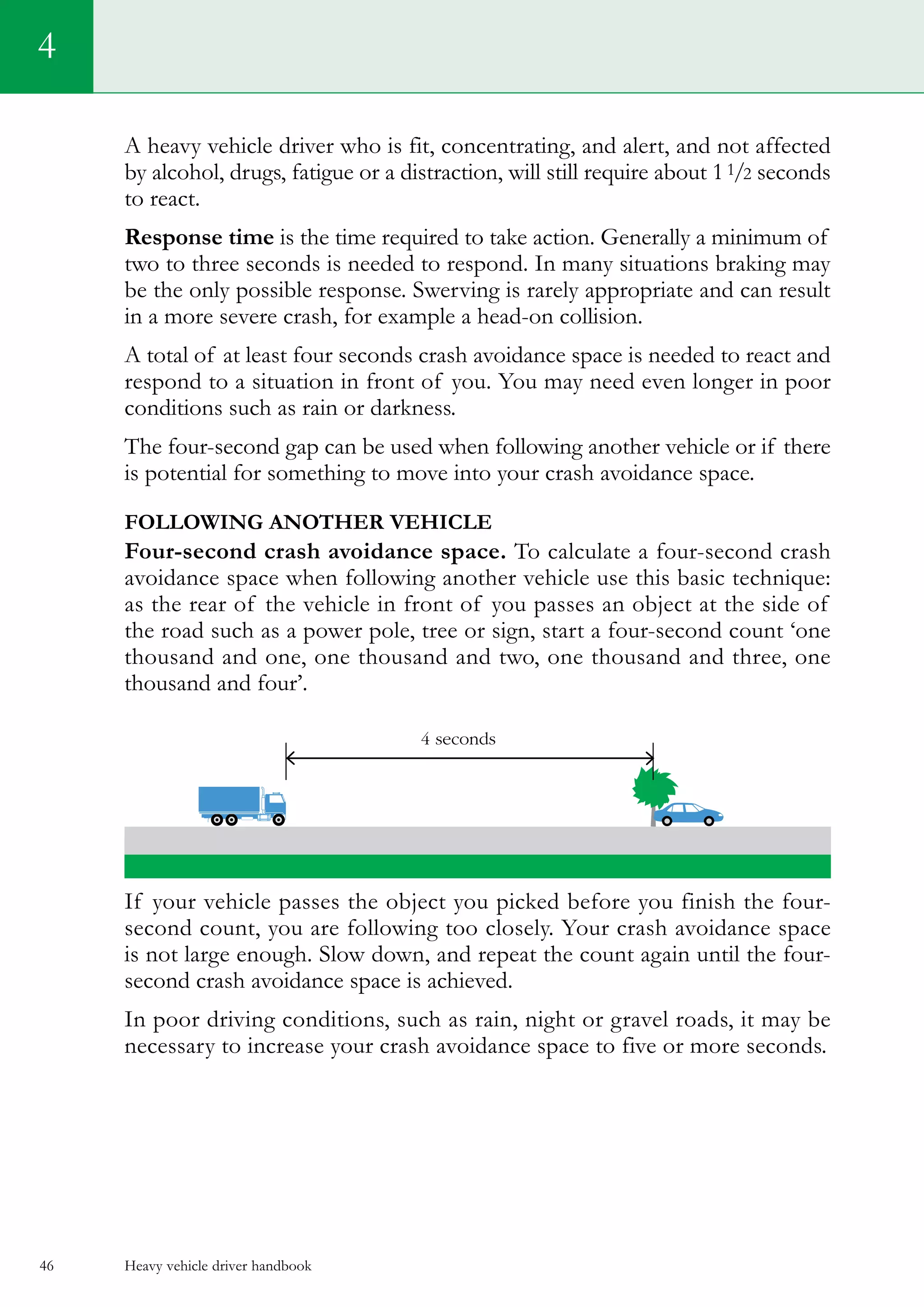
Following another vehicle
Four-second crash avoidance space. To calculate a four-second crash
avoidance space when following another vehicle use this basic technique:
as the rear of the vehicle in front of you passes an object at the side of
the road such as a power pole, tree or sign, start a four-second count ‘one
thousand and one, one thousand and two, one thousand and three, one
thousand and four’.
If your vehicle passes the object you picked before you finish the four-
second count, you are following too closely. Your crash avoidance space
is not large enough. Slow down, and repeat the count again until the four-
second crash avoidance space is achieved.
In poor driving conditions, such as rain, night or gravel roads, it may be
necessary to increase your crash avoidance space to five or more seconds.
Heavy vehicle driver handbook 47
4
Potential for something to move into the crash
avoidance space
The four-second gap can also be used for situations where there is potential
for something to move into the crash avoidance space, for example, a car
in an adjacent street could fail to give way and pull out. Low risk drivers
experienced in maintaining a four-second following distance are able to
mentally judge a four-second crash avoidance space in front of their vehicle.
If there is potential for a hazard to enter this crash avoidance space, reduce
your speed and create a buffer. It is necessary to maintain the crash avoidance
space for all potentially hazardous situations, including blind corners and
crests.
Many of the crashes that occur each day in NSW could be avoided if drivers
actively maintained their crash avoidance space.
LEGAL Minimum distances between large vehicles
All vehicles 7.5 metres or longer must keep the following minimum distances
between long vehicles:
•	 200 metres in a road train area.
•	 60 metres outside a road train area.
This rule does not apply on multi-lane roads, in built-up areas or when
overtaking.
Legal requirements. By law large vehicles must maintain the minimum or greater
following distance.
Heavy vehicle driver handbook48
4
Vehicle controls
Spring brakes or ‘maxi-brakes’
Most fully air-braked vehicles on the road are equipped with spring-loaded
parking brakes. These brakes rely on air pressure to hold them in the OFF
position. See this section on Brake failure.
Trailer brake
Some vehicles are fitted with a hand operated trailer brake. This is a separate
valve operated by hand which applies the trailer brake independently of the
footbrake. The trailer brakes must not be used for normal braking as
they will wear, overheat or burn out, and lose their effectiveness completely.
A trailer with ineffective brakes attached to a towing vehicle with effective
brakes can cause it to jack-knife or rollover if it brakes heavily.
A trailer hand brake may be applied if necessary to prevent the
vehicle from rolling backwards and to avoid transmission shock load
when moving off on a hill. Trailer brakes are not parking brakes and
should not be used as such.
Controlling speed
•	 Brake early and gradually.
•	 Where possible, brake when your vehicle is driving in a straight line.
•	 Allow for the weight of the load – a loaded vehicle takes far more brak-
ing effort to slow down than an unloaded one.
•	 Brake according to the road surface – allow more braking distance
if the road is gravel, steep or slippery.
•	 Ease off the brakes as the vehicle slows down.
•	 Always test the brakes immediately after driving through deep water
as wet brakes do not perform well.
The service brake should be used under all
normal conditions.
Heavy vehicle driver handbook 49
4
Brake failure
Brakes kept in good condition rarely fail. Most brake failures occur because of:
•	 Loss of air pressure.
•	 Loss of hydraulic pressure.
•	 Brake fade (boiling of hydraulic fluid) on long hills
– bad driving practice.
•	 Poorly maintained brakes.
Jack-knife and trailer swing
You can reduce the chances of jack-knife or trailer swing by making sure
that all brakes and tyres are in good condition and that the load is evenly
distributed between axle groups. You should be especially careful in wet
weather.
Trailer swing is where the trailer slides	 A jack-knife is where the trailer and
dangerously.	 prime mover lock against each other.
Heavy vehicle driver handbook50
Loss of pressure in air brakes
Whenever you drive, make sure there is enough air pressure for at least five
brake applications. Air brakes can fail because of a leak in the air lines or
over-use. Stop immediately if the low air pressure warning device comes
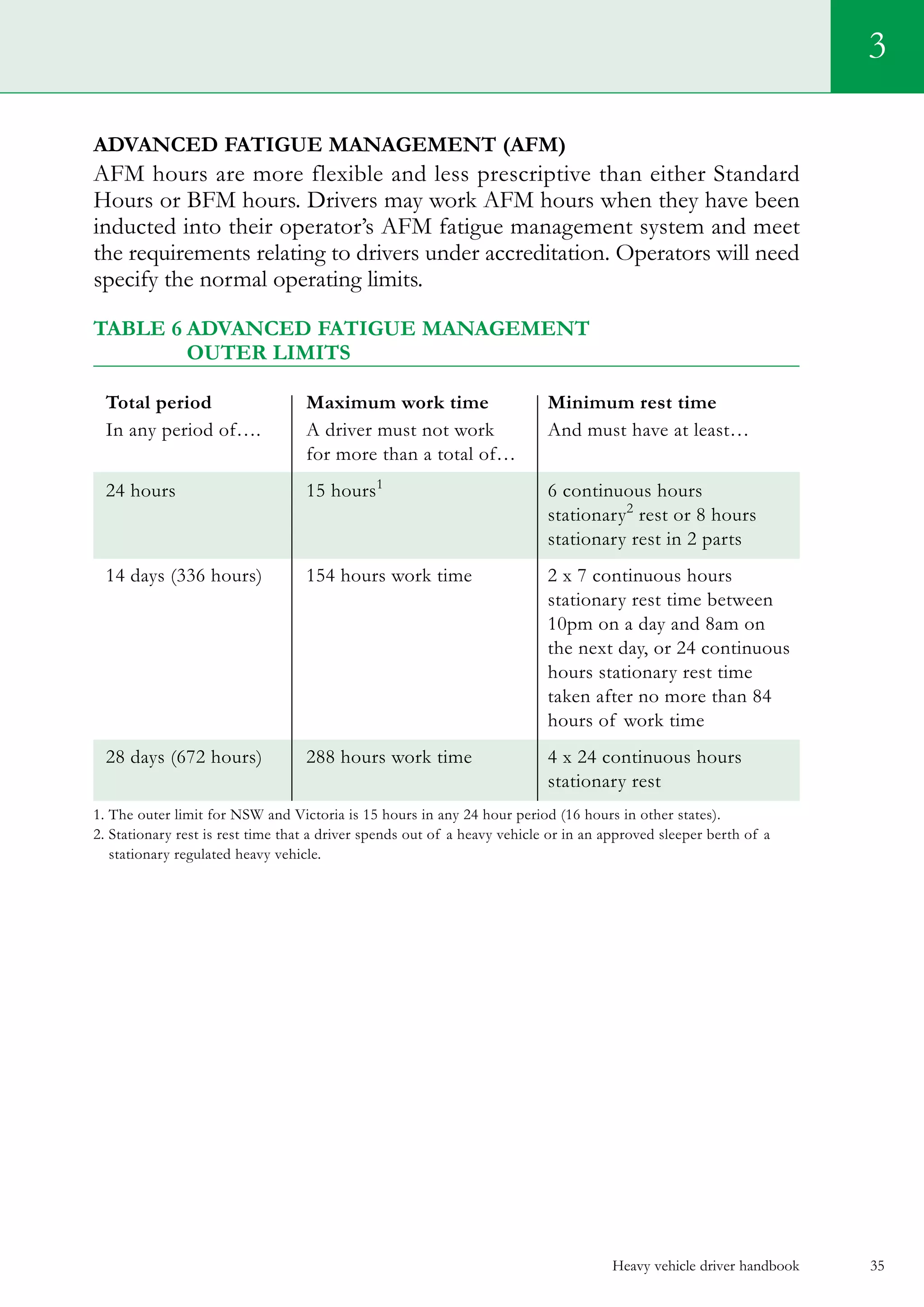
on. You should stop by gearing down until the vehicle is slow enough to
apply the brakes.
Most vehicles fitted with full air system brakes are usually fitted with spring
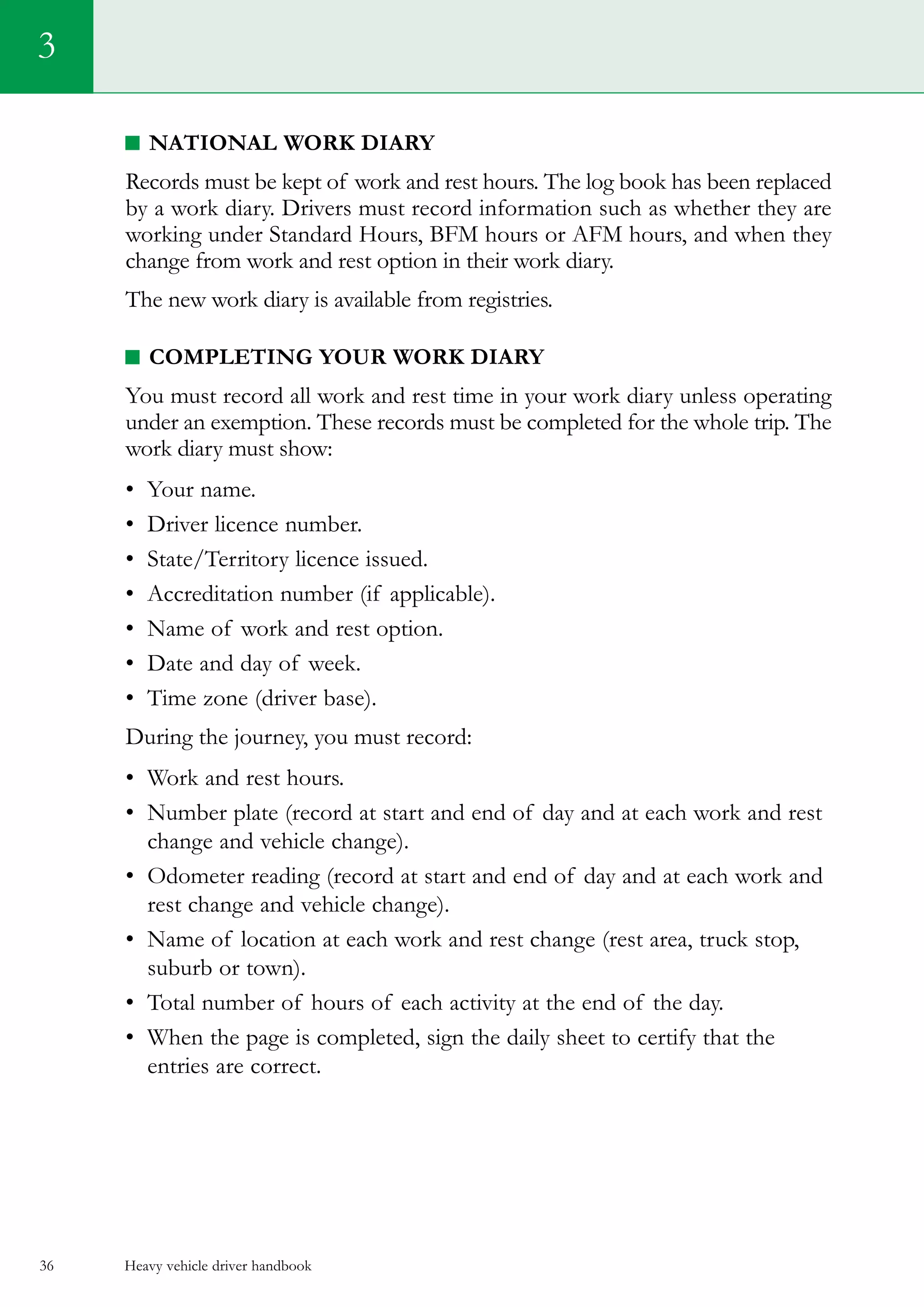
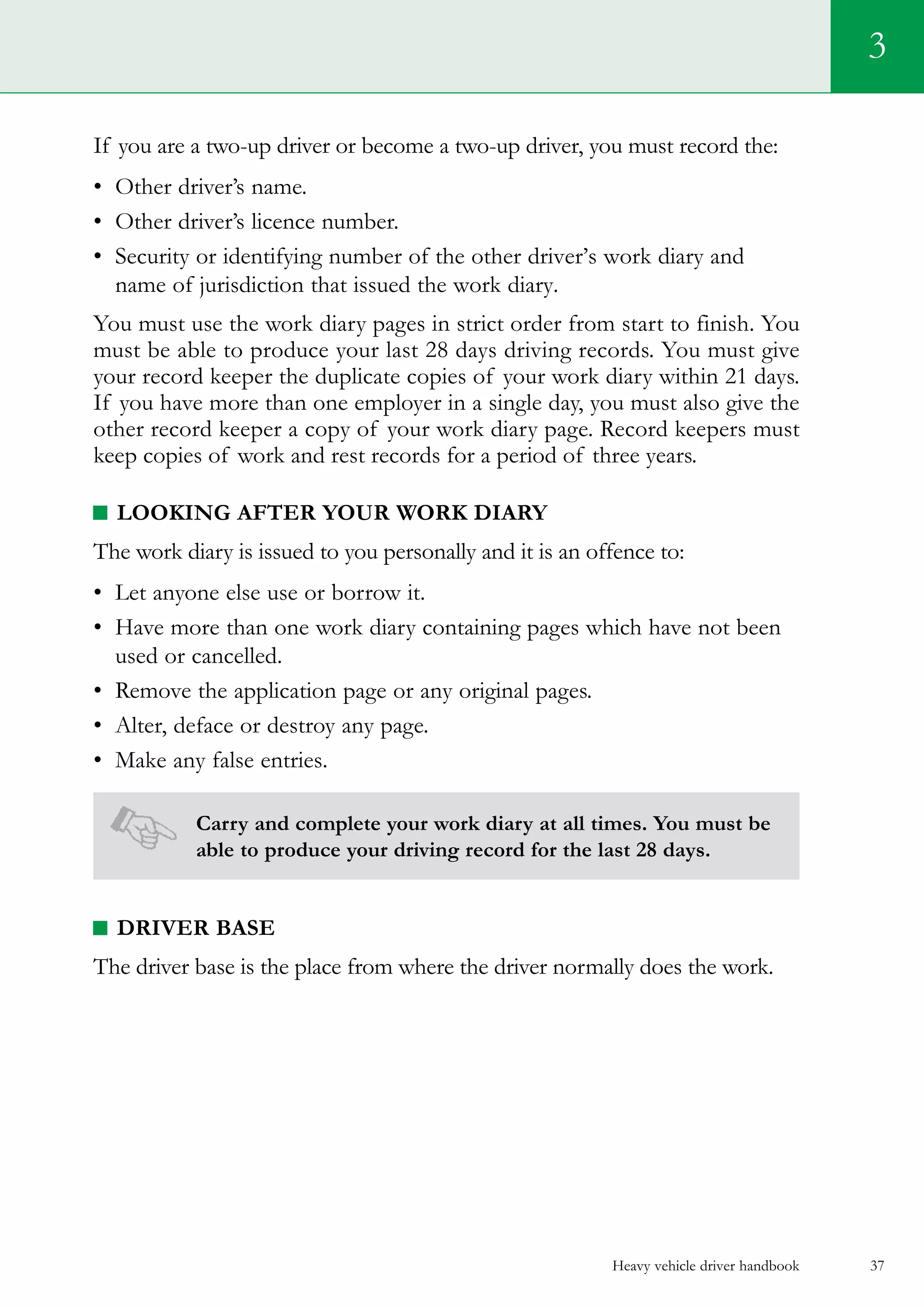
parking brakes, also known as maxi-brakes, where air pressure is required to
keep them off.
On some older vehicles the spring brakes may come on when the air
pressure is very low. You should monitor the air pressure gauges often as low
air pressure can happen anytime. When the gauge shows low air pressure,
release the brakes at least twice, so you can move the vehicle to a safe area.
Loss of hydraulic brakes
What to do if your hydraulic brakes fail:
•	 Change gears down.
•	 Pump the brakes – sometimes pumping them
can partially restore hydraulic brakes.
•	 Use the emergency parking brake.
4
Heavy vehicle driver handbook 51
4
Basic driving techniques
Hills
Before going down a hill
Reduce speed and select the correct gear before beginning the descent. See
section 5 Heavy vehicle road rules and in this section, the information under
the heading Going down hills. It is very important to select a gear low
enough to slow down the vehicle.
If you try to gear down but you miss the gear, stop the vehicle
with the brakes immediately, then select the correct gear.
Attempting to coast while you struggle with the gears is very
dangerous. Do not try to change gears while going downhill
as you can lose control of the vehicle.
Braking going down hills
Brake failure can be prevented by good driving techniques.
If you use the brakes to slow a vehicle travelling down hill it can cause
overheating. This leads to brake fade, or brake burn-out in which the brake
linings completely lose their grip and are no longer effective.
Going down hills
•	 Select a gear low enough to slow down the vehicle
without the constant use of brakes.
•	 If you miss the gear when trying to gear down, stop the vehicle
with the brakes immediately, then select the correct gear. It is very dan-
gerous to coast while you struggle with the gears.
•	 Use auxiliary brakes to help control the vehicle speed.
•	 Reserve your service brakes for coping with emergencies,
traffic conditions or sharp corners.
•	 Try to brake on straight sections of road where possible
as this reduces the chance of skidding.
•	 Avoid fanning (repeatedly applying and releasing) the brakes
as this leads to an increase in brake temperature and failure due
to brake burn out. In air brake systems, fanning wastes compressed air,
reducing the reserve available for an emergency.
Heavy vehicle driver handbook52
4
Going up hills
•	 Shift down early to prevent engine ‘lugging’. Lugging is shuddering
or excessive vibration in the engine.
•	 Use engine torque (the turning force available at the crankshaft)
efficiently. Do not let engine revs fall below the maximum torque speed.
•	 Shifting down two or more gears at once may be necessary
when going up a steep hill.
Before entering a sharp curve
Reduce speed and select the correct gear before you enter the curve. The
gear you select should have the engine revs near the maximum torque level
as specified by the engine manufacturer, allowing you to accelerate smoothly
out of the turn.
Slowing and stopping
When slowing or stopping a heavy vehicle it is best to use your brakes only.
However, when driving down a steep hill it may be necessary to remain in a
low gear to control the vehicle’s speed.
Never drive out of gear. This is extremely dangerous and can lead to loss of
vehicle control and overheated brakes.
You must select a low gear before commencing
steep descents.
ANIMALS AND VEHICLES
A driver or passenger must not lead an animal including by tethering while
the vehicle is moving.
Animals that are being transported must be seated or housed in appropriate
areas. Drivers must not drive with an animal in the driver’s lap.
Heavy vehicle driver handbook 53
4
What you should know about safe driving
After reading this section, you should know:
•	 How to calculate a four-second crash avoidance space
(following distance).
•	 How to control your speed going down hills.
•	 What to do in case of brake failure.
•	 The reasons for jack-knife and trailer swing.
•	 How animals must be transported.
Notes
..........................................................................................................................
...........................................................................................................................
..........................................................................................................................
...........................................................................................................................
..........................................................................................................................
...........................................................................................................................
..........................................................................................................................
...........................................................................................................................
..........................................................................................................................
...........................................................................................................................
..........................................................................................................................
...........................................................................................................................
..........................................................................................................................
...........................................................................................................................
Summary
Heavy vehicle driver handbook54
5
As a professional driver it’s your responsibility to know the
road rules that apply to all vehicles, especially heavy vehicles.
Speed limits
In NSW the maximum speed limit for a vehicle that exceeds a GVM of 4.5
tonnes is 100 kilometres per hour.
For certain road conditions (eg sharp bend, steep descent, winding road),
special speed limit signs may be posted for trucks, road trains and buses. You
must not drive at a speed greater than the speed shown on the sign.
Speed limiters
Speed limiters are devices that limit a vehicle’s maximum speed. If your
vehicle falls into one of the following groups, it must be speed limited to
100 kilometres per hour.
A heavy  vehicle or bus manufactured on or after 1 January 1988, being either a:
•	 Truck having a GVM exceeding 15 tonnes.
•	 Bus used to provide a public passenger service
and with a GVM exceeding 14.5 tonnes.
A heavy vehicle or bus manufactured on or after 1 January 1991 being either a:
•	 Truck having a GVM exceeding 12 tonnes.
•	 Bus used to provide a public passenger service and with
a GVM exceeding five tonnes.
The SPEED COMPLIANCE Regulation
The speed compliance component of the Road Transport (General)
Regulation places duties on parties in the supply chain to take steps to ensure
that their activities, schedules or arrangements do not cause heavy vehicle
drivers to exceed the speed limits.
It complements existing chain of responsibility provisions for mass, load
restraint, vehicle dimension and fatigue management.
The speed compliance component applies to heavy vehicles with a gross
vehicle mass of more than 4.5 tonnes.
Heavy vehicle road rules
Heavy vehicle driver handbook 55
5
Parties in the Chain
There is a specific duty on seven off road parties to take all reasonable steps
to ensure that their actions do not cause drivers to exceed speed limits. The
parties in the chain include:
•	 Employers
•	 Prime contractors
•	 Operators
•	 Schedulers
•	 Loading managers
•	 Consignors
•	 Consignees
It is the performance of any of these functions that determines whether a
person falls into one of the above categories rather than their job title or
description.
In addition, a person may be a party in the chain in more than one capacity.
Heavy vehicle drivers
The Regulation does not impose any obligations on employed drivers.
Drivers of heavy vehicles are required to obey the speed limits. Penalties on
drivers failing to comply with speed limits include demerit points, licence
suspension, cancellation or disqualification and fines.
Driving in wet conditions
Wet roads reduce tyre grip and can result in loss of control.
You should drive at a speed that allows you to brake gradually and stop
within the distance you can see. The safe speed for your vehicle and its load
may be much lower than the posted speed limit.
To avoid skidding, slow down when approaching corners
and select an appropriate gear to maintain vehicle control
without the need for braking.
Heavy vehicle driver handbook56
5
Intersections
At intersections you may have to swing wide to make a left turn. At marked
intersections:
•	 Position your vehicle so that any vehicles behind cannot pass
on your left.
•	 Position yourself to get the best view possible of the road
you are turning into.
Bus and truck drivers need to start a left turn further into the intersection
than a car so that the back wheels do not run over the kerb.
Crossing or entering traffic
You must choose a suitably large gap in the traffic to get across an
intersection, enter a new street or merge with traffic.
Consider the size and weight of your vehicle when crossing or entering
intersections, changing lanes, and making other manoeuvres. Also remember
that a loaded vehicle will accelerate slower than an empty one.
Before moving from a stationary position at the side of
the road or a median strip parking area, you must signal
for at least five seconds, check mirrors and blind spots.
Turning
Trucks and buses need more space to turn wide or cut into traffic so allow
enough space on either side of your vehicle to avoid sideswiping other road
users or objects.
Turning right from a one way street
A vehicle (or vehicle and trailer) that is 7.5 metres or longer and has a DO
NOT OVERTAKE TURNING VEHICLE sign displayed on the back, can
turn right from the lane on the immediate left of the far right lane.
Plan your turn early so that you are in the correct part of the intersection
and you have time to signal. Avoid turning too soon because the side of
your vehicle may hit vehicles on your right as the back of your vehicle cuts
in to the turn.
In a road with two right turn lanes, always use the turning lane on the far
left.
Heavy vehicle driver handbook 57
5
A vehicle of 7.5 metres or longer may display the words DO
NOT OVERTAKE TURNING VEHICLE on one of the rear
marking plates.
If your vehicle (or vehicle and trailer) is under 7.5 metres
long, you must not display this sign on the back, and you
must turn within the lanes marked on the road at all times.
Reversing
When reversing a heavy vehicle, you must:
•	 Activate hazard warning lights before starting to reverse.
•	 Avoid unnecessary reversing. Plan ahead to use the
shortest possible reversing distance.
•	 Use a helper to guide you whenever possible. You should be
able to see the guide who should have a clear view of where
your vehicle is going.
•	 Get out and have a look if you are not sure what is behind you.
•	 Always reverse your vehicle into position in a driveway
or loading dock.
Although you may need to hold up traffic while you reverse, it is much safer
to drive forward into traffic as you leave.
Overtaking
There are special problems associated with overtaking while driving a heavy
vehicle.
It is very important to watch for small vehicles, such as motorcycles. Before
pulling out, check your mirrors and glance down to check for vehicles below
your cabin. Air movement caused by a large vehicle travelling fast can force a
small vehicle off the road, or draw it into the side of a larger vehicle.
Heavy vehicle driver handbook58
5
Being overtaken
If it is safe, move into the left lane to allow faster moving traffic to overtake.
It is illegal and dangerous to direct following vehicles to overtake, using your
hand or the indicator. You may be encouraging an inexperienced driver to
attempt an unsafe move.
LANE CHANGING
It is very important to check that the road is clear when you want to change
lanes, or when lanes merge. You also need to check before leaving the kerb
and before turning. You must look in the appropriate mirrors and do blind
spot head checks before making any of these moves. In a heavy vehicle it is
also essential to check down the side door in the cabin.
Before pulling out check mirrors, signal, check blind spot below cabin.
Restricted areas for road trains and B-doubles
All approved routes are listed in the road train permit notice, and appear on
the road train map available on our website at www.rms.nsw.gov.au
Road trains may operate on all routes in the purple area shown on the road
train map, and on specific roads in the orange area.
Unloaded road train converter dollies can also be towed behind the standard
prime mover/semi-trailer combinations in the road train area, on other
specific road train routes and all 25 metre B-double routes except those
in the Sydney region. When towing an unloaded dolly you must carry a
Heavy vehicle driver handbook 59
5
copy of the Converter Dolly Combination Notice 2005 and comply with the
operating requirements.
B-doubles can operate on all approved road train routes as well as on the
state-wide network of B-double routes.
You must have the correct permit notice to operate a B-double. You must
carry it in the vehicle at all times and present to an authorised officer, if
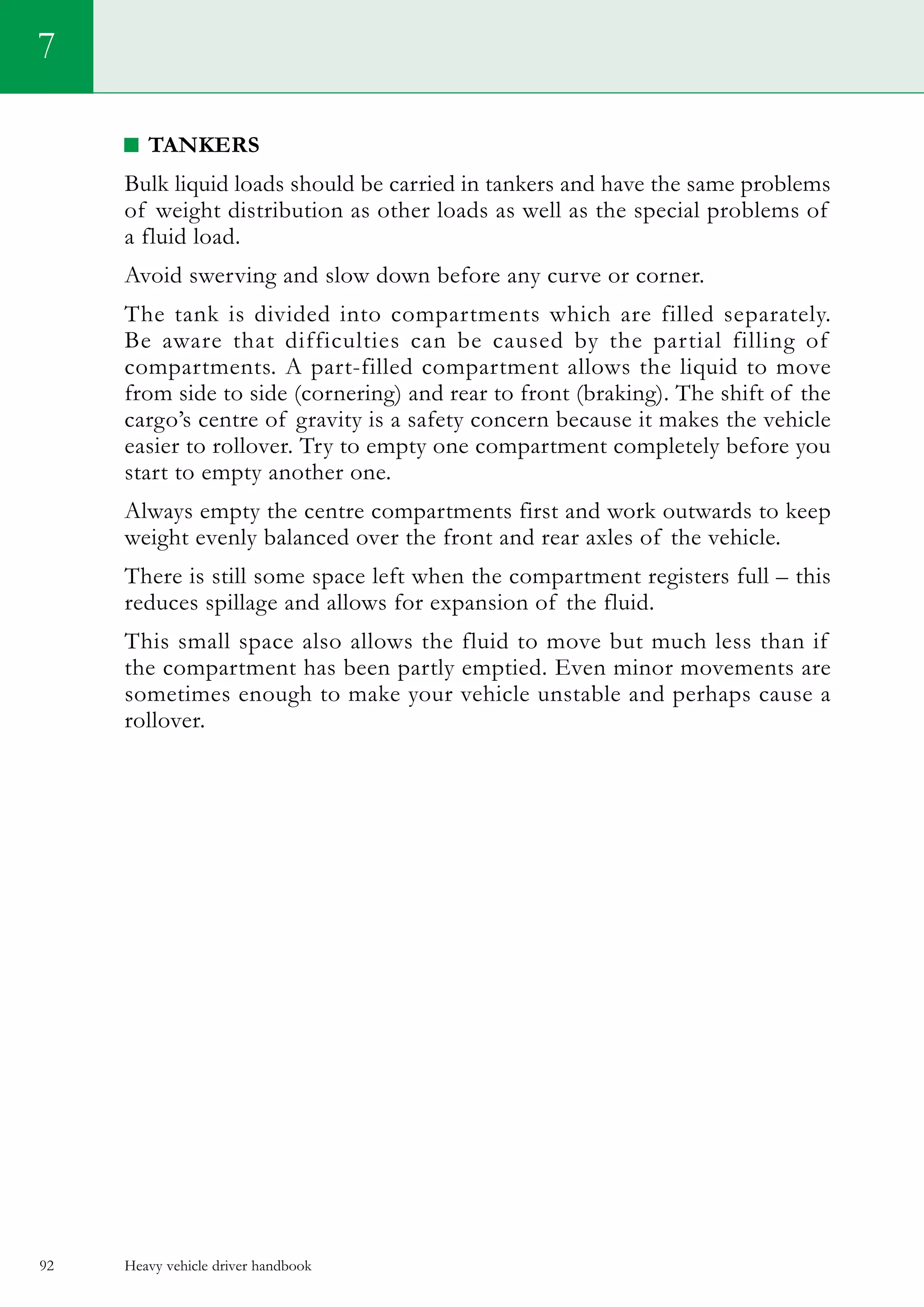
requested. The Permit Notice for the Operation of B-doubles and the maps
for road train and B-double routes in NSW are available from our website at
www.rms.nsw.gov.au
This sign must be fitted to the back of vehicle combinations
longer than 22 m. B-doubles carry a greater payload than a
single articulated vehicle and handle differently.
Height and length limits
The height of a B-double, including load, is limited to a maximum of
4.3 metres. Heights of 4.6 metres are permitted under the 4.6 metre High
Vehicle Route Notice 2008. The 4.6 Vehicle Route includes B-doubles and
specifies approved routes for vehicles 4.6 metres high. A B-double combination
may have a maximum length of 26 metres.
B-doubles with an overall length not greater than 19 metres
and a total mass not exceeding 50 tonnes operating under
a notice may travel on all roads except where prohibited by
a load limit or other sign.
Heavy vehicle driver handbook60
5
Light traffic roads
You must not use any road with a load limit sign if the
total weight of your vehicle is the same as, or heavier
than, the weight shown on the sign.
You may use a light traffic road when that road is your
destination for a pick-up or delivery and there is no
alternative route.
Load limit sign
You must not drive past a bridge load limit (grosS masS) sign
or grosS load limit sign if the total of the gross mass (in tonnes) of
your vehicle, and any vehicle connected to it, is more than the gross mass
indicated in the sign.
No trucks sign
Drivers of long or heavy vehicles except buses must not
drive past a NO TRUCK sign unless the vehicle is equal
to or less than the mass or length specified on the sign.
When the sign does not provide detailed information,
no truck (ie GVM greater than 4.5 tonnes) is permitted
to drive past the sign, unless the drivers’ destination lies
beyond the sign and it is the only route.
trucks MUST ENTER SIGN
Heavy vehicle drivers must enter the area indicated by
information on or with this sign.
Where heavy vehicles can stand or park
Heavy vehicles (GVM of 4.5 tonnes or more) or long vehicles (7.5 metres long
or longer) must not stop on a length of road outside a built up area, except on
the shoulder of the road. In a built up area they must not stop on a length of
road for longer than one hour (buses excepted). For more information on where
vehicles can stand or park, refer to the Road Users’ Handbook.
Heavy vehicle driver handbook 61
5
Warning triangles
A vehicle or a vehicle and trailer with
a GVM of more than 12 tonnes, must
carry three portable warning triangles
to use if the vehicle breaks down.
If a vehicle required to carry warning
triangles stops or the load being carried
by the vehicle falls onto the road and
is not visible for 200 metres in all
directions, the driver must put:
•	 The first triangle between
50-150m from the front of the
vehicle or fallen load.
•	 The second triangle between
50-150m from the rear of the
vehicle or fallen load.
•	 The third triangle at the side
of the vehicle, or fallen load,
in a position that gives sufficient
warning to other road users
of the position of the vehicle
or fallen load.
Requirements for placing
warning triangles.
Truck and bus lanes
truck lanes
Truck lanes are marked by the following sign. Trucks
more than 4.5 tonnes GVM must use these lanes.
250 metres
200 metres
250 metres
200 metres
Heavy vehicle driver handbook62
5
Bus and bus only lanes
Bus and bus only lanes are marked
by the following signs, or by lane
markings. Public buses constructed
principally to carry persons and
equipped to seat more than eight
adults, including the driver, and used
to convey passengers for hire or
reward, or in the course of trade or
business, may use these lanes.
Priority for buses
Other vehicle drivers should give way to a bus displaying
the give way sign in a built-up area, when the bus is about
to enter or proceed in the lane or line of traffic and the
bus is in front of the driver.
You are still required to obey the road rules when
entering the traffic.
Buses cannot park at bus stops but may wait at a bus stop
prior to commencing a regular passenger service.
BUSES
Stopping at a bus stop
Bus drivers should pull up so the entrance and exit doors are as close as
possible to the kerb at a bus stop.
•	 Signal your intention.
•	 Stop the bus smoothly.
•	 Stop parallel with the kerb.
•	 Stop within 300 millimetres from the kerb
measured from the front bus step.
•	 Stop the bus without hitting the kerb.
•	 Apply the bus stop brake. If the bus does not have a bus stop brake
then you must apply the normal parking brake.
•	 Indicate for at least five seconds before pulling out of a bus stop.
Heavy vehicle driver handbook 63
5
Stop within 300 mm of the kerb.
Bus (B) signals
B signals separate buses and other
vehicles at intersections with traffic
lights. B signals are attached to the
traffic lights and show a white B on a
black background. Some traffic lights
have a red, yellow and white signal
attached. Shortly before the usual
traffic signals change to green the
B signal lights up white. Buses may
proceed in any direction unless signs or
markings indicate otherwise.
firES
To minimise the risk of fire:
•	 Make regular checks of the vehicle during your trip.
•	 Follow recommended vehicle operating rules. See section 7
Vehicle dimensions and loading.
•	 Check the instruments and mirrors as part of your regular
scanning routine.
If there is a fire in your vehicle:
•	 Stop it well away from anything else which may burn.
•	 Notify emergency services (dial 000).
•	 Use the correct fire extinguisher.
•	 If the trailer is on fire, and it is safe to do so, uncouple the
prime mover and move it away.
White B means
buses only go.
Red B means
buses stay.
Green means other
vehicles go.
Heavy vehicle driver handbook64
5
•	 If the engine is on fire, try not to open the bonnet any more
than necessary. Spray the fire extinguisher through louvres,
or from the underside of the vehicle.
•	 Where the load is on fire in a van or box trailer, open the doors
slowly and only far enough to let you use the extinguisher properly.
Vehicle monitors
Vehicle monitors are devices which automatically record details about the
operation of a vehicle at all times, whether the engine is on or off. There
are various types of vehicle monitors. Among them are tachographs and
electronic boxes, also known as trip computers or black boxes.
Monitors record:
•	 Lengths of time the vehicle is moving and stationary during a journey.
•	 Speeds at which the vehicle is driven. 	
•	 Distance the vehicle travels between stops.
•	 The time, date and place of starting and finishing a journey,
drivers’ details and vehicle identification.
Monitors produce a continuous record of vehicle operation, allowing drivers
and operators who break the law to be identified. Vehicle monitoring records
also help identify vehicles on which the speed limiter has been tampered
with or disabled.
NSW registered vehicles which must have monitors
•	 Prime movers and articulated vehicles with a GVM or GCM
of more than 13.9 tonnes and manufactured on or after
1 January 1991.
•	 All trucks with a GVM or GCM (if travelling in combination)
of more than 13.9 tonnes carrying dangerous goods and
required to display signs.
•	 All coaches used in the course of trade or business
or for hire or reward.
Vehicle owners and transport operators are accountable
if they schedule journeys that require drivers to exceed
speed limits or driving hours.
Heavy vehicle driver handbook 65
5
Vehicles not required by NSW law to have monitors
Vehicles being used within a radius of 80 kilometres from their usual depot
unless carrying bulk dangerous goods. This includes:
•	 Vehicles being driven for the purposes of original registration.
•	 Vehicles being driven for sale, provided no goods
are carried in bulk quantity.
•	 NSW primary producers’ vehicles, provided evidence
of the primary producer’s concession registration is carried
in the vehicle.
•	 Vehicles being driven under the direction of police
or an authorised officer.	
•	 Coaches used exclusively as route service buses on routes
of less than 40 kilometres.
•	 Coaches used only as school buses.
•	 Vehicles registered federally or in other states or territories.
Requirements for vehicles with monitors
Before you start the journey:
•	 Make sure the monitor is working properly.
•	 Record the time, date and place where the journey starts.
•	 Record the registration number of the vehicle
(unless automatically recorded).
During the journey:
•	 Record the times the vehicle was driven and when
it was stationary unless automatically recorded by the monitor.
•	 Record the name of each driver and times that each driver
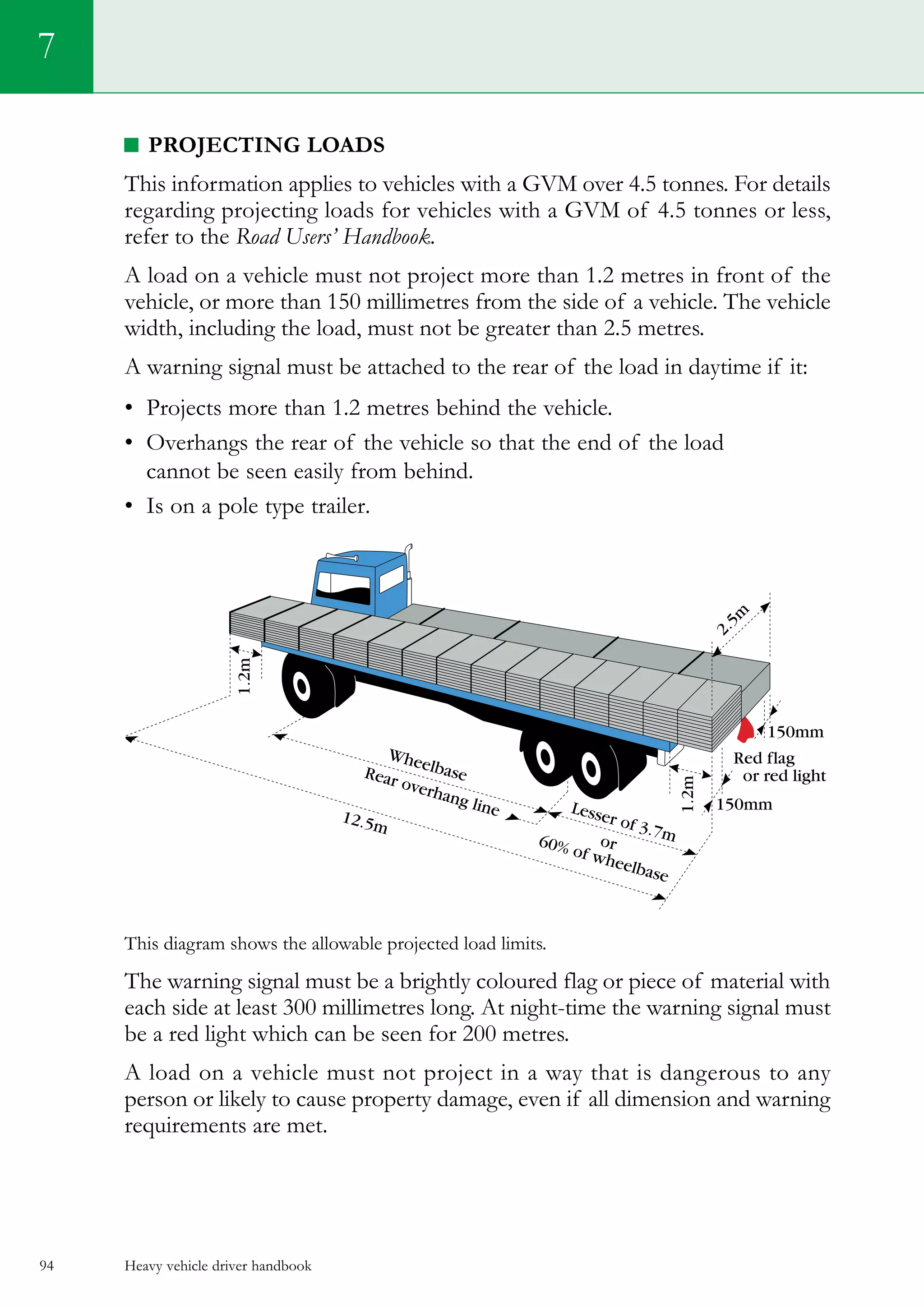
was in charge of the vehicle.
At the end of the journey:
•	 Record the date, time and place where the journey finished.
You may use the duplicate pages of the driver’s work diary to record this
information. If your monitoring device produces charts, attach the duplicate
page to the chart. Alternatively, you can record the information on the back
of the chart.
Heavy vehicle driver handbook66
5
If your monitor breaks down during a trip, you must record, either on a
chart or on a separate report:
•	 Time.
•	 Date.
•	 Place.
•	 Type of break down.
You must continue to record the items referred to in this section and the
distance travelled.
If you own a vehicle, you must ensure that:
•	 Your vehicle monitor is working correctly, is properly calibrated
and that its seals are intact.
•	 Your vehicle specifications are not altered in any way that
could affect calibration of the device.
•	 Your device is recalibrated immediately when the vehicle
specifications are altered or at least every six years.
•	 Your drivers are instructed properly in the use of the device.
•	 You recover trip records from your vehicle and store them
in continuous date order for at least six months.
•	 You make your records available at the request of an
authorised officer.
•	 You check the records for each trip and for each driver
to ensure that driving hours and speed limits have been observed.
•	 Your drivers continue to keep manual records for each journey
if the monitor breaks down.
Police checks and RMS inspections
The police can check that your vehicle monitor is fitted and working
properly. If you are ever involved in a serious crash, or if there is suspicion
of serious offences, police may need your monitor and data.
RMS inspectors make checks of monitor records by visiting vehicle depots
or by using records mailed to RMS from vehicle operators.
Company audits are conducted by RMS inspectors. They may check monitor
records by visiting vehicle depots or by using records mailed to RMS from
vehicle operators. Also see Section 8 Penalties.
Heavy vehicle driver handbook 67
5
What you should know about Heavy vehicle
road rules
After reading this section, you should know:
•	 Speed limits that apply to heavy vehicles.
•	 Rules for turning at intersections, overtaking and reversing.
•	 Restrictions that apply to heavy vehicles.
•	 Rules for stopping at bus stops.
•	 Laws relating to vehicle monitors.
•	 Guidelines on how to manage fires.  
Notes
..........................................................................................................................
..........................................................................................................................
...........................................................................................................................
..........................................................................................................................
...........................................................................................................................
..........................................................................................................................
...........................................................................................................................
..........................................................................................................................
...........................................................................................................................
Summary
Heavy vehicle driver handbook68
5
Heavy vehicles come in a variety of configurations.
It’s your responsibility to know your vehicle. Regular checks and
services are required by law, to minimise the risk of breakdown
and ensure your vehicle is roadworthy.
Roadworthiness
The driver and the owner/operator are responsible for a vehicle’s
roadworthiness. A roadworthy vehicle is a safe one that offers advantages to
both driver and operator as well as other road users. Unroadworthy vehicles
can be heavily fined, especially if they are involved in a crash.
It is very important to check your vehicle is roadworthy. Pre-departure
checks can save time and expense later on and reduce the chance of a crash
resulting from mechanical failure.
To make sure that your vehicle remains roadworthy, you should carry out
daily pre-departure checks and more ‘in depth’ weekly inspections. Refer to
the checklists in this section as a guide. This icon will help you locate
them.
BODY/CAB CONDITION
All door latches or hinges must be secure and working well. The cabin must be
sealed from engine and fuel areas.
BRAKES
AIR BRAKE OPERATION
Most heavy vehicles have full air brakes. It is important that brakes are
properly adjusted and well maintained.
When you apply the foot brake pedal you are opening a valve that allows
pressurised air to flow to the brake chambers at each wheel. Therefore
braking effectiveness depends on how far you depress the pedal, unlike a
car where the braking effectiveness depends on how hard you depress the
pedal.
It is very important to check your brakes properly and regularly, and to refer
to the manufacturer’s manual. Use the following procedure as a guide only
and get a professional to service your brakes often.
Heavy vehicle driver handbook 69
Knowing the vehicle
6
inspection of hydraulic brakes
Step 1: External check
1  Check for line damage and leaks.
2  Check wheel backing plates and brake hoses
for any signs of leaks or damage, such as
chafed hoses or pipes
3  Check around the master cylinder and
hydraulic oil reservoir for leaks. Also check
that the reservoir is full.
Step 2: System check
1  Check the feel of the brake pedal
when you apply the foot brake.
If the pedal sinks down further than usual
or if it feels spongy, there may be a leak
or air in the system.
2 Keep full pressure on the pedal – it should
continue to be hard. If the pedal starts to sink,
there may be a leak in the system.
3  Vacuum brakes – check booster retention with
full vacuum and the engine off. When you apply
the pedal it should stay down without resistance.
The vacuum must be available soon after the engine
is started with low vacuum available after 30 seconds
and normal working vacuum after 60 seconds.
4  Check that the vehicle does not pull to one side
when you brake with the vehicle moving,
off road if possible.
Heavy vehicle driver handbook70
6
inspection of air brakes
Step 1: Secure the vehicle
1  Put on the parking brake.
2 Switch off the engine.
3 Where manual valves are fitted to air tanks, drain daily.
It is illegal to discharge fluid on the ground as it can be washed down
drains and is an environmental hazard.
Step 2: Drain all air tanks
On vehicles with a dual circuit braking system, drain one system first.
Check to make sure that only one gauge indicates no pressure, then
drain the other system. If both gauges show no pressure after draining
one system, do not use the vehicle before your brakes have been
checked by a professional.
Step 3: Refill the system
1 Start engine and run at fast idle – do not race the engine.
2 Check that:
•	 Any low air pressure warning signals (if fitted)
are operating as a result of having no air in the system.
•	 The low air pressure warning signals (if fitted)
operate at about 410 kPa.
•	 The time it takes for air pressure to build up from 0 to
80 per cent of maximum pressure limit (refer to manufacturer’s
specification) is not longer than five minutes.
3 Allow maximum pressure to build up and turn off engine.
Step 4: System check
1  Chock the wheels and release the park brake.
2  Apply the foot brake fully and check the drop in air pressure
on the gauge. The drop in pressure per minute should not exceed
the following:
– Truck 20 kPa.
– Truck and trailer 30 kPa.
Heavy vehicle driver handbook 71
3  Apply the foot brake another four times, holding it down
on the fourth application. The pressure should not have fallen by
more than half normal system operating pressure.
If it has, do not use the vehicle before your brake system has been
checked by a professional.
4  Recharge air system.
Step 5: Trailer check
1 Turn the engine off.
2 Disconnect the air hoses between the hauling unit and trailer
(articulated vehicles and truck/trailer combinations). The trailer
brakes must automatically come on and remain on for at least
15 minutes. This is to check if the breakaway system is operational.
3  Check the tractor protection system of the hauling unit after air
has stopped being released from the hauling unit trailer air line
fittings. If these fittings contain self-sealing devices, hold them
open until no more air is released.
4  Check that the:
• Air pressure is in excess of 300 kPa.
• Service brakes still work.
• Spring brakes (if fitted) have not come on.
Step 6: External check
1 Re-connect air hoses.
2 Apply the park brake.
3 Walk around the vehicle and listen carefully for air leaks.
Step 7: Final check
1 Start the engine to recharge the air system.
2 Release and re-apply the park brake and walk around
the vehicle again and listen carefully for air leaks.
These ‘general checks’ do not replace the need for thorough inspections of the
systems.
6
Heavy vehicle driver handbook72
Anti-lock Braking Systems (ABS)
Many trucks have ABS, which is designed to stop wheel lock-up and improve
steering under heavy braking.
Maximum braking occurs when the wheels are just on the point of locking.
However, if a wheel does lock and skidding occurs, braking is not effective
and you may lose control of the vehicle.
For best results when using an ABS-equipped vehicle in an emergency
situation, press the brake pedal down fully and allow the ABS to regulate
braking for you. This allows you to have full steering control at the same
time as maximum braking.
If the ABS fails, the system reverts to normal brake operation.
PARKING BRAKE
When applied a parking brake must be capable of holding the vehicle
stationary on any slope up to a gradient of at least 15 degrees, or prevent it
from moving under light throttle and must function by mechanical means
such as springs.
ENGINE/EXHAUST BRAKES OR SPEED RETARDERS
These devices may be fitted to medium and large vehicles to supplement the
vehicle’s service brake system. They will not stop the vehicle completely but
may help to slow it down. They are not considered service brakes as they act
on the engine or drive train.
Three most common types are:
•	 Exhaust brake.
•	 Engine brake.
•	 Electric, magnetic or hydraulic retarder.
Applying these brakes may cause a lightly loaded vehicle to skid or jack-knife
on slippery roads.
Auxiliary brakes are generally noisier than the service brake. Try to reduce
brake noise in urban areas by limiting the use of Auxiliary brakes.
6
Heavy vehicle driver handbook 73
6
COUPLINGS
Prime mover/semi-trailers – Turntable mountings and other tow couplings
must be secure and comply with Australian Standards for installation.
Other vehicles – All towbar, coupling and drawbar components must be in
good working condition. Steps on performing uncoupling and coupling are
covered at the end of this section.
DRIVING CONTROLS
All controls should function correctly and be regularly checked and
maintained.
ELECTRICAL SYSTEM
Electrical wiring and connections, both inside and outside the vehicle, must
be secure, damage-free and not exposed to excessive heat.
ENGINE
When running above idle speed, the engine must not discharge excessive
crankcase fumes. See Smoke from engines in section 8.
EXHAUST SYSTEM
The exhaust system must not have leaks due to damage, looseness or poor
maintenance.
The exhaust system must not be too noisy. See Noise pollution in section 8.
fuel SYSTEM
The fuel tank and lines must be secure and not leak. The fuel tank cap must
be properly fitted.
LPG fuelled vehicles must be fitted with an AUTOGAS plate near the LPG
fuel tank and display the appropriate plates or stickers on the front and rear
number plates.
Compressed Natural Gas (CNG) is an alternative fuel commonly used
in NSW in buses. CNG vehicle must display the appropriate plates or
stickers, be fitted with a compliance plate and also be fitted with a refuelling
information plate near the filler connection. CNG cylinders need to be
periodically inspected.
Heavy vehicle driver handbook74
LPG and CNG retroreflective identification labels must be in the shape of a square and
mounted diamond-wise.
Example of a LPG Compliance plate.
GEAR BOXES
Heavy vehicles greater than 4.5 tonnes GVM must use low gear on roads
where a sign displays TRUCKS  BUSES MUST
USE LOW GEAR. The gear chosen by the driver
must be able to control the speed of the vehicle
without use of the brakes.
There are three types of gear boxes.
NON-SYNCHROMESH GEAR BOX
(CONSTANT MESH)
In this type of gear box, the matching of engine and
road speeds depends entirely on your judgement and skill as there are no
synchronisers in the gear box to help you. Double-declutching is essential
while you are learning to use this type of gear box. A non-synchromesh gear
box may commonly be known as a crash or constant mesh gear box.
6
LPG CNG
Heavy vehicle driver handbook 75
6
SYNCHROMESH GEAR BOX
This type of gear box works in much the same manner as those in most
modern cars. They are easy to use, as the synchronising of the gears is done
by the gear box. Be aware that damage can be caused by forcing gear changes
before the engine and road speeds are matched.
AUTOMATIC GEAR BOX
These work in much the same manner as in modern automatic cars.
Double-declutching
Double-declutching means to change gear, by moving the gear lever first into
neutral and then into the desired gear, releasing the clutch pedal between
each movement. You should learn this technique from someone who is
experienced with the practice.
Double-declutching is not recommended for synchromesh gear boxes as it
may cause long term damage.
LIGHTS AND INDICATORS
All lights, and reflectors must work properly and their lenses must not be
damaged. All rearward facing lights except reversing and indicator lights
must be red.
warning LIGHTS
Parking brake and brake failure warning lights, where fitted, must work.
FLASHING LIGHTS
Flashing warning lights must be visible in normal daylight from a distance of
200 metres to drivers approaching from any direction. A flashing light can
be distracting to the driver so must not be directly visible from the normal
driving position of the vehicle to which it is fitted.
A flashing light displayed on a vehicle may only be amber/yellow, blue green
or magenta/crimson. Each of these colours or combination of colours is
intended to convey a specific warning to road users. Their use is limited to
particular types of vehicles and in particular circumstances.
An amber/yellow flashing light warns road users of an obstruction to the
free flow of traffic and can be used by public utility vehicles, tow trucks,
motor breakdown service trucks and street vending vans.
Heavy vehicle driver handbook76
6
Blue or blue and red flashing lights may only be fitted to police vehicles,
ambulances, operational fire brigade and accredited bush fire brigade
vehicles or a vehicle used by a traffic commander or a traffic emergency
patroller appointed or employed by RMS.
A red flashing light warns road users of the presence of an emergency
service vehicle associated with a risk-to-life situation. They may only be fitted
to ambulances, operational fire brigade and accredited bush fire brigade,
mine rescue vehicles, State Rescue Board (SRB) accredited rescue vehicles,
State Emergency Services (SES) vehicles and Red Cross vehicles for urgent
blood deliveries.
A green flashing light warns road users of the presence of a stationary
operational fire brigade, accredited bush fire brigade, ambulance or police
emergency site command vehicle. Green flashing lights may not be fitted
to any other type of vehicle and should not be operated on an approved
vehicle while it is in motion.
A magenta/crimson flashing light warns road users of the presence of an
RMS enforcement vehicle or a vehicle driven by a local council officer while
engaged in monitoring or measuring the weight of heavy vehicles.
REAR MARKING PLATES
All motor vehicles with a GVM exceeding 12 tonnes and trailers with a GTM
over 10 tonnes must be fitted with retroreflective marking plates at the rear
of the vehicle. Smaller trucks may have rear marking plates fitted too.
Prime mover and semi-trailer combinations must display rear marking plates
at the rear of the semi-trailer.
Rear marking plates may also display DO NOT OVERTAKE TURNING
Heavy vehicle driver handbook 77
6
VEHICLE in black letters 50 millimetres high as shown if the vehicle
exceeds 7.5 metres in length. See section 5 Heavy vehicle road rules for
details. Only use plates with approved retroreflective material. Do not
modify or use alternative plates except those described previously.
Keep the plates clean and in good condition. Plates must not be covered or
obscured by any vehicle equipment or load.
When a hauling unit vehicle is rated with a GCM exceeding 12 tonnes or the
sum of the laden mass of the trailer and hauling unit exceeds 12 tonnes, rear
marking plates must be fitted to the rearmost trailer being towed.
Rear marking plate rules do not apply to route buses used only in urban
areas.
The marking plate shown below may be an acceptable alternative, if the
first option is not practicable, provided it meets specific dimensions and
locations. For further information refer to Vehicle Standards Information
No:13 – Rear Marking Plates for Heavy Vehicles.
Typical fitting of alternative style class 2 plate (type 1).
RUST AND CORROSION
Any structure, chassis, frame etc must not have advanced rust. Any panel
separating the driver or passenger from fuel or engine fumes must not have
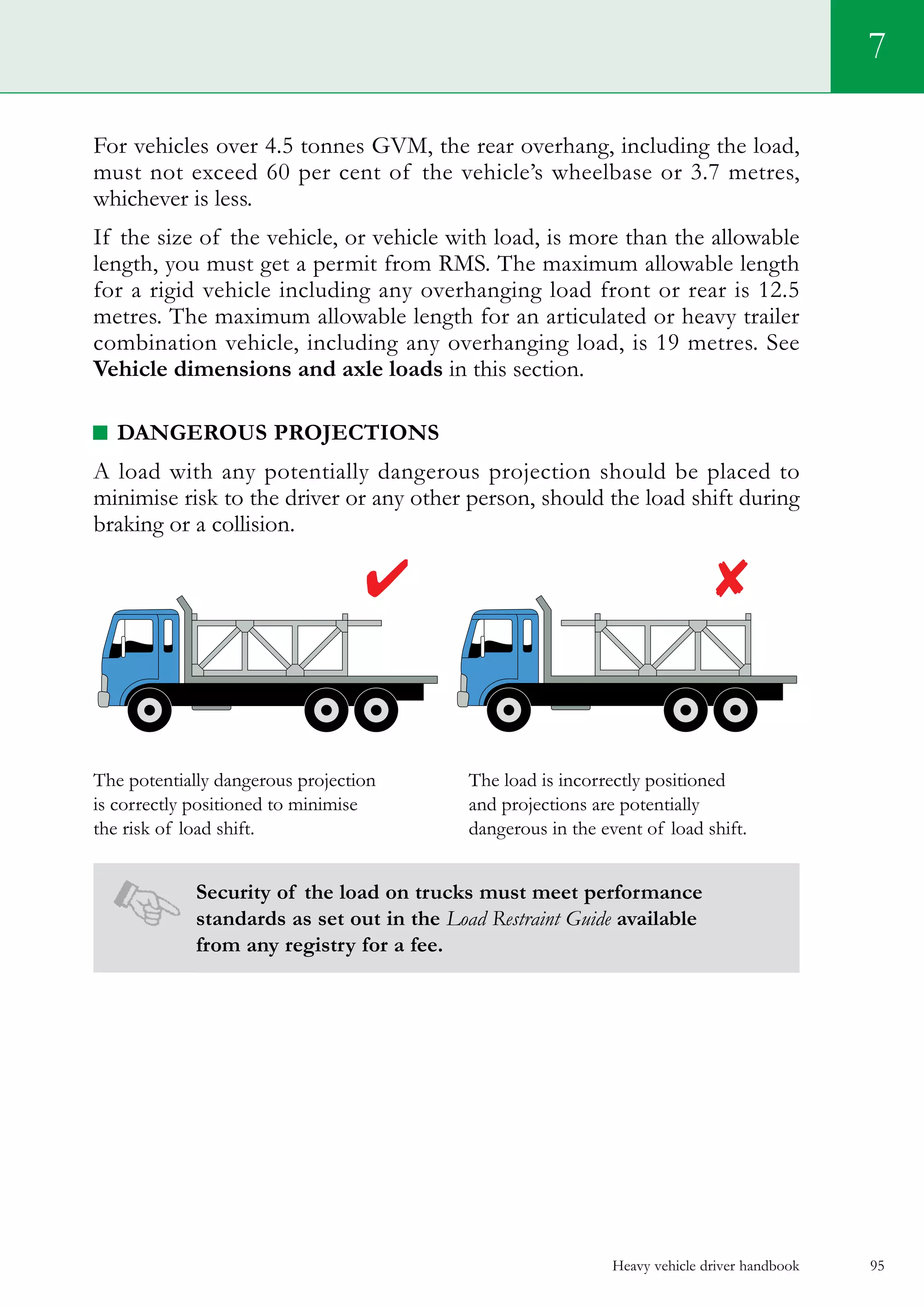
advanced rust – that is rust which would cause the metal to collapse in a
crash.
Heavy vehicle driver handbook78
6
SEATS AND SEATBELTS
Seat frames or mountings must be structurally sound with all seatbelts
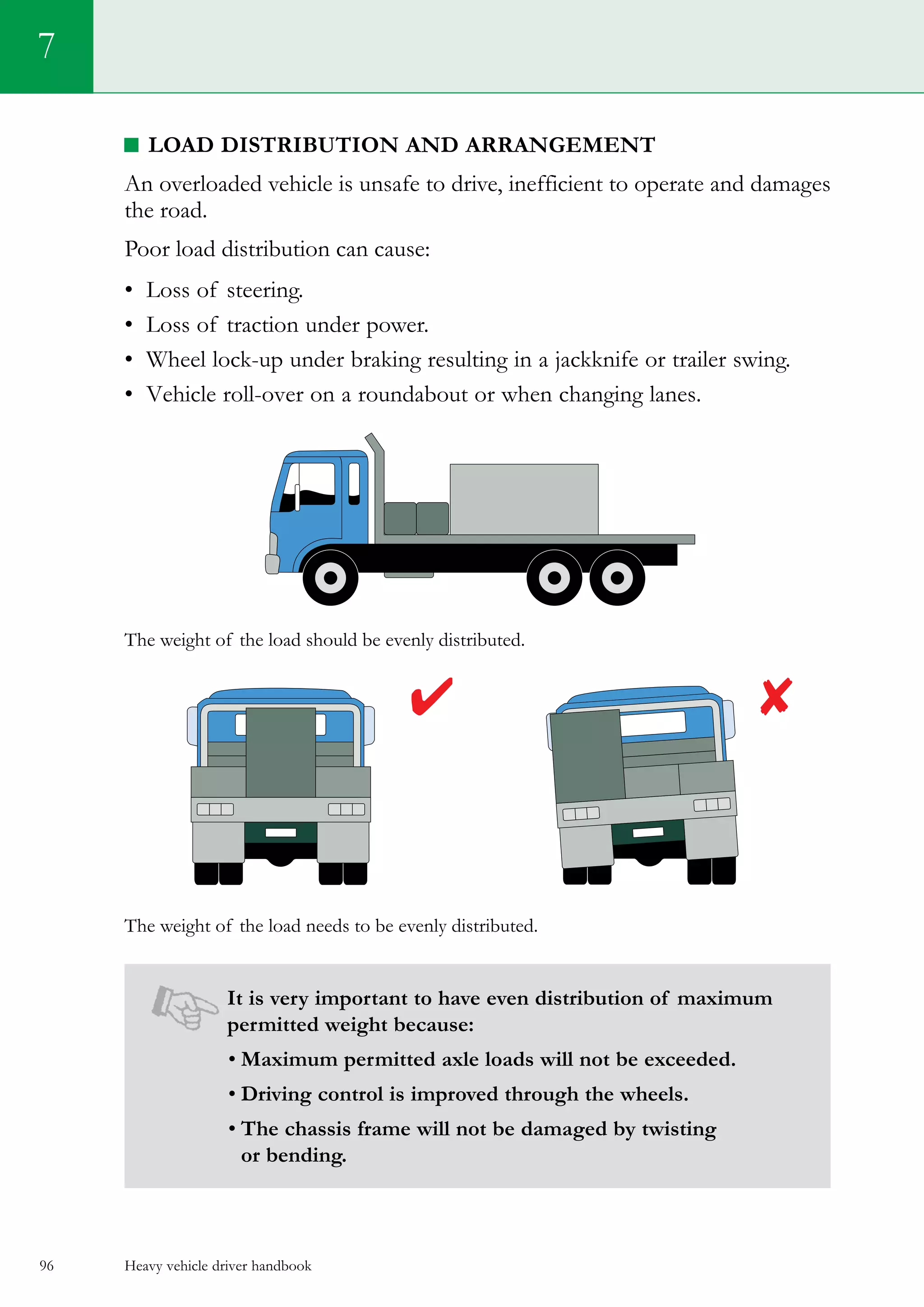
undamaged and working properly.
STEERING
The steering wheel must be undamaged and firmly attached to the steering
column. All steering components must be secure, undamaged and not have
excessive free play.
STRUCTURE
Any structure, chassis, frame etc must not be distorted, cracked or
damaged.
SUSPENSION
Suspension springs must not sag or be modified and all suspension
components must be aligned and undamaged.
WHEELS AND TYRES
All wheels must be properly attached to the vehicle with the right number
and type of nuts and studs and wheel rims must not be cracked or bent.
All tyres must have at least 1.5 millimetres tread depth over 75 per cent of
tyre surfaces which normally contact the road. All tyres must have correct air
pressure. Manufacturer’s recommendations are a good guide.
Regrooved tyres are acceptable provided such tyres (or retreads) are marked
by their manufacturers as being suitable for regrooving. This only applies to
heavy vehicles. Regrooved tyres must be retreaded to meet the requirements
of an appropriate version of Australian Standards AS 1973.
WINDSCREEN AND WINDOWS
The windscreen directly in front of the driver or in the path of the windscreen
wipers must not be cracked, scored or chipped.
Wiper blades, windscreen washers and demisters must be fitted and work
well.
Heavy vehicle driver handbook 79
6
Engine Compartment
Engine oil level......................................................................................................
Engine coolant level.............................................................................................
Clutch fluid level...................................................................................................
Brake fluid level.....................................................................................................
Power steering fluid level.....................................................................................
Screen washer fluid level......................................................................................
Ancillary drive belts..............................................................................................
Electrical
Headlights: high and low beam.............................................................................
Driving and fog lights..........................................................................................
Park lights...............................................................................................................
Indicators: left and right......................................................................................
Clearance lights......................................................................................................
Tail lights and plate light......................................................................................
Brake lights.............................................................................................................
Hazard lights..........................................................................................................
School warning lights...........................................................................................
                                                                                               Continued over the page
Pre-departure checks
All drivers are legally responsible for the safety and
roadworthiness of the vehicles they drive. Before driving any
vehicle you must ensure it is safe and roadworthy.
PRE-DEPARTURE SAFETY CHECKS
It is very important to check your vehicle before you drive, particularly items
that have been reported defective. These checks can save time and expense
later on, reducing the chance of component failure and subsequent loss of
vehicle control, which may result in an accident.
These inspections should be conducted prior to shift start (no matter what
the time of day) and always following the manufacturer’s recommendations.
The areas you need to cover are listed in this section.
Heavy vehicle driver handbook80
Vehicle posture, leaks and load
Vehicle posture.......................................................................................................
Fluid leaks...............................................................................................................
Load properly secured (trucks)................................................................................
Coupling
Air hoses and cables...............................................................................................
Security....................................................................................................................
Vehicle body
Body damage..........................................................................................................
Mud flap(s) and guards – front and rear..............................................................
Cabin entry grab handles.........................................................................................
Door operation and locks......................................................................................
Windows – operation and damage.......................................................................
Bus rear window – Emergency Exit .......................................................................
Cargo and luggage doors (if available).................................................................
Mirror(s) – lens and security..................................................................................
Plates and signs........................................................................................................
Fuel tanks................................................................................................................
Air tanks..................................................................................................................
Toolbox(es)..............................................................................................................
Other.......................................................................................................................
Brakes
Foot and hand controls correctly adjusted and not worn..................................
Hydraulic brakes
Brake fluid reservoirs must be full........................................................................
Hoses, pipes and cylinders leak free.....................................................................
Rigid pipes bracketed, free of rust and have grommets
when passing through chassis frames......................................................................
Air brakes
Compressors, drive belts, exhausters and reservoirs
securely mounted and undamaged........................................................................
Brake air lines, hoses, valve drain cocks and plugs secure,
functional and leak-free............................................................................................
6
Heavy vehicle driver handbook 81
6
Wheels and Tyres
Rims (dents in flanges, loose lugs and nuts, rust trails,
cracks in rim assembly)..........................................................................................
Tyres (tread minimum legal depth of 1.5 millimetres)........................................
Tyre inflation correct................................................................................................
Tyre cuts, damage, dual tyres touching, rocks lodged
between duals..........................................................................................................
Spare wheel(s)/tyre(s).............................................................................................
Generally
Registration label(s) current and attached................................................................
Windscreen wipers.................................................................................................
Warning triangles....................................................................................................
Fire extinguishers.....................................................................................................
Other.........................................................................................................................
.................................................................................................................................
DEALING WITH PROBLEMS
If the vehicle you are driving has a maintenance or mechanical problem, you
must make a written report on a form supplied by the owner.
Keep a record of all repairs and check that the fault has been fixed. Take it
back to the repairer if the problem persists.
DEFECT REPORTING
If the vehicle you are driving has a maintenance or mechanical problem,
inform the owner of all symptoms in a written report.
Heavy vehicle driver handbook82
6
Uncoupling and coupling
Uncoupling and coupling a prime mover and semitrailer is a task
which can lead to serious accidents, injury and vehicle damage.
Follow these steps to perform the task correctly.
Uncoupling a semi-trailer
Step 1: Secure the vehicle
1 Before uncoupling:
•	 Make sure your semi-trailer is parked on a level area.
•	 Ensure the vehicle is on a surface firm enough
to support the trailer landing gear and its load.
•	 Make sure the prime mover and semi-trailer
are in a straight line.
2 You will then need to:
•	 Apply the parking brakes and tractor/trailer protection valve.
•	 Ensure trailer security by giving it a ‘tug test’ with the prime mover
to see if the trailer moves or by chocking the trailer wheels.
Always use chocks when you have to park a semi-trailer
on a grade. It is best to chock the semi-trailer’s front axle
in case the landing legs  collapse and the rear axle(s) lifts.
When you uncouple on soft ground, put suitably strong timber
or other flat supports under the landing gear.
Large pressure drops during a static brake check may indicate
that there is a problem. Always have this checked.  
Step 2: Trailer check
1 Lower the landing gear ensuring firm and even contact
with the ground.
2  Raise the trailer until a gap is visible at the fifth wheel (turntable).
3 Secure the landing gear handle.
Heavy vehicle driver handbook 83
6
Step 3: Uncoupling the trailer
1  Release the turntable jaws. If the release handle cannot be moved,
the jaws may be under load.
2 Take the pressure off by gently rocking the prime mover
forward and back and then try to release again.
3  Move forward slowly. Release the prime mover parking brake
and slowly drive forward in a straight line until the fifth wheel
is just clear of the trailer skid plate, making sure the trailer stays put,
using the trailer brakes if necessary.
4  Apply prime mover park brake.
Step 4: Final check
1 Disconnect the air hoses and electrical cables from the trailer.
2 Stow hoses and cables properly on the prime mover making sure
that the connectors are kept free of dust and water, and that they
cannot get caught on the tail shaft.
3  Drive away slowly. Ensure the driver’s door is closed
whenever the vehicle is moving.
Heavy vehicle driver handbook84
6
coupling a semi-trailer
Step 1: Position the vehicle
1 Reverse the prime mover into position, lined up straight in front of the trailer,
stopping the prime mover with the skid plate just touching the trailer.
2  Apply the parking brake.    
Step 2: Trailer check
1  Check the trailer skid plate, kingpin, turntable jaws, airlines, leads and
connections for damage.
2 Make sure the turntable jaws are open.
3 If the trailer:
•	 Has a block welded to the skid plate about 30 cm behind the kingpin, make
sure the top of the turntable is the type which turns and is unlocked.
•	 Is without the block the turntable will need to be locked in position.
Make sure the top of the turntable is well greased when it is used in
the locked position.
Step 3: Secure the trailer
1  Ensure trailer is secure. Place chocks behind at least one wheel. If the trailer is
equipped with spring brakes, the trailer brakes should already be on.
2  Check that the turntable and kingpin are lined up and that the prime
mover will clear the trailer.
3  Check and adjust the height of the skid plate to the turntable. The height
of the trailer skid plate should be slightly lower than the centre of the
turntable. About five centimetres is ideal.
If the trailer is too low, the prime mover chassis or edge of the turntable
can hit the trailer front instead of going under.
On a trailer that is too high, the turntable may not properly latch on
to the kingpin, or the turntable could even pass beneath the kingpin,
allowing the prime mover cab to hit the trailer.
Step 4: Trailer check
1  Connect air hoses and electrical cables (do not forget to twist lock ring
on bayonet fittings)
2  Set tractor protection valve (if fitted) to normal.
3  Apply the trailer brake.
4  Check brake air pressure.
Heavy vehicle driver handbook 85
6
Step 5: Coupling the trailer
1  Reverse the prime mover slowly under the trailer until the turntable jaws
lock around the kingpin.
You should hear the jaws close and lock into place.
2  Raise landing gear just clear of the ground.
3  Perform a ‘tug test’ to check the trailer is locked on by trying to move off
in first gear with the trailer brakes on.
The prime mover should not move.
4  Repeat this check to be absolutely sure.
5  Check that the coupling release lever is in the locked position and there
is no gap between the turntable and the trailer skid plate.
A visible gap between the turntable and the trailer skid plate may mean
the trailer is set too high.
Try lowering the trailer on the landing gear slightly and the gap should
close but if it does not check for any problems.
6  Check that the turntable jaws are closed correctly and have locked on to
the kingpin.
Make sure that the head of the pin is not sitting on top of the jaws.
7 Fully raise the landing gear and stow the handle.
Check that there is enough clearance for normal movement between the
prime mover (frame and wheels) and the trailer frame.
Check also that there is enough clearance between the landing gear and
the back of the truck frame to allow for turning.
Step 6: Final check
1  Run the engine until the air pressure has reached its maximum in the air
tanks.
2  Switch off the engine, apply the parking brakes, and turn on the hazard
warning lights, side and tail lights.
3  Perform an inspection by walking around the truck and trailer listening
for air leaks, and checking all trailer lights are operational.
4 Remove and stow wheel chocks.
5  Allow time for air ride systems to prime before moving off as substantial
damage may occur if not in the full ride position – this may take time
with some combinations eg B-double.
Heavy vehicle driver handbook86
6
Uncoupling a truck and trailer
Step 1: Secure the vehicle
1 Before uncoupling:
•	 Make sure your truck and trailer are parked on a level area.
•	 Ensure they are on a surface firm enough to support the trailer
drawbar support leg if fitted.
•	 Make sure the truck and trailer are in a straight line.
Step 2: Trailer check
1  Apply park brake and truck/trailer protection valve.
2  Ensure trailer security by ‘tug test’ or chocking wheels.
Step 3: Uncoupling the trailer
1 Lower drawbar support leg.
2 Disconnect and secure all hoses and cables.
3  Release towing connection.
4 Drive slowly forward.
5  Check mirrors to confirm disconnection.
Heavy vehicle driver handbook 87
6
coupling a truck and trailer
Note: These procedures may need to be varied.
Step 1: External check according to actual vehicle configuration
and manufacturer’s recommendations
1  Check coupling assembly including guide flange, towing
and locking pins, and connections.
2 Check pin is in the coupling position.   
Step 2: Secure the trailer
1  Placing chocks behind at least one wheel or if the trailer
is equipped with spring brakes, the trailer brakes should
already be on.
Step 3: Coupling the trailer
1  Reverse truck close to, but not touching, draw bar.
2  Check height and alignment of eye ring to coupling assembly, adjusting
if necessary.
3  Reverse truck slowly until the towing system is locked
or in position to be connected.
4  Perform a ‘tug test’.
5 Look to check the connection.
6  Connect air hoses and cables.
7  Raise drawbar support leg and stow (if fitted).
Step 4: Final checks
1  Check brake air pressure.
2 Switch off engine and inspect by listening for airleaks,
stowing chocks and checking all trailer lights are operational.
3  Remove and stow wheel chocks.
Heavy vehicle driver handbook88
6
Summary
What you should know about maintenance
After reading this section, you should know:
•	 How to conduct a pre-departure check.
•	 What to do should you become aware of a mechanical
or maintenance problem.
•	 How to inspect and check brakes and air pressure.
•	 How to couple and uncouple a trailer.  
Notes
..........................................................................................................................
...........................................................................................................................
..........................................................................................................................
...........................................................................................................................
..........................................................................................................................
...........................................................................................................................
..........................................................................................................................
...........................................................................................................................
..........................................................................................................................
...........................................................................................................................
..........................................................................................................................
...........................................................................................................................
..........................................................................................................................
...........................................................................................................................
...........................................................................................................................
Heavy vehicle driver handbook 89
7
Vehicle dimensions and loading
It is the responsibility of the driver to ensure the vehicle does not
exceed dimension or mass limits and that the load is appropriately
restrained.
Load shift
When moving, a vehicle’s load can shift from forces caused by changes of
speed, braking, accelerating, cornering, travelling over uneven road surfaces,
and slopes. Load shift needs to be managed to prevent danger to any person
or damage to any property.
How to carry a load safely
To carry a load safely and prevent danger to any person, or damage any
property you must:
•	 Choose a suitable vehicle.
•	 Position the load correctly.
•	 Use suitable and adequate restraint equipment.
•	 Use appropriate driving methods.
Vehicle dimensions
Maximum heights
•	 Double deck bus 4.4 metres.
•	 All other vehicles 4.3 metres.
Certain types of commercial vehicles, and vehicles carrying specified
commodities, may operate to a maximum 4.6 metres high. These vehicles are
only permitted on specified routes and are subject to conditions, as defined
by the 4.6 Metre High Vehicle Route Notice 2008, made under the Road Transport
(Mass, Loading and Access) Regulation 2005. A copy of this notice must be carried
in the vehicle when operating under this regulation.
Maximum widths
The maximum width limit for all vehicles is 2.5 metres. When you measure
the width do not include external rear vision mirrors, signalling devices and
tyre pressure monitors.
For more information on maximum axle loads, including maximum allowable
axle weights with ‘super single’ (wide profile) tyres, get the brochure Heavy
Vehicle Mass, Loading and Access from any registry.
Heavy vehicle driver handbook90
7
The right vehicle
To carry a load safely you must make sure the size of the load space and the
condition of the platform are suitable for the job you want to do.
Vehicles carrying:
•	 Long loads should be long enough to avoid excessive overhang
and ensure good weight distribution for vehicle stability.
•	 Liquids and loose bulk material must be designed to completely
contain the load and to minimise the effect of load movement.
To carry a load safely you must make sure the size of the load space and the
condition of the platform are suitable for the job you want to do.
Oversize vehicles including B Triples and AB Triples require
a permit to travel in NSW. Contact the Special Permits Unit
on 1300 656 371 for details.
Contained loads
Tipper bodies are best to contain loose loads such as bush rock, sand, gravel
etc. The most suitable vehicles for these loads have solid sides and tailgates
such as tippers. The solid sides prevent the load from spilling. Sheets or
tarpaulins should be used to cover loose loads to prevent them from being
blown out of the truck. Liquid loads or ‘fine powder loads’ such as cement
powder, flour etc are best contained in tankers.
A correctly contained loose load.	 Loose loads need to be safely 	 	
	 restrained as shown on the left.
Heavy vehicle driver handbook 91
7
Heavy loads
A long, heavy load can also make your vehicle difficult to handle. You can
overcome this by using the right vehicle for the job.
An incorrectly loaded heavy load can take weight from the front wheels
and make steering difficult. On rough roads, the truck may pivot on its rear
wheels, lifting the front wheels entirely off the road.
The load weight is well positioned 	 The load is dangerously positioned.
and evenly distributed.
High loads
These or loads with a high centre
of gravity. It may even tip over
when cornering. High loads should
be carried on vehicles with a low
platform whenever possible such as
a drop frame trailer or low loader.
The overall height of a loaded vehicle must be checked to make sure that it
clears any overhead bridge or other obstruction on your route. It must not
exceed 4.3 metres in height unless you have a special permit.
The load weight is well positioned 	 The load is dangerously positioned
and evenly distributed.	 with the centre of gravity too high.
Low clearance sign indicating clearance
height
Heavy vehicle driver handbook92
Tankers
Bulk liquid loads should be carried in tankers and have the same problems
of weight distribution as other loads as well as the special problems of
a fluid load.
Avoid swerving and slow down before any curve or corner.
The tank is divided into compartments which are filled separately.
Be aware that difficulties can be caused by the partial filling of
compartments. A part-filled compartment allows the liquid to move
from side to side (cornering) and rear to front (braking). The shift of the
cargo’s centre of gravity is a safety concern because it makes the vehicle
easier to rollover. Try to empty one compartment completely before you
start to empty another one.
Always empty the centre compartments first and work outwards to keep
weight evenly balanced over the front and rear axles of the vehicle.
There is still some space left when the compartment registers full – this
reduces spillage and allows for expansion of the fluid.
This small space also allows the fluid to move but much less than if
the compartment has been partly emptied. Even minor movements are
sometimes enough to make your vehicle unstable and perhaps cause a
rollover.
7
Heavy vehicle driver handbook 93
7
Loading
Restrictions on the mass and loading of vehicles and vehicle combinations
have been set by the Road Transport (Mass Loading and Access) Regulation 2005
and apply to any vehicle with a GVM of more than 4.5 tonnes or any vehicle
combination with a GCM of more than 4.5 tonnes.
The limits on the mass or weight of your vehicle (including the load) are
set to reduce wear on roads and bridges, and to increase safety. Vehicle
manufacturers set gross mass (GVM/GCM) limits for each vehicle
model.
A vehicle must not be operated at a mass limit that will exceed the:
•	 Manufacturer’s GVM/GCM.    
•	 Manufacturer’s individual component rating
(ie axles, springs, tyres etc).  
•	 Statutory mass limits or overall axle spacings.
It is the operator’s responsibility to make sure these limits are not
exceeded.
Part of your vehicle registration fee covers the cost of road wear and
maintenance. National charges are calculated using the vehicle type,
the GVM on the compliance plate, number of axles and the nominated
configuration (usage) of the vehicle (the penalty for overloading a vehicle
may exceed $2200 for an individual and $11,000 for a corporation).
The cost of overloading
Millions of dollars are spent every year to repair damaged
roads and bridges. This is not covered by registration fees, and
overloading fines as they only recover a small part of this cost.
Even a little overloading causes a lot of damage to roads and
bridges, which everyone must pay for. It is very important for
the future of NSW roads and the heavy vehicle industry that
you do not overload your vehicle.
Heavy vehicle driver handbook94
7
Projecting loads
This information applies to vehicles with a GVM over 4.5 tonnes. For details
regarding projecting loads for vehicles with a GVM of 4.5 tonnes or less,
refer to the Road Users’ Handbook.
A load on a vehicle must not project more than 1.2 metres in front of the
vehicle, or more than 150 millimetres from the side of a vehicle. The vehicle
width, including the load, must not be greater than 2.5 metres.
A warning signal must be attached to the rear of the load in daytime if it:
•	 Projects more than 1.2 metres behind the vehicle.
•	 Overhangs the rear of the vehicle so that the end of the load
cannot be seen easily from behind.
•	 Is on a pole type trailer.  
This diagram shows the allowable projected load limits.
The warning signal must be a brightly coloured flag or piece of material with
each side at least 300 millimetres long. At night-time the warning signal must
be a red light which can be seen for 200 metres.
A load on a vehicle must not project in a way that is dangerous to any
person or likely to cause property damage, even if all dimension and warning
requirements are met.
Heavy vehicle driver handbook 95
7
For vehicles over 4.5 tonnes GVM, the rear overhang, including the load,
must not exceed 60 per cent of the vehicle’s wheelbase or 3.7 metres,
whichever is less.
If the size of the vehicle, or vehicle with load, is more than the allowable
length, you must get a permit from RMS. The maximum allowable length
for a rigid vehicle including any overhanging load front or rear is 12.5
metres. The maximum allowable length for an articulated or heavy trailer
combination vehicle, including any overhanging load, is 19 metres. See
Vehicle dimensions and axle loads in this section.
Dangerous projections
A load with any potentially dangerous projection should be placed to
minimise risk to the driver or any other person, should the load shift during
braking or a collision.
The potentially dangerous projection	 The load is incorrectly positioned
is correctly positioned to minimise	 and projections are potentially
the risk of load shift.	 dangerous in the event of load shift.
Security of the load on trucks must meet performance
standards as set out in the Load Restraint Guide available
from any registry for a fee.
Heavy vehicle driver handbook96
7
Load distribution and arrangement
An overloaded vehicle is unsafe to drive, inefficient to operate and damages
the road.
Poor load distribution can cause:
•	 Loss of steering.
•	 Loss of traction under power.
•	 Wheel lock-up under braking resulting in a jackknife or trailer swing.
•	 Vehicle roll-over on a roundabout or when changing lanes.
The weight of the load should be evenly distributed.
The weight of the load needs to be evenly distributed.
It is very important to have even distribution of maximum
permitted weight because:
• Maximum permitted axle loads will not be exceeded.
• Driving control is improved through the wheels.
• The chassis frame will not be damaged by twisting
or bending.
Heavy vehicle driver handbook 97
7
Positioning the load
For stability, the load should be spread close to the centre line of the vehicle.
You should stack the heavier things at the bottom. Loading a heavy item on
one side may result in twisting and stress on the chassis frame, or overloading
of axle housings, wheel bearings and tyres. This could be bad enough to:
•	 Allow the brakes to lock on the wheels on the lighter side.
•	 Cause flat spots on the tyres.
•	 Skid on a wet surface.
Problems may occur in a rigid vehicle, when a very heavy small load is placed
against the headboard. This could cause:
•	 The chassis frame to bend, perhaps permanently.
•	 Overloading in the front tyres.
•	 Irregular tyre wear or even a blowout.
Avoid these problems by placing any small heavy load just ahead of the rear
axle.
If you need to place a load back from the headboard to distribute weight,
the load should be blocked so that it cannot move forward. Unless it is
blocked, even the heaviest load will move forward if you stop suddenly.
Securing the load
The following information is a guide only. Detailed information on securing
your load is available in the Load Restraint Guide.
The way your vehicle is loaded is very important for your safety and for the
safety of others. You are legally responsible for your load and any damage
or injury it may cause.
Driving over bumps in the road, around curves and corners, and accelerating
and braking can cause your load to move. The force of an impact can move
a load that is unstable or not properly secured and you can lose control of
your vehicle.
The weight of your load should also be evenly distributed so you can control
your vehicle properly.
Heavy vehicle driver handbook98
7
Load restraints
A load restraint system on a vehicle should be capable of restraining the
following percentages of the weight of the load from shifting:
•	 20 per cent upward.
•	 80 per cent forward.
•	 50 per cent rearward.
•	 50 per cent sideways.
20% upwards and 80% forward.
50% rearward and sideways.
Loads must be secured to prevent:
•	 Any part of the load hanging over or sticking out of the vehicle in a way
which could hurt someone, damage property or cause a hazard to other road
users.
•	 Any part of the load being dislodged or falling out of the vehicle.
Heavy vehicle driver handbook 99
7
It is against the law to drive a vehicle where the load is not secured. You can
stop your load from moving by:
•	 Lashings secured to the vehicle chassis, including:
	 – Cross bearers.
	 – Outriggers.
	 – Tie rails and similar arrangements.
•	 Blocking arrangements such as:
– Load racks.
– Headboards.
– Bulkheads.
– Stakes in pockets.
– Transverse beams.
– Shoring bars.
– Chocks, dunnage, etc.    
•	 Containing the load by using a truck with solid sides and tailgate, a tank-
er or a shipping container.
•	 Covering loose loads such as sand or gravel with sheets or tarpaulins.
Blocking
The most important part of the blocking is the headboard or bulkhead. It is
best to put most loads right against the headboard to prevent the load acting
like a battering ram if it moves forward. If other restraints fail in a sudden
stop, the load might break the headboard. This could damage the cabin and
leave you severely injured.
The headboard and extra blocking can	 The load is not secured and could shift.
be used to stop load shift.
The load is correctly blocked against
the headboard.
Heavy vehicle driver handbook100
7
Many vehicles carry loads that could crush the driver’s cab if the load shifted
forward under sudden braking. If you carry loads such as coils, sheet steel,
steel pipes, structural steel and timber, you should have a solidly constructed
bulkhead instead of a normal headboard.
When carrying a load of metal bars, it is particularly important to ensure
that all bars are secured and unable to move out of the stack. One bar that
moves could go through the bulkhead.
Stakes in pockets
These or stanchions may be used in conjunction with lashings to prevent
long rigid loads such as pipes, logs etc from moving sideways.
Stakes or stanchions should be used to prevent sideways movement.
crowned loads
It is important that long rigid loads such as pipes, logs etc be crowned to
ensure the load is lashed securely without ‘gaps’. Gaps in the load may allow
it to move and cause the lashings to become loose.
To restrain movement in loads	 The gaps in this load can cause
such as pipes, they need to be crowned	 potentially dangerous load shift.
and have no gaps.
Heavy vehicle driver handbook 101
7
Divided crowned loads
In some cases it may be necessary to divide the load into two or more stacks
to crown it effectively. This can be achieved by attaching the lashings along
the middle of the deck.
A load that is divided to minimise the 	 A load with substantial gaps that would
chance of movement.	 allow potentially dangerous movement.
Dunnage
This is packing placed under or between parts of the load. It is used to allow
loading and unloading with forklifts or lifting slings. It is usually made of
rectangular or square hardwood or softwood and must be strong enough to
support the weight of the load placed upon it.
A load with multiple layers or rows must have all dunnage placed directly
above the bottom dunnage. Tie-down lashings must only be placed at
these positions along the load to ensure that the lashings do not loosen or
overtighten if the vehicle chassis flexes.
Long rigid loads such as large diameter steel pipes must be supported in two
positions to allow the vehicle to flex. Additional dunnage (and lashings) will need to
be used along the lengths of more flexible loads such as plastic pipes etc.
Dunnage needs to be vertically aligned to	 The dunnage is placed irregularly and
minimise movement when under lashings.	 could loosen or overtighten lashings
	 when the vehicle is operating.
Heavy vehicle driver handbook102
7
Gates/fencing
A load can also be secured with sidegates, tailgates and other blocks. The
sidegates have to be strong enough not to be forced out by the weight of
the load. Other blocks should be secured and braced. You should close and
lock the tailgate of your vehicle unless the load is too long. Never carry any
separate part of the load on the tailgate.
Where small pipes or logs are carried, suitable sidegates or other containment
methods should be used to prevent sideways movement.
A load secured from sideways	 A load not secured from
movement by gates and fencing.	 sideways movement.
Containers
Vehicles used to carry containers must be equipped with special devices
known as ‘twist locks’. Containers have special corner-pieces which fit into
the twist-locks on the vehicle. They can then be locked into place. Sometimes
frames with twist-locks can be attached to the vehicle. These frames need to
be securely bolted to the chassis.
A container is not properly secured unless the twist-locks are used. This
applies whether the container is full or empty. A vehicle without twistlocks
should not be used to carry containers. Decommissioned containers (those
not carrying a load) can be chained to a vehicle for transport.
A twist lock used to secure a container.
Heavy vehicle driver handbook 103
7
Lashings
These and other fastening devices such as
dogchains, cables, clamps, load binders must
be in good condition. A chain is not good
enough if even one link is deeply gouged,
pitted or worn. Make sure the lashings are
tight enough to stop any movement. Make
sure the type of lashing you use is strong
enough to fasten in place.
The lashings should be protected from any
sharp edges on the load or on the vehicle.
When using more than one lashing, secure
them separately so if one line fails the others
will hold.
Ropes
Ropes used for lashing loads
should be tensioned by either a
single or double ‘truckies hitch’.
The greater the tie down angle
of the lashing to the load, the
greater the lashing tension
will be on the load. Angles of
less than 30 degrees are not
recommended.
The greater the angle of the lashing to the load the greater the lashing tension will be. Angles
less than 30˚ are not recommended.
A correctly lashed
and fastened load.
Heavy vehicle driver handbook104
Belly wrapping
Belly wrapping may be used to prevent large diameter pipes or bars from
rolling. When belly wrapping, the lashings must be looped over the top of
the load to provide tie-down. Lashings that are looped underneath a rounded
load will not prevent the load from rolling.
The lashings must be looped over	 The load could roll dangerously.
the top to prevent rolling.
Large pipe loads
When placed across the vehicle, all upper layer pipes in the load should be
individually tied down so that all pipes in the load are positively clamped to
prevent sideways movement.
All pipes need to be clamped to prevent sideways movement.
7
Heavy vehicle driver handbook 105
Load anchorage points
You cannot rely on traditional rope hooks or rings to hold anything other
than light loads.
Vehicles should have load anchorage points fixed to the vehicle so that the
main chassis frame takes the force of the load.
The chassis frame should be used as 	 You should not rely on non anchorage
an anchorage point.	 points to take anything other than
	 light loads.
Friction
Friction cannot stop your load from moving but it can be a great help. To
make the best use of friction, the base of the load and the platform should
be kept clean, dry and free from grease. A slippery platform surface is always
dangerous.
Sheets and tarpaulins
Except in the case of very light bulk loads, sheets and tarpaulins are not
strong enough to hold down loads, they only protect the load from the
weather. Sand, gravel, etc. should always be covered.
Secured sheets and tarpaulins can be used to protect loads from the weather.
7
Heavy vehicle driver handbook106
7
Dangerous goods
Information on the transport of dangerous or explosive goods can be found
in the following publications;
•	 The Australian Code for the
Transport of Dangerous Goods by
Road and Rail available  from the
Australian Government, Department
of Infrastructure and Transport,
website www.infrastructure.gov.au or call
1300 889 873 for a copy.
•  The Australian Code for the Transport
of Explosives by Road and Rail  
available from Safe Work Australia,
website www.safeworkaustralia.gov.au or
call 02 6121 5317
In the event of a crash you must:
Call the police or fire brigade on 000.
Not touch spilled chemicals and avoid breathing fumes
and dust.
Wash off any chemicals with plenty of water if you are splashed.
Keep people away from the crash site.
Show the shipping documents and emergency procedure guide
to the police or fire brigade when they arrive.
The correct licence
Any driver of a vehicle which carries bulk dangerous goods must be licensed
for that purpose. To find out if your vehicle is defined as carrying bulk
dangerous goods, contact the NSW Office of Environment and Heritage
(OEH).
An example of a petroleum fuel
compliance plate.
Heavy vehicle driver handbook 107
7
Dangerous goods vehicle drivers are subject to the Australian Code for the
Transport of Dangerous Goods by Road and Rail administered in NSW by the
OEH and Workcover Authority.
The driver must:
•	 Be at least 21 years old.
•	 Have held a driver licence for the class of vehicle, which is to carry the
dangerous goods.
•	 Have successfully completed an approved training course.
•	 Submit a medical certificate.
•	 Have a satisfactory driving history.
For details on dangerous goods, refer to www.environment.nsw.gov.au or contact
the NSW Office of Environment and Heritage (OEH), phone 131 555.
In rural areas contact your regional OEH office.
Dangerous goods vehicles are prohibited from travelling
in Sydney’s tunnels.
Risks
Many vehicles carry dangerous loads including substances which are
flammable, toxic, infectious, radioactive or corrosive.
A crash, leakage or fire involving a vehicle carrying dangerous goods could
cause extensive damage, death or serious injury to many people.
Vehicles carrying flammable loads must be fitted with a switch that isolates
the battery and so reduces the risk of fire. For further details contact the
OEH.
In the event of a leakage or accident follow the procedure
outlined on your emergency procedure guide. The
procedure varies for different materials so make sure
you carry the right card.
The OEH can provide you with professional, technical
and scientific information and advice. Call 131 555.
Heavy vehicle driver handbook108
Checklist for dangerous goods:
 Consignment papers
Make sure you have these (shipping documents)
that show what you are carrying.
Proper labelling
Make sure your vehicle is properly labelled.
For bulk dangerous goods it should have:
  A hazard warning diamond at the front and rear.
  Information as required by the OEH which should
be shown on three emergency information panels,
one at the rear of the vehicle and one on each side,
and should include:
– The name of the substance.
– United Nations (UN) identification number.
– Emergency action code.
– Emergency telephone number.
– Name and telephone number of the responsible
company that can be contacted.
Vehicle monitoring device
If your vehicle is more than 13.9 tonnes GVM or GCM
and is used for carrying bulk dangerous goods, it must
be fitted with a vehicle monitoring device (such as an
approved tachograph) which complies with RMS Vehicle Engineering
Specification 531.
7
Heavy vehicle driver handbook 109
Carry appropriate guides
You must keep the Emergency Procedures Guide,
a ‘product’ card which gives a guide to the emergency procedures that
apply to the particular hazardous substance which you are carrying,
together with the Vehicle Fire Card,
on or near the inside of either cabin door. You are permitted
to carry the Initial Emergency Response Guide instead of carrying both
the product card and vehicle fire card as the
guide provides similar information to the cards. The guide
book and cards are published by Standards Australia.
Tank inspections
Inspect the tank or other containers before and after loading and
frequently throughout the journey.
Hatch inspections
Inspect the hatches of the tanker and make sure the seals
are in good condition. Make sure that all filling points are closed. If they
are not, the tank could leak a lot in a rollover. The vapour from an open
filling point could impair your driving.
Protective clothing
Carry sufficient protective clothing so that you will be able
to attend to any small leaks. You may be able to stop them before they
become serious problems.
7
Heavy vehicle driver handbook110
Oversize vehicle permits
The Operating Conditions document, Operating Conditions: Specific permits
for oversize and overmass vehicles and loads, explains the requirements for
vehicles operating oversize and overmass under permit in NSW.
The Operating Conditions document contains:
•	 General information relating to statutory dimension limits
for vehicles in NSW.
•	 Information on the specific permits and how to obtain one
from the Special Permits Unit.
• 	When a specific permit is required and what vehicle types
are eligible for permits
•	 Oversize and overmass permit conditions
•	 Travel restriction information
•	 Conditions and requirements for pilot vehicles
•	 General information on different types of permits issued
as well as useful contacts
General permit types
Permits are available for:
•	 Grain augers.
•	 Combine harvesters.
•	 Cotton bales.
•	 Car carriers.
•	 Truck and dog trailers.
•	 4.9 metre refrigerated semi-trailers.
For more information on oversize permits contact RMS Permits Unit, call
1300 656 371.
7
Heavy vehicle driver handbook 111
7
What you should know about heavy vehicle
dimensions and loading:
After reading this section, you should know:
•	 The maximum height and width for heavy vehicles.
•	 How to distribute a load evenly and safely.
•	 General restraint and loading requirements for
different types of loads.
•	 What you need to do if carrying dangerous goods.  
Notes
..........................................................................................................................
...........................................................................................................................
..........................................................................................................................
...........................................................................................................................
..........................................................................................................................
...........................................................................................................................
..........................................................................................................................
...........................................................................................................................
..........................................................................................................................
...........................................................................................................................
..........................................................................................................................
...........................................................................................................................
..........................................................................................................................
...........................................................................................................................
...........................................................................................................................
Summary
Heavy vehicle driver handbook112
8
Under NSW laws, you can be penalised for traffic offences which
cause inconvenience, costs, injury or suffering to others.
Traffic offences
Penalties for breaking the traffic laws include fines, disqualification from
holding or applying for a licence, licence cancellation, refusal or suspension.
For a very serious offence like drink driving, you may be fined, disqualified
from driving or even go to prison.
Demerit points
For certain traffic offences you will have demerit points recorded against
your licence. There is a limit to the number of points you can build up
before your licence is suspended. Some driving offences such as speeding
and not wearing a seatbelt attract double demerit points during public
holiday periods.
Your licence will be suspended when you reach these limits:
•	 Unrestricted Licence – gold or magenta (national heavy vehicle driver
licence) – 13 points in any three-year period (or 14 in the case of a
professional driver).
•	 Provisional P2 licence – seven points.
•	 Unrestricted licence with good behaviour period
– two points during the good behaviour period.
Your licence will be suspended when you reach or exceed the demerit points
limit. RMS will send a Notice of Suspension to licence holders who reach or
accumulate more than the number of points detailed above.
The suspension period depends on the number of points accumulated and/
or type of licence held.
Good behaviour period
Unrestricted licence holders can apply for a 12-month good behaviour
period instead of serving the suspension. This option is not available to
those already serving a good behaviour period.
Drivers who accumulate two or more demerit points while serving a good
behaviour period will be suspended for double the original suspension time.
Penalties
Heavy vehicle driver handbook 113
8
Unrestricted licence holders can apply for a good behaviour period in person
at a registry, but must do so before the date that the suspension is due to
take effect.
For more information visit our website or get the brochure Demerit points –
Encouraging safe driving from any registry.
Three strikes and you’re out
The Three Strikes Scheme aims to reduce the incidence
of heavy vehicle speeding. Under the scheme, RMS will record
a strike against the registration of any heavy vehicle that is
detected travelling at 15 kilometres per hour or more over the
legal speed limit by a mobile police or fixed digital speed
camera.
If three strikes are issued within a three-year period, RMS will
act to suspend the registration of the vehicle for a period of 28
days.
If four or more strikes are issued within a three year period,
RMS will act to suspend the registration of the vehicle for an
additional three months.
Speeding offences
Automatic licence suspension or disqualification periods apply to drivers
who commit a serious speeding offence:
•	 Driving more than 45 kilometres per hour above the speed limit
– suspension or disqualification for six months. Police can suspend and
confiscate a licence at the roadside.
•	 Driving more than 30 kilometres per hour but not more than
45 kilometres per hour above the speed limit – suspension or
disqualification for three months.
•	 These offences also carry demerit points which may contribute
to another suspension period, either immediately following the
speeding suspension or at another time, if drivers reach or
exceed the demerit points limit.
Heavy vehicle driver handbook114
8
Speed limiter offences
A heavy vehicle operator commits a speed limiter offence when their heavy
vehicle which is required by law to be speed limited travels more than 115
kilometres per hour.
The operator will be given a traffic infringement notice. The maximum court
fines that apply are $3 300 for an individual or $16 500 for a corporation.
Refusal of a licence
RMS may refuse to renew the licence of drivers who have exceeded their
demerit points limit or have committed a serious speeding offence. The
periods of refusal for a licence are the same as those for suspensions.
Safe-T-Cam
The Safe-T-Cam is an automated monitoring system designed to reduce
the incidence of heavy vehicle speeding and driver fatigue. It can determine
if a heavy vehicle has travelled at excessive average speed, or has travelled
beyond prescribed driving hours, between two or more of the 24 Safe-T-
Cam sites located throughout NSW.
Safe-T-Cam forms part of a coordinated heavy vehicle enforcement
program that consists of RMS inspectors, heavy vehicle checking stations,
periodic vehicle inspections and police enforcement.
Safe-T-Cam monitors speed and driver fatigue of heavy vehicle drivers.
Heavy vehicle driver handbook 115
8
Heavy Vehicle Checking Stations
Heavy Vehicle Checking Stations are permanent RMS facilities, located
along major transport routes, where heavy vehicles over 8 tonne GVM may
be stopped and inspected to see that they meet safety and roadworthiness
standards and that their drivers are complying with road transport laws. This
includes trucks, truck and trailer combinations, buses and motor homes that
are over 8 tonne Gross Vehicle Mass (GVM).
Truckalyser
Truckalysers are used by RMS to help keep your vehicle in a safe condition.
The truckalyser tests:
•	 Brakes by measuring the brake force generated at each tyre
and calculating the brake balance on each axle.
•	 Steering and suspension to determine any serious and
potentially dangerous wear in any of the components.
Alcohol and drug offences
It is against the law to drive while under the influence of alcohol and drugs,
including some prescribed medicines. If you are found to be driving under
the influence of drugs, for a first offence you may be fined up to $3300, go
to prison for up to 18 months and be automatically disqualified from driving
for three years. Heavier penalties apply for second or subsequent offences.
It is against the law to drive with a presence of an illicit drug. These drugs
include THC (the active component of cannabis), methylamphetamine and
ecstasy. For a first offence, you can be fined a maximum of $1100 and get an
automatic disqualification of 6 months. Heavier penalties apply for second
and subsequent offences.
Noise pollution
Noise can affect your physical health, cause nervous stress and annoy others.
It adds to fatigue, lowers productivity and can also increase the risk of heart
disease.
Heavy vehicle driver handbook116
8
There are heavy penalties under environmental protection
legislation for breaking the noise control law. These penalties
increase significantly for repeat offences
Types of noise pollution
1. In heavy traffic flow each vehicle contributes to the general roar. Trucks
contribute about half the noise energy from traffic – even though they
are less than 10 per cent of vehicles on the road.
2. There is also noise pollution from excessively noisy individual vehicles –
these contribute more than their fair share to general traffic noise.
Noise limits for trucks and buses in NSW
Type of engine	 GVM tonnes  	 Height above ground of 	
	 	 end of exhaust pipe (mm)	
Spark ignition engine	 More than 3.5	 Less than 1500	
			
		 1500 or more	
			
Diesel engine	 More than 3.5	 Less than 1500	
(horizontal exhaust)	 but not more than 12	 	
			
	 More than 12 	 Less than 1500 	
			
			
Diesel engine	 More than 3.5	 1500 or more	
(vertical exhaust)	 but not more than 12	 	
			
	 More than 12	 1500 or more	
			
			
For vehicles with horizontal exhausts add four decibels to these limits to allow for reflection of
noise from the ground and the body of the vehicle. For example, the noise limit for a diesel truck
more than 3.5 tonnes but not more than 12 tonnes GVM made before 1 July 1980 is 103+4=107
dB(A)
Heavy vehicle driver handbook 117
Date vehicle built 	 Maximum	 noise dB(A)
	
Before 1/7/83	 98
On or after 1/7/83	 95	
Before 1/7/83	 94
On or after 1/7/83	 91
Before 1/7/80 	 107
On or after 1/7/80 and before 1/7/83	 104
On or after 1/7/83	 101
Before 1/7/80	 109
On or after 1/7/80 and before 1/7/83	 106
On or after 1/7/83	 103
Before 1/7/80 	 103
On or after 1/7/80 and before 1/7/83	 100
On or after 1/7/83	 97
Before 1/7/80	 105
On or after 1/7/80 and before 1/7/83	 102
On or after 1/7/83	 99
8
Noisy vehicles
Excessive noise can come from:
•	 Deterioration of the exhaust system from corrosion.  
•	 Fitting an unsuitable muffler.   
•	 Engine modifications such as raising the maximum governed speed.    
•	 Removing sound absorbent materials.    
•	 Bad driving habits such as using the exhaust brake
or a noisy retarder in built up areas.
•	 Body noise on hitting bumps in the road.
Heavy vehicle driver handbook118
What you can do to reduce noise
•	 Fit a good exhaust system:    
•	 Beware of ‘cheapies’ – they can wear out faster and may not have a
warranty. A noisy muffler does not mean higher performance or better fuel
consumption. Tests conducted for the NSW Office of Environment and
Heritage (OEH) have shown that in many cases noisy
systems were no better for backpressure or fuel consumption.
•	 Buy quality replacement mufflers. The manufacturer’s recommended part
is usually the best for all-round performance as well as noise control.
Get your truck or bus tested for noise
Ask the muffler fitter to check that your new muffler has a low noise level.
The legal noise limits vary according to GVM, manufacture date, type of
engine and whether the exhaust pipe is vertical or horizontal.
During testing, the fitting of raincaps and elbows may deflect the radiation
of noise for dB(A) testing, however, the microphone can be placed at any
suitable location so long as it is more than 1.0 metre from the centre of the
exhaust outlet but not in the way of the gas flow.
Smoke from engines
Excessive smoke from vehicles is illegal, unpleasant and at times dangerous.
It can also lead to expensive engine repairs and time off the road.
Blue smoke normally indicates engine wear or damage. Black and grey smoke
results from incomplete combustion and may be caused by a number of factors.
These examples can usually be fixed during routine maintenance:
•	 Blocked air filter.
•	 Obstruction of fuel filters or water traps with dirt, grit or fuel wax.    
•	 Incorrect fuel pump timing.   
•	 Engine speed too high.    
•	 Incorrect valve or tappet adjustment.    
•	 Poor cylinder compression indicating leakage past valves or piston rings.    
•	 Excessive back-pressure in exhaust system.    
•	 Injectors misfiring or leaking.    
•	 Faulty turbo chargers where fitted.    
•	 Poor driving techniques.   
8
Heavy vehicle driver handbook 119
8
Defect notices
Defect notices are issued by various authorised officers of RMS, the NSW
Office of Environment and Heritage (OEH), the police service and certain
authorised council employees (for minor items). There are two categories of
defects – minor and major (which includes major grounded). RMS may also
issue formal warnings.
Formal warning
Type of vehicle defect
These are faults that are non-safety related and are relatively simple to
repair. Owners should be advised that it is not necessary to return a Formal
Warning Category Vehicle Defect Notice for clearance to RMS – these are a
self certification/ clearance notice.
How it affects you
Your vehicle may continue to be used but any necessary repairs or
adjustments must be made by the time specified on the notice. Formal
warnings may be issued as a Load Restraint Advice, Undue Noise Advice or a
Vehicle Unroadworthiness Caution.
Empty tipper trucks can be very noisy, so drive slowly over
rough roads or get rubber lining fitted to the body.
You may be penalised if your vehicle blows smoke for more
than 10 seconds while under load.
Minor defect
Type of vehicle defect
This includes faults in a vehicle’s safety related systems that are not likely to
cause the vehicle to become unsafe during the time specified on the notice.
The vehicle may continue to be used until the expiry of time specified.
Heavy vehicle driver handbook120
8
How it affects you
Your vehicle may continue to be used up until the time specified on the
notice of repair. These categories of vehicle defects are of a more technical
nature and require inspection and clearance of the vehicle defect notice by
either an authorised AIS examiner at an authorised inspection station or an
authorised officer of RMS.
Major defect
Type of vehicle defect
‘Major’ category vehicle defects are serious defects in a vehicle’s safety
related systems that would constitute an imminent and serious safety risk
if the vehicle is operated beyond the time allowed for use – generally this is
not more than 24 hours. A yellow coloured defective vehicle label may be
attached to the vehicle and a traffic infringement notice issued.
How it affects you
Once repairs are completed the vehicle is to be inspected by an authorised
officer of RMS or an authorised AIS examiner at an authorised inspection
station for the vehicle defect notice to be cleared.
It is against the law to drive or stand a vehicle with an
uncleared defect notice on a public street or use a vehicle
contrary to any conditions endorsed on the defect notice.
Major defect – grounded
Type of vehicle defect
Vehicles with dangerous category defects must not be driven from the point
of inspection unless the dangerous faults are repaired immediately or the
vehicle is towed or carried to a place of repair.
How it affects you
A red coloured defective vehicle label is attached to the vehicle. The issuing
officer will explain the clearance procedures and where the vehicle may be
inspected. In most cases the clearance procedures are the same as for major
defects.
Heavy vehicle driver handbook 121
8
Where the vehicle defective notice is issued during the vehicle’s annual
HVIS inspection the yellow copy of the vehicle notice must be kept by the
operator/owner and produced for renewal of the vehicle’s registration.
If the ‘cleared’ blue copy of the vehicle defect notice is not returned to RMS
within 21 days from the end of the time period specified on the vehicle
defect notice the vehicle’s registration may be suspended.
Owners of vehicles that are issued defect notices should keep the ‘cleared’
yellow copy of the vehicle defect notice as a record that the vehicle defect
notice was cleared.
Vehicle defect notices issued to a NSW registered vehicles by interstate
authorities will involve the same follow up procedures if the notice is not
cleared.
RMS inspectors
The job of Inspector Vehicle Regulation (IVR) is to ensure the safety of
drivers and vehicles using NSW roads. The inspectors enforce regulations
for heavy vehicles, with special emphasis on:
•	 Vehicle roadworthiness.
•	 Driving hours.
•	 Weight limit compliance.
•	 Dimension limit compliance.
•	 Noise and exhaust emissions.
•	 Registration and licensing matters.
They also check the performance and standard of Authorised Inspection
Stations (HVAIS and AUVIS) and examiners.
RMS inspectors are easily recognised by their uniform and all inspectors
carry identification cards that are produced on request or when entering
private property.
Heavy vehicle driver handbook122
8
Compliance and Enforcement
All parties in the road transport supply chain are responsible for preventing
a breach of road transport laws. This is called the chain of responsibility
under the National Road Transport Reform (Compliance  Enforcement)
Bill in November 2003. It recognises the effects of the actions, inactions and
How the compliance and enforcement legislation affects y
Job title 	 Role 	
Consignor/dispatcher 	 Dispatches goods for delivery 	


Consignee/receiver 	 Orders and/or accepts the goods being delivered 	
		
Loader 	 Loads goods into the vehicle 	
		
	 	
Packer 	 Packs goods to be loaded into the vehicle 	
		
	 	
Heavy vehicle driver 	 Transports the load to its destination 	


Operator/manager 	 Operates and/or manages the business 	
	 dispatching the goods
Heavy vehicle driver handbook 123
8
demands of off-the-road parties in the transport chain.
All parties in the supply chain – consignor/dispatcher, packer, loader,
consignee/receiver, manager, as well as the driver and operator – must take
positive steps to prevent a breach of the road transport mass, dimension and
loading and driving hours laws. The table below sets out these responsibilities.
you
Under the Law, you must:	 	
Ensure your delivery request doesn’t require a truck driver to:
•  Transport goods that go beyond vehicle dimension or mass limits
•  Inappropriately secure the load
•  Exceed the permitted number of driving hours
•  Fail to have minimum rest periods
•  Exceed the speed limits
Assume the same responsibilities as the consignor/dispatcher, plus a truck driver:
•  Must not knowingly encourage or reward a breach of the mass, dimension,  load restraint or
driving hours laws.
Ensure the vehicle’s load:
•  Doesn’t exceed the dimension or mass limits
•  Cannot become unstable, move or fall off the vehicle
Ensure that when goods are packed:
•  Documentation of the load is accurate, not false or misleading
•  Any goods packed in freight containers don’t exceed the container’s gross weight or safety
approval rating
Maintain current obligations to ensure:
•  The vehicle does not exceed dimension or mass limits
•  The load is appropriately restrained
•  All required equipment is properly fitted to the vehicle
•  Required rest breaks are taken and driving hours regulations and speed limits are observed
•  Safe and responsible driving behaviour is demonstrated at all times
Be responsible for ensuring:
•  Rosters do not require truck drivers to exceed the permitted number of driving hours
•  Accurate records are kept of drivers’ activities, including driving, work and rest times
•  Vehicle speed limiters are functioning
•  Loads do not exceed dimension or mass limits and are properly restrained using appropriate
restraint equipment
Heavy vehicle driver handbook124
8
What you should know about penalties:
After reading this section, you should know:
•	 The demerit points limit for your class of licence.
•	 How the ‘three strikes and you’re out’ scheme works.
•	 Why your licence may be suspended or cancelled.
•	 Types of defects and how you may be affected.
•	 Your obligations under the chain of responsibility.  
Notes
..........................................................................................................................
...........................................................................................................................
..........................................................................................................................
...........................................................................................................................
..........................................................................................................................
...........................................................................................................................
..........................................................................................................................
...........................................................................................................................
..........................................................................................................................
...........................................................................................................................
..........................................................................................................................
...........................................................................................................................
..........................................................................................................................
...........................................................................................................................
...........................................................................................................................
Summary
Heavy vehicle driver handbook 125
9
Industry glossary
ABS – An abbreviation for anti-lock braking
systems.
ADR – Australian Design Rule. A set of
regulations governing vehicle design.
Aggregate mass – Maximum allowable
loaded mass of a particular vehicle or
combination comprising the GVM
or GCM plus the overload tolerance
applicable in a given state.
Aggregated trailer mass – The total mass
of a trailer carrying the maximum load
as specified by the trailer manufacturer. It
includes the mass of the drawbar as well as
the mass on the axles.
Air suspension – A suspension system
in which the weight of the vehicle
is supported by air bags containing
compressed air and the axles are held in
position longitudinally and laterally by
bushed rods.
Air trip – An air-activated release catch on
a tipper tailgate that is operated from the
cabin.
Articulated vehicle – A vehicle with flexibly
connected sections.  Usually applied to a
prime mover and semi-trailer as opposed
to a truck and trailer and known as a
combination vehicle.
Anchor point – Fitting or attachment on a
vehicle or load to secure lashings.
Automatic tow coupling – The most
common type of heavy trailer hitch in
Australia and Europe.
Auxiliary gearbox – A secondary gearbox
that may be located before or after the
main gearbox to provide additional
overdrive or reduction ratios.
Axle group – A group of axles
(or a single axle) supporting one section of
a vehicle.
A-Train – Usually refers to a prime mover
and semi-trailer towing a trailer.
Baffles – Barriers fitted crosswise and
lengthwise inside tanks to limit surging of
fluids (or loads which behave like fluids)
during acceleration, braking and cornering.
Baulking – A solid object, often a large piece
of timber, placed against the load and
fixed securely to the vehicle to prevent
movement of the load.
B-Double – An articulated vehicle with a
second semi-trailer attached to the rear
of the first semi-trailer by means of a
turntable.
Blocking – Material, usually timber, placed
between the load and the vehicle structure,
to prevent movement of the load.
Bolster – A piece of steel or heavy timber
firmly attached to the vehicle (often bolted
to the chassis) to support the load and/or
prevent it from moving.
Bulker – A container fitted with loading
hatches on the roof and discharge hatches
on the doors and front wall.
Bulkhead – A term sometimes applied to the
gate at the front of the tray body or flat top
trailer which is built heavier than side gates.
Cab chassis – A truck with only the cab
fitted.
Chassis – A vehicle frame.
Chocks – Wedge shaped blocks used to
prevent movement of the load.
Heavy vehicle driver handbook126
Clutch brake – A device actuated by the last
inch of clutch pedal travel which brakes the
spinning gears in the transmission.
Coaming – A frame boarder around the
outside of a vehicle’s loading deck.
Combination vehicle – A rigid truck (or bus)
towing one or more trailers.
Constant mesh transmission – A
transmission in which all gears remain in
mesh at all times.
Contained load – A load prevented from
dislodging from the vehicle by the vehicle
structure, gates, sides, racks, headboards,
stanchions or other parts of the load.
Container – A box used for the transporting
goods in bulk. Standard lengths are 20 and
40 feet.
Converter dolly – A unit designed to convert
a semi-trailer to a dog trailer.  A dolly can
also be a device for spreading the weight of
overdimensional loads.
Corner protectors – Material used to protect
lashings and the exposed edges of loads
and vehicles, and to allow lashings to slide
freely when being tensioned.
Cradle – A frame shaped to support a
rounded object.
Crashbox – An older type transmission in
which the ratios were changed by sliding
the various gears into and out of mesh with
each other.
Cribbing – A method of supporting a load
on a stable column of packing of uniform
thickness, stacked in pairs, with alternate
layers at 90 degrees to one another.
Cross-member – A support placed crosswise
below the loading deck.
Deck – The load carrying platform.
Dog – A chain tensioner incorporating an
over-centre locking action with a fixed or
pivoting lever.
Dog trailer – A trailer with two axle groups,
the front group being steered by the
drawbar coupled to a towing vehicle.
Double trailer combination – Combination
of a prime mover, semi-trailer and trailer.  
Drawbar length – The distance from the line
of the towing pivot to the centreline of the
leading axle group of the trailer.
Drawbar stand – A leg that holds a trailer
drawbar at coupling height to allow for
easier hook-up.
Drive shaft – See ‘Tail shaft’.
Driveline – The motor, clutch, gearbox, drive
shafts, diff(s) and axle(s).
Drivetrain – As for Driveline but usually does
not include the engine.
Dry freight container – A normal, fully
enclosed container with doors at the back
and occasionally on one side.
Dual wheels – A matched pair of wheels
attached to each end of an axle.
Dunnage – Packing material (eg pieces of
timber, plywood, mats) placed between the
cargo and the truck platform, or between
items of cargo to level the load and/or
increase friction so the load is less likely to
move during journey. It is also used to leave
a gap between a load and the load deck,
or different parts of the load, to enable
forklifts tynes to be placed under for lifting.
Flat rack – A steel base for supporting loads
fitted with receptacles for twist locks and
provision for forklift operation.
Flat top – A truck, trailer or semi-trailer that
9
Heavy vehicle driver handbook 127
has flat goods carrying area without sides.
Flush deck – A flat loading deck without a
raised coaming.
Forward control vehicle – A truck with the
cab mounted over the engine.
Gates – Permanent or removable vertical
frames used at the front, side and rear of
a vehicle’s loading deck to contain its load.
The front gate is usually called a loading
rack or load rack.
Gross combination mass (GCM) – The
loaded weight of an articulated vehicle or
combination vehicle.
Gross road train mass (GRTM) – The
loaded weight of a road train.
Gross trailer mass (GTM) – The mass on
the axle(s) of a trailer when fully loaded.
Gross vehicle mass (GVM) – The loaded
weight of a rigid vehicle.
Inter-axle differential – A differential that
operates between two driven axles to allow
one axle to turn at a slightly different speed
to the other.
Inter-axle lock – Locks the inter-axle
differential so drive is shared equally by
both driven axles to reduce wheel spin and
increase traction in slippery conditions.
Lashings – Fastening devices, chains, cables,
ropes or webbing used to restrain loads.
Lashing capacity (LC) – The maximum
force (in kilograms) that a lashing system is
designed to sustain in use.
Load Binder – A device used for tensioning
a lashing.
Load capacity – The difference
between the GVM or GTM of
a vehicle and its tare mass.
Load limit – The maximum load
that may be carried in, or on any motor
vehicle upon the road.
Load mat – A sheet of material used
to increase friction and protect
the load.
Pallet – A portable platform or tray
onto which loads are placed for mechanical
handling.
Pantechnicon – A vehicle with a
body enclosed by solid rigid sides
and roof.
Pawl – A lever or lock which protects reverse
rotation on a winch.
Pockets – Housings or sots fixed to
the vehicle to locate gates, stakes
or loading pegs.
Prime mover – A short wheel base truck used
to tow a semi-trailer.
Professional Driver - A professional driver is  
a motor vehicle driver whose primary work
is to transports goods or, a bus, taxi or
hire car driver who is accredited under the
Passenger Transport Act 1990. Drivers will
not quality if the driving of a motor vehicle
is incidental to their primary work  (eg a
sales person or a tow truck driver).
Rear marker or reflector plates –
Red and yellow plates which must
be fitted to the rear of heavy vehicles to
make them more visible when they are slow
moving or parked.
Road train – Either a truck hauling
two or more trailers, or a prime mover
and semi-trailer hauling one or more
trailers (Note: this is not a B-double, which
consists of a prime mover and two semi-
trailers).
Rope hooks – Attachments fixed to
the surrounds of the loading deck
for securing of tarpaulin and tie-down
ropes.
9
Heavy vehicle driver handbook128
Semi-trailer – A semi-trailer has one axle
group at the rear and is designed so that
the front is supported by the prime mover
that tows it.
Speed limiter – A engine management device
that limits the top speed of a truck without
limiting engine revs or power in the lower
gears.
Shackle – A metal coupling link closed by a
bolt which can be used for attaching chain
fittings.
Shoring bar – Adjustable metal beam used to
restrain or segregate sections of load.
Sling – A length of hemp-core rope, webbing
or steel-wire rope with eyes formed at each
end.
Spreader – A transverse spar or frame used to
support tarpaulins and side gates.
Stanchion – A large upright fixed to the side
of a vehicle for sideways restraint.
Stillage – A metal structure for containing
individual items of load.
Strut – A rigid member which can support
loads in the direction of its length.
Synchromesh transmission – A
transmission in which the speeds of the
gears are matched or ‘synchronised’ by
means of in-built synchronising clutches
before they are meshed.
Tachograph – A trip recorder incorporating a
clock, speedometer and often a rev counter
that inscribes a record of a journey on
circular paper graph.
Tachometer – An instrument for measuring
engine revolutions.
Tare mass – The mass of a vehicle without
its load.
Tarpaulin (tarp) – A waterproof sheet
used to cover and protect goods from the
weather.
Tie rail – A round rail which skirts the
perimeter of the loading deck below the
coaming rail.
Torque – The turning force or turning effort
of a shaft. Engine torque is the turning
force available at the crankshaft.
Trailer – A non-powered vehicle built to tow
behind a motor vehicle.
Trailer coupling – The device that attaches a
trailer to a towing vehicle.
Truck winch – A device used for tensioning a
lashing which is normally placed under the
coaming rail and may be fixed in position
using the tie-rail or slide on a rack.
Twist lock – A locking device with a rotating
head which normally engages a corner
casting on the load.
Unladen mass – The mass of a motor
vehicle without a load, but including all
tools, fixed cranes, oil and fuel in the tanks.
The unladen mass of an articulated vehicle
is the unladen mass of the prime mover
only.
Work diary – Driver’s record of hours driven
and rest periods taken.
Winch – A device for tensioning lashings via a
rotating spool.
9
Heavy vehicle driver handbook 129
10
A
Alcohol............................................26, 38, 46, 115
Assessing fitness to drive...................................10
Articulated vehicle.................15, 59, 64, 95, 125
B
B-Double.................................11, 16, 58, 59, 125
map......................................................................26
permits................................................58, 59, 132
routes...............................................26, 58, 59, 89
Belly Wrapping.................................................104
Blocking.......................................................97, 125
Brakes............................48, 49, 50, 51, 52, 68, 69,
70, 71, 80, 115, 126
Bus..................................11, 20, 21, 26, 27, 39, 54
...........................................56, 61, 62, 63, 89, 122
B signals..............................................................63
double deck........................................................89
driving hours..............31, 32, 34, 114, 122, 123
priority for..........................................................62
turning..........................................................56, 57
C
Chain of responsibility..............26, 29, 122, 123
Commercial buses................................. 10, 11, 31
Compliance and
enforcement legislation....................54, 122, 123
Containers..................................99, 102, 123, 126
Contained loads..........................................90, 126
Coupling................20,73, 80, 82, 83, 86, 87, 128
Crash avoidance space......................... 45, 46, 47
Crash – in the event of................................... 106
Crossing or entering traffic...............................56
Crowned loads..........................................100, 101
D
Dangerous goods............................106, 107, 132
Dangerous projections................................94, 95
DECC................................................119, 106, 107
Defect notices..................................119, 120, 121
Depressants..........................................................41
Distances between large vehicles.....................46
Dog Trailer................................................110. 126
Double-declutching............................................74
Driver fatigue...................24, 25, 26, 28, 39, 115
Driving hours regulation...................................26,
27, 29, 30, 31, 32, 33, 34, 35, 122
Drugs...............................................39, 40, 41, 115
Dunnage..............................................99. 101, 126
E
Electrical system..................................................73
F
Fatigue...............................24, 25, 26, 28, 39, 115
Fire...................................................63, 64, 76, 107
Flammable load................................................107
Flashing lights...............................................75, 76
Friction...............................................................105
G
Gates/fencing...................................................102
GCM....................................................96, 125, 127
Gear box........................................................74, 75
Gears...........................................50, 51, 52, 74, 75
GTM.............................................................76, 127
GVM...........................................................125, 127
H
Health................................23, 24, 25, 40, 41, 115
Heavy trailer...................................93, 96, 97, 125
High loads.............................................................91
HVIS...........................................................121, 132
Index
Heavy vehicle driver handbook130
I
Inspections..........................66, 69, 70, 71, 79, 80,
81, 115, 120, 121
Intersections..................................................56, 57
J
Jack knife.................................................48, 49, 72
L
Laden mass...........................................................77
Lashing..................... 99, 100, 101, 103, 104, 127
Learning to drive.................................................18
Licence classes.....................................................11
  LR – Light Rigid...............................................12
  MR – Medium Rigid........................................13
  HR – Heavy Rigid............................................14
  HC – Heavy Combination..............................15
  MC – Multi Combination...............................16
Dangerous goods...........................................106
Tests.....................................................................19
Light traffic roads................................................50
Load anchorage points.................................... 105
Load capacity....................................................127
Load restraints..............................................97, 98
Log book.................................................18, 19, 36
Long vehicles................................................47, 60
LPG and CNG.............................................73, 74
M
Mass limit...............................19, 89, 93, 123, 127
Medical assessment.............................................10
Medication............................................................41
Monitors..........................................64, 65, 66, 108
Moving off....................................................48, 85
N
Noise pollution.......................115, 116, 117, 118
O
Oversize Permits Handbook.................110, 132
Overloading............................................ 93, 96, 97
Overtaking.............................................. 47, 57, 58
P
Pre-departure checks............................ 20, 68, 79
Professional Driver.......................................... 127
Projected loads.............................................94, 95
R
Rear marking plates............................................76
Reversing................................................. 20, 57, 75
Rigid vehicle.....................11, 12, 13, 95, 97, 126
Road train.......................................21, 47, 54, 127
map......................................................................58
permit..................................................................59
routes............................................................58, 59
Roadside rest areas.....................................26, 132
Roadworthiness...................................68, 79, 115
air brakes.......................... 50, 51, 68, 70, 71, 80
body/condition........................................68, 115
electrical system.................................................73
exhaust system...................................................73
fuel system...................................................73, 74
lights and indicators...................................75, 76
noise pollution......................115, 116, 117, 118
rear marking plate......................................76, 77
rust.......................................................................77
seats and seatbelts.............................................78
smoke from engines...................................... 118
steering................................................................78
structure..............................................................78
suspension..........................................................78
truckalyser.......................................................115
vacuum................................................................69
warning lights..............................................75, 76
wheels and tyres................................................78
10
Heavy vehicle driver handbook 131
10
windscreens........................................................78
Rollover.................................................48, 92, 109
Ropes..........................................................105, 127
RMS Inspectors...................................6, 114, 121
S
Safe-T-Cam................................................114, 132
Seat belts........................................................42, 78
Sheets and tarpaulins.................90, 99, 105, 127
Skidding...................................................51, 55, 72
Slowing and stopping.........................................52
Smoke from engines........................................ 118
Speed compliance regulation............................54
Speed limiters..............................54, 64, 114, 128
Speed limits....................................45, 54, 55, 113
Speed retarders...........................................72, 117
Stakes...................................................99, 100, 127
Stanchions..................................................100, 126
Stimulants......................................................39, 40
T
Tankers..................................................................92
Tarpaulins....................................90, 99, 100, 127
Three Points of Contact....................................43
Tie down angles................................................103
Transitional Fatigue Management
Scheme (TFMS)..................................................33
Trailer brake.........................................................48
Trailer swing..................................................49, 96
Truck and bus lanes............................................61
Truckalyser........................................................115
Turning....................................................56, 67, 76
Twist locks..........................................84, 102, 127
Tyres..........................................78, 81, 93, 97, 115
U
Uncoupling................................20, 82, 83, 86, 87
Unladen mass....................................................128
V
Vehicle
dimensions and loading..................... 89, 94, 95
height...................................................................59
inspection.......................................114, 120, 121
length...............................................59, 77, 94, 95
monitors.....................................................64, 108
posture................................................................80
speed limits................................54, 64, 114, 128
width......................................................89, 94, 95
W
Warning triangles..........................................61, 81
Weight – Maximum axle loads.........................89
Work diary...............................18, 36, 37, 65, 128
Heavy vehicle driver handbook132
11
Useful contacts
Dangerous Goods
NSW Office of Environment and Heritage (OEH).
Phone 131 555, Website www.environment.nsw.gov.au
Workcover
Workcover Assistance Services, Phone 13 10 50
Buses  Coaches
Transport for NSW (Transport Operations Division)
– Operator Accreditation
– Driver Authorities
NSW Northern			 1800 049 983
NSW Southern		 	 1800 049 961
Parramatta and Western	 	 1800 227 774
Email 				 mail@transport.nsw.gov.au
NSW Roads and Maritime Services
Heavy vehicle customer service, Phone 1300 364 847
– Heavy Vehicle Inspection Station (HVIS) availability and bookings.
– Heavy vehicle registrations.
– Vehicle emissions management program enquiries.
– Safe-T-Cam operations.
– 3 strikes program.
Technical enquiries, Phone 1300 137 302, Email
tech-enq@rta.nsw.gov.au
– Light and heavy vehicle technical information.
– Road freight regulations.
– Heavy vehicle safety standards.
Special permits unit, Phone 1300 656 371
– Over mass and oversize permits.
– Permit investigations.
NSW truck rest area road map, Phone 13 22 13 or check the website
www.rms.nsw.gov.au
November 2012
Pub. 07.353
ISBN 1039-3633 Cat No. 48026532
For further enquiries:
www.rms.nsw.gov.au
13 22 13
Roads and Maritime Services
The information in this handbook is intended as a guide only and is subject to change at any time
without notice. It does not replace the legislation.

Heavy vehicle driver_handbook

  • 1.
  • 3.
    Heavy vehicle driverhandbook 1 This handbook is only a general interpretation of the law, made easy to understand by using plain English. Laws change often so make sure you have the most recent handbook. other Roads and Maritime services (RMS) publications • Road Users’ Handbook • Load Restraint Guide • A guide to heavy vehicle competency based assessment • Getting your heavy vehicle driver licence Heavy vehicle driver handbook
  • 4.
    Heavy vehicle driverhandbook2 Introduction The Heavy vehicle driver handbook will help you understand the special rules and regulations that apply to you and your heavy vehicle. It is a useful guide outlining rules and regulations, skills and correct attitude required by professional drivers. This publication must be read in conjunction with the Road Users’ Handbook and Load Restraint Guide before undertaking a heavy vehicle driver knowledge test.
  • 5.
    Heavy vehicle driverhandbook 3 1. HOW TO USE THIS HANDBOOK. . . . . . . . . . . . . . . . . . . . . . . 7 2. LICENCES. . . . . . . . . . . . . . . . . . . . . . . . . . . . . . . . . . . . . . . . . . . 9 Ways to get a heavy vehicle driver licence . . . . . . . . . . . . . . . . . . . . . . . . . . . . . . . . . 9 Bribing people is against the law. . . . . . . . . . . . . . . . . . . . . . . . . . . . . . . . . . . . . . . . . 9 Medical assessment. . . . . . . . . . . . . . . . . . . . . . . . . . . . . . . . . . . . . . . . . . . . . . . . . . 10 Licence classes . . . . . . . . . . . . . . . . . . . . . . . . . . . . . . . . . . . . . . . . . . . . . . . . . . . . 11 Upgrading from a P2 licence. . . . . . . . . . . . . . . . . . . . . . . . . . . . . . . . . . . . . . . . . . . 17 Learning to drive. . . . . . . . . . . . . . . . . . . . . . . . . . . . . . . . . . . . . . . . . . . . . . . . . . . 18 Heavy Vehicle Competency Based Assessment (HVCBA). . . . . . . . . . . . . . . . . . . 18 Knowledge tests. . . . . . . . . . . . . . . . . . . . . . . . . . . . . . . . . . . . . . . . . . . . . . . . . . . . . 19 Driving tests. . . . . . . . . . . . . . . . . . . . . . . . . . . . . . . . . . . . . . . . . . . . . . . . . . . . . . . . 19 National Heavy Vehicle Driver Licence. . . . . . . . . . . . . . . . . . . . . . . . . . . . . . . . . . 21 Summary . . . . . . . . . . . . . . . . . . . . . . . . . . . . . . . . . . . . . . . . . . . . . . . . . . . . . . . . . . 22 3. driver management. . . . . . . . . . . . . . . . . . . . . . . . . . . . . 23 Health of professional drivers . . . . . . . . . . . . . . . . . . . . . . . . . . . . . . . . . . . . . . . . . 23 Driver fatigue . . . . . . . . . . . . . . . . . . . . . . . . . . . . . . . . . . . . . . . . . . . . . . . . . . . . . 24 Fatigue is caused by a number of factors. . . . . . . . . . . . . . . . . . . . . . . . . . . . . . . . . 24 Signs of driver fatigue. . . . . . . . . . . . . . . . . . . . . . . . . . . . . . . . . . . . . . . . . . . . . . . . 25 Tips on managing driver fatigue. . . . . . . . . . . . . . . . . . . . . . . . . . . . . . . . . . . . . . . . 25 Roadside rest areas. . . . . . . . . . . . . . . . . . . . . . . . . . . . . . . . . . . . . . . . . . . . . . . . . . . 26 The National Driving Hours Regulation. . . . . . . . . . . . . . . . . . . . . . . . . . . . . . . . . 26 Driver fatigue is an Occupational Health and Safety issue. . . . . . . . . . . . . . . . . . . 28 Chain of responsibility. . . . . . . . . . . . . . . . . . . . . . . . . . . . . . . . . . . . . . . . . . . . . . . 29 Work and rest options. . . . . . . . . . . . . . . . . . . . . . . . . . . . . . . . . . . . . . . . . . . . . . . . 29 National work diary. . . . . . . . . . . . . . . . . . . . . . . . . . . . . . . . . . . . . . . . . . . . . . . . . . 36 Record keeping . . . . . . . . . . . . . . . . . . . . . . . . . . . . . . . . . . . . . . . . . . . . . . . . . . . . . 36 Looking after your work diary. . . . . . . . . . . . . . . . . . . . . . . . . . . . . . . . . . . . . . . . . . 37 Driver base. . . . . . . . . . . . . . . . . . . . . . . . . . . . . . . . . . . . . . . . . . . . . . . . . . . . . . . . . 37 Alcohol, drugs and professional drivers. . . . . . . . . . . . . . . . . . . . . . . . . . . . . . . 38 Effects of alcohol on driving. . . . . . . . . . . . . . . . . . . . . . . . . . . . . . . . . . . . . . . . . . 38 Getting back to zero takes time . . . . . . . . . . . . . . . . . . . . . . . . . . . . . . . . . . . . . . . . 38 What does not sober you up. . . . . . . . . . . . . . . . . . . . . . . . . . . . . . . . . . . . . . . . . . . 38 Drugs and professional drivers. . . . . . . . . . . . . . . . . . . . . . . . . . . . . . . . . . . . . . . . . 39 Drug testing. . . . . . . . . . . . . . . . . . . . . . . . . . . . . . . . . . . . . . . . . . . . . . . . . . . . . . . . 41 Seatbelts. . . . . . . . . . . . . . . . . . . . . . . . . . . . . . . . . . . . . . . . . . . . . . . . . . . . . . . . . . . 42 Entering and exiting a vehicle. . . . . . . . . . . . . . . . . . . . . . . . . . . . . . . . . . . . . . . . . . 43 Summary . . . . . . . . . . . . . . . . . . . . . . . . . . . . . . . . . . . . . . . . . . . . . . . . . . . . . . . . . . 44 Contents
  • 6.
    Heavy vehicle driverhandbook4 4. safe driving. . . . . . . . . . . . . . . . . . . . . . . . . . . . . . . . . . . . . . 45 Low risk driving. . . . . . . . . . . . . . . . . . . . . . . . . . . . . . . . . . . . . . . . . . . . . . . . . . . . 45 Observation. . . . . . . . . . . . . . . . . . . . . . . . . . . . . . . . . . . . . . . . . . . . . . . . . . . . . . . . 45 Speed management. . . . . . . . . . . . . . . . . . . . . . . . . . . . . . . . . . . . . . . . . . . . . . . . . . 45 Road positioning. . . . . . . . . . . . . . . . . . . . . . . . . . . . . . . . . . . . . . . . . . . . . . . . . . . . 45 Crash avoidance space. . . . . . . . . . . . . . . . . . . . . . . . . . . . . . . . . . . . . . . . . . . . . . . . 45 Vehicle controls. . . . . . . . . . . . . . . . . . . . . . . . . . . . . . . . . . . . . . . . . . . . . . . . . . . . . 48 Basic driving techniques. . . . . . . . . . . . . . . . . . . . . . . . . . . . . . . . . . . . . . . . . . . . 51 Hills . . . . . . . . . . . . . . . . . . . . . . . . . . . . . . . . . . . . . . . . . . . . . . . . . . . . . . . . . . . . . . 51 Before entering a sharp curve. . . . . . . . . . . . . . . . . . . . . . . . . . . . . . . . . . . . . . . . . . 52 Slowing and stopping. . . . . . . . . . . . . . . . . . . . . . . . . . . . . . . . . . . . . . . . . . . . . . . . . 52 Animals and vehicles. . . . . . . . . . . . . . . . . . . . . . . . . . . . . . . . . . . . . . . . . . . . . . . . . 52 Summary . . . . . . . . . . . . . . . . . . . . . . . . . . . . . . . . . . . . . . . . . . . . . . . . . . . . . . . . . . 53 5. heavy vehicle road rules . . . . . . . . . . . . . . . . . . . . . . 54 Speed limits. . . . . . . . . . . . . . . . . . . . . . . . . . . . . . . . . . . . . . . . . . . . . . . . . . . . . . . . 54 Driving in wet conditions. . . . . . . . . . . . . . . . . . . . . . . . . . . . . . . . . . . . . . . . . . . . . 55 Intersections. . . . . . . . . . . . . . . . . . . . . . . . . . . . . . . . . . . . . . . . . . . . . . . . . . . . . . . . 56 Reversing. . . . . . . . . . . . . . . . . . . . . . . . . . . . . . . . . . . . . . . . . . . . . . . . . . . . . . . . . . 57 Overtaking. . . . . . . . . . . . . . . . . . . . . . . . . . . . . . . . . . . . . . . . . . . . . . . . . . . . . . . . . 57 Lane changing. . . . . . . . . . . . . . . . . . . . . . . . . . . . . . . . . . . . . . . . . . . . . . . . . . . . . . 58 Restricted areas for road trains and B-doubles. . . . . . . . . . . . . . . . . . . . . . . . . . . . . 58 Height and length limits . . . . . . . . . . . . . . . . . . . . . . . . . . . . . . . . . . . . . . . . . . . . . . 59 Light traffic roads . . . . . . . . . . . . . . . . . . . . . . . . . . . . . . . . . . . . . . . . . . . . . . . . . . . 60 Load limit sign. . . . . . . . . . . . . . . . . . . . . . . . . . . . . . . . . . . . . . . . . . . . . . . . . . . . . . 60 No truck sign. . . . . . . . . . . . . . . . . . . . . . . . . . . . . . . . . . . . . . . . . . . . . . . . . . . . . . . 60 Trucks must enter sign. . . . . . . . . . . . . . . . . . . . . . . . . . . . . . . . . . . . . . . . . . . . . . . 60 Where heavy vehicles can stand or park. . . . . . . . . . . . . . . . . . . . . . . . . . . . . . . . . . 60 Warning triangles. . . . . . . . . . . . . . . . . . . . . . . . . . . . . . . . . . . . . . . . . . . . . . . . . . . . 61 Truck and bus lanes. . . . . . . . . . . . . . . . . . . . . . . . . . . . . . . . . . . . . . . . . . . . . . . . . . 61 Buses. . . . . . . . . . . . . . . . . . . . . . . . . . . . . . . . . . . . . . . . . . . . . . . . . . . . . . . . . . . . . . 62 Fires. . . . . . . . . . . . . . . . . . . . . . . . . . . . . . . . . . . . . . . . . . . . . . . . . . . . . . . . . . . . . . 63 Vehicle monitors. . . . . . . . . . . . . . . . . . . . . . . . . . . . . . . . . . . . . . . . . . . . . . . . . . . . 64 Summary . . . . . . . . . . . . . . . . . . . . . . . . . . . . . . . . . . . . . . . . . . . . . . . . . . . . . . . . . . 67 6. KNowing the vehicle . . . . . . . . . . . . . . . . . . . . . . . . . . . 68 Roadworthiness. . . . . . . . . . . . . . . . . . . . . . . . . . . . . . . . . . . . . . . . . . . . . . . . . . . . . 68 Body/cab condition. . . . . . . . . . . . . . . . . . . . . . . . . . . . . . . . . . . . . . . . . . . . . . . . . . 68 Brakes. . . . . . . . . . . . . . . . . . . . . . . . . . . . . . . . . . . . . . . . . . . . . . . . . . . . . . . . . . . . . 68 Couplings. . . . . . . . . . . . . . . . . . . . . . . . . . . . . . . . . . . . . . . . . . . . . . . . . . . . . . . . . . 73 Driving controls. . . . . . . . . . . . . . . . . . . . . . . . . . . . . . . . . . . . . . . . . . . . . . . . . . . . . 73 Electrical system . . . . . . . . . . . . . . . . . . . . . . . . . . . . . . . . . . . . . . . . . . . . . . . . . . . . 73 Engine . . . . . . . . . . . . . . . . . . . . . . . . . . . . . . . . . . . . . . . . . . . . . . . . . . . . . . . . . . . . 73
  • 7.
    Heavy vehicle driverhandbook 5 Exhaust system . . . . . . . . . . . . . . . . . . . . . . . . . . . . . . . . . . . . . . . . . . . . . . . . . . . . . 73 Fuel system. . . . . . . . . . . . . . . . . . . . . . . . . . . . . . . . . . . . . . . . . . . . . . . . . . . . . . . . . 73 Gear boxes. . . . . . . . . . . . . . . . . . . . . . . . . . . . . . . . . . . . . . . . . . . . . . . . . . . . . . . . . 74 Lights and indicators. . . . . . . . . . . . . . . . . . . . . . . . . . . . . . . . . . . . . . . . . . . . . . . . . 75 Rear marking plates. . . . . . . . . . . . . . . . . . . . . . . . . . . . . . . . . . . . . . . . . . . . . . . . . . 76 Rust and corrosion. . . . . . . . . . . . . . . . . . . . . . . . . . . . . . . . . . . . . . . . . . . . . . . . . . . 77 Seats and seatbelts. . . . . . . . . . . . . . . . . . . . . . . . . . . . . . . . . . . . . . . . . . . . . . . . . . . 78 Steering. . . . . . . . . . . . . . . . . . . . . . . . . . . . . . . . . . . . . . . . . . . . . . . . . . . . . . . . . . . . 78 Structure. . . . . . . . . . . . . . . . . . . . . . . . . . . . . . . . . . . . . . . . . . . . . . . . . . . . . . . . . . . 78 Suspension. . . . . . . . . . . . . . . . . . . . . . . . . . . . . . . . . . . . . . . . . . . . . . . . . . . . . . . . . 78 Wheels and tyres. . . . . . . . . . . . . . . . . . . . . . . . . . . . . . . . . . . . . . . . . . . . . . . . . . . . 78 Windscreen and windows. . . . . . . . . . . . . . . . . . . . . . . . . . . . . . . . . . . . . . . . . . . . . 78 Pre-departure checks. . . . . . . . . . . . . . . . . . . . . . . . . . . . . . . . . . . . . . . . . . . . . . . . . 79 Pre-departure safety checks. . . . . . . . . . . . . . . . . . . . . . . . . . . . . . . . . . . . . . . . . 79 Dealing with problems . . . . . . . . . . . . . . . . . . . . . . . . . . . . . . . . . . . . . . . . . . . . . . . 81 Defect reporting . . . . . . . . . . . . . . . . . . . . . . . . . . . . . . . . . . . . . . . . . . . . . . . . . . . . 81 Uncoupling and coupling. . . . . . . . . . . . . . . . . . . . . . . . . . . . . . . . . . . . . . . . . . . 82 Uncoupling a semi-trailer . . . . . . . . . . . . . . . . . . . . . . . . . . . . . . . . . . . . . . . . . . . . . 82 Coupling a semi-trailer. . . . . . . . . . . . . . . . . . . . . . . . . . . . . . . . . . . . . . . . . . . . . . . . 83 Uncoupling a truck and trailer. . . . . . . . . . . . . . . . . . . . . . . . . . . . . . . . . . . . . . . . . 86 Coupling a truck and trailer. . . . . . . . . . . . . . . . . . . . . . . . . . . . . . . . . . . . . . . . . . . . 87 Summary . . . . . . . . . . . . . . . . . . . . . . . . . . . . . . . . . . . . . . . . . . . . . . . . . . . . . . . . . . 88 7. Vehicle dimensions and loading . . . . . . . . . . . . . . 89 Load shift. . . . . . . . . . . . . . . . . . . . . . . . . . . . . . . . . . . . . . . . . . . . . . . . . . . . . . . . . . 89 Vehicle dimensions . . . . . . . . . . . . . . . . . . . . . . . . . . . . . . . . . . . . . . . . . . . . . . . . . . 89 The right vehicle. . . . . . . . . . . . . . . . . . . . . . . . . . . . . . . . . . . . . . . . . . . . . . . . . . . 90 Contained loads. . . . . . . . . . . . . . . . . . . . . . . . . . . . . . . . . . . . . . . . . . . . . . . . . . . . . 90 Heavy loads. . . . . . . . . . . . . . . . . . . . . . . . . . . . . . . . . . . . . . . . . . . . . . . . . . . . . . . . 91 High loads. . . . . . . . . . . . . . . . . . . . . . . . . . . . . . . . . . . . . . . . . . . . . . . . . . . . . . . . . 91 Tankers. . . . . . . . . . . . . . . . . . . . . . . . . . . . . . . . . . . . . . . . . . . . . . . . . . . . . . . . . . . . 92 Loading. . . . . . . . . . . . . . . . . . . . . . . . . . . . . . . . . . . . . . . . . . . . . . . . . . . . . . . . . . . 93 Projecting loads. . . . . . . . . . . . . . . . . . . . . . . . . . . . . . . . . . . . . . . . . . . . . . . . . . . . . 94 Dangerous projections . . . . . . . . . . . . . . . . . . . . . . . . . . . . . . . . . . . . . . . . . . . . . . . 95 Load distribution and arrangement . . . . . . . . . . . . . . . . . . . . . . . . . . . . . . . . . . . . . 96 Positioning the load. . . . . . . . . . . . . . . . . . . . . . . . . . . . . . . . . . . . . . . . . . . . . . . . . . 97 Securing the load. . . . . . . . . . . . . . . . . . . . . . . . . . . . . . . . . . . . . . . . . . . . . . . . . . . . 97 Load restraints. . . . . . . . . . . . . . . . . . . . . . . . . . . . . . . . . . . . . . . . . . . . . . . . . . . . . 98 Blocking. . . . . . . . . . . . . . . . . . . . . . . . . . . . . . . . . . . . . . . . . . . . . . . . . . . . . . . . . . . 99 Stakes in pockets. . . . . . . . . . . . . . . . . . . . . . . . . . . . . . . . . . . . . . . . . . . . . . . . . . . 100 Crowned loads. . . . . . . . . . . . . . . . . . . . . . . . . . . . . . . . . . . . . . . . . . . . . . . . . . . . . 100 Divided crowned loads. . . . . . . . . . . . . . . . . . . . . . . . . . . . . . . . . . . . . . . . . . . . . . 101
  • 8.
    Heavy vehicle driverhandbook6 Dunnage. . . . . . . . . . . . . . . . . . . . . . . . . . . . . . . . . . . . . . . . . . . . . . . . . . . . . . . . . . 101 Gates/Fencing. . . . . . . . . . . . . . . . . . . . . . . . . . . . . . . . . . . . . . . . . . . . . . . . . . . . . 102 Containers. . . . . . . . . . . . . . . . . . . . . . . . . . . . . . . . . . . . . . . . . . . . . . . . . . . . . . . . 102 Lashings. . . . . . . . . . . . . . . . . . . . . . . . . . . . . . . . . . . . . . . . . . . . . . . . . . . . . . . . . . 103 Ropes. . . . . . . . . . . . . . . . . . . . . . . . . . . . . . . . . . . . . . . . . . . . . . . . . . . . . . . . . . . . 103 Belly wrapping. . . . . . . . . . . . . . . . . . . . . . . . . . . . . . . . . . . . . . . . . . . . . . . . . . . . . 104 Large pipe loads. . . . . . . . . . . . . . . . . . . . . . . . . . . . . . . . . . . . . . . . . . . . . . . . . . . . 104 Load anchorage points . . . . . . . . . . . . . . . . . . . . . . . . . . . . . . . . . . . . . . . . . . . . . . 105 Friction. . . . . . . . . . . . . . . . . . . . . . . . . . . . . . . . . . . . . . . . . . . . . . . . . . . . . . . . . . . 105 Sheets and tarpaulins. . . . . . . . . . . . . . . . . . . . . . . . . . . . . . . . . . . . . . . . . . . . . . . . 105 Dangerous goods . . . . . . . . . . . . . . . . . . . . . . . . . . . . . . . . . . . . . . . . . . . . . . . . . 106 The correct licence . . . . . . . . . . . . . . . . . . . . . . . . . . . . . . . . . . . . . . . . . . . . . . . . . 106 Risks. . . . . . . . . . . . . . . . . . . . . . . . . . . . . . . . . . . . . . . . . . . . . . . . . . . . . . . . . . . . . 107 Oversize vehicle permits. . . . . . . . . . . . . . . . . . . . . . . . . . . . . . . . . . . . . . . . . . . 110 General permit types. . . . . . . . . . . . . . . . . . . . . . . . . . . . . . . . . . . . . . . . . . . . . . . . 110 Summary . . . . . . . . . . . . . . . . . . . . . . . . . . . . . . . . . . . . . . . . . . . . . . . . . . . . . . . . . 111 8. penalties. . . . . . . . . . . . . . . . . . . . . . . . . . . . . . . . . . . . . . . . . 112 Traffic offences. . . . . . . . . . . . . . . . . . . . . . . . . . . . . . . . . . . . . . . . . . . . . . . . . . . 112 Demerit points. . . . . . . . . . . . . . . . . . . . . . . . . . . . . . . . . . . . . . . . . . . . . . . . . . . . . 112 Good behaviour period. . . . . . . . . . . . . . . . . . . . . . . . . . . . . . . . . . . . . . . . . . . . . . 112 Speeding offences. . . . . . . . . . . . . . . . . . . . . . . . . . . . . . . . . . . . . . . . . . . . . . . . . . 113 Speed limiter offences. . . . . . . . . . . . . . . . . . . . . . . . . . . . . . . . . . . . . . . . . . . . . . . 114 Refusal of a licence. . . . . . . . . . . . . . . . . . . . . . . . . . . . . . . . . . . . . . . . . . . . . . . . . 114 Safe-T-Cam . . . . . . . . . . . . . . . . . . . . . . . . . . . . . . . . . . . . . . . . . . . . . . . . . . . . . . . 114 Heavy vehicle checking stations. . . . . . . . . . . . . . . . . . . . . . . . . . . . . . . . . . . . . . . 115 Truckalyser. . . . . . . . . . . . . . . . . . . . . . . . . . . . . . . . . . . . . . . . . . . . . . . . . . . . . . . . 115 Alcohol and drug offences. . . . . . . . . . . . . . . . . . . . . . . . . . . . . . . . . . . . . . . . . . . 115 Noise pollution . . . . . . . . . . . . . . . . . . . . . . . . . . . . . . . . . . . . . . . . . . . . . . . . . . . . 115 Smoke from engines. . . . . . . . . . . . . . . . . . . . . . . . . . . . . . . . . . . . . . . . . . . . . . . . 118 Defect notices . . . . . . . . . . . . . . . . . . . . . . . . . . . . . . . . . . . . . . . . . . . . . . . . . . . . 119 Formal warning. . . . . . . . . . . . . . . . . . . . . . . . . . . . . . . . . . . . . . . . . . . . . . . . . . . . 119 Minor defect. . . . . . . . . . . . . . . . . . . . . . . . . . . . . . . . . . . . . . . . . . . . . . . . . . . . . . . 119 Major defect. . . . . . . . . . . . . . . . . . . . . . . . . . . . . . . . . . . . . . . . . . . . . . . . . . . . . . . 120 Major defect – grounded. . . . . . . . . . . . . . . . . . . . . . . . . . . . . . . . . . . . . . . . . . . . . 120 RMS inspectors. . . . . . . . . . . . . . . . . . . . . . . . . . . . . . . . . . . . . . . . . . . . . . . . . . . . 121 Compliance and Enforcement. . . . . . . . . . . . . . . . . . . . . . . . . . . . . . . . . . . . . . 122 Summary . . . . . . . . . . . . . . . . . . . . . . . . . . . . . . . . . . . . . . . . . . . . . . . . . . . . . . . . . 124 9. industry glossary. . . . . . . . . . . . . . . . . . . . . . . . . . . . . . 125 10. index. . . . . . . . . . . . . . . . . . . . . . . . . . . . . . . . . . . . . . . . . . . . 129 11. useful contacts. . . . . . . . . . . . . . . . . . . . . . . . . . . . . . . . 132
  • 9.
    Heavy vehicle driverhandbook 7 1 The Heavy vehicle driver handbook is an informative resource addressing the rules and regulations that apply to heavy vehicles and the obligations of heavy vehicle drivers. This publication must be read in conjunction with the Road Users’ Handbook and Load Restraint Guide before undertaking a heavy vehicle driver knowledge test. This handbook is divided into sections to make it easy to find what you need to know to operate a heavy vehicle safely on the road. At the end of each section is a summary of the information. You will need to refer to this handbook – in conjunction with the Road Users’ Handbook – if you are taking the driving test to get your heavy vehicle driver licence, or if you are undertaking a Heavy Vehicle Competency Based Assessment (HVCBA). It is also helpful for experienced drivers who want to check current rules and practice. To find information on a specific topic, go to the Index at the back of the handbook where subjects are listed with page numbers. You will also find a glossary of terms in the back to explain the meaning of words used in the heavy vehicle industry. Section 2 Licences explains: The licensing system for drivers of heavy vehicles including the skills and qualifications you need to drive a particular vehicle. Section 3 Driver management explains: The need for professional drivers to be aware of their fitness, and their responsibilities, in particular the laws on alcohol, drugs, fatigue, record- keeping and seatbelts. Section 4 Safe driving explains: Important low risk driving behaviours such as observation, speed management, road positioning and crash avoidance space. Section 5 Heavy vehicle road rules explains: A detailed coverage of the road rules that govern heavy vehicles and road users including the regulations on vehicle monitors. How to use this handbook
  • 10.
    Heavy vehicle driverhandbook8 Section 6 Knowing the vehicle explains: The requirements for keeping your vehicle roadworthy covering most vehicle components and functions such as checking, testing, maintenance and inspections. This section includes user friendly checklists. Checklist icon Checklists are provided to guide you through procedures and general checks. This icon will help you locate them. Section 7 Vehicle dimensions and loading explains: The dimensions of vehicles and allowable loads; ways to secure and distribute loads, types of loads such as dangerous goods and vehicle types including B-doubles and road trains. Section 8 Penalties explains: Penalties for traffic offences and offences directly related to driving heavy vehicles. For information about towing limits for light vehicles (ie cars, station wagons and trucks under 4.5 tonnes GVM) get a copy of the brochure Towing trailers from our website or the Road Users’ Handbook from our registry. 1
  • 11.
    Heavy vehicle driverhandbook 9 As a professional driver who holds a heavy vehicle licence, you have additional obligations and responsibilities to the people you share the road with. A heavy vehicle driver licence carries special responsibilities. Like your private car driver licence, it is a ‘contract’ or agreement between you as a driver and the rest of society. However as a professional driver, you must meet certain conditions and rules that apply only to drivers of heavy vehicles. This handbook contains information that will guide you towards the skills and knowledge you need to hold a heavy vehicle driver licence. For more information on your car driver licence, refer to the Road Users’ Handbook. Ways to get a heavy vehicle driver licence 1. Undertake a Heavy Vehicle Competency Based Assessment (HVCBA) with a Roads and Maritime Services (RMS) accredited Registered Training Organisation (RTO). 2. Undertake a RMS heavy vehicle driving test at the registry. Both the RMS heavy vehicle driving test and HVCBA are conducted in loaded vehicles. The HVCBA system is run by RMS accredited RTOs with heavy vehicle licensed driving instructors. RMS heavy vehicle driving test is conducted by RMS testing officers. For more information on both these licence schemes, see the following pages in this section. Bribing people is against the law It is illegal to offer, request or accept gifts, rewards, money or other favours in order to get a licence without passing the required tests. Penalties are severe and include fines and imprisonment. All cases of corruption will be reported and investigated, and strong action will be taken against all those involved. If you know or believe that someone has got or is about to get a NSW licence by offering or responding to a request for a bribe – or if you suspect or know of any other corruption involving an RMS employee – call RMS on 1800 043 642 (free call) or the Independent Commission Against Corruption (ICAC) on (02) 8281 5999. 2 Licences
  • 12.
    Heavy vehicle driverhandbook10 Medical assessment When you apply for or renew your heavy vehicle licence, you must complete a form with questions about your fitness to drive a heavy vehicle safely. On the basis of this information RMS may ask for a medical report. NSW adopts the national medical standards for private and commercial drivers contained in the Assessing Fitness to Drive, Commercial and Private Vehicle Drivers booklet, published by AUSTROADS and approved by the Australian Transport Council. These standards apply to those licence holders of class MR and higher who are required to provide a medical report to RMS. Proof of Identity and NSW residential address You need to provide proof of your identity and NSW residential address when you apply for a heavy vehicle driver licence. For more information about proof of identity documents, get the brochure, How to prove who you are to RMS from our registry or visit our website. Special requirements also apply if you have changed your name. 2
  • 13.
    Heavy vehicle driverhandbook 11 Licence classes The following diagram shows the classes of heavy vehicle licenses issued by RMS. You may drive any class of vehicle appearing below your licence category on the diagram. At the highest level is an MC licence which allows you to drive all types of vehicles except motorcycles. Licence classes Road train or B-double (MC) Multi-Combination Heavy articulated vehicle (HC) Heavy Combination Heavy rigid truck or bus (HR) Heavy Rigid Medium rigid truck or bus (MR) Medium Rigid Small bus or truck (LR) Light Rigid 2
  • 14.
    Heavy vehicle driverhandbook12 LR (light rigid licence) The vehicle you want to drive rigiD Yes Number of passengers including the driver More than 12 adults including the driver. GVM GVM not greater than 8T. Any towed trailer must not weigh greater than 9T GVM. What you need to get this licence • Have held a class C licence, (except a learner licence) or equivalent for one year or more. • Pass a knowledge test (see this section on Knowledge tests). • Pass an eyesight test. • Either pass an RMS driving test or undertake HVCBA. A person who holds a provisional P1 licence is not eligible for a LR licence. 2
  • 15.
    Heavy vehicle driverhandbook 13 MR (medium rigid licence) The vehicle you want to drive rigiD Yes Number of axles 2 GVM GVM greater than 8T. Any towed trailer must not weigh greater than 9T GVM. What you need to get this licence • Have held a class C licence, (except a learner licence) or equivalent for one year or more. • Pass a knowledge test (see this section on Knowledge tests). • Pass an eyesight test. • Either pass an RMS driving test or undertake HVCBA. A person who holds a provisional P1 licence is not eligible for a MR licence. 2
  • 16.
    Heavy vehicle driverhandbook14 HR (heavy rigid licence) The vehicle you want to drive (note the number of axles) rigiD Yes Note: Bendi-buses are treated as rigid vehicles. Number of axles 3 or more GVM GVM greater than 8T. Any towed trailer must not weigh greater than 9T GVM. What you need to get this licence • Have held a class C licence, (except a learner licence) or equivalent for two years or more. • Pass a knowledge test (see this section on Knowledge tests). • Pass an eyesight test. • Either pass an RMS driving test or undertake HVCBA. The minimum test vehicle for a HR driving test or HVCBA is a three axle rigid vehicle with a GVM of more than 15 tonnes – excluding bobtail prime mover. A person who holds a provisional P1 licence is not eligible for a HR licence. 2
  • 17.
    Heavy vehicle driverhandbook 15 2 Hc (heavy combination licence) The vehicle you want to drive (note the number of axles) Articulated vehicle or heavy rigid vehicle trailer combination including unladen dolly Yes Number of axles 3 or more GVM Any towed trailer with GVM of more than 9T. What you need to get this licence • Have held a class MR or HR licence or equivalent for one year or more. • Pass a knowledge test (see this section on Knowledge tests). • Pass an eyesight test. • Either pass an RMS driving test or undertake HVCBA. The minimum test vehicle for a HC driving test or HVCBA is a three axle prime mover with a minimum two axle semi-trailer or a heavy rigid vehicle plus trailer over nine tonnes GVM. A person who holds a provisional P2 licence is not eligible for a HC licence.
  • 18.
    Heavy vehicle driverhandbook16 2 Mc (Multi-combination licence) The vehicle you want to drive road train or B-double Yes What you need to get this licence • Have held a class HR or HC licence or equivalent for one year or more. • Pass a knowledge test (see this section on Knowledge tests). • Pass an eyesight test. • Undertake and satisfactorily complete HVCBA. Applicants holding a class HR licence are required to pass a class HC licence assessment before undergoing MC training. • Pass a medical examination.
  • 19.
    Heavy vehicle driverhandbook 17 2 Medical examinations For licence class MC, a medical is required: • To first obtain an MC licence. • At age 21 then every 10 years. • At age 40 then every five years. • At age 60 then every two years. • At age 70 then annually. A person who holds a provisional P2 licence is not eligible for a MC licence. upgrading from a p2 licence Provisional P2 licence holders (who also hold a Class LR, MR or HR heavy vehicle licence) will remain on a provisional licence until they have held the P2 licence for a minimum of two years and passed a Driver Qualification Test. There is no variation to this rule and an unrestricted licence will not be issued until the applicant complies with the requirements of the Graduated Licensing Scheme.
  • 20.
    Heavy vehicle driverhandbook18 Learning to drive You can learn to drive heavy vehicles on your current licence if you are eligible to apply for the particular vehicle type. Check this section under What you need to get this licence. You must be accompanied and supervised by a person who has held the class of licence for the heavy vehicle you want to drive, or a higher class of driver licence, for one year or more. You may also need a National Driver Work Diary, see section 3 Driver management. If you want to upgrade your driver licence you need to: • Pass a knowledge test. • Pass an eyesight test. • Either pass an RMS driving test or undertake HVCBA training and assessment. Heavy Vehicle Competency Based Assessment (HVCBA) Under HVCBA you have to demonstrate that you can perform certain skills or criteria to an RMS-accredited RTO driving assessor. Your assessor records your performance in a log book and once you have successfully completed all the required criteria you can apply to upgrade your licence. HVCBA assessment while you learn You can learn to drive either with a licensed driving instructor or with an appropriate NSW licence holder. You can only be assessed by an accredited RTO assessor. All assessors are licensed driving instructors so they can assess and train you. For more information on HVCBA call 13 22 13 or ask for the brochure Getting your heavy vehicle driver licence from any registry. You must hold a current NSW driver licence to be eligible for HVCBA. HVCBA with an RMS-accredited RTO assessor is the primary method for obtaining a heavy vehicle licence in Sydney, Central Coast and Newcastle regions. 2
  • 21.
    Heavy vehicle driverhandbook 19 Knowledge tests The knowledge test assesses what you know about the general road rules as well as rules which relate only to heavy vehicles. For more information on knowledge tests, see the Road Users’ Handbook or our website. You must pass a heavy vehicle road rules knowledge test before you can: • Apply for a Heavy Vehicle Competency Based Assessment Learner’s Log Book and undertake HVCBA. • Book a heavy vehicle driving test. If you are learning, you can start to drive straight away on your current licence, however, you must pass the heavy vehicle road rules knowledge test before booking for a driving test or obtaining a HVCBA Learner’s Log Book. The knowledge test pass is valid for 36 months. Driving tests When you are ready to take a driving test, contact our Call Centre on 13 22 13 and make a booking at a heavy vehicle testing location. Or book through the website www.myrta.com. If you book through the Call Centre, you can pay the test fee by credit card – cash is not accepted. A driving test can also be booked and paid for at any registry. The test vehicle must be currently registered (NOT under the Federal Interstate Registration Scheme (FIRS)) and be roadworthy. All heavy vehicles (except buses and coaches used for driving tests) must have a complying (approved and in working condition) lap-sash retractable seatbelt fitted to the front left passenger seat for use by the testing officer. Driving tests can be undertaken in most vehicles authorised for the licence class you are applying for. However, for a class HR or HC licence there are minimum standards for vehicles used for the driving test (see Which licence do you need, in this section). Vehicles that do not meet these standards will not be accepted for driving tests. All heavy vehicles, except buses, presented for the heavy vehicle driving test must be loaded to at least 75 per cent of the maximum mass allowable for the vehicle to be driven on public roads. This is at least 75 per cent of the ‘legal mass limit’. 2
  • 22.
    Heavy vehicle driverhandbook20 Also, if you pass a driving test in a vehicle fitted with an automatic or synchromesh gear box you will be restricted to driving these types of vehicles. To have the condition removed you have to pass a driving test in a vehicle fitted with a non-synchromesh gear box. Information on which vehicles can be used for testing is available on our website at www.rms.nsw.gov.au Manoeuvres The driving test assesses your ability to drive safely and competently. During the test you will be required to perform certain manoeuvres. The following chart shows which manoeuvres are conducted for the various licence classes and types. Fail and immediate fail items During the test, you can be failed for doing anything that is unsafe or against the law. Test Manoeuvres by licence class and type LR LR MR MR HR HR HC truck bus truck bus truck bus Long reverse No No Yes Yes Yes Yes Yes Bus stop skills No No No Yes No Yes No Reverse park Yes Yes Yes Yes Yes Yes Yes U-turn (three-point turn) Yes Yes No No No No No Kerbside stop Yes Yes Yes Yes Yes Yes Yes Pre-departure check No No Yes Yes Yes Yes Yes Coupling or uncoupling No No No No No No Yes 2
  • 23.
    Heavy vehicle driverhandbook 21 National Heavy Vehicle Driver Licence The National Heavy Vehicle Driver Licence was introduced in the interests of road safety. It provides a driver with a single licence for all states. Points accumulated for traffic offences in any state count against your home state record. You will be given a national licence when you are licensed to drive one of the following vehicles: • A truck over eight tonnes GVM with three or more axles. • A bus over eight tonnes GVM with three or more axles. Licence class MC Applicants for licence class MC, covering B-doubles, road trains and/or road train combinations, should be familiar with RMS publication, Permit Notices for the operation of B-doubles, road trains and 4.6m high vehicles. This publication is available free from our website www.rms.nsw.gov.au 2
  • 24.
    Heavy vehicle driverhandbook22 What you should know about LICENCES After reading this section, you should know: • Which vehicle type you are eligible to apply for on your current licence. • What you must do to upgrade your driver licence. • What manoeuvres you must perform in order to pass a heavy vehicle driving test. • Alternate ways of obtaining a HV licence. Notes .......................................................................................................................... ........................................................................................................................... .......................................................................................................................... ........................................................................................................................... .......................................................................................................................... ........................................................................................................................... .......................................................................................................................... ........................................................................................................................... .......................................................................................................................... ........................................................................................................................... .......................................................................................................................... ........................................................................................................................... .......................................................................................................................... ........................................................................................................................... 2 Summary
  • 25.
    Heavy vehicle driverhandbook 23 Driving a heavy vehicle can be demanding. It is important to abide by the driver fatigue laws and regulations and generally take care of your health, in the interest of public safety and your own wellbeing. A heavy vehicle driver spends a lot of time on the road. The work is demanding and you are responsible for heavy loads, dangerous goods and passengers. It is very important that you are in good health for your own safety and that of the public. Health of professional drivers The most important ways to stay healthy and keep on top of your job are: • Get enough sleep. • Eat a well-balanced diet. • Exercise regularly. • Try to relieve stress. Enough sleep The need for sleep varies among individuals with some people needing more sleep than others. Make sure that you get most of your sleep at night time – it is better than daytime sleep. Regular night sleep of about seven to eight hours is one of the best ways to manage driver fatigue. See the following pages in this section on managing driver fatigue and for information on the legal minimum work and rest time. Diet and exercise To stay fit and healthy for your job your weight needs to be within an acceptable range. Eating the right foods and taking regular exercise is the only answer. Ask your GP for advice or check these websites for information: www.ntc.gov.au and www.austroads.com.au Try to relieve stress Stress affects your driving. If you are having problems at home or at work, you are up to five times more likely to be involved in a crash. Your GP can advise you on where to go for help. 3 Driver management
  • 26.
    Heavy vehicle driverhandbook24 Driver fatigue Driver fatigue is one of the biggest causes of crashes for heavy vehicle drivers. In NSW, at least eight per cent of heavy truck fatal crashes involve a fatigued heavy vehicle driver. Many of these crashes occur late at night or early in the morning. As a professional driver, you need to understand what causes fatigue and how to pick up on the early warning signs so that you can do something about it before it affects your driving. Fatigue is caused by a number of factors, including: Sleep factors • Getting less sleep than you need. • Getting less sleep than you need over a number of days. • Trying to sleep during the day. Time of day factors • Working when you should normally be asleep. • Working in the early hours of the morning. • Working in the early afternoon after a heavy lunch. • Sleeping during the day when you would normally be awake. Work factors • Long driving hours. • Night time driving. • Irregular hours and early starting times. • Tight scheduling. • Insufficient time to recover from previous work. • Doing non-driving physical work such as loading and unloading. • Poor driving conditions such as hot or wet weather. • Monotonous driving. Physical factors • Poor health and fitness. • Emotional issues. • Medical sleep problems. 3
  • 27.
    Heavy vehicle driverhandbook 25 Signs of driver fatigue Driver fatigue severely impairs your concentration and judgment; it slows your reaction time. Watch for these early warning signs of driver fatigue: • Yawning. • Poor concentration. • Tired or sore eyes. • Restlessness. • Drowsiness. • Slow reactions. • Boredom. • Feeling irritable. • Making fewer and larger steering corrections. • Missing road signs and taking wrong turns. • Having difficulty staying in the lane. • Microsleeps where you ‘nod off’ for a short time. Tips on managing driver fatigue • Resting and sleeping are the two most important ways to combat fatigue. Have a good night’s sleep before you start your trip, and even have an afternoon nap before starting back on a night shift. You can also take rests early on in the trip before you start feeling fatigued. • Plan your trip ahead of time to allow for rest breaks. • Plan your rest breaks to happen before you start feeling fatigued, or plan where to stop if you do start to feel fatigued. If you can, plan rest breaks for when your body clock will tell you to be asleep (ie afternoon, night/early morning) because that is when you are most likely to become fatigued. • Try and have a regular sleep and waking schedule on every day of the week. • Be aware of the causes and effects of fatigue and recognise the early warn- ing signs. Make sure you stop and rest as soon as possible when you realise you are becoming fatigued. Do not try and push on, especially in those ‘body clock’ danger times of night/early morning and afternoon. 3
  • 28.
    Heavy vehicle driverhandbook26 • Have at least two nights of unrestricted sleep to repay ‘sleep debt’ to become completely refreshed. • Look after your health and fitness with regular exercise and a healthy diet. • Never drink alcohol before or during your trip. • Never drive longer than the legal work and rest hours, or agree to a roster that is longer than the legal work and rest hours. Roadside rest areas Rest areas are available 24 hours a day all year round and are clearly signposted. Service centres, petrol stations, parks and country towns are other places you can stop and take a break from driving. The NSW truck rest area road map is a useful guide to all major trucking routes across the state as well as locations of truck stops. The map is available from www.rms.nsw.gov.au The National Driving Hours Regulation The Road Transport (General) Regulation contains provisions relating to the management of heavy vehicle driver fatigue. The Regulation applies to drivers of regulated heavy vehicles and to parties in the supply chain whose activities influence the conduct of heavy vehicle drivers in such a way as to affect the driver’s fatigue. The Regulation sets the maximum hours of work and minimum rest periods for drivers of ‘regulated heavy vehicles’. A ‘regulated heavy vehicle’ is a: • Heavy truck with a Gross Vehicle Mass (GVM) of over 12 tonnes or a truck and trailer combination, if the combined GVM is over 12 tonnes. • Bus that seats more than 12 adults (including the driver). 3
  • 29.
    Heavy vehicle driverhandbook 27 work Work limits are like speed limits. They state the maximum time allowed in ideal conditions. That is, when drivers are well rested and alert. If you are likely to be fatigued for any reason you must not drive a regulated heavy vehicle. Work time is not just driving time. Work refers to the time that the driver spends driving a regulated heavy vehicle whether or not it is on a road and any other time spent on tasks related to the operation of the vehicle. Driving includes being in the driver’s seat while the engine is running and instructing or supervising the driver of the vehicle. Work time also includes: • Loading and unloading the vehicle. • Inspecting, servicing or repairing the vehicle. • Inspecting or attending to the load on the vehicle. • Attending to passengers of a bus. • Cleaning or refuelling the vehicle. • Performing marketing tasks in relation to the operation of the vehicle. Marketing tasks include arranging for the transport of passengers or goods as well as canvassing for orders for the transport of passengers or goods. • Recording information. Work time is a maximum period so is always rounded upwards eg a period less than 15 minutes is counted as 15 minutes work, a period more than 15 minutes up to 30 minutes is counted as 30 minutes work etc. Rest All other time is counted as rest. The rest requirement is a minimum period. If you feel fatigued, you will need more rest. When you feel tired, stop, take a break or have a sleep. Rest is always rounded downwards eg a period less than 15 minutes does not count towards rest while a period of 15 minutes but less than 30 minutes is counted as 15 minutes rest etc. 3
  • 30.
    Heavy vehicle driverhandbook28 Driver Fatigue is an Occupational Health and Safety Issue Employers and employees may be held responsible for driver fatigue crashes. The Work Health and Safety (WHS) Act places obligations upon employers to ensure the health, safety and welfare of their employees in the workplace. Employers, in consultation with employees, must identify risks to health and safety, assess the risks, then eliminate the risks or where this is not reasonably practicable, control the risks. Responsibilities under WHS legislation are broad and include employers, employees and self employed persons. The Act provides severe penalties where it is established the employer has failed to meet that duty. It is important that employers and employees adopt principles and practices to manage driver fatigue within those limits to ensure that they fulfil their duty of care. In addition Part 4 (Long Distance Truck Driver Fatigue) of the Occupational Health and Safety Regulation places obligations on an employer whose employee drives a heavy truck that transports freight long distance, to reduce driver fatigue. Employers must assess the risk of harm from fatigue to the driver’s health and safety and take steps to eliminate or control risk. A Driver Fatigue Management Plan must be developed and implemented in accordance with the WHS legislation. A similar obligation is placed on certain carriers, consignors and consignees. 3
  • 31.
    Heavy vehicle driverhandbook 29 Chain of Responsibility Under the Regulation a ‘general duty’ (similar to WHS laws) requires all parties in the supply chain to take all reasonable steps to prevent fatigue of heavy vehicle drivers. For example, this means that: • Drivers must stop the vehicle if feeling tired or fatigued. • Operators and schedulers must plan when drivers can take a rest. • Loading managers must take steps to ensure queuing is managed properly. • Contracts must not be prepared that require drivers to break the law. Parties in the supply chain include the: • Employer of the driver of the vehicle. • Prime contractor of the driver. • Operator of the vehicle. • Scheduler of goods or passengers for transport by the vehicle, and the scheduler of its driver. • Consignor of goods for transport by the vehicle. • Consignee of goods for transport by the vehicle. • Loading manager of goods for transport by the vehicle. • Loader of goods on to the vehicle. • Unloader of goods from the vehicle. Your vehicle is your workplace Any vehicle used by employees in the course of their employment is defined as their workplace, including heavy trucks or buses. Work and Rest Options Under the Regulation, industry will have a choice of operating under three fatigue management schemes. Each option allows increasing levels of flexibility which are offset by managing risks through accreditation schemes. 3
  • 32.
    Heavy vehicle driverhandbook30 The tables that follow set the maximum work and minimum rest requirements provided in the Regulation. In a period referred to in column one, a driver must not work for more than the period referred to in column two. A driver must also have a total rest time for a period of not less than the time referred to in column three. Standard Hours The Standard Hours option is aimed at regular scheduled operations with a lower fatigue risk with up to 12 hours work in any period of 24 hours. Table 1 STandard hours Solo Drivers of a Regulated Heavy Vehicle Total period Maximum work time Minimum rest time In any period of…. A driver must not work And must have at least… for more than a total of… 5 hours and 5 hours and 15 minutes 15 continuous minutes rest 30 minutes 8 hours 7 hours and 30 minutes 30 minutes rest, in blocks of 15 continuous minutes 11 hours 10 hours 60 minutes rest, in blocks of 15 continuous minutes 24 hours 12 hours 7 continuous hours stationary1 rest 7 days (168 hours) 72 hours 24 continuous hours stationary rest 14 days (336 hours) 144 hours 4 night rests (includes 2 consecutive night2 rests) 1. Stationary rest is rest time that a driver spends out of a heavy vehicle or in an approved sleeper berth of a stationary regulated heavy vehicle 2. A night’s rest means 7 continuous hours taken between 10pm and 8am or 24 continuous hours stationary rest. 3
  • 33.
    Heavy vehicle driverhandbook 31 Table 2 Standard hours FATIGUE MANAGEMENT Solo driver of buses Total period Maximum work time Minimum rest time In any period of…. A driver must not work And must have at least… for more than a total of… 5 hours and 5 hours and 15 minutes 15 continuous minutes rest 30 minutes 8 hours 7 hours and 30 minutes 30 minutes rest, in blocks of 15 continuous minutes 11 hours 10 hours 60 minutes rest, in blocks of 15 continuous minutes 24 hours 12 hours 7 continuous hours stationary1 rest 7 days (168 hours) 6 x night rest2 breaks 28 days (672 hours) 288 hours 4 x 24 continuous hours stationary rest 1. Stationary rest is rest time that a driver spends out of a heavy vehicle or in an approved sleeper berth of a stationary regulated heavy vehicle. 2. A night’s rest means 7 continuous hours taken between 10pm and 8am or 24 continuous hours stationary rest. 3
  • 34.
    Heavy vehicle driverhandbook32 3 Table 3 Standard hours FATIGUE MANAGEMENT Two-Up Drivers of a Regulated Heavy Vehicle Total period Maximum work time Minimum rest time In any period of…. A driver must not work And must have at least… for more than a total of… 5 hours and 5 hours and 15 minutes 15 continuous minutes rest 30 minutes 8 hours 7 hours and 30 minutes 30 minutes rest, in blocks of 15 continuous minutes 11 hours 10 hours 60 minutes rest, in blocks of 15 continuous minutes 24 hours 12 hours 5 continuous hours stationary1 rest or 5 continuous hours rest time in an approved sleeper berth while the vehicle is moving 52 hours 10 continuous hours stationary rest 7 days (168 hours) 60 hours 24 hours continuous stationary rest time and 24 hours stationary rest time in blocks of at least 7 continuous hours stationary 14 days (336 hours) 120 hours 4 night rests (includes 2 consecutive night2 rests) 1. Stationary rest is rest time that a driver spends out of a heavy vehicle or in an approved sleeper berth of a stationary regulated heavy vehicle. 2. A night’s rest means 7 continuous hours taken between 10pm and 8am or 24 continuous hours stationary rest.
  • 35.
    Heavy vehicle driverhandbook 33 Basic Fatigue Management (BFM) BFM gives operators a greater say in when their drivers can work and rest, providing the risks of working long and night hours are managed. This scheme replaces the current Transitional Fatigue Management Scheme (TFMS). Drivers can work BFM hours when they have been inducted into their operator’s BFM fatigue management system and meet the requirements relating to drivers under accreditation. The 36 hour rule manages the risk of working long hours in combination with night work. A driver can only work up to 36 ‘long and night’ hours in any seven day period. Table 4 Basic Fatigue Management Solo Drivers of a Regulated Heavy Vehicle Total period Maximum work time Minimum rest time In any period of…. A driver must not work And must have at least… for more than a total of… 6 hours and 15 minutes 6 hours 15 continuous minutes rest 9 hours 8 hours and 30 minutes 30 minutes rest, in blocks of 15 continuous minutes 12 hours 11 hours 60 minutes rest, in blocks of 15 continuous minutes 24 hours 14 hours 7 continuous hours stationary2 rest 7 days (168 hours) 36 hours long/night1 14 days (336 hours) 144 hours 2 x 24 continuous hours stationary rest. First 24 hours rest must be taken after no more than 84 hours work. 4 nights off (including 2 consecutive) 1. Long/night hours means any work time in excess of 12 hours in any 24 hour period or between 12 midnight and 6am. 2. Stationary rest is rest time that a driver spends out of a heavy vehicle or in an approved sleeper berth of a stationary regulated heavy vehicle. 3
  • 36.
    Heavy vehicle driverhandbook34 Table 5 Basic Fatigue Management Two-Up Drivers of a Regulated Heavy Vehicle Total period Maximum work time Minimum rest time In any period of…. A driver must not work And must have at least… for more than a total of… 24 hours 14 hours 82 hours 10 continuous hours stationary1 rest time 7 days (168 hours) 70 hours 24 hours continuous stationary rest time and 24 hours stationary rest time in blocks of at least 7 continuous hours 14 days (336 hours) 140 hours 4 x 7 continuous hours stationary rest time between 10 pm on a day and 8am on the next day, using the time zone of the base of the driver. 1. Stationary rest is rest time that a driver spends out of a heavy vehicle or in an approved sleeper berth of a stationary regulated heavy vehicle. 3
  • 37.
    Heavy vehicle driverhandbook 35 Advanced Fatigue Management (AFM) AFM hours are more flexible and less prescriptive than either Standard Hours or BFM hours. Drivers may work AFM hours when they have been inducted into their operator’s AFM fatigue management system and meet the requirements relating to drivers under accreditation. Operators will need specify the normal operating limits. Table 6 advanced Fatigue Management outer limits Total period Maximum work time Minimum rest time In any period of…. A driver must not work And must have at least… for more than a total of… 24 hours 15 hours1 6 continuous hours stationary2 rest or 8 hours stationary rest in 2 parts 14 days (336 hours) 154 hours work time 2 x 7 continuous hours stationary rest time between 10pm on a day and 8am on the next day, or 24 continuous hours stationary rest time taken after no more than 84 hours of work time 28 days (672 hours) 288 hours work time 4 x 24 continuous hours stationary rest 1. The outer limit for NSW and Victoria is 15 hours in any 24 hour period (16 hours in other states). 2. Stationary rest is rest time that a driver spends out of a heavy vehicle or in an approved sleeper berth of a stationary regulated heavy vehicle. 3
  • 38.
    Heavy vehicle driverhandbook36 National Work Diary Records must be kept of work and rest hours. The log book has been replaced by a work diary. Drivers must record information such as whether they are working under Standard Hours, BFM hours or AFM hours, and when they change from work and rest option in their work diary. The new work diary is available from registries. completing your work diary You must record all work and rest time in your work diary unless operating under an exemption. These records must be completed for the whole trip. The work diary must show: • Your name. • Driver licence number. • State/Territory licence issued. • Accreditation number (if applicable). • Name of work and rest option. • Date and day of week. • Time zone (driver base). During the journey, you must record: • Work and rest hours. • Number plate (record at start and end of day and at each work and rest change and vehicle change). • Odometer reading (record at start and end of day and at each work and rest change and vehicle change). • Name of location at each work and rest change (rest area, truck stop, suburb or town). • Total number of hours of each activity at the end of the day. • When the page is completed, sign the daily sheet to certify that the entries are correct. 3
  • 39.
    Heavy vehicle driverhandbook 37 If you are a two-up driver or become a two-up driver, you must record the: • Other driver’s name. • Other driver’s licence number. • Security or identifying number of the other driver’s work diary and name of jurisdiction that issued the work diary. You must use the work diary pages in strict order from start to finish. You must be able to produce your last 28 days driving records. You must give your record keeper the duplicate copies of your work diary within 21 days. If you have more than one employer in a single day, you must also give the other record keeper a copy of your work diary page. Record keepers must keep copies of work and rest records for a period of three years. Looking After Your Work Diary The work diary is issued to you personally and it is an offence to: • Let anyone else use or borrow it. • Have more than one work diary containing pages which have not been used or cancelled. • Remove the application page or any original pages. • Alter, deface or destroy any page. • Make any false entries. Carry and complete your work diary at all times. You must be able to produce your driving record for the last 28 days. Driver base The driver base is the place from where the driver normally does the work. 3
  • 40.
    Heavy vehicle driverhandbook38 3 Alcohol, drugs and professional drivers It is illegal to drive while under the influence of alcohol or drugs, including some over-the-counter and prescription medicines. Effects of alcohol on driving Alcohol is a depressant and reduces your ability to drive safely because it: • Slows brain functions so that you can’t respond to situations, make deci- sions or react quickly. • Reduces your ability to judge speed and distance. • Gives you false confidence that leads to taking risks. • Makes it hard to do more than one thing at a time. • Affects your sense of balance and coordination. • Makes you sleepy. Getting back to zero takes time After a night of heavy drinking, it can take more than 18 hours for your blood alcohol concentration (BAC) level to get back to zero. Many people are booked for drink driving the day after. What does not sober you up • A cup of black coffee. • A cold shower. • Fresh air. • Mints or chewing gum. • Milk. • A short nap. • Vomiting. These things have no effect on your blood alcohol level. Once you have had a drink, you just have to wait it out.
  • 41.
    Your BAC mustbe under .02 when you drive a: • Heavy vehicle with a GVM of more than 13.9 tonnes. • Public passenger vehicle such as a bus or a coach. • Vehicle which carries a dangerous load. Even one drink can put you over the legal limit. You need to take into account any drinks you have had. It takes the body an hour or more to get rid of the alcohol from one standard drink. Drugs and professional drivers A drug is any chemical substance that alters the normal way that your body or mind works. Drugs not only affect your physical skills such as reaction times, coordination and vehicle control but also affect your mood, perception, information processing and risk taking behaviour. That is why drugs can make your driving worse and greatly increase your chance of having a crash. How a drug will affect you depends on: • The drug itself – type, amount, purity and method of use. • Your weight, body size and health. • Other drugs you have taken, and the setting such as surroundings and work situation. Whatever drug is used, it is important that you know how it affects you, the harm it can do and what it does to your body. Generally heavy vehicle drivers who do take drugs take two types – stimulants to try and stay awake and depressants to try and go to sleep. stimulants Stimulants (uppers) speed up messages between the brain and the body. They include medicines with mild stimulants like pseudoephedrine and illegal drugs like speed. Heavy vehicle driver handbook 39 3
  • 42.
    Heavy vehicle driverhandbook40 3 The effect of stimulants on driving Stimulants do not increase your driving ability or coordination, however, they can: • Give you a false sense of confidence. • Increase your risk taking behaviour. • Distort your visual perceptions making it difficult to judge distances. • Make you feel exhausted because you cannot sleep which will affect your reflexes and your concentration. • Increase your risk of having a crash. As the effects of stimulants begin to wear off, you may experience a level of fatigue that is worse than when you first took the drug. The long-term health effects of taking stimulants include: • Anxiety. • Chronic sleep problems. • Compulsive repetition of actions. • Depression. • Extreme mood swings. • High blood pressure. • Heart failure. • Impotence. • Irritability. • Panic attacks or seizures. • Paranoia. • Suspiciousness. • Weight problems. A good sleep is the only way to prevent or cure fatigue. Taking drugs to keep awake can make fatigue worse when the effect of the drug wears off.
  • 43.
    Heavy vehicle driverhandbook 41 4 Depressants Depressants slow your reflexes, impair your balance and coordination, affect your vision and perception of time and space, your memory and your ability to think logically. The ‘hangover’ effects such as drowsiness and poor coordination can last for several hours after the initial effects, which can mean you are not able to drive safely. Depressants greatly increase the risk of having a crash when you are driving because you can have: • Slower reaction time. • Distorted perception of speed and distance. • Impaired vision. • Reduced ability to concentrate. • Impaired coordination and decreased ability to coordinate the appropriate reaction when driving. Prescription drugs Some prescription medications can affect your driving. Read the instructions on the packaging or consult your doctor or pharmacist to find out if the drugs you are taking would impair your driving ability. More information on prescription drugs is available in the RMS brochure, Driving and medicines. Drug testing Roadside drug testing Police now have the powers to carry out roadside drug testing on any driver, rider and supervising licence holder in NSW. Specific Police drug testing operations will target heavy vehicle drivers. Driving under the influence of drugs If the manner of your driving indicates that you are impaired by drugs or you are involved in a fatal crash, Police have the power to take you to hospital to obtain a blood and urine sample. The sample will be analysed for any drug, including some prescription drugs known to impair driving.
  • 44.
    Heavy vehicle driverhandbook42 Seatbelts It is important for truck and bus drivers to wear a seatbelt. Any driver or passenger must wear a seatbelt properly adjusted and securely fastened wherever there is one available. If there is an empty seat with a seatbelt, a passenger must move to that seat. The driver will not be penalised if there is no seatbelt and the vehicle has been manufactured before the requirement for seatbelts commenced. Compulsory seatbelt laws have been in place for heavy vehicle drivers since 1 February 2000. Vehicles that have been modified by the installation of non-original seats (eg driver’s suspension seat) must have suitable seatbelts in order for those vehicles to comply with mandatory equipment requirements and provide the driver with a suitable level of comfort. It is an offence to remove a fitted seatbelt from a vehicle. If you remove it you may be breached for not wearing it as well as for removing it. The driver is responsible Drivers are responsible for all passengers, particularly children, being properly restrained in a seatbelt or approved child restraint where seat belts are fitted. There are fines and demerit points for a driver who is not wearing a seatbelt and who fails to ensure that passengers use seatbelts. Passengers aged 16 years and over who do not use an available seatbelt will also be individually fined. 3
  • 45.
    Heavy vehicle driverhandbook 43 Entering and exiting a vehicle For safety there is a procedure for entering and exiting a heavy vehicle. To enter the vehicle the driver must check for traffic before moving out from the line of the vehicle and again before opening the door. When entering the vehicle the driver must use available steps and grab handles to climb into the vehicle, maintaining three points of contact at all times. To exit the vehicle the driver must check again for traffic before opening the door. When exiting the vehicle the driver must exit facing the vehicle using available steps and grabs (not jumping) while maintaining three points of contact. Route bus drivers also need to be aware of this procedure. 3
  • 46.
    Heavy vehicle driverhandbook44 3 What you should know about driver management After reading this section, you should know: • How often to take a break when driving. • The warning signs of fatigue. • The blood alcohol level for drivers of trucks and buses. • Standard allowable driving hours for the type of vehicle you intend to drive. • Drugs and their effects. • Law relating to seatbelts. Notes .......................................................................................................................... ........................................................................................................................... .......................................................................................................................... ........................................................................................................................... .......................................................................................................................... ........................................................................................................................... .......................................................................................................................... ........................................................................................................................... .......................................................................................................................... ........................................................................................................................... .......................................................................................................................... ........................................................................................................................... .......................................................................................................................... ........................................................................................................................... Summary
  • 47.
    Heavy vehicle driverhandbook 45 4 Low risk driving As a professional driver you should at all times display ‘low risk’ driving. Only drive when you are alert, respect other road users and know how to control your vehicle. Driving is never risk free, but you should aim to drive ‘low risk’. A low risk driver has good observation, speed management and road positioning skills. This is explained in detail in the Road Users’ Handbook. Observation The key to good observation is scanning. Speed management Drive at a speed that is within the speed limit and that will allow you to react and completely stop within the distance you can see is clear. When you see potential hazards, slow down and prepare to stop. If you cannot see at least five seconds ahead you must slow down. Slow down on wet, icy or gravel roads where it will take longer for your vehicle to stop. Road positioning Position your vehicle to maximise the distance from hazards (this is also referred to as buffering). For example, moving left at the crest of a hill to create space from oncoming vehicles, or moving away from a parked car to avoid doors opening and pedestrian movement. Crash avoidance space A low risk driver maintains a crash avoidance space completely around the vehicle. The crash avoidance space is managed by adjusting the vehicle’s speed and road position. To determine the crash avoidance space to the front of the vehicle you need to take into account two key factors – reaction time and response time. Reaction time is the time the driver needs to: • See the information. • Perceive what it means. • Decide on a response. • Instigate that response. Safe driving
  • 48.
    Heavy vehicle driverhandbook46 4 A heavy vehicle driver who is fit, concentrating, and alert, and not affected by alcohol, drugs, fatigue or a distraction, will still require about 11/2 seconds to react. Response time is the time required to take action. Generally a minimum of two to three seconds is needed to respond. In many situations braking may be the only possible response. Swerving is rarely appropriate and can result in a more severe crash, for example a head-on collision. A total of at least four seconds crash avoidance space is needed to react and respond to a situation in front of you. You may need even longer in poor conditions such as rain or darkness. The four-second gap can be used when following another vehicle or if there is potential for something to move into your crash avoidance space. Following another vehicle Four-second crash avoidance space. To calculate a four-second crash avoidance space when following another vehicle use this basic technique: as the rear of the vehicle in front of you passes an object at the side of the road such as a power pole, tree or sign, start a four-second count ‘one thousand and one, one thousand and two, one thousand and three, one thousand and four’. If your vehicle passes the object you picked before you finish the four- second count, you are following too closely. Your crash avoidance space is not large enough. Slow down, and repeat the count again until the four- second crash avoidance space is achieved. In poor driving conditions, such as rain, night or gravel roads, it may be necessary to increase your crash avoidance space to five or more seconds.
  • 49.
    Heavy vehicle driverhandbook 47 4 Potential for something to move into the crash avoidance space The four-second gap can also be used for situations where there is potential for something to move into the crash avoidance space, for example, a car in an adjacent street could fail to give way and pull out. Low risk drivers experienced in maintaining a four-second following distance are able to mentally judge a four-second crash avoidance space in front of their vehicle. If there is potential for a hazard to enter this crash avoidance space, reduce your speed and create a buffer. It is necessary to maintain the crash avoidance space for all potentially hazardous situations, including blind corners and crests. Many of the crashes that occur each day in NSW could be avoided if drivers actively maintained their crash avoidance space. LEGAL Minimum distances between large vehicles All vehicles 7.5 metres or longer must keep the following minimum distances between long vehicles: • 200 metres in a road train area. • 60 metres outside a road train area. This rule does not apply on multi-lane roads, in built-up areas or when overtaking. Legal requirements. By law large vehicles must maintain the minimum or greater following distance.
  • 50.
    Heavy vehicle driverhandbook48 4 Vehicle controls Spring brakes or ‘maxi-brakes’ Most fully air-braked vehicles on the road are equipped with spring-loaded parking brakes. These brakes rely on air pressure to hold them in the OFF position. See this section on Brake failure. Trailer brake Some vehicles are fitted with a hand operated trailer brake. This is a separate valve operated by hand which applies the trailer brake independently of the footbrake. The trailer brakes must not be used for normal braking as they will wear, overheat or burn out, and lose their effectiveness completely. A trailer with ineffective brakes attached to a towing vehicle with effective brakes can cause it to jack-knife or rollover if it brakes heavily. A trailer hand brake may be applied if necessary to prevent the vehicle from rolling backwards and to avoid transmission shock load when moving off on a hill. Trailer brakes are not parking brakes and should not be used as such. Controlling speed • Brake early and gradually. • Where possible, brake when your vehicle is driving in a straight line. • Allow for the weight of the load – a loaded vehicle takes far more brak- ing effort to slow down than an unloaded one. • Brake according to the road surface – allow more braking distance if the road is gravel, steep or slippery. • Ease off the brakes as the vehicle slows down. • Always test the brakes immediately after driving through deep water as wet brakes do not perform well. The service brake should be used under all normal conditions.
  • 51.
    Heavy vehicle driverhandbook 49 4 Brake failure Brakes kept in good condition rarely fail. Most brake failures occur because of: • Loss of air pressure. • Loss of hydraulic pressure. • Brake fade (boiling of hydraulic fluid) on long hills – bad driving practice. • Poorly maintained brakes. Jack-knife and trailer swing You can reduce the chances of jack-knife or trailer swing by making sure that all brakes and tyres are in good condition and that the load is evenly distributed between axle groups. You should be especially careful in wet weather. Trailer swing is where the trailer slides A jack-knife is where the trailer and dangerously. prime mover lock against each other.
  • 52.
    Heavy vehicle driverhandbook50 Loss of pressure in air brakes Whenever you drive, make sure there is enough air pressure for at least five brake applications. Air brakes can fail because of a leak in the air lines or over-use. Stop immediately if the low air pressure warning device comes on. You should stop by gearing down until the vehicle is slow enough to apply the brakes. Most vehicles fitted with full air system brakes are usually fitted with spring parking brakes, also known as maxi-brakes, where air pressure is required to keep them off. On some older vehicles the spring brakes may come on when the air pressure is very low. You should monitor the air pressure gauges often as low air pressure can happen anytime. When the gauge shows low air pressure, release the brakes at least twice, so you can move the vehicle to a safe area. Loss of hydraulic brakes What to do if your hydraulic brakes fail: • Change gears down. • Pump the brakes – sometimes pumping them can partially restore hydraulic brakes. • Use the emergency parking brake. 4
  • 53.
    Heavy vehicle driverhandbook 51 4 Basic driving techniques Hills Before going down a hill Reduce speed and select the correct gear before beginning the descent. See section 5 Heavy vehicle road rules and in this section, the information under the heading Going down hills. It is very important to select a gear low enough to slow down the vehicle. If you try to gear down but you miss the gear, stop the vehicle with the brakes immediately, then select the correct gear. Attempting to coast while you struggle with the gears is very dangerous. Do not try to change gears while going downhill as you can lose control of the vehicle. Braking going down hills Brake failure can be prevented by good driving techniques. If you use the brakes to slow a vehicle travelling down hill it can cause overheating. This leads to brake fade, or brake burn-out in which the brake linings completely lose their grip and are no longer effective. Going down hills • Select a gear low enough to slow down the vehicle without the constant use of brakes. • If you miss the gear when trying to gear down, stop the vehicle with the brakes immediately, then select the correct gear. It is very dan- gerous to coast while you struggle with the gears. • Use auxiliary brakes to help control the vehicle speed. • Reserve your service brakes for coping with emergencies, traffic conditions or sharp corners. • Try to brake on straight sections of road where possible as this reduces the chance of skidding. • Avoid fanning (repeatedly applying and releasing) the brakes as this leads to an increase in brake temperature and failure due to brake burn out. In air brake systems, fanning wastes compressed air, reducing the reserve available for an emergency.
  • 54.
    Heavy vehicle driverhandbook52 4 Going up hills • Shift down early to prevent engine ‘lugging’. Lugging is shuddering or excessive vibration in the engine. • Use engine torque (the turning force available at the crankshaft) efficiently. Do not let engine revs fall below the maximum torque speed. • Shifting down two or more gears at once may be necessary when going up a steep hill. Before entering a sharp curve Reduce speed and select the correct gear before you enter the curve. The gear you select should have the engine revs near the maximum torque level as specified by the engine manufacturer, allowing you to accelerate smoothly out of the turn. Slowing and stopping When slowing or stopping a heavy vehicle it is best to use your brakes only. However, when driving down a steep hill it may be necessary to remain in a low gear to control the vehicle’s speed. Never drive out of gear. This is extremely dangerous and can lead to loss of vehicle control and overheated brakes. You must select a low gear before commencing steep descents. ANIMALS AND VEHICLES A driver or passenger must not lead an animal including by tethering while the vehicle is moving. Animals that are being transported must be seated or housed in appropriate areas. Drivers must not drive with an animal in the driver’s lap.
  • 55.
    Heavy vehicle driverhandbook 53 4 What you should know about safe driving After reading this section, you should know: • How to calculate a four-second crash avoidance space (following distance). • How to control your speed going down hills. • What to do in case of brake failure. • The reasons for jack-knife and trailer swing. • How animals must be transported. Notes .......................................................................................................................... ........................................................................................................................... .......................................................................................................................... ........................................................................................................................... .......................................................................................................................... ........................................................................................................................... .......................................................................................................................... ........................................................................................................................... .......................................................................................................................... ........................................................................................................................... .......................................................................................................................... ........................................................................................................................... .......................................................................................................................... ........................................................................................................................... Summary
  • 56.
    Heavy vehicle driverhandbook54 5 As a professional driver it’s your responsibility to know the road rules that apply to all vehicles, especially heavy vehicles. Speed limits In NSW the maximum speed limit for a vehicle that exceeds a GVM of 4.5 tonnes is 100 kilometres per hour. For certain road conditions (eg sharp bend, steep descent, winding road), special speed limit signs may be posted for trucks, road trains and buses. You must not drive at a speed greater than the speed shown on the sign. Speed limiters Speed limiters are devices that limit a vehicle’s maximum speed. If your vehicle falls into one of the following groups, it must be speed limited to 100 kilometres per hour. A heavy  vehicle or bus manufactured on or after 1 January 1988, being either a: • Truck having a GVM exceeding 15 tonnes. • Bus used to provide a public passenger service and with a GVM exceeding 14.5 tonnes. A heavy vehicle or bus manufactured on or after 1 January 1991 being either a: • Truck having a GVM exceeding 12 tonnes. • Bus used to provide a public passenger service and with a GVM exceeding five tonnes. The SPEED COMPLIANCE Regulation The speed compliance component of the Road Transport (General) Regulation places duties on parties in the supply chain to take steps to ensure that their activities, schedules or arrangements do not cause heavy vehicle drivers to exceed the speed limits. It complements existing chain of responsibility provisions for mass, load restraint, vehicle dimension and fatigue management. The speed compliance component applies to heavy vehicles with a gross vehicle mass of more than 4.5 tonnes. Heavy vehicle road rules
  • 57.
    Heavy vehicle driverhandbook 55 5 Parties in the Chain There is a specific duty on seven off road parties to take all reasonable steps to ensure that their actions do not cause drivers to exceed speed limits. The parties in the chain include: • Employers • Prime contractors • Operators • Schedulers • Loading managers • Consignors • Consignees It is the performance of any of these functions that determines whether a person falls into one of the above categories rather than their job title or description. In addition, a person may be a party in the chain in more than one capacity. Heavy vehicle drivers The Regulation does not impose any obligations on employed drivers. Drivers of heavy vehicles are required to obey the speed limits. Penalties on drivers failing to comply with speed limits include demerit points, licence suspension, cancellation or disqualification and fines. Driving in wet conditions Wet roads reduce tyre grip and can result in loss of control. You should drive at a speed that allows you to brake gradually and stop within the distance you can see. The safe speed for your vehicle and its load may be much lower than the posted speed limit. To avoid skidding, slow down when approaching corners and select an appropriate gear to maintain vehicle control without the need for braking.
  • 58.
    Heavy vehicle driverhandbook56 5 Intersections At intersections you may have to swing wide to make a left turn. At marked intersections: • Position your vehicle so that any vehicles behind cannot pass on your left. • Position yourself to get the best view possible of the road you are turning into. Bus and truck drivers need to start a left turn further into the intersection than a car so that the back wheels do not run over the kerb. Crossing or entering traffic You must choose a suitably large gap in the traffic to get across an intersection, enter a new street or merge with traffic. Consider the size and weight of your vehicle when crossing or entering intersections, changing lanes, and making other manoeuvres. Also remember that a loaded vehicle will accelerate slower than an empty one. Before moving from a stationary position at the side of the road or a median strip parking area, you must signal for at least five seconds, check mirrors and blind spots. Turning Trucks and buses need more space to turn wide or cut into traffic so allow enough space on either side of your vehicle to avoid sideswiping other road users or objects. Turning right from a one way street A vehicle (or vehicle and trailer) that is 7.5 metres or longer and has a DO NOT OVERTAKE TURNING VEHICLE sign displayed on the back, can turn right from the lane on the immediate left of the far right lane. Plan your turn early so that you are in the correct part of the intersection and you have time to signal. Avoid turning too soon because the side of your vehicle may hit vehicles on your right as the back of your vehicle cuts in to the turn. In a road with two right turn lanes, always use the turning lane on the far left.
  • 59.
    Heavy vehicle driverhandbook 57 5 A vehicle of 7.5 metres or longer may display the words DO NOT OVERTAKE TURNING VEHICLE on one of the rear marking plates. If your vehicle (or vehicle and trailer) is under 7.5 metres long, you must not display this sign on the back, and you must turn within the lanes marked on the road at all times. Reversing When reversing a heavy vehicle, you must: • Activate hazard warning lights before starting to reverse. • Avoid unnecessary reversing. Plan ahead to use the shortest possible reversing distance. • Use a helper to guide you whenever possible. You should be able to see the guide who should have a clear view of where your vehicle is going. • Get out and have a look if you are not sure what is behind you. • Always reverse your vehicle into position in a driveway or loading dock. Although you may need to hold up traffic while you reverse, it is much safer to drive forward into traffic as you leave. Overtaking There are special problems associated with overtaking while driving a heavy vehicle. It is very important to watch for small vehicles, such as motorcycles. Before pulling out, check your mirrors and glance down to check for vehicles below your cabin. Air movement caused by a large vehicle travelling fast can force a small vehicle off the road, or draw it into the side of a larger vehicle.
  • 60.
    Heavy vehicle driverhandbook58 5 Being overtaken If it is safe, move into the left lane to allow faster moving traffic to overtake. It is illegal and dangerous to direct following vehicles to overtake, using your hand or the indicator. You may be encouraging an inexperienced driver to attempt an unsafe move. LANE CHANGING It is very important to check that the road is clear when you want to change lanes, or when lanes merge. You also need to check before leaving the kerb and before turning. You must look in the appropriate mirrors and do blind spot head checks before making any of these moves. In a heavy vehicle it is also essential to check down the side door in the cabin. Before pulling out check mirrors, signal, check blind spot below cabin. Restricted areas for road trains and B-doubles All approved routes are listed in the road train permit notice, and appear on the road train map available on our website at www.rms.nsw.gov.au Road trains may operate on all routes in the purple area shown on the road train map, and on specific roads in the orange area. Unloaded road train converter dollies can also be towed behind the standard prime mover/semi-trailer combinations in the road train area, on other specific road train routes and all 25 metre B-double routes except those in the Sydney region. When towing an unloaded dolly you must carry a
  • 61.
    Heavy vehicle driverhandbook 59 5 copy of the Converter Dolly Combination Notice 2005 and comply with the operating requirements. B-doubles can operate on all approved road train routes as well as on the state-wide network of B-double routes. You must have the correct permit notice to operate a B-double. You must carry it in the vehicle at all times and present to an authorised officer, if requested. The Permit Notice for the Operation of B-doubles and the maps for road train and B-double routes in NSW are available from our website at www.rms.nsw.gov.au This sign must be fitted to the back of vehicle combinations longer than 22 m. B-doubles carry a greater payload than a single articulated vehicle and handle differently. Height and length limits The height of a B-double, including load, is limited to a maximum of 4.3 metres. Heights of 4.6 metres are permitted under the 4.6 metre High Vehicle Route Notice 2008. The 4.6 Vehicle Route includes B-doubles and specifies approved routes for vehicles 4.6 metres high. A B-double combination may have a maximum length of 26 metres. B-doubles with an overall length not greater than 19 metres and a total mass not exceeding 50 tonnes operating under a notice may travel on all roads except where prohibited by a load limit or other sign.
  • 62.
    Heavy vehicle driverhandbook60 5 Light traffic roads You must not use any road with a load limit sign if the total weight of your vehicle is the same as, or heavier than, the weight shown on the sign. You may use a light traffic road when that road is your destination for a pick-up or delivery and there is no alternative route. Load limit sign You must not drive past a bridge load limit (grosS masS) sign or grosS load limit sign if the total of the gross mass (in tonnes) of your vehicle, and any vehicle connected to it, is more than the gross mass indicated in the sign. No trucks sign Drivers of long or heavy vehicles except buses must not drive past a NO TRUCK sign unless the vehicle is equal to or less than the mass or length specified on the sign. When the sign does not provide detailed information, no truck (ie GVM greater than 4.5 tonnes) is permitted to drive past the sign, unless the drivers’ destination lies beyond the sign and it is the only route. trucks MUST ENTER SIGN Heavy vehicle drivers must enter the area indicated by information on or with this sign. Where heavy vehicles can stand or park Heavy vehicles (GVM of 4.5 tonnes or more) or long vehicles (7.5 metres long or longer) must not stop on a length of road outside a built up area, except on the shoulder of the road. In a built up area they must not stop on a length of road for longer than one hour (buses excepted). For more information on where vehicles can stand or park, refer to the Road Users’ Handbook.
  • 63.
    Heavy vehicle driverhandbook 61 5 Warning triangles A vehicle or a vehicle and trailer with a GVM of more than 12 tonnes, must carry three portable warning triangles to use if the vehicle breaks down. If a vehicle required to carry warning triangles stops or the load being carried by the vehicle falls onto the road and is not visible for 200 metres in all directions, the driver must put: • The first triangle between 50-150m from the front of the vehicle or fallen load. • The second triangle between 50-150m from the rear of the vehicle or fallen load. • The third triangle at the side of the vehicle, or fallen load, in a position that gives sufficient warning to other road users of the position of the vehicle or fallen load. Requirements for placing warning triangles. Truck and bus lanes truck lanes Truck lanes are marked by the following sign. Trucks more than 4.5 tonnes GVM must use these lanes. 250 metres 200 metres 250 metres 200 metres
  • 64.
    Heavy vehicle driverhandbook62 5 Bus and bus only lanes Bus and bus only lanes are marked by the following signs, or by lane markings. Public buses constructed principally to carry persons and equipped to seat more than eight adults, including the driver, and used to convey passengers for hire or reward, or in the course of trade or business, may use these lanes. Priority for buses Other vehicle drivers should give way to a bus displaying the give way sign in a built-up area, when the bus is about to enter or proceed in the lane or line of traffic and the bus is in front of the driver. You are still required to obey the road rules when entering the traffic. Buses cannot park at bus stops but may wait at a bus stop prior to commencing a regular passenger service. BUSES Stopping at a bus stop Bus drivers should pull up so the entrance and exit doors are as close as possible to the kerb at a bus stop. • Signal your intention. • Stop the bus smoothly. • Stop parallel with the kerb. • Stop within 300 millimetres from the kerb measured from the front bus step. • Stop the bus without hitting the kerb. • Apply the bus stop brake. If the bus does not have a bus stop brake then you must apply the normal parking brake. • Indicate for at least five seconds before pulling out of a bus stop.
  • 65.
    Heavy vehicle driverhandbook 63 5 Stop within 300 mm of the kerb. Bus (B) signals B signals separate buses and other vehicles at intersections with traffic lights. B signals are attached to the traffic lights and show a white B on a black background. Some traffic lights have a red, yellow and white signal attached. Shortly before the usual traffic signals change to green the B signal lights up white. Buses may proceed in any direction unless signs or markings indicate otherwise. firES To minimise the risk of fire: • Make regular checks of the vehicle during your trip. • Follow recommended vehicle operating rules. See section 7 Vehicle dimensions and loading. • Check the instruments and mirrors as part of your regular scanning routine. If there is a fire in your vehicle: • Stop it well away from anything else which may burn. • Notify emergency services (dial 000). • Use the correct fire extinguisher. • If the trailer is on fire, and it is safe to do so, uncouple the prime mover and move it away. White B means buses only go. Red B means buses stay. Green means other vehicles go.
  • 66.
    Heavy vehicle driverhandbook64 5 • If the engine is on fire, try not to open the bonnet any more than necessary. Spray the fire extinguisher through louvres, or from the underside of the vehicle. • Where the load is on fire in a van or box trailer, open the doors slowly and only far enough to let you use the extinguisher properly. Vehicle monitors Vehicle monitors are devices which automatically record details about the operation of a vehicle at all times, whether the engine is on or off. There are various types of vehicle monitors. Among them are tachographs and electronic boxes, also known as trip computers or black boxes. Monitors record: • Lengths of time the vehicle is moving and stationary during a journey. • Speeds at which the vehicle is driven. • Distance the vehicle travels between stops. • The time, date and place of starting and finishing a journey, drivers’ details and vehicle identification. Monitors produce a continuous record of vehicle operation, allowing drivers and operators who break the law to be identified. Vehicle monitoring records also help identify vehicles on which the speed limiter has been tampered with or disabled. NSW registered vehicles which must have monitors • Prime movers and articulated vehicles with a GVM or GCM of more than 13.9 tonnes and manufactured on or after 1 January 1991. • All trucks with a GVM or GCM (if travelling in combination) of more than 13.9 tonnes carrying dangerous goods and required to display signs. • All coaches used in the course of trade or business or for hire or reward. Vehicle owners and transport operators are accountable if they schedule journeys that require drivers to exceed speed limits or driving hours.
  • 67.
    Heavy vehicle driverhandbook 65 5 Vehicles not required by NSW law to have monitors Vehicles being used within a radius of 80 kilometres from their usual depot unless carrying bulk dangerous goods. This includes: • Vehicles being driven for the purposes of original registration. • Vehicles being driven for sale, provided no goods are carried in bulk quantity. • NSW primary producers’ vehicles, provided evidence of the primary producer’s concession registration is carried in the vehicle. • Vehicles being driven under the direction of police or an authorised officer. • Coaches used exclusively as route service buses on routes of less than 40 kilometres. • Coaches used only as school buses. • Vehicles registered federally or in other states or territories. Requirements for vehicles with monitors Before you start the journey: • Make sure the monitor is working properly. • Record the time, date and place where the journey starts. • Record the registration number of the vehicle (unless automatically recorded). During the journey: • Record the times the vehicle was driven and when it was stationary unless automatically recorded by the monitor. • Record the name of each driver and times that each driver was in charge of the vehicle. At the end of the journey: • Record the date, time and place where the journey finished. You may use the duplicate pages of the driver’s work diary to record this information. If your monitoring device produces charts, attach the duplicate page to the chart. Alternatively, you can record the information on the back of the chart.
  • 68.
    Heavy vehicle driverhandbook66 5 If your monitor breaks down during a trip, you must record, either on a chart or on a separate report: • Time. • Date. • Place. • Type of break down. You must continue to record the items referred to in this section and the distance travelled. If you own a vehicle, you must ensure that: • Your vehicle monitor is working correctly, is properly calibrated and that its seals are intact. • Your vehicle specifications are not altered in any way that could affect calibration of the device. • Your device is recalibrated immediately when the vehicle specifications are altered or at least every six years. • Your drivers are instructed properly in the use of the device. • You recover trip records from your vehicle and store them in continuous date order for at least six months. • You make your records available at the request of an authorised officer. • You check the records for each trip and for each driver to ensure that driving hours and speed limits have been observed. • Your drivers continue to keep manual records for each journey if the monitor breaks down. Police checks and RMS inspections The police can check that your vehicle monitor is fitted and working properly. If you are ever involved in a serious crash, or if there is suspicion of serious offences, police may need your monitor and data. RMS inspectors make checks of monitor records by visiting vehicle depots or by using records mailed to RMS from vehicle operators. Company audits are conducted by RMS inspectors. They may check monitor records by visiting vehicle depots or by using records mailed to RMS from vehicle operators. Also see Section 8 Penalties.
  • 69.
    Heavy vehicle driverhandbook 67 5 What you should know about Heavy vehicle road rules After reading this section, you should know: • Speed limits that apply to heavy vehicles. • Rules for turning at intersections, overtaking and reversing. • Restrictions that apply to heavy vehicles. • Rules for stopping at bus stops. • Laws relating to vehicle monitors. • Guidelines on how to manage fires. Notes .......................................................................................................................... .......................................................................................................................... ........................................................................................................................... .......................................................................................................................... ........................................................................................................................... .......................................................................................................................... ........................................................................................................................... .......................................................................................................................... ........................................................................................................................... Summary
  • 70.
    Heavy vehicle driverhandbook68 5 Heavy vehicles come in a variety of configurations. It’s your responsibility to know your vehicle. Regular checks and services are required by law, to minimise the risk of breakdown and ensure your vehicle is roadworthy. Roadworthiness The driver and the owner/operator are responsible for a vehicle’s roadworthiness. A roadworthy vehicle is a safe one that offers advantages to both driver and operator as well as other road users. Unroadworthy vehicles can be heavily fined, especially if they are involved in a crash. It is very important to check your vehicle is roadworthy. Pre-departure checks can save time and expense later on and reduce the chance of a crash resulting from mechanical failure. To make sure that your vehicle remains roadworthy, you should carry out daily pre-departure checks and more ‘in depth’ weekly inspections. Refer to the checklists in this section as a guide. This icon will help you locate them. BODY/CAB CONDITION All door latches or hinges must be secure and working well. The cabin must be sealed from engine and fuel areas. BRAKES AIR BRAKE OPERATION Most heavy vehicles have full air brakes. It is important that brakes are properly adjusted and well maintained. When you apply the foot brake pedal you are opening a valve that allows pressurised air to flow to the brake chambers at each wheel. Therefore braking effectiveness depends on how far you depress the pedal, unlike a car where the braking effectiveness depends on how hard you depress the pedal. It is very important to check your brakes properly and regularly, and to refer to the manufacturer’s manual. Use the following procedure as a guide only and get a professional to service your brakes often.
  • 71.
    Heavy vehicle driverhandbook 69 Knowing the vehicle 6 inspection of hydraulic brakes Step 1: External check 1 Check for line damage and leaks. 2 Check wheel backing plates and brake hoses for any signs of leaks or damage, such as chafed hoses or pipes 3 Check around the master cylinder and hydraulic oil reservoir for leaks. Also check that the reservoir is full. Step 2: System check 1 Check the feel of the brake pedal when you apply the foot brake. If the pedal sinks down further than usual or if it feels spongy, there may be a leak or air in the system. 2 Keep full pressure on the pedal – it should continue to be hard. If the pedal starts to sink, there may be a leak in the system. 3 Vacuum brakes – check booster retention with full vacuum and the engine off. When you apply the pedal it should stay down without resistance. The vacuum must be available soon after the engine is started with low vacuum available after 30 seconds and normal working vacuum after 60 seconds. 4 Check that the vehicle does not pull to one side when you brake with the vehicle moving, off road if possible.
  • 72.
    Heavy vehicle driverhandbook70 6 inspection of air brakes Step 1: Secure the vehicle 1 Put on the parking brake. 2 Switch off the engine. 3 Where manual valves are fitted to air tanks, drain daily. It is illegal to discharge fluid on the ground as it can be washed down drains and is an environmental hazard. Step 2: Drain all air tanks On vehicles with a dual circuit braking system, drain one system first. Check to make sure that only one gauge indicates no pressure, then drain the other system. If both gauges show no pressure after draining one system, do not use the vehicle before your brakes have been checked by a professional. Step 3: Refill the system 1 Start engine and run at fast idle – do not race the engine. 2 Check that: • Any low air pressure warning signals (if fitted) are operating as a result of having no air in the system. • The low air pressure warning signals (if fitted) operate at about 410 kPa. • The time it takes for air pressure to build up from 0 to 80 per cent of maximum pressure limit (refer to manufacturer’s specification) is not longer than five minutes. 3 Allow maximum pressure to build up and turn off engine. Step 4: System check 1 Chock the wheels and release the park brake. 2 Apply the foot brake fully and check the drop in air pressure on the gauge. The drop in pressure per minute should not exceed the following: – Truck 20 kPa. – Truck and trailer 30 kPa.
  • 73.
    Heavy vehicle driverhandbook 71 3 Apply the foot brake another four times, holding it down on the fourth application. The pressure should not have fallen by more than half normal system operating pressure. If it has, do not use the vehicle before your brake system has been checked by a professional. 4 Recharge air system. Step 5: Trailer check 1 Turn the engine off. 2 Disconnect the air hoses between the hauling unit and trailer (articulated vehicles and truck/trailer combinations). The trailer brakes must automatically come on and remain on for at least 15 minutes. This is to check if the breakaway system is operational. 3 Check the tractor protection system of the hauling unit after air has stopped being released from the hauling unit trailer air line fittings. If these fittings contain self-sealing devices, hold them open until no more air is released. 4 Check that the: • Air pressure is in excess of 300 kPa. • Service brakes still work. • Spring brakes (if fitted) have not come on. Step 6: External check 1 Re-connect air hoses. 2 Apply the park brake. 3 Walk around the vehicle and listen carefully for air leaks. Step 7: Final check 1 Start the engine to recharge the air system. 2 Release and re-apply the park brake and walk around the vehicle again and listen carefully for air leaks. These ‘general checks’ do not replace the need for thorough inspections of the systems. 6
  • 74.
    Heavy vehicle driverhandbook72 Anti-lock Braking Systems (ABS) Many trucks have ABS, which is designed to stop wheel lock-up and improve steering under heavy braking. Maximum braking occurs when the wheels are just on the point of locking. However, if a wheel does lock and skidding occurs, braking is not effective and you may lose control of the vehicle. For best results when using an ABS-equipped vehicle in an emergency situation, press the brake pedal down fully and allow the ABS to regulate braking for you. This allows you to have full steering control at the same time as maximum braking. If the ABS fails, the system reverts to normal brake operation. PARKING BRAKE When applied a parking brake must be capable of holding the vehicle stationary on any slope up to a gradient of at least 15 degrees, or prevent it from moving under light throttle and must function by mechanical means such as springs. ENGINE/EXHAUST BRAKES OR SPEED RETARDERS These devices may be fitted to medium and large vehicles to supplement the vehicle’s service brake system. They will not stop the vehicle completely but may help to slow it down. They are not considered service brakes as they act on the engine or drive train. Three most common types are: • Exhaust brake. • Engine brake. • Electric, magnetic or hydraulic retarder. Applying these brakes may cause a lightly loaded vehicle to skid or jack-knife on slippery roads. Auxiliary brakes are generally noisier than the service brake. Try to reduce brake noise in urban areas by limiting the use of Auxiliary brakes. 6
  • 75.
    Heavy vehicle driverhandbook 73 6 COUPLINGS Prime mover/semi-trailers – Turntable mountings and other tow couplings must be secure and comply with Australian Standards for installation. Other vehicles – All towbar, coupling and drawbar components must be in good working condition. Steps on performing uncoupling and coupling are covered at the end of this section. DRIVING CONTROLS All controls should function correctly and be regularly checked and maintained. ELECTRICAL SYSTEM Electrical wiring and connections, both inside and outside the vehicle, must be secure, damage-free and not exposed to excessive heat. ENGINE When running above idle speed, the engine must not discharge excessive crankcase fumes. See Smoke from engines in section 8. EXHAUST SYSTEM The exhaust system must not have leaks due to damage, looseness or poor maintenance. The exhaust system must not be too noisy. See Noise pollution in section 8. fuel SYSTEM The fuel tank and lines must be secure and not leak. The fuel tank cap must be properly fitted. LPG fuelled vehicles must be fitted with an AUTOGAS plate near the LPG fuel tank and display the appropriate plates or stickers on the front and rear number plates. Compressed Natural Gas (CNG) is an alternative fuel commonly used in NSW in buses. CNG vehicle must display the appropriate plates or stickers, be fitted with a compliance plate and also be fitted with a refuelling information plate near the filler connection. CNG cylinders need to be periodically inspected.
  • 76.
    Heavy vehicle driverhandbook74 LPG and CNG retroreflective identification labels must be in the shape of a square and mounted diamond-wise. Example of a LPG Compliance plate. GEAR BOXES Heavy vehicles greater than 4.5 tonnes GVM must use low gear on roads where a sign displays TRUCKS BUSES MUST USE LOW GEAR. The gear chosen by the driver must be able to control the speed of the vehicle without use of the brakes. There are three types of gear boxes. NON-SYNCHROMESH GEAR BOX (CONSTANT MESH) In this type of gear box, the matching of engine and road speeds depends entirely on your judgement and skill as there are no synchronisers in the gear box to help you. Double-declutching is essential while you are learning to use this type of gear box. A non-synchromesh gear box may commonly be known as a crash or constant mesh gear box. 6 LPG CNG
  • 77.
    Heavy vehicle driverhandbook 75 6 SYNCHROMESH GEAR BOX This type of gear box works in much the same manner as those in most modern cars. They are easy to use, as the synchronising of the gears is done by the gear box. Be aware that damage can be caused by forcing gear changes before the engine and road speeds are matched. AUTOMATIC GEAR BOX These work in much the same manner as in modern automatic cars. Double-declutching Double-declutching means to change gear, by moving the gear lever first into neutral and then into the desired gear, releasing the clutch pedal between each movement. You should learn this technique from someone who is experienced with the practice. Double-declutching is not recommended for synchromesh gear boxes as it may cause long term damage. LIGHTS AND INDICATORS All lights, and reflectors must work properly and their lenses must not be damaged. All rearward facing lights except reversing and indicator lights must be red. warning LIGHTS Parking brake and brake failure warning lights, where fitted, must work. FLASHING LIGHTS Flashing warning lights must be visible in normal daylight from a distance of 200 metres to drivers approaching from any direction. A flashing light can be distracting to the driver so must not be directly visible from the normal driving position of the vehicle to which it is fitted. A flashing light displayed on a vehicle may only be amber/yellow, blue green or magenta/crimson. Each of these colours or combination of colours is intended to convey a specific warning to road users. Their use is limited to particular types of vehicles and in particular circumstances. An amber/yellow flashing light warns road users of an obstruction to the free flow of traffic and can be used by public utility vehicles, tow trucks, motor breakdown service trucks and street vending vans.
  • 78.
    Heavy vehicle driverhandbook76 6 Blue or blue and red flashing lights may only be fitted to police vehicles, ambulances, operational fire brigade and accredited bush fire brigade vehicles or a vehicle used by a traffic commander or a traffic emergency patroller appointed or employed by RMS. A red flashing light warns road users of the presence of an emergency service vehicle associated with a risk-to-life situation. They may only be fitted to ambulances, operational fire brigade and accredited bush fire brigade, mine rescue vehicles, State Rescue Board (SRB) accredited rescue vehicles, State Emergency Services (SES) vehicles and Red Cross vehicles for urgent blood deliveries. A green flashing light warns road users of the presence of a stationary operational fire brigade, accredited bush fire brigade, ambulance or police emergency site command vehicle. Green flashing lights may not be fitted to any other type of vehicle and should not be operated on an approved vehicle while it is in motion. A magenta/crimson flashing light warns road users of the presence of an RMS enforcement vehicle or a vehicle driven by a local council officer while engaged in monitoring or measuring the weight of heavy vehicles. REAR MARKING PLATES All motor vehicles with a GVM exceeding 12 tonnes and trailers with a GTM over 10 tonnes must be fitted with retroreflective marking plates at the rear of the vehicle. Smaller trucks may have rear marking plates fitted too. Prime mover and semi-trailer combinations must display rear marking plates at the rear of the semi-trailer. Rear marking plates may also display DO NOT OVERTAKE TURNING
  • 79.
    Heavy vehicle driverhandbook 77 6 VEHICLE in black letters 50 millimetres high as shown if the vehicle exceeds 7.5 metres in length. See section 5 Heavy vehicle road rules for details. Only use plates with approved retroreflective material. Do not modify or use alternative plates except those described previously. Keep the plates clean and in good condition. Plates must not be covered or obscured by any vehicle equipment or load. When a hauling unit vehicle is rated with a GCM exceeding 12 tonnes or the sum of the laden mass of the trailer and hauling unit exceeds 12 tonnes, rear marking plates must be fitted to the rearmost trailer being towed. Rear marking plate rules do not apply to route buses used only in urban areas. The marking plate shown below may be an acceptable alternative, if the first option is not practicable, provided it meets specific dimensions and locations. For further information refer to Vehicle Standards Information No:13 – Rear Marking Plates for Heavy Vehicles. Typical fitting of alternative style class 2 plate (type 1). RUST AND CORROSION Any structure, chassis, frame etc must not have advanced rust. Any panel separating the driver or passenger from fuel or engine fumes must not have advanced rust – that is rust which would cause the metal to collapse in a crash.
  • 80.
    Heavy vehicle driverhandbook78 6 SEATS AND SEATBELTS Seat frames or mountings must be structurally sound with all seatbelts undamaged and working properly. STEERING The steering wheel must be undamaged and firmly attached to the steering column. All steering components must be secure, undamaged and not have excessive free play. STRUCTURE Any structure, chassis, frame etc must not be distorted, cracked or damaged. SUSPENSION Suspension springs must not sag or be modified and all suspension components must be aligned and undamaged. WHEELS AND TYRES All wheels must be properly attached to the vehicle with the right number and type of nuts and studs and wheel rims must not be cracked or bent. All tyres must have at least 1.5 millimetres tread depth over 75 per cent of tyre surfaces which normally contact the road. All tyres must have correct air pressure. Manufacturer’s recommendations are a good guide. Regrooved tyres are acceptable provided such tyres (or retreads) are marked by their manufacturers as being suitable for regrooving. This only applies to heavy vehicles. Regrooved tyres must be retreaded to meet the requirements of an appropriate version of Australian Standards AS 1973. WINDSCREEN AND WINDOWS The windscreen directly in front of the driver or in the path of the windscreen wipers must not be cracked, scored or chipped. Wiper blades, windscreen washers and demisters must be fitted and work well.
  • 81.
    Heavy vehicle driverhandbook 79 6 Engine Compartment Engine oil level...................................................................................................... Engine coolant level............................................................................................. Clutch fluid level................................................................................................... Brake fluid level..................................................................................................... Power steering fluid level..................................................................................... Screen washer fluid level...................................................................................... Ancillary drive belts.............................................................................................. Electrical Headlights: high and low beam............................................................................. Driving and fog lights.......................................................................................... Park lights............................................................................................................... Indicators: left and right...................................................................................... Clearance lights...................................................................................................... Tail lights and plate light...................................................................................... Brake lights............................................................................................................. Hazard lights.......................................................................................................... School warning lights........................................................................................... Continued over the page Pre-departure checks All drivers are legally responsible for the safety and roadworthiness of the vehicles they drive. Before driving any vehicle you must ensure it is safe and roadworthy. PRE-DEPARTURE SAFETY CHECKS It is very important to check your vehicle before you drive, particularly items that have been reported defective. These checks can save time and expense later on, reducing the chance of component failure and subsequent loss of vehicle control, which may result in an accident. These inspections should be conducted prior to shift start (no matter what the time of day) and always following the manufacturer’s recommendations. The areas you need to cover are listed in this section.
  • 82.
    Heavy vehicle driverhandbook80 Vehicle posture, leaks and load Vehicle posture....................................................................................................... Fluid leaks............................................................................................................... Load properly secured (trucks)................................................................................ Coupling Air hoses and cables............................................................................................... Security.................................................................................................................... Vehicle body Body damage.......................................................................................................... Mud flap(s) and guards – front and rear.............................................................. Cabin entry grab handles......................................................................................... Door operation and locks...................................................................................... Windows – operation and damage....................................................................... Bus rear window – Emergency Exit ....................................................................... Cargo and luggage doors (if available)................................................................. Mirror(s) – lens and security.................................................................................. Plates and signs........................................................................................................ Fuel tanks................................................................................................................ Air tanks.................................................................................................................. Toolbox(es).............................................................................................................. Other....................................................................................................................... Brakes Foot and hand controls correctly adjusted and not worn.................................. Hydraulic brakes Brake fluid reservoirs must be full........................................................................ Hoses, pipes and cylinders leak free..................................................................... Rigid pipes bracketed, free of rust and have grommets when passing through chassis frames...................................................................... Air brakes Compressors, drive belts, exhausters and reservoirs securely mounted and undamaged........................................................................ Brake air lines, hoses, valve drain cocks and plugs secure, functional and leak-free............................................................................................ 6
  • 83.
    Heavy vehicle driverhandbook 81 6 Wheels and Tyres Rims (dents in flanges, loose lugs and nuts, rust trails, cracks in rim assembly).......................................................................................... Tyres (tread minimum legal depth of 1.5 millimetres)........................................ Tyre inflation correct................................................................................................ Tyre cuts, damage, dual tyres touching, rocks lodged between duals.......................................................................................................... Spare wheel(s)/tyre(s)............................................................................................. Generally Registration label(s) current and attached................................................................ Windscreen wipers................................................................................................. Warning triangles.................................................................................................... Fire extinguishers..................................................................................................... Other......................................................................................................................... ................................................................................................................................. DEALING WITH PROBLEMS If the vehicle you are driving has a maintenance or mechanical problem, you must make a written report on a form supplied by the owner. Keep a record of all repairs and check that the fault has been fixed. Take it back to the repairer if the problem persists. DEFECT REPORTING If the vehicle you are driving has a maintenance or mechanical problem, inform the owner of all symptoms in a written report.
  • 84.
    Heavy vehicle driverhandbook82 6 Uncoupling and coupling Uncoupling and coupling a prime mover and semitrailer is a task which can lead to serious accidents, injury and vehicle damage. Follow these steps to perform the task correctly. Uncoupling a semi-trailer Step 1: Secure the vehicle 1 Before uncoupling: • Make sure your semi-trailer is parked on a level area. • Ensure the vehicle is on a surface firm enough to support the trailer landing gear and its load. • Make sure the prime mover and semi-trailer are in a straight line. 2 You will then need to: • Apply the parking brakes and tractor/trailer protection valve. • Ensure trailer security by giving it a ‘tug test’ with the prime mover to see if the trailer moves or by chocking the trailer wheels. Always use chocks when you have to park a semi-trailer on a grade. It is best to chock the semi-trailer’s front axle in case the landing legs collapse and the rear axle(s) lifts. When you uncouple on soft ground, put suitably strong timber or other flat supports under the landing gear. Large pressure drops during a static brake check may indicate that there is a problem. Always have this checked. Step 2: Trailer check 1 Lower the landing gear ensuring firm and even contact with the ground. 2 Raise the trailer until a gap is visible at the fifth wheel (turntable). 3 Secure the landing gear handle.
  • 85.
    Heavy vehicle driverhandbook 83 6 Step 3: Uncoupling the trailer 1 Release the turntable jaws. If the release handle cannot be moved, the jaws may be under load. 2 Take the pressure off by gently rocking the prime mover forward and back and then try to release again. 3 Move forward slowly. Release the prime mover parking brake and slowly drive forward in a straight line until the fifth wheel is just clear of the trailer skid plate, making sure the trailer stays put, using the trailer brakes if necessary. 4 Apply prime mover park brake. Step 4: Final check 1 Disconnect the air hoses and electrical cables from the trailer. 2 Stow hoses and cables properly on the prime mover making sure that the connectors are kept free of dust and water, and that they cannot get caught on the tail shaft. 3 Drive away slowly. Ensure the driver’s door is closed whenever the vehicle is moving.
  • 86.
    Heavy vehicle driverhandbook84 6 coupling a semi-trailer Step 1: Position the vehicle 1 Reverse the prime mover into position, lined up straight in front of the trailer, stopping the prime mover with the skid plate just touching the trailer. 2 Apply the parking brake. Step 2: Trailer check 1 Check the trailer skid plate, kingpin, turntable jaws, airlines, leads and connections for damage. 2 Make sure the turntable jaws are open. 3 If the trailer: • Has a block welded to the skid plate about 30 cm behind the kingpin, make sure the top of the turntable is the type which turns and is unlocked. • Is without the block the turntable will need to be locked in position. Make sure the top of the turntable is well greased when it is used in the locked position. Step 3: Secure the trailer 1 Ensure trailer is secure. Place chocks behind at least one wheel. If the trailer is equipped with spring brakes, the trailer brakes should already be on. 2 Check that the turntable and kingpin are lined up and that the prime mover will clear the trailer. 3 Check and adjust the height of the skid plate to the turntable. The height of the trailer skid plate should be slightly lower than the centre of the turntable. About five centimetres is ideal. If the trailer is too low, the prime mover chassis or edge of the turntable can hit the trailer front instead of going under. On a trailer that is too high, the turntable may not properly latch on to the kingpin, or the turntable could even pass beneath the kingpin, allowing the prime mover cab to hit the trailer. Step 4: Trailer check 1 Connect air hoses and electrical cables (do not forget to twist lock ring on bayonet fittings) 2 Set tractor protection valve (if fitted) to normal. 3 Apply the trailer brake. 4 Check brake air pressure.
  • 87.
    Heavy vehicle driverhandbook 85 6 Step 5: Coupling the trailer 1 Reverse the prime mover slowly under the trailer until the turntable jaws lock around the kingpin. You should hear the jaws close and lock into place. 2 Raise landing gear just clear of the ground. 3 Perform a ‘tug test’ to check the trailer is locked on by trying to move off in first gear with the trailer brakes on. The prime mover should not move. 4 Repeat this check to be absolutely sure. 5 Check that the coupling release lever is in the locked position and there is no gap between the turntable and the trailer skid plate. A visible gap between the turntable and the trailer skid plate may mean the trailer is set too high. Try lowering the trailer on the landing gear slightly and the gap should close but if it does not check for any problems. 6 Check that the turntable jaws are closed correctly and have locked on to the kingpin. Make sure that the head of the pin is not sitting on top of the jaws. 7 Fully raise the landing gear and stow the handle. Check that there is enough clearance for normal movement between the prime mover (frame and wheels) and the trailer frame. Check also that there is enough clearance between the landing gear and the back of the truck frame to allow for turning. Step 6: Final check 1 Run the engine until the air pressure has reached its maximum in the air tanks. 2 Switch off the engine, apply the parking brakes, and turn on the hazard warning lights, side and tail lights. 3 Perform an inspection by walking around the truck and trailer listening for air leaks, and checking all trailer lights are operational. 4 Remove and stow wheel chocks. 5 Allow time for air ride systems to prime before moving off as substantial damage may occur if not in the full ride position – this may take time with some combinations eg B-double.
  • 88.
    Heavy vehicle driverhandbook86 6 Uncoupling a truck and trailer Step 1: Secure the vehicle 1 Before uncoupling: • Make sure your truck and trailer are parked on a level area. • Ensure they are on a surface firm enough to support the trailer drawbar support leg if fitted. • Make sure the truck and trailer are in a straight line. Step 2: Trailer check 1 Apply park brake and truck/trailer protection valve. 2 Ensure trailer security by ‘tug test’ or chocking wheels. Step 3: Uncoupling the trailer 1 Lower drawbar support leg. 2 Disconnect and secure all hoses and cables. 3 Release towing connection. 4 Drive slowly forward. 5 Check mirrors to confirm disconnection.
  • 89.
    Heavy vehicle driverhandbook 87 6 coupling a truck and trailer Note: These procedures may need to be varied. Step 1: External check according to actual vehicle configuration and manufacturer’s recommendations 1 Check coupling assembly including guide flange, towing and locking pins, and connections. 2 Check pin is in the coupling position. Step 2: Secure the trailer 1 Placing chocks behind at least one wheel or if the trailer is equipped with spring brakes, the trailer brakes should already be on. Step 3: Coupling the trailer 1 Reverse truck close to, but not touching, draw bar. 2 Check height and alignment of eye ring to coupling assembly, adjusting if necessary. 3 Reverse truck slowly until the towing system is locked or in position to be connected. 4 Perform a ‘tug test’. 5 Look to check the connection. 6 Connect air hoses and cables. 7 Raise drawbar support leg and stow (if fitted). Step 4: Final checks 1 Check brake air pressure. 2 Switch off engine and inspect by listening for airleaks, stowing chocks and checking all trailer lights are operational. 3 Remove and stow wheel chocks.
  • 90.
    Heavy vehicle driverhandbook88 6 Summary What you should know about maintenance After reading this section, you should know: • How to conduct a pre-departure check. • What to do should you become aware of a mechanical or maintenance problem. • How to inspect and check brakes and air pressure. • How to couple and uncouple a trailer. Notes .......................................................................................................................... ........................................................................................................................... .......................................................................................................................... ........................................................................................................................... .......................................................................................................................... ........................................................................................................................... .......................................................................................................................... ........................................................................................................................... .......................................................................................................................... ........................................................................................................................... .......................................................................................................................... ........................................................................................................................... .......................................................................................................................... ........................................................................................................................... ...........................................................................................................................
  • 91.
    Heavy vehicle driverhandbook 89 7 Vehicle dimensions and loading It is the responsibility of the driver to ensure the vehicle does not exceed dimension or mass limits and that the load is appropriately restrained. Load shift When moving, a vehicle’s load can shift from forces caused by changes of speed, braking, accelerating, cornering, travelling over uneven road surfaces, and slopes. Load shift needs to be managed to prevent danger to any person or damage to any property. How to carry a load safely To carry a load safely and prevent danger to any person, or damage any property you must: • Choose a suitable vehicle. • Position the load correctly. • Use suitable and adequate restraint equipment. • Use appropriate driving methods. Vehicle dimensions Maximum heights • Double deck bus 4.4 metres. • All other vehicles 4.3 metres. Certain types of commercial vehicles, and vehicles carrying specified commodities, may operate to a maximum 4.6 metres high. These vehicles are only permitted on specified routes and are subject to conditions, as defined by the 4.6 Metre High Vehicle Route Notice 2008, made under the Road Transport (Mass, Loading and Access) Regulation 2005. A copy of this notice must be carried in the vehicle when operating under this regulation. Maximum widths The maximum width limit for all vehicles is 2.5 metres. When you measure the width do not include external rear vision mirrors, signalling devices and tyre pressure monitors. For more information on maximum axle loads, including maximum allowable axle weights with ‘super single’ (wide profile) tyres, get the brochure Heavy Vehicle Mass, Loading and Access from any registry.
  • 92.
    Heavy vehicle driverhandbook90 7 The right vehicle To carry a load safely you must make sure the size of the load space and the condition of the platform are suitable for the job you want to do. Vehicles carrying: • Long loads should be long enough to avoid excessive overhang and ensure good weight distribution for vehicle stability. • Liquids and loose bulk material must be designed to completely contain the load and to minimise the effect of load movement. To carry a load safely you must make sure the size of the load space and the condition of the platform are suitable for the job you want to do. Oversize vehicles including B Triples and AB Triples require a permit to travel in NSW. Contact the Special Permits Unit on 1300 656 371 for details. Contained loads Tipper bodies are best to contain loose loads such as bush rock, sand, gravel etc. The most suitable vehicles for these loads have solid sides and tailgates such as tippers. The solid sides prevent the load from spilling. Sheets or tarpaulins should be used to cover loose loads to prevent them from being blown out of the truck. Liquid loads or ‘fine powder loads’ such as cement powder, flour etc are best contained in tankers. A correctly contained loose load. Loose loads need to be safely restrained as shown on the left.
  • 93.
    Heavy vehicle driverhandbook 91 7 Heavy loads A long, heavy load can also make your vehicle difficult to handle. You can overcome this by using the right vehicle for the job. An incorrectly loaded heavy load can take weight from the front wheels and make steering difficult. On rough roads, the truck may pivot on its rear wheels, lifting the front wheels entirely off the road. The load weight is well positioned The load is dangerously positioned. and evenly distributed. High loads These or loads with a high centre of gravity. It may even tip over when cornering. High loads should be carried on vehicles with a low platform whenever possible such as a drop frame trailer or low loader. The overall height of a loaded vehicle must be checked to make sure that it clears any overhead bridge or other obstruction on your route. It must not exceed 4.3 metres in height unless you have a special permit. The load weight is well positioned The load is dangerously positioned and evenly distributed. with the centre of gravity too high. Low clearance sign indicating clearance height
  • 94.
    Heavy vehicle driverhandbook92 Tankers Bulk liquid loads should be carried in tankers and have the same problems of weight distribution as other loads as well as the special problems of a fluid load. Avoid swerving and slow down before any curve or corner. The tank is divided into compartments which are filled separately. Be aware that difficulties can be caused by the partial filling of compartments. A part-filled compartment allows the liquid to move from side to side (cornering) and rear to front (braking). The shift of the cargo’s centre of gravity is a safety concern because it makes the vehicle easier to rollover. Try to empty one compartment completely before you start to empty another one. Always empty the centre compartments first and work outwards to keep weight evenly balanced over the front and rear axles of the vehicle. There is still some space left when the compartment registers full – this reduces spillage and allows for expansion of the fluid. This small space also allows the fluid to move but much less than if the compartment has been partly emptied. Even minor movements are sometimes enough to make your vehicle unstable and perhaps cause a rollover. 7
  • 95.
    Heavy vehicle driverhandbook 93 7 Loading Restrictions on the mass and loading of vehicles and vehicle combinations have been set by the Road Transport (Mass Loading and Access) Regulation 2005 and apply to any vehicle with a GVM of more than 4.5 tonnes or any vehicle combination with a GCM of more than 4.5 tonnes. The limits on the mass or weight of your vehicle (including the load) are set to reduce wear on roads and bridges, and to increase safety. Vehicle manufacturers set gross mass (GVM/GCM) limits for each vehicle model. A vehicle must not be operated at a mass limit that will exceed the: • Manufacturer’s GVM/GCM. • Manufacturer’s individual component rating (ie axles, springs, tyres etc). • Statutory mass limits or overall axle spacings. It is the operator’s responsibility to make sure these limits are not exceeded. Part of your vehicle registration fee covers the cost of road wear and maintenance. National charges are calculated using the vehicle type, the GVM on the compliance plate, number of axles and the nominated configuration (usage) of the vehicle (the penalty for overloading a vehicle may exceed $2200 for an individual and $11,000 for a corporation). The cost of overloading Millions of dollars are spent every year to repair damaged roads and bridges. This is not covered by registration fees, and overloading fines as they only recover a small part of this cost. Even a little overloading causes a lot of damage to roads and bridges, which everyone must pay for. It is very important for the future of NSW roads and the heavy vehicle industry that you do not overload your vehicle.
  • 96.
    Heavy vehicle driverhandbook94 7 Projecting loads This information applies to vehicles with a GVM over 4.5 tonnes. For details regarding projecting loads for vehicles with a GVM of 4.5 tonnes or less, refer to the Road Users’ Handbook. A load on a vehicle must not project more than 1.2 metres in front of the vehicle, or more than 150 millimetres from the side of a vehicle. The vehicle width, including the load, must not be greater than 2.5 metres. A warning signal must be attached to the rear of the load in daytime if it: • Projects more than 1.2 metres behind the vehicle. • Overhangs the rear of the vehicle so that the end of the load cannot be seen easily from behind. • Is on a pole type trailer. This diagram shows the allowable projected load limits. The warning signal must be a brightly coloured flag or piece of material with each side at least 300 millimetres long. At night-time the warning signal must be a red light which can be seen for 200 metres. A load on a vehicle must not project in a way that is dangerous to any person or likely to cause property damage, even if all dimension and warning requirements are met.
  • 97.
    Heavy vehicle driverhandbook 95 7 For vehicles over 4.5 tonnes GVM, the rear overhang, including the load, must not exceed 60 per cent of the vehicle’s wheelbase or 3.7 metres, whichever is less. If the size of the vehicle, or vehicle with load, is more than the allowable length, you must get a permit from RMS. The maximum allowable length for a rigid vehicle including any overhanging load front or rear is 12.5 metres. The maximum allowable length for an articulated or heavy trailer combination vehicle, including any overhanging load, is 19 metres. See Vehicle dimensions and axle loads in this section. Dangerous projections A load with any potentially dangerous projection should be placed to minimise risk to the driver or any other person, should the load shift during braking or a collision. The potentially dangerous projection The load is incorrectly positioned is correctly positioned to minimise and projections are potentially the risk of load shift. dangerous in the event of load shift. Security of the load on trucks must meet performance standards as set out in the Load Restraint Guide available from any registry for a fee.
  • 98.
    Heavy vehicle driverhandbook96 7 Load distribution and arrangement An overloaded vehicle is unsafe to drive, inefficient to operate and damages the road. Poor load distribution can cause: • Loss of steering. • Loss of traction under power. • Wheel lock-up under braking resulting in a jackknife or trailer swing. • Vehicle roll-over on a roundabout or when changing lanes. The weight of the load should be evenly distributed. The weight of the load needs to be evenly distributed. It is very important to have even distribution of maximum permitted weight because: • Maximum permitted axle loads will not be exceeded. • Driving control is improved through the wheels. • The chassis frame will not be damaged by twisting or bending.
  • 99.
    Heavy vehicle driverhandbook 97 7 Positioning the load For stability, the load should be spread close to the centre line of the vehicle. You should stack the heavier things at the bottom. Loading a heavy item on one side may result in twisting and stress on the chassis frame, or overloading of axle housings, wheel bearings and tyres. This could be bad enough to: • Allow the brakes to lock on the wheels on the lighter side. • Cause flat spots on the tyres. • Skid on a wet surface. Problems may occur in a rigid vehicle, when a very heavy small load is placed against the headboard. This could cause: • The chassis frame to bend, perhaps permanently. • Overloading in the front tyres. • Irregular tyre wear or even a blowout. Avoid these problems by placing any small heavy load just ahead of the rear axle. If you need to place a load back from the headboard to distribute weight, the load should be blocked so that it cannot move forward. Unless it is blocked, even the heaviest load will move forward if you stop suddenly. Securing the load The following information is a guide only. Detailed information on securing your load is available in the Load Restraint Guide. The way your vehicle is loaded is very important for your safety and for the safety of others. You are legally responsible for your load and any damage or injury it may cause. Driving over bumps in the road, around curves and corners, and accelerating and braking can cause your load to move. The force of an impact can move a load that is unstable or not properly secured and you can lose control of your vehicle. The weight of your load should also be evenly distributed so you can control your vehicle properly.
  • 100.
    Heavy vehicle driverhandbook98 7 Load restraints A load restraint system on a vehicle should be capable of restraining the following percentages of the weight of the load from shifting: • 20 per cent upward. • 80 per cent forward. • 50 per cent rearward. • 50 per cent sideways. 20% upwards and 80% forward. 50% rearward and sideways. Loads must be secured to prevent: • Any part of the load hanging over or sticking out of the vehicle in a way which could hurt someone, damage property or cause a hazard to other road users. • Any part of the load being dislodged or falling out of the vehicle.
  • 101.
    Heavy vehicle driverhandbook 99 7 It is against the law to drive a vehicle where the load is not secured. You can stop your load from moving by: • Lashings secured to the vehicle chassis, including: – Cross bearers. – Outriggers. – Tie rails and similar arrangements. • Blocking arrangements such as: – Load racks. – Headboards. – Bulkheads. – Stakes in pockets. – Transverse beams. – Shoring bars. – Chocks, dunnage, etc. • Containing the load by using a truck with solid sides and tailgate, a tank- er or a shipping container. • Covering loose loads such as sand or gravel with sheets or tarpaulins. Blocking The most important part of the blocking is the headboard or bulkhead. It is best to put most loads right against the headboard to prevent the load acting like a battering ram if it moves forward. If other restraints fail in a sudden stop, the load might break the headboard. This could damage the cabin and leave you severely injured. The headboard and extra blocking can The load is not secured and could shift. be used to stop load shift. The load is correctly blocked against the headboard.
  • 102.
    Heavy vehicle driverhandbook100 7 Many vehicles carry loads that could crush the driver’s cab if the load shifted forward under sudden braking. If you carry loads such as coils, sheet steel, steel pipes, structural steel and timber, you should have a solidly constructed bulkhead instead of a normal headboard. When carrying a load of metal bars, it is particularly important to ensure that all bars are secured and unable to move out of the stack. One bar that moves could go through the bulkhead. Stakes in pockets These or stanchions may be used in conjunction with lashings to prevent long rigid loads such as pipes, logs etc from moving sideways. Stakes or stanchions should be used to prevent sideways movement. crowned loads It is important that long rigid loads such as pipes, logs etc be crowned to ensure the load is lashed securely without ‘gaps’. Gaps in the load may allow it to move and cause the lashings to become loose. To restrain movement in loads The gaps in this load can cause such as pipes, they need to be crowned potentially dangerous load shift. and have no gaps.
  • 103.
    Heavy vehicle driverhandbook 101 7 Divided crowned loads In some cases it may be necessary to divide the load into two or more stacks to crown it effectively. This can be achieved by attaching the lashings along the middle of the deck. A load that is divided to minimise the A load with substantial gaps that would chance of movement. allow potentially dangerous movement. Dunnage This is packing placed under or between parts of the load. It is used to allow loading and unloading with forklifts or lifting slings. It is usually made of rectangular or square hardwood or softwood and must be strong enough to support the weight of the load placed upon it. A load with multiple layers or rows must have all dunnage placed directly above the bottom dunnage. Tie-down lashings must only be placed at these positions along the load to ensure that the lashings do not loosen or overtighten if the vehicle chassis flexes. Long rigid loads such as large diameter steel pipes must be supported in two positions to allow the vehicle to flex. Additional dunnage (and lashings) will need to be used along the lengths of more flexible loads such as plastic pipes etc. Dunnage needs to be vertically aligned to The dunnage is placed irregularly and minimise movement when under lashings. could loosen or overtighten lashings when the vehicle is operating.
  • 104.
    Heavy vehicle driverhandbook102 7 Gates/fencing A load can also be secured with sidegates, tailgates and other blocks. The sidegates have to be strong enough not to be forced out by the weight of the load. Other blocks should be secured and braced. You should close and lock the tailgate of your vehicle unless the load is too long. Never carry any separate part of the load on the tailgate. Where small pipes or logs are carried, suitable sidegates or other containment methods should be used to prevent sideways movement. A load secured from sideways A load not secured from movement by gates and fencing. sideways movement. Containers Vehicles used to carry containers must be equipped with special devices known as ‘twist locks’. Containers have special corner-pieces which fit into the twist-locks on the vehicle. They can then be locked into place. Sometimes frames with twist-locks can be attached to the vehicle. These frames need to be securely bolted to the chassis. A container is not properly secured unless the twist-locks are used. This applies whether the container is full or empty. A vehicle without twistlocks should not be used to carry containers. Decommissioned containers (those not carrying a load) can be chained to a vehicle for transport. A twist lock used to secure a container.
  • 105.
    Heavy vehicle driverhandbook 103 7 Lashings These and other fastening devices such as dogchains, cables, clamps, load binders must be in good condition. A chain is not good enough if even one link is deeply gouged, pitted or worn. Make sure the lashings are tight enough to stop any movement. Make sure the type of lashing you use is strong enough to fasten in place. The lashings should be protected from any sharp edges on the load or on the vehicle. When using more than one lashing, secure them separately so if one line fails the others will hold. Ropes Ropes used for lashing loads should be tensioned by either a single or double ‘truckies hitch’. The greater the tie down angle of the lashing to the load, the greater the lashing tension will be on the load. Angles of less than 30 degrees are not recommended. The greater the angle of the lashing to the load the greater the lashing tension will be. Angles less than 30˚ are not recommended. A correctly lashed and fastened load.
  • 106.
    Heavy vehicle driverhandbook104 Belly wrapping Belly wrapping may be used to prevent large diameter pipes or bars from rolling. When belly wrapping, the lashings must be looped over the top of the load to provide tie-down. Lashings that are looped underneath a rounded load will not prevent the load from rolling. The lashings must be looped over The load could roll dangerously. the top to prevent rolling. Large pipe loads When placed across the vehicle, all upper layer pipes in the load should be individually tied down so that all pipes in the load are positively clamped to prevent sideways movement. All pipes need to be clamped to prevent sideways movement. 7
  • 107.
    Heavy vehicle driverhandbook 105 Load anchorage points You cannot rely on traditional rope hooks or rings to hold anything other than light loads. Vehicles should have load anchorage points fixed to the vehicle so that the main chassis frame takes the force of the load. The chassis frame should be used as You should not rely on non anchorage an anchorage point. points to take anything other than light loads. Friction Friction cannot stop your load from moving but it can be a great help. To make the best use of friction, the base of the load and the platform should be kept clean, dry and free from grease. A slippery platform surface is always dangerous. Sheets and tarpaulins Except in the case of very light bulk loads, sheets and tarpaulins are not strong enough to hold down loads, they only protect the load from the weather. Sand, gravel, etc. should always be covered. Secured sheets and tarpaulins can be used to protect loads from the weather. 7
  • 108.
    Heavy vehicle driverhandbook106 7 Dangerous goods Information on the transport of dangerous or explosive goods can be found in the following publications; • The Australian Code for the Transport of Dangerous Goods by Road and Rail available from the Australian Government, Department of Infrastructure and Transport, website www.infrastructure.gov.au or call 1300 889 873 for a copy. • The Australian Code for the Transport of Explosives by Road and Rail available from Safe Work Australia, website www.safeworkaustralia.gov.au or call 02 6121 5317 In the event of a crash you must: Call the police or fire brigade on 000. Not touch spilled chemicals and avoid breathing fumes and dust. Wash off any chemicals with plenty of water if you are splashed. Keep people away from the crash site. Show the shipping documents and emergency procedure guide to the police or fire brigade when they arrive. The correct licence Any driver of a vehicle which carries bulk dangerous goods must be licensed for that purpose. To find out if your vehicle is defined as carrying bulk dangerous goods, contact the NSW Office of Environment and Heritage (OEH). An example of a petroleum fuel compliance plate.
  • 109.
    Heavy vehicle driverhandbook 107 7 Dangerous goods vehicle drivers are subject to the Australian Code for the Transport of Dangerous Goods by Road and Rail administered in NSW by the OEH and Workcover Authority. The driver must: • Be at least 21 years old. • Have held a driver licence for the class of vehicle, which is to carry the dangerous goods. • Have successfully completed an approved training course. • Submit a medical certificate. • Have a satisfactory driving history. For details on dangerous goods, refer to www.environment.nsw.gov.au or contact the NSW Office of Environment and Heritage (OEH), phone 131 555. In rural areas contact your regional OEH office. Dangerous goods vehicles are prohibited from travelling in Sydney’s tunnels. Risks Many vehicles carry dangerous loads including substances which are flammable, toxic, infectious, radioactive or corrosive. A crash, leakage or fire involving a vehicle carrying dangerous goods could cause extensive damage, death or serious injury to many people. Vehicles carrying flammable loads must be fitted with a switch that isolates the battery and so reduces the risk of fire. For further details contact the OEH. In the event of a leakage or accident follow the procedure outlined on your emergency procedure guide. The procedure varies for different materials so make sure you carry the right card. The OEH can provide you with professional, technical and scientific information and advice. Call 131 555.
  • 110.
    Heavy vehicle driverhandbook108 Checklist for dangerous goods: Consignment papers Make sure you have these (shipping documents) that show what you are carrying. Proper labelling Make sure your vehicle is properly labelled. For bulk dangerous goods it should have: A hazard warning diamond at the front and rear. Information as required by the OEH which should be shown on three emergency information panels, one at the rear of the vehicle and one on each side, and should include: – The name of the substance. – United Nations (UN) identification number. – Emergency action code. – Emergency telephone number. – Name and telephone number of the responsible company that can be contacted. Vehicle monitoring device If your vehicle is more than 13.9 tonnes GVM or GCM and is used for carrying bulk dangerous goods, it must be fitted with a vehicle monitoring device (such as an approved tachograph) which complies with RMS Vehicle Engineering Specification 531. 7
  • 111.
    Heavy vehicle driverhandbook 109 Carry appropriate guides You must keep the Emergency Procedures Guide, a ‘product’ card which gives a guide to the emergency procedures that apply to the particular hazardous substance which you are carrying, together with the Vehicle Fire Card, on or near the inside of either cabin door. You are permitted to carry the Initial Emergency Response Guide instead of carrying both the product card and vehicle fire card as the guide provides similar information to the cards. The guide book and cards are published by Standards Australia. Tank inspections Inspect the tank or other containers before and after loading and frequently throughout the journey. Hatch inspections Inspect the hatches of the tanker and make sure the seals are in good condition. Make sure that all filling points are closed. If they are not, the tank could leak a lot in a rollover. The vapour from an open filling point could impair your driving. Protective clothing Carry sufficient protective clothing so that you will be able to attend to any small leaks. You may be able to stop them before they become serious problems. 7
  • 112.
    Heavy vehicle driverhandbook110 Oversize vehicle permits The Operating Conditions document, Operating Conditions: Specific permits for oversize and overmass vehicles and loads, explains the requirements for vehicles operating oversize and overmass under permit in NSW. The Operating Conditions document contains: • General information relating to statutory dimension limits for vehicles in NSW. • Information on the specific permits and how to obtain one from the Special Permits Unit. • When a specific permit is required and what vehicle types are eligible for permits • Oversize and overmass permit conditions • Travel restriction information • Conditions and requirements for pilot vehicles • General information on different types of permits issued as well as useful contacts General permit types Permits are available for: • Grain augers. • Combine harvesters. • Cotton bales. • Car carriers. • Truck and dog trailers. • 4.9 metre refrigerated semi-trailers. For more information on oversize permits contact RMS Permits Unit, call 1300 656 371. 7
  • 113.
    Heavy vehicle driverhandbook 111 7 What you should know about heavy vehicle dimensions and loading: After reading this section, you should know: • The maximum height and width for heavy vehicles. • How to distribute a load evenly and safely. • General restraint and loading requirements for different types of loads. • What you need to do if carrying dangerous goods. Notes .......................................................................................................................... ........................................................................................................................... .......................................................................................................................... ........................................................................................................................... .......................................................................................................................... ........................................................................................................................... .......................................................................................................................... ........................................................................................................................... .......................................................................................................................... ........................................................................................................................... .......................................................................................................................... ........................................................................................................................... .......................................................................................................................... ........................................................................................................................... ........................................................................................................................... Summary
  • 114.
    Heavy vehicle driverhandbook112 8 Under NSW laws, you can be penalised for traffic offences which cause inconvenience, costs, injury or suffering to others. Traffic offences Penalties for breaking the traffic laws include fines, disqualification from holding or applying for a licence, licence cancellation, refusal or suspension. For a very serious offence like drink driving, you may be fined, disqualified from driving or even go to prison. Demerit points For certain traffic offences you will have demerit points recorded against your licence. There is a limit to the number of points you can build up before your licence is suspended. Some driving offences such as speeding and not wearing a seatbelt attract double demerit points during public holiday periods. Your licence will be suspended when you reach these limits: • Unrestricted Licence – gold or magenta (national heavy vehicle driver licence) – 13 points in any three-year period (or 14 in the case of a professional driver). • Provisional P2 licence – seven points. • Unrestricted licence with good behaviour period – two points during the good behaviour period. Your licence will be suspended when you reach or exceed the demerit points limit. RMS will send a Notice of Suspension to licence holders who reach or accumulate more than the number of points detailed above. The suspension period depends on the number of points accumulated and/ or type of licence held. Good behaviour period Unrestricted licence holders can apply for a 12-month good behaviour period instead of serving the suspension. This option is not available to those already serving a good behaviour period. Drivers who accumulate two or more demerit points while serving a good behaviour period will be suspended for double the original suspension time. Penalties
  • 115.
    Heavy vehicle driverhandbook 113 8 Unrestricted licence holders can apply for a good behaviour period in person at a registry, but must do so before the date that the suspension is due to take effect. For more information visit our website or get the brochure Demerit points – Encouraging safe driving from any registry. Three strikes and you’re out The Three Strikes Scheme aims to reduce the incidence of heavy vehicle speeding. Under the scheme, RMS will record a strike against the registration of any heavy vehicle that is detected travelling at 15 kilometres per hour or more over the legal speed limit by a mobile police or fixed digital speed camera. If three strikes are issued within a three-year period, RMS will act to suspend the registration of the vehicle for a period of 28 days. If four or more strikes are issued within a three year period, RMS will act to suspend the registration of the vehicle for an additional three months. Speeding offences Automatic licence suspension or disqualification periods apply to drivers who commit a serious speeding offence: • Driving more than 45 kilometres per hour above the speed limit – suspension or disqualification for six months. Police can suspend and confiscate a licence at the roadside. • Driving more than 30 kilometres per hour but not more than 45 kilometres per hour above the speed limit – suspension or disqualification for three months. • These offences also carry demerit points which may contribute to another suspension period, either immediately following the speeding suspension or at another time, if drivers reach or exceed the demerit points limit.
  • 116.
    Heavy vehicle driverhandbook114 8 Speed limiter offences A heavy vehicle operator commits a speed limiter offence when their heavy vehicle which is required by law to be speed limited travels more than 115 kilometres per hour. The operator will be given a traffic infringement notice. The maximum court fines that apply are $3 300 for an individual or $16 500 for a corporation. Refusal of a licence RMS may refuse to renew the licence of drivers who have exceeded their demerit points limit or have committed a serious speeding offence. The periods of refusal for a licence are the same as those for suspensions. Safe-T-Cam The Safe-T-Cam is an automated monitoring system designed to reduce the incidence of heavy vehicle speeding and driver fatigue. It can determine if a heavy vehicle has travelled at excessive average speed, or has travelled beyond prescribed driving hours, between two or more of the 24 Safe-T- Cam sites located throughout NSW. Safe-T-Cam forms part of a coordinated heavy vehicle enforcement program that consists of RMS inspectors, heavy vehicle checking stations, periodic vehicle inspections and police enforcement. Safe-T-Cam monitors speed and driver fatigue of heavy vehicle drivers.
  • 117.
    Heavy vehicle driverhandbook 115 8 Heavy Vehicle Checking Stations Heavy Vehicle Checking Stations are permanent RMS facilities, located along major transport routes, where heavy vehicles over 8 tonne GVM may be stopped and inspected to see that they meet safety and roadworthiness standards and that their drivers are complying with road transport laws. This includes trucks, truck and trailer combinations, buses and motor homes that are over 8 tonne Gross Vehicle Mass (GVM). Truckalyser Truckalysers are used by RMS to help keep your vehicle in a safe condition. The truckalyser tests: • Brakes by measuring the brake force generated at each tyre and calculating the brake balance on each axle. • Steering and suspension to determine any serious and potentially dangerous wear in any of the components. Alcohol and drug offences It is against the law to drive while under the influence of alcohol and drugs, including some prescribed medicines. If you are found to be driving under the influence of drugs, for a first offence you may be fined up to $3300, go to prison for up to 18 months and be automatically disqualified from driving for three years. Heavier penalties apply for second or subsequent offences. It is against the law to drive with a presence of an illicit drug. These drugs include THC (the active component of cannabis), methylamphetamine and ecstasy. For a first offence, you can be fined a maximum of $1100 and get an automatic disqualification of 6 months. Heavier penalties apply for second and subsequent offences. Noise pollution Noise can affect your physical health, cause nervous stress and annoy others. It adds to fatigue, lowers productivity and can also increase the risk of heart disease.
  • 118.
    Heavy vehicle driverhandbook116 8 There are heavy penalties under environmental protection legislation for breaking the noise control law. These penalties increase significantly for repeat offences Types of noise pollution 1. In heavy traffic flow each vehicle contributes to the general roar. Trucks contribute about half the noise energy from traffic – even though they are less than 10 per cent of vehicles on the road. 2. There is also noise pollution from excessively noisy individual vehicles – these contribute more than their fair share to general traffic noise. Noise limits for trucks and buses in NSW Type of engine GVM tonnes Height above ground of end of exhaust pipe (mm) Spark ignition engine More than 3.5 Less than 1500 1500 or more Diesel engine More than 3.5 Less than 1500 (horizontal exhaust) but not more than 12 More than 12 Less than 1500 Diesel engine More than 3.5 1500 or more (vertical exhaust) but not more than 12 More than 12 1500 or more For vehicles with horizontal exhausts add four decibels to these limits to allow for reflection of noise from the ground and the body of the vehicle. For example, the noise limit for a diesel truck more than 3.5 tonnes but not more than 12 tonnes GVM made before 1 July 1980 is 103+4=107 dB(A)
  • 119.
    Heavy vehicle driverhandbook 117 Date vehicle built Maximum noise dB(A) Before 1/7/83 98 On or after 1/7/83 95 Before 1/7/83 94 On or after 1/7/83 91 Before 1/7/80 107 On or after 1/7/80 and before 1/7/83 104 On or after 1/7/83 101 Before 1/7/80 109 On or after 1/7/80 and before 1/7/83 106 On or after 1/7/83 103 Before 1/7/80 103 On or after 1/7/80 and before 1/7/83 100 On or after 1/7/83 97 Before 1/7/80 105 On or after 1/7/80 and before 1/7/83 102 On or after 1/7/83 99 8 Noisy vehicles Excessive noise can come from: • Deterioration of the exhaust system from corrosion. • Fitting an unsuitable muffler. • Engine modifications such as raising the maximum governed speed. • Removing sound absorbent materials. • Bad driving habits such as using the exhaust brake or a noisy retarder in built up areas. • Body noise on hitting bumps in the road.
  • 120.
    Heavy vehicle driverhandbook118 What you can do to reduce noise • Fit a good exhaust system: • Beware of ‘cheapies’ – they can wear out faster and may not have a warranty. A noisy muffler does not mean higher performance or better fuel consumption. Tests conducted for the NSW Office of Environment and Heritage (OEH) have shown that in many cases noisy systems were no better for backpressure or fuel consumption. • Buy quality replacement mufflers. The manufacturer’s recommended part is usually the best for all-round performance as well as noise control. Get your truck or bus tested for noise Ask the muffler fitter to check that your new muffler has a low noise level. The legal noise limits vary according to GVM, manufacture date, type of engine and whether the exhaust pipe is vertical or horizontal. During testing, the fitting of raincaps and elbows may deflect the radiation of noise for dB(A) testing, however, the microphone can be placed at any suitable location so long as it is more than 1.0 metre from the centre of the exhaust outlet but not in the way of the gas flow. Smoke from engines Excessive smoke from vehicles is illegal, unpleasant and at times dangerous. It can also lead to expensive engine repairs and time off the road. Blue smoke normally indicates engine wear or damage. Black and grey smoke results from incomplete combustion and may be caused by a number of factors. These examples can usually be fixed during routine maintenance: • Blocked air filter. • Obstruction of fuel filters or water traps with dirt, grit or fuel wax. • Incorrect fuel pump timing. • Engine speed too high. • Incorrect valve or tappet adjustment. • Poor cylinder compression indicating leakage past valves or piston rings. • Excessive back-pressure in exhaust system. • Injectors misfiring or leaking. • Faulty turbo chargers where fitted. • Poor driving techniques. 8
  • 121.
    Heavy vehicle driverhandbook 119 8 Defect notices Defect notices are issued by various authorised officers of RMS, the NSW Office of Environment and Heritage (OEH), the police service and certain authorised council employees (for minor items). There are two categories of defects – minor and major (which includes major grounded). RMS may also issue formal warnings. Formal warning Type of vehicle defect These are faults that are non-safety related and are relatively simple to repair. Owners should be advised that it is not necessary to return a Formal Warning Category Vehicle Defect Notice for clearance to RMS – these are a self certification/ clearance notice. How it affects you Your vehicle may continue to be used but any necessary repairs or adjustments must be made by the time specified on the notice. Formal warnings may be issued as a Load Restraint Advice, Undue Noise Advice or a Vehicle Unroadworthiness Caution. Empty tipper trucks can be very noisy, so drive slowly over rough roads or get rubber lining fitted to the body. You may be penalised if your vehicle blows smoke for more than 10 seconds while under load. Minor defect Type of vehicle defect This includes faults in a vehicle’s safety related systems that are not likely to cause the vehicle to become unsafe during the time specified on the notice. The vehicle may continue to be used until the expiry of time specified.
  • 122.
    Heavy vehicle driverhandbook120 8 How it affects you Your vehicle may continue to be used up until the time specified on the notice of repair. These categories of vehicle defects are of a more technical nature and require inspection and clearance of the vehicle defect notice by either an authorised AIS examiner at an authorised inspection station or an authorised officer of RMS. Major defect Type of vehicle defect ‘Major’ category vehicle defects are serious defects in a vehicle’s safety related systems that would constitute an imminent and serious safety risk if the vehicle is operated beyond the time allowed for use – generally this is not more than 24 hours. A yellow coloured defective vehicle label may be attached to the vehicle and a traffic infringement notice issued. How it affects you Once repairs are completed the vehicle is to be inspected by an authorised officer of RMS or an authorised AIS examiner at an authorised inspection station for the vehicle defect notice to be cleared. It is against the law to drive or stand a vehicle with an uncleared defect notice on a public street or use a vehicle contrary to any conditions endorsed on the defect notice. Major defect – grounded Type of vehicle defect Vehicles with dangerous category defects must not be driven from the point of inspection unless the dangerous faults are repaired immediately or the vehicle is towed or carried to a place of repair. How it affects you A red coloured defective vehicle label is attached to the vehicle. The issuing officer will explain the clearance procedures and where the vehicle may be inspected. In most cases the clearance procedures are the same as for major defects.
  • 123.
    Heavy vehicle driverhandbook 121 8 Where the vehicle defective notice is issued during the vehicle’s annual HVIS inspection the yellow copy of the vehicle notice must be kept by the operator/owner and produced for renewal of the vehicle’s registration. If the ‘cleared’ blue copy of the vehicle defect notice is not returned to RMS within 21 days from the end of the time period specified on the vehicle defect notice the vehicle’s registration may be suspended. Owners of vehicles that are issued defect notices should keep the ‘cleared’ yellow copy of the vehicle defect notice as a record that the vehicle defect notice was cleared. Vehicle defect notices issued to a NSW registered vehicles by interstate authorities will involve the same follow up procedures if the notice is not cleared. RMS inspectors The job of Inspector Vehicle Regulation (IVR) is to ensure the safety of drivers and vehicles using NSW roads. The inspectors enforce regulations for heavy vehicles, with special emphasis on: • Vehicle roadworthiness. • Driving hours. • Weight limit compliance. • Dimension limit compliance. • Noise and exhaust emissions. • Registration and licensing matters. They also check the performance and standard of Authorised Inspection Stations (HVAIS and AUVIS) and examiners. RMS inspectors are easily recognised by their uniform and all inspectors carry identification cards that are produced on request or when entering private property.
  • 124.
    Heavy vehicle driverhandbook122 8 Compliance and Enforcement All parties in the road transport supply chain are responsible for preventing a breach of road transport laws. This is called the chain of responsibility under the National Road Transport Reform (Compliance Enforcement) Bill in November 2003. It recognises the effects of the actions, inactions and How the compliance and enforcement legislation affects y Job title Role Consignor/dispatcher Dispatches goods for delivery Consignee/receiver Orders and/or accepts the goods being delivered Loader Loads goods into the vehicle Packer Packs goods to be loaded into the vehicle Heavy vehicle driver Transports the load to its destination Operator/manager Operates and/or manages the business dispatching the goods
  • 125.
    Heavy vehicle driverhandbook 123 8 demands of off-the-road parties in the transport chain. All parties in the supply chain – consignor/dispatcher, packer, loader, consignee/receiver, manager, as well as the driver and operator – must take positive steps to prevent a breach of the road transport mass, dimension and loading and driving hours laws. The table below sets out these responsibilities. you Under the Law, you must: Ensure your delivery request doesn’t require a truck driver to: • Transport goods that go beyond vehicle dimension or mass limits • Inappropriately secure the load • Exceed the permitted number of driving hours • Fail to have minimum rest periods • Exceed the speed limits Assume the same responsibilities as the consignor/dispatcher, plus a truck driver: • Must not knowingly encourage or reward a breach of the mass, dimension, load restraint or driving hours laws. Ensure the vehicle’s load: • Doesn’t exceed the dimension or mass limits • Cannot become unstable, move or fall off the vehicle Ensure that when goods are packed: • Documentation of the load is accurate, not false or misleading • Any goods packed in freight containers don’t exceed the container’s gross weight or safety approval rating Maintain current obligations to ensure: • The vehicle does not exceed dimension or mass limits • The load is appropriately restrained • All required equipment is properly fitted to the vehicle • Required rest breaks are taken and driving hours regulations and speed limits are observed • Safe and responsible driving behaviour is demonstrated at all times Be responsible for ensuring: • Rosters do not require truck drivers to exceed the permitted number of driving hours • Accurate records are kept of drivers’ activities, including driving, work and rest times • Vehicle speed limiters are functioning • Loads do not exceed dimension or mass limits and are properly restrained using appropriate restraint equipment
  • 126.
    Heavy vehicle driverhandbook124 8 What you should know about penalties: After reading this section, you should know: • The demerit points limit for your class of licence. • How the ‘three strikes and you’re out’ scheme works. • Why your licence may be suspended or cancelled. • Types of defects and how you may be affected. • Your obligations under the chain of responsibility. Notes .......................................................................................................................... ........................................................................................................................... .......................................................................................................................... ........................................................................................................................... .......................................................................................................................... ........................................................................................................................... .......................................................................................................................... ........................................................................................................................... .......................................................................................................................... ........................................................................................................................... .......................................................................................................................... ........................................................................................................................... .......................................................................................................................... ........................................................................................................................... ........................................................................................................................... Summary
  • 127.
    Heavy vehicle driverhandbook 125 9 Industry glossary ABS – An abbreviation for anti-lock braking systems. ADR – Australian Design Rule. A set of regulations governing vehicle design. Aggregate mass – Maximum allowable loaded mass of a particular vehicle or combination comprising the GVM or GCM plus the overload tolerance applicable in a given state. Aggregated trailer mass – The total mass of a trailer carrying the maximum load as specified by the trailer manufacturer. It includes the mass of the drawbar as well as the mass on the axles. Air suspension – A suspension system in which the weight of the vehicle is supported by air bags containing compressed air and the axles are held in position longitudinally and laterally by bushed rods. Air trip – An air-activated release catch on a tipper tailgate that is operated from the cabin. Articulated vehicle – A vehicle with flexibly connected sections. Usually applied to a prime mover and semi-trailer as opposed to a truck and trailer and known as a combination vehicle. Anchor point – Fitting or attachment on a vehicle or load to secure lashings. Automatic tow coupling – The most common type of heavy trailer hitch in Australia and Europe. Auxiliary gearbox – A secondary gearbox that may be located before or after the main gearbox to provide additional overdrive or reduction ratios. Axle group – A group of axles (or a single axle) supporting one section of a vehicle. A-Train – Usually refers to a prime mover and semi-trailer towing a trailer. Baffles – Barriers fitted crosswise and lengthwise inside tanks to limit surging of fluids (or loads which behave like fluids) during acceleration, braking and cornering. Baulking – A solid object, often a large piece of timber, placed against the load and fixed securely to the vehicle to prevent movement of the load. B-Double – An articulated vehicle with a second semi-trailer attached to the rear of the first semi-trailer by means of a turntable. Blocking – Material, usually timber, placed between the load and the vehicle structure, to prevent movement of the load. Bolster – A piece of steel or heavy timber firmly attached to the vehicle (often bolted to the chassis) to support the load and/or prevent it from moving. Bulker – A container fitted with loading hatches on the roof and discharge hatches on the doors and front wall. Bulkhead – A term sometimes applied to the gate at the front of the tray body or flat top trailer which is built heavier than side gates. Cab chassis – A truck with only the cab fitted. Chassis – A vehicle frame. Chocks – Wedge shaped blocks used to prevent movement of the load.
  • 128.
    Heavy vehicle driverhandbook126 Clutch brake – A device actuated by the last inch of clutch pedal travel which brakes the spinning gears in the transmission. Coaming – A frame boarder around the outside of a vehicle’s loading deck. Combination vehicle – A rigid truck (or bus) towing one or more trailers. Constant mesh transmission – A transmission in which all gears remain in mesh at all times. Contained load – A load prevented from dislodging from the vehicle by the vehicle structure, gates, sides, racks, headboards, stanchions or other parts of the load. Container – A box used for the transporting goods in bulk. Standard lengths are 20 and 40 feet. Converter dolly – A unit designed to convert a semi-trailer to a dog trailer. A dolly can also be a device for spreading the weight of overdimensional loads. Corner protectors – Material used to protect lashings and the exposed edges of loads and vehicles, and to allow lashings to slide freely when being tensioned. Cradle – A frame shaped to support a rounded object. Crashbox – An older type transmission in which the ratios were changed by sliding the various gears into and out of mesh with each other. Cribbing – A method of supporting a load on a stable column of packing of uniform thickness, stacked in pairs, with alternate layers at 90 degrees to one another. Cross-member – A support placed crosswise below the loading deck. Deck – The load carrying platform. Dog – A chain tensioner incorporating an over-centre locking action with a fixed or pivoting lever. Dog trailer – A trailer with two axle groups, the front group being steered by the drawbar coupled to a towing vehicle. Double trailer combination – Combination of a prime mover, semi-trailer and trailer. Drawbar length – The distance from the line of the towing pivot to the centreline of the leading axle group of the trailer. Drawbar stand – A leg that holds a trailer drawbar at coupling height to allow for easier hook-up. Drive shaft – See ‘Tail shaft’. Driveline – The motor, clutch, gearbox, drive shafts, diff(s) and axle(s). Drivetrain – As for Driveline but usually does not include the engine. Dry freight container – A normal, fully enclosed container with doors at the back and occasionally on one side. Dual wheels – A matched pair of wheels attached to each end of an axle. Dunnage – Packing material (eg pieces of timber, plywood, mats) placed between the cargo and the truck platform, or between items of cargo to level the load and/or increase friction so the load is less likely to move during journey. It is also used to leave a gap between a load and the load deck, or different parts of the load, to enable forklifts tynes to be placed under for lifting. Flat rack – A steel base for supporting loads fitted with receptacles for twist locks and provision for forklift operation. Flat top – A truck, trailer or semi-trailer that 9
  • 129.
    Heavy vehicle driverhandbook 127 has flat goods carrying area without sides. Flush deck – A flat loading deck without a raised coaming. Forward control vehicle – A truck with the cab mounted over the engine. Gates – Permanent or removable vertical frames used at the front, side and rear of a vehicle’s loading deck to contain its load. The front gate is usually called a loading rack or load rack. Gross combination mass (GCM) – The loaded weight of an articulated vehicle or combination vehicle. Gross road train mass (GRTM) – The loaded weight of a road train. Gross trailer mass (GTM) – The mass on the axle(s) of a trailer when fully loaded. Gross vehicle mass (GVM) – The loaded weight of a rigid vehicle. Inter-axle differential – A differential that operates between two driven axles to allow one axle to turn at a slightly different speed to the other. Inter-axle lock – Locks the inter-axle differential so drive is shared equally by both driven axles to reduce wheel spin and increase traction in slippery conditions. Lashings – Fastening devices, chains, cables, ropes or webbing used to restrain loads. Lashing capacity (LC) – The maximum force (in kilograms) that a lashing system is designed to sustain in use. Load Binder – A device used for tensioning a lashing. Load capacity – The difference between the GVM or GTM of a vehicle and its tare mass. Load limit – The maximum load that may be carried in, or on any motor vehicle upon the road. Load mat – A sheet of material used to increase friction and protect the load. Pallet – A portable platform or tray onto which loads are placed for mechanical handling. Pantechnicon – A vehicle with a body enclosed by solid rigid sides and roof. Pawl – A lever or lock which protects reverse rotation on a winch. Pockets – Housings or sots fixed to the vehicle to locate gates, stakes or loading pegs. Prime mover – A short wheel base truck used to tow a semi-trailer. Professional Driver - A professional driver is a motor vehicle driver whose primary work is to transports goods or, a bus, taxi or hire car driver who is accredited under the Passenger Transport Act 1990. Drivers will not quality if the driving of a motor vehicle is incidental to their primary work (eg a sales person or a tow truck driver). Rear marker or reflector plates – Red and yellow plates which must be fitted to the rear of heavy vehicles to make them more visible when they are slow moving or parked. Road train – Either a truck hauling two or more trailers, or a prime mover and semi-trailer hauling one or more trailers (Note: this is not a B-double, which consists of a prime mover and two semi- trailers). Rope hooks – Attachments fixed to the surrounds of the loading deck for securing of tarpaulin and tie-down ropes. 9
  • 130.
    Heavy vehicle driverhandbook128 Semi-trailer – A semi-trailer has one axle group at the rear and is designed so that the front is supported by the prime mover that tows it. Speed limiter – A engine management device that limits the top speed of a truck without limiting engine revs or power in the lower gears. Shackle – A metal coupling link closed by a bolt which can be used for attaching chain fittings. Shoring bar – Adjustable metal beam used to restrain or segregate sections of load. Sling – A length of hemp-core rope, webbing or steel-wire rope with eyes formed at each end. Spreader – A transverse spar or frame used to support tarpaulins and side gates. Stanchion – A large upright fixed to the side of a vehicle for sideways restraint. Stillage – A metal structure for containing individual items of load. Strut – A rigid member which can support loads in the direction of its length. Synchromesh transmission – A transmission in which the speeds of the gears are matched or ‘synchronised’ by means of in-built synchronising clutches before they are meshed. Tachograph – A trip recorder incorporating a clock, speedometer and often a rev counter that inscribes a record of a journey on circular paper graph. Tachometer – An instrument for measuring engine revolutions. Tare mass – The mass of a vehicle without its load. Tarpaulin (tarp) – A waterproof sheet used to cover and protect goods from the weather. Tie rail – A round rail which skirts the perimeter of the loading deck below the coaming rail. Torque – The turning force or turning effort of a shaft. Engine torque is the turning force available at the crankshaft. Trailer – A non-powered vehicle built to tow behind a motor vehicle. Trailer coupling – The device that attaches a trailer to a towing vehicle. Truck winch – A device used for tensioning a lashing which is normally placed under the coaming rail and may be fixed in position using the tie-rail or slide on a rack. Twist lock – A locking device with a rotating head which normally engages a corner casting on the load. Unladen mass – The mass of a motor vehicle without a load, but including all tools, fixed cranes, oil and fuel in the tanks. The unladen mass of an articulated vehicle is the unladen mass of the prime mover only. Work diary – Driver’s record of hours driven and rest periods taken. Winch – A device for tensioning lashings via a rotating spool. 9
  • 131.
    Heavy vehicle driverhandbook 129 10 A Alcohol............................................26, 38, 46, 115 Assessing fitness to drive...................................10 Articulated vehicle.................15, 59, 64, 95, 125 B B-Double.................................11, 16, 58, 59, 125 map......................................................................26 permits................................................58, 59, 132 routes...............................................26, 58, 59, 89 Belly Wrapping.................................................104 Blocking.......................................................97, 125 Brakes............................48, 49, 50, 51, 52, 68, 69, 70, 71, 80, 115, 126 Bus..................................11, 20, 21, 26, 27, 39, 54 ...........................................56, 61, 62, 63, 89, 122 B signals..............................................................63 double deck........................................................89 driving hours..............31, 32, 34, 114, 122, 123 priority for..........................................................62 turning..........................................................56, 57 C Chain of responsibility..............26, 29, 122, 123 Commercial buses................................. 10, 11, 31 Compliance and enforcement legislation....................54, 122, 123 Containers..................................99, 102, 123, 126 Contained loads..........................................90, 126 Coupling................20,73, 80, 82, 83, 86, 87, 128 Crash avoidance space......................... 45, 46, 47 Crash – in the event of................................... 106 Crossing or entering traffic...............................56 Crowned loads..........................................100, 101 D Dangerous goods............................106, 107, 132 Dangerous projections................................94, 95 DECC................................................119, 106, 107 Defect notices..................................119, 120, 121 Depressants..........................................................41 Distances between large vehicles.....................46 Dog Trailer................................................110. 126 Double-declutching............................................74 Driver fatigue...................24, 25, 26, 28, 39, 115 Driving hours regulation...................................26, 27, 29, 30, 31, 32, 33, 34, 35, 122 Drugs...............................................39, 40, 41, 115 Dunnage..............................................99. 101, 126 E Electrical system..................................................73 F Fatigue...............................24, 25, 26, 28, 39, 115 Fire...................................................63, 64, 76, 107 Flammable load................................................107 Flashing lights...............................................75, 76 Friction...............................................................105 G Gates/fencing...................................................102 GCM....................................................96, 125, 127 Gear box........................................................74, 75 Gears...........................................50, 51, 52, 74, 75 GTM.............................................................76, 127 GVM...........................................................125, 127 H Health................................23, 24, 25, 40, 41, 115 Heavy trailer...................................93, 96, 97, 125 High loads.............................................................91 HVIS...........................................................121, 132 Index
  • 132.
    Heavy vehicle driverhandbook130 I Inspections..........................66, 69, 70, 71, 79, 80, 81, 115, 120, 121 Intersections..................................................56, 57 J Jack knife.................................................48, 49, 72 L Laden mass...........................................................77 Lashing..................... 99, 100, 101, 103, 104, 127 Learning to drive.................................................18 Licence classes.....................................................11 LR – Light Rigid...............................................12 MR – Medium Rigid........................................13 HR – Heavy Rigid............................................14 HC – Heavy Combination..............................15 MC – Multi Combination...............................16 Dangerous goods...........................................106 Tests.....................................................................19 Light traffic roads................................................50 Load anchorage points.................................... 105 Load capacity....................................................127 Load restraints..............................................97, 98 Log book.................................................18, 19, 36 Long vehicles................................................47, 60 LPG and CNG.............................................73, 74 M Mass limit...............................19, 89, 93, 123, 127 Medical assessment.............................................10 Medication............................................................41 Monitors..........................................64, 65, 66, 108 Moving off....................................................48, 85 N Noise pollution.......................115, 116, 117, 118 O Oversize Permits Handbook.................110, 132 Overloading............................................ 93, 96, 97 Overtaking.............................................. 47, 57, 58 P Pre-departure checks............................ 20, 68, 79 Professional Driver.......................................... 127 Projected loads.............................................94, 95 R Rear marking plates............................................76 Reversing................................................. 20, 57, 75 Rigid vehicle.....................11, 12, 13, 95, 97, 126 Road train.......................................21, 47, 54, 127 map......................................................................58 permit..................................................................59 routes............................................................58, 59 Roadside rest areas.....................................26, 132 Roadworthiness...................................68, 79, 115 air brakes.......................... 50, 51, 68, 70, 71, 80 body/condition........................................68, 115 electrical system.................................................73 exhaust system...................................................73 fuel system...................................................73, 74 lights and indicators...................................75, 76 noise pollution......................115, 116, 117, 118 rear marking plate......................................76, 77 rust.......................................................................77 seats and seatbelts.............................................78 smoke from engines...................................... 118 steering................................................................78 structure..............................................................78 suspension..........................................................78 truckalyser.......................................................115 vacuum................................................................69 warning lights..............................................75, 76 wheels and tyres................................................78 10
  • 133.
    Heavy vehicle driverhandbook 131 10 windscreens........................................................78 Rollover.................................................48, 92, 109 Ropes..........................................................105, 127 RMS Inspectors...................................6, 114, 121 S Safe-T-Cam................................................114, 132 Seat belts........................................................42, 78 Sheets and tarpaulins.................90, 99, 105, 127 Skidding...................................................51, 55, 72 Slowing and stopping.........................................52 Smoke from engines........................................ 118 Speed compliance regulation............................54 Speed limiters..............................54, 64, 114, 128 Speed limits....................................45, 54, 55, 113 Speed retarders...........................................72, 117 Stakes...................................................99, 100, 127 Stanchions..................................................100, 126 Stimulants......................................................39, 40 T Tankers..................................................................92 Tarpaulins....................................90, 99, 100, 127 Three Points of Contact....................................43 Tie down angles................................................103 Transitional Fatigue Management Scheme (TFMS)..................................................33 Trailer brake.........................................................48 Trailer swing..................................................49, 96 Truck and bus lanes............................................61 Truckalyser........................................................115 Turning....................................................56, 67, 76 Twist locks..........................................84, 102, 127 Tyres..........................................78, 81, 93, 97, 115 U Uncoupling................................20, 82, 83, 86, 87 Unladen mass....................................................128 V Vehicle dimensions and loading..................... 89, 94, 95 height...................................................................59 inspection.......................................114, 120, 121 length...............................................59, 77, 94, 95 monitors.....................................................64, 108 posture................................................................80 speed limits................................54, 64, 114, 128 width......................................................89, 94, 95 W Warning triangles..........................................61, 81 Weight – Maximum axle loads.........................89 Work diary...............................18, 36, 37, 65, 128
  • 134.
    Heavy vehicle driverhandbook132 11 Useful contacts Dangerous Goods NSW Office of Environment and Heritage (OEH). Phone 131 555, Website www.environment.nsw.gov.au Workcover Workcover Assistance Services, Phone 13 10 50 Buses Coaches Transport for NSW (Transport Operations Division) – Operator Accreditation – Driver Authorities NSW Northern 1800 049 983 NSW Southern 1800 049 961 Parramatta and Western 1800 227 774 Email mail@transport.nsw.gov.au NSW Roads and Maritime Services Heavy vehicle customer service, Phone 1300 364 847 – Heavy Vehicle Inspection Station (HVIS) availability and bookings. – Heavy vehicle registrations. – Vehicle emissions management program enquiries. – Safe-T-Cam operations. – 3 strikes program. Technical enquiries, Phone 1300 137 302, Email tech-enq@rta.nsw.gov.au – Light and heavy vehicle technical information. – Road freight regulations. – Heavy vehicle safety standards. Special permits unit, Phone 1300 656 371 – Over mass and oversize permits. – Permit investigations. NSW truck rest area road map, Phone 13 22 13 or check the website www.rms.nsw.gov.au
  • 136.
    November 2012 Pub. 07.353 ISBN1039-3633 Cat No. 48026532 For further enquiries: www.rms.nsw.gov.au 13 22 13 Roads and Maritime Services The information in this handbook is intended as a guide only and is subject to change at any time without notice. It does not replace the legislation.