Hibernate ORM:
Tips, Tricks, and
Performance Techniques
Brett Meyer
Senior Software Engineer
Hibernate ORM, Red Hat
Brett Meyer
• Hibernate ORM
– ORM 4 & 5 development
– Hibernate OSGi
– Developer community engagement
– Red Hat enterprise support, Hibernate engineering lead

• Other contributions
– Apache Camel
– Infinispan

• Contact me
– @brettemeyer or +brettmeyer
– Freenode #hibernate or #hibernate-dev (brmeyer)
github.com/brmeyer
/HibernateDemos

slideshare.net/brmeyer
ORM? JPA?
• ORM: Object/Relational Mapping
– Persistence: Data objects outlive the JVM app
– Maps Java POJOs to relational databases
– Supports OO concepts: inheritance, object identity, etc.
– Navigate data by walking the object graph, not the explicit
relational model

• JPA: Java Persistence API
• Hibernate ORM provides its own native API, in
addition to full JPA support
• Annotations and XML
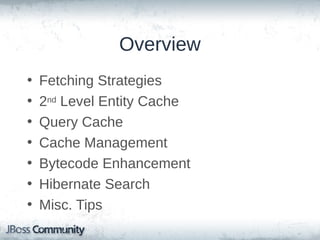
Overview
•
•
•
•
•
•
•
•

Fetching Strategies
2nd Level Entity Cache
Query Cache
Cache Management
Bytecode Enhancement
Hibernate Search
Misc. Tips
Q&A
Caveats
• No “one strategy to rule them all”
• Varies greatly between apps
• Important to understand concepts, then
apply as necessary
• Does not replace database tuning!
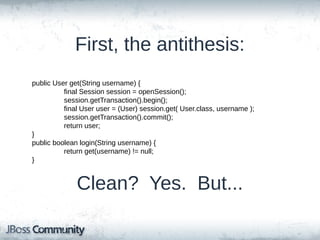
First, the antithesis:
public User get(String username) {
final Session session = openSession();
session.getTransaction().begin();
final User user = (User) session.get( User.class, username );
session.getTransaction().commit();
return user;
}
public boolean login(String username) {
return get(username) != null;
}

Clean? Yes. But...
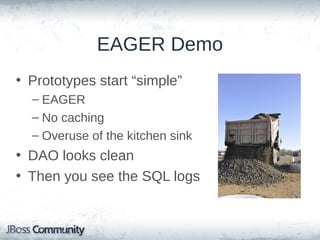
EAGER Demo
• Prototypes start “simple”
– EAGER
– No caching
– Overuse of the kitchen sink

• DAO looks clean
• Then you see the SQL logs
Fetching Strategies
Fetching Strategies
• By far, the most frequent mistake
• Also the most costly
• 2 concepts:
– WHEN (fetch timing)
– HOW (fetch style)
WHEN (fetch timing)
Fetch Timing: EAGER
•
•
•
•

Immediate
Can be convenient (in some ways)
Significantly increases payload
Enormous amount of unnecessary
fetches for deep association tree
Fetch Timing: LAZY
• Fetched when first accessed
• Collections
– LAZY by default
– Utilizes Hibernate's internal concept of “persistent
collections”
– DEMO

• Single attribute (basic)
– Requires bytecode enhancement
– Not typically used nor beneficial
Fetch Timing: LAZY (cont'd)
• Single (ToOne) associations
– Fetched when accessed
– Proxy
• Default
• Fetched when accessed (except ID)
• Handled internally by Hibernate

– No-proxy
• Fetched when accessed (including ID)
• No visible proxy
• Requires buildtime bytecode enhancement
Fetch Timing: EXTRA LAZY
•
•
•
•

Collections only
Fetch individual elements as accessed
Does not fetch entire collection
DEMO
HOW (fetch style)
Fetch Style: JOIN
• Join fetch (left/outer join)
• Great for ToOne associations
• Multiple collection joins
– Possible for non-bags
– Warning: Cartesian product! SELECT is
normally faster

• DEMO
Fetch Style: SELECT
• Follow-up selects
• Default style for collections (avoids
cartesian products)
• Can result in 1+N selects (fetch per
collection entry)
• DEMO
Fetch Style: BATCH
• Fetches multiple entries when one is
accessed
• Configurable on both class and collection
levels (“batch-size”)
• Simple select and list of keys
• Multiple algorithms (new as of 4.2)
• Determines # of entries to fetch, based on
# of provided keys
Fetch Style: BATCH (cont'd)
• Legacy: pre-determined sizes, rounded
down
– batch-size==25, 24 elements in collection
– Fetches -> 12, 10, 2

• Padded: same as Legacy, size rounded up
• Dynamic: builds SQL for the # of keys,
limited by “batch-size”
• DEMO
Fetch Style: SUBSELECT
• Follow-up select
• Fetches all collection entries when
accessed for the 1st time
• Original root entry select used as
subselect
• Performance depends on the DB itself
• DEMO
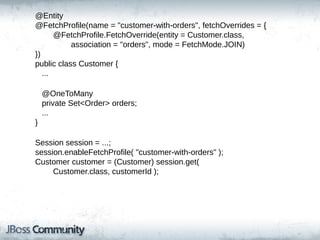
Fetch Style: PROFILE
• named profile defining fetch styles
• “activated” through the Session
@Entity
@FetchProfile(name = "customer-with-orders", fetchOverrides = {
@FetchProfile.FetchOverride(entity = Customer.class,
association = "orders", mode = FetchMode.JOIN)
})
public class Customer {
...
@OneToMany
private Set<Order> orders;
...
}
Session session = ...;
session.enableFetchProfile( "customer-with-orders" );
Customer customer = (Customer) session.get(
Customer.class, customerId );
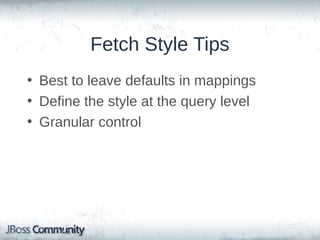
Fetch Style Tips
• Best to leave defaults in mappings
• Define the style at the query level
• Granular control
nd

2 Level Entity
Cache (2LC)
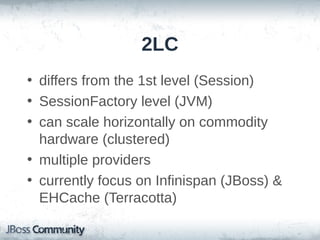
2LC
• differs from the 1st level (Session)
• SessionFactory level (JVM)
• can scale horizontally on commodity
hardware (clustered)
• multiple providers
• currently focus on Infinispan (JBoss) &
EHCache (Terracotta)
2LC (cont'd)
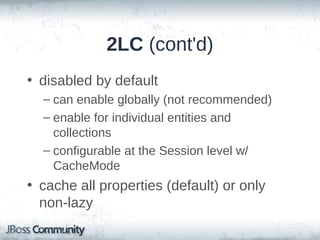
• disabled by default
– can enable globally (not recommended)
– enable for individual entities and
collections
– configurable at the Session level w/
CacheMode

• cache all properties (default) or only
non-lazy
2LC (cont'd)
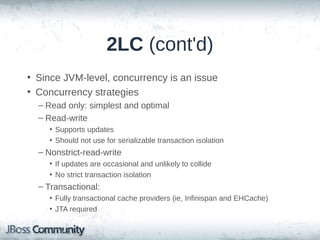
• Since JVM-level, concurrency is an issue
• Concurrency strategies
– Read only: simplest and optimal
– Read-write
• Supports updates
• Should not use for serializable transaction isolation

– Nonstrict-read-write
• If updates are occasional and unlikely to collide
• No strict transaction isolation

– Transactional:
• Fully transactional cache providers (ie, Infinispan and EHCache)
• JTA required
2LC (cont'd)
• DEMO
Query Cache
Query Cache
• Caches query result sets
• Repetitive queries with identical params
• Different from an entity cache
– Does not maintain entity state
– Holds on to sets of identifiers

• If used, best in conjunction with 2LC
Query Cache (cont'd)
• Disabled by default
• Many applications do not gain anything
• Queries invalidated upon relevant
updates
• Increases overhead by some: tracks
when to invalidate based on commits
• DEMO
Cache Management
Cache Management
• Entities stored in Session cache when saved,
updated, or retrieved
• Session#flush syncs all cached with DB
– Minimize usage

• Manage memory:
– Session#evict(entity) when no longer needed
– Session#clear for all
– Important for large dataset handling

• Same for 2LC, but methods on
SessionFactory#getCache
Bytecode
Enhancement
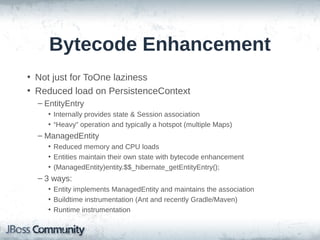
Bytecode Enhancement
• Not just for no-proxy, ToOne laziness
• Reduced load on PersistenceContext
– EntityEntry
• Internally provides state & Session association
• “Heavy” operation and typically a hotspot (multiple Maps)

– ManagedEntity
• Reduced memory and CPU loads
• Entities maintain their own state with bytecode enhancement
• (ManagedEntity)entity.$$_hibernate_getEntityEntry();

– 3 ways:
• Entity implements ManagedEntity and maintains the association
• Buildtime instrumentation (Ant and recently Gradle/Maven)
• Runtime instrumentation
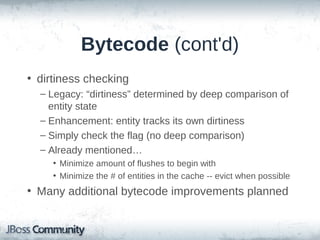
Bytecode (cont'd)
• dirtiness checking
– Legacy: “dirtiness” determined by deep comparison of
entity state
– Enhancement: entity tracks its own dirtiness
– Simply check the flag (no deep comparison)
– Already mentioned…
• Minimize amount of flushes to begin with
• Minimize the # of entities in the cache -- evict when possible

• Many additional bytecode improvements planned
Hibernate Search
Hibernate Search
• Full-text search on the DB
– Bad performance
– CPU/IO overhead

• Offload full-text queries to Hibernate
Search engine
– Fully indexed
– Horizontally scalable

• Based on Apache Lucene
Hibernate Search (cont'd)
• Annotate entities with @Indexed
• Annotate properties with @Field
– Index the text: index=Index.YES
– “Analyze” the text: analyze=Analyze.YES
•
•
•
•

Lucene analyzer
Chunks sentences into words
Lowercase all of them
Exclude common words (“a”, “the”)

• Combo of indexing and analysis == performant
full-text searches!
Misc. Tips
Misc. Tips
• Easy to overlook unintended fetches
– Ex: Fully implemented toString with all
associations (fetches everything simply for
logging)

• Use @Immutable when possible
– Excludes entity from dirtiness checks
– Other internal optimizations
Misc. Tips (cont'd)
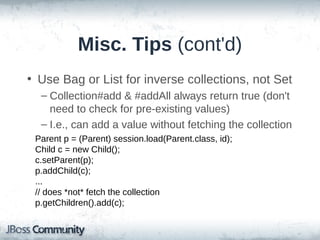
• Use Bag or List for inverse collections, not Set
– Collection#add & #addAll always return true (don't
need to check for pre-existing values)
– I.e., can add a value without fetching the collection
Parent p = (Parent) session.load(Parent.class, id);
Child c = new Child();
c.setParent(p);
p.addChild(c);
...
// does *not* fetch the collection
p.getChildren().add(c);
Misc. Tips (cont'd)
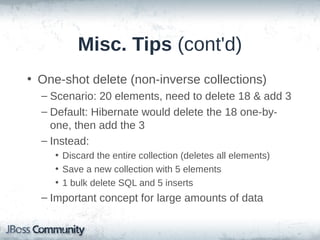
• One-shot delete (non-inverse collections)
– Scenario: 20 elements, need to delete 18 & add 3
– Default: Hibernate would delete the 18 one-byone, then add the 3
– Instead:
• Discard the entire collection (deletes all elements)
• Save a new collection with 5 elements
• 1 bulk delete SQL and 5 inserts

– Important concept for large amounts of data
How to Help:
hibernate.org
/orm/contribute
QUESTIONS?
•
•
•
•

Q&A
#hibernate or #hibernate-dev (brmeyer)
@brettemeyer
+brettmeyer

Hibernate ORM: Tips, Tricks, and Performance Techniques

  • 2.
    Hibernate ORM: Tips, Tricks,and Performance Techniques Brett Meyer Senior Software Engineer Hibernate ORM, Red Hat
  • 3.
    Brett Meyer • HibernateORM – ORM 4 & 5 development – Hibernate OSGi – Developer community engagement – Red Hat enterprise support, Hibernate engineering lead • Other contributions – Apache Camel – Infinispan • Contact me – @brettemeyer or +brettmeyer – Freenode #hibernate or #hibernate-dev (brmeyer)
  • 4.
  • 5.
    ORM? JPA? • ORM:Object/Relational Mapping – Persistence: Data objects outlive the JVM app – Maps Java POJOs to relational databases – Supports OO concepts: inheritance, object identity, etc. – Navigate data by walking the object graph, not the explicit relational model • JPA: Java Persistence API • Hibernate ORM provides its own native API, in addition to full JPA support • Annotations and XML
  • 6.
    Overview • • • • • • • • Fetching Strategies 2nd LevelEntity Cache Query Cache Cache Management Bytecode Enhancement Hibernate Search Misc. Tips Q&A
  • 7.
    Caveats • No “onestrategy to rule them all” • Varies greatly between apps • Important to understand concepts, then apply as necessary • Does not replace database tuning!
  • 8.
    First, the antithesis: publicUser get(String username) { final Session session = openSession(); session.getTransaction().begin(); final User user = (User) session.get( User.class, username ); session.getTransaction().commit(); return user; } public boolean login(String username) { return get(username) != null; } Clean? Yes. But...
  • 9.
    EAGER Demo • Prototypesstart “simple” – EAGER – No caching – Overuse of the kitchen sink • DAO looks clean • Then you see the SQL logs
  • 10.
  • 11.
    Fetching Strategies • Byfar, the most frequent mistake • Also the most costly • 2 concepts: – WHEN (fetch timing) – HOW (fetch style)
  • 12.
  • 13.
    Fetch Timing: EAGER • • • • Immediate Canbe convenient (in some ways) Significantly increases payload Enormous amount of unnecessary fetches for deep association tree
  • 14.
    Fetch Timing: LAZY •Fetched when first accessed • Collections – LAZY by default – Utilizes Hibernate's internal concept of “persistent collections” – DEMO • Single attribute (basic) – Requires bytecode enhancement – Not typically used nor beneficial
  • 15.
    Fetch Timing: LAZY(cont'd) • Single (ToOne) associations – Fetched when accessed – Proxy • Default • Fetched when accessed (except ID) • Handled internally by Hibernate – No-proxy • Fetched when accessed (including ID) • No visible proxy • Requires buildtime bytecode enhancement
  • 16.
    Fetch Timing: EXTRALAZY • • • • Collections only Fetch individual elements as accessed Does not fetch entire collection DEMO
  • 17.
  • 18.
    Fetch Style: JOIN •Join fetch (left/outer join) • Great for ToOne associations • Multiple collection joins – Possible for non-bags – Warning: Cartesian product! SELECT is normally faster • DEMO
  • 19.
    Fetch Style: SELECT •Follow-up selects • Default style for collections (avoids cartesian products) • Can result in 1+N selects (fetch per collection entry) • DEMO
  • 20.
    Fetch Style: BATCH •Fetches multiple entries when one is accessed • Configurable on both class and collection levels (“batch-size”) • Simple select and list of keys • Multiple algorithms (new as of 4.2) • Determines # of entries to fetch, based on # of provided keys
  • 21.
    Fetch Style: BATCH(cont'd) • Legacy: pre-determined sizes, rounded down – batch-size==25, 24 elements in collection – Fetches -> 12, 10, 2 • Padded: same as Legacy, size rounded up • Dynamic: builds SQL for the # of keys, limited by “batch-size” • DEMO
  • 22.
    Fetch Style: SUBSELECT •Follow-up select • Fetches all collection entries when accessed for the 1st time • Original root entry select used as subselect • Performance depends on the DB itself • DEMO
  • 23.
    Fetch Style: PROFILE •named profile defining fetch styles • “activated” through the Session
  • 24.
    @Entity @FetchProfile(name = "customer-with-orders",fetchOverrides = { @FetchProfile.FetchOverride(entity = Customer.class, association = "orders", mode = FetchMode.JOIN) }) public class Customer { ... @OneToMany private Set<Order> orders; ... } Session session = ...; session.enableFetchProfile( "customer-with-orders" ); Customer customer = (Customer) session.get( Customer.class, customerId );
  • 25.
    Fetch Style Tips •Best to leave defaults in mappings • Define the style at the query level • Granular control
  • 26.
  • 27.
    2LC • differs fromthe 1st level (Session) • SessionFactory level (JVM) • can scale horizontally on commodity hardware (clustered) • multiple providers • currently focus on Infinispan (JBoss) & EHCache (Terracotta)
  • 28.
    2LC (cont'd) • disabledby default – can enable globally (not recommended) – enable for individual entities and collections – configurable at the Session level w/ CacheMode • cache all properties (default) or only non-lazy
  • 29.
    2LC (cont'd) • SinceJVM-level, concurrency is an issue • Concurrency strategies – Read only: simplest and optimal – Read-write • Supports updates • Should not use for serializable transaction isolation – Nonstrict-read-write • If updates are occasional and unlikely to collide • No strict transaction isolation – Transactional: • Fully transactional cache providers (ie, Infinispan and EHCache) • JTA required
  • 30.
  • 31.
  • 32.
    Query Cache • Cachesquery result sets • Repetitive queries with identical params • Different from an entity cache – Does not maintain entity state – Holds on to sets of identifiers • If used, best in conjunction with 2LC
  • 33.
    Query Cache (cont'd) •Disabled by default • Many applications do not gain anything • Queries invalidated upon relevant updates • Increases overhead by some: tracks when to invalidate based on commits • DEMO
  • 34.
  • 35.
    Cache Management • Entitiesstored in Session cache when saved, updated, or retrieved • Session#flush syncs all cached with DB – Minimize usage • Manage memory: – Session#evict(entity) when no longer needed – Session#clear for all – Important for large dataset handling • Same for 2LC, but methods on SessionFactory#getCache
  • 36.
  • 37.
    Bytecode Enhancement • Notjust for no-proxy, ToOne laziness • Reduced load on PersistenceContext – EntityEntry • Internally provides state & Session association • “Heavy” operation and typically a hotspot (multiple Maps) – ManagedEntity • Reduced memory and CPU loads • Entities maintain their own state with bytecode enhancement • (ManagedEntity)entity.$$_hibernate_getEntityEntry(); – 3 ways: • Entity implements ManagedEntity and maintains the association • Buildtime instrumentation (Ant and recently Gradle/Maven) • Runtime instrumentation
  • 38.
    Bytecode (cont'd) • dirtinesschecking – Legacy: “dirtiness” determined by deep comparison of entity state – Enhancement: entity tracks its own dirtiness – Simply check the flag (no deep comparison) – Already mentioned… • Minimize amount of flushes to begin with • Minimize the # of entities in the cache -- evict when possible • Many additional bytecode improvements planned
  • 39.
  • 40.
    Hibernate Search • Full-textsearch on the DB – Bad performance – CPU/IO overhead • Offload full-text queries to Hibernate Search engine – Fully indexed – Horizontally scalable • Based on Apache Lucene
  • 41.
    Hibernate Search (cont'd) •Annotate entities with @Indexed • Annotate properties with @Field – Index the text: index=Index.YES – “Analyze” the text: analyze=Analyze.YES • • • • Lucene analyzer Chunks sentences into words Lowercase all of them Exclude common words (“a”, “the”) • Combo of indexing and analysis == performant full-text searches!
  • 42.
  • 43.
    Misc. Tips • Easyto overlook unintended fetches – Ex: Fully implemented toString with all associations (fetches everything simply for logging) • Use @Immutable when possible – Excludes entity from dirtiness checks – Other internal optimizations
  • 44.
    Misc. Tips (cont'd) •Use Bag or List for inverse collections, not Set – Collection#add & #addAll always return true (don't need to check for pre-existing values) – I.e., can add a value without fetching the collection Parent p = (Parent) session.load(Parent.class, id); Child c = new Child(); c.setParent(p); p.addChild(c); ... // does *not* fetch the collection p.getChildren().add(c);
  • 45.
    Misc. Tips (cont'd) •One-shot delete (non-inverse collections) – Scenario: 20 elements, need to delete 18 & add 3 – Default: Hibernate would delete the 18 one-byone, then add the 3 – Instead: • Discard the entire collection (deletes all elements) • Save a new collection with 5 elements • 1 bulk delete SQL and 5 inserts – Important concept for large amounts of data
  • 46.
  • 47.