Hibernate caching
       2012

     Barnabás Südy
barnabas.sudy@gmail.com
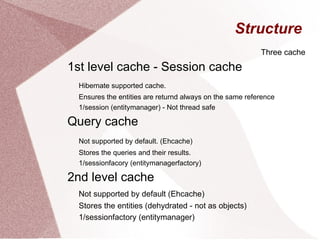
Structure
                                                          Three cache
1st level cache - Session cache
  Hibernate supported cache.
  Ensures the entities are returnd always on the same reference
  1/session (entitymanager) - Not thread safe

Query cache
  Not supported by default. (Ehcache)
  Stores the queries and their results.
  1/sessionfacory (entitymanagerfactory)

2nd level cache
  Not supported by default (Ehcache)
  Stores the entities (dehydrated - not as objects)
  1/sessionfactory (entitymanager)
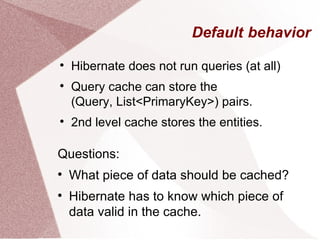
Default behavior

    Hibernate does not run queries (at all)

    Query cache can store the
    (Query, List<PrimaryKey>) pairs.

    2nd level cache stores the entities.

Questions:

    What piece of data should be cached?

    Hibernate has to know which piece of
    data valid in the cache.
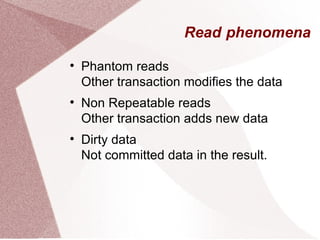
Read phenomena

    Phantom reads
    Other transaction modifies the data

    Non Repeatable reads
    Other transaction adds new data

    Dirty data
    Not committed data in the result.
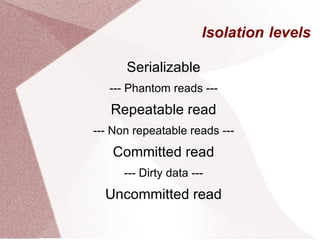
Isolation levels

      Serializable
   --- Phantom reads ---
   Repeatable read
--- Non repeatable reads ---
   Committed read
      --- Dirty data ---
  Uncommitted read
2nd level cache

To optimise the performance Hibernate
 introduced the Cache strategies:

    Read only

    Read-Write

    NonStrict Read-Write

    Transactional
2nd level cache

To optimise the performance Hibernate
 introduced the Cache strategies:

    Read only

    Read-Write

    NonStrict Read-Write

    Transactional
Read only strategy

A read-only cache is good for data that
  needs to be read often but not
  modified.



    Simple

    Safe to use in a clustered environment.

    The data has to never ever modify.

    Best performance.
NonStrict Read-Write

Rarely need to modify data.
This is the case if two transactions are unlikely to try to update the
   same item simultaneously.


    No strict transaction isolation

    Ensure Session.close() or
    Session.disconnect() is called at the end
    of transaction. (except JTA)

    hibernate.transaction.manager_lookup_class to use in JTA environment.
Read-Write

Appropriate for an application which needs
 to update data regularly. (not exacly true)


    Do not use a if serializable isolation
    needed.

    Ensure Session.close() or
    Session.disconnect() is called at the end
    of transaction. (except JTA)

    hibernate.transaction.manager_lookup_class to use in JTA environment.
How is works - Read-only


    The modification is disabled.

    No 2nd level cache update needed.
How is works -
                    NonStrict Read-Write

    The entities are evicted from the 2nd
    level cache by their life timeout. Until the
    eviction they are in use.

    Repeatable reads problem is not solved.
    The queries are not forwarded to the
    database.
How it works - Read-write


    Transaction and entity timestamp.

    If transaction timestamp is older than the
    entity timestamp the entity has to be
    pulled out from the database.

    The responsibility is deflected to the
    database.
How it works - Read-write

Let's take a look our test code.
Good to know

    Be careful with query cache without 2nd level
    cache.

    Be careful 2nd level cache without query
    cache.

    Be careful query cache and read-write entity.

    And again: 2nd level cache is not queryable
    only findable.

    The first level cache keeps the entity
    references.
A little bit configuration....

    Persistence.xml

    Annotations

    Ehcache.xml

    Etc.

Hibernate caching

  • 1.
    Hibernate caching 2012 Barnabás Südy barnabas.sudy@gmail.com
  • 2.
    Structure Three cache 1st level cache - Session cache Hibernate supported cache. Ensures the entities are returnd always on the same reference 1/session (entitymanager) - Not thread safe Query cache Not supported by default. (Ehcache) Stores the queries and their results. 1/sessionfacory (entitymanagerfactory) 2nd level cache Not supported by default (Ehcache) Stores the entities (dehydrated - not as objects) 1/sessionfactory (entitymanager)
  • 3.
    Default behavior  Hibernate does not run queries (at all)  Query cache can store the (Query, List<PrimaryKey>) pairs.  2nd level cache stores the entities. Questions:  What piece of data should be cached?  Hibernate has to know which piece of data valid in the cache.
  • 4.
    Read phenomena  Phantom reads Other transaction modifies the data  Non Repeatable reads Other transaction adds new data  Dirty data Not committed data in the result.
  • 5.
    Isolation levels Serializable --- Phantom reads --- Repeatable read --- Non repeatable reads --- Committed read --- Dirty data --- Uncommitted read
  • 6.
    2nd level cache Tooptimise the performance Hibernate introduced the Cache strategies:  Read only  Read-Write  NonStrict Read-Write  Transactional
  • 7.
    2nd level cache Tooptimise the performance Hibernate introduced the Cache strategies:  Read only  Read-Write  NonStrict Read-Write  Transactional
  • 8.
    Read only strategy Aread-only cache is good for data that needs to be read often but not modified.  Simple  Safe to use in a clustered environment.  The data has to never ever modify.  Best performance.
  • 9.
    NonStrict Read-Write Rarely needto modify data. This is the case if two transactions are unlikely to try to update the same item simultaneously.  No strict transaction isolation  Ensure Session.close() or Session.disconnect() is called at the end of transaction. (except JTA)  hibernate.transaction.manager_lookup_class to use in JTA environment.
  • 10.
    Read-Write Appropriate for anapplication which needs to update data regularly. (not exacly true)  Do not use a if serializable isolation needed.  Ensure Session.close() or Session.disconnect() is called at the end of transaction. (except JTA)  hibernate.transaction.manager_lookup_class to use in JTA environment.
  • 11.
    How is works- Read-only  The modification is disabled.  No 2nd level cache update needed.
  • 12.
    How is works- NonStrict Read-Write  The entities are evicted from the 2nd level cache by their life timeout. Until the eviction they are in use.  Repeatable reads problem is not solved. The queries are not forwarded to the database.
  • 13.
    How it works- Read-write  Transaction and entity timestamp.  If transaction timestamp is older than the entity timestamp the entity has to be pulled out from the database.  The responsibility is deflected to the database.
  • 14.
    How it works- Read-write Let's take a look our test code.
  • 15.
    Good to know  Be careful with query cache without 2nd level cache.  Be careful 2nd level cache without query cache.  Be careful query cache and read-write entity.  And again: 2nd level cache is not queryable only findable.  The first level cache keeps the entity references.
  • 16.
    A little bitconfiguration....  Persistence.xml  Annotations  Ehcache.xml  Etc.