CHAPTER 13 INTRODUCTION TO THE CPT AND LEVEL II NATIONAL CODES (HCPCS)
MEDICAL CODING Transforms services/procedures/ supplies/drugs into  __________  codes Transforms diagnosis and procedures into  ________  codes CPT/HCPCS ICD-9-CM
Levels of Service Codes Level I  CPT—(Category 1: 99201-99607, Category III: 0017T-0259T) Level II  HCPCS, National Codes—(A0021-V5364) Level III  Local Codes—phased out due to HIPAA
Diagnosis Codes ICD-9-CM, Volumes 1 & 2 International Classification of Diseases , 9th Ed., Clinical Modification
ICD-9-CM Classification  ______ Explains why service was provided Changes diagnoses into  _____ Diabetes becomes  ___ .XX (highest level of specificity) system 250 codes
Why Codes? Computers understand  ________ Specific descriptions attached to  each code numbers
CPT Developed by the AMA in  ____ ____ -digit codes Updated in  _________  for use January 1 Five 1966 November
Examples of Types of CPT Codes Medical Surgical Diagnostic services Anesthesia, etc. Category II and Category III codes—alpha numeric Category II =  ___________  measuring Category III = emerging  __________ performance technology
CPT Codes Allow For Communication that is both  _______  and  _______ A mechanism to report a service not described by a specific CPT or Level II code effective efficient
Consider Renal endoscopy through nephrostomy or pyelotomy, with or without irrigation, instillation, or ureteropyelography, exclusive of radiologic service; with endopyelotomy (includes cystoscopy, ureteroscopy, dilation of ureter and ureteral pelvic junction, and insertion of endopyelotomy stent) OR 50575
Codes Are  Used to tell third-party payers about  ________ /procedures provided Often used as basis of  _______ services payment
Incorrect Coding Results in providers being paid  _____________ Either over or underpayment Decreases cash flow Liability risk inappropriately
Codes Are Used By  Clinics Hospitals Rehabilitation units Ambulance services  Long-term care Wherever  __________  services  are provided health care
Outpatient Services for Physicians Reported on insurance form _________  = universal form CMS-1500
CMS-1500 Figure: 13.1
CPT Format Symbols in CPT Used to convey  __________ ________ , moderate (conscious) sedation included (full list in Appendix G, CPT) Example 45391, Colonoscopy with endoscopic ultrasound examination ____________ , pending FDA approval (Appendix K, CPT) Example 90650, Human Papilloma virus (HPV) vaccine, types 16, 18, bivalent, 3 dose schedule, for intramuscular use information Bullseye Lightning bolt
•  Bullet = ____ Code Figure: 13.2 Circle ( ○ ) = Reinstated or recycled code New Figure: 13.6
▲ Triangle = _______ Code Figure: 13.3 Revised
►◄  Right and Left ________ = Beginning and Ending of Text Change Figure: 13.4 Triangles
_____ = Add-On Code Figure: 13.5 + Plus
Add-On Code (…Cont ’d) Can only be used with another  specific code Never used  _____ No reduction for multiple services Full list in Appendix  _  of CPT alone D
=Circle With Line, CPT Appendix E contains a listing of - 51 exempt codes Services typically exempt from multiple procedure reductions -51 Cannot Be Used With these Codes Figure: 13.7
Appendices of CPT Appendix A :  ________ Appendix B :  Additions,  ________ , Revisions Appendix C :  Clinical Examples,  ___  Codes Appendix D :  _______   Codes Appendix E :  ___  Exempt Codes Appendix F :  ___  Exempt Codes Appendix G :  Include Moderate ( _________ )  Sedation Modifiers Deletions E/M Add-On -51 -63 Conscious (Cont ’d…)
Appendices of CPT (…Cont ’d) Appendix  H :  Performance Measures,  Category  __  Codes, on website Appendix  I :  Genetic Testing  ________ Appendix  J :  Electrodiagnostic Medicine  Listing of  _______ ,  _____ , and  Mixed Nerves Appendix  K :  Product Pending  ____  Approval Appendix  L :  ________  Families Appendix  M :  Crosswalk to  _______  CPT Codes Appendix  N : Summary of Resequenced CPT  Codes II Modifiers Sensory Motor FDA Vascular Deleted
___ CPT Sections (like chapters) Evaluation & Management (E/M) Anesthesia Surgery Radiology Pathology & Laboratory Medicine Category II Codes Category III Codes Appendices A-M Index Six
Categorized By Sections  Subsections  Subheadings  Categories
Categorized By (…Cont ’d) ________ Knee or Shoulder _________ Incision or Excision _________ Fracture or Dislocation __________ Cast or Strap ________________ Anterior Cranial Fossa or Middle Cranial Fossa Anatomy Procedure Condition Description Surgical Approach
Categorized By, Example Figure: 13.9 (…Cont ’d)
Guidelines Section-specific information begins each section Figure: 13.10
Notes Must-reading located throughout the CPT Figure: 13.12
Two Types of Codes Stand-alone:  ___  description Indented: Dependent on  _________   __________ Verbiage before the semicolon applies to all indented codes that follow Full preceding stand-alone
Types of Codes, Example Figure: 13.14
Semicolon Indicates full description in  ______________ You must return to the stand-alone for full description preceding code
Modifiers Add Information CPT Modifier Two digits 62 Two surgeons performed a surgical procedure Each surgeon applies his/her individual skill Each surgeon bills the procedure with modifier -62
Level II HCPCS Modifiers “ -AS” Physician’s Assistant “ -F1” Left hand, second digit __   modifiers used on CPT or HCPCS All
Example of Modifier 43820 Gastrojejunostomy -62 two surgeons -43820-62 two surgeons performed a gastrojejunostomy -62 modifier may be allowed based on payor Example: Medicare requires documentation of medical necessity
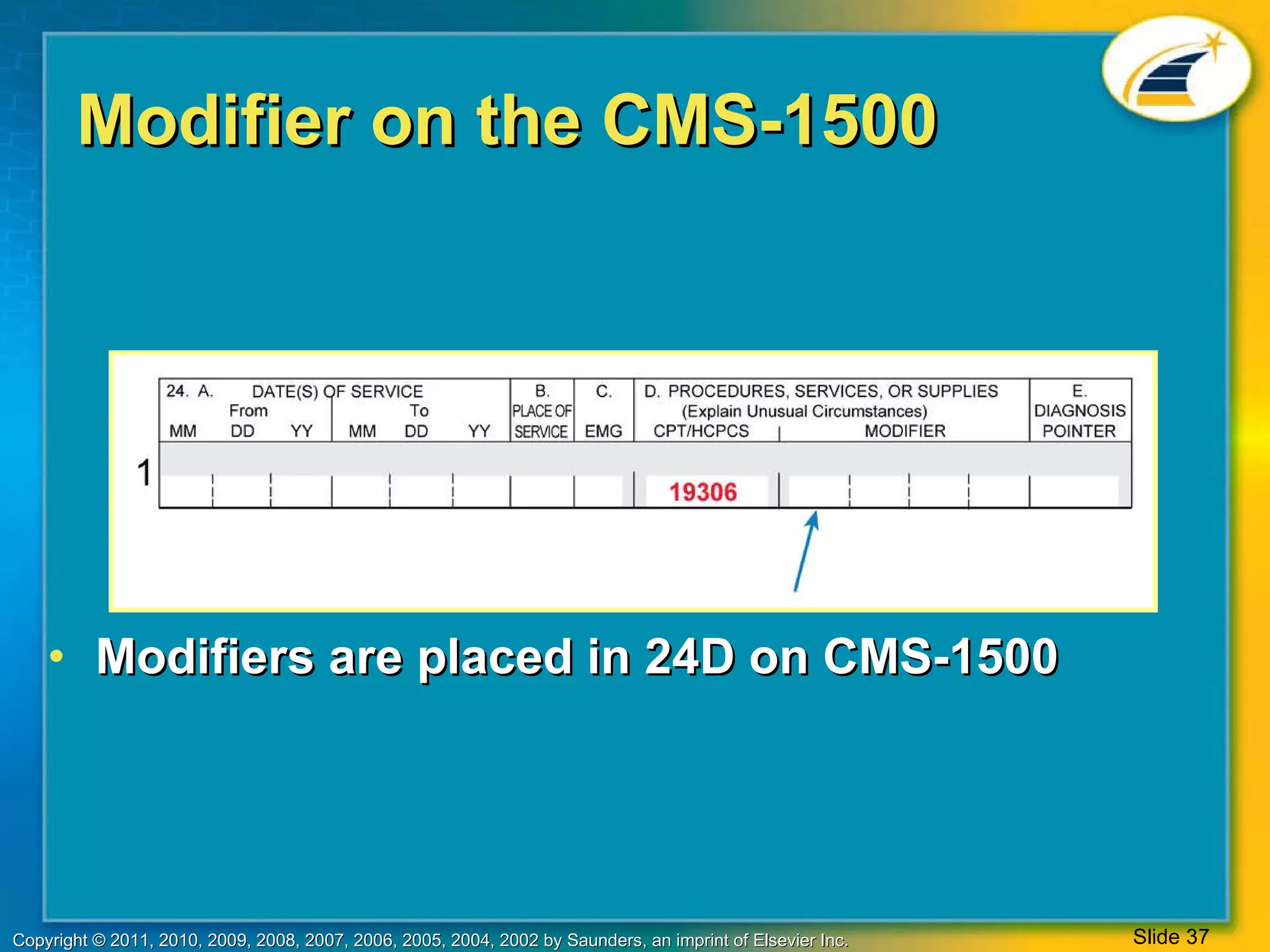
Modifier on the CMS-1500 Modifiers are placed in 24D on CMS-1500
Unlisted Services Codes ending in  ____  =  “no specific Category I or III code” Used if  ___________________ ____________   must accompany submission “ 99” no more specific code Special report
Special or Written Report Indicates: Nature Extent Need Time Effort __________  Used Photos and medical journal articles if relevant Equipment
Category I Codes Category  _  codes (00100–99607) Approved by AMA and Food and Drug Administration Proven clinical effectiveness (efficacy) I
Category II Codes— Supplemental Tracking Codes Used for  ___________  measurements Codes collect data concerning quality of care and test(s) required ____________  and end in the letter  “F” (1006F) Location AMA Website performance Alphanumeric
Category III Codes— New Technology Temporary codes—up to  _  years Identify emerging technology, services, and procedures Located after  ________  section Alphanumeric (0016T) May or may not receive future  ________  I code status 5 Medicine Category
Category III Codes Category  __  codes have not been approved  and have no proven clinical effectiveness Usage order Use  ___________  code instead of unlisted code Use unlisted code if no Category III code III Category III
The Index! Used to locate service/procedure  terms and codes Speeds up code location  Like a dictionary First entries and last entries
CPT Index Figure: 13.18
Presentation of Codes in Index Single code: 38115 Multiple codes: 26645, 26650 -  Note  ______ Range of codes: 22305-22325 -  Note  ______ comma hyphen
Location Methods With Examples ________________ : repair, excision ____________ : median nerve, elbow __________________ : cleft lip, clot ________ : toe and interphalangeal joint _______ : Jones procedure, Heller operation ___________ : ECG, PEEP  (Pressure Breathing, Positive) Service/procedure Anatomic site Condition or disease Synonym Eponym Abbreviation
Always Reference index Locate code in  ___________  of CPT Read the entire  __________  and  any  _____ main portion description notes
“ See” in Index Cross-reference terms “ Look here for code” Index: Stem, Brain:  See  Brainstem
HCPCS Healthcare Common Procedure Coding System Developed by Centers for Medicare and Medicaid Services ( ____ ) Formerly  _____ HCPCS developed,  ____ CPT did not contain all codes necessary for Medicare services reporting CMS HCFA 1983
Levels of Codes Level I:  ___ Level II: _______ , also known as  national  codes Level III:  Local   codes ( __________ ) due to HIPAA CPT HCPCS phased out
Level III, Local Codes Developed by Medicare carriers for use at local level Varied by locale  Discontinued December 31, 2003  Some codes incorporated into HCPCS Level I and II
Level II: _______ Codes Codes for wide variety of providers Physicians Dentists Orthodontists  Temporary codes for Medicare National (Cont ’d…)
Level II: National Codes (…Cont ’d) Codes for wide variety services Specific drugs ________________________  (DME) Ambulance services Durable medical equipment
HCPCS Gains Popularity Many payers require  Each year increased number of  HCPCS codes J0585—Botox, per unit
Format Begins with  ____ , followed by four  _____ Example: E0618, apnea monitor Each letter represents group of codes Example:  “ _ ” codes used to report drugs and dosage letter digits J
Temporary Codes Certain letters ( _ , K,  _ , S, H, T) indicate temporary codes Example: K0006 heavy duty wheelchair Code books published every  ______ But codes added, deleted, and revised throughout the year Notified through carrier bulletins G Q January
Coverage Just because item/service has HCPCS code does NOT mean service covered Example:  V5130,  _______ __________ Not covered under  Medicare From Cummings CW, Flint PW, Harker LA, Haughey BH, Richardson MA, Robbins KT, Schuller DE, Thomas JR, editors: Cummings Otolaryngology-Head & Neck Surgery, ed 4, Philadelphia, 2005, Mosby.  binaural hearing aid
Where HCPCS Are Used _________  settings Including outpatient departments in hospital Level I and II used to report outpatient services to certain payers Outpatient
HCPCS Index Directs to specific codes Do not code directly from index Reference main portion text before assigning code  See Figure 13 – 22 in textbook (Cont ’d…)
HCPCS Index Alphabetical  order (Cont ’d…) (…Cont ’d) Figure: 13.22 Modified from Buck CJ: 2011 HCPCS Level II Professional Edition, St. Louis, 2011, Saunders.
HCPCS Index Main text  display (…Cont ’d) Figure: 13.27 Modified from Buck CJ: 2011 HCPCS Level II Professional Edition, St. Louis, 2011, Saunders.
HCPCS Modifiers ___  and  ______  modifiers used with both HCPCS and CPT codes Figure: 13.25 CPT HCPCS Modified from Buck CJ: 2011 HCPCS Level II Professional Edition, St. Louis, 2011, Saunders.
Anatomical Modifiers F1 Left hand, second digit __ Left hand, third digit F3  Left hand, fourth digit F4  Left hand, fifth digit FA  Left hand, thumb __ Right hand, thumb F6 Right hand, second digit F7 Right hand, third digit __ Right hand, fourth digit F9 Right hand, fifth digit F2 F5 F8
Often Used HCPCS Modifiers __  Left __  Right Example: Right kidney biopsy, 50200-RT Left kidney biopsy, 50200-LT LT RT
Ambulance Modifiers Origin and destination used in combination: First letter:  _____ Second letter:  __________ Example: R = Residence H = Hospital  RH:  origin  (first letter) residence and  destination  (second letter) hospital Origin Destination
Table of Drugs Listed by generic name Modified from Buck CJ: 2011 HCPCS Level II Professional Edition, St. Louis, 2011, Saunders. Figure: 13.26
Durable Medical Equipment DME Used with chronic disabling condition Medicare and Medicaid pay for some DME items Physician must attest to need using  __________________  Necessity Certificate of Medical
Home Oxygen Therapy Medicare may also pay for oxygen with certain medical conditions Physician must complete form (CMS- ___ ) attesting to medical necessity 484
Conclusion CHAPTER 13 INTRODUCTION TO THE CPT AND LEVEL II NATIONAL CODES (HCPCS)

BUCK 2011 - Chapter 013

  • 1.
    CHAPTER 13 INTRODUCTIONTO THE CPT AND LEVEL II NATIONAL CODES (HCPCS)
  • 2.
    MEDICAL CODING Transformsservices/procedures/ supplies/drugs into __________ codes Transforms diagnosis and procedures into ________ codes CPT/HCPCS ICD-9-CM
  • 3.
    Levels of ServiceCodes Level I CPT—(Category 1: 99201-99607, Category III: 0017T-0259T) Level II HCPCS, National Codes—(A0021-V5364) Level III Local Codes—phased out due to HIPAA
  • 4.
    Diagnosis Codes ICD-9-CM,Volumes 1 & 2 International Classification of Diseases , 9th Ed., Clinical Modification
  • 5.
    ICD-9-CM Classification ______ Explains why service was provided Changes diagnoses into _____ Diabetes becomes ___ .XX (highest level of specificity) system 250 codes
  • 6.
    Why Codes? Computersunderstand ________ Specific descriptions attached to each code numbers
  • 7.
    CPT Developed bythe AMA in ____ ____ -digit codes Updated in _________ for use January 1 Five 1966 November
  • 8.
    Examples of Typesof CPT Codes Medical Surgical Diagnostic services Anesthesia, etc. Category II and Category III codes—alpha numeric Category II = ___________ measuring Category III = emerging __________ performance technology
  • 9.
    CPT Codes AllowFor Communication that is both _______ and _______ A mechanism to report a service not described by a specific CPT or Level II code effective efficient
  • 10.
    Consider Renal endoscopythrough nephrostomy or pyelotomy, with or without irrigation, instillation, or ureteropyelography, exclusive of radiologic service; with endopyelotomy (includes cystoscopy, ureteroscopy, dilation of ureter and ureteral pelvic junction, and insertion of endopyelotomy stent) OR 50575
  • 11.
    Codes Are Used to tell third-party payers about ________ /procedures provided Often used as basis of _______ services payment
  • 12.
    Incorrect Coding Resultsin providers being paid _____________ Either over or underpayment Decreases cash flow Liability risk inappropriately
  • 13.
    Codes Are UsedBy Clinics Hospitals Rehabilitation units Ambulance services Long-term care Wherever __________ services are provided health care
  • 14.
    Outpatient Services forPhysicians Reported on insurance form _________ = universal form CMS-1500
  • 15.
  • 16.
    CPT Format Symbolsin CPT Used to convey __________ ________ , moderate (conscious) sedation included (full list in Appendix G, CPT) Example 45391, Colonoscopy with endoscopic ultrasound examination ____________ , pending FDA approval (Appendix K, CPT) Example 90650, Human Papilloma virus (HPV) vaccine, types 16, 18, bivalent, 3 dose schedule, for intramuscular use information Bullseye Lightning bolt
  • 17.
    • Bullet= ____ Code Figure: 13.2 Circle ( ○ ) = Reinstated or recycled code New Figure: 13.6
  • 18.
    ▲ Triangle =_______ Code Figure: 13.3 Revised
  • 19.
    ►◄ Rightand Left ________ = Beginning and Ending of Text Change Figure: 13.4 Triangles
  • 20.
    _____ = Add-OnCode Figure: 13.5 + Plus
  • 21.
    Add-On Code (…Cont’d) Can only be used with another specific code Never used _____ No reduction for multiple services Full list in Appendix _ of CPT alone D
  • 22.
    =Circle With Line,CPT Appendix E contains a listing of - 51 exempt codes Services typically exempt from multiple procedure reductions -51 Cannot Be Used With these Codes Figure: 13.7
  • 23.
    Appendices of CPTAppendix A : ________ Appendix B : Additions, ________ , Revisions Appendix C : Clinical Examples, ___ Codes Appendix D : _______ Codes Appendix E : ___ Exempt Codes Appendix F : ___ Exempt Codes Appendix G : Include Moderate ( _________ ) Sedation Modifiers Deletions E/M Add-On -51 -63 Conscious (Cont ’d…)
  • 24.
    Appendices of CPT(…Cont ’d) Appendix H : Performance Measures, Category __ Codes, on website Appendix I : Genetic Testing ________ Appendix J : Electrodiagnostic Medicine Listing of _______ , _____ , and Mixed Nerves Appendix K : Product Pending ____ Approval Appendix L : ________ Families Appendix M : Crosswalk to _______ CPT Codes Appendix N : Summary of Resequenced CPT Codes II Modifiers Sensory Motor FDA Vascular Deleted
  • 25.
    ___ CPT Sections(like chapters) Evaluation & Management (E/M) Anesthesia Surgery Radiology Pathology & Laboratory Medicine Category II Codes Category III Codes Appendices A-M Index Six
  • 26.
    Categorized By Sections Subsections Subheadings Categories
  • 27.
    Categorized By (…Cont’d) ________ Knee or Shoulder _________ Incision or Excision _________ Fracture or Dislocation __________ Cast or Strap ________________ Anterior Cranial Fossa or Middle Cranial Fossa Anatomy Procedure Condition Description Surgical Approach
  • 28.
    Categorized By, ExampleFigure: 13.9 (…Cont ’d)
  • 29.
    Guidelines Section-specific informationbegins each section Figure: 13.10
  • 30.
    Notes Must-reading locatedthroughout the CPT Figure: 13.12
  • 31.
    Two Types ofCodes Stand-alone: ___ description Indented: Dependent on _________ __________ Verbiage before the semicolon applies to all indented codes that follow Full preceding stand-alone
  • 32.
    Types of Codes,Example Figure: 13.14
  • 33.
    Semicolon Indicates fulldescription in ______________ You must return to the stand-alone for full description preceding code
  • 34.
    Modifiers Add InformationCPT Modifier Two digits 62 Two surgeons performed a surgical procedure Each surgeon applies his/her individual skill Each surgeon bills the procedure with modifier -62
  • 35.
    Level II HCPCSModifiers “ -AS” Physician’s Assistant “ -F1” Left hand, second digit __ modifiers used on CPT or HCPCS All
  • 36.
    Example of Modifier43820 Gastrojejunostomy -62 two surgeons -43820-62 two surgeons performed a gastrojejunostomy -62 modifier may be allowed based on payor Example: Medicare requires documentation of medical necessity
  • 37.
    Modifier on theCMS-1500 Modifiers are placed in 24D on CMS-1500
  • 38.
    Unlisted Services Codesending in ____ = “no specific Category I or III code” Used if ___________________ ____________ must accompany submission “ 99” no more specific code Special report
  • 39.
    Special or WrittenReport Indicates: Nature Extent Need Time Effort __________ Used Photos and medical journal articles if relevant Equipment
  • 40.
    Category I CodesCategory _ codes (00100–99607) Approved by AMA and Food and Drug Administration Proven clinical effectiveness (efficacy) I
  • 41.
    Category II Codes—Supplemental Tracking Codes Used for ___________ measurements Codes collect data concerning quality of care and test(s) required ____________ and end in the letter “F” (1006F) Location AMA Website performance Alphanumeric
  • 42.
    Category III Codes—New Technology Temporary codes—up to _ years Identify emerging technology, services, and procedures Located after ________ section Alphanumeric (0016T) May or may not receive future ________ I code status 5 Medicine Category
  • 43.
    Category III CodesCategory __ codes have not been approved and have no proven clinical effectiveness Usage order Use ___________ code instead of unlisted code Use unlisted code if no Category III code III Category III
  • 44.
    The Index! Usedto locate service/procedure terms and codes Speeds up code location Like a dictionary First entries and last entries
  • 45.
  • 46.
    Presentation of Codesin Index Single code: 38115 Multiple codes: 26645, 26650 - Note ______ Range of codes: 22305-22325 - Note ______ comma hyphen
  • 47.
    Location Methods WithExamples ________________ : repair, excision ____________ : median nerve, elbow __________________ : cleft lip, clot ________ : toe and interphalangeal joint _______ : Jones procedure, Heller operation ___________ : ECG, PEEP (Pressure Breathing, Positive) Service/procedure Anatomic site Condition or disease Synonym Eponym Abbreviation
  • 48.
    Always Reference indexLocate code in ___________ of CPT Read the entire __________ and any _____ main portion description notes
  • 49.
    “ See” inIndex Cross-reference terms “ Look here for code” Index: Stem, Brain: See Brainstem
  • 50.
    HCPCS Healthcare CommonProcedure Coding System Developed by Centers for Medicare and Medicaid Services ( ____ ) Formerly _____ HCPCS developed, ____ CPT did not contain all codes necessary for Medicare services reporting CMS HCFA 1983
  • 51.
    Levels of CodesLevel I: ___ Level II: _______ , also known as national codes Level III: Local codes ( __________ ) due to HIPAA CPT HCPCS phased out
  • 52.
    Level III, LocalCodes Developed by Medicare carriers for use at local level Varied by locale Discontinued December 31, 2003 Some codes incorporated into HCPCS Level I and II
  • 53.
    Level II: _______Codes Codes for wide variety of providers Physicians Dentists Orthodontists Temporary codes for Medicare National (Cont ’d…)
  • 54.
    Level II: NationalCodes (…Cont ’d) Codes for wide variety services Specific drugs ________________________ (DME) Ambulance services Durable medical equipment
  • 55.
    HCPCS Gains PopularityMany payers require Each year increased number of HCPCS codes J0585—Botox, per unit
  • 56.
    Format Begins with ____ , followed by four _____ Example: E0618, apnea monitor Each letter represents group of codes Example: “ _ ” codes used to report drugs and dosage letter digits J
  • 57.
    Temporary Codes Certainletters ( _ , K, _ , S, H, T) indicate temporary codes Example: K0006 heavy duty wheelchair Code books published every ______ But codes added, deleted, and revised throughout the year Notified through carrier bulletins G Q January
  • 58.
    Coverage Just becauseitem/service has HCPCS code does NOT mean service covered Example: V5130, _______ __________ Not covered under Medicare From Cummings CW, Flint PW, Harker LA, Haughey BH, Richardson MA, Robbins KT, Schuller DE, Thomas JR, editors: Cummings Otolaryngology-Head & Neck Surgery, ed 4, Philadelphia, 2005, Mosby. binaural hearing aid
  • 59.
    Where HCPCS AreUsed _________ settings Including outpatient departments in hospital Level I and II used to report outpatient services to certain payers Outpatient
  • 60.
    HCPCS Index Directsto specific codes Do not code directly from index Reference main portion text before assigning code See Figure 13 – 22 in textbook (Cont ’d…)
  • 61.
    HCPCS Index Alphabetical order (Cont ’d…) (…Cont ’d) Figure: 13.22 Modified from Buck CJ: 2011 HCPCS Level II Professional Edition, St. Louis, 2011, Saunders.
  • 62.
    HCPCS Index Maintext display (…Cont ’d) Figure: 13.27 Modified from Buck CJ: 2011 HCPCS Level II Professional Edition, St. Louis, 2011, Saunders.
  • 63.
    HCPCS Modifiers ___ and ______ modifiers used with both HCPCS and CPT codes Figure: 13.25 CPT HCPCS Modified from Buck CJ: 2011 HCPCS Level II Professional Edition, St. Louis, 2011, Saunders.
  • 64.
    Anatomical Modifiers F1Left hand, second digit __ Left hand, third digit F3 Left hand, fourth digit F4 Left hand, fifth digit FA Left hand, thumb __ Right hand, thumb F6 Right hand, second digit F7 Right hand, third digit __ Right hand, fourth digit F9 Right hand, fifth digit F2 F5 F8
  • 65.
    Often Used HCPCSModifiers __ Left __ Right Example: Right kidney biopsy, 50200-RT Left kidney biopsy, 50200-LT LT RT
  • 66.
    Ambulance Modifiers Originand destination used in combination: First letter: _____ Second letter: __________ Example: R = Residence H = Hospital RH: origin (first letter) residence and destination (second letter) hospital Origin Destination
  • 67.
    Table of DrugsListed by generic name Modified from Buck CJ: 2011 HCPCS Level II Professional Edition, St. Louis, 2011, Saunders. Figure: 13.26
  • 68.
    Durable Medical EquipmentDME Used with chronic disabling condition Medicare and Medicaid pay for some DME items Physician must attest to need using __________________ Necessity Certificate of Medical
  • 69.
    Home Oxygen TherapyMedicare may also pay for oxygen with certain medical conditions Physician must complete form (CMS- ___ ) attesting to medical necessity 484
  • 70.
    Conclusion CHAPTER 13INTRODUCTION TO THE CPT AND LEVEL II NATIONAL CODES (HCPCS)

Editor's Notes

  • #2 SXS11ierPPT-INTC13_P1
  • #3 SXS11ierPPT-INTC13_P1 • What is the purpose of assigning a code to a procedure or service? It allows health care providers to communicate efficiently and effectively with third-party payers about the services and procedures provided to their patients. The CPT/HCPCS codes are used to identify procedures/services/supplies/drugs delivered as part of patient care. The ICD-9-CM codes provide the diagnostic justification for the delivery of these services
  • #4 SXS11ierPPT-INTC13_P1 • What are the various levels of physician service codes? Level I: CPT-4 codes used to identify services and procedures delivered by a physician to describe health care services. Level II: National codes used by providers to report services, supplies, and equipment not covered in the CPT-4 code (see Chapter 13). Level III: Codes used for services and materials for which there were no Level I or II codes. These codes were eliminated December 31, 2003. Now only Level I and II codes may be used.
  • #5 SXS11ierPPT-INTC13_P1 • What do ICD-9-CM codes designate? They constitute the official system for diagnostic coding used in the United States. The ICD-9-CM will be discussed in Chapters 2-6 of this textbook.
  • #6 SXS11ierPPT-INTC13_P1 On what basis are ICD-9-CM codes categorized? Within the system, disorders are classified into 17 categories on the basis of disease types and/or body systems. Similar to the CPT/HCPCS systems, the ICD-9-CM translates verbal diagnostic descriptions into codes that convey precise information about the condition being treated.
  • #7 SXS11ierPPT-INTC13_P1 • Why are alphanumeric codes used instead of verbal descriptions of disorders or procedures? Coding allows for greater standardization and simplificatio nof the process of interpreting medical diagnostic and treatment information. Coding makes processing more efficient. Coding permits compilation of statistics related to diseases, disorders, and treatment protocols. No information is lost.
  • #8 SXS11ierPPT-INTC13_P1 • How many digits are included in a CPT-4 code? (CPT-4 uses 5 digits.)
  • #9 SXS11ierPPT-INTC13_P1 • What are the six main categories (chapters) used in the CPT manual? Evaluation and Management (E/M) Anesthesia Surgery Radiology Pathology and Laboratory Medicine
  • #10 SXS11ierPPT-INTC13_P1 • Summarize why CPT codes are important tools for ensuring communication. Numerical codes are the same for all users of CPT, which makes coding more standardized and efficient.
  • #11 SXS11ierPPT-INTC13_P1 • As this example shows, the code 50575, although it conveys the same level of detail as the verbal description, is a far more efficient way to describe this procedure.
  • #12 SXS11ierPPT-INTC13_P1 • How are codes used for processing claim payments? Codes inform payers which services and procedures were provided. Codes become the basis for payment of claims submitted. Codes are an unambiguous way to communicate. Codes expedite claim processing for faster reimbursements to providers.
  • #13 SXS11ierPPT-INTC13_P1 • Correct coding is essential. What are the potential consequences of incorrect coding? Failure to code correctly may result in overpayment, underpayment, or denial of a claim. In addition, incorrect coding may result in fines, imprisonment, or both when it is the result of fraud and/or abuse. The financial consequences to a medical practice for incorrect coding can be substantial. It is the coder’s responsibility to ensure that coding is applied accurately and that error-free claims are submitted to third-party payers.
  • #14 SXS11ierPPT-INTC13_P1 • What types of institutions use CPT codes? Codes are used wherever health care services are provided, such as in physician’s offices, clinics, hospitals, and rehabilitation units. They form the basis for a universal communication system that ensures accuracy and clarity when the procedures and services delivered within the health care system are described.
  • #15 SXS11ierPPT-INTC13_P1 • What types of services are reported on CMS-1500? (Those represented by CPT-4 and HCPCS codes)
  • #16 SXS11ierPPT-INTC13_P1 • CPT-4 codes are entered in section 24D. • Note that complete information must be provided for each claim submitted or it will result in a denial by the insurance carrier. • Effective March 31, 2007 the CMS-1500 claim form changed to reflect the NPI changes. This included the Referring Physician NPI, Rendering Physician NPI, and the Facility NPI. • There is now space for usage of four modifiers.
  • #17 SXS11ierPPT-INTC13_P1 • Why are symbols used in conjunction with CPT codes in the CPT manual? (To draw special attention to information presented in a particular section.) • For example, the bull’s eye in front of 45391, colonoscopy with ultrasound examination, indicates that conscious sedation is required for this procedure. Appendix G of CPT includes a listing of all procedures that include conscious sedation.
  • #18 SXS11ierPPT-INTC13_P1 • The bullet in front of a code indicates that this procedure is being included in CPT for the first time. • The circle in front of a code indicates the procedure is being reinstated or recycled back into the CPT manual.
  • #19 SXS11ierPPT-INTC13_P1 • The upright triangle preceding this code indicates that the description used with this code has changed in some manner since the last revision was released.
  • #20 SXS11ierPPT-INTC13_P1 • Text enclosed in pairs of right- and left-facing triangles reflects a change in text from the previous release of the CPT. • Text changes may occur in any section of the CPT, and multiple changes may be noted in any particular section, if appropriate, as this example illustrates.
  • #21 SXS11ierPPT-INTC13_P1 • In this example, the code is prefaced by both an upright triangle and the plus sign, indicating that it is an add-on code whose description has been altered in some fashion. • The right- and left-facing triangles surrounding the parenthetical note below the code description indicate that this is the portion of the text that has been changed.
  • #22 SXS11ierPPT-INTC13_P1 • What is the purpose of an add-on code? (Using an additional code to show the furthest extent of the procedure.) • Have students provide an example of an add-on code. • Add-on codes are modifier -51 exempt.
  • #23 SXS11ierPPT-INTC13_P1 • What is modifier -51? (It is used to indicate that multiple procedures have been performed.) • What is the role of the circle with a line through it? (This sign indicates that a -51 modifier cannot be used with this code.)
  • #24 SXS11ierPPT-INTC13_P1 • Have students describe each appendix of the CPT manual and provide an example that would apply to each.
  • #25 SXS11ierPPT-INTC13_P1 • For which class of patients would Appendix F apply? (Infants weighing less than 4 kg) • Appendix I is a list of genetic testing modifiers that are reported with molecular laboratory procedures. The first character of these codes is a number that indicates the disease category; the second character is a letter that denotes the gene type.
  • #26 SXS11ierPPT-INTC13_P1 • Why is E/M listed first? (Because procedures and services listed in the E/M are frequently used) • Evaluation and Management (Codes 99201-99499) • Anesthesia (Codes 00100-01999, 99100-99140) • Surgery (Codes 10021-69990) • Radiology (Codes 70010-79999) • Pathology and Laboratory (Codes 80047-89398) • Medicine (Codes 90281-99602)
  • #27 SXS11ierPPT-INTC13_P1 • How are the main sections of the CPT manual subdivided? (Into subsections which are body systems) • How are these further subdivided? (In subheadings, which are body areas, and then further divided by category, which is incision, excision, etc.)
  • #28 SXS11ierPPT-INTC13_P1 • Categorization within the major sections of the CPT depends on what makes most sense for the section in question. • Subdivisions may be based on anatomy, procedure, condition, description, or surgical approach, as described here.
  • #29 SXS11ierPPT-INTC13_P1 • The main section is Evaluation and Management (E/M). • One subsection of E/M is Office or Other Outpatient Services. • Within the Office or Other Outpatient Services subsection, the subheading “New Patient” is found.
  • #30 SXS11ierPPT-INTC13_P1 • Where do Guidelines appear in the CPT manual? (At the start of each section of the CPT) • What is the role of Guidelines? (The information they contain, which is specific to a particular section, allows the coder to appropriately interpret and report on procedures and services included in that section.)
  • #31 SXS11ierPPT-INTC13_P1 • Where do Notes appear in the CPT manual? (Notes appear throughout CPT and are listed before and after the codes that they pertain to.) • What is the role of notes? (Special instructions that must be followed for coding to be accurate)
  • #32 SXS11ierPPT-INTC13_P1 • What are the two types of codes used in the CPT manual? Stand-alone codes have complete, full descriptions attached to them. Indented codes are listed under related stand-alone codes. Descriptions for these codes depend on information in the code that precedes them. NOTE TO INSTRUCTOR: If preferred, the order of slides 30 and 31 can be switched.
  • #33 SXS11ierPPT-INTC13_P1 • What does a semicolon signify when used with CPT codes? It divides the portion of the description that is related to all indented codes that follow it from the portion that pertains specifically and only to the current code. This convention is used throughout the CPT as a major space-saving device. It also increases readability by eliminating unnecessary repetition of text.
  • #34 SXS11ierPPT-INTC13_P1 • To recap, when indented codes are used, a portion of the code description will be found in the last stand-alone code encountered before the code in question. The portion of the description for the stand-alone code that precedes the semicolon must be added to the description for the indented code.
  • #35 SXS11ierPPT-INTC13_P1 • What are CPT modifiers? (Two-digit codes that are placed after the CPT code to give additional information to third-party payers.) • Have students provide examples of modifiers. • A complete list of all modifiers is found in Appendix A of the CPT.
  • #36 SXS11ierPPT-INTC13_P1 • The HCPCS Level II codes also make use of modifiers, in this case, 2-character alphanumeric codes. These tend to relate mnemonically to the modification they describe. For example, -AS is used to indicate that a physician’s assistant delivered the procedure or service; -F1 indicates left hand, second digit.
  • #37 SXS11ierPPT-INTC13_P1 • In this example, Code 43820 is the CPT procedure code for a gastrojejunostomy, without vagotomy. If two surgeons jointly performed this procedure, each performing a specific part of the procedure, code 43820 would be modified to reflect their joint participation, and the claim would indicate code 43820-62. Each surgeon would bill the third-party payer using this modified code, ensuring proper payment for both.
  • #38 SXS11ierPPT-INTC13_P1 • Where is a modifier placed on the CMS-1500 Form? (Box 24D) • Note the excerpt from the CMS-1500 shown in slide 37. Section 24 includes a space in column D for the listing of any modifiers that apply to codes (CPT or HCPCS) also listed in column D. This is where the modifier should be entered on this form to ensure that the claim is processed correctly.
  • #39 SXS11ierPPT-INTC13_P1 • Why are there unlisted services? (Because there may not be a more specific code to use) • What code is used to indicate an unlisted service? (The CPT codes ending in “99”) • On what basis are codes for unlisted services categorized? (They are found at the end of each subsection and therefore categorized by body area.) • Sometimes, Category III codes may exist for procedures that lack a specific code within the CPT. In this case, the Category III code and not the unlisted procedure code must be used.
  • #40 SXS11ierPPT-INTC13_P1 • A written report is required to explain the use of an unlisted code. • Special reports must accompany claims when an unusual, new, seldom used, Category III, or unlisted procedure is performed. • Whose responsibility is it to develop this report? (The physician who performed the procedure) • What is the purpose of the special written report? (It helps the third-party payer determine if the procedure performed was appropriate and medically necessary.)
  • #41 SXS11ierPPT-INTC13_P1 • What do Category I codes designate? (These codes are widely used to describe services and procedures that have been approved by the FDA and/or that have proved to have clinical effectiveness.) • What does a Category III code represent? (It describes services and procedures that may or may not be approved by the FDA, be widely offered, or proved to be clinically effective.)
  • #42 SXS11ierPPT-INTC13_P1 • What is the purpose of a Category II code? (Used for performance measurements) • Is use of a Category II code mandatory? (No, it’s optional and is intended to facilitate data collection.) • Category II codes provide supplemental information and are always used in combination with a Category I or Category III code.
  • #43 SXS11ierPPT-INTC13_P1 • What is the purpose of Category III codes? (They were added in 2002 to provide for coding of procedures and services based on emerging technologies.) • Category III codes are alphanumeric and can be found at the end of the CPT. • Category III codes may eventually achieve Category I status; however, there is no guarantee that this will be the case.
  • #44 SXS11ierPPT-INTC13_P1 • As noted previously, Category III codes exist for procedures that lack a specific code within the CPT. These codes must be used instead of the unlisted services codes. When neither a Category I nor III code exists, an unlisted code should be used.
  • #45 SXS11ierPPT-INTC13_P1 • What is the purpose of using the Index in the back of the CPT manual? (It speeds up location of the term or code.) • Is the CPT Index listed alphabetically or numerically? (Alphabetically) • When should you code only from the CPT Index? (Never)
  • #46 SXS11ierPPT-INTC13_P1 • This slide includes procedures that fall alphabetically between Repair, Iris and Repair, Toe, as the guide words at the top of the page suggest. • Entries may be single codes, multiple codes, or a range of codes, depending on the entry noted in the Index.
  • #47 SXS11ierPPT-INTC13_P1 • Listed single codes: They will be the only entries listed for the indexed item. • Listed multiple codes: Relevant individual codes are listed and separated by commas. • Listed range of codes: Beginning and ending codes for the range are listed with a hyphen.
  • #48 SXS11ierPPT-INTC13_P1 • What are the location methods used when a coder must search the Index for the correct code for a procedure or service? • For the first three circumstances listed in slide 46 (Service or Procedure, Anatomic Site, Condition or Disease), find the main term in the Index, and then find one of the subterms that applies. • For the second set of three circumstances, find the synonym, eponym, or abbreviation, and the Index will direct you to the appropriate main entry.
  • #49 SXS11ierPPT-INTC13_P1 • Is it necessary to read all of the notes that apply to a code? Why? (Yes; the entire description attached to the code, and any notes that apply to it, must be reviewed to ensure that it is the right code to use in the current situation.)
  • #50 SXS11ierPPT-INTC13_P1 • How is the term see used in the Index of the CPT manual? (It is a cross-reference term found whenever you search for synonyms, eponyms, and abbreviations in the CPT Index.) • What does it indicate? (The term directs you to another term or terms, and it is there that the correct code will be found.)
  • #51 SXS11ierPPT-INTC13_P1 • CPT coding is only one portion of a two-part coding system called HCPCS (pronounced “hick-picks”), which stands for Healthcare Common Procedure Coding System. • What is included in HCPCS? (A collection of codes that represent procedures, supplies, products, and services that may be provided to Medicare and Medicaid beneficiaries and to individuals enrolled in private health insurance programs) SXS08ierPPTC13_P2
  • #52 SXS11ierPPT-INTC13_P1 • Level I codes are the CPT codes in the CPT manual, the primary coding system used in the outpatient setting to code professional services provided to patients. • Level II codes are five-position alphanumeric codes that represent physician and nonphysician services not represented in the Level I codes. • Level III codes are no longer used; some of these have been integrated into the national codes (HCPCS). SXS08ierPPTC13_P2
  • #53 SXS11ierPPT-INTC13_P1 • Local codes are no longer available since the implementation of HIPAA. • What does HIPAA stand for? (Health Insurance Portability and Accountability Act) SXS08ierPPTC13_P2
  • #54 SXS11ierPPT-INTC13_P1 • Allied health care professionals such as dentists and orthodontists and various technical support services such as ambulance services are not covered by the CPT. SXS08ierPPTC13_P2
  • #55 SXS11ierPPT-INTC13_P1 • No codes in the CPT coding system pertain to the supplies used in patient care. SXS08ierPPTC13_P2
  • #56 SXS11ierPPT-INTC13_P1 Why is HCPCS becoming more popular? (More and more payers are requiring use of HCPCS codes) SXS08ierPPTC13_P2
  • #57 SXS11ierPPT-INTC13_P1 • The first digit in the national code is a letter—A, B, C, D, E, G, H, J, K, L, M, P, Q, R, S, T, or V. • These letters each have a meaning and are followed by a 4-digit numeric code. SXS08ierPPTC13_P2
  • #58 SXS11ierPPT-INTC13_P1 • Codes beginning with G, K, Q, and S are used for temporary assignment until a definitive decision can be made about appropriate code assignment. • What are K codes used for? (Durable medical equipment) • What are G codes used for? (Procedures and professional services) • What are Q codes used for? (Drugs, biologicals, and medical equipment) • What are S codes used for? (Blue Cross/Blue Shield codes that are not valid for Medicare or Medicaid patients) SXS08ierPPTC13_P2
  • #59 SXS11ierPPT-INTC13_P1 • Some codes are not covered by insurance. • Calling your local carrier will assist in letting the patient know if something will be covered by their insurance. SXS08ierPPTC13_P2
  • #60 SXS11ierPPT-INTC13_P1 • National codes are not used by health care facilities to code for services provided to inpatients. • Inpatient health care facilities use the diagnosis from the ICD-9-CM (not the service rendered) as the basis of payment for their services. SXS08ierPPTC13_P2
  • #61 SXS11ierPPT-INTC13_P1 • Why must coders be able to locate items in the index? (So they can identify the correct code) • Remember to never code from the index, whether you are using the ICD-9 book, CPT book, or HCPCS book. You must reference the main portion, tabular portion, in order to assign the correct codes. SXS08ierPPTC13_P2
  • #62 SXS11ierPPT-INTC13_P1 • What is included in the main index terms? (Tests, services, supplies, orthoses, prostheses, medical equipment, drugs, therapies, and some medical and surgical procedures) SXS08ierPPTC13_P2
  • #63 SXS11ierPPT-INTC13_P1 • The subterms of the index are listed under the main term to which they apply, along with the code. • The coder then locates the code in the main part of the manual and reads any notes that are listed under the code. • The entries in the index may be listed under more than one main term. SXS08ierPPTC13_P2
  • #64 SXS11ierPPT-INTC13_P1 • More than 50 alphabetical modifiers are available for assignment, to add further specificity to the five-digit national code. • What are some examples of how modifiers can be used? (Modifiers can be used to specify the service provider, the anatomic site, etc.) • Modifiers can be found in the indexes of the coding manuals. There is a difference between CPT and HCPCS modifiers. SXS08ierPPTC13_P2
  • #65 SXS11ierPPT-INTC13_P1 • HCPCS modifiers are 2-digit alpha or alpha-numeric codes. • Some HCPCS modifiers are used often in a clinic setting. Body site location modifiers are used often. • What is the correct modifier to show that the procedure was performed on the Right thumb? (F5) • These codes are highly used by podiatrists, but any physician can use these modifiers. SXS08ierPPTC13_P2
  • #66 SXS11ierPPT-INTC13_P1 • HCPCS modifiers better define the location of the procedure. • RT and LT modifiers are probably the most common HCPCS modifiers used in a clinic setting. These are to be used anytime you have a body area that has a mirror image. • Would you use an -RT or -LT modifier if a patient had a procedure done on his right arm? (Yes, an -RT) • Would you use a -RT or -LT modifier if the patient had a procedure done on her left hand, fourth digit? (No, because there is a specific modifier for this -F3) SXS08ierPPTC13_P2
  • #67 SXS11ierPPT-INTC13_P1 • HCPCS modifiers also define the origin of who saw the patient and location of where the service occurred. • First letter indicates the origin, who saw the patient. • The second letter shows the destination, where the service occurred. SXS08ierPPTC13_P2
  • #68 SXS11ierPPT-INTC13_P1 • J codes are used to identify the drugs administered and the dosages given. • How can you find the generic name of a drug when only the brand name is referenced in the medical documentation? (Use the drug reference book.) • The Route of Administration column lists the most common methods used to deliver the referenced generic drug. • Make sure when billing drugs you have the proper dosage for that J code so your units will be correct. Improper units will mean lost revenue for your facility. SXS08ierPPTC13_P2
  • #69 SXS11ierPPT-INTC13_P1 • What is durable medical equipment (DME)? (Equipment used by a patient with a chronic disabling condition) • The term also includes some equipment that is used only temporarily. • Claims for DME can be paid only if the items meet the Medicare definition of covered DME and are deemed medically necessary. • A sample of the DME form is provided in Fig. 13–28 on p. 243 of the text. SXS08ierPPTC13_P2
  • #70 SXS11ierPPT-INTC13_P1 • A sample of this form is provided in Fig. 13–29 on p. 244 of the text. SXS08ierPPTC13_P2
  • #71 SXS11ierPPT-INTC13_P1