SPATIAL ORGANISATION Bineet ChhajerCOMPARITIVE STUDY OF PUBLIC PARKSCOMPARITIVE STUDY OF PUBLIC PARKS
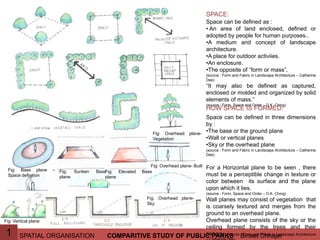
Space can be defined as :
โ€ข An area of land enclosed, defined or
adopted by people for human purposes..
โ€ขA medium and concept of landscape
architecture.
โ€ขA place for outdoor activiies.
โ€ขAn enclosure.
โ€ขThe opposite of โ€œform or massโ€.
(source : Form and Fabric in Landscape Architecture โ€“ Catherine
Dee)
โ€œIt may also be defined as captured,
enclosed or molded and organized by solid
elements of mass.โ€
(source : Form, Space and Order โ€“ D.K. Ching)
Space can be defined in three dimensions
by :
โ€ขThe base or the ground plane
โ€ขWall or vertical planes
โ€ขSky or the overhead plane
(source : Form and Fabric in Landscape Architecture โ€“ Catherine
Dee)
For a Horizontal plane to be seen , there
must be a perceptible change in texture or
color between its surface and the plane
upon which it lies.
(source : Form, Space and Order โ€“ D.K. Ching)
Wall planes may consist of vegetation that
is coarsely textured and merges from the
ground to an overhead plane.
Overhead plane consists of the sky or the
ceiling formed by the trees and their
canopy. (source : Form and Fabric in Landscape Architecture
SPACE:
HOW SPACE IS FORMED:
1
Fig: Base plane โ€“
Space definition
Fig: Sunken Base
plane
Fig: Elevated Base
plane
Fig: Vertical plane
Fig: Overhead plane-
Sky
Fig: Overhead plane- Built
Fig: Overhead plane-
Vegetation
SPATIAL ORGANISATION Bineet ChhajerCOMPARITIVE STUDY OF PUBLIC PARKS
The essence of a volume is its quality of
implied containment. A space :
โ€ข It may be static. It may direct and
concentrate interest and vision inward.
โ€ขIt may open out. It may direct attention to
its frame and beyond. It may fall away or
seem to expand.
โ€ขIt may be flowing and undulating,
suggesting directional movement.
โ€ข It may dominate an object or it may be
dominated by an object.
โ€ขIt may have orientation inward, outward,
upward, downward, radial, or tangential.
โ€ขIt may be so designed as to stimulate a
prescribed emotional reaction or to
produce a predetermined sequence of
such responses.
(source : Landscape Architecture โ€“ J.O Simonds)
SPATIAL QUALITY:
2
SPATIAL ORGANISATION:
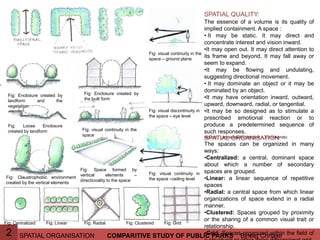
The spaces can be organized in many
ways:
โ€ขCentralized: a central, dominant space
about which a number of secondary
spaces are grouped.
โ€ขLinear: a linear sequence of repetitive
spaces
โ€ขRadial: a central space from which linear
organizations of space extend in a radial
manner.
โ€ขClustered: Spaces grouped by proximity
or the sharing of a common visual trait or
relationship.
โ€ขGrid: Spaces organized within the field of
Fig: Centralized Fig: Linear Fig: Radial Fig: Clustered Fig: Grid
Fig: Enclosure created by
landform and the
vegetation
Fig: Loose Enclosure
created by landform
Fig: Enclosure created by
the built form
Fig: visual continuity in the
space
Fig: visual continuity in the
space โ€“ ground plane
Fig: visual discontinuity in
the space โ€“ eye level
Fig: visual continuity in
the space โ€“ceiling level
Fig: Space formed by
vertical elements โ€“
directionality to the space
Fig: Claustrophobic environment
created by the vertical elements
SPATIAL ORGANISATION Bineet ChhajerCOMPARITIVE STUDY OF PUBLIC PARKS3
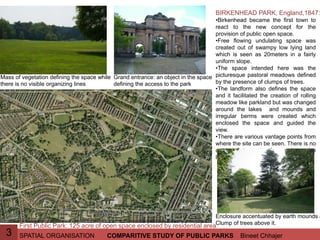
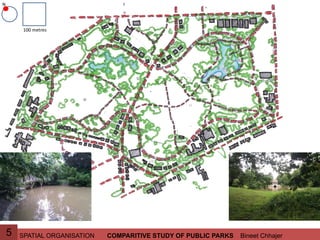
BIRKENHEAD PARK, England,1847:
โ€ขBirkenhead became the first town to
react to the new concept for the
provision of public open space.
โ€ขFree flowing undulating space was
created out of swampy low lying land
which is seen as 20meters in a fairly
uniform slope.
โ€ขThe space intended here was the
picturesque pastoral meadows defined
by the presence of clumps of trees.
โ€ขThe landform also defines the space
and it facilitated the creation of rolling
meadow like parkland but was changed
around the lakes and mounds and
irregular berms were created which
enclosed the space and guided the
view.
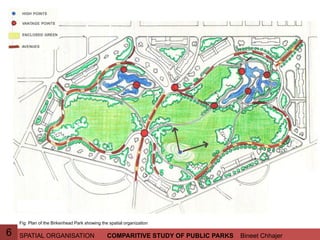
โ€ขThere are various vantage points from
where the site can be seen. There is no
one definite axis from where the
landscape can be experienced.
First Public Park: 125 acre of open space enclosed by residential area
Enclosure accentuated by earth mounds a
Clump of trees above it.
Mass of vegetation defining the space while
there is no visible organizing lines
Grand entrance: an object in the space
defining the access to the park
SPATIAL ORGANISATION Bineet ChhajerCOMPARITIVE STUDY OF PUBLIC PARKS4
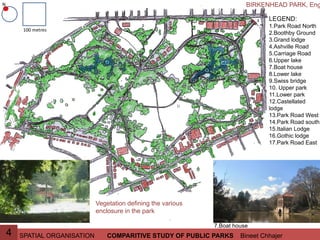
LEGEND:
1.Park Road North
2.Boothby Ground
3.Grand lodge
4.Ashville Road
5.Carriage Road
6.Upper lake
7.Boat house
8.Lower lake
9.Swiss bridge
10. Upper park
11.Lower park
12.Castellated
lodge
13.Park Road West
14.Park Road south
15.Italian Lodge
16.Gothic lodge
17.Park Road East
BIRKENHEAD PARK, EngN
100 metres
Vegetation defining the various
enclosure in the park
7.Boat house
SPATIAL ORGANISATION Bineet ChhajerCOMPARITIVE STUDY OF PUBLIC PARKS5
100 metres
N
SPATIAL ORGANISATION Bineet ChhajerCOMPARITIVE STUDY OF PUBLIC PARKS6
Fig: Plan of the Birkenhead Park showing the spatial organization
SPATIAL ORGANISATION Bineet ChhajerCOMPARITIVE STUDY OF PUBLIC PARKS7
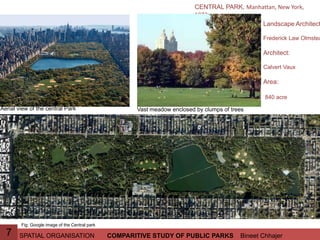
CENTRAL PARK, Manhattan, New York,
1873:
Aerial view of the central Park Vast meadow enclosed by clumps of trees
Landscape Architect
Frederick Law Olmstea
Architect:
Calvert Vaux
Area:
840 acre
Fig: Google image of the Central park
SPATIAL ORGANISATION Bineet ChhajerCOMPARITIVE STUDY OF PUBLIC PARKS8
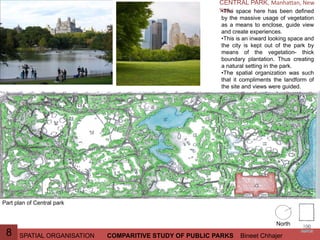
CENTRAL PARK, Manhattan, New
York :โ€ขThe space here has been defined
by the massive usage of vegetation
as a means to enclose, guide view
and create experiences.
โ€ขThis is an inward looking space and
the city is kept out of the park by
means of the vegetation- thick
boundary plantation. Thus creating
a natural setting in the park.
โ€ขThe spatial organization was such
that it compliments the landform of
the site and views were guided.
North
Part plan of Central park
SPATIAL ORGANISATION Bineet ChhajerCOMPARITIVE STUDY OF PUBLIC PARKS9
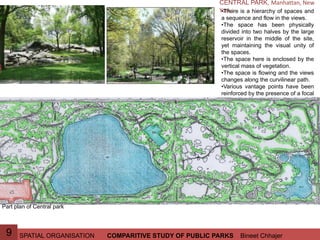
CENTRAL PARK, Manhattan, New
York :โ€ขThere is a hierarchy of spaces and
a sequence and flow in the views.
โ€ขThe space has been physically
divided into two halves by the large
reservoir in the middle of the site,
yet maintaining the visual unity of
the spaces.
โ€ขThe space here is enclosed by the
vertical mass of vegetation.
โ€ขThe space is flowing and the views
changes along the curvilinear path.
โ€ขVarious vantage points have been
reinforced by the presence of a focal
point e.g. the โ€œAngel of watersโ€
fountain.
Part plan of Central park
SPATIAL ORGANISATION Bineet ChhajerCOMPARITIVE STUDY OF PUBLIC PARKS
Lake
10
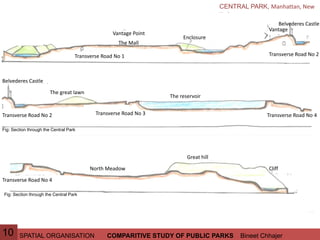
Fig: Section through the Central Park
CENTRAL PARK, Manhattan, New
York :
Transverse Road No 1
the
The Mall
Vantage Point
Enclosure
Vantage
Belvederes Castle
Transverse Road No 2
Belvederes Castle
The great lawn
The reservoir
Transverse Road No 3 Transverse Road No 4
Transverse Road No 4
North Meadow
Great hill
Cliff
SPATIAL ORGANISATION Bineet ChhajerCOMPARITIVE STUDY OF PUBLIC PARKS
HYDE PARK, Central London,
England:
11
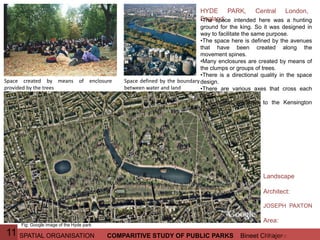
โ€ขThe space intended here was a hunting
ground for the king. So it was designed in
way to facilitate the same purpose.
โ€ขThe space here is defined by the avenues
that have been created along the
movement spines.
โ€ขMany enclosures are created by means of
the clumps or groups of trees.
โ€ขThere is a directional quality in the space
design.
โ€ขThere are various axes that cross each
other.
โ€ขThe space overflows to the Kensington
Gardens.
Fig: Google image of the Hyde park
Space created by means of enclosure
provided by the trees
Space defined by the boundary
between water and land
Landscape
Architect:
JOSEPH PAXTON
Area:
350 acre
SPATIAL ORGANISATION Bineet ChhajerCOMPARITIVE STUDY OF PUBLIC PARKS
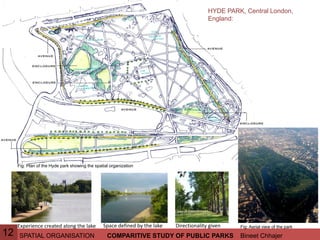
Fig: Plan of the Hyde park showing the spatial organization
12
HYDE PARK, Central London,
England:
Experience created along the lake Space defined by the lake Directionality given Fig: Aerial view of the park
SPATIAL ORGANISATION Bineet ChhajerCOMPARITIVE STUDY OF PUBLIC PARKS13
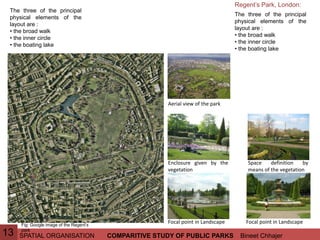
Regentโ€™s Park, London:
Fig: Google image of the Regentโ€™s
park
Aerial view of the park
Enclosure given by the
vegetation
Space definition by
means of the vegetation
Focal point in LandscapeFocal point in Landscape
The three of the principal
physical elements of the
layout are :
โ€ข the broad walk
โ€ข the inner circle
โ€ข the boating lake
The three of the principal
physical elements of the
layout are :
โ€ข the broad walk
โ€ข the inner circle
โ€ข the boating lake
SPATIAL ORGANISATION Bineet ChhajerCOMPARITIVE STUDY OF PUBLIC PARKS
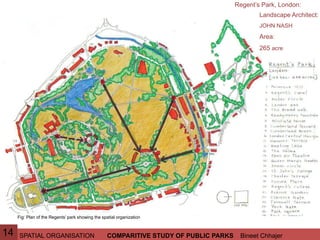
Regentโ€™s Park, London:
Fig: Plan of the Regentsโ€™ park showing the spatial organization
14
Landscape Architect:
JOHN NASH
Area:
265 acre
SPATIAL ORGANISATION Bineet ChhajerCOMPARITIVE STUDY OF PUBLIC PARKS
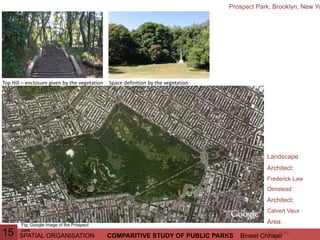
Prospect Park, Brooklyn, New Yo
Fig: Google image of the Prospect
park
15
Landscape
Architect:
Frederick Law
Olmstead
Architect:
Calvert Vaux
Area:
585 acre
Top Hill โ€“ enclosure given by the vegetation Space definition by the vegetation
SPATIAL ORGANISATION Bineet ChhajerCOMPARITIVE STUDY OF PUBLIC PARKS
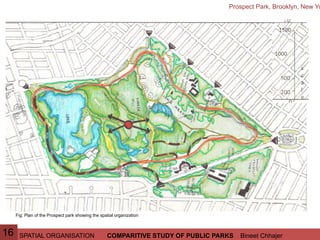
Prospect Park, Brooklyn, New Yo
Fig: Plan of the Prospect park showing the spatial organization
16
SPATIAL ORGANISATION Bineet ChhajerCOMPARITIVE STUDY OF PUBLIC PARKS
Park Buttes Chaumont, Paris:
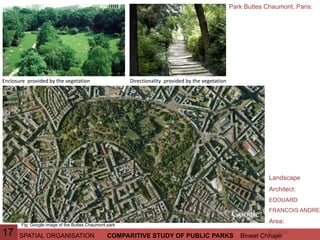
Fig: Google image of the Buttes Chaumont park
17
Landscape
Architect:
EDOUARD
FRANCOIS ANDRE
Area:
61 acre
Directionality provided by the vegetationEnclosure provided by the vegetation
SPATIAL ORGANISATION Bineet ChhajerCOMPARITIVE STUDY OF PUBLIC PARKS
Park Buttes Chaumont, Paris:
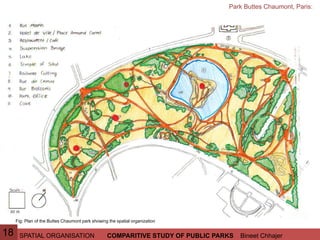
Fig: Plan of the Buttes Chaumont park showing the spatial organization
18
SPATIAL ORGANISATION Bineet ChhajerCOMPARITIVE STUDY OF PUBLIC PARKS
Park De la Villette, Paris:
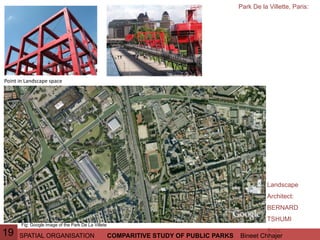
Fig: Google image of the Park De La Villete
19
Landscape
Architect:
BERNARD
TSHUMI
Area:
Point in Landscape space
SPATIAL ORGANISATION Bineet ChhajerCOMPARITIVE STUDY OF PUBLIC PARKS
Park De la Villette, Paris:
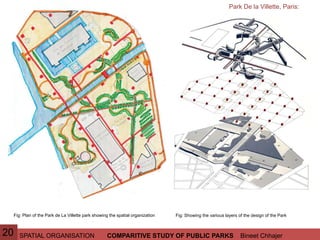
Fig: Plan of the Park de La Villette park showing the spatial organization Fig: Showing the various layers of the design of the Park
20
SPATIAL ORGANISATION Bineet ChhajerCOMPARITIVE STUDY OF PUBLIC PARKS
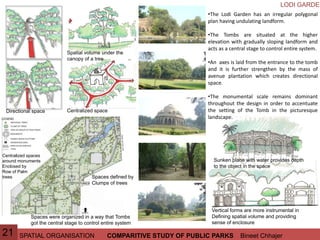
โ€ขThe Lodi Garden has an irregular polygonal
plan having undulating landform.
โ€ขThe Tombs are situated at the higher
elevation with gradually sloping landform and
acts as a central stage to control entire system.
โ€ขAn axes is laid from the entrance to the tomb
and it is further strengthen by the mass of
avenue plantation which creates directional
space.
โ€ขThe monumental scale remains dominant
throughout the design in order to accentuate
the setting of the Tomb in the picturesque
landscape.
LODI GARDEN
Centralized spaces
around monuments
Enclosed by
Row of Palm
trees Spaces defined by
Clumps of trees
Spaces were organized in a way that Tombs
got the central stage to control entire system
Directional space Centralized space
Spatial volume under the
canopy of a tree
Vertical forms are more instrumental in
Defining spatial volume and providing
sense of enclosure
Sunken plane with water provides depth
to the object in the space
21
SPATIAL ORGANISATION Bineet ChhajerCOMPARITIVE STUDY OF PUBLIC PARKS
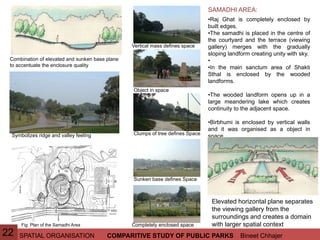
โ€ขRaj Ghat is completely enclosed by
built edges.
โ€ขThe samadhi is placed in the centre of
the courtyard and the terrace (viewing
gallery) merges with the gradually
sloping landform creating unity with sky.
โ€ข
โ€ขIn the main sanctum area of Shakti
Sthal is enclosed by the wooded
landforms.
โ€ขThe wooded landform opens up in a
large meandering lake which creates
continuity to the adjacent space.
โ€ขBirbhumi is enclosed by vertical walls
and it was organised as a object in
space.
SAMADHI AREA:
Elevated horizontal plane separates
the viewing gallery from the
surroundings and creates a domain
with larger spatial contextCompletely enclosed space
Sunken base defines Space
Clumps of tree defines Space
Object in space
Vertical mass defines space
Combination of elevated and sunken base plane
to accentuate the enclosure quality
Symbolizes ridge and valley feeling
Fig: Plan of the Samadhi Area
22

Landscape architecture spatial organisation lecture 3

  • 1.
    SPATIAL ORGANISATION BineetChhajerCOMPARITIVE STUDY OF PUBLIC PARKSCOMPARITIVE STUDY OF PUBLIC PARKS Space can be defined as : โ€ข An area of land enclosed, defined or adopted by people for human purposes.. โ€ขA medium and concept of landscape architecture. โ€ขA place for outdoor activiies. โ€ขAn enclosure. โ€ขThe opposite of โ€œform or massโ€. (source : Form and Fabric in Landscape Architecture โ€“ Catherine Dee) โ€œIt may also be defined as captured, enclosed or molded and organized by solid elements of mass.โ€ (source : Form, Space and Order โ€“ D.K. Ching) Space can be defined in three dimensions by : โ€ขThe base or the ground plane โ€ขWall or vertical planes โ€ขSky or the overhead plane (source : Form and Fabric in Landscape Architecture โ€“ Catherine Dee) For a Horizontal plane to be seen , there must be a perceptible change in texture or color between its surface and the plane upon which it lies. (source : Form, Space and Order โ€“ D.K. Ching) Wall planes may consist of vegetation that is coarsely textured and merges from the ground to an overhead plane. Overhead plane consists of the sky or the ceiling formed by the trees and their canopy. (source : Form and Fabric in Landscape Architecture SPACE: HOW SPACE IS FORMED: 1 Fig: Base plane โ€“ Space definition Fig: Sunken Base plane Fig: Elevated Base plane Fig: Vertical plane Fig: Overhead plane- Sky Fig: Overhead plane- Built Fig: Overhead plane- Vegetation
  • 2.
    SPATIAL ORGANISATION BineetChhajerCOMPARITIVE STUDY OF PUBLIC PARKS The essence of a volume is its quality of implied containment. A space : โ€ข It may be static. It may direct and concentrate interest and vision inward. โ€ขIt may open out. It may direct attention to its frame and beyond. It may fall away or seem to expand. โ€ขIt may be flowing and undulating, suggesting directional movement. โ€ข It may dominate an object or it may be dominated by an object. โ€ขIt may have orientation inward, outward, upward, downward, radial, or tangential. โ€ขIt may be so designed as to stimulate a prescribed emotional reaction or to produce a predetermined sequence of such responses. (source : Landscape Architecture โ€“ J.O Simonds) SPATIAL QUALITY: 2 SPATIAL ORGANISATION: The spaces can be organized in many ways: โ€ขCentralized: a central, dominant space about which a number of secondary spaces are grouped. โ€ขLinear: a linear sequence of repetitive spaces โ€ขRadial: a central space from which linear organizations of space extend in a radial manner. โ€ขClustered: Spaces grouped by proximity or the sharing of a common visual trait or relationship. โ€ขGrid: Spaces organized within the field of Fig: Centralized Fig: Linear Fig: Radial Fig: Clustered Fig: Grid Fig: Enclosure created by landform and the vegetation Fig: Loose Enclosure created by landform Fig: Enclosure created by the built form Fig: visual continuity in the space Fig: visual continuity in the space โ€“ ground plane Fig: visual discontinuity in the space โ€“ eye level Fig: visual continuity in the space โ€“ceiling level Fig: Space formed by vertical elements โ€“ directionality to the space Fig: Claustrophobic environment created by the vertical elements
  • 3.
    SPATIAL ORGANISATION BineetChhajerCOMPARITIVE STUDY OF PUBLIC PARKS3 BIRKENHEAD PARK, England,1847: โ€ขBirkenhead became the first town to react to the new concept for the provision of public open space. โ€ขFree flowing undulating space was created out of swampy low lying land which is seen as 20meters in a fairly uniform slope. โ€ขThe space intended here was the picturesque pastoral meadows defined by the presence of clumps of trees. โ€ขThe landform also defines the space and it facilitated the creation of rolling meadow like parkland but was changed around the lakes and mounds and irregular berms were created which enclosed the space and guided the view. โ€ขThere are various vantage points from where the site can be seen. There is no one definite axis from where the landscape can be experienced. First Public Park: 125 acre of open space enclosed by residential area Enclosure accentuated by earth mounds a Clump of trees above it. Mass of vegetation defining the space while there is no visible organizing lines Grand entrance: an object in the space defining the access to the park
  • 4.
    SPATIAL ORGANISATION BineetChhajerCOMPARITIVE STUDY OF PUBLIC PARKS4 LEGEND: 1.Park Road North 2.Boothby Ground 3.Grand lodge 4.Ashville Road 5.Carriage Road 6.Upper lake 7.Boat house 8.Lower lake 9.Swiss bridge 10. Upper park 11.Lower park 12.Castellated lodge 13.Park Road West 14.Park Road south 15.Italian Lodge 16.Gothic lodge 17.Park Road East BIRKENHEAD PARK, EngN 100 metres Vegetation defining the various enclosure in the park 7.Boat house
  • 5.
    SPATIAL ORGANISATION BineetChhajerCOMPARITIVE STUDY OF PUBLIC PARKS5 100 metres N
  • 6.
    SPATIAL ORGANISATION BineetChhajerCOMPARITIVE STUDY OF PUBLIC PARKS6 Fig: Plan of the Birkenhead Park showing the spatial organization
  • 7.
    SPATIAL ORGANISATION BineetChhajerCOMPARITIVE STUDY OF PUBLIC PARKS7 CENTRAL PARK, Manhattan, New York, 1873: Aerial view of the central Park Vast meadow enclosed by clumps of trees Landscape Architect Frederick Law Olmstea Architect: Calvert Vaux Area: 840 acre Fig: Google image of the Central park
  • 8.
    SPATIAL ORGANISATION BineetChhajerCOMPARITIVE STUDY OF PUBLIC PARKS8 CENTRAL PARK, Manhattan, New York :โ€ขThe space here has been defined by the massive usage of vegetation as a means to enclose, guide view and create experiences. โ€ขThis is an inward looking space and the city is kept out of the park by means of the vegetation- thick boundary plantation. Thus creating a natural setting in the park. โ€ขThe spatial organization was such that it compliments the landform of the site and views were guided. North Part plan of Central park
  • 9.
    SPATIAL ORGANISATION BineetChhajerCOMPARITIVE STUDY OF PUBLIC PARKS9 CENTRAL PARK, Manhattan, New York :โ€ขThere is a hierarchy of spaces and a sequence and flow in the views. โ€ขThe space has been physically divided into two halves by the large reservoir in the middle of the site, yet maintaining the visual unity of the spaces. โ€ขThe space here is enclosed by the vertical mass of vegetation. โ€ขThe space is flowing and the views changes along the curvilinear path. โ€ขVarious vantage points have been reinforced by the presence of a focal point e.g. the โ€œAngel of watersโ€ fountain. Part plan of Central park
  • 10.
    SPATIAL ORGANISATION BineetChhajerCOMPARITIVE STUDY OF PUBLIC PARKS Lake 10 Fig: Section through the Central Park Fig: Section through the Central Park Fig: Section through the Central Park CENTRAL PARK, Manhattan, New York : Transverse Road No 1 the The Mall Vantage Point Enclosure Vantage Belvederes Castle Transverse Road No 2 Transverse Road No 2 Belvederes Castle The great lawn The reservoir Transverse Road No 3 Transverse Road No 4 Transverse Road No 4 North Meadow Great hill Cliff
  • 11.
    SPATIAL ORGANISATION BineetChhajerCOMPARITIVE STUDY OF PUBLIC PARKS HYDE PARK, Central London, England: 11 โ€ขThe space intended here was a hunting ground for the king. So it was designed in way to facilitate the same purpose. โ€ขThe space here is defined by the avenues that have been created along the movement spines. โ€ขMany enclosures are created by means of the clumps or groups of trees. โ€ขThere is a directional quality in the space design. โ€ขThere are various axes that cross each other. โ€ขThe space overflows to the Kensington Gardens. Fig: Google image of the Hyde park Space created by means of enclosure provided by the trees Space defined by the boundary between water and land Landscape Architect: JOSEPH PAXTON Area: 350 acre
  • 12.
    SPATIAL ORGANISATION BineetChhajerCOMPARITIVE STUDY OF PUBLIC PARKS Fig: Plan of the Hyde park showing the spatial organization 12 HYDE PARK, Central London, England: Experience created along the lake Space defined by the lake Directionality given Fig: Aerial view of the park
  • 13.
    SPATIAL ORGANISATION BineetChhajerCOMPARITIVE STUDY OF PUBLIC PARKS13 Regentโ€™s Park, London: Fig: Google image of the Regentโ€™s park Aerial view of the park Enclosure given by the vegetation Space definition by means of the vegetation Focal point in LandscapeFocal point in Landscape The three of the principal physical elements of the layout are : โ€ข the broad walk โ€ข the inner circle โ€ข the boating lake The three of the principal physical elements of the layout are : โ€ข the broad walk โ€ข the inner circle โ€ข the boating lake
  • 14.
    SPATIAL ORGANISATION BineetChhajerCOMPARITIVE STUDY OF PUBLIC PARKS Regentโ€™s Park, London: Fig: Plan of the Regentsโ€™ park showing the spatial organization 14 Landscape Architect: JOHN NASH Area: 265 acre
  • 15.
    SPATIAL ORGANISATION BineetChhajerCOMPARITIVE STUDY OF PUBLIC PARKS Prospect Park, Brooklyn, New Yo Fig: Google image of the Prospect park 15 Landscape Architect: Frederick Law Olmstead Architect: Calvert Vaux Area: 585 acre Top Hill โ€“ enclosure given by the vegetation Space definition by the vegetation
  • 16.
    SPATIAL ORGANISATION BineetChhajerCOMPARITIVE STUDY OF PUBLIC PARKS Prospect Park, Brooklyn, New Yo Fig: Plan of the Prospect park showing the spatial organization 16
  • 17.
    SPATIAL ORGANISATION BineetChhajerCOMPARITIVE STUDY OF PUBLIC PARKS Park Buttes Chaumont, Paris: Fig: Google image of the Buttes Chaumont park 17 Landscape Architect: EDOUARD FRANCOIS ANDRE Area: 61 acre Directionality provided by the vegetationEnclosure provided by the vegetation
  • 18.
    SPATIAL ORGANISATION BineetChhajerCOMPARITIVE STUDY OF PUBLIC PARKS Park Buttes Chaumont, Paris: Fig: Plan of the Buttes Chaumont park showing the spatial organization 18
  • 19.
    SPATIAL ORGANISATION BineetChhajerCOMPARITIVE STUDY OF PUBLIC PARKS Park De la Villette, Paris: Fig: Google image of the Park De La Villete 19 Landscape Architect: BERNARD TSHUMI Area: Point in Landscape space
  • 20.
    SPATIAL ORGANISATION BineetChhajerCOMPARITIVE STUDY OF PUBLIC PARKS Park De la Villette, Paris: Fig: Plan of the Park de La Villette park showing the spatial organization Fig: Showing the various layers of the design of the Park 20
  • 21.
    SPATIAL ORGANISATION BineetChhajerCOMPARITIVE STUDY OF PUBLIC PARKS โ€ขThe Lodi Garden has an irregular polygonal plan having undulating landform. โ€ขThe Tombs are situated at the higher elevation with gradually sloping landform and acts as a central stage to control entire system. โ€ขAn axes is laid from the entrance to the tomb and it is further strengthen by the mass of avenue plantation which creates directional space. โ€ขThe monumental scale remains dominant throughout the design in order to accentuate the setting of the Tomb in the picturesque landscape. LODI GARDEN Centralized spaces around monuments Enclosed by Row of Palm trees Spaces defined by Clumps of trees Spaces were organized in a way that Tombs got the central stage to control entire system Directional space Centralized space Spatial volume under the canopy of a tree Vertical forms are more instrumental in Defining spatial volume and providing sense of enclosure Sunken plane with water provides depth to the object in the space 21
  • 22.
    SPATIAL ORGANISATION BineetChhajerCOMPARITIVE STUDY OF PUBLIC PARKS โ€ขRaj Ghat is completely enclosed by built edges. โ€ขThe samadhi is placed in the centre of the courtyard and the terrace (viewing gallery) merges with the gradually sloping landform creating unity with sky. โ€ข โ€ขIn the main sanctum area of Shakti Sthal is enclosed by the wooded landforms. โ€ขThe wooded landform opens up in a large meandering lake which creates continuity to the adjacent space. โ€ขBirbhumi is enclosed by vertical walls and it was organised as a object in space. SAMADHI AREA: Elevated horizontal plane separates the viewing gallery from the surroundings and creates a domain with larger spatial contextCompletely enclosed space Sunken base defines Space Clumps of tree defines Space Object in space Vertical mass defines space Combination of elevated and sunken base plane to accentuate the enclosure quality Symbolizes ridge and valley feeling Fig: Plan of the Samadhi Area 22