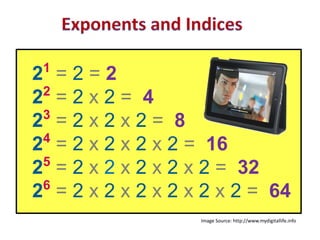
1
2 =2=2
 2
2 =2x2= 4
 3
2 =2x2x2= 8
 4
2 = 2 x 2 x 2 x 2 = 16
 5
2 = 2 x 2 x 2 x 2 x 2 = 32
 6
2 = 2 x 2 x 2 x 2 x 2 x 2 = 64
                   Image Source: http://www.mydigitallife.info
What do you notice about the numbers:

       2, 4, 8, 16, 32, 64
- They are all computer memory and storage
  numbers, like 16 Gig, 32 Gig, 64 Gig on an iPad.

    Power of 2 exponents are the basis of
    all computing which is done in “Binary”
    or base 2 numbers like these.
“Exponents”, “Indices”, “Powers”, and “Indexes” are all
 descriptions of the exact same thing.

They are all a shorthand way of writing multiplications
of the same item several times.

32 means three multiplied by itself two times:

32 = 3 x 3 = 9         ( The 3 is multiplied out twice).

32 does not mean 3 x 2 = 6

  ( 3 x 2 means 2 lots of 3, or 3 + 3, and does not = 3 x 3 )
53 means five multiplied by itself three times:

53 = 5 x 5 x 5 = 25 x 5 = 125
     three of them


34 means three multiplied by itself four times:

34 = 3 x 3 x 3 x 3 = 9 x 9 = 81
        four of them


25 means two multiplied by itself five times:

25 = 2 x 2 x 2 x 2 x 2 = 8 x 4 = 32
          five of them
The little number “2” is called the
                          “Index” or “Power” and tells us
                          how many times to multiply out
                          the big number “5”


The big number “5” is called the “base”
and is what we multiply together

             2
           5 = 5 x 5 = 25
                 Multiply two of them
Powers of Two are called “SQUARES”,
because they form the area of squares.

                            3
 2
1    =   1x1   = 1
22   =   2x2   = 4
 2
3    =   3x3   = 9                 3
42   =   4x4   = 16
52   =   5x5   = 25
 2
6    =   6x6   = 36   Area = 3 x 3 = 9
72   =   7x7   = 49
Powers of Three are called “CUBES”,
because they form the volume of cubes.
                            3
13 = 1 x 1 x 1 = 1
23 = 2 x 2 x 2 = 8
 3                                 3
3 = 3 x 3 x 3 = 27
43 = 4 x 4 x 4 = 64
53 = 5 x 5 x 5 = 125      3
                  Volume = 3 x 3 x 3 = 27
2
         5 = 5 x 5 = 25

 5   2
         is called “Index Form”

5 x 5 is called “Expanded Form”

 25       is called “Numerical Form”
Write the “Index Form” and then Multiply out the
values to get the “Numerical Form” answer.

   1) 4 x 4 = _____ = _____

   2) 3 x 3 x 3 = _____ = _____

   3) 2 x 2 x 2 x 2 x 2 = _____ = _____

   4) 5 = ____ = _____
The “Base” is the number we are multiplying.
The “Index” or “Power” is the little number that
tells us how many multiplies we are doing.

   1) 4 x 4 = 42 = 16

   2) 3 x 3 x 3 = 33 = 27

   3) 2 x 2 x 2 x 2 x 2 = 25 = 32

   4) 5 = 51 = 5    Any Number to Power of 1 = the Number
The Index Power of Zero works out like this:

Subtract 1
             23 = 2 x 2 x 2 = 8
                                            Divide by 2
from Power
             22 = 2 x 2 = 4
Subtract 1
from Power                        Divide by 2
             21 = 2 = 2
Subtract 1
                              Divide by 2
from Power   20 = 1

  Any Number to the Power of Zero Equals 1 : a0 = 1
Write the “Expanded Form”, and then Multiply out
the values to get the “Numerical Form” answer.

   1) 34 = ___________________ = ____

   2) 80 = special rule = ___

   3) 24 = ____________________ = ____

   4) 7831 = just one 783 = _______
To get “Expanded Form”, we Multiply out the big
Base the number of times the little index digit tells
us to. We can then work out the number answer.

   1) 34 = 3 x 3 x 3 x 3 = 81

   2) 80 = “special rule” = 1

   3) 24 = 2 x 2 x 2 x 2 = 16

   4) 7831 = just one 783 = 783
Algebra Exponents with letters as bases are done
the exact same way as number exponents.

   1) m4 = m x m x m x m

   2) k0 = “special rule” = 1

   3) (bh)2 = bh x bh = b x b x h x h = b2 h2

   4) y1 = just one y = y
It is important never to get the following mixed up

   Multiplication involves a group of Additions


              3n = n + n + n
    Powers involve a group of Multiplications

                 3
              n =nxnxn
http://passyworldofmathematics.com

   Visit our site for Free Mathematics PowerPoints

Basic Exponents and Indices

  • 1.
    1 2 =2=2 2 2=2x2= 4 3 2 =2x2x2= 8 4 2 = 2 x 2 x 2 x 2 = 16 5 2 = 2 x 2 x 2 x 2 x 2 = 32 6 2 = 2 x 2 x 2 x 2 x 2 x 2 = 64 Image Source: http://www.mydigitallife.info
  • 2.
    What do younotice about the numbers: 2, 4, 8, 16, 32, 64 - They are all computer memory and storage numbers, like 16 Gig, 32 Gig, 64 Gig on an iPad. Power of 2 exponents are the basis of all computing which is done in “Binary” or base 2 numbers like these.
  • 3.
    “Exponents”, “Indices”, “Powers”,and “Indexes” are all descriptions of the exact same thing. They are all a shorthand way of writing multiplications of the same item several times. 32 means three multiplied by itself two times: 32 = 3 x 3 = 9 ( The 3 is multiplied out twice). 32 does not mean 3 x 2 = 6 ( 3 x 2 means 2 lots of 3, or 3 + 3, and does not = 3 x 3 )
  • 4.
    53 means fivemultiplied by itself three times: 53 = 5 x 5 x 5 = 25 x 5 = 125 three of them 34 means three multiplied by itself four times: 34 = 3 x 3 x 3 x 3 = 9 x 9 = 81 four of them 25 means two multiplied by itself five times: 25 = 2 x 2 x 2 x 2 x 2 = 8 x 4 = 32 five of them
  • 5.
    The little number“2” is called the “Index” or “Power” and tells us how many times to multiply out the big number “5” The big number “5” is called the “base” and is what we multiply together 2 5 = 5 x 5 = 25 Multiply two of them
  • 6.
    Powers of Twoare called “SQUARES”, because they form the area of squares. 3 2 1 = 1x1 = 1 22 = 2x2 = 4 2 3 = 3x3 = 9 3 42 = 4x4 = 16 52 = 5x5 = 25 2 6 = 6x6 = 36 Area = 3 x 3 = 9 72 = 7x7 = 49
  • 7.
    Powers of Threeare called “CUBES”, because they form the volume of cubes. 3 13 = 1 x 1 x 1 = 1 23 = 2 x 2 x 2 = 8 3 3 3 = 3 x 3 x 3 = 27 43 = 4 x 4 x 4 = 64 53 = 5 x 5 x 5 = 125 3 Volume = 3 x 3 x 3 = 27
  • 8.
    2 5 = 5 x 5 = 25 5 2 is called “Index Form” 5 x 5 is called “Expanded Form” 25 is called “Numerical Form”
  • 9.
    Write the “IndexForm” and then Multiply out the values to get the “Numerical Form” answer. 1) 4 x 4 = _____ = _____ 2) 3 x 3 x 3 = _____ = _____ 3) 2 x 2 x 2 x 2 x 2 = _____ = _____ 4) 5 = ____ = _____
  • 10.
    The “Base” isthe number we are multiplying. The “Index” or “Power” is the little number that tells us how many multiplies we are doing. 1) 4 x 4 = 42 = 16 2) 3 x 3 x 3 = 33 = 27 3) 2 x 2 x 2 x 2 x 2 = 25 = 32 4) 5 = 51 = 5 Any Number to Power of 1 = the Number
  • 11.
    The Index Powerof Zero works out like this: Subtract 1 23 = 2 x 2 x 2 = 8 Divide by 2 from Power 22 = 2 x 2 = 4 Subtract 1 from Power Divide by 2 21 = 2 = 2 Subtract 1 Divide by 2 from Power 20 = 1 Any Number to the Power of Zero Equals 1 : a0 = 1
  • 12.
    Write the “ExpandedForm”, and then Multiply out the values to get the “Numerical Form” answer. 1) 34 = ___________________ = ____ 2) 80 = special rule = ___ 3) 24 = ____________________ = ____ 4) 7831 = just one 783 = _______
  • 13.
    To get “ExpandedForm”, we Multiply out the big Base the number of times the little index digit tells us to. We can then work out the number answer. 1) 34 = 3 x 3 x 3 x 3 = 81 2) 80 = “special rule” = 1 3) 24 = 2 x 2 x 2 x 2 = 16 4) 7831 = just one 783 = 783
  • 14.
    Algebra Exponents withletters as bases are done the exact same way as number exponents. 1) m4 = m x m x m x m 2) k0 = “special rule” = 1 3) (bh)2 = bh x bh = b x b x h x h = b2 h2 4) y1 = just one y = y
  • 15.
    It is importantnever to get the following mixed up Multiplication involves a group of Additions 3n = n + n + n Powers involve a group of Multiplications 3 n =nxnxn
  • 16.
    http://passyworldofmathematics.com Visit our site for Free Mathematics PowerPoints