Cloud Native Patterns
Bilgin Ibryam (@bibryam), Architect, Red Hat
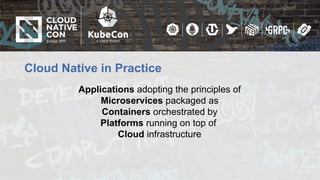
Cloud Native in Practice
Applications adopting the principles of
Microservices packaged as
Containers orchestrated by
Platforms running on top of
Cloud infrastructure
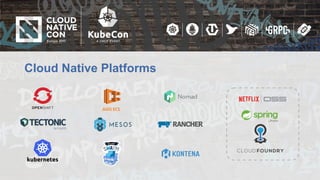
Cloud Native Platforms
Common Abstractions and Primitives
Application packaging (Container)
Deployment unit (Pod)
Declarative update/rollback (Deployment)
Application placement (Scheduler)
Artifact grouping (Label)
Resources isolation (Container/Namespace)
Service discovery & load balancing (Service)
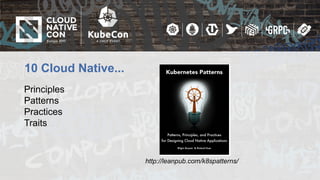
10 Cloud Native...
Principles
Patterns
Practices
Traits
http://leanpub.com/k8spatterns/
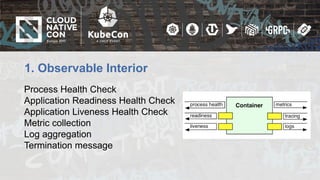
1. Observable Interior
Process Health Check
Application Readiness Health Check
Application Liveness Health Check
Metric collection
Log aggregation
Termination message
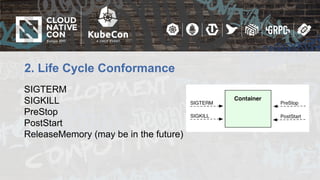
2. Life Cycle Conformance
SIGTERM
SIGKILL
PreStop
PostStart
ReleaseMemory (may be in the future)
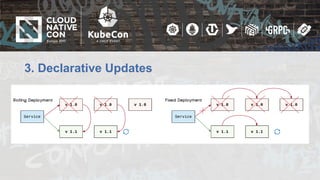
3. Declarative Updates
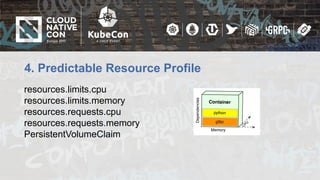
4. Predictable Resource Profile
resources.limits.cpu
resources.limits.memory
resources.requests.cpu
resources.requests.memory
PersistentVolumeClaim
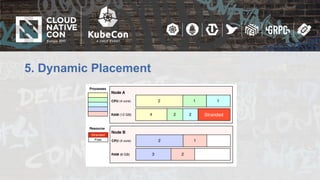
5. Dynamic Placement
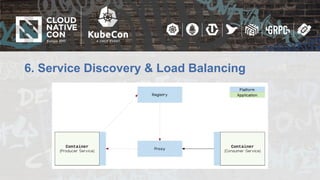
6. Service Discovery & Load Balancing
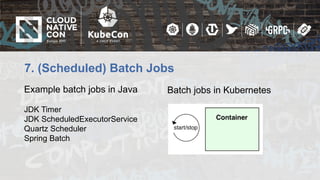
7. (Scheduled) Batch Jobs
Example batch jobs in Java
JDK Timer
JDK ScheduledExecutorService
Quartz Scheduler
Spring Batch
Batch jobs in Kubernetes
8. Clustered Services
How to run a single HA instance of a service? → Pod with 1 replica
How to initialize an application with custom steps? → Init Containers
How to run a process on every node? → DaemonSet
How to manage a stateful service? → StatefulSet
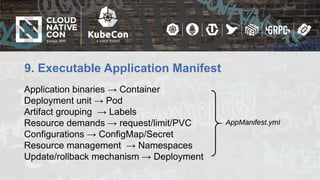
9. Executable Application Manifest
Application binaries → Container
Deployment unit → Pod
Artifact grouping → Labels
Resource demands → request/limit/PVC
Configurations → ConfigMap/Secret
Resource management → Namespaces
Update/rollback mechanism → Deployment
10. In Summary
1. Let the platform automate your routine tasks.
(placement, updates, healthchecks, self-healing, auto-scaling)
2. Move XFR/NFR from your application to the platform.
(service discovery, job mgmt, config mgmt, log aggregation, metric collection, etc)
3. Allow Developers to focus on the business domain.
(show creativity and talent to create great domain designs, hidden behind beautiful APIs)

Cloud Native Patterns

  • 1.
    Cloud Native Patterns BilginIbryam (@bibryam), Architect, Red Hat
  • 2.
    Cloud Native inPractice Applications adopting the principles of Microservices packaged as Containers orchestrated by Platforms running on top of Cloud infrastructure
  • 3.
  • 4.
    Common Abstractions andPrimitives Application packaging (Container) Deployment unit (Pod) Declarative update/rollback (Deployment) Application placement (Scheduler) Artifact grouping (Label) Resources isolation (Container/Namespace) Service discovery & load balancing (Service)
  • 5.
  • 6.
    1. Observable Interior ProcessHealth Check Application Readiness Health Check Application Liveness Health Check Metric collection Log aggregation Termination message
  • 7.
    2. Life CycleConformance SIGTERM SIGKILL PreStop PostStart ReleaseMemory (may be in the future)
  • 8.
  • 9.
    4. Predictable ResourceProfile resources.limits.cpu resources.limits.memory resources.requests.cpu resources.requests.memory PersistentVolumeClaim
  • 10.
  • 11.
    6. Service Discovery& Load Balancing
  • 12.
    7. (Scheduled) BatchJobs Example batch jobs in Java JDK Timer JDK ScheduledExecutorService Quartz Scheduler Spring Batch Batch jobs in Kubernetes
  • 13.
    8. Clustered Services Howto run a single HA instance of a service? → Pod with 1 replica How to initialize an application with custom steps? → Init Containers How to run a process on every node? → DaemonSet How to manage a stateful service? → StatefulSet
  • 14.
    9. Executable ApplicationManifest Application binaries → Container Deployment unit → Pod Artifact grouping → Labels Resource demands → request/limit/PVC Configurations → ConfigMap/Secret Resource management → Namespaces Update/rollback mechanism → Deployment
  • 15.
    10. In Summary 1.Let the platform automate your routine tasks. (placement, updates, healthchecks, self-healing, auto-scaling) 2. Move XFR/NFR from your application to the platform. (service discovery, job mgmt, config mgmt, log aggregation, metric collection, etc) 3. Allow Developers to focus on the business domain. (show creativity and talent to create great domain designs, hidden behind beautiful APIs)