Cloud Native
Camel Design Patterns
(Tips for Running Apache Camel on Kubernetes)
ApacheCon Europe
November 2016
Bilgin Ibryam
Cloud Native Camel Design Patterns2
Bilgin Ibryam
● Senior Middleware Architect at Red Hat UK
● Apache Isis Committer and PMC member
● Apache Camel Committer and PMC member
● Apache OFBiz Committer and PMC member
● Author of Camel Design Patterns (new)
● Author of Apache Camel Message Routing
● Twitter: @bibryam
● Email: bibryam@gmail.com
● Blog: http://ofbizian.com
● LinkedIn: http://www.linkedin.com/in/bibryam
Cloud Native Camel Design Patterns3
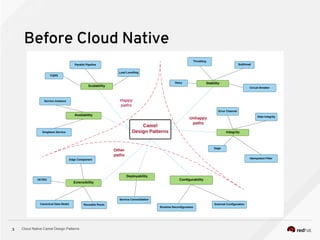
Before Cloud Native
Cloud Native Camel Design Patterns4
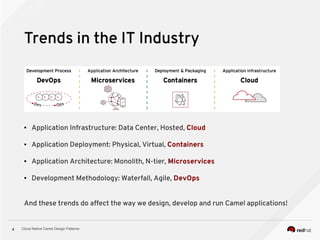
Trends in the IT Industry
● Application Infrastructure: Data Center, Hosted, Cloud
● Application Deployment: Physical, Virtual, Containers
● Application Architecture: Monolith, N-tier, Microservices
● Development Methodology: Waterfall, Agile, DevOps
And these trends do affect the way we design, develop and run Camel applications!
Cloud Native Camel Design Patterns5
What is Cloud Native?
A cloud-native application is a distributed application that runs on a cloud
infrastructure and is in its core scalable and resilient.
● Web-scale – originated from large cloud firms, such as Google, Amazon, Netflix, FB.
● The twelve-factor apps - a methodology for building apps for the Heroku platform.
● 13 factor apps, 14 factor apps – 12 is not enough, nor is 13...
● Cloud-aware or Cloud-ready – cannot benefit from all characteristics of the cloud.
● Cloud native – a marketing term used by Cloud Foundry.
● Cloud Native Computing Foundation - https://cncf.io - part of the Linux Foundation.
Cloud Native Camel Design Patterns6
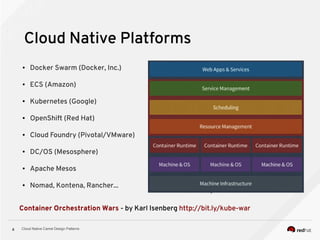
Cloud Native Platforms
Container Orchestration Wars - by Karl Isenberg http://bit.ly/kube-war
● Docker Swarm (Docker, Inc.)
● ECS (Amazon)
● Kubernetes (Google)
● OpenShift (Red Hat)
● Cloud Foundry (Pivotal/VMware)
● DC/OS (Mesosphere)
● Apache Mesos
● Nomad, Kontena, Rancher...
Scheduling
● Placement/Resurrection
● Replication/Scaling
● Upgrades/Downgrades
Resource Management
● Memory/CPU/GPU
● Volumes/IPs/Ports
Service Management
● Labels/Namespaces
● Load Balancing
● Readiness/Liveness
Cloud Native Camel Design Patterns7
Why Kubernetes?
Portable, extensible, self-healing, platform for automating deployment,
scaling, and operations of containers.
● Technology - based on Google's Borg project
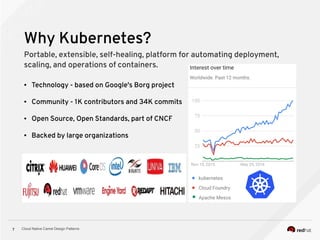
● Community - 1K contributors and 34K commits
● Open Source, Open Standards, part of CNCF
● Backed by large organizations
Cloud Native Camel Design Patterns8
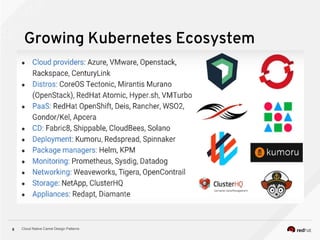
Growing Kubernetes Ecosystem
● Cloud providers: Azure, VMware, Openstack, Rackspace, CenturyLink
● Distros:
● Community - with 1,000-plus contributors and 34,000 commits -- more than
four times those of nearest rival Mesos.
● Open Source, Open Standards, donated to CNCF
●
Cloud Native Camel Design Patterns9
How to run Kubernetes
● Installing from scratch – kubeadm with some manual configuration
● Kops sub project – production grade Kubernetes on AWS
● Kubernetes Anywhere – GCE/AWS/Azure installation
● Google Container Engine – self service Kubernetes clusters
● OpenShift by Red Hat – managed Kubernetes & PAYG options
● 3rd
party service providers - @StackPointCloud, @AppsCodeHQ, @kclusterio
● Local machine – VM, Vagrant, minikube start
● Java devs - mvn fabric8:cluster-start (No Docker, VirtualBox or Vagrant required!)
Cloud Native Camel Design Patterns10
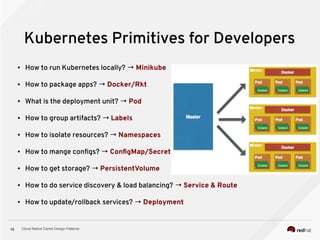
Kubernetes Primitives for Developers
● How to run Kubernetes locally? → Minikube
● How to package apps? → Docker/Rkt
● What is the deployment unit? → Pod
● How to group artifacts? → Labels
● How to isolate resources? → Namespaces
● How to mange configs? → ConfigMap/Secret
● How to get storage? → PersistentVolume
● How to do service discovery & load balancing? → Service & Route
● How to update/rollback services? → Deployment
Cloud Native Camel Design Patterns11
Deployment Patterns
Cloud Native Camel Design Patterns12
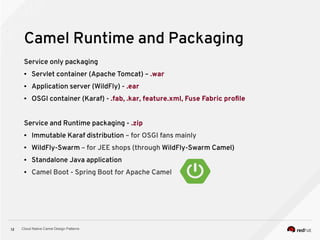
Camel Runtime and Packaging
Service only packaging
● Servlet container (Apache Tomcat) – .war
● Application server (WildFly) - .ear
● OSGI container (Karaf) - .fab, .kar, feature.xml, Fuse Fabric profile
Service and Runtime packaging - .zip
● Immutable Karaf distribution – for OSGI fans mainly
● WildFly-Swarm – for JEE shops (through WildFly-Swarm Camel)
● Standalone Java application
● Camel Boot - Spring Boot for Apache Camel
Cloud Native Camel Design Patterns13
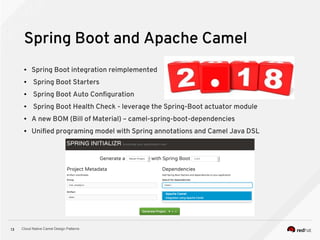
Spring Boot and Apache Camel
● Spring Boot integration reimplemented
● Spring Boot Starters
● Spring Boot Auto Configuration
● Spring Boot Health Check - leverage the Spring-Boot actuator module
● A new BOM (Bill of Material) – camel-spring-boot-dependencies
● Unified programing model with Spring annotations and Camel Java DSL
Cloud Native Camel Design Patterns14
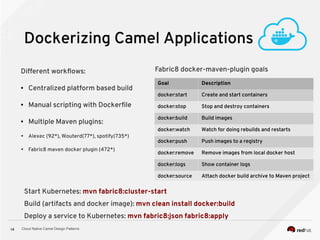
Dockerizing Camel Applications
Goal Description
docker:start Create and start containers
docker:stop Stop and destroy containers
docker:build Build images
docker:watch Watch for doing rebuilds and restarts
docker:push Push images to a registry
docker:remove Remove images from local docker host
docker:logs Show container logs
docker:source Attach docker build archive to Maven project
Start Kubernetes: mvn fabric8:cluster-start
Build (artifacts and docker image): mvn clean install docker:build
Deploy a service to Kubernetes: mvn fabric8:json fabric8:apply
Different workflows:
● Centralized platform based build
● Manual scripting with Dockerfile
● Multiple Maven plugins:
➔ Alexec (92*), Wouterd(77*), spotify(735*)
➔ Fabric8 maven docker plugin (472*)
Fabric8 docker-maven-plugin goals
Cloud Native Camel Design Patterns15
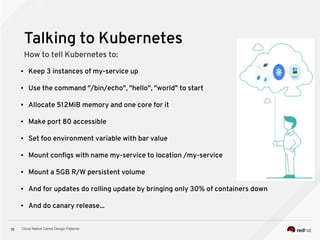
Talking to Kubernetes
How to tell Kubernetes to:
● Keep 3 instances of my-service up
● Use the command "/bin/echo", "hello", "world" to start
● Allocate 512MiB memory and one core for it
● Make port 80 accessible
● Set foo environment variable with bar value
● Mount configs with name my-service to location /my-service
● Mount a 5GB R/W persistent volume
● And for updates do rolling update by bringing only 30% of containers down
● And do canary release...
Cloud Native Camel Design Patterns16
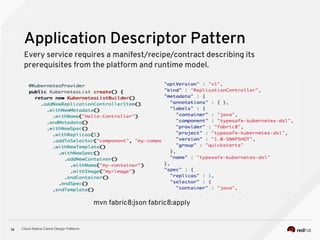
Application Descriptor Pattern
Every service requires a manifest/recipe/contract describing its
prerequisites from the platform and runtime model.
mvn fabric8:json fabric8:apply
Cloud Native Camel Design Patterns17
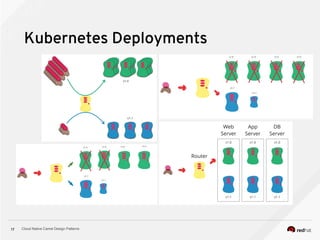
Kubernetes Deployments
Cloud Native Camel Design Patterns18
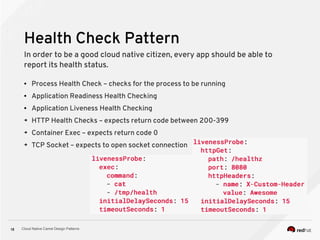
Health Check Pattern
In order to be a good cloud native citizen, every app should be able to
report its health status.
● Process Health Check – checks for the process to be running
● Application Readiness Health Checking
● Application Liveness Health Checking
➔ HTTP Health Checks – expects return code between 200-399
➔ Container Exec – expects return code 0
➔ TCP Socket – expects to open socket connection
Cloud Native Camel Design Patterns19
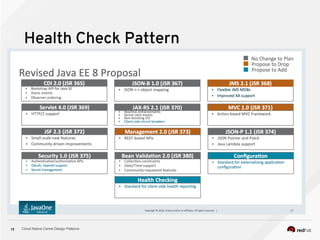
Health Check Pattern
Cloud Native Camel Design Patterns20
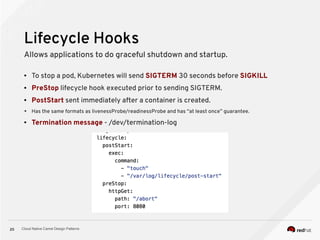
Lifecycle Hooks
Allows applications to do graceful shutdown and startup.
● To stop a pod, Kubernetes will send SIGTERM 30 seconds before SIGKILL
● PreStop lifecycle hook executed prior to sending SIGTERM.
● PostStart sent immediately after a container is created.
➔ Has the same formats as livenessProbe/readinessProbe and has “at least once” guarantee.
● Termination message - /dev/termination-log
Cloud Native Camel Design Patterns21
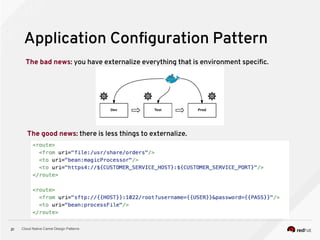
Application Configuration Pattern
The bad news: you have externalize everything that is environment specific.
The good news: there is less things to externalize.
Cloud Native Camel Design Patterns22
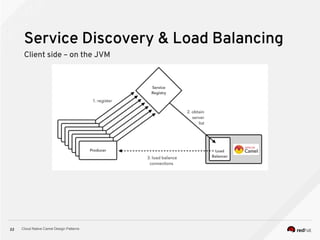
Service Discovery & Load Balancing
Client side – on the JVM
Cloud Native Camel Design Patterns23
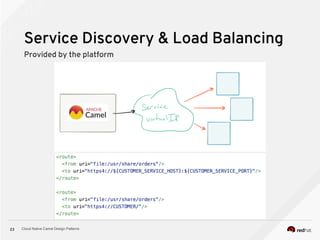
Service Discovery & Load Balancing
Provided by the platform
Cloud Native Camel Design Patterns24
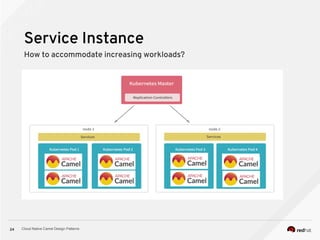
Service Instance
How to accommodate increasing workloads?
Cloud Native Camel Design Patterns25
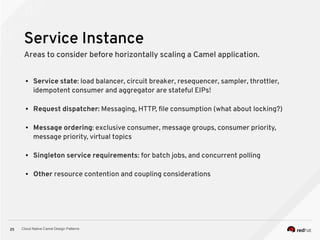
Service Instance
Areas to consider before horizontally scaling a Camel application.
● Service state: load balancer, circuit breaker, resequencer, sampler, throttler,
idempotent consumer and aggregator are stateful EIPs!
● Request dispatcher: Messaging, HTTP, file consumption (what about locking?)
● Message ordering: exclusive consumer, message groups, consumer priority,
message priority, virtual topics
● Singleton service requirements: for batch jobs, and concurrent polling
● Other resource contention and coupling considerations
Cloud Native Camel Design Patterns26
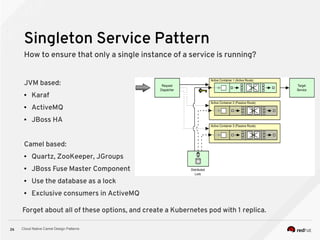
Singleton Service Pattern
How to ensure that only a single instance of a service is running?
JVM based:
● Karaf
● ActiveMQ
● JBoss HA
Camel based:
● Quartz, ZooKeeper, JGroups
● JBoss Fuse Master Component
● Use the database as a lock
● Exclusive consumers in ActiveMQ
Forget about all of these options, and create a Kubernetes pod with 1 replica.
Cloud Native Camel Design Patterns27
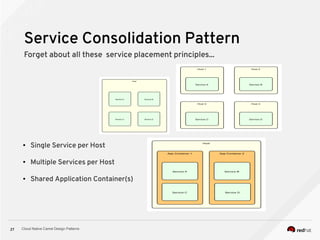
Service Consolidation Pattern
Forget about all these service placement principles...
● Single Service per Host
● Multiple Services per Host
● Shared Application Container(s)
Cloud Native Camel Design Patterns28
Service Consolidation Pattern
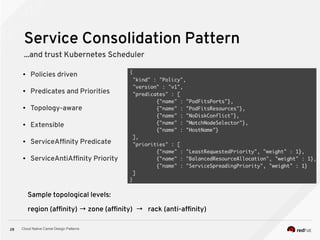
...and trust Kubernetes Scheduler
● Policies driven
● Predicates and Priorities
● Topology-aware
● Extensible
● ServiceAffinity Predicate
● ServiceAntiAffinity Priority
Sample topological levels:
region (affinity) → zone (affinity) → rack (anti-affinity)
Cloud Native Camel Design Patterns29
Error Handling Patterns
Cloud Native Camel Design Patterns30
Circuit Breaker Pattern
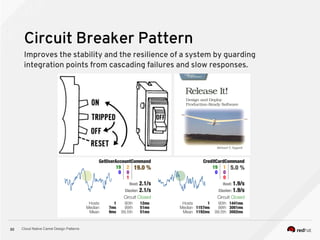
Improves the stability and the resilience of a system by guarding
integration points from cascading failures and slow responses.
Cloud Native Camel Design Patterns31
Circuit Breaker Pattern
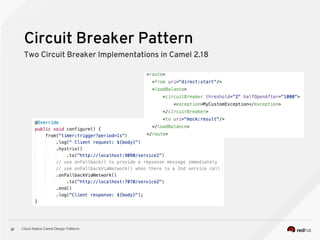
Two Circuit Breaker Implementations in Camel 2.18

Cloud Native Camel Design Patterns32
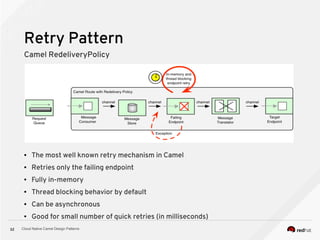
Retry Pattern
Camel RedeliveryPolicy
● The most well known retry mechanism in Camel
● Retries only the failing endpoint
● Fully in-memory
● Thread blocking behavior by default
● Can be asynchronous
● Good for small number of quick retries (in milliseconds)
Cloud Native Camel Design Patterns33
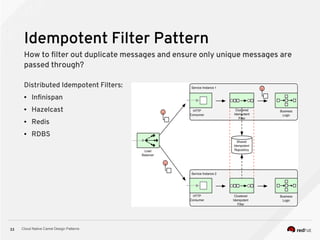
Idempotent Filter Pattern
How to filter out duplicate messages and ensure only unique messages are
passed through?
Distributed Idempotent Filters:
● Infinispan
● Hazelcast
● Redis
● RDBS
Cloud Native Camel Design Patterns34
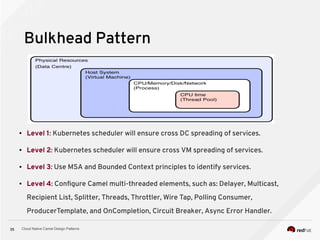
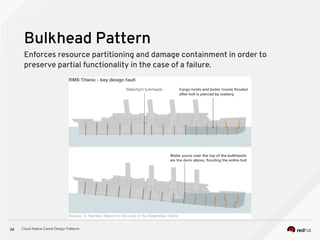
Bulkhead Pattern
Enforces resource partitioning and damage containment in order to
preserve partial functionality in the case of a failure.
Cloud Native Camel Design Patterns35
Bulkhead Pattern
● Level 1: Kubernetes scheduler will ensure cross DC spreading of services.
● Level 2: Kubernetes scheduler will ensure cross VM spreading of services.
● Level 3: Use MSA and Bounded Context principles to identify services.
● Level 4: Configure Camel multi-threaded elements, such as: Delayer, Multicast,
Recipient List, Splitter, Threads, Throttler, Wire Tap, Polling Consumer,
ProducerTemplate, and OnCompletion, Circuit Breaker, Async Error Handler.
Cloud Native Camel Design Patterns36
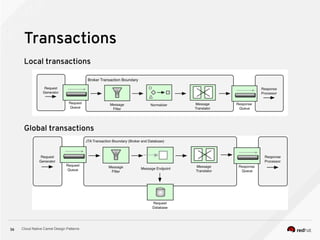
Transactions
Local transactions
Global transactions
Cloud Native Camel Design Patterns37
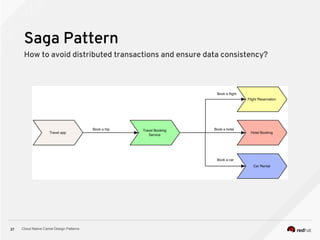
Saga Pattern
How to avoid distributed transactions and ensure data consistency?
Cloud Native Camel Design Patterns38
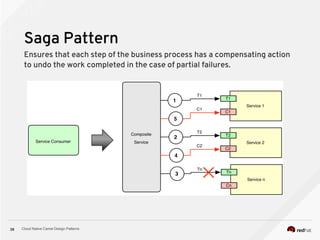
Saga Pattern
Ensures that each step of the business process has a compensating action
to undo the work completed in the case of partial failures.
Cloud Native Camel Design Patterns39
New Patterns
Cloud Native Camel Design Patterns40
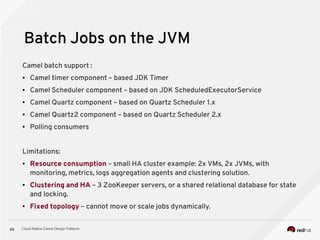
Batch Jobs on the JVM
Camel batch support :
● Camel timer component – based JDK Timer
● Camel Scheduler component – based on JDK ScheduledExecutorService
● Camel Quartz component – based on Quartz Scheduler 1.x
● Camel Quartz2 component – based on Quartz Scheduler 2.x
● Polling consumers
Limitations:
● Resource consumption – small HA cluster example: 2x VMs, 2x JVMs, with
monitoring, metrics, logs aggregation agents and clustering solution.
● Clustering and HA – 3 ZooKeeper servers, or a shared relational database for state
and locking.
● Fixed topology – cannot move or scale jobs dynamically.
Cloud Native Camel Design Patterns41
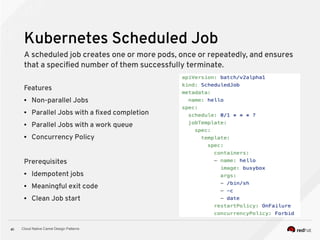
Kubernetes Scheduled Job
Features
● Non-parallel Jobs
● Parallel Jobs with a fixed completion
● Parallel Jobs with a work queue
● Concurrency Policy
Prerequisites
● Idempotent jobs
● Meaningful exit code
● Clean Job start
A scheduled job creates one or more pods, once or repeatedly, and ensures
that a specified number of them successfully terminate.
Cloud Native Camel Design Patterns42
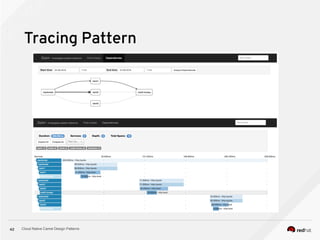
Tracing Pattern
Cloud Native Camel Design Patterns43
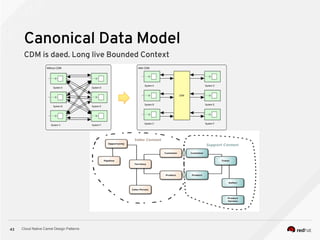
Canonical Data Model
CDM is daed. Long live Bounded Context
Cloud Native Camel Design Patterns44
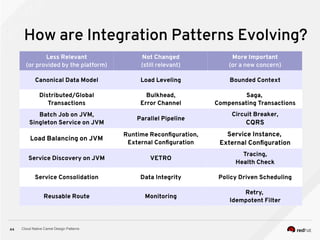
How are Integration Patterns Evolving?
Less Relevant
(or provided by the platform)
Not Changed
(still relevant)
More Important
(or a new concern)
Canonical Data Model Load Leveling Bounded Context
Distributed/Global
Transactions
Bulkhead,
Error Channel
Saga,
Compensating Transactions
Batch Job on JVM,
Singleton Service on JVM
Parallel Pipeline
Circuit Breaker,
CQRS
Load Balancing on JVM
Runtime Reconfiguration,
External Configuration
Service Instance,
External Configuration
Service Discovery on JVM VETRO
Tracing,
Health Check
Service Consolidation Data Integrity Policy Driven Scheduling
Reusable Route Monitoring
Retry,
Idempotent Filter
Cloud Native Camel Design Patterns45
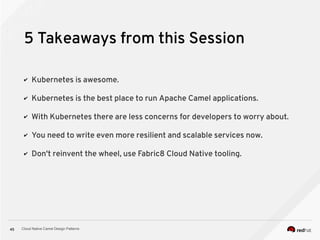
5 Takeaways from this Session
✔ Kubernetes is awesome.
✔ Kubernetes is the best place to run Apache Camel applications.
✔ With Kubernetes there are less concerns for developers to worry about.
✔ You need to write even more resilient and scalable services now.
✔ Don't reinvent the wheel, use Fabric8 Cloud Native tooling.
Q & A
@bibryam
Kubernetes http://kubernetes.io/
Fabric8 https://fabric8.io/
Camel Design Patterns http://bit.ly/camel-patterns/

Cloud Native Camel Design Patterns

  • 1.
    Cloud Native Camel DesignPatterns (Tips for Running Apache Camel on Kubernetes) ApacheCon Europe November 2016 Bilgin Ibryam
  • 2.
    Cloud Native CamelDesign Patterns2 Bilgin Ibryam ● Senior Middleware Architect at Red Hat UK ● Apache Isis Committer and PMC member ● Apache Camel Committer and PMC member ● Apache OFBiz Committer and PMC member ● Author of Camel Design Patterns (new) ● Author of Apache Camel Message Routing ● Twitter: @bibryam ● Email: bibryam@gmail.com ● Blog: http://ofbizian.com ● LinkedIn: http://www.linkedin.com/in/bibryam
  • 3.
    Cloud Native CamelDesign Patterns3 Before Cloud Native
  • 4.
    Cloud Native CamelDesign Patterns4 Trends in the IT Industry ● Application Infrastructure: Data Center, Hosted, Cloud ● Application Deployment: Physical, Virtual, Containers ● Application Architecture: Monolith, N-tier, Microservices ● Development Methodology: Waterfall, Agile, DevOps And these trends do affect the way we design, develop and run Camel applications!
  • 5.
    Cloud Native CamelDesign Patterns5 What is Cloud Native? A cloud-native application is a distributed application that runs on a cloud infrastructure and is in its core scalable and resilient. ● Web-scale – originated from large cloud firms, such as Google, Amazon, Netflix, FB. ● The twelve-factor apps - a methodology for building apps for the Heroku platform. ● 13 factor apps, 14 factor apps – 12 is not enough, nor is 13... ● Cloud-aware or Cloud-ready – cannot benefit from all characteristics of the cloud. ● Cloud native – a marketing term used by Cloud Foundry. ● Cloud Native Computing Foundation - https://cncf.io - part of the Linux Foundation.
  • 6.
    Cloud Native CamelDesign Patterns6 Cloud Native Platforms Container Orchestration Wars - by Karl Isenberg http://bit.ly/kube-war ● Docker Swarm (Docker, Inc.) ● ECS (Amazon) ● Kubernetes (Google) ● OpenShift (Red Hat) ● Cloud Foundry (Pivotal/VMware) ● DC/OS (Mesosphere) ● Apache Mesos ● Nomad, Kontena, Rancher... Scheduling ● Placement/Resurrection ● Replication/Scaling ● Upgrades/Downgrades Resource Management ● Memory/CPU/GPU ● Volumes/IPs/Ports Service Management ● Labels/Namespaces ● Load Balancing ● Readiness/Liveness
  • 7.
    Cloud Native CamelDesign Patterns7 Why Kubernetes? Portable, extensible, self-healing, platform for automating deployment, scaling, and operations of containers. ● Technology - based on Google's Borg project ● Community - 1K contributors and 34K commits ● Open Source, Open Standards, part of CNCF ● Backed by large organizations
  • 8.
    Cloud Native CamelDesign Patterns8 Growing Kubernetes Ecosystem ● Cloud providers: Azure, VMware, Openstack, Rackspace, CenturyLink ● Distros: ● Community - with 1,000-plus contributors and 34,000 commits -- more than four times those of nearest rival Mesos. ● Open Source, Open Standards, donated to CNCF ●
  • 9.
    Cloud Native CamelDesign Patterns9 How to run Kubernetes ● Installing from scratch – kubeadm with some manual configuration ● Kops sub project – production grade Kubernetes on AWS ● Kubernetes Anywhere – GCE/AWS/Azure installation ● Google Container Engine – self service Kubernetes clusters ● OpenShift by Red Hat – managed Kubernetes & PAYG options ● 3rd party service providers - @StackPointCloud, @AppsCodeHQ, @kclusterio ● Local machine – VM, Vagrant, minikube start ● Java devs - mvn fabric8:cluster-start (No Docker, VirtualBox or Vagrant required!)
  • 10.
    Cloud Native CamelDesign Patterns10 Kubernetes Primitives for Developers ● How to run Kubernetes locally? → Minikube ● How to package apps? → Docker/Rkt ● What is the deployment unit? → Pod ● How to group artifacts? → Labels ● How to isolate resources? → Namespaces ● How to mange configs? → ConfigMap/Secret ● How to get storage? → PersistentVolume ● How to do service discovery & load balancing? → Service & Route ● How to update/rollback services? → Deployment
  • 11.
    Cloud Native CamelDesign Patterns11 Deployment Patterns
  • 12.
    Cloud Native CamelDesign Patterns12 Camel Runtime and Packaging Service only packaging ● Servlet container (Apache Tomcat) – .war ● Application server (WildFly) - .ear ● OSGI container (Karaf) - .fab, .kar, feature.xml, Fuse Fabric profile Service and Runtime packaging - .zip ● Immutable Karaf distribution – for OSGI fans mainly ● WildFly-Swarm – for JEE shops (through WildFly-Swarm Camel) ● Standalone Java application ● Camel Boot - Spring Boot for Apache Camel
  • 13.
    Cloud Native CamelDesign Patterns13 Spring Boot and Apache Camel ● Spring Boot integration reimplemented ● Spring Boot Starters ● Spring Boot Auto Configuration ● Spring Boot Health Check - leverage the Spring-Boot actuator module ● A new BOM (Bill of Material) – camel-spring-boot-dependencies ● Unified programing model with Spring annotations and Camel Java DSL
  • 14.
    Cloud Native CamelDesign Patterns14 Dockerizing Camel Applications Goal Description docker:start Create and start containers docker:stop Stop and destroy containers docker:build Build images docker:watch Watch for doing rebuilds and restarts docker:push Push images to a registry docker:remove Remove images from local docker host docker:logs Show container logs docker:source Attach docker build archive to Maven project Start Kubernetes: mvn fabric8:cluster-start Build (artifacts and docker image): mvn clean install docker:build Deploy a service to Kubernetes: mvn fabric8:json fabric8:apply Different workflows: ● Centralized platform based build ● Manual scripting with Dockerfile ● Multiple Maven plugins: ➔ Alexec (92*), Wouterd(77*), spotify(735*) ➔ Fabric8 maven docker plugin (472*) Fabric8 docker-maven-plugin goals
  • 15.
    Cloud Native CamelDesign Patterns15 Talking to Kubernetes How to tell Kubernetes to: ● Keep 3 instances of my-service up ● Use the command "/bin/echo", "hello", "world" to start ● Allocate 512MiB memory and one core for it ● Make port 80 accessible ● Set foo environment variable with bar value ● Mount configs with name my-service to location /my-service ● Mount a 5GB R/W persistent volume ● And for updates do rolling update by bringing only 30% of containers down ● And do canary release...
  • 16.
    Cloud Native CamelDesign Patterns16 Application Descriptor Pattern Every service requires a manifest/recipe/contract describing its prerequisites from the platform and runtime model. mvn fabric8:json fabric8:apply
  • 17.
    Cloud Native CamelDesign Patterns17 Kubernetes Deployments
  • 18.
    Cloud Native CamelDesign Patterns18 Health Check Pattern In order to be a good cloud native citizen, every app should be able to report its health status. ● Process Health Check – checks for the process to be running ● Application Readiness Health Checking ● Application Liveness Health Checking ➔ HTTP Health Checks – expects return code between 200-399 ➔ Container Exec – expects return code 0 ➔ TCP Socket – expects to open socket connection
  • 19.
    Cloud Native CamelDesign Patterns19 Health Check Pattern
  • 20.
    Cloud Native CamelDesign Patterns20 Lifecycle Hooks Allows applications to do graceful shutdown and startup. ● To stop a pod, Kubernetes will send SIGTERM 30 seconds before SIGKILL ● PreStop lifecycle hook executed prior to sending SIGTERM. ● PostStart sent immediately after a container is created. ➔ Has the same formats as livenessProbe/readinessProbe and has “at least once” guarantee. ● Termination message - /dev/termination-log
  • 21.
    Cloud Native CamelDesign Patterns21 Application Configuration Pattern The bad news: you have externalize everything that is environment specific. The good news: there is less things to externalize.
  • 22.
    Cloud Native CamelDesign Patterns22 Service Discovery & Load Balancing Client side – on the JVM
  • 23.
    Cloud Native CamelDesign Patterns23 Service Discovery & Load Balancing Provided by the platform
  • 24.
    Cloud Native CamelDesign Patterns24 Service Instance How to accommodate increasing workloads?
  • 25.
    Cloud Native CamelDesign Patterns25 Service Instance Areas to consider before horizontally scaling a Camel application. ● Service state: load balancer, circuit breaker, resequencer, sampler, throttler, idempotent consumer and aggregator are stateful EIPs! ● Request dispatcher: Messaging, HTTP, file consumption (what about locking?) ● Message ordering: exclusive consumer, message groups, consumer priority, message priority, virtual topics ● Singleton service requirements: for batch jobs, and concurrent polling ● Other resource contention and coupling considerations
  • 26.
    Cloud Native CamelDesign Patterns26 Singleton Service Pattern How to ensure that only a single instance of a service is running? JVM based: ● Karaf ● ActiveMQ ● JBoss HA Camel based: ● Quartz, ZooKeeper, JGroups ● JBoss Fuse Master Component ● Use the database as a lock ● Exclusive consumers in ActiveMQ Forget about all of these options, and create a Kubernetes pod with 1 replica.
  • 27.
    Cloud Native CamelDesign Patterns27 Service Consolidation Pattern Forget about all these service placement principles... ● Single Service per Host ● Multiple Services per Host ● Shared Application Container(s)
  • 28.
    Cloud Native CamelDesign Patterns28 Service Consolidation Pattern ...and trust Kubernetes Scheduler ● Policies driven ● Predicates and Priorities ● Topology-aware ● Extensible ● ServiceAffinity Predicate ● ServiceAntiAffinity Priority Sample topological levels: region (affinity) → zone (affinity) → rack (anti-affinity)
  • 29.
    Cloud Native CamelDesign Patterns29 Error Handling Patterns
  • 30.
    Cloud Native CamelDesign Patterns30 Circuit Breaker Pattern Improves the stability and the resilience of a system by guarding integration points from cascading failures and slow responses.
  • 31.
    Cloud Native CamelDesign Patterns31 Circuit Breaker Pattern Two Circuit Breaker Implementations in Camel 2.18

  • 32.
    Cloud Native CamelDesign Patterns32 Retry Pattern Camel RedeliveryPolicy ● The most well known retry mechanism in Camel ● Retries only the failing endpoint ● Fully in-memory ● Thread blocking behavior by default ● Can be asynchronous ● Good for small number of quick retries (in milliseconds)
  • 33.
    Cloud Native CamelDesign Patterns33 Idempotent Filter Pattern How to filter out duplicate messages and ensure only unique messages are passed through? Distributed Idempotent Filters: ● Infinispan ● Hazelcast ● Redis ● RDBS
  • 34.
    Cloud Native CamelDesign Patterns34 Bulkhead Pattern Enforces resource partitioning and damage containment in order to preserve partial functionality in the case of a failure.
  • 35.
    Cloud Native CamelDesign Patterns35 Bulkhead Pattern ● Level 1: Kubernetes scheduler will ensure cross DC spreading of services. ● Level 2: Kubernetes scheduler will ensure cross VM spreading of services. ● Level 3: Use MSA and Bounded Context principles to identify services. ● Level 4: Configure Camel multi-threaded elements, such as: Delayer, Multicast, Recipient List, Splitter, Threads, Throttler, Wire Tap, Polling Consumer, ProducerTemplate, and OnCompletion, Circuit Breaker, Async Error Handler.
  • 36.
    Cloud Native CamelDesign Patterns36 Transactions Local transactions Global transactions
  • 37.
    Cloud Native CamelDesign Patterns37 Saga Pattern How to avoid distributed transactions and ensure data consistency?
  • 38.
    Cloud Native CamelDesign Patterns38 Saga Pattern Ensures that each step of the business process has a compensating action to undo the work completed in the case of partial failures.
  • 39.
    Cloud Native CamelDesign Patterns39 New Patterns
  • 40.
    Cloud Native CamelDesign Patterns40 Batch Jobs on the JVM Camel batch support : ● Camel timer component – based JDK Timer ● Camel Scheduler component – based on JDK ScheduledExecutorService ● Camel Quartz component – based on Quartz Scheduler 1.x ● Camel Quartz2 component – based on Quartz Scheduler 2.x ● Polling consumers Limitations: ● Resource consumption – small HA cluster example: 2x VMs, 2x JVMs, with monitoring, metrics, logs aggregation agents and clustering solution. ● Clustering and HA – 3 ZooKeeper servers, or a shared relational database for state and locking. ● Fixed topology – cannot move or scale jobs dynamically.
  • 41.
    Cloud Native CamelDesign Patterns41 Kubernetes Scheduled Job Features ● Non-parallel Jobs ● Parallel Jobs with a fixed completion ● Parallel Jobs with a work queue ● Concurrency Policy Prerequisites ● Idempotent jobs ● Meaningful exit code ● Clean Job start A scheduled job creates one or more pods, once or repeatedly, and ensures that a specified number of them successfully terminate.
  • 42.
    Cloud Native CamelDesign Patterns42 Tracing Pattern
  • 43.
    Cloud Native CamelDesign Patterns43 Canonical Data Model CDM is daed. Long live Bounded Context
  • 44.
    Cloud Native CamelDesign Patterns44 How are Integration Patterns Evolving? Less Relevant (or provided by the platform) Not Changed (still relevant) More Important (or a new concern) Canonical Data Model Load Leveling Bounded Context Distributed/Global Transactions Bulkhead, Error Channel Saga, Compensating Transactions Batch Job on JVM, Singleton Service on JVM Parallel Pipeline Circuit Breaker, CQRS Load Balancing on JVM Runtime Reconfiguration, External Configuration Service Instance, External Configuration Service Discovery on JVM VETRO Tracing, Health Check Service Consolidation Data Integrity Policy Driven Scheduling Reusable Route Monitoring Retry, Idempotent Filter
  • 45.
    Cloud Native CamelDesign Patterns45 5 Takeaways from this Session ✔ Kubernetes is awesome. ✔ Kubernetes is the best place to run Apache Camel applications. ✔ With Kubernetes there are less concerns for developers to worry about. ✔ You need to write even more resilient and scalable services now. ✔ Don't reinvent the wheel, use Fabric8 Cloud Native tooling.
  • 46.
    Q & A @bibryam Kuberneteshttp://kubernetes.io/ Fabric8 https://fabric8.io/ Camel Design Patterns http://bit.ly/camel-patterns/