The Growing Complexities and
Challenges of Sol!d Wa$te
Management in Jamaica- Searching
for a Sol!d Wa$te Management
Solution.
MR. PERCIVAL STEWART

PE, MJIE, MSc Civil Engineering,
MSc Environmental Science, Dipl. Solid Waste Management.
DIRECTOR OF OPERATIONS,
THE NATIONAL SOLID WASTE MANAGEMENT AUTHORITY
OVERVIEW
What is solid waste and solid waste management?
 History of solid waste management in Jamaica.
 Collection systems and methodologies.
 How is solid waste financed?
 The Parks and Markets Limited.
 Act of 2001- functions and responsibilities of the NSWMA.
 Challenges to Solid Waste Management.
 Components of Integrated Solid Waste Management.
 The economics of solid waste management
 Searching for a Renewable Energy Solution

WHAT IS SOLID WASTE?


Solid Waste means any garbage,
refuse, sludge from a waste water
treatment plant, water supply
treatment plant, air pollution control
facility and other discarded materials
including solid, liquid, semi solid or
contained gaseous material, resulting
from
industrial,
commercial,
agricultural and mining operations
and from community activities but
does not include solid or dissolved
materials in domestic sewage or solid
or dissolved materials in irrigation
returns flow or industrial discharges.
WHAT IS SOLID WASTE MANAGEMENT?
o

o

o

Solid Waste Management is the collection, transport,
processing, recycling or disposal, and monitoring of waste
materials.
Currently, Jamaica generates approximately 778,471.5
tons of wastes per year, 2012. This is projected to reach
xxxx by 2013 and xxxx by 2020.
Future projections estimate that the world’s
waste production could reach up to 27 billion
tons by 2050.
HISTORY THE SOLID WASTE MANAGEMENT IN
JAMAICA


The Ministry of Local Government and Community
Development, then the Ministry of Local Government, Youth
and Community Development, had the responsibility for the
formulation of a Solid Waste Management Policy.



The Parish Councils/Local Authorities by law had the
responsibility for Solid Waste Management at the parish/local
level.



As a result of this, for many years the Parish Council and the
Kingston & St Andrew Corporation (KSAC) had the
responsibility of solid waste management at the parish level.
HISTORY CONT’D
o

Since colonial days, solid waste in Jamaica has been collected by the
Public Cleansing Departments of the parish councils - a very expensive
and inefficient process.



In the 1980’s five (5) Parks & Markets Companies were created to carry
out solid waste management functions, which includes collection,
transportation and disposal.



Until 1985, Solid Waste Management was controlled by public cleansing
departments of the Parish Councils



In 1986 & 1987 the government divested local government of its
responsibility of solid waste management.



These companies were also responsible for the maintenance of markets
and public parks.
TRANSFER OF RESPONSIBILITY


The legislation for transfer of
responsibility from the Parish
Councils to the Parks and
Markets Agencies was never
established and the 1990’s
saw
the
responsibility
reverting to the Parish
Councils with the Parks and
Markets operating as their
agents.

Company

Parishes Served

Metropolitan Parks St Catherine,
& Markets
Kingston & St
Andrew, St
Thomas

Southern Parks &
Markets

Manchester, St
Elizabeth,
Westmoreland

Western Parks &
Markets

Hanover, St
James, Trelawny

North Eastern
Parks & Markets

St Ann, St Mary,
Portland
DISPOSAL SITES IN JAMAICA


Jamaica has no sanitary landfills but unofficially small
dumpsites across the island and over the years there
has been a reduction from twenty-six (26).



The number of such sites have been reduced to as
little as eight (8), this was due to sanitation and
environmental problems.



Also, these dumps did not had the benefit of
appropriate equipment or sufficient funding for
adequate management to be sustained.
COLLECTION SYSTEMS & METHODOLOGIES
Then
Dumping
locations

at

Curbside Collection
Yard Collection

Recent
designated Skip Containers
Shared Containers

Presently
House-to-House collection
Skip/Community Containers
Shared Containers
Curbside Pick-Up
Self Delivered
Contracted Service
HOW IS SOLID WASTE MANAGEMENT FINANCED??
Funding for solid waste management has primarily come from
property taxes and from Central Government Grants.
THE PARKS AND MARKETS LTD.


The largest of these Parks and Gardens companies is MPM,
50 per cent of the solid waste generated in the country is
attributed to the Kingston Metropolitan Area (KMA).



Having solid-waste collection and management under five
separate entities was inefficient and fragmented, in 2001, the
National Solid Waste Management Act was passed. It
replaced the Anti-Litter Act of 1985. The new act established
an agency of the same name - the National Solid Waste
Management Authority (NSWMA) - as the primary body
responsible for solid waste management in Jamaica.
THE NATIONAL SOLID WASTE MANAGEMENT ACT
OF 2001


The National Solid Waste Management Act 2001, has led to the
establishment of a new entity called the National Solid Waste
Management Authority (NSWMA) as a statutory body, to manage the
collection, treatment and disposal of solid waste in Jamaica.



This Agency subsumes all the Parks and Markets Companies that were
previously existed namely:







Metropolitan Parks and Markets Ltd
Southern Parks and Markets Ltd
North-Eastern Parks and Markets Ltd
Western Parks and Markets Ltd.
Central Parks and Markets
FUNCTIONS OF THE NSWMA









To safeguard public health and the environment
Ensuring solid waste is collected, stored, transported,
recycled, reused or disposed of in an environmentally sound
manner.
Enforcing the National Solid Waste Management Act 2001, to
guarantee full compliance.
To effectively manage solid waste in all ways and forms
throughout the entire island on an everyday basis, the
Authority also acts in times of national disasters or
emergencies.
Promote public awareness through public education.
RESPONSIBILITIES OF THE NSWMA
1. Establishing the standards and criteria that must be
attained by operators in the solid waste sector.
2. Licensing of solid waste companies, collection vehicles
and disposal site operators.

3. Contracting solid waste collectors for municipal garbage
collection.
4. Establishing collection zones in collaboration with the
Parish Councils, the Kingston and St. Andrew Corporation
(KSAC) and the Town Planning Authority.
RESPONSIBILITIES CONT’D
5. Establishing tipping fees structures and rates for
industrial and large commercial entities disposing of
waste at the approved disposal sites, and
6. Operating solid waste disposal sites in the medium
term while preparing them for divestment to the
private sector.

7. Any other matter under the Act required to be
prescribed
THE REGULATORY FRAMEWORK


Licensing of companies to collect and transport
types of waste.

all



Licensing trucks to collect and transport waste.



Tipping fees structures and rates.



Standards for storage containers, collection vehicles,
disposal site and transfer stations
operations
and
recycling.



Developing fines for illegal dumping and littering.
THEN AND NOW……SOLID WASTE MANAGEMENT


At Independence, Jamaica's solid waste was piled on the
surface of garbage dumps.



Today, we speak of landfills because its the new approach to tip
some garbage, spread, compact, cover it with soil, add compact
again.



Landfills are a vast improvement over dumps, but they are not
without their own problems. They are expensive to operate
properly: hundreds of truckloads of soil have to be brought in,
and heavy earth-moving equipment has to be bought, or hired,
to move it around.
BEST PRACTICES IN WASTE MANAGEMENT






Compacting of wastes
Recycling/Recovery
Composting
Transfer Stations
House to house collection
CHALLENGES TO SOLID WASTE MANAGEMENT
Due to financial constraints the Authority finds it difficult to:
 Adequately and effectively manage its disposal sites.
 To frequently undertake covering of landfills.
 Maintain landfill equipment to reduce downtime.
 One of the major challenges of waste management is
created by the ever increasing volume of waste that is
generated and the new varieties of goods that are
discarded.
 Dumps poorly located around the country;
 Uncontrolled scavenging;
CHALLENGES TO SOLID WASTE MANAGEMENT

CONT’D

Inadequate budgetary allocation by Central
Government to the responsible line ministry
 Inappropriate and inadequate vehicular
equipment
 Inadequate management of hazardous waste
 Low public education and awareness of
SWM issues
 Populations underserved with collection
service
Other problems on the landfill includes but not limited to  Frequent Landfill Fires.

SOLID WASTE AND CLIMATE CHANGE…


Landfills provide ideal conditions for methanogenesis.



Solid waste affects climate change through the emission of
landfill gas – methane, which is well known to be a powerful
greenhouse gas and so contributes towards climate change.



The source of manmade methane gas is from landfills which
occurs when organic waste is left to decay anareobically.



Significant landfill gas production starts 1-2 years after waste
disposal and continues for up to 10-60 years or longer (EPA)
LANDFILL GASES - PRODUCTION PHASES

Figure 1. Production phases of a Landfill

Source: EPA
LANDFILL FIRES
Landfill bacteria breaks down
trash in the absence of oxygen. A
byproduct of this breakdown is
landfill gas, containing mainly
methane and CO2
o

This presents a fire hazard as
methane can explode/ burn. If this gas
remains in the landfill it can easily be
set ablaze.
o

o Also,

there are persons who will
deliberately set landfill fires.
Over the years, the most dominant
landfill to be set ablaze is the Riverton
landfill.
o
STORM WATER CALCULATION
Engineering calculations justifying the size
of the
proposed storm water drainage works:
Percolation equivalent = 100mm per month
-3
Hydraulic conductivity of KD=10 m/s
Bottom of landfill slope 1:50 distance between
pipes = 100m
2

h max = L/2 [(tan a +N/KD) 0.5 – tan a]
STORM WATER CALCULATION CON’T
Where :
KD = 1.10-3 m/s
N= 100mm/month, i.e. 3.86 x10⁻⁸ m 3/(m2 x s)
L=100m
Tan a= 0.02
hmax=100/2x[ (0.022 x 3.86x10-8) 0.5 -0.02]

hmax=0.05
RATIONAL METHOD FOR LEACHATE PRODUCTION
Assumption:
Average precipitation (I) = 272 mm/year
Average transpiration (E) = 136mm/year
Calculation:
Q=Q1+ Q2= I/1000x(C1xA1=C2xA2)
Q= the leachate production (m3/year)
Q1=the leachate production from the part of
the landfill still in use (m3/year)
LEACHATE PRODUCTION CONT’D
Q2= the leachate production from the part of
the landfill not in use (m3/year)
A1= the area of the part of the landfill still in
use (m2/year)
A2= the area of the part of the landfill not in
use (m2/year)
LEACHATE COLLECTION FOR RIVERTON
Calculation of the leachate coefficient for the uncovered
part of the landfill:
C1= 1-E/I= 1-136/272=1-0.5=0.5
Calculation of the leachate coefficient for the
covered part
of the landfill:
C2=0.6xC1=0.6x0.5=0.3
Leachate production:
Q=Q1+ Q2= I/1000x (C1xA1=C2xA2)
Q= 272/1000x (0.5x28+0.3x0)
Q=0.272 (0.5x280, 000 + 0.3x0)
Q= 0.272 (140,000)
Q= 38,080 (m3/year)
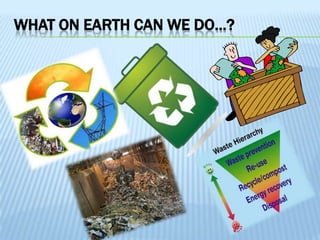
WHAT ON EARTH CAN WE DO…?
WHAT IS INTEGRATED SOLID WASTE
MANAGEMENT?


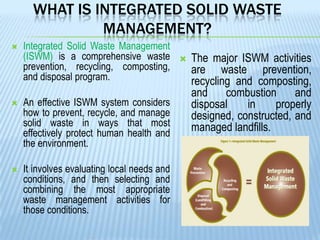
Integrated Solid Waste Management
(ISWM) is a comprehensive waste
prevention, recycling, composting,
and disposal program.



An effective ISWM system considers
how to prevent, recycle, and manage
solid waste in ways that most
effectively protect human health and
the environment.



It involves evaluating local needs and
conditions, and then selecting and
combining the most appropriate
waste management activities for
those conditions.



The major ISWM activities
are waste prevention,
recycling and composting,
and
combustion
and
disposal
in
properly
designed, constructed, and
managed landfills.
RECYCLING, A GREAT POSSIBILITY
Four problems that would be solved:
1. Less money will be spent cleaning the streets and other
public places of plastic waste.
2. Less money would be spent on contracting garbage trucks
to transport plastic waste.
3.Less solid waste would end up at landfills, requiring less soil
to cover it, and fewer tractors would be needed and millions
of dollars would be saved in the process.
4. There would be an opportunity for the private sector to get
involved in solid-waste processing and management.
Charging a refundable deposit on plastics can reduce the
tonnage of garbage trucked to the landfill.
WASTE PREVENTION
 Waste

prevention is often called source reduction

which means reducing waste by not producing it.


Waste prevention actually avoids waste generation, it is
the preferred waste management activity.



Overall, waste prevention conserves resources,
protects the environment, and prevents the formation of
greenhouse gases.
COMPOSTING






This is the controlled aerobic biological decomposition of
organic matter, such as food scraps and plant matter, into
humus, a soil-like material.
Compost acts as a natural fertilizer by providing nutrients to the
soil, increasing beneficial soil organisms, and suppressing
certain plant diseases, thereby reducing the need for chemical
fertilizers and pesticides in landscaping and agricultural
activities.
Organic materials often comprise a large portion of the solid
waste stream. Composting can be particularly helpful to
communities managing their waste.
COMBUSTION


Combustion is the controlled burning of waste in a
designated facility to reduce its volume and, in some
cases, to generate electricity.



Combustion is an ISWM option for wastes that cannot
be recycled or composted, useful where landfill space
is limited. While the combustion process can generate
toxic air emissions, these can be controlled by installing
control equipments.



Combustion of solid waste can help reduce amount of
waste going to landfills.
LANDFILLING: LAST RESORT


Presently, most of Jamaica’s waste is landfilled.



Uncontrolled dumping of waste can contaminate
groundwater and soil, attract disease carrying rats and
insects, and even cause fires.



This method can have problems however, properly
designed, constructed, and managed landfills provide a
safe alternative to uncontrolled dumping.
STRATEGIC PLANS













Upgrading
disposal
sites
islandwide.
Designing a series of Regional
Landfills & a network of Transfer
Stations.
Improving Service Delivery
islandwide.
Developing ways to reduce waste
generation.
Public Education Programme.
Training of Landfill personnel.
Increasing fines and breaches









Reviewed existing collection
systems
islandwide
and
establishing
new
collection
system
The establishment and operation
of regional transfer stations to
reduce fuel costs.
Taking all necessary enforcement
steps to guarantee compliance
adherence to all established
systems.
Taking initiative for proposals for
solid waste management.
THE ECONOMICS OF SOLID WASTE MANAGEMENT


Scrap metal exports from Jamaica moved
from US$13.3 million in 2005 to US$99.58
million in 2006, registering an increase of
over 600% in one year. (Jamaica Exporters'
Association)



US$14M was registered for 2010 but the
growth rate accelerated in the first half of
2011, with US$14M worth of exports from
January to May alone.
SCRAP METAL EXPORTS IN JAMAICA
Scrap Metal Export,
Jamaica

Figure xx displays the monthly trend from January 2009 to May 2011
ECONOMICS OF RECYCLING PLASTICS IN
JAMAICA



Jamaica currently has no recycling plant, however, the
newly formed Jamaica Recycles, hopes to grow capacity
by 50 per cent over the next two to three years, which
would push the capacity from the current 60,000 tons of
recyclable material per annum.



This would divert 20,000 tons of garbage per year from
the Riverton landfill.



The current cost is US$100 per ton of material.



In less than 8 months since December 2009, more than
32,500 plastic bottles from Caribbean Estates have been
recycled!
LANDFILLS: EXCEEDING THEIR LIFE SPANS


The Riverton waste shed receives the largest
volume of waste and has currently exceeded its
life span/cycle.



Therefore, its of utmost importance that other
efficient waste management solutions be
explored to minimize the volumes of wastes
entering the landfill.



Non-sanitary landfills cause land degradation
as a result of leachates.
A SEARCH FOR RENEWABLE ENERGY SOURCES


The Government of Jamaica has invited relevant persons to
submit requests for proposal via the Office of Utilities
Regulations, in search of finding renewable energy sources.



The Authority, is currently in the process of accepting
proposals to convert waste to energy thus, reducing the
amount of wastes entering into landfills



The OUR has made several changes to its Requests for
Proposals for the supply of up to 115 MW of electricity
generation from Renewable Energy Based Generation facilities
on a Build , Own, Operate (BOO) basis.
WASTE TO ENERGY PROPOSALS


The NSWMA, has approximately twenty (20) unsolicited
proposals for Waste to Energy.



This is an attempt to manage the amount of solid waste
generated daily.



These include technologies such as bio-fuels, managed
recycling facility, refuse derived fuel, gasification, waste rubber
and plastic fuel conversion plants, mass burn and pyrolysis.
WASTE TO ENERGY TECHNOLOGIES
WTE & MUNICIPAL SOLID WASTE


The long-term availability of a cost-effective,
reliable
and
sustainable
solid
waste
management system is an important component
of the infrastructure needed by a local
community to spur economic development.



In this regard, municipal solid waste
management (MSW) systems that utilize wasteto-energy (WTE) facilities to process nonrecycled waste for energy recovery provide a
number of noteworthy economic development
benefits.
GASIFICATION


It is a manufacturing process that converts any material
containing carbon such as coal, petroleum coke (petcoke), or
biomass into synthesis gas (syngas). The syngas can be
burned to produce electricity or further processed to
manufacture chemicals, fertilizers, liquid fuels, substitute
natural gas (SNG), or hydrogen.



Gasification helps reduce our dependence on foreign oil and
natural gas, and can provide a clean alternative source of base
load electricity, fertilizers, fuels, and chemicals.
GASIFICATION PLANT
HOW DOES IT WORK?




Feedstock
:Gasifers
capture the values from a
low-grade
hydrocarbon
materials. Gasifers can be
design to use one or more
of the following feed
stocks-solid, liquid, gas.
Oxygen
Plant:
Most
gasification systems use
oxygen to facilitate the
reaction in the gasifer. The
oxygen is then sent into
the gasifer.
HOW DOES IT WORK?

CONT’D



Gasifer: Before entering the
gasifer solid feedstock are
ground into smaller particles,
while liquid and gasses are fed
directly.



Then a controlled amount of
steam or air enters the gasifer,
temperatures within ranges
from 1,400-2,8000 F. The heat
and pressure break apart the
chemical
bonds
of
the
feedstock forming syngas.



Currently gasifers are capable
of processing up to 3,000 tons
of feed stock per day,
converting 70-85% into syngas.
HOW DOES IT WORK?

CONT’D



Gas Clean-up : trace
minerals such as sulpur and
mercury
are
and
unconverted carbon are
removed to very low levels
using processes common to
chemical
and
refining
industries.



Clean Syngas: Before being
used to create power
syngas is cleaned to remove
sulfur, mercury and trace
minerals.
SIGNIFICANT ENVIRONMENTAL BENEFITS


Gasification plants produce
significantly lower quantities
of criteria air pollutants.



Gasification can reduce the
environmental impact of
waste disposal

Gasification
plants
use
significantly less water than
traditional
coal-based
power generation, and can
be designed so they recycle
their
process
water,
discharging none into the
surrounding environment.

Carbon dioxide (CO2) can
be
captured
from
an
industrial gasification plant
using commercially proven
technologies.






Gasification
offers
the
cleanest,
most
efficient
means
of
producing
electricity and the lowest
cost option for capturing
CO2 from power generation



Gasification's
byproducts
are non-hazardous and are
readily marketable
REFUSE DERIVED FUEL


Refuse Derived Fuel is a fuel produced by shredding and
dehydrating municipal solid waste with a waste converter
technology. RDF consists largely of combustible components
of municipal waste such as plastics and biodegradable.



Non-combustible materials such as glass and metals are
removed during the post-treatment processing cycle.



RDF can be used in a variety of ways to produce electricity.
THE PROCESS








Crushing Process -refuse is crushed to the appropriate size for
drying.
Drying Process -high temperature blast dries and deodorizes
refuse
Sorting and Crushing - Process-unsuitable substances for fuel
such as iron and stone are removed, refuse is then crushed to
the appropriate size for forming RDF.
Solidifying Process -additive is supplied to prevent corruption.
Substances are formed to produced high-density and high
strength RDF that is suitable for transportation, storage and
combustion.
REFUSE DERIVED FUEL PLANT
MATERIALS RECOVERY FACILITY
This is a specialized plant that receives, separates and
prepares recyclable materials for marketing to end-user
manufacturers. There are two different types: clean
and dirty MRFs.
 A clean MRF accepts recyclable commingled materials
that have already been separated at the source from
municipal solid waste generated by either residential or
commercial sources.
 A dirty MRF accepts a mixed solid waste stream and
then proceeds to separate out designated recyclable
materials through a combination of manual and
mechanical sorting.

MATERIAL RECOVERY FACILITY
MASS BURN


Mass Burn plants generate electricity and/or steam from waste
by feeding mixed municipal waste into large furnaces
dedicated solely to burning trash and producing power.



This waste management method avoids the expensive and
unpleasant task of sorting through the garbage for unburnable
materials.



All waste received at the facility is shredded into small pieces
and fed into the incinerator.



Steam produced in the incinerator's boiler can be used to
generate electricity or to heat nearby buildings.
MASS BURN

CONT’D

The residual ash and unburnable materials, representing about
10-20 percent of the original volume of waste, are taken to a
landfill for disposal.
Advantages
 Approximately 90% reduction
Mass burn incineration also has
in trash volumes
several drawbacks. Since the waste is
unsorted, it often generates more
polluting emissions than sorted waste.  Power generation
Disadvantages






It is more likely to corrode burner
grates and chimneys.
The residual ash and unburned
materials may be toxic and require
special treatment.



Pollution control
MASS BURN PLANT
STANDARDS AND REGULATIONS


The Agency is in the process of drafting regulations
and standards for operations.
 There

is also a draft regulation waiting to be promulgated.

 Standards
 Waste

currently being drafted are:

Haulers
 Waste to Energy
 Containerization
 Maritime Waste Haulers
 Hazardous Waste Haulers
CONCLUSIONS
The principles of sustainable MSW management
strategies are to:
(i) minimize MSW generation
(ii) maximize waste recycling and reuse, and
(iii)ensure the safe and environmentally sound
disposal of MSW.

With limited land space for continuous disposal,
the search is on.
The End….

Thanks you for your
attention.

What is solid waste

  • 1.
    The Growing Complexitiesand Challenges of Sol!d Wa$te Management in Jamaica- Searching for a Sol!d Wa$te Management Solution. MR. PERCIVAL STEWART PE, MJIE, MSc Civil Engineering, MSc Environmental Science, Dipl. Solid Waste Management. DIRECTOR OF OPERATIONS, THE NATIONAL SOLID WASTE MANAGEMENT AUTHORITY
  • 2.
    OVERVIEW What is solidwaste and solid waste management?  History of solid waste management in Jamaica.  Collection systems and methodologies.  How is solid waste financed?  The Parks and Markets Limited.  Act of 2001- functions and responsibilities of the NSWMA.  Challenges to Solid Waste Management.  Components of Integrated Solid Waste Management.  The economics of solid waste management  Searching for a Renewable Energy Solution 
  • 3.
    WHAT IS SOLIDWASTE?  Solid Waste means any garbage, refuse, sludge from a waste water treatment plant, water supply treatment plant, air pollution control facility and other discarded materials including solid, liquid, semi solid or contained gaseous material, resulting from industrial, commercial, agricultural and mining operations and from community activities but does not include solid or dissolved materials in domestic sewage or solid or dissolved materials in irrigation returns flow or industrial discharges.
  • 4.
    WHAT IS SOLIDWASTE MANAGEMENT? o o o Solid Waste Management is the collection, transport, processing, recycling or disposal, and monitoring of waste materials. Currently, Jamaica generates approximately 778,471.5 tons of wastes per year, 2012. This is projected to reach xxxx by 2013 and xxxx by 2020. Future projections estimate that the world’s waste production could reach up to 27 billion tons by 2050.
  • 5.
    HISTORY THE SOLIDWASTE MANAGEMENT IN JAMAICA  The Ministry of Local Government and Community Development, then the Ministry of Local Government, Youth and Community Development, had the responsibility for the formulation of a Solid Waste Management Policy.  The Parish Councils/Local Authorities by law had the responsibility for Solid Waste Management at the parish/local level.  As a result of this, for many years the Parish Council and the Kingston & St Andrew Corporation (KSAC) had the responsibility of solid waste management at the parish level.
  • 6.
    HISTORY CONT’D o Since colonialdays, solid waste in Jamaica has been collected by the Public Cleansing Departments of the parish councils - a very expensive and inefficient process.  In the 1980’s five (5) Parks & Markets Companies were created to carry out solid waste management functions, which includes collection, transportation and disposal.  Until 1985, Solid Waste Management was controlled by public cleansing departments of the Parish Councils  In 1986 & 1987 the government divested local government of its responsibility of solid waste management.  These companies were also responsible for the maintenance of markets and public parks.
  • 7.
    TRANSFER OF RESPONSIBILITY  Thelegislation for transfer of responsibility from the Parish Councils to the Parks and Markets Agencies was never established and the 1990’s saw the responsibility reverting to the Parish Councils with the Parks and Markets operating as their agents. Company Parishes Served Metropolitan Parks St Catherine, & Markets Kingston & St Andrew, St Thomas Southern Parks & Markets Manchester, St Elizabeth, Westmoreland Western Parks & Markets Hanover, St James, Trelawny North Eastern Parks & Markets St Ann, St Mary, Portland
  • 8.
    DISPOSAL SITES INJAMAICA  Jamaica has no sanitary landfills but unofficially small dumpsites across the island and over the years there has been a reduction from twenty-six (26).  The number of such sites have been reduced to as little as eight (8), this was due to sanitation and environmental problems.  Also, these dumps did not had the benefit of appropriate equipment or sufficient funding for adequate management to be sustained.
  • 9.
    COLLECTION SYSTEMS &METHODOLOGIES Then Dumping locations at Curbside Collection Yard Collection Recent designated Skip Containers Shared Containers Presently House-to-House collection Skip/Community Containers Shared Containers Curbside Pick-Up Self Delivered Contracted Service
  • 10.
    HOW IS SOLIDWASTE MANAGEMENT FINANCED?? Funding for solid waste management has primarily come from property taxes and from Central Government Grants.
  • 11.
    THE PARKS ANDMARKETS LTD.  The largest of these Parks and Gardens companies is MPM, 50 per cent of the solid waste generated in the country is attributed to the Kingston Metropolitan Area (KMA).  Having solid-waste collection and management under five separate entities was inefficient and fragmented, in 2001, the National Solid Waste Management Act was passed. It replaced the Anti-Litter Act of 1985. The new act established an agency of the same name - the National Solid Waste Management Authority (NSWMA) - as the primary body responsible for solid waste management in Jamaica.
  • 12.
    THE NATIONAL SOLIDWASTE MANAGEMENT ACT OF 2001  The National Solid Waste Management Act 2001, has led to the establishment of a new entity called the National Solid Waste Management Authority (NSWMA) as a statutory body, to manage the collection, treatment and disposal of solid waste in Jamaica.  This Agency subsumes all the Parks and Markets Companies that were previously existed namely:      Metropolitan Parks and Markets Ltd Southern Parks and Markets Ltd North-Eastern Parks and Markets Ltd Western Parks and Markets Ltd. Central Parks and Markets
  • 13.
    FUNCTIONS OF THENSWMA      To safeguard public health and the environment Ensuring solid waste is collected, stored, transported, recycled, reused or disposed of in an environmentally sound manner. Enforcing the National Solid Waste Management Act 2001, to guarantee full compliance. To effectively manage solid waste in all ways and forms throughout the entire island on an everyday basis, the Authority also acts in times of national disasters or emergencies. Promote public awareness through public education.
  • 14.
    RESPONSIBILITIES OF THENSWMA 1. Establishing the standards and criteria that must be attained by operators in the solid waste sector. 2. Licensing of solid waste companies, collection vehicles and disposal site operators. 3. Contracting solid waste collectors for municipal garbage collection. 4. Establishing collection zones in collaboration with the Parish Councils, the Kingston and St. Andrew Corporation (KSAC) and the Town Planning Authority.
  • 15.
    RESPONSIBILITIES CONT’D 5. Establishingtipping fees structures and rates for industrial and large commercial entities disposing of waste at the approved disposal sites, and 6. Operating solid waste disposal sites in the medium term while preparing them for divestment to the private sector. 7. Any other matter under the Act required to be prescribed
  • 16.
    THE REGULATORY FRAMEWORK  Licensingof companies to collect and transport types of waste. all  Licensing trucks to collect and transport waste.  Tipping fees structures and rates.  Standards for storage containers, collection vehicles, disposal site and transfer stations operations and recycling.  Developing fines for illegal dumping and littering.
  • 17.
    THEN AND NOW……SOLIDWASTE MANAGEMENT  At Independence, Jamaica's solid waste was piled on the surface of garbage dumps.  Today, we speak of landfills because its the new approach to tip some garbage, spread, compact, cover it with soil, add compact again.  Landfills are a vast improvement over dumps, but they are not without their own problems. They are expensive to operate properly: hundreds of truckloads of soil have to be brought in, and heavy earth-moving equipment has to be bought, or hired, to move it around.
  • 18.
    BEST PRACTICES INWASTE MANAGEMENT      Compacting of wastes Recycling/Recovery Composting Transfer Stations House to house collection
  • 19.
    CHALLENGES TO SOLIDWASTE MANAGEMENT Due to financial constraints the Authority finds it difficult to:  Adequately and effectively manage its disposal sites.  To frequently undertake covering of landfills.  Maintain landfill equipment to reduce downtime.  One of the major challenges of waste management is created by the ever increasing volume of waste that is generated and the new varieties of goods that are discarded.  Dumps poorly located around the country;  Uncontrolled scavenging;
  • 20.
    CHALLENGES TO SOLIDWASTE MANAGEMENT CONT’D Inadequate budgetary allocation by Central Government to the responsible line ministry  Inappropriate and inadequate vehicular equipment  Inadequate management of hazardous waste  Low public education and awareness of SWM issues  Populations underserved with collection service Other problems on the landfill includes but not limited to  Frequent Landfill Fires. 
  • 21.
    SOLID WASTE ANDCLIMATE CHANGE…  Landfills provide ideal conditions for methanogenesis.  Solid waste affects climate change through the emission of landfill gas – methane, which is well known to be a powerful greenhouse gas and so contributes towards climate change.  The source of manmade methane gas is from landfills which occurs when organic waste is left to decay anareobically.  Significant landfill gas production starts 1-2 years after waste disposal and continues for up to 10-60 years or longer (EPA)
  • 22.
    LANDFILL GASES -PRODUCTION PHASES Figure 1. Production phases of a Landfill Source: EPA
  • 23.
    LANDFILL FIRES Landfill bacteriabreaks down trash in the absence of oxygen. A byproduct of this breakdown is landfill gas, containing mainly methane and CO2 o This presents a fire hazard as methane can explode/ burn. If this gas remains in the landfill it can easily be set ablaze. o o Also, there are persons who will deliberately set landfill fires. Over the years, the most dominant landfill to be set ablaze is the Riverton landfill. o
  • 24.
    STORM WATER CALCULATION Engineeringcalculations justifying the size of the proposed storm water drainage works: Percolation equivalent = 100mm per month -3 Hydraulic conductivity of KD=10 m/s Bottom of landfill slope 1:50 distance between pipes = 100m 2 h max = L/2 [(tan a +N/KD) 0.5 – tan a]
  • 25.
    STORM WATER CALCULATIONCON’T Where : KD = 1.10-3 m/s N= 100mm/month, i.e. 3.86 x10⁻⁸ m 3/(m2 x s) L=100m Tan a= 0.02 hmax=100/2x[ (0.022 x 3.86x10-8) 0.5 -0.02] hmax=0.05
  • 26.
    RATIONAL METHOD FORLEACHATE PRODUCTION Assumption: Average precipitation (I) = 272 mm/year Average transpiration (E) = 136mm/year Calculation: Q=Q1+ Q2= I/1000x(C1xA1=C2xA2) Q= the leachate production (m3/year) Q1=the leachate production from the part of the landfill still in use (m3/year)
  • 27.
    LEACHATE PRODUCTION CONT’D Q2=the leachate production from the part of the landfill not in use (m3/year) A1= the area of the part of the landfill still in use (m2/year) A2= the area of the part of the landfill not in use (m2/year)
  • 28.
    LEACHATE COLLECTION FORRIVERTON Calculation of the leachate coefficient for the uncovered part of the landfill: C1= 1-E/I= 1-136/272=1-0.5=0.5 Calculation of the leachate coefficient for the covered part of the landfill: C2=0.6xC1=0.6x0.5=0.3 Leachate production: Q=Q1+ Q2= I/1000x (C1xA1=C2xA2) Q= 272/1000x (0.5x28+0.3x0) Q=0.272 (0.5x280, 000 + 0.3x0) Q= 0.272 (140,000) Q= 38,080 (m3/year)
  • 29.
    WHAT ON EARTHCAN WE DO…?
  • 30.
    WHAT IS INTEGRATEDSOLID WASTE MANAGEMENT?  Integrated Solid Waste Management (ISWM) is a comprehensive waste prevention, recycling, composting, and disposal program.  An effective ISWM system considers how to prevent, recycle, and manage solid waste in ways that most effectively protect human health and the environment.  It involves evaluating local needs and conditions, and then selecting and combining the most appropriate waste management activities for those conditions.  The major ISWM activities are waste prevention, recycling and composting, and combustion and disposal in properly designed, constructed, and managed landfills.
  • 31.
    RECYCLING, A GREATPOSSIBILITY Four problems that would be solved: 1. Less money will be spent cleaning the streets and other public places of plastic waste. 2. Less money would be spent on contracting garbage trucks to transport plastic waste. 3.Less solid waste would end up at landfills, requiring less soil to cover it, and fewer tractors would be needed and millions of dollars would be saved in the process. 4. There would be an opportunity for the private sector to get involved in solid-waste processing and management. Charging a refundable deposit on plastics can reduce the tonnage of garbage trucked to the landfill.
  • 32.
    WASTE PREVENTION  Waste preventionis often called source reduction which means reducing waste by not producing it.  Waste prevention actually avoids waste generation, it is the preferred waste management activity.  Overall, waste prevention conserves resources, protects the environment, and prevents the formation of greenhouse gases.
  • 33.
    COMPOSTING    This is thecontrolled aerobic biological decomposition of organic matter, such as food scraps and plant matter, into humus, a soil-like material. Compost acts as a natural fertilizer by providing nutrients to the soil, increasing beneficial soil organisms, and suppressing certain plant diseases, thereby reducing the need for chemical fertilizers and pesticides in landscaping and agricultural activities. Organic materials often comprise a large portion of the solid waste stream. Composting can be particularly helpful to communities managing their waste.
  • 34.
    COMBUSTION  Combustion is thecontrolled burning of waste in a designated facility to reduce its volume and, in some cases, to generate electricity.  Combustion is an ISWM option for wastes that cannot be recycled or composted, useful where landfill space is limited. While the combustion process can generate toxic air emissions, these can be controlled by installing control equipments.  Combustion of solid waste can help reduce amount of waste going to landfills.
  • 35.
    LANDFILLING: LAST RESORT  Presently,most of Jamaica’s waste is landfilled.  Uncontrolled dumping of waste can contaminate groundwater and soil, attract disease carrying rats and insects, and even cause fires.  This method can have problems however, properly designed, constructed, and managed landfills provide a safe alternative to uncontrolled dumping.
  • 36.
    STRATEGIC PLANS        Upgrading disposal sites islandwide. Designing aseries of Regional Landfills & a network of Transfer Stations. Improving Service Delivery islandwide. Developing ways to reduce waste generation. Public Education Programme. Training of Landfill personnel. Increasing fines and breaches     Reviewed existing collection systems islandwide and establishing new collection system The establishment and operation of regional transfer stations to reduce fuel costs. Taking all necessary enforcement steps to guarantee compliance adherence to all established systems. Taking initiative for proposals for solid waste management.
  • 37.
    THE ECONOMICS OFSOLID WASTE MANAGEMENT  Scrap metal exports from Jamaica moved from US$13.3 million in 2005 to US$99.58 million in 2006, registering an increase of over 600% in one year. (Jamaica Exporters' Association)  US$14M was registered for 2010 but the growth rate accelerated in the first half of 2011, with US$14M worth of exports from January to May alone.
  • 38.
    SCRAP METAL EXPORTSIN JAMAICA Scrap Metal Export, Jamaica Figure xx displays the monthly trend from January 2009 to May 2011
  • 39.
    ECONOMICS OF RECYCLINGPLASTICS IN JAMAICA  Jamaica currently has no recycling plant, however, the newly formed Jamaica Recycles, hopes to grow capacity by 50 per cent over the next two to three years, which would push the capacity from the current 60,000 tons of recyclable material per annum.  This would divert 20,000 tons of garbage per year from the Riverton landfill.  The current cost is US$100 per ton of material.  In less than 8 months since December 2009, more than 32,500 plastic bottles from Caribbean Estates have been recycled!
  • 40.
    LANDFILLS: EXCEEDING THEIRLIFE SPANS  The Riverton waste shed receives the largest volume of waste and has currently exceeded its life span/cycle.  Therefore, its of utmost importance that other efficient waste management solutions be explored to minimize the volumes of wastes entering the landfill.  Non-sanitary landfills cause land degradation as a result of leachates.
  • 41.
    A SEARCH FORRENEWABLE ENERGY SOURCES  The Government of Jamaica has invited relevant persons to submit requests for proposal via the Office of Utilities Regulations, in search of finding renewable energy sources.  The Authority, is currently in the process of accepting proposals to convert waste to energy thus, reducing the amount of wastes entering into landfills  The OUR has made several changes to its Requests for Proposals for the supply of up to 115 MW of electricity generation from Renewable Energy Based Generation facilities on a Build , Own, Operate (BOO) basis.
  • 42.
    WASTE TO ENERGYPROPOSALS  The NSWMA, has approximately twenty (20) unsolicited proposals for Waste to Energy.  This is an attempt to manage the amount of solid waste generated daily.  These include technologies such as bio-fuels, managed recycling facility, refuse derived fuel, gasification, waste rubber and plastic fuel conversion plants, mass burn and pyrolysis.
  • 43.
    WASTE TO ENERGYTECHNOLOGIES
  • 44.
    WTE & MUNICIPALSOLID WASTE  The long-term availability of a cost-effective, reliable and sustainable solid waste management system is an important component of the infrastructure needed by a local community to spur economic development.  In this regard, municipal solid waste management (MSW) systems that utilize wasteto-energy (WTE) facilities to process nonrecycled waste for energy recovery provide a number of noteworthy economic development benefits.
  • 45.
    GASIFICATION  It is amanufacturing process that converts any material containing carbon such as coal, petroleum coke (petcoke), or biomass into synthesis gas (syngas). The syngas can be burned to produce electricity or further processed to manufacture chemicals, fertilizers, liquid fuels, substitute natural gas (SNG), or hydrogen.  Gasification helps reduce our dependence on foreign oil and natural gas, and can provide a clean alternative source of base load electricity, fertilizers, fuels, and chemicals.
  • 46.
  • 47.
    HOW DOES ITWORK?   Feedstock :Gasifers capture the values from a low-grade hydrocarbon materials. Gasifers can be design to use one or more of the following feed stocks-solid, liquid, gas. Oxygen Plant: Most gasification systems use oxygen to facilitate the reaction in the gasifer. The oxygen is then sent into the gasifer.
  • 48.
    HOW DOES ITWORK? CONT’D  Gasifer: Before entering the gasifer solid feedstock are ground into smaller particles, while liquid and gasses are fed directly.  Then a controlled amount of steam or air enters the gasifer, temperatures within ranges from 1,400-2,8000 F. The heat and pressure break apart the chemical bonds of the feedstock forming syngas.  Currently gasifers are capable of processing up to 3,000 tons of feed stock per day, converting 70-85% into syngas.
  • 49.
    HOW DOES ITWORK? CONT’D  Gas Clean-up : trace minerals such as sulpur and mercury are and unconverted carbon are removed to very low levels using processes common to chemical and refining industries.  Clean Syngas: Before being used to create power syngas is cleaned to remove sulfur, mercury and trace minerals.
  • 50.
    SIGNIFICANT ENVIRONMENTAL BENEFITS  Gasificationplants produce significantly lower quantities of criteria air pollutants.  Gasification can reduce the environmental impact of waste disposal Gasification plants use significantly less water than traditional coal-based power generation, and can be designed so they recycle their process water, discharging none into the surrounding environment. Carbon dioxide (CO2) can be captured from an industrial gasification plant using commercially proven technologies.    Gasification offers the cleanest, most efficient means of producing electricity and the lowest cost option for capturing CO2 from power generation  Gasification's byproducts are non-hazardous and are readily marketable
  • 51.
    REFUSE DERIVED FUEL  RefuseDerived Fuel is a fuel produced by shredding and dehydrating municipal solid waste with a waste converter technology. RDF consists largely of combustible components of municipal waste such as plastics and biodegradable.  Non-combustible materials such as glass and metals are removed during the post-treatment processing cycle.  RDF can be used in a variety of ways to produce electricity.
  • 52.
    THE PROCESS     Crushing Process-refuse is crushed to the appropriate size for drying. Drying Process -high temperature blast dries and deodorizes refuse Sorting and Crushing - Process-unsuitable substances for fuel such as iron and stone are removed, refuse is then crushed to the appropriate size for forming RDF. Solidifying Process -additive is supplied to prevent corruption. Substances are formed to produced high-density and high strength RDF that is suitable for transportation, storage and combustion.
  • 53.
  • 54.
    MATERIALS RECOVERY FACILITY Thisis a specialized plant that receives, separates and prepares recyclable materials for marketing to end-user manufacturers. There are two different types: clean and dirty MRFs.  A clean MRF accepts recyclable commingled materials that have already been separated at the source from municipal solid waste generated by either residential or commercial sources.  A dirty MRF accepts a mixed solid waste stream and then proceeds to separate out designated recyclable materials through a combination of manual and mechanical sorting. 
  • 55.
  • 56.
    MASS BURN  Mass Burnplants generate electricity and/or steam from waste by feeding mixed municipal waste into large furnaces dedicated solely to burning trash and producing power.  This waste management method avoids the expensive and unpleasant task of sorting through the garbage for unburnable materials.  All waste received at the facility is shredded into small pieces and fed into the incinerator.  Steam produced in the incinerator's boiler can be used to generate electricity or to heat nearby buildings.
  • 57.
    MASS BURN CONT’D The residualash and unburnable materials, representing about 10-20 percent of the original volume of waste, are taken to a landfill for disposal. Advantages  Approximately 90% reduction Mass burn incineration also has in trash volumes several drawbacks. Since the waste is unsorted, it often generates more polluting emissions than sorted waste.  Power generation Disadvantages    It is more likely to corrode burner grates and chimneys. The residual ash and unburned materials may be toxic and require special treatment.  Pollution control
  • 58.
  • 59.
    STANDARDS AND REGULATIONS  TheAgency is in the process of drafting regulations and standards for operations.  There is also a draft regulation waiting to be promulgated.  Standards  Waste currently being drafted are: Haulers  Waste to Energy  Containerization  Maritime Waste Haulers  Hazardous Waste Haulers
  • 60.
    CONCLUSIONS The principles ofsustainable MSW management strategies are to: (i) minimize MSW generation (ii) maximize waste recycling and reuse, and (iii)ensure the safe and environmentally sound disposal of MSW. With limited land space for continuous disposal, the search is on.
  • 61.
    The End…. Thanks youfor your attention.