Child Welfare Legal Academy
Guardianship !&@*&#
Guardianships
• Often characterized as more legally
durable than transfer of custody
• And more flexible than adoption
• Permanent guardianship is a
recognized permanency option for
children and youth in foster care
under certain circumstances
OCA’s topic
• Public policy
• Experience of stakeholders
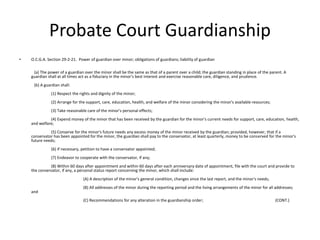
Probate Court Guardianship
• O.C.G.A. Section 29-2-21. Power of guardian over minor; obligations of guardians; liability of guardian
(a) The power of a guardian over the minor shall be the same as that of a parent over a child; the guardian standing in place of the parent. A
guardian shall at all times act as a fiduciary in the minor's best interest and exercise reasonable care, diligence, and prudence.
(b) A guardian shall:
(1) Respect the rights and dignity of the minor;
(2) Arrange for the support, care, education, health, and welfare of the minor considering the minor's available resources;
(3) Take reasonable care of the minor's personal effects;
(4) Expend money of the minor that has been received by the guardian for the minor's current needs for support, care, education, health,
and welfare;
(5) Conserve for the minor's future needs any excess money of the minor received by the guardian; provided, however, that if a
conservator has been appointed for the minor, the guardian shall pay to the conservator, at least quarterly, money to be conserved for the minor's
future needs;
(6) If necessary, petition to have a conservator appointed;
(7) Endeavor to cooperate with the conservator, if any;
(8) Within 60 days after appointment and within 60 days after each anniversary date of appointment, file with the court and provide to
the conservator, if any, a personal status report concerning the minor, which shall include:
(A) A description of the minor's general condition, changes since the last report, and the minor's needs;
(B) All addresses of the minor during the reporting period and the living arrangements of the minor for all addresses;
and
(C) Recommendations for any alteration in the guardianship order; (CONT.)
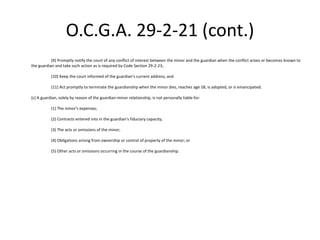
O.C.G.A. 29-2-21 (cont.)
(9) Promptly notify the court of any conflict of interest between the minor and the guardian when the conflict arises or becomes known to
the guardian and take such action as is required by Code Section 29-2-23;
(10) Keep the court informed of the guardian's current address; and
(11) Act promptly to terminate the guardianship when the minor dies, reaches age 18, is adopted, or is emancipated.
(c) A guardian, solely by reason of the guardian-minor relationship, is not personally liable for:
(1) The minor's expenses;
(2) Contracts entered into in the guardian's fiduciary capacity;
(3) The acts or omissions of the minor;
(4) Obligations arising from ownership or control of property of the minor; or
(5) Other acts or omissions occurring in the course of the guardianship.
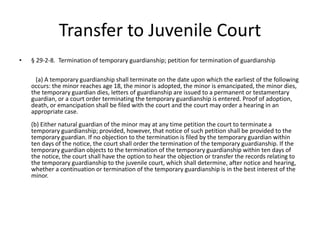
Transfer to Juvenile Court
• § 29-2-8. Termination of temporary guardianship; petition for termination of guardianship
(a) A temporary guardianship shall terminate on the date upon which the earliest of the following
occurs: the minor reaches age 18, the minor is adopted, the minor is emancipated, the minor dies,
the temporary guardian dies, letters of guardianship are issued to a permanent or testamentary
guardian, or a court order terminating the temporary guardianship is entered. Proof of adoption,
death, or emancipation shall be filed with the court and the court may order a hearing in an
appropriate case.
(b) Either natural guardian of the minor may at any time petition the court to terminate a
temporary guardianship; provided, however, that notice of such petition shall be provided to the
temporary guardian. If no objection to the termination is filed by the temporary guardian within
ten days of the notice, the court shall order the termination of the temporary guardianship. If the
temporary guardian objects to the termination of the temporary guardianship within ten days of
the notice, the court shall have the option to hear the objection or transfer the records relating to
the temporary guardianship to the juvenile court, which shall determine, after notice and hearing,
whether a continuation or termination of the temporary guardianship is in the best interest of the
minor.
Probate Court Side Notes
• Can Petition for Permanent guardianship of
minor in certain circumstances
• Standard for Petition for Permanent
guardianship in Probate Court is the best
interest of the minor
Policy/Practice Issues with Probate
Court Temporary guardianship?
• Decrease in the number of filings of deprivations
(now dependencies) and protective orders in
juvenile court, and an Increase in the number of
filings of petitions for guardianship in probate
court
• There are no established procedures, statutes or
case law to guide Juvenile Courts on how to
handle transfer cases. As a result, there are
significant variations in the handling of transfer
cases in each jurisdiction. (cont.)
(cont.)
• Guardianships established in Probate Court are
inherently temporary in nature because they can
be revoked at any time by the parents of the
child with agreement of the guardian. Thus,
they do not offer the qualities of permanency
sought from a child welfare perspective. Legal
guardianship contemplated by state and federal
child welfare laws and regulations suggests an
arrangement more durable than custody. (cont.)
(Cont.)
• Additional barriers to permanency and family-
centered practice exist with the use of Probate Court
guardianships.
• There are substantial filing fees required in Probate
Court.
• Guardianships do not address safety, child support or
visitation.
• Guardianships do not include services for the child,
parent or guardian.
• Guardianships cannot be enforced. If the parent
comes and takes the child, the guardian has no
recourse. (Cont.)
(Cont.)
• Because of their inherent limitations guardianships are not
appropriate where there is dependency including physical abuse
of a child, sexual abuse of a child, substance abuse by the parents,
domestic violence in the home of the parents, or mental illness of
the parents.
• Where there are issues of deprivation such as physical abuse,
sexual abuse, substance abuse, domestic violence and mental
illness, change is required to safely return the child to the parents.
• Guardianships do not result in change because there is no case
plan.
• There are no services.
• The Probate Court cannot incorporate the safety plan of the
Department of Family and Children Services into the guardianship.
• The Probate Court cannot enforce the safety plan. (cont.)
(Cont.)
• Families use temporary guardianships to avoid the
Department of Family and Children Services entry
into their lives and then return the child to the
parents without formally dissolving the guardianship
placing the child at risk for further abuse.
• Probate Judges do not receive training on abuse,
neglect and child development nor do the statutory
provisions and procedures of the Probate Code afford
Probate Judges the opportunity to structure orders to
address child safety and well being.
(Cont.)
(Cont.)
• The Juvenile Court can make a no reasonable efforts
finding because a common practice of the
Department is to place the child under a safety plan
with a safety resource, have the safety resource apply
for guardianship, and close the case upon granting
the guardianship without further monitoring or
further services to assure the safety and well being of
the child. When the Court makes such a finding, the
Department cannot draw down federal IV(e) funds to
assist with the costs of foster care. The cost of foster
care comes from the State budget when federal funds
are not used.
– Source: Paper by Judge Peggy Walker, 2012
Permanent Guardianship in
Juvenile Court
• § 15-11-240. Appointment of permanent guardian; jurisdiction; findings
(a) In addition to the jurisdiction to appoint guardians pursuant to Code Section 15-11-13, the juvenile court
shall be vested with jurisdiction to appoint a permanent guardian for a child adjudicated as a dependent child in
accordance with this article. Prior to the entry of such an order, the court shall:
(1) Find that reasonable efforts to reunify such child with his or her parents would be detrimental to such child
or find that the living parents of such child have consented to the permanent guardianship;
(2) Find that termination of parental rights and adoption is not in the best interests of such child;
(3) Find that the proposed permanent guardian can provide a safe and permanent home for such child;
(4) Find that the appointment of a permanent guardian for such child is in the best interests of such child and
that the individual chosen as such child's permanent guardian is the individual most appropriate to be such child's
permanent guardian taking into consideration the best interests of the child; and
(5) If such child is 14 years of age or older, find that the appointment of a permanent guardian for such child is in
the best interests of such child and that the individual chosen by such child as the child's permanent guardian is
the individual most appropriate to be such child's permanent guardian taking into consideration the best interests
of the child.
(b) The court may enter an order of support on behalf of a child against the parents of such child in accordance
with paragraph (7) of subsection (a) of Code Section 15-11-212.
Effect of guardianship order
• § 15-11-242. Effect of guardianship order
(a) Permanent guardianship orders entered pursuant to Code Section 15-11-240
shall:
(1) Remain in effect until the child adjudicated as a dependent child reaches the
age of 18 or becomes emancipated;
(2) Not be subject to review by the court except as provided in Code Section 15-
11-244; and
(3) Establish a reasonable visitation schedule which allows the child adjudicated
as a dependent child to maintain meaningful contact with his or her parents
through personal visits, telephone calls, letters, or other forms of communication
or specifically include any restriction on a parent's right to visitation.
(b) A permanent guardian shall have the rights and duties of a permanent
guardian as provided in Code Sections 29-2-21, 29-2-22, and 29-2-23 and shall take
the oath required of a guardian as provided in Code Section 29-2-24.
Misuse of guardianship
• So what is the issue with guardianship from DFCS
perspective?
• It is the inappropriate use of GS. That is, give a relative
guardianship and close the DFCS case without assisting the
parent or family.
• The case is closed without providing any services to help
the family or serve the family.
• The result was a change in DFCS policy which does not
apply to children 14 and older, and for which local DFCS can
request a waiver.
• Further, State DFCS intends to put together a committee
together for a best plan to address guardianships.
DFCS Policy Changes
• “DFCS staff are therefore prohibited from
requesting, pursuing, suggesting, or
consenting to a temporary guardianship
during any stage of DFCS involvement with a
child and/or family. The use of temporary GS
contradicts the agency’s goal of ensuring a
safe, permanent home for children, by the
very nature of it being temporary.”
Bobby D. Cagle, Division Director DFCS
DFCS Policy Changes
• “In addition, DFCS staff shall not seek
permanent GS in Child Protective Service
cases (Investigations, Family Support Services,
and Family Preservation Services), as CPS
cases are unlikely to meet the legal
standards/threshold associated with a
permanent guardianship.”
Bobby D. Cagle, Division Director DFCS
DFCS Waiver Request
• “If it is determined that a temporary
guardianship or a permanent GS in a CPS case
is appropriate, subsequent to a thorough
assessment of child safety and a family’s
circumstances, then DFCS staff may request a
policy waiver.”
• “The bar for obtaining a waiver in temporary
GS cases will be high.”
Bobby Cagle, Director DFCS
Guardianship Funding
• The Fostering Connections Act gives states the option of
obtaining federal reimbursement for ongoing assistance
payments made on behalf of eligible children who exit
foster care to guardianship with a relative.
• To implement the Guardianship Assistance Program (GAP)
option, state must submit and receive a federally approved
Title IV-E state plan amendment. Many states have taken
the GAP option. Georgia does not.
• BUT while Georgia DFCS doesn't have a federally-subsidized
(Title IV-E) kinship guardianship assistance program, we do
subsidize eligible kinship guardianships using TANF and
state dollars.
Contact Information
• Ashley Willcott, J.D., C.W.L.S.
Director, Office of the Child Advocate
404-656-4200
awillcott@oca.ga.gov

Guardianship_A_Willcott

  • 1.
    Child Welfare LegalAcademy Guardianship !&@*&#
  • 2.
    Guardianships • Often characterizedas more legally durable than transfer of custody • And more flexible than adoption • Permanent guardianship is a recognized permanency option for children and youth in foster care under certain circumstances
  • 3.
    OCA’s topic • Publicpolicy • Experience of stakeholders
  • 4.
    Probate Court Guardianship •O.C.G.A. Section 29-2-21. Power of guardian over minor; obligations of guardians; liability of guardian (a) The power of a guardian over the minor shall be the same as that of a parent over a child; the guardian standing in place of the parent. A guardian shall at all times act as a fiduciary in the minor's best interest and exercise reasonable care, diligence, and prudence. (b) A guardian shall: (1) Respect the rights and dignity of the minor; (2) Arrange for the support, care, education, health, and welfare of the minor considering the minor's available resources; (3) Take reasonable care of the minor's personal effects; (4) Expend money of the minor that has been received by the guardian for the minor's current needs for support, care, education, health, and welfare; (5) Conserve for the minor's future needs any excess money of the minor received by the guardian; provided, however, that if a conservator has been appointed for the minor, the guardian shall pay to the conservator, at least quarterly, money to be conserved for the minor's future needs; (6) If necessary, petition to have a conservator appointed; (7) Endeavor to cooperate with the conservator, if any; (8) Within 60 days after appointment and within 60 days after each anniversary date of appointment, file with the court and provide to the conservator, if any, a personal status report concerning the minor, which shall include: (A) A description of the minor's general condition, changes since the last report, and the minor's needs; (B) All addresses of the minor during the reporting period and the living arrangements of the minor for all addresses; and (C) Recommendations for any alteration in the guardianship order; (CONT.)
  • 5.
    O.C.G.A. 29-2-21 (cont.) (9)Promptly notify the court of any conflict of interest between the minor and the guardian when the conflict arises or becomes known to the guardian and take such action as is required by Code Section 29-2-23; (10) Keep the court informed of the guardian's current address; and (11) Act promptly to terminate the guardianship when the minor dies, reaches age 18, is adopted, or is emancipated. (c) A guardian, solely by reason of the guardian-minor relationship, is not personally liable for: (1) The minor's expenses; (2) Contracts entered into in the guardian's fiduciary capacity; (3) The acts or omissions of the minor; (4) Obligations arising from ownership or control of property of the minor; or (5) Other acts or omissions occurring in the course of the guardianship.
  • 6.
    Transfer to JuvenileCourt • § 29-2-8. Termination of temporary guardianship; petition for termination of guardianship (a) A temporary guardianship shall terminate on the date upon which the earliest of the following occurs: the minor reaches age 18, the minor is adopted, the minor is emancipated, the minor dies, the temporary guardian dies, letters of guardianship are issued to a permanent or testamentary guardian, or a court order terminating the temporary guardianship is entered. Proof of adoption, death, or emancipation shall be filed with the court and the court may order a hearing in an appropriate case. (b) Either natural guardian of the minor may at any time petition the court to terminate a temporary guardianship; provided, however, that notice of such petition shall be provided to the temporary guardian. If no objection to the termination is filed by the temporary guardian within ten days of the notice, the court shall order the termination of the temporary guardianship. If the temporary guardian objects to the termination of the temporary guardianship within ten days of the notice, the court shall have the option to hear the objection or transfer the records relating to the temporary guardianship to the juvenile court, which shall determine, after notice and hearing, whether a continuation or termination of the temporary guardianship is in the best interest of the minor.
  • 7.
    Probate Court SideNotes • Can Petition for Permanent guardianship of minor in certain circumstances • Standard for Petition for Permanent guardianship in Probate Court is the best interest of the minor
  • 8.
    Policy/Practice Issues withProbate Court Temporary guardianship? • Decrease in the number of filings of deprivations (now dependencies) and protective orders in juvenile court, and an Increase in the number of filings of petitions for guardianship in probate court • There are no established procedures, statutes or case law to guide Juvenile Courts on how to handle transfer cases. As a result, there are significant variations in the handling of transfer cases in each jurisdiction. (cont.)
  • 9.
    (cont.) • Guardianships establishedin Probate Court are inherently temporary in nature because they can be revoked at any time by the parents of the child with agreement of the guardian. Thus, they do not offer the qualities of permanency sought from a child welfare perspective. Legal guardianship contemplated by state and federal child welfare laws and regulations suggests an arrangement more durable than custody. (cont.)
  • 10.
    (Cont.) • Additional barriersto permanency and family- centered practice exist with the use of Probate Court guardianships. • There are substantial filing fees required in Probate Court. • Guardianships do not address safety, child support or visitation. • Guardianships do not include services for the child, parent or guardian. • Guardianships cannot be enforced. If the parent comes and takes the child, the guardian has no recourse. (Cont.)
  • 11.
    (Cont.) • Because oftheir inherent limitations guardianships are not appropriate where there is dependency including physical abuse of a child, sexual abuse of a child, substance abuse by the parents, domestic violence in the home of the parents, or mental illness of the parents. • Where there are issues of deprivation such as physical abuse, sexual abuse, substance abuse, domestic violence and mental illness, change is required to safely return the child to the parents. • Guardianships do not result in change because there is no case plan. • There are no services. • The Probate Court cannot incorporate the safety plan of the Department of Family and Children Services into the guardianship. • The Probate Court cannot enforce the safety plan. (cont.)
  • 12.
    (Cont.) • Families usetemporary guardianships to avoid the Department of Family and Children Services entry into their lives and then return the child to the parents without formally dissolving the guardianship placing the child at risk for further abuse. • Probate Judges do not receive training on abuse, neglect and child development nor do the statutory provisions and procedures of the Probate Code afford Probate Judges the opportunity to structure orders to address child safety and well being. (Cont.)
  • 13.
    (Cont.) • The JuvenileCourt can make a no reasonable efforts finding because a common practice of the Department is to place the child under a safety plan with a safety resource, have the safety resource apply for guardianship, and close the case upon granting the guardianship without further monitoring or further services to assure the safety and well being of the child. When the Court makes such a finding, the Department cannot draw down federal IV(e) funds to assist with the costs of foster care. The cost of foster care comes from the State budget when federal funds are not used. – Source: Paper by Judge Peggy Walker, 2012
  • 14.
    Permanent Guardianship in JuvenileCourt • § 15-11-240. Appointment of permanent guardian; jurisdiction; findings (a) In addition to the jurisdiction to appoint guardians pursuant to Code Section 15-11-13, the juvenile court shall be vested with jurisdiction to appoint a permanent guardian for a child adjudicated as a dependent child in accordance with this article. Prior to the entry of such an order, the court shall: (1) Find that reasonable efforts to reunify such child with his or her parents would be detrimental to such child or find that the living parents of such child have consented to the permanent guardianship; (2) Find that termination of parental rights and adoption is not in the best interests of such child; (3) Find that the proposed permanent guardian can provide a safe and permanent home for such child; (4) Find that the appointment of a permanent guardian for such child is in the best interests of such child and that the individual chosen as such child's permanent guardian is the individual most appropriate to be such child's permanent guardian taking into consideration the best interests of the child; and (5) If such child is 14 years of age or older, find that the appointment of a permanent guardian for such child is in the best interests of such child and that the individual chosen by such child as the child's permanent guardian is the individual most appropriate to be such child's permanent guardian taking into consideration the best interests of the child. (b) The court may enter an order of support on behalf of a child against the parents of such child in accordance with paragraph (7) of subsection (a) of Code Section 15-11-212.
  • 15.
    Effect of guardianshiporder • § 15-11-242. Effect of guardianship order (a) Permanent guardianship orders entered pursuant to Code Section 15-11-240 shall: (1) Remain in effect until the child adjudicated as a dependent child reaches the age of 18 or becomes emancipated; (2) Not be subject to review by the court except as provided in Code Section 15- 11-244; and (3) Establish a reasonable visitation schedule which allows the child adjudicated as a dependent child to maintain meaningful contact with his or her parents through personal visits, telephone calls, letters, or other forms of communication or specifically include any restriction on a parent's right to visitation. (b) A permanent guardian shall have the rights and duties of a permanent guardian as provided in Code Sections 29-2-21, 29-2-22, and 29-2-23 and shall take the oath required of a guardian as provided in Code Section 29-2-24.
  • 16.
    Misuse of guardianship •So what is the issue with guardianship from DFCS perspective? • It is the inappropriate use of GS. That is, give a relative guardianship and close the DFCS case without assisting the parent or family. • The case is closed without providing any services to help the family or serve the family. • The result was a change in DFCS policy which does not apply to children 14 and older, and for which local DFCS can request a waiver. • Further, State DFCS intends to put together a committee together for a best plan to address guardianships.
  • 17.
    DFCS Policy Changes •“DFCS staff are therefore prohibited from requesting, pursuing, suggesting, or consenting to a temporary guardianship during any stage of DFCS involvement with a child and/or family. The use of temporary GS contradicts the agency’s goal of ensuring a safe, permanent home for children, by the very nature of it being temporary.” Bobby D. Cagle, Division Director DFCS
  • 18.
    DFCS Policy Changes •“In addition, DFCS staff shall not seek permanent GS in Child Protective Service cases (Investigations, Family Support Services, and Family Preservation Services), as CPS cases are unlikely to meet the legal standards/threshold associated with a permanent guardianship.” Bobby D. Cagle, Division Director DFCS
  • 19.
    DFCS Waiver Request •“If it is determined that a temporary guardianship or a permanent GS in a CPS case is appropriate, subsequent to a thorough assessment of child safety and a family’s circumstances, then DFCS staff may request a policy waiver.” • “The bar for obtaining a waiver in temporary GS cases will be high.” Bobby Cagle, Director DFCS
  • 20.
    Guardianship Funding • TheFostering Connections Act gives states the option of obtaining federal reimbursement for ongoing assistance payments made on behalf of eligible children who exit foster care to guardianship with a relative. • To implement the Guardianship Assistance Program (GAP) option, state must submit and receive a federally approved Title IV-E state plan amendment. Many states have taken the GAP option. Georgia does not. • BUT while Georgia DFCS doesn't have a federally-subsidized (Title IV-E) kinship guardianship assistance program, we do subsidize eligible kinship guardianships using TANF and state dollars.
  • 21.
    Contact Information • AshleyWillcott, J.D., C.W.L.S. Director, Office of the Child Advocate 404-656-4200 awillcott@oca.ga.gov