Page 1 of 6
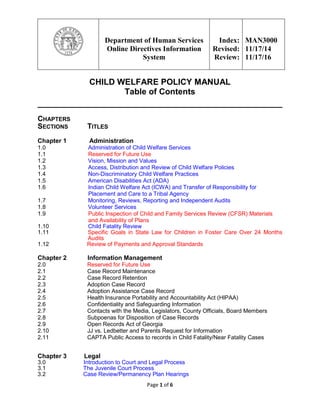
Department of Human Services
Online Directives Information
System
Index:
Revised:
Review:
MAN3000
11/17/14
11/17/16
CHILD WELFARE POLICY MANUAL
Table of Contents
CHAPTERS
SECTIONS TITLES
Chapter 1 Administration
1.0 Administration of Child Welfare Services
1.1 Reserved for Future Use
1.2 Vision, Mission and Values
1.3 Access, Distribution and Review of Child Welfare Policies
1.4 Non-Discriminatory Child Welfare Practices
1.5 American Disabilities Act (ADA)
1.6 Indian Child Welfare Act (ICWA) and Transfer of Responsibility for
Placement and Care to a Tribal Agency
1.7 Monitoring, Reviews, Reporting and Independent Audits
1.8 Volunteer Services
1.9 Public Inspection of Child and Family Services Review (CFSR) Materials
and Availability of Plans
1.10 Child Fatality Review
1.11 Specific Goals in State Law for Children in Foster Care Over 24 Months
Audits
1.12 Review of Payments and Approval Standards
Chapter 2 Information Management
2.0 Reserved for Future Use
2.1 Case Record Maintenance
2.2 Case Record Retention
2.3 Adoption Case Record
2.4 Adoption Assistance Case Record
2.5 Health Insurance Portability and Accountability Act (HIPAA)
2.6 Confidentiality and Safeguarding Information
2.7 Contacts with the Media, Legislators, County Officials, Board Members
2.8 Subpoenas for Disposition of Case Records
2.9 Open Records Act of Georgia
2.10 JJ vs. Ledbetter and Parents Request for Information
2.11 CAPTA Public Access to records in Child Fatality/Near Fatality Cases
Chapter 3 Legal
3.0 Introduction to Court and Legal Process
3.1 The Juvenile Court Process
3.2 Case Review/Permanency Plan Hearings
Page 2 of 6
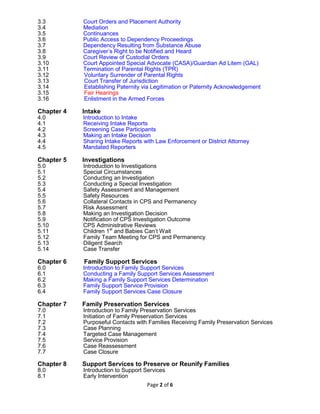
3.3 Court Orders and Placement Authority
3.4 Mediation
3.5 Continuances
3.6 Public Access to Dependency Proceedings
3.7 Dependency Resulting from Substance Abuse
3.8 Caregiver’s Right to be Notified and Heard
3.9 Court Review of Custodial Orders
3.10 Court Appointed Special Advocate (CASA)/Guardian Ad Litem (GAL)
3.11 Termination of Parental Rights (TPR)
3.12 Voluntary Surrender of Parental Rights
3.13 Court Transfer of Jurisdiction
3.14 Establishing Paternity via Legitimation or Paternity Acknowledgement
3.15 Fair Hearings
3.16 Enlistment in the Armed Forces
Chapter 4 Intake
4.0 Introduction to Intake
4.1 Receiving Intake Reports
4.2 Screening Case Participants
4.3 Making an Intake Decision
4.4 Sharing Intake Reports with Law Enforcement or District Attorney
4.5 Mandated Reporters
Chapter 5 Investigations
5.0 Introduction to Investigations
5.1 Special Circumstances
5.2 Conducting an Investigation
5.3 Conducting a Special Investigation
5.4 Safety Assessment and Management
5.5 Safety Resources
5.6 Collateral Contacts in CPS and Permanency
5.7 Risk Assessment
5.8 Making an Investigation Decision
5.9 Notification of CPS Investigation Outcome
5.10 CPS Administrative Reviews
5.11 Children 1st
and Babies Can’t Wait
5.12 Family Team Meeting for CPS and Permanency
5.13 Diligent Search
5.14 Case Transfer
Chapter 6 Family Support Services
6.0 Introduction to Family Support Services
6.1 Conducting a Family Support Services Assessment
6.2 Making a Family Support Services Determination
6.3 Family Support Service Provision
6.4 Family Support Services Case Closure
Chapter 7 Family Preservation Services
7.0 Introduction to Family Preservation Services
7.1 Initiation of Family Preservation Services
7.2 Purposeful Contacts with Families Receiving Family Preservation Services
7.3 Case Planning
7.4 Targeted Case Management
7.5 Service Provision
7.6 Case Reassessment
7.7 Case Closure
Chapter 8 Support Services to Preserve or Reunify Families
8.0 Introduction to Support Services
8.1 Early Intervention
Page 3 of 6
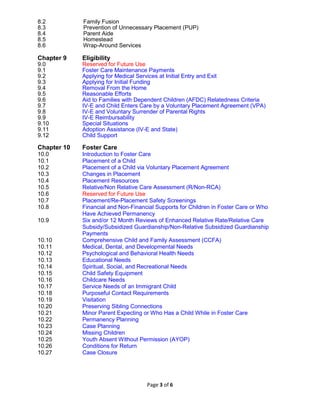
8.2 Family Fusion
8.3 Prevention of Unnecessary Placement (PUP)
8.4 Parent Aide
8.5 Homestead
8.6 Wrap-Around Services
Chapter 9 Eligibility
9.0 Reserved for Future Use
9.1 Foster Care Maintenance Payments
9.2 Applying for Medical Services at Initial Entry and Exit
9.3 Applying for Initial Funding
9.4 Removal From the Home
9.5 Reasonable Efforts
9.6 Aid to Families with Dependent Children (AFDC) Relatedness Criteria
9.7 IV-E and Child Enters Care by a Voluntary Placement Agreement (VPA)
9.8 IV-E and Voluntary Surrender of Parental Rights
9.9 IV-E Reimbursability
9.10 Special Situations
9.11 Adoption Assistance (IV-E and State)
9.12 Child Support
Chapter 10 Foster Care
10.0 Introduction to Foster Care
10.1 Placement of a Child
10.2 Placement of a Child via Voluntary Placement Agreement
10.3 Changes in Placement
10.4 Placement Resources
10.5 Relative/Non Relative Care Assessment (R/Non-RCA)
10.6 Reserved for Future Use
10.7 Placement/Re-Placement Safety Screenings
10.8 Financial and Non-Financial Supports for Children in Foster Care or Who
Have Achieved Permanency
10.9 Six and/or 12 Month Reviews of Enhanced Relative Rate/Relative Care
Subsidy/Subsidized Guardianship/Non-Relative Subsidized Guardianship
Payments
10.10 Comprehensive Child and Family Assessment (CCFA)
10.11 Medical, Dental, and Developmental Needs
10.12 Psychological and Behavioral Health Needs
10.13 Educational Needs
10.14 Spiritual, Social, and Recreational Needs
10.15 Child Safety Equipment
10.16 Childcare Needs
10.17 Service Needs of an Immigrant Child
10.18 Purposeful Contact Requirements
10.19 Visitation
10.20 Preserving Sibling Connections
10.21 Minor Parent Expecting or Who Has a Child While in Foster Care
10.22 Permanency Planning
10.23 Case Planning
10.24 Missing Children
10.25 Youth Absent Without Permission (AYOP)
10.26 Conditions for Return
10.27 Case Closure
Page 4 of 6
Chapter 11 Adoptions
11.0 Introduction to Adoptions
11.1 Adoption Preparation
11.2 Parent Voluntary Surrender to Third Party or Private Agency
11.3 Putative Father Registry
11.4 Permanent Custody to Relatives/Non-Relatives Following TPR
11.5 Permanent Custody to DFCS When Both Parents are Deceased
11.6 Placement with Siblings
11.7 Wait List
11.8 Child Life History
11.9 Child Specific Recruitment Efforts
11.10 Adoption By Relatives
11.11 Foster Parent Adoption Consideration
11.12 Presentation of Child Life History to the Adoptive Family
11.13 Adoption Pre-Placement Staffing
11.14 Partnering with Foster Parent(s) to Prepare a Child for Adoption
11.15 Pre-Placement Visitation
11.16 Child’s Goodbye Before Adoptive Placement Move
11.17 Adoption Commitment Signing & Placement
11.18 Post Placement Supervision
11.19 Support Services: Post Adoptive Placement & Post Adoption
11.20 Finalizing the Adoption
11.21 Disruptions
11.22 Child Re-Enters Foster Care Following Adoption Finalization
11.23 Adoption Dissolution
11.24 Adoption Reunion Registry
11.25 Placement of a Georgia Child Into Another State for Adoption Purposes
11.26 Placement of a Child From Another State Into Georgia for Adoption Purposes
11.27 Family Moves to Another State Prior to Finalization
11.28 Disruption of an ICPC Child
11.29 ICPC Independent Adoption - Georgia Is Sending State
11.30 ICPC Independent Adoption - Georgia Is Receiving State
11.31 Independent Adoption Investigations - Appointed by the Court
11.32 Independent Adoption - Family Evaluation for Adoption by a Third Party
Chapter 12 Adoption Assistance
12.0 Introduction to Adoption Assistance
12.1 Eligibility - Adoption Assistance Payments, Medicaid & Non-Recurring
12.2 Adoption Assistance Application
12.3 Adoption Assistance Specialized Rate
12.4 Negotiating the Adoption Assistance Agreement
12.5 Reviewing and Signing the Adoption Assistance Agreement
12.6 Initiating the Adoption Assistance Benefits
12.7 Subsequent Determinations - Deferred Adoption Assistance Agreement
12.8 Continuation, Renegotiation or Termination of Adoption Assistance Benefits
12.9 Adoption Assistance Benefits - After 18
12.10 Supplemental Security Income (SSI) & Adoption Assistance Payments
12.11 Verification of Continuing Eligibility For Adoption Assistance Payments
12.12 Adoption Assistance Medicaid
12.13 Status Changes
12.14 Family Relocates
12.15 Respite for Medically Fragile Adoptive Children
12.16 Recovery of Adoption Assistance Overpayments
12.17 Case Record Maintenance & Documentation Requirements for Adoption
Assistance Benefits
Chapter 13 Independent Living Program
13.0 Introduction to the Independent Living Program
13.1 Eligibility and Enrollment
13.2 Casey Life Skills Assessment
Page 5 of 6
13.3 Written Transitional Living Plan
13.4 Transition From Foster Care
13.5 Individual Development Accounts (IDA)
13.6 Credit Reports for Youth in Foster Care
13.7 Graduated Independence Plan
13.8 Driver Education and Licensure
13.9 Extended Youth Support Services (EYSS)
13.10 Medical Insurance for Youth 18 Years of Age and Older and the Georgia Advance
Directive for Health Care
13.11 Post Foster Care (PFC) Resources
13.12 Juvenile Court Reviews for Youth Ages 18-23
13.13 National Youth in Transition Database (NYTD)
13.14 Asset Inventory
13.15 Events
13.16 Vendor Contracts
Chapter 14 Resource Development
14.0 Introduction to Resource Development
14.1 Safety and Quality Standards
14.2 Criminal Records Checks
14.3 Caregiver Safety Screening at Initial and Re-evaluation
14.4 Waiver of Non-Safety Approval Standards for Relative Partnership Parents
14.5 Family Daycare and Personal Care Home Operation in Foster Homes
14.6 Recruitment and Retention
14.7 Inquiries and Information Sessions
14.8 Pre-service Training
14.9 Continued Parent Development
14.10 Initial Family Evaluation Administrative Requirements
14.11 Initial Family Evaluation Components
14.12 Initial Family Evaluation Outline
14.13 Family Re-evaluation
14.14 Family Evaluation Addendums
14.15 Household Approval Status
14.16 Working with Caregivers
14.17 Foster Parent Bill of Rights and Grievance Procedure
14.18 Supervision of Children
14.19 Home Safety
14.20 Discipline and Behavior Management
14.21 Reporting Allegations of Abuse and Neglect in Approved Homes
14.22 Policy Violations
14.23 Home Closure
14.24 Inter-County and Inter-Agency Partnerships
14.25 Staff Restrictions on Being Caregivers
Chapter 15 Interstate Compact on the Placement of Children
15.0 Introduction to Interstate Compact on the Placement of Children (ICPC)
15.1 Placements Subject to ICPC Jurisdiction
15.2 Placement of Georgia Children into Other States/Georgia Sending State
15.3 Placement of Children from Other States into Georgia/Georgia Receiving State
15.4 ICPC Expedited Placements
15.5 ICPC Placement Supervision
15.6 Court Jurisdiction Cases and Other ICPC Components
15.7 ICPC Related Travel Expenses
15.8 Border Agreements
Page 6 of 6
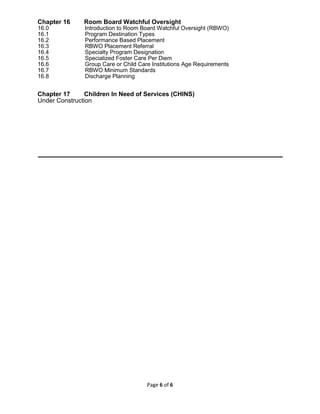
Chapter 16 Room Board Watchful Oversight
16.0 Introduction to Room Board Watchful Oversight (RBWO)
16.1 Program Destination Types
16.2 Performance Based Placement
16.3 RBWO Placement Referral
16.4 Specialty Program Designation
16.5 Specialized Foster Care Per Diem
16.6 Group Care or Child Care Institutions Age Requirements
16.7 RBWO Minimum Standards
16.8 Discharge Planning
Chapter 17 Children In Need of Services (CHINS)
Under Construction

Man3000 child welfare

  • 1.
    Page 1 of6 Department of Human Services Online Directives Information System Index: Revised: Review: MAN3000 11/17/14 11/17/16 CHILD WELFARE POLICY MANUAL Table of Contents CHAPTERS SECTIONS TITLES Chapter 1 Administration 1.0 Administration of Child Welfare Services 1.1 Reserved for Future Use 1.2 Vision, Mission and Values 1.3 Access, Distribution and Review of Child Welfare Policies 1.4 Non-Discriminatory Child Welfare Practices 1.5 American Disabilities Act (ADA) 1.6 Indian Child Welfare Act (ICWA) and Transfer of Responsibility for Placement and Care to a Tribal Agency 1.7 Monitoring, Reviews, Reporting and Independent Audits 1.8 Volunteer Services 1.9 Public Inspection of Child and Family Services Review (CFSR) Materials and Availability of Plans 1.10 Child Fatality Review 1.11 Specific Goals in State Law for Children in Foster Care Over 24 Months Audits 1.12 Review of Payments and Approval Standards Chapter 2 Information Management 2.0 Reserved for Future Use 2.1 Case Record Maintenance 2.2 Case Record Retention 2.3 Adoption Case Record 2.4 Adoption Assistance Case Record 2.5 Health Insurance Portability and Accountability Act (HIPAA) 2.6 Confidentiality and Safeguarding Information 2.7 Contacts with the Media, Legislators, County Officials, Board Members 2.8 Subpoenas for Disposition of Case Records 2.9 Open Records Act of Georgia 2.10 JJ vs. Ledbetter and Parents Request for Information 2.11 CAPTA Public Access to records in Child Fatality/Near Fatality Cases Chapter 3 Legal 3.0 Introduction to Court and Legal Process 3.1 The Juvenile Court Process 3.2 Case Review/Permanency Plan Hearings
  • 2.
    Page 2 of6 3.3 Court Orders and Placement Authority 3.4 Mediation 3.5 Continuances 3.6 Public Access to Dependency Proceedings 3.7 Dependency Resulting from Substance Abuse 3.8 Caregiver’s Right to be Notified and Heard 3.9 Court Review of Custodial Orders 3.10 Court Appointed Special Advocate (CASA)/Guardian Ad Litem (GAL) 3.11 Termination of Parental Rights (TPR) 3.12 Voluntary Surrender of Parental Rights 3.13 Court Transfer of Jurisdiction 3.14 Establishing Paternity via Legitimation or Paternity Acknowledgement 3.15 Fair Hearings 3.16 Enlistment in the Armed Forces Chapter 4 Intake 4.0 Introduction to Intake 4.1 Receiving Intake Reports 4.2 Screening Case Participants 4.3 Making an Intake Decision 4.4 Sharing Intake Reports with Law Enforcement or District Attorney 4.5 Mandated Reporters Chapter 5 Investigations 5.0 Introduction to Investigations 5.1 Special Circumstances 5.2 Conducting an Investigation 5.3 Conducting a Special Investigation 5.4 Safety Assessment and Management 5.5 Safety Resources 5.6 Collateral Contacts in CPS and Permanency 5.7 Risk Assessment 5.8 Making an Investigation Decision 5.9 Notification of CPS Investigation Outcome 5.10 CPS Administrative Reviews 5.11 Children 1st and Babies Can’t Wait 5.12 Family Team Meeting for CPS and Permanency 5.13 Diligent Search 5.14 Case Transfer Chapter 6 Family Support Services 6.0 Introduction to Family Support Services 6.1 Conducting a Family Support Services Assessment 6.2 Making a Family Support Services Determination 6.3 Family Support Service Provision 6.4 Family Support Services Case Closure Chapter 7 Family Preservation Services 7.0 Introduction to Family Preservation Services 7.1 Initiation of Family Preservation Services 7.2 Purposeful Contacts with Families Receiving Family Preservation Services 7.3 Case Planning 7.4 Targeted Case Management 7.5 Service Provision 7.6 Case Reassessment 7.7 Case Closure Chapter 8 Support Services to Preserve or Reunify Families 8.0 Introduction to Support Services 8.1 Early Intervention
  • 3.
    Page 3 of6 8.2 Family Fusion 8.3 Prevention of Unnecessary Placement (PUP) 8.4 Parent Aide 8.5 Homestead 8.6 Wrap-Around Services Chapter 9 Eligibility 9.0 Reserved for Future Use 9.1 Foster Care Maintenance Payments 9.2 Applying for Medical Services at Initial Entry and Exit 9.3 Applying for Initial Funding 9.4 Removal From the Home 9.5 Reasonable Efforts 9.6 Aid to Families with Dependent Children (AFDC) Relatedness Criteria 9.7 IV-E and Child Enters Care by a Voluntary Placement Agreement (VPA) 9.8 IV-E and Voluntary Surrender of Parental Rights 9.9 IV-E Reimbursability 9.10 Special Situations 9.11 Adoption Assistance (IV-E and State) 9.12 Child Support Chapter 10 Foster Care 10.0 Introduction to Foster Care 10.1 Placement of a Child 10.2 Placement of a Child via Voluntary Placement Agreement 10.3 Changes in Placement 10.4 Placement Resources 10.5 Relative/Non Relative Care Assessment (R/Non-RCA) 10.6 Reserved for Future Use 10.7 Placement/Re-Placement Safety Screenings 10.8 Financial and Non-Financial Supports for Children in Foster Care or Who Have Achieved Permanency 10.9 Six and/or 12 Month Reviews of Enhanced Relative Rate/Relative Care Subsidy/Subsidized Guardianship/Non-Relative Subsidized Guardianship Payments 10.10 Comprehensive Child and Family Assessment (CCFA) 10.11 Medical, Dental, and Developmental Needs 10.12 Psychological and Behavioral Health Needs 10.13 Educational Needs 10.14 Spiritual, Social, and Recreational Needs 10.15 Child Safety Equipment 10.16 Childcare Needs 10.17 Service Needs of an Immigrant Child 10.18 Purposeful Contact Requirements 10.19 Visitation 10.20 Preserving Sibling Connections 10.21 Minor Parent Expecting or Who Has a Child While in Foster Care 10.22 Permanency Planning 10.23 Case Planning 10.24 Missing Children 10.25 Youth Absent Without Permission (AYOP) 10.26 Conditions for Return 10.27 Case Closure
  • 4.
    Page 4 of6 Chapter 11 Adoptions 11.0 Introduction to Adoptions 11.1 Adoption Preparation 11.2 Parent Voluntary Surrender to Third Party or Private Agency 11.3 Putative Father Registry 11.4 Permanent Custody to Relatives/Non-Relatives Following TPR 11.5 Permanent Custody to DFCS When Both Parents are Deceased 11.6 Placement with Siblings 11.7 Wait List 11.8 Child Life History 11.9 Child Specific Recruitment Efforts 11.10 Adoption By Relatives 11.11 Foster Parent Adoption Consideration 11.12 Presentation of Child Life History to the Adoptive Family 11.13 Adoption Pre-Placement Staffing 11.14 Partnering with Foster Parent(s) to Prepare a Child for Adoption 11.15 Pre-Placement Visitation 11.16 Child’s Goodbye Before Adoptive Placement Move 11.17 Adoption Commitment Signing & Placement 11.18 Post Placement Supervision 11.19 Support Services: Post Adoptive Placement & Post Adoption 11.20 Finalizing the Adoption 11.21 Disruptions 11.22 Child Re-Enters Foster Care Following Adoption Finalization 11.23 Adoption Dissolution 11.24 Adoption Reunion Registry 11.25 Placement of a Georgia Child Into Another State for Adoption Purposes 11.26 Placement of a Child From Another State Into Georgia for Adoption Purposes 11.27 Family Moves to Another State Prior to Finalization 11.28 Disruption of an ICPC Child 11.29 ICPC Independent Adoption - Georgia Is Sending State 11.30 ICPC Independent Adoption - Georgia Is Receiving State 11.31 Independent Adoption Investigations - Appointed by the Court 11.32 Independent Adoption - Family Evaluation for Adoption by a Third Party Chapter 12 Adoption Assistance 12.0 Introduction to Adoption Assistance 12.1 Eligibility - Adoption Assistance Payments, Medicaid & Non-Recurring 12.2 Adoption Assistance Application 12.3 Adoption Assistance Specialized Rate 12.4 Negotiating the Adoption Assistance Agreement 12.5 Reviewing and Signing the Adoption Assistance Agreement 12.6 Initiating the Adoption Assistance Benefits 12.7 Subsequent Determinations - Deferred Adoption Assistance Agreement 12.8 Continuation, Renegotiation or Termination of Adoption Assistance Benefits 12.9 Adoption Assistance Benefits - After 18 12.10 Supplemental Security Income (SSI) & Adoption Assistance Payments 12.11 Verification of Continuing Eligibility For Adoption Assistance Payments 12.12 Adoption Assistance Medicaid 12.13 Status Changes 12.14 Family Relocates 12.15 Respite for Medically Fragile Adoptive Children 12.16 Recovery of Adoption Assistance Overpayments 12.17 Case Record Maintenance & Documentation Requirements for Adoption Assistance Benefits Chapter 13 Independent Living Program 13.0 Introduction to the Independent Living Program 13.1 Eligibility and Enrollment 13.2 Casey Life Skills Assessment
  • 5.
    Page 5 of6 13.3 Written Transitional Living Plan 13.4 Transition From Foster Care 13.5 Individual Development Accounts (IDA) 13.6 Credit Reports for Youth in Foster Care 13.7 Graduated Independence Plan 13.8 Driver Education and Licensure 13.9 Extended Youth Support Services (EYSS) 13.10 Medical Insurance for Youth 18 Years of Age and Older and the Georgia Advance Directive for Health Care 13.11 Post Foster Care (PFC) Resources 13.12 Juvenile Court Reviews for Youth Ages 18-23 13.13 National Youth in Transition Database (NYTD) 13.14 Asset Inventory 13.15 Events 13.16 Vendor Contracts Chapter 14 Resource Development 14.0 Introduction to Resource Development 14.1 Safety and Quality Standards 14.2 Criminal Records Checks 14.3 Caregiver Safety Screening at Initial and Re-evaluation 14.4 Waiver of Non-Safety Approval Standards for Relative Partnership Parents 14.5 Family Daycare and Personal Care Home Operation in Foster Homes 14.6 Recruitment and Retention 14.7 Inquiries and Information Sessions 14.8 Pre-service Training 14.9 Continued Parent Development 14.10 Initial Family Evaluation Administrative Requirements 14.11 Initial Family Evaluation Components 14.12 Initial Family Evaluation Outline 14.13 Family Re-evaluation 14.14 Family Evaluation Addendums 14.15 Household Approval Status 14.16 Working with Caregivers 14.17 Foster Parent Bill of Rights and Grievance Procedure 14.18 Supervision of Children 14.19 Home Safety 14.20 Discipline and Behavior Management 14.21 Reporting Allegations of Abuse and Neglect in Approved Homes 14.22 Policy Violations 14.23 Home Closure 14.24 Inter-County and Inter-Agency Partnerships 14.25 Staff Restrictions on Being Caregivers Chapter 15 Interstate Compact on the Placement of Children 15.0 Introduction to Interstate Compact on the Placement of Children (ICPC) 15.1 Placements Subject to ICPC Jurisdiction 15.2 Placement of Georgia Children into Other States/Georgia Sending State 15.3 Placement of Children from Other States into Georgia/Georgia Receiving State 15.4 ICPC Expedited Placements 15.5 ICPC Placement Supervision 15.6 Court Jurisdiction Cases and Other ICPC Components 15.7 ICPC Related Travel Expenses 15.8 Border Agreements
  • 6.
    Page 6 of6 Chapter 16 Room Board Watchful Oversight 16.0 Introduction to Room Board Watchful Oversight (RBWO) 16.1 Program Destination Types 16.2 Performance Based Placement 16.3 RBWO Placement Referral 16.4 Specialty Program Designation 16.5 Specialized Foster Care Per Diem 16.6 Group Care or Child Care Institutions Age Requirements 16.7 RBWO Minimum Standards 16.8 Discharge Planning Chapter 17 Children In Need of Services (CHINS) Under Construction