CONCURRENT PLANNING 101:
The Honorable Sandra Miller
Paulding County Juvenile Court
Barbara Burnley & Angie Chandler
Paulding County DFCS
Julie York & Amy Mobley
DFCS Education & Project Management Unit
Georgia Child Welfare Legal Academy
Emory University School of Law
Nov. 18, 2011
Atlanta, GA
Our Shared Vision for Today
 Understand the Theory Behind Concurrent
Case Planning
 Understand the Practices that Promote Good
Concurrent Case Planning
 Understand Where Georgia is Today with
Respect to Concurrent Case Planning
2
Agenda
 Foundational Matters
 Concurrent Planning Nationally
 Concurrent Planning in Georgia
 The Trials & Tribulations of CP at the County
Level
 Questions & Answers
3
What is Concurrent Planning?
 Concurrent Planning: Working towards
reunification while at the same time
establishing and implementing an alternative
permanency plan.
 Permanency Options: Reunification is always
required as the primary plan
 Alternative Plans Include:
1. Adoption
2. Guardianship
3. Permanent Custody with a Fit & Willing Relative.
 APPLA is not an appropriate option for
concurrent plans
4
Alternate Plans Number of Alternate
Plans
Adoption 1191
Guardianship 80
Permanent Custody with Fit & Willing
Relative
1573
Current Planning in Georgia
Today5
 On October 1, 2011:
 2902 children in foster care with concurrent case
plans. That’s about 40% of the overall population.
 Most common Primary plan is Reunification, but there
are primary plans of APPLA, Live with Fit & Willing
Relative, and Adoption (which is not good)
 Alternate Plans Break Down Like This:
Current Planning in Georgia by
Age6
 Median Age: 6.1 // Range: [.1,18)
0
5
10
15
20
25
30
35
0 1 2 3 4 5 6 7 8 9 10 11 12 13 14 15 16 17 18
Concurrent Plan Distribution by Child Age
Why Concurrent Planning?
 Benefits of Concurrent Planning:
 Fewer Placements for Children in Care.
 Fewer Adoption Disruptions
 Reduced Length of Time in Care
 Formation of New Extended Families
 Supports Continuity and Stability in Family
Relationships
 May Produce Cost Savings
7
Theory of Concurrent Planning
 Reduce Time in Care: Foster Care is a
Temporary Setting & Children Should Spend
no More Time in Care Than Absolutely
Necessary
 Shift the Emotional Burden: Adults, Rather
than Children, Should Assume the Emotional
Risk of Foster Care & Uncertain Futures
8
Agenda
 Foundational Matters
 Concurrent Planning Nationally
 Concurrent Planning in Georgia
 The Trials & Tribulations of CP at the County
Level
 Questions & Answers
9
Concurrent Planning Emerges
 Adoption Assistance & Child Welfare Act of
1980
 Practice Required a Preferred Permanency Plan
to Be Ruled out Before an Alternative was
Developed
 Lead to Sequential Case Planning
 Believed to be Among the Contributors to ‘Foster
Care Drift’
 Adoption and Safe Families Act of 1997
 Allows Courts to Order Concurrent Case Planning
10
Concurrent Planning Ruffles
Feathers
 Courts & Attorneys:
 Development of an Alternative Case Plan Conflicts
with Agencies’ Genuine Pursuit of Family
Reunification.
 Provider Community:
 Certain Services (e.g., Adoption Recruitment) May
Not be Initiated Until Petition to TPR is Filed.
 Local Casemanagers:
 Inherent Tension in Working with a Family at the
Same Time You are Recruiting a New One
 Foster Parents & Relatives:
 Asking them to Sign up for the Role of “Plan B.”
11
The Fed’s Recognize the
Challenge
 The Children’s Bureau:
 “concurrent planning efforts are not being
implemented on a consistent basis when
appropriate. . .”
 “some states had formal, excellent concurrent
planning policies at the state level, but there was
no evidence of concurrent planning practices in
the case reviews.”
 “In a number of states, concurrent goals were
written in the case files, but case reviews showed
that efforts towards the goals were sequential
rather than concurrent.”
12
Research on Non-Reunification
 Most Common Indicators for
Non-Reunification:
 Parent previously killed or
seriously harmed another
child.
 Parent repeatedly and with
premeditation harmed a child.
 Parent’s only visible support
system is a drug culture.
 Parent has significant and
untreated mental health
issues.
 Parents rights to another child
13
Atlanta, GA: Timeliness to
Perm.14
Jacksonville, FL: Timeliness to
Perm.15
Concurrent Planning Takes
Shape
INVOLVES:
 Up Front Assessment: individualized and intensive
 Family Engagement: full disclosure of parental
strengths, needs, indicators for concurrent
planning and consequences
 Diligent Search: early and ongoing aggressive
search
 Early Identification of All Permanency Options: not
just reunification at the start
16
Components of Concurrent
Planning
 Firm Timelines for Permanency
 Full Disclosure to Parents
 Early & Ongoing Exploration of Family Members
as Caretakers
 Early Paternity Determination
 Frequent & Meaningful Visitation
 Active Examination of Parental Ambivalence
17
Primary Culprit: the CP Assessment
Guide
 Agency Completes Assessment of Family’s
Likelihood of Being Reunified Quickly Based
on A Number of Indicators
 Families with Poor Prognosis of
Reunification are Given a Concurrent Plan
and Full Disclosure of Such
18
Agenda
 Foundational Matters
 Concurrent Planning Nationally
 Concurrent Planning in Georgia
 The Trials & Tribulations of CP at the County
Level
 Questions & Answers
19
Current Planning in Georgia is
Born20
 Innovation Zones:
 Training Jan – Mar 2010
CHILD FAMILY
Changing the Message
21
Myths and Concerns
 Concurrent planning is just a fast track to
Termination of Parental Rights (TPR) and will
set birth parents up for failure.
22
Myths and Concerns
 Concurrent planning will cause case managers
to give up on birth parents too quickly, or to not
sincerely work on reunification efforts.
23
Myths and Concerns
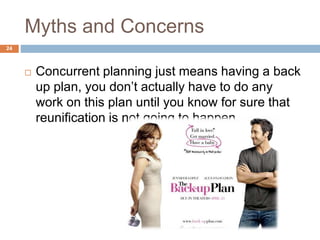
 Concurrent planning just means having a back
up plan, you don’t actually have to do any
work on this plan until you know for sure that
reunification is not going to happen.
24
Myths and Concerns
 You can do concurrent planning anytime
during the life of a case.
25
Myths and Concerns
 When DFCS implements concurrent planning,
every child in foster care will have to have a
concurrent plan.
26
Myths and Concerns
 Resource parents will sabotage the
reunification efforts because they just want to
adopt.
27
Agenda
 Foundational Matters
 Concurrent Planning Nationally
 Concurrent Planning in Georgia
 The Trials & Tribulations of CP at the County
Level
 Questions & Answers
28
STATE COUNTY
Conveying the Message
29
1. Staff Challenges
30
2. Restructuring the Agency
31
 Implementing Mirrored Units
 New Terminology for My 6 F.P.’s
 Partnership Parents: (formerly foster parents):
refers to individuals who provide temporary care for
children who are placed in out-of-the-home and are in
the temporary custody of DFCS. PP are expected to
engage in some level of partnership with the birth
parents of children in their home, and to actively work
with the birth parents toward reunification.
 Resource Parents: Refers to a subset of PP who are
reserved as resources for children with concurrent plans. These
parents also work in partnership with birth parents toward
reunification, but they also agree to be the child’s permanent
resource IF reunification is not successful.
3. Forced Creativity
32
 The Visitation Center
 The First 48
4. Limits in Data Systems
33
5. Learning Lessons the Hard
Way34
 Strategic Permanency Planning from the
Start:
Questions?
“Concurrent Planning will Not Produce Miracles,
and Expectations Should Reflect as Much.”
 Resources:
 DFCS Concurrent Planning Resources
 www.dfcs.dhr.georgia.gov/training
 National Resource Center for Permanency &
Family Connections
 www.nrcpfc.org
35

Concurrent Planning

  • 1.
    CONCURRENT PLANNING 101: TheHonorable Sandra Miller Paulding County Juvenile Court Barbara Burnley & Angie Chandler Paulding County DFCS Julie York & Amy Mobley DFCS Education & Project Management Unit Georgia Child Welfare Legal Academy Emory University School of Law Nov. 18, 2011 Atlanta, GA
  • 2.
    Our Shared Visionfor Today  Understand the Theory Behind Concurrent Case Planning  Understand the Practices that Promote Good Concurrent Case Planning  Understand Where Georgia is Today with Respect to Concurrent Case Planning 2
  • 3.
    Agenda  Foundational Matters Concurrent Planning Nationally  Concurrent Planning in Georgia  The Trials & Tribulations of CP at the County Level  Questions & Answers 3
  • 4.
    What is ConcurrentPlanning?  Concurrent Planning: Working towards reunification while at the same time establishing and implementing an alternative permanency plan.  Permanency Options: Reunification is always required as the primary plan  Alternative Plans Include: 1. Adoption 2. Guardianship 3. Permanent Custody with a Fit & Willing Relative.  APPLA is not an appropriate option for concurrent plans 4
  • 5.
    Alternate Plans Numberof Alternate Plans Adoption 1191 Guardianship 80 Permanent Custody with Fit & Willing Relative 1573 Current Planning in Georgia Today5  On October 1, 2011:  2902 children in foster care with concurrent case plans. That’s about 40% of the overall population.  Most common Primary plan is Reunification, but there are primary plans of APPLA, Live with Fit & Willing Relative, and Adoption (which is not good)  Alternate Plans Break Down Like This:
  • 6.
    Current Planning inGeorgia by Age6  Median Age: 6.1 // Range: [.1,18) 0 5 10 15 20 25 30 35 0 1 2 3 4 5 6 7 8 9 10 11 12 13 14 15 16 17 18 Concurrent Plan Distribution by Child Age
  • 7.
    Why Concurrent Planning? Benefits of Concurrent Planning:  Fewer Placements for Children in Care.  Fewer Adoption Disruptions  Reduced Length of Time in Care  Formation of New Extended Families  Supports Continuity and Stability in Family Relationships  May Produce Cost Savings 7
  • 8.
    Theory of ConcurrentPlanning  Reduce Time in Care: Foster Care is a Temporary Setting & Children Should Spend no More Time in Care Than Absolutely Necessary  Shift the Emotional Burden: Adults, Rather than Children, Should Assume the Emotional Risk of Foster Care & Uncertain Futures 8
  • 9.
    Agenda  Foundational Matters Concurrent Planning Nationally  Concurrent Planning in Georgia  The Trials & Tribulations of CP at the County Level  Questions & Answers 9
  • 10.
    Concurrent Planning Emerges Adoption Assistance & Child Welfare Act of 1980  Practice Required a Preferred Permanency Plan to Be Ruled out Before an Alternative was Developed  Lead to Sequential Case Planning  Believed to be Among the Contributors to ‘Foster Care Drift’  Adoption and Safe Families Act of 1997  Allows Courts to Order Concurrent Case Planning 10
  • 11.
    Concurrent Planning Ruffles Feathers Courts & Attorneys:  Development of an Alternative Case Plan Conflicts with Agencies’ Genuine Pursuit of Family Reunification.  Provider Community:  Certain Services (e.g., Adoption Recruitment) May Not be Initiated Until Petition to TPR is Filed.  Local Casemanagers:  Inherent Tension in Working with a Family at the Same Time You are Recruiting a New One  Foster Parents & Relatives:  Asking them to Sign up for the Role of “Plan B.” 11
  • 12.
    The Fed’s Recognizethe Challenge  The Children’s Bureau:  “concurrent planning efforts are not being implemented on a consistent basis when appropriate. . .”  “some states had formal, excellent concurrent planning policies at the state level, but there was no evidence of concurrent planning practices in the case reviews.”  “In a number of states, concurrent goals were written in the case files, but case reviews showed that efforts towards the goals were sequential rather than concurrent.” 12
  • 13.
    Research on Non-Reunification Most Common Indicators for Non-Reunification:  Parent previously killed or seriously harmed another child.  Parent repeatedly and with premeditation harmed a child.  Parent’s only visible support system is a drug culture.  Parent has significant and untreated mental health issues.  Parents rights to another child 13
  • 14.
  • 15.
  • 16.
    Concurrent Planning Takes Shape INVOLVES: Up Front Assessment: individualized and intensive  Family Engagement: full disclosure of parental strengths, needs, indicators for concurrent planning and consequences  Diligent Search: early and ongoing aggressive search  Early Identification of All Permanency Options: not just reunification at the start 16
  • 17.
    Components of Concurrent Planning Firm Timelines for Permanency  Full Disclosure to Parents  Early & Ongoing Exploration of Family Members as Caretakers  Early Paternity Determination  Frequent & Meaningful Visitation  Active Examination of Parental Ambivalence 17
  • 18.
    Primary Culprit: theCP Assessment Guide  Agency Completes Assessment of Family’s Likelihood of Being Reunified Quickly Based on A Number of Indicators  Families with Poor Prognosis of Reunification are Given a Concurrent Plan and Full Disclosure of Such 18
  • 19.
    Agenda  Foundational Matters Concurrent Planning Nationally  Concurrent Planning in Georgia  The Trials & Tribulations of CP at the County Level  Questions & Answers 19
  • 20.
    Current Planning inGeorgia is Born20  Innovation Zones:  Training Jan – Mar 2010
  • 21.
  • 22.
    Myths and Concerns Concurrent planning is just a fast track to Termination of Parental Rights (TPR) and will set birth parents up for failure. 22
  • 23.
    Myths and Concerns Concurrent planning will cause case managers to give up on birth parents too quickly, or to not sincerely work on reunification efforts. 23
  • 24.
    Myths and Concerns Concurrent planning just means having a back up plan, you don’t actually have to do any work on this plan until you know for sure that reunification is not going to happen. 24
  • 25.
    Myths and Concerns You can do concurrent planning anytime during the life of a case. 25
  • 26.
    Myths and Concerns When DFCS implements concurrent planning, every child in foster care will have to have a concurrent plan. 26
  • 27.
    Myths and Concerns Resource parents will sabotage the reunification efforts because they just want to adopt. 27
  • 28.
    Agenda  Foundational Matters Concurrent Planning Nationally  Concurrent Planning in Georgia  The Trials & Tribulations of CP at the County Level  Questions & Answers 28
  • 29.
  • 30.
  • 31.
    2. Restructuring theAgency 31  Implementing Mirrored Units  New Terminology for My 6 F.P.’s  Partnership Parents: (formerly foster parents): refers to individuals who provide temporary care for children who are placed in out-of-the-home and are in the temporary custody of DFCS. PP are expected to engage in some level of partnership with the birth parents of children in their home, and to actively work with the birth parents toward reunification.  Resource Parents: Refers to a subset of PP who are reserved as resources for children with concurrent plans. These parents also work in partnership with birth parents toward reunification, but they also agree to be the child’s permanent resource IF reunification is not successful.
  • 32.
    3. Forced Creativity 32 The Visitation Center  The First 48
  • 33.
    4. Limits inData Systems 33
  • 34.
    5. Learning Lessonsthe Hard Way34  Strategic Permanency Planning from the Start:
  • 35.
    Questions? “Concurrent Planning willNot Produce Miracles, and Expectations Should Reflect as Much.”  Resources:  DFCS Concurrent Planning Resources  www.dfcs.dhr.georgia.gov/training  National Resource Center for Permanency & Family Connections  www.nrcpfc.org 35