CYCLOIDS
What is a Cycloid?
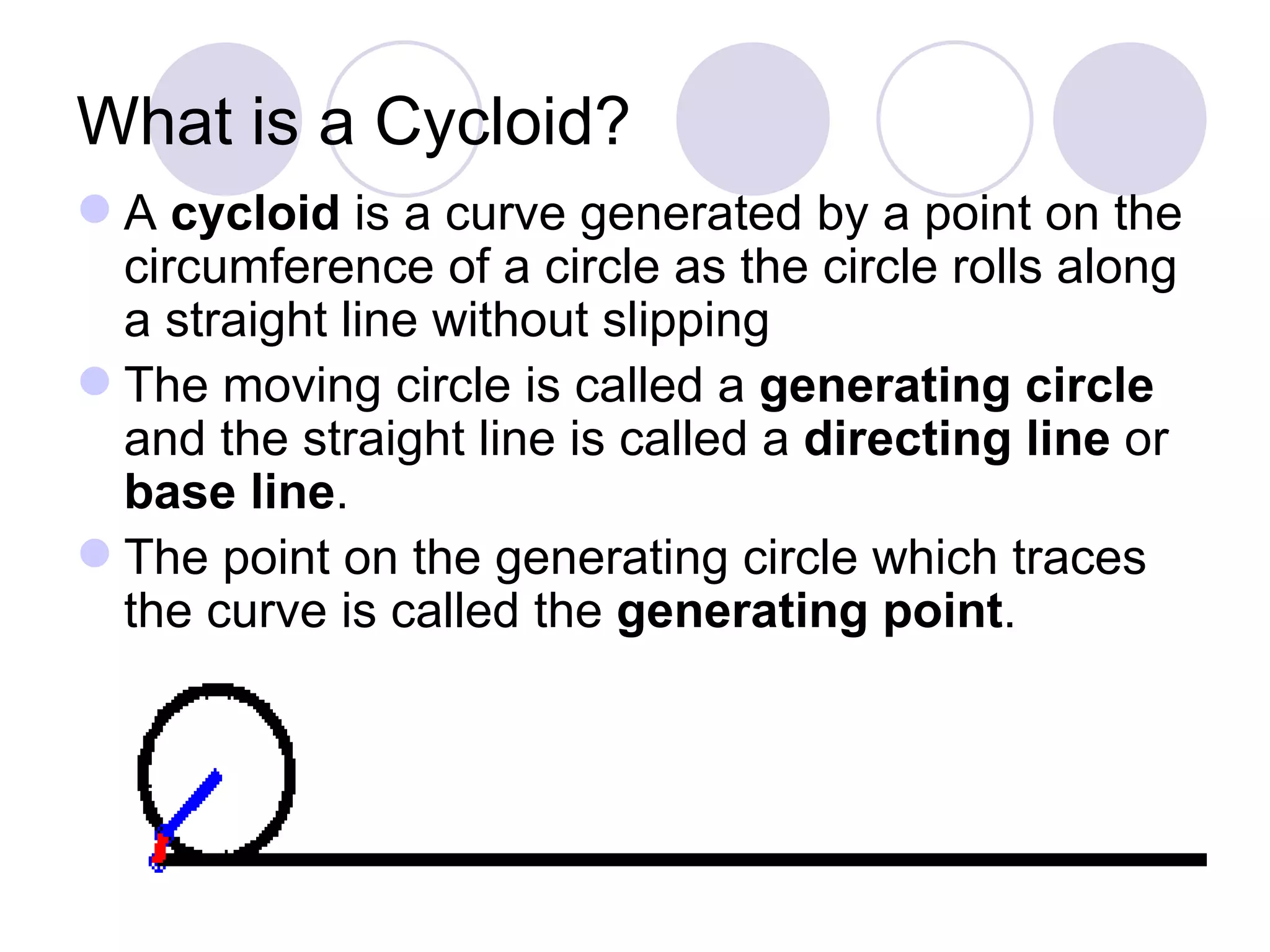
 A cycloid is a curve generated by a point on the
  circumference of a circle as the circle rolls along
  a straight line without slipping
 The moving circle is called a generating circle
  and the straight line is called a directing line or
  base line.
 The point on the generating circle which traces
  the curve is called the generating point.
Construction of a Cycloid


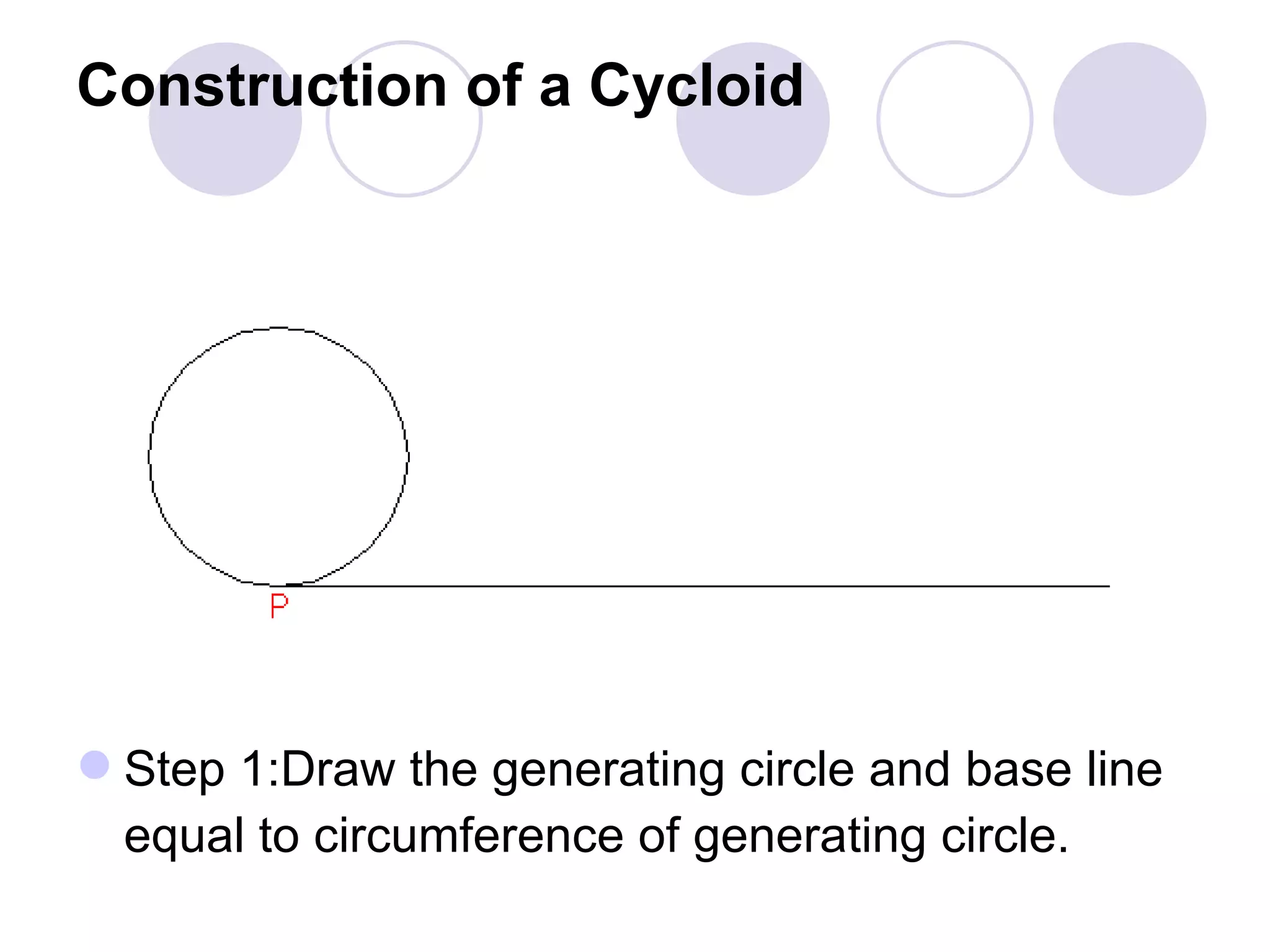
 Step 1:Draw the generating circle and base line
  equal to circumference of generating circle.
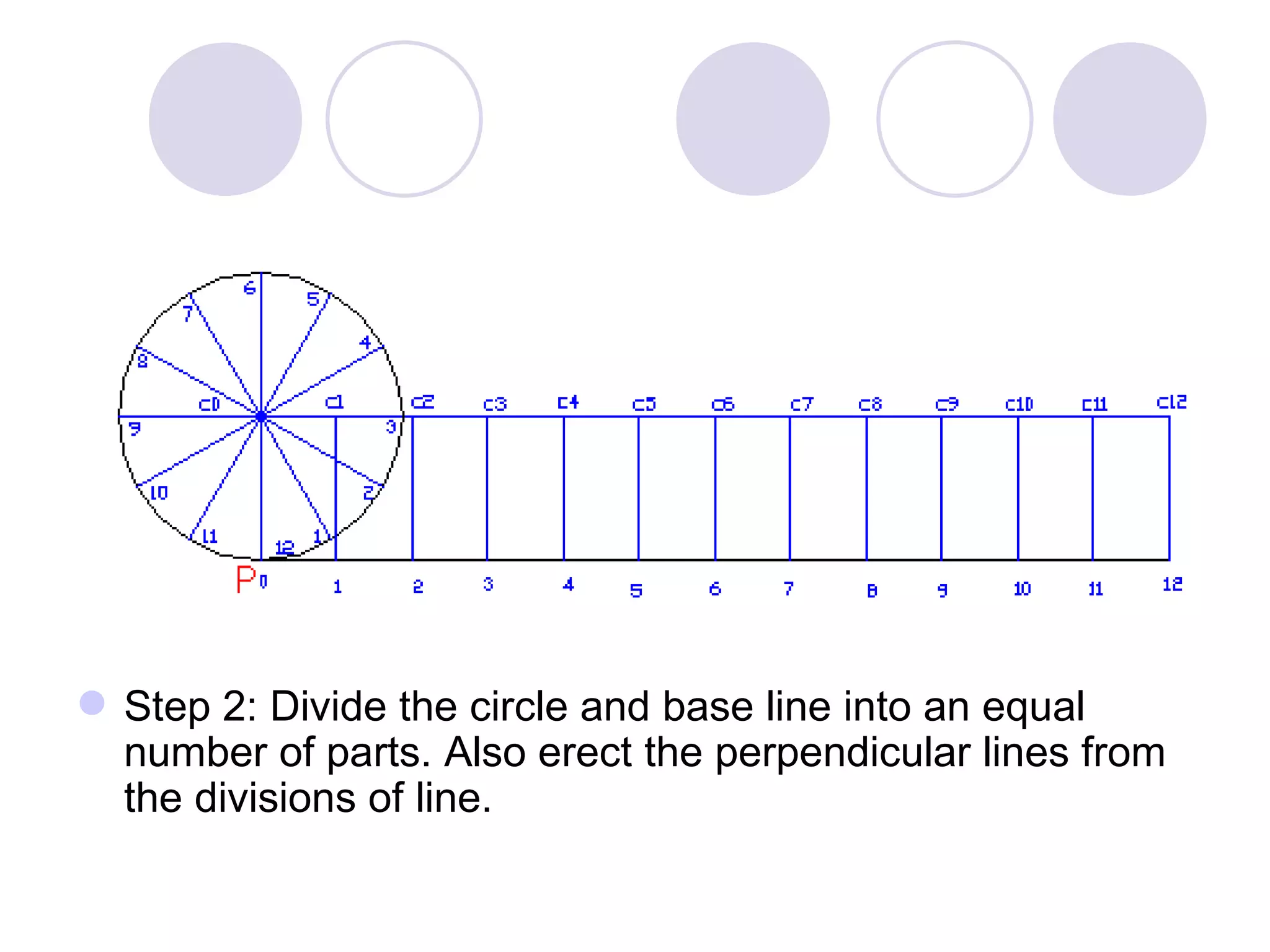
 Step 2: Divide the circle and base line into an equal
  number of parts. Also erect the perpendicular lines from
  the divisions of line.
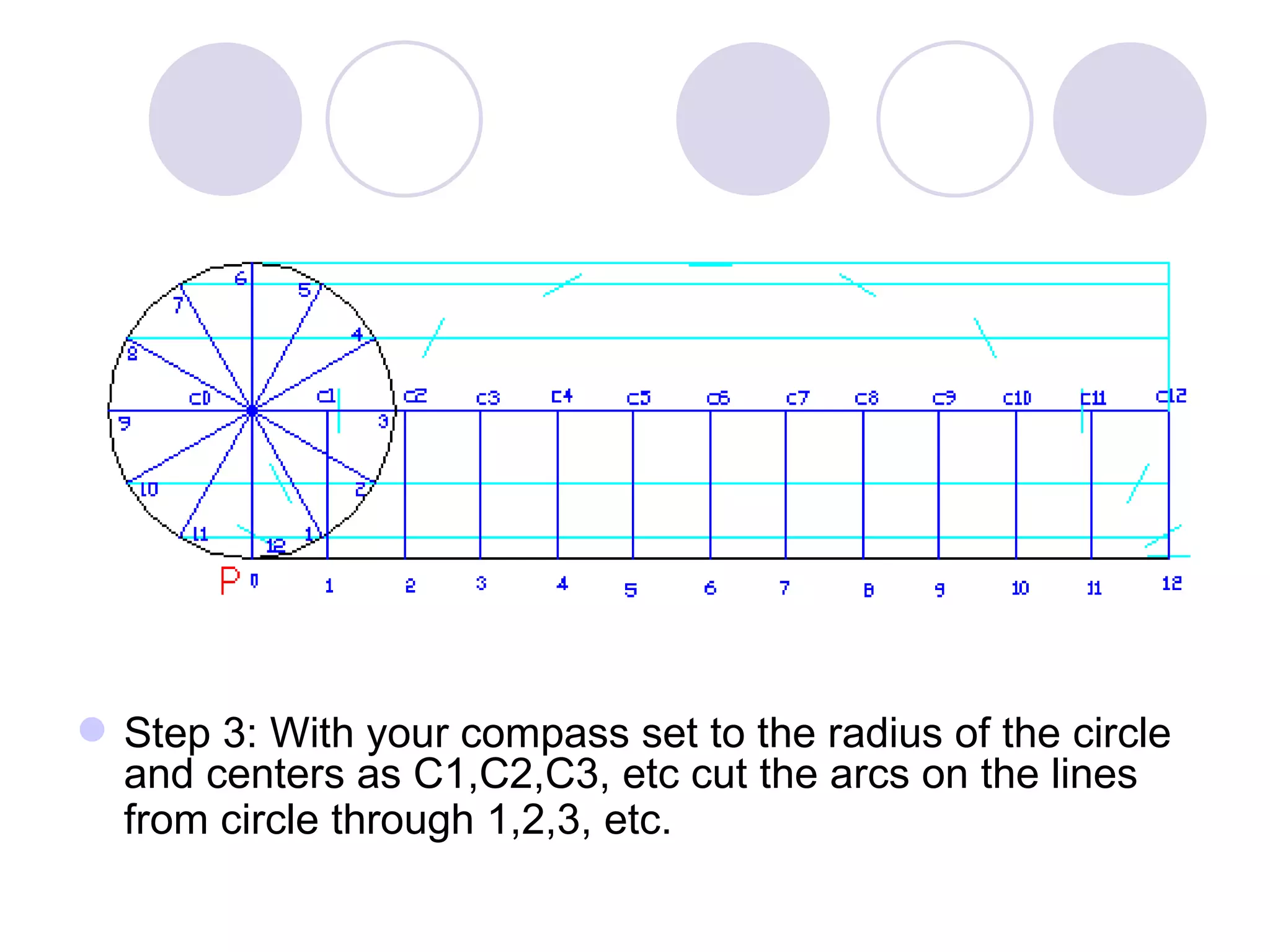
 Step 3: With your compass set to the radius of the circle
  and centers as C1,C2,C3, etc cut the arcs on the lines
  from circle through 1,2,3, etc.
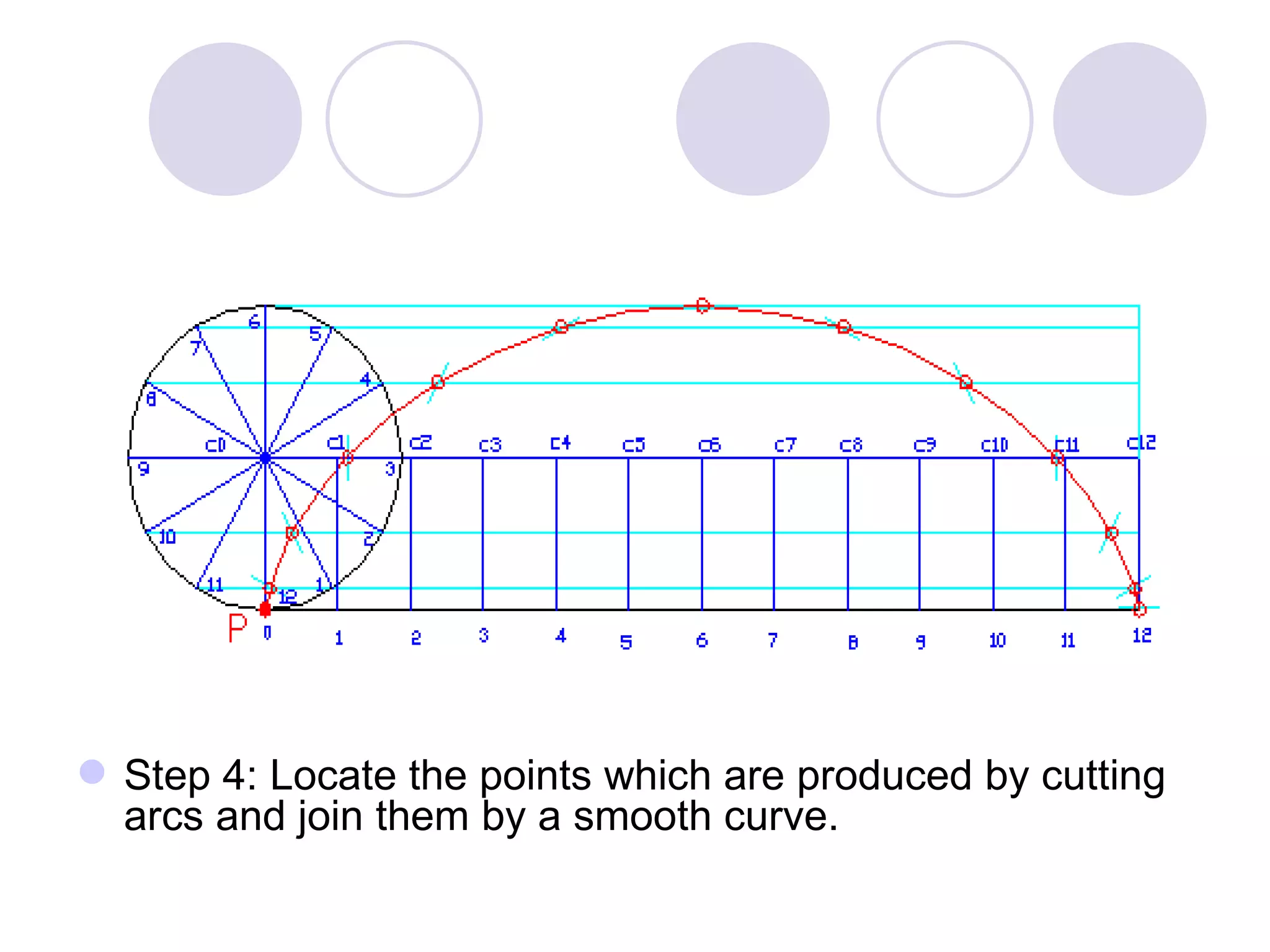
 Step 4: Locate the points which are produced by cutting
  arcs and join them by a smooth curve.
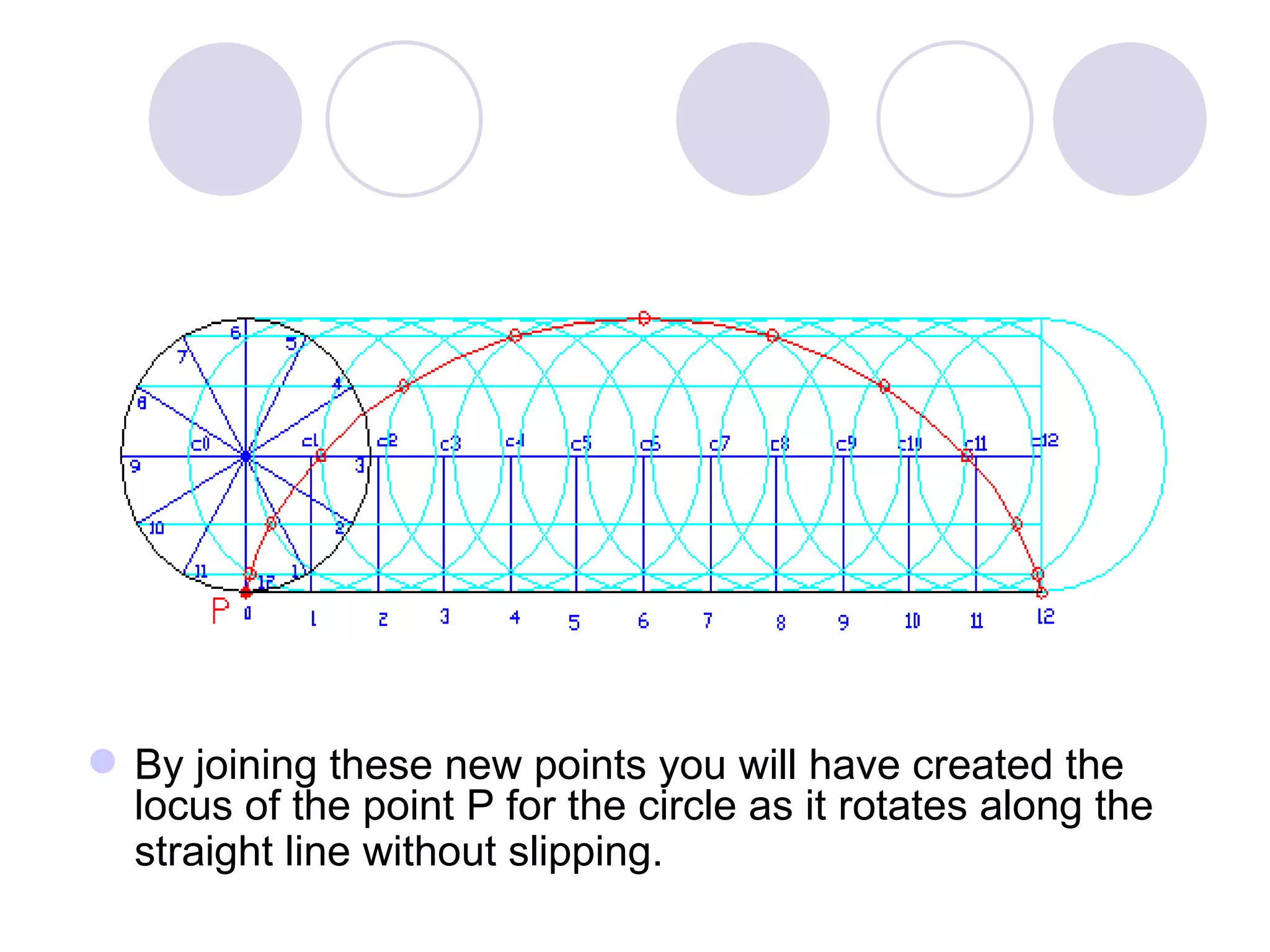
 By joining these new points you will have created the
  locus of the point P for the circle as it rotates along the
  straight line without slipping.
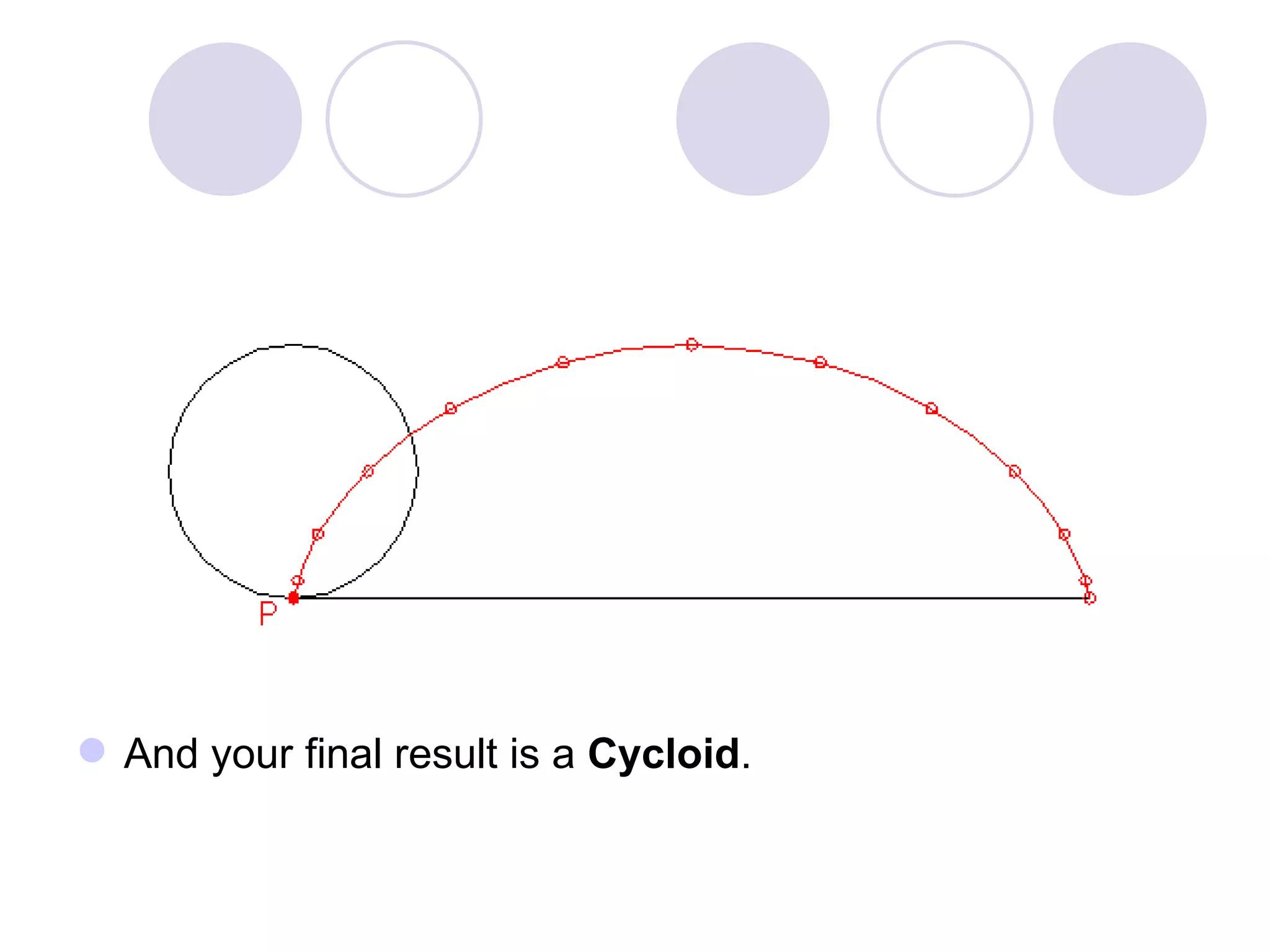
 And your final result is a Cycloid.
Construction of a Tangent and a Normal to a
point on a Cycloid.


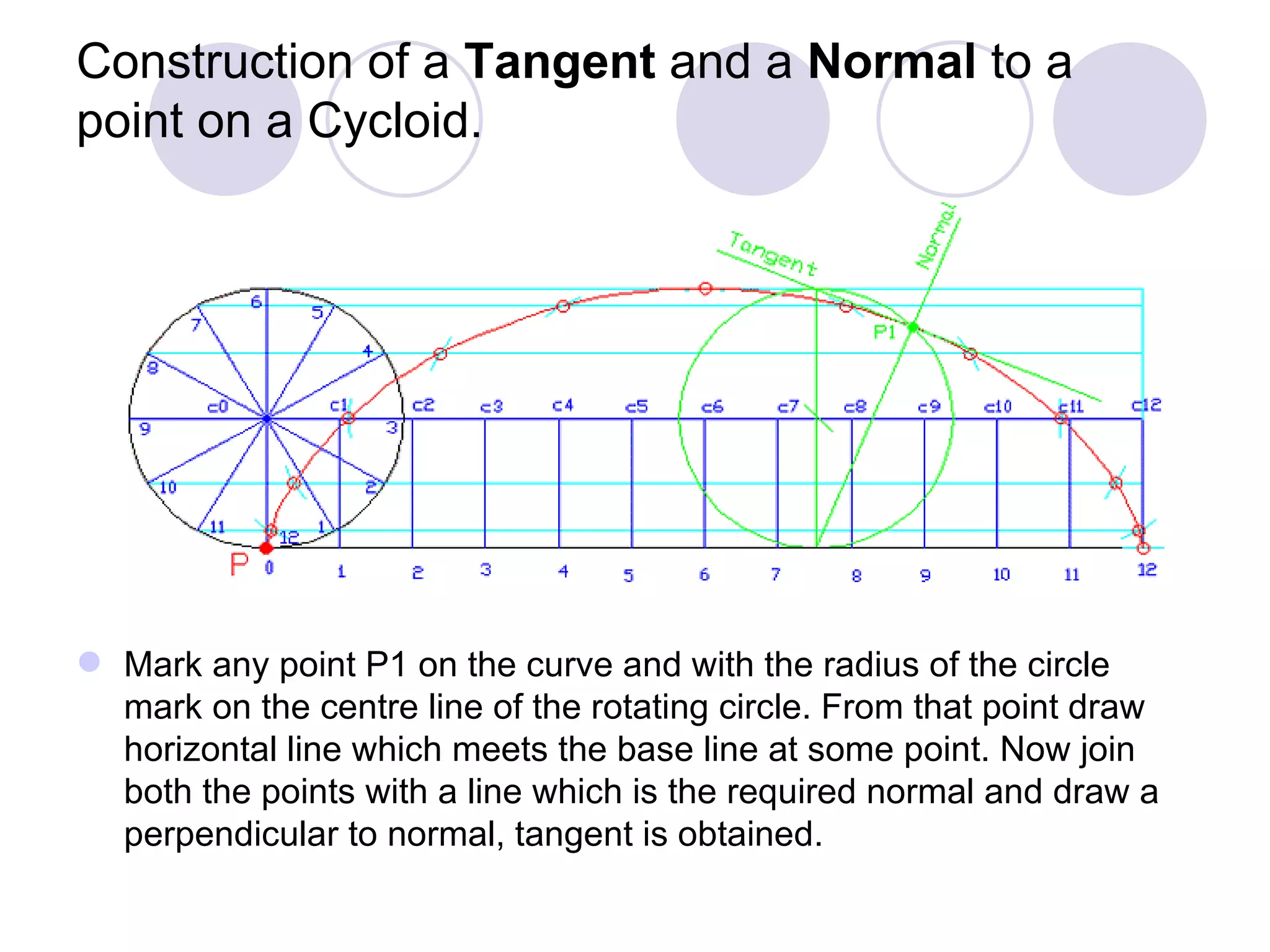
 Mark any point P1 on the curve and with the radius of the circle
  mark on the centre line of the rotating circle. From that point draw
  horizontal line which meets the base line at some point. Now join
  both the points with a line which is the required normal and draw a
  perpendicular to normal, tangent is obtained.
EPICYCLOIDS
What is Epicycloid?
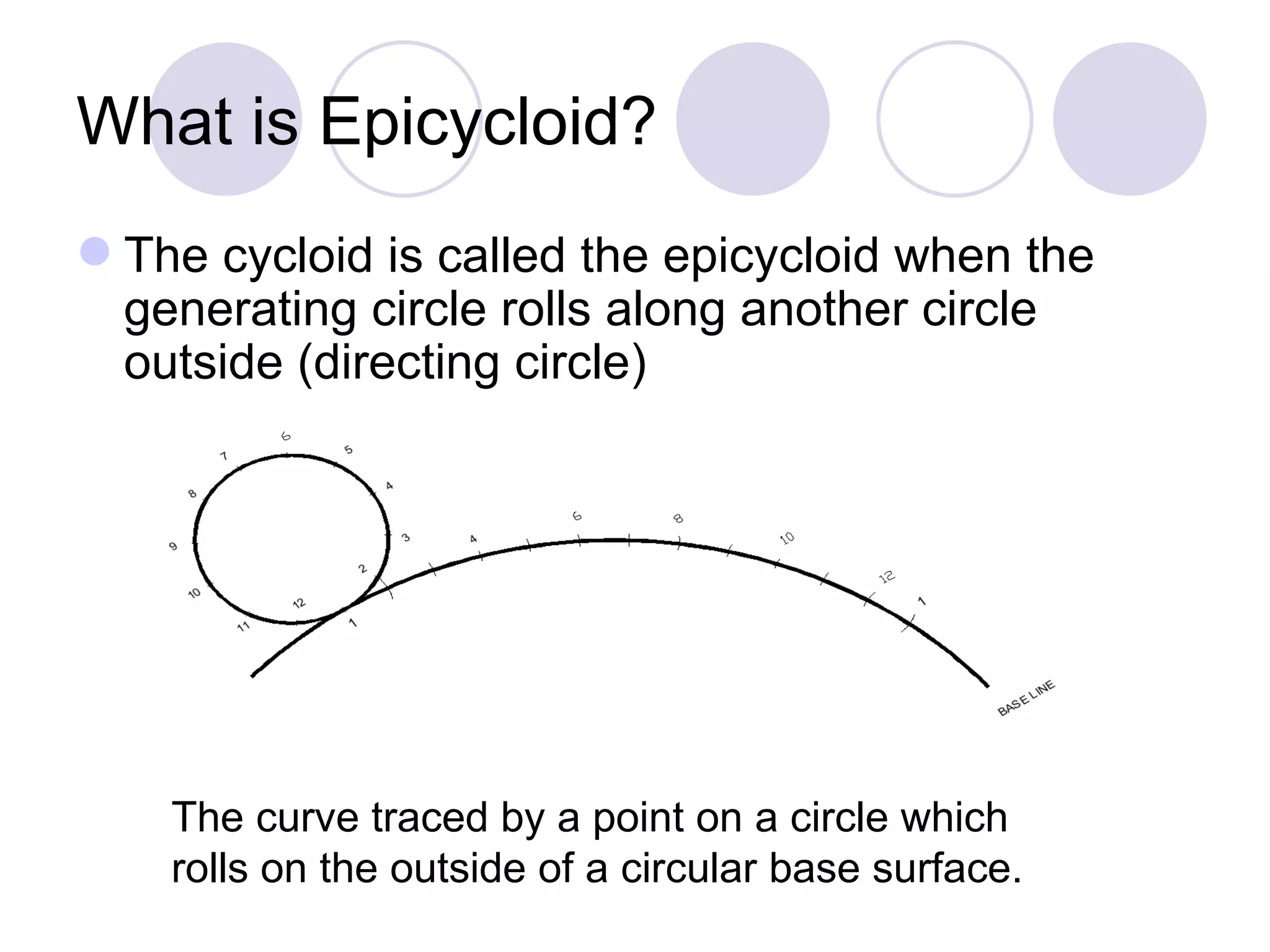
 The cycloid is called the epicycloid when the
  generating circle rolls along another circle
  outside (directing circle)


    The curve traced by a point on a circle which
    rolls on the outside of a circular base surface.
Construction of Epicycloid


     9
               8


                           5
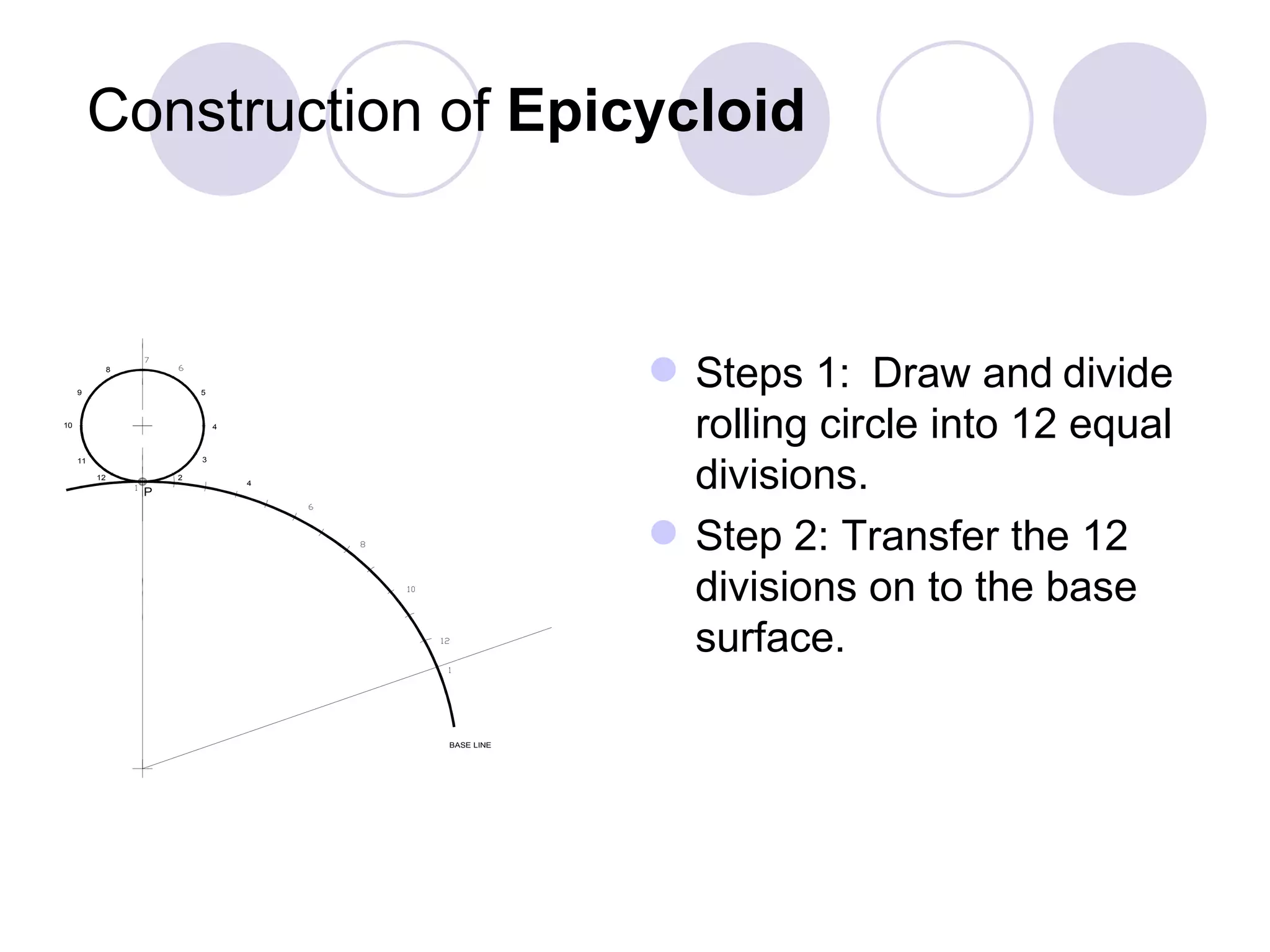
                                                    Steps 1: Draw and divide
10                             4
                                                     rolling circle into 12 equal
                                                     divisions.
     11                    3

          12           2
                                   4
                   P


                                                    Step 2: Transfer the 12
                                                     divisions on to the base
                                                     surface.

                                       BASE LINE
8
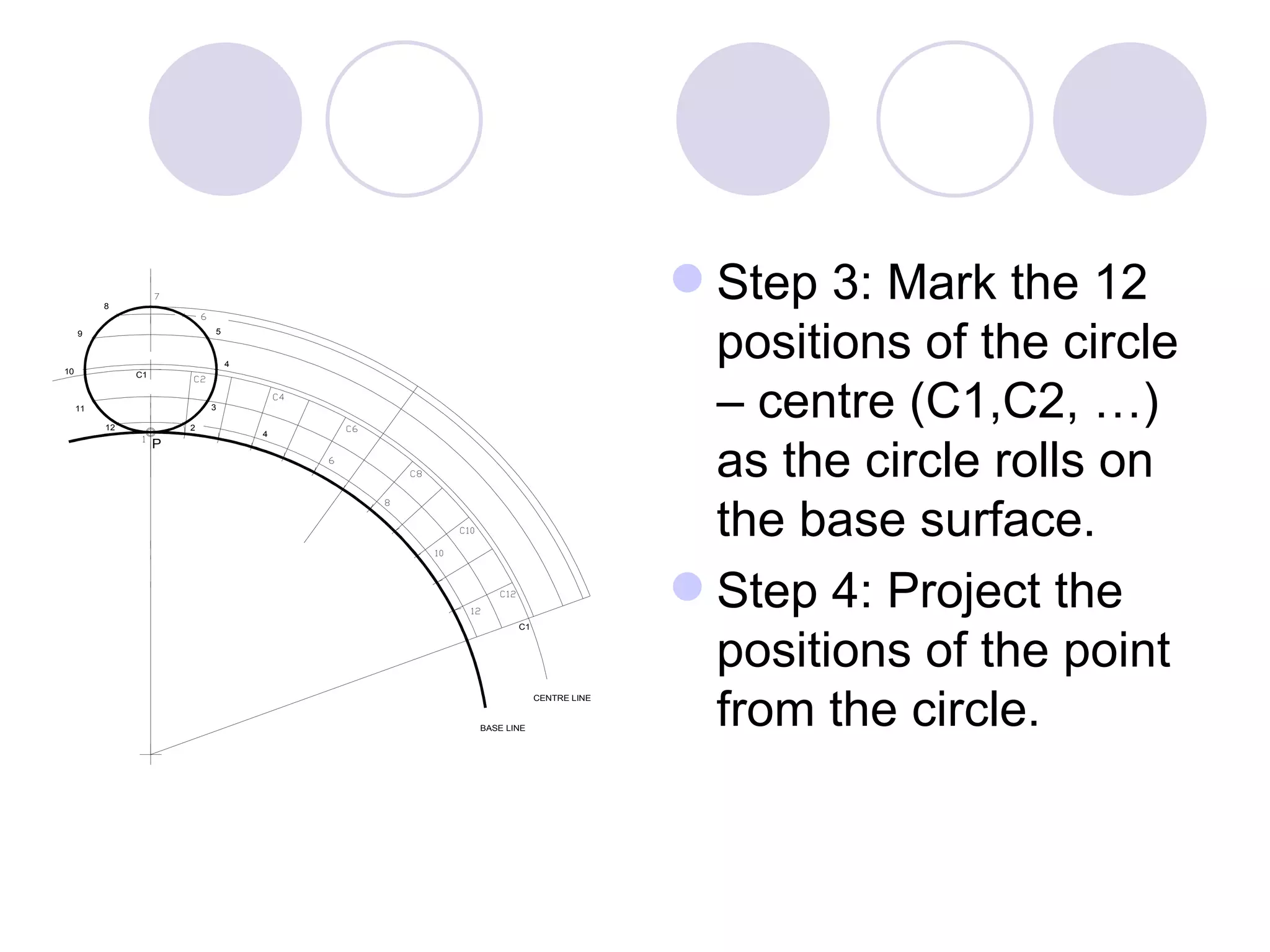
                                                                   Step 3: Mark the 12
10
     9


               C1
                            5


                                4
                                                                    positions of the circle
     11

          12            2
                            3


                                    4
                                                                    – centre (C1,C2, …)
                                                                    as the circle rolls on
                    P


                                                                    the base surface.
                                                                   Step 4: Project the
                                                                    positions of the point
                                               C1


                                                                    from the circle.
                                                    CENTRE LINE


                                        BASE LINE
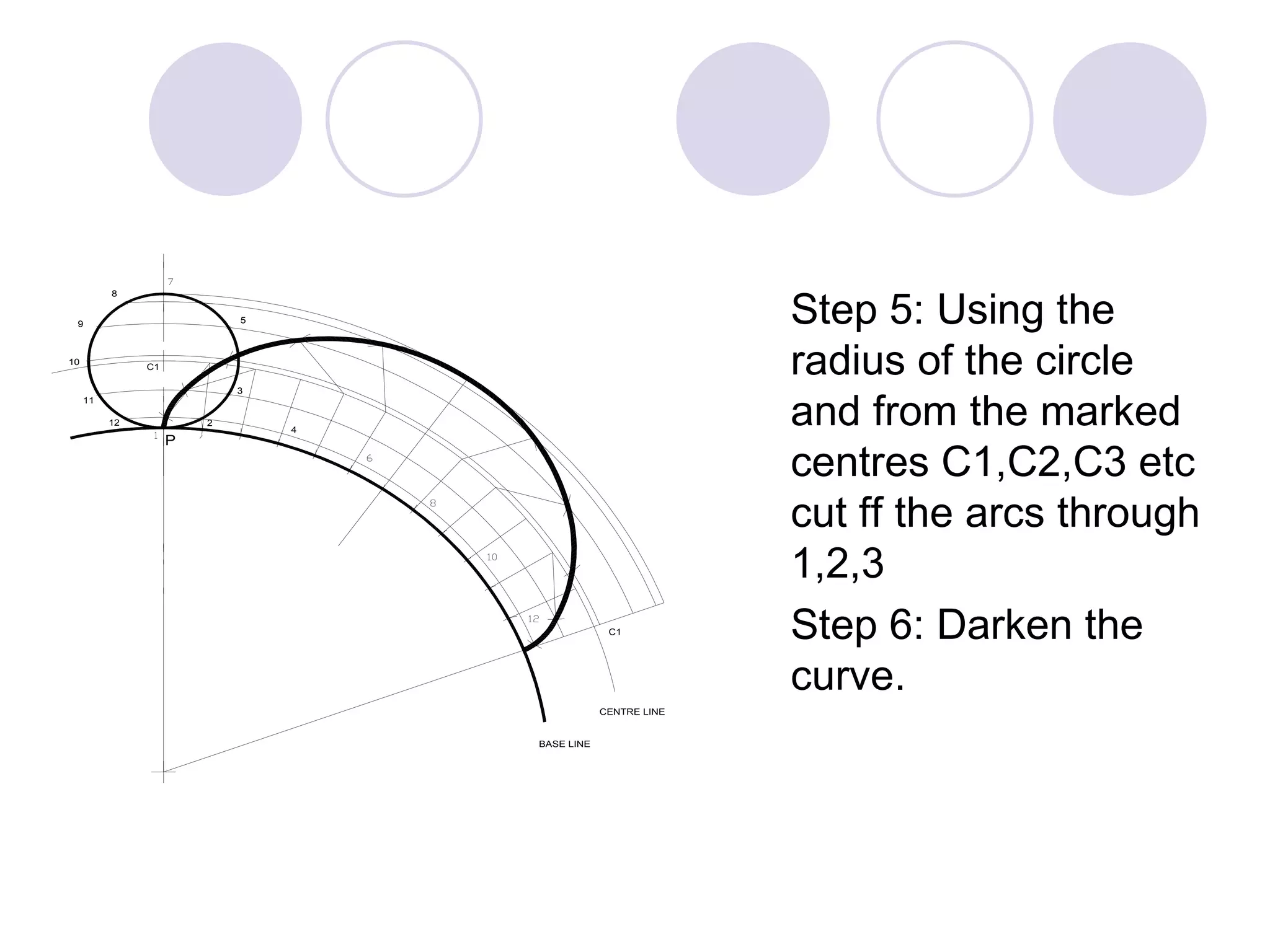
 Step 5: Using the
          8


 9                          5


10
               C1

                            3
                                                                radius of the circle
                                                                and from the marked
     11

          12            2
                                4
                    P

                                                                centres C1,C2,C3 etc
                                                                cut ff the arcs through
                                                                1,2,3
                                                 C1            Step 6: Darken the
                                                                curve.
                                                CENTRE LINE


                                    BASE LINE
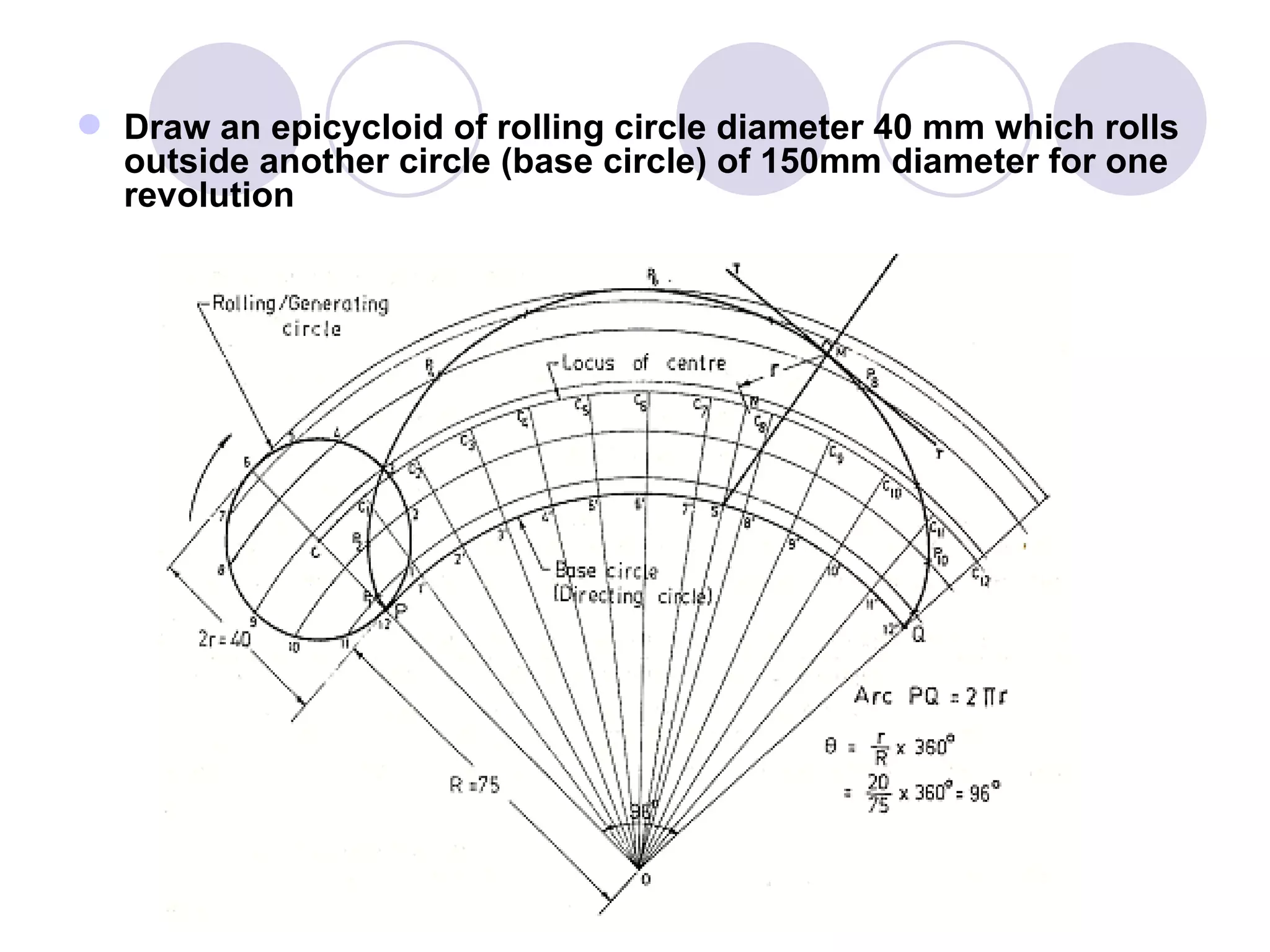
 Draw an epicycloid of rolling circle diameter 40 mm which rolls
  outside another circle (base circle) of 150mm diameter for one
  revolution
 Step 1: Draw an arc PQ with radius75 mm and centre O,
  subtending and angle 96º. P is the generating point. On OP
  produced mark PC = 20mm. Draw a circle with centre C and
  radius 20 mm.
 Step 2 : Divide rolling diameter in to12 equal parts and name
  them as 1,2,3,4… 12 in Clock Wise direction.
 Step 3 : With O as centre draw concentric arcs passing
  through1,2,3,…,12.
 Step 4 : With O as centre and OC as radius, draw an arc to
  represent locus of centre.
 Step 5 : Divide arc PQ in to 12 equal parts and name them as1’,
  2’, …., 12’.
 Step 6 : JoinO1’, O2’, …and produce them to cut the locus of
  centers atC1, C2, ….
 Step 7 : Taking C1 as centre, and radius equal to 20 mm, draw
  an arc cutting the arc through1 at P1. Similarly obtain pointsP2,
  P3,…., P12.
HYPOCYCLOIDS
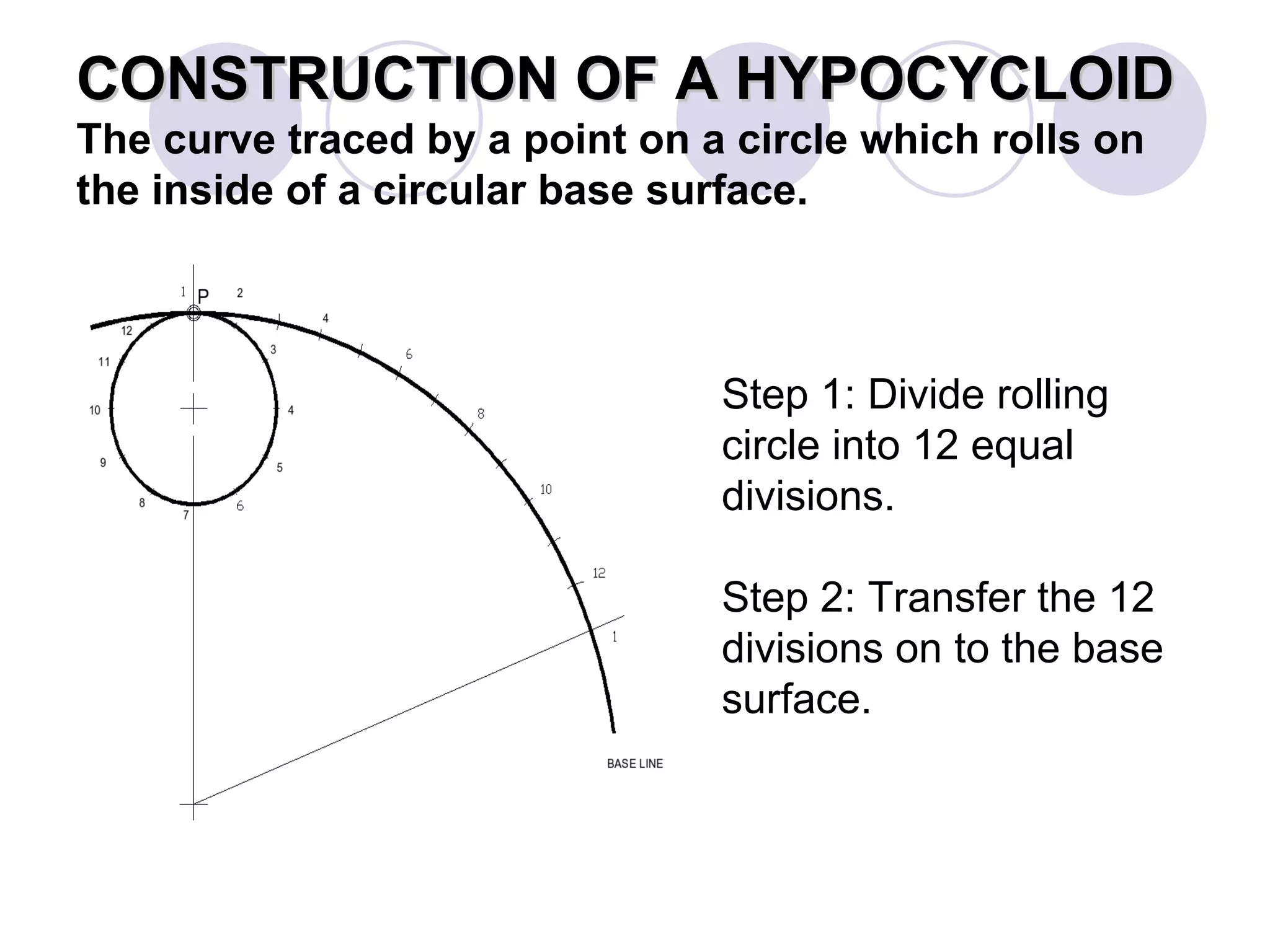
CONSTRUCTION OF A HYPOCYCLOID
The curve traced by a point on a circle which rolls on
the inside of a circular base surface.


                                Step 1: Divide rolling
                                circle into 12 equal
                                divisions.

                                Step 2: Transfer the 12
                                divisions on to the base
                                surface.
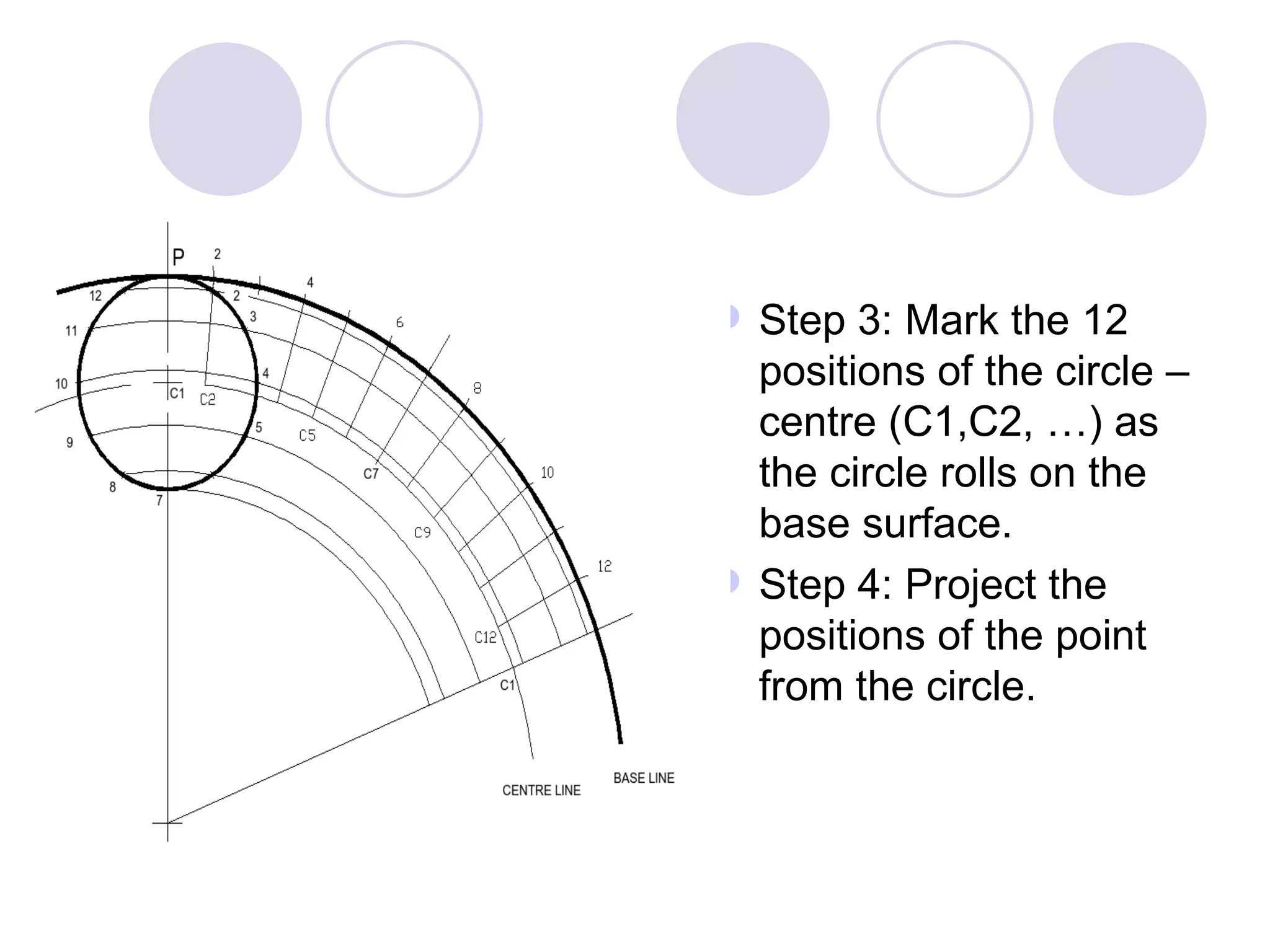
 Step 3: Mark the 12
  positions of the circle –
  centre (C1,C2, …) as
  the circle rolls on the
  base surface.
 Step 4: Project the
  positions of the point
  from the circle.
P   2
                                        4
      12                    2

 11
                                3
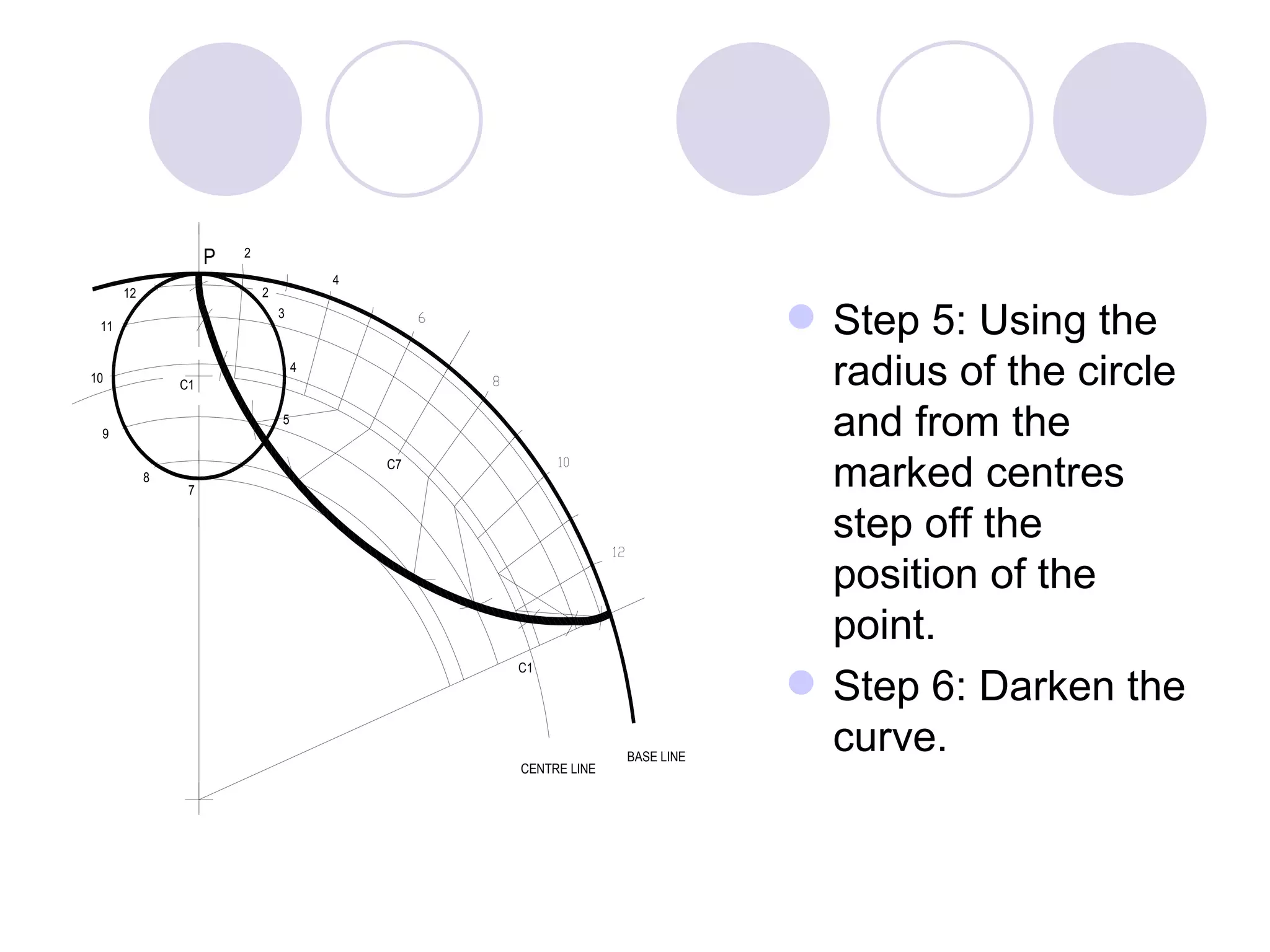
                                                                            Step 5: Using the
10
               C1
                                    4
                                                                             radius of the circle
 9
                                5
                                                                             and from the
           8
                7
                                            C7
                                                                             marked centres
                                                                             step off the
                                                                             position of the
                                                                             point.
                                                                            Step 6: Darken the
                                                 C1


                                                               BASE LINE
                                                                             curve.
                                                 CENTRE LINE
 Applications of cycloid curves:

 Cycloid curves are used in the design of
  gear tooth profiles.

 It is also used in the design of conveyor of
  mould boxes in foundry shops.
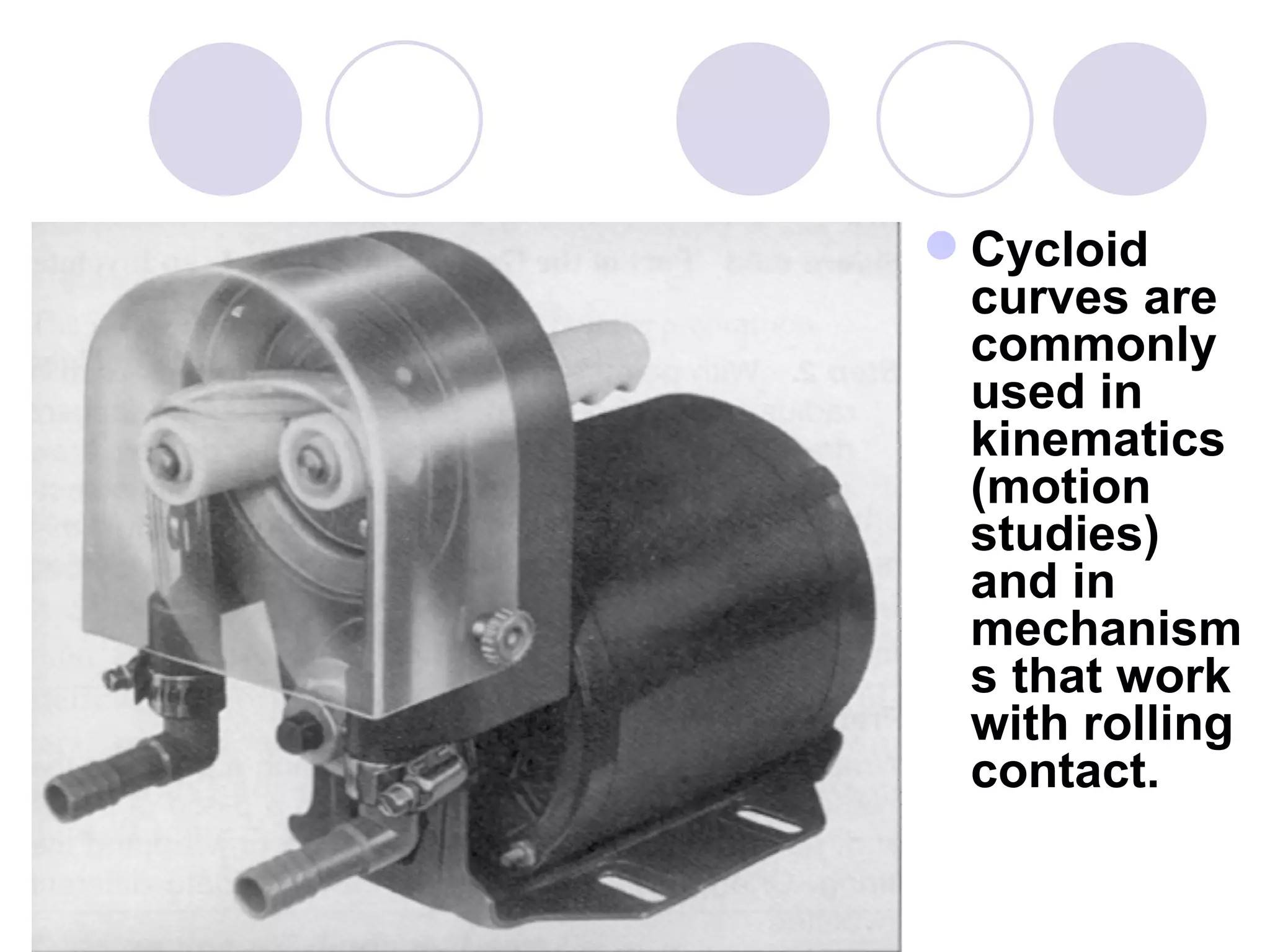
 Cycloid
  curves are
  commonly
  used in
  kinematics
  (motion
  studies)
  and in
  mechanism
  s that work
  with rolling
  contact.

Cycloids

  • 1.
  • 2.
    What is aCycloid?  A cycloid is a curve generated by a point on the circumference of a circle as the circle rolls along a straight line without slipping  The moving circle is called a generating circle and the straight line is called a directing line or base line.  The point on the generating circle which traces the curve is called the generating point.
  • 3.
    Construction of aCycloid  Step 1:Draw the generating circle and base line equal to circumference of generating circle.
  • 4.
     Step 2:Divide the circle and base line into an equal number of parts. Also erect the perpendicular lines from the divisions of line.
  • 5.
     Step 3:With your compass set to the radius of the circle and centers as C1,C2,C3, etc cut the arcs on the lines from circle through 1,2,3, etc.
  • 6.
     Step 4:Locate the points which are produced by cutting arcs and join them by a smooth curve.
  • 7.
     By joiningthese new points you will have created the locus of the point P for the circle as it rotates along the straight line without slipping.
  • 8.
     And yourfinal result is a Cycloid.
  • 9.
    Construction of aTangent and a Normal to a point on a Cycloid.  Mark any point P1 on the curve and with the radius of the circle mark on the centre line of the rotating circle. From that point draw horizontal line which meets the base line at some point. Now join both the points with a line which is the required normal and draw a perpendicular to normal, tangent is obtained.
  • 10.
  • 11.
    What is Epicycloid? The cycloid is called the epicycloid when the generating circle rolls along another circle outside (directing circle) The curve traced by a point on a circle which rolls on the outside of a circular base surface.
  • 12.
    Construction of Epicycloid 9 8 5  Steps 1: Draw and divide 10 4 rolling circle into 12 equal divisions. 11 3 12 2 4 P  Step 2: Transfer the 12 divisions on to the base surface. BASE LINE
  • 13.
    8  Step 3: Mark the 12 10 9 C1 5 4 positions of the circle 11 12 2 3 4 – centre (C1,C2, …) as the circle rolls on P the base surface.  Step 4: Project the positions of the point C1 from the circle. CENTRE LINE BASE LINE
  • 14.
     Step 5:Using the 8 9 5 10 C1 3 radius of the circle and from the marked 11 12 2 4 P centres C1,C2,C3 etc cut ff the arcs through 1,2,3 C1  Step 6: Darken the curve. CENTRE LINE BASE LINE
  • 15.
     Draw anepicycloid of rolling circle diameter 40 mm which rolls outside another circle (base circle) of 150mm diameter for one revolution
  • 16.
     Step 1:Draw an arc PQ with radius75 mm and centre O, subtending and angle 96º. P is the generating point. On OP produced mark PC = 20mm. Draw a circle with centre C and radius 20 mm.  Step 2 : Divide rolling diameter in to12 equal parts and name them as 1,2,3,4… 12 in Clock Wise direction.  Step 3 : With O as centre draw concentric arcs passing through1,2,3,…,12.  Step 4 : With O as centre and OC as radius, draw an arc to represent locus of centre.  Step 5 : Divide arc PQ in to 12 equal parts and name them as1’, 2’, …., 12’.  Step 6 : JoinO1’, O2’, …and produce them to cut the locus of centers atC1, C2, ….  Step 7 : Taking C1 as centre, and radius equal to 20 mm, draw an arc cutting the arc through1 at P1. Similarly obtain pointsP2, P3,…., P12.
  • 17.
  • 18.
    CONSTRUCTION OF AHYPOCYCLOID The curve traced by a point on a circle which rolls on the inside of a circular base surface. Step 1: Divide rolling circle into 12 equal divisions. Step 2: Transfer the 12 divisions on to the base surface.
  • 19.
     Step 3:Mark the 12 positions of the circle – centre (C1,C2, …) as the circle rolls on the base surface.  Step 4: Project the positions of the point from the circle.
  • 20.
    P 2 4 12 2 11 3  Step 5: Using the 10 C1 4 radius of the circle 9 5 and from the 8 7 C7 marked centres step off the position of the point.  Step 6: Darken the C1 BASE LINE curve. CENTRE LINE
  • 21.
     Applications ofcycloid curves:  Cycloid curves are used in the design of gear tooth profiles.  It is also used in the design of conveyor of mould boxes in foundry shops.
  • 22.
     Cycloid curves are commonly used in kinematics (motion studies) and in mechanism s that work with rolling contact.