ENGINEERING CURVES
Part-II
(Point undergoing two types of displacements)
INVOLUTE
1. Involute of a circle
a)String Length = D
b)String Length > D
c)String Length < D
2. Pole having Composite
shape.
3. Rod Rolling over
a Semicircular Pole.
CYCLOID
1. General Cycloid
2. Trochoid
( superior)
3. Trochoid
( Inferior)
4. Epi-Cycloid
5. Hypo-Cycloid
SPIRAL
1. Spiral of
One Convolution.
2. Spiral of
Two Convolutions.
HELIX
1. On Cylinder
2. On a Cone
Methods of Drawing
Tangents & Normals
To These Curves.
AND
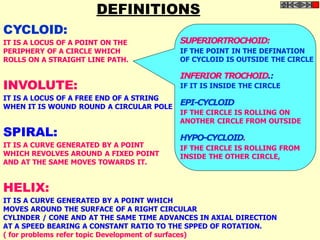
CYCLOID:
IT IS A LOCUS OF A POINT ON THE
PERIPHERY OF A CIRCLE WHICH
ROLLS ON A STRAIGHT LINE PATH.
INVOLUTE:
IT IS A LOCUS OF A FREE END OF A STRING
WHEN IT IS WOUND ROUND A CIRCULAR POLE
SPIRAL:
IT IS A CURVE GENERATED BY A POINT
WHICH REVOLVES AROUND A FIXED POINT
AND AT THE SAME MOVES TOWARDS IT.
HELIX:
IT IS A CURVE GENERATED BY A POINT WHICH
MOVES AROUND THE SURFACE OF A RIGHT CIRCULAR
CYLINDER / CONE AND AT THE SAME TIME ADVANCES IN AXIAL DIRECTION
AT A SPEED BEARING A CONSTANT RATIO TO THE SPPED OF ROTATION.
( for problems refer topic Development of surfaces)
DEFINITIONS
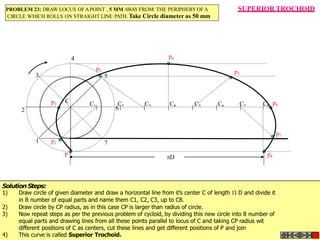
SUPERIORTROCHOID:
IF THE POINT IN THE DEFINATION
OF CYCLOID IS OUTSIDE THE CIRCLE
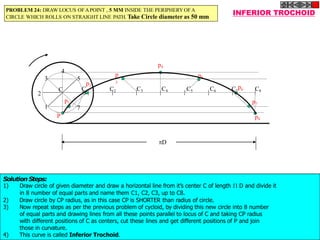
INFERIOR TROCHOID.:
IF IT IS INSIDE THE CIRCLE
EPI-CYCLOID
IF THE CIRCLE IS ROLLING ON
ANOTHER CIRCLE FROM OUTSIDE
HYPO-CYCLOID.
IF THE CIRCLE IS ROLLING FROM
INSIDE THE OTHER CIRCLE,
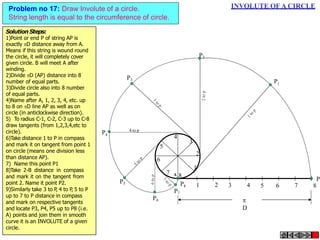
INVOLUTE OF A CIRCLE
Problem no 17: Draw Involute of a circle.
String length is equal to the circumference of circle.
2 3 4 5 6 7
P
8
P8 1
1
2
3
4
5
6
7
P3
P4
4 to p
P5
P7
P6
P2
P1

D
A 8
Solution Steps:
1)Point or end P of string AP is
exactly D distance away from A.
Means if this string is wound round
the circle, it will completely cover
given circle. B will meet A after
winding.
2)Divide D (AP) distance into 8
number of equal parts.
3)Divide circle also into 8 number
of equal parts.
4)Name after A, 1, 2, 3, 4, etc. up
to 8 on D line AP as well as on
circle (in anticlockwise direction).
5) To radius C-1, C-2, C-3 up to C-8
draw tangents (from 1,2,3,4,etc to
circle).
6)Take distance 1 to P in compass
and mark it on tangent from point 1
on circle (means one division less
than distance AP).
7) Name this point P1
8)Take 2-B distance in compass
and mark it on the tangent from
point 2. Name it point P2.
9)Similarly take 3 to P
, 4 to P
, 5 to P
up to 7 to P distance in compass
and mark on respective tangents
and locate P3, P4, P5 up to P8 (i.e.
A) points and join them in smooth
curve it is an INVOLUTE of a given
circle.
INVOLUTE OFACIRCLE
String length MORE than D
2 7 8
P
1
3
4
5
2
6
7
8
P3
P4
4 to p
P5
P7
P6
P2
P1
3 4 5 6
165 mm
(more than D)
D
p8 1
Solution Steps:
In this case string length is more
than  D.
But remember!
Whatever may be the length of
string, mark  D distance
horizontal i.e.along the string
and divide it in 8 number of
equal parts, and not any other
distance. Rest all steps are same
as previous INVOLUTE. Draw
the curve completely.
Problem 18: Draw Involute of a circle.
String length is MORE than the circumference of circle.
1 2 5 6 7 8
P
4
3
5
2
6
1
7
8
P3
P4
4 to p
P5
P7
P6
P2
P1
3 4
150 mm
(Less than D)
D
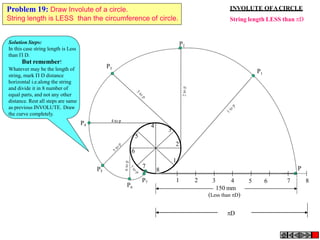
INVOLUTE OFACIRCLE
String length LESS than D
Problem 19: Draw Involute of a circle.
String length is LESS than the circumference of circle.
Solution Steps:
In this case string length is Less
than  D.
But remember!
Whatever may be the length of
string, mark  D distance
horizontal i.e.along the string
and divide it in 8 number of
equal parts, and not any other
distance. Rest all steps are same
as previous INVOLUTE. Draw
the curve completely.
1
2
3
4
5
6
1 2 4 5 6
A
P
3
D/2
P1
1
to
P
P2
P3
3 to P
P4
P
P5
P6
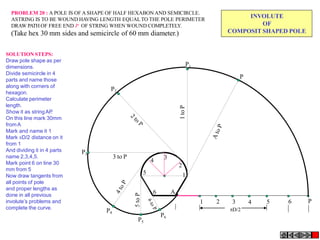
INVOLUTE
OF
COMPOSIT SHAPED POLE
PROBLEM 20 : A POLE IS OF A SHAPE OF HALF HEXABON AND SEMICIRCLE.
ASTRING IS TO BE WOUND HAVING LENGTH EQUALTO THE POLE PERIMETER
DRAW PATH OF FREE END P OF STRING WHEN WOUND COMPLETELY.
(Take hex 30 mm sides and semicircle of 60 mm diameter.)
SOLUTION STEPS:
Draw pole shape as per
dimensions.
Divide semicircle in 4
parts and name those
along with corners of
hexagon.
Calculate perimeter
length.
Show it as stringAP
.
On this line mark 30mm
from A
Mark and name it 1
Mark D/2 distance on it
from 1
And dividing it in 4 parts
name 2,3,4,5.
Mark point 6 on line 30
mm from 5
Now draw tangents from
all points of pole
and proper lengths as
done in all previous
involute’s problems and
complete the curve.
1
2
3
4
D
1
2
3
4
A
B
A1
B1
A2
B2
A3
A4
B3
B4
PROBLEM 21 : Rod AB 85 mm long rolls
over a semicircular pole without slipping
from it’s initially vertical position till it
becomes up-side-down vertical.
Draw locus of both endsA & B.
Solution Steps?
If you have studied previous problems
properly, you can surely solve this also.
Simply remember that this being a rod,
it will roll over the surface of pole.
Means when one end is approaching,
other end will move away from poll.
OBSERVE ILLUSTRATION CAREFULLY!
P
C1 C2 C3 C4 C5 C6 C7 C8
p1
p3
p4
p5
p6
p7
p8
1
2
3
4
5
6
7
C p2
D
CYCLOID
PROBLEM 22: DRAWLOCUS OFAPOINT ON THE PERIPHERY OFACIRCLE
WHICH ROLLS ON STRAIGHT LINE PATH. Take Circle diameter as 50 mm
Solution Steps:
1) From center C draw a horizontal line equal to D distance.
2) Divide D distance into 8 number of equal parts and name them C1, C2, C3 etc.
3) Divide the circle also into 8 number of equal parts and in clock wise direction, after P name 1, 2, 3 up to 8.
4) From all these points on circle draw horizontal lines. (parallel to locus of C)
5) With a fixed distance C-P in compass, C1 as center, mark a point on horizontal line from 1. Name it P
.
6) Repeat this procedure from C2, C3, C4 upto C8 as centers. Mark points P2, P3, P4, P5 up to P8 on the
horizontal lines drawn from 2, 3, 4, 5, 6, 7 respectively.
7) Join all these points by curve. It is Cycloid.
C1 C2 C3 C4 C5 C6 C7 C8
p1
p2
p4
p5
p6
p7
p8
1
2
3
4
p3
5
6
7
C
D
SUPERIOR TROCHOID
P
PROBLEM 23: DRAW LOCUS OFAPOINT , 5 MM AWAYFROM THE PERIPHERYOFA
CIRCLE WHICH ROLLS ON STRAIGHT LINE PATH. Take Circle diameter as 50 mm
Solution Steps:
1) Draw circle of given diameter and draw a horizontal line from it’s center C of length  D and divide it
in 8 number of equal parts and name them C1, C2, C3, up to C8.
2) Draw circle by CP radius, as in this case CP is larger than radius of circle.
3) Now repeat steps as per the previous problem of cycloid, by dividing this new circle into 8 number of
equal parts and drawing lines from all these points parallel to locus of C and taking CP radius wit
different positions of C as centers, cut these lines and get different positions of P and join
4) This curve is called Superior Trochoid.
P
C1 C3 C4 C5 C6
p1
p2
p
3
C2
p4
p5
p
C7 6 C8
p7
p8
1
2
3
4
5
6
7
C
D
INFERIOR TROCHOID
PROBLEM 24: DRAW LOCUS OFAPOINT , 5 MM INSIDE THE PERIPHERYOFA
CIRCLE WHICH ROLLS ON STRAIGHT LINE PATH. Take Circle diameter as 50 mm
Solution Steps:
1) Draw circle of given diameter and draw a horizontal line from it’s center C of length  D and divide it
in 8 number of equal parts and name them C1, C2, C3, up to C8.
2) Draw circle by CP radius, as in this case CP is SHORTER than radius of circle.
3) Now repeat steps as per the previous problem of cycloid, by dividing this new circle into 8 number
of equal parts and drawing lines from all these points parallel to locus of C and taking CP radius
with different positions of C as centers, cut these lines and get different positions of P and join
those in curvature.
4) This curve is called Inferior Trochoid.
C2
EPI CYCLOID :
P
O
r = CP
R
3600
= r
1
2
3
5
6
7
Generating/
Rolling Circle
4
Directing Circle
PROBLEM 25: DRAW LOCUS OFAPOINT ON THE PERIPHERYOFACIRCLE
WHICH ROLLS ONACURVED PATH. Take diameter of rolling Circle 50 mm
And radius of directing circle i.e. curved path, 75 mm.
Solution Steps:
1)When smaller circle will roll on
larger circle for one revolution it will
cover  D distance on arc and it will
be decided by included arc angle .
2) Calculate  by formula  = (r/R) x
3600.
3) Construct angle  with radius OC
and draw an arc by taking O as center
OC as radius and form sector of angle
.
4)Divide this sector into 8 number of
equal angular parts. And from C
onward name them C1, C2, C3 up to
C8.
5)Divide smaller circle (Generating
circle) also in 8 number of equal parts.
And next to P in clockwise direction
name those 1, 2, 3, up to 8.
6)With O as center, O-1 as radius
draw an arc in the sector. Take O-2, O-
3, O-4, O-5 up to O-8 distances with
center O, draw all concentric arcs in
sector. Take fixed distance C-P in
compass, C1 center, cut arc of 1 at P1.
Repeat procedure and locate P2, P3,
P4, P5 unto P8 (as in cycloid) and join
them by smooth curve. This is EPI –
CYCLOID.
HYPO CYCLOID
P1
P2
P3
P4
P5
P6 P7
P8
P
1
2
3
6
5
7
4
O
OC = R ( Radius of Directing Circle)
CP= r (Radius of Generating Circle)
r
3600
=
R
PROBLEM 26: DRAW LOCUS OFAPOINT ON THE PERIPHERYOFACIRCLE
WHICH ROLLS FROM THE INSIDE OFACURVED PATH. Take diameter of
rolling circle 50 mm and radius of directing circle (curved path) 75 mm.
Solution Steps:
1)Smaller circle is rolling
here, inside the larger
circle. It has to rotate
anticlockwise to move
ahead.
2)Same steps should be
taken as in case of EPI –
CYCLOID. Only change is
in numbering direction of
8 number of equal parts
on the smaller circle.
3)From next to P in
anticlockwise direction,
name 1,2,3,4,5,6,7,8.
4)Further all steps are
that of epi – cycloid. This
is called
HYPO – CYCLOID.
2
6
P7
Solution Steps
1. With PO radius draw a circle
and divide it in EIGHT parts.
Name those 1,2,3,4, etc. up to 8
2 .Similarly divided line PO also in
3
P3
P2
P1
1
EIGHT parts and name those
1,2,3,-- as shown.
3. Take o-1 distance from op line
and draw an arc up to O1 radius
vector. Name the point P1
4. Similarly mark points P2, P3, P4
up to P8
And join those in a smooth curve.
4
5
P4
P5
O
P6
7 6 5 4 3 2 1
7
P
It is a SPIRAL of one convolution.
SPIRAL
Problem 27: Draw a spiral of one convolution. Take distance PO 40 mm.
IMPORTANT APPROACH FOR CONSTRUCTION!
FIND TOTAL ANGULAR AND TOTAL LINEAR DISPLACEMENT
AND DIVIDE BOTH IN TO SAME NUMBER OF EQUAL PARTS.
1,9
3,11
4,12
5,13
6,14
7,15
P1
2,10
P2
P3
P4
P5
P6
P7
16 13 10 8 7 6 5 4 3 2 1 P
P8 8,16
P9
P10
P11
P12
P13 P14
P15
SPIRAL
of
two convolutions
Problem 28
Point P is 80 mm from point O. It starts moving towards O and reaches it in two
revolutions around.it Draw locus of point P (To draw a Spiral of TWO convolutions).
IMPORTANT APPROACH FOR CONSTRUCTION!
FIND TOTAL ANGULAR AND TOTAL LINEAR DISPLACEMENT
AND DIVIDE BOTH IN TO SAME NUMBER OF EQUAL PARTS.
SOLUTION STEPS:
Total angular displacement here
is two revolutionsAnd
Total Linear displacement here
is distance PO.
Just divide both in same parts i.e.
Circle in EIGHT parts.
( means total angular displacement
in SIXTEEN parts)
Divide PO also in SIXTEEN parts.
Rest steps are similar to the previous
problem.
8
P
P1
7
6
5
4
3
2
1
P
P2
P3
P4
P5
P6
P7
P8
1
2
3
4
5
6
7
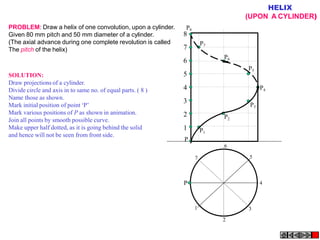
HELIX
(UPON A CYLINDER)
PROBLEM: Draw a helix of one convolution, upon a cylinder.
Given 80 mm pitch and 50 mm diameter of a cylinder.
(The axial advance during one complete revolution is called
The pitch of the helix)
SOLUTION:
Draw projections of a cylinder.
Divide circle and axis in to same no. of equal parts. ( 8 )
Name those as shown.
Mark initial position of point ‘P’
Mark various positions of P as shown in animation.
Join all points by smooth possible curve.
Make upper half dotted, as it is going behind the solid
and hence will not be seen from front side.
P
1
2
3
4
5
6
7
P
P1
P2
P3
P4
P5
P6
P7
P8
P1
P2
P3
P4
P5
P6
P7
P8
X Y
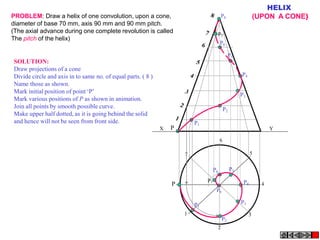
HELIX
(UPON A CONE)
PROBLEM: Draw a helix of one convolution, upon a cone,
diameter of base 70 mm, axis 90 mm and 90 mm pitch.
(The axial advance during one complete revolution is called
The pitch of the helix)
SOLUTION:
Draw projections of a cone
Divide circle and axis in to same no. of equal parts. ( 8 )
Name those as shown.
Mark initial position of point ‘P’
Mark various positions of P as shown in animation.
Join all points by smooth possible curve.
Make upper half dotted, as it is going behind the solid
and hence will not be seen from front side.
Q
Involute
Method of Drawing
Tangent & Normal
STEPS:
DRAW INVOLUTE AS USUAL.
MARK POINT Q ON IT AS DIRECTED.
JOIN Q TO THE CENTER OF CIRCLE C.
CONSIDERING CQ DIAMETER, DRAW
ASEMICIRCLE AS SHOWN.
MARK POINT OF INTERSECTION OF
THIS SEMICIRCLE AND POLE CIRCLE
AND JOIN IT TO Q.
THIS WILL BE NORMALTO INVOLUTE.
DRAWALINE A
T RIGHTANGLE TO
THIS LINE FROM Q.
IT WILLBE TANGENT TO INVOLUTE.
1 2 3 4 5 6 7
P
8
P8
1
2
3
4
5
6
7
8
INVOLUTE OFACIRCLE

D
C
N
CYCLOID
Method of Drawing
Tangent & Normal
STEPS:
DRAW CYCLOID AS USUAL.
MARK POINT Q ON IT AS DIRECTED.
WITH CP DISTANCE, FROM Q. CUT THE
POINT ON LOCUS OF C AND JOIN IT TO Q.
FROM THIS POINT DROPAPERPENDICULAR
ON GROUND LINE AND NAME IT N
JOIN N WITH Q.THIS WILL BE NORMALTO
CYCLOID.
DRAWALINE A
T RIGHTANGLE TO
THIS LINE FROM Q.
IT WILLBE TANGENT TO CYCLOID.
P
C1 C2 C3 C4 C5 C6 C7 C8
CYCLOID
Q
D
C
P
1
2
3
4
5
6
7
P2
P6
P1
P3
P5
7 6 5 4 3 2 1
P7
P4 O
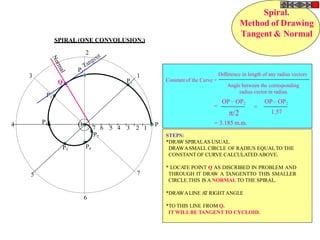
SPIRAL(ONE CONVOLUSION.)
Q
Spiral.
Method of Drawing
Tangent & Normal
Constant of the Curve =
Difference in length of any radius vectors
Angle between the corresponding
radius vector in radian.
/2
OP – OP2 OP– OP2
1.57
= 3.185 m.m.
=
=
STEPS:
*DRAW SPIRALAS USUAL.
DRAWASMALL CIRCLE OF RADIUS EQUALTO THE
CONSTANT OF CURVE CALCULATED ABOVE.
* LOCA
TE POINT Q AS DISCRIBED IN PROBLEM AND
THROUGH IT DRAW A TANGENTTO THIS SMALLER
CIRCLE.THIS IS A NORMAL TO THE SPIRAL.
*DRAWALINE A
T RIGHTANGLE
*TO THIS LINE FROM Q.
IT WILLBE TANGENT TO CYCLOID.

Engineering curve directrix,rectangle method

  • 1.
    ENGINEERING CURVES Part-II (Point undergoingtwo types of displacements) INVOLUTE 1. Involute of a circle a)String Length = D b)String Length > D c)String Length < D 2. Pole having Composite shape. 3. Rod Rolling over a Semicircular Pole. CYCLOID 1. General Cycloid 2. Trochoid ( superior) 3. Trochoid ( Inferior) 4. Epi-Cycloid 5. Hypo-Cycloid SPIRAL 1. Spiral of One Convolution. 2. Spiral of Two Convolutions. HELIX 1. On Cylinder 2. On a Cone Methods of Drawing Tangents & Normals To These Curves. AND
  • 2.
    CYCLOID: IT IS ALOCUS OF A POINT ON THE PERIPHERY OF A CIRCLE WHICH ROLLS ON A STRAIGHT LINE PATH. INVOLUTE: IT IS A LOCUS OF A FREE END OF A STRING WHEN IT IS WOUND ROUND A CIRCULAR POLE SPIRAL: IT IS A CURVE GENERATED BY A POINT WHICH REVOLVES AROUND A FIXED POINT AND AT THE SAME MOVES TOWARDS IT. HELIX: IT IS A CURVE GENERATED BY A POINT WHICH MOVES AROUND THE SURFACE OF A RIGHT CIRCULAR CYLINDER / CONE AND AT THE SAME TIME ADVANCES IN AXIAL DIRECTION AT A SPEED BEARING A CONSTANT RATIO TO THE SPPED OF ROTATION. ( for problems refer topic Development of surfaces) DEFINITIONS SUPERIORTROCHOID: IF THE POINT IN THE DEFINATION OF CYCLOID IS OUTSIDE THE CIRCLE INFERIOR TROCHOID.: IF IT IS INSIDE THE CIRCLE EPI-CYCLOID IF THE CIRCLE IS ROLLING ON ANOTHER CIRCLE FROM OUTSIDE HYPO-CYCLOID. IF THE CIRCLE IS ROLLING FROM INSIDE THE OTHER CIRCLE,
  • 3.
    INVOLUTE OF ACIRCLE Problem no 17: Draw Involute of a circle. String length is equal to the circumference of circle. 2 3 4 5 6 7 P 8 P8 1 1 2 3 4 5 6 7 P3 P4 4 to p P5 P7 P6 P2 P1  D A 8 Solution Steps: 1)Point or end P of string AP is exactly D distance away from A. Means if this string is wound round the circle, it will completely cover given circle. B will meet A after winding. 2)Divide D (AP) distance into 8 number of equal parts. 3)Divide circle also into 8 number of equal parts. 4)Name after A, 1, 2, 3, 4, etc. up to 8 on D line AP as well as on circle (in anticlockwise direction). 5) To radius C-1, C-2, C-3 up to C-8 draw tangents (from 1,2,3,4,etc to circle). 6)Take distance 1 to P in compass and mark it on tangent from point 1 on circle (means one division less than distance AP). 7) Name this point P1 8)Take 2-B distance in compass and mark it on the tangent from point 2. Name it point P2. 9)Similarly take 3 to P , 4 to P , 5 to P up to 7 to P distance in compass and mark on respective tangents and locate P3, P4, P5 up to P8 (i.e. A) points and join them in smooth curve it is an INVOLUTE of a given circle.
  • 4.
    INVOLUTE OFACIRCLE String lengthMORE than D 2 7 8 P 1 3 4 5 2 6 7 8 P3 P4 4 to p P5 P7 P6 P2 P1 3 4 5 6 165 mm (more than D) D p8 1 Solution Steps: In this case string length is more than  D. But remember! Whatever may be the length of string, mark  D distance horizontal i.e.along the string and divide it in 8 number of equal parts, and not any other distance. Rest all steps are same as previous INVOLUTE. Draw the curve completely. Problem 18: Draw Involute of a circle. String length is MORE than the circumference of circle.
  • 5.
    1 2 56 7 8 P 4 3 5 2 6 1 7 8 P3 P4 4 to p P5 P7 P6 P2 P1 3 4 150 mm (Less than D) D INVOLUTE OFACIRCLE String length LESS than D Problem 19: Draw Involute of a circle. String length is LESS than the circumference of circle. Solution Steps: In this case string length is Less than  D. But remember! Whatever may be the length of string, mark  D distance horizontal i.e.along the string and divide it in 8 number of equal parts, and not any other distance. Rest all steps are same as previous INVOLUTE. Draw the curve completely.
  • 6.
    1 2 3 4 5 6 1 2 45 6 A P 3 D/2 P1 1 to P P2 P3 3 to P P4 P P5 P6 INVOLUTE OF COMPOSIT SHAPED POLE PROBLEM 20 : A POLE IS OF A SHAPE OF HALF HEXABON AND SEMICIRCLE. ASTRING IS TO BE WOUND HAVING LENGTH EQUALTO THE POLE PERIMETER DRAW PATH OF FREE END P OF STRING WHEN WOUND COMPLETELY. (Take hex 30 mm sides and semicircle of 60 mm diameter.) SOLUTION STEPS: Draw pole shape as per dimensions. Divide semicircle in 4 parts and name those along with corners of hexagon. Calculate perimeter length. Show it as stringAP . On this line mark 30mm from A Mark and name it 1 Mark D/2 distance on it from 1 And dividing it in 4 parts name 2,3,4,5. Mark point 6 on line 30 mm from 5 Now draw tangents from all points of pole and proper lengths as done in all previous involute’s problems and complete the curve.
  • 7.
    1 2 3 4 D 1 2 3 4 A B A1 B1 A2 B2 A3 A4 B3 B4 PROBLEM 21 :Rod AB 85 mm long rolls over a semicircular pole without slipping from it’s initially vertical position till it becomes up-side-down vertical. Draw locus of both endsA & B. Solution Steps? If you have studied previous problems properly, you can surely solve this also. Simply remember that this being a rod, it will roll over the surface of pole. Means when one end is approaching, other end will move away from poll. OBSERVE ILLUSTRATION CAREFULLY!
  • 8.
    P C1 C2 C3C4 C5 C6 C7 C8 p1 p3 p4 p5 p6 p7 p8 1 2 3 4 5 6 7 C p2 D CYCLOID PROBLEM 22: DRAWLOCUS OFAPOINT ON THE PERIPHERY OFACIRCLE WHICH ROLLS ON STRAIGHT LINE PATH. Take Circle diameter as 50 mm Solution Steps: 1) From center C draw a horizontal line equal to D distance. 2) Divide D distance into 8 number of equal parts and name them C1, C2, C3 etc. 3) Divide the circle also into 8 number of equal parts and in clock wise direction, after P name 1, 2, 3 up to 8. 4) From all these points on circle draw horizontal lines. (parallel to locus of C) 5) With a fixed distance C-P in compass, C1 as center, mark a point on horizontal line from 1. Name it P . 6) Repeat this procedure from C2, C3, C4 upto C8 as centers. Mark points P2, P3, P4, P5 up to P8 on the horizontal lines drawn from 2, 3, 4, 5, 6, 7 respectively. 7) Join all these points by curve. It is Cycloid.
  • 9.
    C1 C2 C3C4 C5 C6 C7 C8 p1 p2 p4 p5 p6 p7 p8 1 2 3 4 p3 5 6 7 C D SUPERIOR TROCHOID P PROBLEM 23: DRAW LOCUS OFAPOINT , 5 MM AWAYFROM THE PERIPHERYOFA CIRCLE WHICH ROLLS ON STRAIGHT LINE PATH. Take Circle diameter as 50 mm Solution Steps: 1) Draw circle of given diameter and draw a horizontal line from it’s center C of length  D and divide it in 8 number of equal parts and name them C1, C2, C3, up to C8. 2) Draw circle by CP radius, as in this case CP is larger than radius of circle. 3) Now repeat steps as per the previous problem of cycloid, by dividing this new circle into 8 number of equal parts and drawing lines from all these points parallel to locus of C and taking CP radius wit different positions of C as centers, cut these lines and get different positions of P and join 4) This curve is called Superior Trochoid.
  • 10.
    P C1 C3 C4C5 C6 p1 p2 p 3 C2 p4 p5 p C7 6 C8 p7 p8 1 2 3 4 5 6 7 C D INFERIOR TROCHOID PROBLEM 24: DRAW LOCUS OFAPOINT , 5 MM INSIDE THE PERIPHERYOFA CIRCLE WHICH ROLLS ON STRAIGHT LINE PATH. Take Circle diameter as 50 mm Solution Steps: 1) Draw circle of given diameter and draw a horizontal line from it’s center C of length  D and divide it in 8 number of equal parts and name them C1, C2, C3, up to C8. 2) Draw circle by CP radius, as in this case CP is SHORTER than radius of circle. 3) Now repeat steps as per the previous problem of cycloid, by dividing this new circle into 8 number of equal parts and drawing lines from all these points parallel to locus of C and taking CP radius with different positions of C as centers, cut these lines and get different positions of P and join those in curvature. 4) This curve is called Inferior Trochoid.
  • 11.
    C2 EPI CYCLOID : P O r= CP R 3600 = r 1 2 3 5 6 7 Generating/ Rolling Circle 4 Directing Circle PROBLEM 25: DRAW LOCUS OFAPOINT ON THE PERIPHERYOFACIRCLE WHICH ROLLS ONACURVED PATH. Take diameter of rolling Circle 50 mm And radius of directing circle i.e. curved path, 75 mm. Solution Steps: 1)When smaller circle will roll on larger circle for one revolution it will cover  D distance on arc and it will be decided by included arc angle . 2) Calculate  by formula  = (r/R) x 3600. 3) Construct angle  with radius OC and draw an arc by taking O as center OC as radius and form sector of angle . 4)Divide this sector into 8 number of equal angular parts. And from C onward name them C1, C2, C3 up to C8. 5)Divide smaller circle (Generating circle) also in 8 number of equal parts. And next to P in clockwise direction name those 1, 2, 3, up to 8. 6)With O as center, O-1 as radius draw an arc in the sector. Take O-2, O- 3, O-4, O-5 up to O-8 distances with center O, draw all concentric arcs in sector. Take fixed distance C-P in compass, C1 center, cut arc of 1 at P1. Repeat procedure and locate P2, P3, P4, P5 unto P8 (as in cycloid) and join them by smooth curve. This is EPI – CYCLOID.
  • 12.
    HYPO CYCLOID P1 P2 P3 P4 P5 P6 P7 P8 P 1 2 3 6 5 7 4 O OC= R ( Radius of Directing Circle) CP= r (Radius of Generating Circle) r 3600 = R PROBLEM 26: DRAW LOCUS OFAPOINT ON THE PERIPHERYOFACIRCLE WHICH ROLLS FROM THE INSIDE OFACURVED PATH. Take diameter of rolling circle 50 mm and radius of directing circle (curved path) 75 mm. Solution Steps: 1)Smaller circle is rolling here, inside the larger circle. It has to rotate anticlockwise to move ahead. 2)Same steps should be taken as in case of EPI – CYCLOID. Only change is in numbering direction of 8 number of equal parts on the smaller circle. 3)From next to P in anticlockwise direction, name 1,2,3,4,5,6,7,8. 4)Further all steps are that of epi – cycloid. This is called HYPO – CYCLOID.
  • 13.
    2 6 P7 Solution Steps 1. WithPO radius draw a circle and divide it in EIGHT parts. Name those 1,2,3,4, etc. up to 8 2 .Similarly divided line PO also in 3 P3 P2 P1 1 EIGHT parts and name those 1,2,3,-- as shown. 3. Take o-1 distance from op line and draw an arc up to O1 radius vector. Name the point P1 4. Similarly mark points P2, P3, P4 up to P8 And join those in a smooth curve. 4 5 P4 P5 O P6 7 6 5 4 3 2 1 7 P It is a SPIRAL of one convolution. SPIRAL Problem 27: Draw a spiral of one convolution. Take distance PO 40 mm. IMPORTANT APPROACH FOR CONSTRUCTION! FIND TOTAL ANGULAR AND TOTAL LINEAR DISPLACEMENT AND DIVIDE BOTH IN TO SAME NUMBER OF EQUAL PARTS.
  • 14.
    1,9 3,11 4,12 5,13 6,14 7,15 P1 2,10 P2 P3 P4 P5 P6 P7 16 13 108 7 6 5 4 3 2 1 P P8 8,16 P9 P10 P11 P12 P13 P14 P15 SPIRAL of two convolutions Problem 28 Point P is 80 mm from point O. It starts moving towards O and reaches it in two revolutions around.it Draw locus of point P (To draw a Spiral of TWO convolutions). IMPORTANT APPROACH FOR CONSTRUCTION! FIND TOTAL ANGULAR AND TOTAL LINEAR DISPLACEMENT AND DIVIDE BOTH IN TO SAME NUMBER OF EQUAL PARTS. SOLUTION STEPS: Total angular displacement here is two revolutionsAnd Total Linear displacement here is distance PO. Just divide both in same parts i.e. Circle in EIGHT parts. ( means total angular displacement in SIXTEEN parts) Divide PO also in SIXTEEN parts. Rest steps are similar to the previous problem.
  • 15.
    8 P P1 7 6 5 4 3 2 1 P P2 P3 P4 P5 P6 P7 P8 1 2 3 4 5 6 7 HELIX (UPON A CYLINDER) PROBLEM:Draw a helix of one convolution, upon a cylinder. Given 80 mm pitch and 50 mm diameter of a cylinder. (The axial advance during one complete revolution is called The pitch of the helix) SOLUTION: Draw projections of a cylinder. Divide circle and axis in to same no. of equal parts. ( 8 ) Name those as shown. Mark initial position of point ‘P’ Mark various positions of P as shown in animation. Join all points by smooth possible curve. Make upper half dotted, as it is going behind the solid and hence will not be seen from front side.
  • 16.
    P 1 2 3 4 5 6 7 P P1 P2 P3 P4 P5 P6 P7 P8 P1 P2 P3 P4 P5 P6 P7 P8 X Y HELIX (UPON ACONE) PROBLEM: Draw a helix of one convolution, upon a cone, diameter of base 70 mm, axis 90 mm and 90 mm pitch. (The axial advance during one complete revolution is called The pitch of the helix) SOLUTION: Draw projections of a cone Divide circle and axis in to same no. of equal parts. ( 8 ) Name those as shown. Mark initial position of point ‘P’ Mark various positions of P as shown in animation. Join all points by smooth possible curve. Make upper half dotted, as it is going behind the solid and hence will not be seen from front side.
  • 17.
    Q Involute Method of Drawing Tangent& Normal STEPS: DRAW INVOLUTE AS USUAL. MARK POINT Q ON IT AS DIRECTED. JOIN Q TO THE CENTER OF CIRCLE C. CONSIDERING CQ DIAMETER, DRAW ASEMICIRCLE AS SHOWN. MARK POINT OF INTERSECTION OF THIS SEMICIRCLE AND POLE CIRCLE AND JOIN IT TO Q. THIS WILL BE NORMALTO INVOLUTE. DRAWALINE A T RIGHTANGLE TO THIS LINE FROM Q. IT WILLBE TANGENT TO INVOLUTE. 1 2 3 4 5 6 7 P 8 P8 1 2 3 4 5 6 7 8 INVOLUTE OFACIRCLE  D C
  • 18.
    N CYCLOID Method of Drawing Tangent& Normal STEPS: DRAW CYCLOID AS USUAL. MARK POINT Q ON IT AS DIRECTED. WITH CP DISTANCE, FROM Q. CUT THE POINT ON LOCUS OF C AND JOIN IT TO Q. FROM THIS POINT DROPAPERPENDICULAR ON GROUND LINE AND NAME IT N JOIN N WITH Q.THIS WILL BE NORMALTO CYCLOID. DRAWALINE A T RIGHTANGLE TO THIS LINE FROM Q. IT WILLBE TANGENT TO CYCLOID. P C1 C2 C3 C4 C5 C6 C7 C8 CYCLOID Q D C
  • 19.
    P 1 2 3 4 5 6 7 P2 P6 P1 P3 P5 7 6 54 3 2 1 P7 P4 O SPIRAL(ONE CONVOLUSION.) Q Spiral. Method of Drawing Tangent & Normal Constant of the Curve = Difference in length of any radius vectors Angle between the corresponding radius vector in radian. /2 OP – OP2 OP– OP2 1.57 = 3.185 m.m. = = STEPS: *DRAW SPIRALAS USUAL. DRAWASMALL CIRCLE OF RADIUS EQUALTO THE CONSTANT OF CURVE CALCULATED ABOVE. * LOCA TE POINT Q AS DISCRIBED IN PROBLEM AND THROUGH IT DRAW A TANGENTTO THIS SMALLER CIRCLE.THIS IS A NORMAL TO THE SPIRAL. *DRAWALINE A T RIGHTANGLE *TO THIS LINE FROM Q. IT WILLBE TANGENT TO CYCLOID.