“IMPACT OF THE
FIRST COMENIUS
PROJECT AT SCHOOL”
As it was felt by
Ropaži Secondary
School, Latvia
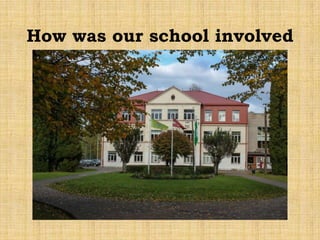
How was our school involved
• Quite accidentally I opened my desktop at
etwinning and there was an invitation from
Alvaro about the possibility to join a ready-
made project. My first step was – consulting
Mara (the Head of our school); then there
were several phone calls to our local sports
centre, to our sports teachers, and I had the
green light to write to Spain. Why exactly did
our Spanish colleagues decided to choose us –
a small school in Latvia – we have to ask them.
Why did our school decide to
participate in such kind of
international projects?
A dream of every
school and ours
especially.
• It has been a dream of our school to
participate in Comenius projects for a long
time. Twice we were quite close to doing
it, but either one country quitted the team or
other mischief
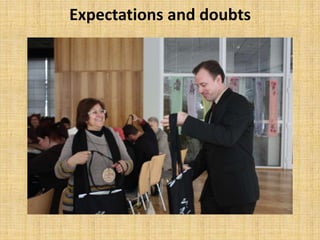
Expectations and doubts
• Whenever you start a new project or
activity, you have some doubts and
expectations. Expectations were the greatest –
active students, responsible teachers, new
experience connected with communication
with foreign colleagues. At the same time
these where the doubts: will the students
understand the importance of such
cooperation? Will our teachers be ready to
improve their knowledge of foreign
languages? How to involve parents and
representatives of local authorities in our
activities?
Impact at school: Has your school
changed in some way during the
process?
Definitely, yes.
Staff motivation, involvement,
language learning ,international
orientation.
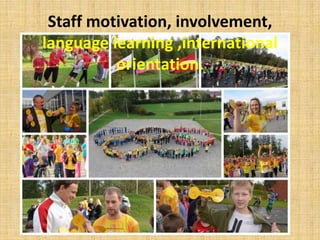
• One of the points – to involve as many of staff in the
activities as possible. Partly this goal has been
achieved through various tasks planned by the
project. And this could be a very successful way to
motivate colleagues to think over their possibilities
how they could do something for the project or raise
any idea. Thus I am grateful to some of my colleagues
who advised me to base the tasks as much as
possible on local facts, people, achievements. You
may see the examples of materials about our local
inhabitants who have taken part in paralympic
events, even in paralympic games; about the
previous athlete – Olympic medallist who works with
the students in our village; our colleague who started
teaching in the school only in September, but who is
an active Paralympic triathlon athlete.
Syllabus and regular learning program.
Does it suffer some modification or
adaptation? Should it?
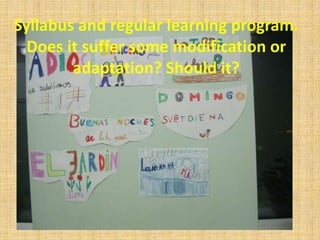
• One of the aims of this project – language
improvement. We – the teachers of English- managed
to join several tasks that were asked to do for the
project with our regular program. F.ex., translating
games; organising some activities in English
(interviews, discussions, presentations). Some tasks
were done together with the teachers of Latvian and
also Russian, the tasks where students had to prepare
interviews, strategies for the interviews, especially in
smaller classes. If such merging is possible, then the
involvement of students in the project work is almost
100 %.
• Modification of syllabus was not felt, because our
students are supposed to know how to present
themselves, how to introduce rules of sport
games, how to give instructions etc. Why not to do it
on the bases of any project tasks?
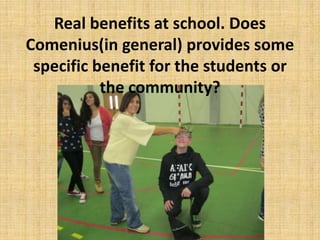
Real benefits at school. Does
Comenius(in general) provides some
specific benefit for the students or
the community?
• It is difficult to point out some specific benefits. If
the work of the project is organised on a high
level, any project may meet the needs of a school
and community, so there can be benefits. Taking
our project. Students had the possibility to visit
other countries and to gain various information
from peers not under the guidance of teachers.
They could feel free in expressing themselves, in
finding out issues essential for them. Working on
project tasks, they were allowed to improvise while
making videos, while organising activities. And we-
teachers felt that it improved their self
confidence, their self-esteem. And these qualities
have to be improved in such small schools and
communities as ours.
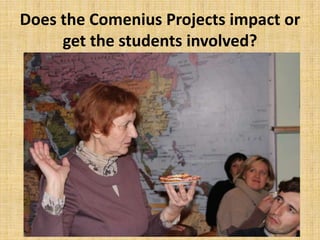
Does the Comenius Projects impact or
get the students involved?
• I have already answered this question.
Probably, the beginning of the project was not
quite satisfactory, because we-teachers
wanted to do everything. Fortunately, we have
an excellent Head teacher who managed to
direct our cooperative work properly.
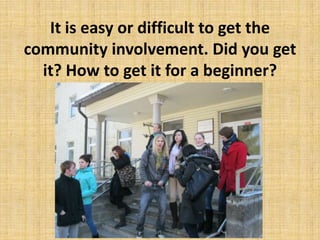
It is easy or difficult to get the
community involvement. Did you get
it? How to get it for a beginner?
• The first year of the Project was rather
complicated, because it was not clear for us how to
involve parents, how to get a closer cooperation
with local authorities. The second year proved that
many things could be done easier if only we ask for
help. F.ex., cooperation with other enterprises of
our community was organised by PR people.
Parents Board helped with some activities that were
organised together with local organisations. That
was partly because these people have children who
are mainly our students.
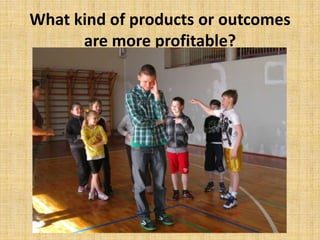
What kind of products or outcomes
are more profitable?
• We tried to take videos and photos of every
activity we did. That can be useful only with some
explanatory notes. At first we had two separate
documentations: a description in a word format
and a video of the activity or photo collection. But
later we came to the conclusion that the
information, f.ex., about a game can be filmed and
the rules can be added as a comment. It doesn’t
exclude a PDF or Word document. The final result
can be used in any format that turns out to be
more convenient.
How to bring the project work to the
class and not just to the visits.
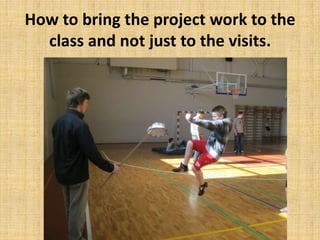
• I have already mentioned how teachers of
languages have introduced the tasks in the class
work. Besides, the material what our partners gave
us at every meeting was shown at the English
lessons; the teachers were acquainted with the
booklets, brochures, f.ex., teachers of history, of
geography. Sport teachers were given the material
about different games. Students prepared and
presented the games at sport lessons and other
school activities.
Assessment and
recommendations·
Is it finally worth it?
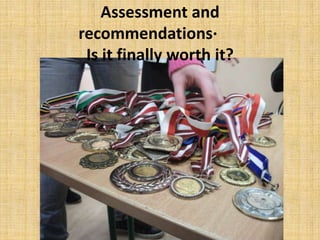
• Of course, every day of this project was worth
it. We are glad that the coordinators have
been strict in their demands to do all the
tasks. But what I enjoyed most was the way
how each of the delegations had understood
the home tasks. The approach was different
but the result – the task done according to the
demands. In this way everyone got an
enormous experience.
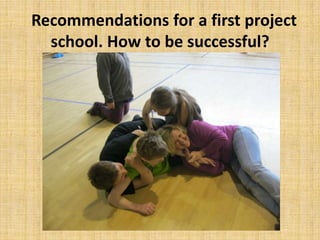
Recommendations for a first project
school. How to be successful?
• I would recommend to be active in the project
work, to follow the tasks, do everything
properly and in due time, learn from your
colleagues. I would recommend to organise a
strong project group that includes a certain
amount of teachers and students.
What should a first project school
avoid?
• Coordinators at schools – trust your
team
• I am sure that I did almost half of the
organisation work. And this is my serious
drawback. Coordinators at schools – trust your
team. They are able to fulfil the tasks and
produce the final result.
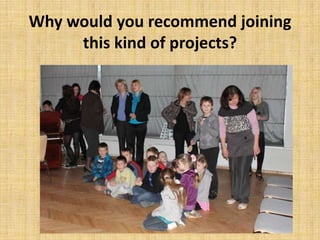
Why would you recommend joining
this kind of projects?
• I think that now having heard my thoughts
about our work in the project, there are no
doubts that Comenius projects are important
in any school’s social life.

Impact of the first comenius project

  • 1.
    “IMPACT OF THE FIRSTCOMENIUS PROJECT AT SCHOOL” As it was felt by Ropaži Secondary School, Latvia
  • 2.
    How was ourschool involved
  • 3.
    • Quite accidentallyI opened my desktop at etwinning and there was an invitation from Alvaro about the possibility to join a ready- made project. My first step was – consulting Mara (the Head of our school); then there were several phone calls to our local sports centre, to our sports teachers, and I had the green light to write to Spain. Why exactly did our Spanish colleagues decided to choose us – a small school in Latvia – we have to ask them.
  • 4.
    Why did ourschool decide to participate in such kind of international projects? A dream of every school and ours especially.
  • 5.
    • It hasbeen a dream of our school to participate in Comenius projects for a long time. Twice we were quite close to doing it, but either one country quitted the team or other mischief
  • 6.
  • 7.
    • Whenever youstart a new project or activity, you have some doubts and expectations. Expectations were the greatest – active students, responsible teachers, new experience connected with communication with foreign colleagues. At the same time these where the doubts: will the students understand the importance of such cooperation? Will our teachers be ready to improve their knowledge of foreign languages? How to involve parents and representatives of local authorities in our activities?
  • 8.
    Impact at school:Has your school changed in some way during the process? Definitely, yes.
  • 9.
    Staff motivation, involvement, languagelearning ,international orientation.
  • 10.
    • One ofthe points – to involve as many of staff in the activities as possible. Partly this goal has been achieved through various tasks planned by the project. And this could be a very successful way to motivate colleagues to think over their possibilities how they could do something for the project or raise any idea. Thus I am grateful to some of my colleagues who advised me to base the tasks as much as possible on local facts, people, achievements. You may see the examples of materials about our local inhabitants who have taken part in paralympic events, even in paralympic games; about the previous athlete – Olympic medallist who works with the students in our village; our colleague who started teaching in the school only in September, but who is an active Paralympic triathlon athlete.
  • 11.
    Syllabus and regularlearning program. Does it suffer some modification or adaptation? Should it?
  • 12.
    • One ofthe aims of this project – language improvement. We – the teachers of English- managed to join several tasks that were asked to do for the project with our regular program. F.ex., translating games; organising some activities in English (interviews, discussions, presentations). Some tasks were done together with the teachers of Latvian and also Russian, the tasks where students had to prepare interviews, strategies for the interviews, especially in smaller classes. If such merging is possible, then the involvement of students in the project work is almost 100 %. • Modification of syllabus was not felt, because our students are supposed to know how to present themselves, how to introduce rules of sport games, how to give instructions etc. Why not to do it on the bases of any project tasks?
  • 13.
    Real benefits atschool. Does Comenius(in general) provides some specific benefit for the students or the community?
  • 14.
    • It isdifficult to point out some specific benefits. If the work of the project is organised on a high level, any project may meet the needs of a school and community, so there can be benefits. Taking our project. Students had the possibility to visit other countries and to gain various information from peers not under the guidance of teachers. They could feel free in expressing themselves, in finding out issues essential for them. Working on project tasks, they were allowed to improvise while making videos, while organising activities. And we- teachers felt that it improved their self confidence, their self-esteem. And these qualities have to be improved in such small schools and communities as ours.
  • 15.
    Does the ComeniusProjects impact or get the students involved?
  • 16.
    • I havealready answered this question. Probably, the beginning of the project was not quite satisfactory, because we-teachers wanted to do everything. Fortunately, we have an excellent Head teacher who managed to direct our cooperative work properly.
  • 17.
    It is easyor difficult to get the community involvement. Did you get it? How to get it for a beginner?
  • 18.
    • The firstyear of the Project was rather complicated, because it was not clear for us how to involve parents, how to get a closer cooperation with local authorities. The second year proved that many things could be done easier if only we ask for help. F.ex., cooperation with other enterprises of our community was organised by PR people. Parents Board helped with some activities that were organised together with local organisations. That was partly because these people have children who are mainly our students.
  • 19.
    What kind ofproducts or outcomes are more profitable?
  • 20.
    • We triedto take videos and photos of every activity we did. That can be useful only with some explanatory notes. At first we had two separate documentations: a description in a word format and a video of the activity or photo collection. But later we came to the conclusion that the information, f.ex., about a game can be filmed and the rules can be added as a comment. It doesn’t exclude a PDF or Word document. The final result can be used in any format that turns out to be more convenient.
  • 21.
    How to bringthe project work to the class and not just to the visits.
  • 22.
    • I havealready mentioned how teachers of languages have introduced the tasks in the class work. Besides, the material what our partners gave us at every meeting was shown at the English lessons; the teachers were acquainted with the booklets, brochures, f.ex., teachers of history, of geography. Sport teachers were given the material about different games. Students prepared and presented the games at sport lessons and other school activities.
  • 23.
  • 24.
    • Of course,every day of this project was worth it. We are glad that the coordinators have been strict in their demands to do all the tasks. But what I enjoyed most was the way how each of the delegations had understood the home tasks. The approach was different but the result – the task done according to the demands. In this way everyone got an enormous experience.
  • 25.
    Recommendations for afirst project school. How to be successful?
  • 26.
    • I wouldrecommend to be active in the project work, to follow the tasks, do everything properly and in due time, learn from your colleagues. I would recommend to organise a strong project group that includes a certain amount of teachers and students.
  • 27.
    What should afirst project school avoid? • Coordinators at schools – trust your team
  • 28.
    • I amsure that I did almost half of the organisation work. And this is my serious drawback. Coordinators at schools – trust your team. They are able to fulfil the tasks and produce the final result.
  • 29.
    Why would yourecommend joining this kind of projects?
  • 30.
    • I thinkthat now having heard my thoughts about our work in the project, there are no doubts that Comenius projects are important in any school’s social life.