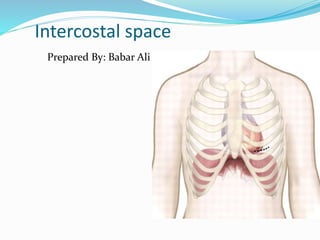
Intercostal space
Prepared By: Babar Ali
Presentation outlines
 Intercostal space .
 Intercostal muscles & their action.
 Neurovascular supply.
 Importance of intercostals .
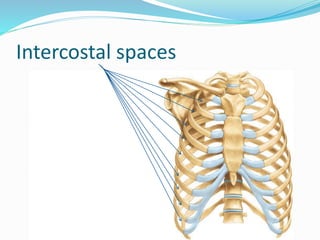
Intercostal space
 The space between two adjacent ribs(costal) is known as
intercostal space.
 There are 12th pairs of ribs and 11th pairs of inter costal space at
thoracic wall.
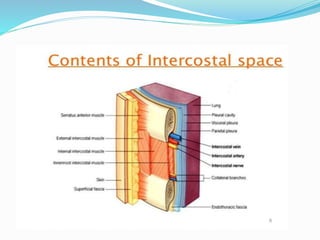
 Interiorly inter costal space are lined by different structure at
thoracic wall in sequence; Skin-Superficial fascia-Serratus
anterior muscle and in between by intercostal muscles.
 Posterioerly by endothoracic facsia-Perital pleura-vicsral pleura
and lungs.
Note: Costal spaces are counted by palpating starnal angle.
Intercostal spaces
Intercostal muscle
 The muscles which cover the spaces in between
adjacent ribs(intercostal space) known as inter costal
muscles.
 There are three types of intrecostal muscles namely;
 External intercostal muscle.
 Internal inter costal muscle.
 Inermost intercostal muscle.
External intercostal muscle
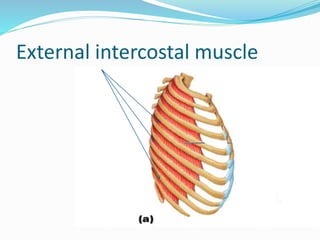
 External intercostals (11 pairs) these outermost muscles
pass from the lower border of the upper rib to the upper
border of the lower rib downword and forward. They
extend anteriorly towards the costochondral junction
becoming gradually more fibrous, and merge into the
external(anterior) intercostal membrane.
External intercostal muscle
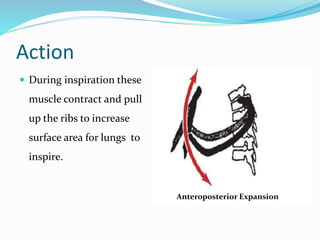
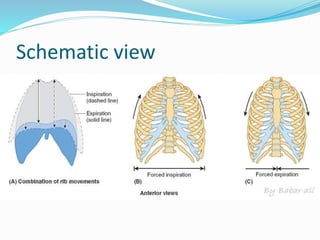
Action
 During inspiration these
muscle contract and pull
up the ribs to increase
surface area for lungs to
inspire.
Anteroposterior Expansion
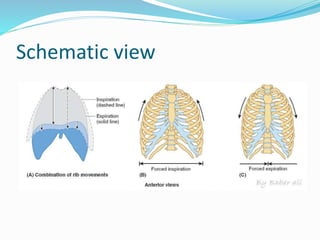
Schematic view
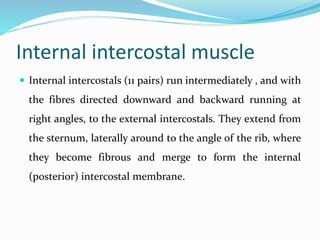
Internal intercostal muscle
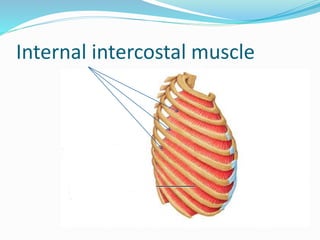
 Internal intercostals (11 pairs) run intermediately , and with
the fibres directed downward and backward running at
right angles, to the external intercostals. They extend from
the sternum, laterally around to the angle of the rib, where
they become fibrous and merge to form the internal
(posterior) intercostal membrane.
Internal intercostal muscle
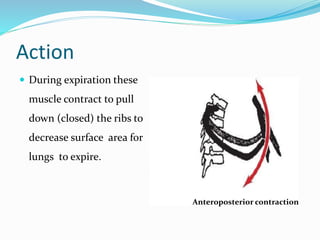
Action
 During expiration these
muscle contract to pull
down (closed) the ribs to
decrease surface area for
lungs to expire.
Anteroposterior contraction
Schematic view
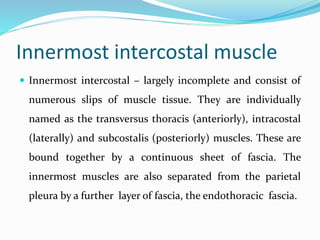
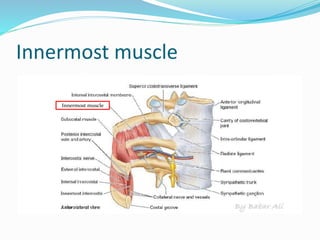
Innermost intercostal muscle
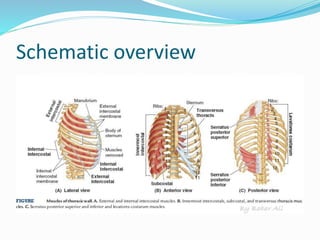
 Innermost intercostal – largely incomplete and consist of
numerous slips of muscle tissue. They are individually
named as the transversus thoracis (anteriorly), intracostal
(laterally) and subcostalis (posteriorly) muscles. These are
bound together by a continuous sheet of fascia. The
innermost muscles are also separated from the parietal
pleura by a further layer of fascia, the endothoracic fascia.
Innermost muscle
Innermost muscle
Innermost muscle
Schematic overview
Neurovascular supply
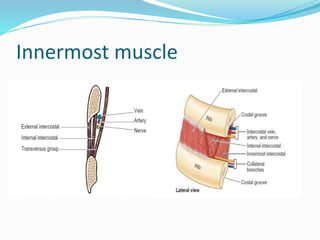
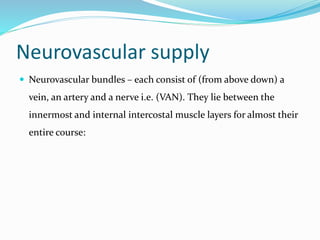
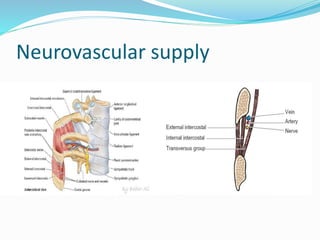
 Neurovascular bundles – each consist of (from above down) a
vein, an artery and a nerve i.e. (VAN). They lie between the
innermost and internal intercostal muscle layers for almost their
entire course:
Neurovascular supply
Venous drainage
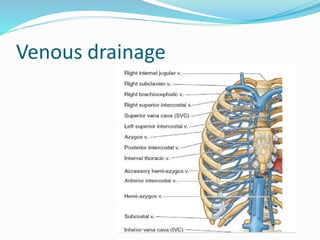
 Veins – have complex terminations and consist of the posterior
and anterior intercostal veins. The posterior veins eventually
drain into the superior vena cava via the azygos and hemi-azygos
systems, and the anterior veins drain into the musculophrenic
vein (lower spaces), or the internal thoracic vein (upper spaces).
Venous drainage
Arterial supply
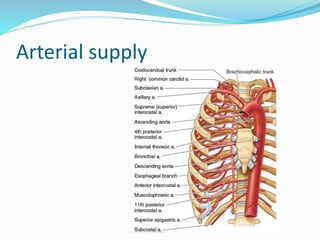
 Arteries – the posterior and anterior intercostal arteries. The posterior
intercostal arteries arise directly from the thoracic aorta from T3 to
T11, and from the superior intercostal artery (T1 and T2). The anterior
intercostal arteries (T1–9) are derived from the two internal thoracic
arteries, which themselves are branches of the subclavian artery, and
run behind and just lateral to the sternal edge. The last two
intercostal spaces are supplied by the posterior intercostal arteries
only. The anterior intercostals eventually anastomose with the
posterior intercostal arteries.
Arterial supply
Nervous supply
 Nerves – ventral (anterior) rami of the thoracic nerves from T1 to
T11. The lower five nerves from T7 to T11 continue to supply the
abdominal wall and maintain their position between the
innermost and internal muscle layers (the internal oblique and
transversus abdominus respectively). The typical intercostal
nerve has the following branches:
Continue…
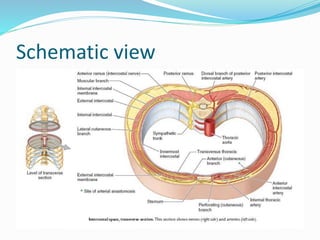
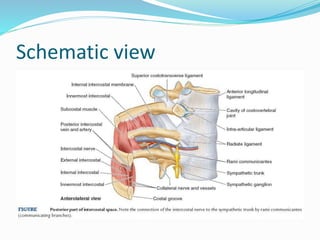
 Rami communicantes to from the sympathetic trunk.
 Collateral to the intercostal muscles and pleura.
 Lateral cutaneous to the lateral wall skin and muscles.
 Anterior cutaneous to the anterior wall skin and muscles.
Schematic view
Schematic view
Importance of intercostals
 Help in breathing .
 Chest lead placement for ECG.
 Play import ant role in auscultation .
 Approachable way to percardial and pleural cavity.
 Prevent the internal tissue and organ from bulging out.
 Medium for internal organ of thoracic cavity during surgery.
 Prevent blowing in and out of air to maintain intrathoracic
pressure .
Any question……..
Keep it………
“The man who try to do something and fail are infinitely
better than those who try to do nothing and succeed”
Thank you…!
Presented to: Mr. Sanaullah
Presented by: Babar Ali
Discipline: Cardiac Perfusion

Intercostal space

  • 2.
  • 3.
    Presentation outlines  Intercostalspace .  Intercostal muscles & their action.  Neurovascular supply.  Importance of intercostals .
  • 4.
    Intercostal space  Thespace between two adjacent ribs(costal) is known as intercostal space.  There are 12th pairs of ribs and 11th pairs of inter costal space at thoracic wall.  Interiorly inter costal space are lined by different structure at thoracic wall in sequence; Skin-Superficial fascia-Serratus anterior muscle and in between by intercostal muscles.  Posterioerly by endothoracic facsia-Perital pleura-vicsral pleura and lungs. Note: Costal spaces are counted by palpating starnal angle.
  • 5.
  • 7.
    Intercostal muscle  Themuscles which cover the spaces in between adjacent ribs(intercostal space) known as inter costal muscles.  There are three types of intrecostal muscles namely;  External intercostal muscle.  Internal inter costal muscle.  Inermost intercostal muscle.
  • 8.
    External intercostal muscle External intercostals (11 pairs) these outermost muscles pass from the lower border of the upper rib to the upper border of the lower rib downword and forward. They extend anteriorly towards the costochondral junction becoming gradually more fibrous, and merge into the external(anterior) intercostal membrane.
  • 9.
  • 10.
    Action  During inspirationthese muscle contract and pull up the ribs to increase surface area for lungs to inspire. Anteroposterior Expansion
  • 11.
  • 12.
    Internal intercostal muscle Internal intercostals (11 pairs) run intermediately , and with the fibres directed downward and backward running at right angles, to the external intercostals. They extend from the sternum, laterally around to the angle of the rib, where they become fibrous and merge to form the internal (posterior) intercostal membrane.
  • 13.
  • 14.
    Action  During expirationthese muscle contract to pull down (closed) the ribs to decrease surface area for lungs to expire. Anteroposterior contraction
  • 15.
  • 16.
    Innermost intercostal muscle Innermost intercostal – largely incomplete and consist of numerous slips of muscle tissue. They are individually named as the transversus thoracis (anteriorly), intracostal (laterally) and subcostalis (posteriorly) muscles. These are bound together by a continuous sheet of fascia. The innermost muscles are also separated from the parietal pleura by a further layer of fascia, the endothoracic fascia.
  • 17.
  • 18.
  • 19.
  • 20.
    Neurovascular supply  Neurovascularbundles – each consist of (from above down) a vein, an artery and a nerve i.e. (VAN). They lie between the innermost and internal intercostal muscle layers for almost their entire course:
  • 21.
  • 22.
    Venous drainage  Veins– have complex terminations and consist of the posterior and anterior intercostal veins. The posterior veins eventually drain into the superior vena cava via the azygos and hemi-azygos systems, and the anterior veins drain into the musculophrenic vein (lower spaces), or the internal thoracic vein (upper spaces).
  • 23.
  • 24.
    Arterial supply  Arteries– the posterior and anterior intercostal arteries. The posterior intercostal arteries arise directly from the thoracic aorta from T3 to T11, and from the superior intercostal artery (T1 and T2). The anterior intercostal arteries (T1–9) are derived from the two internal thoracic arteries, which themselves are branches of the subclavian artery, and run behind and just lateral to the sternal edge. The last two intercostal spaces are supplied by the posterior intercostal arteries only. The anterior intercostals eventually anastomose with the posterior intercostal arteries.
  • 25.
  • 26.
    Nervous supply  Nerves– ventral (anterior) rami of the thoracic nerves from T1 to T11. The lower five nerves from T7 to T11 continue to supply the abdominal wall and maintain their position between the innermost and internal muscle layers (the internal oblique and transversus abdominus respectively). The typical intercostal nerve has the following branches:
  • 27.
    Continue…  Rami communicantesto from the sympathetic trunk.  Collateral to the intercostal muscles and pleura.  Lateral cutaneous to the lateral wall skin and muscles.  Anterior cutaneous to the anterior wall skin and muscles.
  • 28.
  • 29.
  • 30.
    Importance of intercostals Help in breathing .  Chest lead placement for ECG.  Play import ant role in auscultation .  Approachable way to percardial and pleural cavity.  Prevent the internal tissue and organ from bulging out.  Medium for internal organ of thoracic cavity during surgery.  Prevent blowing in and out of air to maintain intrathoracic pressure .
  • 31.
  • 32.
    Keep it……… “The manwho try to do something and fail are infinitely better than those who try to do nothing and succeed”
  • 33.
    Thank you…! Presented to:Mr. Sanaullah Presented by: Babar Ali Discipline: Cardiac Perfusion