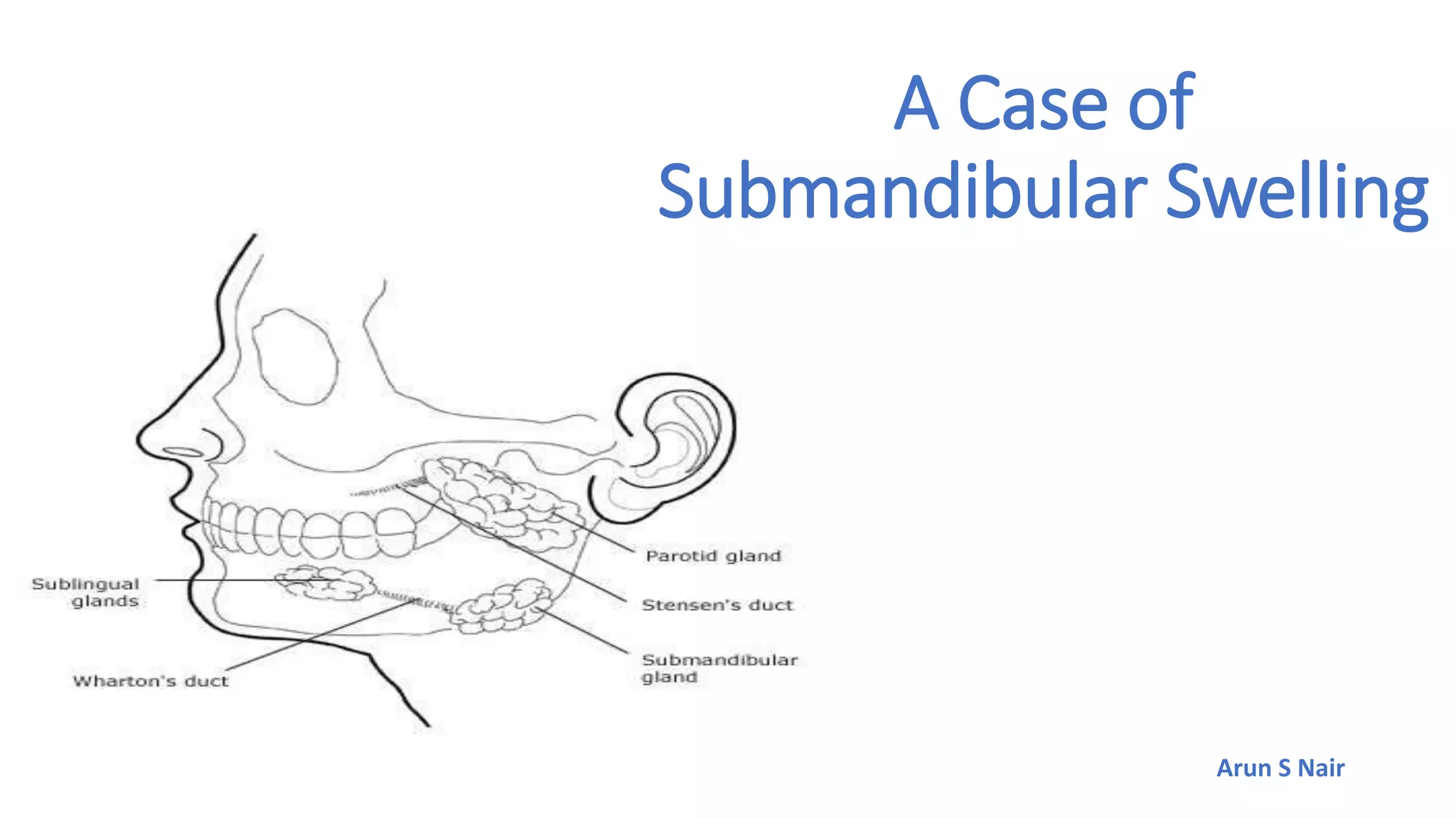
A Case of
Submandibular Swelling
Arun S Nair
Presinting Complaints
• 22/M
• Non smoker / doesn’t consume alcohol admitted on 20 Jan 2014
• Painful swelling sub mandibular region R
• last 7 days
• aggravated by eating
No H/o
• Fever
• Trauma
• Significant wt loss
• Purulent discharge
• Tooth Caries
Past h/o
• Similar complaints in the past during school/colleg days
• Relieved by massaging over the area
Clinical examination
• Pulse : 86/min
• BP : 110/76mmHg
• Temp : afebrile
• RR : 16/min
• No Pallor
• Local examination
• Swelling +
• Tenderness
• Bimanual palpation Sublingual hard mass
• Mobile
• Irregular surface
• Systemic examination .. NAD
• Blood
• Hb 16.2
• TLC 6400
• DLC N56 L34 M07 E08
• Plt 185000
USG
• S/O sialolithiasis (20 × 8 mm) R Wharton’s Duct with sialoadenitis R
SM gland
Diagnosis
Sialolithiasis with secondary Sialadenitis R SM Gland
Treatment
• Adequate analgesics
• Transoral excision ↓ LA on 23 Jan 2014
• Post OP
• DOD 31 Jan 2014
TOPIC DISCUSSION
Sialolithiasis
Sialolithiasis (salivary calculi) the presence of stones in the
salivary glands or ducts
• Cacium , phosphate and carbonate , combined with other salts (Mg,Zn,NH3) and
organic material
• 80 to 92 % submandibular
• 6 to 20 % parotid
• 1 to 2 % sublingual as well as minor
• 1 percent incidence is noted in autopsy studies
• M:F = 2:1
• 75 % single
• 3 % bilateral
Factor predisposing to Submandibular Sialolithiasis
• Anatomy
1.Lengthy and irregular course of Wharton’s duct
2.Position of ductal orifice
3.Size of orifice smaller than duct lumen
• Physiological
1.High mucin content
2.Alkaline pH
3.High phosphate & calcium
Etiology
•Relative stagnation & Concentration of saliva
• Dehydration
• Concentration of saliva
• Fasting or Anorexia
• Stasis of saliva
• Drugs- Anti-histamines, Anti-cholinergics.
• Decrease production of saliva
• Stone can cause stasis of saliva and subsequent bacterial
ascent into the gland.
• Most commonly S. aureus or Strep Viridans.
• Trauma / Stricture
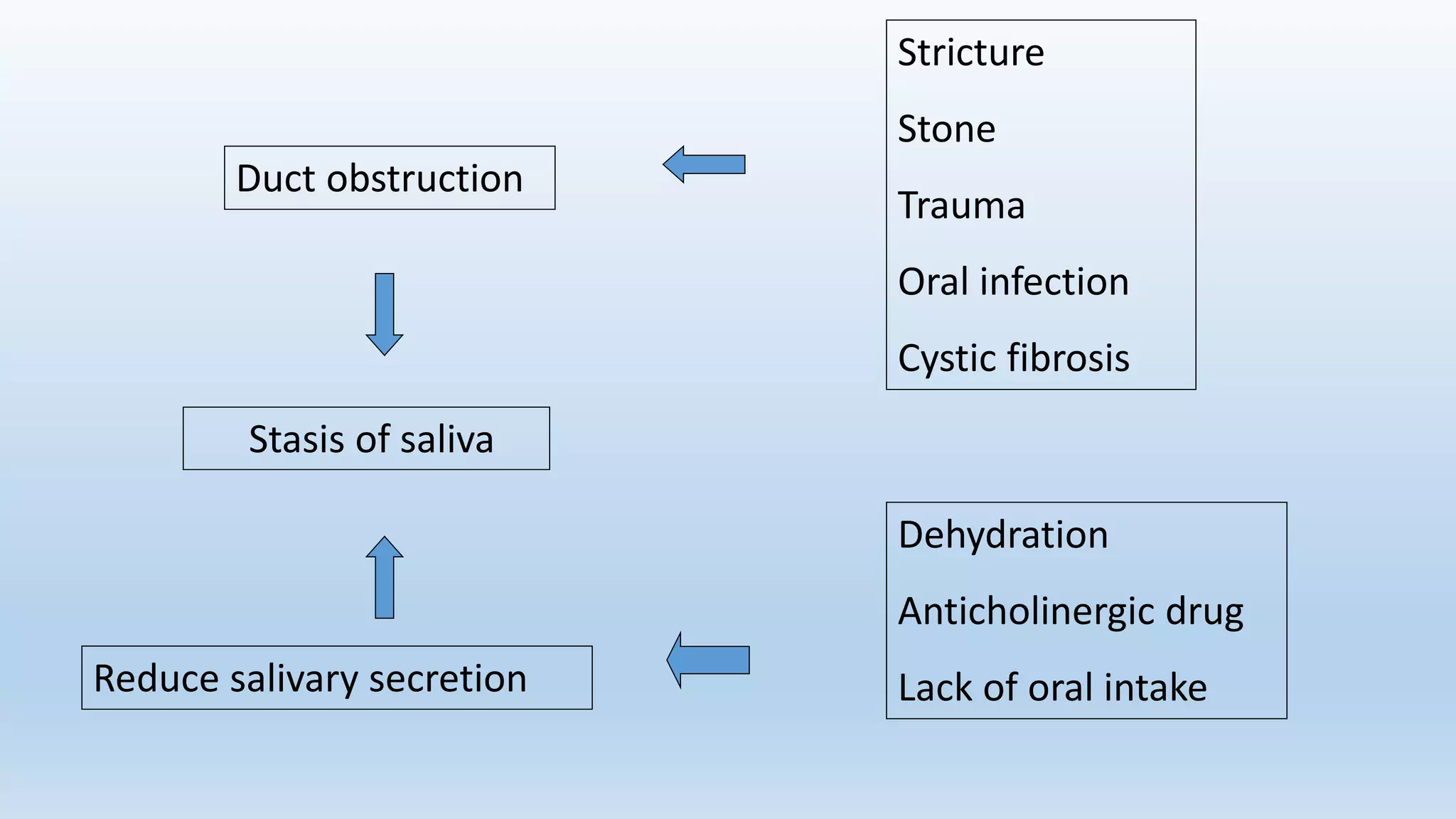
Stasis of saliva
Duct obstruction
Reduce salivary secretion
Stricture
Stone
Trauma
Oral infection
Cystic fibrosis
Dehydration
Anticholinergic drug
Lack of oral intake
• Symptoms
• colicky postprandial pain and swelling
• Local swelling & tenderness at ductal opening if the stone is superficially
• Secondary infection ---> duct stricture
• Diagnosis
• History and Bimanual palpation of duct
• Diagnostic imaging
Imaging studies
• Plain films
• Submandibular calculi radiopaque in 80 to 95 % of cases.
• Parotid calculi are radiopaque in 60 % of cases
• Sialography
• Duct is cannulated and radiopaque dye is injected, followed by plain films.
• Invasive & technically demanding
• Contraindicated in patients with acute sialadenitis or contrast allergy.
• May help facilitate a diagnosis other than sialolithiasis such as stricture, sialectasis, and
cystic degeneration of the duct and gland
Imaging studies
• Ultrasound
• Stones of 2 mm in diameter or larger
• Better assessment of periglandular structures
• Advantage; Radiolucent stones or radiopaque stones that are superimposed on bone
• Magnetic resonance imaging
• Standard MRI will not visualize stones
• Visualize ducts as an alternative to conventional sialography
• No intraductal contrast is required for MR sialography
• Superior sensitivity compared with ultrasound
TREATMENT
•Conservative
• < 2mm often pass on their own
• Hydration
• Moist heat
• Massage the gland & milk the duct
• Sialogogues
• Lemon drops
• Bitter/tart hard candies
• d/c Anti-cholinergics / Anti-histamines
• Antibiotics & Analgesics
Surgery
• Excision
• Transoral
• Transcervical
• Sialadenectomy
• Recurrent cases only
• chance of facial nerve injury
• Parotidectomy ; 29%
• Submandibular; 12%
• Sialoendoscopy
• Laser lithotripsy via endoscope
• Can reach even small stones not accessible by transoral approach
• < 3mm in the parotid
• < 4mm in the submandibular gland
Extracorporeal Shockwave lithotripsy
Effective for stones
that are intraductal
and less than 7 mm &
identifiable by USG
Interventional Radiology
• Wire basket retrieval under
fluoroscopic guidance
• Best for extraglandular & Mobile
stones
Complications
• Sialadenitis
• Abscess
• Gland Atrophy
• Reccurance
D/D
• Viral sialadenitis — Viral parotitis due to mumps virus is characterized by acute pain and
swelling of one or both parotid glands.
• Most common cause of parotid gland swelling.
• Infection is accompanied by a nonspecific prodrome consisting of low grade fever,
malaise, headache, myalgias, and anorexia. These symptoms are generally followed
within 48 hours by the development of parotitis.
• Less common - Coxsackie viruses A and B, Echovirus, Parainfluenzavirus, Influenza A,
and Epstein-Barr virus.
D/D
• Acute bacterial sialadenitis — Suppurative sialadenitis commonly affects elderly, malnourished,
or postoperative patients.
• The parotid gland is most commonly involved.
• Sudden onset of a very firm and tender swelling.
• Fever and chills are usually present, generally with fairly marked systemic toxicity.
• Purulent drainage can often be expressed from the effected duct orifice.
• (Staphylococcus aureus {common} ,Streptococcus pneumonia, Streptococcus viridans,
Haemophilus influenzae, and Bacteroides) .
D/D
• Chronic bacterial sialadenitis is a low grade chronic infection.
• Can eventually lead to destruction of the salivary gland.
• It may occur more commonly in patients with decreased salivary secretion and
increased mucus content in their saliva.
• Predisposing factors include stones, strictures, and trauma.
• Generally have intermittent exacerbations of acute sialadenitis
D/D
• Human immunodeficiency virus — Prone to the development of lymphoepithelial
cysts within the gland.
• These may become superinfected.
• Parotid swelling in HIV infection is typically diffuse and symmetric.
• Cystic lesions on imaging are consistent with the diagnosis of lymphoepithelial
cysts, but solid lesions are concerning for lymphoma or other parotid malignancy.
• Sjögren's syndrome — Chronic inflammatory disorder
• Diminished lacrimal and salivary gland secretions resulting in symptoms of dry
eyes and dry mouth, sicca complex
• Gradual swelling of the parotid or submandibular glands, typically bilaterally.
• Eventually causes parenchymal destruction and dilation of the intraglandular
ducts
D/D
•Sarcoidosis — Extrapulmonary sarcoidosis affects the parotid glands in 1 to 6
percent of cases and may be associated with uveitis and facial paralysis
(Heerfordt's syndrome).
• Bilateral painless parotid enlargement due to granulomatous infiltration.
• Radiation sialadenitis — Low-dose radiation to a salivary gland causes acute,
tender, painful swelling.
• C/O of burning, dry mouth with diminished ability to taste
D/D
•Malnutrition — Sialadenosis, which is a noninflammatory, non-neoplastic
enlargement of a salivary gland, typically the parotid.
• Associated conditions include anorexia nervosa, bulimia, beriberi, pellagra,
diabetes, and alcoholic cirrhosis.
• Histologic evaluation reveals acinar hypertrophy without an inflammatory
infiltrate.
•Salivary gland tumors – swelling with a significant degree of
asymmetry with diffuse parotid enlargement or any focal parotid mass, raises a
concern for neoplasm
A case of submandibular swelling

A case of submandibular swelling

  • 1.
    A Case of SubmandibularSwelling Arun S Nair
  • 2.
    Presinting Complaints • 22/M •Non smoker / doesn’t consume alcohol admitted on 20 Jan 2014 • Painful swelling sub mandibular region R • last 7 days • aggravated by eating
  • 3.
    No H/o • Fever •Trauma • Significant wt loss • Purulent discharge • Tooth Caries
  • 4.
    Past h/o • Similarcomplaints in the past during school/colleg days • Relieved by massaging over the area
  • 5.
    Clinical examination • Pulse: 86/min • BP : 110/76mmHg • Temp : afebrile • RR : 16/min • No Pallor
  • 6.
    • Local examination •Swelling + • Tenderness • Bimanual palpation Sublingual hard mass • Mobile • Irregular surface • Systemic examination .. NAD
  • 7.
    • Blood • Hb16.2 • TLC 6400 • DLC N56 L34 M07 E08 • Plt 185000
  • 8.
    USG • S/O sialolithiasis(20 × 8 mm) R Wharton’s Duct with sialoadenitis R SM gland
  • 9.
  • 10.
    Treatment • Adequate analgesics •Transoral excision ↓ LA on 23 Jan 2014 • Post OP • DOD 31 Jan 2014
  • 13.
  • 14.
    Sialolithiasis (salivary calculi)the presence of stones in the salivary glands or ducts • Cacium , phosphate and carbonate , combined with other salts (Mg,Zn,NH3) and organic material • 80 to 92 % submandibular • 6 to 20 % parotid • 1 to 2 % sublingual as well as minor • 1 percent incidence is noted in autopsy studies • M:F = 2:1 • 75 % single • 3 % bilateral
  • 15.
    Factor predisposing toSubmandibular Sialolithiasis • Anatomy 1.Lengthy and irregular course of Wharton’s duct 2.Position of ductal orifice 3.Size of orifice smaller than duct lumen • Physiological 1.High mucin content 2.Alkaline pH 3.High phosphate & calcium
  • 16.
    Etiology •Relative stagnation &Concentration of saliva • Dehydration • Concentration of saliva • Fasting or Anorexia • Stasis of saliva • Drugs- Anti-histamines, Anti-cholinergics. • Decrease production of saliva • Stone can cause stasis of saliva and subsequent bacterial ascent into the gland. • Most commonly S. aureus or Strep Viridans. • Trauma / Stricture
  • 17.
    Stasis of saliva Ductobstruction Reduce salivary secretion Stricture Stone Trauma Oral infection Cystic fibrosis Dehydration Anticholinergic drug Lack of oral intake
  • 18.
    • Symptoms • colickypostprandial pain and swelling • Local swelling & tenderness at ductal opening if the stone is superficially • Secondary infection ---> duct stricture • Diagnosis • History and Bimanual palpation of duct • Diagnostic imaging
  • 19.
    Imaging studies • Plainfilms • Submandibular calculi radiopaque in 80 to 95 % of cases. • Parotid calculi are radiopaque in 60 % of cases • Sialography • Duct is cannulated and radiopaque dye is injected, followed by plain films. • Invasive & technically demanding • Contraindicated in patients with acute sialadenitis or contrast allergy. • May help facilitate a diagnosis other than sialolithiasis such as stricture, sialectasis, and cystic degeneration of the duct and gland
  • 20.
    Imaging studies • Ultrasound •Stones of 2 mm in diameter or larger • Better assessment of periglandular structures • Advantage; Radiolucent stones or radiopaque stones that are superimposed on bone • Magnetic resonance imaging • Standard MRI will not visualize stones • Visualize ducts as an alternative to conventional sialography • No intraductal contrast is required for MR sialography • Superior sensitivity compared with ultrasound
  • 21.
    TREATMENT •Conservative • < 2mmoften pass on their own • Hydration • Moist heat • Massage the gland & milk the duct • Sialogogues • Lemon drops • Bitter/tart hard candies • d/c Anti-cholinergics / Anti-histamines • Antibiotics & Analgesics
  • 22.
    Surgery • Excision • Transoral •Transcervical • Sialadenectomy • Recurrent cases only • chance of facial nerve injury • Parotidectomy ; 29% • Submandibular; 12% • Sialoendoscopy • Laser lithotripsy via endoscope • Can reach even small stones not accessible by transoral approach • < 3mm in the parotid • < 4mm in the submandibular gland
  • 23.
    Extracorporeal Shockwave lithotripsy Effectivefor stones that are intraductal and less than 7 mm & identifiable by USG
  • 24.
    Interventional Radiology • Wirebasket retrieval under fluoroscopic guidance • Best for extraglandular & Mobile stones
  • 25.
  • 26.
    D/D • Viral sialadenitis— Viral parotitis due to mumps virus is characterized by acute pain and swelling of one or both parotid glands. • Most common cause of parotid gland swelling. • Infection is accompanied by a nonspecific prodrome consisting of low grade fever, malaise, headache, myalgias, and anorexia. These symptoms are generally followed within 48 hours by the development of parotitis. • Less common - Coxsackie viruses A and B, Echovirus, Parainfluenzavirus, Influenza A, and Epstein-Barr virus.
  • 27.
    D/D • Acute bacterialsialadenitis — Suppurative sialadenitis commonly affects elderly, malnourished, or postoperative patients. • The parotid gland is most commonly involved. • Sudden onset of a very firm and tender swelling. • Fever and chills are usually present, generally with fairly marked systemic toxicity. • Purulent drainage can often be expressed from the effected duct orifice. • (Staphylococcus aureus {common} ,Streptococcus pneumonia, Streptococcus viridans, Haemophilus influenzae, and Bacteroides) .
  • 28.
    D/D • Chronic bacterialsialadenitis is a low grade chronic infection. • Can eventually lead to destruction of the salivary gland. • It may occur more commonly in patients with decreased salivary secretion and increased mucus content in their saliva. • Predisposing factors include stones, strictures, and trauma. • Generally have intermittent exacerbations of acute sialadenitis
  • 29.
    D/D • Human immunodeficiencyvirus — Prone to the development of lymphoepithelial cysts within the gland. • These may become superinfected. • Parotid swelling in HIV infection is typically diffuse and symmetric. • Cystic lesions on imaging are consistent with the diagnosis of lymphoepithelial cysts, but solid lesions are concerning for lymphoma or other parotid malignancy. • Sjögren's syndrome — Chronic inflammatory disorder • Diminished lacrimal and salivary gland secretions resulting in symptoms of dry eyes and dry mouth, sicca complex • Gradual swelling of the parotid or submandibular glands, typically bilaterally. • Eventually causes parenchymal destruction and dilation of the intraglandular ducts
  • 30.
    D/D •Sarcoidosis — Extrapulmonarysarcoidosis affects the parotid glands in 1 to 6 percent of cases and may be associated with uveitis and facial paralysis (Heerfordt's syndrome). • Bilateral painless parotid enlargement due to granulomatous infiltration. • Radiation sialadenitis — Low-dose radiation to a salivary gland causes acute, tender, painful swelling. • C/O of burning, dry mouth with diminished ability to taste
  • 31.
    D/D •Malnutrition — Sialadenosis,which is a noninflammatory, non-neoplastic enlargement of a salivary gland, typically the parotid. • Associated conditions include anorexia nervosa, bulimia, beriberi, pellagra, diabetes, and alcoholic cirrhosis. • Histologic evaluation reveals acinar hypertrophy without an inflammatory infiltrate. •Salivary gland tumors – swelling with a significant degree of asymmetry with diffuse parotid enlargement or any focal parotid mass, raises a concern for neoplasm