Republic of the Philippines
MINDANAO STATE UNIVERSITY
Fatima, General Santos City
-ooo0ooo-
COLLEGE OF EDUCATION
APPLICATION FOR PRESENTATION OF THESIS
(PROPOSAL DEFENSE)
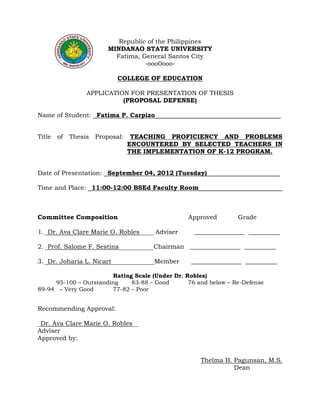
Name of Student: _Fatima P. Carpizo____________________________________
Title of Thesis Proposal: TEACHING PROFICIENCY AND PROBLEMS
ENCOUNTERED BY SELECTED TEACHERS IN
THE IMPLEMENTATION OF K-12 PROGRAM.
Date of Presentation: _September 04, 2012 (Tuesday)_____________________
Time and Place: _11:00-12:00 BSEd Faculty Room________________________
Committee Composition Approved Grade
1. _Dr. Ava Clare Marie O. Robles_____ Adviser ________________ __________
2. _Prof. Salome F. Sestina____________Chairman ________________ __________
3. _Dr. Joharia L. Nicart_______________Member ________________ __________
Rating Scale (Under Dr. Robles)
95-100 – Outstanding 83-88 – Good 76 and below – Re-Defense
89-94 – Very Good 77-82 – Poor
Recommending Approval:
_Dr. Ava Clare Marie O. Robles__
Adviser
Approved by:
Thelma B. Pagunsan, M.S.
Dean
Chapter I
THE PROBLEM
Introduction
One of the aims of the Department of Education is to prepare the
students to be globally competitive. To achieve this, educational reforms of the
government must also focus into the mastery of English as the second
language. Such attempt will greatly help to harness the productive capacity of
the country‟s human resource base towards international competitiveness.
Competitiveness may be gauged from sociolinguistic competence of a
person. Sociolinguistic competence is the ability to use language appropriate to
a given communicative context taking into account the roles of the
participants, the setting and the purpose of interaction. It is the ability to use
and respond to language appropriately, given the setting, the topic, and the
relationships among the people communicating, particularly the lingua franca
of the educational society and community, in its various contexts and
dimensions relatively guarantees the teachers competitive advantage in the
complex society like the Philippines(Alatis, 2009).
One of the alarming situations in the Philippine context is the coming of
the high school graduates into university with fair levels of
Chapter II
REVIEW OF RELATED LITERATURE AND STUDIES
This chapter presents the literature and studies which are found to have
a direct bearing to the present investigation.
Related Literature
Sociolinguistic Competence
All language events consist of a pierce of language in social context.
Every different social context determines the particular form of language. The
language used in particular situation determines the nature of that social event
( Stockwell 2002).
Brown (2001) posited that sociolinguistic competence is the knowledge of
the sociocultural rules of language and of discourse. This type of competence
requires an understanding of the social context in which language is used: the
rules of the participants, the information they share, and the functions of the
interaction. Only in a full context of this kind can judgment be made on the
appropriateness of a „particular utterance'. For students learning English in
Malaysia, sociolinguistic competence should take into account those aspects as
proposed by Bachman. Broersma (2001) claimed that the process of learning
sociolinguistic competence is challenging even in one‟s first language. He also
proposed that evidence of this can be found in the popularity of
Chapter III
METHODOLOGY
This chapter presents the research design, respondents, instruments,
procedures and the statistical methods to be used in the study.
Research Design
This study utilized a descriptive-correlational method. It described the
sociolinguistic competence of freshmen students in English in terms of style of
discourse, euphemisms, idioms and jargons; as well as determined the
academic performance of freshmen students. Additionally, it determined the
significant difference on the sociolinguistic competence between male and
female students and its significant relationship between the sociolinguistic
competence and English performance of freshmen BSED students.
Research Respondents
The respondents of the study were the one hundred thirty two
(132)freshmen students taking up the degree of Bachelor of Secondary
Education on the three major courses namely Math, English, and Biology
during the school year 2011-2012. Table 1 shows the distribution of
respondents.
CHAPTER IV
PRESENTATION, ANALYSIS AND INTERPRETATION OF DATA
This chapter presents, analyzes and interprets the data gathered in this
research study. The various results were presented in the succeeding tables
with corresponding discussions and explanations. It also answered specific
problems given in the previous chapter.
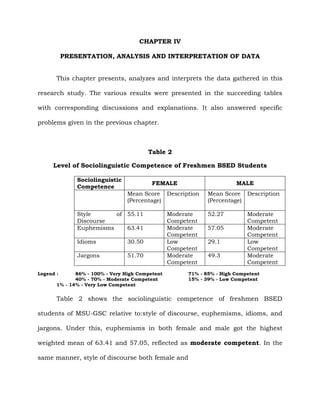
Table 2
Level of Sociolinguistic Competence of Freshmen BSED Students
Legend : 86% - 100% - Very High Competent 71% - 85% - High Competent
40% - 70% - Moderate Competent 15% - 39% - Low Competent
1% - 14% - Very Low Competent
Table 2 shows the sociolinguistic competence of freshmen BSED
students of MSU-GSC relative to:style of discourse, euphemisms, idioms, and
jargons. Under this, euphemisms in both female and male got the highest
weighted mean of 63.41 and 57.05, reflected as moderate competent. In the
same manner, style of discourse both female and
Sociolinguistic
Competence
FEMALE MALE
Mean Score
(Percentage)
Description Mean Score
(Percentage)
Description
Style of
Discourse
55.11 Moderate
Competent
52.27 Moderate
Competent
Euphemisms 63.41 Moderate
Competent
57.05 Moderate
Competent
Idioms 30.50 Low
Competent
29.1 Low
Competent
Jargons 51.70 Moderate
Competent
49.3 Moderate
Competent
CHAPTER V
SUMMARY, FINDINGS, CONCLUSIONS AND RECOMMENDATIONS
This chapter presents the summary of the study, findings on the results,
conclusions, and recommendations.
Summary
This study is conducted to determine the sociolinguistic competence of
freshmen students of bachelor in secondary education students in Mindanao
State University-General Santos City.
Specifically, this study seeks answers to the following sub-problems:
1. What is the level of sociolinguistic competence of Freshmen BSED
students relative to:
1.1 Style of Discourse 1.2 Euphemisms
1.3 Idioms 1.4Jargons
2. What is the academic performance of freshmen students in English 1?
3. Is there any significant difference on the sociolinguistic competence of
freshmen students across sex?
4. Is there a significant relationship between the level of sociolinguistic
competence and performance of students in English 1 subject?
ACKNOWLEDGMENT
With boundless love and appreciation, the researcher would like to
extend his heartfelt gratitude and appreciation to the people who helped him
bring this study into reality. The researcher would like to extend his profound
gratitude to the following:
His adviser, Dr. Ava Clare Marie O. Robles whose expertise, consistent
guidance, ample time spent and consistent advices that helped him bring this
study into success;
To the Panel of Examiners, Prof. Thelma B. Pagunsan and Dr.
JohariaNicart for their constructive comments, suggestions, and critiquing;
To the Dean of the College of Education, Prof. Thelma B. Pagunsan for
her favorable response regarding the study;
Prof. Julita A. Arsenal, the school Registrar, for the consent in getting the
total population of Secondary Students of the College of Education which is
needed for the survey;
The selected secondary education principals and students in General
Santos City for their hospitality shown and time spent during the conduct of
this study in answering the questionnaires;
To Prof. Mely P. Subiere for her unending support, advises and effort to
make this study possible;
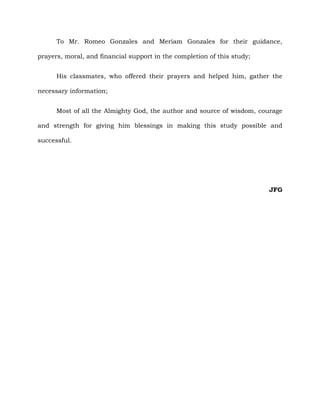
To Mr. Romeo Gonzales and Meriam Gonzales for their guidance,
prayers, moral, and financial support in the completion of this study;
His classmates, who offered their prayers and helped him, gather the
necessary information;
Most of all the Almighty God, the author and source of wisdom, courage
and strength for giving him blessings in making this study possible and
successful.
JFG
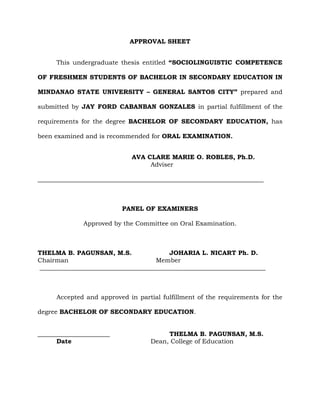
APPROVAL SHEET
This undergraduate thesis entitled “SOCIOLINGUISTIC COMPETENCE
OF FRESHMEN STUDENTS OF BACHELOR IN SECONDARY EDUCATION IN
MINDANAO STATE UNIVERSITY – GENERAL SANTOS CITY” prepared and
submitted by JAY FORD CABANBAN GONZALES in partial fulfillment of the
requirements for the degree BACHELOR OF SECONDARY EDUCATION, has
been examined and is recommended for ORAL EXAMINATION.
AVA CLARE MARIE O. ROBLES, Ph.D.
Adviser
________________________________________________________________________
PANEL OF EXAMINERS
Approved by the Committee on Oral Examination.
THELMA B. PAGUNSAN, M.S. JOHARIA L. NICART Ph. D.
Chairman Member
________________________________________________________________________
Accepted and approved in partial fulfillment of the requirements for the
degree BACHELOR OF SECONDARY EDUCATION.
_______________________ THELMA B. PAGUNSAN, M.S.
Date Dean, College of Education
BIBLIOGRAPHY
A. BOOKS
Bach, K. &Harnish, R.(1979)Linguistic communication and speech acts:
Cambridge, MA: MIT Press.
Brown, P. & Levinson, S.(1978) Universals of language usage: Politeness
phenomena: Cambridge: Cambridge University Press.
Davison, Jon & Moss, John.(2006) Issues in English Teaching:
Routledge,2000 Pahuja, N.P. Teaching of English: Anmol
Publications PVT. Ltd,
Fraser, B. &Walters, J. (1980)An approach to conducting research on the
acquisition of pragmatic competence in a second language: Rowley, MA:
Newbury House.
Norbert, Dittmar. (1976) Sociolinguistics: A critical survey of theory and
application: Edward Arnold (Publishers) Ltd.
Stockwell, Peter. (2002)Sociolinguistics: A Resource book for the
Students.Rutledge,London: TJ International Ltd. Padstow Cornwall.
B. JOURNALS
Truelove, Alison. (2001). Commanding communications: the fifteenth-century
letters of the Stonor women. In James Daybell (Ed.), Early Modern Women
'S Letter Writing, 14.50-1 700.Houndmills, Basingstoke: Palgrave, 42-58.
Wood, Jolianiia L. (2004). Text in context: a critical discourse analysis approach
to Margaret Paston. Journal ofHistorica1 Pragmatics 512: 229-254.
Yu, M. (2003).On the appropriateness for introducing an early-start English
curriculum at the primary grades in Taiwan.Journal of Research on
Elementary and Secondary Education, 10, 1-43.
B. UNPUBLISHED MATERIALS
Bagaan, Salvador. (2003). Communicative Competence of Notre Dame of
Dadiangas College Students. Master Thesis. NDDC-GSC.
Bombeo, ArnelOmapas. (2008). The Communicative Skills in English of Students
in Technical Schools in GSC: Its Implication to Curriculum Development and
Review. Master Thesis. MSU-GSC.
Cabrillos, Ma. Beatriz G. (2003) Factors affecting the Academic Achievement of
Grade IV Pupils in the Elementary Leader School (Non-ELS) at Carmen
North District.Unpublished Master‟s Thesis.University of Mindanao.
España,MariaAdeliz. (2011). Construction and Validation of Test on the
Sociolinguistic Competence of First Year BSED English Students (SY 2010-
2011. Undergraduate Thesis. MSU-GSC
Ibesate, Joe Aldwin A. (2004). Factors that Affect the Academic Achievement of
Grade V Pupils (SY 2002-2003) at Kabacan South District.Unpublished
Master‟s Thesis.University of Mindanao.
IlynMuycoRabago. (2007).The impact of Language Curriculum on the Students‟
Communication Skills Development: Basis for a Language Program. Master
Thesis. NDDU-GSC.
Jumalon, Julnes.(1992). Communicative Competence in English of Mindanao
State University, General Santos City College Freshman. Master Thesis.
NDDC.
Macabangin, Paciencia. (1997). Communicative Competence in English of the
Mindanao State University-General Santos City. Master Thesis.
Mones, Josephine. (1992) The Reading Comprehension Proficiency in English of
First Year High School Students in MSU-GSC. Master Thesis.
C. ONLINE SOURCES
Azhar, Mahmood. (2011) Research article on meeting the challenges of English
Language teaching in present scenario.Retrieved on February 4, 2011
from http://mobile2010.0lx.net/?p=5
Banda, Felix. (2006) Language use and mode of communication in community
development projects in Nyanza province, Kenya.Retrievedon May22,
2006 from
http://etd.uwc.ac.za/usrfiles/modules/etd/docs/etd_gen8Srv25Nme4_9
737_1182811915.pdf
Broersma, D. (2001) "„You‟re So White, So Fat, and So Hairy!": Developing
Sociolinguistic Competence in a Second Language. Retrieved on June,
2004 http://www2.wheaton.edu/bgc/ICCT/slares/FAQ9.html
Danison, Edward. (2006) “Encountering Culture in People, Language and
Media”.Retrieved on February, 2006 from http://www.language-and-
cultureneddanison.com
Juppe, Robert Jr.(2007). Developing Sociolinguistic Competence Through
Aural/Oral Communication Course Activities. Retrieved in the year 1997
fromhttp://www.tsukuba-g.ac.jp/library/kiyou/97/Robert.pdf.
Nevalainen, TERTTU &Raumolin,Brunberg.(2005). Sociolinguistics and the
History of English: A Survey. Retrieved in the year 2005 from
http://www.um.es/ijes/vol5n1/04-Nevalainen-Raumolin.pdf.
Oha, et.al. (2010). An Introduction to Sociolinguistics. Retrieved in the year 2010
from
http://www.nou.edu.ng/noun/NOUN_OCL/pdf/pdf2/ENG%20355.pdf.
Penner, David. (2009). Due for a Change: The Need to Assess Sociolinguistic
Competencies on Standardised Tests for Japanese Speakers of Business
English.Retrieved on April 7, 2009 from
http://www.davestravels.com/eportfolio/papers/standardised_April09.p
df.
Ya, Liu.(2010). A Study of Language Teaching from a Sociolinguistic Perspective
of Communicative Competence.Retrieved on March 2008from
http://cscanada.net/index.php/css/article/view/373/371.
Yu, Ming-chung. (2005). Sociolinguistic Competence in the Complimenting Act of
Native Chinese and American English Speakers: A Mirror of Cultural
Value. Retrieved on March 2005 from
http://krpb.pbworks.com/f/yu+compliments.pdf.
Carolyn (2009).Jargon.Retrieved in the year 2009 from
http://www.wisegeek.com/what-is-jargon.htm
Ho (2004). Academic Performance.Retrieved in the year 2004 from
http://www.ehow.com/about_4740750_define_academicperforman
ce.htm
Jargons, register, and style. http:www.linguistics.ucsb.edu
Silva, Jennifer (2011).What is Jargons.http://www.suite101.com.
Smith, S.E.(2011). Idioms.http://www.wisegeek.com.
Philippine Education System.Retrieved in October 18, 2008 from
http://www.scribd.com/doc/6822836/THE-PHILIPPINE-
EDUCATION-SYSTEM
DEPED Vision &Mission.Retrieved from June 16, 2011 from
http://www.deped.gov.ph/about_deped/vision_mission.asp
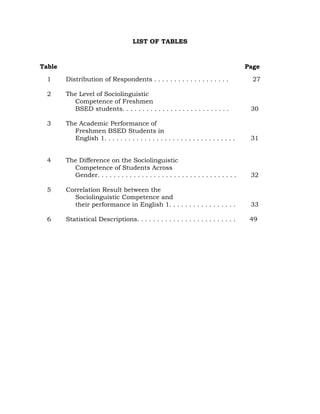
LIST OF TABLES
Table Page
1 Distribution of Respondents . . . . . . . . . . . . . . . . . . . 27
2 The Level of Sociolinguistic
Competence of Freshmen
BSED students. . . . . . . . . . . . . . . . . . . . . . . . . . . 30
3 The Academic Performance of
Freshmen BSED Students in
English 1. . . . . . . . . . . . . . . . . . . . . . . . . . . . . . . . . 31
4 The Difference on the Sociolinguistic
Competence of Students Across
Gender. . . . . . . . . . . . . . . . . . . . . . . . . . . . . . . . . . . 32
5 Correlation Result between the
Sociolinguistic Competence and
their performance in English 1. . . . . . . . . . . . . . . . . 33
6 Statistical Descriptions. . . . . . . . . . . . . . . . . . . . . . . . . 49
LIST OF FIGURES
Page
1. Conceptual Framework…..……………………………………….... 6
2. Research Design……………………………………………………… 38
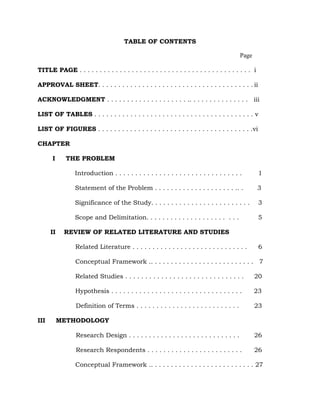
TABLE OF CONTENTS
Page
TITLE PAGE . . . . . . . . . . . . . . . . . . . . . . . . . . . . . . . . . . . . . . . . . . . i
APPROVAL SHEET. . . . . . . . . . . . . . . . . . . . . . . . . . . . . . . . . . . . . . . ii
ACKNOWLEDGMENT . . . . . . . . . . . . . . . . . . . . .. . . . . . . . . . . . . . . iii
LIST OF TABLES . . . . . . . . . . . . . . . . . . . . . . . . . . . . . . . . . . . . . . . . v
LIST OF FIGURES . . . . . . . . . . . . . . . . . . . . . . . . . . . . . . . . . . . . . . .vi
CHAPTER
I THE PROBLEM
Introduction . . . . . . . . . . . . . . . . . . . . . . . . . . . . . . . . 1
Statement of the Problem . . . . . . . . . . . . . . . . . . . . .. . 3
Significance of the Study. . . . . . . . . . . . . . . . . . . . . . . . . 3
Scope and Delimitation. . . . . . . . . . . . . . . . . . . . . . . 5
II REVIEW OF RELATED LITERATURE AND STUDIES
Related Literature . . . . . . . . . . . . . . . . . . . . . . . . . . . . . 6
Conceptual Framework .. . . . . . . . . . . . . . . . . . . . . . . . . . 7
Related Studies . . . . . . . . . . . . . . . . . . . . . . . . . . . . . . 20
Hypothesis . . . . . . . . . . . . . . . . . . . . . . . . . . . . . . . . . 23
Definition of Terms . . . . . . . . . . . . . . . . . . . . . . . . . . 23
III METHODOLOGY
Research Design . . . . . . . . . . . . . . . . . . . . . . . . . . . . 26
Research Respondents . . . . . . . . . . . . . . . . . . . . . . . . 26
Conceptual Framework .. . . . . . . . . . . . . . . . . . . . . . . . . . 27
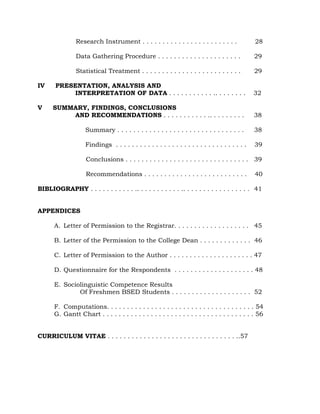
Research Instrument . . . . . . . . . . . . . . . . . . . . . . . . 28
Data Gathering Procedure . . . . . . . . . . . . . . . . . . . . . 29
Statistical Treatment . . . . . . . . . . . . . . . . . . . . . . . . . 29
IV PRESENTATION, ANALYSIS AND
INTERPRETATION OF DATA . . . . . . . . . . . .. . . . . . . . 32
V SUMMARY, FINDINGS, CONCLUSIONS
AND RECOMMENDATIONS . . . . . . . . . . . .. . . . . . . . . 38
Summary . . . . . . . . . . . . . . . . . . . . . . . . . . . . . . . . 38
Findings . . . . . . . . . . . . . . . . . . . . . . . . . . . . . . . . . 39
Conclusions . . . . . . . . . . . . . . . . . . . . . . . . . . . . . . . 39
Recommendations . . . . . . . . . . . . . . . . . . . . . . . . . . 40
BIBLIOGRAPHY . . . . . . . . . . . .. . . . . . . . . . . .. . . . . . . . . . . . . . . . . 41
APPENDICES
A. Letter of Permission to the Registrar. . . . . . . . . . . . . . . . . . . 45
B. Letter of the Permission to the College Dean . . . . . . . . . . . . . 46
C. Letter of Permission to the Author . . . . . . . . . . . . . . . . . . . . . 47
D. Questionnaire for the Respondents . . . . . . . . . . . . . . . . . . . . 48
E. Sociolinguistic Competence Results
Of Freshmen BSED Students . . . . . . . . . . . . . . . . . . . . 52
F. Computations. . . . . . . . . . . . . . . . . . . . . . . . . . . . . . . . . . . . . 54
G. Gantt Chart . . . . . . . . . . . . . . . . . . . . . . . . . . . . . . . . . . . . . . 56
CURRICULUM VITAE . . . . . . . . . . . . . . . . . . . . . . . . . . . . . . . . ..57
Appendix A
LETTER TO THE RESPONDENTS
Republic of the Philippines
MINDANAO STATE UNIVERSITY
Fatima, General Santos City
College of Education
November 18, 2011
Dear Respondents:
Greetings!
I am one of the students of Mindanao State University, General Santos
City who is conducting a thesis on “The Extent of Texting and the Level of
Spelling Skills of First Year Student of LunPadidu National High
School”.This is one of the requirements for the degree of Bachelor of Secondary
Education major in English.
In this connection, I would like to ask you to please answer the following
questions honestly. Be rest assure that you answer will be kept confidentially.
I‟m hoping for your cooperation.
Thank you.
Very truly yours,
(Sgd) IRISH G.PATLINGRAO
Researcher
Noted by:
(Sgd) AVA CLARE MARIE O. ROBLES, PhD.
Adviser
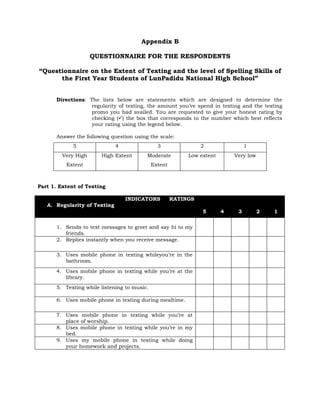
Appendix B
QUESTIONNAIRE FOR THE RESPONDENTS
“Questionnaire on the Extent of Texting and the level of Spelling Skills of
the First Year Students of LunPadidu National High School”
Directions: The lists below are statements which are designed to determine the
regularity of texting, the amount you‟ve spend in texting and the texting
promo you had availed. You are requested to give your honest rating by
checking () the box that corresponds to the number which best reflects
your rating using the legend below.
Answer the following question using the scale:
5 4 3 2 1
Very High
Extent
High Extent Moderate
Extent
Low extent Very low
Part 1. Extent of Texting
INDICATORS RATINGS
A. Regularity of Texting
5 4 3 2 1
1. Sends to text messages to greet and say hi to my
friends.
2. Replies instantly when you receive message.
3. Uses mobile phone in texting whileyou‟re in the
bathroom.
4. Uses mobile phone in texting while you‟re at the
library.
5. Texting while listening to music.
6. Uses mobile phone in texting during mealtime.
7. Uses mobile phone in texting while you‟re at
place of worship.
8. Uses mobile phone in texting while you‟re in my
bed.
9. Uses my mobile phone in texting while doing
your homework and projects.
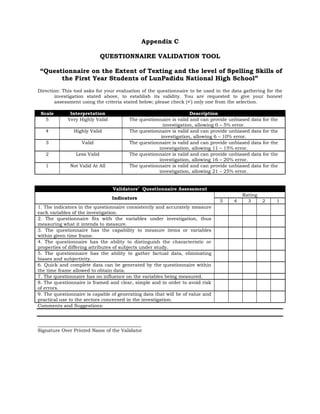
Appendix C
QUESTIONNAIRE VALIDATION TOOL
“Questionnaire on the Extent of Texting and the level of Spelling Skills of
the First Year Students of LunPadidu National High School”
Direction: This tool asks for your evaluation of the questionnaire to be used in the data gathering for the
investigation stated above, to establish its validity. You are requested to give your honest
assessment using the criteria stated below; please check () only one from the selection.
Scale Interpretation Description
5 Very Highly Valid The questionnaire is valid and can provide unbiased data for the
investigation, allowing 0 – 5% error.
4 Highly Valid The questionnaire is valid and can provide unbiased data for the
investigation, allowing 6 – 10% error.
3 Valid The questionnaire is valid and can provide unbiased data for the
investigation, allowing 11 – 15% error.
2 Less Valid The questionnaire is valid and can provide unbiased data for the
investigation, allowing 16 – 20% error.
1 Not Valid At All The questionnaire is valid and can provide unbiased data for the
investigation, allowing 21 – 25% error.
Validators’ Questionnaire Assessment
Indicators
Rating
5 4 3 2 1
1. The indicators in the questionnaire consistently and accurately measure
each variables of the investigation.
2. The questionnaire fits with the variables under investigation, thus
measuring what it intends to measure.
3. The questionnaire has the capability to measure items or variables
within given time frame.
4. The questionnaire has the ability to distinguish the characteristic or
properties of differing attributes of subjects under study.
5. The questionnaire has the ability to gather factual data, eliminating
biases and subjectivity.
6. Quick and complete data can be generated by the questionnaire within
the time frame allowed to obtain data.
7. The questionnaire has no influence on the variables being measured.
8. The questionnaire is framed and clear, simple and in order to avoid risk
of errors.
9. The questionnaire is capable of generating data that will be of value and
practical use to the sectors concerned in the investigation.
Comments and Suggestions:
____________________________________________
Signature Over Printed Name of the Validator
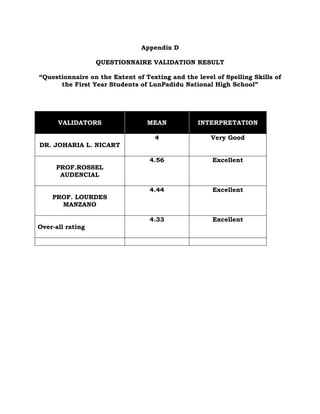
Appendix D
QUESTIONNAIRE VALIDATION RESULT
“Questionnaire on the Extent of Texting and the level of Spelling Skills of
the First Year Students of LunPadidu National High School”
VALIDATORS MEAN INTERPRETATION
DR. JOHARIA L. NICART
4 Very Good
PROF.ROSSEL
AUDENCIAL
4.56 Excellent
PROF. LOURDES
MANZANO
4.44 Excellent
Over-all rating
4.33 Excellent

Format thesis

  • 1.
    Republic of thePhilippines MINDANAO STATE UNIVERSITY Fatima, General Santos City -ooo0ooo- COLLEGE OF EDUCATION APPLICATION FOR PRESENTATION OF THESIS (PROPOSAL DEFENSE) Name of Student: _Fatima P. Carpizo____________________________________ Title of Thesis Proposal: TEACHING PROFICIENCY AND PROBLEMS ENCOUNTERED BY SELECTED TEACHERS IN THE IMPLEMENTATION OF K-12 PROGRAM. Date of Presentation: _September 04, 2012 (Tuesday)_____________________ Time and Place: _11:00-12:00 BSEd Faculty Room________________________ Committee Composition Approved Grade 1. _Dr. Ava Clare Marie O. Robles_____ Adviser ________________ __________ 2. _Prof. Salome F. Sestina____________Chairman ________________ __________ 3. _Dr. Joharia L. Nicart_______________Member ________________ __________ Rating Scale (Under Dr. Robles) 95-100 – Outstanding 83-88 – Good 76 and below – Re-Defense 89-94 – Very Good 77-82 – Poor Recommending Approval: _Dr. Ava Clare Marie O. Robles__ Adviser Approved by: Thelma B. Pagunsan, M.S. Dean
  • 2.
    Chapter I THE PROBLEM Introduction Oneof the aims of the Department of Education is to prepare the students to be globally competitive. To achieve this, educational reforms of the government must also focus into the mastery of English as the second language. Such attempt will greatly help to harness the productive capacity of the country‟s human resource base towards international competitiveness. Competitiveness may be gauged from sociolinguistic competence of a person. Sociolinguistic competence is the ability to use language appropriate to a given communicative context taking into account the roles of the participants, the setting and the purpose of interaction. It is the ability to use and respond to language appropriately, given the setting, the topic, and the relationships among the people communicating, particularly the lingua franca of the educational society and community, in its various contexts and dimensions relatively guarantees the teachers competitive advantage in the complex society like the Philippines(Alatis, 2009). One of the alarming situations in the Philippine context is the coming of the high school graduates into university with fair levels of
  • 3.
    Chapter II REVIEW OFRELATED LITERATURE AND STUDIES This chapter presents the literature and studies which are found to have a direct bearing to the present investigation. Related Literature Sociolinguistic Competence All language events consist of a pierce of language in social context. Every different social context determines the particular form of language. The language used in particular situation determines the nature of that social event ( Stockwell 2002). Brown (2001) posited that sociolinguistic competence is the knowledge of the sociocultural rules of language and of discourse. This type of competence requires an understanding of the social context in which language is used: the rules of the participants, the information they share, and the functions of the interaction. Only in a full context of this kind can judgment be made on the appropriateness of a „particular utterance'. For students learning English in Malaysia, sociolinguistic competence should take into account those aspects as proposed by Bachman. Broersma (2001) claimed that the process of learning sociolinguistic competence is challenging even in one‟s first language. He also proposed that evidence of this can be found in the popularity of
  • 4.
    Chapter III METHODOLOGY This chapterpresents the research design, respondents, instruments, procedures and the statistical methods to be used in the study. Research Design This study utilized a descriptive-correlational method. It described the sociolinguistic competence of freshmen students in English in terms of style of discourse, euphemisms, idioms and jargons; as well as determined the academic performance of freshmen students. Additionally, it determined the significant difference on the sociolinguistic competence between male and female students and its significant relationship between the sociolinguistic competence and English performance of freshmen BSED students. Research Respondents The respondents of the study were the one hundred thirty two (132)freshmen students taking up the degree of Bachelor of Secondary Education on the three major courses namely Math, English, and Biology during the school year 2011-2012. Table 1 shows the distribution of respondents.
  • 5.
    CHAPTER IV PRESENTATION, ANALYSISAND INTERPRETATION OF DATA This chapter presents, analyzes and interprets the data gathered in this research study. The various results were presented in the succeeding tables with corresponding discussions and explanations. It also answered specific problems given in the previous chapter. Table 2 Level of Sociolinguistic Competence of Freshmen BSED Students Legend : 86% - 100% - Very High Competent 71% - 85% - High Competent 40% - 70% - Moderate Competent 15% - 39% - Low Competent 1% - 14% - Very Low Competent Table 2 shows the sociolinguistic competence of freshmen BSED students of MSU-GSC relative to:style of discourse, euphemisms, idioms, and jargons. Under this, euphemisms in both female and male got the highest weighted mean of 63.41 and 57.05, reflected as moderate competent. In the same manner, style of discourse both female and Sociolinguistic Competence FEMALE MALE Mean Score (Percentage) Description Mean Score (Percentage) Description Style of Discourse 55.11 Moderate Competent 52.27 Moderate Competent Euphemisms 63.41 Moderate Competent 57.05 Moderate Competent Idioms 30.50 Low Competent 29.1 Low Competent Jargons 51.70 Moderate Competent 49.3 Moderate Competent
  • 6.
    CHAPTER V SUMMARY, FINDINGS,CONCLUSIONS AND RECOMMENDATIONS This chapter presents the summary of the study, findings on the results, conclusions, and recommendations. Summary This study is conducted to determine the sociolinguistic competence of freshmen students of bachelor in secondary education students in Mindanao State University-General Santos City. Specifically, this study seeks answers to the following sub-problems: 1. What is the level of sociolinguistic competence of Freshmen BSED students relative to: 1.1 Style of Discourse 1.2 Euphemisms 1.3 Idioms 1.4Jargons 2. What is the academic performance of freshmen students in English 1? 3. Is there any significant difference on the sociolinguistic competence of freshmen students across sex? 4. Is there a significant relationship between the level of sociolinguistic competence and performance of students in English 1 subject?
  • 7.
    ACKNOWLEDGMENT With boundless loveand appreciation, the researcher would like to extend his heartfelt gratitude and appreciation to the people who helped him bring this study into reality. The researcher would like to extend his profound gratitude to the following: His adviser, Dr. Ava Clare Marie O. Robles whose expertise, consistent guidance, ample time spent and consistent advices that helped him bring this study into success; To the Panel of Examiners, Prof. Thelma B. Pagunsan and Dr. JohariaNicart for their constructive comments, suggestions, and critiquing; To the Dean of the College of Education, Prof. Thelma B. Pagunsan for her favorable response regarding the study; Prof. Julita A. Arsenal, the school Registrar, for the consent in getting the total population of Secondary Students of the College of Education which is needed for the survey; The selected secondary education principals and students in General Santos City for their hospitality shown and time spent during the conduct of this study in answering the questionnaires; To Prof. Mely P. Subiere for her unending support, advises and effort to make this study possible;
  • 8.
    To Mr. RomeoGonzales and Meriam Gonzales for their guidance, prayers, moral, and financial support in the completion of this study; His classmates, who offered their prayers and helped him, gather the necessary information; Most of all the Almighty God, the author and source of wisdom, courage and strength for giving him blessings in making this study possible and successful. JFG
  • 9.
    APPROVAL SHEET This undergraduatethesis entitled “SOCIOLINGUISTIC COMPETENCE OF FRESHMEN STUDENTS OF BACHELOR IN SECONDARY EDUCATION IN MINDANAO STATE UNIVERSITY – GENERAL SANTOS CITY” prepared and submitted by JAY FORD CABANBAN GONZALES in partial fulfillment of the requirements for the degree BACHELOR OF SECONDARY EDUCATION, has been examined and is recommended for ORAL EXAMINATION. AVA CLARE MARIE O. ROBLES, Ph.D. Adviser ________________________________________________________________________ PANEL OF EXAMINERS Approved by the Committee on Oral Examination. THELMA B. PAGUNSAN, M.S. JOHARIA L. NICART Ph. D. Chairman Member ________________________________________________________________________ Accepted and approved in partial fulfillment of the requirements for the degree BACHELOR OF SECONDARY EDUCATION. _______________________ THELMA B. PAGUNSAN, M.S. Date Dean, College of Education
  • 10.
    BIBLIOGRAPHY A. BOOKS Bach, K.&Harnish, R.(1979)Linguistic communication and speech acts: Cambridge, MA: MIT Press. Brown, P. & Levinson, S.(1978) Universals of language usage: Politeness phenomena: Cambridge: Cambridge University Press. Davison, Jon & Moss, John.(2006) Issues in English Teaching: Routledge,2000 Pahuja, N.P. Teaching of English: Anmol Publications PVT. Ltd, Fraser, B. &Walters, J. (1980)An approach to conducting research on the acquisition of pragmatic competence in a second language: Rowley, MA: Newbury House. Norbert, Dittmar. (1976) Sociolinguistics: A critical survey of theory and application: Edward Arnold (Publishers) Ltd. Stockwell, Peter. (2002)Sociolinguistics: A Resource book for the Students.Rutledge,London: TJ International Ltd. Padstow Cornwall. B. JOURNALS Truelove, Alison. (2001). Commanding communications: the fifteenth-century letters of the Stonor women. In James Daybell (Ed.), Early Modern Women 'S Letter Writing, 14.50-1 700.Houndmills, Basingstoke: Palgrave, 42-58. Wood, Jolianiia L. (2004). Text in context: a critical discourse analysis approach to Margaret Paston. Journal ofHistorica1 Pragmatics 512: 229-254. Yu, M. (2003).On the appropriateness for introducing an early-start English curriculum at the primary grades in Taiwan.Journal of Research on Elementary and Secondary Education, 10, 1-43. B. UNPUBLISHED MATERIALS Bagaan, Salvador. (2003). Communicative Competence of Notre Dame of Dadiangas College Students. Master Thesis. NDDC-GSC.
  • 11.
    Bombeo, ArnelOmapas. (2008).The Communicative Skills in English of Students in Technical Schools in GSC: Its Implication to Curriculum Development and Review. Master Thesis. MSU-GSC. Cabrillos, Ma. Beatriz G. (2003) Factors affecting the Academic Achievement of Grade IV Pupils in the Elementary Leader School (Non-ELS) at Carmen North District.Unpublished Master‟s Thesis.University of Mindanao. España,MariaAdeliz. (2011). Construction and Validation of Test on the Sociolinguistic Competence of First Year BSED English Students (SY 2010- 2011. Undergraduate Thesis. MSU-GSC Ibesate, Joe Aldwin A. (2004). Factors that Affect the Academic Achievement of Grade V Pupils (SY 2002-2003) at Kabacan South District.Unpublished Master‟s Thesis.University of Mindanao. IlynMuycoRabago. (2007).The impact of Language Curriculum on the Students‟ Communication Skills Development: Basis for a Language Program. Master Thesis. NDDU-GSC. Jumalon, Julnes.(1992). Communicative Competence in English of Mindanao State University, General Santos City College Freshman. Master Thesis. NDDC. Macabangin, Paciencia. (1997). Communicative Competence in English of the Mindanao State University-General Santos City. Master Thesis. Mones, Josephine. (1992) The Reading Comprehension Proficiency in English of First Year High School Students in MSU-GSC. Master Thesis. C. ONLINE SOURCES Azhar, Mahmood. (2011) Research article on meeting the challenges of English Language teaching in present scenario.Retrieved on February 4, 2011 from http://mobile2010.0lx.net/?p=5 Banda, Felix. (2006) Language use and mode of communication in community development projects in Nyanza province, Kenya.Retrievedon May22, 2006 from http://etd.uwc.ac.za/usrfiles/modules/etd/docs/etd_gen8Srv25Nme4_9 737_1182811915.pdf Broersma, D. (2001) "„You‟re So White, So Fat, and So Hairy!": Developing Sociolinguistic Competence in a Second Language. Retrieved on June, 2004 http://www2.wheaton.edu/bgc/ICCT/slares/FAQ9.html
  • 12.
    Danison, Edward. (2006)“Encountering Culture in People, Language and Media”.Retrieved on February, 2006 from http://www.language-and- cultureneddanison.com Juppe, Robert Jr.(2007). Developing Sociolinguistic Competence Through Aural/Oral Communication Course Activities. Retrieved in the year 1997 fromhttp://www.tsukuba-g.ac.jp/library/kiyou/97/Robert.pdf. Nevalainen, TERTTU &Raumolin,Brunberg.(2005). Sociolinguistics and the History of English: A Survey. Retrieved in the year 2005 from http://www.um.es/ijes/vol5n1/04-Nevalainen-Raumolin.pdf. Oha, et.al. (2010). An Introduction to Sociolinguistics. Retrieved in the year 2010 from http://www.nou.edu.ng/noun/NOUN_OCL/pdf/pdf2/ENG%20355.pdf. Penner, David. (2009). Due for a Change: The Need to Assess Sociolinguistic Competencies on Standardised Tests for Japanese Speakers of Business English.Retrieved on April 7, 2009 from http://www.davestravels.com/eportfolio/papers/standardised_April09.p df. Ya, Liu.(2010). A Study of Language Teaching from a Sociolinguistic Perspective of Communicative Competence.Retrieved on March 2008from http://cscanada.net/index.php/css/article/view/373/371. Yu, Ming-chung. (2005). Sociolinguistic Competence in the Complimenting Act of Native Chinese and American English Speakers: A Mirror of Cultural Value. Retrieved on March 2005 from http://krpb.pbworks.com/f/yu+compliments.pdf. Carolyn (2009).Jargon.Retrieved in the year 2009 from http://www.wisegeek.com/what-is-jargon.htm Ho (2004). Academic Performance.Retrieved in the year 2004 from http://www.ehow.com/about_4740750_define_academicperforman ce.htm Jargons, register, and style. http:www.linguistics.ucsb.edu Silva, Jennifer (2011).What is Jargons.http://www.suite101.com. Smith, S.E.(2011). Idioms.http://www.wisegeek.com. Philippine Education System.Retrieved in October 18, 2008 from http://www.scribd.com/doc/6822836/THE-PHILIPPINE- EDUCATION-SYSTEM
  • 13.
    DEPED Vision &Mission.Retrievedfrom June 16, 2011 from http://www.deped.gov.ph/about_deped/vision_mission.asp
  • 14.
    LIST OF TABLES TablePage 1 Distribution of Respondents . . . . . . . . . . . . . . . . . . . 27 2 The Level of Sociolinguistic Competence of Freshmen BSED students. . . . . . . . . . . . . . . . . . . . . . . . . . . 30 3 The Academic Performance of Freshmen BSED Students in English 1. . . . . . . . . . . . . . . . . . . . . . . . . . . . . . . . . 31 4 The Difference on the Sociolinguistic Competence of Students Across Gender. . . . . . . . . . . . . . . . . . . . . . . . . . . . . . . . . . . 32 5 Correlation Result between the Sociolinguistic Competence and their performance in English 1. . . . . . . . . . . . . . . . . 33 6 Statistical Descriptions. . . . . . . . . . . . . . . . . . . . . . . . . 49
  • 15.
    LIST OF FIGURES Page 1.Conceptual Framework…..……………………………………….... 6 2. Research Design……………………………………………………… 38
  • 16.
    TABLE OF CONTENTS Page TITLEPAGE . . . . . . . . . . . . . . . . . . . . . . . . . . . . . . . . . . . . . . . . . . . i APPROVAL SHEET. . . . . . . . . . . . . . . . . . . . . . . . . . . . . . . . . . . . . . . ii ACKNOWLEDGMENT . . . . . . . . . . . . . . . . . . . . .. . . . . . . . . . . . . . . iii LIST OF TABLES . . . . . . . . . . . . . . . . . . . . . . . . . . . . . . . . . . . . . . . . v LIST OF FIGURES . . . . . . . . . . . . . . . . . . . . . . . . . . . . . . . . . . . . . . .vi CHAPTER I THE PROBLEM Introduction . . . . . . . . . . . . . . . . . . . . . . . . . . . . . . . . 1 Statement of the Problem . . . . . . . . . . . . . . . . . . . . .. . 3 Significance of the Study. . . . . . . . . . . . . . . . . . . . . . . . . 3 Scope and Delimitation. . . . . . . . . . . . . . . . . . . . . . . 5 II REVIEW OF RELATED LITERATURE AND STUDIES Related Literature . . . . . . . . . . . . . . . . . . . . . . . . . . . . . 6 Conceptual Framework .. . . . . . . . . . . . . . . . . . . . . . . . . . 7 Related Studies . . . . . . . . . . . . . . . . . . . . . . . . . . . . . . 20 Hypothesis . . . . . . . . . . . . . . . . . . . . . . . . . . . . . . . . . 23 Definition of Terms . . . . . . . . . . . . . . . . . . . . . . . . . . 23 III METHODOLOGY Research Design . . . . . . . . . . . . . . . . . . . . . . . . . . . . 26 Research Respondents . . . . . . . . . . . . . . . . . . . . . . . . 26 Conceptual Framework .. . . . . . . . . . . . . . . . . . . . . . . . . . 27
  • 17.
    Research Instrument .. . . . . . . . . . . . . . . . . . . . . . . 28 Data Gathering Procedure . . . . . . . . . . . . . . . . . . . . . 29 Statistical Treatment . . . . . . . . . . . . . . . . . . . . . . . . . 29 IV PRESENTATION, ANALYSIS AND INTERPRETATION OF DATA . . . . . . . . . . . .. . . . . . . . 32 V SUMMARY, FINDINGS, CONCLUSIONS AND RECOMMENDATIONS . . . . . . . . . . . .. . . . . . . . . 38 Summary . . . . . . . . . . . . . . . . . . . . . . . . . . . . . . . . 38 Findings . . . . . . . . . . . . . . . . . . . . . . . . . . . . . . . . . 39 Conclusions . . . . . . . . . . . . . . . . . . . . . . . . . . . . . . . 39 Recommendations . . . . . . . . . . . . . . . . . . . . . . . . . . 40 BIBLIOGRAPHY . . . . . . . . . . . .. . . . . . . . . . . .. . . . . . . . . . . . . . . . . 41 APPENDICES A. Letter of Permission to the Registrar. . . . . . . . . . . . . . . . . . . 45 B. Letter of the Permission to the College Dean . . . . . . . . . . . . . 46 C. Letter of Permission to the Author . . . . . . . . . . . . . . . . . . . . . 47 D. Questionnaire for the Respondents . . . . . . . . . . . . . . . . . . . . 48 E. Sociolinguistic Competence Results Of Freshmen BSED Students . . . . . . . . . . . . . . . . . . . . 52 F. Computations. . . . . . . . . . . . . . . . . . . . . . . . . . . . . . . . . . . . . 54 G. Gantt Chart . . . . . . . . . . . . . . . . . . . . . . . . . . . . . . . . . . . . . . 56 CURRICULUM VITAE . . . . . . . . . . . . . . . . . . . . . . . . . . . . . . . . ..57
  • 18.
    Appendix A LETTER TOTHE RESPONDENTS Republic of the Philippines MINDANAO STATE UNIVERSITY Fatima, General Santos City College of Education November 18, 2011 Dear Respondents: Greetings! I am one of the students of Mindanao State University, General Santos City who is conducting a thesis on “The Extent of Texting and the Level of Spelling Skills of First Year Student of LunPadidu National High School”.This is one of the requirements for the degree of Bachelor of Secondary Education major in English. In this connection, I would like to ask you to please answer the following questions honestly. Be rest assure that you answer will be kept confidentially. I‟m hoping for your cooperation. Thank you. Very truly yours, (Sgd) IRISH G.PATLINGRAO Researcher Noted by: (Sgd) AVA CLARE MARIE O. ROBLES, PhD. Adviser
  • 19.
    Appendix B QUESTIONNAIRE FORTHE RESPONDENTS “Questionnaire on the Extent of Texting and the level of Spelling Skills of the First Year Students of LunPadidu National High School” Directions: The lists below are statements which are designed to determine the regularity of texting, the amount you‟ve spend in texting and the texting promo you had availed. You are requested to give your honest rating by checking () the box that corresponds to the number which best reflects your rating using the legend below. Answer the following question using the scale: 5 4 3 2 1 Very High Extent High Extent Moderate Extent Low extent Very low Part 1. Extent of Texting INDICATORS RATINGS A. Regularity of Texting 5 4 3 2 1 1. Sends to text messages to greet and say hi to my friends. 2. Replies instantly when you receive message. 3. Uses mobile phone in texting whileyou‟re in the bathroom. 4. Uses mobile phone in texting while you‟re at the library. 5. Texting while listening to music. 6. Uses mobile phone in texting during mealtime. 7. Uses mobile phone in texting while you‟re at place of worship. 8. Uses mobile phone in texting while you‟re in my bed. 9. Uses my mobile phone in texting while doing your homework and projects.
  • 20.
    Appendix C QUESTIONNAIRE VALIDATIONTOOL “Questionnaire on the Extent of Texting and the level of Spelling Skills of the First Year Students of LunPadidu National High School” Direction: This tool asks for your evaluation of the questionnaire to be used in the data gathering for the investigation stated above, to establish its validity. You are requested to give your honest assessment using the criteria stated below; please check () only one from the selection. Scale Interpretation Description 5 Very Highly Valid The questionnaire is valid and can provide unbiased data for the investigation, allowing 0 – 5% error. 4 Highly Valid The questionnaire is valid and can provide unbiased data for the investigation, allowing 6 – 10% error. 3 Valid The questionnaire is valid and can provide unbiased data for the investigation, allowing 11 – 15% error. 2 Less Valid The questionnaire is valid and can provide unbiased data for the investigation, allowing 16 – 20% error. 1 Not Valid At All The questionnaire is valid and can provide unbiased data for the investigation, allowing 21 – 25% error. Validators’ Questionnaire Assessment Indicators Rating 5 4 3 2 1 1. The indicators in the questionnaire consistently and accurately measure each variables of the investigation. 2. The questionnaire fits with the variables under investigation, thus measuring what it intends to measure. 3. The questionnaire has the capability to measure items or variables within given time frame. 4. The questionnaire has the ability to distinguish the characteristic or properties of differing attributes of subjects under study. 5. The questionnaire has the ability to gather factual data, eliminating biases and subjectivity. 6. Quick and complete data can be generated by the questionnaire within the time frame allowed to obtain data. 7. The questionnaire has no influence on the variables being measured. 8. The questionnaire is framed and clear, simple and in order to avoid risk of errors. 9. The questionnaire is capable of generating data that will be of value and practical use to the sectors concerned in the investigation. Comments and Suggestions: ____________________________________________ Signature Over Printed Name of the Validator
  • 21.
    Appendix D QUESTIONNAIRE VALIDATIONRESULT “Questionnaire on the Extent of Texting and the level of Spelling Skills of the First Year Students of LunPadidu National High School” VALIDATORS MEAN INTERPRETATION DR. JOHARIA L. NICART 4 Very Good PROF.ROSSEL AUDENCIAL 4.56 Excellent PROF. LOURDES MANZANO 4.44 Excellent Over-all rating 4.33 Excellent