American Journal of Humanities and Social Sciences Research (AJHSSR) 2024
A J H S S R J o u r n a l P a g e | 24
American Journal of Humanities and Social Sciences Research (AJHSSR)
e-ISSN :2378-703X
Volume-08, Issue-11, pp-24-35
www.ajhssr.com
Research Paper Open Access
Exploring the English-speaking Skills of Grade 5 Learners
Yeshi Jamtsho
1
(Department of School Education (MoESD) / Rameychen Primary School, Wangduephodrang, Bhutan)
Corresponding author:Yeshi Jamtsho
ABSTRACT : Bhutan, a multicultural nation with English as one of its official languages, faces significant
challenges in promoting effective English language skills. This research focuses on the major issues related to
English speaking in classrooms, with a particular emphasis on the participation of students in Class V of
Rameychen Primary School. The study aims to explore and analyze the challenges these students face in
developing their English-speaking abilities and to investigate the role of teachers in addressing these issues.
The study will be conducted within a classroom setting to observe, document, and analyze the challenges faced
by students in their English speaking abilities. The research will include both students and teachers as
participants, providing a comprehensive understanding of the issues from multiple perspectives. Active and
passive participant observation methods will be used to gather data. Active participation involves engaging with
students to better understand their difficulties, while passive participant observation will focus on unobtrusively
collecting data on classroom interactions.
The primary objective of the research is to identify the specific problems hindering students' English-speaking
abilities in the classroom. These challenges may include issues such as a lack of fluency, pronunciation
difficulties, and barriers related to confidence. The study will also seek to explore the teaching techniques
utilized by educators to address these challenges, shedding light on the effectiveness of various pedagogical
approaches.
The significance of this research lies in the urgent need to improve English-speaking skills among students,
particularly given the global importance of English as a medium of communication. English proficiency plays a
crucial role in students' educational outcomes and future opportunities, both within Bhutan and in the wider
global context. By identifying and addressing the issues related to English-speaking skills, this study aims to
contribute to the ongoing efforts to enhance language proficiency in classrooms. This improvement is crucial for
preparing students for success in an increasingly interconnected and competitive world.
KEYWORDS :improve, factors, Speaking, strategies,.
I. INTRODUCTION
In Bhutan, the mode of communication to transmit information and knowledge is Dzongkha. However,
the subjects taught in the schools are all in English except for one or two subjects.
English‟s complicated grammar and vast vocabulary becomes a linguistic challenge for Bhutanese students.
Moreover, Dzongkha being the national language, all the students are bound to learn that, which poses a
hindrance in speaking English. English can be challenging for many Bhutanese students particularly to the
primary students due to differences in grammar, vocabulary, and phonetics between English and their native
language. Additionally, limited exposure and practice outside of the classroom also hinder English language
acquisition thus, leading to difficulties in understanding it. Cultural factors and the lack of real-world context for
English can also contribute to difficulty in speaking English.
Mother tongue domination among students, hesitation, poor reading habits, and many more leads to
difficulty in speaking English for Bhutanese students. Thus, resulted in poor performance in all other subjects at
the individual level, hampering the school‟s ranking and then poor standards nationally. Currently, many people
opt to go for further studies but not all can secure the required rank in IELTS (International English Language
Testing System) by international universities. Therefore, we would like to find out how we can change and
improve the English speaking of our students. There is one finding by Dr. Mark Laprairie from his study on
“English medium education in Bhutanese”, “despite studying English at all levels of education Bhutanese
students do not gain the ability to speak English as expected”.
In this action research, I aim to investigate the English-speaking habits of my students, focusing on key factors
that hinder their ability to communicate effectively in English. These factors include lack of confidence,
motivation, the classroom setting, and the language proficiency of the teacher. By examining how often my
American Journal of Humanities and Social Sciences Research (AJHSSR) 2024
A J H S S R J o u r n a l P a g e | 25
students speak English, their levels of confidence, and the challenges they face, I hope to identify areas where
additional support is needed. I will also consider cultural norms, psychological barriers like fear of making
mistakes, and peer influence to better understand why students may hesitate to speak English. By analyzing
these dimensions, I seek to create a more supportive environment that encourages students to practice their
English skills without fear or anxiety.
Additionally, I will explore how my teaching methods and classroom settings contribute to or alleviate these
challenges. Investigating the role of technology, peer collaboration, and real-life language application will offer
me insights into effective strategies to enhance speaking practice. My goal is to identify approaches that foster a
positive learning atmosphere, where students feel motivated and confident to speak English. Ultimately, I aim to
implement solutions that empower my students, enabling them to improve their English-speaking proficiency,
which in turn can support their academic and professional growth.
II. THE AIM OF THE STUDY
In this action research, researcher aim to investigate the English-speaking habits of grade 5 students,
focusing on key factors that hinder their ability to communicate effectively in English. These factors include
lack of confidence, motivation, the classroom setting, and the language proficiency of the teacher. By examining
how often my students speak English, their levels of confidence, and the challenges they face, I hope to identify
areas where additional support is needed. I will also consider cultural norms, psychological barriers like fear of
making mistakes, and peer influence to better understand why students may hesitate to speak English. By
analyzing these dimensions, I seek to create a more supportive environment that encourages students to practice
their English skills without fear or anxiety.
Additionally, researcher explore how my teaching methods and classroom settings contribute to or alleviate
these challenges. Investigating the role of technology, peer collaboration, and real-life language application will
offer me insights into effective strategies to enhance speaking practice. My goal is to identify approaches that
foster a positive learning atmosphere, where students feel motivated and confident to speak English. Ultimately,
researcher aim to implement solutions that empower my students, enabling them to improve their English-
speaking proficiency, which in turn can support their academic and professional growth.
III. RESEARCH QUESTION
1. How can I improve the English speaking of grade five children of Rameychen Primary School?
Sub-questions
1.1 When do students speak English most of the time?
1.2What are the factors that contribute to their English-speaking habit?
1.3How to improve students' English-speaking skills?
IV. SITUATIONAL ANALYSIS
Rameychen Primary School, under Wangdue Dzongkhag, was established in the year 2002. It was one of oldest
and first school in Phobjikha under Wangdue Dzongkhag. At present, there are about 205 students and 7 regular
teachers,and 2 national contract teachers.
Despite daily teaching hours, the school also organizes cultural programs such as dance competitions and
literary activities such as morning speech, storytelling, debates, and poem recitation mainly to inculcate
communication skills and to take interest in it. Conducting those activities directly or indirectly promotes the
communication skills of the students.
A situational analysis is essential for any action research project as it provides a comprehensive overview of the
current situation and challenges that need to be addressed. In this case, a situational analysis for the action
research on improving the English-speaking of our students would involve;
4.1Current Proficiency Level
In the classroom where I teach, I often encounter students with varying levels of English proficiency. Some
students struggle with basic vocabulary and grammar, making it challenging for them to fully participate in class
activities and express themselves effectively. There are also students with average English proficiency who have
a basic understanding of the language but may find more complex tasks challenging, such as advanced reading
comprehension or expressing ideas fluently. On the other hand, some students demonstrate strong English
proficiency, allowing them to actively engage in discussions, comprehend complex texts, and communicate
effectively. The language proficiency of teachers is also an important factor contributing to Bhutanese students
having difficulty speaking English as expected. According to Lado (1950) in contrastive analysis theory, “the
difficulty in speaking English arises from the differences between English and the learner‟s native language”.
This theory directly relates to the understanding of students having difficulty in speaking. As there is a wide
difference between students‟ native language (Dzongkha) and English. Bhutanese students in their early
education, lessons were delivered in Dzongkha though the subject demands it to be taught in English leading to
the current situation where English speaking is a challenge for many students. In the classroom, when asked a
American Journal of Humanities and Social Sciences Research (AJHSSR) 2024
A J H S S R J o u r n a l P a g e | 26
question in English the respondent tend to answer that question in Dzongkha mainly because we are not used to
speaking English and are hesitant. Additionally, unlike the olden day‟s students, most of students nowadays are
seen as engrossed in technologies (online games, movies, etc…) rather than books. In turn, they lack the skills to
speak and understand English.
4.2 Identifying factors that affects the development of English-speaking
Most of the students lack confidence in themselves while speaking out their thoughts and opinions. If the
students themselves do not believe that they can speak, it has become a big problem for them. As Lawtie (2004)
states that speech difficulties can be affected by a person's emotional state, speech is often clearer when a person
is feeling confident and relaxed, and this is the most important factor to consider when communicating with
people who have speech difficulties. Therefore, finding a way out for solving speaking problems becomes very
essential so that the student can speak English better. Students often get demotivated in the class while
responding or raising their voice out in English because they are judged differently by their mates and teacher as
well. Some teachers tend to laugh at the student‟s language usage such as accent, grammar, pronunciation and
so on and some mock them by insulting their grades. This leads learners to zip their mouths in the class which
then contributes to difficulty in speaking English. So the best way we can think of improving this situation is the
teacher being a good reinforce rather than providing negative judgment. It is all about creating a positive
learning environment by building healthy relationships among students and teachers. As a result, students will
be able to express their thoughts even in the fragmented English language and by doing so they learn more and
become better each day.
4.3 Language learning environment
English speaking can be hampered by the classroom environment in several ways as speaking opportunities may
be restricted in large classes. Students may be discouraged from speaking up because they are afraid of making
mistakes. Additionally, if a classroom is lacking the necessary tools or technology students may not be exposed
to real-world dialogues. All of these things have the potential to hinder one's ability to speak English. For the
students, speaking English is a considerable obstacle as Dzongkha is the official language of Bhutan, while
English is taught in school as a second language. Speaking English is difficult for the students due to various
reasons like, fear of mistakes where students are afraid of committing mistakes while speaking or having
language difficulties may find it difficult to talk. It is crucial to create a classroom setting where error is
acceptable. Likewise, lack of motivation is another reason for Bhutanese students to face problems in speaking
English. Students are more likely to be inactive in the class when they are not motivated to speak English.
Moreover, classroom environments also impact the speaking of students in class which include the teachers
instructional styles, class size and physical set up.
4.4 Stakeholder involvement
It is not just language teachers but all teachers are models of good language. It is mostly found that other subject
teachers lack English support in the classroom. They think it is the role of only English teachers to help students
improve their English speaking. In the second or foreign language medium (English) all teachers are English
teachers to some degree or another. Thus, all the teachers who teach subjects that were taught in the English
language like mathematics and science should also focus on and support English teachers to help them improve
students‟ English speaking skills. Meaning all the teachers teaching English medium subjects should try to
deliver their lessons in English and try to interact with their students in English, so that students can get
comfortable and fluent in speaking English. Some of the student‟s parents are educated where they can help
their child learn and speak English better. However, some parents are illiterate and those parent‟s child finds it
difficult as well as less space to learn and speak English. Thus, it is important as a teacher, to encourage and
motivate students to read more English novels and readers to improve their English.
V.LITERATURE REVIEW
English proficiency may frequently be a significant problem in the classroom. Both teachers and students must
be able to communicate effectively in English to transmit ideas, comprehend instructions, and participate in
fruitful discussions. Susanto (2007) states that “English has become popular and one of the most important
languages in the whole aspect of life to understand literature. The students should know about language usage,
but they will be unable to use it if they do not practice in daily communication”. Therefore, English is the most
important thing to be learned and practiced for speaking in daily communication.
The whole world has become a global village and people communicate with each other in a common language
that is English. Its sources and information are widely available around the world like books, academic papers,
websites, and learning resources that give access to different kinds of information. Possession of high English
proficiency skills allows students to successfully pass IELTS and having an IELTS certificate opens the door to
more than 9,000 universities, businesses, professional organizations, and government agencies in more than 140
countries, including the UK, USA, Australia, Canada, New Zealand and many more (Green,2019). Being a good
English speaker holds a wide variety of opportunities to participate in global activities promoting self-
American Journal of Humanities and Social Sciences Research (AJHSSR) 2024
A J H S S R J o u r n a l P a g e | 27
expression to the world. However, there are several factors like lack of confidence, motivation, and classroom
environment which lead to difficulty in speaking English.
Having low self-esteem and confidence hinders the student‟s English speaking. They may have an unbalanced
view of themselves and doubt their abilities in speaking English. The students who perform badly and do not
participate in class discussions in speaking classes seem to have low English background knowledge and
experience in the field. Every skill and aspect of language knowledge may lead them to have low confidence in
speaking English and participating in class. The lack of confidence to speak in the English language can be a
serious issue for many students. Students who do not feel comfortable expressing themselves in English and
tend to withdraw from communication may demonstrate a decrease and the learning progress, as well as lack
necessary interpersonal interaction (Fitriani et al.). From this perspective, teachers should pay more attention to
students who lack confidence to speak English and have low self-esteem.
In order to develop English speaking skills, students should always try to express their thoughts, feelings and
emotions by communicating in English. Research suggests that students who are comfortable communicating
with their friends and teachers in English tend to improve language skills faster than those learners who only
focus on reading and writing (Lyron, 2023). Another issue can be psychological processes underlying the lack
of self-confidence to speak English. Typically, most English learners experience problems when starting to
speak English, primarily due to lack of confidence, experience and assurance in their grammar and
pronunciation skills (Hobson).
One of the ways to develop English speaking skills is listening skills. Listening skill is an important element in
improving the confidence of students in speaking classes. Gilbert (1984) believed that listening skill and
pronunciation are interdependent.
Doff (1998) also approved that learners cannot improve their speaking unless they develop their listening skill.
He believed that if students do not have good listening skills and are not able to grasp what others are saying,
they will have no confidence to say something in response. So in turn they won‟t be able to express what they
are thinking and that habit will lead them to lower their confidence.
Student‟s confidence in English speaking classes is also influenced by affective factors such as anxiety and self-
restriction. Anxiety is about the fear of being wrong or unhelpful, where students lose their words or stop saying
something. According to MacIntyre&Gardne (1991), anxiety is of two types namely situational and trait. They
define situational anxiety as one caused by a new or different situation, on the other hand, trait anxiety is a result
of a speaker‟s personal feelings that are not related to the situation. As students feel worried that they will be
criticized or they will lose face if they commit an error while speaking. Therefore, despite having a lot of
knowledge about the topic of discussion, the students make a lot of mistakes in the sentences they speak or they
choose not to participate in class activities. Wang (2014) states that self-restriction is an opinion that the
students think they will lose face if they speak wrong. As a result, the students are afraid to speak in class. By
not actively participating and practicing their English skills, they miss out on valuable opportunities to improve
and gain their confidence in speaking English.
Encouraging students to go beyond their comfort zone and creating a supportive environment can do wonders
for confidence in speaking English. When they feel safe and supported, they are more likely to take risks,
practice speaking, and make mistakes without fear of judgment. This process of stepping out of their comfort
zone like participating in class discussion, volunteering to speak in front of others, actively engaging with
English-speaking activities and engaging in language exchange programs helps them gain valuable experience
and gradually build their language proficiency. It‟s all about creating a positive and nurturing atmosphere that
fosters growth and confidence.
English tutors can use a variety of techniques and strategies to improve learners‟ self-assurance. Teachers
should consider enhancing students‟ motivation and self-image, eliminating the psychological barriers to
speaking in English. It is suggested that “going from an unconfident speaker to a confident speaker often
involves changing your mindset” (Hobson para.4). Tutors should encourage free talk and interest learners in
expressing themselves by suggesting familiar conversation and asking questions.
The term “motivation” is simply understood as something that encourages people to act. A definition extracted
from Cambridge dictionary mentions that as a reason or reasons for acting or behaving in a particular way, a
desire or willingness to do something. In the field of language speaking, motivation in foreign language
speaking has been defined in different ways. Lightbrown and Spada (2001) identify motivation in second
language acquisition as a complex phenomenon which can be defined in terms of two factors: learners'
communicative needs and their attitudes towards the second language community. For example, when learners
think that they need to speak the second language with the aim of being in touch with others or accomplishing
and achieving specialized desires and goals, they will be motivated to obtain expertise and skills in speaking
second language that is English. Rost (2006) states that there are two levels of motivation in language learning.
First level is finding your passion. All successful learning is somehow connected to a learner‟s passion. The
second level is changing the learner's reality. In every language learning setting, learners cannot make sufficient
American Journal of Humanities and Social Sciences Research (AJHSSR) 2024
A J H S S R J o u r n a l P a g e | 28
progress in the second language because they do not receive enough instruction, not nearly enough attention in
class, not nearly enough input or meaningful interaction or opportunities for serious output.
Ericksen (1978) sees that students‟ motivation to keep learning English in school can highly depend on the
teacher‟s ability to maintain the initial interest that brought the students into the English classroom. In this
context, a major importance can be attributed to the teacher‟s qualification in the area of English teaching.
Teachers need to know and implement teaching techniques and strategies that promote effective learning at the
level subject matter with materials that are relevant to students‟ lives and which challenge their knowledge.
In addition teachers should give feedback at the end of the speaking activities. A lot of learners expect their
teachers to give them the necessary feedback on their speaking performance. According to Harmer (1991), if
instructors directly correct their students‟ problems, the flow of the dialogue and the aim of the speaking task
will be spoiled. On the other hand, if learners are always corrected, they will be demotivated and afraid of
speaking. It has been suggested that instructors should always correct their learners' mistakes positively and give
them more supportive and persuasive feedback while speaking. Despite the fact that learning grammar and
language structure is significant, they are not sufficient to acquire the second or foreign language since many
students have several problems using it with the others. He adds that most of the learners in the world are trying
to learn English in order to speak that global language either through the internet or while traveling: many of
those learners are academically acquiring the language (Bakhtin 2005).
According to William (2022) he mentions that “learning environments are places where people learn. They
include physical spaces such as classrooms, schools, or workplace” It covers things like how the seats are
arranged, the temperature in the classroom and decoration. The comfort, engagement, and learning result of
students can all be strongly impacted by these variables. Teachers plan their classroom environment to promote
successful teaching and learning and moreover a healthy classroom atmosphere promotes engagement,
teamwork, and a feeling of safety for students to express themselves which is essential for effective learning. In
the study of Lodhi, et.al (2019) he states that students learn more when a suitable social environment is provided
to them in school and the learning environment is directly proportional to the language achievement of the
learner. Moreover, a better school environment not only improves their learning but also helps in lessening the
drop out of the students.
Classroom environment is so effective in making students take part in speaking class activities and classroom
settings like class size, seat arrangement affect the motivation of students where if the class size is small there
will be more attention to each student and students will be involved in more activities which will motivate the
students to learn better and with supportive and conducive learning environment inspire students to be more
confident and interested in speaking. Moreover, a positive learning environment will help the students to feel a
sense of belonging, trust each other, and are encouraged to face challenges, take risks, and ask questions. So it is
necessary that the classroom should be properly designed with proper air and lighting conditions and the room
should be airy and comfortable so that students can learn more effectively.
Another thing is the occurrence of the students‟ problem in learning English as seen from their poor
performance in English. Some of the factors contributing to poor English speaking performance are lack of
vocabulary and grammar. It is a widespread notion that vocabulary is one of the key concepts in speaking.
Various researchers have discussed that having limited vocabulary becomes one of the students‟ factors in
speaking English. Learners of English as foreign language find difficulty to speak English because of a lack of
vocabulary Muchemwa (2015); Hasan, (2016); Songbatumis (2017); Haryanto, et al, (2017) And the limited
vocabulary is all due to poor reading habits of an individual students as they will be rich in vocabulary only if
they are a good reader so that Besides, grammar also takes an important part in speaking English. Study done by
Haryanto, et al (2017) presents a student's problem in speaking skills related to grammar where students face
difficulty in arranging the words into sentences when talking with teachers and even with their classmates.
To overcome those matters, there should be proper classroom rules and daily routines for students to keep them
engaged in the English speaking activities like letting students share morning messages daily. Moreover,
creating a positive and conducive learning environment will help students feel safe and comfortable to raise
their thoughts and opinions anytime.
VI.SUMMARY
One of the primary factors affecting English-speaking proficiency among rural students compared to
their urban counterparts is access to educational resources. Urban areas typically boast better educational
infrastructure, including well-trained teachers, modern teaching materials, and technologically equipped
classrooms. This environment fosters an engaging learning atmosphere that encourages students to participate
actively. In contrast, rural schools often face significant challenges such as teacher shortages, outdated
textbooks, and limited access to language learning technologies. The lack of adequate resources in rural schools
can lead to a subpar English education, ultimately hindering students' speaking abilities. Additionally,
extracurricular opportunities such as English clubs, workshops, and language immersion programs are often
American Journal of Humanities and Social Sciences Research (AJHSSR) 2024
A J H S S R J o u r n a l P a g e | 29
concentrated in urban settings, leaving rural students with fewer avenues to practice their English skills outside
the classroom (Smith & Johnson, 2020).
Exposure to the English language plays a critical role in developing speaking proficiency, and urban
students generally enjoy greater access to various forms of English media and social interactions that enhance
their language skills. Urban environments are rich in opportunities for students to engage with English through
films, music, social media, and interactions with diverse peers. This consistent exposure helps urban students to
develop their listening skills, vocabulary, and conversational abilities. Conversely, rural students may have
limited access to English-language media and fewer opportunities to interact with fluent speakers, which can
impede their language acquisition. Furthermore, the social fabric of urban life often encourages multilingual
interactions, allowing students to practice their English in real-world contexts, while rural students might
predominantly engage in their local language, leading to less practical experience with English (Doe, 2019).
Psychological barriers significantly impact the willingness and ability of rural students to engage in English-
speaking activities. Many rural students grapple with a lack of confidence in their English-speaking abilities,
often stemming from fears of making mistakes or being judged by peers. The classroom environment can play a
pivotal role in shaping these attitudes; if teachers and classmates are not supportive, students may be reluctant to
participate in discussions or speak up in class. Moreover, cultural attitudes toward the importance of English in
rural areas can influence students' motivation. In communities where local languages are prioritized, students
may perceive English as less relevant, reducing their incentive to invest time and effort into mastering the
language. Overcoming these psychological barriers requires fostering a supportive classroom culture that
encourages risk-taking and celebrates progress, helping students embrace the power of self-expression in
English (Williams, 2021).
VII. METHODOLOGY
A well-structured research methodology serves as the backbone of any successful study. It is the
foundation that guides researchers in selecting the appropriate methods and tools for gathering and analyzing
data. Research methods, including interviews, surveys, experiments, or case studies, are chosen based on the
nature of the research question. Methodology, on the other hand, not only encompasses the selection of these
methods but also provides the rationale behind them. It involves a critical evaluation of the chosen approach to
ensure it aligns with the research objectives and will produce meaningful, unbiased results. A solid methodology
helps prevent errors in data interpretation, ensuring the conclusions are robust and credible.
In designing a methodology, the decision between qualitative, quantitative, or mixed methods is essential.
Qualitative research focuses on understanding phenomena from a subjective and descriptive angle, using
methods such as interviews or focus groups to gather in-depth insights. Quantitative research, in contrast, relies
on numerical data and statistical analysis to explain relationships between variables. Mixed methods combine
both to draw from the strengths of each. For this particular study, a qualitative approach is preferred, as it allows
for deeper exploration of the research problem and provides nuanced insights into complex social or behavioral
dynamics, which may not be fully captured through quantitative measures alone.
VII.1 Study sample and participant
The quality of a study stands not only by the appropriateness of methodology and instrumentation but also by
the suitability of the sampling strategy that has been adopted by the researchers to carry out their study (Cohen
et al., 2007). Therefore it is important for the researchers to define the population through proper sampling on
which the researcher project will focus. A sample is a set of elements selected in some way from a population
and the purpose of the sampling is to save time and effort, and also to obtain consistent and unbiased estimates
of the population in research (Sapsford& Jupp, 2006). So in this research we will be using purposeful sampling
where researchers intentionally select individuals and sites to learn or understand the central phenomenon. We
will focus on upper primary students (class-V) and observe them while speaking in the class. For data collection
we will take 12 students who are having different level of speaking English. This will help us in describing the
extreme cases related to students having difficulties in speaking English. Purposeful sampling is chosen because
it would be difficult to get accurate data if we are to observe all the students in school. So, if we select a
particular grade and particular number of students to be observed we will be able to get accurate data.
VII.2 Data collection techniques
Data collection techniques are the methods used to collect and analyze different forms of data (Manawis, 2023).
The data collection tools that will be used in our action research will be mainly the ones that will provide
authentic and easy ways to get the required data on the topic. This action research requires qualitative methods
of data collection that would fulfill all different aspects of research questions. So in this research I will employ
participant observation for both the base-line data collection and post intervention data collection.
VII.3 Participant Observation
Observations play a crucial role in action research by providing firsthand insights into the classroom
environment. It allows us to observe and document specific behaviors, interactions, and patterns related to
American Journal of Humanities and Social Sciences Research (AJHSSR) 2024
A J H S S R J o u r n a l P a g e | 30
English speaking. Among the various types of observations researcher will take on participant observation.
Here, the researcher become an active participant in the classroom, immersing ourselves in the learning
environment. By actively participating in the classroom, researcher can observe English speaking behaviors in
real and unfiltered context, providing more authentic data. It also allows me with the contextual understanding
where I understand the specific classroom dynamics, interactions and cultural influences that impact English
speaking in the classroom.Participant observations is particularly useful in observing English speaking as the
major issue in the classroom as it allows researchers to directly witness and understand the challenges students
face in real-time. According to George (2023), participant observation is a flexible research method that can be
adapted to fit a variety of research questions and contexts. Here, the level of participation in the group, the
length of the observation period, and the types of data collected all can be adjusted based on research goals and
timeline. Also it can be often used in combination with other research methods, such as surveys to provide a
more complete picture of the phenomenon being studied.
VII.4 Data Collection Tools
A data collection tool is a tool used to gather and organize information from different sources. It helps in
collecting and analyzing data for various purposes. For this research, two main data collection tools are used;
interviews and anecdotal records. This data collection tool focuses on keeping observational track and written
records.
VII.5 Interview
An interview is one of my tools to collect the data because researcher is working on improving the students'
English-speaking skills. It is because the interviewees can express their viewpoints, in private, without a
framework imposed by the researcher. Depending on the type of interview, the researcher can adapt the line of
questioning to explore emerging topics – an approach that is not usually possible in survey research, for
example (Bolderston, 2012). The interview is a unique technique as researcher can plan to ask questions at
several levels to get the most information from the subject. The combination of structured and unstructured
questions can provide depth and richness to the data.
Interviews can be tape-recorded, of course with the permission of the interviewee. Using a tape recorder has the
advantage that the interview report is more accurate than writing out notes. At the same time, it is also important
to take notes during the interview, even if the interview is tape-recorded. As the interviewer, researcher can
observe the responses of the subject. And if the questions are unclear they can be clarified immediately.
VII.6Anecdotal record
An anecdotal record is a way of documenting and recording a student's behavior, performance, or progress in
the classroom. Researcher used this tool to record the individual's ability to speak English and their disability or
the factor that hinders them in speaking English. Anecdotal record helps participant observation in providing
detailed and specific information about observed behaviors and events. Arulselvi states that „among many
observation tools, anecdotal record keeping is the best tool to observe students‟ progress in studies‟. Anecdotal
records give cumulative information regarding progress, skills acquired by a student and directions for further
instruction. The notes recorded about a student are brief, objective and focused on specific outcomes and notes
taken during an activity or immediately after an activity are generally the most accurate.
VIII. ETHICAL CONSIDERATIONS
Research must be undertaken with clear ethical concerns. Ethical conduct needs to be mandatory in all
disciplines of research for the protection of human rights in the process of the research study. So to ensure that
my research is conducted ethically with informed consent and minimal harm, ethical considerations are crucial.
To carry out my research I already had the permission from the District Education sector,Wangduephodrang.
Researcher sought proper permission from the DEO‟s office for the conduct of the action research. Moreover,
researcher also sought permission from the participants whenever researcher took pictures and record their voice
or video. Another significant ethical consideration adopted in this research study is privacy and confidentiality.
The privacy and confidentiality of the participants is to be preserved by not revealing their identities in the data
collection, analysis and the research findings. So through all those processes of the ethical research code of
conduct it can be said that researchers have respected the decision and rights of every participant.
IX. BASELINE DATA COLLECTION
1.1 Data analysis
Data analysis involves making sense out of text and image data (Creswell, 2003, p. 190). It involves making
deeper and deeper into the understanding, representing and making an interpretation of the larger meaning of the
data. Glesne (1999) points out that data analysis involves what you have seen, heard or read so that you can
make sense of what you have learned (p. 130). It also involves a very intensive activity that requires insight,
creativity, conceptual sensitivity and hard work. Researcher have analyzed the responses of all participants of
this study via the interview and anecdotal records. Researcher came to consensus that most of identified
American Journal of Humanities and Social Sciences Research (AJHSSR) 2024
A J H S S R J o u r n a l P a g e | 31
participants were average English speaker neither very good nor very bad. However, there are some who needs
every support to let them speak. Researcher felt the need to bring improvements in their English-speaking skills.
X. IDENTIFICATION OF INDICATORS
The following are the indicators identified during the interview and anecdotal recording with the participants
and while analyzing baseline data.
1.1 Fluency
When interviewing a student, researcher noticed that some struggle to maintain a smooth and continuous flow of
speech. They pause frequently, repeat words or phrases, or struggle to find the right words to express their
thoughts. This difficulty in fluency could be due to various factors such as nervousness, lack of confidence, or
limited vocabulary. So as the interviewer, it is important to maintain a patient and supportive demeanor,
providing encouragement and reassurance to help alleviate any anxiety the student may be experiencing.
Additionally, researcher can also create a relaxed and non-judgmental atmosphere, where the student feels
comfortable expressing themselves without fear of criticism. Providing opportunities for repeated practice,
constructive feedback, and positive reinforcement can help students gradually build confidence in their speaking
abilities and overcome speech impediments.
1.2 Confidence
While assessing my students‟ English speaking skills, researcher noticed some students responding with low
confidence. They speak softly, avoid eye contact, or hesitate frequently while expressing themselves. Researcher
understand that low confidence can stem from various factors such as fear of making mistakes, lack of practice,
or previous negative experiences. In response, researcher should adopt a supportive and encouraging approach,
offering positive reinforcement and reassurance throughout the interview or observation. Researcher made sure
to create a safe and non-judgmental environment where students feel comfortable expressing themselves without
fear of criticism. It is also vital for us to provide gentle prompts and encouragement to help boost their
confidence and gradually overcome their hesitations.
1.3 Comprehension
As an interviewer and observer assessing my students' English-speaking abilities, researcher noticed that some
students are struggling with comprehension. They appear confused or unsure when responding to questions,
misunderstand prompts, or provide irrelevant answers. Researcher recognized that lack of comprehension can be
attributed to various factors such as limited vocabulary, unfamiliarity with English language structures, or
difficulty understanding accents. In response, we adjusted my approach by speaking slowly, using simpler
language when necessary, and providing additional context or clarification as needed. Researcher can also
encourage active listening and ask follow-up questions to gauge the extent of their understanding. Researcher
need to be patient and supportive, offering guidance and feedback to help students improve their comprehension
skills over time.
1.4Interactive skills
The researcher noticed that some students are struggling with interaction skills. They find it challenging to
engage in meaningful conversation, keeping quiet while asking questions or talking, exhibit limited turn-taking,
or fail to actively listen to their peers. Researcher recognized that lack of interaction skills can stem from
various factors such as shyness, social anxiety, or unfamiliarity with English communication norms. To
overcome that, it is important for us to model effective communication strategies and provide feedback on
active listening, asking open-ended questions, and building on others' contributions. It's essential to foster a
supportive and inclusive learning environment where all students feel empowered to participate and contribute
to discussions.
XI. INTERVENTION
1.1Intervention strategies
For the researcher participants to improve their English speaking skills there must be effective strategies
identified. Identifying is not enough there should be an effort from both parties aiming at achieving the same
goal. To develop the English speaking skills in the classroom we will provide students with more of group
discussions. Moreover, researcher will incorporate speaking exercises such as presentations and debates.
Researcher will be tying the above selected interventions on my participant under observation in the following
ways:
1.1.1 Group Discussion
This intervention involves organizing small group conversations among students on specific topics or prompts
related to English language learning. Group discussions promote active participation, encourage students to
express their thoughts and ideas, and provide opportunities for practicing speaking, listening, and critical
thinking skills. Providing group discussions during the lesson helps them collaborate and speak more with their
peers. In turn, they can improve their speaking skill. Making the English language the mandatory mode of
American Journal of Humanities and Social Sciences Research (AJHSSR) 2024
A J H S S R J o u r n a l P a g e | 32
communication when they are discussing could be one way to let them grab the chance to speak in English.
Even while having the open discussion, encouraging them to use English could the helpful for them.
1.1.2 Presentation
Presentation typically involves speaking in front of a group and engaging listeners through effective
communication techniques. Here, a speaker delivers information or shares ideas with an audience using visual
aids such as slides or props. The objective of this presentation is to help students develop their vocabulary,
grammar, and fluency in speaking English while also building their self-assurance in using the language.
Presentations require students to prepare and deliver speeches or talks on a particular topic in front of their
classmates. This intervention enhances students' English speaking skills by requiring them to organize their
thoughts, structure their speech effectively, and communicate their ideas clearly and coherently. Presentations
also foster confidence in public speaking and help students receive constructive feedback from their peers.
1.1.3 Debate
In debate, participants present arguments and counterarguments on a specific topic. They take turns speaking,
presenting their viewpoints and engaging in a structured discussion. Students are assigned roles as either
proponents or opponents and must present and defend their viewpoints using persuasive language and reasoning
skills. Debates are effective in improving English speaking skills as they require students to think critically,
articulate their arguments convincingly, and engage in respectful dialogue with their peers.
12. Reflections on interventions
Implementing the three strategies for 21 days aimed at improving our students' English speaking skills has been
a rewarding journey. Researcher has witnessed noticeable improvements in their confidence and sociability
throughout the process. Learning was taking place, as students became more engaged and willing to participate
in speaking activities. While the progress wasn't rapid, it was steady and reflective of each student's pace, which
we found encouraging.
Not only did my students benefit from the experience, but researcher also learned a great deal alongside them.
This collaborative learning journey reinforced the reciprocal nature of teaching and learning. As an educator, it's
gratifying to see the impact of effective strategies and to deepen our understanding of pedagogy through
practical application. This experience has reaffirmed my commitment to fostering language development and
creating meaningful learning opportunities for my students.
Additionally, observing the growth in our students' confidence and sociability has highlighted the importance of
creating a supportive and inclusive learning environment. By providing opportunities for active participation
and meaningful engagement, researcher has seen firsthand how students thrive and develop their language skills.
Reflecting on this journey, researcher inspired to continue refining teaching practices and exploring new
approaches to better meet the diverse needs of my students. Each day presents an opportunity for growth and
learning, and researcher eager to continue this journey of empowering my students to become confident and
proficient English speakers.
1.1 Post-intervention data analysis
Like in the baseline data collection, researcher used the same participants in collecting the post-data. Since their
information should be confidential we didn‟t take them by grouping them into poor, average, and well-speaker
but we took 12 participants as a whole. Researcher has collected the data through my chosen tools the interview
and anecdotal record. With the use of the identified interventions, researcher could see the students getting more
confident while speaking and interacting in English. More participants could speak without hesitation and
pauses compared to before. Their speech flow was good as there were no disruptions and interruptions such as
smiling, being silent, etc. which shows the interventions have enhanced their comprehension, interactive skills,
and confidence.
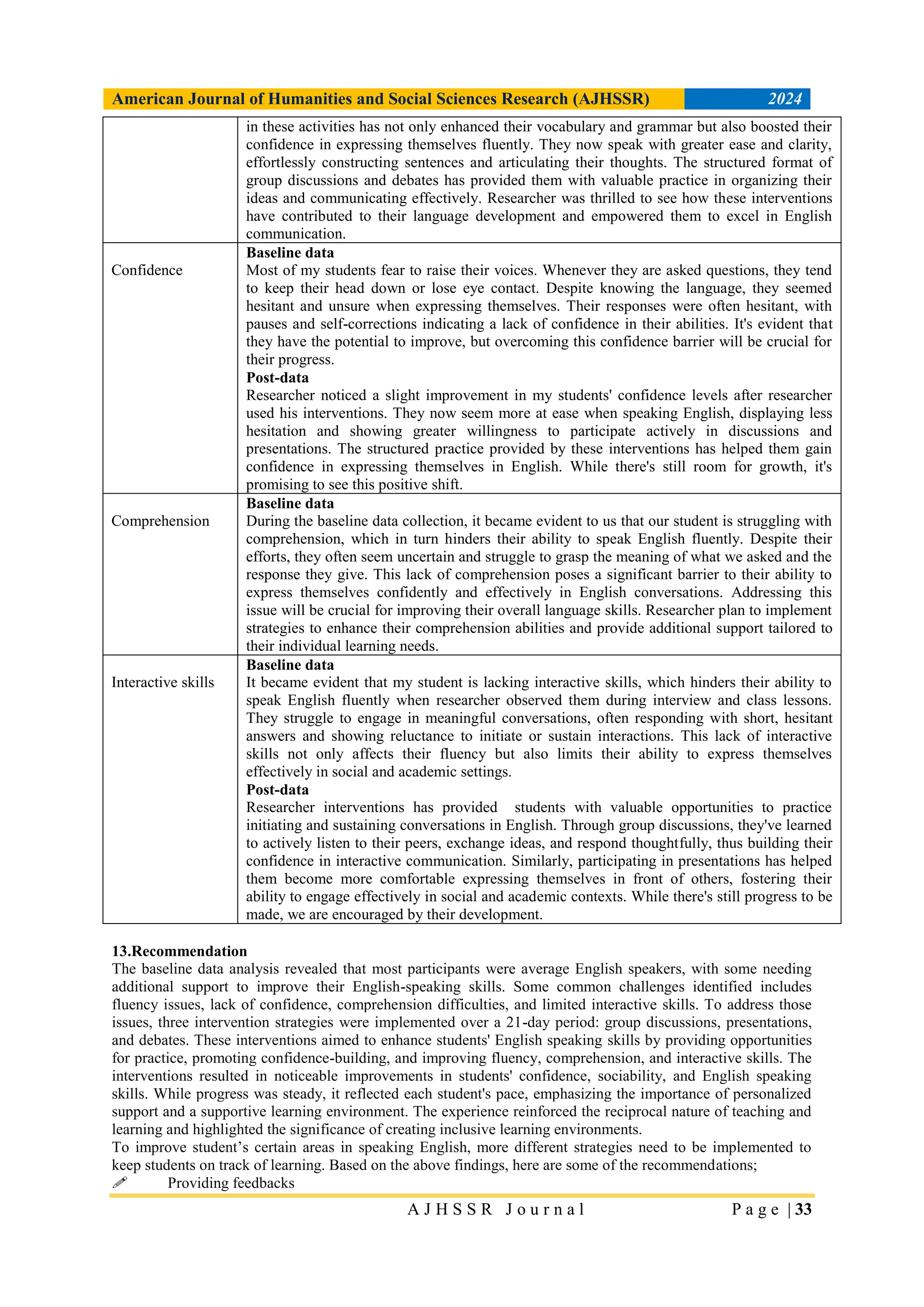
1.2 Comparative Analysis
Indicators Analysis
Fluency
Baseline Data
While collecting the baseline data, researcher identified four common problems that they
faced. One of the problems is fluency. It was observed that the participants had difficulty in
fluency while speaking English. As the interviews progressed, we noticed their hesitation, the
awkward pauses punctuating their sentences, and the occasional stumble over words. Some
clutched their hands tightly, others fidgeted in their seats which are all the signs of the
nervousness hindering their fluency. The language they speak, their learning pace, emotional
factors and the educational support are seen as some of the factors hindering their fluency.
Post- data
With implementing the three different strategies namely group discussions, presentations and
debates, researcher could see improvement in student‟s speaking skills in English. Engaging
American Journal of Humanities and Social Sciences Research (AJHSSR) 2024
A J H S S R J o u r n a l P a g e | 33
in these activities has not only enhanced their vocabulary and grammar but also boosted their
confidence in expressing themselves fluently. They now speak with greater ease and clarity,
effortlessly constructing sentences and articulating their thoughts. The structured format of
group discussions and debates has provided them with valuable practice in organizing their
ideas and communicating effectively. Researcher was thrilled to see how these interventions
have contributed to their language development and empowered them to excel in English
communication.
Confidence
Baseline data
Most of my students fear to raise their voices. Whenever they are asked questions, they tend
to keep their head down or lose eye contact. Despite knowing the language, they seemed
hesitant and unsure when expressing themselves. Their responses were often hesitant, with
pauses and self-corrections indicating a lack of confidence in their abilities. It's evident that
they have the potential to improve, but overcoming this confidence barrier will be crucial for
their progress.
Post-data
Researcher noticed a slight improvement in my students' confidence levels after researcher
used his interventions. They now seem more at ease when speaking English, displaying less
hesitation and showing greater willingness to participate actively in discussions and
presentations. The structured practice provided by these interventions has helped them gain
confidence in expressing themselves in English. While there's still room for growth, it's
promising to see this positive shift.
Comprehension
Baseline data
During the baseline data collection, it became evident to us that our student is struggling with
comprehension, which in turn hinders their ability to speak English fluently. Despite their
efforts, they often seem uncertain and struggle to grasp the meaning of what we asked and the
response they give. This lack of comprehension poses a significant barrier to their ability to
express themselves confidently and effectively in English conversations. Addressing this
issue will be crucial for improving their overall language skills. Researcher plan to implement
strategies to enhance their comprehension abilities and provide additional support tailored to
their individual learning needs.
Interactive skills
Baseline data
It became evident that my student is lacking interactive skills, which hinders their ability to
speak English fluently when researcher observed them during interview and class lessons.
They struggle to engage in meaningful conversations, often responding with short, hesitant
answers and showing reluctance to initiate or sustain interactions. This lack of interactive
skills not only affects their fluency but also limits their ability to express themselves
effectively in social and academic settings.
Post-data
Researcher interventions has provided students with valuable opportunities to practice
initiating and sustaining conversations in English. Through group discussions, they've learned
to actively listen to their peers, exchange ideas, and respond thoughtfully, thus building their
confidence in interactive communication. Similarly, participating in presentations has helped
them become more comfortable expressing themselves in front of others, fostering their
ability to engage effectively in social and academic contexts. While there's still progress to be
made, we are encouraged by their development.
13.Recommendation
The baseline data analysis revealed that most participants were average English speakers, with some needing
additional support to improve their English-speaking skills. Some common challenges identified includes
fluency issues, lack of confidence, comprehension difficulties, and limited interactive skills. To address those
issues, three intervention strategies were implemented over a 21-day period: group discussions, presentations,
and debates. These interventions aimed to enhance students' English speaking skills by providing opportunities
for practice, promoting confidence-building, and improving fluency, comprehension, and interactive skills. The
interventions resulted in noticeable improvements in students' confidence, sociability, and English speaking
skills. While progress was steady, it reflected each student's pace, emphasizing the importance of personalized
support and a supportive learning environment. The experience reinforced the reciprocal nature of teaching and
learning and highlighted the significance of creating inclusive learning environments.
To improve student‟s certain areas in speaking English, more different strategies need to be implemented to
keep students on track of learning. Based on the above findings, here are some of the recommendations;
 Providing feedbacks
American Journal of Humanities and Social Sciences Research (AJHSSR) 2024
A J H S S R J o u r n a l P a g e | 34
Offer regular feedback to students on their speaking performance to help them identify areas for improvement
and track their progress over time. Encourage a growth mindset by emphasizing effort, persistence, and gradual
improvement rather than focusing solely on outcomes. Positive and constructive feedback reinforces students'
confidence and motivation to continue developing their English-speaking skills.
 Incorporating multi-sensory learning
Explore incorporating multi-sensory learning experiences to engage students and enhance retention of
language skills. Utilize visual aids, auditory resources, tactile materials, and kinesthetic activities to appeal to
diverse learning modalities and reinforce language concepts in meaningful ways.
 Promote self-directed learning
Empower students to take ownership of their language learning journey by encouraging self-directed practice
and exploration. Provide resources, tools, and guidance for independent study, such as online language
learning platforms, language exchange programs, and self-assessment tools. Encourage students to set personal
goals, track their progress, and reflect on their learning experiences.
 Cultivate cultural awareness
Integrate cultural awareness and global perspectives into language learning activities to foster intercultural
competence and sensitivity. Explore diverse cultural topics, traditions, and perspectives related to English-
speaking countries to broaden students' understanding and appreciation of cultural diversity
14. Limitations of the study
1.1 Participant selection: Engaging students in the research process is essential for understanding their
English speaking skills and designing effective interventions. However, students' availability and commitment
to participate in research activities may vary. All of them are committed to participate but it was difficult to
select my 12 participants out of 28 as researcher need participants who have different level of speaking and it
was difficult for me to choose.
1.2 Time constraints:Researcher found that time is always a precious commodity. Balancing the demands
of lesson planning, teaching, and administrative duties with the iterative nature of action research is challenging.
Each cycle of planning, implementing interventions, observing student progress, and reflecting on outcomes
requires dedicated time, which competes with other pressing responsibilities. Additionally, the academic
calendar and scheduling constraints within the school limits the duration and frequency of research cycles,
impacting the depth and breadth of data collection and analysis.
15. Conclusion
This study focused on enhancing students' English-speaking skills. A thorough comparative analysis highlighted
prevalent challenges such as fluency issues, lack of confidence, comprehension difficulties, and limited
interactive skills. These findings underscored the need for targeted interventions to address these barriers
effectively. Through the implementation of structured interventions including group discussions, presentations,
and debates, significant improvements were observed across various aspects of language proficiency. Students
demonstrated enhanced fluency, confidence, comprehension abilities, and improved interactive skills, reflecting
the efficacy of the interventions deployed.
However, the study encountered limitations in participant selection and time constraints inherent in the teaching
role, impacting the depth of data collection and analysis. Moving forward, recommendations have been outlined
to further bolster students' English-speaking skills, emphasizing the importance of providing regular feedback,
incorporating multi-sensory learning experiences, promoting self-directed learning, and cultivating cultural
awareness. These strategies aim to create inclusive learning environments conducive to continuous
improvement, empowering students to navigate linguistic barriers with confidence and excel in diverse social
and academic settings.
REFERENCE
[1] Bolderston, A. (2012). Conducting a research interview. Journal of Medical Imaging and Radiation
Sciences, 43(1), 66-76. https://doi.org/10.1016/j.jmir.2011.12.002
[2] Doff, A. (1998). An analysis of factors influencing learner‟s English speaking skill. International
Journal of Research in English Education.
[3] Doe, J. (2019). The impact of media exposure on language acquisition among urban youth. Journal of
Language and Culture, 12(3), 45-56.
[4] Fitriani, D. A., Putra, R. K., &Nurjayanti, F. (2015). A study on students' English speaking problems in
speaking performance. The Equatorial Education and Learning Journal (JPPK, 4(9).
American Journal of Humanities and Social Sciences Research (AJHSSR) 2024
A J H S S R J o u r n a l P a g e | 35
[5] Fitriani, D. A., Putra, R. K., &Nurjayanti, F. (2022). Teacher‟s challenges in teaching online English to
young learners: A case study in the pandemic era. JurnalBasicedu, 6(4), 5533-5541.
https://doi.org/10.31004/basicedu.v6i4.3909
[6] Foster, L. (2023). The nuances of the word “Marica”: Essence lost in translation. Medium.
https://medium.com
[7] Gilbert, J. B. (1984). Clear speech: Pronunciation and listening comprehension in American English.
Cambridge University Press.
[8] International Journal of Science and Research (IJSR). (2018). Factors affecting student confidence in
English speaking classes. English Department, Faculty of Languages and Literature, Kabul University.
[9] IvyPanda. (2023, October 31). The lack of self-confidence to speak English in language learners:
Research paper example. IvyPanda. https://ivypanda.com
[10] Karma, S. J., Dorji, S., Genzang, & Thinley, S. (2014, June 1). Bhutanese students can‟t speak English
as expected: Study shows. BBSCL.
[11] Lado, R. (1950, January). Language learning: Survey of tests in English as a foreign language. 23(1-2),
51-66.
[12] Lapraire, M. (2019). English medium education in Bhutanese. DorjipenjorWordpress.
https://dorjipenjor.wordpress.com
[13] Lawtie, F. (2004). Teaching speaking skills: Overcoming classroom problems. TESL Journal.
[14] Lightbrown, P. M., & Spada, N. (2001). Motivation, its types and its impacts in language learning.
Universiti Sains Malaysia.
[15] Lodhi, M. A. (2019). Relationship of school environment and English language learning at government
schools. Public Administration Research.
[16] MacIntyre, P. D., & Gardner, R. C. (1991). Methods and results in the study of foreign language
anxiety. Language Learning, 41(1), 85-117. https://doi.org/10.1111/j.1467-1770.1991.tb00677.x
[17] Marica. (n.d.). Why you lack confidence in English: Explanations from brain science. Business English
with Christina. https://businessenglishwithchristina.com
[18] Sherig Saga. (2008). Profiles of our seats of learning. Center for Educational Research and
Development.
[19] Smith, A., & Johnson, L. (2020). Educational resources and their role in language proficiency in rural
areas. International Journal of Educational Studies, 18(2), 123-134.
[20] Susanto. (2007). Analyzing students' progress in English oral communication. Journal of English
Language Studies.
[21] Universidad Autónoma de Santo Domingo. (2018). Environmental factors affecting the English
proficiency of students of EFL in the extracurricular courses at UASD. Santo Domingo, Rep. Dom.
[22] Williams, R. (2021). Building confidence in language learning: Strategies for rural classrooms.
Language Education Research, 5(4), 67-78.
APPENDICES
Appendix one; Interview Questions
a) Can you tell me about a memorable experience you've had with your family?
b) How comfortable do you feel speaking English in different situations, such as in class, with friends, or in
public?
c) What strategies do you use to improve your English speaking skills outside of class?
d) Can you describe a time when you had difficulty understanding someone speaking English? How did you
handle the situation?
e) How do you typically prepare for English presentations or speaking activities?
f) Can you share an example of a conversation you had in English recently? What was it about, and how
did it go?
g) Have you ever participated in a debate or discussion in English? What was the experience like for you?
h) How do you feel about receiving feedback on your English speaking skills? Do you find it helpful?
i) What specific areas of English speaking do you feel you need to work on or improve? How do you plan
to address these areas?

Exploring the English-speaking Skills of Grade 5 Learners

  • 1.
    American Journal ofHumanities and Social Sciences Research (AJHSSR) 2024 A J H S S R J o u r n a l P a g e | 24 American Journal of Humanities and Social Sciences Research (AJHSSR) e-ISSN :2378-703X Volume-08, Issue-11, pp-24-35 www.ajhssr.com Research Paper Open Access Exploring the English-speaking Skills of Grade 5 Learners Yeshi Jamtsho 1 (Department of School Education (MoESD) / Rameychen Primary School, Wangduephodrang, Bhutan) Corresponding author:Yeshi Jamtsho ABSTRACT : Bhutan, a multicultural nation with English as one of its official languages, faces significant challenges in promoting effective English language skills. This research focuses on the major issues related to English speaking in classrooms, with a particular emphasis on the participation of students in Class V of Rameychen Primary School. The study aims to explore and analyze the challenges these students face in developing their English-speaking abilities and to investigate the role of teachers in addressing these issues. The study will be conducted within a classroom setting to observe, document, and analyze the challenges faced by students in their English speaking abilities. The research will include both students and teachers as participants, providing a comprehensive understanding of the issues from multiple perspectives. Active and passive participant observation methods will be used to gather data. Active participation involves engaging with students to better understand their difficulties, while passive participant observation will focus on unobtrusively collecting data on classroom interactions. The primary objective of the research is to identify the specific problems hindering students' English-speaking abilities in the classroom. These challenges may include issues such as a lack of fluency, pronunciation difficulties, and barriers related to confidence. The study will also seek to explore the teaching techniques utilized by educators to address these challenges, shedding light on the effectiveness of various pedagogical approaches. The significance of this research lies in the urgent need to improve English-speaking skills among students, particularly given the global importance of English as a medium of communication. English proficiency plays a crucial role in students' educational outcomes and future opportunities, both within Bhutan and in the wider global context. By identifying and addressing the issues related to English-speaking skills, this study aims to contribute to the ongoing efforts to enhance language proficiency in classrooms. This improvement is crucial for preparing students for success in an increasingly interconnected and competitive world. KEYWORDS :improve, factors, Speaking, strategies,. I. INTRODUCTION In Bhutan, the mode of communication to transmit information and knowledge is Dzongkha. However, the subjects taught in the schools are all in English except for one or two subjects. English‟s complicated grammar and vast vocabulary becomes a linguistic challenge for Bhutanese students. Moreover, Dzongkha being the national language, all the students are bound to learn that, which poses a hindrance in speaking English. English can be challenging for many Bhutanese students particularly to the primary students due to differences in grammar, vocabulary, and phonetics between English and their native language. Additionally, limited exposure and practice outside of the classroom also hinder English language acquisition thus, leading to difficulties in understanding it. Cultural factors and the lack of real-world context for English can also contribute to difficulty in speaking English. Mother tongue domination among students, hesitation, poor reading habits, and many more leads to difficulty in speaking English for Bhutanese students. Thus, resulted in poor performance in all other subjects at the individual level, hampering the school‟s ranking and then poor standards nationally. Currently, many people opt to go for further studies but not all can secure the required rank in IELTS (International English Language Testing System) by international universities. Therefore, we would like to find out how we can change and improve the English speaking of our students. There is one finding by Dr. Mark Laprairie from his study on “English medium education in Bhutanese”, “despite studying English at all levels of education Bhutanese students do not gain the ability to speak English as expected”. In this action research, I aim to investigate the English-speaking habits of my students, focusing on key factors that hinder their ability to communicate effectively in English. These factors include lack of confidence, motivation, the classroom setting, and the language proficiency of the teacher. By examining how often my
  • 2.
    American Journal ofHumanities and Social Sciences Research (AJHSSR) 2024 A J H S S R J o u r n a l P a g e | 25 students speak English, their levels of confidence, and the challenges they face, I hope to identify areas where additional support is needed. I will also consider cultural norms, psychological barriers like fear of making mistakes, and peer influence to better understand why students may hesitate to speak English. By analyzing these dimensions, I seek to create a more supportive environment that encourages students to practice their English skills without fear or anxiety. Additionally, I will explore how my teaching methods and classroom settings contribute to or alleviate these challenges. Investigating the role of technology, peer collaboration, and real-life language application will offer me insights into effective strategies to enhance speaking practice. My goal is to identify approaches that foster a positive learning atmosphere, where students feel motivated and confident to speak English. Ultimately, I aim to implement solutions that empower my students, enabling them to improve their English-speaking proficiency, which in turn can support their academic and professional growth. II. THE AIM OF THE STUDY In this action research, researcher aim to investigate the English-speaking habits of grade 5 students, focusing on key factors that hinder their ability to communicate effectively in English. These factors include lack of confidence, motivation, the classroom setting, and the language proficiency of the teacher. By examining how often my students speak English, their levels of confidence, and the challenges they face, I hope to identify areas where additional support is needed. I will also consider cultural norms, psychological barriers like fear of making mistakes, and peer influence to better understand why students may hesitate to speak English. By analyzing these dimensions, I seek to create a more supportive environment that encourages students to practice their English skills without fear or anxiety. Additionally, researcher explore how my teaching methods and classroom settings contribute to or alleviate these challenges. Investigating the role of technology, peer collaboration, and real-life language application will offer me insights into effective strategies to enhance speaking practice. My goal is to identify approaches that foster a positive learning atmosphere, where students feel motivated and confident to speak English. Ultimately, researcher aim to implement solutions that empower my students, enabling them to improve their English- speaking proficiency, which in turn can support their academic and professional growth. III. RESEARCH QUESTION 1. How can I improve the English speaking of grade five children of Rameychen Primary School? Sub-questions 1.1 When do students speak English most of the time? 1.2What are the factors that contribute to their English-speaking habit? 1.3How to improve students' English-speaking skills? IV. SITUATIONAL ANALYSIS Rameychen Primary School, under Wangdue Dzongkhag, was established in the year 2002. It was one of oldest and first school in Phobjikha under Wangdue Dzongkhag. At present, there are about 205 students and 7 regular teachers,and 2 national contract teachers. Despite daily teaching hours, the school also organizes cultural programs such as dance competitions and literary activities such as morning speech, storytelling, debates, and poem recitation mainly to inculcate communication skills and to take interest in it. Conducting those activities directly or indirectly promotes the communication skills of the students. A situational analysis is essential for any action research project as it provides a comprehensive overview of the current situation and challenges that need to be addressed. In this case, a situational analysis for the action research on improving the English-speaking of our students would involve; 4.1Current Proficiency Level In the classroom where I teach, I often encounter students with varying levels of English proficiency. Some students struggle with basic vocabulary and grammar, making it challenging for them to fully participate in class activities and express themselves effectively. There are also students with average English proficiency who have a basic understanding of the language but may find more complex tasks challenging, such as advanced reading comprehension or expressing ideas fluently. On the other hand, some students demonstrate strong English proficiency, allowing them to actively engage in discussions, comprehend complex texts, and communicate effectively. The language proficiency of teachers is also an important factor contributing to Bhutanese students having difficulty speaking English as expected. According to Lado (1950) in contrastive analysis theory, “the difficulty in speaking English arises from the differences between English and the learner‟s native language”. This theory directly relates to the understanding of students having difficulty in speaking. As there is a wide difference between students‟ native language (Dzongkha) and English. Bhutanese students in their early education, lessons were delivered in Dzongkha though the subject demands it to be taught in English leading to the current situation where English speaking is a challenge for many students. In the classroom, when asked a
  • 3.
    American Journal ofHumanities and Social Sciences Research (AJHSSR) 2024 A J H S S R J o u r n a l P a g e | 26 question in English the respondent tend to answer that question in Dzongkha mainly because we are not used to speaking English and are hesitant. Additionally, unlike the olden day‟s students, most of students nowadays are seen as engrossed in technologies (online games, movies, etc…) rather than books. In turn, they lack the skills to speak and understand English. 4.2 Identifying factors that affects the development of English-speaking Most of the students lack confidence in themselves while speaking out their thoughts and opinions. If the students themselves do not believe that they can speak, it has become a big problem for them. As Lawtie (2004) states that speech difficulties can be affected by a person's emotional state, speech is often clearer when a person is feeling confident and relaxed, and this is the most important factor to consider when communicating with people who have speech difficulties. Therefore, finding a way out for solving speaking problems becomes very essential so that the student can speak English better. Students often get demotivated in the class while responding or raising their voice out in English because they are judged differently by their mates and teacher as well. Some teachers tend to laugh at the student‟s language usage such as accent, grammar, pronunciation and so on and some mock them by insulting their grades. This leads learners to zip their mouths in the class which then contributes to difficulty in speaking English. So the best way we can think of improving this situation is the teacher being a good reinforce rather than providing negative judgment. It is all about creating a positive learning environment by building healthy relationships among students and teachers. As a result, students will be able to express their thoughts even in the fragmented English language and by doing so they learn more and become better each day. 4.3 Language learning environment English speaking can be hampered by the classroom environment in several ways as speaking opportunities may be restricted in large classes. Students may be discouraged from speaking up because they are afraid of making mistakes. Additionally, if a classroom is lacking the necessary tools or technology students may not be exposed to real-world dialogues. All of these things have the potential to hinder one's ability to speak English. For the students, speaking English is a considerable obstacle as Dzongkha is the official language of Bhutan, while English is taught in school as a second language. Speaking English is difficult for the students due to various reasons like, fear of mistakes where students are afraid of committing mistakes while speaking or having language difficulties may find it difficult to talk. It is crucial to create a classroom setting where error is acceptable. Likewise, lack of motivation is another reason for Bhutanese students to face problems in speaking English. Students are more likely to be inactive in the class when they are not motivated to speak English. Moreover, classroom environments also impact the speaking of students in class which include the teachers instructional styles, class size and physical set up. 4.4 Stakeholder involvement It is not just language teachers but all teachers are models of good language. It is mostly found that other subject teachers lack English support in the classroom. They think it is the role of only English teachers to help students improve their English speaking. In the second or foreign language medium (English) all teachers are English teachers to some degree or another. Thus, all the teachers who teach subjects that were taught in the English language like mathematics and science should also focus on and support English teachers to help them improve students‟ English speaking skills. Meaning all the teachers teaching English medium subjects should try to deliver their lessons in English and try to interact with their students in English, so that students can get comfortable and fluent in speaking English. Some of the student‟s parents are educated where they can help their child learn and speak English better. However, some parents are illiterate and those parent‟s child finds it difficult as well as less space to learn and speak English. Thus, it is important as a teacher, to encourage and motivate students to read more English novels and readers to improve their English. V.LITERATURE REVIEW English proficiency may frequently be a significant problem in the classroom. Both teachers and students must be able to communicate effectively in English to transmit ideas, comprehend instructions, and participate in fruitful discussions. Susanto (2007) states that “English has become popular and one of the most important languages in the whole aspect of life to understand literature. The students should know about language usage, but they will be unable to use it if they do not practice in daily communication”. Therefore, English is the most important thing to be learned and practiced for speaking in daily communication. The whole world has become a global village and people communicate with each other in a common language that is English. Its sources and information are widely available around the world like books, academic papers, websites, and learning resources that give access to different kinds of information. Possession of high English proficiency skills allows students to successfully pass IELTS and having an IELTS certificate opens the door to more than 9,000 universities, businesses, professional organizations, and government agencies in more than 140 countries, including the UK, USA, Australia, Canada, New Zealand and many more (Green,2019). Being a good English speaker holds a wide variety of opportunities to participate in global activities promoting self-
  • 4.
    American Journal ofHumanities and Social Sciences Research (AJHSSR) 2024 A J H S S R J o u r n a l P a g e | 27 expression to the world. However, there are several factors like lack of confidence, motivation, and classroom environment which lead to difficulty in speaking English. Having low self-esteem and confidence hinders the student‟s English speaking. They may have an unbalanced view of themselves and doubt their abilities in speaking English. The students who perform badly and do not participate in class discussions in speaking classes seem to have low English background knowledge and experience in the field. Every skill and aspect of language knowledge may lead them to have low confidence in speaking English and participating in class. The lack of confidence to speak in the English language can be a serious issue for many students. Students who do not feel comfortable expressing themselves in English and tend to withdraw from communication may demonstrate a decrease and the learning progress, as well as lack necessary interpersonal interaction (Fitriani et al.). From this perspective, teachers should pay more attention to students who lack confidence to speak English and have low self-esteem. In order to develop English speaking skills, students should always try to express their thoughts, feelings and emotions by communicating in English. Research suggests that students who are comfortable communicating with their friends and teachers in English tend to improve language skills faster than those learners who only focus on reading and writing (Lyron, 2023). Another issue can be psychological processes underlying the lack of self-confidence to speak English. Typically, most English learners experience problems when starting to speak English, primarily due to lack of confidence, experience and assurance in their grammar and pronunciation skills (Hobson). One of the ways to develop English speaking skills is listening skills. Listening skill is an important element in improving the confidence of students in speaking classes. Gilbert (1984) believed that listening skill and pronunciation are interdependent. Doff (1998) also approved that learners cannot improve their speaking unless they develop their listening skill. He believed that if students do not have good listening skills and are not able to grasp what others are saying, they will have no confidence to say something in response. So in turn they won‟t be able to express what they are thinking and that habit will lead them to lower their confidence. Student‟s confidence in English speaking classes is also influenced by affective factors such as anxiety and self- restriction. Anxiety is about the fear of being wrong or unhelpful, where students lose their words or stop saying something. According to MacIntyre&Gardne (1991), anxiety is of two types namely situational and trait. They define situational anxiety as one caused by a new or different situation, on the other hand, trait anxiety is a result of a speaker‟s personal feelings that are not related to the situation. As students feel worried that they will be criticized or they will lose face if they commit an error while speaking. Therefore, despite having a lot of knowledge about the topic of discussion, the students make a lot of mistakes in the sentences they speak or they choose not to participate in class activities. Wang (2014) states that self-restriction is an opinion that the students think they will lose face if they speak wrong. As a result, the students are afraid to speak in class. By not actively participating and practicing their English skills, they miss out on valuable opportunities to improve and gain their confidence in speaking English. Encouraging students to go beyond their comfort zone and creating a supportive environment can do wonders for confidence in speaking English. When they feel safe and supported, they are more likely to take risks, practice speaking, and make mistakes without fear of judgment. This process of stepping out of their comfort zone like participating in class discussion, volunteering to speak in front of others, actively engaging with English-speaking activities and engaging in language exchange programs helps them gain valuable experience and gradually build their language proficiency. It‟s all about creating a positive and nurturing atmosphere that fosters growth and confidence. English tutors can use a variety of techniques and strategies to improve learners‟ self-assurance. Teachers should consider enhancing students‟ motivation and self-image, eliminating the psychological barriers to speaking in English. It is suggested that “going from an unconfident speaker to a confident speaker often involves changing your mindset” (Hobson para.4). Tutors should encourage free talk and interest learners in expressing themselves by suggesting familiar conversation and asking questions. The term “motivation” is simply understood as something that encourages people to act. A definition extracted from Cambridge dictionary mentions that as a reason or reasons for acting or behaving in a particular way, a desire or willingness to do something. In the field of language speaking, motivation in foreign language speaking has been defined in different ways. Lightbrown and Spada (2001) identify motivation in second language acquisition as a complex phenomenon which can be defined in terms of two factors: learners' communicative needs and their attitudes towards the second language community. For example, when learners think that they need to speak the second language with the aim of being in touch with others or accomplishing and achieving specialized desires and goals, they will be motivated to obtain expertise and skills in speaking second language that is English. Rost (2006) states that there are two levels of motivation in language learning. First level is finding your passion. All successful learning is somehow connected to a learner‟s passion. The second level is changing the learner's reality. In every language learning setting, learners cannot make sufficient
  • 5.
    American Journal ofHumanities and Social Sciences Research (AJHSSR) 2024 A J H S S R J o u r n a l P a g e | 28 progress in the second language because they do not receive enough instruction, not nearly enough attention in class, not nearly enough input or meaningful interaction or opportunities for serious output. Ericksen (1978) sees that students‟ motivation to keep learning English in school can highly depend on the teacher‟s ability to maintain the initial interest that brought the students into the English classroom. In this context, a major importance can be attributed to the teacher‟s qualification in the area of English teaching. Teachers need to know and implement teaching techniques and strategies that promote effective learning at the level subject matter with materials that are relevant to students‟ lives and which challenge their knowledge. In addition teachers should give feedback at the end of the speaking activities. A lot of learners expect their teachers to give them the necessary feedback on their speaking performance. According to Harmer (1991), if instructors directly correct their students‟ problems, the flow of the dialogue and the aim of the speaking task will be spoiled. On the other hand, if learners are always corrected, they will be demotivated and afraid of speaking. It has been suggested that instructors should always correct their learners' mistakes positively and give them more supportive and persuasive feedback while speaking. Despite the fact that learning grammar and language structure is significant, they are not sufficient to acquire the second or foreign language since many students have several problems using it with the others. He adds that most of the learners in the world are trying to learn English in order to speak that global language either through the internet or while traveling: many of those learners are academically acquiring the language (Bakhtin 2005). According to William (2022) he mentions that “learning environments are places where people learn. They include physical spaces such as classrooms, schools, or workplace” It covers things like how the seats are arranged, the temperature in the classroom and decoration. The comfort, engagement, and learning result of students can all be strongly impacted by these variables. Teachers plan their classroom environment to promote successful teaching and learning and moreover a healthy classroom atmosphere promotes engagement, teamwork, and a feeling of safety for students to express themselves which is essential for effective learning. In the study of Lodhi, et.al (2019) he states that students learn more when a suitable social environment is provided to them in school and the learning environment is directly proportional to the language achievement of the learner. Moreover, a better school environment not only improves their learning but also helps in lessening the drop out of the students. Classroom environment is so effective in making students take part in speaking class activities and classroom settings like class size, seat arrangement affect the motivation of students where if the class size is small there will be more attention to each student and students will be involved in more activities which will motivate the students to learn better and with supportive and conducive learning environment inspire students to be more confident and interested in speaking. Moreover, a positive learning environment will help the students to feel a sense of belonging, trust each other, and are encouraged to face challenges, take risks, and ask questions. So it is necessary that the classroom should be properly designed with proper air and lighting conditions and the room should be airy and comfortable so that students can learn more effectively. Another thing is the occurrence of the students‟ problem in learning English as seen from their poor performance in English. Some of the factors contributing to poor English speaking performance are lack of vocabulary and grammar. It is a widespread notion that vocabulary is one of the key concepts in speaking. Various researchers have discussed that having limited vocabulary becomes one of the students‟ factors in speaking English. Learners of English as foreign language find difficulty to speak English because of a lack of vocabulary Muchemwa (2015); Hasan, (2016); Songbatumis (2017); Haryanto, et al, (2017) And the limited vocabulary is all due to poor reading habits of an individual students as they will be rich in vocabulary only if they are a good reader so that Besides, grammar also takes an important part in speaking English. Study done by Haryanto, et al (2017) presents a student's problem in speaking skills related to grammar where students face difficulty in arranging the words into sentences when talking with teachers and even with their classmates. To overcome those matters, there should be proper classroom rules and daily routines for students to keep them engaged in the English speaking activities like letting students share morning messages daily. Moreover, creating a positive and conducive learning environment will help students feel safe and comfortable to raise their thoughts and opinions anytime. VI.SUMMARY One of the primary factors affecting English-speaking proficiency among rural students compared to their urban counterparts is access to educational resources. Urban areas typically boast better educational infrastructure, including well-trained teachers, modern teaching materials, and technologically equipped classrooms. This environment fosters an engaging learning atmosphere that encourages students to participate actively. In contrast, rural schools often face significant challenges such as teacher shortages, outdated textbooks, and limited access to language learning technologies. The lack of adequate resources in rural schools can lead to a subpar English education, ultimately hindering students' speaking abilities. Additionally, extracurricular opportunities such as English clubs, workshops, and language immersion programs are often
  • 6.
    American Journal ofHumanities and Social Sciences Research (AJHSSR) 2024 A J H S S R J o u r n a l P a g e | 29 concentrated in urban settings, leaving rural students with fewer avenues to practice their English skills outside the classroom (Smith & Johnson, 2020). Exposure to the English language plays a critical role in developing speaking proficiency, and urban students generally enjoy greater access to various forms of English media and social interactions that enhance their language skills. Urban environments are rich in opportunities for students to engage with English through films, music, social media, and interactions with diverse peers. This consistent exposure helps urban students to develop their listening skills, vocabulary, and conversational abilities. Conversely, rural students may have limited access to English-language media and fewer opportunities to interact with fluent speakers, which can impede their language acquisition. Furthermore, the social fabric of urban life often encourages multilingual interactions, allowing students to practice their English in real-world contexts, while rural students might predominantly engage in their local language, leading to less practical experience with English (Doe, 2019). Psychological barriers significantly impact the willingness and ability of rural students to engage in English- speaking activities. Many rural students grapple with a lack of confidence in their English-speaking abilities, often stemming from fears of making mistakes or being judged by peers. The classroom environment can play a pivotal role in shaping these attitudes; if teachers and classmates are not supportive, students may be reluctant to participate in discussions or speak up in class. Moreover, cultural attitudes toward the importance of English in rural areas can influence students' motivation. In communities where local languages are prioritized, students may perceive English as less relevant, reducing their incentive to invest time and effort into mastering the language. Overcoming these psychological barriers requires fostering a supportive classroom culture that encourages risk-taking and celebrates progress, helping students embrace the power of self-expression in English (Williams, 2021). VII. METHODOLOGY A well-structured research methodology serves as the backbone of any successful study. It is the foundation that guides researchers in selecting the appropriate methods and tools for gathering and analyzing data. Research methods, including interviews, surveys, experiments, or case studies, are chosen based on the nature of the research question. Methodology, on the other hand, not only encompasses the selection of these methods but also provides the rationale behind them. It involves a critical evaluation of the chosen approach to ensure it aligns with the research objectives and will produce meaningful, unbiased results. A solid methodology helps prevent errors in data interpretation, ensuring the conclusions are robust and credible. In designing a methodology, the decision between qualitative, quantitative, or mixed methods is essential. Qualitative research focuses on understanding phenomena from a subjective and descriptive angle, using methods such as interviews or focus groups to gather in-depth insights. Quantitative research, in contrast, relies on numerical data and statistical analysis to explain relationships between variables. Mixed methods combine both to draw from the strengths of each. For this particular study, a qualitative approach is preferred, as it allows for deeper exploration of the research problem and provides nuanced insights into complex social or behavioral dynamics, which may not be fully captured through quantitative measures alone. VII.1 Study sample and participant The quality of a study stands not only by the appropriateness of methodology and instrumentation but also by the suitability of the sampling strategy that has been adopted by the researchers to carry out their study (Cohen et al., 2007). Therefore it is important for the researchers to define the population through proper sampling on which the researcher project will focus. A sample is a set of elements selected in some way from a population and the purpose of the sampling is to save time and effort, and also to obtain consistent and unbiased estimates of the population in research (Sapsford& Jupp, 2006). So in this research we will be using purposeful sampling where researchers intentionally select individuals and sites to learn or understand the central phenomenon. We will focus on upper primary students (class-V) and observe them while speaking in the class. For data collection we will take 12 students who are having different level of speaking English. This will help us in describing the extreme cases related to students having difficulties in speaking English. Purposeful sampling is chosen because it would be difficult to get accurate data if we are to observe all the students in school. So, if we select a particular grade and particular number of students to be observed we will be able to get accurate data. VII.2 Data collection techniques Data collection techniques are the methods used to collect and analyze different forms of data (Manawis, 2023). The data collection tools that will be used in our action research will be mainly the ones that will provide authentic and easy ways to get the required data on the topic. This action research requires qualitative methods of data collection that would fulfill all different aspects of research questions. So in this research I will employ participant observation for both the base-line data collection and post intervention data collection. VII.3 Participant Observation Observations play a crucial role in action research by providing firsthand insights into the classroom environment. It allows us to observe and document specific behaviors, interactions, and patterns related to
  • 7.
    American Journal ofHumanities and Social Sciences Research (AJHSSR) 2024 A J H S S R J o u r n a l P a g e | 30 English speaking. Among the various types of observations researcher will take on participant observation. Here, the researcher become an active participant in the classroom, immersing ourselves in the learning environment. By actively participating in the classroom, researcher can observe English speaking behaviors in real and unfiltered context, providing more authentic data. It also allows me with the contextual understanding where I understand the specific classroom dynamics, interactions and cultural influences that impact English speaking in the classroom.Participant observations is particularly useful in observing English speaking as the major issue in the classroom as it allows researchers to directly witness and understand the challenges students face in real-time. According to George (2023), participant observation is a flexible research method that can be adapted to fit a variety of research questions and contexts. Here, the level of participation in the group, the length of the observation period, and the types of data collected all can be adjusted based on research goals and timeline. Also it can be often used in combination with other research methods, such as surveys to provide a more complete picture of the phenomenon being studied. VII.4 Data Collection Tools A data collection tool is a tool used to gather and organize information from different sources. It helps in collecting and analyzing data for various purposes. For this research, two main data collection tools are used; interviews and anecdotal records. This data collection tool focuses on keeping observational track and written records. VII.5 Interview An interview is one of my tools to collect the data because researcher is working on improving the students' English-speaking skills. It is because the interviewees can express their viewpoints, in private, without a framework imposed by the researcher. Depending on the type of interview, the researcher can adapt the line of questioning to explore emerging topics – an approach that is not usually possible in survey research, for example (Bolderston, 2012). The interview is a unique technique as researcher can plan to ask questions at several levels to get the most information from the subject. The combination of structured and unstructured questions can provide depth and richness to the data. Interviews can be tape-recorded, of course with the permission of the interviewee. Using a tape recorder has the advantage that the interview report is more accurate than writing out notes. At the same time, it is also important to take notes during the interview, even if the interview is tape-recorded. As the interviewer, researcher can observe the responses of the subject. And if the questions are unclear they can be clarified immediately. VII.6Anecdotal record An anecdotal record is a way of documenting and recording a student's behavior, performance, or progress in the classroom. Researcher used this tool to record the individual's ability to speak English and their disability or the factor that hinders them in speaking English. Anecdotal record helps participant observation in providing detailed and specific information about observed behaviors and events. Arulselvi states that „among many observation tools, anecdotal record keeping is the best tool to observe students‟ progress in studies‟. Anecdotal records give cumulative information regarding progress, skills acquired by a student and directions for further instruction. The notes recorded about a student are brief, objective and focused on specific outcomes and notes taken during an activity or immediately after an activity are generally the most accurate. VIII. ETHICAL CONSIDERATIONS Research must be undertaken with clear ethical concerns. Ethical conduct needs to be mandatory in all disciplines of research for the protection of human rights in the process of the research study. So to ensure that my research is conducted ethically with informed consent and minimal harm, ethical considerations are crucial. To carry out my research I already had the permission from the District Education sector,Wangduephodrang. Researcher sought proper permission from the DEO‟s office for the conduct of the action research. Moreover, researcher also sought permission from the participants whenever researcher took pictures and record their voice or video. Another significant ethical consideration adopted in this research study is privacy and confidentiality. The privacy and confidentiality of the participants is to be preserved by not revealing their identities in the data collection, analysis and the research findings. So through all those processes of the ethical research code of conduct it can be said that researchers have respected the decision and rights of every participant. IX. BASELINE DATA COLLECTION 1.1 Data analysis Data analysis involves making sense out of text and image data (Creswell, 2003, p. 190). It involves making deeper and deeper into the understanding, representing and making an interpretation of the larger meaning of the data. Glesne (1999) points out that data analysis involves what you have seen, heard or read so that you can make sense of what you have learned (p. 130). It also involves a very intensive activity that requires insight, creativity, conceptual sensitivity and hard work. Researcher have analyzed the responses of all participants of this study via the interview and anecdotal records. Researcher came to consensus that most of identified
  • 8.
    American Journal ofHumanities and Social Sciences Research (AJHSSR) 2024 A J H S S R J o u r n a l P a g e | 31 participants were average English speaker neither very good nor very bad. However, there are some who needs every support to let them speak. Researcher felt the need to bring improvements in their English-speaking skills. X. IDENTIFICATION OF INDICATORS The following are the indicators identified during the interview and anecdotal recording with the participants and while analyzing baseline data. 1.1 Fluency When interviewing a student, researcher noticed that some struggle to maintain a smooth and continuous flow of speech. They pause frequently, repeat words or phrases, or struggle to find the right words to express their thoughts. This difficulty in fluency could be due to various factors such as nervousness, lack of confidence, or limited vocabulary. So as the interviewer, it is important to maintain a patient and supportive demeanor, providing encouragement and reassurance to help alleviate any anxiety the student may be experiencing. Additionally, researcher can also create a relaxed and non-judgmental atmosphere, where the student feels comfortable expressing themselves without fear of criticism. Providing opportunities for repeated practice, constructive feedback, and positive reinforcement can help students gradually build confidence in their speaking abilities and overcome speech impediments. 1.2 Confidence While assessing my students‟ English speaking skills, researcher noticed some students responding with low confidence. They speak softly, avoid eye contact, or hesitate frequently while expressing themselves. Researcher understand that low confidence can stem from various factors such as fear of making mistakes, lack of practice, or previous negative experiences. In response, researcher should adopt a supportive and encouraging approach, offering positive reinforcement and reassurance throughout the interview or observation. Researcher made sure to create a safe and non-judgmental environment where students feel comfortable expressing themselves without fear of criticism. It is also vital for us to provide gentle prompts and encouragement to help boost their confidence and gradually overcome their hesitations. 1.3 Comprehension As an interviewer and observer assessing my students' English-speaking abilities, researcher noticed that some students are struggling with comprehension. They appear confused or unsure when responding to questions, misunderstand prompts, or provide irrelevant answers. Researcher recognized that lack of comprehension can be attributed to various factors such as limited vocabulary, unfamiliarity with English language structures, or difficulty understanding accents. In response, we adjusted my approach by speaking slowly, using simpler language when necessary, and providing additional context or clarification as needed. Researcher can also encourage active listening and ask follow-up questions to gauge the extent of their understanding. Researcher need to be patient and supportive, offering guidance and feedback to help students improve their comprehension skills over time. 1.4Interactive skills The researcher noticed that some students are struggling with interaction skills. They find it challenging to engage in meaningful conversation, keeping quiet while asking questions or talking, exhibit limited turn-taking, or fail to actively listen to their peers. Researcher recognized that lack of interaction skills can stem from various factors such as shyness, social anxiety, or unfamiliarity with English communication norms. To overcome that, it is important for us to model effective communication strategies and provide feedback on active listening, asking open-ended questions, and building on others' contributions. It's essential to foster a supportive and inclusive learning environment where all students feel empowered to participate and contribute to discussions. XI. INTERVENTION 1.1Intervention strategies For the researcher participants to improve their English speaking skills there must be effective strategies identified. Identifying is not enough there should be an effort from both parties aiming at achieving the same goal. To develop the English speaking skills in the classroom we will provide students with more of group discussions. Moreover, researcher will incorporate speaking exercises such as presentations and debates. Researcher will be tying the above selected interventions on my participant under observation in the following ways: 1.1.1 Group Discussion This intervention involves organizing small group conversations among students on specific topics or prompts related to English language learning. Group discussions promote active participation, encourage students to express their thoughts and ideas, and provide opportunities for practicing speaking, listening, and critical thinking skills. Providing group discussions during the lesson helps them collaborate and speak more with their peers. In turn, they can improve their speaking skill. Making the English language the mandatory mode of
  • 9.
    American Journal ofHumanities and Social Sciences Research (AJHSSR) 2024 A J H S S R J o u r n a l P a g e | 32 communication when they are discussing could be one way to let them grab the chance to speak in English. Even while having the open discussion, encouraging them to use English could the helpful for them. 1.1.2 Presentation Presentation typically involves speaking in front of a group and engaging listeners through effective communication techniques. Here, a speaker delivers information or shares ideas with an audience using visual aids such as slides or props. The objective of this presentation is to help students develop their vocabulary, grammar, and fluency in speaking English while also building their self-assurance in using the language. Presentations require students to prepare and deliver speeches or talks on a particular topic in front of their classmates. This intervention enhances students' English speaking skills by requiring them to organize their thoughts, structure their speech effectively, and communicate their ideas clearly and coherently. Presentations also foster confidence in public speaking and help students receive constructive feedback from their peers. 1.1.3 Debate In debate, participants present arguments and counterarguments on a specific topic. They take turns speaking, presenting their viewpoints and engaging in a structured discussion. Students are assigned roles as either proponents or opponents and must present and defend their viewpoints using persuasive language and reasoning skills. Debates are effective in improving English speaking skills as they require students to think critically, articulate their arguments convincingly, and engage in respectful dialogue with their peers. 12. Reflections on interventions Implementing the three strategies for 21 days aimed at improving our students' English speaking skills has been a rewarding journey. Researcher has witnessed noticeable improvements in their confidence and sociability throughout the process. Learning was taking place, as students became more engaged and willing to participate in speaking activities. While the progress wasn't rapid, it was steady and reflective of each student's pace, which we found encouraging. Not only did my students benefit from the experience, but researcher also learned a great deal alongside them. This collaborative learning journey reinforced the reciprocal nature of teaching and learning. As an educator, it's gratifying to see the impact of effective strategies and to deepen our understanding of pedagogy through practical application. This experience has reaffirmed my commitment to fostering language development and creating meaningful learning opportunities for my students. Additionally, observing the growth in our students' confidence and sociability has highlighted the importance of creating a supportive and inclusive learning environment. By providing opportunities for active participation and meaningful engagement, researcher has seen firsthand how students thrive and develop their language skills. Reflecting on this journey, researcher inspired to continue refining teaching practices and exploring new approaches to better meet the diverse needs of my students. Each day presents an opportunity for growth and learning, and researcher eager to continue this journey of empowering my students to become confident and proficient English speakers. 1.1 Post-intervention data analysis Like in the baseline data collection, researcher used the same participants in collecting the post-data. Since their information should be confidential we didn‟t take them by grouping them into poor, average, and well-speaker but we took 12 participants as a whole. Researcher has collected the data through my chosen tools the interview and anecdotal record. With the use of the identified interventions, researcher could see the students getting more confident while speaking and interacting in English. More participants could speak without hesitation and pauses compared to before. Their speech flow was good as there were no disruptions and interruptions such as smiling, being silent, etc. which shows the interventions have enhanced their comprehension, interactive skills, and confidence. 1.2 Comparative Analysis Indicators Analysis Fluency Baseline Data While collecting the baseline data, researcher identified four common problems that they faced. One of the problems is fluency. It was observed that the participants had difficulty in fluency while speaking English. As the interviews progressed, we noticed their hesitation, the awkward pauses punctuating their sentences, and the occasional stumble over words. Some clutched their hands tightly, others fidgeted in their seats which are all the signs of the nervousness hindering their fluency. The language they speak, their learning pace, emotional factors and the educational support are seen as some of the factors hindering their fluency. Post- data With implementing the three different strategies namely group discussions, presentations and debates, researcher could see improvement in student‟s speaking skills in English. Engaging
  • 10.
    American Journal ofHumanities and Social Sciences Research (AJHSSR) 2024 A J H S S R J o u r n a l P a g e | 33 in these activities has not only enhanced their vocabulary and grammar but also boosted their confidence in expressing themselves fluently. They now speak with greater ease and clarity, effortlessly constructing sentences and articulating their thoughts. The structured format of group discussions and debates has provided them with valuable practice in organizing their ideas and communicating effectively. Researcher was thrilled to see how these interventions have contributed to their language development and empowered them to excel in English communication. Confidence Baseline data Most of my students fear to raise their voices. Whenever they are asked questions, they tend to keep their head down or lose eye contact. Despite knowing the language, they seemed hesitant and unsure when expressing themselves. Their responses were often hesitant, with pauses and self-corrections indicating a lack of confidence in their abilities. It's evident that they have the potential to improve, but overcoming this confidence barrier will be crucial for their progress. Post-data Researcher noticed a slight improvement in my students' confidence levels after researcher used his interventions. They now seem more at ease when speaking English, displaying less hesitation and showing greater willingness to participate actively in discussions and presentations. The structured practice provided by these interventions has helped them gain confidence in expressing themselves in English. While there's still room for growth, it's promising to see this positive shift. Comprehension Baseline data During the baseline data collection, it became evident to us that our student is struggling with comprehension, which in turn hinders their ability to speak English fluently. Despite their efforts, they often seem uncertain and struggle to grasp the meaning of what we asked and the response they give. This lack of comprehension poses a significant barrier to their ability to express themselves confidently and effectively in English conversations. Addressing this issue will be crucial for improving their overall language skills. Researcher plan to implement strategies to enhance their comprehension abilities and provide additional support tailored to their individual learning needs. Interactive skills Baseline data It became evident that my student is lacking interactive skills, which hinders their ability to speak English fluently when researcher observed them during interview and class lessons. They struggle to engage in meaningful conversations, often responding with short, hesitant answers and showing reluctance to initiate or sustain interactions. This lack of interactive skills not only affects their fluency but also limits their ability to express themselves effectively in social and academic settings. Post-data Researcher interventions has provided students with valuable opportunities to practice initiating and sustaining conversations in English. Through group discussions, they've learned to actively listen to their peers, exchange ideas, and respond thoughtfully, thus building their confidence in interactive communication. Similarly, participating in presentations has helped them become more comfortable expressing themselves in front of others, fostering their ability to engage effectively in social and academic contexts. While there's still progress to be made, we are encouraged by their development. 13.Recommendation The baseline data analysis revealed that most participants were average English speakers, with some needing additional support to improve their English-speaking skills. Some common challenges identified includes fluency issues, lack of confidence, comprehension difficulties, and limited interactive skills. To address those issues, three intervention strategies were implemented over a 21-day period: group discussions, presentations, and debates. These interventions aimed to enhance students' English speaking skills by providing opportunities for practice, promoting confidence-building, and improving fluency, comprehension, and interactive skills. The interventions resulted in noticeable improvements in students' confidence, sociability, and English speaking skills. While progress was steady, it reflected each student's pace, emphasizing the importance of personalized support and a supportive learning environment. The experience reinforced the reciprocal nature of teaching and learning and highlighted the significance of creating inclusive learning environments. To improve student‟s certain areas in speaking English, more different strategies need to be implemented to keep students on track of learning. Based on the above findings, here are some of the recommendations;  Providing feedbacks
  • 11.
    American Journal ofHumanities and Social Sciences Research (AJHSSR) 2024 A J H S S R J o u r n a l P a g e | 34 Offer regular feedback to students on their speaking performance to help them identify areas for improvement and track their progress over time. Encourage a growth mindset by emphasizing effort, persistence, and gradual improvement rather than focusing solely on outcomes. Positive and constructive feedback reinforces students' confidence and motivation to continue developing their English-speaking skills.  Incorporating multi-sensory learning Explore incorporating multi-sensory learning experiences to engage students and enhance retention of language skills. Utilize visual aids, auditory resources, tactile materials, and kinesthetic activities to appeal to diverse learning modalities and reinforce language concepts in meaningful ways.  Promote self-directed learning Empower students to take ownership of their language learning journey by encouraging self-directed practice and exploration. Provide resources, tools, and guidance for independent study, such as online language learning platforms, language exchange programs, and self-assessment tools. Encourage students to set personal goals, track their progress, and reflect on their learning experiences.  Cultivate cultural awareness Integrate cultural awareness and global perspectives into language learning activities to foster intercultural competence and sensitivity. Explore diverse cultural topics, traditions, and perspectives related to English- speaking countries to broaden students' understanding and appreciation of cultural diversity 14. Limitations of the study 1.1 Participant selection: Engaging students in the research process is essential for understanding their English speaking skills and designing effective interventions. However, students' availability and commitment to participate in research activities may vary. All of them are committed to participate but it was difficult to select my 12 participants out of 28 as researcher need participants who have different level of speaking and it was difficult for me to choose. 1.2 Time constraints:Researcher found that time is always a precious commodity. Balancing the demands of lesson planning, teaching, and administrative duties with the iterative nature of action research is challenging. Each cycle of planning, implementing interventions, observing student progress, and reflecting on outcomes requires dedicated time, which competes with other pressing responsibilities. Additionally, the academic calendar and scheduling constraints within the school limits the duration and frequency of research cycles, impacting the depth and breadth of data collection and analysis. 15. Conclusion This study focused on enhancing students' English-speaking skills. A thorough comparative analysis highlighted prevalent challenges such as fluency issues, lack of confidence, comprehension difficulties, and limited interactive skills. These findings underscored the need for targeted interventions to address these barriers effectively. Through the implementation of structured interventions including group discussions, presentations, and debates, significant improvements were observed across various aspects of language proficiency. Students demonstrated enhanced fluency, confidence, comprehension abilities, and improved interactive skills, reflecting the efficacy of the interventions deployed. However, the study encountered limitations in participant selection and time constraints inherent in the teaching role, impacting the depth of data collection and analysis. Moving forward, recommendations have been outlined to further bolster students' English-speaking skills, emphasizing the importance of providing regular feedback, incorporating multi-sensory learning experiences, promoting self-directed learning, and cultivating cultural awareness. These strategies aim to create inclusive learning environments conducive to continuous improvement, empowering students to navigate linguistic barriers with confidence and excel in diverse social and academic settings. REFERENCE [1] Bolderston, A. (2012). Conducting a research interview. Journal of Medical Imaging and Radiation Sciences, 43(1), 66-76. https://doi.org/10.1016/j.jmir.2011.12.002 [2] Doff, A. (1998). An analysis of factors influencing learner‟s English speaking skill. International Journal of Research in English Education. [3] Doe, J. (2019). The impact of media exposure on language acquisition among urban youth. Journal of Language and Culture, 12(3), 45-56. [4] Fitriani, D. A., Putra, R. K., &Nurjayanti, F. (2015). A study on students' English speaking problems in speaking performance. The Equatorial Education and Learning Journal (JPPK, 4(9).
  • 12.
    American Journal ofHumanities and Social Sciences Research (AJHSSR) 2024 A J H S S R J o u r n a l P a g e | 35 [5] Fitriani, D. A., Putra, R. K., &Nurjayanti, F. (2022). Teacher‟s challenges in teaching online English to young learners: A case study in the pandemic era. JurnalBasicedu, 6(4), 5533-5541. https://doi.org/10.31004/basicedu.v6i4.3909 [6] Foster, L. (2023). The nuances of the word “Marica”: Essence lost in translation. Medium. https://medium.com [7] Gilbert, J. B. (1984). Clear speech: Pronunciation and listening comprehension in American English. Cambridge University Press. [8] International Journal of Science and Research (IJSR). (2018). Factors affecting student confidence in English speaking classes. English Department, Faculty of Languages and Literature, Kabul University. [9] IvyPanda. (2023, October 31). The lack of self-confidence to speak English in language learners: Research paper example. IvyPanda. https://ivypanda.com [10] Karma, S. J., Dorji, S., Genzang, & Thinley, S. (2014, June 1). Bhutanese students can‟t speak English as expected: Study shows. BBSCL. [11] Lado, R. (1950, January). Language learning: Survey of tests in English as a foreign language. 23(1-2), 51-66. [12] Lapraire, M. (2019). English medium education in Bhutanese. DorjipenjorWordpress. https://dorjipenjor.wordpress.com [13] Lawtie, F. (2004). Teaching speaking skills: Overcoming classroom problems. TESL Journal. [14] Lightbrown, P. M., & Spada, N. (2001). Motivation, its types and its impacts in language learning. Universiti Sains Malaysia. [15] Lodhi, M. A. (2019). Relationship of school environment and English language learning at government schools. Public Administration Research. [16] MacIntyre, P. D., & Gardner, R. C. (1991). Methods and results in the study of foreign language anxiety. Language Learning, 41(1), 85-117. https://doi.org/10.1111/j.1467-1770.1991.tb00677.x [17] Marica. (n.d.). Why you lack confidence in English: Explanations from brain science. Business English with Christina. https://businessenglishwithchristina.com [18] Sherig Saga. (2008). Profiles of our seats of learning. Center for Educational Research and Development. [19] Smith, A., & Johnson, L. (2020). Educational resources and their role in language proficiency in rural areas. International Journal of Educational Studies, 18(2), 123-134. [20] Susanto. (2007). Analyzing students' progress in English oral communication. Journal of English Language Studies. [21] Universidad Autónoma de Santo Domingo. (2018). Environmental factors affecting the English proficiency of students of EFL in the extracurricular courses at UASD. Santo Domingo, Rep. Dom. [22] Williams, R. (2021). Building confidence in language learning: Strategies for rural classrooms. Language Education Research, 5(4), 67-78. APPENDICES Appendix one; Interview Questions a) Can you tell me about a memorable experience you've had with your family? b) How comfortable do you feel speaking English in different situations, such as in class, with friends, or in public? c) What strategies do you use to improve your English speaking skills outside of class? d) Can you describe a time when you had difficulty understanding someone speaking English? How did you handle the situation? e) How do you typically prepare for English presentations or speaking activities? f) Can you share an example of a conversation you had in English recently? What was it about, and how did it go? g) Have you ever participated in a debate or discussion in English? What was the experience like for you? h) How do you feel about receiving feedback on your English speaking skills? Do you find it helpful? i) What specific areas of English speaking do you feel you need to work on or improve? How do you plan to address these areas?