
Quick Representation and
Narrative Revision – Section 1b
REPRESENTATION
David Gauntlett
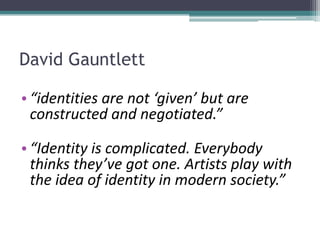
• “identities are not ‘given’ but are
constructed and negotiated.”
• “Identity is complicated. Everybody
thinks they’ve got one. Artists play with
the idea of identity in modern society.”
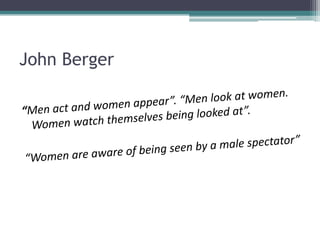
John Berger
Julian McDougall
• ‘In a media saturated world, the
distinction between reality and media
representations becomes blurred or
invisible to us.’
Jib Fowles
Paul Messaris
• “female models addressed
to women....appear to
imply a male point of
view”.
NARRATIVE
Edward Branigan
Kruger, Rayner and Wall
“narrative is an important source
of reassurance in a hostile
universe.”
Some narrative techniques
• Enigma – a puzzle, a narrative technique designed to
intrigue the viewer and encourage them to watch further.
• Retardation – Holding back key information from the
audience so they are unsure what is happening and likely to
watch further to find out.
• Ellipsis - a basic narrative technique used in classical
continuity editing which sees time compressed in order for
the narrative to progress more quickly (editing out the boring
bits!)
• Twist – an unexpected turn of events designed to shock the
audience.
Classic Hollywood Narrative
• This is a typical Hollywood narrative
structure, whereby the story is driven by the
protagonist (main character) and there is a
strong sense of closure: all enigmas that are
raised are resolved at the end. You need to be
aware of this traditional structure so you can
comment when a film does not do this, e.g. it
leaves some loose ends or leaves the audience in
suspense. Examples are The Italian Job or
Lock, Stock and Two Smoking Barrels.
Causality
• This is the term given to the relationship
between two events. It is what makes a narrative.
For example, the king dying and then his wife
dying is not a narrative. There has to be some
kind of cause and effect. Therefore, the king
dying and the queen dying of grief is a narrative.
If you find this hard to remember, just try to
remember that narratives are made up of cause
and effect and you won’t go far wrong.

Quick representation and narrative revision

  • 1.
    Quick Representation and NarrativeRevision – Section 1b
  • 2.
  • 3.
    David Gauntlett • “identitiesare not ‘given’ but are constructed and negotiated.” • “Identity is complicated. Everybody thinks they’ve got one. Artists play with the idea of identity in modern society.”
  • 4.
  • 5.
    Julian McDougall • ‘Ina media saturated world, the distinction between reality and media representations becomes blurred or invisible to us.’
  • 6.
  • 7.
    Paul Messaris • “femalemodels addressed to women....appear to imply a male point of view”.
  • 8.
  • 9.
  • 10.
    Kruger, Rayner andWall “narrative is an important source of reassurance in a hostile universe.”
  • 11.
    Some narrative techniques •Enigma – a puzzle, a narrative technique designed to intrigue the viewer and encourage them to watch further. • Retardation – Holding back key information from the audience so they are unsure what is happening and likely to watch further to find out. • Ellipsis - a basic narrative technique used in classical continuity editing which sees time compressed in order for the narrative to progress more quickly (editing out the boring bits!) • Twist – an unexpected turn of events designed to shock the audience.
  • 12.
    Classic Hollywood Narrative •This is a typical Hollywood narrative structure, whereby the story is driven by the protagonist (main character) and there is a strong sense of closure: all enigmas that are raised are resolved at the end. You need to be aware of this traditional structure so you can comment when a film does not do this, e.g. it leaves some loose ends or leaves the audience in suspense. Examples are The Italian Job or Lock, Stock and Two Smoking Barrels.
  • 13.
    Causality • This isthe term given to the relationship between two events. It is what makes a narrative. For example, the king dying and then his wife dying is not a narrative. There has to be some kind of cause and effect. Therefore, the king dying and the queen dying of grief is a narrative. If you find this hard to remember, just try to remember that narratives are made up of cause and effect and you won’t go far wrong.