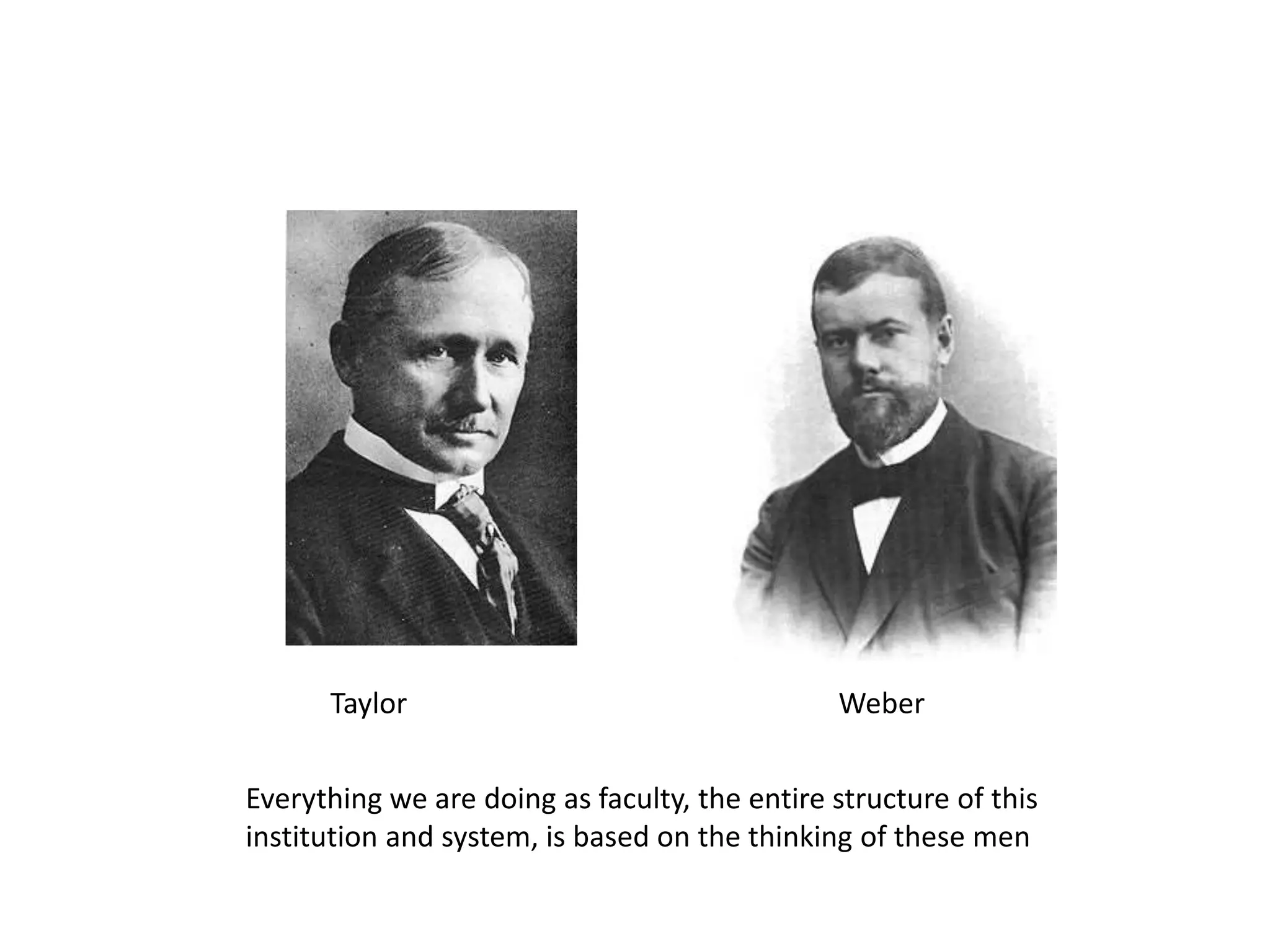
Taylor Weber
Everything we are doing as faculty, the entire structure of this
institution and system, is based on the thinking of these men
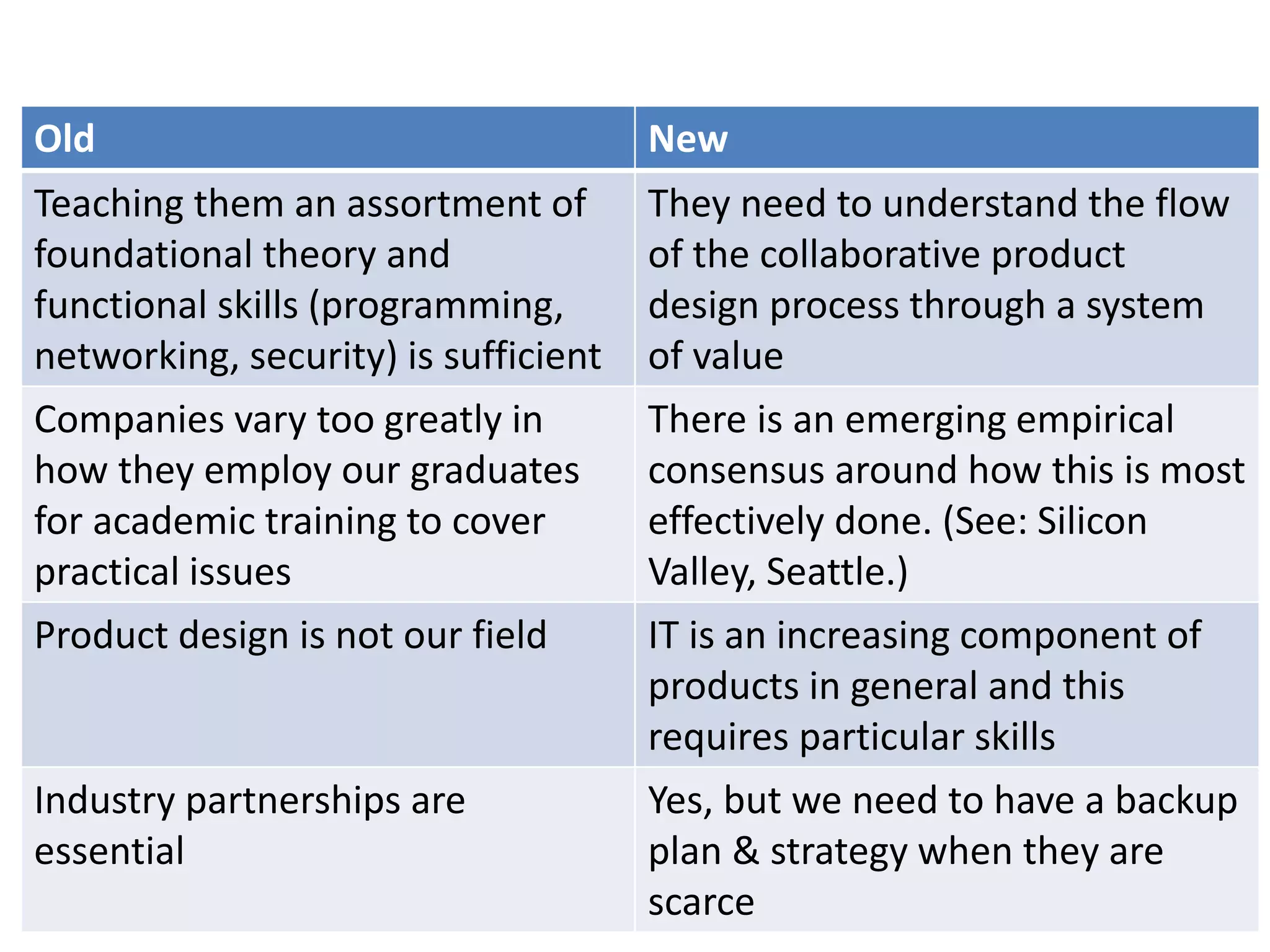
Old New
Teaching them an assortment of
foundational theory and
functional skills (programming,
networking, security) is sufficient
They need to understand the flow
of the collaborative product
design process through a system
of value
Companies vary too greatly in
how they employ our graduates
for academic training to cover
practical issues
There is an emerging empirical
consensus around how this is most
effectively done. (See: Silicon
Valley, Seattle.)
Product design is not our field IT is an increasing component of
products in general and this
requires particular skills
Industry partnerships are
essential
Yes, but we need to have a backup
plan & strategy when they are
scarce
Old New
Theory is relevant for core
computer science, but not
industry practice
There are relevant theories that
WE as educators should be
using to inform our pedagogy
Agile is a cultural and
generational phenomenon
Agile has sound empirical and
theoretical foundations
Technology is moving too
fast (and HOW on earth can
we keep up?)
There is a high value, stable
pedagogical core we can
identify
Engineering Design
What’s missing
Agile, Lean, Devops, Scrum, Kanban,
product & service design, collaboration,
flow, lean startup (test/learn/pivot),
automation, complex adaptive systems,
Cynefin, intersection of ops mgmt & IT,
Pitch: Agile study group
MN educators (MNSCU, ACTC, U of MN, etc)
A supported, formalized, time-boxed collaborative
effort to explore & develop these concepts for the
benefit of Minnesota high technology education
What does this mean? I don’t know. Can we talk?
Charlie’s 2 current projects:
- Calavera simulation (part of insanIT)
- 3rd edition of Architecture of IT Management
Theory Pedagogy Delivery
The starting books

Agile study group

  • 4.
    Taylor Weber Everything weare doing as faculty, the entire structure of this institution and system, is based on the thinking of these men
  • 5.
    Old New Teaching theman assortment of foundational theory and functional skills (programming, networking, security) is sufficient They need to understand the flow of the collaborative product design process through a system of value Companies vary too greatly in how they employ our graduates for academic training to cover practical issues There is an emerging empirical consensus around how this is most effectively done. (See: Silicon Valley, Seattle.) Product design is not our field IT is an increasing component of products in general and this requires particular skills Industry partnerships are essential Yes, but we need to have a backup plan & strategy when they are scarce
  • 6.
    Old New Theory isrelevant for core computer science, but not industry practice There are relevant theories that WE as educators should be using to inform our pedagogy Agile is a cultural and generational phenomenon Agile has sound empirical and theoretical foundations Technology is moving too fast (and HOW on earth can we keep up?) There is a high value, stable pedagogical core we can identify Engineering Design
  • 7.
    What’s missing Agile, Lean,Devops, Scrum, Kanban, product & service design, collaboration, flow, lean startup (test/learn/pivot), automation, complex adaptive systems, Cynefin, intersection of ops mgmt & IT,
  • 8.
    Pitch: Agile studygroup MN educators (MNSCU, ACTC, U of MN, etc) A supported, formalized, time-boxed collaborative effort to explore & develop these concepts for the benefit of Minnesota high technology education What does this mean? I don’t know. Can we talk? Charlie’s 2 current projects: - Calavera simulation (part of insanIT) - 3rd edition of Architecture of IT Management Theory Pedagogy Delivery
  • 9.