#ecommerceseo at #deepseocon by @aleyda from @orainti
7 E-Commerce SEO
Mistakes


… and how to Solve Them
#ecommerceseo at #deepseocon by @aleyda from @orainti
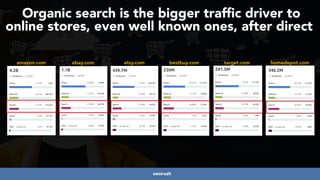
Organic search is the bigger traffic driver to
online stores, even well known ones, after direct
amazon.com ebay.com etsy.com bestbuy.com target.com homedepot.com
semrush
#ecommerceseo at #deepseocon by @aleyda from @orainti
The biggest e-
commerce platforms
acknowledge this
and have started to
provide more SEO
related
functionalities..
#ecommerceseo at #deepseocon by @aleyda from @orainti
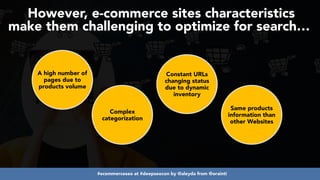
However, e-commerce sites characteristics


make them challenging to optimize for search…
A high number of
pages due to
products volume
Complex
categorization
Constant URLs
changing status
due to dynamic
inventory
Same products
information than
other Websites
#ecommerceseo at #deepseocon by @aleyda from @orainti
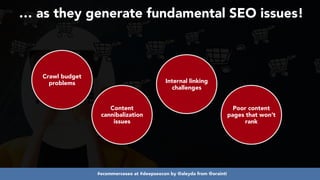
… as they generate fundamental SEO issues!


Crawl budget
problems
Content
cannibalization
issues
Internal linking
challenges
Poor content
pages that won’t
rank
#ecommerceseo at #deepseocon by @aleyda from @orainti
Online stores are
great to improve
your abilities to
tackle SEO issues at
scale to achieve
results
#ecommerceseo at #deepseocon by @aleyda from @orainti
Let’s see 7 common e-commerce
SEO errors & how to fix them
#ecommerceseo at #deepseocon by @aleyda from @orainti
1. No-Indexed sub-categories or
facets pages with traffic potential
#ecommerceseo at #deepseocon by @aleyda from @orainti
2. Un-linked sub-categories or facet
pages with traffic potential
#ecommerceseo at #deepseocon by @aleyda from @orainti
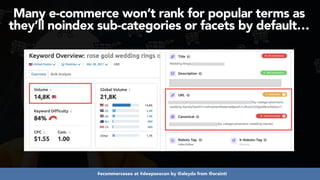
Many e-commerce won’t rank for popular terms as
they’ll noindex sub-categories or facets by default…
#ecommerceseo at #deepseocon by @aleyda from @orainti
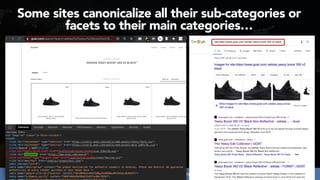
Some sites canonicalize all their sub-categories or
facets to their main categories…
#ecommerceseo at #deepseocon by @aleyda from @orainti
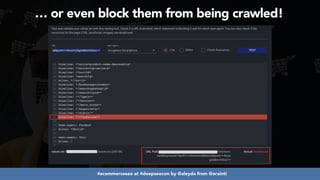
… or even block them from being crawled!


#ecommerceseo at #deepseocon by @aleyda from @orainti
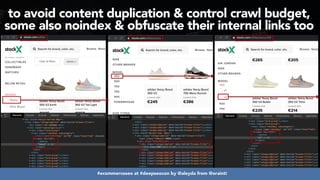
to avoid content duplication & control crawl budget,
some also noindex & obfuscate their internal links too
#ecommerceseo at #deepseocon by @aleyda from @orainti
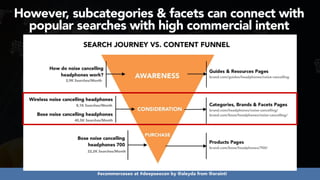
However, subcategories & facets can connect with
popular searches with high commercial intent
#ecommerceseo at #deepseocon by @aleyda from @orainti
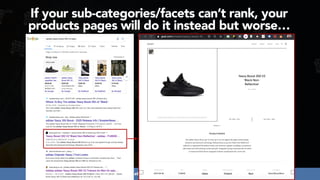
If your sub-categories/facets can’t rank, your
products pages will do it instead but worse…
#ecommerceseo at #deepseocon by @aleyda from @orainti
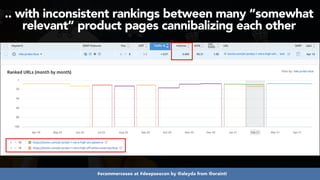
.. with inconsistent rankings between many “somewhat
relevant” product pages cannibalizing each other
#ecommerceseo at #deepseocon by @aleyda from @orainti
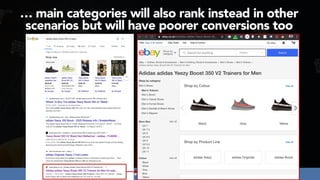
… main categories will also rank instead in other
scenarios but will have poorer conversions too
#ecommerceseo at #deepseocon by @aleyda from @orainti
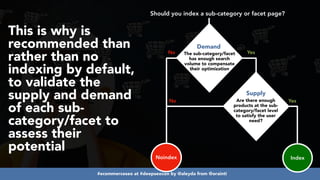
Should you index a sub-category or facet page?
Index
Noindex
No
Are there enough
products at the sub-
category/facet level
to satisfy the user
need?
No
Yes
Yes
Demand
Supply
The sub-category/facet
has enough search
volume to compensate
their optimization
This is why is
recommended than
rather than no
indexing by default,
to validate the
supply and demand
of each sub-
category/facet to
assess their
potential
#ecommerceseo at #deepseocon by @aleyda from @orainti
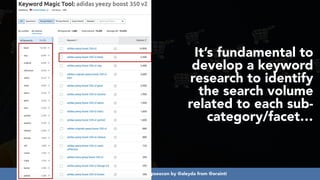
It’s fundamental to
develop a keyword
research to identify
the search volume
related to each sub-
category/facet…
#ecommerceseo at #deepseocon by @aleyda from @orainti
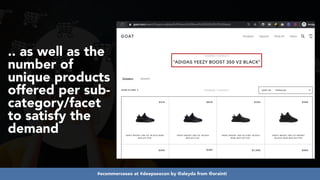
.. as well as the
number of
unique products
offered per sub-
category/facet
to satisfy the
demand
#ecommerceseo at #deepseocon by @aleyda from @orainti
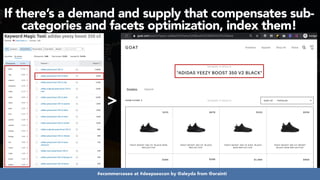
>
If there’s a demand and supply that compensates sub-
categories and facets optimization, index them!
#ecommerceseo at #deepseocon by @aleyda from @orainti
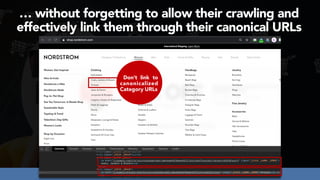
Don’t link to
canonicalized
Category URLs
… without forgetting to allow their crawling and
effectively link them through their canonical URLs
#ecommerceseo at #deepseocon by @aleyda from @orainti
3. Internal search results pages that
cannibalize and won’t rank well
#ecommerceseo at #deepseocon by @aleyda from @orainti
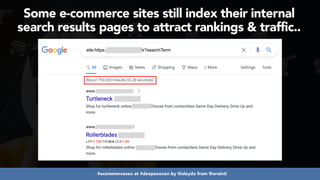
Some e-commerce sites still index their internal
search results pages to attract rankings & traffic..
#ecommerceseo at #deepseocon by @aleyda from @orainti
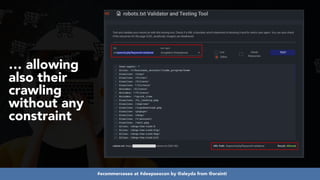
… allowing
also their
crawling
without any
constraint
#ecommerceseo at #deepseocon by @aleyda from @orainti
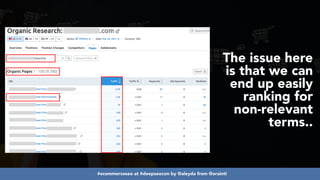
The issue here
is that we can
end up easily
ranking for
non-relevant
terms..
#ecommerceseo at #deepseocon by @aleyda from @orainti
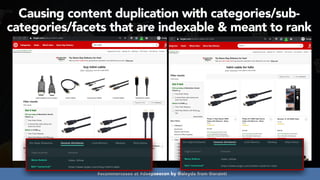
Causing content duplication with categories/sub-
categories/facets that are indexable & meant to rank
#ecommerceseo at #deepseocon by @aleyda from @orainti
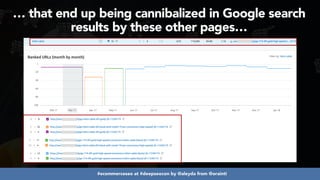
… that end up being cannibalized in Google search
results by these other pages…
#ecommerceseo at #deepseocon by @aleyda from @orainti
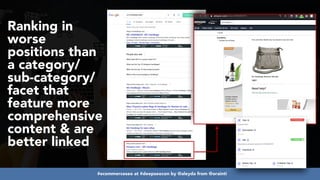
Ranking in
worse
positions than
a category/
sub-category/
facet that
feature more
comprehensive
content & are
better linked
#ecommerceseo at #deepseocon by @aleyda from @orainti
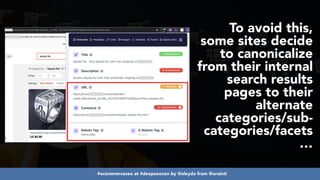
To avoid this,
some sites decide
to canonicalize
from their internal
search results
pages to their
alternate
categories/sub-
categories/facets
…
#ecommerceseo at #deepseocon by @aleyda from @orainti
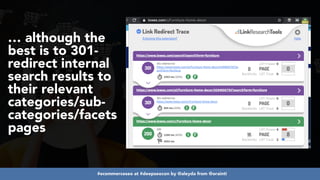
… although the
best is to 301-
redirect internal
search results to
their relevant
categories/sub-
categories/facets
pages
#ecommerceseo at #deepseocon by @aleyda from @orainti
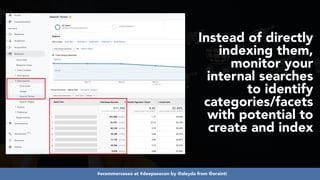
Instead of directly
indexing them,
monitor your
internal searches
to identify
categories/facets
with potential to
create and index
#ecommerceseo at #deepseocon by @aleyda from @orainti
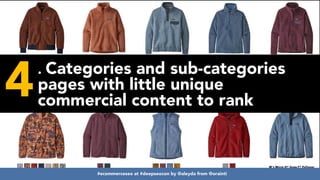
4. Categories and sub-categories
pages with little unique
commercial content to rank
#ecommerceseo at #deepseocon by @aleyda from @orainti
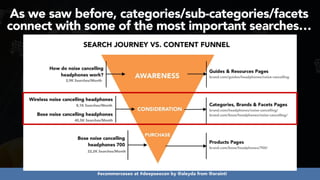
As we saw before, categories/sub-categories/facets
connect with some of the most important searches…
#ecommerceseo at #deepseocon by @aleyda from @orainti
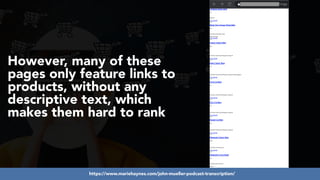
However, many of these
pages only feature links to
products, without any
descriptive text, which
makes them hard to rank
https://www.mariehaynes.com/john-mueller-podcast-transcription/
#ecommerceseo at #deepseocon by @aleyda from @orainti
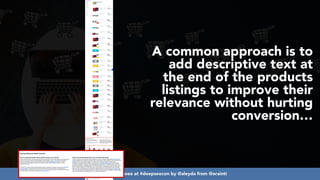
A common approach is to
add descriptive text at
the end of the products
listings to improve their
relevance without hurting
conversion…
#ecommerceseo at #deepseocon by @aleyda from @orainti
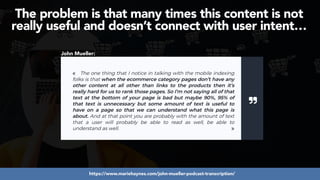
The problem is that many times this content is not
really useful and doesn’t connect with user intent…
John Mueller:
https://www.mariehaynes.com/john-mueller-podcast-transcription/
#ecommerceseo at #deepseocon by @aleyda from @orainti
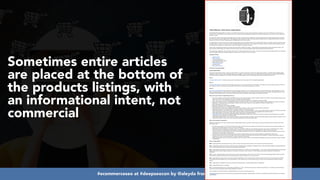
Sometimes entire articles
are placed at the bottom of
the products listings, with
an informational intent, not
commercial
#ecommerceseo at #deepseocon by @aleyda from @orainti
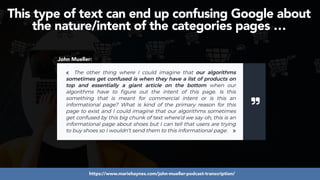
John Mueller:
This type of text can end up confusing Google about
the nature/intent of the categories pages …
https://www.mariehaynes.com/john-mueller-podcast-transcription/
#ecommerceseo at #deepseocon by @aleyda from @orainti
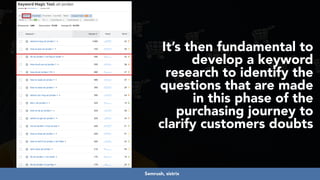
It’s then fundamental to
develop a keyword
research to identify the
questions that are made
in this phase of the
purchasing journey to
clarify customers doubts
Semrush, sistrix
#ecommerceseo at #deepseocon by @aleyda from @orainti
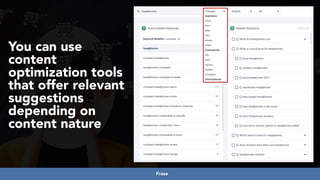
Frase
You can use
content
optimization tools
that offer relevant
suggestions
depending on
content nature
#ecommerceseo at #deepseocon by @aleyda from @orainti
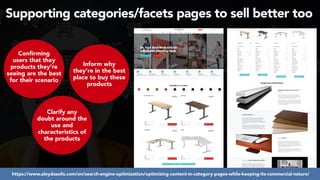
Supporting categories/facets pages to sell better too


Confirming
users that they
products they’re
seeing are the best
for their scenario
Clarify any
doubt around the
use and
characteristics of
the products
Inform why
they’re in the best
place to buy these
products
https://www.aleydasolis.com/en/search-engine-optimization/optimizing-content-in-category-pages-while-keeping-its-commercial-nature/
#ecommerceseo at #deepseocon by @aleyda from @orainti
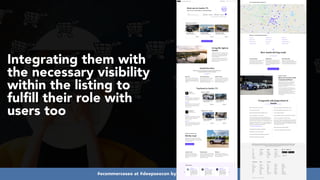
Integrating them with
the necessary visibility
within the listing to
fulfill their role with
users too
#ecommerceseo at #deepseocon by @aleyda from @orainti
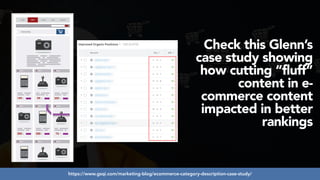
Check this Glenn’s
case study showing
how cutting “fluff”
content in e-
commerce content
impacted in better
rankings
https://www.gsqi.com/marketing-blog/ecommerce-category-description-case-study/
#ecommerceseo at #deepseocon by @aleyda from @orainti
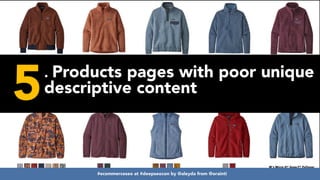
5. Products pages with poor unique
descriptive content
#ecommerceseo at #deepseocon by @aleyda from @orainti
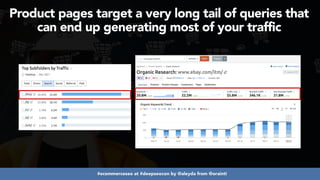
Product pages target a very long tail of queries that
can end up generating most of your traffic
#ecommerceseo at #deepseocon by @aleyda from @orainti
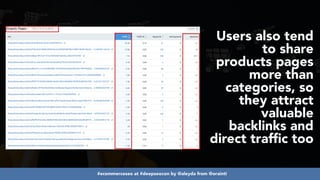
Users also tend
to share
products pages
more than
categories, so
they attract
valuable
backlinks and
direct traffic too
#ecommerceseo at #deepseocon by @aleyda from @orainti
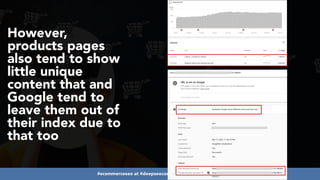
However,
products pages
also tend to show
little unique
content that and
Google tend to
leave them out of
their index due to
that too
#ecommerceseo at #deepseocon by @aleyda from @orainti
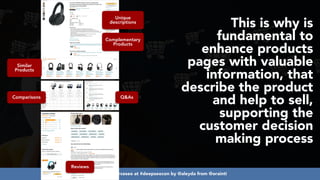
This is why is
fundamental to
enhance products
pages with valuable
information, that
describe the product
and help to sell,
supporting the
customer decision
making process
Unique
descriptions
Comparisons Q&As
Reviews
Complementary
Products
Similar
Products
#ecommerceseo at #deepseocon by @aleyda from @orainti
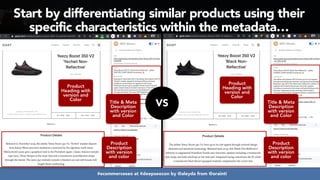
Title & Meta
Description
with version
and Color
Product
Description
with version
and color
Product
Heading with
version and
Color
VS
Start by differentiating similar products using their
specific characteristics within the metadata…
Product
Heading with
version and
Color
Title & Meta
Description
with version
and Color
Product
Description
with version
and color
#ecommerceseo at #deepseocon by @aleyda from @orainti
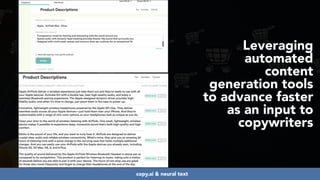
Leveraging
automated
content
generation tools
to advance faster
as an input to
copywriters
copy.ai & neural text
#ecommerceseo at #deepseocon by @aleyda from @orainti
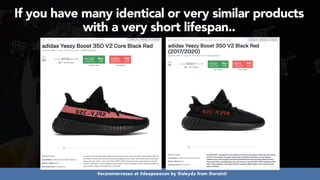
If you have many identical or very similar products
with a very short lifespan..
#ecommerceseo at #deepseocon by @aleyda from @orainti
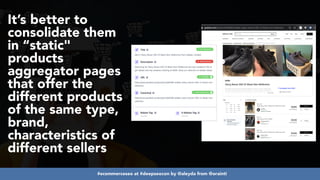
It’s better to
consolidate them
in “static"
products
aggregator pages
that offer the
different products
of the same type,
brand,
characteristics of
different sellers
#ecommerceseo at #deepseocon by @aleyda from @orainti
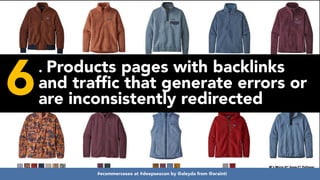
6. Products pages with backlinks
and traffic that generate errors or
are inconsistently redirected
#ecommerceseo at #deepseocon by @aleyda from @orainti
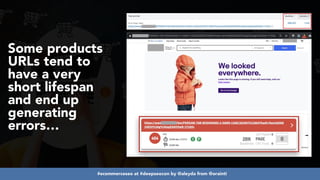
Some products
URLs tend to
have a very
short lifespan
and end up
generating
errors…
#ecommerceseo at #deepseocon by @aleyda from @orainti
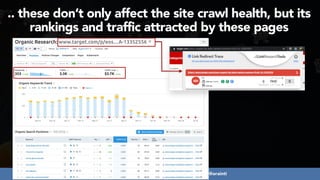
.. these don’t only affect the site crawl health, but its
rankings and traffic attracted by these pages
#ecommerceseo at #deepseocon by @aleyda from @orainti
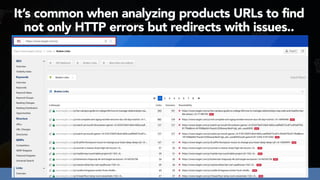
It’s common when analyzing products URLs to find
not only HTTP errors but redirects with issues..
#ecommerceseo at #deepseocon by @aleyda from @orainti
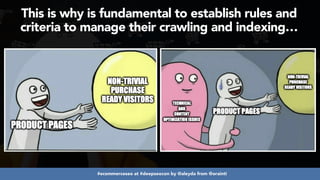
This is why is fundamental to establish rules and
criteria to manage their crawling and indexing…
#ecommerceseo at #deepseocon by @aleyda from @orainti
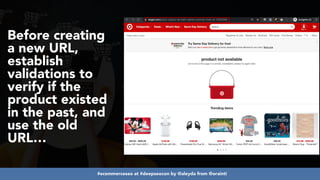
Before creating
a new URL,
establish
validations to
verify if the
product existed
in the past, and
use the old
URL…
#ecommerceseo at #deepseocon by @aleyda from @orainti
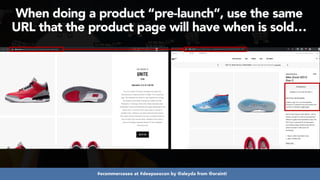
When doing a product “pre-launch”, use the same
URL that the product page will have when is sold…
#ecommerceseo at #deepseocon by @aleyda from @orainti
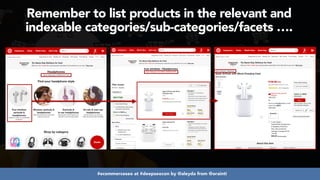
Remember to list products in the relevant and
indexable categories/sub-categories/facets ….
#ecommerceseo at #deepseocon by @aleyda from @orainti
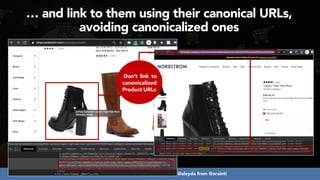
Don’t link to
canonicalized
Product URLs
… and link to them using their canonical URLs,
avoiding canonicalized ones
#ecommerceseo at #deepseocon by @aleyda from @orainti
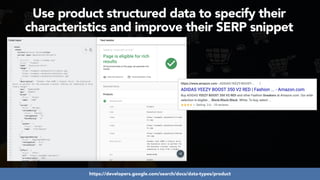
https://developers.google.com/search/docs/data-types/product
Use product structured data to specify their
characteristics and improve their SERP snippet
#ecommerceseo at #deepseocon by @aleyda from @orainti
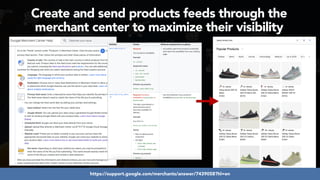
https://support.google.com/merchants/answer/7439058?hl=en
Create and send products feeds through the
merchant center to maximize their visibility
#ecommerceseo at #deepseocon by @aleyda from @orainti
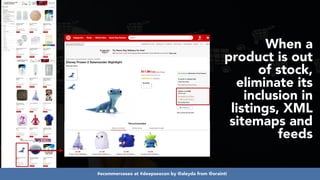
When a
product is out
of stock,
eliminate its
inclusion in
listings, XML
sitemaps and
feeds
#ecommerceseo at #deepseocon by @aleyda from @orainti
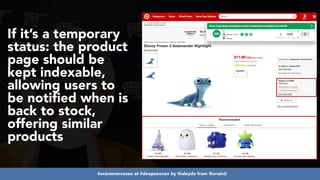
If it’s a temporary
status: the product
page should be
kept indexable,
allowing users to
be notified when is
back to stock,
offering similar
products
#ecommerceseo at #deepseocon by @aleyda from @orainti
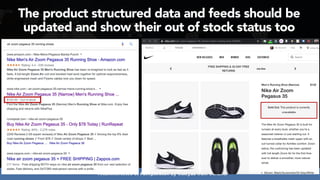
The product structured data and feeds should be
updated and show their out of stock status too
#ecommerceseo at #deepseocon by @aleyda from @orainti
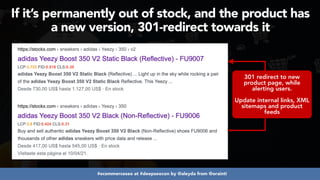
If it’s permanently out of stock, and the product has


a new version, 301-redirect towards it
301 redirect to new
product page, while
alerting users.


Update internal links, XML
sitemaps and product
feeds
#ecommerceseo at #deepseocon by @aleyda from @orainti
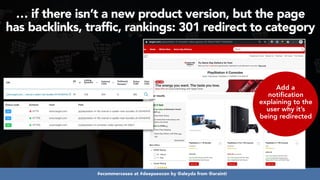
Add a
notification
explaining to the
user why it’s
being redirected
… if there isn’t a new product version, but the page
has backlinks, traffic, rankings: 301 redirect to category
#ecommerceseo at #deepseocon by @aleyda from @orainti
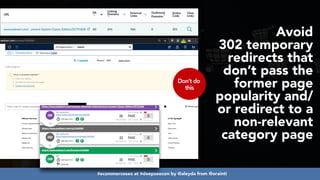
Don’t do
this
Avoid
302 temporary
redirects that
don’t pass the
former page
popularity and/
or redirect to a
non-relevant
category page
Don’t do
this
#ecommerceseo at #deepseocon by @aleyda from @orainti
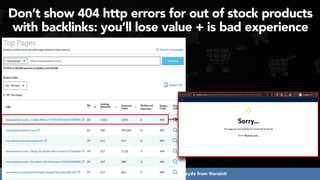
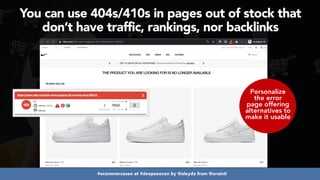
Don’t show 404 http errors for out of stock products
with backlinks: you’ll lose value + is bad experience
#ecommerceseo at #deepseocon by @aleyda from @orainti
Personalize
the error
page offering
alternatives to
make it usable
You can use 404s/410s in pages out of stock that
don’t have traffic, rankings, nor backlinks
#ecommerceseo at #deepseocon by @aleyda from @orainti
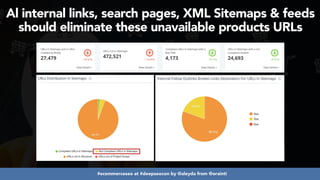
Al internal links, search pages, XML Sitemaps & feeds
should eliminate these unavailable products URLs
#ecommerceseo at #deepseocon by @aleyda from @orainti
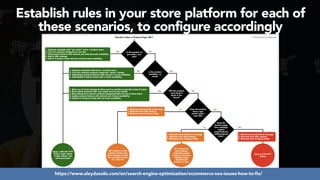
Establish rules in your store platform for each of
these scenarios, to configure accordingly
https://www.aleydasolis.com/en/search-engine-optimization/ecommerce-seo-issues-how-to-fix/
#ecommerceseo at #deepseocon by @aleyda from @orainti
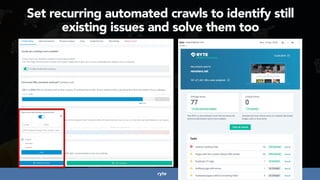
ryte
Set recurring automated crawls to identify still
existing issues and solve them too
#ecommerceseo at #deepseocon by @aleyda from @orainti
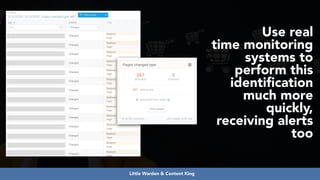
Use real
time monitoring
systems to
perform this
identification
much more
quickly,
receiving alerts
too
Little Warden & Content King
#ecommerceseo at #deepseocon by @aleyda from @orainti
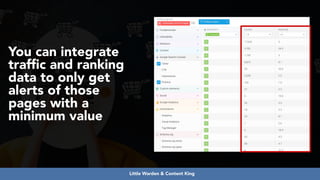
You can integrate
traffic and ranking
data to only get
alerts of those
pages with a
minimum value
Little Warden & Content King
#ecommerceseo at #deepseocon by @aleyda from @orainti
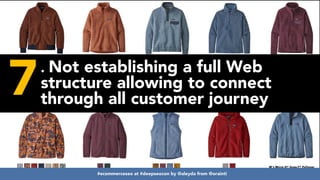
7. Not establishing a full Web
structure allowing to connect
through all customer journey
#ecommerceseo at #deepseocon by @aleyda from @orainti
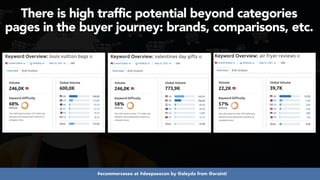
There is high traffic potential beyond categories
pages in the buyer journey: brands, comparisons, etc.
#ecommerceseo at #deepseocon by @aleyda from @orainti
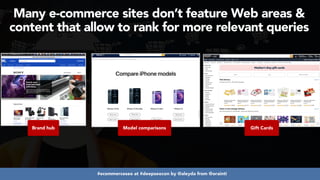
Many e-commerce sites don’t feature Web areas &
content that allow to rank for more relevant queries
Brand hub Model comparisons Gift Cards
#ecommerceseo at #deepseocon by @aleyda from @orainti
It’s key to
develop a keyword
research and content
audit, that allows to
map all the different
queries types during
the buying journey
with a relevant areas/
content type that
satisfies their need
Guides/articles
Brand page
Comparison page
…..
#ecommerceseo at #deepseocon by @aleyda from @orainti
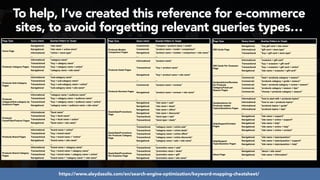
To help, I’ve created this reference for e-commerce
sites, to avoid forgetting relevant queries types…
https://www.aleydasolis.com/en/search-engine-optimization/keyword-mapping-cheatsheet/
#ecommerceseo at #deepseocon by @aleyda from @orainti
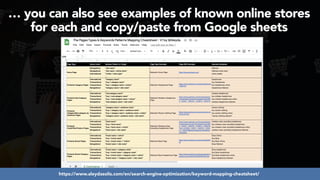
… you can also see examples of known online stores
for each and copy/paste from Google sheets
https://www.aleydasolis.com/en/search-engine-optimization/keyword-mapping-cheatsheet/
#ecommerceseo at #deepseocon by @aleyda from @orainti
Really?
#ecommerceseo at #deepseocon by @aleyda from @orainti
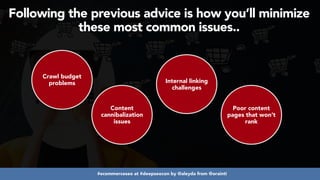
Following the previous advice is how you’ll minimize
these most common issues..
Crawl budget
problems
Content
cannibalization
issues
Internal linking
challenges
Poor content
pages that won’t
rank
#ecommerceseo at #deepseocon by @aleyda from @orainti
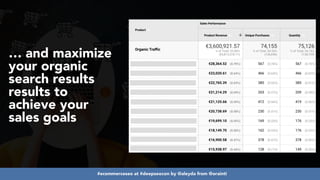
…
	
and maximize
your organic
search results
results to
achieve your
sales goals
#ecommerceseo at #deepseocon by @aleyda from @orainti
www.orainti.com
Thanks! Questions?
orainti.com
I’m Aleyda Solis


* SEO Consultant & Founder at Orainti


* SEO Speaker at +100 Events in +20 countries


* Author “SEO. Las Claves Esenciales.”


* Crawling Mondays Video & Podcast Series Host


* #SEOFOMO Newsletter Wrangler


* Maker LearningSEO.io


* European Search Personality of the Year in 2018


* remoters.net Co-Founder

7 E-Commerce SEO Mistakes & How to Fix Them #DeepSEOCon

  • 1.
    #ecommerceseo at #deepseoconby @aleyda from @orainti 7 E-Commerce SEO Mistakes 
 … and how to Solve Them #ecommerceseo at #deepseocon by @aleyda from @orainti
  • 2.
    #ecommerceseo at #deepseoconby @aleyda from @orainti Organic search is the bigger traffic driver to online stores, even well known ones, after direct amazon.com ebay.com etsy.com bestbuy.com target.com homedepot.com semrush
  • 3.
    #ecommerceseo at #deepseoconby @aleyda from @orainti The biggest e- commerce platforms acknowledge this and have started to provide more SEO related functionalities..
  • 4.
    #ecommerceseo at #deepseoconby @aleyda from @orainti However, e-commerce sites characteristics 
 make them challenging to optimize for search… A high number of pages due to products volume Complex categorization Constant URLs changing status due to dynamic inventory Same products information than other Websites
  • 5.
    #ecommerceseo at #deepseoconby @aleyda from @orainti … as they generate fundamental SEO issues! 
 Crawl budget problems Content cannibalization issues Internal linking challenges Poor content pages that won’t rank
  • 6.
    #ecommerceseo at #deepseoconby @aleyda from @orainti Online stores are great to improve your abilities to tackle SEO issues at scale to achieve results
  • 7.
    #ecommerceseo at #deepseoconby @aleyda from @orainti Let’s see 7 common e-commerce SEO errors & how to fix them #ecommerceseo at #deepseocon by @aleyda from @orainti
  • 8.
    #ecommerceseo at #deepseoconby @aleyda from @orainti 1. No-Indexed sub-categories or facets pages with traffic potential #ecommerceseo at #deepseocon by @aleyda from @orainti
  • 9.
    #ecommerceseo at #deepseoconby @aleyda from @orainti 2. Un-linked sub-categories or facet pages with traffic potential #ecommerceseo at #deepseocon by @aleyda from @orainti
  • 10.
    #ecommerceseo at #deepseoconby @aleyda from @orainti Many e-commerce won’t rank for popular terms as they’ll noindex sub-categories or facets by default…
  • 11.
    #ecommerceseo at #deepseoconby @aleyda from @orainti Some sites canonicalize all their sub-categories or facets to their main categories…
  • 12.
    #ecommerceseo at #deepseoconby @aleyda from @orainti … or even block them from being crawled! 

  • 13.
    #ecommerceseo at #deepseoconby @aleyda from @orainti to avoid content duplication & control crawl budget, some also noindex & obfuscate their internal links too #ecommerceseo at #deepseocon by @aleyda from @orainti
  • 14.
    #ecommerceseo at #deepseoconby @aleyda from @orainti However, subcategories & facets can connect with popular searches with high commercial intent
  • 15.
    #ecommerceseo at #deepseoconby @aleyda from @orainti If your sub-categories/facets can’t rank, your products pages will do it instead but worse…
  • 16.
    #ecommerceseo at #deepseoconby @aleyda from @orainti .. with inconsistent rankings between many “somewhat relevant” product pages cannibalizing each other
  • 17.
    #ecommerceseo at #deepseoconby @aleyda from @orainti … main categories will also rank instead in other scenarios but will have poorer conversions too
  • 18.
    #ecommerceseo at #deepseoconby @aleyda from @orainti Should you index a sub-category or facet page? Index Noindex No Are there enough products at the sub- category/facet level to satisfy the user need? No Yes Yes Demand Supply The sub-category/facet has enough search volume to compensate their optimization This is why is recommended than rather than no indexing by default, to validate the supply and demand of each sub- category/facet to assess their potential
  • 19.
    #ecommerceseo at #deepseoconby @aleyda from @orainti It’s fundamental to develop a keyword research to identify the search volume related to each sub- category/facet…
  • 20.
    #ecommerceseo at #deepseoconby @aleyda from @orainti .. as well as the number of unique products offered per sub- category/facet to satisfy the demand
  • 21.
    #ecommerceseo at #deepseoconby @aleyda from @orainti > If there’s a demand and supply that compensates sub- categories and facets optimization, index them!
  • 22.
    #ecommerceseo at #deepseoconby @aleyda from @orainti Don’t link to canonicalized Category URLs … without forgetting to allow their crawling and effectively link them through their canonical URLs
  • 23.
    #ecommerceseo at #deepseoconby @aleyda from @orainti 3. Internal search results pages that cannibalize and won’t rank well #ecommerceseo at #deepseocon by @aleyda from @orainti
  • 24.
    #ecommerceseo at #deepseoconby @aleyda from @orainti Some e-commerce sites still index their internal search results pages to attract rankings & traffic..
  • 25.
    #ecommerceseo at #deepseoconby @aleyda from @orainti … allowing also their crawling without any constraint
  • 26.
    #ecommerceseo at #deepseoconby @aleyda from @orainti The issue here is that we can end up easily ranking for non-relevant terms..
  • 27.
    #ecommerceseo at #deepseoconby @aleyda from @orainti Causing content duplication with categories/sub- categories/facets that are indexable & meant to rank
  • 28.
    #ecommerceseo at #deepseoconby @aleyda from @orainti … that end up being cannibalized in Google search results by these other pages…
  • 29.
    #ecommerceseo at #deepseoconby @aleyda from @orainti Ranking in worse positions than a category/ sub-category/ facet that feature more comprehensive content & are better linked
  • 30.
    #ecommerceseo at #deepseoconby @aleyda from @orainti To avoid this, some sites decide to canonicalize from their internal search results pages to their alternate categories/sub- categories/facets …
  • 31.
    #ecommerceseo at #deepseoconby @aleyda from @orainti … although the best is to 301- redirect internal search results to their relevant categories/sub- categories/facets pages
  • 32.
    #ecommerceseo at #deepseoconby @aleyda from @orainti Instead of directly indexing them, monitor your internal searches to identify categories/facets with potential to create and index
  • 33.
    #ecommerceseo at #deepseoconby @aleyda from @orainti 4. Categories and sub-categories pages with little unique commercial content to rank #ecommerceseo at #deepseocon by @aleyda from @orainti
  • 34.
    #ecommerceseo at #deepseoconby @aleyda from @orainti As we saw before, categories/sub-categories/facets connect with some of the most important searches…
  • 35.
    #ecommerceseo at #deepseoconby @aleyda from @orainti However, many of these pages only feature links to products, without any descriptive text, which makes them hard to rank https://www.mariehaynes.com/john-mueller-podcast-transcription/
  • 36.
    #ecommerceseo at #deepseoconby @aleyda from @orainti A common approach is to add descriptive text at the end of the products listings to improve their relevance without hurting conversion…
  • 37.
    #ecommerceseo at #deepseoconby @aleyda from @orainti The problem is that many times this content is not really useful and doesn’t connect with user intent… John Mueller: https://www.mariehaynes.com/john-mueller-podcast-transcription/
  • 38.
    #ecommerceseo at #deepseoconby @aleyda from @orainti Sometimes entire articles are placed at the bottom of the products listings, with an informational intent, not commercial
  • 39.
    #ecommerceseo at #deepseoconby @aleyda from @orainti John Mueller: This type of text can end up confusing Google about the nature/intent of the categories pages … https://www.mariehaynes.com/john-mueller-podcast-transcription/
  • 40.
    #ecommerceseo at #deepseoconby @aleyda from @orainti It’s then fundamental to develop a keyword research to identify the questions that are made in this phase of the purchasing journey to clarify customers doubts Semrush, sistrix
  • 41.
    #ecommerceseo at #deepseoconby @aleyda from @orainti Frase You can use content optimization tools that offer relevant suggestions depending on content nature
  • 42.
    #ecommerceseo at #deepseoconby @aleyda from @orainti Supporting categories/facets pages to sell better too 
 Confirming users that they products they’re seeing are the best for their scenario Clarify any doubt around the use and characteristics of the products Inform why they’re in the best place to buy these products https://www.aleydasolis.com/en/search-engine-optimization/optimizing-content-in-category-pages-while-keeping-its-commercial-nature/
  • 43.
    #ecommerceseo at #deepseoconby @aleyda from @orainti Integrating them with the necessary visibility within the listing to fulfill their role with users too
  • 44.
    #ecommerceseo at #deepseoconby @aleyda from @orainti Check this Glenn’s case study showing how cutting “fluff” content in e- commerce content impacted in better rankings https://www.gsqi.com/marketing-blog/ecommerce-category-description-case-study/
  • 45.
    #ecommerceseo at #deepseoconby @aleyda from @orainti 5. Products pages with poor unique descriptive content #ecommerceseo at #deepseocon by @aleyda from @orainti
  • 46.
    #ecommerceseo at #deepseoconby @aleyda from @orainti Product pages target a very long tail of queries that can end up generating most of your traffic
  • 47.
    #ecommerceseo at #deepseoconby @aleyda from @orainti Users also tend to share products pages more than categories, so they attract valuable backlinks and direct traffic too
  • 48.
    #ecommerceseo at #deepseoconby @aleyda from @orainti However, products pages also tend to show little unique content that and Google tend to leave them out of their index due to that too
  • 49.
    #ecommerceseo at #deepseoconby @aleyda from @orainti This is why is fundamental to enhance products pages with valuable information, that describe the product and help to sell, supporting the customer decision making process Unique descriptions Comparisons Q&As Reviews Complementary Products Similar Products
  • 50.
    #ecommerceseo at #deepseoconby @aleyda from @orainti Title & Meta Description with version and Color Product Description with version and color Product Heading with version and Color VS Start by differentiating similar products using their specific characteristics within the metadata… Product Heading with version and Color Title & Meta Description with version and Color Product Description with version and color
  • 51.
    #ecommerceseo at #deepseoconby @aleyda from @orainti Leveraging automated content generation tools to advance faster as an input to copywriters copy.ai & neural text
  • 52.
    #ecommerceseo at #deepseoconby @aleyda from @orainti If you have many identical or very similar products with a very short lifespan..
  • 53.
    #ecommerceseo at #deepseoconby @aleyda from @orainti It’s better to consolidate them in “static" products aggregator pages that offer the different products of the same type, brand, characteristics of different sellers
  • 54.
    #ecommerceseo at #deepseoconby @aleyda from @orainti 6. Products pages with backlinks and traffic that generate errors or are inconsistently redirected #ecommerceseo at #deepseocon by @aleyda from @orainti
  • 55.
    #ecommerceseo at #deepseoconby @aleyda from @orainti Some products URLs tend to have a very short lifespan and end up generating errors…
  • 56.
    #ecommerceseo at #deepseoconby @aleyda from @orainti .. these don’t only affect the site crawl health, but its rankings and traffic attracted by these pages
  • 57.
    #ecommerceseo at #deepseoconby @aleyda from @orainti It’s common when analyzing products URLs to find not only HTTP errors but redirects with issues..
  • 58.
    #ecommerceseo at #deepseoconby @aleyda from @orainti This is why is fundamental to establish rules and criteria to manage their crawling and indexing…
  • 59.
    #ecommerceseo at #deepseoconby @aleyda from @orainti Before creating a new URL, establish validations to verify if the product existed in the past, and use the old URL…
  • 60.
    #ecommerceseo at #deepseoconby @aleyda from @orainti When doing a product “pre-launch”, use the same URL that the product page will have when is sold…
  • 61.
    #ecommerceseo at #deepseoconby @aleyda from @orainti Remember to list products in the relevant and indexable categories/sub-categories/facets ….
  • 62.
    #ecommerceseo at #deepseoconby @aleyda from @orainti Don’t link to canonicalized Product URLs … and link to them using their canonical URLs, avoiding canonicalized ones
  • 63.
    #ecommerceseo at #deepseoconby @aleyda from @orainti https://developers.google.com/search/docs/data-types/product Use product structured data to specify their characteristics and improve their SERP snippet
  • 64.
    #ecommerceseo at #deepseoconby @aleyda from @orainti https://support.google.com/merchants/answer/7439058?hl=en Create and send products feeds through the merchant center to maximize their visibility
  • 65.
    #ecommerceseo at #deepseoconby @aleyda from @orainti When a product is out of stock, eliminate its inclusion in listings, XML sitemaps and feeds
  • 66.
    #ecommerceseo at #deepseoconby @aleyda from @orainti If it’s a temporary status: the product page should be kept indexable, allowing users to be notified when is back to stock, offering similar products
  • 67.
    #ecommerceseo at #deepseoconby @aleyda from @orainti The product structured data and feeds should be updated and show their out of stock status too
  • 68.
    #ecommerceseo at #deepseoconby @aleyda from @orainti If it’s permanently out of stock, and the product has 
 a new version, 301-redirect towards it 301 redirect to new product page, while alerting users. 
 
 Update internal links, XML sitemaps and product feeds
  • 69.
    #ecommerceseo at #deepseoconby @aleyda from @orainti Add a notification explaining to the user why it’s being redirected … if there isn’t a new product version, but the page has backlinks, traffic, rankings: 301 redirect to category
  • 70.
    #ecommerceseo at #deepseoconby @aleyda from @orainti Don’t do this Avoid 302 temporary redirects that don’t pass the former page popularity and/ or redirect to a non-relevant category page Don’t do this
  • 71.
    #ecommerceseo at #deepseoconby @aleyda from @orainti Don’t show 404 http errors for out of stock products with backlinks: you’ll lose value + is bad experience
  • 72.
    #ecommerceseo at #deepseoconby @aleyda from @orainti Personalize the error page offering alternatives to make it usable You can use 404s/410s in pages out of stock that don’t have traffic, rankings, nor backlinks
  • 73.
    #ecommerceseo at #deepseoconby @aleyda from @orainti Al internal links, search pages, XML Sitemaps & feeds should eliminate these unavailable products URLs
  • 74.
    #ecommerceseo at #deepseoconby @aleyda from @orainti Establish rules in your store platform for each of these scenarios, to configure accordingly https://www.aleydasolis.com/en/search-engine-optimization/ecommerce-seo-issues-how-to-fix/
  • 75.
    #ecommerceseo at #deepseoconby @aleyda from @orainti ryte Set recurring automated crawls to identify still existing issues and solve them too
  • 76.
    #ecommerceseo at #deepseoconby @aleyda from @orainti Use real time monitoring systems to perform this identification much more quickly, receiving alerts too Little Warden & Content King
  • 77.
    #ecommerceseo at #deepseoconby @aleyda from @orainti You can integrate traffic and ranking data to only get alerts of those pages with a minimum value Little Warden & Content King
  • 78.
    #ecommerceseo at #deepseoconby @aleyda from @orainti 7. Not establishing a full Web structure allowing to connect through all customer journey #ecommerceseo at #deepseocon by @aleyda from @orainti
  • 79.
    #ecommerceseo at #deepseoconby @aleyda from @orainti There is high traffic potential beyond categories pages in the buyer journey: brands, comparisons, etc.
  • 80.
    #ecommerceseo at #deepseoconby @aleyda from @orainti Many e-commerce sites don’t feature Web areas & content that allow to rank for more relevant queries Brand hub Model comparisons Gift Cards
  • 81.
    #ecommerceseo at #deepseoconby @aleyda from @orainti It’s key to develop a keyword research and content audit, that allows to map all the different queries types during the buying journey with a relevant areas/ content type that satisfies their need Guides/articles Brand page Comparison page …..
  • 82.
    #ecommerceseo at #deepseoconby @aleyda from @orainti To help, I’ve created this reference for e-commerce sites, to avoid forgetting relevant queries types… https://www.aleydasolis.com/en/search-engine-optimization/keyword-mapping-cheatsheet/
  • 83.
    #ecommerceseo at #deepseoconby @aleyda from @orainti … you can also see examples of known online stores for each and copy/paste from Google sheets https://www.aleydasolis.com/en/search-engine-optimization/keyword-mapping-cheatsheet/
  • 84.
    #ecommerceseo at #deepseoconby @aleyda from @orainti Really?
  • 85.
    #ecommerceseo at #deepseoconby @aleyda from @orainti Following the previous advice is how you’ll minimize these most common issues.. Crawl budget problems Content cannibalization issues Internal linking challenges Poor content pages that won’t rank
  • 86.
    #ecommerceseo at #deepseoconby @aleyda from @orainti … and maximize your organic search results results to achieve your sales goals
  • 87.
    #ecommerceseo at #deepseoconby @aleyda from @orainti www.orainti.com Thanks! Questions? orainti.com I’m Aleyda Solis * SEO Consultant & Founder at Orainti * SEO Speaker at +100 Events in +20 countries * Author “SEO. Las Claves Esenciales.” * Crawling Mondays Video & Podcast Series Host * #SEOFOMO Newsletter Wrangler * Maker LearningSEO.io * European Search Personality of the Year in 2018 * remoters.net Co-Founder