Technopreneurship (WBB10102)
WHAT IS CREATIVITY?

Technopreneurship (WBB10102)
WHAT IS INNOVATION?

Technopreneurship (WBB10102)
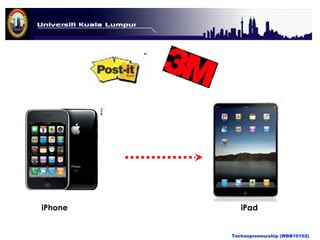
iPhone

iPad

Technopreneurship (WBB10102)
Learning Objectives
1)Identify, evaluate and select
business opportunity.
2) Describe the process of creativity.
3) Explain the types of innovations.
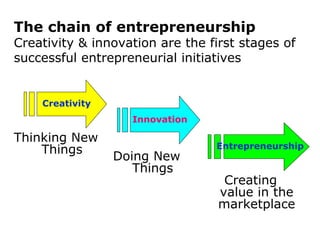
The chain of entrepreneurship

Creativity & innovation are the first stages of
successful entrepreneurial initiatives

Creativity
Innovation

Thinking New
Things

Doing New
Things

Entrepreneurship

Creating
value in the
marketplace
3.1
Business Opportunity:
Identification, Evaluation
And Selection
Business is all about selling
a product or service
•

Every time something happens,
positive or negative, I ask myself,
WHERE is the OPPORTUNITY here?

•

How do you spot an opportunity?
Keep your eyes open all of the time
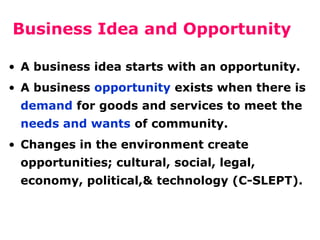
Business Idea and Opportunity
• A business idea starts with an opportunity.
• A business opportunity exists when there is
demand for goods and services to meet the
needs and wants of community.
• Changes in the environment create
opportunities; cultural, social, legal,
economy, political,& technology (C-SLEPT).
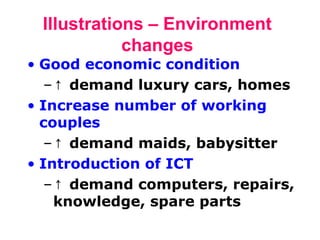
Illustrations – Environment
changes

• Good economic condition
– ↑ demand luxury cars, homes
• Increase number of working
couples

– ↑ demand maids, babysitter
• Introduction of ICT
– ↑ demand computers, repairs,
knowledge, spare parts
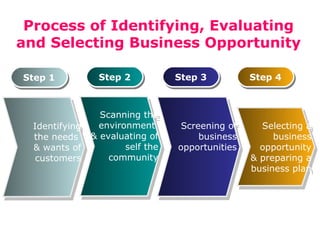
Process of Identifying, Evaluating
and Selecting Business Opportunity
Step 1
Step 1

Step 2
Step 2

Scanning the
Scanning the
environment
Identifying
environment
Identifying
the needs & evaluating of
self the
& wants of
self the
& wants of
community
customers
community
customers

Step 3
Step 3

Screening of
Screening of
business
business
opportunities
opportunities

Step 4
Step 4

Selecting a
Selecting a
business
business
opportunity
opportunity
& preparing a
& preparing a
business plan
business plan
Step 1: Identification of NEEDS &
WANTS of consumers
• Need – is something basic in life such as food,
drink, clothing and shelter.
• Want – is extension of need; craving for better
than the basic need.
– Need for food: Rice
– Want for food: Chicken Rice (Chicken Rice
Shop)
– Need for shelter: Renting a flat with 10
housemates
– Want for shelter: Renting a condo
• The better the economy of people, the more
business opportunities available for the
entrepreneurs.
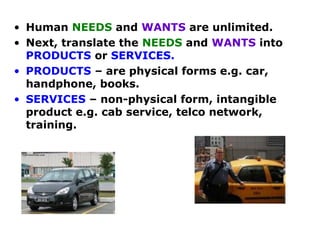
• Human NEEDS and WANTS are unlimited.
• Next, translate the NEEDS and WANTS into
PRODUCTS or SERVICES.
• PRODUCTS – are physical forms e.g. car,
handphone, books.
• SERVICES – non-physical form, intangible
product e.g. cab service, telco network,
training.
Step 2: Environmental Scanning,
Self Analysis & Community Values
3 factors to be considered:
1) Environmental Scanning
- help identify business opportunities.
- 2 approaches:
i) Macro scanning
e.g. population, ethnics, average
income,
ii) Micro scanning
e.g. family size, Malay delicacies,
individual income.
Step 2: Environmental Scanning,
Self Analysis & Community Values
2) Self Evaluation
- to see what is available in oneself:
i) Experience
- match business with experience
e.g. engineer work with Public Work
Dept (JKR) will become a Civil Engineer.
ii) Knowledge & Skill
- do business on what he really
knows what to do e.g. Contractor must
not only knows how to manage his
business but also how to construct the
buildings.
Step 2: Environmental Scanning, Self
Analysis & Community Values
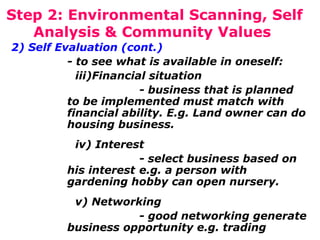
2) Self Evaluation (cont.)
- to see what is available in oneself:
iii)Financial situation
- business that is planned
to be implemented must match with
financial ability. E.g. Land owner can do
housing business.
iv) Interest
- select business based on
his interest e.g. a person with
gardening hobby can open nursery.
v) Networking
- good networking generate
business opportunity e.g. trading
Step 2: Environmental Scanning,
Self Analysis & Community Values
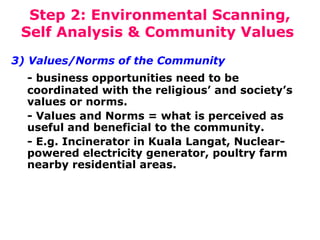
3) Values/Norms of the Community
- business opportunities need to be
coordinated with the religious’ and society’s
values or norms.
- Values and Norms = what is perceived as
useful and beneficial to the community.
- E.g. Incinerator in Kuala Langat, Nuclearpowered electricity generator, poultry farm
nearby residential areas.
Step 3: Screening of Business
Opportunities
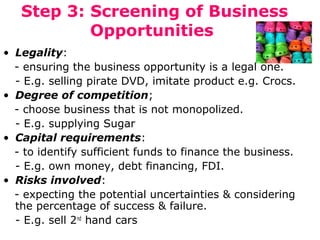
• Legality:
- ensuring the business opportunity is a legal one.
- E.g. selling pirate DVD, imitate product e.g. Crocs.
• Degree of competition;
- choose business that is not monopolized.
- E.g. supplying Sugar
• Capital requirements:
- to identify sufficient funds to finance the business.
- E.g. own money, debt financing, FDI.
• Risks involved:
- expecting the potential uncertainties & considering
the percentage of success & failure.
- E.g. sell 2nd hand cars
2 types of risks:

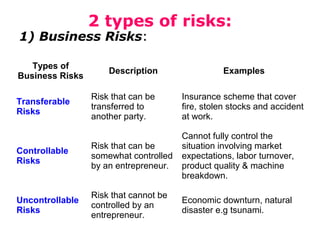
1) Business Risks:
Types of
Business Risks

Description

Examples

Risk that can be
transferred to
another party.

Insurance scheme that cover
fire, stolen stocks and accident
at work.

Controllable
Risks

Risk that can be
somewhat controlled
by an entrepreneur.

Cannot fully control the
situation involving market
expectations, labor turnover,
product quality & machine
breakdown.

Uncontrollable
Risks

Risk that cannot be
controlled by an
entrepreneur.

Economic downturn, natural
disaster e.g tsunami.

Transferable
Risks
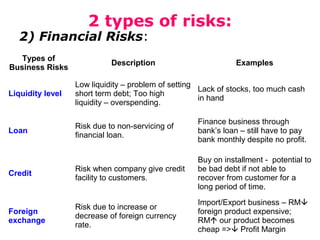
2 types of risks:

2) Financial Risks:
Types of
Business Risks

Description

Examples

Liquidity level

Low liquidity – problem of setting
Lack of stocks, too much cash
short term debt; Too high
in hand
liquidity – overspending.

Loan

Risk due to non-servicing of
financial loan.

Finance business through
bank’s loan – still have to pay
bank monthly despite no profit.

Credit

Risk when company give credit
facility to customers.

Buy on installment - potential to
be bad debt if not able to
recover from customer for a
long period of time.

Foreign
exchange

Risk due to increase or
decrease of foreign currency
rate.

Import/Export business – RM
foreign product expensive;
RM our product becomes
cheap => Profit Margin
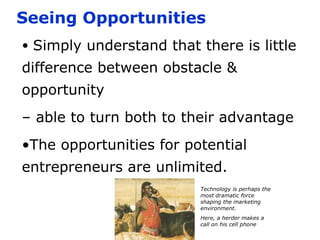
Seeing Opportunities
• Simply understand that there is little

difference between obstacle &
opportunity
– able to turn both to their advantage
•The opportunities for potential
entrepreneurs are unlimited.
Technology is perhaps the
most dramatic force
shaping the marketing
environment.
Here, a herder makes a
call on his cell phone
Step 4: Selecting a business
opportunity and preparing a
business plan
• After fulfill step 1 to 3,
it is time for the entrepreneur to
select a business opportunity.
• Then to prepare the business
plan.
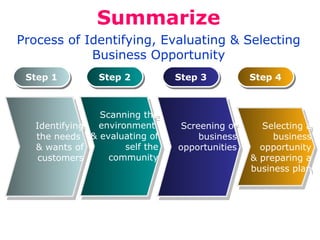
Summarize
Process of Identifying, Evaluating & Selecting
Business Opportunity
Step 1
Step 1

Identifying
Identifying
the needs
the needs
& wants of
& wants of
customers
customers

Step 2
Step 2

Scanning the
Scanning the
environment
environment
& evaluating of
& evaluating of
self the
self the
community
community

Step 3
Step 3

Screening of
Screening of
business
business
opportunities
opportunities

Step 4
Step 4

Selecting a
Selecting a
business
business
opportunity
opportunity
& preparing a
& preparing a
business plan
business plan
3.2
Business Creativity
What is CREATIVITY??

“the ability to produce work
that is novel (i.e. original
and unexpected), high in
quality and appropriate (i.e
useful, meet expectations)
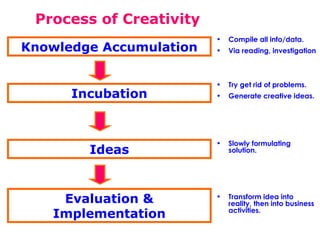
Process of Creativity
•

Compile all info/data.

•

Via reading, investigation

•

Try get rid of problems.

•

Generate creative ideas.

Ideas

•

Slowly formulating
solution.

Evaluation &
Implementation

•

Transform idea into
reality, then into business
activities.

Knowledge Accumulation

Incubation
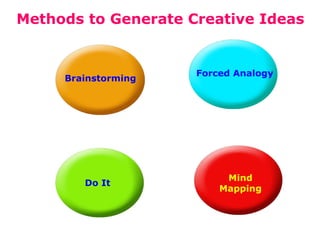
Methods to Generate Creative Ideas

Brainstorming

Do It

Forced Analogy

Mind
Mapping
3.3
Business Innovation
What is INNOVATION??

“the process by which
entrepreneurs convert
opportunities into
marketable ideas.”
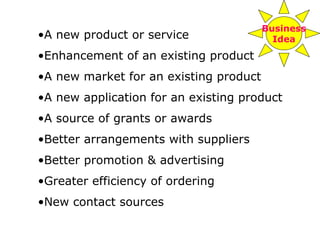
•A new product or service

Business
Idea

•Enhancement of an existing product
•A new market for an existing product
•A new application for an existing product
•A source of grants or awards
•Better arrangements with suppliers
•Better promotion & advertising
•Greater efficiency of ordering
•New contact sources
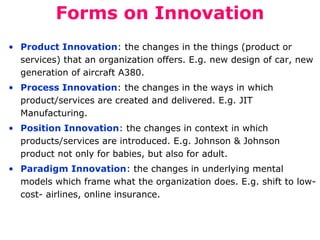
Forms on Innovation
• Product Innovation: the changes in the things (product or
services) that an organization offers. E.g. new design of car, new
generation of aircraft A380.
• Process Innovation: the changes in the ways in which
product/services are created and delivered. E.g. JIT
Manufacturing.
• Position Innovation: the changes in context in which
products/services are introduced. E.g. Johnson & Johnson
product not only for babies, but also for adult.
• Paradigm Innovation: the changes in underlying mental
models which frame what the organization does. E.g. shift to lowcost- airlines, online insurance.
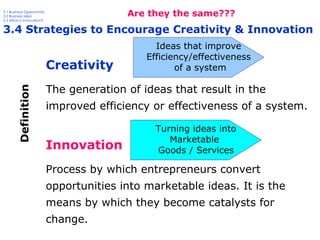
Are they the same???

3.1 Business Opportunity
3.2 Business idea
3.3 What is Innovation?

3.4 Strategies to Encourage Creativity & Innovation

Definition

Creativity

Ideas that improve
Efficiency/effectiveness
of a system

The generation of ideas that result in the
improved efficiency or effectiveness of a system.

Innovation

Turning ideas into
Marketable
Goods / Services

Process by which entrepreneurs convert
opportunities into marketable ideas. It is the
means by which they become catalysts for
change.
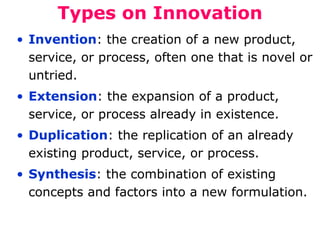
Types on Innovation
• Invention: the creation of a new product,
service, or process, often one that is novel or
untried.
• Extension: the expansion of a product,
service, or process already in existence.
• Duplication: the replication of an already
existing product, service, or process.
• Synthesis: the combination of existing
concepts and factors into a new formulation.
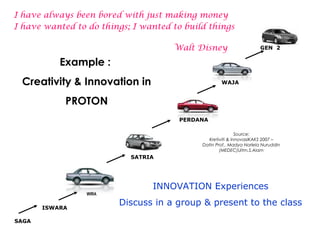
I have always been bored with just making money
I have wanted to do things; I wanted to build things
Walt Disney

GEN 2

Example :
Creativity & Innovation in

WAJA

PROTON
PERDANA
Source:
Kretiviti & InnovasiKAKS 2007 –
Datin Prof.. Madya Norlela Nuruddin
(MEDEC)Uitm,S.Alam

SATRIA

INNOVATION Experiences
WIRA

ISWARA
SAGA

Discuss in a group & present to the class
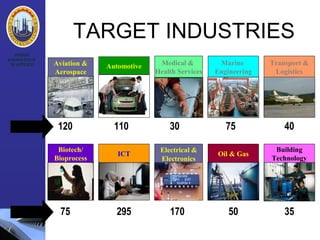
TARGET INDUSTRIES
WHERE
KNOWLEDGE
IS APPLIED

No of Techno

Aviation &
Aerospace

120
Biotech/
Bioprocess

No of Techno

75

Automotive

110

Medical &
Health Services

30

Marine
Engineering

75

Transport &
Logistics

40

ICT

Electrical &
Electronics

Oil & Gas

Building
Technology

295

170

50

35
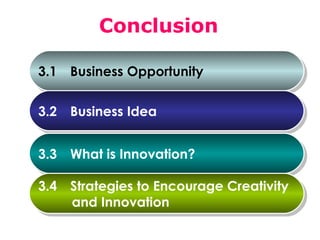
Conclusion
3.1 Business Opportunity
3.2 Business Idea
3.2 Business Idea
3.3 What is Innovation?
3.4 Strategies to Encourage Creativity
and Innovation
and Innovation
FOR YOUR
PRECIOUS
ATTENTION

Chapter 2 Bisplan: Generating business opportunities

  • 1.
  • 2.
  • 3.
  • 4.
  • 5.
  • 6.
    Learning Objectives 1)Identify, evaluateand select business opportunity. 2) Describe the process of creativity. 3) Explain the types of innovations.
  • 7.
    The chain ofentrepreneurship Creativity & innovation are the first stages of successful entrepreneurial initiatives Creativity Innovation Thinking New Things Doing New Things Entrepreneurship Creating value in the marketplace
  • 8.
  • 9.
    Business is allabout selling a product or service • Every time something happens, positive or negative, I ask myself, WHERE is the OPPORTUNITY here? • How do you spot an opportunity? Keep your eyes open all of the time
  • 10.
    Business Idea andOpportunity • A business idea starts with an opportunity. • A business opportunity exists when there is demand for goods and services to meet the needs and wants of community. • Changes in the environment create opportunities; cultural, social, legal, economy, political,& technology (C-SLEPT).
  • 11.
    Illustrations – Environment changes •Good economic condition – ↑ demand luxury cars, homes • Increase number of working couples – ↑ demand maids, babysitter • Introduction of ICT – ↑ demand computers, repairs, knowledge, spare parts
  • 12.
    Process of Identifying,Evaluating and Selecting Business Opportunity Step 1 Step 1 Step 2 Step 2 Scanning the Scanning the environment Identifying environment Identifying the needs & evaluating of the needs & evaluating of self the & wants of self the & wants of community customers community customers Step 3 Step 3 Screening of Screening of business business opportunities opportunities Step 4 Step 4 Selecting a Selecting a business business opportunity opportunity & preparing a & preparing a business plan business plan
  • 13.
    Step 1: Identificationof NEEDS & WANTS of consumers • Need – is something basic in life such as food, drink, clothing and shelter. • Want – is extension of need; craving for better than the basic need. – Need for food: Rice – Want for food: Chicken Rice (Chicken Rice Shop) – Need for shelter: Renting a flat with 10 housemates – Want for shelter: Renting a condo • The better the economy of people, the more business opportunities available for the entrepreneurs.
  • 14.
    • Human NEEDSand WANTS are unlimited. • Next, translate the NEEDS and WANTS into PRODUCTS or SERVICES. • PRODUCTS – are physical forms e.g. car, handphone, books. • SERVICES – non-physical form, intangible product e.g. cab service, telco network, training.
  • 15.
    Step 2: EnvironmentalScanning, Self Analysis & Community Values 3 factors to be considered: 1) Environmental Scanning - help identify business opportunities. - 2 approaches: i) Macro scanning e.g. population, ethnics, average income, ii) Micro scanning e.g. family size, Malay delicacies, individual income.
  • 16.
    Step 2: EnvironmentalScanning, Self Analysis & Community Values 2) Self Evaluation - to see what is available in oneself: i) Experience - match business with experience e.g. engineer work with Public Work Dept (JKR) will become a Civil Engineer. ii) Knowledge & Skill - do business on what he really knows what to do e.g. Contractor must not only knows how to manage his business but also how to construct the buildings.
  • 17.
    Step 2: EnvironmentalScanning, Self Analysis & Community Values 2) Self Evaluation (cont.) - to see what is available in oneself: iii)Financial situation - business that is planned to be implemented must match with financial ability. E.g. Land owner can do housing business. iv) Interest - select business based on his interest e.g. a person with gardening hobby can open nursery. v) Networking - good networking generate business opportunity e.g. trading
  • 18.
    Step 2: EnvironmentalScanning, Self Analysis & Community Values 3) Values/Norms of the Community - business opportunities need to be coordinated with the religious’ and society’s values or norms. - Values and Norms = what is perceived as useful and beneficial to the community. - E.g. Incinerator in Kuala Langat, Nuclearpowered electricity generator, poultry farm nearby residential areas.
  • 19.
    Step 3: Screeningof Business Opportunities • Legality: - ensuring the business opportunity is a legal one. - E.g. selling pirate DVD, imitate product e.g. Crocs. • Degree of competition; - choose business that is not monopolized. - E.g. supplying Sugar • Capital requirements: - to identify sufficient funds to finance the business. - E.g. own money, debt financing, FDI. • Risks involved: - expecting the potential uncertainties & considering the percentage of success & failure. - E.g. sell 2nd hand cars
  • 20.
    2 types ofrisks: 1) Business Risks: Types of Business Risks Description Examples Risk that can be transferred to another party. Insurance scheme that cover fire, stolen stocks and accident at work. Controllable Risks Risk that can be somewhat controlled by an entrepreneur. Cannot fully control the situation involving market expectations, labor turnover, product quality & machine breakdown. Uncontrollable Risks Risk that cannot be controlled by an entrepreneur. Economic downturn, natural disaster e.g tsunami. Transferable Risks
  • 21.
    2 types ofrisks: 2) Financial Risks: Types of Business Risks Description Examples Liquidity level Low liquidity – problem of setting Lack of stocks, too much cash short term debt; Too high in hand liquidity – overspending. Loan Risk due to non-servicing of financial loan. Finance business through bank’s loan – still have to pay bank monthly despite no profit. Credit Risk when company give credit facility to customers. Buy on installment - potential to be bad debt if not able to recover from customer for a long period of time. Foreign exchange Risk due to increase or decrease of foreign currency rate. Import/Export business – RM foreign product expensive; RM our product becomes cheap => Profit Margin
  • 22.
    Seeing Opportunities • Simplyunderstand that there is little difference between obstacle & opportunity – able to turn both to their advantage •The opportunities for potential entrepreneurs are unlimited. Technology is perhaps the most dramatic force shaping the marketing environment. Here, a herder makes a call on his cell phone
  • 23.
    Step 4: Selectinga business opportunity and preparing a business plan • After fulfill step 1 to 3, it is time for the entrepreneur to select a business opportunity. • Then to prepare the business plan.
  • 24.
    Summarize Process of Identifying,Evaluating & Selecting Business Opportunity Step 1 Step 1 Identifying Identifying the needs the needs & wants of & wants of customers customers Step 2 Step 2 Scanning the Scanning the environment environment & evaluating of & evaluating of self the self the community community Step 3 Step 3 Screening of Screening of business business opportunities opportunities Step 4 Step 4 Selecting a Selecting a business business opportunity opportunity & preparing a & preparing a business plan business plan
  • 25.
  • 26.
    What is CREATIVITY?? “theability to produce work that is novel (i.e. original and unexpected), high in quality and appropriate (i.e useful, meet expectations)
  • 27.
    Process of Creativity • Compileall info/data. • Via reading, investigation • Try get rid of problems. • Generate creative ideas. Ideas • Slowly formulating solution. Evaluation & Implementation • Transform idea into reality, then into business activities. Knowledge Accumulation Incubation
  • 28.
    Methods to GenerateCreative Ideas Brainstorming Do It Forced Analogy Mind Mapping
  • 29.
  • 30.
    What is INNOVATION?? “theprocess by which entrepreneurs convert opportunities into marketable ideas.”
  • 31.
    •A new productor service Business Idea •Enhancement of an existing product •A new market for an existing product •A new application for an existing product •A source of grants or awards •Better arrangements with suppliers •Better promotion & advertising •Greater efficiency of ordering •New contact sources
  • 32.
    Forms on Innovation •Product Innovation: the changes in the things (product or services) that an organization offers. E.g. new design of car, new generation of aircraft A380. • Process Innovation: the changes in the ways in which product/services are created and delivered. E.g. JIT Manufacturing. • Position Innovation: the changes in context in which products/services are introduced. E.g. Johnson & Johnson product not only for babies, but also for adult. • Paradigm Innovation: the changes in underlying mental models which frame what the organization does. E.g. shift to lowcost- airlines, online insurance.
  • 33.
    Are they thesame??? 3.1 Business Opportunity 3.2 Business idea 3.3 What is Innovation? 3.4 Strategies to Encourage Creativity & Innovation Definition Creativity Ideas that improve Efficiency/effectiveness of a system The generation of ideas that result in the improved efficiency or effectiveness of a system. Innovation Turning ideas into Marketable Goods / Services Process by which entrepreneurs convert opportunities into marketable ideas. It is the means by which they become catalysts for change.
  • 34.
    Types on Innovation •Invention: the creation of a new product, service, or process, often one that is novel or untried. • Extension: the expansion of a product, service, or process already in existence. • Duplication: the replication of an already existing product, service, or process. • Synthesis: the combination of existing concepts and factors into a new formulation.
  • 35.
    I have alwaysbeen bored with just making money I have wanted to do things; I wanted to build things Walt Disney GEN 2 Example : Creativity & Innovation in WAJA PROTON PERDANA Source: Kretiviti & InnovasiKAKS 2007 – Datin Prof.. Madya Norlela Nuruddin (MEDEC)Uitm,S.Alam SATRIA INNOVATION Experiences WIRA ISWARA SAGA Discuss in a group & present to the class
  • 36.
    TARGET INDUSTRIES WHERE KNOWLEDGE IS APPLIED Noof Techno Aviation & Aerospace 120 Biotech/ Bioprocess No of Techno 75 Automotive 110 Medical & Health Services 30 Marine Engineering 75 Transport & Logistics 40 ICT Electrical & Electronics Oil & Gas Building Technology 295 170 50 35
  • 37.
    Conclusion 3.1 Business Opportunity 3.1Business Opportunity 3.2 Business Idea 3.2 Business Idea 3.3 What is Innovation? 3.3 What is Innovation? 3.4 Strategies to Encourage Creativity 3.4 Strategies to Encourage Creativity and Innovation and Innovation
  • 38.