Aeromedical FactorsGroups B/D: First Year
Essential QuestionsWhat is a medical certificate and what ranks are there?What different types of physiological factors can affect pilots during flight?In what ways can your vision trick you during flight?
Obtaining a Medical CertificateValid medical certificate required to exercise privileges of airman certificates (exception of glider and free balloon pilots)Acquisition of medical requires exam by AME (aviation medical examiner)
Obtaining a Medical CertificateThird classRequired for private or recreational3 years for under 40 years old, 2 years otherwiseSecond classRequired for commercial1 yearFirst classRequired for ATP6 months
Obtaining a Medical CertificateHigher the class, more rigorous the standardsHigher class medicals have met requirements for lower classesFirst class lasts for 2 (or 3) years for private/recreational, same applies for second class14 CFR part 6714 CFR part 61
Physiological Factors Affecting Pilot PerformanceHypoxiaHyperventilationMiddle Ear/Sinus ProblemsSpatial DisorientationIllusionsPostureMotion SicknessCO PoisoningStressFatigueDehydration/HeatstrokeAlcoholDrugs
HypoxiaMeans “reduced oxygen” or “not enough oxygen”Most concern is with getting enough oxygen to brainReduction in mental function while flying can result in life-threatening errorsHypoxia can be caused by insufficient supply of oxygen, inadequate transportation of oxygen, or inability of the body tissues to use oxygen
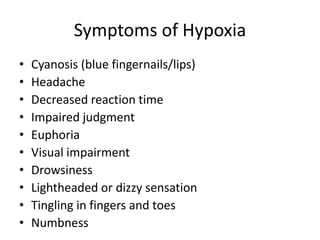
Symptoms of HypoxiaCyanosis (blue fingernails/lips)HeadacheDecreased reaction timeImpaired judgmentEuphoriaVisual impairmentDrowsinessLightheaded or dizzy sensationTingling in fingers and toesNumbness
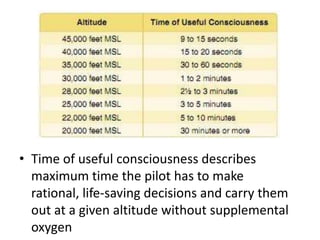
Time of useful consciousness describes maximum time the pilot has to make rational, life-saving decisions and carry them out at a given altitude without supplemental oxygen
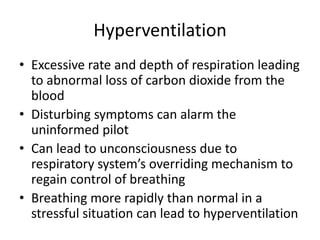
HyperventilationExcessive rate and depth of respiration leading to abnormal loss of carbon dioxide from the bloodDisturbing symptoms can alarm the uninformed pilotCan lead to unconsciousness due to respiratory system’s overriding mechanism to regain control of breathingBreathing more rapidly than normal in a stressful situation can lead to hyperventilation
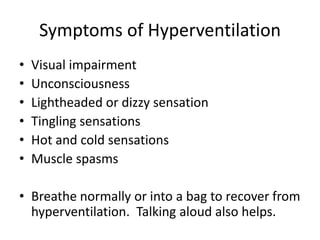
Symptoms of HyperventilationVisual impairmentUnconsciousnessLightheaded or dizzy sensationTingling sensationsHot and cold sensationsMuscle spasmsBreathe normally or into a bag to recover from hyperventilation.  Talking aloud also helps.
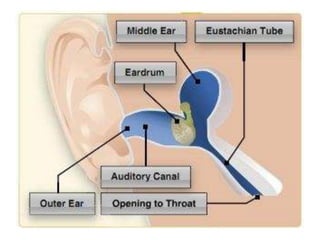
Middle Ear and Sinus ProblemsAir inside body cavities expands due to difference in air pressure at higher altitudesMiddle ear is a small cavity located in the bone of the skullAir can get trapped inside middle ear and cause a uncomfortable difference in pressure internally and externallyGreater external pressure, eardrum will bulge inward; greater internal pressure, eardrum will bulge outward
Middle Ear and Sinus ProblemsThis is why you don’t go flying when you’re sick!!!Swelling can cause closing of Eustachian tube and pressure difference cannot be relievedCan be damaging to eardrumsAir pressure in sinuses also equalizes with pressure in flight deck that connect sinuses to nasal passagesRespiratory infection, allergies, colds, etc. can lead to slow equalization and cause discomfort
Spatial DisorientationLack of orientation with regard to position, attitude, or movement of airplane in spaceThree body systems working together to decide orientation in space:1. vestibular system: organs in inner ear that sense position by balance2. somatosensory system: nerves in skin, muscles, and joints which, along with hearing, sense position based on gravity, feeling, sound3. visual system: eyes sense position based on what is seenFlying can sometimes cause systems to supply conflicting information to the brain, leading to disorientation
Carbon Monoxide (CO) PoisoningCO is a colorless, odorless gas produced by all internal combustion enginesCO prevents hemoglobin from carrying oxygen to cells, resulting in hypoxiaBody requires up to 48 hours to dispose of COIf CO poisoning is severe enough, it can lead to death
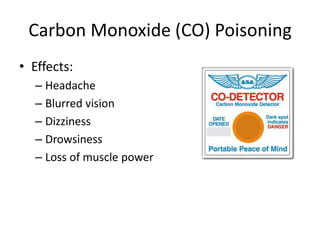
Carbon Monoxide (CO) PoisoningEffects:HeadacheBlurred visionDizzinessDrowsinessLoss of muscle power
StressBody’s response to physical and psychological demands placed upon itStressor is an element that causes stressPhysical stress (noise or vibration)Physiological stress (fatigue)Psychological stress (difficult work or personal situations)Acute stressImmediate threat that is perceived as danger“Fight or Flight”Can lead to chronic stressChronic stressLevel of stress that presents an intolerable burden, exceeds the ability of an individual to cope, and causes individual performance to fall sharply
FatigueFREQUENTLY ASSOCIATED WITH PILOT ERRORAcuteShort termNormal occurrence in everyday livingChronicLong termUsually has psychological rootsBest way to prevent is to get adequate rest
Vision in FlightOf all senses, vision is most important for flightStructure of eye includes an aperture, lens, mechanism for focusing, and surface for registering imagesRods and cones are light-sensitive cells that convert light energy into electrical signals that are sent to the brainConesResponsible for all color visionConcentrated toward center of field of visionRodsResponsible for detecting movement and provide vision in dim lightNo rods or cones in area where optic nerve enters eyeball leaves blind spot in field of vision
Find Your Blind Spot
AutokinesisCaused by staring at a single point of light against dark background for more than a few secondsLight appears to move on its own after a few momentsFocus eyes on objects at varying distances to prevent illusion and avoid fixating on one target
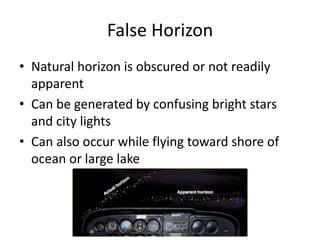
False HorizonNatural horizon is obscured or not readily apparentCan be generated by confusing bright stars and city lightsCan also occur while flying toward shore of ocean or large lake
Night IllusionsPilots are more likely to fly a lower-than-normal approachLights should always be as dim as possible during landing so as to have correct depth perceptionVisual obscurities can cause night illusionsRainHaze
Aeromedical Factors (Groups B/D)

Aeromedical Factors (Groups B/D)

  • 1.
  • 2.
    Essential QuestionsWhat isa medical certificate and what ranks are there?What different types of physiological factors can affect pilots during flight?In what ways can your vision trick you during flight?
  • 3.
    Obtaining a MedicalCertificateValid medical certificate required to exercise privileges of airman certificates (exception of glider and free balloon pilots)Acquisition of medical requires exam by AME (aviation medical examiner)
  • 4.
    Obtaining a MedicalCertificateThird classRequired for private or recreational3 years for under 40 years old, 2 years otherwiseSecond classRequired for commercial1 yearFirst classRequired for ATP6 months
  • 5.
    Obtaining a MedicalCertificateHigher the class, more rigorous the standardsHigher class medicals have met requirements for lower classesFirst class lasts for 2 (or 3) years for private/recreational, same applies for second class14 CFR part 6714 CFR part 61
  • 6.
    Physiological Factors AffectingPilot PerformanceHypoxiaHyperventilationMiddle Ear/Sinus ProblemsSpatial DisorientationIllusionsPostureMotion SicknessCO PoisoningStressFatigueDehydration/HeatstrokeAlcoholDrugs
  • 7.
    HypoxiaMeans “reduced oxygen”or “not enough oxygen”Most concern is with getting enough oxygen to brainReduction in mental function while flying can result in life-threatening errorsHypoxia can be caused by insufficient supply of oxygen, inadequate transportation of oxygen, or inability of the body tissues to use oxygen
  • 8.
    Symptoms of HypoxiaCyanosis(blue fingernails/lips)HeadacheDecreased reaction timeImpaired judgmentEuphoriaVisual impairmentDrowsinessLightheaded or dizzy sensationTingling in fingers and toesNumbness
  • 9.
    Time of usefulconsciousness describes maximum time the pilot has to make rational, life-saving decisions and carry them out at a given altitude without supplemental oxygen
  • 10.
    HyperventilationExcessive rate anddepth of respiration leading to abnormal loss of carbon dioxide from the bloodDisturbing symptoms can alarm the uninformed pilotCan lead to unconsciousness due to respiratory system’s overriding mechanism to regain control of breathingBreathing more rapidly than normal in a stressful situation can lead to hyperventilation
  • 11.
    Symptoms of HyperventilationVisualimpairmentUnconsciousnessLightheaded or dizzy sensationTingling sensationsHot and cold sensationsMuscle spasmsBreathe normally or into a bag to recover from hyperventilation. Talking aloud also helps.
  • 12.
    Middle Ear andSinus ProblemsAir inside body cavities expands due to difference in air pressure at higher altitudesMiddle ear is a small cavity located in the bone of the skullAir can get trapped inside middle ear and cause a uncomfortable difference in pressure internally and externallyGreater external pressure, eardrum will bulge inward; greater internal pressure, eardrum will bulge outward
  • 14.
    Middle Ear andSinus ProblemsThis is why you don’t go flying when you’re sick!!!Swelling can cause closing of Eustachian tube and pressure difference cannot be relievedCan be damaging to eardrumsAir pressure in sinuses also equalizes with pressure in flight deck that connect sinuses to nasal passagesRespiratory infection, allergies, colds, etc. can lead to slow equalization and cause discomfort
  • 15.
    Spatial DisorientationLack oforientation with regard to position, attitude, or movement of airplane in spaceThree body systems working together to decide orientation in space:1. vestibular system: organs in inner ear that sense position by balance2. somatosensory system: nerves in skin, muscles, and joints which, along with hearing, sense position based on gravity, feeling, sound3. visual system: eyes sense position based on what is seenFlying can sometimes cause systems to supply conflicting information to the brain, leading to disorientation
  • 16.
    Carbon Monoxide (CO)PoisoningCO is a colorless, odorless gas produced by all internal combustion enginesCO prevents hemoglobin from carrying oxygen to cells, resulting in hypoxiaBody requires up to 48 hours to dispose of COIf CO poisoning is severe enough, it can lead to death
  • 17.
    Carbon Monoxide (CO)PoisoningEffects:HeadacheBlurred visionDizzinessDrowsinessLoss of muscle power
  • 18.
    StressBody’s response tophysical and psychological demands placed upon itStressor is an element that causes stressPhysical stress (noise or vibration)Physiological stress (fatigue)Psychological stress (difficult work or personal situations)Acute stressImmediate threat that is perceived as danger“Fight or Flight”Can lead to chronic stressChronic stressLevel of stress that presents an intolerable burden, exceeds the ability of an individual to cope, and causes individual performance to fall sharply
  • 19.
    FatigueFREQUENTLY ASSOCIATED WITHPILOT ERRORAcuteShort termNormal occurrence in everyday livingChronicLong termUsually has psychological rootsBest way to prevent is to get adequate rest
  • 21.
    Vision in FlightOfall senses, vision is most important for flightStructure of eye includes an aperture, lens, mechanism for focusing, and surface for registering imagesRods and cones are light-sensitive cells that convert light energy into electrical signals that are sent to the brainConesResponsible for all color visionConcentrated toward center of field of visionRodsResponsible for detecting movement and provide vision in dim lightNo rods or cones in area where optic nerve enters eyeball leaves blind spot in field of vision
  • 22.
  • 23.
    AutokinesisCaused by staringat a single point of light against dark background for more than a few secondsLight appears to move on its own after a few momentsFocus eyes on objects at varying distances to prevent illusion and avoid fixating on one target
  • 24.
    False HorizonNatural horizonis obscured or not readily apparentCan be generated by confusing bright stars and city lightsCan also occur while flying toward shore of ocean or large lake
  • 25.
    Night IllusionsPilots aremore likely to fly a lower-than-normal approachLights should always be as dim as possible during landing so as to have correct depth perceptionVisual obscurities can cause night illusionsRainHaze