Using Hierarchical Modeling to Assist Effects Based Planning and Assessment Lt Col Dave “Doc” Denhard, PhD Maj Robert “Dagwood” Umstead Air Force Institute of Technology Wright-Patterson, Air Force Base Ohio United States The views expressed in this presentation are those of the authors and do not reflect the official policy or  position of the Air Force, Department of Defense or the U.S. Government. Contact info: [email_address] 01-937-255-3355 X3325
Overview Effects-Based Operations (EBO) Air Force Institute of Technology (AFIT) EBO Research Stream Dimensionality and EBO Course of Action (COA) and EBO Risk Filtering, Ranking, and Management (RFRM) Methodology Guiding Principles COA Development, Evaluation, and Selection Observations Continuing Research
Effects-Based Operations Enemy Systems of Systems Model Effect 1 Action (via Resource) [Node A] [Node B] [Node C] Friendly Course of Action (COA) Against  An Enemy System Node Effect 2 (Desired) Effect 3 (Undesired) Objective “ Operations that are  planned, executed, assessed, and adapted based on a holistic understanding  of the operational environment in order to influence or change  system behavior  or  capabilities   using the integrated application of selected instruments of power to achieve directed policy aims.”  JFCOM JWFC Doctrine Pamphlet 7, Nov 04 Political Political Social Social Military Economic Economic Information Information Infrastructure Infrastructure A B C
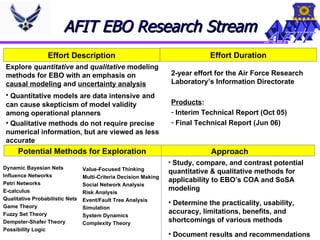
AFIT EBO Research Stream Approach Potential Methods for Exploration Effort Description Explore  quantitative  and  qualitative  modeling methods for EBO with an emphasis on  causal modeling  and  uncertainty analysis Quantitative models are data intensive   and can cause skepticism of model validity among operational planners Qualitative methods do not require precise numerical information, but are viewed as less accurate Study, compare, and contrast potential quantitative & qualitative methods for applicability to EBO’s COA and SoSA modeling Determine the practicality, usability, accuracy, limitations, benefits, and shortcomings of various methods Document results and recommendations Dynamic Bayesian Nets Influence Networks Petri Networks E-calculus Qualitative Probabilistic Nets Game Theory Fuzzy Set Theory Dempster-Shafer Theory Possibility Logic Value-Focused Thinking Multi-Criteria Decision Making Social Network Analysis Risk Analysis Event/Fault Tree Analysis Simulation System Dynamics Complexity Theory Effort Duration 2-year effort for the Air Force Research Laboratory’s Information Directorate Products : Interim Technical Report (Oct 05) Final Technical Report (Jun 06)
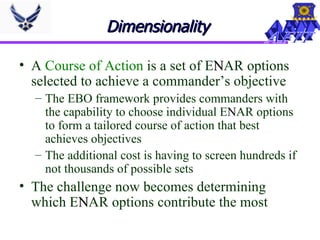
Dimensionality  A  Course of Action  is a set of E N AR options selected to achieve a commander’s objective The EBO framework provides commanders with the capability to choose individual E N AR options to form a tailored course of action that best achieves objectives The additional cost is having to screen hundreds if not thousands of possible sets The challenge now becomes determining which E N AR options contribute the most
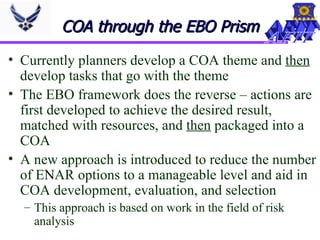
COA through the EBO Prism Currently planners develop a COA theme and  then  develop tasks that go with the theme The EBO framework does the reverse – actions are first developed to achieve the desired result, matched with resources, and  then  packaged into a COA A new approach is introduced to reduce the number of E N AR options to a manageable level and aid in COA development, evaluation, and selection This approach is based on work in the field of risk analysis
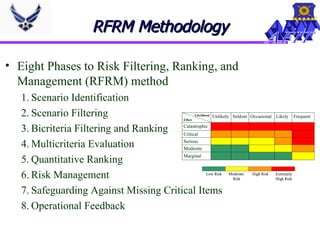
RFRM Methodology Eight Phases to Risk Filtering, Ranking, and Management (RFRM) method Scenario Identification Scenario Filtering Bicriteria Filtering and Ranking Multicriteria Evaluation Quantitative Ranking Risk Management Safeguarding Against Missing Critical Items Operational Feedback
Guiding Principles Qualitative-based filtering of E N AR options is required to solve the dimensionality problem All sources of evidence must be applied Professional experience, expert knowledge, statistical data, and common sense Must answer (as a minimum) four questions? What ENAR options are supportable with resources?  What is the likelihood that a given set of ENAR options will accomplish the desired effects? What are the consequences of executing a given set of ENAR options to our force?  What impact will current decisions have on future options?
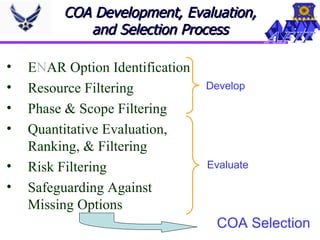
COA Development, Evaluation, and Selection Process E N AR Option Identification Resource Filtering Phase & Scope Filtering Quantitative Evaluation, Ranking, & Filtering Risk Filtering Safeguarding Against Missing Options Develop Evaluate COA Selection
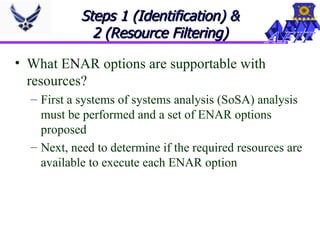
Steps 1 (Identification) & 2 (Resource Filtering) What E N AR options are supportable with resources? First a systems of systems analysis (SoSA) analysis must be performed and a set of ENAR options proposed Next, need to determine if the required resources are available to execute each ENAR option
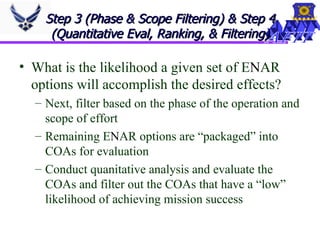
Step 3 (Phase & Scope Filtering) & Step 4 (Quantitative Eval, Ranking, & Filtering) What is the likelihood a given set of E N AR options will accomplish the desired effects? Next, filter based on the phase of the operation and scope of effort Remaining E N AR options are “packaged” into COAs for evaluation Conduct quanitative analysis and evaluate the COAs and filter out the COAs that have a “low” likelihood of achieving mission success
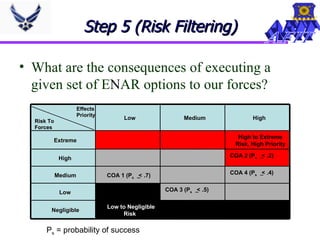
Step 5 (Risk Filtering) What are the consequences of executing a given set of E N AR options to our forces? P s  = probability of success Low to Negligible  Risk Negligible Negligible COA 3 (Ps  < .5) Low Low COA 4 (Ps  < .4) COA 1 (Ps  < .7) Medium Medium COA 2 (Ps  < .2) High High High to Extreme  Risk, High Priority Extreme Extreme High High Medium Medium Low Low Low to Negligible  Risk Negligible Negligible COA 3 (P s   < .5) Low Low COA 4 (P s   < .4) COA 1 (P s   < .7) Medium Medium COA 2 (P s   < .2) High High High to Extreme  Risk, High Priority Extreme Extreme High High Medium Medium Low Low Risk To Risk To Forces Forces Effects Effects Priority Priority
Step 6 (Safeguarding) What impact will current options have on future options? Previous filtered ENAR options are reviewed within the context of the selected COAs to determine potential impacts
Deliberate Vs. Crisis Action Planning In  deliberate planning  there is generally time to take  both  a quantitative and qualitative approach to determine the likelihood of success as well as the impact on future options On the other hand, in  crisis action planning  time constraints are significant.  Quantitative steps could be eliminated from the ranking of candidate COAs
Observations Generation of E N AR options Complexity vs. Reduction Analysis Methodologies Single vs. Multiple Information requirements Uncertainty of Cause and Effect Action produces   Effect Effect  attains  Objective
Continuing AFIT Research Our research has expanded beyond this initial work to include: Characterization of Uncertainty in EBO Planning and Assessment Complex Systems Analysis of EBO networks Cause and Effect Modeling Multiobjective Analysis of Operational Objectives
End of Using Hierarchical Modeling to Assist Effects Based Planning and Assessment Presentation

Effects Based Planning And Assessment

  • 1.
    Using Hierarchical Modelingto Assist Effects Based Planning and Assessment Lt Col Dave “Doc” Denhard, PhD Maj Robert “Dagwood” Umstead Air Force Institute of Technology Wright-Patterson, Air Force Base Ohio United States The views expressed in this presentation are those of the authors and do not reflect the official policy or position of the Air Force, Department of Defense or the U.S. Government. Contact info: [email_address] 01-937-255-3355 X3325
  • 2.
    Overview Effects-Based Operations(EBO) Air Force Institute of Technology (AFIT) EBO Research Stream Dimensionality and EBO Course of Action (COA) and EBO Risk Filtering, Ranking, and Management (RFRM) Methodology Guiding Principles COA Development, Evaluation, and Selection Observations Continuing Research
  • 3.
    Effects-Based Operations EnemySystems of Systems Model Effect 1 Action (via Resource) [Node A] [Node B] [Node C] Friendly Course of Action (COA) Against An Enemy System Node Effect 2 (Desired) Effect 3 (Undesired) Objective “ Operations that are planned, executed, assessed, and adapted based on a holistic understanding of the operational environment in order to influence or change system behavior or capabilities using the integrated application of selected instruments of power to achieve directed policy aims.” JFCOM JWFC Doctrine Pamphlet 7, Nov 04 Political Political Social Social Military Economic Economic Information Information Infrastructure Infrastructure A B C
  • 4.
    AFIT EBO ResearchStream Approach Potential Methods for Exploration Effort Description Explore quantitative and qualitative modeling methods for EBO with an emphasis on causal modeling and uncertainty analysis Quantitative models are data intensive and can cause skepticism of model validity among operational planners Qualitative methods do not require precise numerical information, but are viewed as less accurate Study, compare, and contrast potential quantitative & qualitative methods for applicability to EBO’s COA and SoSA modeling Determine the practicality, usability, accuracy, limitations, benefits, and shortcomings of various methods Document results and recommendations Dynamic Bayesian Nets Influence Networks Petri Networks E-calculus Qualitative Probabilistic Nets Game Theory Fuzzy Set Theory Dempster-Shafer Theory Possibility Logic Value-Focused Thinking Multi-Criteria Decision Making Social Network Analysis Risk Analysis Event/Fault Tree Analysis Simulation System Dynamics Complexity Theory Effort Duration 2-year effort for the Air Force Research Laboratory’s Information Directorate Products : Interim Technical Report (Oct 05) Final Technical Report (Jun 06)
  • 5.
    Dimensionality A Course of Action is a set of E N AR options selected to achieve a commander’s objective The EBO framework provides commanders with the capability to choose individual E N AR options to form a tailored course of action that best achieves objectives The additional cost is having to screen hundreds if not thousands of possible sets The challenge now becomes determining which E N AR options contribute the most
  • 6.
    COA through theEBO Prism Currently planners develop a COA theme and then develop tasks that go with the theme The EBO framework does the reverse – actions are first developed to achieve the desired result, matched with resources, and then packaged into a COA A new approach is introduced to reduce the number of E N AR options to a manageable level and aid in COA development, evaluation, and selection This approach is based on work in the field of risk analysis
  • 7.
    RFRM Methodology EightPhases to Risk Filtering, Ranking, and Management (RFRM) method Scenario Identification Scenario Filtering Bicriteria Filtering and Ranking Multicriteria Evaluation Quantitative Ranking Risk Management Safeguarding Against Missing Critical Items Operational Feedback
  • 8.
    Guiding Principles Qualitative-basedfiltering of E N AR options is required to solve the dimensionality problem All sources of evidence must be applied Professional experience, expert knowledge, statistical data, and common sense Must answer (as a minimum) four questions? What ENAR options are supportable with resources? What is the likelihood that a given set of ENAR options will accomplish the desired effects? What are the consequences of executing a given set of ENAR options to our force? What impact will current decisions have on future options?
  • 9.
    COA Development, Evaluation,and Selection Process E N AR Option Identification Resource Filtering Phase & Scope Filtering Quantitative Evaluation, Ranking, & Filtering Risk Filtering Safeguarding Against Missing Options Develop Evaluate COA Selection
  • 10.
    Steps 1 (Identification)& 2 (Resource Filtering) What E N AR options are supportable with resources? First a systems of systems analysis (SoSA) analysis must be performed and a set of ENAR options proposed Next, need to determine if the required resources are available to execute each ENAR option
  • 11.
    Step 3 (Phase& Scope Filtering) & Step 4 (Quantitative Eval, Ranking, & Filtering) What is the likelihood a given set of E N AR options will accomplish the desired effects? Next, filter based on the phase of the operation and scope of effort Remaining E N AR options are “packaged” into COAs for evaluation Conduct quanitative analysis and evaluate the COAs and filter out the COAs that have a “low” likelihood of achieving mission success
  • 12.
    Step 5 (RiskFiltering) What are the consequences of executing a given set of E N AR options to our forces? P s = probability of success Low to Negligible Risk Negligible Negligible COA 3 (Ps < .5) Low Low COA 4 (Ps < .4) COA 1 (Ps < .7) Medium Medium COA 2 (Ps < .2) High High High to Extreme Risk, High Priority Extreme Extreme High High Medium Medium Low Low Low to Negligible Risk Negligible Negligible COA 3 (P s < .5) Low Low COA 4 (P s < .4) COA 1 (P s < .7) Medium Medium COA 2 (P s < .2) High High High to Extreme Risk, High Priority Extreme Extreme High High Medium Medium Low Low Risk To Risk To Forces Forces Effects Effects Priority Priority
  • 13.
    Step 6 (Safeguarding)What impact will current options have on future options? Previous filtered ENAR options are reviewed within the context of the selected COAs to determine potential impacts
  • 14.
    Deliberate Vs. CrisisAction Planning In deliberate planning there is generally time to take both a quantitative and qualitative approach to determine the likelihood of success as well as the impact on future options On the other hand, in crisis action planning time constraints are significant. Quantitative steps could be eliminated from the ranking of candidate COAs
  • 15.
    Observations Generation ofE N AR options Complexity vs. Reduction Analysis Methodologies Single vs. Multiple Information requirements Uncertainty of Cause and Effect Action produces Effect Effect attains Objective
  • 16.
    Continuing AFIT ResearchOur research has expanded beyond this initial work to include: Characterization of Uncertainty in EBO Planning and Assessment Complex Systems Analysis of EBO networks Cause and Effect Modeling Multiobjective Analysis of Operational Objectives
  • 17.
    End of UsingHierarchical Modeling to Assist Effects Based Planning and Assessment Presentation

Editor's Notes

  • #2 Authors: Lt Col Dave Denhard Assistant Professor Department of Operational Sciences Air Force Institute of Technology Maj Robert Umstead Student, School of Advanced Military Studies Ft. Leavenworth, KS