GENRE
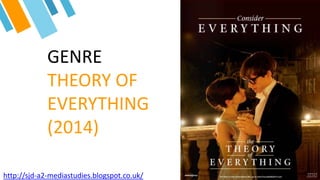
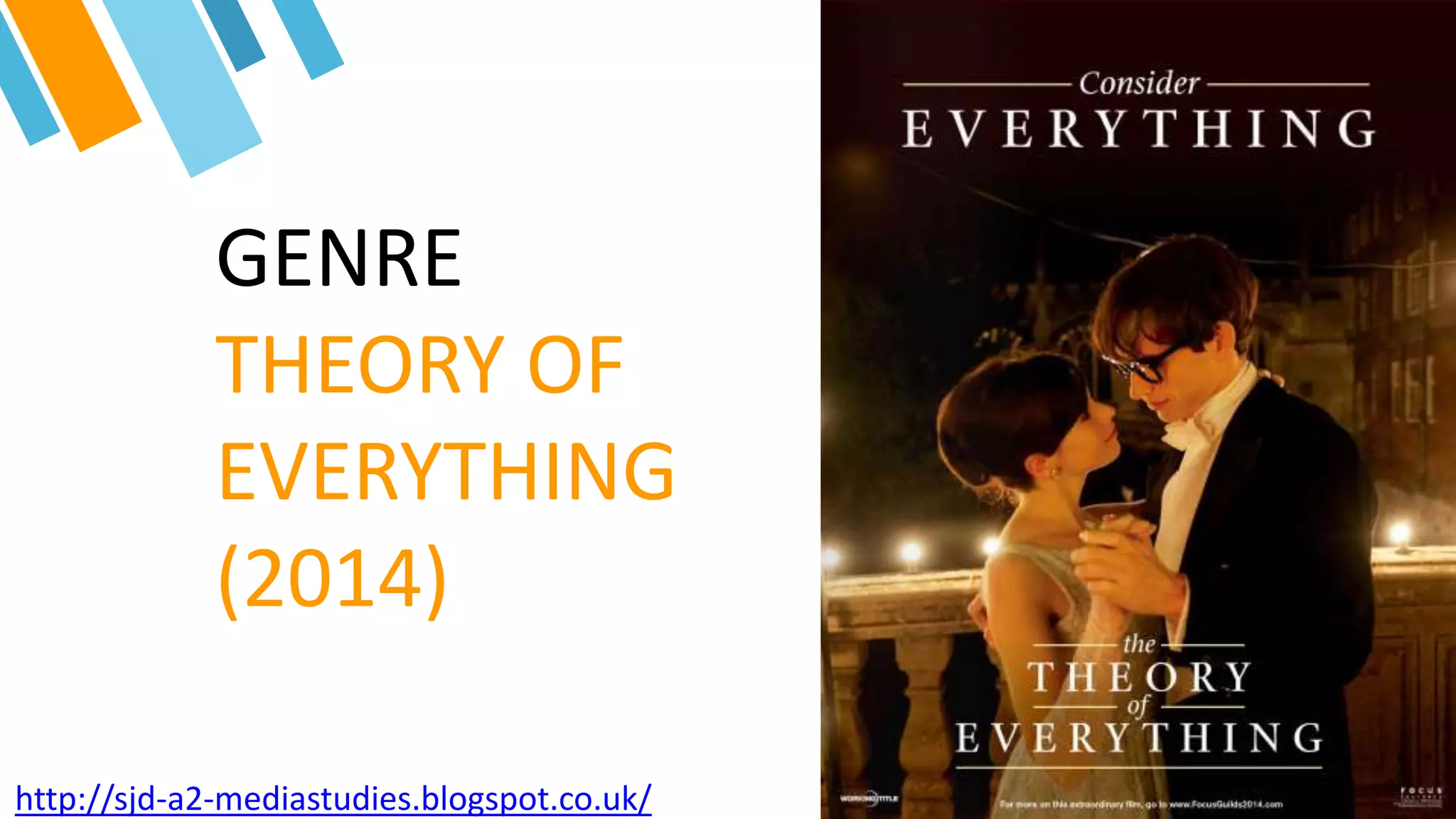
THEORY OF
EVERYTHING
(2014)
http://sjd-a2-mediastudies.blogspot.co.uk/
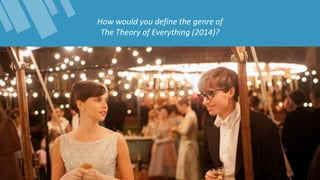
How would you define the genre of
The Theory of Everything (2014)?
GENRE
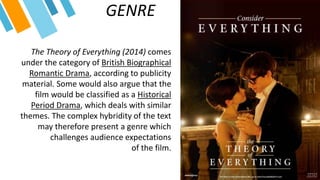
The Theory of Everything (2014) comes
under the category of British Biographical
Romantic Drama, according to publicity
material. Some would also argue that the
film would be classified as a Historical
Period Drama, which deals with similar
themes. The complex hybridity of the text
may therefore present a genre which
challenges audience expectations
of the film.
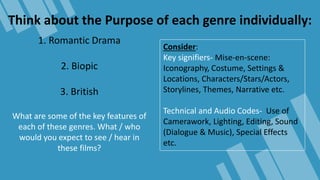
Think about the Purpose of each genre individually:
Consider:
Key signifiers- Mise-en-scene:
Iconography, Costume, Settings &
Locations, Characters/Stars/Actors,
Storylines, Themes, Narrative etc.
Technical and Audio Codes- Use of
Camerawork, Lighting, Editing, Sound
(Dialogue & Music), Special Effects
etc.
1. Romantic Drama
2. Biopic
3. British
What are some of the key features of
each of these genres. What / who
would you expect to see / hear in
these films?
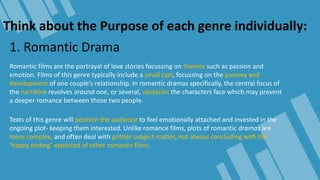
Think about the Purpose of each genre individually:
Romantic films are the portrayal of love stories focussing on themes such as passion and
emotion. Films of this genre typically include a small cast, focussing on the journey and
development of one couple’s relationship. In romantic dramas specifically, the central focus of
the narrative revolves around one, or several, obstacles the characters face which may prevent
a deeper romance between those two people.
Texts of this genre will position the audience to feel emotionally attached and invested in the
ongoing plot- keeping them interested. Unlike romance films, plots of romantic dramas are
more complex, and often deal with grittier subject matter, not always concluding with the
‘happy ending’ expected of other romantic films.
1. Romantic Drama
Think about the Purpose of each genre individually:
Biographical films (or Biopics) are films which dramatize the life of a non-fictional person.
Films of this genre aim to show the life of a historical person making references to their
personal lives, work, friends and family. The central character is referred to by their real name.
In comparison to films that are ‘based on a true story’, Biopics attempt to comprehensively tell
a person’s life story (or at the very least, the most historically important years of their lives.
2b. Historical Period Drama
Similarly, historical period dramas refer to a text which is set in an earlier time period. This
term does not lend itself to one specific genre and can instead be applied to several. Historical
Period Dramas are based on historical events and, typically, famous people.
2. Biopic
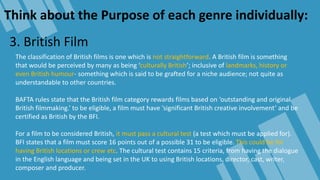
Think about the Purpose of each genre individually:
3. British Film
The classification of British films is one which is not straightforward. A British film is something
that would be perceived by many as being ‘culturally British’; inclusive of landmarks, history or
even British humour- something which is said to be grafted for a niche audience; not quite as
understandable to other countries.
BAFTA rules state that the British film category rewards films based on ‘outstanding and original
British filmmaking.’ to be eligible, a film must have ‘significant British creative involvement’ and be
certified as British by the BFI.
For a film to be considered British, it must pass a cultural test (a test which must be applied for).
BFI states that a film must score 16 points out of a possible 31 to be eligible. This could be for
having British locations or crew etc. The cultural test contains 15 criteria, from having the dialogue
in the English language and being set in the UK to using British locations, director, cast, writer,
composer and producer.
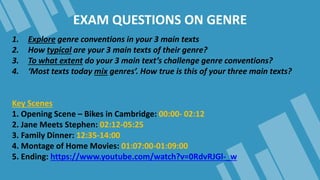
EXAM QUESTIONS ON GENRE
1. Explore genre conventions in your 3 main texts
2. How typical are your 3 main texts of their genre?
3. To what extent do your 3 main text’s challenge genre conventions?
4. ‘Most texts today mix genres’. How true is this of your three main texts?
Key Scenes
1. Opening Scene – Bikes in Cambridge: 00:00- 02:12
2. Jane Meets Stephen: 02:12-05:25
3. Family Dinner: 12:35-14:00
4. Montage of Home Movies: 01:07:00-01:09:00
5. Ending: https://www.youtube.com/watch?v=0RdvRJGl-_w
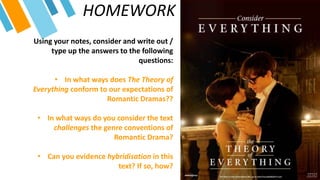
HOMEWORK
Using your notes, consider and write out /
type up the answers to the following
questions:
• In what ways does The Theory of
Everything conform to our expectations of
Romantic Dramas??
• In what ways do you consider the text
challenges the genre conventions of
Romantic Drama?
• Can you evidence hybridisation in this
text? If so, how?

Genre theory of everything

  • 1.
  • 2.
    How would youdefine the genre of The Theory of Everything (2014)?
  • 3.
    GENRE The Theory ofEverything (2014) comes under the category of British Biographical Romantic Drama, according to publicity material. Some would also argue that the film would be classified as a Historical Period Drama, which deals with similar themes. The complex hybridity of the text may therefore present a genre which challenges audience expectations of the film.
  • 4.
    Think about thePurpose of each genre individually: Consider: Key signifiers- Mise-en-scene: Iconography, Costume, Settings & Locations, Characters/Stars/Actors, Storylines, Themes, Narrative etc. Technical and Audio Codes- Use of Camerawork, Lighting, Editing, Sound (Dialogue & Music), Special Effects etc. 1. Romantic Drama 2. Biopic 3. British What are some of the key features of each of these genres. What / who would you expect to see / hear in these films?
  • 5.
    Think about thePurpose of each genre individually: Romantic films are the portrayal of love stories focussing on themes such as passion and emotion. Films of this genre typically include a small cast, focussing on the journey and development of one couple’s relationship. In romantic dramas specifically, the central focus of the narrative revolves around one, or several, obstacles the characters face which may prevent a deeper romance between those two people. Texts of this genre will position the audience to feel emotionally attached and invested in the ongoing plot- keeping them interested. Unlike romance films, plots of romantic dramas are more complex, and often deal with grittier subject matter, not always concluding with the ‘happy ending’ expected of other romantic films. 1. Romantic Drama
  • 6.
    Think about thePurpose of each genre individually: Biographical films (or Biopics) are films which dramatize the life of a non-fictional person. Films of this genre aim to show the life of a historical person making references to their personal lives, work, friends and family. The central character is referred to by their real name. In comparison to films that are ‘based on a true story’, Biopics attempt to comprehensively tell a person’s life story (or at the very least, the most historically important years of their lives. 2b. Historical Period Drama Similarly, historical period dramas refer to a text which is set in an earlier time period. This term does not lend itself to one specific genre and can instead be applied to several. Historical Period Dramas are based on historical events and, typically, famous people. 2. Biopic
  • 7.
    Think about thePurpose of each genre individually: 3. British Film The classification of British films is one which is not straightforward. A British film is something that would be perceived by many as being ‘culturally British’; inclusive of landmarks, history or even British humour- something which is said to be grafted for a niche audience; not quite as understandable to other countries. BAFTA rules state that the British film category rewards films based on ‘outstanding and original British filmmaking.’ to be eligible, a film must have ‘significant British creative involvement’ and be certified as British by the BFI. For a film to be considered British, it must pass a cultural test (a test which must be applied for). BFI states that a film must score 16 points out of a possible 31 to be eligible. This could be for having British locations or crew etc. The cultural test contains 15 criteria, from having the dialogue in the English language and being set in the UK to using British locations, director, cast, writer, composer and producer.
  • 8.
    EXAM QUESTIONS ONGENRE 1. Explore genre conventions in your 3 main texts 2. How typical are your 3 main texts of their genre? 3. To what extent do your 3 main text’s challenge genre conventions? 4. ‘Most texts today mix genres’. How true is this of your three main texts? Key Scenes 1. Opening Scene – Bikes in Cambridge: 00:00- 02:12 2. Jane Meets Stephen: 02:12-05:25 3. Family Dinner: 12:35-14:00 4. Montage of Home Movies: 01:07:00-01:09:00 5. Ending: https://www.youtube.com/watch?v=0RdvRJGl-_w
  • 9.
    HOMEWORK Using your notes,consider and write out / type up the answers to the following questions: • In what ways does The Theory of Everything conform to our expectations of Romantic Dramas?? • In what ways do you consider the text challenges the genre conventions of Romantic Drama? • Can you evidence hybridisation in this text? If so, how?

Editor's Notes

  • #2 http://sjd-a2-mediastudies.blogspot.co.uk/