1 
Linear Approximation
2 
Outline 
 Review of Linear Approximation for 
Nonlinear Terms 
 A Case Study 
 Renewable Sensor Networks with Wireless 
Energy Transfer
Linear Approximation 
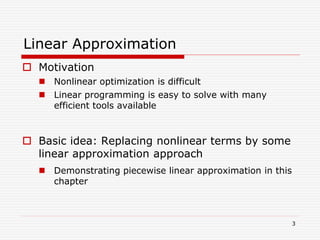
 Motivation 
 Nonlinear optimization is difficult 
 Linear programming is easy to solve with many 
efficient tools available 
 Basic idea: Replacing nonlinear terms by some 
linear approximation approach 
 Demonstrating piecewise linear approximation in this 
chapter 
3
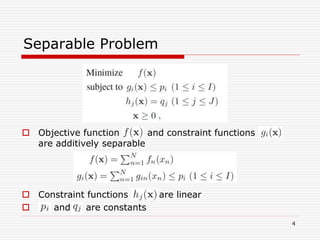
Separable Problem 
4 
 Objective function and constraint functions 
are additively separable 
 Constraint functions are linear 
 and are constants
Piecewise Linear Approximation 
휇 = 휆푘−1휇푘−1 + 휆푘 휇푘 
휃 (휇) = 휆푘−1휃(휇푘−1) + 휆푘휃(휇푘) 
 : A continuous nonlinear function 
 : A linear approximation of 
5 
휃(·) 
휃 (·) 휃 (휇) 
휃(휇) 
휇0 = 푎 휇1 휇휇2 
푘−1 휇 휇푘 휇푚 = 푏
Piecewise Linear Approximation (cont’d) 
 General math expression for 
 : Weight for each grid point 
 Only two continuous and can be positive 
 All other must be zero 
 휃 푢 is defined as 
6
Piecewise Linear Approximation (cont’d) 
 : A binary variable indicates whether falls within 
the k-th segment 
 Relationship between and 
7
Piecewise Linear Approximation (cont’d) 
 Back to the separable problem 
 Replacing each nonlinear function and 
by its piecewise linear approximation 
 The solution to the linear approximating problem 
may or may not be feasible to the original 
separable problem 
 Feasible: Accuracy/complexity vs. number of grid points 
 Infeasible: Construct a feasible solution by local search 
8
9 
Outline 
 Review of Linear Approximation for 
Nonlinear Terms 
 A Case Study 
 Renewable Sensor Networks with Wireless 
Energy Transfer
Wireless Sensor Networks (WSNs) 
 Sensor nodes 
 Sensing multi-media (video, audio 
etc.) and scalar data (temperature, 
pressure, light etc. ) 
 Transmitting data to the base 
station via multi-hop 
 Battery-powered 
 Network lifetime 
 Limited by battery outage 
 Tremendous research efforts 
 Energy-harvesting 
10
WSNs (cont’d) 
 But lifetime remains a major performance 
bottleneck 
 Our objective 
 Remove the fundamental performance bottleneck 
 Motivated by the recent breakthrough in wireless 
energy transfer 
11
Wireless Energy Transfer 
 Dated back to the early 1900s 
by Nikola Tesla 
 Radiative mode by omni-directional 
antennas 
 Low efficiency 
 Never put into practice use 
12
Wireless Energy Transfer (cont’d) 
 Little progress over nearly a century 
 In early 1990, the critical need of 
wireless power transfer re-emerged 
 Example: electric toothbrush 
 Limited applications due to 
stringent requirements 
 Omni-directional antennas: close in contact 
 Uni-directional antennas: accurate alignment in charging 
direction, uninterrupted line of sight 
13
Wireless Energy Transfer (cont’d) 
 A breakthrough technology: Magnetic resonance 
 Published in Science 2007 
 Non-radiative, based on resonant coupling 
 Omni-directional, mid-range (up to 2 meters) 
and efficient energy transfer 
A 60-W light bulb is lighted up from a distance 
of 2 meters away (by Kurs et al.) 
14
Experiment Setting 
15
Wireless Energy Transfer (cont’d) 
The emerging technology 
comes to reality! 
Demonstrated in 2009 TED Global 
The first No-tail TV was released at 
2010 International CES 
Wireless power 
consortium is setting 
the international 
standard for 
interoperable wireless 
charging 
Revolutionize how energy is 
exchanged in the near 
future! 
16
Problem Description 
Objective: 
1) Make sensor network 
work forever 
2) Maximize the 
percentage of 
vacation time 
Mobile Wireless 
Charging Vehicle (WCV) 
Sensor Node 
Base Station 
Service 
Station 
17
Three Basic Components 
 Traveling path 
(including direction) 
for WCV 
 Charging schedule 
at each node 
 Multi-hop data 
routing 
18
19 
Outline of Case Study 
 A Solution Procedure 
 Renewable energy cycle 
 The optimal traveling path for WCV 
 The optimal charging schedule and multi-hop data 
routing 
 Numerical Results
Renewable Energy Cycle 
i 
Arrival 
time 
Sensor Energy Behavior 
Departure 
time 
Vacation 
Time 
Two requirements for renewable 
energy cycle are: 
1. Starts and ends at the same 
energy level over a period of cycle. 
2. Energy level never falls below 퐸푚푖푛 
20
Optimal Traveling Path 
 In an optimal solution, the WCV must move 
along the shortest Hamiltonian cycle that crosses 
all sensor nodes and the service station 
 Obtained by solving the Traveling Salesman 
Problem (TSP) 
 The shortest cycle may not be unique 
 WCV can follow either direction 
 Any shortest path can achieve the same optimal 
objective 
21
Charging Schedule and Data Routing 
 Traveling path for 
WCV 
Charging schedule 
at each node 
Multi-hop data 
routing 
22
Optimization Problem 
The ratio of the WCV’s vacation time to a 
cycle time 
Data 
routing 
Charging 
schedule 
Consumed 
energy 
Nonlinear optimization problem: NP-hard in general. 
Routing 
constraint 
Energy 
consumption 
Time constraint 
Cycle 
constraints 
23
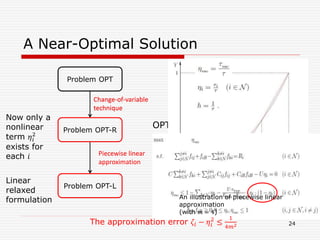
A Near-Optimal Solution 
24 
OPT-R 
Problem OPT 
Problem OPT-R 
Piecewise linear 
approximation 
Problem OPT-L 
Now only a 
nonlinear 
term 휂2 
푖 
exists for 
each 푖 
An illustration of piecewise linear 
approximation 
(with 푚 = 4) 
2 ≤ 
The approximation error 휁푖 − 휂푖 
1 
4푚2 
Change-of-variable 
technique 
Linear 
relaxed 
formulation
Performance Gap vs. Segment Number 
An upper bound is obtained 
by linear relaxation OPT-L 
Unknown optimal objective 
value of problem OPT 
UB 
LB A lower bound is obtained by 
feasible solution construction 
Estimated 
performance 
gap 
Performance 
gap 
Estimated performance gap is a decreasing function of m 
(the number of segments in approximation) 
25
Choosing Segment Number 
An upper bound by 
linear relaxation 
Unknown optimal 
objective value 
A feasible solution 
is constructed 
UB 
LB 
3) Construct a provable near-optimal solution 
Estimated 
performance 
gap < є 
Target 
performance 
gap є 
1) Given an arbitrarily small performance gap ϵ 
2) Choose an appropriate 푚 (a function of ϵ) 
26
Summary of Solution Approach 
 Traveling path for WCV 
 Charging schedule at each node 
 Multi-hop data routing 
The performance gap is no more than requirement є 
27
Sensor Energy Behavior 
- Complete Process 
1st renewable 
energy cycle 
The first renewable 
energy cycle starts. 
2nd renewable 
energy cycle 
Initial transient 
cycle 
The first renewable 
energy cycle ends, i.e., 
the second renewable 
energy cycle starts. 
0 
28
29 
Outline of Case Study 
 A Solution Procedure 
 Renewable energy cycle 
 The optimal traveling path for WCV 
 The optimal charging schedule and multi-hop data 
routing 
 Numerical Results
A 50-node Network 
ϵ = 0.01 
m = 4 
Cycle time = 30.73 hours 
Vacation time = 26.82 hours 
Percentage = 87.27% 
Optimal traveling path Charging schedule 
30
Results under Different Directions 
Identical charging 
schedule and flow 
routing 
Different arrival time 
and renewable cycle 
starting energy 
31
Bottleneck Node 
Provably show the 
existence of at least 
one “bottleneck” 
node in an optimal 
solution 
32 
Bottleneck node
Bottleneck Node (cont’d) 
The energy behavior of the bottleneck node 
33
Multi-hop Data Routing 
34
A 100-node network 
35 
ϵ = 0.01 
m = 5 
Cycle time = 58.52 hours 
Vacation time = 50.30 hours 
Percentage = 85.95%
Summary 
36 
 Review of Linear Approximation for Nonlinear 
Terms 
 A case study 
 Exploited recent breakthrough in wireless energy 
transfer technology for a WSN 
 Showed that a WSN can remain operational forever! 
 Studied a practical optimization problem 
 Objective: Maximizing the ratio of the WCV’s vacation 
time over the cycle time 
 Proved that the optimal traveling path is the shortest 
Hamiltonian cycle 
 Developed a provable near-optimal solution for both 
charging schedule and flow routing

Linear approximation

  • 1.
  • 2.
    2 Outline Review of Linear Approximation for Nonlinear Terms  A Case Study  Renewable Sensor Networks with Wireless Energy Transfer
  • 3.
    Linear Approximation Motivation  Nonlinear optimization is difficult  Linear programming is easy to solve with many efficient tools available  Basic idea: Replacing nonlinear terms by some linear approximation approach  Demonstrating piecewise linear approximation in this chapter 3
  • 4.
    Separable Problem 4  Objective function and constraint functions are additively separable  Constraint functions are linear  and are constants
  • 5.
    Piecewise Linear Approximation 휇 = 휆푘−1휇푘−1 + 휆푘 휇푘 휃 (휇) = 휆푘−1휃(휇푘−1) + 휆푘휃(휇푘)  : A continuous nonlinear function  : A linear approximation of 5 휃(·) 휃 (·) 휃 (휇) 휃(휇) 휇0 = 푎 휇1 휇휇2 푘−1 휇 휇푘 휇푚 = 푏
  • 6.
    Piecewise Linear Approximation(cont’d)  General math expression for  : Weight for each grid point  Only two continuous and can be positive  All other must be zero  휃 푢 is defined as 6
  • 7.
    Piecewise Linear Approximation(cont’d)  : A binary variable indicates whether falls within the k-th segment  Relationship between and 7
  • 8.
    Piecewise Linear Approximation(cont’d)  Back to the separable problem  Replacing each nonlinear function and by its piecewise linear approximation  The solution to the linear approximating problem may or may not be feasible to the original separable problem  Feasible: Accuracy/complexity vs. number of grid points  Infeasible: Construct a feasible solution by local search 8
  • 9.
    9 Outline Review of Linear Approximation for Nonlinear Terms  A Case Study  Renewable Sensor Networks with Wireless Energy Transfer
  • 10.
    Wireless Sensor Networks(WSNs)  Sensor nodes  Sensing multi-media (video, audio etc.) and scalar data (temperature, pressure, light etc. )  Transmitting data to the base station via multi-hop  Battery-powered  Network lifetime  Limited by battery outage  Tremendous research efforts  Energy-harvesting 10
  • 11.
    WSNs (cont’d) But lifetime remains a major performance bottleneck  Our objective  Remove the fundamental performance bottleneck  Motivated by the recent breakthrough in wireless energy transfer 11
  • 12.
    Wireless Energy Transfer  Dated back to the early 1900s by Nikola Tesla  Radiative mode by omni-directional antennas  Low efficiency  Never put into practice use 12
  • 13.
    Wireless Energy Transfer(cont’d)  Little progress over nearly a century  In early 1990, the critical need of wireless power transfer re-emerged  Example: electric toothbrush  Limited applications due to stringent requirements  Omni-directional antennas: close in contact  Uni-directional antennas: accurate alignment in charging direction, uninterrupted line of sight 13
  • 14.
    Wireless Energy Transfer(cont’d)  A breakthrough technology: Magnetic resonance  Published in Science 2007  Non-radiative, based on resonant coupling  Omni-directional, mid-range (up to 2 meters) and efficient energy transfer A 60-W light bulb is lighted up from a distance of 2 meters away (by Kurs et al.) 14
  • 15.
  • 16.
    Wireless Energy Transfer(cont’d) The emerging technology comes to reality! Demonstrated in 2009 TED Global The first No-tail TV was released at 2010 International CES Wireless power consortium is setting the international standard for interoperable wireless charging Revolutionize how energy is exchanged in the near future! 16
  • 17.
    Problem Description Objective: 1) Make sensor network work forever 2) Maximize the percentage of vacation time Mobile Wireless Charging Vehicle (WCV) Sensor Node Base Station Service Station 17
  • 18.
    Three Basic Components  Traveling path (including direction) for WCV  Charging schedule at each node  Multi-hop data routing 18
  • 19.
    19 Outline ofCase Study  A Solution Procedure  Renewable energy cycle  The optimal traveling path for WCV  The optimal charging schedule and multi-hop data routing  Numerical Results
  • 20.
    Renewable Energy Cycle i Arrival time Sensor Energy Behavior Departure time Vacation Time Two requirements for renewable energy cycle are: 1. Starts and ends at the same energy level over a period of cycle. 2. Energy level never falls below 퐸푚푖푛 20
  • 21.
    Optimal Traveling Path  In an optimal solution, the WCV must move along the shortest Hamiltonian cycle that crosses all sensor nodes and the service station  Obtained by solving the Traveling Salesman Problem (TSP)  The shortest cycle may not be unique  WCV can follow either direction  Any shortest path can achieve the same optimal objective 21
  • 22.
    Charging Schedule andData Routing  Traveling path for WCV Charging schedule at each node Multi-hop data routing 22
  • 23.
    Optimization Problem Theratio of the WCV’s vacation time to a cycle time Data routing Charging schedule Consumed energy Nonlinear optimization problem: NP-hard in general. Routing constraint Energy consumption Time constraint Cycle constraints 23
  • 24.
    A Near-Optimal Solution 24 OPT-R Problem OPT Problem OPT-R Piecewise linear approximation Problem OPT-L Now only a nonlinear term 휂2 푖 exists for each 푖 An illustration of piecewise linear approximation (with 푚 = 4) 2 ≤ The approximation error 휁푖 − 휂푖 1 4푚2 Change-of-variable technique Linear relaxed formulation
  • 25.
    Performance Gap vs.Segment Number An upper bound is obtained by linear relaxation OPT-L Unknown optimal objective value of problem OPT UB LB A lower bound is obtained by feasible solution construction Estimated performance gap Performance gap Estimated performance gap is a decreasing function of m (the number of segments in approximation) 25
  • 26.
    Choosing Segment Number An upper bound by linear relaxation Unknown optimal objective value A feasible solution is constructed UB LB 3) Construct a provable near-optimal solution Estimated performance gap < є Target performance gap є 1) Given an arbitrarily small performance gap ϵ 2) Choose an appropriate 푚 (a function of ϵ) 26
  • 27.
    Summary of SolutionApproach  Traveling path for WCV  Charging schedule at each node  Multi-hop data routing The performance gap is no more than requirement є 27
  • 28.
    Sensor Energy Behavior - Complete Process 1st renewable energy cycle The first renewable energy cycle starts. 2nd renewable energy cycle Initial transient cycle The first renewable energy cycle ends, i.e., the second renewable energy cycle starts. 0 28
  • 29.
    29 Outline ofCase Study  A Solution Procedure  Renewable energy cycle  The optimal traveling path for WCV  The optimal charging schedule and multi-hop data routing  Numerical Results
  • 30.
    A 50-node Network ϵ = 0.01 m = 4 Cycle time = 30.73 hours Vacation time = 26.82 hours Percentage = 87.27% Optimal traveling path Charging schedule 30
  • 31.
    Results under DifferentDirections Identical charging schedule and flow routing Different arrival time and renewable cycle starting energy 31
  • 32.
    Bottleneck Node Provablyshow the existence of at least one “bottleneck” node in an optimal solution 32 Bottleneck node
  • 33.
    Bottleneck Node (cont’d) The energy behavior of the bottleneck node 33
  • 34.
  • 35.
    A 100-node network 35 ϵ = 0.01 m = 5 Cycle time = 58.52 hours Vacation time = 50.30 hours Percentage = 85.95%
  • 36.
    Summary 36 Review of Linear Approximation for Nonlinear Terms  A case study  Exploited recent breakthrough in wireless energy transfer technology for a WSN  Showed that a WSN can remain operational forever!  Studied a practical optimization problem  Objective: Maximizing the ratio of the WCV’s vacation time over the cycle time  Proved that the optimal traveling path is the shortest Hamiltonian cycle  Developed a provable near-optimal solution for both charging schedule and flow routing